Blog

  • Facebook Sued for Scamming Users via Game Ads

    Recently, yet another suit hit Facebook, and this time it is caused by various game advertisements that scammed numerous users. The second defendant in this federal class-action lawsuit is Zynga, and the two companies are requested to pay more than $5 million to the social network users who had been scammed through the displayed game ads.

    This action was predicted by several voices over the web, since the representatives of a law firm from Sacramento, Kershaw, Cutter & Ratinoff, announced that they were searching for people who had been scammed by the same ads while playing Mafia Wars or Farmville. They were trying to gather enough data to file a class-action suit, and when they found the appropriate information, they went to the federal district court.

    In all fairness, it is worth mentioning that neither of the two defendants is the real originator of the advertisements in question. The situation appeared because third-party companies place ads within the Zynga games listed on Facebook, thus generating great revenue for the two companies. The scams are conducted by encouraging users to sign up for unauthorized cell phone charges, as well as highly priced mail order products (such as CDs), which are presented as “free,” “free trials,” or parts of “online quizzes.”
    read more)

  • Black Friday 2009: Newegg.com sale

    Newegg Black Friday Sale

    We’ve hit you with a bunch of sales and leaks, but we’ve been waiting to see what had up their sleeve. We can now report that we’ve got details on the Newegg Black Friday 2009 sale, and there are some nice tidbits. How about a 6-foot HDMI cable for $1.99, or a 46-inch 1080p 120Hz HDTV for $699? Yeah, and that’s not all:

    Pre-Black Friday (Starts Midnight PST on Monday 11/23)

    • Canon DC410 DVD Camcorder $199.99 (list: $279.99)
    • Antec 300 PC Case $49.95 (list $69.95)
    • Seagate 2TB External Hard Drive $149.99 (list: $179.99)
    • Monster 16ft High Speed HDMI Cable $29.99 (list: $54.99)
    • Viewsonic 8” Digital Photo Frame $49.99 (list: $69.99)
    • Logitech RX1500 3-Button Laser Mouse $12.99 (list $27.99)
    • Creative GigaWorks T40 Series II Speakers $69.99 ($149.99)
    • Logitech G11 Gaming Keyboard $43.99 (list $63.99)
    • Sparkle GeForce 8400GS PCI-E Low-Profile Video Card $19.99 (list $34.99)

    Black Friday (starts 11/25 at 3PM PST)

    • Cash Back starts at 3PM PST on all products on NewEgg.com
    • Digital Photo Frame $29.99
    • HDMI Cable – 6 FEET $1.99 after MIR
    • 1080P 120Hz LCD TV $699.99
    • 430W ATX 12V Power Supply $16.99

    As always, you can find all sorts of Newegg promo codes and deals on our forums.


    Tags:
    ,
    ,
    ,
    ,
    ,
    ,
    ,
    ,
    ,
    ,
    ,
    ,
    ,
    ,

    Black Friday 2009: Newegg.com sale originally appeared on Gear Live on Sat, November 21, 2009 – 3:35:08


  • USocial Stops Selling Facebook Friends after Cease and Desist Letter

    With Facebook counting over 325 million users, it’s little wonder that many are trying to profit from the social network and not always with the nicest of methods. One company that was selling fans and friends to customers wanting to boost their counts, USocial, was sent a Cease and Desist letter by Facebook for violating its Terms of Service with the methods it employs to get its customers more followers.

    Facebook didn’t make it clear whether it had an issue with USocial’s business, selling followers, and only said that the company “violates its rights by sending spam, using web tools to harvest pages, getting login names and by accessing accounts that did not belong to the marketing firm.” The social network threatened legal actions unless USocial stopped the activities it had issues with. Facebook doesn’t allow users to profit from their profiles, for example getting paid to friend someone, but it hasn’t taken a stance on service getting Facebook users without offering them money.

    USocial has decided to comply with the request and said it would stop offering to sell friends but would not shut down the service completely. The company stated it would delete the login information it had gathered up and also put a notice on its site, buried at the bottom, saying it isn’t a… (read more)

  • Download Google Chrome 4.0.249.4

    Google has pushed a new build to the Chrome dev channel with the usual number of small fixes and tweaks. It’s only a minor update but if you want to be on the bleeding edge, you should grab the latest build, Google Chrome 4.0.249.4, from the download link below. The updated version fixes a number of issues across all platforms but the extensions gallery hinted at lately still isn’t here.

    Anthony Laforge, Google Chrome Program Manager, listed the bug fixes that apply to all platforms, “Some extensions crash after installing 4.0.249.0. Reload on crash infobar causes more crashes.” On Windows, the update “[f]ixed top windows crasher. Fixed a crashing race condition in bookmark synchronization. Make the character encoding indicator visible again on Windows.”

    Mac users finally get Silverlight support and some bookmark bar improvements and “[p]asting some text into the Omnibox should no longer crash Google Chrome” on both Mac and Linux. With a big extensions announcement likely coming soon, the dev team is putting some finishing touches ahead of the broader launch like fixing the tab traversal in popups on Windows and several other bugs.

    Finally, Google wanted to make sure users realize the fact that the new extension links in the fresh tab page that don’t work are not a bug and… (read more)

  • Twitter to Get 'Really Cool' Ads

    People in the tech industry love speculating about two things, what Facebook is really worth and how Twitter will make money. The jury is still out on the first one but Twitter is adding more fuel to the fire by changing its tune and now saying that ads are in fact coming to the site. To add to the hype, Twitter isn’t actually saying how and when but, not one for thinking small, the company claims it will be “fascinating,” “non-traditional” and “really cool.”

    Ads on a website is not exactly a revolutionary business model and not usually something to get excited about. The reason why everyone is aflutter about Twitter ads is because the company has been saying for a while now that ads were the last option when it came to generating revenue. Time and time again Twitter talked about “alternative” revenue streams and more innovative ways of making money.

    So, why the sudden change of heart? Well, it’s not exactly sudden and not a change of heart either. While the company said it wasn’t planning on putting ads on the site, it didn’t completely rule out the idea. In fact, a relatively recent change in Twitter’s Terms of Service made provisions for advertising to be integrated with the service.

    The new direction was revealed by the company’s COO Dick Costolo at the Realtime CrunchUp conference. He di… (read more)

  • The Winds of War, The Sands of Time, v2.0

    300pxww2_iwo_jima_flag_raising_2This is a version 2.0 of a legendary article written here back on March 19, 2006, noticed and linked by Hugh Hewitt, which led to The Futurist getting on the blogosphere map for the first time.  Less than four years have elapsed since the original publication, but the landscape of global warfare has changed substantially over this time, warranting an update to the article. 


    In the mere 44 months since the original article was written, what seemed impossible has become a reality.  The US now has an upper hand against terrorist groups like Al-Qaeda, despite the seemingly impossible task of fighting suicidal terrorists.  As regular readers of The Futurist are aware, I issued a prediction in May of 2006, during the darkest days of the Iraq War, that not only would the US win, but that the year of victory would be precisely in 2008.  As events unfolded, that prediction turned out to be precisely correct.  As readers continue to ask how I was able to make such a prediction against seemingly impossible odds, I claim that it is not very difficult, once you understand the necessary conditions of war and peace within the human mind. 


    Given the massive media coverage of the minutia of the Iraq War, and the fashionable fad of being opposed to it, one could be led to think that this is one of the most major wars ever fought.  Therein lies the proof that we are actually living in the most peaceful time ever in human history. 


    Just a few decades ago, wars and genocides killing upwards of a million people were commonplace, with more than one often underway at once.  Remember these?


    Second Congo War (1998-2002) : 3.6 million deaths


    Iran-Iraq War (1980-88) : 1.5 million deaths


    Soviet Invasion of Afghanistan (1979-89) : 1 million deaths


    Khmer Rouge (1975-79) : 1.7 million deaths from genocide


    Bangladesh Liberation War (1971) : 1.5 million deaths from genocide


    Vietnam War (1957-75) : 2.4 million deaths


    Korean War (1950-53) : 3 million deaths


    This list is by no means complete, as wars killing fewer than one million people are not even listed.  At least 30 other wars killed over 20,000 people each, between 1945 and 1989.


    If we go further back to the period from 1900-1945, we can see that multiple wars were being simultaneously fought across the world.  Going further back still, the 19th century had virtually no period without at least two major wars being fought.


    We can thus conclude that by historical standards, the current Iraq War was tiny, and can barely be found on the list of historical death tolls.  That it got so much attention merely indicates how little warfare is going on in the world, and how ignorant of historical realities most people are. 


    Why have so many countries quitely adapted to peaceful coexistence?  Why is a war between Britain and France, or Russia and Germany, or the US and Japan, nearly impossible today?  Why are we not seeing a year like 1979, where the entire continent of Asia threatened to fly apart due to three major events happening at once (Iranian Revolution, Soviet Invasion of Afghanistan, Chinese invasion of VietNam)? 


    300pxusafb2spirit750pix We can start with the observation that never have two democratic countries, with per-capita GDPs greater than $10,000/year on a PPP basis, gone to war with each other.  The decline in warfare in Europe and Asia corelates closely with multiple countries meeting these two conditions over the last few decades, and this can continue as more countries graduate to this standard of freedom and wealth.  The chain of logic is as follows :

    1) Nations with elected governments and free-market systems tend to be the overwhelming majority of countries that achieve per-capita incomes greater than $10,000/year.  Only a few petro-tyrannies are the exception to this rule. 


    2) A nation with high per-capita income tends to conduct extensive trade with other nations of high prosperity, resulting in the ever-deepening integration of these economies with each other.  A war would disrupt the economies of both participants as well as those of neutral trading partners.   Since the citizens of these nations would suffer financially from such a war, it is not considered by elected officials. 


    3) As more of the world’s people gain a vested interest in the stability and health of the interlocking global economic system, fewer and fewer countries will consider international warfare as anything other than a lose-lose proposition.


    4) More nations can experience their citizenry moving up Maslow’s Hierarchy of Needs, allowing knowledge-based industries thrive, and thus making international trade continuously easier and more extensive. 


    5) Since economic growth is continuously accelerating, many countries have crossed the $10,000/yr barrier in just the last 20 years, and so the reduction in warfare after 1991 years has been drastic even if there was little apparent reduction over the 1900-1991 period. 

    This explains the dramatic decline in war deaths across Europe, East Asia, and Latin America over the last few decades.  Thomas Friedman has a similar theory, called the Dell Theory of Conflict Prevention, wherein no two countries linked by a major supply chain/trade network (such as that of a major corporation like Dell Computer), have ever gone to war with each other, as the cost of losing the presence of major industries through war is prohibitive to both parties.  If this is the case, then the combinations of countries that could go to war with each other continues to drop quickly. 


    To predict the future risk of major wars, we can begin by assessing the state of some of the largest and/or riskiest countries in the world.  Success at achieving democracy and a per-capita GDP greater that $10,000/yr are highlighted in green.  We can also throw in the UN Human Development Index, which is a composite of these two factors, and track the rate of progress of the HDI over the last 30 years.  In general, countries with scores greater than 0.850, consistent with near-universal access to consumer-class amenities, have met the aforementioned requirements of prosperity and democracy.  There are many more countries with a score greater than 0.850 today than there were in 1975.


    Let’s see how some select countries stack up.


    War  


    China : The per-capita income is rapidly closing in on the $10,000/yr threshold, but democracy is a distant dream.  I have stated that China will see a sharp economic slowdown in the next 10 years unless they permit more personal freedoms, and thus nurture entrepreneurship.  Technological forces will continue to pressure the Chinese Communist Party, and if this transition is moderately painless, the ripple effects will be seen in most of the other communist or autocratic states that China supports, and will move the world strongly towards greater peace and freedom.  The single biggest question for the world is whether China’s transition happens without major shocks or bloodshed.  I am optimistic, as I believe the CCP is more interested in economic gain than clinging to an ideology and one-party rule, which is a sharp contrast from the Mao era where 40 million people died over ideology-driven economic schemes.  Cautiously optimistic. 


    India : A secular democracy has existed for a long time, but economic growth lagged far behind.  Now, India is catching up, and will soon be a bulwark for democracy and stability for the whole world.  Some of the most troubled countries in the world, from Burma to Afghanistan, border India and could transition to stability and freedom under India’s sphere of influence.  India is only now realizing how much the world will depend on it.  Optimistic.


    Russia : A lack of progress in the HDI is a total failure, enabling many countries to overtake Russia over the last 15 years.  Putin’s return to dictatorial rule is a further regression in Russia’s progress.  Hopefully, energy and technology industries can help Russia increase its population growth rate, and up its HDI.  Cautiously optimistic.


    Indonesia : With more Muslims than the entire Middle East put together, Indonesia took a large step towards democracy in 1999 (improving its HDI score), and is doing moderately well economically.  Economic growth needs to accelerate in order to cross $10,000/yr per capita by 2020.  Cautiously optimistic.


    Pakistan : My detailed Pakistan analysis is here.  The divergence between the paths of India and Pakistan has been recognized by the US, and Pakistan, with over 50 nuclear warheads, is also where Osama bin Laden and thousands of other terrorists are currently hiding.  Any ‘day of infamy’ that the US encounters will inevitably be traced to individuals operating in Pakistan, which has regressed from democracy to dictatorship, and is teetering on the edge of religious fundamentalism.  The economy is growing quickly, however, and this is the only hope of averting a disaster.  Pakistan will continue to struggle between emulating the economic progress of India against descending into the dysfunction of Afghanistan.  Pessimistic.


    Iraq : Although Iraq is not a large country, its importance to the world is disproportionately significant.  Bordering so many other non-democratic nations, our hard-fought victory in Iraq now places great pressure on all remaining Arab states.  The destiny of the US is also interwined with Iraq, as the outcome of the current War in Iraq will determine the ability of America to take any other action, against any other nation, in the future.  Optimistic.


    Iran : Many would be surprised to learn that Iran is actually not all that poor, and the Iranian people have enough to lose that they are not keen on a large war against a US military that could dispose of Iran’s military just as quickly as they did Saddam’s.  However, the autocratic regime that keeps the Iranian people suppressed has brutally quashed democratic movements, most recently in the summer of 2009.  The secret to turning Iran into a democracy is its neighbor, Iraq.  If Iraq can succeed, the pressure on Iran exerted by Internet access and globalization next door will be immense.  This will continue to nibble at the edges of Iranian society, and the regime will collapse before 2015 even without a US invasion.  If Iran’s leadership insists on a confrontation over their nuclear program, the regime will collapse even sooner.  Cautiously optimistic. 


    So Iraq really is a keystone state, and the struggle to prevail over the forces that would derail democracy has major repurcussions for many nations.  The US, and the world, could nothave afforded for the US mission in Iraq to fail.  But after the success in Iraq, all remaining roads to disastrous tragedy lead to Pakistan.  The country in which the leadership of Al-Qaeda resides is the same country where the most prominent nuclear scientist was caught selling nuclear secrets on the black market.  This is simply the most frightening combination of circumstances that exists in the world today, far more troubling than anything directly attributable to Iran or North Korea. 


    But smaller-scale terrorism is nothing new.  It just was not taken as seriously back when nations were fighting each other in much larger conflicts. The 1983 Beirut bombing that killed 241 Americans did not dominate the news for more than two weeks, as it was during the far more serious Cold War.  Today, the absence of wars between nations brings terrorism into the spotlight that it could not have previously secured. 


    Wars against terrorism have been a paradigm shift, because where a war like World War II involved symmetrical warfare between declared armies, the War on Terror involves asymmetrical warfare in both directions.  Neither party has yet gained a full understanding of the power it has over the other. 


    Flag_1A few terrorists with a small budget can kill thousands of innocents without confronting a military force. Guerilla warfare can tie down the mighty US military for years until the public grows weary of the stalemate, even while the US cannot permit itself to use more than a tiny fraction of its power in retaliation.  Developed nations spend vastly more money on political and media activites centered around the mere discussion of terrorism than the terrorists themselves need to finance a major attack on these nations. 


    At the same time, pervasively spreading Internet access, satellite television, and consumer brands continue to disseminate globalization and lure the attention of young people in terrorist states.  We saw exactly this in Iran in the summer of 2009, where state-backed murders of civilian protesters were videotaped by cameraphone, and immediately posted online for the world to see.  This unrelentingly and irreversibly erodes the fabric of pre-modern fanaticism at almost no cost to the US and other free nations.  The efforts by fascist regimes to obstruct the mists of the information ethersphere from entering their societies is so futile as to be comical, and the Iranian regime may not survive the next uprising, when even more Iranians will have camera phones handy.  Bidirectional asymmetry is the new nature of war, and the side that learns how to harness the asymmetrical advantage it has over the other is the side that will win.


    It is the wage of prosperous, happy societies to be envied, hated, and forced to withstand threats that they cannot reciprocate back onto the enemy.  The US has overcome foes as formidable as the Axis Powers and the Soviet Union, yet we managed to adapt and gain the upper hand against a pre-modern, unprofessional band of deviants that does not even have the resources of a small nation and has not invented a single technology.  The War on Terror was thus ultimately not with the terrorists, but with ourselves – our complacency, short attention spans, and propensity for fashionable ignorance over the lessons of history. 


    But 44 months turned out to be a very long time, during which we went from a highly uncertain position in the War on Terror to one of distinct advantage.  Whether we continue to maintain the upper hand that we currently have, or become too complacent and let the terrorists kill a million of us in a day remains to be seen. 

  • Op-ed: Band Gone Wild? Hardly.

    Five and a half years ago, one of the biggest reasons I came to Stanford was that no other university has a band quite like ours. I grew up on their “Controversial Actions” Wikipedia page, and when I found out my HPAC had been one of the brides in the band’s infamous marriage gag at BYU, I gained an admiration for her that no transcript could ever provide. And although many of the Band’s actions may have been tasteless (see: Notre Dame, Oregon, USC), each has stemmed from a legitimate, socially conscious stance (opposing bigotry, environmental destruction and murder and excessive media attention).

    It is thus with a huge amount of pride that, as of the ASU field shows, I am now a band writer. The Band comes up with the shows they want to perform, and writers come up with material to bridge the formations and inspire others.

    I am also proud to say that I wrote much of this past weekend’s Girls Gone Wild show at USC. The show, which dug into sleazebag GGW founder and USC alum Joe Francis, included entirely factual lines like this:

    “USC can’t take all the credit for the successes of its students. After all, it takes a special kind of man to be wanted for sexual harassment, drug trafficking, tax evasion, prostitution, child abuse and disruptive flatulence, but that’s just the kind of captain of industry Joe Francis is.”

    But a few things led this show to draw attention across the Internet (Huffington Post, Twitter, etc.) and in our own administration. First of all, there was the fact that god-among-men Jim Harbaugh orchestrated an utter, 55-21 shaming of USC. Confused and distraught, several SC fans then complained about the Band show they booed through.

    Their most frequent qualm was that the band formed a soap-on-a-rope in reference to Francis’s prison stays. While the Stanford athletic department approved this formation, during the show the complex arrangement got muddied, and USC fans misinterpreted it. As one USC fan tweeted: “Stanford marching band makes an ejaculating penis.” The Twitter name of that reliable witness? @emmadoes69.

    I wish I were making that up. I also wish that her opinion hadn’t mattered, but the USC fans’ inaccurate, angry tweets, combined with their e-mails and phone calls (one man called in saying he somehow saw a formation where a father was having sex with his daughter), have forced our athletic department to pay heed.

    I certainly do not envy our administrators who end up having to placate upset audience members any time the band does something offensive (which, if Band had its way, would be pretty often). At the same time, though, I wish they had said, “We truly are sorry you saw a penis (or a man having sex with his daughter)–while the formation was unclear, having talked to band members and seen the footage and formation charts, we trust that they did try to form a soap-on-a-rope.”

    At the very least, I wish they had said, “Dudes. It wasn’t a penis. The band’s made penises before, and that was definitely not one.” Or even: “You know what? Joe Francis is, truthfully, kind of a douche. The band has every right to criticize him.” It’s frustrating seeing the representatives for our school having to bend over backward to apologize for things the band didn’t even do, when the majority of blogs, videos and comments on the Internet have been overwhelmingly supportive, often calling the show funny, timely and poignant.

    Perhaps it would help if band supporters called in as often as its detractors. Maybe then we would be able to write the Big Game show we wanted to. Instead, we’ve had to remove cheap digs at Cal (example: that their hippies smell bad. It’s such an old, classic, harmless joke that I would be shocked if anyone still found it offensive), as well as our substantial jabs (we had a joke about their athletic department siphoning funds from their academic budget. Problematically, band sided with Cal’s furious professors).

    It’s a shame because these cuts are unnecessary, but it’s even more disappointing because tomorrow is the most important Big Game in decades. If not even band can mock Cal for fear of upsetting their fans, who can?

    That is, aside from the football team. I hope we go for two every chance we get.

    Apart from the Band, one of the biggest reasons I came to Stanford was the rivalry; during Princeton’s admit weekend, I once asked my RoHo if they had one.  His response: “Well, Penn kinda thinks we’re rivals with them, but I mean, there’s just no way they’re on our level.”

    The second we stop throwing mud is the second we cease to be rivals with Cal and start thinking we’re too good for them. Our rivalry is fun because in most ways, Stanford and Cal are pretty equal. They can handle jokes at their expense just as we should be able to tolerate ones at ours. It’s college. It’s fun. It’s necessary.

  • YouTube Cuts Off 'Popcorn Hour' Set-Top Boxes

    People love online video these days. In some cases, it has even begun to replace old-fashioned TV watching as users connect their PCs or web-enabled set-top boxes to their TV sets and get the best of both worlds. But it’s a tough world to make a living in for video sites, not only are they struggling to bring in revenue, they also have to keep content creators, aka TV networks, happy. Put all of these things together and you get another case where a video site cuts off access to a device and, surprisingly, this time it isn’t Hulu, it’s YouTube.
    Starting with next month, users of a line of set-top boxes going by the name of Popcorn Hour are left without access to everyone’s favorite chat-video site in what the manufacturer, Syabas Technology, believes to be a somewhat arbitrary move. The company says that it had an agreement with YouTube to access the content through the API the video site offers and the devices have had YouTube videos for more than a year now. Syabas claims that YouTube has changed its Terms of Service (ToS), which it was in its rights to do, so that third-party manufacturers like itself are being blocked from accessing the videos, if they don’t pay up anyway.

    YouTube wouldn’t comment on this particular case but has issued a statement that applies to it, “Since July of 2008, YouTube’s … (read more)

  • Seattle Times writes ill-conceived Korea FTA editorial, WAFTC and CAGJ respond

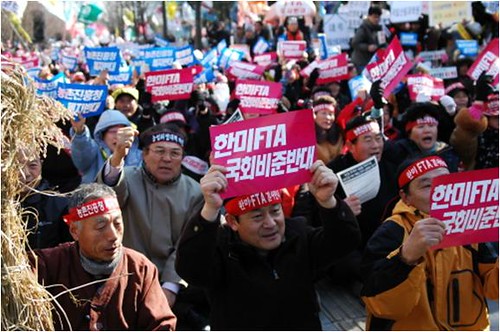
    Korean farmers campaigning against the ratification of the US Korea FTA and other trade agreements and rules that are inimical to farmers’ interests.The Seattle Times Editorial Board penned a piece promoting the same outdated, irresponsible, and damaging neoliberal trade model that was at the center of protests that shut down the WTO almost ten years ago.  Seattle responded!  See the original editorial, with several responses from CAGJ members and allies, below.

    Ratify Korea trade pact

    Seattle Times Editorial Board

    THE South Korea-U.S. Free Trade Agreement should be ratified, and soon, because of the initialing last month of a similar agreement between South Korea and the European Union.

    The EU-Korean free-trade agreement hasn’t yet been formally signed or ratified, but it will be. Americans have their own agreement already in our pockets. It was signed on June 30, 2007. It awaits ratification, but has been stalled in Congress for more than two years. Americans could have their agreement before the Europeans have theirs, and have a trade advantage — if Congress acts.

    If not, the trade advantage will go to the Europeans.

    This is not like an agreement with Peru or Panama. This is a big one. South Korea is the 11th largest economy in the world. It’s a country that makes some of the best flat-screen TVs on the market, and can afford products made by American workers.

    Both agreements, America’s and Europe’s, reduce more than 90 percent of industrial-goods tariffs to zero over a few years. Agriculture is more difficult. Korea will continue to protect its rice, and it will only slowly reduce its high tariff on U.S. beef. Still, Korea’s barriers against U.S. food products will fall substantially.

    There are winners and losers on both sides when trade is made freer, but overall the gains are much bigger than the losses — on both sides. History is clear on this.

    In Puget Sound country, we have a regional interest, and one that should transcend partisan loyalties. We were reminded of this recently when we received a joint news release of Rep. Adam Smith, Democrat, and Rep. Dave Reichert, Republican. They disagree on a number of things, but not on this.

    For some Americans, whether to compete in the world is a big question. Here, there is no question. We made our decision long ago — at Boeing and Weyerhaeuser, Microsoft and Costco, the Aerospace Machinists and the Longshore workers, in our universities and our ports. Trade is good, and we are for it.

    Get it done.

    Trade agreement: Been there, done that

    Yes, trade is good, but not all trade deals are good, so let’s not do the Korea free-trade agreement.

    Korea has systematically shut out U.S.-manufactured goods, most notably U.S. automobiles, and this agreement does not change that. The mega-banks, entertainment providers and software industry will be big winners in this deal, but once again American workers will come up short.

    The Korea agreement uses the WTO model that the least regulation is the best regulation. It is the same flawed approach that led to the recent global financial crisis created by runaway banks.

    Our members of Congress should be working on reforming and improving our trade model before making any more bad deals.

    The template for change already exists in the Trade Act (HR 3012), which has been co-sponsored by 127 members of Congress, but not one from Washington state. It’s time to get on board the way forward and stop repeating past mistakes.

    — Allan Paulson, SeaTac

    We need a new direction, and a new policy

    Our country has spent the past 15 years indulging the free-market, free-trade ideology of deregulation and offshoring, of cutting government oversight and coddling investors.

    Look what its brought us: Our manufacturing sector is in shambles, our leading export is fraudulent financial services, and the rich keep getting richer while the rest of us struggle.

    Even in our state of Washington, companies like Boeing are outsourcing and offshoring faster than you can say, “Oops, the Dreamliner’s off schedule again.”

    Do you still think the answer is more of the same?

    Come on.

    Our country needs a new direction in trade policy. Reps. Adam Smith and Dave Reichert should reject the outdated Korea free-trade agreement, and instead put that great bipartisan spirit to work fixing the mess we’re in.

    — Marina Skumanich, Seattle

    Finding the balance between pure free trade and protectionism

    The trade debate is easily expressed as trade versus protectionism.

    If you are against trade, you must be a protectionist. This is a curiously American sentiment, since every other country in the world finds a comfortable spot between those two extremes.

    No country in the world is pure free trade or pure protectionism.

    It is far more useful for everyone to favor a trade policy that raises our standard of living and strengthens communities we care about. We can all oppose a trade policy that lowers our standard of living or wrecks communities we care about.

    From that perspective, we all favor trade, and we need only ask which of the available trade policies will do the best job of raising our standard of living, and helping communities we care about.

    Free trade has failed to meet lofty promises made to American workers, families and communities. Adding one more agreement with Korea won’t redeem a trade model that is fundamentally flawed.

    — Stan Sorscher, Seattle

    Dear Seattle Time Opinion Editor,

    The current economic crisis is further evidence that US policies on trade are flawed. Therefore it is deeply troubling that the Seattle Times continues to advocate for the corporate-driven model of trade that drives down our standard of living and that of our trading partners.

    This time you are trying to dust off the Korean Free Trade Agreement with the simplistic assertion that any trade is good trade. We challenge the Times to actually talk with workers in WA State and get their opinions on the containers that come into WA State ports filled with flat screen TVs and cars manufactured in Korea and go back empty, a problem that the Korea FTA will only make worse. Workers in aerospace, longshore, IT, agriculture and almost every other sector have repeatedly called for an overhaul of our failed trade policy.

    Jobs are being outsourced by the tens of thousands and living wage jobs are harder and harder to find. WA State is facing a more than two billion dollar debt. How is trade working for more than the few at the top of the corporate food chain?

    The Washington Fair Trade Coalition, with 45 member organizations in labor, social justice and environmental advocacy throughout Washington State, calls on Reps Smith, Reichert and the entire WA Congressional delegation to bury once and for all Bush-brokered trade agreements and put workers back into trade policy and support the TRADE Act.

    The TRADE Act (HR 3012) has the confidence of over 128 members in the US House of Representatives and is actively supported by workers at Boeing, Microsoft, in our ports and universities, who are the backbone of economic recovery here in WA State.

    Signed,

    Kristen Beifus

    Washington Fair Trade Coalition

  • Miyamoto: Not everything needs to be in 3D

    While everyone is going agog over 3D technology, Nintendo’s Shigeru Miyamoto once again goes against the flow. For him, not everything has to be in 3D…

  • Filing up the void: New Dark Void video features the Watchers

    Dark Void (PS3, Xbox 360, PC) may have been delayed by Capcom to 2010, but there’s no reason to delay even gameplay videos for it. And we have o…

  • God of War Collection freeze issues abound

    Reports have been coming in that folks who purchased the God of War Collection on the PS3 have been experiencing freeze problems. Are you one of them?…

  • Skeptic’s Circle 124

    New Skeptics Circle is up at Beyond The Short Coat

    Its simple but there is a lot of good reading in there! Include one from yours truly! Have a blast!

    The next Skeptics Circle is right here at Effort Sisyphus!

    UPDATE (December 1): I am afraid that I will be unavailable to work on this tomorrow. So I have to close this circle for submissions now. Sorry if you were trying to pop out one last entry, but have strength! The next circle is only 2 weeks away.


  • Liberian Laws Are A Secret Due To Copyright; Even The Gov’t Doesn’t Have Them

    We’ve seen a few ridiculous cases whereby local governments claim copyright on a law, but it’s still stunning to see what’s going on in Liberia. Tom sends in the news that no one knows what the law covers in Liberia, because one man, leading a small group of lawyers, claims to hold the copyright on the laws of the country and won’t share them unless people (or, rather, the government of Liberia) is willing to pay. Oh, and did we mention that the US government paid for some of this?

    The story is a bit convoluted, but apparently, Liberia hasn’t really had a full copy of its laws, as they were mixed and matched in “incomplete sets” throughout different libraries. A professor at Cornell had begun a (free) project to compile the country’s laws, but after he died, a group of lawyers in Liberia took over the project — and were given $400,000 by the US Justice Department. The lawyers then “numbered, bound, and indexed” all of the recent laws, and claim that because of that, they now own the copyright on it.

    While perhaps copyright law is different in Liberia, most places have rejected “sweat of the brow” arguments for copyright. If you didn’t create the actual content, you’re not supposed to get the copyright. You don’t get a copyright just for compiling the work of others without adding anything new. If this lawyer wanted to get paid for the work, he should have negotiated that upfront. Instead, he’s holding the country’s laws hostage, and asking for $150,000 to $360,000 to turn them over to the government.

    What’s really amazing is that this guy is currently serving as Liberia’s justice minister. The work he did on the laws happened before that, and he claims that he’d give up the laws for free, but that the other lawyers he worked with will not.

    Perhaps Liberia should just start from scratch and create all new laws, wiping out the value of these particular locked up laws.

    Permalink | Comments | Email This Story


  • Banned Resistance player turns his sights on Microsoft and Nintendo, sues them after Sony

    Erik Estavillo is one avid gamer. So avid in fact, that he will not hesitate to take you to court if you get in the way of his pursuit of happiness wi…

  • Top 25 Photoshop Tips – Part 1

    This 2 part article offers 25 tips for Adobe Photoshop, carefully selected to give you increased efficiency and a set of timesaving techniques when using the program. With focus placed on practicality, this compilation delivers many of the overlooked- and little known tricks present in the most popular image manipulation tool.

    1. The Quicker Way of Opening Documents

    In Photoshop, you are not forced to rely on the upper menu bar to open documents. You can double click on the blank workspace and this action will pop the Open dialog up.

    2. Scrub Opportunities

    Many vital functions in Photoshop are controlled by sliders, like the opacity of Layers or the opacity of the Brush you are using. It is a little known fact that the majority of these sliders are adjustable by scrubbing the mouse over the name of the desired command.

    3. Isolation by Visibility

    To make one particular Layer visible and render all the other Layers temporarily invisible, hold down the Alt modifier key and click on the visibility toggle of the Layer you want to isolate. Repeat this action to toggle its function back and forth.

    5. Image Size and Canvas Size

    Ctrl + Alt + i invokes the Image Size dialog, while Ctrl + Alt + c invokes the Canvas Size dialog. Though Image- and Canvas Size values are intuitively related, they are practically separate from each other. You are free to place an image on the canvas if the image is bigger than the canvas and vice versa.

    4. Creating Groups Using Selection Columns

    To create a selection column of any number of Layers, first select a Layer to define the top of the selection column, then Shift + select a Layer to define the bottom of the selection column. You can go the other way, as well, defining the bottom first. This is an efficient method to declare elements of a Layer Group. To create the Layer Group itself, rely on the Ctrl + g hotkey combination with the selection column active, or you can select the Folder icon on the Layer Palette with the selection column active.

    5. Efficient Layer Stacking

    While creating the stacking order by drag and drop seems to be an intuitive method, it has disadvantages. If you grab a Layer and start to modify its position in the stack, you will not be able to evaluate the result until you release the Layer. Modifying its position in the stack with the hotkey combination Ctrl + Brackets gives you immediate feedback of every possible position. It also is a more fluent way of arranging Layers, as Photoshop tends to demand pixel precise accuracy if you want to place a Layer on the top of the stack manually. This becomes much easier with the hotkey combination. If you add the Shift modifier key to the Ctrl + Brackets command, then the Layer will jump right to the top or to the bottom, depending on the command.

    6. Efficient Layer Cycling

    The hotkey combination Alt + Brackets lets you select a Layer in the stack. If you want your fresh selection to include your previous selection(s), then add the Shift modifier key to the Alt + Brackets command. If you need to select all Layers with minimal effort, you can rely on the Ctrl + Alt + a hotkey combination.

    7. Instant Fills

    The Alt + Backspace hotkey combination fills the current Layer with the active Foreground color.

    The Ctrl + Backspace hotkey combination fills the current Layer with the active Background color.

    If you add the Shift modifier key, then the Fill will affect only the opaque pixels of the Layer. Shift + Backspace will bring up the Fill dialog panel.

    8. Quick Access to Shadows and Highlights

    The Dodge and Burn tools are excellent solutions for defining the shading extremes of any colored region. These tools do fall under the same category and are accessible by the hotkey o or by the hotkey combination Shift + o, depending on the last tool you have used from this category.

    9. Creating New Layers

    The Ctrl + Shift + n hotkey combination creates a new, empty Layer. The Ctrl + j hotkey combination duplicates the Layer which is currently selected.

    10. Mask On

    The hotkey d resets the Foreground color to Black and resets the Background color to White. This is useful when you want to paint Masks, as the White value will reveal the affected portions of the Mask, while the Black value will render those invisible.

    11.  Revert Command

    The hotkey F12 invokes the Revert command, which will discard all edits you have made since the last save. This is useful when you are unhappy with the current state of the document, as you would be forced to close- and open the document again without this function.

    12. Selection Actions

    Selecting portions of the image defines the regions you want to amend your edits on. There are selection related hotkeys that are worth knowing. Regardless if you are using the Rectangular Marquee Tool, the Lasso Tool or the Pen Tool to define your current selection region, the following hotkeys do apply. To add to a selection region, start a fresh selection with the Shift modifier key pressed. To subtract from a selection, rely on the Alt modifier key while drawing the selection. The modifier key combination Ctrl + Alt will pick up intersections between selection regions and will give you the intersection itself as a selection. As long as you keep the mouse button pressed while defining selection boundaries, you are free to position the center of the selection on the screen, using the Space modifier key.

    Stay tuned for more, in part two!


    Reblog this post [with Zemanta]

    Related posts:

    1. Top 25 Photoshop Tips – Part 2 This post is the second part of the two…
    2. Complex Manual Selections in Photoshop Photoshop comes with various selections tools you could utilize to…
    3. Using Reuseable Borders in PhotoShop About In this tutorial I will continue where the previous…

    Related posts brought to you by Yet Another Related Posts Plugin.


  • Lily Allen: It’s Ok To Sell My Counterfeit CDs, Just Don’t Give My Music For Free

    Dark Helmet alerts us to the news that our good friend Lily Allen is back in the news discussing file sharing again. Tragically, it does not appear that she’s used her “time off” to better understand copyright issues very much. Unlike nearly everyone else who complains about copyright infringement, she’s apparently “all for” infringing on her copyrights, just so long as you pay someone — even if it’s the guy on the street selling the counterfeit CDs. Seriously:


    “If someone comes up with a burnt copy of my CD and offers it to you for £4 I haven’t a problem with that as long as the person buying it places some kind of value on my music.”

    Yes, so while some musicians have said they’re fine with non-commercial file sharing, but are against anyone selling their unauthorized works, Ms. Allen seems to have taken the opposite approach. Counterfeit all you want, just as long as you profit from it. Yeah. Someone should explain to her the difference between price and value, and also the benefits of word of mouth marketing. But, it doesn’t seem like she’s much interested in actually understanding this stuff, so if you want to help her understand, maybe go set up a shop selling burned copies of her CDs, and see what happens.

    Of course, if we take this seriously, it shows how little she’s thought this through. Her earlier complaint was that when people file share, they don’t provide money back to the artists and the labels. Of course, when counterfeiters are selling on the street, the same thing is true, but suddenly it’s okay? At what point does the world realize that Ms. Allen doesn’t know what she’s talking about?

    Permalink | Comments | Email This Story


  • Verizon Wireless Gets the Omnia2 First in USA

    vzw-omnia-ii-launch-pack-90-sm The big red VZW is going to be the first in the US to get the new Omnia2. The Omnia2 has been out around Europe for a while now, but it seems America is next on its tour bus to get a CDMA Omnia2 with its awesome features for a great price. VZW—America’s biggest network(3G,Subscribers)—will get the Omnia2 on December 2nd for a really great $200 price tag with a contract of course which is still about the best price.

    This phone does not only look good, but the specifications are even better and it has something no other Windows Mobile phone has. This phone is special because it is the first AMOLED phone to ever run WM, for the people that do not know what that is, AMOLED is just the best period. The only problem is that it is still a resistive screen. The phone has an 8GB internal memory base, which makes it 1 hand over the HD2, but the screen is still 3.7inches so the HD2 wins.

    This phone has some great things. VZW bands, 3.7inch WVGA AMOLED screen, 8GB internal memory, Wifi, Gps, Bluetooth, 800Mhz processor, and a pretty good 5MP camera. The phone will ship with 6.1, but shortly get a 6.5 upgrade.

    I should be one of the first people getting one for a review and I will do some video—If I can—and I will compare it with the TP2, HD2, Droid1, Droid2, Imagio and maybe even the TG01 if it is out for VZW yet.

    WM

    Share/Bookmark

  • EFF Looks To Bust Bogus Podcasting Patent; Needs Prior Art

    Back in July, we wrote about how a company named Volomedia had gleefully announced that it had patented podcasting. The patent itself (7,568,213) seemed ridiculously broad, obvious and covered by prior art. On top of that, it was difficult to see how it passed the current (though, perhaps not for long) “Bilski” test for what can be patented.

    It looks like the EFF has decided to be proactive about this and is looking for prior art with which to bust this particular patent. In the comments on our original post about this, reader Marcel de Jong, noted that Dave Winer described audio enclosures for RSS in a blog post in January of 2001 — nearly three years before this patent was filed. Hopefully that is rather compelling prior art, but if anyone has any more info, please send it over to the EFF.

    Permalink | Comments | Email This Story


  • Review: We’re Only Human

    The blog reviewed here is ‘We’re Only Human‘ by Wray Herbert.

    Appearance and Design

    At the time of writing on the left hand side of the title pane the initials APS and the words ‘Association for Psychological Science’ appear while to the right is the title – ‘We’re Only Human’. The APS initials appear at the bottom of the screen also. However I wasn’t able to find an about section. A quick google search reveals a bio on Wray Herbert who is described as having 25 years experience in writing about science and medicine and writes in a number of prestigious publications. On the right hand pane there is a link to podcasts which leads through to a website for the Association for Psychological Science. The right hand pane also contains links to past months in the archives as well as links to previous posts and an RSS feed. The background for the site is dark red, with the articles containing black text on a beige background and a brown paint-like theme running in horizontal and vertical strips across this background.

    Content

    Herbert writes about articles that appear in the journal Psychological Science and effectively weaves them into a narrative through devices such as the personal anecdote and the discussion of popular films. The articles typically are a few paragraphs long and summarise the material in an easily ‘digestible’ form. Herbert also covers evolutionary psychology in a number of articles also.

    • The blog starts in May 2006 with an article on crossword puzzles and Herbert interprets an imaging study with altered activity in the visual and temporal cortices during task completion. There were a number of articles that I found interesting
    • This article discusses research suggesting some characteristics of eye gaze in a sample of older adults and the suggestion that gaze can be a means for regulating emotions
    • This article looks at a study examining the performance of autistic children and adults on cognitive tasks in comparison with a control group
    • This article looks at a study examining the effects of loneliness in young and older adults
    • An article on a study showing a link between the readability of instructions for exercise and the likelihood of carrying out exercise in a student population
    • An article on the possible evolutionary benefits of positive emotions
    • An article on research into different patterns of  internet use in adolescents with different health effects
    • An article on a study looking at the relationship between walking backwards and vigilance!
    • An article on a study looking at meaning making and Kafka

    Conclusions

    The blog is an accessible means for keeping a finger on the pulse of some of the psychology research that is coming out and which features in the journal ‘Psychological Science’. The research is varied and the articles effectively convey the meaning of the research.

    Twitter

    You can follow ‘The Amazing World of Psychiatry’ Twitter by clicking on this link

    Podcast

    You can listen to this post on Odiogo by clicking on this link (there may be a small delay between publishing of the blog article and the availability of the podcast).

    TAWOP Channel

    You can follow the TAWOP Channel on YouTube by clicking on this link

    Responses

    If you have any comments, you can leave them below or alternatively e-mail [email protected]

    Disclaimer

    The comments made here represent the opinions of the author and do not represent the profession or any body/organisation. The comments made here are not meant as a source of medical advice and those seeking medical advice are advised to consult with their own doctor. The author is not responsible for the contents of any external sites that are linked to in this blog.