Blog

  • Opinion: Psystar Ruling Could Have Set Precedent for Upgrading Your Mac

    This past Friday, your future ability to upgrade your Mac may have been significantly restricted. Psystar, the company that tried to create “open” Macs by running OS X on non-Apple hardware, suffered a quick defeat in its effort against Apple’s OS license restrictions.

    No question this was a long shot and Psystar was going for the Hail Mary. Nonetheless, Apple’s arguments and victory in the case could have a chilling effect on any modification of Apple hardware and software. Will your next Mac be as locked down as the iPhone?

    We euphemistically call gaining the ability to install any software on a iPhone “jailbreaking.” This allows you full administrative access to your iPhone to modify the software as necessary for your own use. You already purchased the iPhone hardware and a license for the Apple software necessary to run your iPhone–but are restricted in its use? Apple locks you out of making certain changes to your iPhone; every aspect of iPhone usage is controlled by Apple, yet Apple’s fickle and inconsistent App Store policies further complicate matters and virtually beg people to jailbreak their iPhone.

    Unlike with the iPhone, we can pretty much do want we want on our Macintosh computers. Installation of hardware and software is unrestricted and Apple exercises no control over how we use our Macs. We can circumvent functions in the operating system and enhance it without a problem. We are virtually unrestricted in upgrading or enhancing our Macs. Manufacturers can write kernel extensions to modify the operating system so their hardware can work. Don’t like the Apple monitor? No problem, go out and buy your own. Apple charging too much for RAM? Go out and buy third-party RAM. Want to add new functionality to your Mac? Buy and install third-party software that enhances the operating system.

    The Psystar ruling reminds us that we use our Macs only with the consent of, and the pleasure of, Apple. Even though you “own” your Mac, your ability to use it can be modified, restricted or revoked by Apple without recourse. As Macs grow in market share and more third-party developers come to the table, we’ll be presented with options for our Macs that Apple’s own team can hardly imagine. If Apple starts losing revenue due to such enhancements, Apple can simply disable it. Any attempt to circumvent Apple’s restrictions could be seen as a violation of the DMCA. For example, to increase sales on iTunes, could Hulu be disabled by a future Apple OS? Legally, yes. We are one Automatic Software Update away from an Apple Kill Switch for our Mac.

    Conspiracy Theory? Think Again

    Before you blow this off as a conspiracy theory, note that similar actions have happened other times in Mac history. The most memorable was back in March 2001, when Apple issued a firmware update that disabled most third-party RAM. Apple RAM worked just fine, but other RAM was suddenly considered “out of spec.” Historians will debate whether this was deliberate or accidental. Eventually it all worked out when manufacturers swapped out RAM and other users avoided the update. In 1999, Apple disabled G4 upgrade cards in Blue and White G3s via another firmware updates. The original iMac had the ability to support a floppy drive, but later Apple purposefully disabled that function. Previous versions of iLife only worked with Apple-supported optical media.

    Obviously, Apple is going to vehemently fight to prevent non-licensed Apple clones, and while it may be in the right here, the arguments used could be applied to any modification to the Macintosh OS, especially those used to enable non-Apple hardware to work with OS X. While I agree that the odds are low of waking up one morning and finding your Mac unable to boot due to a “DMCA violation,” Apple consistently argues it is its right to do so and it has exercised that right in the past. How very Microsoft of Apple. Just ask XBox 360 owners.

    The iPhone is proof of its desire to lock the consumer out of any unapproved modifications. What’s stopping Apple from doing this with our Macs? Financial interest? Goodwill? You tell me.


  • GameStop breaks street dates again, Assassin’s Creed II, Left 4 Dead 2 now being sold

    GameStop stirred up some controversy earlier this month when they broke the street date on Modern Warfare 2 (Xbox 360, PS3, and PC). The retailer own…

  • LaterDude Pro 50% off for today only

    laterdude_pro

    Our buddy Fabian is selling LaterDude Pro for 50% off today. That means the app is yours for only $1.48 (regularly $2.95).

    LaterDude Pro is a simple app that reminds you to call, SMS or email someone. The app creates a new event in the calendar, so you definitely won’t forget.

    Stay tuned because Fabian has some great stuff coming for all you Storm2 users. From his Twitter account: “Workin on the new BlackBerry Storm2 app – lots and lots of testing.”


    © Kyle for BlackBerry Cool, 2009


  • AdMob Could Have Gone to Apple, Sources Say

    admob_logo1AdMob, the mobile advertising firm that recently made headlines thanks to a Google acquisition, might have become part of the Apple fold if things had worked out differently, according to a report by Bloomberg that appeared this weekend. Apple reportedly approached AdMob with interest before the Google deal went down.

    That’s according to “people familiar with the matter” speaking to Bloomberg. It isn’t clear which side of the deal the source was on, but he or she declined to go on record since the proposed talks were never made public. Apple is said to have contacted AdMob “a few weeks” before Google made its successful $750 million bid for the firm.

    If true, the rumors point to the increasingly fierce competition between two major players in the mobile phone game. Google’s Android is being adopted by more and more manufacturers and distributed on more devices everyday. To have a piece not only of the revenue from the use of Android apps and devices, but also from the advertising that appears on those phones, is a huge boon for the search giant.

    It’s unclear why Apple’s bid didn’t succeed, if it was indeed made. It’s possible that Google made a better offer while Apple was still in talks with AdMob, or that the advertising firm used the Apple offer as a bargaining tool in enticing Google. All of the companies involved in both deals declined to comment on the reports made by the anonymous source.

    Acquiring a mobile ad firm would have been a bit of a departure for Apple, which is still a hardware manufacturer first and foremost, but it is a logical move for Cupertino to make. Many of the ads AdMob displays in mobile apps direct users back to other programs in the App Store, so essentially Apple would just be closing the loop and taking in additional revenue by promoting its own revenue-generating software delivery method. Plus, it could probably use the company to place hardware ads as well, promoting less successful products through the massively popular iPhone.

    If Apple is genuinely interested in getting into online advertising, it could attempt another acquisition, or it may start hiring staff with the necessary skill sets. I’d hazard a guess that if the computer maker did make a failed bid for AdMob, it’ll be twice shy about getting into the game now, since Google now controls an intimidating 30 percent to 40 percent of the mobile advertising market. It’d be hard to gain a solid foothold at this point.


  • Samsung releases another Android: where will it fit in with Bada approaching?

    By Tim Conneally, Betanews

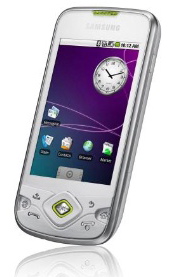
    Samsung today officially announced the long-rumored Galaxy Spica (i5700,) the company’s fourth Android smartphone and sequel to its Galaxy handset from early 2009.

    Samsung Galaxy Spica

    Like the original Samsung Galaxy, this 3.2″ touchscreen smartphone is not likely to hit the American market, and will be released in select markets in Europe and Asia.
    This 3.6Mbps HSDPA 3G device is equipped with the basic Google-friendly Android 1.5 distro, a 3 Megapixel camera, and an 800MHz application processor. It’s actually considerably less feature-rich than the Behold 2 which came to T-Mobile in October.

    While there is relatively little to say about this device, it will be important to watch Samsung’s Android and Windows Mobile releases as it works toward the release of its first version of Bada, the company’s own open smartphone platform which will ultimately come to replace Symbian.

    Copyright Betanews, Inc. 2009


    Add to digg
    Add to Google
    Add to Slashdot
    Add to Twitter
    Add to del.icio.us
    Add to Facebook
    Add to Technorati


  • Hitachi redesigns the SimpleDrive and ups the capacity to 2TB

    SimpleDrive_v3Folks, 2TB external drives are now coming out from everyone. Isn’t it grand? Hitachi has revised the look of the SimpleDrive external hard drive and it’s now available in a 2TB option. In fact, the rest of the SimpleTech lineup can now be had with a 2TB Hitachi Deskstar 7K2000 hard drive.

    The redesigned SimpleDrive now sports a rather modest and somewhat boring aluminum enclosure. But who cares about the design when you know it’s packing a 2TB drive. The new design is available in 500GB, 1TB, and 2TB capacities at a MSRP of $100, $130, and $250, respectively.

    Hitachi Debuts New 2TB SimpleDrive

    Third-Generation External Storage Solution is Loaded with 2TBs of Simple, Reliable Storage and Backup Options for Consumers and Business Users; 2TB Capacities Now Available Across Hitachi’s Entire Retail 3.5-Inch Product Line

    SAN JOSE, Calif.–(BUSINESS WIRE)–Hitachi Global Storage Technologies (Hitachi GST) today announced the availability of the newly designed SimpleDrive™ desktop external hard drive with capacities of up to two terabytes (2TB). In addition, the company announced that all of its 3.5-inch retail drives are now available in 2TB capacities, featuring the Hitachi Deskstar 7K2000, the industry’s first 2TB 7,200 RPM hard drive that blends performance and high capacity with low power features. New, upgraded solutions include the Hitachi SimpleTech Pro Drive™; the two-drive, RAID 0/1 Duo Pro Drive™; and the Hitachi Internal Hard Drive Kit for the do-it-yourself (DIY) computer-upgrade market. All products are now available.

    “Hitachi continues to build its channel presence with an expanded portfolio of 2TB storage solutions for business users, consumers or virtually anyone who needs additional capacity to manage the growing number and size of their digital files,” said Azmat Ali, vice president of marketing, Branded Business, Hitachi GST. “Even though people are inundated with digital content daily, many are not taking the necessary precautions to safeguard their content. Our external drives, together with consistent backup practices, will help people keep their digital memories, entertainment and business documents safe.”

    New SimpleDrive USB 2.0 Desktop External Hard Drive

    With a new design that clearly communicates a purpose – solid data protection – the SimpleDrive balances ruggedness and ease of use all in one streamlined package. The new Hitachi SimpleDrive sits vertically for a non-invasive footprint, which is important for a small home or office environment. With up to 2TB capacity and a plug-and-play design, the SimpleDrive gives both Mac and PC users simplicity, reliability and enough capacity to store or backup 665,000 photos, 500,000 MP3s or 4,000 hours of standard video1. Delivering style and substance, it features an anodized aluminum enclosure to keep the SimpleDrive cool, and a reliable, high performance, low-power Hitachi hard drive inside to help protect your pics, flix, tunes and docs. Now available at OfficeMax stores nationwide, the Hitachi SimpleDrive comes in 500GB, 1TB and 2TB capacities, with a manufacturer’s suggested retail price (MSRP) of $99.99, $129.99 and $249.99, respectively.

    Extended 2TB Hitachi Family

    To help relieve users of data overload and free up more working space, Hitachi now offers the following solutions in 2TB capacities:

    SimpleTech Pro Drive by Hitachi – With four interface options (USB 2.0, FireWire 400, FireWire 800, and 3Gb/sec eSATA) and two levels of backup protection, the Pro Drive is a smart investment that delivers virtually everything you need in a single storage and backup solution. Its compact design lets you stack multiple units or stand them upright to optimize desk space. A built-in security lock helps ensure that the drive remains where you left it. Capacities and MSRPs include 500GB ($119.99), 1TB ($169.99) and 2TB ($299.99).

    SimpleTech Duo Pro Drive by Hitachi – With two drives in one, the Duo Pro Drive gives you two ways to save your data: RAID 0 (speed) or RAID 1 (mirroring). RAID 0, or striping, leverages both hard drives inside to read/write files, making storing and accessing files significantly faster than using one disk alone. If using eSATA in RAID 0, you can receive six times the speed of USB 2.0, ideal for home video editing or working with graphic-intensive files. For added data protection, RAID 1, or mirroring, makes an extra copy of stored files on the second internal hard drive, so you always have two separate copies of your important stuff. Interfaces include eSATA and USB 2.0. MSRP is $199.99 for 1TB, $299.99 for 2TB, and $499.99 for 4TB.

    Hitachi Internal Hard Drive Kits – Easily boost the capacity and performance of your Mac or PC desktop computer in minutes with a Hitachi Internal Hard Drive Kit. Each premium kit features a proven and reliable high-performance drive, easy installation instructions, a SATA cable and mounting screws. Balancing low-power and performance, Hitachi hard drives come in 5400 RPM and 7200 RPM with up to a 32MB cache buffer. The MSRP of the 2TB, 7,200 RPM Hitachi Internal Hard Drive Kit is $249.99.

    Two Levels of Protection – Local Backup and Highly-Secure Online Backup

    All Hitachi SimpleTech desktop external hard drives ship with two levels of data backup to better protect and manage personal or professional content. Hitachi Local Backup offers simple wizards to guide users in setting up automatic backups on specific days or dates that is convenient for you. Automatic file selection provides easy identification of particular file types to back up—for example, photos, emails or documents— regardless of where they are stored on the computer’s drive.

    In addition to local backup software, Hitachi’s external drive family comes with 2GB of free online backup space from Hitachi Ultimate Backup. For only $4.95 per month, users can access unlimited capacity and back up all of their files and media collections offsite. Users set up Ultimate Backup once, and it automatically and regularly backs up content behind the scenes to a secure offsite location. All data is encrypted for security using 128-bit SSL encryption while in transit, with an option for a private encryption key. Offsite 448-bit Blowfish encrypted servers are housed by a Fortune 500 company, helping to ensure file protection, longevity, security and peace of mind.

    Hitachi SimpleTech products are Mac and PC compatible, and feature a three-year warranty.


  • This Isn’t the Caramel Apple of Your Youth (It’s Also Not Organic)

    mrs.prindables.jpg
    You have until Monday, November 23, 2009 to order one of these unique Caramel Apples from Mrs. Prindables in time for Thanksgiving. Loaded with chocolate, almonds, and peanut butter chips, this apple serves between eight to ten people. Mrs. Prindables also makes gourmet gift baskets.

    My family tried one of the Autumn Wreath Jumbo Apples. My deprived children had never had a caramel apple before, and they didn’t know what to expect. This apple is so loaded with chocolate and peanut butter chips, it’s hard to find the apple inside. It’s a good thing a tart granny smith is inside to counter that sweetness on the outside. In my opinion, it’s a little (OK, a lot) too much. My children enjoyed it, but this apple is not made from organic ingredients and contains corn syrup (not high fructose).

    Disclosure:  I was sent this product for review at no cost.  No assurances were given as to whether the review would be positive or negative in exchange for the product.


  • Twitter To Make Suggested Users Feature More Like Twellow’s?

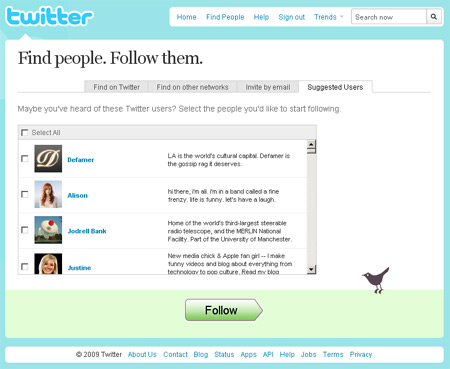
    Last month Twitter CEO Evan Williams made some comments at the Web 2.0 Summit, indicating that the company was strongly considering ditching the "Suggested Users" list. This is a list that co-founder Biz Stone once discussed as being a way to get new users engaged with Twitter. This has historically been an important thing for Twitter to consider, as user retention rates have suffered in the past.

    "When you don’t follow any other accounts on Twitter the product is not as relevant as it could be," Stone said in an old post to the Twitter blog. "To improve the user experience, we started suggesting some accounts to follow. As a result, new users are much more engaged and active."

    Twiter Suggestions

    But since then, the company’s attitude towards this list has changed. Williams noted that the list was initially meant as a way to help new users, but it became controversial. The biggest problem with the list is that it is not personalized. If you are not interested in the specific people that Twitter thinks you should be, you will still find no reason to continue using the service (at least if you are the type of person who needed suggested users to find value in the service in the first place).

    suggested_users_tab

    Our own Twellow service (shameless plug) recently launched a new feature, which provides suggested users for Twitter on a more personalized level, making it far more useful. The feature is aimed at connecting Twitterers with similar interests. It’s tailored to the interests of the specific user, rather than just one list for everyone.

    It appears that Twitter is looking to offer its suggested user list in a similar way. Sarah Perez at ReadWriteWeb reports that Biz Stone told a crowd at a conference in Malaysia, that the current suggested users list "will" be going away, and "in its stead will be something that is more programmatically chosen, something that actually delivers more relevant suggestions."

    That sounds pretty similar, but one difference is that Twellow’s feature is already available. There’s no telling how long it will take for Twitter to actually roll it out. We’re still waiting on the retweet feature.

    Twitter’s Lists feature of course was recently launched after a significant wait, and it should go a long way in helping user retention moving into the future. It’s an incredibly valuable tool for Twitter users, for a variety of reasons. Between that and a more personalized suggested users list on the way, Twitter should be keeping more people using its service longer.

    Do you think a personalized suggested users list would be beneficial to Twitter users? Have you tried Twellow’s version? Let us know what you think.

    Related Articles:

    A Suggested Users List for Twitter That You Can Actually Use

    Easily Find Twitterers You’re Interested In

    Twellow Adds New "View Non-Mutuals" Feature

    Location Adds Purpose and Context to Twitter

  • WiMAX Hits Austin and San Antonio Today

    Sprint announced WiMAX service today in San Antonio and my hometown of Austin, Texas, so this is just to tell y’all I’m playing with a modem and will be letting folks know how it all works, once I activate the darn thing. Currently Sprint doesn’t support a USB modem for Macs (but I’m assured that one is coming, likely in time for the holidays), which means I need a PC to activate my modem on. But then I can use a personal hotspot product that converts the WiMAX signal to Wi-Fi to test it out on my MacBook (and iPod Touch)! So send me your questions, concerns and anything else WiMAX-related, and I’ll try to address them or get them answered. Personally, I want to see if this is something I could replace my wired connection with, or if it’s really just what I’d use instead of my 3G MiFi while I wait for LTE.

  • RoadRunnerGPS Fitness Tracking for BlackBerry with Giveaways

    RoadRunner_GPS

    RoadRunnerGPS is a feature rich app for fitness enthusiasts. The app uses GPS features to provide feedback for joggers and walkers on their time, speed, distance, pace and calories.

    Once you have finished your run, you can upload the data to Kanavon’s servers where you can review the data and get a variety of metrics and statistics about your workout.

    We’re giving away 25 copies of this app, so just comment and let us know what other fitness apps you have tried for BlackBerry.

    There is more information about RoadRunnerGPS on their site, as well as in the App World webstore.

    Update: Thanks everyone for participating! The 25 winners have been selected and will receive an email shortly.


    © BlackBerry Cool for BlackBerry Cool, 2009


  • PS3s being used to catch child pornographers

    Back in the old days, the hand of justice used sophisticated, thousand-dollar computers to crack down on sickos on the internet. Although expensive,…

  • Yahoo Launches Comedy Clip Show

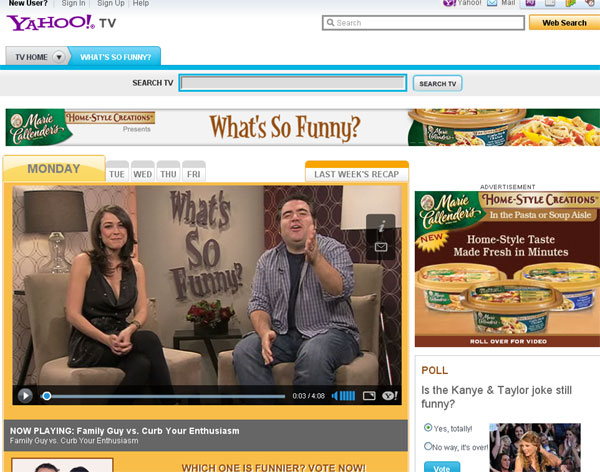
    Yahoo has launched a new original online series sponsored by ConAgra Foods, called "What’s So Funny?"

    "What’s So Funny?" features daily three-minute clips with hosts Mike Bachmann and Shira Lazar, which recap the funniest moments from the previous night’s prime time lineup.

    Viewers can vote on the funniest moments of the week, helping to decide the content for a weekend episode recapping the week’s most humorous moments. Each episode will include a 30 to 60-second ad that features a ConAgra Foods brand.

    What's-so-Funny

    "Yahoo! continues to expand its portfolio of branded entertainment programming, allowing brands to connect with our audience in unique and meaningful ways," said Erika Nardini, vice president brand packaging, Yahoo!

    "With ‘What’s So Funny?,’ Yahoo! and the brands of ConAgra Foods will bring together the best ingredients for a daily laugh."

    The sponsoring brand also will be featured on the "What’s So Funny?" homepage, which will be linked from Yahoo TV. MediaCom, ConAgra’s media agency, helped create and develop the program in partnership with Yahoo.


    Related Articles:

    >Yahoo Hires Editor For Homepage News

    >Yahoo Launches Spanish Version Of Mobile Home Page

    >Research Scientist Heads From Yahoo To Twitter


  • Information Should Not Be Free… Says InfoWorld Columnist That You Can Read For Free

    Doug sent over a link to an angry screed by columnist Bill Snyder that bashes anyone who thinks anything should be offered for free. Want to read it? Go ahead, because it’s free at InfoWorld.

    And, of course, that’s the problem with Snyder’s analysis. It doesn’t take into account the wider business model. The reason that Snyder’s article is available for free is because InfoWorld has decided that it has a better chance of monetizing that content by offering it for free and selling advertising. It’s other option would be to charge people directly to read Snyder’s economically confused analysis — but then no one might pay. So which makes more sense? According to Snyder, the latter.

    Snyder also takes on the scourge of free WiFi, that pretty quickly showed that paid WiFi is a niche market, only working where you have limited and captive audiences (and even it is under greater and greater competitive threats). Unfortunately, his economic analysis is misguided:


    News and Wi-Fi service are commodities, just like cars, housing, and food are commodities. Labor and raw materials, as well as the capital to buy them, are the essential ingredients of most any good or service we might care to own or consume. No money, no commodity — that’s a basic economic principle that the digital revolution has done nothing to change.

    Sounds good, but it’s wrong. Very wrong. Yes, they’re commodities, but the defining rule of a commodity is that it is priced on the marginal cost, not the fixed costs. And yet, Synder suddenly thinks that while that applies to cars, housing and food… it goes away in the digital world? The only person really claiming that the economics has changed is Snyder, in insisting that digital products do not adhere to the same laws of supply and demand.

    Snyder seems positively confused that free is a part of a larger business model:


    I don’t write for free, my editors don’t edit for free, and I’ll bet your IT hands don’t run networks or produce code for free.

    And yet, your content is available for free. Funny how that works. Why does it work? Because it makes good business sense. But, to Snyder, when this is pointed out, he gets confused and thinks that it proves his point:


    I know, I know — some of you are going to bring up open source.

    Sorry, that proves my point. Open source has grown in influence and quality in the last few years as business models in the community have evolved. Not too long ago, any open source company that dared post a paid or paid-support enterprise version of its software would be pilloried. But not any more. The recession has put many excellent technologists out of work, but there would be even fewer employed if open source companies were afraid to make a profit, then plow it back into development projects and expanded infrastructure.

    Just ask the open source millionaires at MySQL if they think everything they produce should be free.

    Snyder figured out the wrong thing. Yes, getting paid is important, but the question is what you get paid for, and he’s asking people to charge for the parts of a business that make the most sense being free — and doesn’t explain why he gets to decide what should be free and what shouldn’t. The answer, really, is that none of us decides: basic economics tells us. If you have a competitive product with no marginal cost, it’s going to eventually get driven to free. Whether you like it or not. And then you shouldn’t whine about the evils of “free.” You should instead figure out ways to use that to your advantage.

    Permalink | Comments | Email This Story


  • CMS Report: House Bill Will Raise Health Care Costs, Affect Seniors’ Benefits

    A new report from the Centers for Medicare and Medicaid Services finds that the health overhaul bill passed by the House will raise health costs by approximately $289 billion in the next ten years.  The report was requested by House Republicans and compiled by CMS’ chief actuary, Richard Foster.

    The Washington Post: “A plan to slash more than $500 billion from future Medicare spending — one of the biggest sources of funding for President Obama’s proposed overhaul of the nation’s health-care system — would sharply reduce benefits for some senior citizens and could jeopardize access to care for millions of others, according to a government evaluation released Saturday. The report, requested by House Republicans, found that Medicare cuts contained in the health package approved by the House on Nov. 7 are likely to prove so costly to hospitals and nursing homes that they could stop taking Medicare altogether.”

    “Democrats focused Saturday on the positive aspects of the report, noting that Foster concludes that overall national spending on health care would increase by a little more than 1 percent over the next decade, even though millions of additional people would gain insurance. Out-of-pocket spending would decline more than $200 billion by 2019, with the government picking up much of that. The Medicare savings, if they materialized, would extend the life of that program by five years, meaning it would not begin to require cash infusions until 2022.” (Montgomery, 11/15).

    The Hill: “CMS’s analysis is not an apples-to-apples comparison to the cost estimate conducted by the Congressional Budget Office (CBO) and the Joint Committee on Taxation (JCT) because CMS did not review tax provisions, which help offset the price tag of the Democrats’ measure. However, the CMS analysis clearly states that the House bill falls short in attaining a key goal of the Democrats’ effort to reform the nation’s healthcare system: ‘With the exception of the proposed reduction in Medicare… the provisions of H.R. 3962 would not have a significant impact on future healthcare cost growth rates.’”

    “Minority Leader John Boehner (R-Ohio) highlighted the report on Saturday in a written statement. ‘This report once again discredits Democrats’ assertions that their $1.3 trillion government takeover of health care will lower costs, and it confirms that this bill violates President Obama’s promise to “bend the cost curve.” It’s now beyond dispute that their bill will raise costs, which is exactly what the American people don’t want.’ … CMS’s findings are not binding on Congress, however. Congress must abide by CBO and JCT estimates. The Hill has a copy of the full report (Hooper, 11/14).

    The Associated Press: “Overall spending on health care would rise as a result of legislation approved a week ago by the House, and billions of dollars in projected savings contained in the measure will be difficult to maintain, according to a report by a top official at the agency that oversees Medicare. The legislation would expand insurance coverage to an estimated 32 million people who now lack it, according to the report, creating a demand for services that ‘could be difficult to meet initially … and could lead to price-increases, cost-shifting and/or changes in providers’ willingness to treat patients with low-reimbursement health coverage’” (Espo, 11/14).

    Politico analyzed some of the the report’s statements: “Pg. 3 – ‘Most of the provisions of H.R. 3962 that were designed, in part, to reduce the rate of growth in health care costs would have a relatively small savings impact.’ Translation: Things like wellness and prevention programs and reducing Medicare fraud don’t save much money.”

    “Pg. 9 – Over the next decade, the report estimates ‘a relatively small reduction in non-Medicare federal health care expenditures of $2.1 billion, all of which is associated with the comparative effectiveness research provision.’ … Pg 16 – ‘The additional demand for health services could be difficult to meet initially with existing health provider resources and could lead to price increases, cost-shifting, changes in providers’ willingness to treat patients with low-reimbursement health coverage.” Translation: A crush of newly insured patients could be a shock to the system’” (Frates, 11/14).

    In a second story, Politico reports on White House reaction to the report. “Nancy-Ann DeParle, director of the White House Office of Health Reform, pushed back Sunday on the CMS report that concluded Medicare beneficiaries could lose access to health care providers under the House bill. …’It is an interesting analysis but it is pretty speculative though of what the impact will be on providers and beneficiaries. Our recent experience would indicate something quite different’” (Budoff Brown, 11/15).

  • Simple is not easy

    The dirty little secret about simple: It’s actually hard to do. That’s why most people make complex stuff. Simple requires deep thought, discipline, and patience – things that many companies lack. That leaves room for you. Do something simpler than your competitors and you’ll win over a lot of people.

    There are only three major items on Chipotle’s menu: burritos, tacos, and salads. In Chipotle’s Secret Salsa, Founder and CEO Steve Ells sums up its business model in a single sentence: “Focus on just a few things, and do them better than anybody else.”

    One thing you won’t find at Chipotle is dessert. Restaurant analysts say a cookie or other dessert at the end of the food line could instantly boost sales by 10 percent or more there. Ells doesn’t care. “We’ve had 10 years of double-digit comps in a row, and we’ve done that without cookies,” he says. “So why start now? I see only the downside to adding cookies.”

    The yogurt chain Pinkberry started off by selling only two flavors of yogurt: original and green tea. That meant fewer worries about inventory, machinery, recipes, and other complications that would have resulted from selling a variety of products. Instead the company focused on flavor. It’s now a chain with dozens of stores and devout fans who refer to the yogurt as “Crackberry.” (Ever think about how your product would sound with “crack” as a prefix?)

    This isn’t just for restaurants either. Nintendo has won big by doing less than competitors. The Flip has won a big percentage of the camcorder market by doing less. Fixed-gear bikes have been growing in popularity due to their simple, low-maintenance design.

    You can try to win a features arms race by offering everything under the sun. Or you can just focus on a couple of things and do ‘em really well and get people who really love those things to love your product. For little guys, that’s a smarter route.

    When you choose that path, you get clarity. Everything is simpler. It’s simpler to explain your product. It’s simpler for people to understand. It’s simpler to change it. It’s simpler to maintain it. It’s simpler to start using it. The ingredients are simpler. The packaging is simpler. Supporting it is simpler. The manual is simpler. Figuring out your message is simpler. And most importantly, succeeding is simpler.

    Our software product designs are not all that different than those in the food industry—or any other industry. We tend to have fewer crumbs, though.

    Permalink

    | Leave a comment  »

  • States Experience Medicaid Changes And Offer New Models For Reform

    News outlets report on a variety of health issues at the state level including the upcoming launch of a huge Medicaid data project in Florida, health care changes that could reduce  spending in Georgia and a model for reform in Vermont.

    Health News Florida: “In a big step forward in the use of electronic health records, Florida is preparing to make the health histories of 1.6 (million) Medicaid patients accessible to 80,000 doctors, clinics and hospitals in the state on a secured-access system, one of the planners said Thursday. … The information will be that derived from claim forms, including office visits, hospitalizations, diagnoses, prescriptions, immunizations and lab results. Except in an emergency, it will be available only if the Medicaid patient agrees, (Christine Nye, director of the State Center for Health Information and Policy Analysis) said, and the state will track every authorization that is granted” (Sexton, 11/13). 

    The Augusta Chronicle: “Figures released Thursday show Georgia taxpayers saved between $123 million and $140 million in the past fiscal year because of the state’s own health-care reform of sorts. The federal share of savings is even greater. For 1 million low-income Georgians covered by the state’s Medicaid and PeachCare for Kids insurance plans, the Perdue administration began nudging them toward a concept it called care-management organizations. Three private companies bid for the business, which requires them to provide a more intense level of interaction with patients. The goal is for case managers to teach more healthful habits” (Jones, 11/16).

    NPR reports on health care in Vermont and interviews the state’s Republican governor Jim Douglas, who chairs the National Governors Association. Douglas says Vermont’s own state-initiated reforms called Blueprint for Health, which focuses on preventative and coordinated care, could provide a national model. Douglas says: “I realize that the time that our Medicaid budget was headed for unsustainability, we got permission from the federal government to redeploy our Medicaid dollars for preventive care. And we’ve seen a significant decline in hospital utilization by Medicaid participants and trips to the emergency room and in the dollars we’re expending. Secondly, we have a community health team that coordinates the care for each individual person. And we provide payment incentives for following that model” (11/15).

  • Spartan Dischords Merrily present Rockin the Manger

    manger banner

    Urgent: Christmas is coming early this year as the Spartan Dischords merrily present: Rockin’ the Manger. On December 11th at 7:30pm the Spartan Dischords will be throwing up Christmas cheer all over the Pasant Theater and those luckily enough to be in attendance. Seriously there will be so much joy and happiness within the comfy confines of Pasant that even Kanye himself would have to love those around him more than he loves himself. There is no way of knowing what might occur on this semi-holy night because as we all know love, eggnog, and all male Acappella is a scary and unpredictable combination. If you dont leave the show with the urge to hug strangers and sing christmas cheer for all to hear then we recommend seeing a doctor because you might be dead inside. Even though its the Friday before finals dont kid yourselves – you wont be studying.

    Get your tickets at whartoncenter.com or pick them up at the box office.  Dont forget to add us and our event on facebook.

    Happy Holidays.

  • Big Dog, now with more killing power

    So the dudes at Boston Dynamics have finally added weapons to the Big Dog, America’s favorite scary striding robot. What does this mean? More fun when you run naked and bleeding from your home, your left kidney stolen from you as you slept, as the robots rise up and begin preparing our organs for harvest!

    OK, so horns aren’t weapons, but they are pointy!

    How long before Big Dog starts looking like this scene from a recent school reunion gone wrong in Scranton, PA?


  • Revised Google Books Settlement Still Has Critics

    Another milestone in a significant legal dispute has passed; a revised version of the Google Books settlement was submitted to U.S. District Court late Friday.  It looks like the book-scanning clash isn’t nearly over, however, since some powerful groups still have qualms about Google’s proposed resolution.

    Google tried to dial back both the scope of the agreement and the degree to which it would represent a be-all, end-all decree.  The settlement would now just cover books published in Australia, Canada, the U.K., and the U.S., and more of an effort would be made to find and pay the creators of so-called orphan works.

    Also, Google promised that it would price its out-of-print books so that they’re in line with a competitive market, and repeated an older pledge to allow book retailers to sell online access.

    But here’s what Peter Brantley, co-chair of the Open Book Alliance, had to say in a statement emailed to WebProNews.  "Our initial review of the new proposal tells us that Google and its partners are performing a sleight of hand; fundamentally, this settlement remains a set-piece designed to serve the private commercial interests of Google and its partners."

    Brantley later continued, "By performing surgical nip and tuck, Google, [the Association of American Publishers], and [the Authors Guild] are attempting to distract people from their continued efforts to establish a monopoly over digital content access and distribution; usurp Congress’s role in setting copyright policy; lock writers into their unsought registry, stripping them of their individual contract rights; put library budgets and patron privacy at risk; and establish a dangerous precedent by abusing the class action process."

    Jessica E. Vascellaro and Jeffrey A. Trachtenberg reported that the Department of Justice is unhappy, too.

    This promises to stay interesting, then, or at least get interesting again following a lull.  The next hearing on the matter should be held sometime early next year.

    Related Articles:

    > (Another) New Google Books Deadline Set

    > Google Books Gets A Little More Organized

    > November 9th Target Set In Google Books Case

  • KHN Column: Will There Be A Market For Gov’t Long-Term Care Insurance?

    In his latest Kaiser Health News column, Howard Gleckman writes about long-term care: “The CLASS Act—the far-reaching proposal to create a national long-term care insurance program—is in the House health reform bill, and is still in the mix as Senate leaders struggle to design their own version of reform.” He also poses the following: “[A] key question about the CLASS Act remains: How many will buy the coverage even if it is broadly available? (11/16). Read the entire column.