Kaiser Health News offers a humorous view of health policy developments with Milt Priggee’s “Derailed?”
Blog
-
Political Cartoon: ‘Derailed?’
-
A Challenge To Dartmouth Atlas’ Claims Of Wasteful Health Care Spending
Kaiser Health News staff writer Jordan Rau reports on Dr. Richard Cooper’s contrarian views. “Cooper, a 73-year-old University of Pennsylvania medical school professor, … denounced as ‘malarkey’ a reigning premise of the health care debate — that one-third of the nation’s $2.5 trillion in annual health spending is unnecessary — and said that the idea came from ‘a bunch of clowns’ (11/16). This story was produced in collaboration with The Philadelphia Inquirer. Read the entire article. Rau also details the reaction to Cooper’s challenge (11/16).
-
Evernote Gets $10 Million in New Funding
 Evernote, a Mountain View, Calif.-based company that makes one of my favorite cross-platform apps, called (what else) Evernote, has raised $10 million in new funding. The new round was led by Morgenthaler Ventures, a respected Sand Hill Road firm with a deep history. Evernote had previously raised $6.5 million in VC funding. Phil Libin, Evernote’s CEO, tells The New York Times that he is going to be using the money to expand to new geographic markets and add new platforms. At present the app works on Android, iPhone, BlackBerry, Mac, PC and Palm’s WebOS. As you all know, I am a big fan of the application and its freemium business model. It probably is the single most useful app on my computer and my phones. (Related articles from WebWorkerDaily: Evernote Wants to Be Your Long-term Memory and How to Use Evernote for Collaboration.)
-
Denied a Promotion Because She’s a Woman
 Andrea Young was a 13-year veteran of the Pennsylvania State Police when she sat for the state’s promotion exam. She scored sixth out of 2,000 test-takers. But she was skipped for the promotion, and she argues in a new lawsuit that the snub was just one facet of the consistent harassment she suffered as a female officer on the force.
Just 4% of state cops in Pennsylvania are women, and Young said she endured jokes about her sex life and even received a photo of one officer’s penis. Other officers admitted to her they were cheating on the test, but then accused her of cheating. She says she wasn’t only targeted because she’s a woman, but because she was a speaking up about the conditions under which she worked.
-
YouTube On Verge Of Supporting 1080p Video
YouTube will soon put even more distance between itself and its old reputation for being a repository of crummy-looking, user-generated content. Support for watching 1080p HD videos in full resolution is due to be introduced on Monday.

1080p is, in case you didn’t know, the picture type associated with Blu-ray. It makes very minute details visible (hair and makeup teams were none too happy about its creation), and on YouTube, should simply allow for larger images, too.
Unfortunately, creating and displaying 1080p clips requires enough stuff that not everyone will be able to take part. Content creators who don’t have fairly new cameras will be left out. Then, viewers who don’t have fast Internet connections, fast computers, and large monitors should probably just stick to what was already available for the sake of not having clips stutter.
Still, YouTube’s trying to make the switch easy on people. A post on the YouTube Blog stated, "[T]hose of you who have already uploaded in 1080p, don’t worry. We’re in the process of re-encoding your videos so we can show them the way you intended."
And the introduction of support for 1080p is important. In the long run, it’ll provide an attractive option to professional content creators and advertisers, along with the obvious eye candy benefits for YouTube users.
Related Articles:
> YouTube Talks Up Social Side
> Has YouTube Found The Right Ad Solution?
> Yahoo Challenges YouTube On Music Video Front
-
Beijing Watch Party for President's Town Hall
As President Obama spoke in Shanghai to four hundred-plus Chinese youth, many thousands more young (and not so young) people throughout China attended the event virtually in classrooms, coffee houses, living rooms, and at “watch parties” organized by the U.S. Embassy and Consulates. Some events were hosted by Fulbright professors or Chinese exchange program alumni who had taught or studied in the U.S. Others were organized by Embassy or Consulate contacts. The vast majority, however, were simply groups of interested Chinese citizens and netizens who tuned in on their own.
-
The Leica M7 Hermes edition is yet another gadget none of us will ever own

Leica loves to produce ultra special editions of its high-end cameras. The latest example is this $14k Hermes edition of the M7. Yes, $14,000 dollars for a film-based camera.Now, if you happen to be from what Rush Limbaugh likes to call the “job creating class”, you better get your name on one of these quick. There will only be 100 produced under the Hermes name. And I think it’s important to remember that you would be spending roughly the equivalent of a Kia for a non-digital camera. Hey, if I had the ability, I probably would.
-
Google May Change Your Page Titles
In case you were not aware, Google "reserves the right" to change the titles of your pages in search results. Google’s Matt Cutts has released a video discussing why and how they go about doing this.
Cutts says Google wants to show the titles that it thinks are most useful. "For example, suppose the title of your page is ‘Untitled’ or if there is no title. If that’s the case, we try to show a relevant, useful title."
"We reserve the right to try to figure out what’s a better title, what’s a more descriptive title or snippet to show the users," he continues.
According to Cutts, if you have a title that’s really long, they may still use that in their scoring, but in the snippet, they might try to find a "better title." This is presumably based on what the user is looking for.
As Cutts has said in the past, sometimes Google will use snippets right from the Open Directory Project (DMOZ). Sometimes, they’ll simply use snippets from the page or the meta description tag. "We do a bunch of different things to find the best description that we can," he says.
"If you have a bad title or a title that we don’t think helps users as much, we can try to find a better title, and one we think will be an informative result so that users will know whether that’s a good result for them to click on," he says.
Have you noticed Google changing your titles? Did they find better ones? Discuss here.
Related Articles:
> Why Your Email Address May Show up in Google Search Results
> Why Your Robots.txt Blocked URLs May Show up in Google
> Does Google Recognize the Name of Your Business?
-
2009 Report: False Medicare Claims Cost Government More Than $47 Billion
The Associated Press: “The government paid more than $47 billion in questionable Medicare claims including medical treatment showing little relation to a patient’s condition, wasting taxpayer dollars at a rate nearly three times the previous year. Excerpts of a new federal report, obtained by The Associated Press, show a dramatic increase in improper payments in the $440 billion Medicare program that has been cited by government auditors as a high risk for fraud and waste for 20 years. It’s not clear whether Medicare fraud is actually worsening.”
Much of the increase is attributed to better data collection and the new report shows the challenges the government faces to combat fraud: “While noting that several new anti-fraud efforts were beginning, the government report makes clear that ‘aggressive actions’ to date aimed at reducing improper payments had yielded little improvement. … [President] Obama is expected to announce new initiatives this coming week to help crack down on Medicare fraud.” This week the Centers for Medicare and Medicaid Services is also planning to unveil a new Web site with additional data (Yen, 11/15).
-
The SEO’s Toolkit Part Three of Three: Resources
Welcome to part three of this three part series on SEO tools and resources. In the last two articles we discussed the variety of Firefox extensions used for SEO as well as an assortment of other free or affordable SEO tools. In this article we’ll discuss some of the resources you’ll want to access on a regular basis to keep up to date and informed on the goings-on in the search engine and SEO realm.
We’re doing to cover a few different types of resources below and I’m going to try to keep this article to a reasonable length so let’s begin …
Media
when there’s a breaking story or you want an expert opinion on a subject, a good first place to hit is the media sources in that industry. The SEO industry is no different and there are some amazing albeit often unconventional media sources. Some of my favorite are:
Webmaster Radio is an Internet-based radio station with some great programing ranging from affiliate marketing to PPC to organic optimization and much more. With shows hosted by experts in their fields from Danny Sullivan (Search news) to Dave Szetela (PPC) you’ll solid information that is well-sounded. I’d list my favorite shows however what I like may be different than you and what I need to know may be different than what you need to know so look through their programming and either listen through your work day as I often do or download the podcasts for later listening.
WebProNews offers up-to-the-minute information on virtually every event. They have reporters writing constantly and have other scoring SEO blogs and other news sources, compiling the information in one place for easy access. They also have great articles by third-party writers and a very active readership that is proactive in their commenting. Definitely near the top of my go-to list when I’m looking for news and current feedback.
This site is difficult to classify as it fits into a couple categories but I decided to include under media as that’s my primary use. They include tools, resources, a directory and much more on their site. My primary use of this site is for the articles and newsletter.
No list of SEO resources would be complete without including Search Engine Watch. This site is the one that started it all. Search Engine Watch provides everything from fantastic articles to breaking news to search engine stats and an awesome forum. A definite bookmark.
Blogs
As with many industries – blogs are a great way to keep informed on the latest goings-on in the SEO realm. The trick, however, is figuring out which blogs are worth reading and which authors are truly knowledgeable. Over the years I’ve read many blogs and to be honest – I still do. Below are some of the key blogs I reference on a regular basis.
Aaron Wall over at SEO Book has an excellent blog worth reading on a regular basis. I have yet to visit his blog and not find some tid-bit of information that was worth reading either because of the information itself or because often he’s just entertaining. Another to add to your weekly reading list.
It’s nice to get it from the horse’s mouth. For those who don’t know – Matt Cutts is the head of Google’s Webspam team. He blogs about Google, technology and occasionally his cat. One has to read what he writes knowing that he’s a Google employee and as such can’t really give away the farm BUT he gives tons of great advice, insight and tips. The perk being – this time you don’t have to ask if following his advice will get you banned. 🙂
Bill Slawski (the author) focuses his attentions on the more technical side of things with tales of patents, algorithmic possibilities, statistics and functionalities. For many, his would be one of the more dry blogs if not for his gift with words and ability to make even the most bland of subject, palatable. You don’t need to visit his blog daily but adding it to your weekly journey through the web is recommended.
What blog list would be complete without the inclusion of the SEOmoz blog. Rand Fishkin and crew keep their visitors up-to-date of some great research, news and SEO tips. From opinion pieces to months-long whitepapers you’ll find useful information. Again – not necessary to visit every day but a weekly pass is always worthwhile.
Forums
Forums are a great place to gather information, especially on current events such as ranking updates. That said, reading forums can be a risky thing. Almost anyone can join a forum and post their thoughts. While this format allows us to capture a wide range of information and knowledge – it also results in less qualified people giving advice as well. So while I recommend reading forums – I also recommend taking things with a grain of salt – at least until you figure out who’s who.
The SEO chat forums are easily one of the largest and most popular of the SEO forums. They cover a HUGE array of issues from Google to social media to Alexa rankings to (hold your hats) Ask Jeeves (that’s right – the forum’s been around for THAT long). Users worth noting are rustybrick, fathom, and randfish.
DigitalPoint also is an ancient forum (2000 – ancient by web standards at least). They cover a wide range of topics from SEO to PPC to affiliate programs. Some users worth noting there are shoemoney, daven, and of course digitalpoint. A great place to ask your questions. Heavily visited and they have a ranking system for their users so you can get a decent feel as to whether they’re reliable.
There are a variety of reasons I like SitePoint and I own a number of their books. Their forums focus on design and development (not SEO) but every SEO needs resources on the design and development side.
Newsletters & Other Resources
Of course there are other resources that every SEO or webmaster needs to be able to get their hands on. Here they are:
These are the guidelines set out by Google telling you what you can and can’t do and what tactics to look out for. Worth a look over periodically as the do change from time-to-time. If you’re heading into the forums for advice you’ll definitely want to gander at the guidelines first to make sure that if you get lead astray – at least you’ll know what can get you banned or penalized first.
A social media site for SEO. Here you’ll find user-submitted stories on a wide array of Internet Marketing topics. Obviously the quality and relevancy of the stories ranges from brilliant to utter crud but the cream usually rises to the top with good stories hitting page one. That said – an occasional peek at specific threads often reveals some hidden gems.
Perhaps I should have included this in the media section above as it’s a fine site unto itself but it was the newsletter component that I find most helpful and so I have decided to place it here. Sign up for their newsletter and you’ll get daily notification as to when some of the major search engine events happen and some solid advice as to what it means for you.
Jill over at High Rankings puts out a solid newsletter where she provides tips and advice including replies to visitor questions. While I may disagree with some of her points from time to time (the same can likely be said for more of the resources noted and I’m sure others can say the same about my writings and opinions) I’ve never seen her provide bad advice – my advice just might be different from time-to-time.
Conclusion
Obviously there are a ton more tools and resources available. In this series of articles I’ve tried to include those that apply to the broadest spectrum of people and that are the most helpful. I highly recommend hunting for your own – especially if you’ve got issues that you can’t find help for here.
Good luck to all the DIYers out there.
-
Health Lobbying Ranges From Below The Radar To High Profile
A Charlotte, N.C., law firm is operating a secretive group called Americans for Quality and Affordable Healthcare to attempt to shape lawmakers’ and the public’s opinions on health reform, the Associated Press reports. The law firm would not name the groups’ backers, saying they want to remain “off the front page,” but the group’s “below-the-radar” activities (such as helping a member of a Las Vegas conservative group appear on local talk radio to criticize the Democrats’ proposal) oppose any “government-run” insurance plan and support broader mandates for people to buy insurance, two goals shared by insurers. Major insurers in North Carolina and nationally, as well as the leading industry group, said they were not involved in the group.
The group is not alone – its “activities illustrate how some are furtively trying to shape public and congressional opinion through front groups — seemingly independent organizations that pursue their founders’ goals while masking their identity,” the AP reports. The group has so far caught notice in Louisiana, Maine, and Nevada, three crucial reform states as the home to the Senate Majority leader and two potential Senate swing votes (Fram, 11/15).
Meanwhile, “[t]he U.S. Chamber of Commerce and an assortment of national business groups opposed to President Obama’s health-care reform effort are collecting money to finance an economic study that could be used to portray the legislation as a job killer and threat to the nation’s economy, according to an e-mail solicitation from a top Chamber official,” The Washington Post reports. Under the plan, the Chamber would spend $50,000 to have a “respected economist” to study “the impact of health-care legislation … on jobs and the economy.” Step two as outlined in an email written by a Chamber senior health policy manager and obtained by The Post would be as follows: “The economist will then circulate a sign-on letter to hundreds of other economists saying that the bill will kill jobs and hurt the economy. We will then be able to use this open letter to produce advertisements, and as a powerful lobbying and grass-roots document” (Shear, 11/16).
Meanwhile, Roll Call reports that “Downtown’s newest labor boss is making bold predictions during his first weeks on the job, assuring passage of a liberal health care overhaul by the 2010 State of the Union … Newly minted AFL-CIO President Richard Trumka also is not ruling out launching television advertisements or rallying his members against a Democratic-backed health care bill if it taxes benefits, does not include a public insurance option or if it does not force companies to cover their employees.” The organization oopses taxes on employee health plans (Murray, 11/16).
-
Electronic Health Records Not Yet Making Impact, Patients Turn To Web For Advice
As the United States launches “an ambitious program, backed by $19 billion in government incentives, to accelerate the adoption of computerized patient records in doctors’ offices and hospitals,” a new study of 3,000 hospitals “has found little difference in the cost and quality of care,” The New York Times reports. “Dr. Karen Bell, a former senior official in the Department of Health and Human Services and an expert in health technology, said she was not surprised by the research. ‘Very few hospitals today are effectively using the capabilities of electronic health records,’ she observed.”
Dr. Ashish K. Jha, “an assistant professor at the Harvard School of Public health, who led the research project,” notes that most of the gains found from the technology “has come from looking at an elite group of large, high-performing health providers that have spent years adapting their practices to the technology. The group usually includes Kaiser Permanente, the Mayo Clinic, the Cleveland Clinic and Intermountain Healthcare, among others. But the new study… suggests that these exceptions mostly point to the long-term potential of electronic health records, properly used” (Lohr, 11/15).
In other medical technology news, 61 percent of adults say they seek health information online, according to a recent survey by the Pew Internet and American Life Project, NPR reports. About 20 percent of these so-called “e-patients” visit “Internet and social-networking sites where they can talk to medical experts and other patients, says Susannah Fox, with the Pew Internet and American Life Project. ‘They are posting their first-person accounts of treatments and side effects from medications,’ says Fox. ‘They are recording and posting those podcasts. They’re tagging content. They are part of the conversation. And that, I think, is an indicator of where we could be going in terms of the future of participatory medicine.’” Fox “says patients are far ahead of doctors and hospitals when it comes to using the Internet” (Shapiro, 11/16).
Pittsburgh Tribune Review: The Pew researchers report that “[t]he Internet ranks third behind health professionals and family members as a source for medical advice.” But there is a generational divide. “Younger patients are more likely to research health issues online and follow up with their doctors. Internet users ages 18 to 29 make up the largest group of people seeking health information, the Pew study found. Those ages 30 to 49 were second” (Smith, 11/16).
-
Cisco Yields to Tandberg Shareholders
 Cisco said today it would up its offer to buy Tandberg to $3.4 billion — a boost of $400 million over its original bid, made last month — and said 40 percent of Tandberg’s shareholders have so far accepted the deal (Cisco needs 90 percent). About two weeks after the networking giant offered to buy the Norwegian video conferencing equipment maker, a group of shareholders protested, saying the offer was too low. This new offer should placate those shareholders, one of which was a brokerage firm that at the time of the original announcement had a target value on the shares that was slightly lower than the per-share price Cisco is now offering.
-
How Important is Natural Language to the Future of Search?
Where Google is a search engine, and Bing is a "decision engine," Ask.com seeks to be an answer engine. Ask thinks the future of search is in questions and answers. This means, you should be able to ask a direct question and get a specific answer, rather than pages of results, which can lead you to finding the answer on your own.
It’s natural language search, and it’s not exactly a new concept. However, Ask says it is dedicated to improving how well this works. It makes sense, since the Q&A niche has been the area of search, which Ask has carved out for itself. Rather than trying to compete directly with Google as Bing does, Ask appears to be more interested in setting itself apart as a place to go simply to find answers. "Asking a question isn’t the same as searching," says Ask.
How imporant will natural language search be in the future? Share your thoughts.
Ask illustrates the difference with a couple sample queries, saying that the most successful answers won’t get clicked:
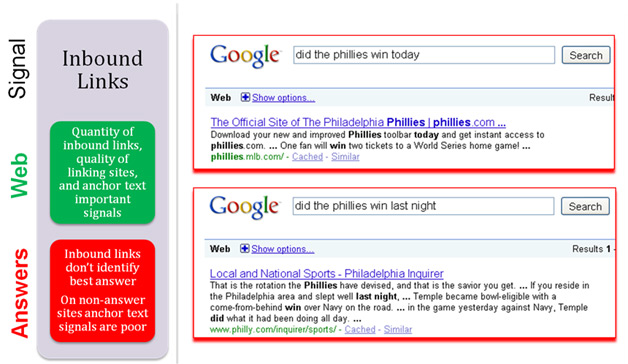

The company says it is seeing increased loyalty from users who conduct question searches, and has seen "a pronounced increase" in the percentage of users who conduct queries in the form of a question. In fact, they claim to see three times more questions as a share of total queries than their competitors.
"Indeed, the information that is directly relevant to many questions most certainly exists; it’s just that it’s locked in people’s heads or captured in unpublished conversations, and therefore inaccessible by traditional search," says Ask President Doug Leeds. "Obviously, this is not a trivial deficiency in a world that is increasingly interconnected and clamoring for perspective, guidance, and shared knowledge at an interpersonal level online."
Ask is setting out to extract and rank existing answers, and index sources of answers that have not yet been published. "To extract and rank existing answers, as opposed to merely ranking web pages that contain information, we have and are continuing to develop a unique set of algorithms and technologies that are based on new signals for relevance specifically tuned to questions and answers," says Leeds, outlining these signals with the following images.
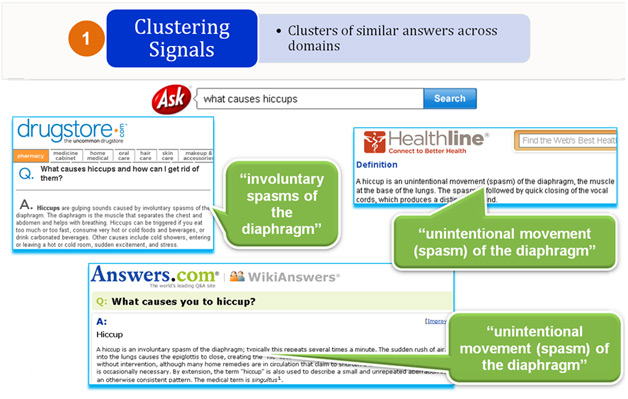
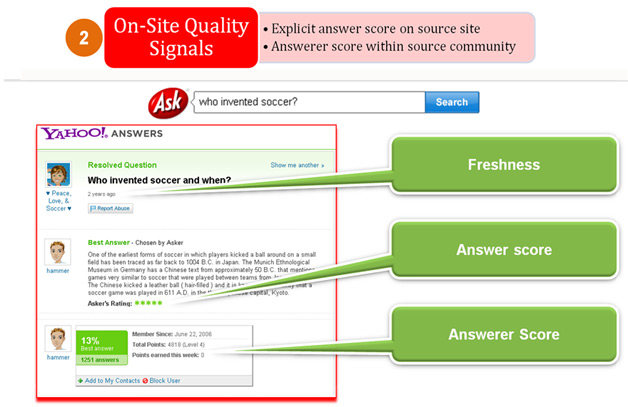
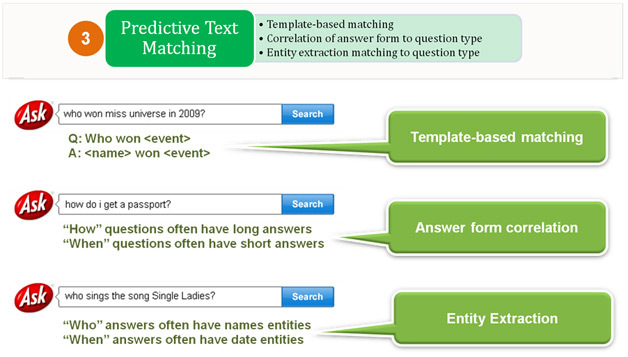
Right now, Ask is focused on developing a new algorithm that utilizes the signals highlighted above. "But our work doesn’t end with extraction and ranking of existing, published answers," says Leeds. "Where our vision really comes to life is in our efforts to index the sources of unpublished knowledge that can generate answers specifically in response to a question, in the moment it’s asked. This is the long tail of questions that are nearly impossible for search engines to answer, but which create incredible value for users when they are."
These include complex questions (like "What is the cheapest way to get to the Austin airport from downtown Austin?"), temporally dependant questions (like "When will the Oakland Bay Bridge re-open?"), and subjective questions (like "What should you do to save a withering tomato plant?").
Ask has reached a milestone of 400 million Q&A pairs in its database, so the engine is already capable of answering a significant amount of questions you might have, but there’s a lot of work to be done in order to give users the "best answers on the planet" in real time, as the company intends to do. It will be interesting to see how Ask’s progress comes along. Leeds promises updates on the company blog as they work their way along.
Do you think Q&A search is an important part of search’s future? Do you think Ask will play a key role in it? Do you ever use Ask to find answers? Tell us what you think in the comments.
Related Articles:
> Ask Gets More Serious About Answers
> Ask.com Gets New U.S. Leadership
> Microsoft Tipped As Most Likely Ask.com Buyer
> Searching for Answers Google Doesn’t Have
-
Your hipster GF will love these iPhone earrings

You could spend $14.95 to buy the set pre-made, or follow your mom’s advice and make a set yourself. It means more that way. [via MAKE]
-
Media Literacy Project: “Basta Dobbs, It’s Just the Beginning.”
Media Literacy Project celebrated a victory on November 11th when longtime CNN anchor Lou Dobbs announced his resignation. MLP has been collaborating locally and nationally to advocate for journalistic integrity in an attempt to remove inflammatory language and misinformation from our media system.

Nationally, MLP joined more than 40 other organizations to promote the BastaDobbs.com campaign, which launched in mid-September. More than 100,000 people joined the effort, which included online petitions, a viral YouTube video, a text-message campaign, and radio PSAs.
On October 21st, MLP and New Mexico MAG-Net hub members – SouthWest Organizing Project, Quote Unquote Community Media Center, KUNM Youth Radio, Young Women United, El Centro de la Raza and El Centro de Igualdad y Derechos – held a press conference at the National Hispanic Cultural Center to call on CNN to remove Dobbs and to speak out against hate speech in our communities.

A week later, Media Literacy Project conducted a town hall with Albuquerque community leaders to develop a volunteer council that would address these issues while working as part of MLP’s Siembra la palabra digna campaign.
Upon learning of Dobb’s resignation, Andrea Quijada, Executive Director of the NM Media Literacy Project promised,
“This is just the beginning of our efforts in Albuquerque as we continue to collaborate with local immigrant rights organizations to educate our communities and prevent hate speech in New Mexico’s media.”
-
Record Breaking Spring Heat Wave in South Australia 2009

2009Nov16: “An unusual spring heat wave in South Australia broke numerous records and left the land extremely vulnerable to fire danger. Adelaide experienced eight consecutive days with temperatures in excess of 35 °C (95 °F), resulting in the first spring heat wave experienced by the city since records began in 1887. The average maximum temperature for Adeliade for the first 15 days of November was more than 8 °C (14 °F) above the normal of 24.9 °C (77 °F)” (NCDC/NOAA).
Reference: NCDC/NOAA http://www.ncdc.noaa.gov/sotc/?report=hazards&year=2009&month=11&submitted=Get+Report
Image Description: Australia – Maximum Temperature Anomaly 16 Nov. Source: Australian BoM. Image Location: http://www.ncdc.noaa.gov/sotc/?report=hazards&year=2009&month=11&submitted=Get+Report Credit: Commonwealth of Australia/Australian Bureau of Meteorology, 2009 Image Permission: This work is copyrighted and unlicensed. However, it is believed that the use of this work to illustrate the subject in question, Where no free equivalent is available or could be created that would adequately give the same information, on Interlinked Challenges, hosted on servers in the United States by Michigan State University, qualifies as fair use under United States copyright law.
-
Analysts talk about upcoming BlackBerry slider

Analysts at Kaufman Bros are saying that RIM will be launching a touchscreen BlackBerry slider with a QWERTY keyboard, along with an updated web browser.
Kaufman said they are picking up strong indications of a new form factor under development that would be a cross between a touchscreen BlackBerry Storm 2 and a physical keyboard BlackBerry. They said, “from our understanding, this new BlackBerry would have a full touchscreen plus a pull-out physical keyboard. It would be similar to others from HTC, Palm, Motorola and others but of course sport a distinctive signature BlackBerry industrial design.”
We have heard rumors of such a device being codenamed Talladega, but nothing much else. It would still be cool to see a BlackBerry Storm slider though. Also, a touchscreen device would be a great launch device for the new WebKit-based BlackBerry Browser.
© Kyle for BlackBerry Cool, 2009
-
Coming This Week: New Law To Prevent Discrimination Based On Genes
“The most important new antidiscrimination law in two decades — the Genetic Information Nondiscrimination Act — will take effect in the nation’s workplaces next weekend, prohibiting employers from requesting genetic testing or considering someone’s genetic background in hiring, firing or promotions,” The New York Times reports. “The act also prohibits health insurers and group plans from requiring such testing or using genetic information — like a family history of heart disease — to deny coverage or set premiums or deductibles.” Employers and insurers would no longer be allowed to ask employees for their medical histories. Group health plans would also be banned from “the common practice of rewarding workers, often with lower premiums or one-time payments, if they give their family medical histories when completing health risk questionnaires.”
“The new law (called GINA) was passed by Congress last year because many Americans feared that if they had a genetic test, their employers or health insurers would discriminate against them, perhaps by firing them or denying coverage.” Genetic tests can be used to “help determine whether someone is at risk of developing an inherited disease or medical condition” (Greenhouse, 11/15).
-
Samsung announces the Galaxy Spica i5700

Today Samsung officially announced the Galaxy Spica i5700, a wallet-friendly Android smartphone that we’ve been keeping tabs on since September. On sale now in Europe and the Commonwealth of Independent States with availability in the Middle East and Asia coming shortly, the Galaxy Spica features an AMOLED touchscreen display, 3.2 megapixel camera, DivX support (a first for Android), 3.5mm headphone jack and an 800MHz processor. Oddly enough, official pricing was omitted from the press release, but last we heard it was to go for around 350€ or $524 USD.
