Blog

  • 20 Goals for Business Social Media Use

    I probably don’t have to tell you that many businesses are still struggling with the concept of using social media. Many simply can’t find a good reason to use it at all, and many more find themselves using it but struggling to validate that use. They can’t find the ROI. They feel that too much time is being wasted. Basically, they’re just using social networks because they feel like they’re supposed to. They just want to keep up.

    Many businesses are even banning social media from the workplace entirely. In fact, a great deal of our readers have expressed that they feel that social media doesn’t belong in the workplace because employees are there to "work," not "goof off."

    Well, that may be the case, and perhaps social media doesn’t fit into your business at all, but considering your general business goals can help you decide whether or not there is a place for social media, and whether or not your employees can fit into that puzzle.

    As social media enthusiast Chris Brogan told WebProNews in a recent interview, it’s time to get over the touristy part of social media and start getting down to business.

    He says it’s not "Gee whiz, it’s cool" anymore. It’s "What are we gonna do with it?"

    "Great you can type. Now what?" he says.

    Here are some sample goals a business owner or manager might set for social media use. Once the goal is considered, then you can look at the tools that are out there and evaluate which ones will give you the best shot of achieving those goals.

    20 Possible Goals

    1. I’m a content provider, and I want to expand my reach.

    2. I want my customers to be able to stay updated with news about my company.

    3. I want to get to know my customers.

    4. I want to promote my product.

    5. I want to stay abreast of current news and trends.

    6. I want to share my ideas with likeminded individuals.

    7. I want to increase brand awareness.

    8. I want to provide customer service and support easily.

    9. I want to find a job.

    10. I want to recruit.

    11. I want people to like my brand.

    12. I want to collaborate on business projects.

    13. I want to directly sell a product.

    14. I want to earn respect within my industry.

    15. I am getting information overload, and I want to get organized.

    16. I want to drive traffic to my site.

    17. I want to attract advertisers and make money.

    18. I want to get more involved with local prospects.

    19. I want to get more involved with people on an international and global level.

    20. I want to keep up with my competitors.

    There are certainly more possible goals for business social media use out there. I’ve probably not even scratched the surface. What goals do you set for your social media efforts? Discuss here.

    Related Articles:

    How Big Brands Use Social Media

    Some Brands Have Good Ideas For Social Media. Do You?

    Using Facebook Traffic to Drive Brand Loyalty


  • Tauntaun sleeping bag now available for pre-order

    bb2e_tauntaun_sleeping_bag_conversationJust in time for the holidays ThinkGeek is proud to present the TaunTaun sleeping bag. Immortalized last spring in an April Fool’s joke, interest was so high that ThinkGeek decided to make it. Now you can pretend you’re brave Captain Kirk on the Ice Planet Hoth fighting the evil Ewok Empire and slaying the Cylons. Or something.

    Anyway, it will cost $99 and there is a limit of two Tauntauns per customer. Apparently you can wear it around like a Snuggie.

    Product Page


  • Micro fuel cell technology awarded U.S. patent, exclusively licensed by Caltech

    Technology developed at the California Institute of Technology that enables fuel cells for micro applications has been patented and licensed exclusively to a subsidiary of VIASPACE, Inc., an Irvine, CA-based alternative energy company that provides products and technology for renewable, clean energy. U.S. Patent 7,585,577 was licensed to Direct Methanol Fuel Cell Corporation (DMFCC). The inventors are Sekharipuram R. Narayanan and Thomas I. Valdez, both with the NASA/Caltech Jet Propulsion Laboratory, where the direct methanol fuel cell was invented.

    The new patent is related to monopolar fuel cell stacks. Traditionally, direct fuel cells have employed stacked unit cells arranged vertically like slices of bread in a loaf. Monopolar stacks use the same unit cells, but the “bread slices” can be laid horizontally next to each other. This allows for a thinner fuel cell that is more suitable for many micro applications like mobile phones. According to the patent, the stack design offers two- to three-fold improvement in power densities. The technology is suitable for manufacturing, uses inexpensive plastic materials, and is easy to assemble and troubleshoot. DMFCC says the technology substantially improves the commercialization prospects of portable direct methanol fuel cell power sources.

    DMFCC already holds an extensive portfolio of direct methanol fuel cell patents licensed from Caltech and the University of Southern California. “This new patent adds significant value to our intellectual property portfolio,” says Carl Kukkonen, CEO of VIASPACE and DMFCC. “It will be difficult for any company to go to market with direct methanol fuel cells for micro applications — or other applications for that matter — without first obtaining protection under the Caltech patents which we have licensed.”

    Source: Reuters


  • Google Seeking Not To Cross The Creepy Line

    Google CEO Eric Schmidt while appearing on Fox Business made some interesting comments about Google’s emergence as a huge Microsoft-like business power. I thought most interesting was Schmidt’s statement about Google becoming like Microsoft, "Hopefully, we won’t repeat the mistakes that Microsot made ten years ago that ultimately led to all these things that happened with them".

    Schmidt elaborated:

    "In our case we see ourselves as a disruptor, and a disruptor because we are using new technology to solve real consumer problems, that in some cases people didn’t even realize could be solved. We are also a company that operates at scale using computers globally. And of course, we are in the information business and people have a lot of opinions on how information should be organized."

    Fox Business’ Neil Cavuto asked Schmidt in reference to Google’s new Dashboard product how we really knew if Google deleted our personal data when we pressed delete via Dashboard. Schmidt’s response:

    "Because we say so and we would be sued (if we didn’t)."

    Cavuto joked: "It’s like … come in peace to serve man."

    Watch the whole interview below:

  • Are the Symbian Foundation’s Open-source Plans DOA?

    “When Nokia announced that it was launching the Symbian Foundation to great fanfare,” writes John Mark Walker on OStatic, “it had within its grasp that rarest of opportunities to move swiftly and become the dominant open-source mobile platform. Alas, just one and a half years later, Nokia and the foundation have seemingly ceded that position to Android. Instead of recognizing the threat from Android and making strategic changes to counter, they instead criticized Google’s closed-door development of the OS before releasing a line of code themselves.” Can the Symbian Foundation and Nokia recover quickly and deliver on their important open-source promises and goals?  OStatic tackles that question today, here.

  • New EU telecoms framework mandates user consent before getting cookies

    By Scott M. Fulton, III, Betanews

    The heads of state and high ministers of Europe’s 27 member nations are now putting the finishing touches on a sweeping new telecommunications regulatory framework, some of whose provisions would go into effect as soon as the first quarter of next year. One of the provisions that appears likely to be approved without much debate would prohibit any Internet service from saving anything whatsoever to individual users’ systems without their prior consent. And if they don’t give consent, Web sites will just need to find a way to deal with it.

    Although Europe’s member states would be charged with enforcing this framework, technically there appears to be nothing that would prohibit any of them from taking action against non-conforming Web sites outside of their own borders — even outside of Europe — on the grounds that they publish to European readers.

    “Third parties may wish to store information on the equipment of a user, or gain access to information already stored, for a number of purposes, ranging from the legitimate (such as certain types of cookies) to those involving unwarranted intrusion into the private sphere (such as spyware or viruses),” reads the October 22 draft of the regulatory framework (PDF available here). “It is therefore of paramount importance that users be provided with clear and comprehensive information when engaging in any activity which could result in such storage or gaining of access. The methods of providing information and offering the right to refuse should be as user-friendly as possible.”

    The exceptions that the new framework would allow include when a Web site must store something on the client side, when the user has specifically requested a service where that storage is necessary. But simply typing in the URL of that service may not constitute a request or an authorization for that storage; the site may still have to put up some type of notice. The framework also makes it feasible for Web browsers to effectively communicate a kind of “all cookies allowed” state to Web sites on behalf of their users, so that consent may be presumed if that’s what the user permits. That would let users bypass a kind of “Vista UAC” scenario where they’re prompted for permission to continue every 30 seconds.

    But it might also become a security concern, as users who would enable browsers to say, “Go ahead and send me everything,” and then filter absolutely nothing that’s incoming, may open themselves up to more than they were expecting.

    In the meantime, the entire Web may have to start functioning like User Account Control in order for sites to comply with this new directive, especially if it becomes law in a matter of months, in the opinion of Pinsent Masons technology law attorney Struan Robertson. In a post for his firm’s Out-Law.com blog on Monday, Robertson wrote, “There has been almost no fuss about this little law, despite the harm it could do to advertising, the lifeblood of online publishing. It also threatens to irritate all Web users by appearing at every new destination like an over-zealous security guard.”

    Robertson was also among the first to point out that the entire Web analytics business — how sites like Betanews counts their users — depends on the cookie mechanism, which may no longer function in the background. “So almost every site that carries advertising should be seeking its visitors’ consent to the serving of cookies,” he wrote. “It also catches sites that count visitors — so if your site uses Google Analytics or WebTrends, you’re caught.”

    Copyright Betanews, Inc. 2009


    Add to digg
    Add to Google
    Add to Slashdot
    Add to Twitter
    Add to del.icio.us
    Add to Facebook
    Add to Technorati


  • Advanced Stress Management

    There are many things we can do that fall under the category of Basic Stress Management. We know that we can eat right, exercise, get plenty of rest, and eliminate addictive habits like caffeine, nicotine, alcohol, and drugs. These behaviors will create energy and it takes energy to manage stress.

    So what do we know about Advanced Stress Management?

    Advanced Stress Management is evolving our stressful habits into successful practices by evolving the mind. In order to evolve our mind we must take responsibility for our thoughts, feelings, actions, and attitude. Frequently we live our lives while our thoughts are on autopilot. When our mind is on autopilot we are not necessarily thinking but reacting from our habits. We get up in the morning, without intention, get ready for the day, go to work or school, get home, watch TV, go to bed, and then we do it all over again.

    In order to evolve our mind we must remove ourselves and our thoughts from autopilot and take responsibility for our thoughts, feelings, actions, and attitude by living with intention. We can start our day with intention, live our day with intention, and end our day with intention.

    How do we live with intention? One way is we can take our worries and turn them into faith.

    For example, we may be worried about not having enough money. When we worry about not having enough money we may feel doubt and fear about our situation. When we feel doubt and fear we start to make decisions based on this doubt and fear. Some decisions may be to cut back on our expenses and luxuries.

    When we evolve our mind we take responsibility for our thoughts, become aware of our worry, and then focus on a what we want. We focus on a solution, move towards that solution, and that will create faith.

    When we are worried about not having enough money, the opposite would be having more than enough money. This goal of having more than enough money is our intention. We should then wake up in the morning with intention, asking ourselves, “how can I make more money?” We should go through our day thinking, “What can I do today, right now to make more money?” And then we can go to sleep with intention by thinking about what we would like to do to make more money. When we think like this we feel desire and make decisions based on the feelings of desire. Some decisions may be to start a business or look for a better job or career.

    This intentional behavior is taking responsibility for our thoughts, feelings, actions, and attitude.

    We take responsibility for our thoughts by taking them off autopilot and a habit of worry, and focus them on goals.

    We take responsibility for our feelings by removing the doubt and fear and replacing it with intention, expectation, and hope.

    We take responsibility for our actions because we take action towards our goals versus taking action in the direction of our troubles. This behavior creates faith, the opposite of worry.

    And finally, we take responsibility for our attitude by having faith rather than fear.

    Advanced Stress Management is truly evolving the mind by taking responsibility for our thoughts, feelings, actions, and attitude. These successful habits create desire, faith, and confidence by becoming aware of and eliminating thoughts of doubt, fear, and worry.

    If you are a worrier evolving the mind might take some serious dedication. But, when we become accountable for our thoughts, feelings, actions, and attitude, we truly become experts on managing our stress.

    If you are having a hard time and are unhappy something must be done. If you would like to learn more about destressing yourself with advanced stress management I can help you, for free!

    Subscribe to this blog via rss or email (you can do this right here in the right side column) for the updated posts, visit my website, sign up for our free weekly newsletters, visit our store and download the free stress management audios.

    If you would like to live the life you dream of, let me help you. Learn to destress yourself, for free, by me, and learn what advanced stress management really is.

    Thank you for visiting my blog. Hope this is helpful.

    Have a great day and until next post…

    Don’t forget to have fun and be playful, it’s in your nature.

    Elizabeth

    Add me as a friend on facebook

  • At Least 10 Bidders for Ratiopharm

    FRANKFURT (Reuters) – German generic drugmaker Ratiopharm has attracted at least 10 first-round bids, several people familiar with the procedure told Reuters on Wednesday, indicating that a competitive auction was underway.

    Bidders from the healthcare industry include Israel’s Teva (TEVA.TA), Mylan (MYL.O) of the United States, Sanofi-Aventis (SASY.PA) of France, China’s Sinopharm (1099.HK) and Actavis of Iceland, the sources said.

    Buyout firms participating in the round of bids, which were non-binding, include TPG, Advent in collaboration with Goldman Sachs (GS.N), Permira and KKR.

    One source said EQT also filed a bid.

    A spokesman for Ratiopharm, put up for sale to cut its owner’s debt, declined to comment.

    Teva, Actavis and all private equity companies named by the sources also declined comment.

    Sanofi, Sinopharm and Mylan were not immediately available for comment.

    Several sources close to the proceedings also told Reuters on Wednesday that most bids came in between 2 billion euros ($3 billion) and 2.5 billion euros.

    A spokesman for Ratiopharm’s parent, the Merckle family’s investment vehicle VEM, said last week VEM was positively surprised by the number of bids and that it was “very satisfied” with the level of the offers.

    Encouraged by the interest from suitors, the sale of Ratiopharm as a whole remained a priority, he said at the time.

    VEM owner Ludwig Merckle is selling Ratiopharm as part of concessions made by his late father to creditor banks.

    (Reporting by Philipp Halstrick, Frank Siebelt and Ludwig Burger in Frankfurt and by Simon Meads and Quentin Webb in London)

    ShareThis


  • Motorola DROID accounts for around 25% of all U.S. Android web traffic?

    droid-traffic

    Well, kind of. Our boys at Clicky (awesome site analytics service, by the way) released a report this morning compiled of data from over 150,000 websites which have their tracking code installed. It’s a pretty large sample size, and what they found was that the DROID, less than a week old, already accounts for around 25% of all Android traffic they see in the United States. We’ll let you guys tear this apart in the comments…

    Thanks, Sean!

    Read

  • What’s the bigger seller: New Super Mario Bros. Wii or Modern Warfare 2?

    speculation

    So by now you probably already have Modern Warfare 2, have beaten the single-player mode (cheap shot!), and have been killed within three seconds of re-spawning in multi-player mode more times than you’d care to admit. Great, good for you. Something that has been taken for granted, though, is that the game will be one of the best-selling games of the year, if not the best-selling. Hold your horses, partner, because an Electronic Entertainment Design and Research analyst has said that New Super Mario Bros. Wii will well outsell Modern Warfare 2 when it’s all said and done.

    There’s an important distinction to make: what we’re talking about is eventual sales. What may happen is that Modern Warfare 2 could well end up the best-selling game of the year, but it won’t necessarily be the best-selling game released in 2009. New Super Mario Bros. Wii just might have longer longevity than its first-person shooter competition.

    Does this matter to you and I, really? Eh, no. Who cares what game outsells what? Don’t let sales numbers get in your way of enjoying whatever you play.

    It’s expected that the new Mario game will sell 15 million units over its lifetime. That new Mario games (well, not counting smaller titles like Mario Learns to Cook or whatever) are so rare, compared to Activision’s ability to publish Call of Duty after Call of Duty suggests that there’s not enough time for the shooters to get a foothold, as it were.

    Of course, this is all speculation designed to help your day go by a little faster. Hopefully I have achieved my objective.


  • Why can’t chimps speak? Study links evolution of single gene to human capacity for language

    If humans are genetically related to chimps, why did our brains develop the innate ability for language and speech while theirs did not? 
     
    Scientists suspect that part of the answer to the mystery lies in a gene called FOXP2. When mutated, FOXP2 can disrupt speech and language in humans. Now, a UCLA–Emory University study reveals major differences between how the human and chimp versions of FOXP2 work, perhaps explaining why language is unique to humans.
     
    Published Nov. 11 in the online edition of the journal Nature, the findings provide insight into the evolution of the human brain and may point to possible drug targets for human disorders characterized by speech disruption, such as autism and schizophrenia. 
     
    “Earlier research suggests that the amino-acid composition of human FOXP2 changed rapidly around the same time that language emerged in modern humans,” said Dr. Daniel Geschwind, Gordon and Virginia MacDonald Distinguished Chair in Human Genetics at the David Geffen School of Medicine at UCLA. “Ours is the first study to examine the effect of these amino-acid substitutions in FOXP2 in human cells.
     
    “We showed that the human and chimp versions of FOXP2 not only look different but function differently too,” said Geschwind, who is currently a visiting professor at the Institute of Psychiatry at King’s College London. “Our findings may shed light on why human brains are born with the circuitry for speech and language and chimp brains are not.”
     
    FOXP2 switches other genes on and off. Geschwind’s lab scoured the genome to determine which genes are targeted by human FOXP2. The team used a combination of human cells and post-mortem brain tissue from both chimps and humans who died of natural causes.
     
    The chimp brain dissections were performed in the laboratory of co-author Todd Preuss, an associate research professor of neuroscience at Emory University’s Yerkes National Primate Research Center.
     
    The scientists focused on gene expression — the process by which a gene’s DNA sequence is converted into cellular proteins. 
     
    To their surprise, the researchers discovered that the human and chimp forms of FOXP2 produce different effects on gene targets in the human cell lines.  
     
    “We found that a significant number of the newly identified targets are expressed differently in human and chimpanzee brains,” Geschwind said. “This suggests that FOXP2 drives these genes to behave differently in the two species.”
     
    The research demonstrates that mutations believed to be important to FOXP2’s evolution in humans change how the gene functions, resulting in different gene targets being switched on or off in human and chimp brains.   
     
    “Genetic changes between the human and chimp species hold the clues for how our brains developed their capacity for language,” said first author Genevieve Konopka, a postdoctoral fellow in neurology at the David Geffen School of Medicine at UCLA. “By pinpointing the genes influenced by FOXP2, we have identified a new set of tools for studying how human speech could be regulated at the molecular level.”
     
    The discovery will provide insight into the evolution of humans’ ability to learn through the use of higher cognitive skills, such as perception, intuition and reasoning.
     
    “This study demonstrates how critical chimps and macaques are for studying humans,” Preuss said. “They open a window into understanding how we evolved into who we are today.”


    Because speech problems are common to both autism and schizophrenia, the new molecular pathways will also shed light on how these disorders disturb the brain’s ability to process language. 
     
    The National Institute of Mental Health, the A.P. Giannini Foundation and the National Alliance for Research on Schizophrenia and Depression funded the study.

    Co-authors included Jamee Bomar, Giovanni Coppola, Fuying Gao, Sophia Peng, Kellen Winden, James Wohlschlegel and Zophonias Jonsson, all of UCLA.

     
    For more news, visit the UCLA Newsroom or follow us on Twitter.

  • Mac Office Update: Stability, Stability, Stability

    office2008macbox

    Microsoft issued updates for Office 2004 and 2008 covering security issues for both versions, as well as an XML conversion tool. The Office 2008 update also includes a number of minor fixes to enhance stability.

    Regarding security, both updates address vulnerabilities “that an attacker can use to overwrite the contents of your computer’s memory with malicious code.” Opening a “specially crafted” Word or Excel file could grant the attacker the same user rights as the local user, including administrative rights if applicable. The XML Conversion Tool was also updated to address this issue.

    The 12.2.3 update for Mac Office 2008 update also focuses on stability. In Word, general crashing issues have been addressed. The update also fixes the annoying text-spacing bug when opening some Windows Office documents. For Excel, crashing issues when using PivotTables has been addressed. PowerPoint also addresses stability. Apparently, Entourage is stable enough, though there is a new junk mail definition file. Finally, Microsoft Document Connection for the Mac gets several minor upgrades and fixes.

    While this minor update is welcome, many Mac Office users are waiting for information about, if not an actual release of, Outlook for the Mac. In August, we learned Mac Outlook will be out by Christmas 2010, will be built from the ground up using Cocoa, and will have many features we desire, but since then nothing. How about an update on that?

  • A Look At All The Sites Owned By Rupert Murdoch That ‘Steal’ Content

    As Rupert Murdoch talks about how he wants to cut off Google, while claiming that aggregator sites are “parasites” and “stealing” from him — and that fair use would likely be barred by the courts, it seemed like a good time to examine at least some of the sites that are owned by Rupert Murdoch that appear to aggregate content from other sites and which rely on the very same fair use argument. We’ve mentioned a few in the past, but figured it wouldn’t hurt to explore them more thoroughly.

    Well, let’s start with the flagship Wall Street Journal itself. It integrates its own “aggregator” with headlines and links to other stories. For example, on the WSJ’s tech news page if you scroll down, you’ll find a bunch of headlines and links to other sources — without permission:


    Oops. Looks like the WSJ is “parasiting” and “stealing” according to Murdoch. Perhaps he should cut them of too.

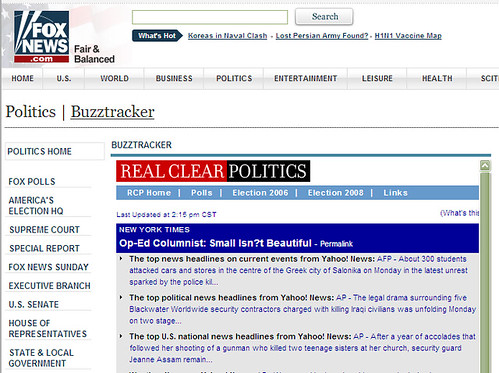
    Okay, how about Fox News itself? Yup. It’s got an aggregator as well. Here’s its Politics Buzztracker that aggregates and links to stories from a variety of different publications, including the NY Times, the Washington Post, MSNBC and others:


    Murdoch can’t be too happy about all that thieving.

    Then we’ve got the folks over at AllThingsD, who I actually think do excellent work, and who have built up a nice part of their site called “Voices.” I actually quite like this and find it useful (and yes, every so often, they are kind enough to “parasite” one of my posts). In fact, it helps keep AllThingsD in my RSS reader because it’s so useful. But, damn, if that doesn’t look just like what Murdoch is complaining about. Not only does it have headlines, but also a fair bit of intro text (no summary, no commentary) and even the links are hidden at the bottom, rather than using the headlines as links:


    Of course, it’s not just with news either. The folks at AlarmClock remind us that Murdoch’s News Corp. owns IGN, which has a variety of properties, including the ever popular RottenTomatoes movie review aggregation site. Yes, the entire site is based on “parasiting” (according to Murdoch) movie reviews off of every other site, and pulling them all together:


    Good thing Murdoch is planning on working on ways to get the court to ban that sort of “fair use.”

    Some other IGN sites don’t quite have aggregators, but I do find it interesting that they’ve integrated in Google search, such that you could do searches for things across the web and have them remain in a totally News Corp./IGN-branded experience. Effectively, on these pages, Murdoch’s own properties are able to “parasite” back Google’s own “parasite” engine. Here are two examples:


    I’m sure there are probably more examples of various News Corp. properties regularly doing exactly what Murdoch and other News Corp. execs are now decrying as illegal and which must be stopped. So, it has to be asked, Mr. Murdoch, will you pull down all of these sites?

    Permalink | Comments | Email This Story


  • The Cabinet Honoring Our Veterans

    In Washington D.C., each government agency is proud to count veterans among their workforce.  Everyone from the Department of Homeland to Security to those at the Department of Agriculture observes this day of remembrance in a unique way.  And of course this is as big a day as their is for the VA.

    For the Department of Veterans Affairs, Secretary Eric Shinseki and Assistant Secretary Tammy Duckworth attended the traditional White House Veterans Day breakfast this morning, they then headed to Arlington National Cemetery for the wreath-laying and ceremony, where Assistant Secretary Duckworth led the Pledge of Allegiance.  Assistant Secretary Duckworth then headed towards the National Observatory for the Vice President’s luncheon for Veterans, while Secretary Shinseki is scheduled to attend a reception at the Mayflower Hotel hosted by the Paralyzed Veterans of America.  Read an excellent profile of Secretary Shinseki out of the New York Times today.  In addition, the Department is expanding its ability communicate online with Veterans and their families with the first phase of a larger web renovation project by redesigning the look and feel of the department’s website and improving usability.  The VA has also begun embracing new media by launching Facebook and Twitter pages for the department and each of its three primary administrations, along with a central YouTube page and a secon channel for its Health Administration.  Over the coming months, the department has ambitious plans for what it hopes will eventually become a single online communications platform capable of supporting a central VA blog, individual and group employee field-based blogs, as well as entries submitted by users—from VA’s top leadership, to student-Veterans, to family members.  The Department is convinced that reaching out using these techniques will greatly enhance their ability to both disseminate information and receive feedback from veterans effectively.

    For those of you enjoying nicer weather than we are here in DC, know that the Department of the Interior has announced that areas managed by the department will not charge entrance fees today.  As Secretary Ken Salazar put it, "The Department of the Interior is honored to offer this fee free day to thank our nation’s service men and women.  The sacrifices and achievements of the brave men and women of our armed forces can never be understated. We invite all of our visitors to enjoy this fee free day and take time out on this national holiday to remember our service men and women who are currently serving overseas in harms way."

    The Department of Homeland Security employs 47,000 veterans—25% of all civilian employees–in a number of capacities. Visit their site to learn more about the Department’s efforts to engage the talents and dedication of our nation’s veteran community. Also available is the press release introducing the new veterans website, designed to highlight veteran employment and contracting opportunities. Secretary Napolitano said the new website "reflects the shared commitment across the Department to hiring American veterans. Veterans play a vital role in the Department of Homeland Security’s mission to protect the nation, and this website will help us build our veteran workforce to more than 50,000 Department-wide by 2012."

    A moving slideshow currently headlines the Department of Defense website, highlighting the President’s trip to Fort Hood, where he honored the 13 brave men and women killed in last week’s shooting along with Defense Secretary Gates, Army Secretary John McHugh, left, and Army Chief of Staff Gen. George Casey Jr. amongst others.  During the somber ceremony, President Obama and the First Lady comforted survivors and families. You can also read Defense Secretary Robert Gates’ annual message commemorating the holiday, excerpted here:

    Our nation cannot fully repay the debt owed our veterans and their families, but we can use this opportunity to reflect and remember what these brave Americans have done. David Lloyd George, speaking during the opening months of World War I, the conflict that began this day of remembrance, said: "The stern hand of fate has scourged us to an elevation where we can see the everlasting things that matter for a nation – the great peaks we had forgotten, of Honor, Duty, Patriotism, and clad in glittering white, the towering pinnacle of sacrifice pointing like a rugged finger to Heaven."

    President and First Lady at Fort Hood

    President Barack Obama and First Lady Michelle Obama place a commander-in-chief’s coin on the fallen Soldier memorials honoring 13 shooting victims at the conclusion of a memorial ceremony at Fort Hood November 10, 2009. (U.S. Army photo by Sgt. Jason R. Krawczyk)

    Visit the Department of Justice blog to learn about The Justice Department’s Civil Rights Division, which works to protect the rights of those who have protected us – America’s veterans – by enforcing laws that defend their employment, voting and financial security rights. Tracy Russo of DOJ writes, "The Department of Justice is proud to serve our Nation’s service men and women. Through enforcement of veteran-specific statutes as well as state and local support offered in conjunction with our partners, we salute these Americans."


  • Holiday Shoppers Turning To Social Media And Internet

    Digital technologies continue to drive a new approach to shopping, with social media and mobile phones becoming key influencers this holiday season, according to a new survey of holiday retail spending and trends by Deloitte.

    Social media is gaining traction with 17 percent of consumers planning to use social media during their holiday shopping, and 60 percent plan to use it to find discounts, coupons and sales information, More than half (53%) plans to use social media to research gift ideas, while 52 percent plan to check the gift wish lists of friends and family.

    Consumers in all age groups plan to embrace social media over the holidays. While more than half (52%) of those who expect to use social media during the shopping process are in the 18-29 years old age group, 33 percent are in the 30-44 years old age group and 12 percent are in the 45-60 years old age group.

    The mobile phone is another digital tool for the holidays that is on track to be used by 19 percent of consumers to help with their holiday shopping. Those consumers plan to find store locations (55%), research prices (45%), find product information (40%), get discounts and coupons (32%) and read reviews (31%). A quarter plan to make a holiday purchase with their phone.

    The Internet ranks as a top shopping destination and continues to see steady growth. Nearly a quarter (22%) of consumers indicate they will shop primarily online this year and many are using the Internet to find special offers, with 44 percent of shoppers expecting to use a coupon they get online.

    Reviews have become another key online source of information, with 39 percent of consumers indicating they often read consumer-generated reviews of stores or products online, and one-quarter (25 percent) saying they will likely purchase a product this holiday season based on an online recommendation. More than a third (34 percent) say that online consumer reviews and ratings influence their buying decisions more than advertising.
    Stacy-Janiak
    "Consumers are turning to mobile, online and social media during their entire holiday shopping experience," said Stacy Janiak, vice chairman and Deloitte’s U.S. Retail leader. "Retailers should consider harnessing this activity to turn browsers into buyers with one-click access to coupons, promotions and purchasing tools."

    "This year’s leaner in-store inventories may also open the door for retailers to lure customers to their online channels where it is easier to access inventory, no matter where it is located."

    The Internet is also changing the traditional store-based purchase process. Almost half of consumers (48%) say they like the convenience of shopping with multi-channel retailers, and 78 percent indicate they have purchased an item in a retailer’s store after viewing or researching the product online. In addition 65 percent have done the opposite and purchased an item on retailer’s website after viewing it in the store or catalog.

    Related Articles:

    >Online Retailers To Have Better Holiday Season

    >Amazon And Walmart Engage In Price War Over Holiday Book Shoppers

    >Consumer Online Spending To Grow 24%


  • Modern Warfare 2 sets new day-one sales record in UK

    Activision is positively raking in the dough in the wake of Modern Warfare 2’s release. Biggest entertainment launch of all time? Could be. In the UK …

  • Chinese pirates are making a pretty penny installing hacked Win7

    fig_pirates_wtArr… Vendors in Beijing’s Zhongguancun market are charging customers $7 to install Windows 7 onto any computer. The hilarious part? The copies of Windows are pirated.

    The service takes about 40 minutes and includes a full install as well as a quick crack. Win7 Family Edition costs $11.

    I haven’t actually seen any Win7 cracks – it just never came up in my searches – but this points to the possibility that either Win7 is hard to install (which I don’t believe is the case) or that the cracks are quite complex right now, similar to the old tricks you had to play with XP.

    via Shanzai


  • Google Okay With Blocking News Corp.

    In a recent interview we wrote about this morning, Rupert Murdoch indicated that News Corp. may block search engines from indexing its sites.  Now, it doesn’t exactly look like Google’s going to offer money to him (or throw a fit) in response, as the search giant’s more or less replied by saying "fine."

    Actually, depending on what sort of tone you attribute to them, some of the comments made to Emma Barnett came closer to "it’s your funeral."  A spokesman told her, "Google News and web search are a tremendous source of promotion for news organisations, sending them about 100,000 clicks every minute."

    And later, there was something approaching "make my day."  The spokesman said, "If publishers want their content to be removed from Google News specifically all they need to do is tell us."

    So it should be interesting to see what happens.  Judging solely by the comments on our earlier piece and Barnett’s article, it seems that Murdoch might wind up missing "search people" (as he referred to them) a lot more than searchers would miss News Corp.’s content.

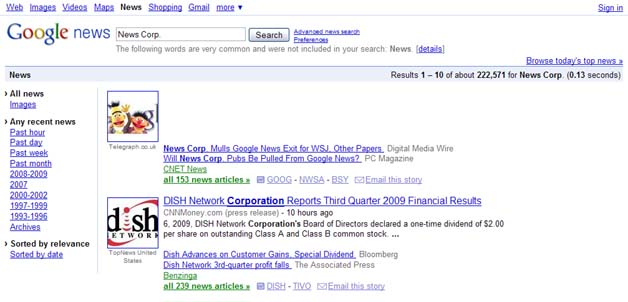
    Google News, Minus News Corp.

    Pay walls have worked in some specific instances, though, and since any disappearing act News Corp. pulled would almost certainly receive tons of mainstream media coverage, the publicity-generating value of the unprecedented move is interesting to consider.

    Related Articles:

    > Murdoch On Blocking Search Engines: "I Think We Will"

    > MySpace To Miss $100 Million From Google Search Deal

    > Murdoch Says Newspapers Must Charge For Online Content

  • Ratchet and Clank toys coming for your holiday cash

    The holidays are fast approaching and it often seems like the season will eat up so much cash on video games alone. Adding to that increasingly long…

  • MySpace Losing $1 Million Per Month On Empty Offices

    Don’t be shocked if ads for 420,000 square feet of office space start popping up all over MySpace.  It seems that the social networking company no longer intends to use a particular facility, but until it can unload the space, has gotten stuck paying over $1 million per month.

    MySpace LogoMatthew Garrahan reported late yesterday, "The company is locked into a 12-year lease worth about $350m that it signed in August 2008, when the number of people using MySpace was increasing and the social network was running out of space in its Beverly Hills offices."

    The economy in general has taken a big hit since then, however, and MySpace in particular decided in June to lay off about 400 employees.  Hence the decision not to go ahead with the expansion.

    So MySpace has been saddled with a lot of office space in Playa Vista, California that no one (as of yet) seems interested in subleasing.  And that space will in fact become more costly to MySpace over time, since payments are scheduled to increase.  (If you do the math, $350 million over the space of 12 years averages out to $2.43 million per month.)

    Maybe this snafu will result in an interesting resolution, at least.  If not the office ads on MySpace, perhaps realtors could get offered the chance to have their profiles swapped with Tom Anderson’s for a day.

    Related Articles:

    > New Googleplex Established In Brussels

    > Plan For Impressive "Yahooplex" In Motion

    Twitter Lines Up New Office Space