Blog

  • Canon 7D shots can carry over ghost image to next shot (fix imminent)

    double20exposure_Full
    Even cameras with mechanical shutters, it seems, aren’t immune to sensor carryover issues. It seems that when you’re doing that famous 8FPS continuous shooting, it’s possible under certain circumstances that a ghost image will be present in the next image shot. Canon says it’s “barely noticeable,” but someone must have noticed anyway because they’re having to issue a fix. It doesn’t occur in single shots or movies; I’m guessing it’s just a timing issue where the sensor isn’t completely reset before the new exposure begins.

    Here’s Canon’s statement:

    In images captured by continuous shooting, and under certain conditions, barely noticeable traces of the immediately preceding frame may be visible. This phenomenon is not noticeable in an image with optimal exposure. The phenomenon may become more noticeable if a retouching process such as level compensation is applied to emphasize the image.

    A fix should be here soon, I’d guess within a day or two. In the meantime, those of you with 7Ds should try to replicate it! It sounds kinda cool. I get an effect like that when I’m doing a flash+long exposure and a second flash goes off in the background. It looks crazy as hell. The 7D bug should be nothing like that, but hey.

    [via CameraTown]


  • Billions of Dollars Worth of Australian Property at Risk From Rising Sea Levels and More Frequent Storms Due to Climate Change 2009

    800px-Port_douglas_qld_australia

    2009Oct27: AUS$150 billion worth of Australian property is at risk from rising sea levels and more frequent storms due to climate change, according to a report from the House Standing Committee on Climate Change, Water, Environment and the Arts (Guardian.co.uk).

    Reference: Guardian.co.uk http://www.guardian.co.uk/environment/2009/oct/27/rising-sea-levels-australia-beaches

    Read the House Standing Committee on Climate Change, Water, Environment and the Arts report http://www.aph.gov.au/house/committee/ccwea/coastalzone/report.htm#chapters

    Image Description: Four Mile Beach, Port Douglas, Queensland, Australia. Photo by Malcolmj, 2004Nov12. Image Location: Wikimedia Commons http://commons.wikimedia.org/wiki/File:Port_douglas_qld_australia.jpg Image Permission: This file is licensed under the Creative Commons Attribution ShareAlike 2.0 License.

  • First look: BFG Deimos gaming laptop

    DLF_9054We just got a BFG Deimos in today, and it is big, shiny, and competing against Alienware’s M17x. So far, I can tell you that it’s a bit lighter then the Alienware, but (unscientifically speaking) about equal as far as speed. We’ll be doing a full review in the upcoming weeks, but I wanted to share some pictures and first impressions with you today.

    BFG is new to the laptop world, and it kind of shows. The box was very basic, without all the pointless extras that some manufacturers include. I’m fine with that, I don’t particularly feel a need to have a BFG hat or mouse pad. I’m here for the gaming performance.

    The machine looks good. And it’s not ridiculously heavy like certain other gaming laptops. It’s still huge, but not in an overwhelming way. More importantly, everything works. Sure, there’s isn’t any gimmicky “facial recognition,” but that hardly ever works right anyway. First impression is a solid machine with enough bling to keep me happy. I have to admit, I’m a sucker for blue LEDs.

    So I’ve fired up my Steam account, I’m downloading some machine-melting games, and looking forward to putting this thing through its paces. As always, I’ll ask: any particular questions about the machine? Anything you’d like me to take a look at in particular in the full review? Also, if you like the look so far, keep in mind you can get 10% off the price if you pre-order by this Friday.


  • Pediatric patients experience Halloween fun at Mattel Children’s Hospital UCLA

    WHAT:
    Despite being in the hospital, pediatric patients at Mattel Children’s Hospital UCLA will still get to celebrate Halloween by dressing up in costumes, face-painting and watching a magic show. In addition, five canine teams from UCLA’s People-Animal Connection (PAC), an animal-assisted therapy program, will don costumes and accompany the kids while they trick-or-treat through the hospital hallways.   
     
    WHEN:  
    11:30 a.m.–1:30 p.m., Friday, Oct. 30
     
    11:30 a.m.
    Creative arts, including crafts and face-painting
     
    Noon
    Magic show
     
    12:30 p.m.
    PAC dogs greet kids, trick-or-treat parade begins
     
     
    WHERE:
    Child Life Playroom, on the fifth floor of Mattel Children’s Hospital UCLA
    (757 Westwood Blvd., Los Angeles)  
     
    BACKGROUND:
    The annual Halloween party is hosted by the hospital’s Child Life/Child Development department in an effort to make sure the young patients experience a memorable celebration. For the third year, Spirit Halloween, the country’s largest seasonal Halloween retailer, has generously donated all costumes and accessories for pediatric families at UCLA’s Westwood and Santa Monica hospitals. Art of Elysium, a nonprofit organization that facilitates creative arts activities with pediatric patients and their families, will organize Halloween face-painting, and Pun the Magician will host his annual magic show.  
     
    MEDIA CONTACT:  
    Amy Albin, UCLA Health Sciences Media Relations, 310-794-8672  
     
    R.S.V.P. & PARKING:
    Please call media contact to R.S.V.P. and arrange parking.

  • Review:Implicit and Explicit Aspects of Sequence Learning in Presymptomatic Huntington’s Disease

    iStock_000008294264Small

    The article reviewed here is ‘Implicit and Explicit Aspects of Sequence Learning in Presymptomatic Huntington’s Disease’ by Ghilardi and colleagues and freely available here. In the abstract, the authors conclude

    These results suggest that both explicit and implicit aspects of sequence learning may be impaired before the onset of motor symptoms. However, when attentional demands decrease, explicit, but not implicit, learning may improve

    Thus the authors compare and contrast implict and explicit learning in Huntington’s Disease (HD) for a very specific task. The study revolves around a sequencing task and some assumptions. The assumptions are that in this case, implicit and explicit learning can be demarcated according to different elements of the response to the task. Thus for instance they argue that as learning proceeds, the movements become more efficient, saving energy and that this occurs implicitly. They also argue that the number of anticipatory movements in the task is a proxy for explicit learning. However it could be argued that there can be an overlap. Thus the subject could tire of the movements involved in the task and consciously seek to perform these actions more efficiently. Further these actions could be accompanied by an internal dialogue which could almost certainly be considered an explicit form of learning or it could occur non-verbally where the subject nevertheless attends to this goal. Similarly for the initial period of learning the task involves consideration of the sequence of events but here too it could be asked ‘does the learning take place consciously’ (the same could, I think, be asked of this example where the question could be asked  ‘is this chimp consciously or explicitly aware of what he is doing?’). In effect then, it might be reasonable to ask if implicit or explict learning are continuous rather than discrete functions or even if this characterisation is task specific such that it might not be possible to generalise from single tasks.

    The researchers have considered a large number of variables which are given in tables 2 and 3. Interestingly they mention that there is a ‘post-hoc analysis’ and a null hypothesis is not clearly stated although the authors do discuss their interpretation of the different components of the task response. The researchers have corrected for the multiple comparisons by using Bonferrini corrections. On the tasks, the subjects with presymptomatic HD (the number of CAG repeats averaged 41. The greater the number the greater is the risk of conversion) performed significantly worse on the implicit and explicit learning components of the tasks as interpreted by the researchers. My initial impression was that the explicit task involved sequencing and might under Baddeley’s model of working memory be attributed to the central executive. There would be expected to be executive dysfunction if the frontal-subcortical loops are affected by the disease process which is seen in HD. The only question here is whether or not there is interruption of the frontal-subcortical loops as this is prefmanifest HD. The researchers also found that if they reduced the complexity of the task there was no significant difference between the premanifest HD subjects and the controls on the ‘explicit learning’ but there was a significant difference on the ‘implicit learning’ task.

    The researchers discuss their results and comment on the possible involvement of the dorsolateral prefrontal cortex and a number of other pathways. They also suggest that implicit memory involves primary motor cortex and supplementary motor areas but it is also interesting to note that the cerebellum is thought to play a significant role in this type of learning for motor tasks. I would be interested to see a larger replication study with clearly delineated primary outcome measures and a range of tasks examining both implicit and explicit memory.


    Twitter

    You can follow ‘The Amazing World of Psychiatry’ Twitter by clicking on this link

    Podcast

    You can listen to this post on Odiogo by clicking on this link (there may be a small delay between publishing of the blog article and the availability of the podcast).

    Responses

    If you have any comments, you can leave them below or alternatively e-mail [email protected]

    Disclaimer

    The comments made here represent the opinions of the author and do not represent the profession or any body/organisation. The comments made here are not meant as a source of medical advice and those seeking medical advice are advised to consult with their own doctor. The author is not responsible for the contents of any external sites that are linked to in this blog

  • Booksellers Claiming That Competition And Lower Prices Are Bad For Consumers

    Clay Shirky points us to a letter sent by the American Booksellers Association (ABA) to the Justice Department suggesting that a book price war between Amazon and Wal-Mart is potentially illegal. What they appear to be saying — as Shirky also noted — is that lower prices are a bad thing:


    While on the surface it may seem that these lower
    prices will encourage more reading and a greater sharing of ideas in the culture,
    the reality is quite the opposite. Consider this quote from Mr. Grisham’s agent,
    David Gernert, that appeared in the New York Times:

    “If readers come to believe that the value of a new book is $10,
    publishing as we know it is over. If you can buy Stephen King’s new novel
    or John Grisham’s ‘Ford County’ for $10, why would you buy a brilliant first
    novel for $25? I think we underestimate the effect to which extremely discounted
    best sellers take the consumer’s attention away from emerging writers.”

    Basically the booksellers are saying they can’t compete in the marketplace. That may be true, but if it’s not actually harming consumers, what is the problem? There is no rule that says books must cost $25. If companies can figure out how to sell books for less, in ways that work for their bottom line, then what’s wrong with that?

    Permalink | Comments | Email This Story


  • Amazon lowers EC2 cloud service fees, adds MySQL relational instancing

    By Scott M. Fulton, III, Betanews

    amazon web services logoCome November 1, Amazon’s Web Services division will be lowering the per-hour prices for all of its current five instance types (AMIs), while adding two new AMI types on the high-end, according to a multitude of announcements from Amazon today. At the new high end of the scale will be a “quadruple extra-large” AMI with 68.4 GB of dedicated RAM, and the virtual computing power of a 1 GHz, 26-core Intel Xeon processor (albeit a 2007 model).

    The new high-end instances won’t come cheap — they’ll carry a premium of $2.40 per instance-hour for Linux editions, and $2.88 per instance-hour for Windows Server 2003. The previous high-end AMI, still called “extra large,” had been priced at nearly one-third that amount.

    However, revenue from the new super-high-end will help drive down prices for everyone else, starting November 1. At that time, the per-hour price for the smallest and cheapest instance available, running generic Linux, will be reduced by 15% to $0.085 per hour. Windows Server instances will be trimmed a bit, but not by as much percentage-wise — the “extra large” price, for instance, will drop only 4¢ to $0.96 per hour.

    The price cuts come as Amazon looks to offer more competitive buildouts, for customers that continue to prefer to deploy entire machine instances — rather than just applications, such as Salesforce.com and Microsoft offer — in the cloud, administered using everyday software. Already Amazon has been offering pre-configured AMIs with Microsoft SQL Server (at about a 10% premium per-hour), and IBM DB2 (somewhat higher at $0.38 per hour). Now Amazon is committing to offering its own brand of database server, called Amazon RDS, in lower-priced instances that will compete with its SQL Server, Oracle, and DB2 instances, using MySQL as the underlying engine.

    “For customers whose applications require relational storage, but want to reduce the time spent on database management, Amazon RDS automates common administrative tasks to reduce complexity and total cost of ownership,” reads a statement from Amazon AWS to Betanews this afternoon. “Amazon RDS automatically backs up a customer’s database and maintains the database software, allowing customers to spend more time on application development. With the native database access Amazon RDS provides, customers get the programmatic familiarity, tooling and application compatibility of a traditional RDBMS. Customers also benefit from the flexibility of being able to scale the compute resources or storage capacity associated with a Relational Database Instance via a single API call.”

    Customers will still be expected to maintain their own databases, Amazon’s statement tells us, although instancing in the cloud will enable them to re-provision resources as necessary on a more granular basis. Multiple statements today managed to make mince meat of Amazon’s quoted rates for transfer, but a blog post this afternoon managed to straighten the matter out: RDS customers will be charged 10¢ per gigabyte per month for storage, and another 10¢ per month for every one million I/O requests. Bandwidth charges should then be the same as for Amazon’s existing, non-relational SimpleDB instances: The first gigabyte of data in or out is free, then fees rise to 10¢ per gigabyte in and 17¢ per gigabyte out, declining to 10¢ per gigabyte out after 150 TB.

    This will not be the first appearance of MySQL on Amazon’s cloud; the commercial MySQL Enterprise has been available under Sun Microsystems’ branding since this time last year.

    Copyright Betanews, Inc. 2009


    Add to digg
    Add to Google
    Add to Slashdot
    Add to Twitter
    Add to del.icio.us
    Add to Facebook
    Add to Technorati


  • Video play-by-play: The first seven minutes of the new sci-fi TV show ‘V’

    To paraphrase the great Joe Rogan, from last Saturday’s UFC 104, I don’t watch much TV, maybe the Discovery Channel here and there to see a documentary or two. I bring this up because I’ve been told to write about some TV show called “V,” and the beauty is that I have no idea what it’s about! My first thought was, “V For Vendetta? Oh, no? Oh, well, then yeah, not a clue.” Apparently it’s a re-make of an old sci-fi show. Thankfully, though, ABC, the network where this show will air here in the U.S., has just posted the first seven minutes online. Let’s watch it, together!

    Note: I’m not sure if this video works outside of the U.S. Sorry if it doesn’t, but there’s no other source right now. So if you’re an international reader, feel free to skip all of this.

    Opening scene, it’s the blonde woman, the former “Other,” from Lost, who, to be totally honest, was the only reason I watched Lost as long as I did, and I’m not keen on blondes at all.

    Moving on, a priest looks ominously at a street lamp. He talks to a man in a wheelchair, saying nothing of any importance.

    A man is trying to buy an engagement ring. “Can’t go wrong with a knee,” says the shopkeep, in response to a question if going down on one knee is corny or not when asking a woman to marry you.

    We’re about a third of the way through, and the one thing that’s painfully obvious, given the spooky music and quick camera cuts, is that something bad is going to happen. Plus, everything is shaking for some reason. Shaking = bad.

    The Lost woman is back. Her no-good son in at a doctor’s office in SoHo (following a party he wasn’t supposed to attend), which either means this is taking place in New York City, and thus totally unreliable to Middle America, or in London, which would be reasonably exotic and interesting. Fingers crossed!

    The shaking has returned! Books fall off the shelf (to illustrate how severe the shaking is), and the priest saves that same man in a wheelchair from a giant, falling crucifix inside the church.

    … and then a fighter jet crashes into the streets of, sigh, New York. The CGI here is abysmal. Goldeneye for the N64 had better fire effects. Oh, and Goldeneye was also fun. This? So far…

    The pilot of the fighter jet, who’s presumably dead, floats down to the street via his parachute. Then the guy who was buying an engagement ring looks up and sees… something! They’re building suspense, that’s what they’re doing!

    And we’re back to the kid who’s talking to his Lost mother. She tells him to stay where he is, but then his phone, an iPhone, cuts out. It needs to be said that the kid’s iPhone cutting out may be totally unrelated to the oncoming commotion because, as we all know, AT&T is a hunk of junk in New York City. So far, this is the most realistic scene in the show.

    Now we get scenes of people looking up into the sky. Clearly something is up there, but what?

    We get a better glimpse of what’s going on: a vessel of some sort is floating in the sky.

    There it is! It’s a vessel of some sort, all right, and it’s shaped like a sting ray.

    vvvvvv

    The cops are telling everyone to remain calm while the Lost woman’s no-good son arrives on a motorcycle, presumably to reinforce his tough guy image. He can’t be seen driving a Ford Fiesta, now can he? He tries to go against the flow of people to go home, but a soldier tells him to keep walking with the crowd, away from home. Oh, my.

    Then we see some news footage of people talking nonsense, including some nerd kid who corrects his friend’s reference to the movie Independence Day. The one kid says, “Dude, this is Independence Day,” but then the other kid says something like, “Well, that movie was a ripoff of any number of other alien invasion movies.” I get it.

    The engagement guy meets up with his girl, and they embrace. Guess they won’t be getting engaged today. Now that guy has to psyche himself up all over again, presumably after all of this craziness ends. That’s if they both survive, of course.

    The Lost woman is looking for her son on the streets, but a solider tells her to hit the bricks. She crosses the police line anyway. If this were real life she would have been detained right then and there—you mean to tell me that no officer saw her cross the police line?—but not in the clever world of TV, where anything is possible.

    Of course Lost woman finds her son. Why challenge the audience? What could be more terrifying than losing your child? Bring some emotion into this dreck.

    The vessel is opening! We see lights, and people are looking up!

    And there’s a woman looking down from the vessel. She looks like Alyx Vance from Half-Life 2.

    End of video.

    Boring. I’m sorry, but you see one invasion angle and you’ve seen ‘em all. Granted, Alyx Vance may portend something not quite usual, but I can’t get behind another invasion angle. It’s played out. Not even the Lost woman will get me to watch it.

    Feel free to disagree, but I shan’t be watching this show (outside of this here preview).


  • Honoring fallen comrades. GeoCities goes down.

    slideshow-2009-bhobama-16Today marks the death of an internet giant. One of the first, one of the best. Oh GeoCities. What would we have done without you? Where would we have put our brightly colored, constantly flashing backgrounds? Who else had rotating .gifs for links and neon green page hit counters? There is no substitute for your plethora of font colors and sizes, for your broken HTML codes and page badges, for your MIDI synth-horns. We will sorely miss your animated “Under Construction” signs we came to know and love.

    GeoCities users, never fear. You still can upgrade to Yahoo web hosting without losing any of your page information. But you probably already knew that, seeing as it was your website that was going down. The number of free website hosts are dwindling, but the cheapest start close to a dollar a month. So there’s no excuse for not making sites no one will read.

    RIP


  • Insomniac not done making new IPs, co-op to play significant role in future titles

    If for some strange reason you thought Resistance was the last new Insomniac IP, better think again. In the words of senior community manager James St…

  • T-Mobile’s “Project Dark” a Threat to Prepaid Providers

    gtmo_12061_158079_v3T-Mobile USA has seen its growth stall and its ARPU slide in recent months as cut-rate discount service providers poach budget-conscious customers, and as AT&T and Verizon Wireless target high-end users. So the nation’s fourth-largest carrier is taking aim at both segments at we enter the holiday season with new calling plans and two new Android phones. But it’s the prepaid guys who have the most to fear.

    “Even More Plus” plans, which don’t require a contract, include an unlimited-everything option for $80 a month and a voice-only unlimited plan for $50 a month. And while T-Mobile doesn’t offer subsidized handsets with the new no-contract plans, it does allow users to pay for expensive phones over a 20-month period without interest; users who already have a handset can also take advantage without additional fees. A number of traditional contract plans are offered, too, under the “Even More” category.

    The prepaid plans, which were announced yesterday, had been rumored for weeks as the centerpiece of T-Mobile’s “Project Dark” initiative, and the carrier is clearly taking aim at its bigger brothers by marketing the offerings on its web site as “1/2 the price of comparable AT&T or Verizon plans.” But it’s the smaller, prepaid-only providers that could be feeling nervous about the new plans. T-Mobile hasn’t matched the rock-bottom plans of bargain-basement providers like TracFone Wireless, but it does operate a truly national network and it offers a more compelling lineup of handsets than most prepaid competitors. For prepaid users looking for more than just voice and text messaging, “Even More Plus” will be pretty attractive.


  • ResponseLogix Raises $5.6 Million

    ResponseLogix Inc., a Sunnyvale, Calif.-based provider of automotive digital response management software, has raised $5.6 million in new VC funding. Emergence Capital Partners led the round, and was joined by return backers GRP Ventures, Shasta Ventures, Belo Corp. and AH Belo Corp.

    PRESS RELEASE

    ResponseLogix, Inc., the leading provider of automotive digital response management software, today announced the closing of $5.6 million in new funding led by Emergence Capital Partners. The round also included existing investors GRP Ventures, Shasta Ventures, Belo Corp. and AH Belo Corp. The funds will be used to further cement ResponseLogix’s leadership in the growing market for internet lead management services to the auto industry.

    “Emergence Capital Partners invested in ResponseLogix because of its market leadership position, compelling customer value proposition, and the experience and passion of the management team,” said Jason Green, General Partner at Emergence Capital Partners. “We have watched ResponseLogix grow its business dramatically during one of the worst financial and auto industry downturns in history. I can’t wait to see what happens to this company as the economy rebounds.”

    Emergence Capital Partners is the leading venture capital firm focused on cloud-based business and consumer services companies. In 2002, Emergence Capital was the first to recognize the power and potential of SaaS to disrupt the technology industry and invested in some of the most successful companies including Salesforce.com and SuccessFactors. Their mission is to help build market leading companies in true partnership with forward thinking entrepreneurs. Today the firm has over $325 million under management from premiere institutional investors.

    “The Emergence team has a proven track record of funding and building market-leading technology companies, particularly software-as-a-service (SaaS) businesses. As a SaaS business ourselves, we are delighted to partner with them to accelerate our growth,” said Tom Mohr, President and CEO of ResponseLogix. “We are also pleased that existing investors joined Emergence in this financing. The commitment of all our investors in ResponseLogix further validates our value proposition — that a rapid quote response and effective ongoing customer follow-up are the keys to driving automotive Internet sales.”

    About ResponseLogix, Inc.

    ResponseLogix delivers software as a service (SaaS) technology to auto dealers so they can better respond to Internet leads. SmartQuote™ answers Internet leads within 10 minutes, with a price quote on multiple vehicles based on the customer’s make, model and trim level request. SmartFollow™ helps dealers stay in touch with the customer with dynamically timed, interactive follow-up emails. SmartFacts™ delivers powerful analytics to help optimize the performance or Internet sales departments. The ResponseLogix’s SmartQuote product recently received recognition by Automotive News Magazine as one of ten featured products in its annual post-National Automobile Dealers Association convention product review, this year entitled “Cool Stuff at NADA”. ResponseLogix products are available in 40 US markets for Toyota, Ford, Lincoln-Mercury, Chrysler, Dodge, Jeep, Honda, Lexus, Audi, Honda, Acura, Nissan, Infiniti and Hyundai dealers across the US. Additional OEM’s will be supported soon. Additional information is available at www.responselogix.com.

    ShareThis


  • YouTube Faces Formal Complaints In Germany

    In about two weeks’ time, the two-year anniversary of YouTube Germany’s launch will roll around.  The site’s set to receive more legal documents than birthday presents, however, as it’s facing some formal complaints.

    The distribution of copyrighted material is at issue, of course, and so is the (lack of) distribution of royalties.  What sets this situation a little bit apart from other ones is that a number of individuals -rather than just a money-grubbing organization or two – are involved. 

    YouTube Logo

    Wolfgang Spahr reported, "Those filing the complaints include: U.K. soprano Sarah Brightman and her German producer Frank Peterson; German producers Jon Caffery (Die Toten Hosen) and Toni Cottura (Backstreet Boys, Twenty Four Seven, Scatman); independent publishers Gerig Musikverlage, Bishop Songs and Musikverlag Progressive; plus independent labels Highball Music and Coconut Music."

    Then here’s the other odd thing about the situation: the claimants have asked for both the uploaders and downloaders of copyrighted material to be identified.

    Still, it seems that German authorities will get to say a few things before the case even makes it to court.  And it’s almost hard to guess what sort of outcome YouTube really wants, considering that it might appreciate having a global stage to promote Content ID and point out some of the music industry’s quirks.

    Related Articles:

    > YouTube Strikes Deal With UK Broadcaster

    > Report: Emails May Make Viacom’s Case In YouTube Suit

    > Germany Gives Street View Go-Ahead

  • Public Firefox 3.6 beta now expected Wednesday, 3.5.4 Tuesday

    By Scott M. Fulton, III, Betanews

    Actual Beta News feature bannerDuring a Mozilla developers’ planning meeting today, it was officially announced that Firefox users will begin seeing notices for version 3.5.4’s availability beginning tomorrow (October 27). Full information about security issues addressed by this regular update will probably be released at that time, although Betanews tests indicate that Windows 7 users in particular will probably notice a bit of a speed boost, on account of improved document load times.

    The first public beta of Firefox 3.6, which adds even more Windows 7 integration, will be released the following day. It will probably not be the final public beta for the product, as a development cycle for Beta 2 has been ongoing since the Beta 1 code was frozen last October 14.

    As Betanews reported before, our tests show Firefox 3.6 speed gains to be sizable on all platforms, now pulling the venerable browser to within the performance levels of version 2 of Google Chrome (although version 3 is the current stable edition, and version 4 is its widely distributed dev channel build). However, we also expected to see the final public build ten days ago — its released was blocked on account of newly discovered bugs. Some sources had reported the product was actually released, and a few went on to say it was released and then retracted; data obtained by Betanews from Mozilla indicates this was never the case.

    Tomorrow’s rollout of the stable version bug fix means the window for the next bug fix in that cycle moves to mid-December, which is not the most desirable timeframe. During today’s planning meeting, contributors called for suggestions as to how or whether that timeframe could be adjusted.

    Copyright Betanews, Inc. 2009


    Add to digg
    Add to Google
    Add to Slashdot
    Add to Twitter
    Add to del.icio.us
    Add to Facebook
    Add to Technorati


  • Dear Hollywood: Don’t Be Idiots; Don’t Delay Movie Rentals

    Sometimes you just shake your head at ideas that come out of some executives that are just so incredibly dumb, it makes you wonder how anyone ever took them seriously. There have been some hints about this latest one, though. Just last week, in discussing the latest IP Colloquium podcast, we noted (with surprise) that Paramount’s top lawyer thought the solution to business model problems in the entertainment industry was “more windows.” Windows, of course, are the different time periods in which movies are released solely for different formats/media. So, it starts with the theater (the first window), followed by video, pay per view, cable and network TV — each representing another window, and another chance to squeeze more money out of the same content.

    Yet, with the industry facing some challenges, rather than actually looking at what users want, its top brains seem to think that the answer is more windows. It’s hard to explain how incredibly short-sighted this is, because it’s so monumentally backwards that it makes you wonder what they’re thinking. At best, my guess is that the execs are extrapolating out in the simplest form that with the launch of each “window” they make more money, so the way to make even more money must be to offer more windows. Of course, this assumes two rather basic things that are totally wrong. One, is that these windows won’t piss off users and two, that those users have no alternatives.

    But, apparently not realizing that, these execs have hit upon a few different attempts to add more windows. First, they’ve been pushing for the permission to break your TV or DVR with selectable output control barring your ability to tape movies. This way, they can create a new “window” of movies on TV that you can’t record, that they can offer before the movies even get out on video. Of course, this will (a) piss people off and (b) drive them to more piracy. Brilliant.

    The other attempt, is to get video rental places to stop renting movies when the DVDs first come out. The LA Times had an entire article explaining this plan, whereby the studios would force all rental services, including Netflix and Blockbuster to not rent certain films — but only offer them for sale. The idea (short-sighted as it is), is that this would somehow force people to buy more DVDs, which gives the studios a higher margin than rentals. We actually heard about this earlier this year with the contract terms that the studios tried to put on Redbox, but it’s apparently trying to do the same with Netflix and Blockbuster as well.

    This idea is so bad that even the LA Times, who tends to support its hometown industry more often than go against it, put out a separate opinion piece with the original article, calling this new idea “crazy” and “absurd.”

    In the meantime, what do customers actually want? Well, there’s pretty good evidence they prefer choice not being limited by windows. They’ve been clamoring for so-called “day-and-date” release, whereby all these windows are compressed. If you don’t want to see a movie in the theater, why not be able to get the DVD? It’s as if the studios don’t realize that part of what they’re selling is the social experience of “going out” to the theater. Even better, if the DVD comes out at the same time as the theater version of the film, less marketing money needs to be spent to sell more DVDs, and you can do nice tie-ins, like having the ability to buy the DVD as you walk out of the theater. Giving people more value and more choice is what the market is asking for.

    Instead, Hollywood execs are trying to take away choice and limit value. Incredible.

    Permalink | Comments | Email This Story


  • Star Trek onesies for young nerdlings

    star_trek_onesiesWhile scores of parents the world over may worry endlessly about the distinct possibility of their children growing up nerdly, I say get ‘em started early with stuff like these Star Trek onesies.

    Nerdy kids are smart, they develop loyal friendships, and they laugh hysterically at various factoids and inside jokes that most of the rest of society will never understand. Plus if you happen to be around during your freshman year of college for the first time a nerd gets drunk, don’t walk away. Picture child-like wonderment mixed with double-jointed limb flailing and uproarious laughter, and you’ve got the makings of a good night.

    As for these onesies, they’re available in several styles and sizes for $16.

    Star Trek Uniform Onesies [ThinkGeek]


  • At long last, Microsoft to release Outlook .PST file specifications

    By Scott M. Fulton, III, Betanews

    Three weeks ago, the European Commission signaled its approval of Microsoft’s revised plan for a more vendor-neutral Web browser selection screen for European Windows users. But that revised plan was buffered with a big bonus: a promise to supply the general public with a wealth of interoperability information, including about proprietary formats.

    Among the most sought after formats on that list has been for Outlook Personal Folders — the much-maligned .PST file format, whose lack of comprehension has been the pet peeve of certainly every developer who’s ever worked on a calendar or smartphone synchronization utility. Now the manager for Microsoft’s new Office Interoperability Group announced this morning that work is under way on public documentation for the file format.

    “This will allow developers to read, create, and interoperate with the data in .PST files in server and client scenarios using the programming language and platform of their choice,” reads Paul Lorimer’s notice this morning. “The technical documentation will detail how the data is stored, along with guidance for accessing that data from other software applications. It also will highlight the structure of the .PST file, provide details like how to navigate the folder hierarchy, and explain how to access the individual data objects and properties.”

    Although Microsoft had already documented the Outlook Object Model, that was essentially the type library, or interface, for .NET applications to address components of the running Outlook 2007 application. That’s only helpful if you’re a developer of an add-on or some other product that assumes that Outlook is running. What Microsoft is promising today goes much deeper: As a Microsoft spokesperson told Betanews this afternoon, the specification will actually enable some organizations to finally comply with new government policies for corporate governance, especially with regard to maintenance of interoffice communications.

    Back in March 2007, the issue of whether Outlook’s ability to automatically delete old communications was brought to light by way of AMD’s ongoing antitrust suit against Intel. At that time, Intel’s attorneys claimed the company inadvertently destroyed much of the internal e-mails it had been ordered to keep, on account of an internal network policy enabling Outlook to destroy old .PST files. Knowing that such a loss was possible, Intel managers had instructed their staff to create new, personal .PST files that could not be destroyed.

    Had a better understanding of the .PST file format been available at the time, theoretically, forensic engineers may have been able to recover deleted .PST material from backups, or from hard drives that were also in use for other purposes.

    The documentation will be released under the company’s Open Specification Promise, which was unveiled in February 2008 with the expectation that the .PST format would certainly be among those that the European Commission would expect to see opened up. But even after today’s announcement, the matter of when the documentation would be released, was left undetermined. As Lorimer puts it, the amount of time Microsoft expects to take will be determined by how long “industry experts and interested customers” may take reviewing the drafts, “to ensure that it is clear and useful.”

    Copyright Betanews, Inc. 2009


    Add to digg
    Add to Google
    Add to Slashdot
    Add to Twitter
    Add to del.icio.us
    Add to Facebook
    Add to Technorati


  • Reid To Announce His Support For Public Plan

    Senate Majority Leader Harry Reid plans to announce at a 3:15 press conference today his support for inclusion of a public option in health care reform legislation. Politico reports that Reid will announce his “plans to push ahead with a public option vote – most likely one that includes an opt-out provision for states – even though he’s currently short several votes for passage, according to people close to the situation.”

    “Reid, who spoke with virtually every member of his 60-member caucus this weekend, currently has between 56 and 57 votes for a proposal to create a national insurance plan but allow states to opt out of it, according to Democratic aides. A public option with a delayed ‘trigger’ – supported by the White House and Sen. Olympia Snowe (R-Maine) – has between 58 and 59 backers.” That iteration could be floated “as an alternative if the opt-out measure fails to obtain the 60 votes needed for cloture, sources said.” During the course of the weekend, Reid convened several meetings with his leadership team, and wrangled “over the details with White House Chief of Staff Rahm Emanuel”  (Thrush, 10/26).

    Bloomberg: “Reid’s move gives new momentum to the so-called public option as Congress considers the biggest changes to the U.S. medical-care system since it created Medicare, the health program for the elderly, in 1965.” The majority leader needs at least 60 votes “to overcome the ability of Republicans to block consideration of legislation. Virtually all Republicans oppose the measures passed by two Senate committees (Rowley, 10/26).

    The Washington Post’s Capitol Briefing blog reports that “senior Senate sources said they have been informed by Reid that the leader intends to send several versions of health-care reform legislation to the Congressional Budget Office for cost analysis, and that the bills may offer different approaches to creating a public option.” Some of these approaches include an “an ‘an opt out’ clause that would allow states to decide not to participate in a government plan; an ‘opt in’ provision for states that many Democratic moderates prefer; and a ‘trigger’ that would create a government plan if private insurers do not offer policies at affordable prices (Murray, 10/26).

    CNN’s Political Ticker: “Reid hopes his proposal will appeal to liberal senators who have been insisting on a public option as well as to conservatives who are wary of a government-run plan but could persuaded to support one if states have the authority to opt out.” Democratic sources have told CNN that because Reid does not yet have firm commitments in place for the requisite 60 votes, his “strategy is risky.” But an aide described Reid as “cautiously optimistic” (Bash, 10/26).

  • On Shelves This Week: October 25 – October 31, 2009

    We have a rather sizeable haul of new games this week. The cream of the crop includes such titles as Tekken 6, DJ Hero, Forza Motorsport 3, Ratchet &a…

  • Highest Cost Generating Plant Comes On Line in Florida to Obama Fanfare

    Florida Power & Light (FPL) has built a 25 megawatt photovoltaic power plant in Southern Florida that will supply power to 3000 homes and businesses–a small fraction of the company’s over 4 million customers.[i] And, when the plant comes on-line Tuesday, October 26, 2009, President Obama will travel to Florida in Air Force One to promote the largest US photovoltaic plant and the carbon dioxide emissions it will displace. However, Obama’s flight will result in releasing greenhouse gases, negating some of the more than 19,000 tons the plant is estimated to save each year.[ii] And, President Obama won’t mention the high construction costs of this photovoltaic plant that will be paid for by US taxpayers and electricity consumers in Florida.

    He also won’t mention that while the plant employed 400 draftsmen, carpenters, and others during its construction, few full-time employees will be needed during its operation—one engineer to trouble shoot problems and six ground keepers to keep the grass trimmed and animals away.[iii] As such, the ongoing operation of this solar plant will not help the rising Florida unemployment rate.

    FPL spent $152 million building the plant[iv], which amounts to $6,080 per kilowatt—a figure substantiated by the Energy Information Administration, who ranks photovoltaic solar the highest cost technology of a potential slate of 20 possible future generating technologies.[v]

    levelized costs electricity

    While traditional fossil fuel technologies cost substantially less, solar photovoltaic technology is being supported by Federal subsidies, consisting of investment tax credits and accelerated depreciation, and by mandates for renewable power in many US states.[vi] The Florida Legislature approved a one-time rate increase of about 31 cents per month for the average customer to cover the construction of three solar test sites totaling 110 megawatts—about one half of one percent of the total energy FPL produces.[vii]

    European Experience

    The US is not the only country building and subsidizing solar plants. In fact, it ranks fourth in the world for cumulative installed solar electric power. Germany ranks first, Spain second, and Japan third.[viii] In Germany, solar producers receive as much as 64 US cents per kilowatt hour through a feed-in tariff, which requires utility companies to purchase renewable power at their higher cost. The feed in tariff for photovoltaic solar in Germany is more than eight times higher than the electricity price at the power exchange.[ix] Germany is reducing its subsidies for solar to ease costs for electricity consumers. Surprisingly, Germany’s photovoltaic manufacturing industry is beginning to support slashing subsidies due to competition from Chinese manufacturers, whose production costs are 30 percent lower. China is now the world’s largest producer of solar cells.[x]

    Spain has a mandate requiring 20 percent of its electricity generation to come from renewable power by 2010, and it uses feed-in tariffs to further promote renewable generation. In 2008, Spain’s solar power cost was over 7 times higher than its average electricity price.[xi] Spain also slashed subsidies for solar power, limiting those subsidies to 500 megawatts, about one-fifth of the solar capacity it subsidized in 2008.[xii] In Japan, the government has set a target for 30 percent of all households to have solar panels installed by 2030.[xiii]

    Subsidy Levels by Country

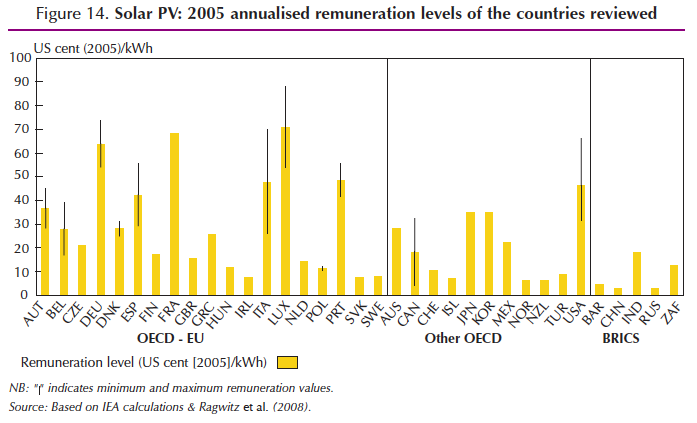
    In 2008, the International Energy Agency released an analysis of policies used to deploy renewables during the period 2000-2005 for the 30 countries of the Organization for Economic Cooperation and Development and for Brazil, Russia, China, India, and South Africa.[xiv] They found that the investment costs of photovoltaic systems are high, representing the most important barrier to their deployment. The agency’s calculated 2000-2005 policy effectiveness levels for photovoltaics are lower by a factor of ten than for more mature renewable technologies such as wind energy. Feed-in tariffs (complemented by the easy availability of soft loans and fair grid access) have been very effective in Germany, albeit at a high cost. In recent years, the level of the German feed in tariff for solar photovoltaics has decreased to some extent, and an element of degression, a pre-determined percentage decrease in the renewable technologies’ support level, has been introduced. The German parliament approved proposals for acceleration of degression rates for stand-alone installations from 5 percent per year in 2008 to 10 percent per year in 2010 and 9 percent from 2011 onwards. According to the IEA, this creates incentives to reduce costs.

    The IEA calculated the remuneration levels in 2005 for each renewable technology for the 35 countries they analyzed. The solar remuneration levels are given in the figure below. In Luxembourg, for example, the remuneration level in 2005 was as high as 90 cents US per kilowatt hour. The average renumeration levels are higher for solar photovoltaic technologies than for other more mature renewable technologies due to their high investment costs.

    solar PV annualized remuneration

    Conclusion

    Even with large subsidies, solar photovoltaic power is having trouble gaining market share, contributing less than one percent to the total power generated in each of the countries that have the largest solar capacity in the world—Germany, Spain, and the United States. The reason is the high investment costs that solar power needs for deployment. Regardless, our Federal and state governments seem intent on making consumers of electricity pay for solar technologies that are not economic against traditional generating technologies causing taxpayers and customers to subsidize their construction and operation. Our state and Federal politicians tout that this will help employment. However, when the largest solar plant built in the United States goes operational on Tuesday, it will lose 393 employees that it employed for less than a year, needing only 7 for ongoing operations.


    [i] http://my.att.net/s/editorial.dll?eeid=6895421&eetype=article&render=y&ck=&ch=mo

    [ii] http://www.fpl.com/environment/solar/desoto.shtml

    [iii] “Solar plant set to open, even as shadows loom”, Herald Tribune, Zac Anderson, Oct. 14, 2009, http://www.heraldtribune.com/article/20091014/ARTICLE/910141033/2055/NEWS?Title=Solar-plant-set-to-open-even-as-shadows-loom

    [iv] Ibid.

    [v] Energy Information Administration, Assumptions to the Annual Energy outlook 2009, Table 8.2, http://www.eia.doe.gov/oiaf/aeo/assumption/index.html

    [vi] http://www.instituteforenergyresearch.org/2009/10/19/the-u-s-doubles-down-on-solar-subsidies-while-europe-retreats/

    [vii]“Solar plant set to open, even as shadows loom”, Herald Tribune, Zac Anderson, Oct. 14, 2009, http://www.heraldtribune.com/article/20091014/ARTICLE/910141033/2055/NEWS?Title=Solar-plant-set-to-open-even-as-shadows-loom

    [viii] Solar Energy Industries Association, http://www.seia.org/cs/about_solar_energy/industry_data

    [ix]“Economic Impacts from the promotion of renewable energies”, Rheinisch-Westfalisches Institut fur Wirtschaftsforschung , http://www.instituteforenergyresearch.org/germany/Germany_Study_-_FINAL.pdf

    [x] “Solar-Power Incentives in Germany Draw Fire,” Vanessa Fuhrmans, Wall Street Journal, September 28, 2009, http://online.wsj.com/article/SB125383541153239329.html

    [xi] Study of the effects on employment of public aid to renewable energy sources, Universidad Rey Juan Carlos, March 2009, http://www.juandemariana.org/pdf/090327-employment-public-aid-renewable.pdf

    [xii] Wall Street Journal, “Darker Times for Solar-Power Industry”, May 11, 2009, http://online.wsj.com/article/SB124199500034504717.html .

    [xiii] Energy Information Administration, International Energy Outlook 2009, May 2009, page 68, http://www.eia.doe.gov/oiaf/ieo/pdf/0484(2009).pdf .

    [xiv] International Energy Agency, “Deploying Renewables: Principles for Effective Policies”