In advance of the BlackBerry Storm2 release, RIM has released OS 5.0 for the first generation BlackBerry Storm. There are a host of improvements as detailed by RIM.
New Power / Lock button usage
Using the Power or Lock button on the top of the BlackBerry smartphone, you can perform the following tasks depending on the state of the BlackBerry smartphone:
State of the BlackBerry smartphone: Unlocked and the back light is turned on
Action: Press and release button.
Result: Locks the BlackBerry smartphone and turns off the back light.
Action: Press and hold button.
Result: Turns off the BlackBerry smartphone.
State of the BlackBerry smartphone: Unlocked and the back light is turned off
Action: Press and release button.
Result: Turns on the back light.
Action: Press and hold button.
Result: Turns on the back light and displays the power off prompt.
State of the BlackBerry smartphone: Locked and the back light is turned off
Action: Press and release button.
Result: Turns on the back light and displays the unlock prompt.
Action: Press and hold button.
Result: Turns on the back light and presents the power off prompt.
State of the BlackBerry smartphone: Locked and back light is turned on
Action: Press and release button.
Result: Presents the unlock prompt.
Action: Press and hold.
Result: Presents the power off prompt.
Verizon released the BlackBerry OS 5.0 update alongside the Storm2 launch date this morning. I just had to try it out as I had ranked the BlackBerry Storm as the worst phone ever made. I’ve only had the update loaded for about an hour so far, but everything seems slightly better including the reception, responsiveness, and the iPhone-like effects. I still don’t like the phone but at least it seems usable now.
Leaky gut syndrome is a phenomenon that may, or may not, actually exist. The theory is that things (such as antibiotics, infections, and inflammation) can damage the cells that line the intestines and weaken the “tight junctions” between the cells. This causes there to be small gaps between the cells and, thus, particles that the cells would normally prevent from entering the bloodstream get through. This, in turn, causes the body to mount an immune reaction against these particles which are viewed as foreign invaders.
A leaky gut has been implicated by various nutritionists as one of the causes of chronic fatigue syndrome — another syndrome about which little is known with certainty.
It is my own personal theory that allergy tests that measure immunoglobulin G (IgG), and find that someone is “allergic” to a host of different foods, are sometimes merely uncovering a leaky gut in someone who is not actually allergic to all or most of those foods.
So what does the research say? Not much. There has been very little published on leaky gut syndrome. I could find only one clinical trial (1).
The purpose of this trial was to see if they could get immunoglobulin A (IgA) and M (IgM) levels to go down in people with chronic fatigue syndrome. To do this, they used a dietary regimen, but their purpose was not to actually test this regimen, and they, therefore, give very few details about it; they merely say:
“All patients followed the leaky gut diet and took glutamine, zinc and [N-acetyl-L-cysteine], in combination with other [natural anti-inflammatory and antioxidative substances], which were given according to the immune and biochemical status of the patients, i.e. L-carnitine, coenzyme Q10, taurine and lipoic acid (in case of carnitine and/or coenzyme Q10 shortage); or curcumine and quercitine (in case of systemic or intracellular inflammation).”
They described their “leaky gut diet” as a dairy and gluten-free, low-carbohydrate diet.
Their study found that some people’s IgA and IgM levels were reduced on this regimen. They also found that a younger age at onset of chronic fatigue, a shorter duration of illness, and a younger age of the patient led to a better outcome.
It’s important to note that there was no control group and so it could be that patients were merely responding to the care and attention they were receiving or from a placebo effect.
This blog post is just to get something started on the subject. As more research comes out, I will post updates.
It looks like the US Chamber of Commerce Web site, and has a convincing URL: www.chamber-of-commerce.us. It bears the seal of the Chamber, a private organization that advocates for business issues before federal legislators. And where you’d expect to find links to the real Chamber Web site, there they are — real links to www.uschamber.com.
But it’s another daring act of imitation crafted by the self-proclaimed impostors known as the Yes Men — the same group that, in 2004, successfully pretended to be Dow Chemical representatives, appearing on the BBC to take responsibility for the Bhopal chemical plant tragedy. This was after Yes Men posted a similar impostor Web site purporting to come from Dow Chemical. That site had a press response address, to which the BBC addressed its request for an interview, and from which Yes Men — still pretending — complied.
A transcript of what appeared to be a speech from Chamber president Thomas Donohue from the National Press Club appeared last week on the fake Chamber site, appearing to reverse the Chamber’s stance on global climate change issues. “In business, as in life, we sometimes don’t look ahead. We seize the day while forgetting the year,” the phony speech began. “Let’s remember Lehman Brothers, a committed, solid member of this Chamber, who in the interest of short-term gain scuttled a century. They ate lamb, but were left without wool when the cold, hard winter set in. We must learn from the past, so that we can manage the future.”
Continuing what may be a perfect batting average on the subject, Reuters ran the phony press release as actual news, and both CNBC and Fox News interrupted programming to report the developments as real. In a face-saving attempt, a CNBC commentator suggested that perhaps the White House, not the Yes Men, was actually responsible for the hoax.
The Chamber’s real viewpoints on the dubiousness of scientific data pointing to the trends of global climate change, have recently prompted high-level members such as Apple and GE to resign their membership.
Last week, the real US Chamber issued a DMCA takedown notice (PDF available here) to the ISP hosting the phony site, Fremont, California-based Hurricane Electric. “The Web site infringes the Chamber of Commerce’s copyrights by directly copying the images, logos, design, and layout of the Chamber of Commerce’s copyright-protected official Web site,” the notice reads.
The ISP’s defense, according to the Chamber, was that it was an “upstream provider,” and thus unable to comply.
Two Web sites side-by-side: [left] the real US Chamber of Commerce; [right] the Yes Men rip-off.
Last Thursday, the Yes Men’s response came from its own lawyers: counsel for the Electronic Frontier Foundation. In a letter to the Chamber’s attorneys sent that day (PDF available here), warning that if Hurricane Electric complies with the takedown request, the Chamber may be liable for misrepresentation of infringement. Citing the Supreme Court, the EFF’s Matthew Zimmerman wrote, “parodies must often use substantial portions of an original work to make their point.”
But the problem — one which may haunt both the Yes Men and the Chamber — is that the law has never been particularly clear on this point. What’s more, the law has been specifically clear about the extent to which it has been unclear, pointing to a glaring, seven decades-long gap that has never quite been filled.
The first real legal precedent on the electronic use of parody came by way of a 1956 ruling from the Ninth Circuit Court of Appeals, against comedian Jack Benny. At the time, his TV show periodically produced send-ups of popular movies, and Benny’s troupe had performed a parody of the 1944 movie Gaslight with Charles Boyer and Ingrid Bergman, based on the theatrical play. The rights holders to that production, Loew’s Incorporated, claimed copyright infringement and won, and Benny’s appeal was denied, after Loew’s had argued that Benny’s defense of parody-as-fair-use couldn’t hold up. To be parody, Loew’s said, it had to be funny.
The courts struggled to bypass having to address those arguments; and eventually the Ninth Circuit ruled that if a parody resembles its target too closely, that’s copyright infringement. In other words, a reasonable person might be confused into thinking the parody was real because 1) Jack Benny looked so much like Charles Boyer (or Ingrid Bergman); 2) neither the real Gaslight nor the parody were…well, all right, all that funny.
But the case law on the current books comes from the Ninth Circuit’s classic 1978 reversal of itself, in a case surrounding the alleged lack-of-fair-use around some of Walt Disney Co.’s trademarks. The Ninth Circuit decided at that time, “Parody and satire are deserving of substantial freedom — both as entertainment and as a form of social and literary criticism…At the very least, where as here, it is clear that parody has neither the intent nor the effect of fulfilling the demand for the original, and where the parodist does not appropriate a great amount of the original work than is necessary to ‘recall or conjure up’ the object of his satire, a finding of infringement would be improper.”
It’s that case law which the EFF is relying upon for its Yes Men defense. However, here’s the problem: In delineating where its predecessors went wrong, the 1978 Ninth Circuit ruled that a parody should not be confusable with the original, reasoning that true copyright infringement takes place when the infringing work substitutes for the original work.
And there will be the stickler in this latest Yes Men case, for the impostors didn’t just use the name “Thomas J. Donohue,” but also the graphics and style of the real US Chamber Web site. And the bottom of the fake speech transcript page clearly reads, “Copyright 2009 U.S. Chamber of Commerce…All rights reserved.” That’s a mark that traditionally has never been appropriated by others for “fair use” parody.
The implications of a final ruling on this subject go way beyond the interests of parody practitioners. For instance, an individual’s right to register sound-alike domain names, or defacement names such as “AirFranceSucks.com” — a practice currently considered cybersquatting — could become permanently protected by law.
Bloggers at Think Progress chronicled Fox Business and CNBC breaking the fake Yes Men press release as real news.
Meanwhile, a completely separate issue could arise with regard to whether Yes Men appropriated their fake Web site name improperly. The name they chose falls under the .us top-level domain, whose rules are not the same as for .com.
According to the .us domain registration agreement (PDF available here), information posted on a .us Web site may be used by the US government for any purpose. For that reason, according to Dept. of Commerce guidelines, the Web site must disclose its proper identity.
The WHOIS database currently lists the registrant of the fake address as “Support and Commitment, Inc.,” which is known to have also registered “CheneyBush.com,” “georgewbush.org,” and “YesBushCan.com.” Back in 2004, at the height of the presidential campaign, the latter site was responsible for issuing a fake press release, claiming it had defected from its candidate and endorsed John Kerry for President — an announcement that, once again, was covered by real sources as real news.
Qualcomm has joined its rival Intel in jumping aboard the open source bandwagon. The San Diego-based chipmaker today unveiled the Qualcomm Innovation Center, a subsidiary created to “optimize open source software with Qualcomm technology.” The QuIC, as Qualcomm has dubbed it, will be headed by Rob Chandhok, who serves as senior vice president of software strategies for Qualcomm CDMA Technologies.
“Open source and community-driven software development is becoming increasingly important to the wireless industry,” Chandhok said in a prepared statement. “To fulfill this commitment and to provide focus to this effort, Qualcomm has transferred experienced software engineers to QuIC. These engineers will focus on such important open source initiatives as Linux and Webkit, and on open source operating systems such as Symbian, Android and Chrome.”
Qualcomm gained traction in the feature-phone space with its own BREW platform for application development, but working with other platforms is nothing new for the company: Earlier this year it released Java Platform Standard Edition 6 on its Snapdragon ARM-based architecture, and it’s targeting carriers with a cross-platform app store. And while Apple’s proprietary iPhone OS has taken the mobile industry by storm, open source operating systems such as Android, Chrome and Moblin are gaining traction (GigaOM Pro, sub. required) among developers on both handsets and netbooks. Indeed, Intel has partnered with Nokia in an effort to build its open source business in mobile. So as Qualcomm steps up its fight with its rival, the company is sagely placing a wager on the open source market.
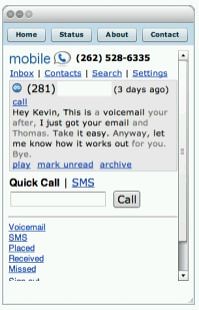
“In this early version, the app is exactly like the mobile version I see on my iPhone,” he writes. “Voicemails even play within GVoice. It refreshes the Inbox every minute, so I’m always up to date on my voicemails and text messages without having to look at my phone. Of course, I can send texts from it or initiate a call to a contact from one of my two phones, as well.”
With the iPhone 3GS, the possibilities are endless. In July 2009, Harold Smith and Graham Mcbain took the iPhone 3GS, and made the first prototype of the OWLE Bubo, which we covered on CrunchGear. Now, just four months later, the OWLE Bubo is ready to ship to the public. OWLE, which stands for Optical Widgets for Life Enhancement, is aiming to making mobile video much easier, by taking the parts you use on your camcorder, and enabling you to use them on the iPhone.
The Bubo comes standard with a hotshoe mount on top for LED lights, four tripod mounts and standard 37mm lens threading so that you can put your own lenses on it, in addition to the lens that the Bubo comes with.
UK folks interested in the iPhone 3GS only have mere weeks to wait before they can shop around and escape the tyranny of O2, according to a report from The Guardian this past weekend. In fact, in only two short weeks, Orange will begin offering the coveted Apple handheld, on Nov. 10.
That’s the day following the end of O2’s exclusivity contract with Apple, so it literally couldn’t begin offering it any earlier. No word yet on when specifically Vodafone will begin offering the device, though it will eventually join its two rivals in selling the 3GS sometime in the new year.
According to The Guardian, despite the iPhone’s strong performance to date, interest in the device in the UK isn’t showing signs of stopping anytime soon:
Certainly interest in the iPhone among UK consumers shows no signs of abating. Already Orange has had over 200,000 customers register their interest in getting the device, before the company has even said what it will charge for it.
While the timing seems ideal in terms of sparking a holiday price war for Christmas consumer dollars, that scenario is actually fairly unlikely, since Orange UK has made statements to the contrary, claiming that instead of offering a lower price on the device than O2, it will try to attract customers with added value. That might take the form of accessories, temporary contract incentives, or pre-loaded applications, which is the mobile equivalent of bloatware, if you ask me.
It’s a disheartening sign for those who were expecting a more open field with regards to the sale of the iPhone to result in more affordable prices, but remember that this is only the beginning. Vodafone will enter the fray in 2010, as will the smallest UK carrier, 3, according to recent statements by the company’s CEO, Kevin Russell:
I would expect the iPhone to be on the 3 network sometime during 2010. At the moment, we don’t have the iPhone. We don’t really have any smartphones, but if we improve our range of smartphones and introduce the iPhone then our data traffic will grow massively.
If networks want to use the iPhone to do more than just retain existing subscribers, they’ll have to begin offering clearly defined advantages, and nothing attracts attention more than lower prices. Remember that the iPhone is already among the most heavily subsidized devices on the market, though, so it isn’t clear how much further providers can go without seriously affecting profitability.
What was the big news that happened in your sector in Q3? Catch up with GigaOM Pro’s, “Quarterly Wrap-ups.”
Not much info on this yet, but NEC is apparently preparing a mobile PC that’s reportedly as “capable as a personal computer” for business customers. The yet to be named device features three main buttons and a 7 to 8-inch LCD display (which appears to be a touch screen). Sorry, the small picture is all that’s available at this point.
NEC says the device boots up quickly and lets users boost productivity through accessing files and software through cloud computing. The company plans to start selling the device in Japan this autumn and wants to sell 100,000 to 200,000 units yearly. Eventually NEC hopes it can sell more than 1 million of the hand-helds each year.
NEC has lost the top spot among Japan’s PC makers to Fujitsu in August (16.2% market share to 16.0%). The company announced a whopping 48 new models last week.
Via Nikkei [registration required, paid subscription]
If you are or ever have been the board gaming type, you may have run across Settlers of Catan, or at least heard of it from a fanatic friend. The game, which is a bit like Risk but without the war (at least in its basic incarnation), is all about resource gathering, trading, and colonization.
Fans of the series (and there are many) will be pleased to know that Settlers is now playable on your iPhone thanks to Catan ($4.99, iTunes link), an app that faithfully recreates the experience on your mobile device. If you aren’t yet a fan, Catan for your iPhone or iPod touch might just be the thing that converts you.
Gameplay
If you’ve played Settlers the board game, or if you’ve played it on your PC or Xbox 360, then you’ll already be familiar with the gameplay in the iPhone version, since it uses the standard rule set. Expansions are available for the board game which add more tiles or new gameplay elements, but for now, Catan on the iPhone doesn’t offer any of these additional modes of play.
The board consists of 19 hexagonal tiles, themselves laid out in a hexagon pattern. Each tile represents one resource, either Sheep, Wheat, Ore, Lumber or Brick. Each player gets to place settlements at the corners of these tiles, and collect resources from them when the number on the tile is rolled. Each tile has a number from 1 to 12, and each player rolls two six-sided die at the beginning of their turn.
Some tiles, like those with a 6 or an 8, come up more frequently, statistically speaking, and are strategically advantageous because of this. The goal in the game is to amass resources, which you can use to buy more settlements, roads, and other things to earn victory points. In traditional play, the first person with 10 victory points is the winner.
Catan on the iPhone lets you play with between three and four players. You can either play against computer opponents, or play hot seat multiplayer mode, in which you pass the iPhone off to other players when it’s their turn. It’s not an ideal multiplayer situation, since you have to trust your partner not to glance at your resource distribution, but without a Wi-Fi or Bluetooth option, it at least works well enough to be playable.
Sights and Sounds
Clearly, Catan wasn’t rushed out to the masses on the iPhone. Developer United Soft Media (USM) took its time in refining the look and feel of this cult sensation before its release, probably predicting correctly that fans of the game would be sticklers when it came this version’s faithfulness to the original.
The board is viewed from a top-down perspective, and you can zoom in or out using touch controls. Your resource count is displayed at the bottom of the screen in a convenient and non-obtrusive status bar. All of your controls are nested in a pop-out tab interface usually hidden at the right side of the screen behind an arrow button.
Sound is great, with a nice, fitting soundtrack running in the background, and appropriate sound effects for things like trades, resources, and standard button presses. In fact, I’d say it compares favorably even to the console version on the Xbox 360.
Conclusion
Whether you’ve heard of Settlers of Catan before or not, the iPhone port is an awesome time-waster. It’s engrossing, rich, and carefully tailored to the handheld touch-controlled platform. I will say that I found the difficulty to be rather on the challenging side, even when playing against a stacked line up of all the weakest computer players. The Xbox version has both a universal difficulty switcher and different AIs, allowing for greater versatility, and I would recommend Catan for iPhone adopt that in future, too. Still, for $4.99, you couldn’t ask for a better or more challenging pocket strategy game.
Growing mobile data use turned up heat on carriers in Q3. Read the, “Mobile Q3 Wrap-up.”
Friday afternoon in the Jacqueline Kennedy Garden, First Lady Michelle Obama donned pink to honor the millions of women and families affected by breast cancer. Speaking to a crowd of survivors, lawmakers, and doctors, the First Lady highlighted the importance of adequate health coverage for those facing the disease. One in eight women will be diagnosed with breast cancer this year, and these women deserve to battle their disease without the worry of their insurance companies letting them down:
And this is a disease, as we know, that affects not just those diagnosed with it, and not just those who’ve survived it and those who’ve lost their lives to it, but it is a disease that also affects those who love and know them — which these days seems like almost every single person in this country.
That’s why it is so critically important that we finally reform our health care system that is causing so much heartache for so many people affected by this disease. Now is the time.
Fortunately, that’s exactly what the plans being considered by Congress right now would do.
So just to be clear, under these plans, if you already have insurance that works for you, then you’re all set. You can keep your insurance and you can keep your doctors.
The plans put in place some basic rules of the road to protect you from abuses and unfair practices by insurance companies. That would mean no more denying coverage to people like women we heard from today because of so-called preexisting conditions like having survived cancer. (Applause.) Because there’s a belief that if you’ve already fought cancer, you shouldn’t have to also fight with insurance companies to get the coverage that you need at a price that you can afford. (Applause.)
These plans mean insurance companies will no longer be allowed to cap the amount of coverage that you can get, and will limit how much insurance companies can charge you for out-of-pocket expenses, because in this country, getting sick shouldn’t mean going bankrupt. (Applause.)
And finally, these plans will require insurance companies to cover basic preventative care — from routine checkups, to mammograms, to pap smears — at no extra charge to you. And though I want to emphasize that in the end, as we all know, it’s our responsibility as women to also talk to our doctors about what screenings that we need and then make the appointments to get those screenings, even when it’s inconvenient or maybe a little bit uncomfortable. It’s something that we owe not just to ourselves but to the people that love us.
(First Lady Michelle Obama talks with a participant following a Breast Cancer Awareness Month event in the East Garden of the White House, Oct. 23, 2009. Official White House Photo by Samantha Appleton)
What happens when you pull off a Night Elf Huntress rush and see it fall apart before your eyes? You get a counter rush in the form of an Undead ghoul rush of course. What to you do?
You run.
You run back to your base and hope your micro can save your failed onslaught and hopefully win you the game. Which was what happened.
The videos of me and my friend duking it out in Echo Isles in a Warcraft 3: The Frozen throne 1.24b after the jump.
\”Drug Free is the Key\” for the Defense Department’s Red Ribbon Week this year
as it works to raise public awareness and mobilize communities to combat tobacco,
alcohol and drug use among military personnel, civilians and families.
…
U.S. Navy warships set anchor in the Mediterranean Sea on the coast of Israel as
Israeli Defense Forces, joined by more than 1,000 U.S. servicemembers, prepared
for a simulated missile attack against the capital city…
An Arizona Air National Guard MQ-1B Predator pilot recently received the Air
National Guard’s nomination for the Air Force’s Lance P. Sijan Leadership
Award…
More than 300 Puerto Rico National Guardsmen responded to a massive fire that
burned throughout much of the weekend at the Caribbean Petroleum Corporation’s
refinery near San Juan, Puerto Rico…
Amazon’s infamous “one-click” patent is quite often rolled out as an example of how ridiculous our patent system has become. At times, even Jeff Bezos has indicated he realizes this… and yet, the company still keeps on fighting for control over the “one click” concept. In the US, the patent is still involved in a re-exam, but up in Canada, the patent was rejected this summer, along with a rejection of pretty much all software/business model patents in Canada — saying that without specific new laws from the government, such things would be considered unpatentable in Canada. Michael Geist points out that Amazon, rather than leaving well enough alone, is appealing the rejection in Canada.
I have to admit that I don’t understand why Amazon is fighting for this patent any more. The management there has to realize that this patent is case study #1 in the problems of the patent system. And, while it did try to enforce the patent against Barnes & Noble in the past, as far as I’m aware, it hasn’t bothered to enforce the patent against anyone else in many years (anyone have any info to the contrary?). Continuing to fight for this patent in both the US and Canada doesn’t seem to add any value whatsoever to Amazon, but just highlights how the company appears to be abusing the patent system with ridiculous patents.
Cross-posted from the Department of Transportation’s Fast Lane blog.
This is the final week of the GreenGov Challenge, and I urge everyone to view some of the remarkable sustainability ideas submitted thus far by government and military employees.
And for those readers who are government or military employees, I urge you to share your suggestions. Though nearly 6,000 have been submitted thus far, that good idea in your mind right now could rewrite the way the Federal government reduces energy use, conserves water, reduces waste, and supports clean technology.
SolarWinds (NYSE: SWI), an Austin, Texas-based provider of network management software for the SMB/SME market, has filed to sell 11.5 million shares via a secondary public offering. The company itself would sell 1.5 million shares, while the remainder would be offered by existing backers like Insight Venture Partners (approx. 2.5 million shares), Bain Capital Ventures (2m) and Austin Ventures (276k). Each selling shareholder would retain an equity position in SolarWinds.
SolarWinds stock closed Friday at $19.84 per share, compared to a May IPO price of $12.50 per share.www.solarwinds.com

 Verizon released the BlackBerry OS 5.0 update alongside the
 ![Two Web sites side-by-side: [Left] The real US Chamber of Commerce; [Right] the Yes Men rip-off](http://images.betanews.com/media/3982.jpg "Two Web sites side-by-side: [Left] The real US Chamber of Commerce; [Right] the Yes Men rip-off")


 Qualcomm has joined its rival Intel in jumping aboard the open source bandwagon. The San Diego-based chipmaker


 With the iPhone 3GS, the possibilities are endless. In July 2009, Harold Smith and Graham Mcbain took the iPhone 3GS, and made the first prototype of the OWLE Bubo, which we covered on CrunchGear. Now, just four months later, the OWLE Bubo is ready to ship to the public. OWLE, which stands for Optical Widgets for Life Enhancement, is aiming to making mobile video much easier, by taking the parts you use on your camcorder, and enabling you to use them on the iPhone.
 UK folks interested in the iPhone 3GS only have mere weeks to wait before they can shop around and escape the tyranny of O2, according to a report from The Guardian this past weekend. In fact, in only two short weeks, Orange will begin offering the coveted Apple handheld, on Nov. 10.


 If you are or ever have been the board gaming type, you may have run across
  Gameplay
 Some tiles, like those with a 6 or an 8, come up more frequently, statistically speaking, and are strategically advantageous because of this. The goal in the game is to amass resources, which you can use to buy more settlements, roads, and other things to earn victory points. In traditional play, the first person with 10 victory points is the winner.
 Sound is great, with a nice, fitting soundtrack running in the background, and appropriate sound effects for things like trades, resources, and standard button presses. In fact, I’d say it compares favorably even to the console version on the Xbox 360.


