Last week, Volkswagen “launched” the new 2010 GTI via an iPhone App. This week, famous rock band Alice in Chains launches its new album via an iPhone App. It comes out tomorrow, and includes the album itself, along with photos, news, videos, etc. Think of it as a bonus DVD, back in the early days of when the record labels were trying to figure out how to get people to buy CDs.
Blog
-
Alice in Chains launches its new album, yes, via an iPhone App
-
BlackBerry 5.0, T-Mobile Price Cuts & More Mobile Monday Madness
What a Monday it is turning out to be for the mobile industry — one major news announcement after another. Three of the most notable include:- BlackBerry 5.0, the latest operating system update for RIM devices, is out. James Kendrick from jkOnTheRun has the details. From what I understand, it has follow-up flags for email, which makes it pretty useful.
- T-Mobile USA caused a major upheaval yesterday when it announced an everything unlimited plan for $79 a month. You just need to bring your own devices. Jason Devitt, CEO of Skydeck and one of our favorite mobile industry insiders, thinks this is a major development as it indicates that the market might be ready to transition from the culture of two-year contracts and subsidized phones.
- Verizon is betting that a slew of new devices, including the Android-powered Droid, are going to push its sales up in the coming quarters. The company needs a hit phone badly: It added 1.2 million new subscribers in the third quarter vs. 2 million added by archnemesis AT&T during the same period.

-
PS3 Netflix: The best use of BD-Live yet
Finally, Sony’s PlayStation 3 home video game console and Blu-ray player will be receiving Netflix Instant streaming, a feature which has appeared on a number of other pieces of hardware, including rival console Xbox 360 and connected Blu-ray players from manufacturers such as Samsung, LG, and even Sony itself.
But unlike those other platforms, which connect to Netflix Instant Streaming through an interface native to the console, PlayStation 3 users will be required to boot up the service from a Netflix Blu-ray disc, which utilizes BD-Live to access the online content. BD-Live is a Blu-ray standard which lets a disc have downloadable bonus content instead of limiting it to content burned onto the disc.
Wedbush Morgan analyst Michael Pachter believes the BD-Live technique was chosen to work around some exclusivity clauses between Netflix and Microsoft, but the real reason is unknown. We’ve contacted Netflix and Sony for comment on Pachter’s hypothesis, and will update with their responses as they arrive.
But whatever the reason, the inclusion of Netflix on PlayStation 3 means big things. Firstly, and most obviously, it takes away one of the major exclusive capabilities of Microsoft’s Xbox 360 and offers it for free. On the 360, Netflix subscribers must also be an Xbox Live gold member, which costs $50 a year, raising the price of Netflix streaming-only access by some 46%. This adds fodder to the debate that the PS3’s online capabilities are not as good as the 360’s, but are at least offered freely.
Secondly, this will help expose even more consumers to Netflix Instant streaming. The PS3 has an estimated 9 million users now, and numbers have been swelling rapidly thanks to the recent — and long demanded — console price cut. The Netflix disc can be obtained free of charge and opens the PS3 to the streaming library of more than 17,000 titles. Rather than pack the disc with the PlayStation 3, Netflix is only making the Instant Streaming discs available through the mail, which could ensure higher customer conversion.
Thirdly, this has potential to be the single largest use of BD-Live yet. In September, Deluxe Digital Studios said users were connecting to BD-Live about 4 million times a month, with the majority of interest coming in the form of downloadable trailers. Meanwhile, the first three months after Netflix was introduced on Xbox Live, more than 1 million users were connected to the service for 1.5 billion minutes. Even if users were connecting to BD-Live in five-minute increments, which is long for a trailer, that would still only amount to 20 million minutes a month.
-
U.K. Social Networking Sites Account For 25% Of Display Ads
Social networking sites in the U.K. accounted for 13.8 billion display ad impressions in August 2009, representing more than 25 percent of all display ads viewed online, according to a new study by comScore.
Telecommunications companies were the heaviest social networking site advertisers, serving more than 949 million display ad impressions on social networks in August, or about 7 percent of all display ads delivered in the site category.
The retail advertiser category ranked second with 753 million display ad views, followed by banking brands with 248 million, travel brands with 213 million, and entertainment brands with 181 million display ad views.
Among the top 10 advertiser categories on social networking sites, teen content advertisers delivered the highest amount of their ad impressions in the social networking category at 37.3 percent. Online dating advertiser (33.8%) and retail advertisers (30.1%) also delivered an above average proportion of their ads in the site category.
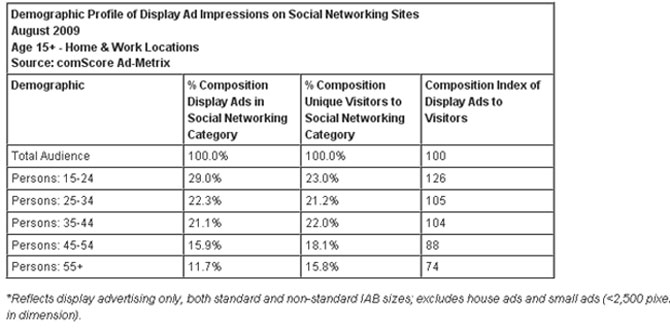
A demographic analysis of display ads on social networking sites in the U.K. found while ad delivery skewed somewhat younger than average, all age segments were reached with a notable percentage of display ads.

Display-Ad-Demographics15-24 year olds were the highest indexing age segment, accounting for 29 percent of display ad impressions while representing 23 percent of the total category audience. Those between the ages of 25-44 received ads at a slightly higher than average rate, while those 45 and older received ads at a lower than average rate. Each of the five age segments accounted for at least 15 percent of the category audience and 10 percent of ad impressions.
“CPMs on social networking sites have traditionally suffered relative to other content categories, in part because of the perception that much of the audience are younger consumers with lower spending power,” said Mike Read, comScore managing director, Europe.
“However, these data suggest that every demographic segment is reached via social networking sites and that no particular age segment accounts for an overwhelming percentage of ads delivered. Given the overall reach and volume of ads delivered on social networking sites, brand advertisers who ignore this channel may be missing a significant opportunity and enabling their competitors to gain a dominant share of voice in the channel.”
Related Articles:
> Making Money With Social Media
>Facebook Can Drive More Traffic Than Google
> Social Media Will Not Replace Search
-
Social Networks Blamed For $2.25B In Lost Productivity
Short stretches can really accumulate. Did you know, for instance, that if someone comes back from lunch nine or ten minutes late every day, he (or she) will take the equivalent of free week of paid vacation per year? And similarly, one IT services and technology company believes social networking is costing UK businesses $2.25 billion each year.
Morse surveyed 1,460 office workers, and on average, they admitted to spending 40 minutes per week on Twitter, Facebook, and the like. While on the clock, and for personal use. Morse did some multiplying and came up with the figure $2.25 billion (or actually, £1.38 billion – we converted) in lost productivity.
What’s more, Morse tried to make its estimate conservative. It turns out that, when asked about their coworkers, the respondents said they believe the average amount of time spent on social networks is closer to 59 minutes.
Philip Wicks, a consultant at Morse, observed in a statement, "The popularity of social networking sites such as Twitter and Facebook has grown considerably over the last couple of years, however with it has come the temptation to visit such sites during office hours. When it comes to an office environment the use of these sites is clearly becoming a productivity black hole."
Don’t be surprised if another wave of businesses decides to create usage policies or block its employees from accessing Facebook, Twitter, and MySpace, then.
Related Articles:
> Hitwise: Facebook Receives One-Seventh Of UK Page Views
> Online Retailers To Focus On Facebook And Twitter During Holidays
> Hitwise: Facebook’s Social Market Share Up 194 Percent
-
Google Taken To Court To Explain Why It Shut Down Someone’s Gmail Over Missent Email
Paul Alan Levy writes “Last month, you wrote about the travesty perpetrated by Rocky Mountain Bank when it sued Google to shut down the gmail account of a Google customer to whom the bank had mistakenly emailed a pile of customer records. Equally disturbing was the way that Google — which is usually pretty good about standing up to subpoenas for customer identity — just rolled over and obeyed the court’s order even though a second’s review of the company’s ex parte arguments to the court showed both that the bank never explained what the Gmail customer did wrong, never explained how Google could be sued in the face of 47 USC 230, and never showed that there was diversity jurisdiction.
So we have gone back to court, representing MediaPost Communications, arguing that Google’s report to the Court, showing its compliance, is a judicial record that should have been, and now must be, filed publicly. We agree of course that any actual customer identification in the compliance report should be redacted.”
This is a tricky issue. After all, Google, as a private company, has the right to shut down an email account on its own. But, seeing as this was all a part of a legal case, with a number of questionable elements, it does seem like the information that led to the account being shut down should be a part of the public record.
Permalink | Comments | Email This Story
-
Digital Contents Expo Tokyo: Awesome “Time And Space Mapping Software”

The Tokyo Polytechnic University has showcased c-loc at this year’s Digital Contents Expo, a spectacular mapping software for “time and space” that runs on a touch screen. The technology looks super-futuristic, and it not only works but is actually useful, too.
The idea is to visualize geographical and chronological data via 3D graphics and let users easily access and alter the data they see via a touch screen. c-loc can cover text-based information, images, sounds and videos. You can use it to visualize how a certain building (space) evolves over the years (time), for example. The makers target archeologists, historians, urban researchers and others with their product.
Here are two videos I took of the mapping software in action at the event yesterday.
Video 1:
Video 2:
-
Transcript: Health On The Hill – October 26, 2009
KHN’s Mary Agnes Carey and Eric Pianin talk about new optimism among liberal Democrats that a public option will be included in the final health overhaul bill. They also discuss Senate Majority Leader Harry Reid’s determination to have a bill soon. View the HOTH video or listen to the audio version (mp3).
Related Video
Transcript:
JACKIE JUDD: Good day. I am Jackie Judd with Health on the Hill, a conversation about efforts to pass health care reform legislation. Joining me, Mary Agnes Carey of Kaiser Health News and Eric Pianin, also of Kaiser Health News. Welcome to you both. Over the weekend, it became apparent that the public option, the discussion of the public option has been revived. What happened?
MARY AGNES CAREY: It’s an amazing story. If you look back at the Town Hall meetings in August, a lot of opposition, loud opposition to the public plan. About a month ago, the Senate Finance Committee took a vote and did not vote for the public plan to be included in the Senate Finance Bill. At that point, a lot of analysts thought it was dead.
I think there has been a lot of pushback from progressive groups, from Democrats who have said now wait a minute, this debate is about choice and we want the public plan in there to provide choice to millions of Americans to help in the Democrats’ words and the words of President Obama “keep health insurers honest.” I think there was a very strong pushback and this is where we are now.
JACKIE JUDD: And what are the range of ideas now when we say the public plan, both in the House and the Senate?
MARY AGNES CAREY: There is debate over what the rates would be paid, for example, and the more robust option in the House had considered in the past was setting provider rates, what was paid to the doctors and physicians, tagging that to the Medicare reimbursement rates, or perhaps adding 5-percent additional for physicians.
There seems to be more support coalescing behind a public plan where the rates are negotiated, so it means you wouldn’t save as much money, but it may be more political acceptable to folks, and now there is a discussion about putting the public plan into the Bill, letting states opt out if they choose.
JACKIE JUDD: And what does the White House think of all this discussion?
ERIC PIANIN: Well, I think the White House is very excited that the prospects of improved or passage of health care reform this fall. The President desperately wants to have a Bill on his desk. I think that there still is some real tension between the White House and Congressional Leaders over the best approach and what form of public option would be most saleable and politically wise.
JACKIE JUDD: What signals did you pick up on over the weekend about what the White House would like the public option to look like at this moment?
ERIC PIANIN: I think the President and his advisors want what many people think is a relatively weak version of the public option. They don’t want the public option to take effect immediately. Instead, they want to see how the legislation works out.
If, down the road in certain states, citizens are not afforded adequate insurance at reasonable prices, if in some states 95-percent of the citizens do not have the option of getting affordable insurance, then this public option would trigger in. And I think that there is a feeling on the Hill, particularly among liberal Democrats including Harry Reid the Senate Majority Leader that is too weak a version.
What they would prefer is what Mary Agnes was discussing, this provision where you create a public option, if states want to opt out of it they may, but for the rest of the country there would be a public option.
JACKIE JUDD: And what is the political calculation that the White House would at this moment support? What is the most cautious approach to a public option?
ERIC PIANIN: Well, I think that the President at this point would prefer the trigger mechanism and I think part of it is a concern that many conservative Democrats who have to run for reelection next year would have a very tough time defending a robust public option. They want the weakest version, if you will, and the trigger mechanism certainly fills that Bill.
JACKIE JUDD: Okay and on Capitol Hill, Senator Reid, the Senate Majority Leader, is trying to cobble together a single Bill from the two committee Bills. What is the status of that?
MARY AGNES CAREY: The negotiations are ongoing with members of the Senate Health, Education, Labor and Pensions Committee as well as the Finance Committee. We have had White House representatives in the room. They are hoping to finalize the discussions this week, get a Bill to the Congressional Budget Office, also known as the CBO, to give a score to see if it will hit that $900 billion mark that the President has set and if it doesn’t they would have to make adjustments but they want to see what the price tag is because they have told members that they want to do that before the Bill goes to the floor.
JACKIE JUDD: But we don’t know the contours of it yet.
MARY AGNES CAREY: We don’t know yet. Of course, they are negotiating; for example, the Bills differ on things like would there be an employer mandate? It is in the HELP Committee Bill, not in the Senate Finance Bill. How would the individual mandate work? The HELP Committee Bill has a very robust public option. The Senate Finance Bill has this co-op provision that had been inserted, so we have to see how they work out those differences.
JACKIE JUDD: Okay, thank you to both, and thank you for joining us. I’m Jackie Judd.
-
Need a replica iPhone? No? Well here’s one anyway.
![Screen shot 2009-10-26 at [ October 26 ] 9.50.26 AM](http://www.mobilecrunch.com/wp-content/uploads/2009/10/Screen-shot-2009-10-26-at-October-26-9.50.26-AM.png)
In just about every other movie or TV show we watch, at least one of the characters (if not half the cast) is rocking the iPhone. For example: Have you seen Chuck? If not, you definitely should — it’s a great show — but it has more Apples than Granny Smith.
Sooner or later, one of these shows is going to have a reason to destroy an iPhone on camera. Up until now, the prop folks have only read had two options: Smash a real iPhone to pieces, or recreate the iPhone in one-off prop form. Depending on the size of the production, either of those options might be a bit too pricey. Enter: the iPhone dummy.
-
Facebook Makes Share Buttons More Useful
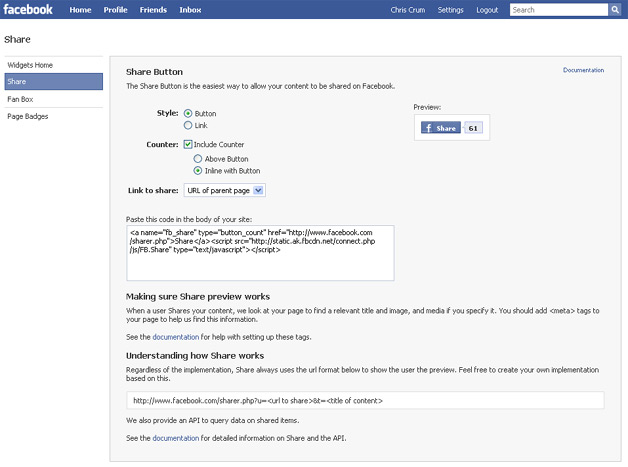
Facebook launched a new version of its Share button today. This includes a live counter and analytics. When you use the new share button on your content, you can measure engagement and view the number of shares, likes, comments made, and clicks back to your site.
"Share analytics bring new opportunities to show how content is being shared on Facebook, such as Techmeme for selecting top stories and bit.ly for analyzing URL traffic," a spokesperson for Facebook tells WebProNews. "The new Share button is among the easiest Facebook Connect widgets to install and can be added to any website with just a few lines of code."
To get the share button, go to Facebook’s widgets page. From there, you can set up how you want it to look and retrieve the appropriate code.

The Facebook share button can be a tremendous contributor to the driving of traffic via the social network. Once Facebook updates begin appearing in Bing results (and possibly Google if Google makes a deal with Facebook) search and share buttons should combine for some major measurable traffic.
According to Facebook, users share over 2 billion pieces of content on the social network each week. Most of that, the company says, is facilitated by Facebook Share buttons across the web. More on the new share button here.
Related Articles:> Facebook Can Drive More Traffic Than Google
> Facebook Pages to Get Click Through Rates
> TweetMeme Bringing Analytics to the Retweet Table
-
New on GigaOM Pro: Where the Real World Meets the Web
As we saw at last week’s “What’s Next for the Web?” Bunker Series event, we’re pushing the boundaries of the web. The NewNet, as we call it, is blurring the lines between what’s online and what’s real life. From augmented reality apps to location-based services and speech-activated mobile tools, technology is increasingly working to leverage everyday human interaction as its interface with the world. This morning, we have two pieces on our subscription research service, GigaOM Pro, looking at this very trend.First, Ed Gubbins takes a look at how this shift is impacting the search market, in “How Search Is Evolving Beyond Text.” We wrote a lot last week about the move toward real-time search, but audio, video and image search are growing up, too. Whether its matching input sounds and images with indexed sounds and images or leveraging crowd-sourced metadata on video clips, new tools are helping seekers get the content they’re looking for without relying on the simple text query.
Liz Shannon Miller flips the question on its head to show how web analytics can act as a road map to success for real-world events. As we interact with online content, we leave dozens of digital footprints about who we are, what we like, and where we live. In “New Use For Web Stats: Finding Hot Markets, Offline,” Liz looks at how everyone from indie films and big-name bands is tapping into this rich data source to build an audience.
Sign up with GigaOM Pro today to read these and dozens of other detailed research briefings and in-depth articles in each of five areas: NewNet, Mobile, Connected Consumer, Infrastructure and Green IT. Today’s also the last day to take advantage of our Bunker event discount code for GigaOM Pro. Sign up using this discount code “BUNKER1019″ and get $20 off the regular one-year subscription price of $79.

-
At long last, an iPhone quiver
Nothing says “please rob me blind” like riding a foot-powered scooter and housing your iPhone in a dedicated quiver-like sash that exposes the top-most part of the device, logo and all.
But if you’re confident in your ability to maneuver your scooter safely out of harm’s way or you live in some sort of suburban utopia where nobody gets their i-Products stolen, then perhaps the $20 Strap Pocket for iPhone will appeal to you.
It’s made of light and durable and Neoprene and works with all generations of iPhone and iPod touch models (and, of course, other similarly-sized gadgets). There’s a main pocket for the device, a smaller pocket for headphones, and a buckle for attaching it to a full-sized bag “for additional fail-safe security,” according to the product description.
Strap Pocket for iPhone / iPod / Mobilephone [USBfever.com]
-
Blackra1n RC 2 released for your jailbreaking pleasure
Our favorite iPhone outlaw, geohot, has released an update to the iPhone jailbreak software blackra1n. Dubbed RC2 the update addresses several issues including:
- Fixes 3G signal issues
- Tethered jailbreak for 3.1 OOTB iPod touch 8GB and new 3GS’
- Fixes issues with package software”Icy“
- Versions for both Windows and Mac now available
No need to rerun blackra1n if you already applied RC1 successfully, but for those of you who have not been able to crack into your iPiece take RC2 for a spin. Let us know how it goes!
-
On The Media Takes On The Music Industry
WNYC’s excellent radio program On The Media this week decided to spend an hour discussing the music industry. It’s quite well done, in that it highlights how this is actually a great time in the music industry for musicians and fans — with the only party really in trouble being the old record labels. The program talks to numerous knowledgeable people, including James Boyle, Amanda Palmer, Greg Kot and others. The one section, however, that I thought was a bit weak, was the section on live shows. That section only focused large stadium/amphitheater shows — the kind that only a very small number of bands deal with. It doesn’t even mention the much more common forms of touring and live shows. Furthermore, that section only seemed to talk to one individual — a smaller concert promoter who used the part to basically bash Live Nation. Now there are things you can complain about with Live Nation (though, I’d argue that they’ve got a much better understanding of where the market is heading than most people give them credit for based on conversations I’ve had with Live Nation folks), but that segment was incredibly one-sided.
The other thing that I found incredibly telling was that the person who sounded most out of date and most in denial was not the RIAA representatives (who actually sounded at least somewhat circumspect on how the music industry was changing), but Rob Levine from Billboard Magazine, who still insists that it makes no sense to pay attention to “those who steal music.” He brushes aside the band Ok Go for just doing “ok” as if you don’t count unless you go platinum in record sales. He dismisses things done “as a hobby” as simply not mattering. He is, of course, defending Billboard’s obsolete “charts” which are still based mostly on CD sales and radio play, but just comes across as someone who doesn’t even realize what he’s measuring (at 43:15 on the podcast):
“Right, okay, the one thing that does skew our ratings is that older people buy more music. They steal less music…. So like, you know, a Bruce Springsteen or a Madonna might overperform on the album sales chart relative to some more subjective measure of their popularity. But as far as like who’s stealing what… I mean, what use is that?”
And that, right there, is why Billboard has become so obsolete. It’s lead by people who think that file sharing is “stealing” and that it’s meaningless in figuring out where the money is in music. It ignores the studies that have shown that people who download also end up buying more music. It ignores the studies that show people who download are more likely to attend a show or buy merchandise (things that Billboard doesn’t appear to think matter at all in the industry). It’s as if Billboard wanted to judge the popularity of the transportation industry by judging how many buggy whips are sold. Yes, as automobiles became more popular, buggy whip sales declined. Sucks to be you if you’re focused just on measuring buggy ship sales, but the problem is that you’re measuring the wrong thing.
Instead, the guy who sounds like he’s really looking to the future is Duncan Freeman, of the site Band Metrics, who shows that the really important thing is not figuring out how many CDs are being sold, but how much fans are devoted to an artist (disclosure: I’ve met Duncan a few times at events, and talk to him occasionally about the music industry — he’s also given me an account on Band Metrics to check it out, even though it’s not yet fully public — though, I actually haven’t used it yet). The program shows how a band can actually figure out where their biggest fans are, where they’re getting the most buzz, and actually helps bands better connect with fans in multiple ways — not just on the old model of selling them more CDs.
Oh yeah, one other point. Some Hollywood lawyers were getting on my case earlier this year, every time I claimed that the RIAA announced last year that it was no longer suing end users, even though it did keep suing. Those lawyers insisted that the RIAA said no such thing (even though that’s what all of the press reported). In this podcast, the RIAA’s Jonathan Lamy repeats: “Last December, we officially announced that we would end the litigation program against end users.” Except it hasn’t.
Overall, the program is a really great hour’s worth of discussion on the types of things we regularly talk about here, and well worth a listen if you’re interested in these things.
Permalink | Comments | Email This Story
-
TopTenReviews Adds On
TopTenReviews, an Ogden, Utah-based provider of expert tech and entertainment reviews, has acquired the consumer media division of Imaginova Inc. No financial terms were disclosed for the deal, which includes Space.com, LiveScience.com and Newsarama.com. TopTenReviews raised $6 million in 2007 from Highway 12 Ventures and Village Ventures.
PRESS RELEASE
TopTenREVIEWS today announced it has acquired the Consumer Media Division of Imaginova Inc., a privately held company based in New York City. Included in the acquisition are Space.com, LiveScience.com and Newsarama.com. As part of the ongoing expansion, TopTenREVIEWS has established the TechMediaNetwork to incorporate these properties.TopTenREVIEWS, the 4th largest technology news site according to September 2009 U.S. comScore Media Metrix data, joins Space.com, LiveScience.com and Newsarama.com as TechMediaNetwork properties, a network encompassing technology, science and entertainment. Combined, 12.2 million people visit TechMediaNetwork sites each month.
“This acquisition expands TopTenREVIEWS’ coverage as a trusted technology adviser and strengthens the company as a source of technology news,” said TopTenREVIEWS founder and CEO Jerry Ropelato. “We see strong potential for growth in traffic and revenue as a result of the synergy between the sites.”
TopTenREVIEWS is a privately held technology review Web site covering software, Web services, consumer electronics and entertainment, offering millions of reviews in more than 350 categories. With Space.com, LiveScience.com and Newsarama.com, TopTenREVIEWS expands its coverage to include news and information about technology, science and comic genre entertainment, in addition to content about purchasing the best technology and entertainment products. TopTenREVIEWS will expand its coverage of consumer reviews to include products and services related to the new properties.
“Creating TechMediaNetwork is a natural progression in our company’s goal to create a more comprehensive network of technology and entertainment news, information and purchasing advice,” said Stan Bassett, president of TopTenREVIEWS. “Our new tech network broadens our ability to educate people on a wider range of topics – from astronomy to health to computer security.”
The sites, each brand leaders in their markets, will remain fundamentally the same. The science properties syndicate original content to the following news portals: Yahoo!, MSNBC, AOL, USA Today and FoxNews.com. TopTenREVIEWS will also continue the relationships Imaginova had with the scientific community, including the National Science Foundation (NSF) and the National Aeronautics and Space Administration (NASA), while expanding its technology and entertainment coverage.
Space enthusiasts visit Space.com for compelling content about space science, astronomy and exploration news. Launched in 1999, Space.com has enjoyed the past management participation of several key space-related public figures.
LiveScience.com is the leading source for groundbreaking developments in health, the environment and technology. It is the 2007 winner of the Online Journalism Award for Specialty Journalism among large Web sites, by the Online News Association (ONA). Known for its ability to convert often complex concepts into simple explanations, LiveScience attracts millions of visitors each month.
Newsarama.com provides comprehensive coverage and commentary of comics and genre-related entertainment. It won the 2008 Eisner Award for Best Comics-Related Periodical/Journalism. Entertainment Weekly included Newsarama in its list of “100 Greatest Websites,” and the American Library Association lists it as a research resource in the field of comics.
Founded in 2003, TopTenREVIEWS.com provides consumers with side-by-side product and pricing comparisons to help them research, shop and purchase technology and entertainment products and services. To fuel growth, TopTenREVIEWS received a Series A investment from venture capital firms Highway 12 Ventures and Village Ventures in June 2008. The investment in TopTenREVIEWS built on the success of the initially self-funded company’s vision to change the way consumers shop for technology and entertainment products and services by providing helpful, accurate and unbiased reviews and resources.
To learn more about TechMediaNetwork, visit www.techmedianetwork.com. For more information about TopTenREVIEWS, visit: www.toptenreviews.com/about-us.html. For more information on LiveScience, visit: www.livescience.com; Space.com, www.space.com; and Newsarama, www.newsarama.com.
-
New Nokia netbook next year already?

Rumors are abound that Nokia may be looking to release a new version of its Booklet 3G netbook sometime next year.
I use the term “rumors” loosely as the basic idea seems to be that Compal Electronics, the company that manufactures the current Booklet 3G, is “working overtime to satisfy demand,” according to DigiTimes and, therefore, “market rumors are circulating that Nokia will take advantage of its current netbook momentum by releasing a new version in 2010.”
Yes, that does indeed sound plausible — why not? A computer product released in 2009 that sells well would probably see some sort of update in 2010. And as chipsets get smaller and faster, it’d be silly for Nokia to just sit on a single Booklet offering.
Now information about when a new model would be released might be more helpful. If Nokia’s going to push one out on January 1st or something, it might be a good idea to hold off on buying the current Booklet 3G. From the sounds of it, though, it doesn’t seem like we’re anywhere close to a situation like that:
“Compal is expected to have a good chance of landing the orders, according to the report. However, no special insight was provided as to why Compal will receive the orders except for the fact that the Taiwan-based notebook maker is currently Nokia’s netbook manufacturing partner.”
So take this news with a grain of salt. If the current Booklet 3G is successful, though, it’d be odd if Nokia didn’t update the line sometime next year.
-
Wind Hellas Gets Two Bailout Bids
ATHENS/LONDON (Reuters) – The list of bidders for Greek mobile operator Wind Hellas was whittled down to two on Monday, with only the current owner and a group of bondholders left in the running to bail out the debt-laden company.
Wind Hellas, which must agree a debt restructuring deal with lenders — owed 3.2 billion euros ($4.8 billion) — within the month, said on Monday it would continue to talk to the two bidders and would identify a preferred candidate next week.
The company is looking to secure new cash investment and a reduction in debt, said Matthew Tippetts, director of Wind Hellas parent company Hellas Telecommunications UK.
“The group is now working with its creditors to achieve the necessary consents to implement a transaction,” Tippetts said.
Current owner Weather Investments, majority-owned by Egyptian telecoms tycoon Naguib Sawiris, is one of the bidders, while a group of subordinated bondholders coordinated by Aladdin Capital is the other, the company said in an emailed statement.
U.S. buyout house TPG Capital, which previously owned the company alongside Apax Partners, had also looked closely at making an offer before ultimately declining to do so.
The subordinated bondholders — owed 1.17 billion euros — have said they would be willing to back a buyout of the company if an alternative deal undervalued Wind Hellas’s assets. [ID:nLM294867] (Reporting by Tom Freke and Simon Meads in London, with Harry Papachristou in Athens; Editing by David Holmes) ($1=.6650 Euro)
-
Abraaj Capital In Talks To Invest in Logistics Co.
DUBAI (Reuters) – Abraaj Capital, the Middle East’s biggest private equity firm, is in advanced talks to invest in a logistics firm, and is setting up a new fund worth at least $2 billion to exploit attractive valuations, its managing director said on Monday.
“Right now we do have some transactions at very advanced stages — before the year end or the start of next year … Something in logistics which operates in more than one country. It is not a Gulf company,” Mustafa Abdel-Wadood told the Reuters Middle East Investment Summit.
Asked whether a fourth fund is likely, Abdel-Wadood said: “It is on the way. It is a constant cycle. The size is an adaptive process … It will be larger than the last fund.”
When asked the potential size of the fund Abdel-Wadood said it would be more than $2 billion with funding coming primarily from regional sources.
“Our core supporters will always remain the region, regional institutions, regional investors with increased participation from non-regional investors,” he added.
The firm also has $3 billion to invest in the next two years, roughly the same as January’s level, coming from the current fund and the new fund that is in the making.
Abdel-Wadood said the firm had no plans to “realistically” exit from its existing portfolio companies in the next 18 months.
“This is probably not the best exit environment,” he said. “There is a little bit of a window … but there is no pressure for us to do (that).”
Abraaj has about $6.5 billion in funds under management. Among those investments is a stake in United Arab Emirates-based low-cost carrier Air Arabia (AIRA.DU: Quote, Profile, Research, Stock Buzz).
The private equity firm reiterated its interest in countries with large populations and economies such as Turkey, Saudi Arabia and Egypt. Countries such as Iran have potential but currently still entail too many investment risks, Abdel-Wadood said.
In terms of sectors, Abraaj is looking across the board, but highlighted consumer banking, food, basic infrastructure, healthcare and education.
“The reason is there is a structural imbalance between the demand for all these services and current supply,” Abdel-Wadood said.
Private equity activity in the Middle East has suffered during the crisis, but experts see the industry rebounding in 2010, as liquidity is slowly returning to the market, albeit less abundant and at a higher cost.
“It’s pricier, its less in how much you can leverage … generally it’s not as easy as it was two years ago,” he said.
By Nicolas Parasie and Rachna Uppal
(Additional Reporting by John Irish, Natsuko Waki, Amran Abocar and Chris Wickham; Editing by Rupert Winchester) -
Blackstone Investors Appeal IPO Suit Dismissal
NEW YORK (Reuters) – A group of Blackstone Group LP (BX.N) investors has appealed the dismissal of their class-action lawsuit seeking to hold the private equity firm responsible for their losses on its stock.
The appeal to the U.S. Court of Appeals for the Second Circuit came after Judge Harold Baer of Manhattan federal court last month said the plaintiffs had failed to state a claim on which they could recover.
The plaintiffs had alleged that prior to its initial public offering, Blackstone failed to disclose that investments in bond insurer FGIC, Freescale Semiconductor Inc [FSLSM.UL] and real estate were losing value.
Blackstone went public in June 2007 at $31 per common unit. The price of the units had fallen to about $7 by the time the plaintiffs filed their amended complaint in October 2008.
Baer concluded that Blackstone’s exposure to FGIC and to Freescale fell short of being “material.” He also said the plaintiffs failed to show a link between known problems in residential housing in late 2006 and early 2007 and Blackstone’s investments in commercial and hotel properties.
Blackstone units rose 12 cents to $15.94 in morning trading on the New York Stock Exchange.
The case is Landmen Partners Inc v. Blackstone Group LP, U.S. District Court, Southern District of New York, No. 08-3601. (Reporting by Jonathan Stempel; editing by John Wallace)
-
RiskMetrics Group Opens Comment Period for 2010 Proxy Voting PoliciesSubmitted by: Sarah Cohn, Corporate Communications
RiskMetrics Group today announced the opening of its annual comment period for its 2010 proxy voting policies. The comment period, part of RiskMetrics’ policy development process, offers institutional investors, corporate issuers, and industry constituents the opportunity to provide feedback on RiskMetrics’ draft policies.
The comment period runs through November 11 and covers updates to RiskMetrics’ proxy voting policy in markets worldwide. Topics covered include takeover defenses, board and director independence, executive compensation, and share purchase authorities.
RiskMetrics gathers extensive input each year from clients and market constituents through a policy survey, issue-oriented roundtables and a unique open comment period to ensure its voting policies comprise a broad range of views. This year’s policy survey had over 700 respondents, weighing in on issues ranging from management say-on-pay to sustainability and corporate responsibility. The full results from the survey are posted to RiskMetrics’ Policy Gateway.
RiskMetrics Group plans to release its final 2010 U.S. and International policy updates on November 20 and its Global Policy Summary and Concise Guidelines in late-December. To participate in RiskMetrics’ comment period, please visit here. To learn more about RiskMetrics’ policy formulation process, please visit here.