
Blog

  • Dedicated YouTube channel coming to British TV

    Freesat, the BBC and ITV-backed satellite TV operator, has unveiled plans to launch a dedicated YouTube channel from next month. This will be the first time Google’s service has been made available through a free-to-air provider in the UK.

    Available by the end of March, the YouTube channel will be the very latest iteration built on HTML 5 and, according to Freesat, offer a “TV-optimized, visually stunning and fully interactive viewing experience”. Viewers will be able access videos to watch through the main programming guide.

    Peter Sherman, Product Marketing Manager for YouTube said, “We’re happy to be working with Freesat so that Freesat users can now access YouTube from the platform. Our creator community is developing quality content that will delight and inspire viewers and we’re pleased to be able to bring it to people in new ways”.

    Freesat customers require a set-top box to access the service but do not have to pay a subscription fee. The service launched in 2008 and has just sold its 3 millionth product.

    Photo Credit M.Stasy/Shutterstock

  • Create animated GIFs from YouTube videos with Any GIF Animator

    From a Captain Picard facepalm to a dancing Homer Simpson, there’s an animated GIF for every occasion. Which is one reason why they’re still regularly used in emails, forum posts, on web pages and so on. (Although another is probably compatibility: unlike more modern technologies, such as HTML5 or CSS3, animated GIFs work just about everywhere.)

    If you’re tired of reposting one of the standard animations, though, why not create a new GIF of your own? It’s surprisingly easy. Any GIF Animator imports just about any video or YouTube clip, and once you’ve zoomed in on the section you’d like to use, can have a quality animated GIF ready and online in just a few seconds.

    After a quick installation (no adware, but the program does ask to install Media Player Codec Pack Lite) you’re able to import your first video. The program can open a wide range of formats (3GP, ASF, AVI, DAT, FLV, MKV, MOV, MP4, MPEG, RAM/RM/ RMVB, TS, VOB, WEBM, WMV), and it’ll also download YouTube clips if you just provide the appropriate URL.

    An embedded media player then allows you to browse through your video clip, find and mark the section you’d like to convert. Oddly, you can’t step through the movie in frames — the smallest increment is a tenth of a second — so you’re not able to be as precise as we’d like. But otherwise this is a fairly simple operation, and you’ll quickly have your core clip ready.

    If you’d like fine control over your animation then the good news is that Any GIF Animator provides lots of configuration options. So you can set the GIF’s size and frame rate; crop the image; tweak saturation, brightness and contrast; add a text caption, choose the best dithering method, set the animation type (looping, direction) and more.

    But if you’re not sure whether you need any of this, or are just in a hurry, then you can just accept the default settings — they work well, most of the time.

    And when you’re happy with the clip, all you have to do is click “Convert to GIF” and Any GIF Animator will process your chosen video, create an animated GIF version, and upload it to the AnyGif server, where you’ll be given the URLs you need to share the clip with others.

    One very obvious issue here is that the program doesn’t offer you a choice about uploading animations — it just does it. And your GIF will then immediately be visible to anyone who visits the site, so bear that in mind before you create anything of a, well, personal nature. (We’d also urge caution if you’re looking for something family-friendly; the program itself is fine, but view what others are creating on the website and you’ll find plenty of porn.)

    Perhaps most annoyingly, Any GIF Animator doesn’t even provide an option to save a local copy of your animation. If you want to do this then you’ll need to either allow it to be uploaded, then save it from your browser, or make a copy of the temporary file the program creates — see C:\Users\[UserName]\AppData\Roaming\Any GIF Animator, for instance, or search your system for out.gif.

    There’s a lot to like about Any GIF Animator, then, and you can use it right now to produce quality animations. The program also has some significant annoyances, though, and it really needs a local save option to be added very soon.

    Photo Credit: Alex Kosev/Shutterstock

  • Shervin Pishevar is leaving Menlo VC to start Sherpa, a startup foundry

    shervin-pishevar-MenloVentures_0485_72High profile entrepreneur Shervin Pishevar has carved out a big slice of attention in Silicon Valley. When he is not hobnobbing with Presidents and crown princes, Pishevar, who co-founded Webs.com and Social Gaming Network, is busy talking up companies he has invested in on behalf of Sandhill Road firm, Menlo Ventures.

    We heard about Pishevar’s exit a few days ago and since then have independently confirmed with two sources that he is leaving the firm he joined as a managing director in 2011. Shervin confirmed his exit. He will stay on an adviser to Menlo and is going to join Uber as a strategic adviser. In addition, he plans to start a new company — Sherpa, which is a combination of startup foundry and a fund.

    He explained that Sherpa is a company helping to build other companies, and it will be working with large corporations and other founders to come up with ideas. He declined to offer any details except that he is partnering with Scott Stanford, a Goldman Sachs investment banker, for this new project.

    During his tenure at Menlo, Pishevar had invested in companies such as Uber, Fab, Getaround and Cinemagram. Pishevar is one of the most liked people in the entrepreneur community. He was an angel investor in about three dozen companies before joining Menlo Ventures in 2011.

    Related research and analysis from GigaOM Pro:
    Subscriber content. Sign up for a free trial.

  • How battery improvements will revolutionize the design of the electric car

    Tesla could have never created the Model S — it’s second-generation electric car that won Motor Trend’s car of the year award for 2012 — with battery technology from a few decades ago, said Tesla’s CTO and co-founder J.B. Straubel at the Cleantech Investor Summit last week. He explained, “The type of vehicle we can create is fundamentally different every time that tech [batteries] moves a little forward.”

    While battery innovation appears gradual, the incremental leaps add up over time. Battery innovation is improving around 5 to 8 percent per year, which can deliver a doubling in core performance metrics every ten years, which is ultimately really “revolutionary” said Straubel. Because of the large size and heavy physical weight of batteries involved with electric cars, the impact of battery innovation on the design of the car can be even more significant than Moore’s Law has on some computing products, added Straubel.

    For car design, “It’s almost as if the properties of steel were improving at a rate of 5 to 8 percent per year,” said Straubel.

    Tesla Model S

    The new design and engineering of the Model S has been Tesla’s differentiator, and it is what the company is hoping will help it move into profitability and success as a more mainstream auto maker down the road. The car is one of the first electric cars in the world that was designed from the ground up as electric. In contrast most auto makers that have built electric cars have taken an existing traditional gas-powered car and put batteries in it.

    The Model S, in comparison, has placed the battery along the bottom of the car, so that it doesn’t take up seating and storage space, and also so that the car has a low center of gravity and is more aerodynamic. The Tesla Roadster (it’s first car) and the Nissan LEAF are based on the bodies of gas-powered cars.

    Shai Agassi, the founder and former CEO of Better Place, also touted the importance of the rate of battery innovation during his talk at the Cleantech Investor Summit. He said the energy density of batteries goes up 15 percent every 18 months; the cost per kilowatt hour goes down 15 percent every 18 months; the life cycles of the batteries (how many times it can charge and recharge) goes up 15 percent every 18 months; and the cost per lifecycle-mile does down 50 percent every 18 months. “If you don’t like the margins in this [electric car] business just wait 12 months,” said Agassi.

    The crucial factor for both Tesla and Better Place will be surviving in an early market place as these improvements emerge. As with all startups, timing and execution will be key.

    Related research and analysis from GigaOM Pro:
    Subscriber content. Sign up for a free trial.

  • Reports: Apple testing curved glass, iOS-powered smart watch

    Apple is reportedly exploring different types of designs of smart watches, both the New York Times and the Wall Street Journal reported on Sunday. The descriptions of the potential product vary slightly: The WSJ says the company is experimenting with ”a watch-like device that would perform some functions of a smartphone.” The NYT says Apple is looking at “wristwatch-like devices made of curved glass.”

    The watch would run the same iOS platform as the iPhone, iPod touch and iPad, according to the Times‘ report. The Journal adds that Apple has talked with its chief manufacturing partner, Foxconn, about manufacturing the device.

    Last week, one of the original human interface designers at Apple, Bruce Tognazzini, wrote a detailed post on his personal blog about what he imagined Apple could do with an “iWatch.” He no longer works at Apple, and said he had no knowledge of what Apple’s designers may actually be working on now. Among other things, he pointed out that Apple has been testing and has patented a method of producing curved glass displays.

    These latest reports aren’t the first that such a watch or device is under consideration inside Apple’s Cupertino, Calif. headquarters. It’s important to note that Apple testing or experimenting with a device is a long ways from it being an actual product. But as wearable computing becomes more mainstream — it’s expected by a $1.5 billion business by next year — it makes sense that a wearable, iOS-based device is something Apple would want to at least explore, especially as the market for iPhones continues to mature.

    Related research and analysis from GigaOM Pro:
    Subscriber content. Sign up for a free trial.

  • The secret to tackling mobile, cloud and big data? Treat them as one.

    There is widespread agreement—across the globe and in every industry—that mobile, big data, and cloud computing are the three cornerstone issues of tomorrow’s business environment. In fact, a strong organizational response to each of these issues is already critical to competitive survival.

    As a result, CIOs, business strategists and IT leaders are working furiously to make sure their businesses have plans in place to stay ahead of these challenges. But there is one subtlety that is frequently overlooked: When it comes to mobile computing, big data and the cloud, what we have is not three problems but one.

    Rising in unison

    It’s not a coincidence that the profile of these three business challenges rose in parallel. Mobile, big data, and cloud are not siloed concerns easily addressed in isolation. They exist in an overlapping matrix, where the importance of each issue increases because it leverages (or helps solve) an issue raised by one of the others.

    For example, in the days before mobile computing, business users typically did all their work using just a handful of applications. Today, the average smartphone has 41 apps installed on it. And each of those applications sparks a need to consider security, since it generates data each and every time it is used. And because these devices are often connected to service provider networks – rather than directly with corporate servers – a great deal of that business app data requires secure cloud storage.

    Thus the proliferation of mobile devices exacerbates the big data problem, which in turn precipitates the demand for cloud.

    In short, they are all part of a single, converged and symbiotic trend. And to address them optimally requires a holistic perspective on all three.

    No bottom in sight

    With global demand for mobile computing at the heart of this escalation, it makes sense that IT strategists would be keenly interested in the trend lines for mobile adoption. Today, 87 percent of the world’s population owns a mobile phone; 60 million Android devices were sold in the second quarter of 2012, and now 1 million new Android devices are provisioned daily, according to Google. As of last month, there were likely more smartphones on the planet than humans, according to Cisco.

    So the question is whether there is a saturation point on the horizon that could help curb this cloud/mobile/data demand? Surprisingly, no. The average number of mobile devices per employee worldwide has already reached three to five, and adoption rates continue to grow as consumers add tablets and ever-more capable smartphones to their mobile arsenals.

    But consumers’ ceaseless enthusiasm for new form factors and functionality is not the whole story behind the world’s bottomless demand for mobility. Today, businesses themselves – rather than consumers – are adding fuel to the fire.

    Not just a BYOD issue

    As industries finally crest the hump of transforming their workflows to leverage mobile device availability, they drive new demand – not only for mobile devices, but for new scalable infrastructures that deliver more actionable intelligence from their big data.

    Finance Consumer banks, operators and retailers are widely deploying mobile commerce capabilities, which, in addition to automating traditional transactions, must include on-demand access to unstructured data, such as check images.

    Manufacturing  Mobile devices on the factory floor automate manual processes, thereby feeding more rapid information into the system. This makes it possible to detect and respond early to issues that take a toll on quality or productivity, such as supplier errors.

    Retail  Retailers are giving regional store managers mobile app access to daily and even real-time sales performance data on the floor, allowing them to optimize displays and customer service to sell more of the most popular items.

    Health care Thanks to new mobile apps and devices, the details of every patient interaction is now entered into the system nearly instantaneously. This provides a basis for a more efficient and orchestrated care response, and in some cases leading to more rapid or accurate diagnoses.

    The internet of things

    As mobile technology embeds itself into more and more objects, vehicles, buildings, sensors and machines, the heterogeneity of actionable business information will only grow. “Annual global IP traffic will surpass the zettabyte threshold by the end of 2016,” reports Cisco. “In 2016, global IP traffic will reach 1.3 zettabytes per year or 109.5 exabytes per month.”

    Smart equipment and vehicles will upload data to service provider networks as well as private networks, and organizations will need a plan to normalize data in many forms and from many sources. The scalable infrastructures we design today to store and structure such varied data are critical to the enablement of the business innovations we will need in the future.

    The effect of this convergence is already apparent, especially in the area of business intelligence. Mobile business intelligence makes it possible for organizations to provide analytics on key performance metrics to a wider variety of employees – not just for executives. Once employees get a taste for how mobile apps fuel greater effectiveness in their job duties, they will push for more dashboards and more data. And these big data stores can’t be undertaken without cloud, to facilitate real-time performance, nor mobile devices and apps, to deliver data into the field where it’s put to good use.

    Embracing the Entanglement

    The interdependence of mobile, big data and cloud is undeniable, and will only multiply as data growth and mobile use continue. Yet our strategic thinking lags behind the evidence. As we have learned from IT revolutions of the past, a partial strategy is worse than no strategy at all, as you can end up with an inflexible, tactical implementation that requires a ‘rip and replace’ approach.

    Organizations that manage to avoid a false start with a siloed strategy will create a network design better aligned with where IT will be in five years. In short, the most successful organizations recognize the secret alliance of mobile, big data and cloud early, and develop a holistic strategy considering all three in concert.

    Sanjay Poonen is president and head of SAP’s mobile division. Read more of his work here, and follow him on Twitter @spoonen.

    Photo courtesy of Herbert Kratky / Shutterstock.com.


    Related research and analysis from GigaOM Pro:
    Subscriber content. Sign up for a free trial.

  • MobileTechRoundup podcast 290: Scoring a 128 GB Surface Pro

    MoTR 290 is 51:50 minutes long and is a 32 MB file in MP3 format.

    CLICK HERE to download the file and listen directly.


    HOSTS: Matthew Miller (Seattle) and Kevin C. Tofel (Philadelphia)

    TOPICS:

    • Hunt for the Surface Pro and first impressions
    • One week in with the BlackBerry Z10
    • Coda One 3-in-1 bluetooth handset. How come there aren’t more of these? Great for voice conversations on a tablet.
    • HP jumps in the Chromebook game: $329 for a Pavilion with 14-inch screen
    CONTACT US: Email us or leave us a voicemail on our SkypeLine!

    SUBSCRIBE: Use this RSS feed with your favorite podcatcher or click this link to add us to iTunes

    Related research and analysis from GigaOM Pro:
    Subscriber content. Sign up for a free trial.

  • Stories from W/E 10th February 2012

    Taken from my @egyptologynews Twitter account:

    Free online paper: Architectural Conservation of an Amun Temple in Sudan. T. Sweek, J.R. Anderson, S. Tanimoto. JCMS. http://bit.ly/12DJGrE 
        
    Queen Hatshpsut’s Netery-Menu has been reconstructed at Karnak, open to public by the End of February. Luxor Times http://bit.ly/122kScQ
        
    David Lightbody has added a piece about the new find of 35 Sudanese pyramids with inner circles on his Arkysite blog http://bit.ly/YikC2y

    Osteogenesis imperfecta in skeletal remains of foetus from Romano-Byzantine cemetery, Dakhleh Oasis. Past Horizons http://bit.ly/WXouc8

    Book Review by Tim Reid: “Eternal Egypt: Masterworks of Ancient Art from the British Museum” E.R. Russmann. Egyptians http://bit.ly/V8disI

    The iMalqata dig diary is being updated: “A Celebration Fit for a King: Amenhotep III’s Heb Sed festival.” iMalqata http://bit.ly/VLuJBT

    Slightly older article, but in case you missed it from 30th Jan: Searching for lost royal city in Nubia. Past Horizons http://bit.ly/WyRaaV

    Temple of Mut dig diary is online for the new season: “Back at Mut – How things have changed!” With pics. Brooklyn Mus. http://bit.ly/VKkusd

    Proyecto de la UJA en Egipto “peligra” por la supresión de ayuda del Gobierno. Europa Press http://bit.ly/U1jtiT

    Reviews of the British Film Institute’s “Digging the Past” in 3 parts: http://bit.ly/SAbkBw, http://bit.ly/WAIY7i, http://bit.ly/11huHUF

    Early Third Intermediate Period tombs with grave goods found at Mortuary temple of Amenhotep II on west bank. Al Shorfa http://bit.ly/XltGqk

    Lovely review from @egyptologynews of @poisonchallis and I at @bfi having a great deal of fun in the name of research! http://petriemuseum.com/blog/the-british-film-institute-and-petrie-museum-presentation-digging-the-past-3/

    30 Jan françois tonic françois tonic ‏@francoistonic
    @egyptologynews little news about Karakhamon et South Asasif (in french sorry) http://goo.gl/FVo1Z

    Leiden excavations at Saqqara: Dig diary, week 3: 2nd – 8th February 2013. A Name for the Anonymous Tomb…saqqara.nl http://bit.ly/VMdUS6

    Em Hotep Digest vol. 02 no. 04: Dedicated to Barbara Adams best known from Hierakonpolis Expedition and Petrie Museum http://bit.ly/Y3vmBF

    Amara West: The life of a field ceramicist is certainly never dull, though perhaps sometimes repetitive. With photos. http://bit.ly/XUnjIs

    Archeologists excavating near Luxor have found a wooden sarcophagus believed to belong to a 5-yr old. Huffington Post http://huff.to/VHsWh3

    35 small pyramids, along with graves, have discovered clustered closely together at Sedeinga in Sudan.Yahoo News. http://yhoo.it/Yauz1U

    Mini-pyramids of of Kush: Archaeologists discover 35 burial chambers in Sudan desert with fascinating links to Egypt http://bit.ly/VLW15J

    Ahram Online traces the footsteps of Egyptian and Sudanese history in the capital, Khartoum. http://bit.ly/YN8JUu

    Ancient Rome In Libya: A Suppressed History Resurfaces After Revolution. With photos. IBT http://bit.ly/WRvGXp

    Very short piece about fire breaking out at Karnak Temple. More will doubtless be forthcoming. Al Arabiya http://bit.ly/12BZH18

  • Can conservatives break the copyright stalemate?

    Copyright law is supposed to encourage creativity and reward artists but right now the system is a mess. Worse, the debate over how to change the law is dominated by bitter partisanship that makes real copyright reform impossible.

    That’s why it’s a relief to see a new group enter the debate. In the last six months, a growing number of figures on the political right have been taking aim at our broken copyright system and offering some very sensible solutions.

    The arrival of these conservative reformers, who join longtime liberal copyright critics, means the U.S. may at last get to have an honest debate over the best way to compensate content creators.

    The current mess

    It’s worth recalling just why the copyright system is so troubled in the first place and and who is responsible. For starters, note that U.S. copyright has ballooned from its original term of 28 years to the life of the author plus 70 years — meaning a young novelist or songwriter’s work is now likely to stay locked up until the year 2143 or beyond.

    There is no justification for these absurd copyright terms other than as a form of corporate welfare to the entertainment industry. The Constitution’s rationale for copyright in the first place is to “promote .. useful Arts.”  It’s inconceivable that an artist will not pick up her pen unless she is promised 100+ years of copyright protection.

    While the terms are a problem, copyright enforcement is a mess too. This is partly because Congress gave copyright owners a very big stick that lets them seek $150,000 every time someone takes their content without permission — even if the infringement led to zero economic loss. The chance to impose such big penalties for a trifling offense has led to a spate of abusive lawsuits by copyright trolls who target bloggers or file mass “John Doe” complaints intended to embarrass gay porn viewers.

    Despite all this, copyright infringement still remains widespread. Call it “sharing” or call it “theft” — however you describe it, people keep helping themselves to content without offering a dime to the writers, musicians or film makers who made it.

    To justify this behavior, pirates point to the mendacity of the entertainment industry to say, in effect, that content owners have it coming to them.  There is some validity to this (especially as the industry often shortchanges the artists it purports to stand for) but it doesn’t address the underlying issue: how should we pay content creators? If we agree on having a copyright system in the first place, it needs to work in a way that allows writers, musicians and photographers to make a living.

    Right now, what we have instead is a copyright system that is unfriendly not only to consumers but often to individual creators as well. While big companies can flex legal muscles to chase copyright violators, the law doesn’t offer authors a simply way to seek payment when someone blatantly rips them off.

    Unfortunately, for now, the debate over how to fix copyright remains dominated by industry lobbyists on one side and piracy apologists on the other. The result is an unhealthy stalemate in which those who propose a middle ground risk being labeled as a thief by the industry or as a stooge by its critics.

    The conservative case for copyright

    The copyright debate is not entirely controlled by the ideologues, of course. In the last decade, scholars and journalists (Lawrence Lessig, Bill Patry, Cory Doctorow and Mike Masnick to name a few) have made eloquent arguments about reforming the law.

    The problem is that these copyright critics come from the same world; they’re all liberals with ties to Silicon Valley. This has made it easy for the entertainment industry to caricature them and for Washington to ignore them.

    Now, though, the case for copyright reform is being made by figures on the right as well. Last fall, the famous judge and law-and-economics scholar Richard Posner declared copyright terms to be too long and warned that poorly defined fair-use rules can have “very damaging effects on creativity.”

    This conservative critique heated up significantly in January when a Republican memo in the House attacked over-reaching copyright laws as an assault on laissez-faire capitalism. The entertainment industry soon stepped in to smother the memo and get its author fired but the memo’s contents are still resonating.

    In late January, the American Conservative published a lengthy feature on “crony copyright” that repeated the memo’s economic arguments and also reported that the Tea Party and the Heritage Foundation are taking a growing interest in IP reform. Since then, the right-wing Washington Times printed an op-ed criticizing the White House for trying to use copyright to control public domain photographs.

    So what does all this mean? The significance is that copyright reformers have powerful new allies and fresh intellectual ammunition. While the left has relied on cultural arguments to attack the copyright system, the right makes a compelling case based on economics.

    Chance for a grand bargain

    This conservative conversion to copyright reform comes at a crucial time. The rise of sites like Twitter and Tumblr mean it’s easier than ever to share images, music and movies. In this context, copyright that lasts more than a hundred years makes even less sense and the opportunity for abusive lawsuits is even greater.

    The emergence of a combined liberal and conservative case against the current copyright system offers the chance to reach a grand bargain. Specifically, there is now an opportunity to create shorter copyright terms and to fix the enforcement regime so that it doesn’t permit content owners to wield a $150,000 hammer over every infraction. In return, a more balanced copyright law would help to undercut many of the moral justifications that lead people to turn to piracy in the first place.

    (Image by Viorel Sima of Shutterstock)

    Related research and analysis from GigaOM Pro:
    Subscriber content. Sign up for a free trial.

  • Solving the Sequester: The Facts

    With less than three weeks before devastating, across the board cuts – the so-called "sequester" – are slated to hit, affecting our national security, job creation and economic growth, we must make sure we are having a debate over how to deal with these looming deadlines that is based on facts- not myths being spread by some Congressional Republicans who would rather see these cuts hit than ask the wealthiest and big corporations to pay a little bit more. 

    First, the notion that President Obama hasn't put forward a solution to deal with these looming cuts is false. In the fall of 2011, the President put forward a proposal to the Supercommittee for the specific purpose of laying out his vision to resolve the sequester and reduce our deficit by over $4 trillion dollars in a balanced way- by cutting spending, finding savings in entitlement programs and asking the wealthiest to pay their fair share. That proposal would have completely turned off the sequester while further reducing our deficit and ensuring we could still invest in the things we need to grow our economy and create jobs.  That same approach was presented to Congress in the President's budget last year.  And the President's last offer to Speaker Boehner in December remains on the table- an offer that meets the Republicans halfway on spending and on revenues, and would permanently turn off the sequester and put us on a fiscally sustainable path.

    We should have a debate over how to best reduce the deficit. But with only three weeks until these indiscriminate cuts hit, Congress should find a short term package to give themselves a little more time to find a solution to permanently turn off the sequester. That package should have balance and include spending cuts and revenues.

    read more

  • House Of Cards, one week later: Spoiler alerts and the DVD question

    Last Friday, when I binge-viewed my way through the first season of House of Cards, I didn’t have a lot of time to consider what kind of effects the show might end up having on the state of television today; I was, after all, very busy trying to figure out exactly what Kevin Spacey’s duplicitous Congressman Underwood was plotting.

    But a week later, the David Fincher-produced political drama has raised a number of questions about the current state of television — and what impact the Netflix model of distribution might have upon it.

    Spoiler Alert!

    Spoiler etiquette — otherwise known as “When is it okay to openly tweet about what just happened on ?” — is a touchy subject for television fans who worry about being ruined for a show’s best twists. A few months ago, Sam Biddle at Gizmodo proposed the following rules, which work well for serialized fare:

    1. A seven day grace period for new episodes.
    2. Putting major spoilers on Twitter is a no-no.
    3. If it’s off the air, it’s fair game.
    4. Even outside of the grace period, a heads up about spoilers in mixed company is polite.

    But how does the grace period work when everyone’s watching at their own pace? If, a month from now, I tell someone why the ending of House of Cards‘s “Chapter 7″ is [SPOILER ALERT] very creepy, would they have the right to be upset?

    Informally, many I’ve talked to are about halfway through the first season — and even if a friend says to me that they just finished Chapter 5, one of the consequences of binge-viewing is that episodes have a habit of blending together: Only the most attentive of viewers are able to remember exactly which episodes contain which plot developments (though the creepy sex scenes do stand out).

    There’s no good answer for this yet, which means for the duration we’re probably going to see a lot of articles like Aymar Jean Christian’s at Televisual, which goes into detail about a character revelation from “Chapter 8,” but only after being heavily couched with spoiler warnings.  It’s not terribly efficient, but ultimately the prudent approach — unless you want to be Miss Know-It-All from Netflix’s own ads.

    Binge-Viewing: Bad for television?

    The Onion AV Club, that sprawling nexus of television commentary, is approaching House of Cards with a two-pronged approach: Reviewing episodes on a week-by-week basis, while allowing commenters who have already binged a spoiler-soaked forum for discussion.

    But the AV Club also ran a piece this week entitled “Could Netflix’s programming strategy kill the golden age of TV?”, in which TV editor Todd VanDerWerff observed that he may have liked House of Cards less if he was watching it on a weekly schedule:

    Binge-viewing has advantages over watching episodes one at a time… Individual episodes’ flaws become magnified when viewers have a week between episodes to stew over them, but in the middle of a binge, those flaws are diminished, simply because it’s always time to move onto the next thing…  I wouldn’t give any of the seven House Of Cards episodes I’ve watched higher than a B+, but I also wouldn’t go lower than B-. The show neatly splits the difference between being just good enough and never trying anything risky enough to turn off large portions of its audience.

    A counterpoint by critic Jaime Weinman suggests that the new world order pushes us to evaluate shows as complete seasons, rather than on an episode by episode basis, which may ultimately create a stronger viewing experience:

    After watching something for 13 hours, it’s difficult to know what the good parts or the bad parts are, or even to follow anything beyond the basic plot; everything blurs together. Yet that in itself is a possible argument for binge-viewing. Watching an episode a week tends to inflate the importance of every episode, sometimes beyond what a single TV episode can sustain. This, I think, is part of the reason that we’re more likely to be disappointed by new episodes of a series when they appear once a week, and why seasons often look better when they go to DVD or to daily syndication. The shorter the wait between episodes, the less of a life-or-death proposition every episode becomes.

    But what definitely suffers is be the discussion of television online (which is probably one of the Top 10 internet recreations, right after pornography, fantasy football and cat videos). After all, it’s tough to talk about a show when everyone’s on a different episode — controlling their individual viewing, but at the expense of the communal experience.

    House of Cards: Available on DVD and Blu-ray?

    Speaking of internet commments — the question I’ve been seeing a lot of places is will the first season of House of Cards be released in disc form anytime in the future?

    While yes, the market for physical media may be dying, it’s not dead yet: In 2012, according to the Los Angeles Times, DVD/Blu-ray sales actually increased (by a fraction) to $18 billion. People without Netflix subscriptions, whose binge-viewing is enabled by box sets, still exist — even Netflix still makes 50.1 percent of its profits off the DVD rental side of its business.

    According to a Netflix spokesperson, Netflix currently has the first window of exclusivity for the series, but when that window is complete, Media Rights Capital (the production company behind the series) will also be able to pursue a home video release for the show. So, the odds are good that you’ll be able to give your thriller-loving grandparents Season 1 on Blu-ray as early as this summer.

    This is just the beginning of Netflix’s 2013 of original content, and at the very least House of Cards is an exciting way to kick it off. Because love it or hate it, one thing is definitely true: It’s got people talking.

    Related research and analysis from GigaOM Pro:
    Subscriber content. Sign up for a free trial.

  • Cost per hour: A new metric for paid content

    A week ago Netflix released all 13 episodes of House of Cards, allowing subscribers to watch the series in marathon sessions. Variety noted ”the efficiency that makes binge viewing so compelling also accelerates the time a consumer spends with Netflix.”  This novel release schedule highlights the question of how consumers value paid content relative to consumption time.

    The time spent consuming information and entertainment goods is an important element of the overall satisfaction (or, as economists call it, utility) they provide. So while consumers may not use a calculator each time they go to the movies, buy a book, or subscribe to a magazine,  the calculation of utility is implicit in every transaction, despite any obstacles in comparing media across platforms.

    In our increasingly digital world, the challenge for consumers in determining a given product’s value or utility will continue to shrink, creating an environment where consumers will explicitly consider “Cost Per Hour,” or CPH, when buying content. Likewise, providers will have the tools to measure CPH and the ability to influence it. The result is that providers who embrace CPH as a metric will have greater opportunities and success for charging consumers for their content.

    How we currently consume

    With analog channels, consumers associate value with the plastic, celluloid, and newsprint that are mere containers for the content itself. (The value of television programming, too, is clouded by distribution considerations.  If the cost of the “dumb pipe” is stripped out, video content fees would become transparent.) Consumers will have an easier time making CPH calculations when they pay for zeros and ones separate from paper and pipes.

    The chart below shows a few sample CPH calculations for selected channels for U.S. consumers (figures taken from a variety of sources and are meant as illustration).

    Screen Shot 2013-02-08 at 9.55.30 AM

    From listening to bundle bashers, cord cutters,and over-the-top enthusiasts, one would assume consumers suffer from an astronomical pay TV CPH, yet it turns out it’s a serious bargain. And if  you were to adjust for the average 2.6 persons per U.S. household, pay TV’s CPH drops to a mere 23 cents! (But similar adjustments apply to Netflix, the most economical option among the listed channels.) Newspapers and magazines, which tend to count pass-along readers, deserve a CPH adjustment, too.

    Digital media will help solve the valuation problem associated with multiple users. The future promises greater use of personal consumption devices like smartphones and tablets, as well as greater personalization of shared screens (be they computers or TVs) such as with Netflix’s planned personal profiles feature.

    Future generations will know only digital information goods. So their value calculations, unlike ours, won’t be rooted in analog versions or clouded by digital-analog bundles. Instead they will be keenly aware of a product’s value proposition based on CPH.

    Opportunities for content providers

    For media companies, the difficulty of measuring time spent with analog content is well known. Time magazine is unaware if a subscriber has read an issue cover-to-cover or simply deposited it, unread, in the recycle bin. Likewise, Nielsen certainly provides insights into TV viewership, but today’s television ratings are a blunt instrument compared with the possibilities afforded by digital platforms.

    Digital content providers, informed by enhanced analytics, are starting to have a growing tool set to positively impact CPH. As an example, the Wall Street Journal Online offers readers 76 newsletters and alerts and maintains 26 Twitter accounts to encourage them to engage more with its product. These digital methods for pushing content to readers and drawing them back to the main property increases engagement, which results in a real drop in CPH.

    As an example of a company that has long understood the impact of the principles of CPH, Netflix famously offered a $1 million Netflix Prize to anyone who could create a better prediction algorithm for accurately matching its viewers with content they’d like. As Netflix clearly understands, better content discovery translates into more viewership and smaller CPH – and in turn lower churn, as customers find value in the product.

    The media and entertainment business grows more complex as consumers increasingly expect any content, any time, any place, on any platform. Concurrently, consumers migrating from analog to digital platforms will become more sensitive to the relation between price and consumption time. CPH is an actionable metric for an industry seeking profitable models for charging consumers.

    David Justus is a principal at contentcurrents.com, a digital media consultancy. Follow him on Twitter @ContentCurrents.

    Photo courtesy of discpicture/Shutterstock.com.

    Related research and analysis from GigaOM Pro:
    Subscriber content. Sign up for a free trial.

  • This week in cloud: OpenStack chugs along and Eucalyptus shakes up

    OpenStack updates

    The OpenStack community keeps chugging along, with Morphlabs the latest to come out with an updated version of its OpenStack cloud. MCloud Osmium is designed and priced for third-party service providers wanting to offer Amazon-like public cloud services.  The OpenStack Foundation  recently voted to name the next major release of its technology Havana. There should be a lot more information on that at the OpenStack Summit in Portland come April.

    full openstack cloud software logo

    Rackspace to staff up, with some help from Texas

    One of the original OpenStack backers, Rackspace plans to add 1000 people to its ranks in the next 2 years. The San Antonio, Texas-based company is getting some help from its home state, with Texas funding a $2.5 million grant, according to Computerworld.

    Rackspace will get help educating people in “cloud-specific IT” like Ruby or Python programming languages.

    Eucalyptus co-founder returns to academia

    Rich Wolski, the University of California Santa Barbara phenom who co-founded Eucalyptus, will spend more time back at UCSB and less at the private cloud company he helped create, as GigaOM reported Friday.

    Eucalyptus CEO Marten Mickos also confirmed that Said Ziouani, a Red Hat veteran who came aboard two years ago to lead sales, has left.

    Late last year, Mickos told me that Eucalyptus is now running its EMEA (Europe, Middle East and Africa) region out of the US and that David Butler, the SVP of marketing that joined the company two years ago, left last fall.

    Other news you can use

    Government IT reseller DLT adds Amazon Web Services to its GSA contract.

    Oracle releases still more Java patches.

    Microsoft makes collaboration easier by dropping SkyDrive sign-in requirement.

    Belgian startup ComodIT takes on Puppet and Chef with autoscaling.

     Feature photo courtesy of  Flickr user mnsc

    Related research and analysis from GigaOM Pro:
    Subscriber content. Sign up for a free trial.

  • New playlists: “Maestros, if you please … !” and “Design of useful things”

    maetros_if_you_pleaseTED playlists are collections of talks around a topic, built for you in a thoughtful sequence to illuminate ideas in context. This weekend, two new playlists are available: “Design of useful things” and “Maestros, if you please … !”

    Maestros, if you please … !
    These 7 extraordinary maestros bring you into the world of writing and conducting music.

    Design of useful things
    Seven quirky, fascinating talks about the design of practical things we all need, whether we know it or not.

  • Microsoft announces Surface Pro availability while apologizing that you can’t get it

    Last weekend was a big one for the sports world — the Super Bowl is a day when even non-NFL fans suddenly watch football. This weekend turned out to be an exciting one for the tech world with Microsoft’s launch of the Surface Pro tablet, which resulted in lines and a sellout.

    In an ironic blog post yesterday Microsoft’s Panos Panay, Surface chief, both announced the availability while simultaneously apologizing that customers could not actually buy one. A post titled “Surface Pro: Available Now” begins with “We’re working with our retail partners who are currently out of stock of the 128GB Surface Pro to replenish supplies as quickly as possible. Our priority is to ensure that every customer gets their new Surface Pro as soon as possible”. If you are confused then apparently you are not the only one.

    Panay went on to sing the praises of the new tablet and ironically ended by letting everyone know to “get yourself a Limited Edition Touch Cover before they’re all gone”. I am not exactly sure what he expects customers to use it on, since the tablet it is made for is out of stock.

    As of this morning the 64 GB version is still in stock, at least on Microsoft’s online store. The big brother remains unavailable. But hey, at least you can get your Touch Cover now!

  • Last week on Pro: bursting the cloud bubble, task management tools taken to task

    This week began with a blackout and a buy-back, and looks like it’s ending in a whiteout — at least for our readers on the East Coast. Meanwhile, over on GigaOM Pro, our analysts are publishing research on the cloud, the future of the task management tools market, and the latest news and speculation about new products from Apple and HBO.

    Note: GigaOM Pro is a subscription-based research service offering in-depth, timely analysis of developing trends and technologies. Visit pro.gigaom.com to learn more about it.

    Cloud: Why Cloud Computing is Harder and more Expensive than we Thought
    David Linthicum

    Is the cloud honeymoon already over? Pro analyst David Linthicum gives us a reality check with some results from KPMG’s most recent Cloud Survey. While 50 percent of businesses who responded were already using a cloud solution, a third also indicated that moving to cloud-based platforms was costlier than expected. Linthicum points out some of the realities of implementing cloud solutions, and makes a few recommendations for how we can reset our expectations around the constraints of the technology and the amount of time and money they require.

    Connected Consumer: Apple settles into the set-top
    Paul Sweeting

    Pro analyst Paul Sweeting has some bad news for Apple fanboys (and fangirls) hoping for an iTV rollout this year: while tech insiders have long speculated that Apple might introduce a game-changing device for the living room, recent chatter indicates that the company plans continue its current line of set-top boxes, rather that producing anything new. Sweeting also takes a look at the latest leaked news surrounding the HBO Go app, another contender for living room MVP.

    Social: The 2013 task management tools market
    Stowe Boyd

    The task management and collaboration tools market continues to grow as remote workers and mobile teams become increasingly important to the enterprise, small businesses, and startups alike. Pro analyst Stowe Boyd provides an extensive analysis of ten of the leading task management products currently on the market (including Asana, Astrid, and Remember the Milk), dividing the group into three tiers, highlighting distinguishing features and assessing each on their team and task model. Is there another Yammer/Microsoft success story on the horizon?

    Related research and analysis from GigaOM Pro:
    Subscriber content. Sign up for a free trial.

  • Surface sells out!

    So much for the naysayers panning Microsoft’s flagship tablet, or (wrongly) calling it woefully overpriced (but inferior) iPad. The first Surface Pro shipment sold out — well, just about — and only within a few hours, too. I called a half-dozen West Coast Microsoft Stores Saturday evening. None have either model. The online shop is sold out of the 128GB slate, but you can still get the 64 gigger. Stock checks at Best Buy and Staples also reveal sell-outs.

    “They cleaned us out!” one California MS Store employee tells me Saturday night. Another says his shop stocked out in a couple of hours. No one would say how much inventory was available, but one person says, “Plenty!” Clearly not plenty enough. The question now: How long will those who want Surface Pro wait? One staffer says he expects more tablets Tuesday. No one else has timeframe.

    Early February 9, I wondered what to expect after going to the San Diego store, which opened at 10 am local time to a line of about 50. When I snapped the photo above, only about 30 people waited — and what a stereotypical geek group, too. Many looked like they had just time-traveled from 1978 and coding alongside Microsoft cofounder Bill Gates. After months of catcalls deriding Windows 8 or Surface RT, these buyers paid their revenge — four businesses down from Apple Store. As did others across Canada and the United States.

    Perhaps BetaNews poll “Will you buy Microsoft Surface Pro?” captures a trend. Among the more than 2,000 respondents (so far), only 16 percent definitively say they won’t purchase the tablet. A stunning 45 percent say “as soon as available”, which is now — that is if anyone can reasonably call two countries “available”.

    Microsoft manufactures two Surfaces, its first commercially available personal computers. One, running Windows RT and using ARM architecture, competes with iPad. The other is x86-based Windows 8 Pro and competes with MacBook Air. For the big lowdown, see my first-impressions review and followup asking “Should you buy Surface Pro?

    Surface Pro specs: 10.6-inch ClearType HD Display with 1920 by 1080 resolution; 1.7GHz Intel Core i5 processor and HD 4000 graphics; 4GB RAM; 64GB or 128GB storage; 720p front- and rear-facing cameras (meaning they’re for video more than photos); accelerometer; ambient-light sensor; compass; gyroscope; Wi-Fi A/N; Bluetooth 4; USB 3; Windows Pro 8. Dimensions and weight: 10.81 x 6.81 x 0.53 inches and just under 2 pounds. Price: $899 (64GB); $999 (128GB).

    Surface is unlike any other slate currently available: tablet, laptop and sketchboard (there’s stylus and touch). Whether sales are sustainable or even meaningful is anyone’s guess, until (hopefully not if) Microsoft releases sales numbers.

    For now I request feedback. If you bought Surface Pro, do tell us all which model and share your reaction. Trust me, lots of people want to know.

    Photo Credit: Joe Wilcox

  • Get your files in order with Just Manager

    There are many reasons to be annoyed by Windows, but perhaps one of the most common is its feeble file manager. Explorer is desperately short on features and functionality, and there’s no sign of this changing any time soon: if anything, it looks like Microsoft is trying to head for a simpler world where most people never bother with file management at all.

    Fortunately you don’t have to put up with the standard Windows offerings, though, as there are a host of third-party file managers to explore. And the latest, Just Manager, is particularly promising: it’s still in alpha, but if you’re interested in Explorer alternatives then it’s definitely worth a few minutes of your time.

    The program’s portable build is extremely compact, for instance, at barely more than 500KB. And its installation is extremely simple: a single executable, one DLL, a few settings and language files, and that’s it. Just Manager isn’t going to clutter your system.

    Launch the program and there are no obvious compromises in the interface, though, which looks just as you’d expect for this kind of tool: multi-pane, with a tabbed interface, already network-enabled (your existing mapped drives should already be available, and you can easily add more), with full drag and drop support, and so on.

    And despite its alpha status and small size, Just Manager still has room for some useful extras. Like a small command line at the bottom of the program window, for instance. Navigate to a folder, enter a particular command there — “attrib *.exe” or whatever it might be — and a console window will open to show you the results.

    But that’s just the start. There’s also a batch file renaming tool. A capable search dialog. An option to change the file stamps and attributes for your chosen files (and we mean all the attributes: Compressed, Offline, System, Sparse file, Reparse point and more). A folder comparison tool. You even get an FTP client (basic, but it works).

    And this can all be configured via a surprisingly capable Settings box, where for example you can already customise the entire menu system. So you can browse to a particular item and remove or rename it, replace its icon, even give it an entirely different action of your own (so clicking “Search”, for example, could launch any other search tool you might want to use).

    This is still an alpha, of course, and so you’ll spot deficiencies and problems from time to time. Icons can’t display the contents of files, for instance (image file icons won’t show picture thumbnails). You can’t drag and drop files onto a tab that isn’t currently selected. And we found the program crashed a few times for no apparent reason.

    Still, even now Just Manager is a likeable tool with a lot of features, and already far more powerful than Explorer in many areas. Development seems to be proceeding well, too, and we’ll be interested to see where the project goes next.

    Photo Credit: S.john/Shutterstock

  • Spanning takes the crown for Google Apps backup services [review]

    The competition in the Google Apps backup market is steadily ramping up, with more than a few contenders jumping in lately to have a piece of this newfound need. Just two months ago, I wrote about my (mostly) positive thoughts regarding Apps backup provider Backupify. But in order to do the competition justice, I decided to give the other popular alternative Spanning a run for the money.

    Your choices don’t stop at Spanning and Backupify, in case you’re wondering. Google stepped into the backup arena with its first party Vault solution earlier last year, which takes the crown for being the  most integrated option (for apparent reasons.) Some of the junior vendors in this space also include CloudAlly and SysCloudSoft. These two latter providers try to edge out Spanning and Backupify with better pricing, but they are not yet as established so it is tough to judge them on cost comparison alone.

    For Google Apps administrators looking for a quality cloud backup solution, both Spanning and Backupify fit the bill at face value. Each provides varying degrees of data backup for the Apps platform, and both are quite cost-effective. But as I outlined in my writeup on Backupify back in December 2012, it does have a few shortcomings. Namely in offering no price discounts for the educational/nonprofit sectors and also in having some questionable inabilities like no true Google Sites restoration, as well as forced “all or nothing” restores as opposed to per-item selections.

    Spanning is Well-organized and Visually Appealing

    I know backup platforms aren’t here to win fashion awards, but visual organization and a clean UI go a long way in creating a fully functional service. Case in point: Backupify doesn’t have the worst UI in the cloud arena, but it surely wouldn’t win any trophies from me. It took me a good 15-20 mins to get acquainted enough with Backupify to truly understand how to navigate the entire interface, and how it grouped backups, settings, etc.

    Spanning spared me the lesson in software navigation. In short order, I quickly understood that moving around the backup service entailed two simple concepts. The first entails understanding what level of your domain you are browsing (the uppermost “domain” portion of your account, or a particular user account) and then the subsequent settings and available restoration options for that level. The contrasting color scheme goes a long way in creating simplistic experience that doesn’t dumb down the interface, but saves me from having to go into the FAQ section to get my bearings straight.

    Even non-technical admins can make their way around Spanning. The interface as a whole is a pleasure to navigate and you’re never left wondering about where to go next.

    Spanning takes a more Google Apps-esque viewpoint on assigning backup rights to accounts in your domain. Whereas Backupify opts to have mere on and off approach to which accounts are backed up, Spanning uses the licenses method that Google Apps admins should already be used to (since Google Apps forces you to purchase seats by licenses.) I wouldn’t say I necessarily favor one approach over the other, but you can quickly reassign licenses and see how many are left at a glance.

    Another area where I like Spanning in the visual department is its Status History page that shows you a simple dot matrix chart that corresponds to how backups went for each user over the past 30 days. Its clever, simple, yet intuitive and reduces the need for admins to waste time digging into status reports unnecessarily. In many ways, this page takes numerous cues from Google’s own Status Dashboard, but I don’t mind. The basis behind the idea works well.

    Checking on your backup stats couldn’t be simpler. Green is good, anything else deserves a second look. Clean, yet effective.

    There are other small areas that aren’t very crucial on the outset but become more useful in more nuanced scenarios. For example, there’s no way in Backupify to view how much space each user is taking up in terms of backup needs. In Spanning, this is easily done on a single page that displays the largest users on top, using simple bars or varying sizes to denote storage space used. Other minor nuances persist throughout the service like bright, big buttons for changing options and visual cues that hit you over the head when something is wrong.

    Backup and Restore Capabilities are Top-notch

    I have to bite my tongue a bit, because I gave Backupify some high accolades for impressive capabilities. That was until I laid my hands on what Spanning offered Google Apps administrators. The level of features baked into the service are quite stellar, especially when you look at the bevy of options provided when it comes to restoration abilities.

    For starters, Spanning introduces some welcome settings that allow you to adjust things like backup exclusions per account. By default the service has options configured that prevent shared documents and calendars from being backed up to a third party’s (the sharing recipient) account. But as an admin, you may opt to change these settings for select users. In similar fashion, particularly email under certain labels can be excluded from backups if it serves little value to the user or organization.

    The crown jewel of Spanning’s prowess is clearly demonstrated on its Restore page that allows each user’s data to be plucked back from oblivion. And here is where the differences between Spanning and Backupify are even greater, because Spanning allows for point-in-time restoration on top of multi-item restoration. Want to go back and merely bring back a copy of a Google Doc from two weeks ago, as well as a Google Presentation two days prior to that? With Spanning this is easy as ever, since the interface allows for complex searches that are visually succinct and easy to follow.
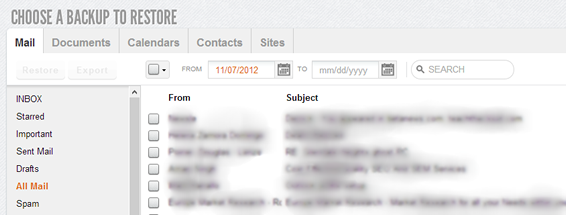
    Spanning lets you see your inbox the way it stood at any point in time. Talk about detailed restoration.

    Another important difference is that Spanning allows you to restore entire folder structure for your Google Drive account. In Backupify, to my best knowledge from past tests, folder structure was not kept intact and large, complex accounts became a miserable mess if a full restoration was needed due to data disaster. Spanning not only brings these files back but recreates where they sat, saving you endless hours in cleaning up your cloud storage drive.

    The level of control provided on restores really does matter. Think about it: do most users truly make messes of their entire inbox or Google Drive account at a time? Not likely. Most of the time, in my own consulting experience, end users lose single files or emails and want the ability to bring those selective items back from the dead. Spanning simplifies this process to the lowest common denominator, and I can’t commend it enough for this capability.

    An item that may or may not matter to some organizations could also be the fact that Spanning can handle full restores on Google Sites within a domain. While Backupify does handle backup of Sites, it can only offer exports on them – not true restores. Many organizations I consult are choosing Google Sites as an alternative to Sharepoint these days, so this could be another tipping point in your own comparison search.
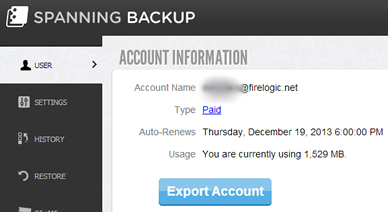
    A colorful interface that has a dead simple menu structure. “It just works”.

    In keeping with their dedication to granular file control, Spanning goes a step further and allows for multi-selected file export. Want to download three files from someone’s Google Drive that may be needed? You can do it with just a few clicks. The online interface for Spanning represents a simplistic version of Windows Explorer so even the most beginner of Google Apps admins will not feel overwhelmed with performing such tasks. Backupify has export capability on the various Apps, but they are primarily full service exports. The “all or nothing” mentality as I mentioned previously which is nice, but not great.

    Spanning doesn’t come without its flaws, however. While it allows you as admin to select whether end users can or can’t change their backup settings, it doesn’t let you, for example, pick and choose which options users can adjust. It would have been nice to see Spanning allow admins to let users adjust which mail labels they can/can’t backup, but force full backups on each Drive account if necessary.

    Also, while you can see how much storage space each user occupyies on the service at a glance, you can’t tell what services account for the used space. Spanning could have taken a few functional cues from FlashPanel on that point, since the service excels in providing very good insight as to how much data is residing in both Drive and Email at any given time.

    Minor grievances aside, Spanning provides an all around experience that is exemplary of what my wish list from a cloud backup provider looks like. Some companies excel in function, some in form – but Spanning seems to have hit it home in both areas, and to that, a much needed kudos.

    Competitive Pricing and Proven Security Credentials

    Lots of companies are very particular on the security credentials of auxiliary services my company recommends in the course of Google Apps and Office 365 consulting. And while I was pretty impressed with Backupify’s claims about security, Spanning puts their money where their mouth is in the form of having achieved full SSAE 16 audit status.

    This accreditation not only certified the level of security and standards in place for their technology backbone, but everything else encompassing employee protocol, customer communication, and much more. If everything else puts Spanning and other backup providers neck and neck, then this should be something to bring it over the top.

    Before you wish to purchase, they provide the obligatory 14 day free trial. Getting signed up is a piece of cake. And on the pricing front, Spanning has another clear win. Their service costs a flat $40/year at face value ($35/year if you can find a discount code) and the most important factor here is that there is no storage cap. Backupify’s lowest end tier places a 35GB cap on storage space per user, which could easily become a problem for execs who have 20GB in their email inboxes and another 20GB+ of Drive files to manage. Sure, you could go up to Backupify’s $4/month plan but Spanning still has them beat in cost for the same feature set level.

    I also knocked Backupify on their lack of discounts for the educational and nonprofit sectors. Spanning has, in contrast, been offering lofty 25-percent discounts for these two important markets, and this will definitely play a big part in many organizations’ decisions. Google’s own Vault may be the one platform that undercuts Spanning on cost, as they offer free Vault service to all students at any K-12 domain that purchases Vault for its entire staff base (at a cheap $10/user per year.) But for the feature set and multi-faceted capabilities of Spanning, Vault is tough to recommend above that of the former.

    Whichever direction you decide to head with your organization, remember that the cloud still needs to be backed up like any other on-premise system. While it’s very true that Google Apps and Office 365 both have the technical underpinnings to prevent systematic failure or data loss, they do nothing to prevent user-induced data loss. This is where you need to have some kind of solution in place, ready to help restore files in times of need.

    The cloud is great as a whole, but data backup is something we just can’t seem to shake. At least Spanning makes it foolproof easy.

    Photo Credit: T. L. Furrer/Shutterstock

    Derrick Wlodarz is an IT professional who owns Park Ridge, IL (USA) based computer repair company FireLogic. He has over 7+ years of experience in the private and public technology sectors, holds numerous credentials from CompTIA and Microsoft, and is one of a handful of Google Apps Certified Trainers & Deployment Specialists in the States. He is an active member of CompTIA’s Subject Matter Expert Technical Advisory Council that shapes the future of CompTIA examinations across the globe. You can reach out to him at [email protected].

  • X-Wing Squadron Seeks $11M On Kickstarter For Measured Response To Funding Of Intergalactic Weapon

    x-wings

    The Death Star may be well on its way to Kickstarter success, with £224,596 pledged out of total £20,000,000 goal, but its construction won’t go unopposed. Rebel forces have rallied to crowdfund a means to oppose Imperial tyranny, in the form of an X-Wing fighter and a pilot trained to use it to take down any moon-sized space stations that may end up floating around in the void.

    The project’s creators are seeking $11,000,000 in funds to finance the development of a single X-Wing, and to train a pilot to use the fighter to deliver its deadly payload. Let me take this opportunity to volunteer myself to wear the orange jumpsuit, since I’ve logged countless hours on the X-Wing and TIE Fighter simulators that LucasArts wisely issued back in the 90s in anticipation of this exact scenario.

    If somehow I’m not picked to be the first X-Wing pilot, then at least I hope to be considered for the entire X-Wing squadron that project creators Simon Kwan and Ed Dean hope to put together if they can manage to hit their stretch goal of $4,458,672,683. For backup, should the project achieve 13 million Galactic Standard Credits, the team will also fund and build the creation of a Corelleian YT-1300 freighter, which certainly came in handy when the Rebels took down the second death start in our distant past during that far-flung galactic struggle we all know so well from the re-enacted documentaries created by George Lucas.

    While it’s likely true that the galaxy needs an X-Wing or two, I’m a little skeptical about this project’s ability to achieve its goals, for one reason: the conversion rate for Galactic Standard Credits is all wrong. The GSC was estimated to be worth around 0.62 USD back in May 2012, which means that that 13 million stretch goal would translate to around 8.6 million USD – under the total funding amount required to make the project successful in the first place.

    That’s just crazy, and it definitely doesn’t give me any confidence in the ability this project’s creators to get the job done. If you can’t handle basic galactic currency conversion, how do you expect to manage planetary defence? There’s a lot of math involved.