Blog

  • As users flee 3G, Verizon turns it into a prepaid network

    Willing to give up speedy LTE service to save a few bucks? Then Verizon has your number. The operator launched two new prepaid phone plans on Friday that include unlimited voice minutes and messaging.

    For $60, you also get 500 MB of mobile data, while another $10 per month boosts your broadband bucket to 2 GB. There’s no contract involved, so the only “gotcha” is the limitation of service: These plans are only good for 3G phones, which have data connections 10 times slower than LTE devices.

    We actually saw this coming a few months ago. Back in November, my colleague Kevin Fitchard noted that as Verizon customers migrate to the LTE network, the old 3G airwaves would be used less and less. Using the 3G network for any additional revenue generation is gravy at this point:

    So in just year or two Verizon will have a largely empty 3G network. Eventually it will shutter those CDMA systems, replacing them with 4G technologies, but that could take the remainder of the decade if not longer. Verizon needs those CDMA networks for its legacy voice services, and its planned launch of an IP-based voice-over-LTE service is still on the drawing board. In short, that 3G data network is going nowhere so it behooves Verizon to find ways of filling it.

    So who will these new plans appeal to? Folks that want Verizon’s coverage and call quality without a contract. They’ll have to use an older phone due to the 3G limitation but Verizon says the new prepaid plans support Android, iOS and BlackBerry devices. Yesterday’s flagship phone may be one person’s trash but with this plan, it could turn into someone else’s treasure.

    Related research and analysis from GigaOM Pro:
    Subscriber content. Sign up for a free trial.

  • Madden NFL 25 Release Date: August 27

    Yesterday EA teased that something called Madden 25 would be coming later this year on August 27. Today the publisher confirmed that it will, in fact, be the next yearly game in the Madden franchise, titled Madden NFL 25.

    “There’s no better way to celebrate and mark the culmination of 25 years of innovation than by naming this year’s game Madden NFL 25,” said Cam Weber, general manager of American football for EA Sports. “This year’s game will push the boundaries with gameplay and feature innovations that will lay a very strong foundation for the next 25 years of this storied franchise.”

    Madden NFL 25 will be released for the PlayStation 3 and Xbox 360 consoles. No word yet on whether the game will make an appearance on Microsoft’s and Sony’s next-generation consoles, which are rumored to launch this fall.

    The cover athlete for the game will be determined using a voting tournament. 32 “all-time NFL greats” will be pitted against one another for a spot on the game’s cover. The bracket will be unveiled on ESPN’s SportsNation TV program on March 11, the day that the voting begins.

    “This is the third consecutive year EA Sports and ESPN have collaborated on the Madden NFL cover vote in its current iteration,” said Raphael Poplock, vice president of games and partnerships for ESPN. “Each year has brought record-setting results as NFL fans come out in droves to support their favorite players and teams, and by going big this year with legends facing off against the league’s current leaders, needless to say it will be an interesting vote with much debate and discussion.”

    The first Madden-branded game was 1988′s John Madden Football. Since that time, the franchise has sold around 99 million games and generated over $3.7 billion for its publishers.

  • IM+ Pro for BlackBerry 10 Now Available

    IM+ by Shape is a complete Instant Messaging suite for BlackBerry 10. IM+ plugs in to nearly every IM system out there making it easy to manage all your IM clients with a single app.

    Customize your IM experience by assigning different notification tones for each system. IM+ has an impressive compatibility list, a must have if you use even more than one messaging app.

    Here’s a list of all the supported IM formats

    • Facebook chat
    • Skype
    • Google Talk
    • Yahoo!
    • iChat/AIM
    • ICQ
    • Jabber
    • Mig33
    • MeinVZ
    • Yandex IM
    • Mamba.Ru
    • VKontakte
    • Webio
    • Fetion
    • SINA and more!

    Click here to buy IM+ for $4.99 for BlackBerry 10.

    Click here for the FREE download of IM+ for your legacy BlackBerry OS (4, 5, 6 and 7)


  • Google Agrees To “Support” Publishers In France

    It looks like Google is paying to link to French publishers’ content.

    Google and publishers in France have not been seeing eye to eye for quite some time. In October, the company spoke out about a proposal by French lawmakers, backed by publishers, which would seek for search engines to license content in order to have the privilege of linking to it.

    At the time, Google’s Director of Public Policy in France said, “The web has led to an explosion of content creation, by both professional and citizen journalists. So it’s not a secret that we think a law like the one proposed in France and Germany would be very damaging to the internet. We have said so publicly for three years.”

    “In order to shed light on the reasons that lead us to believe that this law is detrimental to French users, innovation on the Internet and ultimately to the news publishers themselves, we decided to post the note in its entirety,” he said. “We have always been and remain committed to collaborate with French Publishers associations as they experiment and develop sustainable economic models on the Internet.”

    On Friday, Google Executive Chairman Eric Schmidt, announced with President Francois Hollande, two initiatives to “help stimulate innovation and increase revenues” for French publishers.

    Reuters reports it as “a deal on payment of media links,” as described by a Reuters journalist present at the signing.

    Google has agreed to create a €60 million fund called the DIgital Publishing Innovation Fund to “help support transformative digital publishing initiatives for French readers.” Google says it will also “deepen” its partnership with French publishers to help increase their online revenues using Google’s ad technology.

    “This exciting announcement builds on the commitments we made in 2011 to increase our investment in France—including our Cultural Institute in Paris to help preserve amazing cultural treasures such as the Dead Sea Scrolls,” said Schmidt. “These agreements show that through business and technology partnerships we can help stimulate digital innovation for the benefit of consumers, our partners and the wider web.”

    The announcement follows a similar one Google made in December, when it reached an agreement with publishers in Belgium after six years of litigation, which saw publishers sue Google claiming that it violated their copyrights by displaying snippets in Google News and linking to cached copies of their pages in Google search.

    As part of the agreement in Belgium, Google said it would advertise its services on publishers’ media, and publishers would optimize their use of AdWords. Google would also work with Belgian French-language publishers to “help increase publishers’ revenue,” collaborating on ways to make money with Paywalls and subscriptions, and with AdSense and the Ad Exchange. Google would also work with Belgian publishers to implement Google+ social tools and launch YouTube channels.

    At the time, Google had indicated it would like to come to similar terms with publishers around the world, and it looks like today’s announcement is the next step in that.

    It’s going to be quite interesting to see how Google deals with the rest of the countries with publishers who have voiced similar concerns as those in France.

  • The 10 best robots at TED

    Robots-redo

    Begin your countdown to TED2013: “The Young. The Wise. The Undiscovered” kicks off in just 23 days. We at the TED Blog will be reporting live from the event, bringing you news, fresh talks, Q&As, photos and much, much more.

    There is so much to look forward to at TED2013: powerful talks from the 34 speakers discovered via our worldwide talent search, not to mention talks from Bono, Peter Gabriel and Amanda Palmer. But there is one thing that we in the TED Office are secretly look forward to: the robots.

    Nearly every year at TED, we get a peek at the incredible advances going on in the fields of robotics. Below, the best robots from TED events past in reverse chronological order, to help you get ready for TED2013 — whether you’re there in person, watching via TED Live or reading our coverage.

    Vijay Kumar: Robots that fly ... and cooperateVijay Kumar: Robots that fly … and cooperate
    Vijay Kumar: Robots that fly … and cooperate
    The Event: TED2012
    The Robots: Autonomous agile aerial robots
    What it does: These tiny, 8-inch flying quadrotors know where they are without GPS, and their small size makes them able to turn, circle and flip — extremely quickly. But these bots can also work together. Forming teams, they can transport cargo, build things, assess damage after disasters — even map radiation and leaks in unsafe areas.
    See it in action: Watch them flip at 3:46. Watch one navigate obstacles at 7:17. And fast-forward to 10:05 to see a choreographed swarm.
    A robot that flies like a birdA robot that flies like a bird
    A robot that flies like a bird
    The Event: TEDGlobal 2011
    The Robot: SmartBird
    What it does: Modeled after a seagull, this robot is light and aerodynamic. And it flies by flapping its wings, allowing engineers to study what we can learn from bird motion.
    See it in action: Watch it start flapping and take off at 2:08, taking several flying loops around the TEDGlobal theater.
    Péter Fankhauser: Meet Rezero, the dancing ballbotPéter Fankhauser: Meet Rezero, the dancing ballbot
    Peter Fankhauser: Meet Rezero, the dancing ballbot
    The Event: TEDGlobal 2011
    The Robot: Rezero
    What it does: This robot can dance. Technically a ballbot, he balances on a single, large ball rather than on multiple wheels — which allows for ballet-like movement. These robots could be used in a hospital to carry equipment, or could even be a form of transportation.
    See it in action: See Rezero’s balance checked at 1:48. And watch him full-out dance and pirouette at 3:57.
    Cynthia Breazeal: The rise of personal robotsCynthia Breazeal: The rise of personal robots
    Cynthia Breazeal: The rise of personal robots
    The Event: TEDWomen 2010
    The Robots: Kismet, Leo and Autumn
    What it does: Meet the world’s first social robots, able to learn from us, listen to us and even teach us how they interact. The cutest robot around, furry Leo reacts to social cues as he is presented with an unfamiliar object – much like a child, he looks to people to learn how he should react. Autumn is a diet and exercise coach who can motivate you to set healthy goals. These social robots can be used to get kids away from screens and playing physically – as the characters go back and forth between the screen and the real world.
    See it in action: Watch Kismet listening to one of Breazeal’s teammates at 1:31. See Leo learn in real time at 2:34. Get a glimpse of Autumn at 8:44. And at 11:33, watch the playful robots move between realities.
    Heather Knight: Silicon-based comedyHeather Knight: Silicon-based comedy
    Heather Knight: Silicon-based comedy
    The Event: TEDWomen2010
    The Robot: Data
    What it does: This robot has jokes — and lots of them. Using a database of humor, Data creates stand-up routines on the fly. It learns from laughter and applause, figuring out what is working and what isn’t — and tailors its humor based on the reaction.
    See it in action: Get ready to laugh at 3:30.
    David Hanson: Robots that "show emotion"David Hanson: Robots that "show emotion"
    David Hanson: Robots that “show emotion”
    The Event: TED2009
    The Robot: Einstein
    What it does:  This robot has empathy. Rather than bleeping, a la R2-D2, Hanson’s robots have faces — made of Frubber — making them look and act as if they were human. These robots show emotions and react to the expressions of others with facial gestures of their own.
    See it in action: See Einstein brought back to life at 2:10.
    PW Singer on military robots and the future of warPW Singer on military robots and the future of war
    PW Singer on military robots and the future of wars
    The Event: TED2009
    The Robots: PackBot, robotic tanks, drones
    What it does: These robots go to war zones and perform tasks that are too dangerous for humans. Singer begins his talk with the story of PackBot, a robot who went to Iraq to investigate IEDs and lost his life in a blast. In this prescient talk from early 2009, Singer predicts we may see tens of thousands of robots both fighting wars and keeping peace alongside living soldiers.
    See it in action: At 3:45, see images of the robots currently in use in war zones.
    Hod Lipson builds "self-aware" robotsHod Lipson builds "self-aware" robots
    Hod Lipson builds “self-aware” robots
    The Event:
    TED2007
    The Robots: Self-aware robots
    What it does: These robots evolve. Hod Lipson applied natural selection to robots – rewarding those that succeeded in moving forward, and denying those that did not. As a result, they’ve gradually become more advanced. Some of these models do not know their shape, initially, but learn how to move through processes of elimination. They use programmed “self-models” to understand a unique, unprogrammed way to move.
    See it in action: Watch a robot learn how to move at 3:57. And at 5:23, watch robots whose form of reward is self-replication — it grows as it absorbs other robots.
    Rodney Brooks says robots will invade our livesRodney Brooks says robots will invade our lives
    Rodney Brooks says robots will invade our lives
    The Event: TED2003
    The Robots: Roomba, PackBot and Kismet
    What it does: Roomba, the vacuum cleaner ‘bot, easily navigates around objects and learns where to clean as it goes. More complex is PackBot, also described above, which catalogues local information and has the ability to communicate from areas too dangerous to search for survivors. Also, get another demonstration of Kismet’s ability to react and communicate.
    See it in action: At 2:51, see a demonstration of Roomba at work. Watch 5:00, for PackBot. And cut to 11:02 for Kismet’s response to social cues.
    And: Rodney Brooks is bringing his newest robot, Baxter, to TED2013.
    Dean Kamen on inventing and givingDean Kamen on inventing and giving
    Dean Kamen on inventing and giving
    The Event: TED2002
    The Robot: The Segway
    What it does: These robots help you get around, without expending energy, relying on gas or requiring a parking spot. The idea: efficiency in a motorized platform that is the size of a person.
    See it in action: Watch it all. Kamen gives his entire talk aboard a Segway.

    Tune in to the TED Blog for live coverage of TED2013 beginning on February 25. Watch out for Rodney Brooks’ talk in session 1, where we hope he’ll unveil his newest robot —Baxter.

  • Burger King Admits To Possible Horse-Meat Burgers

    Burger King has announced that they were one of the companies affected by the recent discovery of horse DNA inside hamburger patties.

    Three processing plants–including Silvercrest Foods, which supplied UK and Ireland Burger King stores with their hamburger–have been under investigation for their use of horse meat in their products after the Food Safety Authority of Ireland conducted tests, which also found pig DNA. The companies also supply grocery stores in the UK and Ireland with the meat. And while BK says the meat tested in their restaurants was negative for horse DNA, they do admit they have used meat sourced from Silvercrest and have changed their supplier.

    “Our independent DNA test results on product taken from restaurants were negative for any equine DNA,” the company said in a statement. “However, four samples recently taken from the Silvercrest plant have shown the presence of very small trace levels of equine DNA. Within the last 36 hours, we have established that Silvercrest used a small percentage of beef imported from a non-approved supplier in Poland. They promised to deliver 100% British and Irish beef patties and have not done so. This is a clear violation of our specifications, and we have terminated our relationship with them.”

    While the Food Safety Authority of Ireland says there is not health risk to be had from eating what some are calling “tainted” meat, the news has consumers across the pond worried and Silvercrest is losing clients left and right, including Aldi, Tesco, and Asda.

  • Dijit buys Miso’s assets as social TV space consolidates

    The rumors are true, after all:Dijit Media, the company behind the Nextguide TV guide app, is buying social TV pioneer Miso’s assets. The acquisition, which was announced by Dijit Friday, doesn’t include any of Miso’s remaining eight employees, but Miso’s co-founder and CEO Somrat Niyogi will become an advisor to Dijit. The move is another sign that the social TV space, which has brought us dozens of startups with similar ideas and products, is ripe for consolidation.

    Miso was one of the first companies to take Foursquare’s idea of checking into locations to the media space, offering its users to check into TV shows instead. “They invented social TV,” Dijit CEO Jeremy Toeman said during an interview Wednesday. But Miso failed to get enough traction beyond its initial user base, was quickly surpassed by competitor GetGlue.

    Niyogi also had his own doubts about check-ins as a core offering, and the company went on to try a few other products: Miso Sideshows allowed anyone to curate and author second-screen content that can be synchronized with existing TV shows, and Quips enabled users to share key moments of their favorite TV show episodes with others.

    Dijit said Friday that it is going to continue to support the core Miso check-in platform as well as Miso Sideshows, but that Quips are going to be shut down just two months after the launch of the product. Miso had raised a total of $5.5 million from Google Ventures, Hearst Ventures, Koshla Ventures and others. Financial details of the acquisition were not disclosed.

    Toeman told me that the acquisition brings Dijit a lot of intellectual property and technology, as well as Miso’s existing user base. He didn’t give specifics on the number of users of either Nextguide or Miso, but said that both company’s products together amount to a user base in the “low millions.”

    Miso’s acquisition comes just a few weeks after social TV startup Viggle tried to buy GetGlue. That acquisition fell through after debt financing necessary to close the deal reportedly didn’t materialize.

    Related research and analysis from GigaOM Pro:
    Subscriber content. Sign up for a free trial.

  • You can steal — ah, still get — Windows 8 Pro cheap

    I owe a commenter an apology. Let me explain. Two months ago I wrote about a Microsoft error that allowed anyone the Windows 8 Pro upgrade for $14.99, which is supposed to only be available to those who have purchased a Windows 7 PC after June 2, 2012. I took a lot of heat from our kind readers for pointing out the flaw. Microsoft also contacted me and assured me that the loophole would be fixed.

    It is an easy fix, honestly. Require the user to enter a Windows 7 key and then check against the database to ensure that it was activated after the required date. It is really that simple. But, Microsoft didn’t close the loophole.

    Yesterday Microsoft ended promotional pricing for Windows 8. You can no longer upgrade to Windows 8 Pro for $39.99, but if you purchased a Windows 7 computer within the required dates then you have until the end of this month to grab that $14.99 upgrade.

    After being told by “Ilev” in the comments yesterday that customers could still use the deal without worry, I disagreed. I assumed that Microsoft had fixed the flaw as I had been told. Uh-oh, I checked, and guess what? The loophole is still wide open.

    In other words, you do not need to pay $199.99 for Windows 8 Pro just yet. Microsoft has left the ability to grab it for $14.99. You can enter any computer make and model, any purchase date and any retailer name. No questions asked.

    It is unclear at this point whether or not Microsoft will leave this option open until the promotion expires. How much will it cost the company given few customers will stumble upon the opportunity? Heck, it is even good business to drum up a few extra sales from the tech crowd who will find this offer or read this article.

  • IER Statement on Secretary Chu’s Resignation

    WASHINGTON D.C. — IER Senior Vice President Daniel Kish released the following statement today in response to the announced resignation of Energy Secretary Steven Chu:

    “As Secretary Steven Chu leaves the Department of Energy, it is important to measure his tenure by his record. Under his watch, energy consumption in the United States declined by 2.24 percent while our leading economic competitor, China, increased energy consumption by 28 percent. Similarly, GDP growth in the United States has limped along at the anemic annual rate of 0.6 percent while China’s economy has soared at the annual rate of 9.12 percent, more than 15 times our own. Clearly, the policies and priorities of Steven Chu’s energy department have benefitted our global competitors and intensified the economic pain felt by millions of unemployed Americans.”

    ###


  • iPhone wins the U.S. (kind of), but Android rules the world

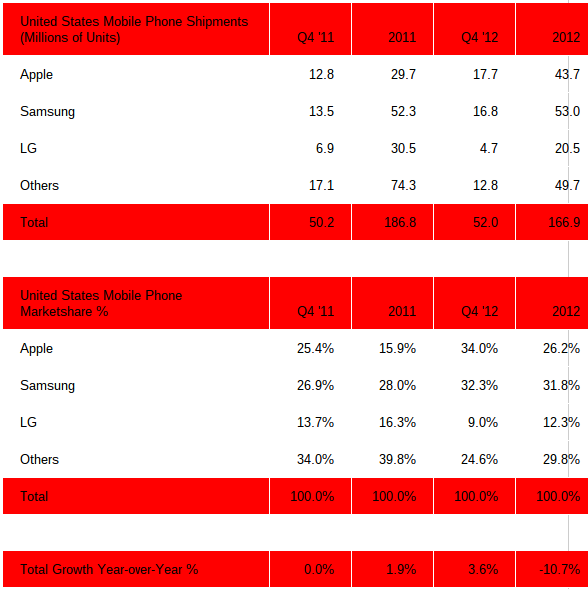
    Americans love their iPhones, finally enough to topple Samsung’s long-time leadership. During fourth quarter, Apple nudged ahead of the South Korean electronics giant, with 34 percent share, based on shipments, according to Strategy Analytics. To be clear, the numbers are for all mobiles, not just smartphones. The distinction is important for several reasons. The American company only ships smartphones, for which demand rages. Related: Overall phone shipments fell for the year.

    “Apple has become the number one mobile phone vendor by volume in the United States for the first time ever”, Neil Mawston, Strategy Analytics research director, says. “Samsung had been the number one mobile phone vendor in the U.S. since 2008, and it will surely be keen to recapture that title in 2013 by launching improved new models such as the rumored Galaxy S4”.

    Apple shipped 17.1 million handsets during Q4, compared to Samsung’s 16.8 million, for 32.3 percent share. A year earlier: 25.4 percent and 26.9 percent, respectively. However, Samsung easily leads for the year, with 31.8 percent share to its rival’s 26.2 percent. But the share lead considerably shrank compared to 2011 — 28 percent and 15.9 percent, respectively. Unquestionably, iPhone’s gains are remarkable, and in a rapidly saturating market.

    The United States is the most mature smartphone market, which is where Apple only competes, while Samsung still sells feature handsets. The fruit logo company’s changing position is more than increased demand for iPhone then. For all 2012, Samsung phone shipments changed little year over year — 53 million units from 52.3 million — while Apple rose to 43.7 million from 29.7 million.

    Mobile phone shipments grew a scant 4 percent during the quarter but fell 11 percent for the whole year. “Growth was driven by robust demand among consumers for 4G smartphones and 3G feature phones”, Mawston says.

    Globally, Samsung’s lead over Apple is enormous and widening, ranking first and third, respectively, with 24 percent and 10.6 percent share for the quarter and 25.2 percent and 8.6 percent for the year, according to Strategy Analytics. During 2012, the American company’s share rose 2.6 points compared to its rival’s four. Stated differently: Samsung accounted for “one in four of all mobile phones shipped worldwide last year”, Mawston says.

    Comparing global to U.S. shipments reveals just how dependent Apple is on the one country. During Q4, the United States accounted for 36 percent of Apple handset shipments, but only 16 percent for Samsung. For the year, 13 percent to Apple’s 32 percent.

    The point: Samsung’s global reach far exceed’s Apple, and there is huge disparity regarding the most-mature handset market, particularly smartphones, where sales are slowing.

    Then there are smartphones, which account for the majority of handset growth in most markets. While Americans favored iOS over Android during fourth quarter, Google’s green robot captured the world. Year over year, Android surged to 70.1 percent smartphone share from 51.3 percent, according to Strategy Analytics. iOS share actually retracted, to 22 percent share from 23.6 percent. For all 2012, Android climbed to 68.4 percent from 48.7 percent, while Apple nudged up to 19.4 percent from 19 percent.

    In the world’s largest smartphone market, China, Android market share reached 86 percent during Q4, compared to 12 percent for iOS, according to Strategy Analytics.

    The point: The Apple Fan Club of analysts, bloggers, reporters and other writers claim bragging rights today (just look at all the “iPhone is No. 1” stories). But in larger context, during iPhone 5’s global launch quarter, Android still rules the world and the U.S. for all 2012.

  • Behind the Scenes: Thorsten Heins brings BlackBerry 10 to NBC’s TODAY

    Thorsten Heins on TODAY

    This week is all about BlackBerry 10, and it has definitely been a whirlwind. To keep the momentum going, Thorsten Heins, President and CEO, BlackBerry, was a guest on NBC’s TODAY, where he talked about the new BlackBerry Z10, BlackBerry Q10 and the future of the newly-renamed company, BlackBerry.

    Many folks from Team BlackBerry were up at the crack of dawn to appear in the audience to show their support for BlackBerry 10. We got to follow Thorsten to TODAY, and here’s an exclusive Inside BlackBerry behind-the-scenes look. Watch the video below for all the details.

    [ YouTube link for mobile viewing ]

    We’re keeping the BlackBerry 10 momentum going, and everyone seems very excited about the new BlackBerry devices. Can’t wait to get your hands on BlackBerry 10? Check out this post for pricing and availability in your region, and let us know when you’ll be picking up yours.

  • It’s official: the King of the energy nerds, Steven Chu, is leaving

    Confirming a media report from last month, Energy Secretary Steven Chu, announced on Friday that he won’t be returning to office for President Obama’s second term. In a long letter, he detailed the accomplishments that the DOE has made over the past four years, like the ARPA-E program, and writes:

    While I will always remain dedicated to the missions of the Department, I informed the President of my decision a few days after the election that Jean and I were eager to return to California. I would like to return to an academic life of teaching and research, but will still work to advance the missions that we have been working on together for the last four years.

    As we wrote last month, it’s an end of an era for the Obama administration’s green dream team. Chu accomplished a good deal during his time ushering in billions of dollars in stimulus spending for clean energy, electric cars and more. At the same time, the DOE has not been without controversy with high profile bankruptcies from companies, like Solyndra, that got stimulus money.

    Related research and analysis from GigaOM Pro:
    Subscriber content. Sign up for a free trial.

  • Chelsea FC owner Roman Abramovich invests £70M in Truphone

    Russian billionaire investor Roman Abramovich has plunked down £70 million (U.S. $110 million) for a big piece of London’s Truphone, an international mobile operator that charges local rates for calls made in other countries.

    Abramovich’s new 23.3 percent stake in Truphone isn’t quite as impressive as his outright ownership of the world-famous Chelsea Football Club (that’s soccer to us Yanks). But the investment is a huge vote of confidence to an aging startup, which is on its second business model in six years. Abramovich’s investment vehicle Minden led a £75 million round – it’s first since its £16.5 million Series B in 2008 — valuing the company at £300 million.

    truphone-iphoneTruphone started out in 2006 as the mobile equivalent of Skype, developing handset software that allowed customers to place free or low-cost VoIP calls over Wi-Fi to international destinations and while roaming onto international networks. Rather than compete with other VoIP providers like Skype it partnered, supporting their services within its client.

    But in 2010 Truphone became a mobile virtual network operator (MVNO), creating an international SIM card that access multiple networks in different countries as if they were “home” networks. The result is a service where customers paid the same local rates regardless of whether they were in the U.S., U.K. and Australia.

    Truphone plans to use the new funds to expand its virtual footprint outside of Anglophone countries. It plans to target the Netherlands, Hong Kong, Poland, Germany and Spain this year, but is also in negotiations with carriers in other countries to buy capacity off their networks, the company said. Truphone added that it would hire another 500 employees, most of which would be based in the U.K.

    Related research and analysis from GigaOM Pro:
    Subscriber content. Sign up for a free trial.

  • EnCap’s Fund IX Closes at $5 Bln

    EnCap Investments said Friday that it closed its ninth fund at its $5 billion hard cap. The fund, which was oversubscribed, will focus on upstream sector of the oil and gas industry in North America. News of the fundraising was reported by peHUB in November.

    PRESS RELEASE

    EnCap Investments L.P., a leading oil and gas private equity firm, announced today that it has closed EnCap Energy Capital Fund IX, L.P., with $5 billion of limited partner capital commitments. Fund IX, which reached its $5 billion hard cap and was significantly oversubscribed, provides growth capital to proven management teams focused primarily on the upstream sector of the oil and gas industry in North America. EnCap is led by the firm’s four managing partners, David B. Miller, Gary R. Petersen, D. Martin Phillips and Robert L. Zorich. Since its inception in 1988, EnCap has managed approximately $18 billion of capital commitments from some 300 institutional investors, providing growth capital to more than 190 companies and establishing its reputation as the preeminent source of private equity to the oil and gas industry.

    Robert Zorich, one of EnCap’s managing partners, said, “Our existing investors’ strong support of Fund IX resulted in a very quick and very successful fundraise. We’ve had the good fortune now of having our last three funds heavily oversubscribed, and we couldn’t have done it without the longstanding relationships we have with so many highly respected limited partners.” Gary Petersen, another EnCap managing partner, said, “Building on the success of our 25-year history, we are pleased to have a fresh pool of capital to back the highest quality management teams in what remains a robust investment environment in the upstream sector of the oil and gas industry.” To date, EnCap has committed approximately $350 million to three portfolio companies in Fund IX, including Common Resources III, Paloma Partners III and PayRock Energy.

    The post EnCap’s Fund IX Closes at $5 Bln appeared first on peHUB.

  • Flurry courts mobile developers with free crash reporting tool

    As a way to sweeten its mobile analytics product, Flurry Analytics is adding two more services to help mobile developers gauge how they’re attracting new users and how often their app crashes — and it’s adding those features for free.

    Both iOS and Android developers can use the Flurry SDK and will have access to new User Acquisition analytics and Crash Reporting analytics. The User Acquisition feature is available starting Friday, the crash reporting tool will be available for Android developers on Friday (in beta form) and for iOS users sometime later this month. Currently there are 95,000 SDK users.

    Measuring the effectiveness of in-app ad campaigns will be useful for developers who want to understand user behavior. The crash reporting tool was added because developers want and need it: It was the No. 1 most requested feature when Flurry polled its users at the end of 2012.

    By giving away this feature, Flurry can hope to attract more developers away from other services, like Bugsense (which also works with Windows Phone 7 and HTML5 apps) and Crittercism (which also does HTML 5 apps) which offer basic free service, but charge for premium services. Another potential competitor, Crashlytics, was just scooped up in an acquisition by Twitter this week, to help that service work on improving Twitter’s mobile app performance.

    Flurry has been slowly building out its SDK offering. In June the company bought mobile backend provider Trestle and turn it into its AppCloud service.

    Thumbnail image courtesy Chris Harvey via Shutterstock. Below image courtesy Flurry.

    Flurry user analytic tools

    Related research and analysis from GigaOM Pro:
    Subscriber content. Sign up for a free trial.

  • Gravity giving away personalization to whichever publishers want it

    Gravity, a Santa Monica, Calif-based startup that personalizes reader content for web publishers, is opening up its recommendation engine to anyone that wants to use it. If you don’t mind a few sponsored stories popping up in the newsfeed — a condition of using the free platform — this could be a pretty good deal.

    Gravity’s recommendation system is based on its interest graph technology, which we detailed last year. Here’s how I described it then:

    [T]he gist is that humans first serve as guides for machine-learning algorithms by determining connections between terms within large data sets, then the algorithms take over to complete the job faster than humans ever could. When they’re done, the humans step in one more time to kill any bad connections between terms. The result is a system that can determine with high accuracy that a person tweeting about Vanessa Laine (Los Angeles Laker Kobe Bryant’s ex-wife), for example, is probably more interested in basketball than about Laine’s date of birth or other accurate but irrelevant information.

    As new content streams into Gravity’s system, it’s analyzed and categorized in real time, then presented to users accordingly based on their interests and behavioral history.

    How Gravity's platform works

    How Gravity’s platform works

    Graph processing and graph databases — which store and analyze data based on their relationship to one another — are critical to our onlines lives, powering everything from online recommendations to social search to knowledge discovery. Graph technologies are also the focal point of some impressive life sciences work from companies such as Syapse and Ayasdi, which will be presenting at Structure: Data in New York next month.

    But publishers struggling to stand out on a noisy web might have the most to gain from graphs and personalization, generally. At our PaidContent Live conference (April 17 in New York), executives from Prismatic, Zite and Bluefin Labs will take the stage to talk about the importance of personalization for helping consumers filter through the deluge of content online so they can find what they really want. It’s arguable that the trick to keeping readers happy is knowing what they want to read — possibly better than they do themselves.

    According to Gravity, its platform currently “delivers more than 25 million personalized content recommendations per day to more than 200 million users. Beta partners have reported click through rates two to three times above previous levels, return visitation increases of 300 percent and session length increases up to 40 percent.”

    Related research and analysis from GigaOM Pro:
    Subscriber content. Sign up for a free trial.

  • Building Customer Communities Is the Key to Creating Value

    What are your customers telling their friends and colleagues about your business? As I described in my last post, your prospective customers and buyers increasingly learn about you from their peers — including your current customers — while tending more and more to ignore traditional sales and marketing communications from corporate. Companies are now taking advantage of this new marketing reality, becoming more skilled at getting their customers to advocate for them, create peer influence in their markets, and make important contributions in areas like product development and services.

    Creating and capturing such value from customer relationships doesn’t just happen, no matter how stellar your products and services are. It requires an enhanced value proposition, what I call a Level 4 customer value proposition.

    At Level 1, buyers perceive you as the supplier of a commodity. They’re entirely price sensitive. And more companies are at this level than think they are. Think PC makers, who load their computers with features and functionality believing they’re adding value and creating differentiation. In fact, the vast majority of their customers not only don’t care about such features, but find that all the clutter detracts from the user experience.

    At Level 2, buyers perceive you as helping them get a job done. They associate your product or service with their desired outcome, and the fact that you help them achieve that in some way that makes you stand out. Significantly (and ironically) companies that reach Level 2 often remove features or functionality that competitors provide. Think Apple, or Southwest Airlines, or for a more recent example, Zipcar.

    At Level 3, you engage the customer emotionally, which strengthens loyalty and retention. And here’s where it gets interesting. Some firms have such great offerings (at least, great compared to the competition) that their products or services alone are enough to create significant emotional attachment, again, such as Apple and Southwest (when I fly Southwest, I can actually feel my blood pressure drop as I interact with their friendly people.)

    But not everyone can create such awesome products or services — and even when you do, maintaining that emotional connection through your products and services may be fleeting. (With TiVo, for instance, customers have come to rely on the service so much, they don’t even think about it.) Firms that excel in the new world are discovering that they can create strong emotional attachment by moving to the next level…

    At Level 4, you’re helping customers build their social capital — that is, helping them to build and expand valuable support groups and communities.

    Helping customers build social capital may seem far removed from the concerns a competitive business should occupy itself with. But think about it: these days, buyers and prospects are open to receiving, and are even seeking, information from your customers &#8212 their peers. Helping your customers build social capital is the way to make it attractive to them to provide this information.

    This is an area of tremendous creativity. Here are some specific ways that companies are doing this:

    Help customers build their reputation

    When Jeff Bezos made the controversial decision to allow customers to post reviews of the books they bought on Amazon’s site — a seminal event ushering customer-based marketing into the online world — he reasoned simply that ordinary reader reviews were what buyers wanted. To encourage more of this, Amazon now designates top reviewers on the site and a reviewer Hall of Fame (based in part on ratings from readers), lets reviewers set up their own pages showing their reviews of other books, provides them with a distinctive badge for their pen names, and more — all of which builds their reputation in the book buying community. Top Amazon reviewers are often more powerful than traditional media reviewers.

    Help customers build their affiliation networks

    Customer advisory boards — in which a firm’s customers provide input and guidance on products and strategy — have been around for years and are often an effective way to gain “buy-in” from customers. Firms like Microsoft are taking this up a notch, with industry councils. These are groups that focus not on Microsoft’s products, services and strategy, but rather on a compelling industry issue that is top-of-mind with people in the industry — a significant difference with great appeal to buyers. In particular, Microsoft formed a council that focused on one of the most vexing of all business technology issues: interoperability (the council is called the Interoperability Executive Council or IEC). Once people were convinced that this was a serious attempt to address the issue (and not a vehicle to push marketing), Microsoft was able to attract a marquee list of senior technology executives from around the world. At times, the IEC will address issues that Microsoft can’t help with — and the firm will go so far as to bring competitors into the discussion who can.

    What’s in it for Microsoft? Over time, the discussions and work performed by the IEC have given the firm insider access to the best thinking on this issue, which informs its product decisions, helps it establish thought leadership, and burnishes its standing as a constructive force for the industry.

    Help customers build status in the community

    When marketing services and software firm, Eloqua, for example, decided to start recognizing outstanding work and results achieved by firms in its industry with awards, it decided to go whole hog. And for good reason: helping customers build status is an exceptionally valued aspect of one’s social capital. Eloqua patterned the awards ceremony after the Emmy awards (it even hired the firm that designs the Emmy statues — calling it the “Markie“). They’re awarded at a lavish black tie ceremony at a posh location, where some 20 awards are handed out over the course of the evening. The event attracts substantial media attention, in part because the firm is very careful to make sure that winners really are the best. And note — awards are not limited to Eloqua clients. They go the best in the industry, as determined by an independent industry council.

    Give them a say

    High glamour isn’t the only way to help customers build social capital. CSC, which creates financial services software, has built a tier of for-customer communities that allow customers to exchange ideas and best practices, and have a say in new releases. As products or updates are being developed, customers can subscribe to RSS feeds keeping them apprised of new release progress, and provide input — which CSC takes seriously. This can slow the process down, but it creates enthusiasm, as borne out by the numbers. After implementing the process, request rates for new software releases increased 50%.

    What do all of these efforts have in common? They build communities that exert positive peer influence across all the relevant companies’ markets. The ability to create this kind of Level 4 customer value proposition is the key skill set that companies will need in the new world of marketing.

  • Apple Takes 3 Of Top 5 Spots In U.S. Mobile Phone Sales For Q4 2012, Says NPD

    iphone-family

    Apple has managed to nab three of the top 5 spots for the top-selling mobile phones in the U.S. during Q4 2012 according to the NPD Group, with the iPhone 5, iPhone 4S and iPhone 4 ranking first, third and fourth, respectively. Apple also retained the crown for best-selling overall smartphone maker, accounting for 39 percent of smartphone sales in Q4 2012, compared to Samsung’s 30 percent.

    iPhone 4 sales rose 79 percent compared to Q3 2012, and iPhone 4S sales grew 43 percent sequentially, while the iPhone 5 accounted for 43 percent of all iPhone sales in Q4 2012, which is roughly in line with the numbers we’re seeing out of carrier data as well. It also made up nearly two-thirds of all smartphone sales on post-paid plans with a value over $200, NPD says. Samsung made considerable gains on the year, going up to 30 percent of all U.S. smartphone sales in Q4 2012 from 21 percent in the year ago quarter, but the gains were mostly at the expense of other Android OEMs, including HTC, while Apple’s overall share remained constant.

    Net Applications also released its monthly report on mobile OS share, which found that Apple’s iOS increased slightly in terms of traffic, accounting for 60.56 percent of all mobile operating systems, while Android actually took a bit of a dip to 24.51 percent, continuing a decline that has occurred over the past two months from a peak high in November of 28.02 percent. It looks like Apple’s release of the iPhone 5 might have essentially begun to erase earlier gains made by the longer availability of the Samsung Galaxy S III, but Apple still has some ground to make up if it wants to climb back to its 2012 high of nearly 66 percent web traffic share among mobile devices.

    Apple’s holiday quarter, which included 47.8 million iPhone sales and 22.9 million iPads, looks to have helped it in terms of remaining the leader in both smartphone and mobile device sales in the U.S., and in keeping the hold it has on mobile browsing. The strong quarter also accounts for Apple’s regaining the role of largest mobile phone maker by volume in the U.S., an honor it reclaimed according to the latest data from Strategy Analytics released earlier today.

  • Citrix Podio Now Available for BlackBerry 10

    Citrix Podio is a productivity app that helps manage collaborative projects. Users make custom work collaboration apps by dragging, dropping and configuring modules. Once complete, the custom apps can be run on BlackBerry 10, Android and iOS.

    The Podio App Builder web client is an easy to use tool that allows you to create a custom collaboration app by dragging and configuring modules that take care of a variety of tasks. The flexibility of the system is made better by only using the components you need. This adds up to easy to make apps that don’t have any superfluous menus or dialogs.

    Over 200000 organizations have tried their hand at Podio for their tailor-made collaborative app needs, and yes, it’s as easy as it sounds.

    Click here to watch on your mobile device.


  • The Walking Dead: Survival Instinct Now Coming Out On March 19

    Remember The Walking Dead: Survival Instinct? It’s the first-person shooter based on the wildly popular graphic novel and TV series of the same name. It was originally scheduled to come out on March 26, but publisher Activision has moved it up a week.

    Polygon reports that the latest The Walking Dead game will now launch on March 16 for the Xbox 360, PS3 and PC. The Wii U version of the title will launch a week later on March 26.

    The Walking Dead: Survival Instinct has run into some rough patches since being announced last year. For one, the title is already facing skepticism from gamers who feel that it can’t possibly live up to the high standard set by Telltale’s The Walking Dead games from last year. It also doesn’t help that a fan cut together some early footage and called it a gameplay trailer. Many gamers took it as the real deal and assumed the early footage was representative of the final product.

    Now Activision and developer Terminal Reality have a little over a month and a half to convince players that it has what it takes to deliver a game that Walking Dead fans can rally behind. Unfortunately, Activision hasn’t exactly been selling the game to players very well. The latest trailer features no gameplay instead opting to have the TV series’ actors talk about it for less than 20 seconds.