Blog

  • Why a maturing Apple freaks us out, and why it shouldn’t

    Change — rapid, visceral change — is one of the most exciting things about the technology industry; when hard work and incredible foresight combine in a product or service that changes the world in just a few years and makes a lot of people rich in the process. Maybe that’s why when we see a company responsible for such profound change start to mature, we get a little uneasy.

    It has been a little over six years — an eternity in tech — since the late Steve Jobs stood onstage at San Francisco’s Moscone West convention center to announce that “today, Apple is going to reinvent the phone.” Already in good shape thanks to the success of the iPod, the iPhone (and later iPad) turned Apple into something Silicon Valley and Wall Street had never really seen: a big, profitable consumer tech company growing at a surreal pace.

    That party isn’t exactly over, but those who just stopped in for some quick fun are looking for their coats; at least based on Apple’s quarterly results this past week and the reaction from investors and supporters to a steep drop in Apple’s stock price over the last several weeks and months.

    Apple is maturing, and that’s starting to sink in among those looking to play the market for a quick buck, those with genuine respect and admiration for what Apple has accomplished, and those in the media who have built audiences around the intense interest in Apple during that period. Apple’s surge in profits, market share and market capitalization over the last 10 years was unlike anything most of us have seen, and the prospect that such an incredible growth story might be coming to an end is disappointing; not to mention a little scary for those whose job it is to find those growth stories.

    We won. Now what?

    The mobile revolution ushered in by the 2007 introduction of the iPhone is old news, in a way. Worldwide smartphone sales are still growing at a healthy 36 percent clip, according to IDC, but that growth has slowed as more and more people embrace smartphones over basic mobile phones. There’s still a ton of growth ahead for tablets, which are clearly having an effect on the PC market, but it doesn’t look like tablets will be as profitable for manufacturers (including Apple) because of how smartphone prices are distorted by carrier subsidies.
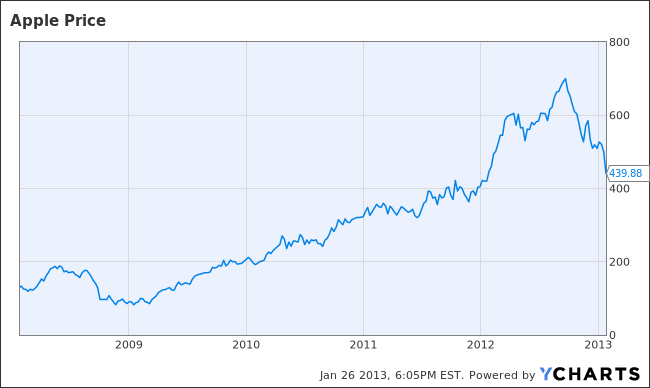
    AAPL Chart

    AAPL data by YCharts

    As with many things involving Apple, these trends tend to be used for partisan purposes.

    Investors who only care about growth — and not necessarily technology — seem to have decided to go find the next big growth stock somewhere else. As they sell off their holdings, the slumping stock (which still closed Friday 228 percent higher than it was in January 2008) triggers a bunch of Wall Street-oriented stories wondering, “What’s wrong with Apple?” That in turn leads to a very predictable and usually heated backlash from Apple’s army of supporters who mock Wall Street types for assuming Apple is doomed despite record revenue, profits and mobile sales. And then those who have been desperately trying to write the “Apple has peaked and is headed down” story in order to look prescient in the future are licking their chops. Page views for everybody.

    Nothing is wrong with Apple. And no one is suggesting (with a straight face, anyway) that Apple is doomed. Instead, we’re seeing a different type of Apple emerge, one that is still growing very strongly but that is no longer attached to a rocket ship.

    Settling down

    This realization is hard to accept for both financial and tech types alike. Investors who hunger for exponential growth now have to figure out what to do next, and it’s no surprise that some of those pushing Apple to release a mind-blowing television are financial types hungry for the same type of growth that was provided by the iPhone. (Should that actually come to pass, maybe Apple still has some rocket fuel left.)

    Apple’s supporters (and detractors) must come to terms with the fact that we’re now well into a different era in Apple’s history. The iPhone caught the mobile industry flat-footed in 2007. Six years later, major competitors have righted themselves and beautiful hardware and software is battling for prominence with compelling services delivered onto those handsets and tablets.

    The queue outside Philadelphia's Walnute Street Apple Store for the iPhone 5 launch.

    The queue outside Philadelphia’s Walnut Street Apple Store for the iPhone 5 launch.

    I feel like the mobile world in early 2013 is a little like the PC market of the mid 1990s, say the period around when Windows 95 had arrived. PCs were not a novelty then, but nor were they in every house in the land. And there was still a ton of growth and innovation ahead as desktops grew more powerful, laptops grew more capable, and the browser connected it all. That mature-but-still-growing market continued for about a decade before the mobile computer became the new darling of the industry.

    Today, even though the iPhone is a household name, smartphones in general still make up less than half of all the mobile phones sold worldwide. And the tablet market has huge potential. The days of 70 percent growth in these markets are probably over, but there are still a lot of years of strong growth ahead.

    By 2018, who knows how this crazy industry will have changed again. But Apple will either lead the pack or be a strong contender for those mobile customers over the next several years. And at some point, Apple’s stock will come into balance with its new identity.

  • What the future holds for international development

    A cold start to 2013. Picture: Neil Squires

    I couldn’t resist posting this picture of the snow that is currently covering the UK, marking a cold start to what promises to be an exciting year.

    2013 is the year in which the UK will achieve its commitment to spend 0.7% of the UK’s Gross National Income on development aid. There has been a huge amount of work going on in DFID over the last year, identifying areas where careful use of development aid can make the biggest difference to poor people’s lives. The discipline of developing business cases, which consider different options for spending and assess the relative value for money of these options, has driven much of this work. There is a huge commitment within DFID to ensure we get maximum value from UK aid. The work on gathering the evidence for effective investment and monitoring the impact of programmes will continue this year as we track progress and demonstrate how UK aid is translating into real results for poor people.

    2013 is also a year in which there will be a major focus on what should follow on from the Millennium Development Goals, the targets that are set to reduce poverty by 2015. A High Level Panel will be assessing progress and discussing what comes next. I mentioned in a previous blog, some of the inputs that will inform these discussions, and other DFID bloggers have also posted on the ongoing process.

    Clearly there will still be a need to continue to invest in many of the areas that were prioritised by the Millennium Development Goals. Poverty and gender inequity remain major challenges, people the world over want better education for their children and this needs to make sure that girls have the same access to an education as boys. Whilst there has been progress in reducing maternal death and improving child health, there is still an unacceptable toll of infant, child and maternal mortality, with continuing high levels of under nutrition contributing to the burden. Poor people in many countries still need better sanitation, improved hygiene and access to water and the threat of climate change and resulting severe climate events needs to be managed.

    Some of the things I am hoping to focus on this year will feed into this agenda. My first big meeting this year will be to discuss the new funding mechanism of the Global Fund to Fight HIV/AIDS, TB and Malaria. The large investments made through the Global Fund have had significant health impacts. One of the key challenges going forward will be to make sure that continued investment to combat these three diseases also helps to build more accessible health services that are better able to meet the health needs of all people, rather than just those with specific diseases. The article posted here, highlights some of the health system challenges of achieving the Millennium Development Goals around health.

    I hope to be reviewing a number of UK aid programmes throughout 2013, and to be able to highlight some of the innovative work that is being supported by DFID Health Advisers around the world. I will also be meeting with a number of the researchers and research programmes that DFID has been supporting. The new knowledge being generated by this research and reviews can help make sure we invest in the right things. Systematic reviews of key areas of health policy have been helping to identify what the evidence base is for many of the investments we make, challenging existing practices as well as identifying key gaps in our knowledge and highlighting evidence which can inform new ways of working.

    The snow will be gone in a few days, leaving just a memory of the additional struggles of getting into work. The Millennium Development Goals highlighted a long term challenge that will not disappear so readily. Our efforts and investment will need to be sustained to 2015 and beyond in support of some of the most hard pressed governments who are struggling in the face of limited resources and fragile or weak systems to improve the wellbeing of their populations. A key challenge that will extend beyond 2015 will be to make sure that the benefits of development and economic growth reach the poorest, and help narrow the health gap that exists in many countries between rich and poor.

  • Driverless cars could be the big thing that vaults Google over Apple

    Google Driverless Car
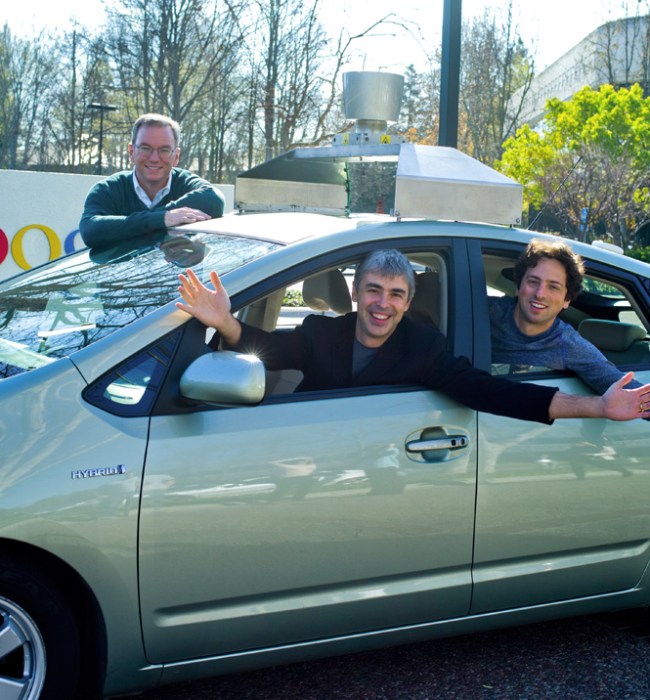
    Apple (AAPL) may not be the most valuable over company in the world anymore, but it’s still by far the most valuable tech company, as its market cap of around $416 billion easily tops Google’s (GOOG) $248 billion valuation and Microsoft’s (MSFT) $233 billion valuation. Over at Forbes, Chunka Mui makes an interesting case that Google’s investment in driverless car technology will be an absolute goldmine for the company in the coming years that could even vault it past its rivals in Cupertino.

    Continue reading…

  • New playlists: “Close up and personal,” “The global power shift” and “Climate change: Oh, it’s real.”

    up_close_and_personal

    TED playlists are collections of talks around a topic, built for you in a thoughtful sequence to illuminate ideas in context. This weekend, three new playlists are available: “Close up and personal,” “The global power shift” and “Climate change: Oh, it’s real.”

    Close up and personal
    Talks from seven photographers, with stunning images from the world’s dark and marginalized corners.

    Climate change: Oh, it’s real.
    We still have a lot to learn about climate change’s causes and implications. But make no doubt about it: It’s real, alright. Stay informed with these eight talks on this essential topic that affects us all.

    The global power shift
    Economic power is shifting across the world, and we’re moving away from a mono-polar model to a multi-polar one. These 9 talks from economists, politicians and activists look at the big picture.

  • Last week on Pro: CES, the fragmented web experience and natural gas

    As the dust settles from CES and the latest flurry of earnings calls, GigaOM Pro analysts are looking beyond connected forks and daily stock market standings. This week, GigaOM Pro takes a look at how the ever-evolving web experience is disrupting content distribution (and consumption), a flash analysis of the biggest hits and misses at CES, and more.

    Note: GigaOM Pro is a subscription-based research service offering in-depth, timely analysis of developing trends and technologies. Visit pro.gigaom.com to learn more about it.

    Cleantech: Natural gas – the other scenario
    Adam Lesser

    Solar has been getting the lion’s share of press in the cleantech sector; the specter of Solyndra continues to plague the industry, and is blamed for scaring away potential investors and hope for market evolution. Pro analyst Adam Lesser identifies another culprit: natural gas. In his latest weekly update, Lesser notes that natural gas is a cheap and appealing alternative for many utilities, who often favor it in lieu of other renewable energy alternatives. However, the natural gas market has its own perils, and Lesser outlines several scenarios that will continue to effect the economics of renewable power in the near future.

    Connected Consumer: CES 2013 flash analysis: disruptions and disappointments from consumer tech’s biggest show
    Michael Wolf

    Pro Analyst Michael Wolf provides a Las Vegas post-mortem and analyzes the results of this month’s GigaOM reader survey. Wolf also takes a look at the show’s major trends – everything from the Internet of things to 3D printing – to determine what’s next for consumer products. What were the biggest highlights (and lowlights) of CES?

    Mobile: How new devices, networks, and consumer habits will change the web experience
    Amy Cravens

    As mobile devices (such as smartphones and tablets) continue to rise, content providers are struggling to contend with a rapidly-growing consumer base that expects zero latency across multiple devices in their user experience. Pro analyst Amy Cravens looks at the biggest shifts in the web experience of the past decade and analyzes the major factors that impact web experience, from design to actual devices. She also presents a pair of case studies from Walmart and the Financial Times before presenting her shortlist of emerging solutions for addressing web content delivery.

  • BMW Alpinas: B10 3.5 / B7S Turbo

    BMW e24 Alpina

    BMW e24 Alpina’s are not only rare, but some of the most sought after BMW’s ever created. They possess timeless body lines, intoxicating exhaust notes and are simply stunning from every angle. Featured in this episode of Petrolicious are two examples in the form of an e24 Alpina B10 3.5 and a B7S Turbo. And while both cars may look similar, according to their owner, their personalities are drastically different. Check them out after the jump.

    Source: Vimeo.com

  • Audi Luxury Through the Years

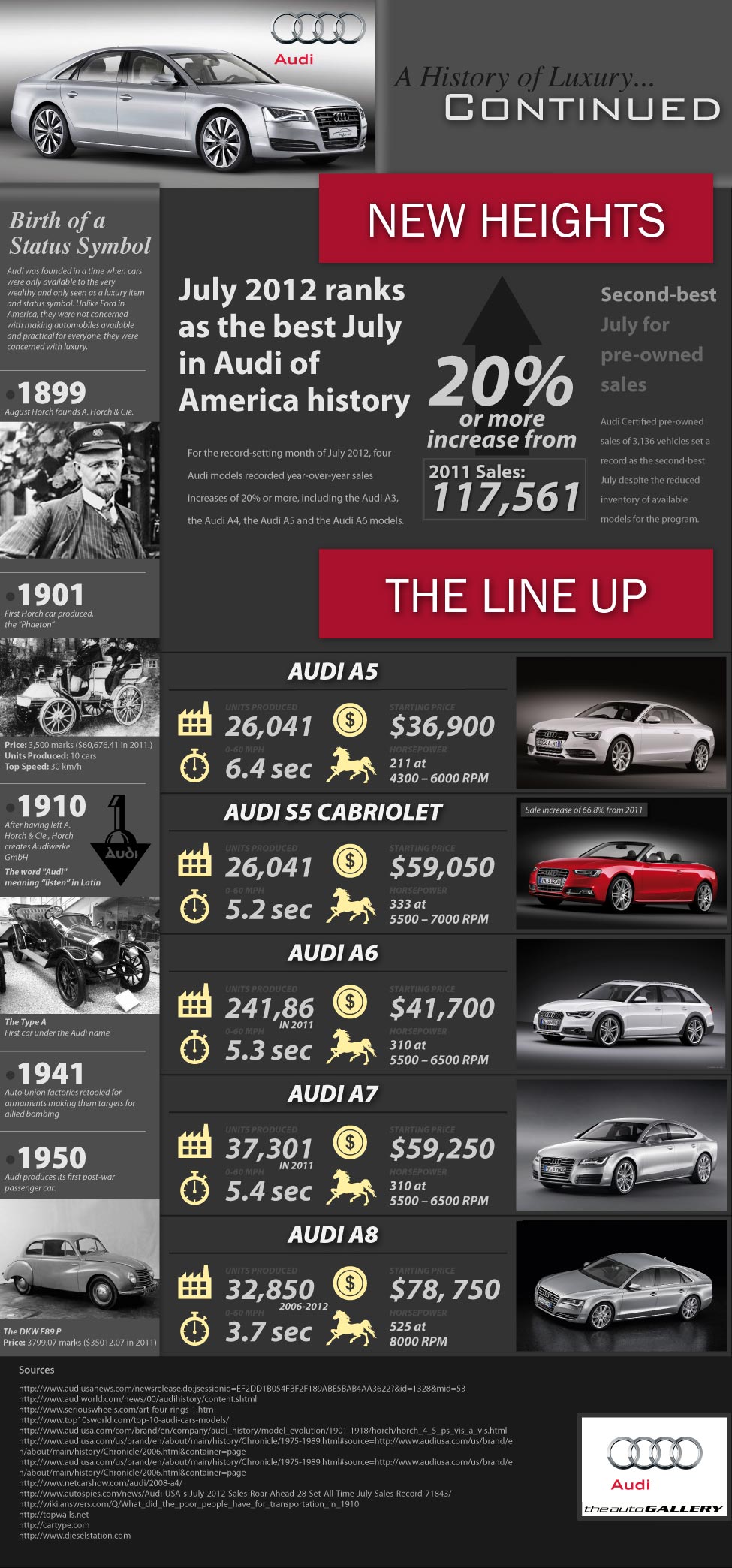
    Over the years Audi has been known for it’s luxurious cars. Audi was founded in a time when cars were only available to the very wealthy and only seen as a luxury item and status symbol. Unlike Ford in America, they were not concerned with making automobiles available and practical for everyone, they were concerned with luxury.

    Even though Audi was found in Germany, their luxurious cars have become increasingly popular in the United States. Sales in recent years have soared as more and more people are experiencing the luxury and power of an Audi.

    Want to learn more about the history of Audi’s luxurious cars? Check out the infographic below presented by The Auto Gallery.


    Audi Luxury Through The Years Infographic from TheAutoGalleryAudi.com

  • Exclusive: Silver Lake eyes digital media, makes Ex-NDS CEO Dave Habiger senior advisor

    Private equity firm Silver Lake has tapped Dave Habiger to expand its work in the digital media space. Habiger, who until last year served as the CEO of U.K.-based pay TV set-top box maker NDS, is joining the firm as senior advisor to the value creation team.

    Silver Lake is known for its investments in high-profile technology companies like Skype and Groupon as well as for a growing interest in the clean energy sector. But the firm has also been stepping up its presence in the media space. Last year, Silver Lake bought a reported 31 percent stake in Ari Emanuel’s William Morris Endeavour agency, with a specific focus on digital initiatives.

    Habiger brings an interesting background to the table for Silver Lake. Before NDS, he was the CEO at Sonic Solutions, where he oversaw the transition from a software-based business to one focused on premium online video. Sonic Solutions ran Cinemanow, one of the first transactional video-on-demand platforms, and ended up powering the premium video offerings of companies like Blockbuster and Best Buy. Sonic Solutions eventually got bought by Rovi for $775 million.

    NDS, on the other hand, has been focused on the other end of the premium video market: cable, satellite and IPTV service providers. But despite working with legacy distribution businesses, the company also looked to innovate through targeted advertising, advanced programming guides and more. Cisco picked up NDS for $5 billion last year, and Habiger left the company when the deal closed.

    Having worked in both worlds — over-the-top and traditional pay TV — gives Habiger a unique perspective on some of the key challenges the media business is facing. Many in the industry believe that the big technological problems with regards to digital content distribution have been solved. What’s left are questions around content rights and business models. Addressing these is going to require a lot of capital. Silver Lake’s appointment of Habiger could be a sign that the firm is seeing an opportunity to profit from this process.

    Check out this interview I did with Habiger back in 2010 when he was still CEO of Sonic Solutions:


  • Put your friends on Avatar, Iron Man or Lord of the Rings posters with Funny Photo Maker

    Transforming a standard portrait photo into something which stands out from the crowd, a shot you’d genuinely like to share with others, usually takes a great deal of time and expertise. But if you don’t have much of either, you might want to consider Funny Photo Maker, an excellent tool which produces great results with the absolute minimum of hassle.

    As you might guess from the program name, this isn’t a regular photo editor and won’t be for everyone. But if you’d like to take a friend’s face and place it on an ape, a magazine cover, movie poster or something similar, then you really need to take a closer look.

    Getting started is extremely easy. Just open a portrait shot, optionally choose the Edit option and position a selection rectangle (or other shape) around the face you’d like to use. And then start browsing the program’s templates to see what’s on offer.

    The Magazine section has covers for Allure, Cosmopolitan, GQ, Vogue and more, for instance, and just clicking any of these will display that issue with a picture of your friend on the cover.

    If they’re more interested in Hollywood then you or your friends could appear on posters like Avatar, Iron Man, Lord of the Rings, Twilight, X-Men and more.

    And you also get lots of clever and inventive frames. So again, in just a click or two you could have an image which displays your photo in an art gallery, on the side of a truck, as the face on a dollar bill, and on the big screen in Time Square, amongst many others.

    If this is a little too off the wall for your needs, there are more standard effects available under the “Artistic” tab. You can add snow or rain to an image, say; turn it into an oil or water painting; apply some excellent lighting effects, turn the image into a collage, and more.

    Funny Photo Maker also includes a very basic editor of its own where you can do simple work: sharpen an image, tweak brightness and contrast, add a text caption, clipart and more.

    And when you’re done, the program provides options to save your image as a file, or upload it directly to Facebook or Twitter.

    You do have to keep your editing expectations fairly low here, as the program is more about ease of use than trying to rival Photoshop. So you don’t get advanced selection tools to try and precisely separate a face from the image background, for instance, and there aren’t 100 hi-tech ways to adjust your image colors (or really any at all).

    That doesn’t matter, though. Funny Photo Maker works because you can have the basic setup complete within seconds, then there are a huge range of quality effects to explore, and applying them mostly only takes a click. If you want a fast and fun way to get more creative with your images then this tool is an absolute must.

  • The delusions that companies have about the cloud

    In the years that I led the Google Apps team, I heard every imaginable objection to cloud computing. Back in 2007, perhaps, those arguments may have had more merit, given the immaturity of most services and limited track record of the providers.

    But over time, it became clear to me that those who rejected cloud computing (typically in favor of that unicorn of technology: the private cloud) were experiencing a form of insanity that, if left untreated, would put the very existence of their companies at risk.

    When I left Google last year (to found Upstart), I jumped over the table and became a consumer of the cloud. As CEO of a tech company that does not even own a computer, tablet or phone, I now get to fully experience the cloud from a customer’s perspective. So before I get into any specifics about the myths of the cloud averse, allow me to recount a couple of anecdotes to give a little context.

    I’m entirely obsessed with Google Analytics’ real-time dashboard, so it was with much dismay that on the morning of Jan. 16 of this year  I saw our traffic at Upstart drop to zero.

    Zilch. Nada. Zippo.

    Checking quickly with our engineers, I learned that Heroku had gone down and since we’re hosted on Heroku, we got taken down with it. Hard. Because Heroku is an application platform that runs on Amazon Web Services, I didn’t know whom to blame. To me, it didn’t matter – we were down for 40 minutes or so, and that sucked. I checked Heroku’s status page, and figured out what had happened, and what they were doing to fix it.

    But all I could really say to our users was “we’re waiting as fast as we can!”

    That is one of the chief conundrums of cloud computing: you are powerless to fix a problem, and entirely dependent on somebody you can’t see, hear or yell at, to fix it. People hate that.

    I was on the other side of this sort of panic many times during my years at Google. Despite the BS about the “end of email,” it’s still the most broadly and voraciously consumed business application in the world. So I occupied an elite circle in Hell when our services failed to deliver. In short, when Gmail went down, pandemonium ensued – particularly in Silicon Valley. In fact, the outcry from a sizable Gmail crash was enough to bring down Twitter, too.

    I recall a particularly terrible outage that happened three or four years ago. I was in a hotel in Philadelphia when my own email stopped working, and my Twitter feed lit up like a roman candle. Gmail was down, and I’m not talking about one of those outages that affects less than 1 percent of users (you know, like a few million people). I’m talking about a big one.

    I called a couple of engineers who I knew were close to the situation and were working to resolve it. But I got off the phone quickly, because I knew talking to me wasn’t helping anything. (To the contrary, I was wasting their time.) So I went out for a run, just praying that Gmail would be back up by the time I returned (which it was).  So even as President of Google Enterprise, I was powerless to do more than ensure that the best people were working on resolving the outage.

    And this, in fact, is the essence of the cloud. As a consumer or corporate buyer of cloud computing, your task is ridiculously simple: Make sure the best people are working on it. And in fact, those engineers working on Gmail are so good that sizable outages are extremely rare these days. Yet whether it’s service reliability, data protection, or regulatory issues, there remains to this day an insane resistance to cloud computing that is quickly becoming the “Darwinian litmus test” for companies in every industry.

    This insanity has three pervasive dimensions to it:

    Insanity #1: These big outages mean we should keep things in house

    I have news for you: a big public outage is actually a sign of success for a cloud vendor – after all, it means tons of customers are relying on its service, no?  (When was the last time you read about IBM experiencing a hosted Lotus Notes outage?) But underlying the essence of Insanity #1 is the presumption that a cloud outages implies your in-house IT organization could do it better.

    In reality, outages merely provide your IT department with excuses to protect their kingdom. The facts are that Gmail uptime is in the range of 99.99 percent – meaning the average user experiences about four minutes of downtime per month – and Amazon targets 99.95 percent for AWS. So, can your team beat that?

    Further, this confused IT leader thinks his team can manage a service more reliably than a company whose entire existence depends on its ability to do so. To put it bluntly, Google has assembled the greatest collection of computer science talent in the world. Similarly Amazon has a multi-year lead in delivering compute power by the drop, with which it’s happy to provide to you with the single-digit gross margins of a successful retailer. Your IT organization simply doesn’t rate at this level.

    Insanity #2: I need somebody to talk to when a service interruption occurs

    I’ve never understood why IT departments seem to care deeply about how important they are to their vendors. It’s a dysfunctional need that can only result in you paying far more to your vendors than is necessary, so that they can afford to show you the love.

    Needing to talk to a cloud vendor when there’s an outage is a striking example of this: Would you rather have your cloud provider spending millions on account managers to call you when something goes wrong, or instead to spend their money on world-class engineers working to fix the problem?

    You can’t have both (unless you want to pay a lot more for your service). By this time, any credible cloud vendor has mastered the art of providing online status updates (just as Heroku did for us here). It’s no small challenge to do this right (we worked on it for years at Google), but it’s critical to servicing customers well in the cloud. So why are so many large companies turned off by the idea of getting updates via a website or RSS? Because it doesn’t make them feel special.

    As a consumer of cloud computing, your goal is to be as unimportant to your cloud vendor as possible – to ride the curve of innovation and cost reductions that result from their efforts to serve an enormous and diverse customer base.

    Insanity #3; Cloud is OK for non-critical applications with non-sensitive data

    If you believe that cloud vendors are just plain better, faster and cheaper at delivering IT services, then it’s another level of insanity (and illogic) to limit the use of these services to inconsequential applications that aren’t critical to your organization. This is the status quo’s last stand – “this data is too sensitive to enable Company X to manage it for us!” (A similar concern is for those who find perverse comfort in actually knowing where their data physically resides.)

    This thinking is backwards. If you care about the reliability, security, and the protection of your data, then you should entrust it to those who are most capable of managing it. If you believe you can match the capabilities and rigor of Google’s Security Operations team, I wish you well.

    Of course, the objection to the cloud heard more often than any other is “it’s not me, it’s them.” In this case, “them” means the boss, the lawyers, the executive team, or the board of directors. And just as frequently, “them” is a varied assortment of regulators whose statutes invariably fail to give clear guidance on whether cloud computing is, in fact, legal. Strangely, even when you speak with these regulators, you will hear the same thing: It’s not me, it’s them.

    Ultimately, the spoils of cloud computing will accrue to those organizations that break through the insanity, that resolutely fight through these distractions and ambiguities to drive this radically better approach to computing throughout their organizations.

    Dave Girouard is founder and CEO of UpStart. Previously he was President of Enterprise at Google. Follow him on Twitter @davegirouard.

    Photo courtesy of John Wollwerth/Shutterstock.com.

  • Goss’ Garage: Quick Car Care

    MotorWeek

    If you’re a fan of the show MotorWeek like I am then the name Pat Goss is very familiar to you. You see Pat is the resident expert on car care at MotorWeek, and aside from being unbelievably knowledgeable, he just comes across as a good honest individual who wants nothing more than to educate motorists. On this segment Goss instructs us to “proceed with caution” whenever you have your car serviced at a quick care establishment and not to fall for any of those “extra” services that are usually offered by technicians. Click through and check it out.

    Source: Youtube.com

  • How to use your iPhone, iPad or Mac to borrow ebooks from the library

    You may be familiar with purchasing books and magazines for your iPhone and iPad, but have you ever borrowed an ebook or digital edition of a magazine from your local library?  As more and more local libraries are adding online digital catalogs of books for borrowing, it’s a great — and cheaper! — way of building up your digital library for free.  After trying out a few methods for using the resources of your local library to borrow electronic versions of your favorite ebooks, magazines and audiobooks, I’ve written up a quick guide to follow.

    Borrowing ebooks with OverDrive

    Most libraries are choosing a third party to host and manage the lending process.  One such service provider, OverDrive Digital Downloads, is what my local library uses. OverDrive currently supports 18,000 libraries with millions of readers. The experience is not quite what you would expect if you’re used to Apple’s integrated iBooks app or Amazon’s Kindle bookstore. But it does work, and once you have the ebook on your iPhone or iPad, the reading experience is just about the same.

    Getting Started

    Getting Started: The first thing you will need is an active account at your local library.  This will be used to identify you as a borrower and ultimately limit the number of ebooks you can have checked out at any one time.

    Borrowing an eBook

    Selecting an e-reader: For most of the titles available from my local library on OverDrive, I have only two main choices:  to either use Amazon’s Kindle solution on my iPhone, iPad and Mac, or to use OverDrive’s own e-reader client for the iPhone, iPad and Mac.  As a possible third option, you can also elect to use Adobe Digital Editions for the Mac.  But be aware: the one client that you will not be able to use is Apple’s own iBook e-reader for iOS, as it does not support the DRM solution that the other readers support.

    Downloading the eBook

    Borrowing an ebook: Browsing the online library of ebooks is the same experience for all e-eaders.  You will select a book via your browser.  I found that using Safari for OS X and iOS work just fine for this.  Once you associate your library account with OverDrive, you can create wish lists and place holds on books you want to read.  Each title in the library is limited to a predetermined number of copies that the library can lend out.

    Reading the eBook

    Downloading the ebook: If you place a hold on a book, you will be notified via email when the book is available.  Depending on your e-reader, once you log in to your library account, you will either download the file directly to the OverDrive e-reader client on your device, or you will log on and register your library account with Amazon, and check the book out directly to your Amazon account.

    Since I already have all of my devices registered with my Amazon Kindle account, as soon as I checked out the ebook it was available on all of my devices for me to read.  So reading any ebook that I check out from the library is the same experience on my Kindle as with any other book in my library.  Even my bookmarks sync across all of my devices.

    Digital magazines with Zinio

    The experience with magazines is different since my library chose to go with Zinio as its partner.  Zinio has been around for a while and was bringing digital versions of popular magazines to your iPhone and iPad long before Apple introduced iOS Newsstand to the world.  There are no choices here, you have to use the Zinio reader for the iPhoneiPad and Mac.

    Zinio Magazines

    You do have to sync your Zinio account with your library account, but once that is done, as soon as you select a magazine from the online library of digital magazines available for lending, it instantly shows up on your Zinio account for reading.  While you won’t have the same connivence as you would with a receiving updates via a paid subscription, selecting individual releases can be more cost effective since borrowing is of course free.

    Borrowing audiobooks

    I was also happy to see that you can use OverDrive to check out audiobooks from the library as well.  To do this, you will have to use the OverDrive client for Mac, which does come with some restrictions: You will not be able to borrow any audiobook that in only available in WMV format.  You will be limited to borrowing only MP3 audiobooks.

    OverDrive Audiobooks

    You will be able to listen to your audiobooks in your favorite audio device as the OverDrive client for Mac supports exporting audiobooks to devices like an iPhone, iPad and iPod.  You are even permitted to use the OverDrive client to burn an audiobook to CD.

    Overall the experience was a positive one.  It takes a little to get used to the process of searching for electronic books and magazines that will work with the format your e-reader supports, and ultimately to get them working on your preferred devices.  But after you have done it a couple of times, it’s really not all that complicated.  And it can definitely help expand your reading list and your own personal digital library without costing you anything.

  • Top 5 Data Center Stories Week of Jan. 26

    google-tapelibrary

    Google spent $1 billion in the fourth quarter investing in data center equipment, like this huge tape backup archive. (Photo: Connie Zhou for Google)

    For your weekend reading, here’s a recap of five noteworthy stories that appeared on Data Center Knowledge this past week. Enjoy!

    Google Pours $1 Billion Into Data Centers in 3 Months – Google poured $1 billion into its data center operations in the fourth quarter of 2012, marking its highest quarterly investment ever in Internet infrastructure. The only time the company has spent more on capital expenditures was the fourth quarter of 2010, when it spent $2 billion purchase 111 8th Avenue, primarily for its office space.

    Silicon Photonics: The Data Center at Light Speed – Intel has developed a prototype of a “photonic rack” with high-speed connections that allow new approaches to server design that separate components like CPUs and storage, allowing them to be upgraded independently. Here’s a video overview.

    Hyve Brings Facebook’s Servers to Your Racks – Hyve Solutions is developing products based on Open Compute designs, so that other companies can begin to take advantage of some of the latest innovations in open hardware. At the recent Open Compute Summit in Santa Clara, the Hyve team gave DCK a look at its latest hardware.

    Rackspace Plans Major Cloud Expansion in UK – Rackspace Hosting plans a major expansion of its cloud computing infrastructure in the United Kingdom, and has hired Digital Realty Trust to build a new data center. Rackspace has been experiencing strong growth in its cloud business, as its total server count has grown by more than 10,000 over the past year while revenue has improved 27 percent.

    Flash Memory at Scale: Fusion-io Goes Large – With growing demand for Flash memory from hyperscale and cloud companies, Fusion-io last week unveiled ioScale. Fusion-io’s Gary Orenstein describes the Fusion ioScale product in this video with Data Center Knowledge editor Rich Miller at the Open Compute Summit.

    Stay current on Data Center Knowledge’s data center news by subscribing to our RSS feed and daily e-mail updates, or by following us on Twitter or Facebook or join our LinkedIn Group – Data Center Knowledge.

  • Shocker: An electric car company actually meets production goals (and yes, it’s Tesla)

    Once again electric car pioneer Tesla Motors is the lone firm out of its electric car peers that says it’s going to do something, and then actually (usually) does it. According to Automotive News, Tesla has now reached its goal of producing 400 Model S electric cars per week, or around 20,000 cars per year.

    This rate of production has been Tesla’s goal for months — if not years — and it’s a big step on the company’s path to profitability this year. Back in November, during its latest quarterly earnings, Tesla said it was on track to reach this milestone after having to scale back its original production goals a couple months earlier in September. It also means that all those customers on the waiting list to get their Model S cars — there were 13,200 as of the third quarter — will get their cars sooner, rather than later.

    Tesla Model S

    However, as I’ve written before, Tesla seems to be the exception rather than the rule in the struggling world of independent electric car makers and batteries made for electric cars. Electric car infrastructure maker Better Place shuffled out its second CEO in as many months last week, and laid off a big chunk of staff in the face of very slow adoption of its electric car service in Israel.

    Electric car startup Fisker hasn’t made any of its hybrid electric Karma cars in months, and is looking for a Chinese partner, investor or acquirer with deep pockets to offer it a lifeline. Fisker’s original production goal at the beginning of its life was 5,000 Karmas in 2011, and it’s made around 1,900. A123 Systems, which has been making batteries for Fisker’s Karma, went bankrupt last year and then was bought by Chinese auto tech giant Wanxiang.

    For the auto giants like GM and Nissan, which have been making their own mainstream electric cars, production isn’t a problem. It’s just that sales are a little slow. GM sold a total of 23,461 Volts in 2012, up from the 7,671 sold in 2011, and Nissan sold 9,819 Leafs in 2012, according to AutoblogGreen. GM originally wanted to sell 45,000 Volts in 2012.

    We drive the new Tesla Model S thumbnail

    So why is it so hard for independent electric car companies to meet their targets, and large auto makers to hit sales targets? For the auto giants, the market is only just emerging. GM’s Volt and the Nissan LEAF are the first mass produced plug-in battery cars on the market in the U.S. Auto exec Bob Lutz, who kickstarted GM’s Volt and is now on the board of some startups, says the transition to electric cars will be very slow.

    For independent car startups, commercial scale production can be daunting and take a lot longer than expected, too. Many things can go wrong, and the it can take months to streamline the process of auto manufacturing. Tesla was founded back in 2003, and its pilot car — where it made errors and suffered delays — was the original Roadster. It’s taken Tesla this many years to get to its closer to mainstream auto maker status just pushing out 400 cars per week.

  • Apple’s slowed growth has blown the future of the mobile industry wide open… and that’s very exciting

    Mobile Industry Analysis
    What a difference just a few months makes. If you don’t recall, it was only last September when Apple’s (AAPL) share prices were blasting past $700 and bullish analysts were proclaiming that the company was well be on its way to having a $1 trillion valuation and dominating the tech industry for years to come. All that’s changed now as Apple has lost its spot as the world’s most valuable company and investors are panicking that the company’s growth rate may have peaked. This isn’t to say that Apple is doomed (and sorry, Apple haters, but it isn’t) or that it can’t return to the lofty heights it achieved last summer, but for the time being it no longer seems destined to mop the floor with its competitors for years to come.

    Continue reading…

  • TED Weekends offers simple solutions to heal the masses

    PhoneCould the telephone be used as a healthcare device? Mathematician Max Little believed that it could. Max Little: A test for Parkinson’s with a phone callMax Little: A test for Parkinson’s with a phone callBecause Parkinson’s disease causes unusual tremors in the voice, Little realized that a 30-second phone call could be all that’s needed to diagnose the disease, which devastates 6.3 million people worldwide. As Little shared at TEDGlobal 2012, in trials, this test appears to be 99 percent accurate. But he needed 100,000 Good Sumaritans to call the Parkinson’s Voice Initiative and help refine the tool. Luckily, they did.

    It’s inspiring to think that the most simple of ideas could save lives and spare pain all across the world. That’s the idea that today’s TED Weekends on the Huffington Post is dedicated to. Here, three of the great essays that are available now for your reading pleasure. 

    Max Little: How Math Could Improve Life for Nearly 6 Million People with Parkinson’s

    I’m a mathematician and am constantly amazed that the world around us can be described mathematically. All it takes is a combination of a handful of simple mathematical concepts. I’m insatiably curious, and I want to understand how things fit together, so, I get involved in many kinds of scientific problems — everything from the changing statistics of extreme rainfall, to the behavior of life at the scale of molecules, to analyzing voice and speech recordings for forensics. But there’s one project, on Parkinson’s disease that has occupied me for the last seven years. I fell into it almost by accident.

    It is estimated that between 4 and 6 million people worldwide have Parkinson’s. Because the disease is more likely to affect older people than younger, and because the population is aging and growing, that figure is expected to rise. Parkinson’s primarily affects movement, the ‘classic’ symptoms are uncontrollable and unwanted motion in the limbs, which looks like shaking or tremors.

    I can only imagine what it is like to suffer from a neurological disease. Read the full essay » 

    Alvaro Fernandez: Retooling Brain Care with Low-Cost, Data-Driven Technologies

    While sophisticated neuroimaging techniques such as fMRI (functional magnetic resonance imaging) provide a significant boost in our understanding of the brain — and sexy research frequently reported all over the media — they are extremely costly. This makes it difficult to reach the mass scale required to conduct clinically meaningful research and to improve the brain care of millions if not billions of individuals around the globe.

    Good news is, we are witnessing an explosion of new methods that make use of low cost, already ubiquitous technologies to inform brain health prevention, diagnoses and treatments on a wide scale. Read the full essay » 

    Maura O’Neill: Disruptive Innovation Often Comes from Unexpected Places

    As a mathematician, Max Little hasn’t spent most of his career in a doctor’s office or a hospital, but with a pad and pencil or behind a laptop. And yet it is he who has crafted a radically lower cost and more ubiquitous method for diagnosing Parkinson’s.

    Steve Jobs loved music, but hadn’t spent his life as a disc jockey. He was not a professional musician or a stereo hardware designer and he didn’t focus on music marketing. That is, until he and his team at Apple released the iPod. What Jobs did have was a deep respect for the consumer music experience, and with his knowledge on business and technology, he devised a business model that forever changed the industry and its customers. Read the full essay » 

  • Android this week: Galaxy Note 8.0 pics; App finds best network; a Google smart watch?

    Another week brings us closer to the Mobile World Congress event where Samsung is rumored to be showing off new Android tablet. The Galaxy Note 8.0 has been leaked, confirmed and now pictured by several sites, looking like a large Samsung Galaxy S 3 phone. That’s not a bad thing considering the GS3 is Samsung’s top-selling smartphone.

    What intrigues me most about the images is speaker above the 8-inch display, which is expected to have a 1280 x 800 resolution.

    Galaxy Note 8.0That means the tablet is likely to have voice capabilities like a phone, although I don’t anticipate many to hold this slab to their head. It would work in a pinch, meaning you didn’t want to have a speakerphone conversation and didn’t have a wired or wireless headset handy.

    Bear in mind that the original 7-inch Galaxy Tab had cellular voice capabilities, but here in the US, that feature was stripped out of the device for all 3G models.

    If Samsung does out a new note at this size, the S-Pen and multiwindow software features could increase appeal. The company already supports these on the 5.5-inch Galaxy Note 2 and, after a recent software update, on the larger Galaxy Note 10.1 tablet.

    Speaking of software, I stumbled upon a handy app for Androids that helps determine the best cellular and Wi-Fi network near your location. Called OpenSignal 2, the free app uses crowdsourced information to create maps for coverage and speed, while also using a compass-like function to find the nearest Wi-Fi hotspots. OpenSignal 2 also keeps track of your mobile broadband usage and provides a speed testing feature too.

    Late this past week, I started speculating on why it’s time for Google to make a smart watch. As the recent sales success of the Pebble e-paper smart watch shows — the product topped 80,000 backers on Kickstarter alone — there’s some consumer interest in wearable devices such as these.

    motoactv-watchGoogle actually already has a smart watch by proxy: It owns Motorola, which makes the MotoActv; perhaps one of the best Android-compatible watches on the market. It wouldn’t take much for Google to tweak or improve it. If the company is serious about wearable devices and quantified self gadgets, I’d think it could launch a revamped smart watch as early as this year’s Google I/O event.

    If the company does so and gets even a small percent of Android device owners to use such a smart watch, it could gain access to tens of millions of  health-related data points such as steps taken, calories burned, heart rate. And as we already know: Google is all about gathering, indexing and using data.

  • 2013 Lightning Lap – LL4 and LL5 Class

    Car and Driver Lightning Lap

    In this, the fourth and fifth installment of Car and Driver’s 2013 Lightning Lap, we get to check out cars that range from $120,000 – $239,999 in the LL4 Class, to those costing more than $240,000 in LL5. The competitors are all run at Virginia International Raceway under the same conditions until one winner from each class is proven. This episodes lineup includes the Ferrari 458 Italia, Jaguar XKR-S and the Lexus LFA. These are some stout automobiles no doubt, but how will they hold up under the stresses of the raceway. Click through to find out.

    Source: CarandDriver.com

  • Should Internet Data Be Taxed?

    French President François Hollande commissioned a report that was presented last Friday, which describes a new Internet tax that would attempt to collect revenue from Internet companies based on the amount of users whose data they track and monetize.

    Should Internet data be taxed anywhere? Let us know what you think.

    Eric Pfanner at The New York Times explains:

    The report published Friday said a tax on data collection was justified on grounds that users of services like Google and Facebook are, in effect, working for these companies without pay by providing the personal information that lets them sell advertising.

    The report says tax rates would be based on the number of users an Internet firm tracked, to be verified by outside auditors. The authors did not recommend tax rates or estimate how much money such a levy could raise.

    Obviously the idea has been controversial, and has drawn a great deal of criticism. For example, Nicholas Carlson at Business Insider says the “French view of the Internet will make you want to pull your hair out,” adding, “Users are not, ‘in effect’ or otherwise, ‘working for these companies without pay by providing the personal information that lets them sell advertising. They are using products for free! NO ONE IS MAKING THEM USE FACEBOOK OR GOOGLE, SHEESH.”

    Google is reportedly reviewing the report. Perhaps we’ll see a blog post about it from Google in the future.

    France has been looking at Google’s tax practices for a couple years now, as the French government has accused the company (and others) of playing the tax system by placing their European operations in places like Ireland or Luxembourg, where tax rates are lower.

    On Thursday, French Industry Minister Arnaud Montebourg said France has decided to go after all big Internet firms “curbing legal tax avoidance,” as Reuters puts it, to collect payment of back taxes. Reporter Brian Love writes:

    The government had decided, Montebourg said on France 2 television, “to launch tax retrieval procedures covering all of the Internet giants”.

    He did not elaborate and it was not clear whether the comment, made in a wide-ranging interview about French industry, referred specifically to existing tax investigations of the Internet search engine and retail giants Google (GOOG) and Amazon (AMZN), or was suggesting a broader campaign.

    Amazon received a $252 million back tax bill from the French government in November.

    Meanwhile, talks between Google and publishers in France over payments for links are at a stand-still, according to ZDNet, which cites French newspaper Le Monde. We reported on this situation last fall, when Google prepared a note about a link tax proposal by French lawmakers (backed by the publishers).

    Google’s Director of Public Policy in France, Oliver Esper, said at the time, “The web has led to an explosion of content creation, by both professional and citizen journalists. So it’s not a secret that we think a law like the one proposed in France and Germany would be very damaging to the internet. We have said so publicly for three years.”

    He later added, “We have always been and remain committed to collaborate with French Publishers associations as they experiment and develop sustainable economic models on the Internet.”

    Google executive chairman Eric Schmidt met with Hollande back in the fall to discuss the proposal, and the parties involved were supposed to resolve their issues by the end of the year (at least as far as the president was concerned), but so far, it sounds like little has been resolved.

    As far as Internet taxes go, while French regulators’ plans may be designed to go after big companies like Google, where are the lines drawn? Will smaller players be affected as well? The very nature of the Internet is global, and that includes France.

    Is this a good idea on France’s part? Let us know what you think.

  • Weekly Address: Two Nominees Who Will Fight for the American People

    President Obama discusses his nomination of Mary Jo White to lead the Securities and Exchange Commission and Richard Cordray to continue as Director of the Consumer Financial Protection Bureau.

    Transcript | Download mp4 | Download mp3