Blog

  • Match.com Sued Over Relationship That Ended in Attempted Murder

    50-year-old Mary Kay Beckman has filed a $10 million lawsuit against dating site Match.com, placing blame on them for a 2011 incident that left her nearly dead.

    In September of 2010, Beckman met her “match” on the site, 53-year-old Wade Ridley. But after just eight days, she decided to break it off. Four months later, he broke into her house and stabbed her 10 times with a butcher knife. So hard that according to reports, the knife broke.

    Ridley later committed suicide in jail awaiting trial.

    Beckman is suing, claiming that Match.com doesn’t do enough to warn people of the risks they take when pursuing an online “match.”

    Match.com has responded to the lawsuit, calling the situation “horrible” but the lawsuit itself “absurd”:

    What happened to Mary Kay Beckman is horrible but this lawsuit is absurd. The many millions of people who have found love on Match.com and other online dating sites know how fulfilling it is. And while that doesn’t make what happened in this case any less awful, this is about a sick, twisted individual with no prior criminal record, not an entire community of men and women looking to meet each other.

    Match.com’s terms of use does tackle the issue of “interactions with other members,” saying that they are not responsible for them, and that they currently don’t conduct criminal background checks. “Match.com makes no representations or warranties as to the conduct of members or their compatibility with any current of future member,” they state.

    “IN NO EVENT SHALL MATCH.COM BE LIABLE FOR ANY DAMAGES WHATSOEVER, WHETHER DIRECT, INDIRECT, GENERAL, SPECIAL, COMPENSATORY, CONSEQUENTIAL, AND/OR INCIDENTAL, ARISING OUT OF OR RELATING TO THE CONDUCT OF YOU OR ANYONE ELSE IN CONNECTION WITH THE USE OF THE SERVICE,” says the site in big, bold, capital letters.

    But it’s not as if terms of use are always airtight and courts can’t rule against a company in spite of them. What do you think? Is match.com in any way liable for violence that occurred based on one of their suggestions? Or is this lawsuit, like they put it, absurd?

    [Fox 4 via Mashable]

  • Google Developers Talk About The Future Of Dart

    In 2011, Google introduced the Dart programming language as an alternative to JavaScript. It’s been a little over a year now since it launched. It’s come a long way since then, but there’s still a lot of work to be done.

    In today’s Google Developers’ Office Hours, the Dart team talks about the latest developments in the programming language. They also address what the next year and beyond will hold for Dart. If you are a fan of Dart or want to know more about Google’s foray into programming languages, you’ll want to check it out:

    As an added bonus, here’s a video on how to enable continuous integration with Drone.io using Dart:

  • All My Children, One Life To Live To Return Via Hulu, iTunes

    Nearly two years ago, news came out that ABC had canceled the long-running soap operas All My Children and One Life To Live. ABC had decided to replace them with food shows, saying the decision was guided by “extensive research into what today’s daytime viewers want and the changing viewing patterns of the audience.”

    If daytime TV viewers didn’t want All My Children and One Life To Live, you could have fooled me, because when the news broke, the angry comments flooded the web.

    Angry fans can find joy once again, because both shows are making a return, courtesy of Hulu. We have yet to see an official announcement, but TechCrunch is reporting that both will be back in shorter 30-minute episodes each weekday, starting in the spring on Hulu, as well as on iTunes and Prospect Park’s (the production company that licensed the soap operas from ABC) The Online Network, but Hulu will manage the ad sales and package them.

    Prospect Park actually announced the shows’ return earlier this month, but didn’t mention Hulu or iTunes (via zap2it):

    “We are pleased to confirm that Prospect Park is reviving the beloved soap operas, All My Children and One Life To Live as the anchor programs on The Online Network (TOLN). Today we are also pleased to confirm that Prospect Park has: 1) signed guild agreements with both SAG-AFTRA (Screen Actors Guild and the American Federation of Television and Radio Artists) and the DGA (Directors Guild of America); 2) entered into a consulting agreement with Agnes Nixon the creator of All My Children and One Life to Live guaranteeing her active involvement; 3) hired Foz McDermott (coordinating producer Heroes) as TOLN’s head of production, Jennifer Pepperman (Director, One Life to Live) as Executive Producer on One Life to Live, and Ginger Smith (Producer, All My Children) as Executive Producer on All My Children; and 4) arranged the necessary financing to begin production in February on both All My Children and One Life To Live.

    Online video has become quite the savior for fans of canceled TV shows, showing that if there is big enough demand, your old favorites might have a chance at returning. Netflix has managed to pull off what many of us thought would never happen, in bringing back the cult favorite Arrested Development, which returns in May. Now, long-running soap operas are finding their way back to fans in what should be a happy moment for a lot of people.

  • Can we blame Best Buy’s big MacBook Air sale on Chromebook?

    If you ever wanted Apple’s tiny laptop, cash in your savings or dig out the credit card. Best Buy has a short sale going, discounting MacBook Air by $200. That means price starting at $799.99 today and tomorrow for an 11.6-inch model with Intel Core i5 processor and 64GB SSD. Double the storage for another 100 bucks.

    The promotion, part of Winter Doorbuster Days, is Friday and Saturday. Best Buy discounts other goodies, but MacBook Air stands out for the price, which lowers the entry cost to joining the Mac Fan Club. But Best Buy also sells the Samsung ARM Chromebook, for $249.99, also with 11.6-inch panel, similar size and weight and comparable (if not better) ergonomics. And Best Buy can’t stock Chromebooks fast enough. While the company doesn’t release sales data, social network chatter reveals bounty hard to get. So can we just blame Chromebook for Best Buy’s sale?

    I write this post on the Sammy Chromebook, by the way. In May, I moved from the then top-of-the-line MacBook Air and haven’t looked back. I don’t think Chrome OS is for everyone, or even most people, but those who embrace the cloud will be surprised.

    Rarely a day goes by where I don’t see someone boast about buying Chromebook online. Ron Minnich posts today on Google+: “Ah, this Samsung ARM Chromebook is just so nice. I still can’t believe these things only sell for $249”.

    Mike Beeson: “My personal Chromebook (Samsung $250 model) came today. I guess I can take my others back to work now”.

    Oh this has got to hurt. “My wife just found out the hard way that her Samsung Chromebook does not work well when you accidentally dump your cup of coffee on it”, Padric Toman tells. “I felt bad for her, so I gave her my Chromebook. We are drying out the coffee soaked Chromebook right now. Maybe a miracle will happen”. You’re a good husband, Padric. “Maybe Google will be sympathetic and send us a new one”. Hey, Chromebook team, show him some compassion.

    Even if he ends up buying a new one, $249 is a lot more manageable than $999 for cheapest-cost MacBook Air (at normal price). Value has different measures.

    So do run down to Best Buy to buy MacBook Air cheap, but look at Chromebook while there. You just might save 550 bucks.

    Photo Credit: Joe Wilcox

  • Why it’s time for a Google smart watch

    Google is exploring the idea of making a smart watch according to a Business Insider source. The unnamed source suggests that Google is researching how to market such a device and BI notes certain relevant patents Google has that would support such a product. Even with the report, which I’d consider a rumor at this point, now’s the time for a Google smart watch for a number of reasons I can think of. The biggest one? Google already has a smart watch on the market.

    Hello Moto

    I’m talking about the Motorola MotoActv, the part smart watch, part exercise tracker that I bought nearly a year ago. Although Google has kept Motorola as a separate business division since purchasing the company in 2011, for all intents and purposes, whatever Motorola makes is a Google product. The watch also runs a highly customized version of Android. In fact, its been one of the most stable Android devices I’ve ever used.

    motoactv_mr7_notificationsI originally bought the watch to track my running activities because it’s ideal for that. Inside the watch are various sensors and radios including: Wi-Fi, GPS, Bluetooth, and accelerometer. Flash storage of 8 or 16 GB adds room for music tracks which can be listened to through wired or wireless headphones. The software also supports my golf habit, tracking my scores, shots and providing detailed distance to the pin or to various golf hazards.

    Later, I began wearing the watch every day when Motorola added support for the companion Android app for handsets built by other manufacturers. All of a sudden, my exercise tracker started notifying me of incoming messages, mail, tweets and upcoming calendar events. And it works well. Google could easily advance the device, features and software because it has a solid product to start with.

    More data required, please

    The second reason I wouldn’t be surprised to see a Google smart watch? The company really isn’t yet part of the wearable device market that’s gathering steam. Yes, Google’s Project Glass is entry here, but at $1,500 for a developer edition, it’s not a consumer device yet. It will take time before these high-tech glasses appear on retail shelves, if they ever do. And even if they do, they’re not likely to be part of the “quantified self” concept; a watch like the MotoActv is because it captures personal data such as steps taken, calories burned and more.

    That reason alone is a good one for Google to design such a device. The company thrives on gathering and aggregating the world’s data but it really doesn’t have a good hook into health data. Even if Google could sell a smart watch to just 10 percent of Android devices owners, it would have access to quantified self data of over 50 million individuals in year, based on the 1.5 million Android devices that are activated every day. That’s some big data.

    Since Google could easily build off of the existing MotoActv watch, I don’t think it would take too much time or effort to improve the device quickly. I wouldn’t be surprised at all if we see a Google smart watch at this year’s Google I/O event, in fact. Time will tell, of course.

  • Parents Sent to Sex Site Thanks to Typo in School Email

    Shock! Horror! Impending lawsuits!

    Parents of children who attend one of the many schools in the Chicago Public Schools system were inadvertently directed to a soft-core adult site, after the school system sent out a mass email containing one slightly altered link.

    The point of the email was to notify parents that CPS was raising their standards when it comes to the Illinois Standards Achievement Test, or ISAT. The new standards for the ISAT are being implemented by the Illinois State Board of Education, or ISBE.

    A link at the conclusion of the email wanted to direct parents to the ISBE site more more information. Instead, the addition of one extra letter wound up directing parents to ISBEL.com, which happens to be a “private invite only community” with the goal of “enriching the modern woman’s sex life and sensuality.”

    Luckily (or unluckily, depending on who you ask), the site’s home page only features an artistic photo of an open Kama Sutra book, placed on a bed. No real hardcore porn stuff or anything.

    But of course, CPS had to make a public apology.

    “As soon as it was brought to our attention, we sent out an updated letter with a corrected link and apologized for any inconvenience it may have caused,” said a spokeswoman for the Chicago Public Schools system.

    Let’s just see how many parents come out and say they were scarred by CPS’ carelessness. Maybe their kids even saw the landing page. THE CHILDREN! THINK OF THE CHILDREN!

    [CBS Chicago via CNET]

  • The Web Can Be A Dangerous Place: Learn To Protect Yourself

    Malware, phishing scams and other dangerous entities are all over the Web these days. A report from earlier this month said 2013 was going to be even worse than 2012 in regards to the proliferation of malware across the net. It’s now more important than ever to protect yourself, but perhaps you don’t know how. That’s where these helpful tips come in.

    Google thought it was high time to remind its users once again how to remain safe and secure on the Web. The following video contains a number of common sense tips, but you’d be surprised by how many people don’t actually actively protect their computers from Web-born attacks and malware.

    As I said, a lot of these are common sense safeguards that you can put into place. I would like to give special attention, however, to the 2-step verification process. I never used the feature for my Google account because I’m careful about who I give my personal email address to and never ventured outside the “safe boundaries” of the Web without the proper precautions. Even with all my precaution, my account was almost hijacked by a hacker out of China. It was a much needed wake up call.

    In short, if you use a personal email client, you really need to take advantage of the security options that your service provider employs. If you’re proactive about security now, you won’t have to deal with the fallout of having your online identity stolen later.

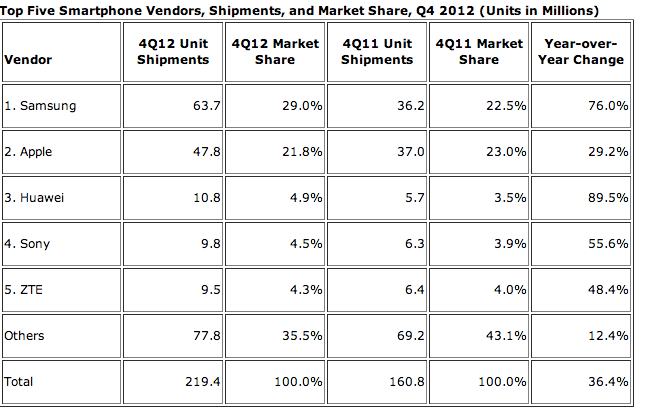
  • Huawei is now the world’s third largest smartphone vendor, but still far behind Samsung and Apple

    Smartphone Market Share Q4 2012
    Research firm IDC released the latest numbers from its Worldwide Quarterly Mobile Phone Tracker this week and found that a total of 482.5 million mobile phones were shipped in the fourth quarter of 2012, an increase from 473.4 million in 2011. Smartphones accounted for nearly half, or 45.5%, of all mobile phone shipments, the highest percentage ever. Samsung (005930) and Apple (AAPL) remained the two top vendors with market shares of 29% and 21.8% respectively. The report did include some surprises, however.

    Continue reading…

  • Get Android ICS natively on Windows 7 and 8

    Running Android on Windows is not a new concept. It has been possible for sometime now, but it required the use of something like Virtual Box, or rival virtual machines. Now version 4.0.3, known more familiarly as Ice Cream Sandwich, has been ported to both Windows 7 and Windows 8. It runs natively, no virtual anything needed.

    This is not exactly for everyone. For one thing, there is no Google Play Store, although the developers are working to add this rather important feature. For now you can side-load apps using the APK file.

    Getting Android for Windows is also not as easy as it should be. You will need to fill out a short form and then wait for an email with the download link. Despite being a rather small file, the download is slow, perhaps due to demand. I also had some issues with “corrupt file” messages and I had to redownload the program a couple of times.

    However, once those obstacles are overcome, you will have a full running version of Android in a window right on your desktop. This is new, and certainly not without issues, but it could shape up to be a great tool for developers once all of the kinks are worked out. Trust me, in my brief experience I found a lot of kinks. It is certainly not ready for prime time, but I have hopes it will get there.

    In fact, as I write this, it has crashed and is failing to restart…


  • Burt Reynolds Hospitalized With Nasty Bout Of Flu

    Burt Reynolds, everyone’s favorite badass, has been hospitalized after coming down with a severe case of the flu bug that’s going around.

    Reynolds apparently had the symptoms for several days and was trying to deal with it in his own badass way, but it finally got the better of him and he checked into a hospital. His reps say that despite being severely dehydrated, he’s expected to make a full recovery.

    The flu has taken down thousands of people so far this year and has even caused several deaths. Some states have declared medical emergencies as their hospitals are having to turn people away due to overcrowding. The CDC warns that very young children and the elderly are most susceptible to the virus; as always, the best defense is constant hand-washing, especially after coming into contact with publicly-used surfaces or handling money. Many grocery stores have taken to placing anti-bacterial wipes beside their stash of shopping carts for customers to use on the germ-laden trolley they put their food in. Wipe that sucker down, people, and then nuke the entire thing from orbit; it’s the only way to be sure. If that doesn’t do the trick, have some Influenza Sorbet and call in sick, because your co-workers don’t want to be in the same room with an incubus of viral plague.

  • Studying India’s Maha Kumbh Mela Festival

    Between 2000 and 2010, the population of Delhi burgeoned from 15 million to 22 million while Shanghai’s population swelled from 14 to 20 million. Compare that to the recent rise of an impromptu city near Allahabad in India: In the week after January 14, 2013, the first day of the Maha Kumbh Mela festival — during which Hindus gather for a sacred bath at the confluence of the Ganga and Yamuna rivers — around 10 million people had gathered there.

    When the event ends five weeks later, approximately 100 million people would have moved into and out of Allahabad. (I say “approximately” because the precise numbers are difficult to come by.) It took 60 years for the population of Istanbul to grow from one to 10 million, and 50 years in the case of Lagos. At Allahabad, though, the population rose from zero to 10 million, give or take a few million, in just a week’s time.

    That’s a slightly unfair comparison because the local government isn’t going to put in place all the fixtures of a functional metropolis. However, it’s only partly unfair. The Indian authorities do have to pull off the creation of a huge temporary tent city with minimal mishap. An enormous amount of urban planning, civil engineering, governance and adjudication, and maintenance of public goods — physical ones like toilets as well as intangibles such as law and order — and plans to deal with unexpected events goes into the creation of this city. Those are pretty much the main elements surrounding the creation of any city in the world.

    There will also be a reasonably efficient dissolution of the city when the Kumbh Mela ends in late February, but that’s another story. Some cities have declined over time, but I can’t even imagine what it would take for one of the world’s major metropolises to unwind.

    The mammoth people flows at Allahabad got me excited when two colleagues at Harvard University, religion professor Diana Eck and design professor Rahul Mehrotra, broached the idea of studying the Maha Kumbh Mela some months ago. As a child growing up in India, I had read about the festival, but had never entertained the idea of visiting it or studying it. Having lived outside India for over two decades, I now find myself in a position to revisit the event, intellectually and physically.

    The flows of humanity that my colleagues and I will study during the five weeks of the Kumbh Mela will shed light on similar events, such as responses to unexpected events, disasters, and the like, that will take decades to unfold in other metropolises. Some researchers are social anthropologists, in effect, following key officials during the Mela to unmask the processes that allow efficient and rapid decision making. In a sense, the festival is a laboratory setting that scientists of all sorts constantly look for. While there are other large gatherings of folks, such as the Hajj pilgrimage to Mecca, those are a tenth of the size in terms of the number of participants.

    Another issue of interest is the emergence of social structure in complex groupings. The Kumbh Mela authorities put down some bright lines on who gets to go where, when, and how — for example, rules that govern people’s movements during some religious days — and some rules are determined by long-standing customs. Other, more informal norms among disparate groups of people seem to emerge quickly. To those interested in how cooperation among diverse groups happens, this is a fortuitous setting.

    This is also the first Big Data Kumbh, as I call it. With cellphone usage ubiquitous in India, the millions of cellphones at the Kumbh Mela will act as mobile sensors. My colleagues and I have undertaken, with the help of local cellular providers and government authorities, to amass, arguably, the biggest ever telecom data set.

    To imagine the uses to which researchers could put the data, consider these hypothetical ideas. The data could be used to understand how untoward incidents have been contained. After all, the Maha Kumbh Mela has managed to prevent major disasters for a long time. Why don’t disasters spiral out of control when massive numbers of people, unfamiliar with each other, are involved? Can we spot the signatures of an incipient disaster in the data, and the process by which those signals are attenuated rather than amplified?

    There is much commerce, as well as charitable exchange, of goods and services at the Kumbh Mela. How do vendors deal with the inevitable errors in forecasting demand? Do inter-vendor communication patterns allow the collective containment of uncertainties? Indeed, the telecom data generated at the Kumbh Mela should provide grist to the intellectual mills of statisticians, engineers, mathematicians, and social scientists for a long time, and allow us to model the use of this kind of Big Data.

    We’ll report on our findings here over the coming weeks.

  • Square COO Keith Rabois resigned due to sexual harassment allegations

    Keith Rabois, the COO of mobile payments startup Square, resigned Thursday for reasons that were unclear. On Friday, the Wall Street Journal was the first to report that Rabois resigned “amid accusations from a Square employee of sexual harassment.”

    Square confirmed the report, saying in a statement:

    The first we heard of any of these allegations was when we received the threat of a lawsuit two weeks ago. We took these allegations very seriously and we immediately launched a full investigation to ascertain the facts. While we have not found evidence to support any claims, Keith exercised poor judgment that ultimately undermined his ability to remain an effective leader at Square. We accepted his resignation.

    In a post on his personal blog on Friday, Rabois wrote:

    In May 2010, I met someone via mutual friends. With increasing frequency, we hung out, drank wine, and I helped prepare him for interviews with tech startups. As our friendship deepened, we spent more time together, and our relationship became physical. … Several months after our relationship began, I recommended that he interview at Square. He went through the interview process and was ultimately hired. I had no impact on his potential success at the company. At no point did he ever report directly to me, and I have seen his work product less than a handful of times.

    Rabois denied the allegations:

    I realize that continuing any physical relationship after he began working at Square was poor judgment on my part. But let me be unequivocal with the facts: (1) The relationship was welcome. (2) Square did not know of the relationship before a lawsuit was threatened; it came as a complete surprise to the company. (3) He never received nor was denied any reward or benefits based on our relationship. And (4), I did not do the horrendous things I am told I may be accused of. While I have certainly made mistakes, this threat feels like a shakedown, and I will defend myself to the full extent of the law.

    He said he “decided to resign from Square so my colleagues could continue to do great work without the distraction that a lawsuit would most certainly bring.”

    Square appeared ready to back Rabois in the suit. Richard Curiale, outside counsel for Square and Rabois, told AllThingsD, “I have not as yet found any conduct that is illegal and therefore there is no adverse relationship between Keith and Square. We don’t pay for claims that have no merit to them, because it amounts to extortion.”

    Square, a Silicon Valley-based startup that allows vendors to accept credit card payments from mobile phones, was cofounded by Twitter cofounder Jack Dorsey in 2009. The company has raised over $340 million in funding, with a reported valuation of $3.25 billion.

    This story was continuously updated Friday afternoon as information became available.

  • ‘Robodocs’? ‘Tricorders’? How telemedicine will shape the future of health

    Telemedicine is an idea that has been talked up for decades, but it looks as if it’s finally coming into its own.

    Thursday’s news that iRobot’s medical robot, which would let doctors talk to and monitor patients remotely, stoked interest across the web. But ‘robodocs’ are  just one way telemedicine could keep healthcare costs down, improve care and increase access to patients in remote communities.

    The American Telemedicine Association (ATA) estimates that 10 million Americans directly benefited from some sort of telemedicine service in the past year, with clinical applications, like those for radiology and emergency room services leading the pack. A report this month projected that telehealth would grow 53 percent in 2013 and six-fold by 2017.

    Aside from the rise of sensors, expanded broadband access and the ubiquity of connected and mobile devices among patients and doctors, several health-specific trends are making remote care more of a reality. More patients are coming online, meaning that fewer doctors will be needed to serve more patients; payment models are shifting from fee-for-service to managed care approaches that emphasize patient outcomes; and hospitals are under more pressure to keep re-admission rates down. Remote monitoring and communication technology could play a critical role in addressing each of those issues.

    scanadu1Some telehealth innovations, like the iRobot that lets doctors visit  a patient’s bedside via an electronic avatar and 15-inch screen, seem like the stuff of science fiction. San Francisco-based Scanadu is developing handheld tools that have been likened to the StarTrek “Tricorder.”  A recent product lets you check your temperature, blood oxygen levels, pulse and other vitals by holding the device close to your body. Then it sends the information to your smartphone, where it can be sent on to your doctor. To encourage more innovation in sensor-based mobile technology, the X Prize Foundation even developed the Qualcomm Tricorder X Prize competition (in which Scanadu is a participant). A “Magic Carpet” developed by researchers at GE and Intel, uses sensors in home carpets to monitor seniors’ activity and then predict and detect falls.

    Other telemedicine services aren’t as sexy but could still go a long way in getting improved care to people who need it. Corporate giants like GE, Intel and Cisco have, for years, provided videoconferencing and remote communication platforms to hospitals to enable, people in rural communities, seniors and the chronically ill to interact with doctors from home. But new applications and companies are bringing telehealth into more specialized areas and the everyday.

    iCouchStartups like Direct Dermatology and Iagnosis help patients seek skincare help from doctors via technology. iCouch and Breakthrough provide online counseling services, and Ringadoc targets consumers with a network of doctors available 24/7 to give advice and even write prescriptions from phone consultations. This week, the iExaminer App from Welch Allyn received FDA clearance to make iPhone-enabled remote eye exams more feasible. And a company called CampusMD this month announced a nationwide telehealth program to provide students with round-the-clock, remote access to doctors.

    Still, despite increasing innovation, legacy barriers still stand in telemedicine’s way – for example, licensing issues related to interstate telemedicine and Medicare and Medicaid reimbursements that are limited. And then there’s the expense and time commitment needed to implement new platforms and train providers, as well as the skeptics who raise confidentiality and ethical questions (and not without good reason).

    But more insurers, like Aetna and Cigna, and big employers, including GE and Delta, are backing the trend – earlier this month, WellPoint, one of the country’s biggest insurance companies, said it would support telehealth services for all employer and individual plans. And the ATA reports that other groups, including state legislator, patient groups and medical societies, are making new inroads in at least pushing for more favorable policies.

    Four or five years ago, there were virtually no telehealth services targeting consumers. But Jonathan Linkous, ATA’s CEO said 400,000 consumers used an online service in the past year to receive remote health care.

    “When a consumer realizes how much more benefit they’re going to be able to get [from a telehealth service], they’re going to wonder why [their doctor] doesn’t support it and go to another doctor,” he said. “We’re right at the tip of that now.”

  • Facebook To Developers: Most Of You Just Keep Doing What You’re Doing

    As previously reported, Facebook has been blocking some apps from accessing data – namely the newly launched Wonder from Yandex and Twitter’s new Vine video app, which Facebook has reportedly kept from utilizing the Find Friends API.

    Facebook issued a response to concerns about its Platform today in a post on its Developers Blog. Facebook’s Justin Osofsky writes:

    For the vast majority of developers building social apps and games, keep doing what you’re doing. Our goal is to provide a platform that gives people an easy way to login to your apps, create personalized and social experiences, and easily share what they’re doing in your apps with people on Facebook. This is how our platform has been used by the most popular categories of apps, such as games, music, fitness, news and general lifestyle apps.

    For a much smaller number of apps that are using Facebook to either replicate our functionality or bootstrap their growth in a way that creates little value for people on Facebook, such as not providing users an easy way to share back to Facebook, we’ve had policies against this that we are further clarifying today (see I.10).

    We are committed to helping you build great apps with Facebook, and will continue to invest in products that help you succeed while creating a healthy ecosystem.

    So, don’t do things that Facebook already does, or piggyback off Facebook’s data in a way that does little to help Facebook users is pretty much the message they’re sending. In a statement to TechCrunch, Yandex already explained why it felt it wasn’t violating Facebook’s policies, before Facebook even pulled the data, but clearly that didn’t help. The companies, according to that publication, are talking about how to proceed.

  • DayZ Standalone Gets a Huge Progress Update

    It turns out that the sparse info about the upcoming DayZ standalone game released earlier this month was just a small taste of what the developers have been working on. Today, Dean “Rocket” Hall took to the DayZ tumblr blog and provided a vast amount of details covering everything from the game’s new server architecture to customizing characters and weapons.

    First off, the game’s lighting system has been improved and a volumetric cloud system has been implemented, which Rocket says, “adds a sense of realism when compared with the previous result.”

    The game’s art assets are also being quickly completed, with new objects such as wrecked vehicles and buses already implemented. Buildings have been redesigned and some new buildings have been created, with new textures that make them seem more damaged.

    The inventory system is far enough along that players can put on and drop different clothing items, which can all carry diseases and have durability ratings. Weapons are now customizable, and even individual ammunition magazines are considered attachments and must be kept in serviceable shape.

    The developers also want to include ways to support social organization within the game, such as tattoos or markings on weapons or other in-game surfaces. They are also experimenting with having all of the zombies on one server spawn at the start of server initialization to eliminate the meta-gaming the presence of zombies previously enabled.

    The server architecture for the game has been completely redeveloped, with a style closer to an MMO-type game. Rocket stated that this should help deter hackers by having the servers control character behavior and send updates.

    Character customization has become a priority for the development team, and will be “really the entire focus of our efforts for the next few months, prior to starting on vehicle customization and finally on base building at the end of the year.”

    It’s unclear if “end of the year” might coincide with the release of the game, or whether early versions of the game will be released Minecraft-style, as was planned. Rocket stated, as he has in the past, that the developers will take their time to get the title right. From the blog post:

    I feel fantastic about the situation, more than ever I feel like we’re doing something really interesting with this development. Now is not the time to rush things, but we do need to ensure our pace is kept up. Our development blog and getting players in and testing as soon as possible will be key in ensuring we succeed in making this a great game.

    An internal closed test on the game has already begun. In addition, the developers are now working with Valve to develop an new browser system, which will utilize Steam. A more public beta test will have to wait until the game’s server/client architecture is in place.

  • X marks the spot: This week’s TEDxTalks

    TEDxnotebook

    Each week, TEDx chooses four of our favorite talks, highlighting just a few of the enlightening speakers from the TEDx community, and its diverse constellation of ideas worth spreading. Below, give this week’s talks a listen.

    Fighting Duchenne muscular dystrophy: Dr. Benjy Seckler at TEDxBerkshires
    Potential medicines, especially for rare genetic diseases, take years to develop and test. Patients with Duchenne muscular dystrophy — who rarely live past the age of 25 — don’t have that time. Benjy Seckler took action, creating a foundation that raises money for a cure to save not only his son’s life, but the lives of all children affected by DMD. (Filmed at TEDxBerkshires)

    Rocket science that could restore voices: Effie Gutmark and Sid Khosla at TEDxCincy
    Believe it or not, we still don’t fully understand the mechanics behind the human voice — but rocket science can help. In this fascinating talk from TEDxCincy, vocal cord specialist Sid Khosla teams up with rocket scientist Effie Gutmark to explain how the basic dynamics of airflow could lead to new techniques for treating voice and swallowing disorders. (Filmed at TEDxCincy)

    Hope for epilepsy patients: Mark Cook at TEDxUWollongong
    Imagine living with the knowledge that at any moment — perhaps at work, or while driving — you might become incapacitated. This is the reality for many who live with epilepsy. At TEDxUWollongong, Mark Cook talks through a promising treatment, in development now, that may stop seizures in their tracks. (Filmed at TEDxUWollongong)

    Medicine from milk: Harry Meade at TEDxBoston
    Synthesizing essential proteins for those who lack them is very expensive and time-consuming in a laboratory setting. What if we could get nature to do the work for us? Harry Meade shares an incredible and surprisingly simple idea — specially bred animals that cultivate essential drugs in their milk. (Filmed at TEDxBoston)

    And here, some of the week’s highlights from the TEDx blog this week:

  • Elle Magazine Mistake Prompts Twitter Reaction

    When a magazine as popular as Elle makes a mistake on a social media site as popular as Instagram, people are bound to notice in a hurry. And when someone from the magazine mistakenly captioned a photo of “The Walking Dead” actress Danai Gurira as Nene Leakes from “The Real Housewives Of Atlanta”, the incident gained some negative attention pretty fast.

    “#NeNeLeakes looking gorgeous in #alexanderwang and @hot diamonds #ellewitv”, read the caption, and followers immediately responded. They also took to Twitter to call out the perpetrator for making such a blatant mistake and demanded an apology. The caption has since been taken down and replaced with, “Apologies—clearly someone on our team needs glasses! The fabulous Danai Gurira looking stunning as ever!”

    elle magazine mistake

    This is Nene Leakes.

    nene leakes

  • How to succeed on Kickstarter: Find 35 people and ask for less than $9,000?

    A predictive model from machine learning service BigML claims it can help predict whether a Kickstarter campaign will be successful. The model analyzed nearly 17,000 campaigns and seems to show that target goals and the number of backers matter a lot. It’s hard to be certain how accurate the model is, but it is fun to play with.

    Before digging into the Kickstarter data, though, a refresher on how BigML works is helpful. It’s a machine-learning service that discovers patterns within large datasets and then generates predictive models based on the data. The models are displayed as decision trees that place the factors most highly correlated with the target outcome up top and work their way down to less-predictive factors.

    There’s also a feature that lets users predict the outcome of any given situation (a Kickstarter campaign, in this instance) by entering specific data points and receive a prediction on its outcome. Alternatively, BigML can ask users a series of questions based on the correlations it discovered — almost like a game of 21 questions — and the system will answer once it has enough info to make a prediction.

    The Kickstarter predictions (available to play around with here) can get pretty complicated but there are some strong indicators of success. The most-important is the number of backers: the model is 80.5 percent confident that campaigns with more than 34 backers will succeed, while it’s 65 percent confident those with less than 34 backers will fail.

    Up next is target goal, with smaller amounts resulting in a higher likelihood of success. The model is 92.6 percent confident that campaigns with more than 34 backers and aiming for less than $8,815.85 will succeed, while the confidence level is only 62 percent for those aiming for more. And if a successful campaign is all that matters, the target goal really should be less than $4,844.48 (a a confidence score of 96.3 percent versus 86 percent for higher goals).

    ks bigml

    However, few — if any — things are actually deal-breakers, according to the BigML model. For every decision a Kickstarter entrepreneurs makes about his or her campaign, or however many backers a campaign attracts, there’s still a branch of factors that can suggest success or failure. The amount of money each backer pledges can make big difference, obviously, and in some cases not choosing categories such as food, publishing or gaming can make a difference.

    The likelihood that my hypothetical campaign with 222 backers, a goal of $10,000 and an average of $25 per backer will succeed: High. The likelihood that my hypothetical campaign with 100 backers, a $20,000 goal, an average of $40 per backer and and 6,697 Facebook followers will succeed: Low.

    Kickstarter, for what it’s worth, gives a less-nuanced prediction of success that doesn’t always jive with the model’s predictions: “Of the projects that have reached 20% of their funding goal, 82% were successfully funded. Of the projects that have reached 60% of their funding goal, 98% were successfully funded.”

    Perhaps this apparent discrepancy has something to do with the limited dataset that the model (created by BigML’s Justin Donaldson using data compiled by Dan Misener at Kickback Machine) uses. It only takes into account less than 17,000 campaigns that had a 52 percent success rate, whereas Kickstarter has handled more than 84,000 campaigns with a 43.6 percent success rate. Of the 35,282 that have been successful as of 11:22 a.m. PT on Jan. 25, approximately 80 percent raised between less than $9,999.

    ks stats

    Even if it’s not entirely accurate, the BigML model is a lot of fun to play around with. And I think the service itself is indicative of a forthcoming wave of consumer-friendly web services that let anyone with some interesting data try to play data scientist. We’ll be talking a lot about the cutting edge of machine learning and big data at our Structure: Data conference (March 20-21 in New York), but there’s also a need to bring these concepts down to the masses (or at least non-data-scientists). And while machine learning might be a difficult thing to make foolproof, just being able to start working with it for free is pretty powerful.

  • Google Talks Ad Rank In This Google+ Hangout

    Google has posted a recent Google+ Hangout to its Business YouTube channel, where a few members from the AdWords team talk about how ad positioning is determined, and how advertisers can optimize their bids and quality scores. It goes into factors that determine ad rank, bidding strategies and estimates, how quality score is calculated, and optimizing to achieve certain positions.

    They’ll be doing another hangout on February 7.

  • Beware Pundits Bearing National Stereotypes

    The front page of today’s New York Times carries the shocking story that some Chinese college graduates prefer unemployment to factory work because they think it is beneath them.

    I have encountered both ends of the Fill-In-The-Blank Work Ethic trope for most of my career. Thirty years ago, the Germans spoke derisively about “Polnische Wirtschaft” — or the laziness of Polish workers. Of course people showed little initiative when there was no reason (positive or negative) to work. They even had a joke: The government pretends to pay us and we pretend to work. After 1989, with wages tied to productivity and the dismantling of Poland’s extensive (if shabby) social safety net, it turned out that Poles (and Czechs and Hungarians) worked just as hard (or in some cases, harder) than the Germans themselves.

    For the past two decades, western businessmen and pundits have lauded the Chinese work ethic, as though it were something genetically or at least culturally engrained. They saw the workers in those factories in Guangdong province working 16-hour shifts for what seemed like a pittance, and proclaimed that the Chinese workforce would outcompete everyone else — but especially we soft, lazy Americans — for decades to come.

    Now that stereotype is finally beginning to crumble. Chinese families that have enough saved up are enabling their college-educated kids to wait for the right job (even though there might not be one given the poor quality of some Chinese tertiary education). Those children seem just as likely to move back home or take rent subsidies as the offspring of some of my friends and recent grads in the US generally.

    According to the Times story:

    “A national survey of urban residents, released this winter by a Chinese university, showed that among people in their early 20s, those with a college degree were four times as likely to be unemployed as those with only an elementary school education.”

    And it’s not just those spoiled intellectuals who are eschewing factory work. Plant managers throughout the Pearl River Delta have been having more and more trouble filling jobs for the past decade. Initially, they could just recruit workers from the hinterlands, but high wages for workers along China’s coast and improved infrastructure inland have meant that economic development is moving inland as well.

    The problem is that China does have a very strong cultural predisposition about work, but it involves a stigma against manual labor. Even 25 years ago, Beijing cab drivers often exhibited exceptionally long fingernails, which seemed like a bizarre affectation, but was intended to demonstrate to society that they did not have to work with their hands.

    It turns out that people everywhere in the world will work just as hard as the rewards they receive — monetary, psychic, social standing — or the punishment they avoid (think Siberian salt mines or the threat of losing your housing for ration stamps). If hard times come, those Beijing taxi drivers and the newly minted college grads will work as hard as they have to in order to support themselves and their families economically. They will work even more effectively if they get less tangible benefits such as higher social status or a greater sense of self worth. But they’ll do it because they’re just like everyone else in the world, not because of their country of origin.