Blog

  • Guess which country leads the world in botnets?

    Botnets are frequently in the news, most recently with Red October. Many of us think, perhaps smugly, that these things are based in locations like China and Russia, but the truth is, while some of the computers themselves may be there, these massive, distributed networks are being controlled from a location much closer to home for many of us — the United States.

    Benjamin Cruz of McAfee reports that the United States not only leads the world in this category, but has more than double the number of Russia and China combined. In fact, the two nations we frequently blame for attacks fall into fourth and tenth place on the list that Cruz published. British Virgin Islands and the Netherlands trail the United States, respectively.

    How does McAfee know this? Cruz explains that “with millions of McAfee endpoints and network security appliances sending information to McAfee Global Threat Intelligence (GTI) in the cloud, coupled with a vast collection of malicious binary and proactive research, McAfee Labs has a clear view of botnet threats around the world”.

    Why the United States? That question is not answered in the report, so speculating would be useless. However botnets are frequently used for sending spam email and spreading viruses, both of which generate revenue and the country does have a great history of “entrepreneurship”. 

    Organized crime has also made the jump to the cyber world, using many of the same strong-arm tactics it used in the past. Threatening to take down sites with a DDOS attack if “protection” money isn’t paid. And yes, with the right sites, it works — a person running a gambling site does not want to go down on Superbowl Sunday.

    Occasionally these botnets are taken down in a high-profile, newsworthy way. However, it is perhaps an endless battle that will not be won until users learn to secure computers better and operating system and software makers work out the final kinks in the code. Or, in other words, probably never.

    Photo Credit: Oxlock/Shutterstock

  • AMC Releases New Mad Men Season 6 Cast Photos (Premiere Date: April 7)

    The best TV show about advertising of all time (to be fair, I haven’t seen many others) returns on April 7. AMC announced the news on Wednesday, and now, the network has released a handful of new cast photos from the upcoming season.

    Mad Men season 6

    Mad Men Season 6

    Mad Men Season 6

    Mad Men

    It will be interesting to see if the show can generate another vial hit this season on par with that of last season’s Fat Betty Draper.

    Credit for all photos: Frank Ockenfels/AMC (via blogs.amctv.com)

  • Shaggy Not Dead, Twitter Users Can Relax

    A death-hoax is making the rounds once again, and once again, singer Shaggy is the victim.

    The “Wasn’t Me” singer has been on the receiving end of the hoax a couple of times now but fans can rest assured that he’s still kickin’ despite an internet rumor that he was stabbed during a barfight. An update to Shaggy’s Wikipedia page caused a lot of confusion, however, as the prankster behind the hoax updated his bio to include his death date. The page has since been changed.

    Fans and curious Twitter users took to the social media site to discuss, exclaim, and mourn the performer before word got out that it was all a hoax:

  • Apple approves penis-measuring app for iPad and (less well-endowed) iPhone users

    Apple used to be quite picky about what apps it let through into the App Store, but it’s relaxed the rules in recent times, and now we’ve reached the point where an app that lets you measure your member and see how you compare in the length and/or girth world rankings is perfectly fine.

    Condom Size bills itself as an educational app designed to help users determine the proper condom size they need. It also includes educational tips, fun facts about condoms, and more.

    Measuring length involves pressing your erect penis against the side of the screen while girth requires the use of a piece of string. When you’ve finished measuring, the $0.99 app will tell you the condom size you need, recommend a make and brand of prophylactic, and tell you how you compare for length and girth in the world. It helpfully points out that above 100 percent means you are larger than average and under 100 percent means… well, it’s not the size that counts, right?

    Naturally the world ranking tables are not to be taken too seriously as it’s just possible users may have, ahem, massaged their measurements a little.

    Apple’s store policy — what is and isn’t allowed — has always been a bit hit and miss and apps are occasionally pulled after being approved, usually in the wake of unfavorable reports in the press. Popular photography app 500px, which had been available since October 2011 and downloaded almost a million times, was removed from the App Store by Apple earlier in the week after customer complaints over “possible child pornography”.

    Since Condom Size contains no images, and is essentially just a measuring and education tool, it’s likely to be allowed to stay in store, for now.

    Editor’s Note: Android users can measure up, too. The app debuted on Google Play last year. Who says the best apps are developed for iOS first?

  • Twitter Launches Six-Second Video App Vine for iPhone

    As previously reported, Twitter CEO Dick Costolo previewed what an upcoming Twitter video-sharing experience would look like when he tweeted, using Vine, which the company acquired last year.

    Today, the company officially launched the offering in the form of a downloadable iOS app. From the company blog:

    Today, we’re introducing Vine: a mobile service that lets you capture and share short looping videos. Like Tweets, the brevity of videos on Vine (6 seconds or less) inspires creativity. Now that you can easily capture motion and sound, we look forward to seeing what you create.

    I understand Twitter’s long-standing philosophy of brevity, but I’m not sure it works as well in video form. Is there really a great deal of demand to share six-second video clips? I’m sure you can point to any number of potential use cases, but I just can’t see this being a huge thing among Twitter users. Of course, there’s always the strong possibility that I’m completely wrong. Plenty of similar sentiments were expressed by many when Twitter itself came out.

    More from the Vine blog:

    Posts on Vine are about abbreviation — the shortened form of something larger. They’re little windows into the people, settings, ideas and objects that make up your life. They’re quirky, and we think that’s part of what makes them so special…We also believe constraint inspires creativity, whether it’s through a 140-character Tweet or a six-second video.

    Twitter makes no mention of an Android app, or an app for any other mobile platform, but it stands to reason these will come in time.

    It should be noted that you don’t need a Twitter account to use Vine. Perhaps Vine will find its own user base, completely independent of Twitter.

  • Joyent Offers Hadoop Solution for Big Data Challenges

    Joyent announced a new Apache Hadoop-based solution, built using the Hortonworks Data Platform (HDP), that allows companies to run enterprise-class Hadoop on the high-performance Joyent Cloud.

    As a new entrant into the big data landscape Joyent is addressing industry demand to reduce costs and decrease query response times. Software product development services company Altoros Systems said that Hadoop clusters on Joyent Cloud produced a nearly 3X faster disk I/O response time versus identically-sized infrastructure. Through the use of the Joyent operating system virtualization and CPU bursting technology, Joyent says it is able to extract better response times and deliver results to data scientists and analysts faster.

    “We are pioneering a new era of big data and our Hadoop offering is just the start of our 2013 agenda,” said Jason Hoffman, CTO and Founder, Joyent. “We intend to continue bringing our technical expertise to the market and reverse the typical understanding of big data implementations – that they’re expensive and hard to use. We’re committed to meeting the insatiable demand for faster analytics and data retrieval, changing how computing functions for the enterprise.”

    Global telecom Telefonica was an early adopter of Joyent’s Hadoop solution.   “Joyent technology powers our service – Instant Servers – and is providing Telefonica Digital an advantage to deliver the fastest performing Hadoop big data solution in our marketplace,” said Carlos Morales Paulin, Global Managing Director, M2M, Cloud Computing and Apps, Telefonica. “Joyent has inversed the big data cost equation while at the same time innovating how computing on large distributed and unstructured data can be accomplished for large enterprises. Our customers can now get insight from their data quicker than ever before without the massive cost that’s typically associated with high-performance big data solutions.”

    The Apache Hadoop solution is available immediately for Joyent customers.

  • Is Mobile the Future of the Landline?

    434_2999645

    Once cell phones became ubiquitous in the early 2000s, it was clear that landlines were on their way out. Many families held, and still hold, onto their landlines for familiarity reasons. They’re used to having a landline, and people have known their numbers for some time. The younger generation, on the other hand, sees little need for a non-portable, non-personal phone. It is fairly clear that in a decade or so, landlines will have only a niche market.

    One of those niche markets is business. While many workers, even those attached to a desk in an office for eight hours a day, have cell phones, they also have office numbers. Not only does that give them a number to hand out to potential clients and contacts, but it makes intra-office communications easier. But if T-Mobile’s new business tools catch on, the boundary between landlines and mobile will be blurred even further.

    T-Mobile Office Connect in many ways resembles Google Voice. It’s a single number that can ring multiple phones. That includes both an office landline and a mobile phone. The included software allows users to flip the switch whenever they need to, so they are accessible via that single number at all times. Or they can be available at no times, since the voice mail feature works the same on both the mobile and the landline.

    This kind of service might not be right for home usage. It only serves to ring someone’s personal cell phone at a common house location. But for businesses it could be a big break. It can help them reduce costs by paying one price for both landline and mobile service. It also makes life easier for users, since they can have a single number to hand out.

    The latter point is something that most office workers would appreciate. When we print up business cards these days, we typically include both an office number, with extension, and a cell number. Many callers will go straight for the cell phone, since they don’t know whether we’re in the office. Having one number puts the control back in the hands of the user, rather than the caller. It’s no small consideration — especially if we don’t want to be bothered after working hours. Presumably you can still check your email, but have calls forwarded to the office (and voicemail).

    The service starts at $9.99 per month, but surely there are plenty of upgrades available that will fit the needs of any size business.

    Via Phone Scoop.

    The post Is Mobile the Future of the Landline? appeared first on MobileMoo.

  • Video: Servers Stacked Like Books on a Shelf

    One of the interesting facets of the open hardware movement is the potential to bring different approaches to common problems. We saw several different approaches to server chassis design at last week’s Open Compute Summit. An example can be seen in Dell’s latest generation of Open Compute hardware. On this video, Dell Solutions Architect Rafael Zamora demonstrates Dell’s C8000 Open Compute chassis (originally codenamed Zeus). Either 19 inches or 21 inches wide (Open Rack standard), it holds computational units and power units positioned vertically. The units are slotted in sleds and line up like “books on a shelf.” This enables either a single-wide or double-wide configuration and the ability to slide sleds out and “hot swap” drives, thus maintaining systems without powering down the entire server. Dell, which has a long relationship with Facebook, has been collaborating on the Open Compute project and working with Facebook since 2008. This video runs 5 minutes, 30 seconds.

    For a comparison of other Open Compute designs, see our coverage of Facebook’s three-wide server design, and the rackmount designs from AMD and others.

    For additional video, check out our DCK video archive and the Data Center Videos channel on YouTube.

  • X-Prize Foundation answers my tricorder competition complaints

    Second in a series. This message from the X-Prize Foundation is in response to the letter I sent Qualcomm’s CEO.

    They seem to feel the contest is fine as-is and my objections are without merit.

    Dear Bob,

    I am the Senior Director in charge of this competition and I appreciate receiving your letter of interest dated January 11.  First, let me offer you my highest level of encouragement for your creation of a SIDS monitoring device. As you know, medical technology is one of the most difficult areas to make significant progress in. To make something really work and pass through all the regulatory hurdles in this space is challenging as you point out.  Second, my sincere personal condolences on the loss of your child. I understand and respect your total commitment to solve this challenging problem and admire your dedication and passion to address this urgent need.

    We announced the Qualcomm Tricorder X PRIZE in January 2012 and spent a year refining the guidelines and structure of the competition, which includes the winning parameters, registration fees, rules and a timeline.  The guidelines were finalized and released this month after receiving input from the scientific and medical communities, companies working in this space, and the general public.  We are asking teams to develop a medical device that will allow consumers to diagnose a set of 15 diseases and monitor 5 vital signs, independent of a healthcare provider or facility.  While we recognize that there are a number of unique new technologies, including yours, that address important public health concerns, we could not include every one of them in this competition. We did choose a range of core and elective conditions that are widely recognized as being significant for public health in North America and also offered a wide range of sensing and interpretive challenges.

    As of today there isn’t an integrated personal health device on the market that does everything that we’re requiring in the guidelines. That is the essence of the competition and sets the stage for a unified solution that can capture data from many types of sensors, potentially including yours. As with many innovation competitions and Prizes, there is a registration fee required to participate.  The registration fee, which is $5,000 until April 10th, helps us cover operational expenses such as numerous team and judging summits, ongoing communications to many stake holders, comprehensive device testing and judging processes that are essential to staging a fair and objective competition.

    Please realize that we are a competition that intends to drive innovation and help to usher in a new digital health marketplace. We are not investors and in fact, we are not even the Judges who will act totally independent of us in determining the finalists.  Our goal is stimulate an influx of consumer devices on the market in the near future. Even if you decided not to compete, the overall effect of these competitions will help to lift all boats in the digital health space, including yours we believe.

    I encourage you to consider entering the Qualcomm Tricorder X PRIZE and/or Nokia Sensing X CHALLENGE, or join a current pre-registered team and incorporate your device into their submission. Although SIDS is not one of the defined conditions in the requirements it does not mean that the inclusion of your technology would not be advantageous to existing teams who all seek to commercialize their solutions.  Inventing, developing, funding and bringing to market medical technology is a very difficult endeavor and a team approach may help.  At the X PRIZE Foundation, one of our jobs is to provide a forum for sharing ideas, concepts and new technologies that might have otherwise gone unnoticed. That has been a guiding principle of this and all our competitions. We hope that you will consider becoming involved on this basis.

    If you have additional questions or would like to speak further, please don’t hesitate to contact me.

    Sincerely

    Mark Winter

    Senior Director, Qualcomm Tricorder X PRIZE and Nokia Sensing X CHALLENGE

    Reprinted with permission

    Photo Credit: tanewpix/Shutterstock

  • How Behavioral Economics Could Save Both the Fishing Industry and the Oceans

    It’s frightening enough that 87% of the world’s assessed fisheries are fully or over-exploited. But it is even scarier to consider how little we know about the condition of most of the world’s fisheries, because four-fifths of them have never been scientifically assessed. A recent study in the journal Science is providing fresh insights into thousands of fisheries where data has not been previously available. These “data poor” fisheries make up 80% of the world’s catch — and many are on the brink of collapse.

    Despite the dire news, there is a bright spot in the study. The authors conclude that the ocean is nowhere near a lost cause and with the right management tools, the abundance of fish could increase by 56%. In some places, the study says, fisheries yields could more than double.

    This isn’t just a big deal for the fish. As the authors of the Science study write, “When sustainably managed, marine fisheries provide food and livelihoods for hundreds of millions of people worldwide.” So what’s the key to seeing such a rebound become reality? An approach to overseeing fisheries known as rights-based management, or catch shares.

    Over the past decade, catch shares have taken hold in U.S. waters, ensuring the sustainability of about 65% of the fish landed in the United States. This is the greatest unknown policy success of our time. Don’t take my word for it — I work for the Environmental Defense Fund, a policy shop that has long championed the approach. Instead, consider the facts that helped lead the authors of the Science article draw that same optimistic conclusion.

    Catch shares are a market-based management tool used in commercial fishing that, coupled with catch limits, have been successful in rebuilding fish populations while improving the efficiency and business of fishing. After decades of failed regulatory regimes, catch shares are working for fish and for fishermen. What’s unfolding before our eyes is a global behavioral economics study — one that’s delivering major benefits to people around the world.

    The Gulf of Mexico red snapper fishery, for example, was on the brink of collapse in the early part of the last decade. Fishermen were limited to 52-day seasons that were getting shorter every year. The shortened seasons, an attempt to counter overfishing, hurt fishermen economically and created unsafe “derbies” that often forced them to race into storms like the boats in The Deadliest Catch.

    This short window also meant that all of the red snapper were being caught and brought to market at the same time, creating a glut that crashed prices. Many fishermen couldn’t even cover the cost of their trip to sea after selling their fish.

    A decade ago, the Environmental Defense Fund began working with a group of commercial red snapper fishermen on a new and better way of doing business. Together, we set out to propose a catch share management system for snapper.

    Simply put, fishermen would be allocated shares based on their catch history (the average amount of fish in pounds they landed each year) of the scientifically determined amount of fish allowed for catch each year (the catch limit). Fishermen could then fish within their shares, or quota, all year long, giving them the flexibility they needed to run their businesses.

    This meant no more fishing in dangerously bad weather and no more market gluts. For the consumer, it meant fresh red snapper all year long.

    After five years of catch share management, the Gulf of Mexico red snapper fishery is growing because fishermen are staying within the scientific limits. Boats that once suffered from ever-shortening seasons have seen a 60% increase in the amount of fish they are allowed to catch. Having a percentage share of the fishery means fishermen have a built-in incentive to husband the resource, so it will continue to grow.

    Another major problem facing commercial fishing is known as discards — a euphemism for the tragic waste of tons of fish thrown overboard dead. Under the Gulf red snapper catch share system, discards have decreased by half. Fewer wasted fish, along with a fishery that stays within its limits, are two keys to rebuilding the resource.

    On the business end, fishermen have seen a 25% increase in the price they get for their landings of red snapper.

    The economic incentives for sustainability are clear. Creating a responsible commercial fishery does not have to be at odds with the economic goals of fishermen. In fact, it can make those goals easier to reach.

    The success of red snapper fishermen led to the creation of catch share programs for other species and in other regions — grouper and tilefish in the Gulf of Mexico, groundfish in the waters off Northern California, Oregon and Washington State — resulting in similarly impressive increases in revenue and decreases in waste.

    In New England, a form of a catch share also produced promising results for groundfish. From 2009 to 2011, groundfish landings were up six percent, revenues for fishermen were up 18% and discards were reduced by two-thirds. But all is not well there. Warming Atlantic waters are leading to migration changes and increases in predator species that prey on cod and compete for food. Declining cod populations led the Obama administration to issue a Disaster Declaration to provide needed relief to fishermen. In New England, catch shares have kept a difficult situation from becoming even worse.

    Now the idea is catching on elsewhere. The European Commission has proposed adoption of “Transferable Fishing Concessions,” a European version of catch shares that would increase fishermen’s incentives to comply with science-based catch limits. And earlier this year, the World Bank announced a global partnership for oceans that includes more than 100 other organizations — governments, private sector interests and NGOs, including the Environmental Defense Fund — to address issues related to overfishing, pollution, and habitat in the world’s oceans. Rights-based management programs like catch shares will be a major part of that strategy to address overfishing. At the same time, they will contribute to the health of the global economy; the World Bank estimates that failed fisheries management contributes economic losses of $50 billion annually.

    As an experiment in behavioral economics, the results are striking. A look at the varying fisheries management approaches around the world shows that the industry behaves in very different ways under different sets of rules. Overfishing is not a given. The key to solving it is to take human behavior into account, giving the industry more rather than fewer rights and responsibilities, and developing financial rewards for stewardship of the resource. Catch shares accomplish all of this.

    It’s all too easy to lose hope that human beings will ever rise to the challenge of solving the global environmental crises we face. But we should not despair. The catch shares success story demonstrates that people will respond when we get the right market signals in place.

    In other words, we don’t have to change human nature to save the seas. We just have to change human incentives. And catch shares give us a very effective way to do just that.


  • There’s something missing from Qualcomm’s Tricorder contest

    First in a series. I wrote a letter to Qualcomm CEO Paul Jacobs. This went out January 11th and was delivered on the morning of the 14th.

    The response will be my next post.

    Dear Mr. Jacobs:

    As a professional blogger I’d normally be posting this letter on my web site but this time I’ll first try a more graceful approach.  You see I have a beef with your Qualcomm Tricorder X-Prize and I want you to make some changes.

    In 2002 my son Chase died of Sudden Infant Death Syndrome (SIDS) at age 73 days. I wrote about it at the time and received great support from the Internet community. My pledge to do something about SIDS manifested itself in a research project that came to involve online friends in Canada, Israel, Japan and Russia as well as the United States.

    Our goal was to create a device that would plug into a power outlet. It would identify and wirelessly monitor all mammal life forms in a room, gathering data about whatever babies, dogs or old people were there, detecting as they entered and left the room and setting off a loud alarm if anyone stopped breathing or their heart rate dropped below a certain threshold. SIDS can’t be cured, you see, but it can be cheated and all that requires is judicious use of a 120 dB alarm to scare the baby back into consciousness. No parental intervention is even required.

    Making the product a wall wart meant no batteries needed changing. Making it wireless meant no sensors needed to be attached or removed. It would be a no-brainer, completely plug-and-play.

    And we did it.

    It took four years but we completed a working prototype. We were going to call it the Tricorder and I even bought the Tricorder domain.

    But then we ran out of money, lawyers and medical experts told us there were liability issues, that gaining FDA approval would take years and millions, though why that should be the case for a non-contact device we never understood. By this time, too, I had three young sons and a so-called career to manage so we put the project aside. That was in 2006.

    Then last week you announced a $10 million prize seeking almost exactly what we had already built. But your prize rules say I have to pay $5,000 so that 35 months from now you’ll look at the work we have already done.

    How stupid is that?

    We can claim your prize in 30 days, max, by porting our old code to Android or IOS (our team includes a crack tablet developer who is also an MD and specializes in medical apps). Why shouldn’t we be allowed to? This would give us the funds to finally complete our work and eradicate SIDS. How many lives won’t be saved because of these silly rules?

    So please correct this error by changing your prize to allow the immediate recognition of scientific achievement. I’m sure you’d rather succeed earlier than later. The good publicity that will come from a quicker award will be no less sweet. After all, it will have pulled from obscurity technologies that might have been lost forever.

    All the best,

    Bob Cringely

    Reprinted with permission

  • Bad Leaders Can Change Their Spots

    We have many ways to describe the common belief that a person’s behavior is relatively fixed: “A leopard can’t change his spots.” “You can’t teach an old dog new tricks.” You could probably add a few more old saws yourself. This view, we’ve found, seems especially prevalent in relation to senior leaders with noticeable weakness, like an uncontrollable temper or a marked tendency to be rude or unreasonably demanding.

    John H. Sununu, former governor or New Hampshire and later White House chief of staff to George H. W. Bush, had a reputation for being extremely unpleasant to work with. This finally prompted him to ask an aide, “Why do people take such an instant dislike to me?” After a brief hesitation, the aide replied, “Oh, I’m not sure sir, but I guess it just saves them a lot of time.”

    Intuitively, this notion makes so much sense. Surely the combination of age, power, success, inadvertent and deliberate moves to avoid feedback, and years of practicing their vices with impunity leaves little incentive for senior leaders to change.

    And yet we contend that they can — and they do. Here’s why:

    We looked at data from 545 relatively senior executives who participated in recent leadership development programs in three different organizations — a large bank, a large high-tech communications company, and an Ivy League university (not affiliated with this organization). Through 360 assessments, they were judged on how skilled they were in the 16 attributes we’ve found through our research to be most essential to leadership effectiveness (fundamental leadership abilities like inspiring others, communicating effectively, driving for success, and the like).

    Sadly, in that group we identified 96 unfortunates (18%) who were judged worse than 90% of their peers in their ability to perform one or more of these critical leadership skills. A score that low on even a single attribute can derail a career.

    And so we counsel these individuals to fix their fatal flaws before they focus, as the rest of the group would do, on identifying their particular strengths and learning how to make them (and themselves) even more remarkable.

    Those who believe that leopards, particularly senior management leopards, can’t change their spots may be surprised to find that 71 of those 96 leaders were able to improve those flaws enough show a statistically significant improvement in their overall leadership effectiveness on their subsequent 360 evaluations. That is, roughly 75% of these leaders were able to change their behavior enough that their colleagues, subordinates, direct reports, and bosses (who had judged them so harshly before) could readily see improvement.

    Furthermore, the changes weren’t small. In 18 months to two years, these people hadn’t just managed to drag themselves up from the bottom 10% to the bottom 20%. They move up 33 points. That propelled them from the bottom to being above average. If they choose to continue their development efforts, there’s every reason to believe that many will continue to improve even more.

    As with Governor Sununu, the flaws most commonly tripping up our at-risk leaders were related to failures in establishing interpersonal relationships. Far less frequent were fatal flaws involved in leading change initiatives, driving for results, and — we’re happy to report — character. That might explain how they’d managed to get as far as they had. But past a certain point, individual ambition and results aren’t enough. As they climb higher in an organization and the ability to motivate others becomes far more important, poor interpersonal skills, indifference to other people’s development, and a belief that they no longer need to improve themselves come to haunt these less effective leaders the most.

    fatalflawsdataset.gif

    The exceptionally good news, our data show, is that far more often than not, those who take these issues seriously can succeed in shedding bad habits to become markedly better leaders. New spots, anyone?

  • Hyundai hits a roadbump

    The issue of the falling yen is focusing many minds these days, nowhere more than in South Korea where exporters of goods such as cars and electronics often compete closely with their Japanese counterparts. These companies got a powerful reminder today of the danger in which they stand — quarterly profits from Hyundai fell sharply in the last quarter of 2012.  (See here to read what we wrote about this topic last week)

    Korea’s won currency has been strong against the dollar too, gaining 8 percent to the greenback last year. In the meantime the yen fell 16 percent against the dollar in 2012 and is expected to weaken further. Analysts at Morgan Stanley pointed out in a recent note that since June 2012, Korean stocks have underperformed Japan, corresponding to the yen’s 22 percent depreciation in this period. Their graphic below shows that the biggest underperformers were consumer discretionary stocks (a category which includes auto and electronics manufacturers). Incidentally, Hyundai along with Samsung, makes up a fifth of the Seoul market’s capitalisation.

    Shares in Hyundai and its Korean peer Kia have fared worst among major global automakers for the past three months – down 5 percent and 18 percent, respectively.  Both companies expect sales this year to be the slowest in a decade. Toyota on the other hand has risen 30 percent and expects to reach the top spot in terms of world sales for the first time since 2010.

    Lim Hyung-geun, a fund manager at GS Asset Management, is one of the many investors who have offloaded Hyundai stock, helping to push its shares down 5 percent on Thursday.  The strong won is one reason, he tells Reuters:

    Hyundai’s ability to overcome worsening external factors will be put to the test this year.   

    There is a bright spot for Hyundai however. It stands to benefit from Japan’s territorial dispute with China which has seen consumers  in the world’s biggest car market boycott Japanese goods. Hyundai expects China sales to rise 13.3 percent compared with 12 percent last year.  Sales of Japanese brands such as Nissan and Toyota on the other hand are down 16-30 percent down from year-ago levels.

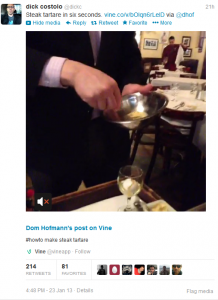
  • Twitter’s first video tweet shows how to make steak tartare in six seconds

    The first video tweet using an app from Vine, the start-up Twitter acquired last year, has appeared on the micro-blogging site. Originally created and sent by Dom Hofmann, co-Founder and CEO of Vine, it was then posted by Twitter boss Dick Costolo and dutifully retweeted by a couple of hundred people.

    The embedded video, like all clips sent using Vine, lasts six seconds, and shows the steak tartare creation process — with optional sound — in a loop. While this could prove rather maddening if you have lots of Vine clips visible in your stream, it’s easy enough to hide away.

    The Vine app will be available as an iOS exclusive initially, but an android version is expected to follow shortly afterwards. The recording process is as simple as pressing the screen and then letting go when you’re done. Vine will have an Instagram element to it, and let you follow other users and search for clips from people they know.

    How Twitter plans to deal with the inevitable deluge of offensive or pornographic clips isn’t currently known.

    Update: And Vine’s just gone live at the Apple Store.

  • TechCrunch Makers: An Evening At The Van Brunt Stillhouse

    Screen Shot 2013-01-24 at 9.17.25 AM

    What do you do when you already have the coolest job in the world? You start a business where you can have another amazing job on evenings and weekends.

    Daric Schlesselman is an editor for the Daily Show in Manhattan who lives in deepest Red Hook, a small, cool community on the edge of Brooklyn. There he rents a former paint factory where he’s set up the Van Brunt Stillhouse and storage facility where he makes some of the nicest grappa, whiskey, and rum this side of the Gowanus.

    Schlesselman started out as a homebrewer but has taken investment to build a small, artisinal distillery in Red Hook. He makes booze to match the season – rum in the summer, whiskey in the fall, and grappa anytime – and he’s the perfect example of someone who followed his dream to sweet fruition.

    The stillhouse is compact and well-appointed with plenty of barrels of delicious whiskey aging in white oak. He may not be making 3D printers or electronic eyes, but the Van Brunt Stillhouse shows us that even a mild-mannered TV editor can, with a little time, energy, and perseverance, build a real business making some amazing stuff.

    TechCrunch Makers is a video series featuring people who make cool stuff. If you’d like to be featured, email us!.

  • TED2013 speakers tweet about the lineup, their talks, and Bono

    TED2013

    Earlier this month, when we released the incredible lineup of TED2013 speakers, you couldn’t hide your excitement. But you’re not the only tweeps chirping about the conference. Below, find a sampling of posts from the speakers themselves — both about prepping their talks and about the fellow speakers they can’t wait to watch. Spoiler alert: Bono-mania appears to be a common theme.

  • Pebble Smart Watch iPhone And Android Apps Now Available, Just In Time For First Shipments

    PnOiadU

    Pebble, the Kickstarter darling and connected smart watch, announced just yesterday that its product was now beginning to ship out to backers in limited quantities, but its iPhone app had yet to be approved. Today, the company announced to its Kickstarter backers that both the iPhone and Android apps are available now, which means they’ll be fully functional for users of both types of devices when they arrive at backer doors.

    Of course, the apps won’t do anything on their own without any hardware to talk to, but at least the icon is very attractive, and it’s something to help soothe the pain of having to wait so long to actually get your hands on the Pebble itself. When you do get hardware, you’ll be able to update your Pebble software, install and remove custom watch faces for the device, and also send test messages to the watch for troubleshooting purposes. The Pebble team says that they’ll be updating the free app on a regular basis, presumably with more features.

  • Apple Patents Smart Shoes That Feature Embedded Sensors, And Alarms For When You Need New Ones

    Image (1) shoesuntied.jpg for post 195299

    Apple has been dabbling in wearable tech, at least when it comes to the U.S. Patent Office, and a new application uncovered Thursday by AppleInsider adds to that growing category. Apple has filed for a patent covering so-called “smart shoe” systems which feature sensors that can track wear and usage and tell you when you need to replace them, charting your progress on a companion app for a mobile device, or via built-in LED lights, speakers or displays.

    In its description of how this would work, Apple suggests embedding the processor and other electronics in the shoe’s heel, where there is plenty of room to house such components. Sensors can be housed in the sole, heel, and all along the shoe at points where detecting where provides a good indication of how worn out a shoe is getting. The sensors could include simple pedometers, activity or motion detectors that can translate any kind of motion into a timed unit of use (which can tell a user if they’re past the 500 hours recommended for a walking shoe, for instance), or a body bar that can detect weight and resistance to give more of a qualitative measure to use.

    The power for the sensors can either be supplied by a built-in battery, or from a generator that uses the actual motion of walking to recharge an energy store. Why not harness kinetic energy when the whole point of what you’re making is to track movement to begin with?

    Apple has applied for patents related to shoes before, like the one it was granted last January for embedded sensors in clothing that could inform your workouts. The idea is that the best way to craft workouts to actually help people achieve their goals is by monitoring their actual activity as reported by the garments closest to their bodies, rather than through depending on individuals to report their own habits accurately. Today’s shoe patent filing isn’t focused on health quite as directly, but it could be used in tandem with that kind of system to provide a holistic view of workout and activity habits, including how fast and often you’re wearing out your footwear.

    While many companies are looking at wearable computing in the form of smart watches or glasses-based heads-up interfaces (Apple included), there seems to be a background current at Apple devoted to more subtle and invisible incarnations of on-body tech. As with any patents, there’s no guarantee we’ll ever see these inventions ship, but wearable computing is bound to be a growing concern for any major consumer electronics maker in the next few years.

  • When You Should Seek Capital from an Impact Investor

    If you’re running a social venture, you’re probably familiar with the challenge of raising capital for growth. And despite the Global Impact Investing Network’s recent report that over $8 billion was invested by impact investors in 2012, it is still common to hear a lot of complaints from both sides: investors bemoan the lack of quality deal flow and social entrepreneurs say it’s difficult to find interested investors.

    Honestly, we’ve heard this for a very long time. Greg has worked with some of the world’s most accomplished social entrepreneurs for over 30 years; Cathy is a former impact investor who has also worked extensively with pioneering impact angel groups like Investors’ Circle and Toniic. We came together over a Skoll Foundation-funded project a few years ago to explore business models for social entrepreneurs. And the number one question that came up in our surveys and interviews with several hundred successful global social entrepreneurs was: Should I seek capital from an impact investor?

    The answer is almost always “No”. Despite our belief in the power of impact investing and the need for capital to scale, most social entrepreneurs should not seek this type of capital unless four fundamental conditions are met:

    1. Your business model is stable.

    How well can you demonstrate your ability to generate sufficient financial returns for a potential investor? Cash flow needs to be stable and regular; you must have a track record of recurring or growing revenue that is documented for any impact investor to look seriously. Many angel investment groups will not even consider you if you are pre-revenue. Lenders need to see your ability to pay back cash starting today. According to our research, social entrepreneurs seem to evolve their business models over five to 15 years, and income stability may take longer.

    2. You have a convincing plan toward profitability.

    Are you profitable? Is your potential market big enough? If not, can you make a case for future profitability based on similar business models used by others in different sectors or geographies? One of the reasons that alternative energy and mobile telephony businesses have taken off in developing markets is they are both system workarounds, driving on demographic trends and able to be plunked down in new places with little required of local infrastructure. Even then, an investor may be hesitant unless the entrepreneurial team has a strong track record of success with other ventures.

    3. You don’t need your cash more than an investor does.

    Do you know how you will pay your investor back? Impact investors want a return and usually have a time horizon over which they need to get it. Will you have the free cash flow — cash over and above what is needed to keep your venture thriving — to provide this return? Debt will require interest and principal repayments. Equity investors may not need immediate cash, but they need a pay day. For most social ventures, the option of an initial public offering in which outside investors save the day by repaying previous equity investors is highly unlikely, and social entrepreneurs often resist the idea of their ventures being bought out by someone else.

    This leaves some form of stock repurchase by your company. Where will the cash come from? By then, perhaps five or ten years after the equity investment, the pot of money your investors are expecting could be quite large. In entrepreneurship circles, they often say “cash is king.” Understand the cash demands of an investment and make sure you can handle them. Don’t be lured by the idea that you can figure out how to repay the investment later.

    All forms of impact investment will limit your flexibility to direct your company’s cash flows in the future and you need to consider if you need this cash for mission or for other reasons now, before you take the investment.

    4. You, your investor, and the terms of the deal are mission-aligned.

    Impact investors are definitely not one-size-fits-all. Once you’ve found a potential match by stage, industry, impact area and geography, you also need to consider the implications of the investment on the mission and impact of your business, and be sure you and your investor are on the same path. Root Capital, a lender to small-scale farmers in the developing world, discussed a potentially large market-rate loan from a major bank a few years ago. According to a recent Columbia Business School case study, Root Capital struggled with the implications of this kind of deal on the overall mission of the business, and what the pressure to pay it back would have on whom they would lend to, what interest rates they could give and what support services they’d be able to provide — all critical pillars of Root Capital’s work.

    Social entrepreneurs need to remember that impact investors want to see stability and high potential and should not be depended on for the experimentation and risk-taking that gets you to that point. That, according to Acumen and Monitor, is what “enterprise philanthropy” is for. In their recent report “From Blueprint to Scale,” they argue that the early validation of new and untested business models is best supported by philanthropy, with return-seeking investors coming into the process once the model is validated.

    Impact investing is not the panacea for everyone but is an incredible tool for the select group of businesses and organizations who are in the right place at the right time to start to return capital in the way that investors need it.

  • Is Anybody Surprised that Krugman Was Wrong about U.K. Fiscal Policy?

    Daniel J. Mitchell

    Just like in the United States, politicians in the United Kingdom use the deceptive practice of “baseline budgeting” as part of fiscal policy.

    This means the politicians can increase spending, but simultaneously claim they are cutting spending because the budget could have expanded at an even faster pace.

    Sort of like saying your diet is successful because you’re only gaining two pounds a week rather than five pounds.

    Anyhow, some people get deluded by this chicanery. Paul Krugman, for instance, complained in 2011 that “the government of Prime Minister David Cameron chose instead to move to immediate, unforced austerity, in the belief that private spending would more than make up for the government’s pullback.”

    This was nonsense. There have not been any genuine budget cuts in the United Kingdom. Heck, just compare what’s happening today in the United Kingdom and what happened in Canada in the 1990s to see the difference between gimmickry and real fiscal restraint.

    Now we have some new numbers that confirm that the UK economy is suffering because of a heavy burden of government spending.

    Here’s some of what Allister Heath, the Editor of City A.M., wrote for the UK-based Telegraph.

    The public finances are deteriorating again, making a mockery of the Coalition’s core purpose. Osborne’s fatal problem is that he is proving unable to deliver any meaningful reduction in the size of the state. The extent of his failure will come as a shock to many. Remarkably, public spending actually went up last year as a share of our national income… public spending hit 49pc of UK GDP last year, a shocking increase on the 48.6pc of GDP spent by the state in 2011. Even with a stagnant economy, this implies that Osborne has lost control of public spending.

    Gee, doesn’t sound like much budget cutting to me.

    Heck, the burden of government spending is worse than it is in Germany (45 percent of GDP). Or even Spain (44 percent) or Portugal (47.4 percent).

    Perhaps the most shocking number is the one showing that the UK has radically veered in the wrong direction this century.

    Public spending as a share of GDP hit a trough of just 36.6pc in 2000.

    Allister hits the nail on the head.

    …after all the rows about “slashing spending to the bone”, and following almost three years of coalition government, the state is still spending around half of national income. …it beggars belief that a government that remains so large, so bloated cannot provide much better quality services, and that we have a public debate in this country that exaggerates beyond all recognition the extent of the state’s downsizing.

    But there has been some “austerity,” but only for taxpayers.

    …real austerity is only biting on the tax side: total UK government revenues increased from 40.3pc of GDP in 2011 to 42.4pc in 2012, the OECD estimates. It’s getting increasingly hard for the Chancellor to extract revenues, with taxes on income and wealth falling to £194.3bn over 2012 as a whole, 2.7pc lower than in 2011, when they stood at £199.7bn, according to separate figures from the Centre for Economics and Business Research.

    That last sentence, by the way, shows the Laffer Curve in action.  The supposedly Conservative government of Cameron and Osborne has raised the tax burden, yet revenues aren’t materializing.

    Allister also echoes the argument of Veronique de Rugy about choosing the right kind of austerity and reining in the public sector.

    Not all kinds of austerity were created equal: cutting current expenditure, such as benefits, is good for growth; but hiking taxes is bad for it… There is also lots of evidence that elevated levels of public spending and large government debts are bad for GDP; no wonder, therefore, that growth is failing to materialise.

    So what’s the bottom line? Well, as Allister stated, the real problem is that government is too big and spending too much.

    And until Cameron and Osborne are willing to tackle that problem, don’t expect much positive from the United Kingdom.