Blog

  • Bipartisan Senate Push Seeks To Expose Owners Of Prepaid Cell Phones

    A couple Senators are Voltroning to introduce legislation that would let authorities track identities of prepaid cell phone owners. Anyone who’s seen The Wire knows criminals thrive off of pre-paids.

    Engadget reports:

    New York Senator Chuck Schumer has already taken aim at texting while driving, and it looks like he’s now set his sights on pre-paid cellphones, which he says can also be dangerous — when in the wrong hands, at least. To that end, he and Republican co-sponsor John Cornyn of Texas have introduced legislation that would give authorities the ability to identify the owners of pre-paid cellphones, which they say is long overdue “because for years, terrorists, drug kingpins and gang members have stayed one step ahead of the law by using prepaid phones that are hard to trace.”

    If you use pre-paids, why do you go that route and what do you think of the legislation?

    Senators push for tracking of pre-paid cellphones [Engadget]

  • Supreme Court Asked To Explore Whether ‘Innocent Infringement’ Is A Legit Response In File Sharing Cases

    A few years back, we wrote about a teenager who used “innocent infringement” as a defense to an unauthorized file sharing lawsuit brought against her by the RIAA. Innocent infringement is in the law, as a way to reduce the statutory awards from the $750 minimum to $200. It doesn’t absolve the person or get them out of paying, but can greatly lower the amount. The district court agreed, and said she could just pay the $200 rate. However, an appeals court overturned, saying that because CDs have copyright notices on them — even though the girl never saw the CDs — the girl should have known that the mp3s were infringing. The logic there made very little sense. How can you hold someone to a clause that was never seen?

    The girl’s lawyers have now appealed the case to the Supreme Court, which now has the option of weighing in on the matter (the Wired article linked here is a little misleading, in that at the beginning and in the headline, it implies that the Supreme Court has agreed to hear the case). If I had to guess, I’d say the Supreme Court won’t take the case, even though it is an important issue.

    Permalink | Comments | Email This Story


  • Opera’s Speed Test Is Pretty Incredible, Too [Humor]

    Hey, remember those amazing Chrome speed tests from a few weeks back? Well, Opera’s not about to be outdone. And they’ve got parody on their side. If only this also came with its own “making of” video. [Opera via Engadget] More »


    OperaGoogle ChromebrowserWWWClients

  • New Weapon To Fight Heart Disease: Toothbrush

    According to recent study, brushing your teeth can not only prevent a variety of tooth diseases and make your breath smell nice, but it can also help to prevent heart disease.  The study found that people who admitted to brushing their teeth less than twice a day had a 70% greater risk of having a heart attack.

    According to Richard Watt, DDS, from University College London: “Our results confirmed and further strengthened the suggested association between oral hygiene and the risk of cardiovascular disease.  Furthermore, inflammatory markers were significantly associated with a very simple measure of poor oral health behavior.”  However, Watt also said that more studies would need to be conducted before it could be determined whether the two factors in question, namely poor dental hygiene and heart disease, are in fact causal or simply have a tendency to occur alongside one another.

    However, researches do suspect causal tie:  “Inflammation plays an important role in the pathogenesis of atherosclerosis, and markers of low grade inflammation have been consistently associated with a higher risk of cardiovascular disease,” is what was written in a report.

    Related posts:

    1. Still’s Disease: Causes, Symptoms and Other Information
    2. Unprocessed Meat Better Than Processed Meat
    3. Pistachios Good For The Heart

  • Education and lawmakers’ images took a big hit in session

    The budget passed in the Illinois General Assembly this week cut education and human service providers and has a gaping fiscal hole in it.   We’re still waiting for the smoke to clear to get a clear understanding of what’s been cut, but there is near-unanimous agreement that the budget passed this week is unbalanced and irresponsible.

    But it doesn’t have a tax increase, so some will claim that it’s the best budget possible.

    The state senate will soon return to try to pass a bill to borrow $4 billion to allow the state to make its required payment to the pension systems.

    Borrowing to pay for pensions, incredibly, is the most responsible option.  Since the legislature refuses to increase revenues, the only alternative would be to declare a “pension holiday,” which would cost taxpayers billions more and further weaken the systems.

    What a state we’re in.

    The Southtown’s Phil Kadner observes that state government’s reputation is such that, when a lawmaker changes a position, eveyone believes the change was the result of a political deal as opposed to a belief that changing the vote is “the right thing to do.”

    Case in point, Rep. David Miller (D-Lynwood) who voted “No” on the pension-borrowing proposal, then switched his vote after the measure appeared  about to fall one vote short of passage in the House.

    After his “No” vote, Rep. Miller met with Speaker Michael Madigan and Gov. Pat Quinn.  A short time later, when a second vote was held, he voted “Yes.”

    Interestingly, Miller said the Madigan, Quinn meetings weren’t the deciding factor,

    He said House Republican Leader Tom Cross railed against the plan in a partisan fashion. He heard some of his Democratic colleagues discussing a possible tax increase or budget cuts as solutions to the state’s deficit.

    “But those things weren’t going to happen,” Miller said. “They weren’t realistic alternatives because there were not enough votes to pass any of them.

    “And the more I listened to that, the more I realized that unless we act like mature adults here, we’re never going to come up with a solution. We’re going to drive the state to insolvency.”

    Kadner says the negative reaction to Miller’s decision to do “the right thing” speaks volumes about the state of our state’s politics.

    It has become impossible to believe that any elected official in Illinois would do anything just because he thought it was the right thing to do.

    And maybe that’s worse than the budget crisis itself.

    No members of the legislature emerged from this month’s activities with an enhanced reputation, but for a House member from a wealthy Chicago suburb, this has been a most unmerry month of May.

    May sorry

    Karen May (D-Highland Park) was among a group of Democrats who announced a plan to cut the state budget which, some believe, is needed to pave the way for a tax increase.

    Nothing wrong with that.  We’ve been saying for sometime that a “balanced approach, involving cuts more revenue” is needed to get Illinois back on solid financial footing.

    However, Rep. May, for some reason, went into last Monday’s news conference with an attitude that seemed quite tone-deaf to thousands of Illinoisans living on fixed incomes:

    “As much as we love our retirees, this is a tough-love exercise,” said Rep. May. “They have to feel the pain.

    We’re guessing that it was Rep. May who experienced some discomfort through contacts from retirees.  By the end of the week she had retreated:

    “I would have, could have, should have, said, ‘We must all share the pain,’” May clarified Wednesday. “If it came out differently, I apologize.”

    “If?”

    Oh, well.  We’ll accept the apology anyway.

  • A Snail on Meth Remembers When You’ve Wronged It | 80beats

    SnailsPoke a snail with a stick and it remembers for a day. Poke a snail with a stick after you’ve given it methamphetamine and it remembers for much longer.

    Getting gastropods hooked on meth perhaps sounds cruel, but Barbara Sorg and her team are among those scientists trying to figure out how the drug works in the brain to produce intense connections that feed the addiction cycle. In a study forthcoming in the Journal of Experimental Biology, the scientists show that, in snails at least, meth makes it hard to forget things that happened while on the drug.

    Here’s the test: The snails Sorg studied can breathe two ways, through their skin underwater and also through a breathing tube they can deploy when they surface. The team kept two groups of snails—one on meth, one not—in separate tanks of shallow water. And if the snails tried to surface and breathe that way, the scientists would poke them.

    By poking the snails, Sorg’s team trained them to associate using the tubes with an unpleasant experience, and so keep them shut. Only the snails on speed remembered their training the following morning, and in a separate experiment it took longer for them to “unlearn” the memory [New Scientist].

    The drug induces changes in the brain that last after the chemical is out of a snail’s system.

    “These drugs of abuse produce very persistent memories,” explained Dr Sorg. “It’s a learning process – drug addiction is learning unwittingly. All of these visual, environmental and odour cues are being paired with the drug” [BBC News].

    Pinning down just what physical changes in the brain allow for that effect is the key to the ultimate end of this kind of research: Targeting the intense memory associations that feed addiction as a part of drug treatment. And the research on learning and forgetting could have wider implications as well, says George Kemenes of the University of Sussex, who also does mollusk research:

    “Ultimately, the humble snail could help prevent and treat memory disorders or even enhance normal memory” [BBC News].

    Related Content:
    80beats: Can Erasing a Drug Memory Erase the Need for a Fix?
    80beats: How the Brain Makes Space for New Memories: By Replacing a Few Old Ones
    80beats: How Ritalin Works in the Brain: With a One-Two Dopamine Punch
    DISCOVER: How to Erase a Single Memory
    DISCOVER: Disremembrance of Things Past

    Image: Wikimedia Commons


  • One Reason Why the GOP Can't Repeal Health Care Reform

    GOP House leaders introduced a bill on Thursday to repeal the health care reform law … the same day the Obama administration announced that it will begin sending seniors the first Medicare “doughnut hole” rebate checks to demonstrate the HCR’s benefits to some likely voters.*

    Interesting juxtaposition. Stories like this help explain why it’s politically implausible to call for health care reform’s repeal. The public’s opinion of health care reform as a general idea is still mixed. But nothing changes minds like money. Deleting the law means clawing back financial assistance for older Americans with prescription drug bills between $3,000 and $6,000. Seniors are linchpins to midterm success because of their disproportionately high turnout. Republicans know that. Democrats know that. And the administration definitely knows that, which is why it’s waging a PR war against Republicans with early rebates checks.

    As the health care bill moved through the sausage maker, the benefits moved to the front and the pain moved to the back. In the final reconciliation bill, the subsidies grew more generous, but
    they’re also scheduled to grow more slowly until they eventually fall back to the levels
    that existed in the House bill, pre-reconciliation. The excise tax on
    expensive employer insurance plans was delayed until 2018 and hits
    fewer Americans in the first few years, but it is scheduled to grow faster than in the
    Senate or House plan. So what we’re seeing with the Medicare rebates checks is, for better or worse, something of a microcosm of the bill. Democrats are
    front-loading the benefits of the plan and leaving the cost-cutting for the second decade.
    __
    *Medicare Part D helps seniors pay for prescription drugs up to a
    certain level — about $2,700 — and above a “catastrophic level” —
    about $6,100, but not in between. The health care reform bill gradually
    fills that gap, which for whatever reason has come to be known as a
    “doughnut hole.”


    Email this Article
    Add to digg
    Add to Reddit
    Add to Twitter
    Add to del.icio.us
    Add to StumbleUpon
    Add to Facebook


    MedicarePrescription drugUnited StatesPresidency of Barack ObamaMedicare Part D

  • Animoto – The End of Slideshows

    Animoto, a web application that automatically generates professionally produced videos using patent-pending technology and high-end motion design. Each video is a fully customized orchestration of user-selected images and music. Produced on a widescreen format, Animoto videos have the visual energy of a music video and the emotional impact of a movie trailer.

    The heart of Animoto is its newly developed Cinematic Artificial Intelligence technology that thinks like an actual director and editor. It analyzes and combines user-selected images, video clips and music with the same sophisticated post-production skills and techniques that are used in television & film.

    Animoto - The End of Slideshows

  • When It Comes to Open Data, Is Transparency Enough?

    The push to free up more public information and make government more transparent is one of the primary goals of open data advocates and the “Government 2.0″ movement. But sociologist and Microsoft researcher Danah Boyd warned attendees at the recent Gov 2.0 conference that there’s a downside to such efforts. “Transparency is not enough,” she said (video is embedded below), and raw information without the ability to understand or make sense of it does no one any good.

    The issues with transparency are similar to the issues with Internet access and the digital divide. In focusing on the first step – transparency or access – it’s easy to forget the bigger picture. Internet access does not automagically created an informed citizenry. Likewise, transparent data doesn’t make an informed citizenry. Transparency is only the first step. And when we treat transparency as an ends in itself, we can create all sorts of unintended consequences.

    Boyd described how laws require the publication of lists of registered sex offenders, which she agreed is a positive thing in most ways. But as she noted, many of the names on them belong to young people who were charged with criminal acts for having a consensual relationship with someone under the age of official consent. Having just the raw information about such types of things can actually make things worse if it’s not interpreted correctly:

    Information is power. This is precisely why we want to get information into the hands of more people. But as we do, we need to account for a new twist in all of this: Spinning the interpretation of the information is even more powerful. And the more that we make information available, the more that those in power twist it to tell their story. When everyone has information, information is no longer nearly as powerful as the ability to control its narrative.

    Information alone doesn’t empower people, she said, adding that: “Information is never neutral. Neutrality is another one of those lovely ideals. But Wikipedia entries are not neutral nor is the algorithm that produces Google News.” To be able to take advantage of all the transparency and open data that people are calling for, Boyd argued, we need information literacy, which includes the skills to interpret information in context. “If you want information access because you want a better-informed citizenry and a fairer society, you must start embracing the importance of information literacy and the need to provide infrastructure to help people build these skills.”

    Boyd isn’t the only prominent figure to raise the issue of the unintended consequences of transparency in government: Harvard Law professor Larry Lessig wrote an essay last year that argued transparency can be a double-edged sword.

    Related content from GigaOM Pro (sub req’d): Why New Net Companies Must Shoulder More Responsibility

    Post and thumbnail photos courtesy of Flickr user Stardust


    Atimi: Software Development, On Time. Learn more about Atimi »

  • Be Out There – Safely!

    DontHi! I’m Anne Keisman and I work on the Be Out There campaign at the National Wildlife Federation (NWF). Sometimes I can’t believe my luck – every day I am tasked with coming up with new ways to inspire people – especially parents and children — to go outside and play. I’m excited to partner with Don’t Fry Day to spread the word about sun safety. At NWF, we love to promote the positive side of the sun. It helps green things grow, keeps animals warm, and lets us see the world around us.

    And children love the sun too. From the moment they can wield a crayon, plump yellow suns show up in their drawings – right next to the fluffy white clouds!

    But — like many things in nature — the sun can be dangerous if we don’t take precautions. If you know the facts about protecting your family, you won’t have to be anxious when your family heads out to the beach or the park.  Once you’re protected from UV rays, pledge to spend more time outside with your family. Kids today spend twice as much time indoors as their parents did, missing out on the simple pleasures and lasting mental and physical health benefits of daily outdoor time.

    NWF recommends that parents give their kids a “Green Hour” every day — time for unstructured play and interaction with the natural world. Be Out There’s practical tools for families, schools and communities make being outdoors a fun, healthy and automatic part of everyday life.

    Stumped for ideas for outdoor fun? Check out National Wildlife Federation’s Summer Guide and our Green Hour activities for great tips for your family.

    And on June 26, camp under the stars – in your own backyard! Join the Great American Backyard Campout.

    Have fun in the sun!

    About the author: Anne Keisman is Senior Associate Editor for the Be Out There Campaign at the National Wildlife Federation. Follow her at www.twitter.com/greenhour.

  • Dodge Challenger comemora 40 anos de vida

    Imagens do veículo

    Um dos carros mais famosos dos EUA completa quatro décadas de existência: O Dodge Challenger. Para comemorar o fato, a Chrysler disponibilizou para o público várias imagens que mostram um pouco da bela história do veículo.

    Na época de seu lançamento, entre 1970 e 1974, o Challeger teve um motor de seis cilindros e, claro, suas versões V8. A maior diferença entre a primeira geração e a atual do Challenger é que não existe uma versão conversível do modelo atual.

    Depois da versão de 1974 parar de ser produzida, foram vendidas 188.000 unidades no total. Em 1978 a segunda geração do Challenger foi construída, e o modelo foi baseado em carros da Mitsubishi (que particularmente, foi a versão mais feia desse carro, mas enfim) que tinha um motor 1.6 com 77 cv ou um motor opcional de 105 cv 2.6. Em 2006, a terceira geração do Challenger apareceu como um conceito, e após 2008 estava nas ruas, com versões V8 e seis cilindros. Vejam a história em fotos a seguir.

    Imagens do veículo
    Imagens do veículoImagens do veículoImagens do veículoImagens do veículoImagens do veículoImagens do veículoImagens do veículoImagens do veículoImagens do veículoImagens do veículoImagens do veículoImagens do veículoImagens do veículoImagens do veículoImagens do veículoImagens do veículoImagens do veículoImagens do veículoImagens do veículoImagens do veículoImagens do veículoImagens do veículoImagens do veículoImagens do veículoImagens do veículoImagens do veículoImagens do veículoImagens do veículoImagens do veículoImagens do veículoImagens do veículoImagens do veículoImagens do veículoImagens do veículoImagens do veículoImagens do veículoImagens do veículoImagens do veículoImagens do veículoImagens do veículoImagens do veículoImagens do veículoImagens do veículoImagens do veículoImagens do veículoImagens do veículoImagens do veículoImagens do veículoImagens do veículoImagens do veículoImagens do veículoImagens do veículoImagens do veículoImagens do veículoImagens do veículoImagens do veículoImagens do veículoImagens do veículoImagens do veículoImagens do veículoImagens do veículoImagens do veículo

    Via | Carscoop


  • Politico: “Signs of life” for climate bill – Murkowski “dirty air” Amendment vote June 10 will be a key test

    The inside-the-beltway media mavens at the Politico report today that the Senate climate and clean energy jobs bill has a heartbeat:

    EXCLUSIVE – BIG SUMMER AHEAD FOR ENERGY LEGISLATION: Senator Majority Leader Harry Reid has scheduled a meeting of climate/energy chairs (Kerry/Boxer/Bingaman/Baucus/Rockefeller/Lincoln) for June 10, and asked them to give him feedback on the Kerry-Lieberman American Power Act by June 8. “Shows new urgency – feeling very good,” a Senate leadership source e-mails. Sen. Kerry met Wednesday with Phil Schiliro, President Obama’s congressional liaison, to discuss the floor schedule for the bill.

    Other signs of life for the legislation:

    –A bill is most likely to happen when/if the Fortune 500 demand it. And there were Ford, Google, PepsiCo and other biggies, signing a letter yesterday to President Obama and Senate leaders from 60 enviro groups, unions, trade associations and corporations: “It’s time for Democrats and Republicans to unite behind bipartisan, national energy and climate legislation that increases our security, limits emissions, and protects our environment while preserving and creating American jobs.” Read the letter

    –President Obama pushed the bill yesterday in his opening remarks in the East Room: “If nothing else, this disaster should serve as a wake-up call that it’s time to move forward on this legislation. It’s time to accelerate the competition with countries like China, who have already realized the future lies in renewable energy. And it’s time to seize that future ourselves. So I call on Democrats and Republicans in Congress, working with my administration, to answer this challenge once and for all.”

    The Politico further reports that “top strategists” in both parties tell them, “we’ll know a comprehensive energy bill’s likelihood of passing after a June 10 vote on an amendment by Sen. Lisa Murkowski (R-Alaska) that would block the EPA’s ability to regulate greenhouse gases. Top Dems say if she gets over 50 votes, that’s BAD for the prospects of comprehensive energy legislation. If she gets 55 votes, that’s DEATH KNELL for the bill. Under 50, supporters are still in the ballgame, even thought the conventional wisdom is still against them.”

    The ever-shrinking Sen. from South Carolina, however, is here to embrace the conventional wisdom and pull the plug on the patient, as Climate Wire (subs. req’d) reports:

    Sen. Lindsey Graham (R-S.C.) said the administration’s toughening stance on domestic oil and gas exploration — just two months after President Obama expanded drilling — could disrupt delicate negotiations designed to gain crucial votes from lawmakers in Alaska and Louisiana.

    Obama’s decision, announced yesterday, comes five weeks after an underwater well began shooting thousands of barrels of crude daily into the Gulf of Mexico.

    “It made the hill steeper,” Graham said of the decision’s effect on passing climate legislation in an interview yesterday. “I understand why the president is taking a pause on drilling, but when you talk about cancelling leases, when you talk about stopping Alaska exploration, it makes it harder for this concept to sell.”

    … “If [Obama] says we’re gonna not be able to drill along Alaska’s coast, put a moratorium on that, that makes it harder for Lisa Murkowski to pursue this grand bargain we’ve got,” Graham said.

    “Let’s be blunt here. Kerry-Lieberman doesn’t have enough support on the Democratic side to come to the floor,” said Robert Dillon, Murkowski’s spokesman. “Sen. Murkowski continues to support economically sound climate legislation. Unfortunately, as of yet, we have not seen a proposal that meets her criteria of doing no harm to the economy.”

    Unlike, say, the BP oil disaster, which is I guess doing no harm to the economy — or global warming, for that matter (see “Lisa Murkowski proposes to fiddle while Alaska burns“).

  • ESPN Columnist: U.S. Grand Prix in Austin has a lot of hurdles

    Filed under: ,

    There has been no shortage of entrepreneurs over the last couple of decades hoping to play host to a Formula One race. But as many of them have discovered, hopping into bed with Bernie Ecclestone is a surefire way to prove Roger Penske’s motorsports maxim: “The quickest way to make a small fortune in racing is to start with large fortune.”

    Tavo Hellmund and his team at Full Throttle Productions have some mighty big dreams for a new dedicated F1 race track in Austin, Texas. So far, however, they don’t seem to have land, financing or much of anything else. The owners of the Donington Park track in England already had a track and more time to get ready to host the British Grand Prix and they still failed.

    According to ESPN columnist Terry Blount, the $200-300 million estimate for the track seems very low compared to the $250 million spent on Texas Motor Speedway – a facility that was built 15 years ago. The odds of a brand-new track being ready for a race in Austin by 2012 seem pretty slim unless the cash starts flowing and the bulldozers start moving the dirt very soon. Now, a street course, on the other hand…

    [Source: ESPN F1 | Image: JJWright85 via CC 2.0]

    ESPN Columnist: U.S. Grand Prix in Austin has a lot of hurdles originally appeared on Autoblog on Fri, 28 May 2010 09:29:00 EST. Please see our terms for use of feeds.

    Permalink | Email this | Comments

  • Facebook Leads in Google’s Top 1,000 Websites

    Google has introduced a couple of new features for its advertising solutions, in particular the DoubleClick Ad Planner. For anyone outside of the online marketing business, that may not sound particularly interesting. What is interesting, though, is the new Ad Planner 1000 list, which features the top 1,000 websites in the world ranked by unique vis… (read more)

  • Jet Engine Veto Threat Could Still Scotch ‘Don’t Ask, Don’t Tell’ Repeal

    After 17 years of “Don’t Ask, Don’t Tell,” the next bill authorizing the Department of Defense’s budget will contain a provision instructing the Pentagon to repeal the military’s ban on open gay service after its Working Group issues its guidance for doing so. And the healthy margin by which the amendment cleared the House floor — 234 to 194 — indicates that the already politically sacrosanct defense bill has a similarly healthy likelihood of full passage in the chamber, probably today. But that doesn’t mean the bill is out of the woods quite yet.

    One of the amendments to the bill that didn’t pass last night was a measure to strip out $485 million worth of funding for a second engine for the F-35 Joint Strike Fighter. President Obama, backing Defense Secretary Bob Gates, announced yesterday that he’ll veto a defense bill that contains the engine. “This program is a perfect example of wasteful spending that Congress must begin to address, and I am disappointed that our amendment failed,” Rep. Earl Blumenauer (D-Ore.), the amendment’s main sponsor, said in a statement after last night’s vote. “I hope we can work in conference with the Senate to eliminate this program once and for all.” They’ll have to. The Senate mark-up of the bill managed not to include the money for the engine.

    It’s unclear what Senate Republican strategy is going to be for the defense bill. Only one Republican, Susan Collins (R-Maine), voted for the “Don’t Ask, Don’t Tell” repeal, and several others, including John McCain (R-Ariz.), were angry at the measure’s passage in committee last night. There would be no shortage of cognitive dissonance if the Republican caucus filibustered over a half-trillion for defense and over $150 billion for two wars just months before an election.

    But the veto threat could give them a way out of the dilemma. If the conferees are unable to strip the funding for the engine out, Obama — who last night said repealing “Don’t Ask, Don’t Tell” would “help make our Armed Forces even stronger and more inclusive” — would have to choose between infuriating his defense secretary or abandoning one of his central promises to a key Democratic constituency.

    After Blumenaeur’s amendment failed, Gates’ spokesman, Geoff Morrell, emailed reporters, “We don’t want nor need the extra engine, but this is just one step in a long journey and Secretary Gates is committed to staying engaged in this process the whole way, including if necessary ultimately recommending President Obama veto this legislation.” All eyes will be on the House-Senate conference.

  • Sony Patents the Solar-Charged Courier [Patents]

    Microsoft may have canceled their lovable Courier project, but Sony’s patent application for a dual-screened “Electronic Book With Enhanced Features” may pick up where Microsoft left off. More »


    MicrosoftPatentIntellectual propertySonyLaw

  • Apple passes Microsoft as #1 in tech

    Wall Street has called the end of an era and the beginning of the next one: The most important technology product no longer sits on your desk but rather fits in your hand.

    The moment came Wednesday, May 26, 2010 when Apple, the maker of iPods, iPhones and iPads, shot past Microsoft, the computer software giant, to become the world’s most valuable technology company.

    [Source: New York Times]

  • Japanese Solar Hydrogen Electrolysis Reduces Voltage 50-Percent

    One of the problems of brute force electrolysis has always been the amount of energy it takes to split water into hydrogen and oxygen. The use of different kinds of metal or chemical catalysts, sound wave frequencies and other methods to loosen the bonds between hydrogen and oxygen atoms have met with encouraging success.

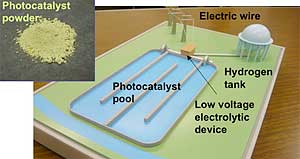
    And, another attempt at lowering the voltage requirements of splitting water has gained laboratory success by Japanese researchers. The Solar Light Energy Conversion Group, the Energy Technology Research Institute and the National Institute of Advanced Industrial Science and Technology have developed a tungsten oxide (WO3) photocatalyst that along with solar energy reduces the voltage requirements for producing hydrogen by 50-percent.

    According to the press release, “The high efficiency of the WO3 photocatalyst was achieved using a new method—treatment of the surface of the photocatalyst with Cesium (Cs). The activity of the treated catalyst is more than ten times that of untreated catalysts. The quantum yield of the new photocatalyst is 19% under visible light of wavelength 420 nm and is approximately 50 times the previously reported values (0.4%)*. The use of solar energy can reduce the voltage required for water electrolysis by almost 50%. Hence, the low-cost production of hydrogen is expected.”

    One of the main arguments that critics have of producing hydrogen (even from renewable methods such as solar) is that it takes too much energy to produce H2 and why not just store this energy in batteries. By significantly lowering the voltage needed to produce hydrogen fuel from water, this argument is taken away.

    Hydrogen cars have a longer range and much quicker refueling times than battery electric vehicles and if the production of hydrogen is cost effective this means that one more hurdle will be crossed in the realization of a hydrogen-based transportation system.

  • Panasonic WES8080H1507 Trimmer

    The Panasonic WES8080H1507 Trimmer fits models ES8025 ES8026 ES8033 ES8036 ES8024 ES8023 ES8080 ES8056

    View Panasonic WES8080H1507 Trimmer Details