Author: Serkadis

  • Data Center Links: Western Digital Invests in SSD Specialist Skyera

    Here’s our review of some of this week’s noteworthy links for the data center industry:

    Western Digital invests in Skyera.  Skyera, which makes enterprise solid state storage systems,  announced that it has received strategic funding from Western Digital Capital as part of its recently announced Series B round of financing.  The $51 million round is an extension of the strategic relationship between the two companies that also includes joint technology development. Western Digital had previously funded Skyera as its initial outside investor. “One of our primary goals in developing strategic relationships with technology  innovators in the broader storage ecosystem is to enable customers to develop highly optimized storage solutions that meet their changing data management needs,” said Steve Milligan, president and chief executive officer, Western Digital. “We see companies like Skyera as offering a dramatic improvement over traditional approaches to emerging storage challenges. We will continue to support innovation by collaborating with customers and partners, and investing in companies who are addressing today’s most exciting storage opportunities.”

    HP selected by European Commission.  HP (HPQ) announced that it has been selected by the European Commission to supply HP Integrity servers and related offerings to support critical workloads, including database-intensive applications and other critical environments, across multiple EC countries. HP will also provide associated equipment, including software,  services and support, including maintenance and professional services. “Fuelled by trends in cloud computing, big data and mobility, mission-critical demands are evolving and increasing,” said Ric Lewis, vice president and interim general manager, Business Critical Systems, HP “HP Integrity servers with the HP-UX operating environment will allow the contracting authorities to continue to confidently deploy mission-critical solutions with high levels of reliability, performance and efficiency.”

    Teradata Launches Warehouse Appliance 2700.  Teradata (TDC) announced the immediate worldwide shipment of the Teradata Data Warehouse Appliance 2700. Configurable from 7 terabytes to 82 terabytes of uncompressed user data per cabinet, the new appliance is a part of the Teradata Unified Data Architecture (UDA).  It features InfiniBand interconnects, 8-core Intel processors, parallel compression engines, and data-at-rest encryption for increased data security and compliance. “There is a perception that appliances are not enterprise-ready. However the Teradata Data Warehouse Appliance product line drives strategic intelligence and advanced analytics for some of the world’s largest enterprises,” said Ed White, general manager, Teradata Appliances. “The scalable Teradata Data Warehouse Appliance 2700 extends the enterprise capabilities by enhancing workload management so organizations can easily manage multiple applications. On one Teradata appliance, organizations can meet the demanding service level agreements for many different groups.”

  • Stolen iPad Pictures Lead To Some Fun For Victim

    Allen Engstrom left his iPad on a plane, where it was apparently stolen (unless you belong to the “finders keepers” camp). He still doesn’t have the device in his possession, but he’s gaining plenty of entertainment value from it.

    The person who Engstrom believes has the iPad has been taking photos of herself, and they’ve been appearing in his iCloud account, so he can see what she looks like and the faces she is making.

    ABC 10 News out of Little Rock reports:

    Engstrom says the woman is taking “selfies” — or self portraits — with the iPad.

    She probably has no idea that her pictures are backing up to my iPhone, Engstrom said.

    So far, he’s received more than a dozen photos.

    Engstrom is not only having fun viewing the photos with his family, however. He’s taking it a step further and uploading them to Facebook for the world to enjoy. Here are some he shared on Facebook along with the captions he provided:

    Stolen ipad pictures

    Hey cool! This is an actual pic of the wonderful person who stole my iPad. Apparently the pics she is taking of herself are backing up and appearing on my phone. No I’m not kidding, this is really happening. — with Ugly McCrazy Shirt.

    Stolen iPad Pictures

    Looking right… Camera still works when you are looking away!

    Stolen iPad Pictures

    Looking left! — with Rhonda Burgandy.

    Stolen iPad pictures

    The wonderful person who snaked my iPad continues to take glamour shots of herself apparently unaware that they are backing up to my iPhone. So naturally I’m blasting them out to the entire world. Enjoy!

    The pictures are already generating a great deal of buzz on the web, and are even hitting the search trends. I wonder how long it will be until the the subject of the photos sees them in an article like this.

  • Even The BBC Can Get Unnatural Link Warnings From Google

    This seems to be proof that Google does not favor big brands of major media outlets when it comes to obeying the quality guidelines. Even the BBC has been getting unnatural link warnings from Google.

    A representative from the organization posted in a Google Webmaster Help forum (as noticed by Search Engine Roundtable):

    My URL is: www.bbc.co.uk

    I am a representative of the BBC site and on Saturday we got a ‘notice of detected unnatural links’.

    Given the BBC site is so huge, with so many independently run sub sections, with literally thousands or agents and authors, can you give us a little clue as to where we might look for these ‘unnatural links’.

    Later in the thread, he adds:

    Yeah the problem is that the site is so big, and has so many agents, that something stupid might have been done, but without being given a clue to what or where, it is kind of hard to track the culprits down and ‘advise them to be a better web citizen’. I have certainly been involved previously is stopping people before they do something ‘unwise’ in relation to the site.

    Of course, I’m not saying someone connected with the site has done something naughty, just that it is a possibility.

    He says he sent a reconsideration request, and explained the situation to Google.

    At SMX West, earlier this week, Google’s Matt Cutts made a point of saying that big brands are penalized often. Of course, we recently saw UK flower site Interflora get penalized, though that didn’t last long.

  • Google Translate Adds Phrasebook To Help You Remember What You Learned

    Google has introduced a new feature for Google Translate, which could go a long way in helping users remember the translations they learn from the tool. It’s called Phrasebook, and lets you save useful translated phrases to refer to later.

    To use it, simply click the star under the translated text in Google Translate, and it will save it to the Phrasebook feature. There is a new Phrasebook icon in the upper right-hand corner, where you can view the stuff you save.

    In addition to helping you retain knowledge, the feature should make it quicker and easier to get translations you might need more frequently.

    “With Google Translate, you can find the right thing to say, but you may not remember the translation at the right time,” says Google in a blog post. “You might find yourself performing the same translation again and again, until you finally commit the translation to memory.”

    “Phrasebook for Google Translate jumpstarts this slow learning process by allowing you to save the most useful phrases to you, for easy reference later on, exactly when you need them,” the company adds. “By revisiting the useful phrases in your Phrasebook from time to time, you can turn any brief translation into lasting knowledge.”

    Phrasebook includes controls to let you filter phrases by language pair, and lets you search for specific phrases within the feature. When you hover over the phrases, you find a clickable text-to-speech icon, so you can hear a phrase pronounced.

  • Schneider Electric Sharpens Focus on Service Providers

    Energy management conglomerate Schneider Electric this week announced two new teams, one to focus on data center service providers and another to integrate Schneider’s acquisition of Lee Technologies into a software and services offering.

    The Data Center Service Provider Team will focus on the specific needs of colocation, hosting and cloud businesses. Its a multi-disciplinary team that brings together solution architects, global project management and execution, supply chain and account managers.

    “The market is moving this way,” said Chris Buckley. “It’s a very fast-growing segment of our business. This customer segment is unique. They’re doing things other customers aren’t doing.”

    Industry veteran Joe Reele will serve as Vice President, Data Center Solutions Architects for the new Schneider unit. Reele has more than 10 years and one million square feet of data center experience in helping organizations analyze requirements and develop cost-effective solutions.

    Schneider also announced the expansion of its IT Business with the launch of the Schneider Electric Mission Critical Services & Software division,and represents the full integration of Schneider Electric’s energy management services with Lee Technologies’ data center lifecycle methodology. The division will feature more than 7,000 trained specialists to work with data center clients.

    Jason Schafer, who is familiar to DCK readers from his tenure as an analyst at Tier 1/451 Research, has joined Schneider as Director, Technology & Operations Management for the Mission Critical Services and Software. Schafer will be responsible for the development and coordination of facility operations consultancy services. He has 18 years of experience in the mission-critical facilities field, including service in the Naval Nuclear Power Program and as a data center commissioning specialist and construction manager for Lee Technologies, where he managed data center projects for Fortune 100 enterprises and various government entities.

    “The launch of Schneider Electric’s Mission Critical Services & Software division and the Data Center Service Provider Team places Schneider Electric in a strategic position as the leader in end-to-end data center energy management,” said Rob McKernan, Senior Vice President, Americas, Schneider Electric IT Business. “We provide one-of-a-kind, holistic, and fully-comprehensive solutions that are unique and currently unavailable in today’s market, with energy management capabilities from planning, building and operations to energy procurement, lifecycle management and software, all from one company. This is further complemented by our team of consultative and technical experts that provide guidance every step of the way.”

  • Sculpteo Shows Us What 3D Printing Is Really Good For: Creating Adapters For Old iPod Docks

    Screen Shot 2013-03-15 at 9.42.48 AM

    Sculpteo, a French 3D printing company, is now offering custom iPhone adapters for older iPod docks, allowing you to add connect to your old Bose, Sony, JBL, and other docks with the new Lightning connector. Obviously you need a Lightning adapter but the $17 pieces will make it much easier for you to connect your phone to these older docks.

    But the most interesting thing here is that this essentially creates a sort of interstitial hardware. Instead of buying a new dock (or a new baby gate or a new garden parasol) you can buy and print or download and print your own spare parts. This obviously won’t put your local hardware store out of business and 99% of the world won’t buy this Lightning adapter, but the fact that it’s available is very important.

    “This story and this adapter is opening a new field of 3D printed spare parts for a lot of different devices. Battery covers, clips, docks, handles … a lot of things can be lost, or become unusable because some other device changed or has been updated,” said Sculpteo founder Clement Moreau. “We really see 3D Printing here as a way to work smoothly in a moving environment, where big companies have really good reasons to change standards from time to time.”

    This is print-on-demand hardware, designed for a very specific purpose with a very specific audience. Because they don’t have to hold inventory, you can essentially offer customized dock adapters. This one is a one-size-fits-all but you could feasibly print new ones for oddly-shaped ports or even adapters for different phones. It makes no sense to make 50,000 of these at a factory in Asia but it makes perfect sense to dump out few hundred to those in need.

    This is hardly an earth-shattering announcement. Oddly enough, as a Makerbot owner I’d actually prefer to be able to download and print my own copy of this adapter rather than buy one for the ridiculous price of $20. I won’t, but still. This announcement does raise a lot of interesting points as to where the hardware business is headed. And when I can breathe new life into old docks with just a tiny piece of plastic I’m a much happier man. And, when someone inevitably creates a free copy of these things, we’ll have to begin asking ourselves what copyright really means in an era when we can print anything at any time, from iPhone dock adapters to guns.

  • Bill Gates On Gay Ban In Boy Scouts: It Should “Absolutely” Be Lifted

    Microsoft founder and philanthropist Bill Gates, who also happens to have been in the Boy Scouts, thinks the Boy Scouts of America should end its ban on gay members and leaders. He said so, quite matter-of-factly, at a Politico event in Washington D.C. this week.

    When asked what he learned from scouting, Gates said, “How to tie knots, how to weave baskets, how to hike long distances without complaining too much, how to cook food in rainy, drizzly mountain places where we carried the food in twenty miles. It was fun.”

    When asked which of those things he still does, he said he still ties knots every once in a while. “I haven’t weaved any baskets recently,” he admits, noting that he does go hiking with his kids.

    When asked if the Boy Scouts should rescind its ban on gay members and leaders, Gates said, “Absolutely. Because it’s 2013.”

    That got a lot of applause. Here’s the video:

    Gates’ comments are getting quite a bit of attention, and perhaps his influence will have an impact on the Scouts’ position going forward. We’ll see. The organization has been polling members on their “attitudes” toward gay people.

  • Asetek Liquid Cooling To Support EU Initiative

    A server tray using Asetek's Rack CDU Liquid Cooling system, which was announced this week. The piping system connects to a cooling distribution unit. (Source: Asetek)

    A server tray using Asetek’s Rack CDU Liquid Cooling system. The piping system connects to a cooling distribution unit. (Source: Asetek)

    Previously reserved for extreme densities and supercomputers, liquid cooling continues to make strides in the data center. Asetek announced that its data center liquid cooling solutions are a part of the European Commission roadmap for moving to a low-carbon economy.  The solutions will support a new initiative by the European Commission to reduce EU greenhouse gas emissions by 40 percent by 2030.

    “The new initiative to reduce EU greenhouse gasses validates Asetek’s own goals of reducing data center energy costs and emissions.  Data centers consume today 2% of global electricity.  Our liquid cooling solutions will play a key role in reaching energy goals around the globe as data centers concentrate more and more on efficiency,” said David Garcia, VP & GM of Asetek’s Data Center Business Unit.

    Liquid cooling has been used in U.S. government data centers that house supercomputers, and has made inroads towards enabling  rack servers and blade servers as well.  Late last year the U.S. Department of Defense announced that it will convert one of its data centers to use a liquid cooling system from Asetek.

    The primary product from Asetek in use is its RackCDU — a hot water, direct-to-chip, data center liquid cooling system. It removes heat from CPUs, GPUs, memory modules and other hot spots within servers and takes it all the way out of the data center using liquid, where it can be cooled for free using outside ambient air, or recycled for building heat or hot-water.

    Denmark-based Asetek recently filed for an Initial Public Offering on the Oslo Stock Exchange. Offering between 3.6 and 4.35 million new shares, the company hopes to raise approximately $25 million. The company’s RackCDU was also selected by Norway’s University of Tromsø for a pilot install of the liquid cooling rack in the university’s High Performance Computing facility. Asetek will reduce energy consumption of the data center and enable waste heat from servers to heat the university campus.

  • Google Panda Update Is Rolling Out [Report]

    As previously reported, Google’s Matt Cutts revealed at SMX this week that Google would be pushing a refresh to its famous (or perhaps infamous) Panda update on either Friday or Monday. Friday has arrived, and it appears that the refresh has arrived with it.

    Barry Schwartz is pointing to some forum chatter about webmasters already seeing the effects of the refresh, indicating that it has likely begun to roll out. As others have pointed out, it’s not uncommon for Google to do this on a Friday. Schwartz says signs point to the roll out starting on Thursday afternoon and into today.

    This isn’t just your typical run of the mill Panda refresh, however. This could very well be the last time Google manually pushes one, and has an announcement for it. Panda is becoming more of a “rolling” update. Schwartz quotes Cutts from SMX:

    Rather than having some huge change that happens on a given day. You are more likely in the future to see Panda deployed gradually as we rebuild the index. So you are less likely to see these large scale sorts of changes.

    It remains to be seen just what kind of an impact this will truly have on sites, but it’s not likely to make things much easier.

    Panda recently turned two years old, and opinions of Google’s search results since its implementation vary.

    Image: Tekken 5 (via YouTube)

  • Podcast: Samsung Galaxy S 4 blasts off and RIP Google Reader

    This was a week of saying hello to shiny new things and good-bye to old favorites. In this episode of the GigaOM Podcast, we give you everything you need to know about the Samsung Galaxy S4, ponder the death of Google Reader and even get in a little bit about how you can upgrade your seat in the stadium during a baseball game.

    (Download this episode)

    Subscribe to RSS

    iTunes

    Stitcher Radio

    Show notes:
    Hosts: Chris Albrecht and Tom Krazit
    Guests: Kevin Tofel, Laura Hazard Owen and Erica Ogg

    This episode of GigaOM Podcast is brought to you by Squarespace – the best way create a modern and professional website, with all the features you need integrated into one platform. Every Squarespace website is mobile ready, and includes e-commerce, 24/7 customer support, and a free domain name. Start your free trial today, at squarsepace.com/gigaom.

    And thank you again to Stitcher smart radio for letting us use their studio.

    SELECT PREVIOUS EPISODES:
    Electric Imp aims to make the Internet of Things devilishly simple

    Call-In: Galaxy S 4 predictions, Chromebook Pixel cloud storage

    Podcast: Facebook’s feedin’; Lean In’s meanin’; and everyone’s Hadoop-in

    IoT podcast: When devices can talk, will they conspire against you?

    Call in podcast: Galaxy S 4 predictions and Chromebook Pixel cloud storage

    Call-in show: Why the “I’m leaving iPhone” trend?

    Internet of things Podcast – Almond+’s nutty idea: Making sensor connectivity a snap

    Yahoo’s WFH Boo-Boo

    Podcast: Why the internet of things is cool and how Mobiplug is helping make it happen

    Related research and analysis from GigaOM Pro:
    Subscriber content. Sign up for a free trial.

  • Samsung Taps Mobeam To Bring Beamable Barcodes To The Galaxy S 4, Could Wallet Integration Be Next?

    gs4

    Samsung talked up the Galaxy S 4′s features with a bit of Broadway flair here at Radio City Music Hall, but there still are some neat additions to the device that didn’t get a moment in the spotlight. The Korean electronics giant, for instance, tapped a San Francisco company called Mobeam to bring its novel approach to displaying barcodes to the Galaxy S 4.

    Rather than sticking to the tried and not-so-true approach of trying to display a barcode on a phone’s screen, Mobeam coaxes the device’s infrared proximity sensor to pulse a pattern at a barcode scanner. Essentially, it’s trying to trick the scanner into thinking that the light flashing at it is a “reflection” of a valid barcode — it sounds a little out there, but it definitely seems to work. The problem may sound trivial to some, but that’s certainly not the case for companies and advertisers that want a more direct way to interact with consumers.

    We’ve seen more than a few startups attempt to tackle this issue — there’s Disrupt Battlefield alumnus SnipSnap for one, while devices like the ambitious iCache Geode tried to solve the issue with a secondary display — but Mobeam’s solution strikes me as one of the smarter ways to do it. After all, why deal with paper coupons and gift cards that come in the mail (that often expire and get thrown out anyway) when a company like, say, Coca-Cola can cut out the middleman and send you retail-friendly deals directly. You get a price break, retailers don’t need to revamp their point of sales systems, and Coca Cola makes a sale.

    According to Mobeam CEO Chris Sellers, the company has been working out the particulars of this partnership with Samsung for around 18 months. It’s the first time that the Mobeam has locked up a partnership with handset manufacturer, but they’re no stranger to attention from major companies — in late 2011 Procter and Gamble teamed with Mobeam in a bid to better distribute digital coupons. With any luck, the Galaxy S 4 won’t be the last device to benefit from Mobeam’s tech, as Sellers told TechCrunch that Mobeam has been in talks with a number of major handset OEMs.

    At this stage, there don’t seem to be any applications on the Galaxy S 4 that take advantage of Mobeam’s tech. It’s there for curious developers and companies to muck around with, but one has to wonder if Samsung has something specific planned. Back at Mobile World Congress, Samsung officially pulled back the curtain on Samsung Wallet, a Passbook clone of sorts that lets users digitally store “coupons, membership cards, tickets, and boarding passes” — all things that a device like that S 4 could pass it self off as thanks to Mobeam. Sellers wouldn’t confirm that Samsung planned to tap into Mobeam’s API for Wallet, but if Samsung is really looking for a way to beat Apple and Passbook, this may well be it.

  • Meet Samsung Galaxy S IV

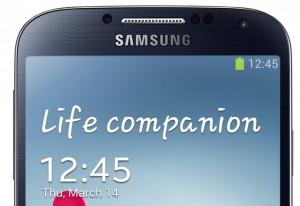
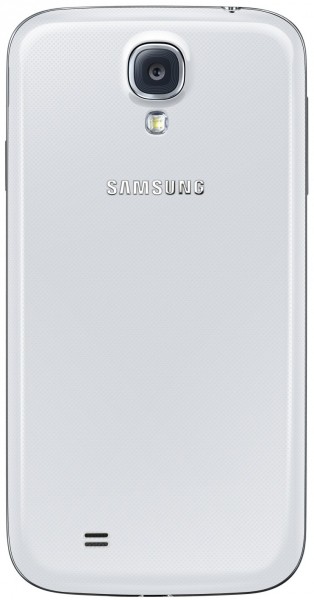
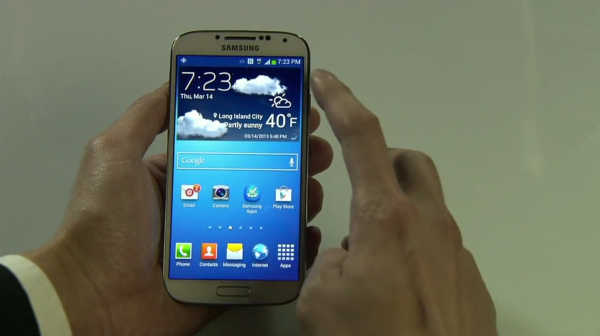
    After months of rumors, Samsung finally took the wraps off Galaxy S IV tonight at the famed Radio City Music Hall and to big overflow crowd in Times Square. The phone is as large as the “Unpacked” event, quite literally — with 5-inch display. Try clipping that to your belt (how I carry my phones).

    The hotly-anticipated smartphone starts shipping at the end of April, eventually available from 327 carriers in 155 countries. All major U.S. carriers will sell the phone: AT&T, Cricket, Sprint, T-Mobile, US Cellular and Verizon Wireless. Among the global partners: Deutsche Telecom, EE, H3G, Orange, Telenor, Telia Sonera, Telefonica, and Vodafone. Like earlier Galaxies, the S4 will be available in 3G and 4G (HSPA+ and LTE) variants and, once again, Americans can expect less than buyers in many international markets.

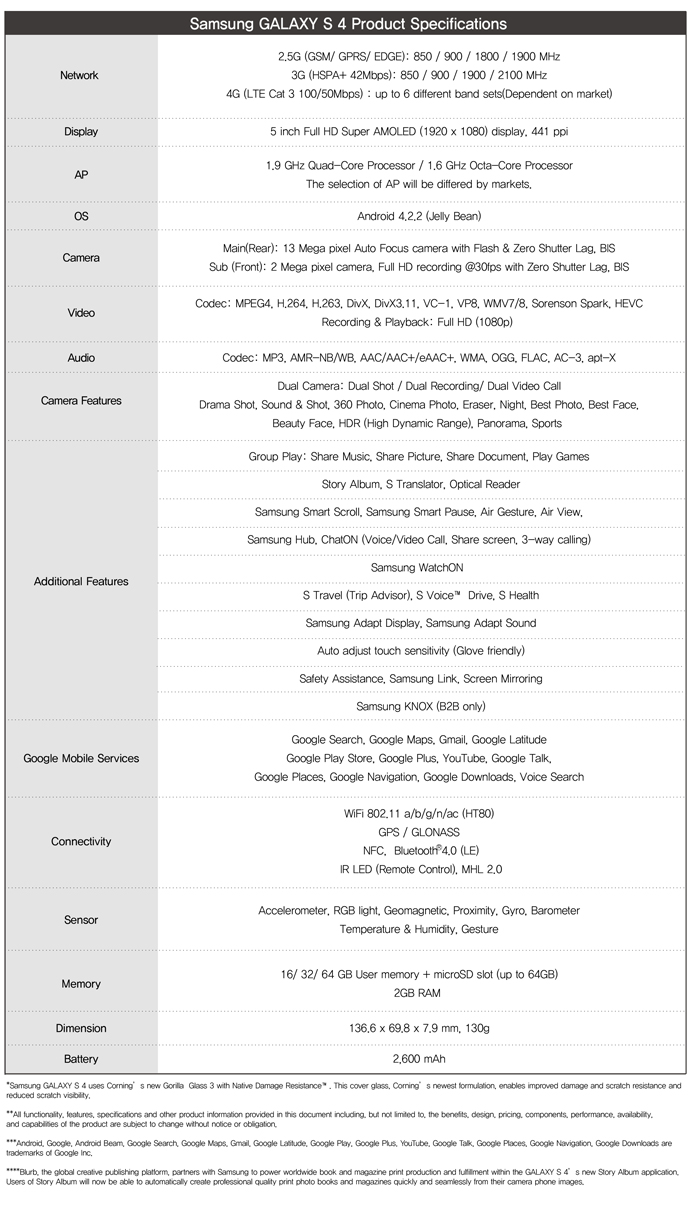
    The 5-inch Super AMOLED display is 1920 x 1080 resolution and 441 pixels per inch. Processor will be 1.9 GHz quad-core or 1.6 GHz octa-core depending on the variation. In the past Americans got fewer cores on LTE models and more cores went to HSPA+ phones, which is my expectation here.

    Memory is 2GB, while storage varies from 16GB to 64GB, depending on carrier variation, expandable with microSD card up to an additional 64GB. In a departure from other recent phone designs, the battery is removable and hefty — 2,600 mAh. Storage and battery expansion, along with the high-resolution touchscreen, really brings the S4 into tiny computer class.

    The rear-facing camera is 13-megapixels, 2MP for the front. The phone runs Android 4.2.2, but Samsung adds many capabilities on top of the core operating system. For example, there is a Dual Camera mode that lets the shooter take photos front and back simultaneously and insert him or herself into the image. The feature also works for video, and lets the user pop in and out of frames.

    Software and Services

    Among the other software benefits:

    Air Gesture lets users wave over the phone to manipulate some controls, such as choosing music or scrolling web pages. Related: Air Wave allows people to hover their fingers to manipulate the screen.

    Dual Video Call. Users can use both cameras simultaneously so that the caller on the other end can see other people, say, at a party.

    Eraser removes unwanted objects (or people) from photos. Who hasn’t wanted to do that?

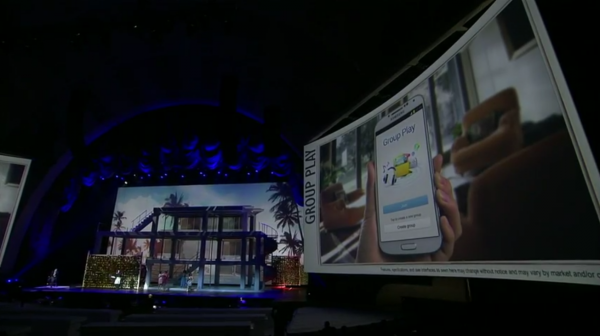
    Group Play lets S4 users share documents, music, games and more, even combining up to eight handsets to create a speaker system (using Share Music).

    S Health tracks some personal biological functions, such as calorie burn, heart rate and pulse and pulls them together into a mini report.

    S Translate. This one looks quite futuristic. Think Star Trek’s universal translator. The feature can translate 9 languages, including speech-to-text and text-to-speech capabilities. While the service needs a network connection for optimal use, there is basic vocabulary on device for basic translation.

    S Voice Car is a voice-activated system for using Galaxy S IV hands-free.

    Life Companion

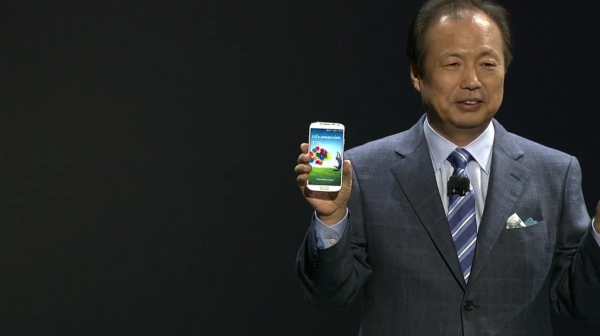
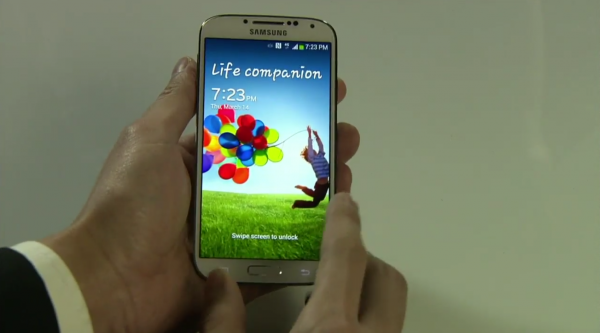
    Samsung’s theme for Galaxy S IV is “life companion”, a point JK Shin, president of Samsung’s IT & Mobile Communications Division, repeatedly made during tonight’s launch event. From that perspective, much of the innovation is about software and services.

    The theme extends from that adopted for the S3 and jumps past what Apple started nearly six years ago. The original iPhone stood apart from all other phones, not just smart ones, for its humanness. Touch, and its intimacy, and the way the handset responded to your proximity gave it a human quality. Suddenly the phone wasn’t an inanimate object but more living thing. Apple extended humanness with each new model. Siri is best representation in iPhone 4S and 5.

    Galaxy S IV packs eight different sensors and uses them to make the phone highly responsive, as the above features should indicate. Wearing gloves or have chocolate on your hands? Wave instead of touch. Want to share the party with a distant friend? Use both cameras for the video call. Want to check your messages while driving? Let the S4 read them to you. Samsung’s software and services design approach is all about making the smartphone more human, more responsive and more like a personal assistant.

    Already there is some debate here in the newsroom about the new handset. I am generally impressed by the software and services features. My colleague Mihaita Bamburic says the the phone is “alright, but not a GS4 — a GS3 Plus or like Apple’s iPhone 4S over the iPhone 4. I was expecting more because I hoped for Samsung to release some more impressive and truly innovative features”.

    I expect Mihaita to add more tomorrow in a commentary, and he may not be the only one. Of course, the real test is hands-on, to see if the benefits are as good as Samsung promises.

  • The tech industry doubles down on design in 2013

    If you thought the trend of the design founder, and the designer as the new tech rockstar, had reached its peak last year, think again. Internet and mobile startups, older tech firms and venture capitalists all seem to be doubling down on investing in design and building design practices in 2013.

    On Thursday Facebook announced that it has acquired the talent of design firm Hot Studio. Facebook says it’s been working with Hot Studio for the past few months, and the acquihire follows in the footsteps of Facebook bringing in designers like Nick Felton, Mike Matas, and Nate Bolt.

    Also on Thursday venture firm NEA announced the launch of NEA Studio, a 12-week program in New York for design founders of web and mobile startups. NEA says during the program founders will work with designers and NEA portfolio companies, and the founders that excel will have the opportunity to work on launching a product and can use NEA’s workspace and receive a stipend.

    The NEA news is similar to the announcement by Kleiner Perkins back in November that it is launching a design fellows program. Google Ventures has been aggressive on design work with its Design Studio, as has 500 Startups with their design fund and Greenstart with its in house designers.

    Mobile apps, web products, and wearable connected devices are winning and losing based on the designed user experience and user interface of the product. Well-designed products like Path and Pinterest have emerged as leaders, while sites that haven’t evolved with good design haven’t.

    Another aspect behind this trend is that the Internet, mobile networks and computing is maturing, and the way regular people — not tech nerds and early adopters — interact with these technologies is fundamentally changing. Google and Apple both have their audio AI computing products, Google Now and Siri, respectively, and touch has started to become the defacto standard for mobile devices.

    At the SXSW Interactive festival this week, there seemed to be a greater presence of talks from designers and design founders than in previous years. During one such panel Tony Fadell, the CEO and founder of Nest, talked about how good design has always existed but has more recently, with the rise of Apple, become more democratized.

    But designing a winning UX for a targeted audience can be tricky, which is why designers are starting to be so highly coveted. On the SXSW panel, Fadell and Jawbone CEO Hosain Rahman talked about the importance of iteration and testing and Rahman said Jawbone’s connected wristband product UP had over 200 iterations. Still, the first version of the Jawbone UP flopped, and the company replaced those early versions with a version 2 of the product.

    Wearables in particular can be tricky, as the world of computing hasn’t previously had to think much about the UX of the body. Google has reportedly started working with designer glasses company Warby Parker for the design of its Google Glass, augmented reality glasses.

    We delved into some of these connected design topics at our second annual RoadMap event last year, and we think design is such an important trend that we plan to keep that conversation going throughout 2013. Our third annual RoadMap event will take place later this year in November.

    Related research and analysis from GigaOM Pro:
    Subscriber content. Sign up for a free trial.

  • Samsung Galaxy S 4 hands-on shows nice hardware but software is the star

    After months of leaks, rumors and general gossip, the Samsung Galaxy S 4 is finally here. On Thursday night, Samsung unveiled its new flagship phone and I was able to spend a short amount of time using a pre-production model. While some may find the hardware improvements to be incremental, it’s difficult to argue that Samsung’s software is the star of the smartphone. In the 15 or so minutes that I used the handset, it became clear to me that nobody — not even Google, to a degree — is pushing Android software ahead.

    Obviously, I’ll have a full review of the phone after getting a loaner device and putting it through paces. So consider this to be my first impressions.

    The hardware: better but not a design departure

    At 130 grams, the Galaxy S 4 is barely lighter than its predecessor. And yes, it’s mostly plastic and looks similar to the Galaxy S 3  and Galaxy Note 2. But at 7.9 millimeters thick, it is thinner and a little more polished than the prior model: If you don’t mind the Galaxy S 3 design and build, you’ll be happy with the look and feel this handset.

    There are also some solid component upgrades: A next-generation, 1.9 GHz quad-core processor with integrated LTE modem (for the U.S. market), a 5-inch Full HD Super AMOLED display with 441 ppi density and Gorilla Glass 3, 2600 mAh battery, 2 GB of memory, 13 megapixel rear camera and 2 megapixel front facing camera. All flavors of Wi-Fi — including the new 802.11 a/c standard — are supported as is Bluetooth 4.0, NFC, GPS/GLONASS, HSPA+42 and LTE. The Galaxy S 4 also has an IR blaster in it, so you can use it to control any television set that uses an infrared remote.

    With this hardware the device seemed peppy and responsive, even though it doesn’t yet have the final software version installed. The phone easily handled a burst of 20 camera shots without breaking a sweat. And the display is outstanding from every angle; colors aren’t over-saturated as they were on some Samsung phone displays over the past few years.

    If you’re on the fence with hardware, the software may win you over

    Samsung has packed so many new features in the phone that I have five handwritten pages of notes covering them all. I say that in a good way, because first and foremost, the Galaxy S 4 software is build on Android 4.2.2. Yes, this phone is actually introduced with the most current version of Android. That alone is nice, but then you have TouchWiz, Samsung’s software interface.

    TouchWiz itself is really no different than before. Instead, Samsung has baked in more features to the phone through TouchWiz. There’s a new Settings option in the notification shade to enable or disable all of the features. So what are they? Here’s a run-down, brief description and thoughts on just some of the major ones:

    • AirView. You can hover with your finger over the display — about 1 to 1.5 centimeters in my quick tests — to interact with the phone. This works for video previews, calendar event or email information and a custom version of Flipboard: Hover a finger over the Technology tile, for example, and the tile expands to show the first three story titles.
    • AirBrowse. Another gesture function that I think will get more use than AirView. Waving your hand over the phone flips through gallery images, songs or browser tabs. You can also answer your phone with this gesture and the call will immediately initiate speakerphone mode. In the browser, waving up or down over the phone actually scrolls the web page; handy for reading while eating lunch! I’d love to see this feature in the Kindle app, but Samsung told me that Amazon would have to include it.
    • Smart Pause. This uses facial recognition, not quite eye-tracking, to tell when you’re looking at the display. If you’re watching a video and turn your head away from the screen, the content will pause.
    • Dual Camera. This feature uses both camera sensors at the same time and provides 8 ways to combine the images. It seems a little gimmicky, but I could see a few interesting use cases, such as interviews, gadget reviews or presentations.
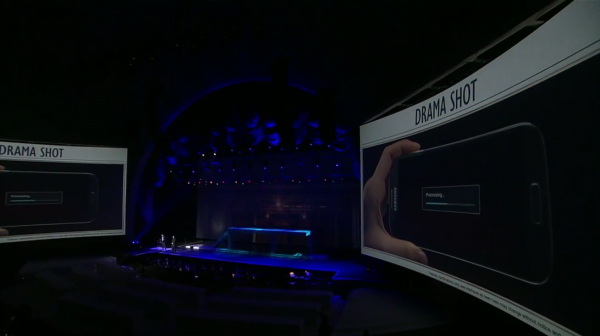
    • Drama Shot. An interesting use of burst mode that combines multiple images into one. This is good for action shots: One example I saw was someone diving off a cliff. Using Drama Shot, you can see the diver at multiple points of the dive in a single image.
    • Eraser. Another camera mode and one I think can be really handy; especially if you live among photobombers. This mode takes multiple images in burst mode and detects any movement in the frame. The assumption is that you didn’t want that object or person in the image; think of someone walking in between you and a landmark. The Galaxy S 4 in Eraser mode lets you easily remove the unwanted bits from the picture and restores the background from the other images. Clever.
    • S-Health. Samsung is getting into the health tracking business with custom software and accessories. The app works with an integrated pedometer, optional heart rate monitor or pedometer band. Your activity data is then synced up to Samsung for storage and analysis.
    • S-Translator. Samsung has integrated a translation app in many of its own native software, helping to translate communications to one of 10 languages at launch. Email and ChatOn are two apps that support S-Translator.
    • Text reader. This app will scan a picture of text and then convert it through Optical Character Recognition. If it detects contact information, it can even smartly auto-populate a contact record; great for scanning business cards instead of manually entering the data. It also works with QR codes.

    There’s plenty more tucked inside the Galaxy S 4 but again, in my limited time, these were what I felt were the most interesting use cases and experiences. Other than a revamped design, I’m not sure what people could have expected Samsung to do from a hardware perspective. Even with technology cycling faster all the time, the components in the Galaxy S 4 are surely enough to carry the device out for a year or so. And most new flagship phones use the same, or nearly the same components.

    That’s why I think Samsung’s software improvements and features will help the Galaxy S 4 appeal to a widespread audience when it becomes available. We’ll see in the second quarter when all four major U.S. carriers, along with Cricket and US Cellular start sales.

    Related research and analysis from GigaOM Pro:
    Subscriber content. Sign up for a free trial.

  • Samsung launches Galaxy S IV

    Live from New York, it’s Samsung Unpacked! This evening at 7 pm EDT, Samsung officially rolls out its highly-anticipated flagship smartphone, and we’re there (via live stream). It’s not like being present exactly, but close enough.

    All times are Eastern for this post, which is in reverse chronological order (e.g., newest first). I also recommend companion story “Why Apple fears Galaxy S IV“.

    7:59 pm. As the event closes there are 393,000 people watching the live stream.

    7:56 pm. “S View Cover” in an accessory that protects the phone while also presenting some info at a glance.

    7:54 pm. “S Health” tracks your activity, such as calorie usage. There’s also monitoring of heart rate, blood pressure and sugar level.

    7:52 pm. “Air Gesture” lets you control the phone without touching it.

    7:51 pm. “Dual Video Call” is — say what? You can make a call using both cameras, so the recipient can see you and others.

    7:49 pm. “Group Plays” turns one group of phones into one large 5.1 sound system and supports up to eight Galaxy devices. Feature supports multi-player games as well and works with as few as two phones (to make like 2.1 system).

    7:47 pm. Galaxy S IV is the first Samsung smartphone with “Knox”, the security feature announced last month. Knox separates personal and professional spaces, among other security features.

    7:46 pm. WTH? The phone works when you’re wearing gloves.

    7:44 pm. Other personal assistant features include reading back messages, like when driving.

    7:43 pm. “Smart Switch” uses the PC as go-between to change devices.

    7:42 pm. “S Voice Drive” is a customized version of S Voice for the car, which presents fonts and other visuals larger.

    7:39 pm. Dual-camera record! Wow! You can shoot video from both cameras at the same time and insert yourself into the whole video.

    7:38 pm. “Story Album” creates photos and places them into story photo albums. There is support for tags and social sharing.

    7:37 pm. “Adapt Display” adjusts contrast, lighting, etc. for all kinds of content.

    7:35 pm. “S Translate” is like a Star Trek universal translator. It understands 9 languages and supports text to speech and speech to text. Languages include English, French, German, Japanese and Korean. There are 3,000-embedded sentences for when there is no network connection.

    7:33 pm. “Eraser” allows you to remove unwanted objects from photos.

    7:31 pm. “Drama Shot” can capture 100 frames in four seconds and from that pick the best shots.

    7:26 pm. Wow, the battery is 2,600 mAh removal battery and removable.

    7:25 pm. Device has 13-megapixel rear- and 2MP front-facing cameras, 2GB RAM, storage from 16GB to 64GB storage, which is expandable.

    7:22 pm. Samsung’s Ryan Bidan says the phone, with 5-inch display, is 441 pixels per inch.

    7:20 pm. Samsung will roll out from 327 carriers in 155 countries, starting at the end of April, with 3G and 4G versions.

    7:19 pm. The music makes the debut really dramatic.

    7:19 pm. Here’s the phone! Looks similar to Galaxy S III. But larger.

    7:18 pm. Shin say the S4 is designed to help people “live the way they aspire to. For each of us life is a journey” and people want to bring their devices “on that journey”.

    7:16 pm. “Imagine touchless interfaces”, Shin says. He talks about benefits exchanging data seamlessly. He promises a “perfect solution for work and play”, securely.

    7:15 pm. JK Shin, a Samsung Electronics president, takes the stage.

    7:13 pm. Will Chase is the MC. Jeremy Maxwell, the kid from the teaser commercials, has a box with the phone. He exits.

    7:10 pm. Whoa, there’s a live band! It is Radio City after all.

    7:06 pm. Now 318,000 viewers. How many would Apple get for iPhone?

    7:03 pm. Start is late and now 283,000 viewers, via YouTube.

    7:00 pm. As the show starts more than a quarter million people view the stream.

  • Why Apple fears Samsung Galaxy S IV

    Early this evening, during a New York soiree, Samsung launched the Galaxy S IV smartphone. The venue is atypical. The South Korean electronics giant usually starts from home, offering new smartphones globally before reaching the United States. Now, in a dramatic change, a flagship Galaxy phone lands on Apple’s home turf first.

    The companies are in a struggle for smartphone supremacy, with Samsung leading in most countries. With one glaring exception: The United States. Today’s venue clearly marks the South Korean manufacturer’s intentions to take the share lead from its American rival.

    Apple responded to today’s launch S4 by sending out marketing chief Phil Schiller to talk down Samsung, its products and Android generally. But big headlines from blogs and news sites fall far short of offering a competitive product. The fruit-logo company rarely sends anyone on such a talking-down door. Surely someone is worried in Cupertino, Calif.

    Even a year ago, the electronics giant wouldn’t have been so bold as to launch here, but Samsung’s brand acceptance is up, in part because of the success of Galaxy S III and Galaxy Note II and some aggressive and creative marketing. Samsung also benefits from high-profile conversions, like prominent Mac journalist Andy Ihnatko switching to the S3 from iPhone 4S.

    Samsung Soars

    To say Samsung is on a roll is an understatement. During 2012, the company captured the No. 1 spot for all handsets and also smartphones. For the full year, as measured in actual phone sales to end users, Samsung share reached 22 percent — that’s from 385 million units, according to Gartner. Share was a tad higher for fourth quarter: 22.7 percent. Meanwhile Samsung smartphone sales soared 85 percent or nearly four times that of Apple.

    Samsung’s sales success strongly weighs against Android, not just Apple. During fourth quarter, Android smartphone share rose to 69.7 percent from 51.3 percent a year earlier. By comparison, iOS fell to 20.9 percent from 23.6 percent. Samsung sold so many smartphones, it accounted for 42.5 percent of all Android sales in the category.

    “The Android brand is being overshadowed by Samsung’s brand with the Galaxy name nearly a synonym for Android phones in consumers’ mind share”, Anshul Gupta, Gartner principal research analyst, says. Samsung’s success is mixed for Android as a platform. The South Korean company, and not Google, largely controls customers’ experience via TouchWiz UI and other features.

    Dollars and Sense

    Mobile makes huge contributions to Samsung’s bottom line. For Q4, the South Korean electronics giant reported revenue of about $52.45 billion and $6.55 billion profit. Mobile division revenue was $25.35 billion, and Samsung credits success largely to two devices — Galaxy S III and Galaxy Note II. Interestingly, Samsung mobile ASPs are rising, and analyst data shows expansion across the globe — particularly markets once dominated by Nokia, China among them. Samsung credits sales to emerging markets as a bright point for the quarter.

    They also happen to be where all the big sales growth is and where Samsung displaces, or replaces, leader Nokia. IDC predicts that emerging markets — Brazil, China and India, particularly — will be the biggest growth areas for smartphones, which accounted for 45 percent of all handset sales in Q, according to Gartner.

    Apple struggles to get beyond the wealthiest consumers in this markets because:

    • Subsidies make selling prices higher
    • Contract commitments are required in countries where non traditionally are required

    For example, “China is a massive growth prospect, but Apple is not making the market share impact there that it is in other markets”, Nicole Peng, Canalys China research director, says. By contrast, Samsung is a top vendor there elsewhere.

    Unquestionably, Samsung blindsided Apple, much the way the American company did to competitors BlackBerry and Nokia. They didn’t see iPhone coming. Clearly Apple execs expected much less success from the so-called copycat.

  • Google BigQuery is now even bigger

    Google might be upsetting a lot of people with some of its recent “spring cleaning,” but its latest batch of updates to BigQuery should make data analysts happy, at least.

    With the latest updates — announced in a blog post by BigQuery Product Manager Ju-kay Kwek on Thursday — users can now join large tables, import and query timestamped data, and aggregate large collections of distinct values. It’s hardly the equivalent of Google launching Compute Engine last summer, but as (arguably) the inspiration for the SQL-on-Hadoop trend that’s sweeping the big data world right now, every improvement to BigQuery is notable.

    BigQuery is a cloud service that lets users analyze terabyte-sized data sets using SQL-like queries. It’s based on Google’s Dremel querying system, which can analyze data where it’s located (i.e., in the Google File System or BigTable) and which Google uses internally to analyze a variety of different data sets. Google claims queries in BigQuery run at interactive speeds, which is something that MapReduce — the previous-generation tool for dealing with such large data sets — simply couldn’t handle within a reasonable time frame or level of complexity. Of course, if you want to schedule batch jobs, BigQuery lets you do that, too, for a lower price.

    This constraint — and therefore the potential benefits of something like Dremel and its commercial incarnation, BigQuery — wasn’t lost on the Hadoop community, which itself had been largely reliant on MapReduce processing for years. In the past year, we’ve seen numerous startups and large vendors pushing their own Dremel-like (or MPP-like) technologies for data sitting in the Hadoop Distributed File System. If you happen to be in New York next week, you can hear some of the pioneers in this space talk about it at our Structure: Data conference.

    Background aside, the ability to join large data sets in BigQuery is probably the most-important of the three new functions. Joins are an essential aspect of data analysis in most environments because pieces of data that are relevant to each other don’t always reside within the same table or even within the same cluster. And joining tables of the size BigQuery is designed for can take a long time without the right query engine in place.

    How to do a join in BigQuery

    How to do a join in BigQuery

    Kwek offers an anecdote from Google that shows why joins, and the new aggregation function, are important:

    [W]hen our App Engine team needed to reconcile app billing and usage information, Big JOIN allowed the team to merge 2TB of usage data with 10GB of configuration data in 60 seconds. Big Group Aggregations enabled them to immediately segment those results by customer. Using the integrated Tableau client the team was able to quickly visualize and detect some unexpected trends.

    Related research and analysis from GigaOM Pro:
    Subscriber content. Sign up for a free trial.

  • Outside the box: UCLA uses brain aneurysm treatment to stop irregular heart rhythms

    For the first time, a UCLA team has used a technique normally employed in treating brain aneurysms to treat severe, life-threatening irregular heart rhythms in two patients.
     
    This unique use of the method helped stop ventricular arrhythmias — which cause “electrical storms” — that originated in the septum, the thick muscle that separates the heart’s two ventricles. This area is virtually impossible to reach with conventional treatment.
     
    The research is published in the February issue of Heart Rhythm, the official journal of the Heart Rhythm Society, and is highlighted on the cover.
     
    Many people suffer from ventricular arrhythmias, which are one of the leading causes of death in the U.S., claiming 400,000 lives annually. These arrhythmias can usually be controlled by medications, by implanting a cardioverter defibrillator device that automatically shocks the heart back into normal rhythm, or by a procedure called catheter ablation, which involves a targeted burn or the application of extreme cold to the tiny area of the heart causing the irregular heart beat.
     
    None of these traditional treatments worked for the two patients featured in this report, who suffered from a severe form of arrhythmia called ventricular tachycardia, which causes a dangerous rapid heartbeat.
     
    Instead, the UCLA team of cardiologists and interventional neuro-radiologists used coil embolization, a minimally invasive method originally developed at UCLA and now commonly used around the world to treat brain aneurysms.  
     
    “We have to think outside the box to help patients with severe arrhythmias located in hard-to-reach areas of the heart,” said senior author Dr. Kalyanam Shivkumar, director of the UCLA Cardiac Arrhythmia Center and a professor of medicine and radiological sciences at the David Geffen School of Medicine at UCLA. “We hope that this treatment will offer new hope for these heart patients, who previously had few options.”
     
    As is common with other arrhythmia procedures, the team first took colorful images of the electrical system of each patient’s heart using wires within the arteries of the heart muscle. This helped pinpoint the exact origin of the arrhythmia and served as a roadmap for the medical team. 
     
    During the coil embolization procedure, the team inserted a tiny catheter through a small incision in the groin, then guided it up to the heart and into the small arteries known as septal perforators, which supply blood to the area of the septum wall in which the arrhythmia originated. 
     
    Once positioned, the team carefully guided tiny, soft-metal coils — just slightly larger than the width of a human hair — through the catheter and into the arteries. The doctors filled each targeted artery with coils, thereby cutting off the blood supply to the region where the arrhythmia originated and stopping it.
     
    Similarly, during coil embolization for a brain aneurysm — an abnormal bulge in a blood vessel caused by a weakening in the vessel wall — coils are guided into the aneurysm to fill it. In this way, the aneurysm is sealed off, eliminating the danger that the ballooning area of the vessel will burst in the brain. This procedure also employs a catheter inserted in the groin.
     
    “We are seeing more cross-over into different medical specialties of these cutting-edge techniques that are able to target and navigate delicate areas in the body, such as the brain and heart,” said Dr. Gary Duckwiler, a professor of radiological sciences at the Geffen School of Medicine. “We look forward to future collaborations with cardiology.”
     
    Shivkumar lauded the partnership between the two medical specialties.
     
    “Cardiac electrophysiologists are like fighter pilots in chasing and zeroing in on arrhythmias that can be tricky to track down,” he said. “Once we have the arrhythmia’s origin pinpointed — and if it’s in a place that is hard to reach — we turn to help from interventional radiologists, who are truly like astronauts in developing novel treatments and ways to navigate through the body.”
     
    “More study will help determine if coil embolization could be used with a broader range of arrhythmia patients,” said Dr. Noel Boyle, a clinical professor of medicine and director of the electrophysiology lab at the UCLA Cardiac Arrhythmia Center.
     
    For now, the technique will be used to treat patients for whom conventional methods are not an option. 
     
    Dr. Rod Tung, an assistant professor of medicine and director of the ventricular tachycardia program at the UCLA Cardiac Arrhythmia Center, noted that both patients in the case study are doing well and have had no recurrences in several months.  
     
    Other study authors included Dr. Venkakrishna N. Tholakanahalli and Dr. Stefan Bertog of the Veterans Affairs Medical Center in Minneapolis, and Dr. Henri Roukoz of the University of Minnesota, Minneapolis.
     
    For more news, visit the UCLA Newsroom and follow is on Twitter.

  • How OpenStack upended the private cloud market overnight

    I like to think of the private cloud market as existing in two distinct eras — Before OpenStack and Anno OpenStack. It is now 3 A.O. (well, in a few months), and Oracle’s announced acquisition of Nimbula on Wednesday got me thinking of just how much the world has changed since OpenStack officially launched on July 18, 2010.

    A report I wrote for GigaOM Pro in June 2010 (subscription req’d), entitled “Defining Internal Cloud Options: From Appistry to VMware,” seems like a good starting point for a private-cloud startup edition of “where are they now.” Ignoring the public companies on the list for the time being (with the exception of CA), here’s what has happened to the private companies and startups.

    1. Abiquo: Abiquo has a new CEO, a tight partnership with NEC around selling to service providers and appears focused on the European market. The company raised about $14 million in 2010, but hasn’t really made a lot of noise stateside since then.
    2. Appistry: Appistry made a huge shift in August 2011 and it now positions itself as a platform for running high-performance applications in areas such as life sciences, defense and financial services. Its biggest area of focus is genomics, where it is even developing new methods for analyzing genomes.
    3. CA: CA bought a bunch of cloud startups in 2009 and 2010 — Cassatt, 3Tera, Oblicore and Nimsoft among them — but it has been essentially silent since then in terms of real innovation. Maybe these acquisitions are driving big business, but I was expecting a more-visionary strategy in terms of fusing them into a cohesive and forward-looking whole.
    4. Cloud.com: Winner!!! Cloud.com had big-name users and workable technology, and it sold itself to Citrix for more than $200 million in 2011. It has since launched an open source competitor to OpenStack called Apache CloudStack and appears to be doing good business.
    5. Elastra: Elastra is no more.
    6. Enomaly: Enomaly’s products still technically exist, but Virtustream bought the company in 2011 with the primary goal of repurposing its intellectual property in the realm of cloud federation and gaining a toehold in China.
    7. Eucalyptus Systems: If you ask CEO Marten Mickos, everything is great with Eucalyptus, and its whopping $55.5 million in venture capital (including a $30 million round in April 2012) and tens of thousands of downloads of its Amazon-compatible cloud softwware are proof. Ask anyone else and they’ll likely tell a different story.
    8. GigaSpaces: GigaSpaces appears to be doing well enough, although it was around well before the term “private cloud.” It has always been much more about its in-memory data grid tech and apps that need dynamic scalability, although it does now offer a Platform-as-a-Service product that’s somewhat disconnected from the legacy business.
    9. JoyentJoyent has always been respected for its engineering chops, although rumors sometimes swirl about how much business the company — which has raised an incredible $115 million — is actually bringing in. Still, it continues to improve its public and private cloud offerings and has landed some big-name users.
    10. Librato: Librato looks to have abandoned its resource-management product line to focus on measuring stuff — sensors, server use, whatever.  It wears that hat well, and Heroku is among its loyal users.
    11. LongJump: In hindsight, LongJump’s business was not actually a great fit for that 2010 report, and its business appears about the same: you build apps in a user-friendly setting and they can run on LongJump’s infrastructure or your own.
    12. Morphlabs: Morphlabs is the master of pivots, although it’s still hanging around and pushing out new products. Now an OpenStack-based cloud-software vendor, it released a new service-provider-focused platform called mCloud Osmium in February.
    13. Nimbula: Nimbula, as noted above, is now part of Oracle in a move that is widely believed to be an “acquihire” situation, although neither company will comment on the details.
    14. Platform ComputingIBM bought Platform Computing in October 2011 and appears to have refocused the company around its HPC roots. Not that that’s a bad thing — Platform was a $72 million company on its own in a niche market, and I’d guess IBM paid a fair price for it.
    15. VirtustreamAnother winner! Virtustream has been on fire since 2010 (actually buying up Enomaly) and looks to be the darling of the enterprise cloud space. It’s primarily a public cloud provider, but it has a strong private/hybrid cloud business that ties Virtustream back to customers’ data centers.
    16. Voxel: Voxel, whose main business was a public cloud offering, got acquired for $30 million by managed hosting provider Internap in January 2012.

    OpenStack is what happened to the private cloud market and forced so many acquisitions, pivots and even one closure. Users, investors and everyone, really, were waiting for some promise of cloud interoperability and portability (aka something other than Amazon, VMware or Microsoft) and OpenStack delivered it. Further, for the service provider community — which has arguably bolstered the sales of private cloud software since its inception — OpenStack provided a relatively engineering-free path to public cloud offerings (compared with building their own from scratch, that is) without fear of being at the mercy of a startup that might fold tomorrow and take its core technology with it.

    I haven’t run the numbers, but I’d be willing to bet the majority of venture capital going toward “private cloud” in the past two years has gone to OpenStack-based startups. We’ve also seen nearly every large software vendor pin its cloud ambitions to OpenStack to some degree — Cisco, HP, IBM and Red Hat to name a few. Even Rackspace is now in the private cloud game thanks to OpenStack.

    For buyers, a large, well-heeled and deep-pocketed community has to be more appealing than a disparate collection of startups all doing their own thing.

    Structure 2012: Marten Mickos - CEO, Eucalyptus Systems, Chris C. Kemp - CEO, Nebula and Co-Founder, OpenStack, Sameer Dholakia - Group VP and GM, Cloud Platforms Group, Citrix, Jo Maitland - Research Director, GigaOM Pro

    L to R: Marten Mickos of Eucalyptus, Chris Kemp of Nebula (an OpenStack startup) and Sameer Dholakia of Citrix at Structure 2012.
    (c) Pinar Ozger

    Who’s not doing OpenStack (at least in any meaningful way)? VMware, Microsoft, Amazon Web Services — all companies with their own intellectual property, huge user bases and lots of money to back their visions. They all also have strong public cloud connections (some, obviously, stronger than others).

    The cloud startups from 2010 that are still arguably thriving today share similar characteristics. They’ve been big on engineering, won major customers early on and raised a lot of money to help them maintain through any tough times. All but Cloud.com, now part of Citrix, have a very prominent public cloud component, too — which appears critical for a truly seamless hybrid environment — but it has staked out its own claim as the anti-OpenStack.

    All of the aforementioned companies are/were doing infrastructure as a service primarily, but we’re already seeing a similar thing happen in the platform-as-a-service space thanks to Cloud Foundry. Providers that weren’t part of that community are jumping on board, and it’s just a few established holdovers that look like they’ll be able to push forward without riding Cloud Foundry’s coattails.

    Perhaps this is telling for how the future of anything at the infrastructure or platform layers is going to play out. You’re either really early and really good, or you wait for an open source project — OpenStack, Cloud Foundry, Hadoop, Open Compute, OpenFlow, etc. — and try to build on that. There’s following fast, and there’s following smart.

    Feature image courtesy of Shutterstock user Alexey Repka.

    Related research and analysis from GigaOM Pro:
    Subscriber content. Sign up for a free trial.

  • What’s up with Google’s Spring cleaning?

    I sometimes wonder if Larry Page is a neatness freak. After all, throwing out stuff defines his nearly two years back as chief executive. He has chucked more Google products than junk I discard from our apartment — there’s no hording around here. Nor at Google. But the last 24 hours is simply unprecedented for changes that broadly affect customers and partners. This Spring cleaning is something to behold.

    Let’s start with today. Jeff Huber is out as head of Google Mapping and Commerce. He explains: “Finishing up my first decade at Google, and excited to return to my startup roots and begin the next one at Google X! Let me know what you’d like to see Google X do next”. The Wall Street Journal says there’s more: Google Maps will split from Commerce and become part of Search and the other folds into Advertising.

    Bigger shocks came yesterday, with the sudden — and I do mean suddenchange regarding Android leadership. Andy Rubin has “decided it’s time to hand over the reins and start a new chapter at Google”, Page says. But the CEO doesn’t say what that is. Huber’s future is clear. Google X is the company’s internal think tank/research lab run by cofounder Sergey Brin. Chrome and Apps lead Sundar Pichai is now responsible for Android.

    As if that wasn’t enough, later yesterday Google announced plans to retire — or in the words of colleague Alan Buckinghamexecute” — a bunch of products or technologies. Among them: Apps Script, CalDAV API, Google Building Maker, Google Cloud Connect, Google Voice App for Blackberry, Search API for Shopping and Snapseed Desktop for Macintosh and Windows.

    But one sent shockwaves across the web last night: Google Reader, which goes under the ax on July 1. I got a notice about the closure date when logging into the service this morning.

    Users rally to save the service, which includes three petitions, and lots of angry social shares. In response to the outrage, colleague Mihaita Bamburic quips: “Your move, Google“.

    In a few weeks, Page celebrates his second year as CEO. Surely now is time to assess the past year and look ahead, which perhaps precipitates this sudden Spring cleaning. But I wonder when and where it ends. Last week, Google began a new round of Motorola layoffs — 1,200 reportedly — tidying up the subsidiary.

    I don’t believe Page is done and see this: The housekeeping is more than just clearing clutter. There is clear consolidation underway as the CEO brings trusted executives — those with whom he resonates or who share his vision — closer to the inner circle. Others will move on, which is one way to look at Huber and Rubin changes. They won’t be the last. Not before Page’s two-year anniversary on April 4.

    A different Google emerges as Page’s vision, and that of his lieutenants, propagates — one that: cross-integrates more products and services, releases updates at faster pace and is much, much, much more aggressive in the market place. The Google you thought you knew is something else.

    Photo Credit: meneame comunicacions, sl