Author: Serkadis

  • Samsung Will Reveal Its Galaxy S IV Tonight, Join Us At 7PM Eastern/4PM Pacific For Our Liveblog

    gs4-newyork

    Sure, some last minute leaks may have ruined Samsung’s big surprise, but that doesn’t mean that there still won’t be plenty to talk about when the Korean electronics titan shows off its flagship Galaxy S IV later tonight.

    As usual, Samsung will be streaming the event (both online and in the heart of the city), but Jordan Crook, Michael Seo, and I will be liveblogging the event too in case you aren’t set up for video or would prefer to digest the night’s events with a heaping dose of personality.

    In case you’ve somehow missed the deluge of Galaxy S IV information that has inundated the geekier districts of the web, here’s a quick rundown of what we expect to see tonight. If a slew of recently leaked photos are any indication then the Galaxy S IV won’t stray very far from the design language Samsung has grown fond of with devices like the Galaxy S III and Note II, and the love-them-or-hate-them plastic bodies don’t seem to be going anywhere. Meanwhile, people’s eyes will likely gravitate toward a 5-inch Super AMOLED screen and one of Samsung’s Exynos 5 Octa chipsets (though it could be swapped for a Qualcomm Snapdragon 600 when the device makes its way Stateside).

    And of course, new hardware is only going to be part of the equation — Samsung appears to have baked nifty software features like Floating Touch and Smart Pause into its highly customized Android build. It won’t be long until we finally see how the device matches up to the rumors, so stay tuned.

  • Vice President Biden Launches Audio Series “Being Biden”

    Today, Vice President Biden launched an audio series called “Being Biden.”

    The series will combine a photo that offers a glimpse into the Vice Presidency with an audio recording of the Vice President narrating the moment and its significance. He will tell the story behind the story – of where he was when the photo was snapped, why it matters to him, and how the experience fits into the broader narrative of this Administration. From meetings at the White House to travels around the country, the Vice President will share his perspective in candid, behind-the-scenes snapshots.

    In other words, he’ll explain what it’s like “Being Biden.”

    Check out the first installment at whitehouse.gov/beingbiden. The series will be available at whitehouse.gov/beingbiden, and will also be shared through the @VP Twitter account. To recieve an email update when new stories are posted, sign up here.

    Check out "Being Biden."

  • We’ll be reporting live from Samsung’s Galaxy S IV unveiling tonight at 7:00PM!

    Samsung Galaxy S IV Liveblog
    The wait is almost over. Samsung (005930) is set to finally unveil its next-generation Galaxy S IV smartphone on Thursday evening and BGR will be on hand reporting live from the event. The company rented out Radio City Music Hall in New York City to debut its new flagship smartphone, so we’re likely in store for a spectacle of unimaginable proportions. Samsung’s next-generation Galaxy S IV is expected to feature a 5-inch HD display, an eight-core processor (or a quad-core chipset in the U.S.), a 13-megapixel camera, up to 64GB of storage plus microSDXC support, 2GB of RAM and Android 4.2 Jelly Bean. While it’s shaping up to be an absolute beast on paper, will the Galaxy S IV live up to its sky-high expectations once it’s finally announced?

    Bookmark this link, which will go live shortly before the event begins tonight, and make sure to head there for our live coverage of Samsung’s press conference! Coverage will begin just before 7:00 p.m. EDT / 4:00 p.m. PDT.

  • 2012 was a record-breaking year for solar panels in the US

    Last year there was a record-breaking 3.3 gigawatts worth of solar panels — or 16 million individual solar panels — installed in the U.S., making solar power the fastest-growing energy source domestically. That’s according to a new report from the Solar Energy Industries Association and GTM Research.

    In comparison, a large nuclear or coal plant can generate about a gigawatt, so there was the equivalent of three of these types of large power plants installed across rooftops in the U.S. in 2012. The 3.3GW worth of solar panels was more than the three previous years combined, said the report, and showed a 76 percent growth over 2011.

    A gigawatt of those solar panels were installed in California, while Arizona and New Jersey also installed hundreds of megawatts. The fourth quarter in particular in the U.S. saw 1.3 GW worth of solar panels installed, which was a record-breaking quarter, said the report.

    SEIA

    The reason that solar panels were the fastest growing type of energy in the U.S. last year was due to the fact that the price of solar panels has dropped dramatically. Companies are also offering financing deals that cover the upfront costs of the systems, and states are offering strong incentives. It’s not a coincidence that states like California with the best subsidies for solar panels had the most installations.

    The growth of solar panels in the U.S. is supposed to continue, says the report. For 2013, the researchers have estimated that there will be 4.3GW of solar panels installed, which would be an increase of 29 percent over 2012.

    There are now 300,000 solar panel systems operating in the U.S. and a total of 7.2 GW of cumulative solar panel power in the U.S. Concentrating solar systems — which use the sun’s heat instead of light to produce electricity — deliver 546 MW worth of power in the U.S.

    The report is note worthy because solar is becoming a game changer. It, along with wind power, are just starting to deliver real volumes and change the way electricity is created in the U.S.

    Related research and analysis from GigaOM Pro:
    Subscriber content. Sign up for a free trial.

  • Teens & Technology: Is mobile the right tool or the only tool available?

    rural phonePew Internet and American Life released a new report this week on teens’ use of technology and the Internet. I’m always interested in these reports – both because of my obvious interest in broadband but also because after a big birthday in February I am now the proud keeper of two teens. And as of this week they each have an iPhone.

    Here are some of the broadband highlights from the report…

    • 95% of teens are online, a percentage that has been consistent since 2006.
    • One in four teens (23%) have a tablet computer, a level comparable to the general adult population.
    • Nine in ten (93%) teens have a computer or have access to one at home. Seven in ten (71%) teens with home computer access say the laptop or desktop they use most often is one they share with other family members.

    I’m impressed by 95 percent of teens being online – although that is a huge wake up call to the five percent who aren’t. It would be interesting to know why those teens aren’t online. Yesterday Connect Minnesota released a report on Minnesota adoption. They found reasons that most Minnesotans who aren’t online have stayed offline. The top answers are:

    • Don’t want it (19 percent)
    • Broadband fees are expensive (13 percent)
    • No content worth viewing (13 percent)

    Since I just saw my teen send SnapChat pictures to a friend on the whole drive home from dinner last night – I can’t believe the bar for ”cotent worth viewing” is that high with teens. You wonder if it’s cost or access or parents’ decision. The bigger question is how do we prepare those teens to use the technology their peers take for granted?

    There were also range of statistics on cellphone use by teens:

    • 78% of teens now have a cell phone, and almost half (47%) of those own smartphones. That translates into 37% of all teens who have smartphones, up from just 23% in 2011.
    • About three in four (74%) teens ages 12-17 say they access the internet on cell phones, tablets, and other mobile devices at least occasionally.
    • One in four teens are “cell-mostly” internet users — far more than the 15% of adults who are cell-mostly. Among teen smartphone owners, half are cell-mostly.
    • Older girls are especially likely to be cell-mostly internet users; 34% of teen girls ages 14-17 say they mostly go online using their cell phone, compared with 24% of teen boys ages 14-17. This is notable since boys and girls are equally likely to be smartphone owners.
    • Among older teen girls who are smartphone owners, 55% say they use the internet mostly from their phone.

    So now I have the data to contrast my teens’ whining that they were the only ones in the world without smartphones – but I have to admit 37 percent is pretty impressive. I’m intrigued by 25 percent of teens being cell-mostly internet users. I get that 71 percent share a computer at home, which makes it harder to use the laptop or desktop, but that number still surprises me. And I wonder if it is because their cell use is virtually constant through the day so that any other time spent on a traditional computer seems brief? Or is the cell use replacing traditional use?

    For me the difficulty with smartphone/cell-only (or mostly) access has been my difficulty understanding how someone could get their “work” done on a smartphone. For example – I don’t want to read a Pew Report, cross reference other studies or type out this blog post on my smartphone. I do want my smartphone for directions (maps and occasional how-to videos), contact management, easy communication (Facebook, Twitter, text), music while I workout, ready reference, comparison shopping; some of those activities are work related.

    The big question to me – for teens and others who choose cell/smartphone access – are we doing things differently? (Do they find a smartphone sufficient for research and writing?) Is the “work” changing? For example are people watching videos instead of reading reports and are they commenting via video? Because I’d choose a smartphone for that work too.

    Do they choose smartphones because it’s the right tool for the job or because it’s the only tool available?

  • Too many remotes? The internet of things can solve it

    Look around. Can you see the internet of things? The beginning stages of the network of connected devices and services that can help us track our fitness goals, manage our home automation and improve factory performance is all around us; we just have to knit things together. We also have to start tracking how many devices we’re connecting to the internet, especially those that we don’t interact with directly, like we do laptops or smartphones.

    If the core theme of our internet of things meetup in San Francisco was how we define the topic, then the big question of our Boulder, Colo. meetup on Wednesday night was, “where is the internet of things?” THE 80-to-90 people at the home of TechStars (our host for the evening) weren’t interested in abstract ideas about avatars or services versus hardware; they wanted the stories from on the ground.

    For example, Mike Soucie, a cofounder of Mobiplug, laid out his company’s vision for the connected home, showing how you could connect your existing devices using the Mobiplug hub. He was asked about privacy; namely, when we put all this information from our Philips’ Hue light bulbs to our door locks on our phone, what happens if the phone goes missing? Or someone snoops on our home Wi-Fi network? Soucie acknowledged that these are concerns, but didn’t really answer the question, stating that people already keep a lot of information on their phones today.

    But he did help people stop thinking about the internet of things as some brand-new concept, pointing out this it is an extension of inventions like the printing press that helped drive the spread of information, and thus innovation. In many cases, where we are today is similar, only the information is coming at us much faster — and we have cheap computing to do something with it.

    Mike Rosenblatt, CEO of Atoms Express.

    Mike Rosenblatt, CEO of Atoms Express.

    The historical perspective was popular with Michael Rosenblatt, who is the CEO of Atoms Express, a connected toy company. He traced the internet of things back to a connected stock ticker from the late 1800s and pointed out that companies exist who still do variations on that today (click through). His presentation dovetailed nicely with Soucie’s. From both I took away three characteristics consumers will likely care most about when purchasing connected products:

    Unification: As Rosenblatt said, “At home I have a bunch of remotes and now I have a bunch of apps.” This is almost the founding statement of Mobiplug as well. No one wants to open six apps to turn down the lights, start a movie, lock the doors and settle in for a movie night.

    Wrap your software in great hardware : This is pretty self-explanatory, but even if the internet of things will center around services and software, you will lure consumers with the hardware itself. So make it attractive and resilient.

    Device awareness (network topologies) will matter : This one is nerdy, but important. A true internet of things won’t just react to you (or your smartphone) it should be able to react to other devices around it. Network protocols and figuring out how to program networks will be crucial in bringing more autonomy to the internet of things (at that point we can rename it Skynet).

    Matt Bolton of SparkFun.

    Matt Bolton of SparkFun.

    While Soucie and Rosenblatt covered where we have been and where they hope the industry goes, another speaker, Matt Bolton of SparkFun, offered a complementary presentation that showcased how the internet of things owes a debt to the Maker movement. The availability of electronics projects like those sold by SparkFun are often a gateway drug for the entrepreneurs who end up starting IoT companies.

    The culture around hacking together hardware leads people to contemplate how the experience can be improved — and since many of these projects involved an element of connectivity, people start looking at how to bridge the digital and physical worlds in ways that more and more people could participate in. Out of projects like that you get startups like SmartThings, Electric Imp, and others.

    Bolton’s points about the challenges faced by SparkFun as an open hardware manufacturer — he estimates his company has 12 weeks before someone clones their designs — also echoes an unfortunate truth about the speed at which alternatives to hardware can enter the market. That’s why services and software will be so crucial for startups building the internet of things.

    Related research and analysis from GigaOM Pro:
    Subscriber content. Sign up for a free trial.

  • BlackBerry Z10 sell-outs continue in new markets, but sales said to be slowing in Canada, U.K.

    BlackBerry Z10 Sales
    BlackBerry’s (BBRY) new flagship Z10 smartphone has seemingly been well-received in a number of markets, and the latest round of launches has been no different. Following a note from Jefferies & Company analyst Peter Misek suggesting the BlackBerry Z10 sold out across numerous retailers in India, RBC Capital Markets’ Mark Sue and RBC Dominion Securities’ Paul Treiber report that the Z10 has indeed been well received in India and other new markets following its launch late last month. The duo’s checks have found stock-outs across India and other markets. They raised their February-quarter estimates to 500,000 units from 350,000 as a result, but they still see BlackBerry selling 2 million smartphones in the May quarter as sales appear to be slowing in Canada and the United Kingdom.

    Continue reading…

  • How pathetic Apple has become

    Phil Schiller’s preemptive attack against Samsung’s Galaxy S IV, which launches later today, says everything you need to hear about the sorry state of Apple. I’m stunned, because the marketing chief sounds too much like Microsoft CEO Steve Ballmer in 2007, when he dismissed iPhone. Denial is the surest sign a company has lost its way, and I don’t just mean some executive denying such-and-such product or competitor is any good as distracting marketing ploy. The worst, and Schiller gives it, is corporate denial — the proverbial ostrich with head in the sand — about the world around.

    Last night, I saw Schiller quoted in the Wall Street Journal. This morning I see posts from Bloomberg and Reuters, too, and a raff of tech blogs and news stories — largely quoting one of the more mainstream services. The Journal calls Schiller’s Android attack a “rare interview”. But I see something else: Desperation. Denial. What’s missing means much more: The typical leaks and rumors about Apple’s next thing that steals the thunder from a competitor. Apple has nothing to show, and the InterWebs are less embracing of rumors. How pathetic is that?

    Schiller, like Ballmer

    Think about it. For the previous three years, Apple launched a new tablet around this time, with lots of buzz-generating rumors circling round. In 2013, there is near silence about the next iPads — plural now there is mini — or anything other than a watch. Oh, please! How lame! Apple’s problem is two-fold then: Nothing new is imminent and bloggers, news media and social network sharers aren’t as quick to jump on new rumors or counter-marketing moves.

    Consider Consumer Electronics Show, where Apple rumors typically overshadow real announcements. The best the company could do this year: Announcement about 40 billion downloads, which took little attention away from CES. Meanwhile, the InterWebs are a tangle of Galaxy S4 rumors and product sightings — the kind of stuff that just a year ago would have been about an iOS device. Suddenly Samsung is the cool kid in town.

    Why the cold reception? As I’ve asserted for years: Apple’s stock price. Lots of people had lots of reasons to spread rumors because they lifted Apple shares. And as these investors — some, bloggers writing regularly about Apple — made money they couldn’t contain their glee. Joy is contagious, they say. So are sour grapes. Shares are down nearly 40 percent today from September’s all-time high. Lots of people lost lots of money in Apple and aren’t feeling good at all about their share crop. There’s nothing to gain propagating rumors, either. Apple’s stock is a rolling bolder.

    Denial Means…

    The bigger problem is leadership living in denial, which is the clear tone of Schiller’s statements. In all three interviews the marketing exec rails about Android fragmentation — to which I say: “Tell us something we don’t already know”. His reasoning reminds of iPod competitors in the mid-Noughties. So many of them complained that Apple’s music player lacked features like FM radio and was overall too simple. But simple, particularly sync, is what people wanted — and features like super-long battery life and smaller size. As an analyst then, I consulted with several companies certain they could beat iPod with more features. But they missed the fundamentals.

    Schiller does the same thing today. He rattles off stats about how fragmented Android is compared to iOS. But his priorities are misplaced. Like consumers buying iPods a decade ago, people don’t care. What matters is user experience — what Apple once got right and made a priority — not the underlying operating system. During fourth quarter, Samsung accounted for 42.5 percent of Android sales, according to Gartner. Buyers got a single, unified user experience from TouchWiz UI.

    Schiller’s statements so reminds of competitors dumbfounded by Apple. He denies market realities, like they did. The quality and tone of his statements — that he would even grant “rare” interviews — shows Apple in crisis:

    That Apple has nothing to show at a time when it typically does, even if just a whiff of rumor, shows leadership in disarray — and the response sounds too much like Nokia or Microsoft executives facing down iPhone in 2007 and 2008. In January, I asked: “Will 2013 be another year of Apple iteration masquerading as innovation?” Schiller already answered the question.

    Photo Credit: Andrew Mager

  • Live blog: Samsung unveils the Galaxy S 4

    Later today in New York, Samsung plans to introduce its latest flagship Android phone, the Galaxy S 4. I’ll be covering the event live from Radio City Music Hall starting at 4pm PT (7pm ET), as Samsung introduces what will likely be the most scrutinized phone in the Android world.

    Samsung is coming off a strong year, during which it has practically assumed control of the Android market as rivals like HTC, Motorola, LG and others have faltered. We already know an awful lot about the Galaxy S 4, and here are a few stories to whet your appetite while waiting for the event to start.

    Related research and analysis from GigaOM Pro:
    Subscriber content. Sign up for a free trial.

  • Taking Action to Prevent Domestic Violence Homicide

    Vice President Joe Biden delivers remarks at a Domestic Violence Homicide Reduction Event

    Vice President Joe Biden delivers remarks at a Domestic Violence Homicide Reduction Event at the Montgomery County Executive Office Building in Rockville, MD, March 13, 2013. Also pictured are (from left) Janet Blackburn, Attorney General Eric Holder, Actress Mariska Hargitay, and Chief Jeff Spaulding, Chief of Police of the Westminster Police Department.

    (Official White House Photo by David Lienemann)

    Yesterday I attended an event held by Vice President Biden and Attorney General Holder focused on reducing domestic violence homicides. The Vice President spoke movingly about the changes that have occurred since the passage of the Violence Against Women Act but also reminded us that three women a day still die as a result of domestic violence. The Attorney General announced grants to twelve communities to screen victims for risk of homicide and create high risk teams to contain these dangerous offenders. He stressed the importance of understanding the warning signs that could indicate the risk of homicide is increasing and linking those victims with services. The Vice President was joined by Mariska Hargitay of Law & Order: Special Victims Unit, domestic violence advocate Janet Blackburn, and state and local officials from around Maryland.

    The event was held in Maryland to showcase the success of their model lethality assessment program. By screening victims for risk factors at crime scenes, in hospital emergency rooms, and in court and linking those most at risk with immediate crisis intervention services, Maryland has reduced its domestic violence homicide rate by 34% over the past five years. The Vice President also highlighted the work of Newburyport, Massachusetts, which launched a multi-disciplinary high risk team to identify and address the most dangerous cases of domestic violence in their community. Since beginning this approach in 2005, there have been no domestic violence homicides in Newburyport. The grants announced today will help communities around the country replicate these two successful models.

    read more

  • Firm that called Apple’s spectacular slide says now it’s time to buy

    Apple Stock Analysis
    While Wall Street continue to issue sky-high price targets in excess of $1,000 on Apple (AAPL) shares last year, BTIG’s Walter Piecyk saw the writing on the wall in April and downgraded the stock to Neutral. Five months later, Apple shares took a spectacular dive and have yet to show any real signs of recovery. Piecyk seemingly now believes we’re at the bottom, however, as the analyst on Thursday upgraded Apple to Buy with a $540 target.

    Continue reading…

  • Leaked high-quality Galaxy S IV photos dispel any remaining mystery

    Samsung Galaxy S IV Photos
    With Samsung’s (005930) Galaxy S IV set to debut Thursday evening, the dam has finally broken. The slow trickle of leaked photos is now a river, and the highest quality images we’ve seen so far have been published by Chinese gadget blog IT168. While we likely already know nearly everything there is to know about the Galaxy S IV, these new photos show the handset’s sleek design in sharp detail, leaving nothing to the imagination. Samsung’s Galaxy S IV is expected to feature a 5-inch Super AMOLED HD display, an eight-core Exynos processor or a quad-core Snapdragon chipset depending on region, up to 64GB of storage, 2GB or RAM and Android 4.2 Jelly Bean. BGR will be on hand reporting live when Samsung unveils the Galaxy S IV Thursday night at 7:00 p.m. EDT, but in the meantime, several additional high-quality photos of the new smartphone follow below.

    Continue reading…

  • Apple’s next-gen iPhones to usher in new manufacturing split

    Apple iPhone 5S Manufacturing
    Apple (AAPL) has historically relied on one Eastern manufacturing giant to assemble its iPhone lineup, but the next generation of Apple handsets will reportedly see that change. According to well-connected KGI Securities analyst Ming-Chi Kuo, Apple plans to diversify its iPhone manufacturing plans and split orders between Foxconn and Pegatron. While Foxconn has historically assembled all iPhone models, Pegatron will reportedly build 75% of the FDD-LTE version of Apple’s upcoming entry-level iPhone model and 55% of legacy iPhone 4S and iPhone 4 models. In his research note, which was picked up by AppleInsider, Ming-Chi also estimates that Apple will ship 35.8 million iPhone 5S handsets in 2013 and 53.4 million new entry-level iPhones.

    Continue reading…

  • Electric Imp aims to make the Internet of Things devilishly simple

    We constantly hear that to make the internet of things popular, we’re going to need to make connecting devices to the web and to each other easier. Electric Imp is hoping to handle both problems, according to CEO Hugo Fiennes. He discusses how his experience at Apple helped him build an easy-to-implement card that let’s people and manufacturers add connectivity to everything.

    In the podcast he and I talk about how various startups are tackling the connectivity problem and where each fits in, why Wi-Fi is the best technology for the internet of things, despite its expense, and ponders the idea of our future devices having a slot where consumers can add an Electric Imp card if they see value in connecting it to the web.

    (download this episode)

    Subscribe to RSS

    iTunes

    Stitcher Radio

    Show notes:
    Host: Stacey Higginbotham

    • How to make Wi-Fi the de facto standard for the internet of things
    • How other IoT players differ and where they fit into the ecosystem
    • How to connect herds of cows and mangrove swamps
    • Will everything have an “IoT slot,” and will consumers get to choose what they will add connectivity to after they buy it?

    SELECT PREVIOUS EPISODES:
    Call-In: Galaxy S 4 predictions, Chromebook Pixel cloud storage

    Podcast: Facebook’s feedin’; Lean In’s meanin’; and everyone’s Hadoop-in

    IoT podcast: When devices can talk, will they conspire against you?

    Call in podcast: Galaxy S 4 predictions and Chromebook Pixel cloud storage

    Call-in show: Why the “I’m leaving iPhone” trend?

    Internet of things Podcast – Almond+’s nutty idea: Making sensor connectivity a snap

    Yahoo’s WFH Boo-Boo

    Podcast: Why the internet of things is cool and how Mobiplug is helping make it happen

    Podcast: Ballmer’s in the Dell, do tweets ruin TV? And how ISPs are not like gas pumps

    Podcast: Kabam founder on scaling globally and designing for different platforms

    Related research and analysis from GigaOM Pro:
    Subscriber content. Sign up for a free trial.

  • Google Reader lived on borrowed time: creator Chris Wetherell reflects

    You would think that Chris Wetherell, an early creator of Google Reader (and part of the team that eventually made it happen) would be feeling sorry for himself — after all Google had decided to euthanize a product he (and others) had spent countless months spent building.

    And yet, he was in good sprits, focusing instead on good things that were happening in his life – his new startup, Avocado (an intimacy application much like Pair and Couple) finally has a new office and is growing like weed on the Android platform. He has ample money from investors such as General Catalyst and Lightspeed Venture Partners. So perhaps it that is why he doesn’t want to dwell on the past.

    Wetherell who spent four years on the product left Google and later joined Twitter, co-started Thing Labs and worked on Brizzly before arriving at his new idea.

    IMG_5552When I asked the Beaverton, Oregon native about his emotional state, he quietly pointed out that he has had years to prepare for today.

    As we dug into steaming plates of vegetarian (and super spicy) Chinese food at Henry’s Hunan, a block away from his and my office, Wetherell joked that he had lost his innocence about the business world a long time ago and had developed a thick skin. “I have seen a lot worse decisions than this,” he quipped, in between sips of piping hot soup.

    A slow lingering death

    “When they replaced sharing with +1 on Google Reader, it was clear that this day was going to come,” he said. Wetherell, 43, is amazed that Reader has lasted this long. Even before the project saw the light of the day, Google executives were unsure about the service and it was through sheer perseverance that it squeaked out into the market. At one point, the management team threatened to cancel the project even before it saw the light of the day, if there was a delay.

    1. fusion the earliest - home page

    “We had a sign that said, ‘days since cancellation‘ and it was there from the very beginning,” added a very sanguine Wetherell. My translation: Google never really believed in the project. Google Reader started in 2005 at what was really the golden age of RSS, blogging systems and a new content ecosystem. The big kahuna at that time was Bloglines (acquired by Ask.com) and Google Reader was an upstart.

    And it entered the market with big ideas and a clear, clean slate and captured the imagination of early adopters, despite some glitches. The Google Reader team which included Chris (who was the Senior Software Engineer) worked hard to keep pushing the product forward. Among the folks who worked on the project included backend guru Ben Darnell, Mihai Parparita and Jason Shellen.

    Missed opportunities

    I wonder, if the company (Google) and the ecosystem at large misread the tea leaves? Did the world at large see an RSS/reader market when in reality the actual market opportunity was in data and sentiment analysis? Wetherell agreed. “Reader market never went past the experimental phase and no was iterating on the business model,” he said. “Monetization abilities were never tried.”

    “There was so much data we had and so much information about the affinity Readers had with certain content, that we always felt there was monetization opportunity,” he said. Dick Costolo (CEO, Twitter) who worked for Google at the time (having sold Google his company, Feedburner) and came up with many monetization ideas but they fell on deaf ears. Costolo, of course is working hard to mine those affinity-and-context connections for Twitter, and is succeeding.

    In a November 2011 blog post, he pointed out:

    Reader exhibits the best unpaid representation I’ve yet seen of a consumer’s relationship to a content producer. You pay for HBO? That’s a strong signal. Consuming free stuff? Reader’s model was a dream. Even better than Netflix. You get affinity (which has clear monetary value) for free, and a tracked pattern of behavior for the act of iterating over differently sourced items – and a mechanism for distributing that quickly to an ostensible audience which didn’t include social guilt or gameification – along with an extensible, scalable platform available via commonly used web technologies – all of which would be an amazing opportunity for the right product visionary. Reader is (was?) for information junkies; not just tech nerds. This market totally exists and is weirdly under-served (and is possibly affluent).

    If there were things that went wrong, then there is a lot of positive things that came from Google Reader, Wetherell said. He believed that one of the main reasons why Google Reader could exist was because companies and entities with completely conflicting agendas came together, supported RSS and other standards. Google, MoveableType, Blogger, WordPress, Flickr and several other web-apps believed in creating RSS feeds for easy consumption. “In the end it helped the average users,” said Wetherell.

    But all that is behind us and we might not see similar altruism again, Wetherell theorized. I agree with him.  If in the early 2000s, Web 2.0 companies were building platforms that wanted to work with each other, today, we have platforms that are closed.  We live in the world of silos now. Twitter and Instagram have broken up. Facebook is the Soviet Union of the modern web. The new systems don’t offer RSS or feeds.”There is no common language of sharing,” he bemoans. And rightfully so!  And unless we have web giants speaking the same language of sharing, there seems to be no future of aggregation.

    Built at Google Scale 

    Google data centerMarco Arment says it is good Google Reader is shutting down, because “We’re finally likely to see substantial innovation and competition in RSS desktop apps and sync platforms for the first time in almost a decade.” It won’t be easy or trivial. As we finished up our dinner, Wetherell said that it took a lot to make Google Reader work.

    For instance, it was Google Crawler that gave the system ability to make lightening fast connections and also bring up recommendations. It is one of the main reasons it cannot be open sourced. The systems is too intertwined with Google’s search and other infrastructure to be sold as well.

    In addition, Google had a separate recommendations team fine tuning Google Reader and those people don’t come in cheap. And let’s not forget that it was Google’s infrastructure that allowed millions of accounts to be hosted and many billions of items – photos, videos, text objects to be saved for people to consume them at their leisure.

    It wasn’t and it still isn’t a cheap exercise, said Wetherell, rationalizing why he somewhat understands Google’s predicament. ”This is and will always be a Google level problem, especially if you are building a service for more than a few people,” he said.

    End of the Reader Era

    So if a company like Google which has the infrastructure and a monetization machine in place to profit from the reader market is throwing in the towel, what hope others have? Most importantly, what if readers are not even necessary. Dave Winer writes:

    I didn’t think the mailbox approach to news was right. Who cares how many unread items there are. I like the river of news approach and I have a very fine set of rivers that keep me well supplied with news and podcasts.

    After a roller coaster of emotions — shock, disappointment and anger — had run their gut wrenching course, I asked myself the question: has the world has changed so much that don’t really need something like Google Reader. Is it time to think about something else, something brand new. Something that is more in sync with a world where information flows through the social webs and is consumed on devices in our pockets. Something like Prismatic, perhaps? Something that automagically surfaces what we want or what we should want to read. I know — it is a painful thought to think at this moment, but technology brings change – and change we must. Chris puts it well when he writes:

    Reader will be an interesting footnote in tech history. That’s neat and that’s enough for me; wasn’t it fun that we were able to test if it worked?

    2. fusion prototype - home page

    Related research and analysis from GigaOM Pro:
    Subscriber content. Sign up for a free trial.

  • Google kills Google Reader, says it will go offline on July 1, 2013

    Google is doing a second round of spring cleaning — its euphemism for small projects it finds unworthy of its time and efforts — and is killing off a whole bunch of projects, the biggest of them being Google Reader. In a blog post Wednesday afternoon, Urs Hölzle, Google’s senior vice president of Technical Infrastructure, announced the pending closure:

    Everyone has a device, sometimes multiple devices. It’s been a long time since we have had this rate of change—it probably hasn’t happened since the birth of personal computing 40 years ago. To make the most of these opportunities, we need to focus—otherwise we spread ourselves too thin and lack impact. So today we’re announcing some more closures, bringing the total to 70 features or services closed since our spring cleaning began in 2011

    Image (3) google-reader.jpg for post 28194

    The other projects that are being euthanized include Google Voice for Blackberry, Calendar API, Snapseed for desktop, Search API for shopping and others. However, it is the loss of Google Reader that is going to impact a lot of people — especially those of us who actually love using RSS feeds to plow through hundreds of feeds. I use it in combination with Reeder app on my iPad, iPhone and Macbook Pro to stay on top of the technology world.

    We launched Google Reader in 2005 in an effort to make it easy for people to discover and keep tabs on their favorite websites. While the product has a loyal following, over the years usage has declined. So, on July 1, 2013, we will retire Google Reader. Users and developers interested in RSS alternatives can export their data, including their subscriptions, with Google Takeout over the course of the next four months.

    I take issue with Urs’ comments about usage declining. It declined because the company put no resources into the product and took away social features that made it useful for many. It was a project that was orphaned because it didn’t fit into Google’s vision of a machine-driven reading experience. Despite minimal resources devoted to it, Google Reader was one of the better apps built by the Mountain View, Calif.-based company.

    It is probably my second-most used Google service — after GMail — and I have always been befuddled by Google’s lack of desire to make Google Reader into a bigger reading platform. It could and it still can evolve into a Flipboard type service, but that would mean that Google would have to put resources and some real creative thought into Reader.

    I wish they would reconsider this decision or, better yet, release the project into the open-source community so that someone can build a follow-on product.

    Update: Folks from Feed.ly are offering an option for all of us left at the altar by Google’s decisions.

    Google announced today that they will be shutting down Google Reader. This is something we have been expecting for some time: We have been working on a project called Normandy which is a feedly clone of the Google Reader API – running on Google App Engine. When Google Reader shuts down, feedly will seamlessly transition to the Normandie back end. So if you are a Google Reader user and using feedly, you are covered: the transition will be seamless.

    A Feedly spokesperson tells us:

    Our goal is to have the API be identical to the Google Reader un-official API. So any client which plugs in to the API should be to easily migrate to Normandy. There are just a few things around authentication and ordering of categories and feeds which might be different.

    Related research and analysis from GigaOM Pro:
    Subscriber content. Sign up for a free trial.

  • Reddit ‘Ask Me Anything’ with Economic Advisor Gene Sperling

    This afternoon, Gene Sperling, Director of the National Economic Council, turned to Reddit to answer some questions about the President’s plan to reduce the deficit. During the 'Ask Me Anything', Sperling responded to questions on a range of topics, including the President's proposal to raise the minimum wage and how the "The West Wing" (television show) compares to the actual West Wing.

    You can see all of the responses on Reddit, or check out the questions and responses below.

    Gene Sperling Answers Questions on Reddit

    Gene Sperling, Director of the National Economic Council and Assistant to President Obama for Economic Policy, answers questions during an ‘Ask Me Anything’ on Reddit.

    March 13, 2013.

    read more

  • Android and iOS are neck-and-neck in two-horse tablet platform race

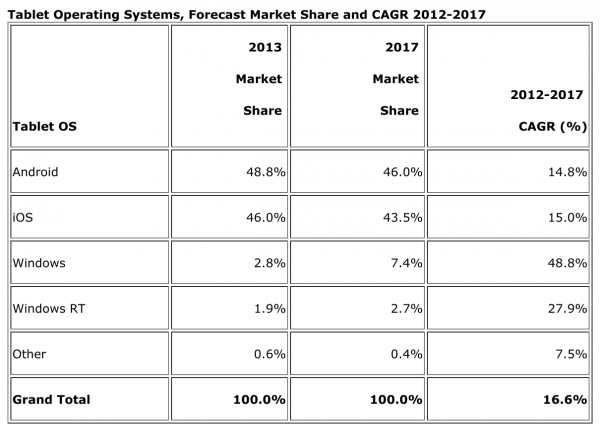
    In December, I warned: “You can’t trust IDC’s 2016 tablet forecast, or any other“. That’s because the analysts revise predictions every couple months. Well, lookyloo. The firm dropped a new forecast late yesterday, and like every other Android gives iOS another beating. I say, “Perhaps”.

    The great soothsayers now see Android tablet shipment share rising above iOS for all 2013, a feat already claimed individually for third and fourth quarters. IDC sees the green robot at 48.8 percent share to 46 percent for the fruit-logo. Don’t believe it. The market is too volatile and IDC, along with all its competitors, has yet to make accurate predictions. Anything can happen, including an unexpected surge of Windows tablets.

    Let’s look at the track record for 2012. In June, IDC forecast iOS tablet share of 62.5 percent, but revised downward to 59.7 percent in September and in early December to 53.8 percent. Meanwhile, IDC forecast Android share of 38.8 percent in June, lowered to 35.3 percent in September and raised to 42.7 percent in December. With just three weeks left in the year, the analyst firm couldn’t get projections right. Final numbers: 51.3 percent for iOS and 46.3 percent for Android. Statistically, the margins of error here are huge. Just ask NASA sending spacecraft to Mars.

    Let’s use a different measure. Between March and December last year, IDC raised its tablet forecast for 2012 by 15.3 percent and 2016 by 42.6 percent. This kind of change is huge, taking place during the course of a single calendar year.

    A new year means another forecast (through 2017) and more revisions. The analyst firm raised full-year shipment projections to 190.9 million from 172.4 million. That’s an 11-percent change, which IDC applies throughout the forecast period. Projection for 2017: 350 million. Don’t believe it. The actual number will be considerably more.

    That’s because smaller slates, which sales potential most analyst dismissed two years ago, are gangbusters. “One in every two tablets shipped this quarter was below 8 inches in screen size — and in terms of shipments, we expect smaller tablets to continue growing in 2013 and beyond”, Jitesh Ubrani, IDC research analyst, says. Geez Louise. NPD DisplaySearch predicts models with 7-7.9-inch screens will account for 45 percent of all tablet shipments in 2013.

    Oh, and keeping with the “you can’t trust anyone’s forecast” theme, DisplaySearch estimates 240 million tablets, or 67.6 million more than IDC projections.

    I do expect smaller slates to outsell larger ones, since they double so well as ebook readers (which forecast IDC lowers) and cost so much less. “Vendors are moving quickly to compete in this space as consumers realize that these small devices are often more ideal than larger tablets for their daily consumption habits”, Ubrani says. Yes, there are.

    Perhaps it’s no coincidence that less than 24 hours after IDC released the forecast, Amazon cut prices by as much as $100 on Kindle Fire HD 8.9″.

    The tablet, from the maker of Kindle Reader, is good segue to ebook readers, to which IDC says smaller slates are “damaging”. The analyst firm cut projections by 14 percent average through 2016.

    Photo Credit: Cheryl Ann Quigley/Shutterstock

  • Samsung said to be locked into Android, no plans to stray with Tizen

    Samsung Tizen Analysis
    There is little doubt that Samsung (005930) is exploring a world where it relies on Android far less than it does today. According to Hillside Partners analyst Rory Maher, however, there is hardly any chance Samsung will begin to stray from Android in favor of its upcoming Tizen platform. In a note picked up by Barron’s, Maher said that like Bada, Tizen is likely a regional play that will receive only a fraction of the attention Samsung gives to Android.

    Continue reading…

  • Hardware Startups: Spots Are Filling Up For Hardware Alley At Disrupt NYC

    Wednesday on Hardware Alley With Mike Butcher

    I love hardware. That’s why I want you guys to bring some of the coolest hardware projects imaginable to Disrupt NY this year. That’s why I want you guys in our Hardware Alley and spots are almost full.

    Hardware Alley is a one-day celebration of hardware startups both young and old. The goal has always been to show off amazing hardware that we have written about over the past few months, as well as a few surprises. Last Disrupt we featured the guys from Thermovape, Makerbot, and Lit Motors. This year we want to fill Disrupt NY with more amazing companies.

    For more details on Disrupt head over here. We’re looking for new or even unlaunched products, as well as potential Kickstarter projects. Prototypes are fine as long as they’re amazing.

    You can see the previous Hardware Alley participants here. You can sign up here. Bootstrappers can contact me directly at [email protected] if you need a break on price. Hope to see you in the alley… the Hardware Alley.

    Our sponsors help make Disrupt happen. If you are interested in learning more about sponsorship opportunities, please contact our amazing sponsorship team here [email protected].