Author: Serkadis

  • Google Updates Spam Detection For Reviews, Warns SEOs

    Google announced that it has made some improvements to its spam detection algorithms that increased the number of reviews that appear on some Google+ Local pages.

    Google’s Dasha made the announcement in a Google Groups forum thread (via Search Engine Roundtable).

    “Online reviews have been in the news a lot recently, and we at Google are committed to helping people to get ratings, reviews, and recommendations that are relevant, helpful, and trustworthy,” Dasha says. “To protect both business owners and customers from spam reviews, we have systems in place that may remove individual reviews.”

    “No one likes spam, and we’d like to talk about what you can do to make sure all of the reviews on Google+ Local are useful, honest, and written by real people!” adds Dasha.

    Google advises business owners to be wary of SEO and reputation management services that promise to generate reviews, and Google says it will take down fake “glowing testimonies”. The company also notes that it does not take down negative reviews for just being negative for anyone, and instead advises business owners to respond themselves. Google also says not to trust anyone who says they know how to remove reviews from Google.

    Interestingly, a specific guideline Google lists for business owners is to not set up a computer or tablet in their place of business customers can leave reviews on site. The company also reminds business owners that it doesn’t allow them to give customers free gifts or discounts in exchange for reviews. It’s kind of like the whole paid links thing.

    Google tells SEOs specifically, “If a business accepts paper comment cards it might be tempting to collect them and “digitize” them by posting the reviews on Google+ Local. We ask that all reviews come from first hand experience and do not allow posting reviews on behalf of others.”

  • Super Bowl Should Highlight Growing Significance Of Mobile Ads

    The Super Bowl, for many, is as much about advertising as it is football. As smartphone and tablet use continue to climb, television-watching in general is becoming a much more interactive experience for consumers, and obviously advertisers want to take advantage of the phenomenon.

    “CBS is once again set to live-stream the game, and was almost completely sold-out of mobile inventory space in December, with prices ranging from high six to low seven figures,” Sephi Shapira, CEO of mobile marketing firm MassiveImpact tells WebProNews. “But, marketers aren’t just thinking about people live-streaming the game, they’re thinking about how to engage with traditional TV viewers via mobile.”

    “Prior to the start of the game, many brands are looking for viewers to interact with traditional television ads on their mobile devices,” Shapira adds. “That interaction is about more than increasing traffic to an app or mobile site; it’s about specific end-user targeting. Based on how the viewer reacts to the television ad on their mobile device, the content they receive for the rest of the game via mobile will be tailored to the individual’s initial mobile interaction.”

    “This individualized content should mean large returns for advertisers, and will continue as a trend for interaction through the upcoming year,” Shapira notes.

    “Mobile ad personalization is a focus for the industry moving into 2013,” Shapira says. “Some firms have already instituted the use of real-time performance analytics to increase end-user ad relevancy. These firms leverage past mobile purchases, past mobile browsing history, and geo-location to ensure that end-users only receive timely and relevant ads.”

    A lot of Super Bowl viewers just got new tablets and smartphones for Christmas, and will no doubt be holding them through the game. Meanwhile, mobile apps are becoming as popular as TV itself.

    According to recent data from Gartner, mobile ads are expected to rake in $11.4 billion in 2013.

    Hulu’s AdZone is here if you want to check out the Super Bowl ads.

  • Two days with the BlackBerry Z10: Some likes, some dislikes

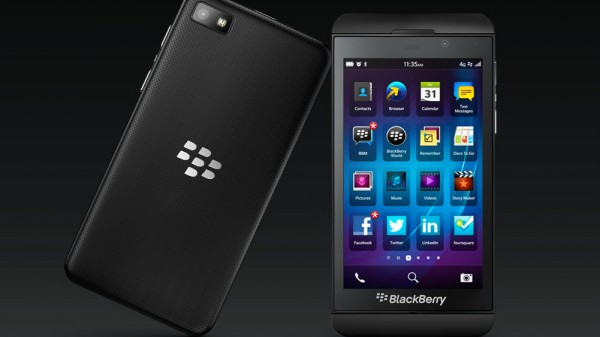
    It hasn’t quite been 48 hours since I left Wednesday’s BlackBerry 10 event with the new Z10 handset, so I can’t provide a full review yet. Stay tuned for that next week. However, as I formulate the review, I’m definitely seeing things I really like about the new product, as well as a few aspects that have me scratching my head.

    In no particular order then are some thoughts on the experience, both good and bad. I think many of the shortcomings can (and will) be resolved over time, but of course, you should always buy a product for what it does now, as well as for your specific needs.

    • The Z10 hardware is impressive. Great display, responsive and has a nice texture on the back, making it comfortable to hold. It weighs a little more than the iPhone 5 and is a smidge thicker, but doesn’t feel bulky at all.
    • I haven’t used the camera except for a few stills, so I can’t comment. I did read about poor low light camera performance, which I’ll test.
    • Battery life has me concerned, particular because I’ve been using the device on Wi-Fi only until this morning; I’m now using a nano SIM with adapter. I got through the day yesterday but not with heavy usage; I’ll say moderate with little video playback. Battery level was 20 percent at the end of the day.
    • I like that there’s no hardware “home” button. BlackBerry’s gestures are quite good — they were on the PlayBook too — and bring more functionality.
    • There’s also no “home” screen in the traditional sense. If no apps are running, you start with a grid of apps. Open an app, slide up to minimize it and it dynamically becomes a widget on a new main screen. Eight of these are supported at one time; plenty for me and easy to switch through. I can navigate through my open apps and tasks quite fast. Here’s a look:
      BB10 home
    • Love the “peek” gesture which shows the number of messages; to see this, you slide up the screen from the bottom during any activity.
    • While the BlackBerry Hub function is smart — this consolidates mail, Twitter, Facebook, LinkedIn, BBM — it is slow to start up when powering on the device and it can be lacking. You can reply to a Tweet, for example, but I don’t see a way to retweet; for that I seem to have to go into the Twitter client. It’s also a pain to delete all of the tweets and Facebook updates from the Hub to remove clutter. Here’s an example with tweets, Facebook status updates and read email:
      BlackBerry Hub
    • The software keyboard is outstanding. So much so, that on a recent podcast, I said it may be the best for any platform. Even though I generally use two thumbs for on-screen keyboards, I’m cranking out text with one hand due to the word prediction over the next letter of each typed word.
    • Email is generally good, but you can’t move from message to message; every email action takes you back to the inbox. Ugh.
    • The web browser is solid and fast. Adobe Flash is supported for those that care, but turned off by default. Search suggestions are good. Zooming and scrolling is fluid; page loads appear fast. I like the Reader function; same as in iOS.
    • Sharing information is similar to Android, meaning: great! Sharing a web page, for example, brings up options for BBM, mail, Facebook, Twitter, Bluetooth, NFC, etc…
    • The lack of apps that I use on other devices is concerning. BlackBerry has commitments for Skype, Amazon Kindle and others, but they’re not there. Nor is Netflix, any recognizable top-tier games, or my offline reading platforms. Google Talk is there, but no Google Voice; a must for me on any phone. YouTube is the HTML 5 mobile site wrapped up.

    I have plenty more to test; as I said, the full review will be coming soon. For now, my gut still says what it said before I even used the phone and platform: Existing BlackBerry users will be happy, but at this point in time, I don’t see many people switching to BB 10. That may change over time as more apps arrive and the platform matures.

    Related research and analysis from GigaOM Pro:
    Subscriber content. Sign up for a free trial.

  • What have investors got against BlackBerry?

    I would think that the long-anticipated BB10 platform would excite the stock market. Rather, shares of the company formerly known as Research in Motion and still listed as RIMM are down more than 26 percent from Monday’s open. BlackBerry (new company name) is up about 1 percent in late-mornong trading today, but it’s tiny respite from a beating that started before Wednesday’s big new product reveal.

    I haven’t seen BlackBerry 10 up close, or the new Q10 and Z10 smartphones, but “impressed” is apt description, nevertheless. Would I switch, though, from Nexus 4 and Android? Probably not, and that is RIMM’s problem — too many people like me — and perhaps what has legitimate investors (not pesky shortsellers) antsy. BlackBerry market share has fallen too far against Android and iOS, which, according to IDC, had 92.1 percent combined market share in fourth quarter. Once a leader, BlackBerry fights to be the far-behind third smartphone platform.

    How far the mighty has fallen. Three years ago, BlackBerry’s share of smartphones was 15.9 percent, according to IHS iSuppli. In 2012: 5.2 percent. For fourth quarter 2009, BlackBerry commanded 19.6 percent market share, putting it ahead of Apple (16 percent) and behind category leader Nokia (38.2 percent), according to IDC. Three years later, BlackBerry didn’t even make the top 5, with Apple in second place.

    “Despite the overwhelming advantages held by the opposition, BlackBerry’s introductions this week will keep the company in the smartphone game — for now”, Ian Fogg, IHS iSuppli senior principal analyst, says. “The new operating system and phones increase the chances that BlackBerry can regain some of its lost market share during the make-or-break year of 2013”.

    But he warns: “In order to claim the title as the smartphone market’s third ecosystem after Google and Apple — a distinction now being pursued by a range of competitors — BlackBerry needs to bring its A game in all areas. These areas range from differentiating its products, to offering compelling and reliable smartphone devices, to securing broad operator support, to creating a complete software ecosystem”.

    Kevin Burden, Strategy Analytics research, director sees opportunity in the two others’ dominance: “Blackberry 10 is now the newest mobile platform on the market and gives Blackberry the opportunity to attract users who are feeling the fatigue set-in from five year-old platforms like iOS and Android”.

    Distribution means everything. In the United States, three of the four major carriers — AT&T, T-Mobile and Verzion — will carry BlackBerry Z10, which is good sign.

    Still people, have to purchase the devices. Two days ago, I asked: “Will you buy BlackBerry Z10?” Forty-eight percent of respondents answer “No”. But another 31.43 percent say they will buy the smartphone “as soon as available”.


    In the year since becoming BlackBerry CEO, Thorsten Heins has done an amazingly good job reviving the ailing, and core, smartphone business. The question now: Is it too late? Have Android and iOS gained too much to allow room for BlackBerry, which competes with, among other platforms, Windows Phone?

    “BlackBerry 10 is a smart launch from a smart company that has marshaled its relatively modest resources effectively to create a range of next-generation smartphones that are differentiated compared to what’s on the market now”, Fogg says. “However, to compete with the big boys, BlackBerry will need to execute every part of its playbook perfectly during the next 12 months. If BlackBerry fails in any phase, it will be game over for the company’s comeback story”.

  • Path Settles With FTC Over Privacy Issues

    The U.S. Federal Trade Commission announced today that Path has agreed to settle FTC charges that it deceived users by collecting personal info from mobile device address books without users’ knowledge and consent.

    Path is now required to establish a “comprehensive” privacy program, obtain independent privacy assessments every other year for the next 20 years (similar terms to what Google and Facebook have had to agree to in the past), and pay $800,000.

    “Over the years the FTC has been vigilant in responding to a long list of threats to consumer privacy, whether it’s mortgage applications thrown into open trash dumpsters, kids information culled by music fan websites, or unencrypted credit card information left vulnerable to hackers,” said FTC Chairman Jon Leibowitz. “This settlement with Path shows that no matter what new technologies emerge, the agency will continue to safeguard the privacy of Americans.”

    The FTC charged that Path violated the COPPA rule by not spelling out its collection, use and disclosure policy for children’s personal info, not providing parents with direct notice of its collection, use and disclosure policy for children’s personal info, and not obtaining verifiable parental consent before collecting children’s personal info.

    Path is also required to delete info collected from children under the age of 13. The company has already deleted the address book info that it collected during the time period for what the FTC calls its “deceptive practices” took place.

    In related news, Leibowitz announced his resignation as FTC Chairman today. He will step down on February 15.

    Path recently launched a new search feature, which lets you search “moments” your friends and family have shared on Path or other social networks like Facebook, Instagram and Foursquare.

    Update: Path has issued its response to the FTC’s announcement. The company says:

    Today the United States Federal Trade Commission (FTC) announced that it reached a settlement pending court approval with Path regarding alleged violations of the Children’s Online Privacy Protections Act (COPPA). The gist of the FTC’s complaint is this: early in Path’s history, children under the age of 13 were able to sign up for accounts. A very small number of affected accounts have since been closed by Path.

    As you may know, we ask users’ their birthdays during the process of creating an account. However, there was a period of time where our system was not automatically rejecting people who indicated that they were under 13. Before the FTC reached out to us, we discovered and fixed this sign-up process qualification, and took further action by suspending any under age accounts that had mistakenly been allowed to be created.
    We want to share our experience and learnings in the hope that others in our industry are reminded of the importance of making sure services are in full compliance with rules like COPPA. From a developer’s perspective, we understand the tendency to focus all attention on the process of building amazing new things. It wasn’t until we gave our account verification system a second look that we realized there was a problem. We hope our experience can help others as a reminder to be cautious and diligent.

    Throughout this experience and now, we stand by our number one commitment to serve our users first.

  • Path reaches settlement with FTC, agrees to pay $800,000 fine for COPPA violations

    DaveMorin-DLD

    Path CEO Dave Morin. Photo by Om Malik

    Path, the San Francisco-based startup that offers private social networking services, has reached a settlement with the Federal Trade Commission (pending judicial approval) on alleged violations of the Children’s Online Privacy Protections Act (COPPA). As part of the settlement, the company will pay a fine of $800,000 and has purged about 3,000 accounts from the network. The settlement requires Path to establish a comprehensive privacy program and to obtain independent privacy assessments every other year for the next 20 years, the FTC said in a statement.

    The discovery of the underage members came as a byproduct of the FTC investigation into the privacy fiasco over the uploading of iPhone address books to Path’s servers without the permission of the individuals. That privacy breach became a major headache for the company, including stoking  the ire of a very irate Apple. The company later changed its policies.

    In a statement, the FTC said:

    “Over the years the FTC has been vigilant in responding to a long list of threats to consumer privacy, whether it’s mortgage applications thrown into open trash dumpsters, kids information culled by music fan websites, or unencrypted credit card information left vulnerable to hackers,” said FTC Chairman Jon Leibowitz.  “This settlement with Path shows that no matter what new technologies emerge, the agency will continue to safeguard the privacy of Americans.”

    In addition to the $800,000 civil penalty, Path is prohibited from making any misrepresentations about the extent to which it maintains the privacy and confidentiality of consumers’ personal information.  The proposed settlement also requires Path to delete information collected from children under age 13 and bars future violations of COPPA.  Path has already deleted the address book information that it collected during the time period its deceptive practices were in place.

    Dave Morin, Path’s founder and chief executive officer, said that the company had identified the accounts in February 2012 and by May 2012 had implemented changes to its sign-up process that automatically caught the underage sign-ups. Path discovered the issue on its own and addressed it (that is, they removed and blocked minors under the age of 13 from the service) before the FTC approached the company, Morin said. Path is currently compliant with COPPA rules. Morin said that the typical Path user is about 25 years old. The company, which has about 6 million registered users, is targeting families for using Path to share personal moments, so this particular settlement offers up a new and unique set of challenges to the company.

    Morin said that the big reason the underage children were able to get into the network is because the company didn’t have requisite checks and balances in the system. In a blog post that the company shared with us, Morin explained:

    Today the United States Federal Trade Commission (FTC) announced that it reached a settlement pending court approval with Path regarding alleged violations of the Children’s Online Privacy Protections Act (COPPA). The gist of the FTC’s complaint is this: early in Path’s history, children under the age of 13 were able to sign up for accounts. A very small number of affected accounts have since been closed by Path.

    As you may know, we ask users’ their birthdays during the process of creating an account. However, there was a period of time where our system was not automatically rejecting people who indicated that they were under 13. Before the FTC reached out to us, we discovered and fixed this sign-up process qualification, and took further action by suspending any under age accounts that had mistakenly been allowed to be created.

    We want to share our experience and learnings in the hope that others in our industry are reminded of the importance of making sure services are in full compliance with rules like COPPA. From a developer’s perspective, we understand the tendency to focus all attention on the process of building amazing new things. It wasn’t until we gave our account verification system a second look that we realized there was a problem. We hope our experience can help others as a reminder to be cautious and diligent.

    Throughout this experience and now, we stand by our number one commitment to serve our users first.

    Path has raised a total of $41.2 million from investors such as Index Ventures, Kleiner Perkins Caufield & Byers and Redpoint Ventures. It was rumored that Google offered a couple hundred million dollars for the company.

    Related research and analysis from GigaOM Pro:
    Subscriber content. Sign up for a free trial.

  • StumbleUpon Makes Email Notification Changes

    StumbleUpon appears to be making a move a number of its social media peers have made in recent months, by seeking further engagement from its members via email.

    The company has been sending emails to users discussing their email notification settings, and has made some changes with regards to the kinds of emails people get from StumbleUpon.

    “This is a quick note to let you know about some changes we’ve made to the email settings in your StumbleUpon account,” the email says. “We’ve created a bunch of new notification options that allow you to have more control over what types of emails you’ll receive from us. These new notification options are not compatible with the old settings, so your settings have been reset. We apologize for any inconvenience, and want to make sure we only send you the emails you want to receive.”

    To be perfectly honest, it’s been a long time since I’ve looked at my email settings on StumbleUpon, and since the company didn’t go into specifics, I can’t say exactly what all has changed, but here’s what the options look like now:

    StumbleUpon Email Settings

    One thing that must be relatively new is the addition of the “Tell me when a Stumbler follows my List” option, as the Lists feature itself was only released several months ago.

    Twitter, LinkedIn and Google+ (especially Twitter) have all added various types emails for users within the last year or so. It’s a good move in terms of keeping users coming back, and keeping the service fresh in their minds. Of course, that is dependent on users checking those boxes above.

    Related:

    Twitter Wants You to Email Tweets to Your Non-Twitter-Using Friends

    You Can Now Receive Twitter’s “Best-Of” Emails Daily, If That’s Something You’re Into

    Twitter Finds Another Reason To Send Users Email

    Google+ Starts Relying More On Email For Engagement

    Is Email The Future Of Social Media?

  • Google Submits European Antitrust Proposal, Leibowitz Resigns From FTC

    Google has submitted its settlement proposal to the European Union Competition Commission, Commissioner Joaquin Almunia told reporters. The details of the proposal have yet to be made public, so it’s hard to speculate on what this might mean for Google in Europe going forward. We should, however, find out soon enough.

    As you may know, Google has already settled its antitrust issues in the U.S., at least for the time being. The FTC ended its probe last month.

    Bloomberg reports:

    Google sent a “detailed proposal,” said Antoine Colombani, a spokesman for Almunia. He said he couldn’t anticipate if the offer was sufficient to allay antitrust concerns or whether it would be sent to rivals and customers for comments. If this market test is successful, the EU can make the commitments legally binding. Such a settlement would avoid possible fines against the Mountain View, California-based company.

    It will be interesting to see what the rivals make of it. These rivals were not all that pleased with the FTC settlement, saying that it did not go far enough. FairSearch, whose 17 members in the U.S., Europe and South America include Expedia, KAYAK, Microsoft, Nokia, Oracle, and represent the largest group of formal complainants to the EC, has already released a statement ahead of its analysis. You can read the whole thing at the end of this article.

    Meanwhile, Jon Leibowitz, the FTC Chairman who led the Google probe back in the U.S. has announced his resignation after four years in the role. He will step down on February 15. He’s been a commissioner since 2004.

    “I have been honored to head this extraordinary, bipartisan Commission and to work alongside the best staff in federal government,” he said. “Our small but mighty agency has safeguarded the privacy of Americans and stopped predatory financial practices by companies taking advantage of cash-strapped consumers. Our antitrust enforcement has helped contain health care and drug costs, and helped reduce prices and increase innovation for smartphones, computer chips and other high-tech products.”

    Google is mentioned several times throughout his lengthy resignation announcement:

    Most recently, the Commission announced a landmark agreement with Google to ensure consumers would continue to be able to buy a variety of high-tech devices from smartphones to games to tablets. The settlement gives competitors access to standard-essential patents, and ensures that companies that advertise on Google’s website will have more flexibility to use rival search engines.

    During the last few years, Leibowitz has worked to raise the profile of privacy practices through law enforcement, consumer education and policy initiatives. FTC settlement orders against Google and Facebook let the companies move on and innovate for consumers while requiring comprehensive privacy programs and affirmative choice for material privacy changes, and prohibiting privacy misrepresentations.

    The FTC also took steps to rein in the alleged misuse of standard-essential patents, which can lead to patent hold-up and ultimately higher prices for popular devices such as smart phones, laptop and tablet computers, and gaming consoles. The Commission made the case publicly – and through law enforcement actions such as the Google consent decree – that companies should be restricted from seeking injunctions on standard-essential patents if they are bound by prior commitments to license their standard-essential patents on fair, reasonable, and non-discriminatory terms.

    Some critics of the FTC/Google settlement indicated that they felt Leibowitz had rushed through the Google Probe and the decision, as to get it done before Leibowitz’s imminent resignation.

    Here’s the statement FairSearch emailed us about Google’s settlement proposal in Europe:

    What to look for in Google’s offer to the European Commission

    European Commission Vice President Joaquín Almunia said only weeks ago that the key to Google’s abuse of dominance is that the search giant, with more than 90 percent market share, is diverting traffic in the way that it presents its own services.

    “They are monetizing this kind of business, the strong position they have in the general search market and this is not only a dominant position, I think – I fear – there is an abuse of this dominant position,” Commissioner Almunia told the Financial Times on 10 January 2013 (click here for article<http://www.ft.com/cms/s/0/2b5bead6-5b3c-11e2-8d06-00144feab49a.html##axzz2JSz87To1>).

    Google’s biased display of results in favour of its own products was also the first of four concerns Commissioner Almunia listed publicly on 21 May 2012 (click here for full statement<http://europa.eu/rapid/press-release_SPEECH-12-372_en.htm?locale=en>). We are optimistic that Commissioner Almunia will make sure that Google’s proposal meets the test he set of truly restoring competition to the marketplace.

    A settlement will achieve Almunia’s goal of restoring competition to Internet search and related markets if it delivers positive answers to the following questions:

    *   Does Google apply the same rules to its own services as it does to others when it returns and displays search results?
    *   Does Google always provide the user with the most relevant results at the top of the search page, even if those come from non-Google sites?
    *   Is Google prevented from blacklisting competing companies or categories of companies from appearing in the top search results (for example, online travel agencies or metasearch sites)?
    *   Is Google prevented from using the quality scores and minimum bids it assigns to each website as a pricing mechanism to exclude competitors from appearing in the top display of search results?

    The deal should also include a fast-track dispute resolution mechanism administered by a third-party monitor, to ensure that the settlement ends Google’s search bias and other practices identified by Commissioner Almunia as potential abuses of dominance.

  • Friday funny video: How to use a dual-screen Windows tablet in Starbucks

    Let’s face it: More often than not, the Apple logo is everywhere at Starbucks. You see it on iPhones, iPads, iPods and MacBooks. Heck, occasionally you see it on a “portable” iMac! But the ol’ Microsoft Windows branding appears from time to time, begging the question: How does one blend in with the Apple crowd with such a device?

    Here’s the simple answer from Steve Paine, provided you’re using an Asus Taichi 21 in your local coffee shop:

    I’ll be honest, I never really saw a use for the second touchscreen display on this Asus laptop. Now, I have. Of course, with the Asus Taichi 21 costing $1,300 or more, this is far more expensive than the old method of using an Apple sticker, no?

    Related research and analysis from GigaOM Pro:
    Subscriber content. Sign up for a free trial.

  • Podcast: Blackberry’s in a jam, no Facebook phone and Netflix’s excellent adventure

    It’s a special edition of the GigaOM Podcast this week as we welcome our very first non-GigaOM guest! After we talk with Kevin Tofel about RIM Blackberry’s Hail Mary event and Eliza Kern about Facebook’s move into mobile, we talk with Prof. Bob Sutton, author of the books Good Boss, Bad Boss and The No Asshole Rule about the enduring appeal of the Netflix culture deck.

    Subscribe to the RSS Feed

    iTunes

    Stitcher Radio

    SHOW NOTES:
    Hosts: Chris Albrecht and Erica Ogg
    Guests: Kevin Tofel, Eliza Kern and Prof. Bob Sutton

    00:00 – Intro and Blackberry’s new phones
    11:58 – Eliza Kern rounds up Facebook earnings and its mobile-first moves
    22:26 – Bob Sutton on the Netflix culture deck and scaling excellence in companies

    SELECT PREVIOUS GIGAOM PODCAST EPISODES:
    Call-in Show: 128 GB iPad? Straight Talk v. AT&T and Windows RT or Windows 8

    RoadMap Re-Run: Perry Chen on Creativity and Crowdsourcing)

    Gov’t grabs for Google data, Facebook search facepalms, Apple earnings insanity

    Podcast: Q&A, Google Voice on Windows Phone? Chromebook on iMac? AirPlay v. Bluetooth?

    Facebook’s Graph-ic Search, Open Compute is Kinda Cool, Netflix vs. TWC

    Why Big Data Will Be Even Bigger in 2013

    Related research and analysis from GigaOM Pro:
    Subscriber content. Sign up for a free trial.

  • 7 projects looking to use big data to cut the cost of solar power

    The Department of Energy is putting a collective $9 million into 7 projects being developed at universities and government labs that will us big data to lower the cost of solar in various ways. The projects, at places like Yale, and the National Renewable Energy Laboratory, will be focused on using analytics to lower the cost of solar installations and making solar cells more efficient.

    Apple's massive solar farm in North Carolina, photo by WCNC-TV

    Apple’s massive solar farm in North Carolina, photo by WCNC-TV

    Here’s the 7 projects:

    • A solar financing model: NREL and solar financing startup Clean Power Finance will use $2.26 million to analyze data from 1,300 solar installation companies to try to create new types of community and regional financing methods.
    • A publication and patent reader: SRI International, the University of Toledo and GE will use $600K to create software that can read and analyze science publications and patents to unearth innovations that can lower the cost of solar.
    • Articulate a solar theory: Gordan Moore had his own law for chips, and some in the solar sector talk about a Swanson’s Law for the dropping cost of solar, but folks at MIT will use close to $500K to study the tech evolution process of solar and to create an overarching theory.
    • Better forecasting of production costs: Researchers at the University of North Carolina at Charlotte, Arizona State University and the University of Oxford will use almost $950K to analyze data about patents, prices and production to create better forecasts of solar cell, wafer and panel prices.
    • A model for solar markets: Sandia National Labs, the University of Pennsylvania and the California Center for Sustainable Energy will use $2.3 million to process data about solar markets and to create a model looking at how economic and social issues impact solar installations.
    • Better strategies for community-led solar purchasing: Yale and SmartPower’s New England Solar Challenge will use $1.9 million to develop new strategies to that can make community solar buying programs work better.
    • More effective solar installation in Texas: The University of Austin will use close to $500K to collaborate with six Texas utilities to create more strategic ways to install and interconnect solar in the state.

    Related research and analysis from GigaOM Pro:
    Subscriber content. Sign up for a free trial.

  • DIY R2-D2 Heels Are Perfect For Your Next Black Tie-Fighter Event

    FJ5V51BHAQ2V49D.MEDIUM

    Fans of Star Wars can take their love of droids and kitten heels to the streets with this DIY Instructables project. Created by Mike Warren, an editor at the site, these are the droid shoes you’re looking for.

    DIYers take note: this isn’t easy stuff. Note the tools list, for example:

    MIG welder
    soldering iron
    propane torch
    rotary tool
    elecric drill
    rubber cement
    foam glue
    2-part epoxy (extra strength – not “quick setting”)
    white spray paint

    Seriously. A MIG welder. For shoes.

    You’ll also need a pair of shoes, some R2-D2 toys, and a little thinger that will light up like R2′s weird eye thinger. More important, the shoes Warren used came from outside his house because someone threw them away. In short, they were almost free!

    So whether you’re trying to please your own Princess Leia or need to stab one of Jabba’s Daleks with your stiletto, now you have the perfect tool.

  • Electric car startup Coda quietly dealing with lawsuits over unpaid bills

    Court records show that startup Coda Automative, already wrestling with layoffs and very slow sales of its first electric car, has been fending off a number of lawsuits for not paying its bills on time. Vendors, including car engineering and development company RLE International (as well as an affiliate contract work company RTECH), vehicle development services company EDAG, and vehicle testing company FEV, have all filed lawsuits against Coda within the last six or so months, alleging that Coda owes them money for services.

    When RLE filed its lawsuit in late October it said Coda owed RLE $356,500; when EDAG filed its lawsuit last June it said Coda owed them $608,770; and when FEV filed its lawsuit in December it said Coda owed them $268,200. RTECH, an affiliate of RLE, also has a lawsuit against Coda for failing to pay for contract workers, which it filed December 2012.

    The parties agreed to dismiss three of the cases. In the RTECH lawsuit, the dismissal occurred after Coda filed papers stating that the contract in question forced RTECH to resolve the issue through arbitration. It’s possible this is why the other two cases settled. The FEV case is ongoing.

    Coda electric sedan

    While Coda lawyers seem to be dealing with these suits, it’s the latest bad sign for the electric car maker, which in December laid off staff. While press reports at the time said the layoffs were massive, Coda tried to soften the blow and said it had laid off 50 employees, or 15 percent of staff.

    The problem is that the company hasn’t been selling its cars. Some reports have put the number of Coda sedans sold at less than 100 since it went on sale in March 2012. That launch was actually delayed, from late 2010, then to late 2011, and then early 2012. The company also had a recall of the cars it had sold in August due to a mis-installed side curtain air bag.

    The car itself isn’t that competitive in a market where you can buy a Tesla Model S, a Nissan LEAF or a Chevy Volt. As auto reporter Jim Motavelli described it:

    The strategy of buying a bargain Chinese car sounded good at the time, but it’s plain that making the Coda competitive was a Herculean task, despite a larger battery, battery management and more range than the Nissan Leaf. One big problem is that Chinese styling is 20 to 30 years behind the West, and attempts to dress up the Coda didn’t do much to disguise the 1985 Toyota Corolla design. The car looks dated.

    We’ll see what happens to Coda. Fisker Automotive, another struggling electric car startup, is heads down trying to sell itself to Chinese auto companies. Coda already has deep partnerships with Chinese firms — the company has a joint venture with China battery maker Lishen, called Lio (oil spelled backward), and a deal with auto maker Great Wall Motors Company to co-develop a low cost electric car. Given these relationships Coda probably has a better chance than others to find a Chinese acquirer.

    Related research and analysis from GigaOM Pro:
    Subscriber content. Sign up for a free trial.

  • Time Warner Cable’s modem fee cost it today, but should pay off tomorrow

    Remember that $4 per month modem fee time Warner Cable implemented — the one that had Wall Street all excited about its potential boost to revenue? Well, it seems that people were miffed enough about the charge to affect how many subscriptions the nation’s second largest cable company added during the quarter — 75,000, which is less than the 129,000 Wall Street anticipated. But before feeling vindicated, know this — the fee generated about an extra $1.83 per month from each subscriber.

    And in the long term, analysts think it will pay off for the cable giant, which reported financial results Thursday. Especially as consumers find themselves stuck between Time Warner Cable’s modem fee and slower DSL-based service offering. From an analyst note issued today by Stifel Nicolas:

    Residential PSUs declined by 20,000 versus our estimate of +48,802, primarily due to weaker-than-expected HSD [high speed data] adds. We believe that the company’s residential HSD net adds (+75,000 vs. estimate 129,000) were negatively affected by higher-than-expected churn as a result of the company’s recent introduction of a modem fee (~$4). While the “fallout” from the modem fee could spill over into 1Q13 results, we don’t expect this to be a long-term issue for the company’s residential HSD product. In fact, the modem fee contributed ~3/4 (~$1.83) to the 6.3% increase in HSD ARPU during Q4.

    So there you have it. Customers clearly are put off by the modem fee, but it won’t last. Likely because they don’t really have another option for broadband in many areas. Yet, plenty of people are still unconvinced that ISPs engage in anti-competitive behavior in the broadband market.

    Related research and analysis from GigaOM Pro:
    Subscriber content. Sign up for a free trial.

  • Some Highlights For Marketers From Facebook’s Earnings

    Facebook, as you may know, released its Q4 and full-year earnings on Wednesday. Between the release and the earnings call, the company provided plenty of info for us all to absorb, including various statements made by CEO Mark Zuckerberg.

    COO Sheryl Sandberg had plenty to say during the conference call as well, discussing Facebook’s focus on building products and tools for brand marketers, direct marketers, local businesses and developers.

    There are some key points Facebook wants marketers to take away from what she talked about, so here are the highlights, via an email from the company:

    • For brand marketers, Facebook is now working with every one of the Ad Age Global 100 advertisers. Wal-mart used this target block over the Thanksgiving weekend to deliver 50 million mobile ads to their existing and potential customers. Michael Kors used Facebook to launch a new line of sneakers. Many of the sneakers sold out online and in stores, and they achieved a 16-point increase in awareness of the new sneaker among the 36 million people that the campaign reached on Facebook. That’s the equivalent of 5.8 million new people in the brand’s target audience who are now aware of the new line of shoes.
    • For direct marketers, tools including Offers, Custom Audiences and FBX are fueling growth. Nearly 42 million unique users are claiming an Offer. Costs per redemption compare favorably to those from email, newspaper, paid search, and display media based on data from the Direct Marketing Association. JackThreads, an online shopping site for men, used Custom Audiences to target specific segments of its customer database and target them with ads for products in categories the company knew were most relevant to them such as sneakers. As a result, the company achieved a 30% lower cost per acquisition than other platforms and saw a 6x return on advertising spend. And despite only becoming available to all marketers in September, by December, FBX served nearly one billion impressions daily and supported over 1,300 advertisers each day.
    • Revenue from local businesses was particularly strong in the fourth quarter: local business Pages that advertise on Facebook nearly doubled since the beginning of 2012, fueled by Promoted Posts, which makes it easier for businesses to create and purchase ads directly from their Facebook Page. Almost 500,000 Pages have used Promoted Posts. About 30% of those are new advertisers to Facebook and more than 70% have become repeat customers.
    • Developers are seeing success with mobile app install ads, launched in October and already being used by 20% of the top 100 grossing iOS apps to accelerate growth. According to research conducted by comScore in December, Facebook is the top driver of awareness of new mobile app downloads and, among people who learn about new apps on Facebook, 48% click directly from the Facebook app to download new mobile apps. A new game, Car Town Streets broke into the Top 10 Games list on iOS in many countries while achieving a 40% lower cost per installation compared to their other advertising with mobile app install ads.
    • Research from Aggregate Knowledge showed that Facebook is an increasingly powerful tool to help marketers reach more people and drive sales. In a study of fourth quarter marketing campaigns, they found that media plans that included Facebook reached people who would not have seen the campaigns otherwise. In fact, 45% of those reached were reached exclusively through Facebook. The study also found that Facebook had a 68% lower cost per acquisition and drove 24% more new sales than other online channels.
    • Facebook built a deep relationship with PepsiCo, working with its Lay’s brand to drive sales significantly ahead of plan and a 5x return on advertising spend for their “Do Us A Flavor” campaign on Facebook.

    According to Sandberg, 65% of Facebook’s advertisers are using ads in News Feed (mobile and desktop). That’s a 50% increase from the end of the third quarter. News Feed ads drive over eight times the incremental offline sales than ads on the right hand side, according to the company.

  • Good news Gmail users: Google extends Sync support through July

    Gmail users with a Windows Phone: you’ve got some good news. Google will be extending support for Google Sync through July 31, according to a Microsoft blog post. The service allows Gmail to be used on mobile devices through Microsoft’s Exchange ActiveSync (EAS) protocol, enabling support for multiple Gmail calendars and push email on smartphones and tablets. In December, Google said it would drop EAS support by today, Jan. 31.

    The support extension is a boon for Microsoft because it without EAS support in Gmail, any Windows Phone users with Gmail accounts would experience a far more limiting experience for mail, calendar events and contact management.

    Why is Google even dropping EAS support? For starters, it’s not free: Google — or any company that wants to use Exchange ActiveSync — pays a licensing fee to Microsoft. That’s not the primary reason though, else Google would cease all Sync support. Instead, it will still provide it to Google Apps for Business, Government and Education users.

    BB 10 accountsGoogle does, however, use the IMAP mail protocol, CalDAV for calendar information and CardDAV for contacts. This trio provides much of the same support currently available through EAS but through a non-company standard; these are more open protocols used on the web. The extra time for Sync allows Microsoft to rework its mail client with these three protocols so that Gmail users on Windows Phone won’t see a service disruption.

    Also of note: I noticed in passing the BlackBerry Z10 handset that runs BlackBerry 10 already supports IMAP, CalDav and CardDAV, in addition to the standard Gmail account setup. That means Gmail users considering a new BlackBerry don’t even have to worry about Google Sync.

    Related research and analysis from GigaOM Pro:
    Subscriber content. Sign up for a free trial.

  • Bing Is About To Get Some Product Listing Ads Of Its Own [Exclusive]

    We just spoke with David Pann, GM of Microsoft’s Search Network, and he tells us that we can expect Bing’s version of product listing ads sometime this year. This may raise a few eyebrows, considering Bing’s heavy campaigning against Google’s PLA-based Google Shopping model, but rest assured, Bing’s not about to start doing what it’s been criticizing Google for.

    We don’t have much in the way of details about Bing’s coming product listing ads (even their official name), but Pann says it’s not going to result in a pay to play system for Bing Shopping the way Google Shopping is set up. Google Shopping (as of October in the U.S. and since in other countries) is based solely on PLAs, but Bing will retain free listings as well. Pann says there is room for free and paid to co-exist.

    Pann expects the product listing ads to come to market sometime this calendar year.

    Bing product listing ads have been spotted in the wild in the past. Last summer, RKG shared some screenshots of what Microsoft was testing at the time.

    Bing PLAs

    It’s unclear at this point if the finished product will look just like these. Pann did say the product would be similar to Google’s PLAs. He also noted that some “alpha testers” have been using them.

    There has pretty much been nothing but positive data coming out about Google’s PLAs lately (positive for Google and for advertisers). In fact, Adobe recently shared some data with us indicating that Google PLA spend alone is nearly that of Yahoo Bing Network spend in the U.S.

    Still, Yahoo Bing Network continues to take away market share from Google piece by piece. Microsoft points to independent data from firms like RKG showing that Microsoft’s Bing Ads and the Yahoo Bing Network have seen positive momentum already this year, and that Bing Ads have gained paid search spend share from Google for the fourth quarter in a row.

    Pann attributes the Bing Ads momentum to a variety of factors. One is new ad formats like its version of sitelinks, which Pann says have seen rapid adoption. According to Pann, advertisers come over with the mentality of “It performs well over there [Google], so it will here too.”

    Another factor, Pann says, has been Microsoft’s efforts in reducing friction for advertisers and making the system easier to use. He says Microsoft has adopted the philosophy of “what takes 45 minutes in AdWords should take 15 minutes with Bing Ads”. He also says the Google Import Feature has been a key factor, in its availability for the desktop tool, the API, and the user interface. Adoption of the feature, he says, has taken off.

    Similar capabilities will likely be implemented in other tools in the future. He notes that Google’s agreement with the FTC (the part related to ad campaign data portability) is an important step in that regard.

    Microsoft and Pann appear quite pleased with the level of success Bing Ads have seen in recent months, but Pann says, “We’re not finished by any means.”

    The new product listing ads are just one thing Microsoft has up its sleeve for the year. We’ll discuss a couple of others in an upcoming article.

  • Sequoia Supercomputer Breaks 1 Million Core Barrier

    Sequoia-Nov2012-470

    The Sequoia supercomputer at Lawrence Livermore National Laboratory recently harnessed more than 1 million compute cores to run a complex fluid dynamics simulation. (Image: LLNL)

    The Stanford Center for Turbulence Research (CTR) has set a new record in computational science, using the Sequoia supercomputer with more than one million computing cores to solve a complex fluid dynamics problem — he prediction of noise generated by a supersonic jet engine.  Installed at the Lawrence Livermore National Laboratory (LLNL)  Sequoia was named the most powerful supercomputer in the world on the June 2012 Top500 list, and moved to number two in November 2012.

    With a total of 1,572,864 compute cores installed, research associate Joseph Nichols was able to show for the first time that million-core fluid dynamics simulations are possible—and also to contribute to research aimed at designing quieter aircraft engines.  Predictive simulations aid in the process of peering inside and measuring processes  occurring within the harsh aircraft exhaust environment that is otherwise inaccessible to experimental equipment. The data gleaned from these simulations are driving computation-based scientific discovery as researchers uncover the physics of noise.

    “Computational fluid dynamics (CFD) simulations are incredibly complex,” said Parviz Moin, the Director of CTR. “Only recently, with the advent of massive supercomputers boasting hundreds of thousands of computing cores, have engineers been able to model jet engines and the noise they produce with accuracy and speed.”

    Recently Stanford researchers and LLNL computing staff have been working closely to iron out the last few wrinkles. They were glued to their terminals during the first “full-system scaling” to see whether initial runs would achieve stable run-time performance. They watched eagerly as the first CFD simulation passed through initialization then thrilled as the code performance continued to scale up to and beyond the all-important one-million-core threshold, and as the time-to-solution declined dramatically.

  • Wikipedia Gets More Location-Friendly

    The Wikimedia Foundation has announced the launch of a new GeoData extension to usher in “a new age of geotagging on Wikipedia”. Roughly translated, Wikipedia will be getting a lot more useful at the location level.

    The extension for MediaWiki adds coordinates to articles to be stored separately in the database, as opposed to in wiki markup, which the foundation says makes it easy to query the coordinates of a particular page or a list of pages around a set of coordinates. The functionality will also be available via the API, so developers can utilize it in their apps.

    “One of the first major uses of GeoData information will be in the experimental mode of the Wikipedia mobile site, which will allow beta users to see a list of nearby articles,” explains the Wikimedia Foundation’s Max Semenik. “We expect to release this feature into our experimental mode in the coming weeks. In the future, we also hope to build this functionality into our contribution tools: for instance, we’d like to be able to show users a map of articles needing images near their location, so that they can easily take and upload photos of subjects around them missing an illustration.”

    Geo tagging wiki articles

    The functionality will be supported by all Wikipedia and Wikivoyage sites. Wikipedia in English, German, Simple English and Chinese are already using it.

    More on the technical side of things in this blog post.

  • Surface sales suck

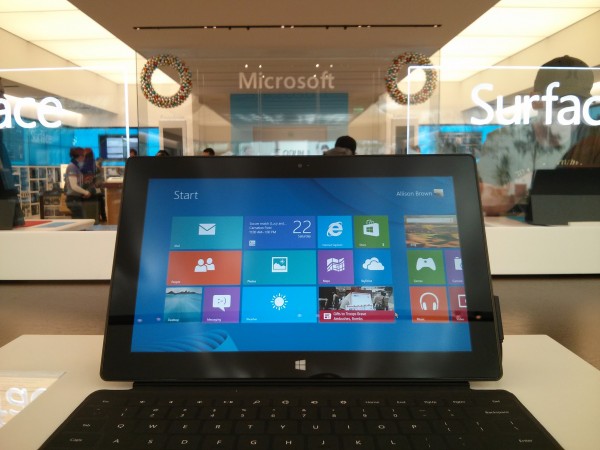
    Or do they? If you listen to some analysts, Surface, and other slates running Windows 8 or RT, started slow out of the gate. Considering how much tablets sapped PC shipments in Q4, slow forebodes trouble ahead. Or does it?

    “There is no question that Microsoft is in this tablet race to compete for the long haul”, Ryan Reith, IDC program manager, says. “However, devices based upon its new Windows 8 and Windows RT operating systems failed to gain much ground during their launch quarter, and reaction to the company’s Surface with Windows RT tablet was muted at best”. He estimates that Microsoft shipped just 900,000 Surfaces during fourth quarter, which means to stores and not actual sales to customers.

    That number sure looks low compared to any manufacturer in the top 5. Even lowly ASUS shipped 3.1 million units. But sell-through matters more. Except for about 10 days of the quarter, at retail, Surface sold exclusively through 66 retail shops in Canada and the United States. Apple offered iPad through an average 390 shops — 150 outside the United States. Accounting for online sales and doing some best guesstimates, I get 14,680 iPads sold per Apple Store and (assuming 600,000 units) 9,090 Surfaces per Microsoft shop.

    However, when adjusting for actual sales days (Microsoft’s slate was available for only about two-thirds of the quarter), Surface-sell through averages out a little higher than iPad on a per-store basis. Meaning: Given limited distribution, Microsoft’s tablet sells better than IDC shipments suggest.

    Size Matters

    Microsoft’s problem is something else: Size. “We believe that Microsoft and its partners need to quickly adjust to the market realities of smaller screens and lower prices”, Reith emphasizes. That’s a polite way of saying Surface RT costs too much at $499 and Pro, for sale starting February 9, is already overpriced. But are they? Really?

    According to NPD DisplaySearch, market demand shifts towards smaller, and lower-cost models. The firm forecasts that slates with 7-7.9-inch displays will account for 45 percent of shipments this year. By contrast, 9.7-inchers will fall to 17 percent — that’s the size of iPad, the category leader. But Apple offers the 7.9-inch iPad mini, whereas Microsoft and its partners offer nothing in this rapidly exploding size segment.

    Apple tablets are pricey, too. Starting February 5, one iPad 4 will sell for $929. But fruit-logo pricing starts lower, at $329 for 16GB iPad with WiFi. Microsoft is locked lowest at $499 with a 10.6-inch slate. What the company needs more is a broader range of sizes and prices, the strategy competitors like Apple, ASUS and Samsung pursue. That would preserve current Surface pricing.

    Such an approach doesn’t easily fit Microsoft’s current tablet strategy, which is all about making a traditional desktop operating system available on more form factors. But that’s not what the market wants today, when tablets displace some computer sales rather than replace PCs altogether.

    Reith warns: “In the long run, consumers may grow to believe that high-end computing tablets with desktop operating systems are worth a higher premium than other tablets, but until then ASPs on Windows 8 and Windows RT devices need to come down to drive higher volumes”.

    Give a Little

    Simply stated: Working with partners, Microsoft must make gaining market share the top priority. Tablet shipments grew about 75 percent year over year and quarter on quarter to 52.5 million in Q4. Laptops lead the PC category, but NPD DislaySearch predicts that tablet shipments will exceed notebooks this year. Again, that’s not so much slates replacing PCs as displacing new sales, as capabilities overlap. Microsoft doesn’t want to be left behind Android and iOS slates. This is a platform war that nobody wants to lose.
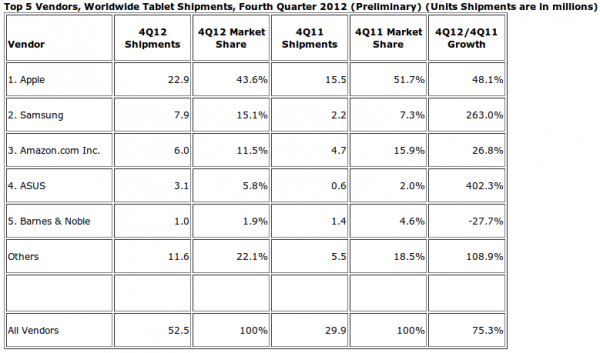
    ASUS tablet shipments grew 402.3 percent year over year and Samsung’s by 263 percent, according to IDC. These are phenomenal gains, and both companies offer models running Windows 8 or RT alongside Android. Something else: They also sell what Microsoft doesn’t — smaller slates with screens 7-7.9 inches. Short term, Microsoft’s options are limited with Surface. But working with partners, Microsoft could bring Windows RT to smaller screens. Such a strategy would preserve Surface pricing and Microsoft’s strategy around bringing desktop Windows to new devices.

    But there’s a wrinkle. Android costs ASUS and Samsung nothing, and Apple realizes the cost of iOS through research and development. Whereas, Microsoft partners pay to license Windows RT. I wouldn’t recommend that Microsoft give tablet OEMs Windows for free, but co-marketing contributions and other incentives could temporarily make the fees essentially zero — on smaller slates.

    Already Apple feels the pinch. In Q4, iPad shipment share fell to 43.6 percent from 51.7 percent a year earlier, even as volumes increased (22.9 million from 15.1 million), according to IDC. However, for the second quarter in a row, iPad share declined.

    Apple’s falling tablet fortunes show just how dynamic is the segment, and that competitors can and will gain share. But for which platform? Android or Windows RT? Microsoft can answer the question, even in part, by adjusting its tablet strategy.

    Photo Credit: Joe Wilcox