Author: Serkadis

  • Enterprises embrace Apple like Microsoft

    During the mainframe era, you could hear phrase: “No one is fired for buying IBM”. In the 1990s and 2000s, the same could be said about Microsoft. As the so-called Post-PC era pushes forward, soon same can be said about Apple, if some IT organizations don’t already. Gartner predicts that by 2014, enterprises will accept the fruit-logo as much as Windows, which is something scary for the company owning that market segment.

    Consumerization of IT — or bring your own device to work — forced Apple on unwilling IT organizations. Now, after tasting the fruit, they like it. More of them than ever are willing to deploy Macs, which encroach on territory Microsoft seeks to claim for Windows 8.

    “Although Apple’s mobile iPhone and iPads are already as accepted by enterprise IT as is Microsoft, Apple’s Mac systems for laptops/notebooks and desktops remain not commonly accepted by IT”, David Mitchell Smith, Gartner Fellow, says. “Going forward, Apple will continue to benefit from consumerization and will continue to evolve Macs to take on more iOS characteristics, which will contribute to acceptance of Macs in the enterprise. As such, enterprise acceptance of Apple will continue to be driven by consumer demand”.

    According to “Good Technology’s 2nd Annual State of BYOD Report”, 76 percent of enterprises with more than 2,000 employees have programs in place, and the total is expected to reach 88 percent this year. However, the largest and smallest businesses are slowest adopters. Among organizations with 10,000 employees, only 46 percent have BYOD programs in place, up from 35 percent in 2011. One-quarter of businesses with less than 2,000 employees follow suit.

    Apple and other Microsoft platform competitors benefit from a startling shift in costs — to employee up rather than organization down. Good finds that in half the companies with BYOD programs, employees pay for devices and supporting services, such as cellular data for cell phones, tablets and some laptops.

    Development Changes

    This trend, more than perhaps any other, eases the way for enterprises to embrace non-traditional platforms, such as iPhone and iPad. Mac is next, Gartner says, but who pays is the question yet to be answered.

    Apple also benefits from changes in enterprise applications development, which platform independence increases. “Enterprises are finding that they need to support multiple platforms, especially as the BYOD trend gains momentum”, Ken Dulaney, Gartner distinguished analyst, says. Increased interest in mobile devices drives demand for hybrid apps that transcend established and emerging platforms. While OS X isn’t emerging, many IT shops entrenched in Windows will see it that way — then there is the Mac operating system’s increasing hybridization with iOS.

    There are increasing signs that Apple will close the fork between OS X and iOS, creating a single platform for all devices. Google follows similar trend with Android and Chrome OS. The question isn’t so much if but when platforms merge. Meanwhile, Microsoft follows a more defined two-platform strategy with Windows 8 and Windows Phone 8.

    As I have heard IT managers often say: “We make decisions about applications, not operating systems”. As BYOD changes the device mix, application development moves with them. Gartner’s advice to enterprises embracing native app development with web applications –something Microsoft presents quite nicely in Windows 8, I should emphasize, much better than Apple does with OS X.

    “Enterprises should consider how applications can be enriched or improved by the addition of native device capabilities and evaluate development frameworks that offer the ability to develop native, hybrid and Web applications using the same code base”, Van Baker, Gartner research vice president advises. Where possible, development activities should be consolidated via cross-platform frameworks”.

    Photo Credit: Joe Wilcox

  • The Top Search Trends During The Super Bowl

    Google revealed on Monday what the top trending searches were during the Super Bowl (US). The top five were:

    1. M&M’s
    2. Beyonce
    3. Baltimore Ravens
    4. San Francisco 49ers
    5. Colin Kaepernick

    Very interesting that “power outage” didnt’t make the list, though Google does mention it as another noteworthy trend. I guess it only had half a game to work with. Ultimately, it ended up ranking eighth out fo the most-searched terms during game time.

    Beyonce searches spiked during the halftime show, of course. Searches for Chrysler spiked after the brand’s fourth quarter commercial, Google says.

    Google software engineer Jeffrey Oldham says, “As they did in the game, the Ravens narrowly beat out the 49ers as the most-searched team during the game on Google. The most-searched players of the game were Colin Kaepernick, Joe Flacco, Michael Oher, David Akers and Jacoby Jones—thanks to his 108-yard kickoff return.”

    “The Harbaugh brothers’ on-field battle has been one of the big stories of the game, so it’s no surprise that viewers took to the web to find more information on these coaches,” he adds. “While John Harbaugh took home the trophy, Jim was the most-searched brother on Google.”

    Searches for Super Bowl ads on Google were 55 times higher on Sunday than they were for the same time the previous Sunday. The most searched-for ads were from: M&M’s, Mercedes-Benz, Disney’s “Oz Great and Powerful,” Lincoln, and Audi. Searches for “Gangnam Style” also trended on YouTube, as did searches for Beyonce and Alicia Keys, who sang the National Anthem.

    Yahoo also shared some insight into what people were searching for during the Super Bowl on its search engine. Searches spiked for “why did the lights go out,” “superdome power outage,” and “what caused power outage”.

    Here’s the top ad-related searches from Yahoo:

    1. [dodge super bowl commercial] (God Made A Farmer) – up 1722% during the game on Yahoo!
    2. [taco bell commercial]
    3. [go daddy commercial]
    4. [doritos goat commercial]
    5. [Budweiser commercial]
    6. [banned skittles commercial]
    7. [tide super bowl commercial]
    8. [calvin klein commercial]
    9. [jeep commercial]
    10. [oreo super bowl commercial
    11. [kia super bowl commercial]
    12. [mercedes commercial] The new car buzzed 3570% on Yahoo!
    13. [soda stream commercial] – the soda stream spiked 5244% on Yahoo!

    According to Yahoo, Bar Refaeli was the most buzzed about celebrity featured in a commercial followed by Kate Upton, Kaley Cuoco, Stevie Wonder, Paul Rudd and Seth Rogen. Rogen spiked by 1,045% on Yahoo, while Rudd searches spiked by 668% and Kate Upton searches spiked by 152%.

    Fast & The Furious 6 got the most buzz for movie trailers, spiking 827% on Yahoo, followed by World War Z at 78%.

    Searches for “beyonce super bowl 2013″ spiked 7,236% on Sunday, searches for Jennifer Hudson spiked 10,802%, and searches for Destiny’s Child spiked 4,000%.

    Other noteworthy Super Bowl Sunday search trends from Yahoo:

    Super Bowl Related “How To” | “Who Is” Questions on Yahoo!

    [how to ripen avocados]
    [how to make wings]
    [how to make jello shots]
    [who is the direct tv genie]
    [who is favored to win the super bowl]
    [who is playing in the super bowl]
    [who is singing the national anthem at the super bowl]
    [who is in the super bowl]
    [who is beyonce married to]
    [who is beyonce’s husband]
    [who is older jim or john harbaugh]
    [who is paul harvey]
    [who is ray lewis]

    Top Searched Recipes On Super Bowl Sunday From Yahoo!:

    [7 layer dip]
    [easy super bowl recipes]
    [guacamole dip]
    [spinach dip]
    [meatball recipes]
    [spinach artichoke dip]
    [taco dip recipe]
    [crab dip recipe]
    [jalapeño dip recipe]
    [easy super bowl appetizers]
    [crockpot chili recipes]
    [white chicken chili]
    [baked chicken wings]
    [kale chip recipes]
    [hamburger recipes]
    [queso dip]
    [coleslaw recipe]

    Top Super Bowl Searches on Super Bowl Sunday on Yahoo!:

    [super bowl blackout]
    [super bowl lights out]
    [super dome]
    [beyonce super bowl]
    [super bowl winners]
    [superbowl food ideas]
    [super bowl snack ideas]
    [super bowl bets]
    [superbowl kick off time]
    [super bowl halftime show]
    [what time is super bowl]
    [vegas super bowl odds]
    [super bowl history]
    [super bowl squares]
    [puppy bowl]
    [puppybowl lineup]

  • Controversial VW Ad Gets Plenty Of Views, Plenty Of Buzz

    A particular Volkswagen ad that aired during the Super Bowl brought a fair amount of controversy with it. The ad, called “Get in. Get Happy.” features a guy from Minnesota going around his office and talking with a Jamaican accent, and ultimately getting his co-workers to do the same once they ride in a Volkswagen with him.

    Some think the ad was racist. Many others don’t. Either way, the ad has gotten a lot of people talking, and a lot of people seem to have liked it. It even has over 8.5 million views on YouTube.

    Plenty have taken to Twitter to share their thoughts on the ad:

    Jamaican beer company even appears to be utilizing the buzz from the ad to serve promoted tweets on the Twitter search query “vw ad”:

    Red Stripe Tweet

    Volkswagen itself tweeted a link to a press release from Minna Press, which says:

    The new Volkswagen ad for the 2013 Super Bowl game garners a host of mixed reactions worldwide. “The ad shows a worker from Minnesota trying to cheer up co-workers in an accent often associated with Jamaicans, because he has been made so happy by his Volkswagen,” the Associated Press explains.

    According to George Meikle, author of the book, In Praise of Jamaica, “the ad may be considered racist by some people … but us Germaicans say, “come to Jamaica and feel alright.” He states: “Volkswagen makes an astute observation that we Jamaicans radiate happiness no matter our circumstances, which is the point of the ad.”

    Meikle adds, “we may speak funny but we can laugh at ourselves. Our book, In Praise of Jamaica tells the intriguing story about the wonders, heroes and achievements of Jamaicans.”

    Volkswagen has a history of viral success. Many still recall the kid in the Darth Vader mask from previous years’ ads.

  • Oreo Outage Tweet Is Social Marketing Done Right

    Oreo seems to have the social media marketing thing down. During the infamous power outage during last night’s Super Bowl, the beloved cookie brand quickly thought on its feet and tweeted this:

    While the power outage lasted for about a half hour, Oreo was able to get out a highly successful ad (for free) to accompany its TV spot (not free). Buzzfeed spoke with 360i, the agency behind the tweet. Agency president Sarah Hofstetter told them:

    “We had a mission control set up at our office with the brand and 360i, and when the blackout happened, the team looked at it as an opportunity. Because the brand team was there, it was easy to get approvals and get it up in minutes.”

    “You need a brave brand to approve content that quickly. When all of the stakeholders come together so quickly, you’ve got magic.”

    As of the time of this writing, that one tweet has been retweeted 14,555 times, and is still being retweeted regularly.

    So about Oreo and social media marketing – the brand once set a Guinness Record for likes on Facebook, and has frequently used timely events to capitalize on its large following on social media channels.

  • Oracle To Acquire Acme Packet For $2.1 Billion

    Oracle has entered into an agreement to acquire Acme Packet, a session delivery network solutions company, for $29.25 per share in cash in a deal worth $2.1 billion.

    Oracle President Mark Hurd had this to say about the deal: “The proposed acquisition of Acme Packet is another important piece in Oracle’s overall strategy to deliver integrated best-in-class products that address critical customer requirements in key industries. The addition of Acme Packet to Oracle’s leading communications portfolio will enable service providers and enterprises to deliver innovative solutions that will change the way we interact, conduct commerce, deliver healthcare, secure our homes, and much more.”

    Acme Packet CEO Andy Ory said, “Acme Packet brings deep domain expertise and proven, mission-critical solutions to enable all- IP networks. Together with Oracle, we expect to provide customers with purpose-built, innovative solutions to accelerate the deployment of all-IP networks and help deliver a superior experience across services, devices and networks.”

    “The communications industry is undergoing a dramatic shift as users become more connected and dependent on mobile applications and devices. Service providers and enterprises need a comprehensive communications solution that will enable them to more effectively engage with their customers,” said Bhaskar Gorti, SVP and GM, Oracle Communications. “This combination will enable secure and reliable delivery of real-time interactive communications through the most comprehensive, best-in-class communications portfolio in the industry.”

    The deal is expected to close in the first half of the year, subject to Acme Packet shareholder approval. The company’s board has unanimously approved it.

    Here’s a letter Ory sent to Acme Packet’s customers and partners:

    On February 4, 2013, we announced that we have signed an agreement to be acquired by Oracle. The proposed transaction is subject to stockholder approval, certain regulatory approvals, and customary closing conditions and is expected to close in the first half of 2013. Until the deal closes, each company will continue to operate independently, and will operate its business as usual.

    Today is a significant milestone for Acme Packet. We are excited to join forces with Oracle because we believe that together we can rapidly accelerate the transformation to all-IP communications networks across the globe. The combination of our session border control and other solutions with Oracle’s powerful Communications portfolio will enable service providers to uniquely differentiate and monetize next-generation services, and help enterprises benefit from more effective user engagement and improved employee productivity. This combination will also provide our partners with an expanded portfolio of world-class solutions to help them create even greater value for their customers.

    Oracle plans to make Acme Packet a core offering in its Oracle Communications portfolio to enable customers to more rapidly innovate while simplifying their IT and network infrastructures. This means our customers can expect to continue to receive the expertise, vision and passion that they have come to expect from us today — and our efforts will be supported by the global reach, investment and infrastructure of Oracle.

    Acme Packet’s management team and employees are expected to join Oracle’s Communications Global Business Unit, and continue their focus on building the industry’s best session delivery solutions. We expect that joining Oracle will provide significant benefits for both our customer and partner communities.

    Thank you for your continued support and for being part of the Acme Packet community.

    Best regards,

    Andy Ory
    CEO, Acme Packet

  • Sri Lanka Independence Day Celebrated With Google Doodle

    Google is showing a doodle on its home page in Sri Lanka, honoring Sri Lanka Independence Day:

    Sri Lanka Independence Day Google Doodle

    On February 4th each year, the island country commemorates its independence from Britain, which became official on this day in 1948. Citizens celebrate the holiday with flags, parades, etc.

    This isn’t the only doodle Google is running today. On its Canadian home page, the company is honoring the last day of the Canadian penny, as it is withdrawn from circulation.

    Last week, Google honored Jackie Robinson with a doodle here in the United States.

  • Canadian Penny Gets A Google Doodle On Its Last Day

    Today is the last day of the Canadian penny, as the coin is withdrawn from circulation. Google is honoring the coin with a doodle on its Canadian home page. In the doodle, the first of the Os in the word “Google” is replaced with a Canadian penny, and it spins around every few seconds to show you what it looks (looked) like on both sides.

    Last March, the Canadian government announced that it would withdraw the penny from circulation, and now the time has come. Canada’s CBC Radio has a piece asking if Canadians will miss the coin. Andrew Nichols writes:

    There was a time when a penny was not something people would cast aside or ignore. You could buy a loaf of bread with it …and back around the time it was first minted in Canada in 1876 it was not uncommon that a-day’s-work for an unskilled labourer would bring in just one-hundred pennies.

    Nowadays a loaf of bread can easily cost two-hundred pennies and more. Over the last few years several studies have recommended pulling the Canadian penny …something other countries such as Australia, New Zealand, Finland to name just a few have already done. And since it cost the Canadian Mint 1.6 cents to make one cent …that’s $11-million dollars per year …many knew the penny’s days were numbered.

    CTV News reports that in the right hands, the penny still holds value. Some are trying to preserve the coins through jewelry and accessories. On top of that, there will always be coin collectors who will no doubt gladly keep at least a few on hand.

    Canadian retailers are reportedly not obligated to discontinue using the penny, so there should still be plenty of pennies used in transactions for the time being.

  • StormFly Wants To Childproof Your Computer With Its Ubuntu-Booting USB Bracelet

    stormfly

    When I was but a wee lad, I hosed my share of family computers simply because I wanted to help out — once I tried to free up space on a 6GB hard drive by deleting anything larger than 1MB. You can imagine how well that played out.

    I wouldn’t be surprised to hear that the founders of Barcelona-based Now Computing went through something similar, because they’ve just recently launched a Kickstarter project for a device that should ensure it never happens again.

    At its core, the $59 StormFly is little more than a 16GB USB 3.0 flash drive with a bootable version of Ubuntu that someone (ideally a kid) can wear on their wrist. After a little bit of setup (mostly changing the boot sequence in a PC’s BIOS), those little ones whip the USB bracelet off their wrists, plug it into a PC or a Mac, and do whatever it is that kids do on computers these days without having to worry. Thankfully, since the StormFly’s user never has access to the OS that’s actually installed on the host computer, there’s no way for them to royally screw things up by mucking with other people’s settings or downloading things they really shouldn’t be.

    Not a bad proposition, especially when parents are exposing children to technology earlier and earlier these days (for better or worse).

    Granted, this is the sort of thing most of you readers could probably cobble together in under an hour, but not everyone can be bothered to put together a custom computing environment for their kids. StormFly is about more than just a bit of hardware that you wear though — young ones are prone to lose things, which is why StormFly also features an encrypted online backup component… for an additional monthly fee. In the event that its user misplaces their USB bracelet, StormFly can ship out a replacement unit that has all of a user’s data back where it was within about 24 hours.

    There are, however, some issues to be found here. Perhaps most concerning its the project’s tagline — the team claims multiple times that the StormFly is “like a PC on your wrist,” which seems a bit misleading. To their credit, the project’s description puts a finer point on what the thing actually is (a USB 3.0 flash drive with Ubuntu loaded onto it), but it’s a questionable move that’s already caused some heated debate in the project’s comments section. Still, it’s a neat enough project, and it’s slowly been picking up steam — StormFly has currently hit $14,000 in pledges after only a few days, so it’s certainly got a shot at becoming a real product.

  • ‘House of Cards’ is just that for big media companies

    The new made-for-Netflix drama “House of Cards” is aptly named for what it represents — a fundamental shift in entertainment creation, distribution and consumption. The political thriller is by no means the first made-for-web TV show. But the production values, storytelling and intrigue meet, and in some ways surpass, those found from cable network productions. Yes, even Showtime’s popular “Homeland”.

    I predict that Netflix has here what HBO did with “The Sopranos” in 1999, an industry-changing series. The D.C. drama, starring Kevin Spacey and Robin Wright, shows how the entertainment industry is a house of cards new media distribution can topple. Good content can go to the web first, or only there.

    Crime Family

    HBO was no studio startup when Tony Soprano sat in the psychiatrist chair 14 years ago, but had no real success producing television series (more mini-series and made-for-pay-cable feature films). The drama’s popularity demonstrated the value of pay cable, and bolstered the appeal and economics. All the cable productions that followed — even “Mad Men” or “Walking Dead”, from non-premium subscription network AMC — owe homage to “The Sopranos”.

    Like HBO, Netflix depends on licensing deals with Hollywood studios, but the new media company also threatens long-established distribution channels. “House of Cards” spotlights the economics, suddenly showing how Netflix could be something like the Google of entertainment. The search giant’s business model is about giving away stuff for free — or at most for less cost — than competitors.

    From that perspective, Google lowers the value of everything it touches. Why should people pay for something they can get for free? But that’s a simplification. Free isn’t often good enough. The stuff given away by Google has value — or is valuable enough.

    People will always pay, and this is especially true for entertainment, when there is value. Why else do subscription services like HBO remain so popular? (Okay, that and some damn good content-distribution contracts.) That said, Netflix is just $7.99 a month, available to pretty much anyone — no cable or premium network subscription required. Like Google, Netflix changes the economics by streaming movies and TV shows — that’s nothing new. Producing dramas that are as good as those from HBO or Showtime raises the stakes.

    Netflix seemingly bites the hand that feeds it, but that’s another simplification. People didn’t stop watching network television because of pay-cable dramas like “The Sopranos”. TV simply got better, and I’d argue across the board. A new golden age of television started around 2004, with debut of dramas like “Lost”, and continues today (Yes, there are early exceptions, like “The West Wing”, which is same vintage as “The Sopranos”, or many Fox dramas).

    Network programs are better, but more importantly, cable is changed. Most major cable-only networks, even the non-premiums, produce in-house dramas, not just mini-series. If successful, “House of Cards” could — I predict will — lead to a surge in TV shows produced directly for the web. The series is that good.

    Political Intrigue

    Netflix has a real winner that smartly, and too accurately, captures Washington’s political intrigue — from the Capitol dome to the newsroom. “House of Cards” is based on a 1990 BBC program, which also is available on Netflix. So, you can watch both and compare, which I may do. Besides great acting and storytelling, the original Netflix series does something else quite dramatic. There is no serialization. All 13 episodes are available at once, for people to watch at their own pace. That’s simply brilliant.

    “The world of 7:30 on Tuesday nights, that’s dead”, series director David Fincher says. “A stake has been driven through its heart, its head has been cut off, and its mouth has been stuffed with garlic. The captive audience is gone. If you give people this opportunity to mainline all in one day, there’s reason to believe they will do it”.

    That’s how many people watch TV shows on Netflix, or even Amazon Prime, today. It’s the next thing beyond the DVR. Rather than time-shift by recording, watching and fast-forwarding commercials, people can watch what they want when they want and how much they want. Granted, this isn’t new, whether programs are rented, purchased or consumed for free from the Internet.

    The earth that shakes media distribution’s house of cards is something else: Releasing all episodes of a series simultaneously, turning the concept of serialization on its head. My wife and I watched the first two “House of Cards” episodes late last night and probably more today.

    For Netflix, the approach makes loads of sense, because the business model is different. For traditional television programming, the idea is to get people to come back and to pull them away from competing networks. Like websites that measure value by the amount of time people stay on them, Netflix wants viewers to stay put. Why not 13 hours straight, then present them even more reasons with other programming that is either original or otherwise not available elsewhere.

    Take “Annika Bengtzon: Crime Reporter“, which I recently watched on Netflix. The producers filmed six 90-minute movies back-to-back over the course of a year. Only one released to theaters in Europe. But all are quite good and available on Netflix to watch on your time, which I did when sick with the flu earlier this month. The production concept is similar to “House of Cards” — make them all, then release them all, at the same time. I highly recommend the book-based Swedish series, by the way.

    The question, looking ahead 12 to 36 months: What next, and from where? I’d pay for MAX Go, as a separate streaming service, just for the original programming. Cut cable’s cord. Wouldn’t you? Today you can taste the future. “House of Cards” debuted February 1, and for the month the first episode is available to everyone, even non-subscribers.

  • Android this week: Samsung Galaxy Tab 3 spec’d; HTC M7 yelled; Nexus 4 ships

    The close we get to this month’s Mobile World Congress event, the more information about new Android devices gets leaked. First up is the third iteration of Samsung’s small slate. The Galaxy Tab 3 may be one of the bigger Samsung reveals at MWC as it’s more likely the Samsung Galaxy S 4 smartphone will warrant its own event later.

    galaxy_tab_7_7So what’s the word on the Galaxy Tab 3? Samsung has already created 7- and 7.7-inch tablets, and it appears the new slate will be in available in a similar size. It could be even be an 8-inch tablet; the same screen size as the expected Galaxy Note 8.0. A key difference, however, is that the Galaxy Tab 3 won’t have an active digitizer nor supporting digital S-Pen like the Note model. That should keep costs down for the new Tab 3; perhaps even in the sub-$200 range to compete against Google’s Nexus 7.

    Alleged benchmarks for the Galaxy Tab 3 indicate a 1280 x 800 display running Android 4.2.1 and a CPU capable of up to 1.5 GHz. I’m willing to bet that Samsung keeps the price down by not using one of its new Exynos 5 processors, but a dual-core version of the prior Exynos generation. It’s more likely that Samsung uses the newer chip in the Galaxy Note 8.0.

    HTC will also be at Mobile World Congress but it may debut its newest flagship phone even sooner. I’ll be attending an HTC press event in New York City later this month, where the company could out the HTC M7. There’s little doubt the phone exists now that a video and pictures of HTC’s CEO, Peter Chou, shouting out “M7!” and using the phone’s camera at an year-end company celebration.

    Little information is known about the M7 other than it should have a new version of HTC’s Sense user interface based on some Android Police photos. That’s to be expected, given the company’s yearly iteration of its smartphone software. I suspect this to be a large-screened 1080p device — perhaps 5-inches diagonally — with one of the latest Qualcomm Snapdragon Pro chips running a version of Android 4.2. I wouldn’t be surprised for HTC to put it its highest resolution camera sensor to date in the M7 as well. We’ll see as soon as Feb. 19, which is when the HTC press event is planned.

    Google Nexus 4 by LGEnough about phones and tablets that are coming soon: How about a phone that’s coming after being sold out for so long? Amid quick sell-outs, the Google Nexus 4 appeared back in stock on line and many folks are reporting shipments in under 48 hours, per Geek.com. My recent check of availability says both the 8 and 16  GB versions of the unlocked phone are now shipping in 1 to 2 weeks if you order now. That’s much better than the “coming soon” message we’ve seen for weeks on end; perhaps LG is kicking up the production pace as noted two weeks ago?

    Related research and analysis from GigaOM Pro:
    Subscriber content. Sign up for a free trial.

  • Weekend listening: 128 GB iPad? Kickstarter and Creativity and no a-holes

    In case you missed any of our thrilling podcasts this week, this is your chance to catch up! There’s something here for everyone:

    Kickstarter CEO Perry Chen talks about creativity and crowdfunding.

    (download)

    Kevin Tofel answers your questions about gadgets. For instance, who should get a 128 GB iPad?

    (download)

    Our weekly news wrap up tackled the new Blackberry, Facebook’s mobile moves and Bob Sutton, author of The No Assholes Rule, talked about the continuing excellence of Netflix.

    (download)

    Related research and analysis from GigaOM Pro:
    Subscriber content. Sign up for a free trial.

  • Android is winning the mobile platform wars

    Some days the sorry state of news reporting really baffles me. Today I read numerous headlines claiming that Android tablet share surged past 50 percent in Q4, usurping iPad — all using numbers I wrote about a day earlier. The one on CNN — “IDC says Android is the new king of tablet market share” — got to me. Immediate reaction: “What did I miss?” But in looking over the numbers, nothing really jumped out that IDC said any such thing. Sure iPad shipment share fell to 43.6 percent from 51.7 percent annually and from 46.4 percent sequentially. I chose to ask the analysts rather than follow the feeding frenzy.

    “Android actually passed the 50 percent mark in 3Q 12”, Tom Mainelli, IDC research director for tablets, says. Whoa, there’s no new king at all. Android took the crown last summer. Still, that’s a phenomenal achievement, setting me to write a story I couldn’t imagine a year ago.

    Cloudy Crystal Balls

    C`mon, analysts had forecast iPad share well above 50 percent through 2015. Example, Gartner, in April 2011, predicted iPad would fall from 83.9 percent in 2010 to 68.7 percent in 2011 to 63.7 percent in 2012 to 47.1 percent in 2015. By comparison, the analyst firm predicted that Android would go from 19.9 percent in 2011 to 38.6 percent in 2015.

    The tablet market is so volatile, no one gets it right. IDC revised tablet operating system forecasts three times throughout 2012. In the most recent (now subsumed by actual data), iOS: 53.8 percent, down from 59.7 percent in September and 62.5 percent in June. Meanwhile, Android forecast increased to 42.7 percent share from 38.8 percent in September but down from 35.3 percent in June.

    “I think the big picture is that for many years people insisted that there wasn’t a tablet market, just an iPad market”, Mainelli says. “The last few quarter have shown that there is indeed a market for tablets beyond the iPad, although that product continues to be quite dominant from a vendor market share perspective”.

    Beyond Apple’s brand, Mainelli puts perspective on the current market:

    The iPad has long benefited from the fact that there are many, many apps created specifically for that device, whereas Android tablet owners often had to make due with smartphone apps scaled up to fit their tablet screen. I think part of the reason Android has gained traction recently is the simple fact that many of the Android devices shipping these days are 7-inch models, and smartphone apps don’t look nearly as bad on a 7-inch screen as they do on a 10-inch screen.

    Actually, NPD DisplaySearch sees a dramatic shift in size preference underway, forecasting that 9.7-inch models (majority iPad), will command just 17 percent share this year, while 7-7.9-inchers rise to 45 percent. But, again, given how rapidly this market changes, consider no forecast reliable.

    Ultimately, Mainelli sees apps as turning point. “As the installed based of Android tablets grow, I think we’ll see more tablet-specific apps appearing, and that will in turn lead to more Android tablet shipments”.

    Platform Purge

    In October 2009, I asserted that “Apple cannot win the smartphone wars“, then declared Android winner four months ago. In February 2012, I asserted that “Apple is winning the mobile platform wars“, largely because of iPad gains combined with iPhone.

    But much changed since. Weeks later, Android Market became Google Play, starting a major transformation of the store. The rebranding marked Google’s first of many steps taking more authority over Android. By summer, cumulative Android shipments surpassed iOS for the first time — 500 million to 400 million. Apple’s platform only caught up in December. Then came Android 4.1, Google Now and Nexus 7 tablet in mid summer. Apps got a lot better, and suddenly by release of the Nexus 10’s release, Android really looked like a viable all-around mobile platform for anyone.

    I was right a year ago, but wrong today. Now Android is winning the mobile platform war — 1.3 million device activations per day, compared to 834,000 for iOS, based on fourth quarter shipments of 75 million. Android smartphone shipments, so not counting tablets, were higher — 80.6 million, according to Strategy Analytics. Based on analyst data, Android share exceeds iOS on both major mobile platforms. As the numbers rise, the apps get better and more piqued for tablets.

    “Of course, Apple isn’t sitting still”, Mainelli says. “The iPad mini was a response to consumer demand for smaller tablets, and as you know they couldn’t make enough of them over the holidays (they’re still supply constrained). And, interestingly enough, iPad has become the go-to tablet for commercial entities who consider Android insecure, and schools buy almost exclusively iPads at present”.

    Locally last year, here in San Diego, the school district bought 25,000 iPads, which replaced the fleet of netbooks.

    But Android and iOS aren’t the only contenders for the crown. “you have Microsoft and its partners trying to make inroads with WinRT and Win8 tablets”, Mainelli says. “So 2013 should bring plenty of good products and great competition, which is always good for consumers”.

    Photo Credit: Joe Wilcox

  • Here’s A Recent TED Talk About Prototyping Google Glass

    Tom Chi, one of the guys behind Google Glass spoke about prototyping the device at TEDYouth. He discusses how the company was able to speed up the creation process via “rapid prototyping”. He says it only took them one day to come up with the prototype (this was done with clay, paper and modeling wire). They were able to prototype projections for the device in 45 minutes.

    In actual Google Glass-related news, a headset with bone-conduction speakers was revealed in a recent FCC filing.

    More on Google Glass

  • Should Sites Be Forced To Pay For Linking? Harvey Weinstein Thinks So.

    Harvey Weinstein, an Oscar winning producer and prolific proponent of Obama, told Deadline that he is going to push for legislation that would force websites to pay for linking to news articles. This legislation would require any news website or blog to pay a monitoring organization a fee for every link to an article written by a journalist.

    Should news sites, bloggers and other sites like Facebook, Twitter and Google pay for the privilege of including snippets and links to news stories? Also, should YouTube or sites that include embedded videos of movie/TV clips pay every time somebody views them?

    Give us your thoughts on this important topic that goes to the heart of the internet in the comments below.

    Weinstein said, “Journalists don’t benefit when their stories are taken, and given a link. It would be like me launching a newspaper–call it Link—where I can have the greatest journalists in the world working for me without paying them. It’s inconceivable. If BMI and ASCAP can monitor the music business, we need a BMI and an ASCAP to monitor these businesses. This will be the one legislation for our industry that I’ll press.”

    This would be part of a broader law that where a monitoring organization would also monitor the web for video clips and require websites like YouTube to pay this organization a fee for each view of a clip of a movie or television show.

    As the publisher of WebProNews and a longtime advocate of the right to link, in my opinion Weinstein’s idea would destroy the internet as we know it today. The internet is based on the idea of linking, that’s why it was originally referred to as the World Wide Web! If you make publications, blogs, Google, Twitter and Facebook pay for linking to a news story, how many of them would still do it. The answer is none.

    Weinstein may think he’s only talking about making news linking giants like Google News pay, but laws against free linking could not just apply to them. His proposed legislation would also have to apply to Reddit, Stumbleupon, Facebook, Twitter and news publishers and bloggers who routinely republish snippets of news articles with links to the original. Many of these sites also inbed video clips as well.

    Weinstein challenges the assertion by publishers that linking and taking small snippets of articles is not stealing content but is actually promoting the content. Weinstein equates linking and publishing as one and the same. Weinstein also told Deadline, “When it comes to journalists and journalism, I’m with you. It is important they get paid for good work, and wrong that others just take it, with a link.”.

    Since most articles have numerous social buttons encouraging “sharing” their articles via social media sites like Facebook and Twitter, you would think it would be obvious to Weinstein that publishers and journalists want their stories to be linked to. The definition of going viral is mass sharing on social media sites which pushes huge numbers of people to a journalist article if he is so lucky. Linking drives traffic to an article which theoretically can then be monitized by the publisher. If the publisher doesn’t want the traffic he can put up a firewall login and charge visitors to read the sites content.

    If a news site like Deadline doesn’t want its articles linked to then it shouldn’t publish them on a linking platform called the Web. Weinstein may be surprised to learn that Deadline and most news sites are quite happy that their articles get free traffic driven by links!

    Just like the music industry, which has in the past sued the parents of kids who downloaded music without paying for it, Weinstein proposes that those linking to content should also have to pay up. He wants to do it a bit more tactifully than the RIAA, but still wants to collect nonetheless. His idea I presume is to first change the definition of fair use which is permitted per U.S. and many international copyright laws, where a website can take snippets of content and reuse it to a certain extent.

    Theoretically, considering Weinstein’s personal connection with Obama, he could persuade the President to tighten this definition via some minor changes in regulations and rules and bypass Congress. The definition of fair use as written in U.S. copyright laws is vague and could easily be redefined via regulation. This is a scary proposition considering that linking and discussing news articles is integral to free speech.

    Once fair use is redefined to allow copyright holders the ability to charge a retroactive fee to websites for each view of snippets and links to news articles, that’s when a new organization similar to BMI would emerge to ensure that journalists are paid for their work. BMI has people going into businesses, such as bars and restaurants, all around the country looking to see if music is being played without their license. When it catches a business playing unauthorized music it forces them to pay based on a variety of factors such as number of seats in a restaurant and number of songs played.

    If a bar doesn’t join BMI and agree to pay a monthly fee up front, then often BMI will sue for huge amounts. For instance, one restaurant in North Carolina was order by a court to pay the BMI $30,450 for playing just four unauthorized songs.

    This is what Weinstein wants for publishers and writers of news content! If you are a blogger that makes a small amount of money from ads and you include a snippet from a news article in your story you could be sued if you didn’t already agree to a monthly payment.

    For Facebook, Google and Twitter the ramifications of this kind of heavy handed legislation could be huge. They are the YouTube of written content since so many of us share snippets and links via them. If sites like these need to license links with a BMI type organization, it’s likely that they would just eliminate news links and snippets altogether which would change the web forever… don’t you think?

  • White House Posts Another Google+ Hangout (This Time On Immigration Reform)

    Members of President Obama’s administration have been participating in a series of “fireside hangouts” on Google+. Vice President Joe Biden recently discussed gun violence in one, for example.

    On Thursday, Cecilia Muñoz, the Director of the White House Domestic Policy Council, participates in one about immigration reform, along with journalist Jose Antonio Vargas, America Ferrera, Jim Wallis, Cristina Jimenez, and Shervin Pishevar. The video is currently available via the White House YouTube channel.

    Immigration reform is a topic that Google is particularly interested in, as the company also released a blog post discussing it earlier this week.

  • As users flee 3G, Verizon turns it into a prepaid network

    Willing to give up speedy LTE service to save a few bucks? Then Verizon has your number. The operator launched two new prepaid phone plans on Friday that include unlimited voice minutes and messaging.

    For $60, you also get 500 MB of mobile data, while another $10 per month boosts your broadband bucket to 2 GB. There’s no contract involved, so the only “gotcha” is the limitation of service: These plans are only good for 3G phones, which have data connections 10 times slower than LTE devices.

    We actually saw this coming a few months ago. Back in November, my colleague Kevin Fitchard noted that as Verizon customers migrate to the LTE network, the old 3G airwaves would be used less and less. Using the 3G network for any additional revenue generation is gravy at this point:

    So in just year or two Verizon will have a largely empty 3G network. Eventually it will shutter those CDMA systems, replacing them with 4G technologies, but that could take the remainder of the decade if not longer. Verizon needs those CDMA networks for its legacy voice services, and its planned launch of an IP-based voice-over-LTE service is still on the drawing board. In short, that 3G data network is going nowhere so it behooves Verizon to find ways of filling it.

    So who will these new plans appeal to? Folks that want Verizon’s coverage and call quality without a contract. They’ll have to use an older phone due to the 3G limitation but Verizon says the new prepaid plans support Android, iOS and BlackBerry devices. Yesterday’s flagship phone may be one person’s trash but with this plan, it could turn into someone else’s treasure.

    Related research and analysis from GigaOM Pro:
    Subscriber content. Sign up for a free trial.

  • Google Agrees To “Support” Publishers In France

    It looks like Google is paying to link to French publishers’ content.

    Google and publishers in France have not been seeing eye to eye for quite some time. In October, the company spoke out about a proposal by French lawmakers, backed by publishers, which would seek for search engines to license content in order to have the privilege of linking to it.

    At the time, Google’s Director of Public Policy in France said, “The web has led to an explosion of content creation, by both professional and citizen journalists. So it’s not a secret that we think a law like the one proposed in France and Germany would be very damaging to the internet. We have said so publicly for three years.”

    “In order to shed light on the reasons that lead us to believe that this law is detrimental to French users, innovation on the Internet and ultimately to the news publishers themselves, we decided to post the note in its entirety,” he said. “We have always been and remain committed to collaborate with French Publishers associations as they experiment and develop sustainable economic models on the Internet.”

    On Friday, Google Executive Chairman Eric Schmidt, announced with President Francois Hollande, two initiatives to “help stimulate innovation and increase revenues” for French publishers.

    Reuters reports it as “a deal on payment of media links,” as described by a Reuters journalist present at the signing.

    Google has agreed to create a €60 million fund called the DIgital Publishing Innovation Fund to “help support transformative digital publishing initiatives for French readers.” Google says it will also “deepen” its partnership with French publishers to help increase their online revenues using Google’s ad technology.

    “This exciting announcement builds on the commitments we made in 2011 to increase our investment in France—including our Cultural Institute in Paris to help preserve amazing cultural treasures such as the Dead Sea Scrolls,” said Schmidt. “These agreements show that through business and technology partnerships we can help stimulate digital innovation for the benefit of consumers, our partners and the wider web.”

    The announcement follows a similar one Google made in December, when it reached an agreement with publishers in Belgium after six years of litigation, which saw publishers sue Google claiming that it violated their copyrights by displaying snippets in Google News and linking to cached copies of their pages in Google search.

    As part of the agreement in Belgium, Google said it would advertise its services on publishers’ media, and publishers would optimize their use of AdWords. Google would also work with Belgian French-language publishers to “help increase publishers’ revenue,” collaborating on ways to make money with Paywalls and subscriptions, and with AdSense and the Ad Exchange. Google would also work with Belgian publishers to implement Google+ social tools and launch YouTube channels.

    At the time, Google had indicated it would like to come to similar terms with publishers around the world, and it looks like today’s announcement is the next step in that.

    It’s going to be quite interesting to see how Google deals with the rest of the countries with publishers who have voiced similar concerns as those in France.

  • iPhone wins the U.S. (kind of), but Android rules the world

    Americans love their iPhones, finally enough to topple Samsung’s long-time leadership. During fourth quarter, Apple nudged ahead of the South Korean electronics giant, with 34 percent share, based on shipments, according to Strategy Analytics. To be clear, the numbers are for all mobiles, not just smartphones. The distinction is important for several reasons. The American company only ships smartphones, for which demand rages. Related: Overall phone shipments fell for the year.
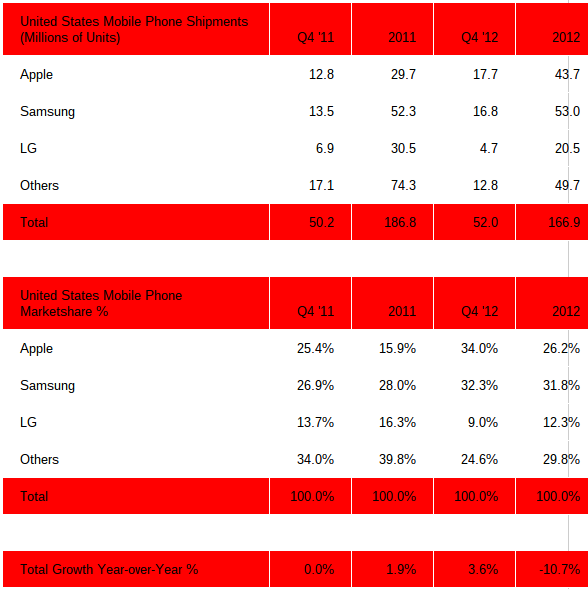
    “Apple has become the number one mobile phone vendor by volume in the United States for the first time ever”, Neil Mawston, Strategy Analytics research director, says. “Samsung had been the number one mobile phone vendor in the U.S. since 2008, and it will surely be keen to recapture that title in 2013 by launching improved new models such as the rumored Galaxy S4”.

    Apple shipped 17.1 million handsets during Q4, compared to Samsung’s 16.8 million, for 32.3 percent share. A year earlier: 25.4 percent and 26.9 percent, respectively. However, Samsung easily leads for the year, with 31.8 percent share to its rival’s 26.2 percent. But the share lead considerably shrank compared to 2011 — 28 percent and 15.9 percent, respectively. Unquestionably, iPhone’s gains are remarkable, and in a rapidly saturating market.

    The United States is the most mature smartphone market, which is where Apple only competes, while Samsung still sells feature handsets. The fruit logo company’s changing position is more than increased demand for iPhone then. For all 2012, Samsung phone shipments changed little year over year — 53 million units from 52.3 million — while Apple rose to 43.7 million from 29.7 million.

    Mobile phone shipments grew a scant 4 percent during the quarter but fell 11 percent for the whole year. “Growth was driven by robust demand among consumers for 4G smartphones and 3G feature phones”, Mawston says.

    Globally, Samsung’s lead over Apple is enormous and widening, ranking first and third, respectively, with 24 percent and 10.6 percent share for the quarter and 25.2 percent and 8.6 percent for the year, according to Strategy Analytics. During 2012, the American company’s share rose 2.6 points compared to its rival’s four. Stated differently: Samsung accounted for “one in four of all mobile phones shipped worldwide last year”, Mawston says.

    Comparing global to U.S. shipments reveals just how dependent Apple is on the one country. During Q4, the United States accounted for 36 percent of Apple handset shipments, but only 16 percent for Samsung. For the year, 13 percent to Apple’s 32 percent.

    The point: Samsung’s global reach far exceed’s Apple, and there is huge disparity regarding the most-mature handset market, particularly smartphones, where sales are slowing.

    Then there are smartphones, which account for the majority of handset growth in most markets. While Americans favored iOS over Android during fourth quarter, Google’s green robot captured the world. Year over year, Android surged to 70.1 percent smartphone share from 51.3 percent, according to Strategy Analytics. iOS share actually retracted, to 22 percent share from 23.6 percent. For all 2012, Android climbed to 68.4 percent from 48.7 percent, while Apple nudged up to 19.4 percent from 19 percent.

    In the world’s largest smartphone market, China, Android market share reached 86 percent during Q4, compared to 12 percent for iOS, according to Strategy Analytics.

    The point: The Apple Fan Club of analysts, bloggers, reporters and other writers claim bragging rights today (just look at all the “iPhone is No. 1” stories). But in larger context, during iPhone 5’s global launch quarter, Android still rules the world and the U.S. for all 2012.

  • It’s official: the King of the energy nerds, Steven Chu, is leaving

    Confirming a media report from last month, Energy Secretary Steven Chu, announced on Friday that he won’t be returning to office for President Obama’s second term. In a long letter, he detailed the accomplishments that the DOE has made over the past four years, like the ARPA-E program, and writes:

    While I will always remain dedicated to the missions of the Department, I informed the President of my decision a few days after the election that Jean and I were eager to return to California. I would like to return to an academic life of teaching and research, but will still work to advance the missions that we have been working on together for the last four years.

    As we wrote last month, it’s an end of an era for the Obama administration’s green dream team. Chu accomplished a good deal during his time ushering in billions of dollars in stimulus spending for clean energy, electric cars and more. At the same time, the DOE has not been without controversy with high profile bankruptcies from companies, like Solyndra, that got stimulus money.

    Related research and analysis from GigaOM Pro:
    Subscriber content. Sign up for a free trial.

  • Gravity giving away personalization to whichever publishers want it

    Gravity, a Santa Monica, Calif-based startup that personalizes reader content for web publishers, is opening up its recommendation engine to anyone that wants to use it. If you don’t mind a few sponsored stories popping up in the newsfeed — a condition of using the free platform — this could be a pretty good deal.

    Gravity’s recommendation system is based on its interest graph technology, which we detailed last year. Here’s how I described it then:

    [T]he gist is that humans first serve as guides for machine-learning algorithms by determining connections between terms within large data sets, then the algorithms take over to complete the job faster than humans ever could. When they’re done, the humans step in one more time to kill any bad connections between terms. The result is a system that can determine with high accuracy that a person tweeting about Vanessa Laine (Los Angeles Laker Kobe Bryant’s ex-wife), for example, is probably more interested in basketball than about Laine’s date of birth or other accurate but irrelevant information.

    As new content streams into Gravity’s system, it’s analyzed and categorized in real time, then presented to users accordingly based on their interests and behavioral history.

    How Gravity's platform works

    How Gravity’s platform works

    Graph processing and graph databases — which store and analyze data based on their relationship to one another — are critical to our onlines lives, powering everything from online recommendations to social search to knowledge discovery. Graph technologies are also the focal point of some impressive life sciences work from companies such as Syapse and Ayasdi, which will be presenting at Structure: Data in New York next month.

    But publishers struggling to stand out on a noisy web might have the most to gain from graphs and personalization, generally. At our PaidContent Live conference (April 17 in New York), executives from Prismatic, Zite and Bluefin Labs will take the stage to talk about the importance of personalization for helping consumers filter through the deluge of content online so they can find what they really want. It’s arguable that the trick to keeping readers happy is knowing what they want to read — possibly better than they do themselves.

    According to Gravity, its platform currently “delivers more than 25 million personalized content recommendations per day to more than 200 million users. Beta partners have reported click through rates two to three times above previous levels, return visitation increases of 300 percent and session length increases up to 40 percent.”

    Related research and analysis from GigaOM Pro:
    Subscriber content. Sign up for a free trial.