Author: Serkadis

  • Live from the PDC 2009 Day 1 keynote

    By Scott M. Fulton, III, Betanews

    Chief Architect Ray Ozzie is scheduled to be the main presenter this morning at PDC 2009 in Los Angeles. We’re in our usual location at the press box.

    10:05am PT: New applications server called App Fabric goes into beta today, Muglia announced — a “platform for building scale-out, high-tier services.” Enabling developers to concentrate on core functionality, fielding out the failover part of the operation to Microsoft. Database cache is kept entirely in the cloud. Sounds at first glance like a more pre-packaged, buffet-table-based model for delivering cloud-based applications through Azure.

    9:50am PT: Representative from Kelley Blue Book demonstrates a Silverlight app for an online car finder. Needs a second data center for failover, “only using it a couple of hours per week,” and the cloud model provides a cost-effective, flexible solution.

    9:43am PT: Developer crowd favorite Don Box demonstrates low-level programming techniques that leverage Azure services…low-level meaning, stuff that includes assembler macros. C++ demonstration (not C#) to show how standardized this can be. Now proceeding to cloud-based authentication service for cloud-leveraged database in SQL Azure, through SQL Server Management Studio.

    9:31am PT: Muglia continues the theme with a continuation of the applications development model throughout the previous decades, calling cloud applications the “fifth generation” of development models, after SOA. The metaphor here extends the idea of giving identity to the cloud.

    Microsoft President Bob Muglia serves as a personal identity counselor for 'the Cloud.'

    9:27am PT: Bob Muglia’s funny video this year is serving as a “life coach” for the cloud (a guy dressed in a puffed-up pillow costume), who is suffering an identity crisis (perhaps as a result of puffed-up metaphors). Muglia invites the cloud to “soar, soar, soar!” in a physical routine that makes Steve Ballmer’s cry for developers seem tame.

    A little demonstration of how clouds can fly, courtesy Bob Muglia a la Steve Ballmer.

    9:23am PT: “This data does no good unless we turn the potential into the kinetic, unless we develop apps and solutions that wrap around that data.”

    9:23am PT: Ray: “In the grand scheme of things, these really are the early days…not only for the cloud, but for the great transmedia experiences that we all dream about.”

    Please remember three things: When thinking of the experience component of your apps, bet on Windows 7. There’s a huge wave of excitement around Win7. “The opportunity for all of us is to innovate.”

    Second, for the cloud, bet on online services and Windows Azure. Focused on providing applications, infrastructure, platform, and data, now all as a service “ready for business now…They’re the foundation of everything we do.”

    Third, when you’re daydreaming over the holidays, think of how much the world around us is in transition. “Our world and our systems are increasingly wired with sensors, physical sensors, that are recording unimaginable volumes of data.”
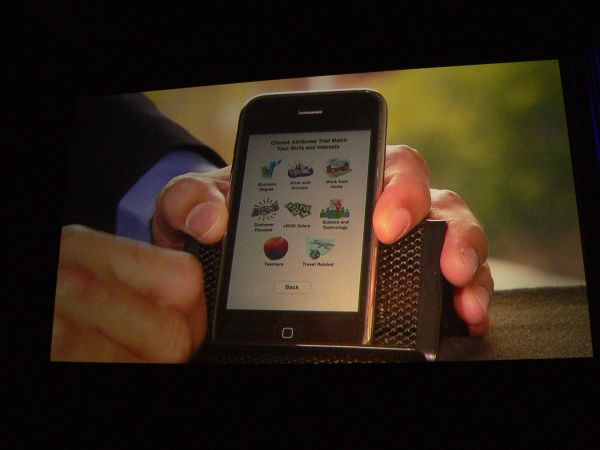
    Microsoft counselor Vivek Kundra shows a Data.gov live job finding application...for the iPhone.

    9:20am PT: People trying to find jobs can collect data from Data.gov in an application “created in a matter of days” for a certain black, slick smartphone that shall remain nameless. Enables job seekers to use full data center contents from Microsoft’s back end, to find jobs sorted by category, and also by seekers’ personal GPS locations. “Data applications for the good of the republic,” says Kundra, who spoke earlier about his close personal friendship with the President. But that’s a real nice, slick, responsive app there, Vivek. Cool phone.

    3D data from the Mars Rover photographs, live from NASA, served up through Windows Azure.

    9:17am PT: Public data demonstration from NASA includes 3D images of landscapes taken by the Mars Rovers. Everyone pops on his 3D glasses.

    Attendees at the PDC 2009 Day 1 keynote view the Mars pictures using 3D glasses.

    Vivek Kundra, Microsoft’s information counselor, speaks live from Washington. Anybody can look at http://beamartian.jpl.nasa.gov to see the public data collected by the Jet Propulsion Laboratory — also over 100,000 data sets from the EPA on toxic waste.

    9:07am PT: Dallas data feeds will be discovered through Pinpoint. For example, infoUSA has interesting data about businesses, some of it shows reviews by users. Click on the EULA to subscribe. “I really did read the EULA in my hotel room.”

    AP, Data.gov, NASA, NatGeo are among the data providers in the early going.

    9:06am PT: Ray returns: “This seems to have been enormously valuable to Martin and Matt.” Promises Bob Muglia coming forth soon.

    Business productivity online services. “How can I use the Azure platform to help me sell my products to all of these customers?” Announcing Microsoft Pinpoint, integrated into Azure Developer Portal, Microsoft Partner Network, in the midst of integrating into Microsoft Portal for IT. The idea here being a sharing of customers searching for services, and searches searching for customers.

    “It’s difficult for me to overstate the importance of common catalogs…a place where anyone can see some stunning network effects for the things found to be most popular to the community. Online catalogs aren’t just about apps, they can be places to discover the most popular and useful data.”

    CTP of a “game-changing new subsystem” code-named Dallas, an open catalog for commercial data, with a uniform discovery mechanism, binding mechanism, a uniform licensing model for easy joining and recombining. “By delivering data as a service, our aspirations are that Dallas could catalyze a whole new wave of experimentation by developers.”

    Dave Campbell, Microsoft Technical Fellow, takes the stage.

    9:01am PT: During November 2008, CNN’s WordPress blogs were battling for traffic against blogs with pictures of funny cats dancing on keyboards. Host of I Can Haz Cheezburger blog takes the stage. 8M page views, 100,000 processed per day. “We look at the crap so you don’t have to…We’ve been launching more and more news sites, because we don’t know exactly what’s going to be funny.”

    New site, OddlySpecific.com, will be run on Azure on the back end. When it gets popular, Azure specifications can be modified instantaneously. Site devoted to real, funny signage.
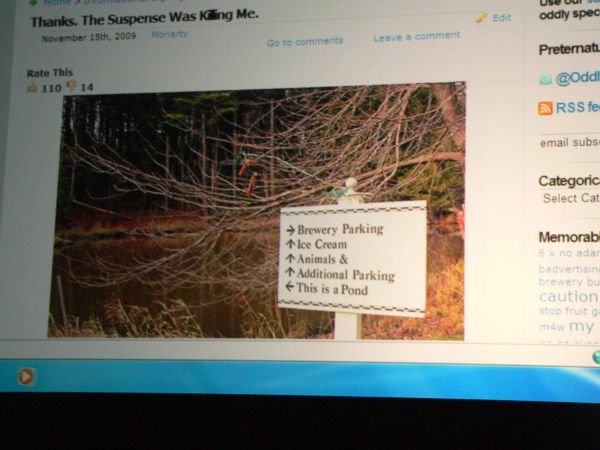
    A sample of the content now available from the Azure-based OddlySpecific.com.

    8:57am PT: Some WordPress blogs are being hosted on Windows Azure. Demonstration of settings for back-end configuration using XML host file.

    8:55am PT: “Some of you have been itching to take Azure out of the preview phase and into production.” Select customers will be taken into production starting today, one of which is WordPress. Matt Mullenweg, founder of WordPress parent company Automatic, takes the stage.

    8:55am PT: “We now support any Windows programming model…enabling extremely flexible binding.”

    MySQL, Java, Eclipse, PHP, Zend Framework now supported (not actually news).

    Moved to an all-container design for Azure servers in Microsoft’s data centers, “to drive latency in the supply chain from months down to mere weeks.”

    Entity Group Transactions added to Azure tables, integrated content delivery network support for pushing popular downloads to the edge.

    8:49am PT: Microsoft Chief Software Architect Ray Ozzie during the Day 1 keynote at PDC 2009. Ray acknowledged here that last year, he spoke of the cloud in very “cloudy” terms. Reminder about launch of Windows Azure at PDC 2008. “We committed to spending the year engaged with you, listening with you…before we took it live.”

    CTP program _will continue to the end of this year_. January 1, Windows Azure will switch to a production service for paying customers. Billing systems will start coming on line, but no charges will accrue until February.

    8:43am PT: Loic LeMeur, Founder & CEO of Seesmic, takes the stage. He has a Silverlight-based application which collects together feeds from individual users in social networks, plus RSS feeds, plus Twitter feeds. Will be shipping today Silverlight for Windows.

    8:39am PT: News on Silverlight and IE tomorrow, nothing yet today here either.

    8:37am PT: “a fundamental belief…in Web-centric experiences that are also shared with the cloud…experiences that are delivered through data centers or the world-wide public cloud.”

    The “Three Screens and a Cloud” vision today, with focus on the back end in today’s keynote. Client software tomorrow.

    In the coming spring, you’ll hear about Windows Live. That’s the first word we’ve seen that there’s no news on Windows Live — it’s not ready for prime time, even now. It’ll have to wait for MIX ’10 in Las Vegas.

    8:34am PT: The first metaphor out of the gate is how “we’ve talked about shifts” in previous years.

    “What incredible innovation we’re seeing in the PC space…Over the past few weeks, we’ve begun to have the same simple realization, that Windows 7 has the potential to sweep through for developers the current installed base…worldwide. What a good time for new ideas…a great time for innovation on the client. On a parallel track on the back end, who could have imagined the innovation on the cloud?”

    Copyright Betanews, Inc. 2009


    Add to digg
    Add to Google
    Add to Slashdot
    Add to Twitter
    Add to del.icio.us
    Add to Facebook
    Add to Technorati


  • Motorola to Sell 600,000 Droids in 2009

    Motorola and Verizon, thanks to their $100 million marketing efforts, are going to sell some 600,000 Droids during the fourth quarter of 2009, according to Mark McKechnie of Broadpoint AmTech, a boutique research firm. He had initially expected about 200,000 device sales following the launch, but he has upped his forecast: Motorola should sell another 200,000 Droids by Black Friday and 150,000-200,000 during the remainder of the holiday season. This would bring the total to some 600,000 Droids for 2009.

    We recently reported the findings of a study from Flurry that indicated Motorola might have sold close to 250,000 Droids in the first week of its availability. McKechnie’s forecast adds credence to Flurry’s findings. McKechnie expects that Motorola will sell about a million Android-based phones during the quarter. That works out to 400,000 CLIQ (also known as Dexter) sales on T-Mobile, Orange, Telefonica and America Movil.

    According to Broadpoint AmTech estimates, Motorola should sell about 10 million Android units in 2010 with an average selling price of $286. The company is planning to have about 20 different smartphone models in 2010 and will be selling on most major carriers in the U.S. Each Android unit contributes four times the gross profit of a feature phone unit; those 10 million Android units will contribute nearly half of the gross profits in Motorola’s handset division.


  • eBay And Delta Partner On Free Wi-Fi

    eBay has partnered with Delta Airlines to offer passengers free Gogo Inflight Internet service on all Wi-Fi equipped flights from November 24-30.

    Delta says its has 260 Wi-Fi enabled airplanes flying more than 1,000 flights each day, and during the Thanksgiving promotion it expects more than 1 million customers will access the service.

    "Operating the world’s largest fleet of Wi-Fi-enabled aircraft, Delta offers new ways to thank our customers for their loyalty and provide them new products and services with partners like eBay," said Ranjan Goswami, Delta’s director – Customer Experience.

    "Delta’s Thanksgiving promotion with eBay marks the first time we have been able to extend in-flight Internet access as a sponsored benefit to our customers."

    Delta said it is working on equipping more than 300 aircraft with Wi-Fi by the end of 2009. An additional 200 pre-merger Northwest aircraft are on schedule to be Wi-Fi enabled by mid-2010.

    Greg-Fant "eBay’s partnership with Delta Air Lines will showcase to a million-plus holiday travelers the amazing value, and unparalleled selection that eBay offers shoppers every day," said Greg Fant, eBay vice president of marketing. "This year marks the largest integrated holiday season campaign eBay has created."

    Google announced last week that it would make free Wi-Fi available at 47 U.S. airports during the holidays. Google also partnered with Virgin America to offer free Wi-Fi on flights during the holidays through January 15, 2010.


    Related Articles:

    >Google And Virgin America To Offer Free WiFi During The Holidays

    >American Expands In-Flight Internet Service

    >The American In-Flight Internet Revolution


  • MySpace to Acquire Music Streaming Service iMeem

    The online music space is in a volatile state with newcomers popping up seemingly every week while older services are dwindling, having failed to reach the popularity they needed to survive. But, while they may not be thriving financially, the online music market is sure to explode in the coming years and already some players are consolidating their position. MySpace has given up on the social media front and wants to become an entertainment hub, with music being a huge component. The company is now said to be in talks to acquire music streaming startup iMeem with a deal awaiting approval according to multiple sources.

    There aren’t too many details on the deal but it looks like investors don’t really have anything to be overjoyed about as MySpace is the last option for the struggling company. The company has been bleeding money and failed to develop a sustainable business model based on free music streaming and investor money and patience are running thin.

    iMeem has raised a significant amount of capital, some $25 million since being founded in 2005 but hasn’t managed to turn this into a viable business. The company also has about $10 million in debt. The money it raised so far is mostly gone and without additional funding the firm is forced to look to outside help. Bad news for iMeem and its investors,… (read more)

  • Pandemic Studios closing down today?

    Rumor has it that Electronic Arts will be adding more people to its list of cut employees. The target? Pandemic Studios.Kotaku reports that several so…

  • Google to Get More Interactive with Mobile Video Ads

    AdMob, which is being purchased by Google, has unveiled a new interactive video ad unit for the iPhone today. Upon the announcement of Google’s acquisition, the highlights of the purchase included SMS, search, web display, and app display ads. Now, video is part of the mix.

    "For the first time, mobile video is truly interactive as we’ve included customizable in-player action buttons enabling consumers to engage with Web content and more video content without leaving the video player," says AdMob VP Product Ali Diab. The in-player action buttons enable users to browse web sites, view additional videos, etc. while the video is playing.

    As AdWords Senior Product Specialist Frederick Vallaeys discussed in a recent interview with WebProNews, you can expect to see a lot of new interesting mobile advertising trends in the coming year or so, particularly as a result from Google’s acquisition of AdMob.

    "AdMob’s new Interactive Video Ad Unit brings together consumers’ love of watching videos on their mobile device with advertisers’ goal of providing an interactive, social experience for consumers," said AdMob CEO Omar Hamoui. "We are excited to create new ways for advertisers to engage with consumers on their mobile devices and for the developers behind the most popular and engaging iPhone applications to effectively monetize."

    The first ads will begin running this week in select (but unnamed) applications across AdMob’s iPhone ad network. This network has reached over 20 million iPhones and iPod Touch devices around the world this year so far. A video demonstrating the new video ad unit can be viewed here.

    Related Articles:

    > Google Buys Mobile Ad Firm For $750 Million In Stock

    > Usage of Mobile Web and Apps Doubles in 2 Years

    > That’s a Lot of Mobile Advertising!

  • PHP Will Be the Top Freelance Skill for 2009

    Following our usual monthly report, we present the conclusions of the recent Elance Work Index, a top provided by Elance, which ranks the most desired skills in today’s online freelance work. Even if the latest report is only for the month of October, PHP skills seem to have won the competition for the number one spot in this year’s top, Elance reports.

    After battling it out with Graphic Design all year, exchanging the number one spot between them several times, the fall in job numbers for Graphic Designers has clearly put PHP on top of the annual rankings. This demise has been noticed starting with August when Graphic Design skills slipped out of the top two positions, slowly going down to number ten for the month of October.

    This month’s top ten is:
    1. PHP
    2. HTML
    3. Article Writing
    4. Content Writing
    5. CSS
    6. WordPress
    7. Adobe Flash
    8. Creative Writing
    9. Photoshop
    10. Graphic Design.

    Analyzing the rest of the top 100 (via this link), we can see a huge number of writing-related skills like Creative Writing, Article Writing, Content Writing, Copywriting, Business Writing, Academic Writing and more.

    As the team from Elance also noticed, this month’s top 100 was invaded by Translation-related skills, with Spanish Translation ranked at n… (read more)

  • Adobe Releases Flash Player 10.1 And AIR 2.0 – Both Include Multi-touch Support

    A mere week after Adobe Systems reported that it would be shedding nearly 700 employees or 9% of its total worldwide workforce, the company is releasing two highly anticipated new products that have been in the works for a while: Flash Player 10.1 and AIR 2.0.

    Both of the products are being released with a ‘beta’ label at the same time for all 3 major operating systems (Windows, Mac and Linux) and x86-based netbooks, and are available now via Adobe Labs.

    People who were still hoping for a beta release of the new Flash Player for mobile will be somewhat disappointed by the fact that they’ll have to exercise even more patience.


  • Pirate Bay closes down torrent tracker

    By Tim Conneally, Betanews

    After months of legal controversy which were followed by months of uncertainty about the future of the service, the Pirate Bay’s popular torrent tracker has been shut down for good.

    But it wasn’t a court-ordered takedown or the result of regulatory shuffling, the old Pirate Bay torrent tracker simply became obsolete. As a result, the Pirate Bay is no longer running its old tracker, and has switched over to listing “magnet links,” a method for locating DHT (Distributed Hash Table) or PEX (Peer Exchange) nodes.

    The Pirate Bay team posted in its blog today, “DHT (combined with PEX) is highly effective in finding peers without the need for a centralized service. If you run uTorrent you might have noticed in the tracker tab of your torrents that the [Peer Exchange] (PEX) row is often reporting a lot more peers than the trackers you might have for that torrent. These peers all came to you without the use of a central tracker service! This is what we consider to be the future. Faster and more stability for the users because there is no central point to rely upon.”

    Copyright Betanews, Inc. 2009


    Add to digg
    Add to Google
    Add to Slashdot
    Add to Twitter
    Add to del.icio.us
    Add to Facebook
    Add to Technorati


  • Apple’s Black Friday Sales Leaked Early

    If you’re planning your holiday shopping but want to get a good grasp of the budget available to you in advance, it helps to know what kind of deals you’re going to get. Luckily, Apple’s Black Friday discounts have been leaked early, so you can factor in those price reductions while you’re figuring out how pinched you’re going to be financially come January.

    Boy Genius Report got the early tip-off, from an anonymous source. It comes in the form of what looks like a flyer image, detailing some pretty significant discounts on all things Apple, basically. They’re deep enough that you’d probably do well to hold off any Mac or iPod-related purchase for at least another 10 days just in case.

    Here’s what we’re looking at, if the rumors prove true:

    • Up to 30 percent off all iPods (excluding iPhone and iPod shuffle)
    • Up to 25 percent off all Macs
    • Up to 15 percent off all accessories, Apple software and Apple hardware

    The sales seem to be available in Apple retail stores only, since the poster also states that “Select Apple stores open at 6 am,” and a line at the bottom advertises the new availability of in-store gift-wrapping. Last year we saw online Black Friday discounts, though, so it’s possible we’ll see them again.

    If these deals do indeed come to pass, they would be pretty significant compared with previous Black Friday sales by the Mac maker. Twenty-five percent off of all Macs is a very good discount, for example, and would result in a $500 discount on the Core i5 27-inch iMac, or a $250 discount on the entry-level MacBook. Compare that to a $101 discount on the MacBook last year, and a $101 discount on the top model iMac.

    The teaser image leaked by BGR is fairly convincing, in that it does seem to use design cues and aesthetics currently favored by Apple in its marketing materials, but it’s hard not to be skeptical in the face of sound business sense — considering Apple’s previous Black Friday discounts, and the fact that last time I checked, it really wasn’t in a position to need to offer big price cuts to bolster sales.

    If these do prove true, I’ve been putting a new Time Capsule or Airport Extreme purchase on the back burner for quite some time now, and that 15 percent off is nothing to sneeze at, given Apple’s usual reluctance to offer any kind of price cut at all. Anyone else planning on making a purchase if these discounts really do apply? Something you wouldn’t buy otherwise, perhaps?


  • Another $50 Million for RockYou…Why?

    Wow…I had completely forgotten about RockYou, a Redwood City, Calif.-based startup that started out as a widget maker but then turned social app developer and now is trying out hawking virtual goods. Sort of like the company it loves to imitate: Slide. RockYou made a splash today by raising a whopping $50 million in new funding from existing investor Softbank. That brings the total funding raised by the 4-year-old company to $119 million. My view is that if the first $69 million didn’t make RockYou into a real, profitable business, what are the odds that the new $50 million will? Not very high!


  • Gym Technik for the BlackBerry Storm coming in two weeks

    StormDataEntryWhen we posted about RoadRunnerGPS, a lot of BlackBerry Cool readers recommended using Gym Technik for weight training. At first, this app was a web-based client but a few weeks ago they went native, which really helps if your gym is in a basement.

    Gym Technik will be launching their popular fitness tracking app for the BlackBerry Storm in two weeks. To find out when Gym Technik for the Storm goes live, you can register at their site.


    © Kyle for BlackBerry Cool, 2009


  • Apple’s App Store Approval Process Now Includes an Automated Layer

    App Store developers now have more to contend with than just the fickle tastes of the humans Apple has reviewing submissions. Now, submissions also go through an automated filter that determines whether or not the app is obeying the rules and not using any of Apple’s private APIs, which is a no-no, according to the developer agreement.

    The news comes via a conversation that occurred between developers on Twitter. Craig Hockenberry, best known for Twitterific, guessed that the App Store now contains a mechanism to check submitted code against proper framework use, and John Gruber responded that Apple has in fact recently begun to do just that.

    The specific function of the new automated component is to check submissions for private API calls. If it finds any, the app is rejected outright. Presumably, such a check would be run at the beginning of the review process, thereby cutting down a lot on the number of submissions that must be reviewed by actual human beings. In other words, it’s a volume compensation strategy on Apple’s part.

    It’s also technically fair, since Apple has said all along that private APIs are off-limits. The published reason being that Apple can’t confirm that said APIs will remain stable from release to release of the iPhone OS, meaning that something based on them might break every time an update rolls out. By forcing developers to stick with the public APIs, Apple is trying to ensure that some stability exists for end-users who depend on the hundred thousand apps or so available now in the App Store.

    Despite being technically fair, the move feels a little unfair to developers, since Apple hasn’t exactly been consistent about enforcing the rules regarding private APIs up till now. One reason could have been that spotting their use just isn’t that easy, which the computer filter now rectifies. But it seems clear that Apple also looked the other way in at least a couple of cases when it suited it to do so, like with Google’s mobile search app, hence my suggestion that this has more to do with reducing workload using a non-arbitrary filter than anything else.

    While the introduction of an automated layer does, on the surface, seem to guarantee a level of fairness, it also probably isn’t very encouraging to developers, who now essentially face a firewall before they gain access to individuals they can actually talk to about what’s wrong with their submission. Expect more headaches for the App Store team as the fallout for the implementation of this measure.


  • The Trouble With Hulu… Too Many Competing Interests

    Nearly a year ago, we questioned whether or not Hulu could survive. It’s not that we don’t think the product is well done or well liked. Other than the annoying regional restrictions which pisses off lots of people, the overall service is quite nice. The problem is that there are just way too many conflicts to deal with. The company is owned, in large part, by the networks, and that’s leading to all sorts of pressure and complaints about how ads are sold and whether or not there should be a subscription service. From what I’ve heard, the folks at Hulu understand quite well how an internet-age company should act. The company’s rather honest explanation for its fight with Boxee certainly suggested the problem was at a different level than with Hulu management. But… with Hulu having most of its ownership from legacy industries, combined with having so many different players involved in the ownership, it shouldn’t come as a surprise at all that the company is now coming under pressure to do things (subscriptions, limits, etc.) that will certainly kill off whatever good has been done. And, since some of the pressure is actually coming from the cable guys as well (who view Hulu as a huge threat), this will only get worse if, as is widely expected, Comcast completes its purchase of NBC Universal.

    Permalink | Comments | Email This Story


  • EBay Deal Alert! 4,000 iPhones stolen from Belgian electronics store

    thief_3_thumbnail

    Thieves in Willebroek, Antwerp cut a hole in the roof of an electronics warehouse and stole 3,000 to 4,000 iPhones, one of the greatest heists of its kind in history. The phones were headed to Belgian Mobistar and are estimated to be worth $3 million.

    The news article noted that the thieves made a hole directly over the iPhones which suggests they knew exactly where the phones were being kept.

    The phones can be feasibly tracked and can only be activated through jailbreaking, which could put a damper on their online sales. Also, this comment was funny:

    Haha, geen medelijden mee. Mobistar is zelf een dief als het op abonementen aankomt.

    Which roughly translates to “Don’t pity them. Mobistar is the thief when it comes to subscriptions.”

    via Fortune


  • BlackBerry and Twitter a huge success in Venezuela

    Bloomberg has a great article about the use of BlackBerrys and Twitter in Venezuela. The combination of a BlackBerry and Twitter, is apparently a crucial traffic tool in a country with shoddy road work and hectic driving conditions. Under a group called Trafico, Venezuelans flag potholes and vent frustrations about local infrastructure.

    According to RIM, Venezuela’s per- capita use of smartphones outpaces Europe’s. Under Chavez’s currency controls, Venezuelans are allowed $400 annually for online purchases. It seems that they are spending this $400 on a new BlackBerry because it’s a status symbol.

    If you’re interested in checking out the service that Venezuelans are using to Tweet traffic reports, try out GroupTweet.


    © Kyle for BlackBerry Cool, 2009


  • Adobe releases AIR 2 and Flash Player 10.1 betas

    By Tim Conneally, Betanews

    Today, Adobe has made the betas of AIR 2 and Flash Player 10.1 available for download for Windows, Mac and Linux.

    The big features in AIR 2 were shown off at Adobe MAX in October, and they include: Support for USB mass storage devices, support for multi-touch and gesture-based input, improved support for local peripherals and native application processes, improved performance, and peer to peer and UDP networking.

    Flash Player 10.1 adds a host of functions designed with the mobile device in mind. Even though today’s beta of 10.1 is not available on mobile platforms, Adobe says it will be available “across a broad spectrum of smartphones and other Internet-connected devices in 2010.” Already, it includes support for Android 2.0, Windows Mobile 6.5, Symbian S60 V5 and Palm WebOS.

    In order for Flash Player 10.1 to be “ready for mobility,” Adobe says it has made a number of tweaks to run on constrained systems, which include performance improvements, rendering, scripting, memory, start-up time, battery and CPU optimizations.

    Like AIR 2, Flash 10.1 supports multi-touch, gestures, accelerometer and mobile input models which will bring rich Flash interaction to mobile platforms. Going further, however, it also adds support for screen orientation changes, sleep mode, adaptive frame rate streaming, and graphics hardware acceleration.

    Copyright Betanews, Inc. 2009


    Add to digg
    Add to Google
    Add to Slashdot
    Add to Twitter
    Add to del.icio.us
    Add to Facebook
    Add to Technorati


  • Love-Digi Moving Photo Camera is a portable photo booth – almost (video)

    love_digi_01

    Here’s something yourself or your sister might be particularly interested in: A digital camera that helps you to pretty up pictures taken with it on the go. The so-called Love-Digi Moving Photo Camera [JP] is made by Japanese toymaker Takara Tomy and based on the cultural phenomenon of Purikura, photo booths in Japan that especially teenage girls use to create decorated snaps of themselves.

    All you need to do is to take a picture (just with a regular camera) first and then add a total of 40 different backgrounds, 30 different frames and about 120 different stamps to it. The 2MP camera has a 2.34-inch LCD with 480×234 resolution, 1GB of internal memory, a microSD card slot and a battery life of 2.5 hours. It’s called “moving photo” because the decorations in the pictures are actually GIF animations that you can view on the camera’s LCD screen. Now the only thing that’s missing in order to really call this a portable photo booth is a built-in printer.

    love_digi_02

    Takara Tomy will start selling the Love-Digi in Japan on November 21 in blue or pink. The Japan Trend Shop already offers the device for everyone living outside this country for $168.

    Here’s the super-cute commercial for the camera:

    Via Akihabara News


  • The Pirate Bay Tracker Is Shutting Down

    The BitTorrent peer-to-peer technology has been around for quite a few years; its huge popularity ensures that it will be around for at least as many. Anyway, the BitTorrent protocol has evolved over the years to the point where BitTorrent trackers, the sites which managed the initial communications between clients, are now useless. In fact, the world’s largest BitTorrent tracker, the Pirate Bay, is shutting down for good, but users of the site have nothing to worry about, for the most part they shouldn’t even notice the change.

    “TPB has decided that there is no need to run a tracker anymore, so it will remain down! It’s the end of an era, but the era is no longer up2date. We have put a server in a museum already, and now the tracking can be put there as well,” the Pirate Bay announced. “By moving to a more decentralized system of handling tracking (DHT+PEX) and distributions of torrent files (Magnet Links), BitTorrent will become less vulnerable to downtime and outages.”

    As the Pirate Bay puts it, it’s “the end of an era” but the fact is that for the user little will change. Up till now, in order to download a file through BitTorrent, the client software had to first connect to a tracker server, which would then give it the necessary info to find peers. After this, the actual … (read more)

  • Android Gets Some Serious Support for Consumer Devices

    ARM and more than 35 other companies have banded together to create an alliance dubbed the Solution Center for Android, which is aimed at increasing the resources available for developers trying to build for the relatively young OS on top of ARM hardware. Android, an open-source, Linux-based OS pioneered by Google, is the underlying operating system in several popular smartphones such as those from HTC and the Motorola Droid. However, as computer companies plan netbooks based on the ARM architecture (known as smartbooks), ARM and several other companies, including Texas Instruments and Mentor Graphics, determined that the Android OS needed more infrastructure to support these more complicated consumer devices.

    The Solution Center will serve as a go-to place for developers to get information on development tools, as well as resources and services optimized specifically for Android on the ARM platform. The end result should be better devices that are able to get to market quickly. And because ARM is so prevalent in other consumer gadgets scattered around the home, it’s possible that the alliance will help bring Android to more devices.