Author: Serkadis

  • Wilfrid Laurier School of Business offers BlackBerry MBA program

    This isn’t breaking news as it went live about a month ago, but it slipped under my radar and I have to post it. The Canadian Wilfrid Laurier School of Business and Economics in Waterloo, Ontario (near RIM headquarters), offers an MBA BlackBerry pilot program. The program puts a BlackBerry Curve 8900 in the hands of every student, as well as provides them with education and collaboration tools for their device.

    The faculty even talks about using push technology to push content to their students’ BlackBerrys, and will be recording metrics to gauge which content is being accessed.

    So if you’re a student in this program, feel free to hit up BlackBerry Cool for software and accessories. I have no problem giving you some cool applications for the device to test what it can do.

    © Kyle for BlackBerry Cool, 2009


  • KHN Column: Is Fear Of Flu Shifting The Goal Posts?

    In this column for Kaiser Health News, Shannon Brownlee and Jeanne Lenzer write about the swine flu. “If any public health message has alarmed Americans in recent weeks, it is the repeated claim in the media that healthy young people are dying of 2009 H1N1, or swine flu. … The response has been predictable: frantic parents clogging waiting rooms in pediatricians’ offices, lining up for hours to get their kids vaccinated, and rushing to fill prescriptions for anti-viral drugs before the local pharmacy runs out” (11/17).

  • Political Cartoon: ‘The Blue Dog’

    Kaiser Health News offers a humorous look at health policy developments with Clay Bennett’s “The Blue Dog.”

  • Business Opponents Of Health Overhaul Ramp Up Advertising

    Interest groups, including business opponents, are ramping up spending on advertising.

    “Business foes of health care overhaul legislation are outspending supporters at a rate of 2-to-1 for TV ads as they grow increasingly nervous over a final bill,” The Associated Press reports. “Led by the giant U.S. Chamber of Commerce, opponents of the Democratic health care drive have spent $24 million on TV commercials over the past month to $12 million spent by labor unions and other backers. That’s an abrupt reversal from the vast spending advantage supporters enjoyed most of this year, according to Evan Tracey, president of Campaign Media Analysis Group, which tracks political ads. More than half the opposition spending has been by the chamber.” The chamber has also “circulated an e-mail to other business groups asking them to help fund a $50,000 study by a ‘respected economist’ of the proposed health care overhaul. The study would be used for a letter, ads and other lobbying efforts to argue that the bill ‘will kill jobs and hurt the economy,’ according to the e-mail” (Fram, 11/17). 

    CongressDaily: “Interest groups are ramping up spending on nationwide advertising as Senate Majority Leader [Harry] Reid prepares to bring his chamber’s version of healthcare reform legislation to the floor for debate. The Employment Policies Institute, backed by Republican lobbyist Rick Berman, announced today it is adding $2 million to its healthcare ad budget, bringing total spending to more than $12 million. The campaign is running ads in eight states warning about the bill’s cost and its potential consequences for jobs and the economy. Plans for print and radio advertising are in the works.” The ads target senators from swing states who are key to passing health reform legislation in the Senate (Hunt, 11/16).

    Meanwhile, “On the White House’s official blog, Nancy-Ann DeParle, the director of the Office of Health Reform, rebuts recent claims by the insurance industry that the proposed health care overhaul would actually increase the cost of premiums,” The New York Times reports. “‘Despite being roundly and thoroughly debunked,’ she writes, ‘the industry lobby continues to release these studies and push their bogus conclusion about cost increases.’” DeParle also cites “an analysis by Goldman Sachs about the possible impact of any overhaul on the for-profit insurance companies. The companies’ ‘earnings could be cut by 50 percent over the next decade if the Senate Finance Committee version of health reform passes,’ she said” (Abelson, 11/16).

    The Seattle Times reports on seniors who are skeptical of a health overhaul. The health bill passed by the House “would bring about some unmistakable benefits for seniors,” yet “many seniors remain unconvinced that health reform would be good for them.” Polls show that “Americans 65 and older are less likely than younger people to support President Obama’s health-care efforts and more skeptical that changes would benefit them personally. According to the September 2009 Kaiser Health Tracking Poll, people 65 and older were evenly split over whether they would be better off with an overhaul, while among those under 65, twice as many believe they would be better off than worse off.” (Kaiser Health News is a program of the foundation). Many of those opposed are concerned about the “nearly $500 billion in spending cuts that are designed to keep Medicare solvent longer by reducing fraud, waste and excessive spending” (Song, 11/17).

  • Technology To Help Elderly People Stay Healthy At Home

    In a collaboration between Kaiser Health News and The Washington Post, Elizabeth Olson writes about how emerging technology is helping older people stay in their homes and can, in some instances, offer mechanisms to improve patient outcomes and reduce health care costs. “Every morning at 10 a.m. sharp, Juanita Wood, 87, taps “okay” on a screen to start up a device that takes her blood pressure and transmits the information to her medical clinic. At 10:30 a.m., her husband, Arthur, 91, touch-starts his own device, neatly lined up next to hers. The machine calculates his blood pressure and weight and sends them off, along with a blood sugar count that he enters by hand” (11/17).


  • Airport Wi-Fi users tend to be well-off, rich folk

    airport-wifiIt’s a good time to be an airport Wi-Fi advertiser. According to a study just released by JiWire, the folks behind a lot of airport Wi-Fi, most people that use airport W-iFi are loaded and spend a good amount of time online while waiting for their flight. This means, of course, that Mr. Money Bags has plenty of time to click on the flashing banner ads that airport Wi-Fi generally sports. But check out these stats, I’m in the wrong game. I should be selling airport Wi-Fi ads.

    JiWire,

    Seventy-two percent of the airport audience is business travelers with highly desirable demographics:
    • Fifty percent travel at least once a month.
    • Over half hold an executive or management position.
    • Over half have annual household incomes of over $100,000.
    • Seventy-five percent of all airport Wi-Fi customers plan to make a big-ticket purchase in the next 12 months.

    Sure, it’s all good for advertisers and access providers, but airport Wi-Fi is about the worst access you can get. It’s generally slow and burdened-down by tons of ads. Even if it’s free, I generally won’t use it unless it’s an absolute emergency. If a user agreement page loads, I close my notebook and grab a magazine.


  • Are you experiencing a BIS outage?

    There are reports all around that the BIS is down across North America. Personally, I never notice these things when they happen because I’m on a BES, but I feel for everyone affected. The outages are reported with AT&T, Verizon, and T-Mobile. Again, there are so many reasons why the BIS might be down that it’s impossible to speculate, but if multiple carriers are affected, it’s probably a node somewhere in RIM’s network.

    Are you experiencing an outage? Where are you and who is your network provider?


    © Kyle for BlackBerry Cool, 2009


  • This Microsoft store is trying too hard

    This is embarrassing. Not only are the Microsoft Stores a clear copy of Apple Stores, but now the employees are trying to be spontaneous and stir up customer reactions with a weird bastardization of Improv Anywhere.


  • Effect Of Abortion Restrictions In Health Bill May Be Less Than Advocates Fear

    Despite widespread debate, abortion restrictions in the House health reform bill could affect only a small number of women. Meanwhile, Catholic bishops weigh into the debate and abortion rights group plan a rally to contest the restrictions.

    The Wall Street Journal reports that the restrictions were included “to ensure that no taxpayer dollars fund abortion. To that end, the government-run public insurance plan set up by the House bill wouldn’t cover abortion, except in the rare cases of rape or incest, or when the pregnancy endangers the woman’s life. Individuals getting federal subsidies to buy insurance on a new health-care exchange — a potentially large group, reaching from the working poor well into the middle class — also would be barred from buying policies that cover abortion, unless they do so with their own money. Supporters of legal abortion fear that insurers will stop offering abortion coverage for all their customers to streamline their plans, meaning millions of women could lose benefits they currently have.”

    “Just 13% of abortions nationwide are billed to private insurance, according to a 2001 study by the Guttmacher Institute … More than 90% of abortions take place in the first trimester, at an average cost of $413. For some women, that would be a staggering sum. … But for many women who have private insurance, losing abortion coverage and having to pay out of pocket for the procedure wouldn’t be an insurmountable burden.” However, “late-term procedures, which account for just 1% of all abortions, take several days and can cost $5,000” (Simon, 11/17).

    Related KHN story: How The House Abortion Restrictions Would Work (Appleby, 11/10)

    Politico on Catholic bishops weighing in: “The bishops can make a strong case that the anti-abortion language inserted into the House health care bill extends only this central principle: Federal health dollars can’t go to pay for abortions. And for 12 years, these same restrictions have applied not just to fees for abortion services but also to any federal contributions to health plans that cover elective abortions” (Rogers, 11/17).

    Meanwhile, Roll Call reports that “[a]bortion-rights groups and other progressive lobbies are organizing a post-Thanksgiving assault on Capitol Hill to press lawmakers to keep restrictive language on abortion out of the final health care package.” The organizations have are organizing a National Day of Action on Dec. 2 “that will include a rally at the Capitol as well as visits by activists from around the country to lawmakers’ offices. The event comes as abortion-rights groups seek to regroup and energize their members after being blindsided by the House decision to add anti-abortion language to its health care bill. They are now figuring out how they can keep similar language out of the Senate bill” (Roth, 11/17).

  • White House Deal With Drug Makers May Be Unraveling

    “Congressional Democrats’ intensifying efforts to pay for their healthcare overhaul and provide more relief for consumers are threatening to unravel a White House deal with the pharmaceutical industry and turn one of Washington’s most powerful lobbies against the legislation,” the Los Angeles Times reports. “Drug makers, which have already spent $110 million lobbying Congress this year, are preparing to make a stand in the Senate,” where a health bill is expected to be unveiled this week. Senior administration officials “are warning members of Congress not to antagonize the deep-pocketed industry at a time when a major victory appears to be within reach, according to Democratic aides.”

    Under a deal struck between the White House and drug makers this summer, “companies pledged to support an overhaul and provide limited discounts to Medicare patients in exchange for a promise that no other controls would be imposed on pharmaceutical prices.” But the House legislation challenges that deal by forcing “drug makers to provide bigger discounts when the federal government buys drugs for low-income senior citizens on Medicare. The bill also would give the government new authority to negotiate lower prices for all seniors on Medicare.” Now, it appears a bipartisan group of senators “wants to open the door to lower-priced prescription drugs from other countries. Still other lawmakers want to speed the development of cheaper generic versions of biologic drugs, a new class of pharmaceuticals” (Levey and Hamburger, 11/17).

  • Google, Bing Perform Well In Latest comScore Report

    The latest comScore report concerning the search market has arrived, and although it may not cause too many jaws to drop, there are some interesting tidbits contained within.  It seems that Google hit its stride again in October, and Bing continued to make some impressive gains.

    Google LogoGoogle experienced a couple months’ worth of shakiness earlier this year, failing to win any share between May and June, and then actually losing a little heading into July and August.  But between September and October, Google moved its needle from 64.9 percent to 65.4 percent, which is fairly impressive.

    In fact, according to comScore, the search giant managed a 17.4 percent year-over-year increase.

    Bing, for its part, did even better, pulling off a 30.8 percent gain in the same time span.  And in terms of just the last little bit, Bing bumped its share from 9.4 percent to 9.9 percent between September and October.  Not bad at all.

    It’s Yahoo fans who have cause to be disappointed.  Yahoo’s share of the search market has sunk 0.7 percent on a year-over-year basis, and comScore determined that it dropped from 18.8 percent in September to 18.0 percent in October.

    Related Articles:

    > Bing Gets A Bunch Of New Search Features

    > Microsoft Bing Goes Live In The UK

    > Bing Managed Big Gain In October

  • New Technology Drives Therapies For Older Patients, Those With Alzheimer’s

    Technology advances are making life better for the elderly and those with Alzheimer’s disease by allowing the older to stay in their homes and giving the ill a way to interact with society again.

    Kaiser Health News, in collaboration with The Washington Post, reports on “high-tech but simple devices” that are giving older people a better chance at independence later in life as pilot projects in homes and retirement communities see if these approaches can lead to improved at-home patient monitoring. “The goal is to help control problems before they escalate and cut back on the need for costly long-term care and hospital admissions — especially repeat hospital visits for chronic conditions. … The hope is that by closely monitoring patients at home, some of these (major health) events can be avoided or managed better” (Olson, 11/17).

    In other technology news, The Wall Street Journal reports that using music therapy with MP3 players such as iPods allows stroke victims or patients with Alzheimer’s to better interact with others. “Caregivers have observed for decades that Alzheimer’s patients can still remember and sing songs long after they’ve stopped recognizing names and faces. … (T)here’s growing evidence that listening to music can also help stimulate seemingly lost memories and even help restore some cognitive function.” Music can also help infants gain weight, the autistic communicate, stroke patients regain speech and motor function and also help many others’ conditions improve (Beck, 11/16).

  • Amazon’s Kindle now available to Canadians

    kindle2_front

    Canadians that have long been jealous of their Southern neighbours ability to procure an Amazon Kindle need no longer feel hostile, for today Amazon announced it will ship the Kindle to its Canadian customers. To offer over 300,000 books and a wide assortment of international newspapers, a bunch of unique Canadian content has also been added with The Globe and Mail and The National Post having signed up to deliver their dailies to those that wish to subscribe (Canwest’s publications are said to be coming soon if they don’t get visited by the repo man first). The Kindle will set Canadians back $259 USD ($275 CDN) on Amazon’s American website.

    Read

  • YouTube Connects News Outlets With Citizen Reporters

    YouTube has launched a new video platform called YouTube Direct that allows users to submit relevant videos to participating news organizations for broadcast.

    All videos submitted to news organizations and approved by their editors will appear on YouTube with a link back to the news site.

    Key features of YouTube Direct include:
       

    • Built on the YouTube API, this 100% open-source solution provides you with an easily-integrated audience engagement platform for your website
    • The customizable interface allows you to tailor the look and feel of the tool precisely to your audience
    • Visitors can answer your call for content by uploading their videos to YouTube via your site without leaving the page
    • A moderation panel enables your editors to review and approve/reject all submitted videos, deciding which ones meet your organization’s editorial criteria

    News organizations currently testing YouTube Direct include the Huffington Post, NPR, Politico, the San Francisco Chronicle, the Washington Post, and two TV stations in Boston.

    The YouTube Blog provides additional details. "Though we built YouTube Direct to help news organizations expand their coverage and connect directly with their audiences, the application is designed to meet any organization’s goal of leveraging video content submitted by the community."

    "Businesses can use YouTube Direct to solicit promotional videos, nonprofits can use the application to call-out for support videos around social campaigns and politicians can use the platform to ask for user-generated political commercials. The opportunities to use the tool are as broad as the media spectrum itself."
     

    Related Articles:

    > YouTube, Univision Announce Partnership

    >YouTube On Verge Of Supporting 1080p Video

    >YouTube Talks Up Social Side

  • State Health Plans In Washington, Kansas Face Challenges

    Officials in Washington state and Kansas are working to get residents out of or into their state-run insurance programs.

    The Seattle Post-Intelligencer: About as many people are on the wait list for Washington’s Basic Health plan, a state-run, low-cost health insurance program, as are currently enrolled. “As of Monday, 78,834 people were enrolled in Basic Health, the state’s low-cost health care coverage program. An estimated 78,419 people were on the wait list.” But, recent budget cuts mean the program is trying to thin out it rolls, not take on new customers. The economic recession has increased demand for the cash-strapped plan, local experts said (Ho, 11/16).

    Kansas Health Institute: A state insurance program has struggled to enroll patients as the number of uninsured children in the state rose, even as it declined nationally. “Between 2005 and 2008, the number of uninsured children in the state increased about 20,000 to a total of about 70,000 according to a recent report released by Kansas Action for Children.” State officials acknowledge that flaws in the enrollment system for HealthWave, a state-run insurer for low-to-modest-income children and families, may contribute to the surge (Ranney, 11/16).

  • Atlus releasing 3D Dot Game Heroes in North America

    Atlus has announced that they’ve picked up the rights to release From Software’s 3D Dot Game Heroes in North America.The North American version of the…

  • Looking at the Big Picture on the Recovery Act

    Last month, in a first-ever effort by the federal government recipients that received Recovery Act funds had to file a report saying how much they had received, what they had done with it, and how many jobs these funds had saved or created.  The reports were due just 10 days after the end of the federal fiscal year on September 30th, and were posted on Recovery.gov just 20 days later.

    More than 130,000 such reports were filed.  You can go to Recovery.gov and look them up by zip code, or search for them on a map.  It’s a “real-time” update on your tax dollars at work that is unmatched by any federal initiative, ever, of this scale.

    As part of President Obama’s commitment to transparency and disclosure, it’s been a huge success.  When you consider the sheer number of reports that had to be filed, processed, and posted; the fact that this had never been done before; and the very short time to check reports and make sure they were right – the data collected and posted is very impressive.

    Unfortunately, it would be hard to know that by reading some of what’s been written and said about recipient reporting.  The Administration has been criticized for pointing out to the independent Recovery Board some erroneous reports that should not have been posted – and for failing to find all the erroneous reports.  Skeptics have raised doubts about reports that show jobs created with no funds spent (although that is possible, as workers are hired in anticipation of projects starting), or funds spent with no jobs created (when materials are purchased for projects that are not yet underway).

    Some filers, working with the new system, punched in the wrong Congressional district, and some just got the data wrong.  And about 10% of those folks who were supposed to file a report haven’t filed it yet.

    We fully agree with those who find the mistakes in the data frustrating – and we’ve been working with the Recovery Board to find the mistakes, and fix them.   Just because mistakes are inevitable in any new system – especially one this large, and this new — doesn’t mean they are acceptable.  We are going through the reports with a fine tooth comb, identifying mistakes, and working with filers to correct them.  That said, three big picture points should not be lost.

    First, the mistakes are RELATIVELY few, and don’t change the fundamental conclusions one can draw from the data.   Even if as many as 5-10% of the reports or 5-10% of the totals are wrong (and we don’t think it is that high), that still means the Recovery Act saved or created between 600,000 and 700,000 direct jobs in its first seven months – more than most experts predicted when it passed.  And most leading experts agree that – whatever the recipient reported total should be – the actual number of jobs saved or created is about double that, because the recipient reports don’t include direct payments to individuals, the jobs created by Recovery Act tax cuts, and the jobs created when workers on Recovery Act projects spend their paychecks. 

    Second, some of the mistakes are frustrating typos and coding errors that don’t undermine information at the heart of the data.   Yes, it is “silly” that Recovery.gov shows that a project went to the 15th Congressional District in Arizona – when there is no such district.  But a “click” on the project details gives you the address, and a check on the address shows it is in Arizona’s 3rd district.  All this shows is that when people send in 130,000 reports, some will have silly mistakes.  But it doesn’t really undermine the ability of the public to track and follow the data – or the fact that real jobs have been created.

    Third, transparency is going to be messy – but it is better than the alternative.   It would be great if every report filed was correct the first time, on time, and contained no errors.  But that’s not realistic when 130,000 reports are being filed in a 10 day period.  It would be great if the reviewers at the federal agencies, could have found all the mistakes in the 20 days they had to do the job, gotten the reports back to the recipients to be fixed, and reposted  – but again, that isn’t realistic.  And so, it’s all out there now for the public to see – because the Recovery Act chose speed and transparency as its watchwords – and the result is some data errors for the critics to pick over.  But think about it this way:  What government program has ever even attempted to provide this sort of information, on this scale, this quickly?  In my over thirty years of government service, I can tell you without hesitation:  something like this has never happened before.  In previous administrations, hundreds of billions of dollars have been spent without anyone being asked what happened to the money, being asked how it was spent, or being asked how many jobs were created – and some of the loudest critics of Recovery Act data today were shockingly silent.  And if these questions were asked, answers would usually take months or years to produce.

    Last month, something happened that has never happened before.  Critics – some well intentioned, some who just wanted to discredit the Recovery Act — have had over two weeks to try to make hay with  the data.   But no criticism has come close to discrediting the larger and most important point:  that the Recovery Act has helped save or create more than 1 million  jobs across America and across various sectors of the economy.   The data will get better and better – but in the noise over counting jobs, we shouldn’t lose sight of the Recovery Act’s progress in creating them.

    G. Edward DeSeve is Special Advisor to the President, Assistant to the Vice President and Special Advisor to the OMB Director for Implementation of the Recovery Act

  • Another big day in gaming: Assassin’s Creed II, Left 4 Dead 2 & Tony Hawk Part 900

    ac22

    Today’s another big day in gaming, friends. (You’ll notice that we’re practically a game blog now. I blame the publishers for releasing the biggest games of the year within a few days of each other.) Ubisoft’s Assassin’s Creed II, Valve’s Left 4 Dead 2, and Activision’s Tony Hawk Ride come out today (I assume the Tony Hawk franchise is still around because it’s still popular. I haven’t played one since Tony Hawk 4.)

    There’s no Assassin’s Creed II reviews yet, which I’m interpreting as Ubisoft either being control freaks, or that that game isn’t exactly a 10 out of 10. Hopefully the game is halfway as good as that Justice trailer:

    I read one Left 4 Dead 2 review (I’ll do my usual round-up later in the day), from Eurogamer, and it ends with this:

    Whereas once we treated Left 4 Dead as a stopgap between Half-Lifes, this is no longer a weird little side project with modest expectations, and Valve is confident enough to play around with it, safe in the knowledge that you can trust your players. Left 4 Dead proved it. And whereas that game had a personality, this one is overflowing with it.

    Considering the PC version is the “real” version, and my iMac can only just run Call of Duty 1 and Medal of Honor: Allied Assault (which I’ve been playing for the past week), and that I never played the first game, and that I’m really not the biggest fan of online multi-player games, well, what more do I have to say?

    Too. Many. Games.


  • As Senate Debate Approaches, Partisans Step Up Volume

    Volleys of rhetoric, attack ads and procedural parries are rippling through the Congressional health care debate.

    The Philadelphia Inquirer: “Democrats are emailing thousands of people who backed Barack Obama last year in two GOP-controlled Pennsylvania congressional districts, asking them to protest their representatives’ recent ‘no’ votes on health care reform legislation” (Fitzgerald, 11/16).

    Lansing State Journal: The “Democratic National Committee will run radio ads this week targeting four Michigan Republicans in Congress who voted against health care reform this month but represent districts that backed President Barack Obama in last year’s election” (Spangler, 11/16)

    MinnPost: The Democratic National Committee is running ads “in 32 Republican-held congressional districts” around the country “where voters backed Barack Obama in the 2008 presidential election.” The ads attack Republicans for voting against the health-reform bill, claiming, for instance, that one member “stood with the insurance industry, not the people he was elected to represent” (Wallbank, 11/16).

    NPR: Democrats also have taken aim at insurers more broadly, shifting the term for their massive legislative effort from “health care reform” to “health insurance reform.” Experts say the latter may be a more accurate term for a reform effort that squeezes insurers but may not do enough to change the health delivery system and bridle rising health costs (Welna, 11/17).

    Roll Call: “Sen. Tom Coburn (R-Okla.) confirmed Senate Democratic leaders’ fears that he will insist that the massive health care reform bill be read aloud on the Senate floor.” The voluminous bill would take “several days” to read in its entirety (Pierce, 11/16).

    The Washington Times: “Senate Republicans say they’re prepared to file dozens of amendments on the health care bill Democrats send to the floor, targeting proposals to cut Medicare spending and increase taxes, warning that the Democrats’ overhaul plans will raise insurance premiums for all Americans” (Haberkorn, 11/17).

    In a separate story, The Washington Times reports on the two Republican physicians who serve in the Senate and who “don’t sound like other Republican lawmakers when they talk about the debate over reforming the nation’s health care system.” The two doctors, Sens. Tom Coburn of Oklahoma and John Barrasso of Wyoming, “say the Democratic lawmakers’ proposals being presented to Congress would allow the government too much control over physicians’ and patients’ decision-making and destroy the art of medicine. Coburn is also attacking the bills because, he says, they would take the art out of medicine” (Haberkorn, 11/17).

  • Google May Take Over More Design Jobs

    Web designers beware. Google is expanding its templates for Google Sites, which is part of Google Apps, and the company is really pushing Google Apps these days. What this means is that as more businesses adopt Google Apps and find a wider variety of site templates to choose from, the less they may need the services of web designers for basic design work (developers are a different story).

    Ok, perhaps it is a bit of an exaggeration to assume that this is going to completely put web designers out of work. Website templates have been around for years. It’s just that the potential of Google Apps to infiltrate more and more offices may lead to more widespread use of Google Sites.

    Google has just launched a new template gallery for Google Sites, and it is public. Anyone can contribute templates by simply following these steps:

    1. Open up the site you want to add to the gallery (the site must be published and you must be an owner to submit the site).

    2. Select ‘More actions’, ‘Manage site,’ ‘General’, and chose ‘Publish this site as a template.’

    3. Choose a template name, a category, enter a description and click ‘Submit template.’

    While anyone can browse the gallery, businesses using Google Apps each have a private area where employees can share site templates with coworkers. Site templates can be used not only to build business websites, but intranets and more.

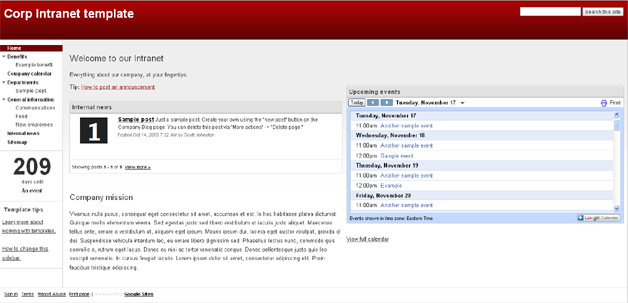
    Corporate Intranet Template

    "The rate that businesses are adopting Google Sites has surpassed our expectations, and templates will make Sites even more useful by dramatically reducing the time it takes to set up collaborative workspaces like employee intranets, project tracking sites, team sites and employee profile pages," says Google Sites product manager Scott Johnston. "Templates let you quickly start a new site with pre-built content, embedded gadgets, page layouts, navigation links, theming and more."

    Given that anyone can contribute templates to the gallery, it stands to reason that it will grow quickly and greatly. One knock against site templates has always been that they don’t make for a unique design. These days the chances of having a truly unique design are getting slimmer and slimmer as the web becomes more flooded with content. However, the more templates that are available, the less chances you have of actually coming across different sites that use the same one. Given that this is a Google product, it’s almost certain that it will get many contributions.

    Do you think designers should worry about Google Sites? Share your thoughts here.

    Related Articles:

    > Google Exec: Docs Can Supplant Office In One Year

    > API Makes Google Sites More Useful for Business

    > Google Launches New Features for Sites