 Google is constantly trying to customize search results and make them more relevant to each individual user. It’s also adding more info to the search results page, besides the regular entries. One feature that has actually been around for many years, but that gets rarely used, is the ‘Similar’ websites link. This is probably part of t… (read more)
Author: Serkadis
-
Google Introduces Similar Page Suggestions
-
Hollywood Park Race 7 Horse Racing Betting Pick Wednesday 4-28-10
Our free play for our forum visitors will come from Race 7 at Hollywood Park on Wednesday. It is a 6-½ furlong event for fillies and mares three year olds and up running on the synthetic surface. With our free pick we will play on #2 Bella Roja to win. Race 7 is scheduled for a 7:07PM Eastern Time start and you can watch it on TVG.Bella Roja will be ridden by Joe Talamo and is trained by Craig Dollasse. She has produced three good performances in her past three races and finished strongly in each race with 2 wins and a third. She makes the turf to dirt move which is a move I like on the synthetics. She was a good third by ¾ lengths in a non graded stakes race across town on March 14th. She produced a bullet work at Hollywood Park on April 20th in preparation for this race.
Play #2 Bella Roja to win race 7 at Hollywood Park 7-2 on the Morning Line.
Post Time at 7:07PM Eastern Time televised by TVG
Courtesy of Tonys Picks
-
Primal Nutrition and Fertility
 Although for many of us starting a family simply happens (surprise!), others among us take an intentional approach. Maybe we delay having children for professional, financial or relationship reasons. Maybe we begin trying when we’re young. Regardless of timing, facing our fertility (so to speak) is an intensely personal and often emotional passage. It can inspire joy and wonder in our basic human capacities – our deep-seated physical impulse and emotional expansion toward parenthood. For some of us, however, the journey takes on anxiety and disappointment. Although varied and nuanced factors define our reproductive health (some not fully understood even today in the medical community), experts agree that lifestyle factors contribute to overall fertility.
I get emails from time to time on the fertility question, and I appreciate these readers’ stories and interest. The growing science of nutrigenomics, the study of how diet influences gene expression patterns, will undoubtedly offer more insights in the future. Research, however, offers plenty of suggestions already for enhancing reproductive results through dietary measures – a briefing of sorts on what to eat, what not to eat, what to consider supplementing, etc. For everyone who’s tried, is trying or interested in trying somewhere down the line, here’s a Primal primer for fertility nutrition.
For Both Men and Women…
Achieve a Normal Weight. Obesity is a known factor in infertility for both men and women. Obesity early in life presents the most reproductive risk.
Reduce Oxidative Stress. Oxidative stress from a whole host of factors, including oxidized fats, intense physical activity, alcohol, illness and regular metabolic functioning, negatively impact conception success and pregnancy outcomes. For men, oxidative stress has been shown to damage sperm DNA and lower sperm count and motility. For women, oxidative stress impacts conception ability by decreasing the permeability and function of the egg, impairing successful implantation of a fertilized egg in the uterine lining, and decreasing the viability of the embryo. (image)
Up your antioxidant and fish oil intake. We know antioxidants and anti-inflammatory fatty acids like omega-3 fight oxidative stress elsewhere in the body. The same goes for reproductive functioning. Research has shown time and again that antioxidants support fertility in both men and women. Vitamins C and E and cofactors like selenium, zinc and copper, appear to be especially key. There are probably many other antioxidants that can benefit as well. As for fish oil, sperm actually depend on a generous polyunsaturated fatty acid supply for well-functioning, fluid membranes that are required for fertilization.
For the Men…
As already suggested, the onus is on both halves of a hopeful couple. Here are a few key recommendations for men.
Avoid soy. I’ve never been a fan of soy, and prepping for pregnancy is a good time to reassess your intake. The issue with soy of course is the estrogenic effects, which animal and human studies have shown decrease sperm counts. The inevitable question is raised why Asian countries where soy is prevalent don’t suffer a fertility crisis. It’s a perfectly valid point – one which research hasn’t fully addressed. From my own perspective, I’d venture to guess that at least part of the discrepancy might be traced to the consumption of unprocessed, often fermented soy in Asian cuisine versus the heavily processed versions in Western menus.
Supplement strategically. Studies of male infertility have shown that zinc and vitamin C levels correlated with sperm count and quality. Additionally, L-carnitine and L-acetyl-carnitine have been useful supplements for enhancing sperm motility and quality.
For the Women…
Female infertility that can be traced to hormonal disruption, as in polycystic ovary syndrome (PCOS) or luteal phase deficiency, responds especially well to dietary intervention. A few years ago, a book called The Fertility Diet highlighted results obtained from studying 18,000+ women and the associations between their diets and respective fertility rates. Critics suggested that the study design was far from air tight and that the book’s findings were most useful for women with PCOS. The book, however, offered generally sensible recommendations for the most part. Somehow the findings related to carbs was re-spun to suggest “good carbs” as opposed to low carbs as the specific results suggested, but that’s of little surprise. Based on the bulk of research out there, here are a few recommendations for women.
Achieve Normal Insulin Levels. Excess insulin can impair ovarian function and increase hormone-binding globulin, which raises androgen levels and commonly decreases ovulation. Although getting insulin under control can help boost fertility, avoid chromium picolinate during the preconception period, since it has been linked to DNA mutation and sterility.
Supplement Strategically. Iron and zinc are particularly crucial for early cell division once the egg is fertilized. Folic acid both pre-conception and in early pregnancy cuts the risk of neural tube effects. Higher iron levels have been linked to higher fertility.
Eat Clean Protein. The Fertility Diet authors suggests that balancing plant and animal protein corresponded with fewer fertility difficulties; however, no attention was given to the possible impact of livestock hormones, antibiotics, etc. If there’s any time to go organic, preconception is the time.
Eat Plenty of Good Fats. Trans fats are paramount in fertility impairment. One study showed that a 2% increase in trans fat intake resulted in a 75% increase in fertility risk. Full fat dairy showed a positive effect, but go for clean organic sources.
Go Low/No Alcohol and Caffeine. Both alcohol and caffeine have been shown to decrease fertility in women.
This has been sort of a brief, straight-to-the-point, text book overview of nutrition and fertility. Now it’s your turn. I know that many Mark’s Daily Apple readers have stories about going Primal and getting pregnant. Do you have recommendations and experiences for enhancing fertility? Share your thoughts and anecdotes in the comment board. Grok on!
Get Free Health Tips, Recipes and Workouts Delivered to Your Inbox
Related posts:
-
Daigo Umehara signs up with Mad Catz
Daigo “The Beast” Umehara, currently reigning as the world Street Fighter IV champ and possibly the best Ryu user who ever played Street Fighter, has now teamed up with the company that provides pros and avid players
-
BREAKING: 2003 Toyota Sequoia to be recalled over traction control
Filed under: SUV, Japan, Recalls, Safety, Toyota

Toyota made big headlines recently because of sliding floor mats and then sticky gas pedals – both resulting in unintended acceleration. Well, let’s call today’s recall announcement unintended deceleration. According to The Detroit News, Toyota is preparing to recall 50,000 of its full-size model year 2003 Sequoias.
According to the daily, there have been 160 reports of “inappropriate activation of the electronic stability control or the traction control system.” Which is a fancy way of saying the vehicles suddenly seem to slow down on their own. Here’s what the National Highway Traffic Safety Administration is saying:
“During the activation of either system, the driver loses throttle control and one of more brakes may apply, causing the vehicle to slow suddenly. During these activation events, the brake lights are not illuminated to signal to following traffic that the vehicle is slowing.”For its part, Toyota admits that:
“…the VSC system could, in limited situations, activate at low speed (approximately 9 mph) for a few seconds after acceleration from a stopped position and, as a result, the vehicle may not accelerate as quickly as the driver expects. There have been no reported injuries or accidents as a result of this condition.”Obviously, if your vehicle suddenly slows unexpectedly while under acceleration without warning (and without brake lights!), that’s an issue. For its part, Toyota initially admitted it was a problem with the traction control system (not the stability control), but for some reason it didn’t feel a recall was necessary. However, that was sixteen months ago, before the Japanese giant’s woes began in earnest. Today, they’re going to fix the issue. Toyota would do well to remember their Nixon: it’s not the crime, it’s the cover up. Official press release available after the jump.
[Source: The Detroit News]
Continue reading BREAKING: 2003 Toyota Sequoia to be recalled over traction control
BREAKING: 2003 Toyota Sequoia to be recalled over traction control originally appeared on Autoblog on Wed, 28 Apr 2010 11:27:00 EST. Please see our terms for use of feeds.
-
Copyright Defenders Don’t Realize That New ‘Fair Use’ Report Mocks Their Own Study
Last year, we had written about how the CCIA had taken the same methodology used by entertainment industry lobbyists to claim how “big” the “copyright industry” was and applied it to the “fair use” industry, to show that it was actually much bigger than the copyright industry. Both numbers are clearly bogus — which is effectively the point that CCIA was making. The point that is clear, however, is that if you accept the methodology that claims that “copyright” brings $1.52 trillion into the economy, then weaker copyright/exceptions to copyright (such as fair use) bring in $2.2 trillion. Lots of folks have been submitting the news that the CCIA just recently updated the report to show that we’re now talking about $4.7 trillion contributed by the “fair use industries.” Again, this number is bogus — but it’s main point is to show just how silly the copyright lobbyist’s argument that copyright contributes $1.52 trillion to the economy is, because it uses the same methodology — a point recently confirmed by the GAO.
So I have to admit that it’s absolutely hilarious to see Patrick Ross, the head of “The Copyright Alliance” (one of a bunch of lobbying/marketing groups representing the entertainment industry) lash out at this new report, making arguments that apply equally to the $1.52 trillion number he’s famous for touting every chance he gets:
“It is not helpful to policymakers or the public to pronounce sweeping arguments that defy logic,” said Alliance Executive Director Patrick Ross. “In its report, CCIA identifies broad industries, suggests some entities in those industries occasionally engage in what some might call fair use, and then lumps all revenues and jobs in those industries into a newly coined “fair use” industry…”
But, as we’ve noted, that’s exactly the same methodology that was used by the copyright industry to defend the $1.52 trillion number. The methodology is a joke. It identifies broad industries (including things like furniture!), suggests some entities in those industries occasionally engage in what some might call copyright, and then lumps all revenues and jobs in those industries into a newly coined ‘copyright’ industry…
And guess who one of the biggest abusers of this bogus $1.52 trillion number is? You guessed it! It’s Patrick Ross! He tosses the number around like it’s going out of style and is regularly quoted in the press using that number as well.
Apparently, he’s so wrapped up in this issue, he doesn’t quite realize that the whole point of the CCIA report is to use the same methodology to show that if he and those who fund him are going to keep throwing around that $1.52 trillion number, they need to also note that the exceptions to copyright creates an industry that’s even bigger. So I’m curious, Patrick, why is it “not helpful to policymakers” to use this number, when the number you throw out to policymakers all the time uses the same methodology?
Permalink | Comments | Email This Story
-
2011 Renault Kangoo Van Z.E

The Renault Kangoo Van Z.E will be released in the first half of 2011 and with an operational range of 160km. The electric version of Kangoo Van features the same practical functions as the internal combustion-engined version, i.e. the same carrying capacity (from 3 to 3.5m3), the same payload (650kg) and the same high standard of comfort. On top of that, it delivers a silent ride and responsive performance, immediate availability of torque as soon as its starts, no gear changes, low running costs and, of course, the satisfaction of owning a zero-emissions* vehicle.


The length of Renault Kangoo Van Z.E. stands at 4.21 metres, while carrying capacity ranges from 3 to 3.5m3. The battery is located in a central position beneath the floor, enabling the electric version of Kangoo to boast the same carrying capacity as the internal combustion-engined version. The asymmetric hinged rear doors and sliding side door provide easy access to the cargo area.
Renault Kangoo Van Z.E. is an all-electric vehicle. Renault Kangoo Van Z.E. is powered by a 44kW electric motor which boasts energy efficiency of 90 per cent, a figure that is far superior to the 25 per cent associated with internal combustion engines which suffer from energy losses. For example, when an electric vehicle consumes 10kWh of energy, 9kWh is actually transmitted to the wheels, compared with just 2.5kWh in the case of an internal combustion engine.
This motor revs to 10,500rpm and instantly delivers peak torque, which is a constant 226Nm. Acceleration from low speed is particularly responsive. The electric motor is very quiet, too. The 22kWh battery is located beneath the boot floor and does not affect Kangoo Van Z.E.’s load capacity.
Renault Kangoo Van Z.E. is charged via a socket located behind a flap alongside the right-hand headlamp. A conventional charge via a household mains supply (16A 220V) will charge the vehicle in between six and eight hours. This method is perfectly suited to vehicles that are parked up overnight or during the day at the workplace.
Renault Kangoo Van Z.E. will go on sale in the first half of 2011 with an operational range of 160km.


-
Google Details Its Wi-Fi Data-Collection Policies
 German officials were “horrified” to find out last week that Google was using Street View cars to collect Wi-Fi data. Why it took them so much to find out a publicly known fact, they didn’t say, but they were clear that Google’s actions were out of bounds. The claims were a bit hypocritical, since plenty of other companie… (read more)
 -
PSN getting treated to three bullet-hell games next month
The PlayStation Network is turning into a bullet-filled warzone thanks to a collaboration between Sony Online Entertainment and indie game studio Rockin’ Android. The two have announced that some of the latter’s bullet-hell titles will be launching
-
Report: Bentley planning Mulsanne-based Azure droptop
Bentley’s gracefully aging Azure convertible will reportedly retain its name when a Mulsanne-based replacement debuts in the not-too-distant future. Sources indicate that it will debut in 2011 as a 2012 model.
The range-topping convertible, which sits above the Continental GT, will, like the Mulsanne, be designed to appeal more to Bentley’s traditional customers. Look for the automaker’s classic-yet-updated 6.75-liter, twin-turbo V8 from the Mulsanne to carry over into the third-generation Azure.Despite middling sales for the current Azure, which was never intended to be a volume model like the Continental GT, Bentley has been careful to ensure that there is enough production capacity for a flagship convertible at its Crewe, England, assembly plant.
The existing Azure has been on sale since 2006, although it was updated last year to become the Azure T. Based on the now-discontinued Arnage, its future has been the subject of much speculation.
As more details on the next-generation Azure become available, we’ll make sure to update this space.
References
1.’Bentley unveils high…’ viewSource: Leftlane
-
Vídeo: Piloto de Rally pensa que seu carro é avião e sai voando
Durante um trecho do Rally da Turquia, o piloto Aleksandr Saluk e seu Mitsubishi Lancer fizeram uma coisa que chamou muito a atenção de quem estava no local assistindo.
Saluk ao saltar uma rampa, literalmente saiu “voando” com seu carro a uma altura considerável, o que assustou até mesmo o co-piloto que não se conteve e falou uma palavra “feia” para seu colega.
Ao ver a câmera interna do carro, imaginei a sensação que deve ser quando se dá um salto desses. Deve ser algo muito doido mesmo! Vejam o vídeo para maiores informações.
-
Infographic: One car stolen every 33 seconds… and other fun grand theft auto facts
Filed under: Etc.
 View infographic after the jump
For as many people out there who own a car, there is seemingly an equally large group of people who want to steal them. The funny thing is that car thieves rarely pull a Gone in 60 Seconds and steal expensive, rare autos. Year after year some aging model year of the Honda Accord tops the list as the most frequent car stolen in the U.S., followed by such everyman-mobiles as the Civic, Toyota Camry and Ford F-150. Ubiquity rather than desirability seems to be the common denominator among these top stolen vehicles.
Follow the jump for our latest infographic that explores the facts and figures of stealing cars. And remember not to be one of the 15 percent of people who leave their keys in the ignition.
[Source: Auto Insurance for Autoblog.com]
Continue reading Infographic: One car stolen every 33 seconds… and other fun grand theft auto facts
Infographic: One car stolen every 33 seconds… and other fun grand theft auto facts originally appeared on Autoblog on Wed, 28 Apr 2010 10:58:00 EST. Please see our terms for use of feeds.
-
Auto trader releases list of top ten most searched-for hybrids
Green Right Now Reports
Once the hybrid auto shopper debated between the Prius and the Civic.
Today there’s a hybrid for everyone from your spitfire teenage daughter (keep her down to earth with a Civic) to your boat-pulling, SUV-loving family fisherman (dare we say Tahoe?) to the mom who’s still carting a crowd to soccer games (let the good times roll in a Highlander).

Honda Insight
Surveying the hybrid sedans, SUVs and compacts on the market for 2010, the auto analysts at AutoTrader.com, reviewed what consumers were looking for most frequently on their online auto classifieds site and came up with this list of “top 10 most searched-for hybrids”:
- Toyota Prius II
- Toyota Camry
- Ford Fusion Hybrid
- Honda Insight EX
- Lexus HS 250h
- Toyota Highlander Limited with 3rd Row
- Ford Escape Hybrid FWD
- Honda Civic
- Ford Escape Hybrid 4WD
- Lexus RX 450h AWD
Number one, no surprise, is the highest mileage hybrid on the market, the pioneering Toyota Prius, now rated at over 50 mpg in the city.
But note that the Ford Escape, a darling of a mini-SUV appears on the list twice, in front-wheel drive and four-wheel drive versions.
The rest of the list is diverse. And with the Toyota Camry, Ford Fusion and Lexus HS 250h occupying top spots, one might conclude that America is looking for a roomier hybrid, a family car, even — when they’re not looking for a Prius or Honda’s answer to the Prius, the Insight.
“In the past, the selection of eco-friendly cars was limited, forcing consumers to choose from a handful of options,” said Shawn Tucker, auto analyst at AutoTrader.com.
“Today, manufacturers are catering to everyone, and the definition of eco-friendly vehicles are changing. Consumers who want to help reduce their carbon footprints need to educate themselves on the wide array of vehicles available, and keep up with evolving green car trends, which will help them save money and stay informed when searching for an eco-friendly vehicle of their own.
-
NHA Hydrogen Conference and Expo Ride and Drive Next Week
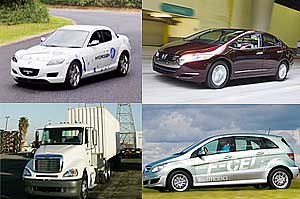 The National Hydrogen Association (NHA) Hydrogen Conference and Expo is coming to Long Beach, California next week, May 3 – 6, 2010. There are expected to be 1,500 attendees, 150 speakers and over 100 exhibitors.
Two of the exhibitors I’m interested in speaking with include SunHydro who have stated that they intend on building an East Coast Hydrogen Highway system and ITM Power who are building low cost electrolysis-based hydrogen fueling stations (SunHydro for sure will be there, but I have yet to confirm ITM Power will be there as well).
But, the main event in my eyes is Public Day including the free Ride ‘n’ Drive event. On Tuesday, May 4, 2010 from 10 am – 4:30 pm the public is invited to drive or ride in one of the hydrogen cars or vehicles at the Expo. Entrance into the Exposition is also free on Public Day.
What is so special about this Ride ‘n’ Drive event is that there will be several firsts. For instance, this will be the first time the public will be able to test drive the Mercedes-Benz B-Class F-CELL vehicle. A few years ago when I was at the NHA Conference and Expo, I received the opportunity to drive the Mercedes F-Cell A-Class, so I’m looking forward to taking this upgraded vehicle for a spin.
Another first will be the opportunity to drive the Mazda RX-8 RE rotary engine dual fuel vehicle. And yet another first will be the opportunity to ride in the Class 8 Vision Tyrano Hydrogen Fuel Cell Truck. And for me personally, I have yet to take the Honda Clarity out for a spin so this will be a special treat.
There is one more item that has piqued my interest about the Ride ‘n’ Drive and that is in the lineup of hydrogen vehicles to drive is listed a “Chevy Fuel Cell EV”. Now, this most likely will be the Chevy Equinox Fuel Cell, but could there be a surprise announcement? I guess we’ll just have to go to the conference to see.
No matter, however, since the new technology inside the Expo and new vehicles for the Ride ‘n’ Drive will be the most exciting and engaging to date.
-
Wow, Look What The Euro Just Did
This is beginning to feel like a bad play.
From FinViz is the latest Euro puke, following S&P’s downgrade of Spain:

Join the conversation about this story »
See Also:
- S&P Downgrades Spain To AA
- Here’s The Presentation Spain Is Using To Convince The World It Can Borrow Money
- Here We Go Again: Stocks And Gold Buck Wildly After Spanish Downgrade
-
Greenpeace reports Target now best for sustainable seafood
From Green Right Now Reports
Greenpeace released its fourth seafood “sustainability scorecard” today, which showed that the supermarket chain Target has moved up from fourth place to receive the number one ranking.

Tilapia, look for U.S. farmed (Image: Monterey Bay Aquarium)
Wegmans, last year’s winner for best seafood sustainability practices, inched down to second place. Whole Foods Markets remained at third place.
Safeway and Ahold USA (Stop and Shop and Giant stores) and Harris Teeter rounded out the top six stores in the rankings, which rate the retailers based on how well they are monitoring the seafood they sell to keep threatened and over-fished species off the market.
The top six supermarket chains of 20 reviewed all received strong marks for having a sustainability plan and acting on it. The next four stores were given credit for having a plan, and for taking some actions to preserve ocean ecosystems. The bottom ten stores were given failing grades.
The rankings are part of a report called Carting Away the Oceans. In the report, Greenpeace notes that three companies that had previously received a failing grade, achieved passing marks this year. Those are: A&P; Delhaize and Trader Joe’s, which Greenpeace had singled out last year for its failure to stop buying imperiled fish and its lack of a seafood policy to guide buying. The chain announced in March that it was developing a sustainable seafood plan.
This year’s losers in the Greenpeace rankings — those stores that continue to sell seafood that conservationists have identified as in jeopardy and have no “visible” plan to address seafood sustainability — include: H.E.B. (H.E.B. and Central Market), Meijer, Costco, SUPERVALU, Publix and Winn Dixie.
“A significant divide is developing among the major retailers,” said Greenpeace’s Senior Markets Campaigner, Casson Trenor. “It’s now clear that Wegmans, Target and Whole Foods are making substantive progress reflecting their commitment while others such as H.E.B. and Costco remain committed to selling endangered species and destroying marine ecosystems.”
Greenpeace believes all seafood sellers should adopt sustainable practices to help ensure the survival of fisheries and marine ecosystems worldwide. The environmental advocacy group advocates the creation of a global network of marine preserves that operate to help save ocean eco-systems and maintain long-term viability of fish populations. To help with this, food sellers should refuse to sell from fisheries that exploit marine populations, alter the eco-system (such as when large trawlers destroy coral), use practices that harm non-targeted fish (like dolphin) or illegal and unlicensed means of obtaining fish.
The list of chains that Greenpeace investigated, ranked from best to worst:
1. Target
2. Wegmans
3. Whole Foods
4. Safeway (Dominicks, Genuardi’s, Pavilions, Randall’s, Von’s)
5. Ahold USA (Stop & Shop, Giant)
6. Harris Teeter
7. A&P (Food Emporium, Pathmark, Super Fresh, Waldbaum’s)
8. Delhaize (Bloom, Food Lion, Hannaford Bros., Sweetbay)
9. Walmart
10. Trader Joe’s
11. Price Chopper
12. Aldi
13. Kroger (Baker’s, City Market, Dillon’s, Fred Meyer, Fry’s, King Soopers, Ralph’s, Smith’s, Quality Food Center – QFC)
14. Costco
15. Supervalu (Acme, Albertson’s, Bristol Farms, Jewel-Osco, Save-A-Lot, Shaw’s)
16. Giant Eagle
17. Publix
18. Winn Dixie
19. Meijer
20. H.E.B. (H.E.B., Central Market)
-
Video: Citroën Nemo fails European “moose test,” highlights value of stability control
Filed under: Safety, Videos, Peugeot, Citroën
 Citroën Nemo on its tippy toes – Click above to watch the video after the break
We’ve recently had two shining examples of the importance of having a properly functioning electronic stability control system (ESC) in new vehicles. The instability of the 2010 Lexus GX 460 is a known problem and Toyota is working to address it. The Lexus was equipped with ESC, it just wasn’t effective enough. Over in Europe, the Citroën Nemo failed miserably in a test conducted for a British consumer magazine because it lacked ESC entirely.
Which? is something of a British counterpart to Consumer Reports and had recently worked with German auto club ADAC to evaluate a trio of compact MPVs from Fiat, Peugeot and Citroën. The Qubo, Bipper Teepee and Nemo all share the same basic design, but only the Italian variant offers ESC as an option (and then only on diesel models). The Peugeot and Citroën do not offer ESC at any price. Needless to say, the results on the dreaded “moose test” (also known as the “elk test”) were not good. This particular test is a double lane change obstacle avoidance maneuver at 50 miles per hour.
After the Citroën Nemo flipped over in this test, the remaining testing of the Peugeot was abandoned. PSA, the parent company of the automakers, has announced that it will start installing ESC on the Nemo and Bipper diesel models in July of this year. A version for gas engined will have to be developed and installed starting in fall 2011. Video of the test is after the jump.
[Source: Which?]
Video: Citroën Nemo fails European “moose test,” highlights value of stability control originally appeared on Autoblog on Wed, 28 Apr 2010 10:27:00 EST. Please see our terms for use of feeds.
-
M.I.A.’s Graphic ‘Born Free’ Video Pulled by YouTube
 M.I.A. has never backed down from making a statement even if it has meant trouble for her on more than one occasion. Her latest video is no different, a nine-minute clip, which can be hard to watch at times, directed by Romain Gavras. Some are praising it as no-nonsense political commentary, others are appalled by the gore fest. But the explicit… (read more)
 -
Wakeboarding HD demo available tomorrow on PSN
The Tik Games-Creat Studios team-up may be known for its addictive puzzle games, but now that they have a shiny new spot down at the PlayStation Store, they’ll be spicing it up a bit with Wakeboarding HD,
-
Analyst: IW to be ‘essentially closed’ after the next MW2 map pack
The next Modern Warfare 2 map pack may very well be Infinity Ward’s last release. One analyst predicts that the studio will be “essentially closed” after that.
