Author: Serkadis

  • Roman and Medieval Confirmed by Ocean Sediments


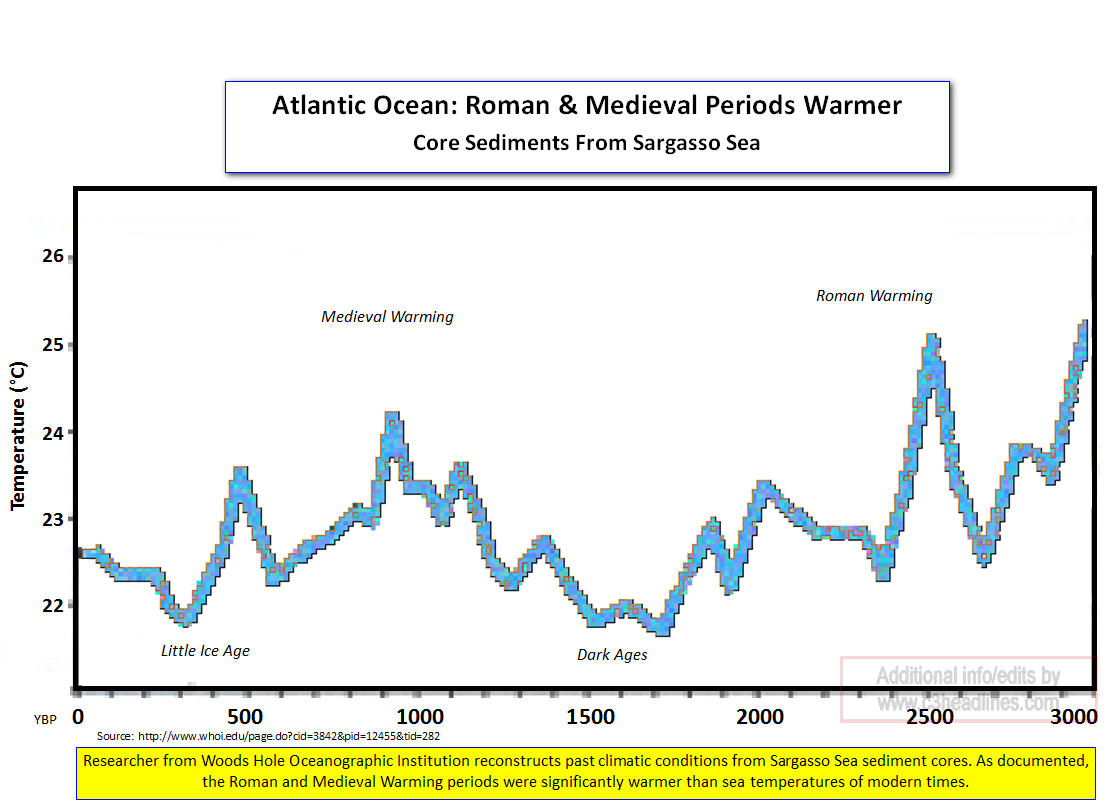
    I have posted that it is my present position that the atmospheric climate is altered through the engine of ocean temperature change and not the other way around.  What this chart shows is how variable the energy content of the Atlantic actually is and that key lows and highs are expressed in the historical record rather convincingly.


    Disappointingly, it is not clear from this that the process is particularly cyclic at all.  We do not have the rest of the Holocene here to play with, but the apparent 1100 cycle may simply not exist or it may exist but be imprecise in terms of period.  Again we need the whole Holocene and we also need to correct for the Bronze Age possibly sustained by the lack of desertification.


    The present regime tells us of a consistent heat content that has not changed in fifty years and that the resolution is too poor to pick up short term changes.


    We now have pretty consistent evidence that more heat is entering the Arctic at a constant annual inflow.  It is also clear that this increase may be very difficult to detect in either the sedimentary record or with ocean temperature records.  It is not too hard to imagine that the surplus heat is represented by an obscure diversion of currents somewhere and undetected.


    However, real climate change came with gross changes in the temperature of the north Atlantic Gyre and that is surely a lagging indicator at best, while temperatures associated with the Gulf Stream would lead.


    Atlantic Ocean Sediments Confirm Roman & Medieval Periods Warmer, Peer-Reviewed Research Determines

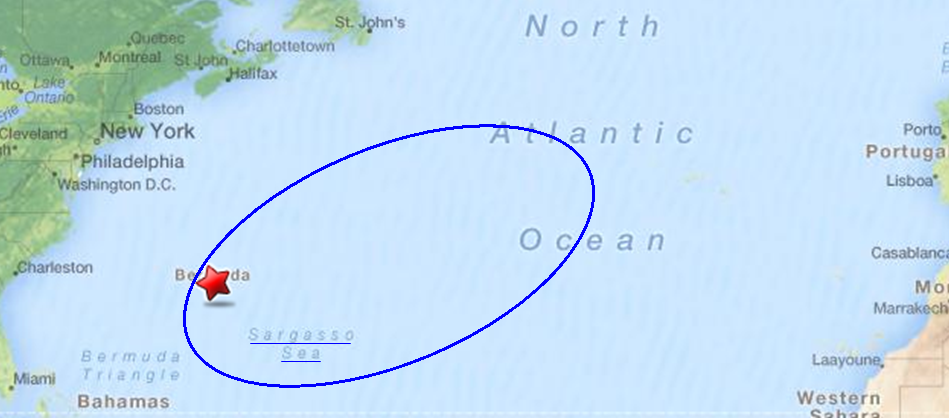
    Read here. View full map source here and/or click on image to enlarge. From the Sargasso Sea, researchers worked with a combination of “biweekly hydrographic data, a long history of sediment trap collections to document the rain of particles from the sea surface to the seafloor, and exceptional deep sea cores of sediment” to reconstruct sea surface temperatures stretching back some 3,000 years. The empirical evidence confirms that the Bermuda sub-tropical area experienced warmer temperatures during both the Roman and Medieval warming periods versus modern temperatures. (click on image to enlarge)
    “The core-top data indicate temperatures of nearly 23 degrees, very close to the average temperature at Station S over the past 50 years. However, during the Little Ice Age of about 300 years ago sea surface temperatures were at least a full degree lower than today, and there was an earlier cool event centered on 1,700 years ago. Events warmer than today occurred about 500 and 1,000 years ago, during the Medieval Warm Period, and it was even warmer than that prior to about 2,500 years ago.”
    “These results are exciting for a few reasons. First, events as young and as brief as the Little Ice Age and the Medieval Warm Period have never before been resolved in deep sea sediments from the open ocean. Because the Sargasso Sea has a rather uniform temperature and salinity distribution near the surface, it seems that these events must have had widespread climatic significance. The Sargasso Sea data indicate that the Medieval Warm Period may have actually been two events separated by 500 years, perhaps explaining why its timing and extent have been so controversial.”
  • Agricultural Infrastructure Opportunity


    What ho?  The agricultural industry has lost infrastructure?  This process has been going on for decades and has presently exhausted its course.  Capital based agriculture delivers most food to the market today while smaller operators are simply starved for capital.
    Push back is not going to alter the fact that most of our food will still come from these sources.
    However, it is quite right to observe that real political support is on the side of successful small operators.  Thus it is possible to reform the regulatory framework to actually support them.  This takes time, but even reported here changes are been made.
    It is also quite right for society to demand a high level of competence in the processing sector.  The difficulty has been that most farmers do not have the specialized training.  Yet that training is readily acquired through brief apprenticeships through licensing.  A large supply of local staff will also ably support a local processing industry.
    It is no big trick for a farm operation to equip a proper licensed slaughter shed and processing room with even a cold room.  Certainly I have seen this done for smaller animals such as turkeys and meat goats.  The end product was high end packaged meat.
    Doing it for beef cannot be much more troublesome as we certainly have done so in the past.  It only starts been difficult if you need to process more than one at a time.  A single operator with a modicum of stainless steel equipment can do it all to hung sides.
    My friend with turkeys and goats had no trouble getting the necessary regulatory support.
    Remember that a low volume operator has the extra time to do it right and to make sure the process is done cleanly.  Importantly, they are already experienced in maintaining clean operations.  Large operations have problems because they are vulnerable to the weakest link.  That new hire out of high school is not up to snuff and volumes must be maintained.
    Vertical integration is completely achievable for the farm operator.  Given operators can specialize in specific equipment and trade that with his neighbors.  What drives it all is the sharp value added selling structure achieved.  My friend with only five acres and a bunch of free range turkeys and a handful of goats, by both processing and packaging achieved gross sales approaching $200,000 while creating demand for his product and expansion possibilities.
    The result was also a completely desirable product.
    The NYT highlights a key food-system gap: infrastucture 
    CHRONICLE OF A MARKET FAILURE FORETOLD
    29 MAR 2010 1:23 PM
    When you’ve been in the trenches writing about a problem for a while, it’s good to see it finally getting traction in media and policy circles. That’s why I was thrilled to see Sunday’s New York Times piece on how a shortage of infrastructure is hampering the growth of local and regional food production.
    If you want more happy cows, agitate for more slaughterhouses and dairy facilities.When I helped start Maverick Farms in 2004 — and immediately started trying to source local meat and dairy for our farm dinners — it quickly became evident that the infrastructure needed to create an accessible, efficient, and profitable alternative food system in our area simply didn’t exist.
    The infrastructure gap was one of the topics that inspired me to write about food policy in the first place. In my very first Victual Reality column — published Aug. 16, 2006 — I declared that “The problem facing local food production isn’t lack of demand; it’s lack of infrastructure.”
    It’s a theme I’ve returned to dozens of times since (including in a recent op-ed for Newsweek). It is the lens through which I view the related topic of corporate consolidation of the food system — as large companies swallow up share of the food market, they shutter “inefficient” small processing plants and focus on operating ever fewer and ever larger facilities. The withering away of local-food infrastructure is a direct consequence of consolidation.
    My Meat Wagon series of posts, which focuses on the depredations of the very few companies who control the vast majority of meat production in this country, is animated by the desire to see a revival of human-scale, widely distributed diversified agriculture that mixes crops and livestock.
    I’ve argued again and again that local and regional food networks are never going to gain real traction without serious infrastructure investment; and that small and mid-sized farms, with their tight or negative profit margins, simply don’t have the cash flow to make those investments. Who should? To long-time readers, this will sound like a broken record: The federal government — which looked the other way while the food industry consolidated to levels that would make a 19th century robber baron blush, and which greases that system even now with crop subsidies — will have to step in. What we have is a classic market failure: growing demand for locally produced, pasture-based meat; growing desire among farmers to produce such meat; and a tight bottle-neck in processing infrastructure.
    I even made the eminently sensible — and utterly ignored — argument last year that a big chunk of the stimulus spending be directed to rebuilding local and regional food infrastructure. Sigh.
    So imagine my joy when I see stuff like this in the New York Times.
    In what could be a major setback for America‘s local-food movement, championed by so-called locavores, independent farmers around the country say they are forced to make slaughter appointments before animals are born and to drive hundreds of miles to facilities, adding to their costs and causing stress to livestock.
    As a result, they are scaling back on plans to expand their farms because local processors cannot handle any more animals.
    And the USDA, which has rarely until very recently uttered a peep about consolidation or the withering away of infrastructure, has taken note.
    “It’s pretty clear there needs to be attention paid to this,” Agriculture Secretary Tom Vilsack said in an interview. “Particularly in the Northeast, where there is indeed a backlog and lengthy wait for slaughter facilities.”
    According to the United States Department of Agriculture, the number of slaughterhouses nationwide declined to 809 in 2008 from 1,211 in 1992, while the number of small farmers has increased by 108,000 in the past five years.
    And the agency is even devoting resources to fix the problem.
    Mr. Vilsack … [is] urging farmers to band together and open local cooperatives or mobile slaughter facilities. The Agriculture Department is financing some mobile units and helping to build a regional facility near the Quad Cities in Illinois and Iowa. Helping small farmers, Mr. Vilsack said, will improve struggling rural economies.
    “We recognize that the buy-local food movement is a significant economic driver in rural communities,” he said.
    Of course, it remains to be pointed out that such funds — embedded in the “Know your Farmer, Know Your Food” program — amount to pennies on the dollar compared to what’s being spent on crop subsidies and corn-ethanol goodies.
    But it’s a start — and gratifying to see.
    Yet there remain massive gaps. The most glaring one today, to my mind, is dairy. According to this pretty amazing 2007 USDA report, there were 2507 processing facilities nationwide for fluid milk in 1972. By 2002, there were 524. Thus in the span of 30 years, we surrendered a startling 80 percent of our milk facilities. Over the same time period, the market share controlled by the top four dairy processors jumped from 17 percent to 42.6 percent. Today, a single company, Dean Foods, bottles more than a third of the milk consumed in the United States.
    These trends illustrate a kind of permanent, structural crisis in dairy farming — farmers face constant pressure to scale up and intensify, or exit the business. Between 1994 and 2004, the USDA report informs us, “the number of dairy farms decreased by 45 percent, but milk production per farm doubled.”
    Dairy farming recently entered particularly brutal phase — farmers are being forced to sell milk at below production costs, driving themselves into ruin and burnishing the bottom line of mega-processors like Dean Foods. Meanwhile, surviving farms tend to be large, heavy-polluting operations. Yet we’re living in a time when people are increasingly demanding access to milk from appropriate-scale, pasture-based farms. The time has come to bust up the dairy trusts — and rebuild the infrastructure that’s been laid waste as they gobbled up their smaller peers. Of course, I would say that.
  • Spinning Up Wind Energy


    The only thing I find encouraging about this particular scheme is that it is been pushed by a mechanical engineer.  This means that most of the basic homework is likely well done.  It should not fall over if built.
    Other wise it sounds a bit like a step too far, just like our super tall buildings.  We continue to discover that pushing technology past comfortable size constraints has a cost structure that does not rise linearly.  That is why we do not have hundreds of very tall buildings.  And who says that the users particularly like them?
    Again, I have to assume this can be built.  The piston scheme is simple and been industrial sized, is also likely to be very efficient.  Using bladders to hold the air at an appropriate depth is also simple.  However depth should not be too deep because the compression ratios will not favor it.  That may mean that they can simply be placed in nearby lake bottoms.  This at least avoids the issues with sea operations.
    Better still, set it all up in a reservoir that can be drained for early testing.
    Spin-out puts new spin on wind energy
    Mar 31, 2010
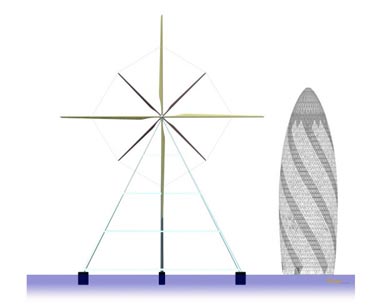
    The future of wind energy could involve huge blades spanning half a kilometre that generate compressed air – which is then piped into giant, underwater balloons. That is the dream of Seamus Garvey, a mechanical engineer at the University of Nottingham in the UK, who envisages using the pressurized air to inflate the underwater balloons, nestling about 500 m below the surface of the sea. Electricity could then be generated by releasing the air to drive a set of turbines.
    An important advantage of this arrangement, according to Garvey, is that several days’ worth of energy could be stored in the balloons while the wind is blowing – and then released when there is no wind. Garvey has just formed a university spin-out company called NIMROD Energy to commercialize the technology – dubbed Integrated Compressed Air Renewable Energy Systems (ICARES) – which he was been working on since 2006.
    Rotating slowly
    Garvey’s generator technology takes advantage of the fact that – for a given wind speed – huge turbines rotate more slowly than their smaller counterparts. While slow rotation makes electrical generation expensive, it is ideal for doing mechanical work. NIMROD’s turbine blades would be hollow and contain an internal piston. When a blade is pointing downwards, the piston is at the tip. But as the blade slowly lifts skywards, the piston falls through the cylinder, compressing air.
    According to Garvey, such a scheme can only work if the blade rotates slowly enough that the centrifugal force is not too large to pin the pistons to the ends of the blades. As a result, it would only be practical for turbines bigger than about 230 m in diameter. Indeed, he describes the 230 m-diameter turbine as the “baby”, with a giant, 500 m-diameter turbine being the ideal size.
    Although building such massive turbines would be expensive, that wind is free still makes them economical in the long term, claims Garvey. He calculates that building a compressed-air system would be less than a third of the price of a conventional offshore wind system with the same generating capacity. Indeed, Garvey says that his system could be as cheap as a gas-turbine generator and have zero fuel costs.
    What lies beneath
    On the energy storage side of the scheme, Garvey says the ideal storage balloon would be about 20 m in diameter and anchored 500 m below the surface of the sea. He has already begun to test prototype “energy bags” and has received a €310,000 grant from the energy company E.ON to develop the technology further.
    Garvey told physicsworld.com that a commercial undersea-storage system will be available by May 2011. However, he believes that it will take about 15 years to get the giant turbines up and running. In the meantime Garvey thinks the undersea bags could offer a convenient way of storing surplus energy from more conventional energy sources such as nuclear reactors, which are often located near the ocean.
    Bags of potential
    Compressed-air energy storage is not, however, a totally new idea. There are two facilities in the world – one in Germany and the other in the US – where surplus energy is taken off the electrical grid and used to pump air underground into disused salt mines.
    According to Garvey, underwater storage has two advantages over such underground facilities. First, underwater storage is not limited to the locations of disused mines. Indeed, many coastlines – including southern Europe and the western US have deep water nearby. Second, the pressure in an undersea bag is constant, which means that turbines can be used to covert the air back into electricity in a relatively efficient way. An underground storage facility, by contrast, has a fixed volume, which means that the air pressure drops as air is released.
    Garvey also believes that the bags could be used to store natural gas in maritime nations like the UK, boosting the country’s ability to ride out an interruption in imports of the fuel.
    Jakob Mann, a wind-energy expert at Risø National Laboratory in Denmark, says that the storage technique is “worthwhile trying”, adding that cheap ways of storing surplus energy are much needed. However, he added that the undersea nature of scheme could boost the cost. “Offshore is always expensive,” he says.
    Although Mann does not think locating the turbines in deep water will be a problem, he believes that building such massive compressing systems will be a challenge. Indeed, he suggests that the concept should first be trialled using electrical turbines that power electrical compressors.
    About the author
    Hamish Johnston is editor of physicsworld.com.
  • Smallest Superconductor Created


    This is an extraordinary discovery.  I wonder if nature has taken advantage of this somewhere like on butterfly wings.
    How about growing a super conductor layer on layers of graphene and chill it down to produce magnetic exclusion vessels?  All of a sudden super conducting technology became interesting.
    I continue to be pleasantly surprised to see this advance so quickly.
    Scientists create smallest superconductor
    by Staff Writers
    Athens, Ohio (UPI) Mar 29, 2009 

    U.S. scientists say they have created the world’s smallest superconductor — a sheet of four pairs of molecules less than one nanometer wide.

    The Ohio University-led study is said to provide the first evidence that nanoscale molecular superconducting wires can be fabricated and used for nanoscale electronic devices and energy applications.

    “Researchers have said that it’s almost impossible to make nanoscale interconnects using metallic conductors because the resistance increases as the size of wire becomes smaller,” said Associate Professor Saw-Wai Hla of the university’s Nanoscale and Quantum Phenomena Institute.

    Hla, who led the study, said superconducting materials have an electrical resistance of zero, so they can carry large electrical currents without power dissipation or heat generation. Superconductivity was, until recently, considered a macroscopic phenomenon. Hla said the current findings, however, suggest it exists at the molecular scale, which opens up a novel route for studying the phenomenon,

    The study also provided evidence that superconducting organic salts can grow on a substrate material. “This is also vital if one wants to fabricate nanoscale electronic circuits using organic molecules,” Hla said.

    The research that included Kandal Clark, Sajida Khan, Abdou Hassanien, Hisashi Tanaka and Kai-Felix Braun appears in the early online edition of the journal Nature Nanotechnology.
  • Lift and Carry System

    Key Features and Benefits:

    -Barrel Cam and Cam Follower lift mechanism allowing smooth lift and lowering motion
    -Soft touch pick-up per customer specifications are machined into the lift cam – eliminating the need for extra programming
    -Hydraulic compensation system to assist on lift strokes to increase life expectancy of the lift unit
    -Special tooling inserts with customer specified hole patterns
    -High quality extruded steel rails available in many sizes
    -Extruded steel 3 dimensional cut rails to reduce noise during transfers
    -Hardened gear rack and pinions for transfers
    -Cam plate / cam follower technology for positioning accuracy during transfer strokes
    -Pevolan and Vulkollan transfer rollers for noise reduction and increased life of shuttle rails
    -Many different standard and custom lift and transfer shuttle options available

  • Washable cut resistant glove

    Handling glove, water repellent cowhide palm, water repellent split leather back, elasticated wrist, cut resistant seamless lining.

    Abrasion : 3 / 4
    Cut : 5 / 5
    Tear : 4 / 4
    Puncture : 4 / 4

    Dexterity : 5 / 5
    Water penetration: 4 / 4 (180 mn)

    Protective glove to handle sharp objects in a dry environment, exclusively against mechanical risks.

  • FIRST VERTIMILL® 3000-WB HEADED FOR AUSTRALIA

    The first 3000 HP (2240 kW) Vertimill®, known as the VTM-3000-WB, is destined for Newcrest Mining Ltd.’s Cadia Valley Operations, where it will be operated in a tertiary grinding role. Cadia’s concentrators in New South Wales already have several Vertimills® (VTMs) operating in traditional regrinding roles, as well as a VTM grinding SAG product in parallel with a ball mill.
    The Metso VTM has been proven to grind more efficiently than ball mills with feeds as coarse as 6 mm to products finer than 20 microns. It has become the industry standard in concentrate regrind application, but has been slow to be adopted for large scale coarser applications. The hesitation to advance VTMs in primary and secondary grinding is largely because more VTMs are needed to perform the same task as a single large ball mill. The new VTM-3000-WB, however, reduces the number of units required. Cadia is now able to get the grinding power it needs to meet their product size requirements with a single Vertimill.®
    “The VTM-3000-WB is an enabling technology that allows operations like Cadia to get the maximum payback and profitability for their grinding projects,” says Jonathan Allen, Metso’s Vertimill product manager. “It has all of the same components and therefore the same advantages as smaller VTMs, but with the added advantage of lowering total capital cost and maintenance.”
    Their Cadia Valley operations are based on a large, low grade ore deposit requiring high throughputs to maintain profitability. These commenced with the Cadia open cut mine and concentrator, which commissioned in 1998, and the adjacent Ridgeway underground mine and concentrator, commissioned in 2002. Current capacity at Cadia is 17 million tonnes per annum and for Ridgeway 5.6 million tonnes per annum.
    The near surface ores are being worked out, so to ensure the longer term future at Cadia Valley, Newcrest is developing two underground projects — Ridgeway Deeps and Cadia East.
    The changing ore feed to the Ridgeway concentrator necessitates additional grinding power. According to Leigh Cox, general manager of Newcrest’s Cadia Projects, additional grinding ultimately means improved recovery.
    The project also had space limitations, so the small footprint of a single VTM made it the ideal solution.
    The VTM will be delivered mid-March 2010 and commissioned by the end of June. Installation support and process commissioning services are included.

  • 4.5″ (114MM) WIDE – ELECTRIC LABEL DISPENSER “HIGH SPEED”

    Designed to see CLEAR LABELS
    Ideal for short length and bar code labels
    Will dispense labels and die-cut parts
    Will dispense labels from .25″ to 4.5″ (6.4 to 114mm) in width
    Will dispense labels from .125″ to 6″ (3.2 to 152mm) in length
    Will accommodate core sizes from 1″ (25.4 mm) up
    Photosensor accuracy
    Automatically removes paper, vinyl, acetate, polyester, foil, etc.
    from its liner
    Automatically rewinds liner scrap for a cleaner working
    environment
    Liner scrap is easily removed
    No tools required for adjusting to different size labels
    All metal construction
    No maintenance required
    Adjustable strip plate for hard-to-release labels
    Made in the U.S.A.

    START International’s The Label Dispenser; Electric Label dispensers increase efficiency, eliminate waste, increase operator productivity and deliver your labels with integrity.

    START International’s The Label Dispenser; Electric Label dispensers increase efficiency, eliminate waste, increase operator productivity and deliver your labels with integrity.

  • Model range expanded: NASH Vectra XL 750 with suction capacities to 7,000 m³/h

    Gardner Denver Nash has expanded its “Vectra” model range series of liquid ring vacuum pumps and compressors: The NASH Vectra XL 750 is designed and built for suction capacities of up to 7,000 m³/h and can be used as a vacuum pump as well as a compressor.

    When operating as a vacuum pump, suction capacities of up to 6,800 m³/h can be achieved and the vacuum range can reach 50 mbar absolute. As a compressor, the NASH Vectra XL 750 handles up to 7,300 m³/h and achieves a discharge pressure of 3 bar absolute.

    Due to single-point inlet and discharge connections, the need for manifolds is eliminated. This simplifies the layout of the piping to and from the process and reduces installation costs.

    NASH Vectra XL 750 liquid ring vacuum pumps and compressors combine maximum reliability with flexibility and are available for a wide range of applications, including the chemical process industry and filter applications in paper manufacturing. O-ring seals and oil lubricated bearings are used to meet the most demanding requirements and, as always, Gardner Denver Nash uses state-of-the-art manufacturing procedures to achieve optimum performance and operating efficiency.

    The NASH Vectra XL 750 is available in ductile iron or stainless steel.
    ATEX certified NASH Vectra XL vacuum pumps and compressors, complying with guideline 94/9/EG in categories 1 and 2, are available for explosive categories and for the handling of explosive media.

    Reliability, efficiency and flexibility make the NASH Vectra XL 750 an outstanding liquid ring pump for use in demanding applications.

    About the Company:
    Gardner Denver Nash is the Nash Division of Gardner Denver, Inc. Originating from nash_elmo Industries, the company is the world’s leading manufacturer of liquid ring vacuum pumps, compressors and engineered systems. For more than 100 years, Gardner Denver Nash has engineered and produced liquid ring pumps and vacuum and compressor systems for the most demanding applications in a variety of fields and industries.

  • Resource-efficient PET foam core for the composite materials industry

    A ‘green’ plastic? – What sounds like a contradiction in terms is in fact already part of our everyday lives: PET is recyclable and is fed back into the economic cycle as a high-quality resource. PET beverage bottles, for example, are recycled in the form of polyester fibres which are then used to make products such as fleece textiles or new bottles. Thanks to innovative technologies, Armacell is now able to manufacture foam cores, which are used in transport, wind turbine construction or shipbuilding, from the recyclate of PET bottles. So in future the company is going one step further and offering not just a fully recyclable foam core, but a product which is manufactured from a recycled raw material.

    Armacell is adopting the cradle-to-cradle principle. This concept is aimed at avoiding waste by recycling materials in a closed loop and, therefore, continuously re-using them. However, this recyclability (and thus the conservation of natural resources) is not the only advantage of the polymer. Its low weight makes PET an ideal material for lightweight construction applications. PET foam cores are extremely energy efficient, because they require less input power than conventional materials. Furthermore, ArmaFORM PET foams have high mechanical strength in combination with residual flexibility and excellent fatigue resistance. In addition, they are high-temperature resistant and withstand short-term curing temperatures of up to +180 °C. They also display very slight variances in density of +/- 5 kg/m³ and, unlike natural core materials, their availability is ensured.

    Typical areas of application for ArmaFORM PET are marine (boat hulls, cabin interiors), transport (carriage body, interior panelling in trains, buses, trucks and cars) and wind turbine construction (rotor blades, nacelles). Whereas the disposal of rotor blades made of conventional composite materials presents problems which will become a real challenge for wind turbine operators in the coming years, PET foams are recyclable. When future wind turbines are produced, it is surely the logical consequence for this ‘green’ sector to use ArmaFORM PET, which conserves resources and protects the environment.

    Meet us at the JEC-show in Paris, booth Q52 (13.-15.04.2010) to find out more about our green foams.

  • UTE developed a new design for dental handpiece bearing

    High speed dental drill bearing is the heart of high speed dental handpiece. 17 years ago, UTE was the first one to devote in its design and new material use. UTE dental drill bearing can give a stable performance as 400 thousand revolutions per minute (RPM), which has led dental treatment to a painless era.

    S418 and S718 series dental drill bearing, the ferrule and balls are made of 440C stainless steel. UTE also makes silicon nitride ceramic ones according to customer request. Currently, we are using stainless steel balls from Japan and Si3N4 silicon nitride ceramic balls from Saint-Gobain (USA).

    We use super resin material with titanium fibers to make UTE’s self-developed S418 series dental drilling bearing support frame. Since the hardness of titanium fiber is much lower than fiber glass, it protects the counterpart from friction. We also added some portion of solid lubrication in this resin to reduce friction and let the bearing endure longer friction under high speed rolling. The lubrication capability of this material is quite suitable for dental drilling bearings to take high temperature and high pressure steam sanitization time after time, even in oilless condition.

    Because of the low friction of UTE dental drilling bearings, it consumes less power but produces strong output performance. It also saves time and man power, preferred by many dental experts.

    Presently, UTE developed a new design for dental handpiece bearing, which is angular contact ball bearing and has 9 balls(conventional 8 ball bearing is deep groove ball bearing). This new bearing has higher load capacity and longer lifetime.

  • ZEITLAUF® NoiselessPlus planetary gearheads – unique smoothness

    The NoiselessPlus Planetary gearhead from ZEITLAUF® antriebstechnik is one of the smoothest running and quietest planetary gearheads currently available on the market. NoiselessPlus is setting new standards for planetary gearheads – with outstanding properties which offer clear advantages in all areas of application:

    • maximum smoothness
    • high radial loads
    • unbeatable reductions
    NoiselessPlus shows its strengths best wherever the application requires maximum power output and lowest noise generation. This unique compact drive can cope with a wide range of different tasks.

  • U-COMAX

    NC Boring and facing heads for Transfer machines and special machines.

    U-Comax boring and facing heads are axial control heads designed to be used on transfer machines, machining units, and special machinery. The feed control of the tool holder slide is commanded, also during rotation, by a UDrive drive unit and is managed directly by the numerical control of the machine.

  • Rotary Welding System – Quickly loaded/ unloaded

    The automated circumferential welding system from Gullco International Ltd. Incorporates an XY slide driven servo motor which is interfaced with a Gullco software program. This allows the operator to work with a graphic touch screen interface enabling numerous individual weld cycles to be programmed and stored. These new slides can operate as either a linear slide or an oscillator with adjustable oscillation position, adjustable width and dwell. They can also be programmed for index welding, multipass welding with programmable lift and changes in oscillation width and position.

    www.gullco.com

  • One Embedded Core Duo Computer controls two displays

    Dual Independent Display and Display Clone possible

    MPL AG developed an expansion module for the Intel Core Duo based PIP series computers, that provides the possibility to connect an additional second display! The new “Serial Display Link to DVI module” (SDLD-1), together with the Intel Embedded Graphics driver, offers the following graphical display output combinations:

    • Different display content (Dual Independent Display)
    • Identical display content (Display Clone)
    • One expanded Desktop

    The optional module can easily be mounted on the on-board SDVO (Serial Digital Video Out) interface of the PIP computer and allows the connection of an additional digital DVI monitor. Depending on the application, the two displays can be identical or totally different (size, resolution & type). The maximum supported resolution of each monitor is 1920 x 1200 (WUXGA).
    The combination of a PIP and SDLD-1 is a reliable, complete, compact and clever solution for industrial applications. With an additional second digital graphic output, the embedded PCs are ready to enter new markets. MPL reacts to the increased demand to control two displays with only one computer.

    The new SDLD-1 module can be used in the powerful Intel Core Duo fanless embedded PIP series (versions with Core Duo 2x 1.67GHz and Core 2 Duo 2x 1.5GHz). The solution offers a flexible, cost-efficient possibility to control two displays with one compact embedded computer.

  • Vaisala Launches New High Performing Humidity-Temperature Probe, HMP110

    Vaisala press release

    Improved stability for long term humidity measurements

    Demanding and tightly regulated environments in life science industries and laboratories require accurate and reliable humidity and temperature measurements. Processing, packaging, and storing of products in pharmaceutical, biotechnology and medical device industries need stable environmental conditions to ensure productivity and high quality.

    Vaisala’s new high performing humidity and temperature probe, Vaisala HUMICAP ® HMP110, is ideal for these environments as it offers improved measurement stability for for long periods of time.

    Vaisala HUMICAP® Humidity and Temperature Probe HMP110 is small and compact, easy to install, maintain and change. The high performance, chemical tolerance and stability are based on Vaisala’s renowned HUMICAP sensor technology. The probe covers the full humidity range in temperatures from -40 to + 80 °C. Each individually adjusted probe comes with a calibration certificate traceable to NIST (National Institute of Standards and Technology).

    HMP110 complements Vaisala’s wide offering of high-performing instruments for incubators and stability chambers.

    Probe replacement service
    In addition to the standard calibration services, Vaisala offers a new type of replacement service for the HMP110. When needed, customers can order a new calibrated probe from Vaisala and exchange their old probe to the new one, shipped from Vaisala’s service centers in Finland, USA, Japan and China.

    Vaisala’s Cleanrooms and Chambers market segment serves customers in versatile industries to increase operational efficiency and productivity. Customers operate in critical environments such as cleanrooms, laboratories, incubators, environmental test chambers and warehouses.

    Vaisala is a global leader in environmental and industrial measurement. Building on more than 70 years of experience, Vaisala contributes to a better quality of life by providing a comprehensive range of innovative observation and measurement products and services for meteorology, weather critical operations and controlled environments. Headquartered in Finland, Vaisala employs over 1400 professionals worldwide and is listed on the NASDAQ OMX Helsinki. www.vaisala.com

    For more information:

    Jan Grönblad, Market Manager, Cleanrooms and Chambers, tel. +358 40 7683 826
    Liisa Ahtiluoto, Communications Manager, tel. +358 40 730 7695

  • Molten Metal Temperature Indicator

    Molten metal Temperature Indicator (LMI-2010): Libratherm offers Micro controller based Molten Metal Temperature Indicator model LMI-2010, which is designed to measure accurately the temperature of ferrous and non ferrous molten metals. The measurement of this temperature is a critical process, since the expendable thermocouple is dipped for merely 3 to 4 seconds and then withdrawn. In this short measurement time, the operator is guided through the measurement cycle by audio/visual alarms for thermocouple continuity, measurement in progress and measurement over.
    Any error in measurement due to thermocouple open condition is immediately detected and informed by activating the audio/visual alarm.

    LMI-2010 is indigenously designed to measure and display the molten metal temperature in very short time interval. The indicator is rugged, reliable, field proven and very easy to operate. User can select the desired type of thermocouple and also set other parameters using front panel key board. During measurement, the indicator ignores the slag temperature and the Average or Plateau reading is determined using the advanced algorithm and the same is latched and displayed on the bright 7 segment 2” red Led display. The latched readings are transmitted on two wire RS485 bus for remote display and computer interface.
    Large or Remote Display (LRU-2010) : Libratherm also offers micro controller based remote display to be used in association with LMI-2010. The reading available from LMI-2010 on RS485 2 wire bus is captured by this remote display model LRU-2010, which indicates the latched reading on 4” large red 7 segment LED display.
    With single LMI-2010, maximum 1 node of computer and 5 LRU-2010 can be connected in serial multi-drop configuration. This display works on 230VAC and can be mounted at a suitable height for distant viewing.

    Lamp and Hooter Compartment (LLC-2010): For remote audio/visual indications – Libratherm offers this unit – which can be driven from the potential free contacts available from LMI-2010.

  • For complicated geometries

    Start for ROEMHELD swing clamps without swing stroke

    Actually the principle is quite simple: The hydraulic swing clamp without swing stroke is a double-acting pull-type cylinder where a part of the piston stroke is used to swing the piston rod without axial stroke. This allows the clamping arm to easily enter in recesses that are only insignificantly higher than the clamping arm.

    The ROEMHELD experts with their high potential of experiences now have realised in a technically perfect way, what sounds simple in theory . Where up to now clamping points have to be kept free for loading and unloading of the fixture, now also recesses can be used for clamping. The piston rod together with the clamping arm is rotated without axial stroke to the desired direction and after the completion of the swing motion above the clamping point the linear clamping stroke is effected. To make this principle a reality, a higher production expense and more interior components that are perfectly matched are required compared to traditional swing clamps.

    Ideal for complex design workpieces

    Especially for complex shaped cast parts or aluminium parts with complicated ribbing it is ideal, if no swing stroke is required. Besides the high process safety, there is a further time saving due to a clamping lever that can be swung into a recess. The demand for up to date fast loading and unloading of the workpiece to be machined is thereby met.

    The swing clamp with its compact flange design and its maximum operating pressure of 350 bar is optionally available with clockwise or counterclockwise swing motion. The standard swing angle is 90°, but special swing angles between 20° and 70° are available on request as well. Also the metallic wiper that protects the standard FKM wiper against mechanical damage can be selected as an option. An electric or pneumatic position monitoring is optionally available.

    The reinforced swing mechanism without overload protection device endures a collision of the clamping arm with the workpiece up to a pressure of 100 bar during the swing motion.

    Focused on a high-precision fabrication and a way of thinking oriented at the customer, ROEMHELD has looked for a purposeful solution for clamping tasks and has implemented an application-oriented solution.

  • New protection and colouring system

    Protection and colouring system for blind rivets and self-tapping screws.
    • Available in over 50 colours.
    • For rivets and screws from D. 2,4 to 5 mm with head diameters up to 10 mm.
    • Preservation against the atmospheric agents.
    • Pleasant looking.

    Packaging:
    • Bulk packaging 5.000 pcs.
    • Box 500 pcs.
    • Blister 100 pcs.

  • Assemblies and Optical Systems from OWIS®

    OWIS® develops and manufactures opto-mechanical assemblies and optical systems for the photonics industries and research.

    Customers in sectors such as semiconductors, industrial sensor technology, biotechnology and medicine, aerospace and printing technology appreciate OWIS® for their competence and reliability.

    OWIS® assemblies and optical systems are a combination of:
    – optical components
    – mechanical and motorized components
    – control units and software

    Our optical systems and components in different beam heights are, particularly in the smallest miniature version, ideal for building complex beam lines in a limited space (black box). Not only the compact size and the easy handling, but also the compatibility of the OWIS® systems to one another allows flexible setups in all application ranges.

    For these or other applications OWIS® also offers manual and motorized positioning units for all system heights, as standard and customized solutions. Using the corresponding positioning controls, motion sequences can be performed automatically.

    With an extensive know-how based on 30 years of experience, OWIS® engineers support the customers in the implementation of their demanding tasks – from consulting to engineering and production through testing and documentation.