Jake Breeden, author of “Tipping Sacred Cows: Kick the Bad Work Habits that Masquerade as Virtues,” recently participated in an “At Google” talk, which Google has now made available for viewing on YouTube.
More recent At Google talks here.
Jake Breeden, author of “Tipping Sacred Cows: Kick the Bad Work Habits that Masquerade as Virtues,” recently participated in an “At Google” talk, which Google has now made available for viewing on YouTube.
More recent At Google talks here.
Data center nerds got two big announcements today with both Google and Facebook announcing big projects. Facebook’s new data center construction in Iowa is the fourth data center for the search giant, while Google’s Iowa expansion carriers a higher price tag. But the dueling news releases also highlight a growing infrastructure rivalry between these web giants.
Facebook formally announced the construction of a new data center in Altoona, Iowa. Construction on the first phase will begin this summer and your Facebook likes and photos will start traveling over the data center in late 2014 according to Tom Furlong, vice president of site operations at Facebook.
He said that while newspaper reports placed the value of the center at $1 billion to $1.5 billion, he’s unsure where those figures came from. This first phase will cost $300 million and result in a 476,000 square-foot data center. That square footage includes both offices and floor space. Like Facebook’s data center in Lulea, Sweden the hardware inside will be built for Facebook to its Open Compute standards.

Facebook’s data center in Prineville, Ore.
When I asked Furlong if the Altoona data center would be built for disaster recovery purposes — as some of my sources had suggested — he told me, “we’re in the N+1 mode,” meaning he was building out capacity beyond what he needs to serve customers. While Furlong was clear that the data center would be more than just a failover site for Facebook’s Prineville, Ore.; Forest City, N.C.; Lulea, Sweden or leased data center space, it would represent excess capacity that could still support traffic from other sites if a region failed.
He also alluded to mechanical, electrical and networking improvements, but other than saying that servers handling similar products would be grouped together he declined to get specific. But I’m hoping his boss, Jay Parikh, the VP of infrastructure engineering at Facebook who is speaking at Structure in June will share the details.
On the capital investment side, Facebook said in its 10-K filing that it planned to spend $1.8 billion in capital expenditures in 2013. When asked if this data represented a large chunk of that, Furlong said it didn’t. AND at $300 million it probably wouldn’t, especially if servers and gear wouldn’t make it into the data center until 2014 as Furlong suggested.
But in a curious bit of timing, Google today said it would expand its Iowa data center operations in (relatively) nearby Council Bluff, Iowa. The search giant will spend $400 million building out its existing data center operations, bringing its total spent in the area to $1.5 billion. The data center houses computer systems and associated components that support services such as Google Search, Gmail, Google Maps and Google+.
In the data center world, the growing rivalry between Google and Facebook is common — if quietly addresses –knowledge, which is why the timing of Google’s announcement seems designed to steal Facebook’s thunder. However, Google’s spokeswoman attributed the timing to an Iowa Economic Development Board meeting held this morning, where the board approved incentives for both Facebook and Google.
However, it’s no secret that Facebook has been stealing pages from Google’s book and is also pushing for more openness than it’s famously “open” rival. Facebook’s Open Compute project announced in April 2011 clearly found inspiration in Google’s own efforts to build its own hardware to maximize efficiency. With Open Compute, Facebook took Google’s basic idea and opened it up to masses after putting considerable engineering talent behind it.
That’s only one example. Facebook has also been open about how it builds and operates its data centers, which has led to many of those in the industry to start releasing their own data. For example, after Google published a blog post last year noting the power usage effectiveness ratio for its data centers, Facebook countered with an email indicating the differences between its calculations and Google’s. Microsoft also was quick to respond with details on its own PUE calculations.

Facebook’s Forest City, North Carolina data center.
That type of data has now become a PR battleground for many of these companies. And while it’s a game Google seems reluctant to play, it’s one that it has resigned itself to. Industry insiders note that Google is opening up as Facebook pushes the envelope on transparency.
The search giant’s appearance and presentation last November at an industry conference that shared seven years of knowledge gained at Google, plus its invitation of a CBS news crew to tour its data center in North Carolina (where Apple and Facebook both have data centers and our own Katie Fehrenbacher was yelled at for snapping a picture) are a few examples.
These steps are unheard of for the search giant, which is famous for holding its infrastructure details close to the vest. In the CBS video, Google’s infrastructure czar Urs Hölzle said that the tour granted to the CBS crew is the only time he’ll allow cameras into the data center. Google once asked me to avoid using a picture of a slide I had taken at a conference that showed a switch it had designed. I didn’t run the picture, but that was because it was blurry.
So as Facebook pushes Google, perhaps Google is now pushing back a bit today with its own Iowa news. Google’s is a bigger project announcement, coming the same day after Facebook’s might just be a coincidence enabled by incentive packages, or it might be an attempt to steal Facebook’s thunder.
Regardless, two web giants striving to make computing faster, more efficient and in Facebook’s case, more open, is a good thing: both for Iowa and for the rest of us.

Related research and analysis from GigaOM Pro:
Subscriber content. Sign up for a free trial.

     |
Google has bought mobile news startup Wavii for over $30 million, according to a report from TechCrunch, who says the news comes from “a legitimate source”. Nothing official has been announced yet.
According to TechCrunch’s Alexia Tsotsis, Google was in competition with Apple for the startup, which has drawn comparisons to Summly, which Yahoo acquired last month, and has already implemented in its new iPhone app.
Here’s an interview we did with Wavii CEO Adrian Aoun last year, in which he describes the product.
Rumors were going around last week that Google was close to acquiring the company, though Business Insider said the price would be less than $30 million.
Jody Eddy, author of the book, “Come In, We’re Closed: An Invitation to Staff Meals at the World’s Best Restaurants” recently gave an “At Google” talk, speaking about her work, which is said to “peer behind the ‘closed’ sign in the world’s greatest restaurants”.
Similarly, author Michael Romano also spoke at Google talking about his book Family Table, which also looks behind the scenes at some restaurants.
More recent At Google Talks here.
 X-Mouse Button Control allows contextual mapping of the mouse buttons. This means that the mouse can initiate different actions depending on a given context (an active application, specific area on the screen).
Obviously, this tool is not intended for users that view the computer mouse as a simple three-button pointing device.
… (read more)

Google announced the launch of a new upgrade center for upgrading AdWords accounts to Enhanced Campaigns today. The center lets advertisers upgrade several campaigns at once and merge them together.
In a blog post, Google explains how to use the tool:
There are two basic ways to use the upgrade center.
1. Bulk upgrade
This option provides a fast way to upgrade multiple campaigns that don’t need to be merged. Rather than upgrade campaigns one at a time, you can select several campaigns, choose a mobile bid adjustment, view traffic estimates, and upgrade with fewer clicks.
2. Merge and upgrade
If you have search-only or search+display campaigns that have similar keywords and location targets, the upgrade center automatically identifies them as candidates to merge. You’ll then be able to preview and adjust the proposed campaign settings, ad groups, and extensions for the merged campaign. By default, ad groups and budgets will be combined. Other campaign level settings and extensions in the Primary campaign will override those in the Secondary campaign.
The upgrade center will be rolling out over the coming weeks. It can be found in the left-hand navigation bar on the Campaigns tab.
All campaigns will be upgraded to Enhanced Campaigns on July 22.
Microsoft introduced a new ad format for Outlook.com today, called versaTiles. It’s currently being sold in the U.S. and Brazil, but will also soon launch in Australia, Canada, France, Germany, Italy, Japan, Netherlands, Spain and the U.K.
The format consists of flexible-sized tile strips, which Microsoft says gives advertisers a “valuable surface area” to deliver relevant content in scenarios where people expect commercial content. Here’s a look:
There are three customizable templates that advertisers can use: Online Retailer, Media Showcase and Catalogue.
Online Retailer, Microsoft says, “Allows the advertiser to capture consumers’ attention, and showcase a product or a service, and then connect the consumer to the advertiser’s online distributors. From a consumer standpoint, this template enables them to locate brick and mortar retail outlets in their area, alongside viewing and discovering product or service details within the tile experience.”
The company adds that Media Showcase “Gives a unique ad experience to get a brand’s message conveyed by using a combination of video, image galleries and text. The template is applicable to multiple verticals aiming at building awareness and consumer engagement.”
Catalogues simply lets you feature multiple products. The first tile shows the theme, and the others show different products.
In addition to three templates, the versaTiles format also consists of three states: Default, Hover and Click. The default state is what consumers see when they log in to Outlook.com, the hover state shows more in-depth info and/or additional images and info when they hover over the ad, and the click state has the ad expand when clicked, showing different creative elements or brand messaging (which varies by template).
Groupon has launched updates to its iPhone and Android apps, which make search “a front-and-center experience,” as the company says.
Here’s a look:


Groupon has this to say about search’s importance to its business:
Search is a critical part of Groupon’s product strategy. Most Groupon merchants now make their deals available on an ongoing basis, and search allows customers to find only the deals most relevant to them in this expanded marketplace. In iPhone v.2.5 search is prominent with a clickable icon that allows customers to navigate from anywhere in the app.
Search is also a central element of Android v.2.4, which also includes a sleek new interface for 10-inch tablets. The Android tablet market is growing quickly, and, with support for tablets, the Groupon Android app is now a great complement to Groupon’s highly regarded iPad app.
An increased focus on search from Groupon is long overdue. People want deals on specific things, not just the latest massage offer that they happen to email you on a given day. This is why Google’s AdWords has been so successful. Advertisers can cater to what people are actually looking for. Likewise, with Groupon, this should be a basic element of the service, and promoted as such.
 The measure of a platform’s success is applications — and, contrary to Apple marketing, not how many but which ones. Windows Phone 8 gets a lift today with the addition of Tumblr, natively developed rather than homegrown like Facebook.
I don’t have Windows Phone to test the app, but based on information Microsoft provides, all the basics are there — posting photos from the camera, for example. There is voice recognition for dictating posts and support for animated GIFs.
Social is key to any smartphone platform’s success, and Tumblr is one Windows Phone needs. The service hosts more than 104 million blogs, has received 48.7 billion posts to date and in February had more than 26 million unique visitors, just behind Pinterest (26.97 million) and WordPress.com (27.96 million), according to comScore.
Full feature highlights, from Tumblr staff blog:
- Find and follow the things you love
- Share photos, gifs, video, quotes, chats, links, and text
- Jump between your dashboard and Explore with just one swipe
- Display the latest images from your dashboard on your lock screen and live tile
- GIFs play as you scroll
Still, huge social holes remain, like Instagram. Given Microsoft’s investment in and partnership with Facebook, an official app for the social network and photo-sharing service shouldn’t be that hard to do — and yet they’re MIA. SnapChat, anyone? Not on Windows Phone.
Here’s a roundup of some of some of this week’s headlines from the storage industry:
SGI Unveils InfiniteStorage Gateway. SGI introduced the InfiniteStorage Gateway, a virtualized data management solution, which reduces the runaway costs and complexity organizations face when managing exponential data growth. While creating a virtualized storage fabric that can include disk, tape, object and cloud storage the gateway provides a way for users to see and access all the data all the time, no matter what might be happening to the storage infrastructure in the background. Because the storage infrastructure is virtualized, as requirements change, the type of storage deployed can also evolve, with no interruption to users. SGI InfiniteStorage Gateway includes up to 276 terabytes of onboard capacity, and is deployed as a factory-integrated solution in the 4U SGI MIS storage server, powered by Intel Xeon processors. ”As data growth has continued to sky-rocket, IT organizations increasingly face the problem of infrastructure fragmentation, and the fact that their most expensive primary storage arrays are often used to house mostly inactive data,” said Laura DuBois, program vice president, IDC Storage Systems, Software and Solutions. “Data management is not only about the performance of active data today. It also must provide a seamless long-term strategy for all data that keeps costs at a minimum and reduces IT administrative burden without impacting users.”
Violin Flash Memory Arrays Certified with SAP Sybase. Violin Memory announced that its 6000 Series Flash Memory Arrays are now certified for interoperability with SAP Sybase Adaptive Server Enterprise (SAP Sybase ASE), delivering reliability and accelerated performance across a range of enterprise applications. Violin Memory is now an SAP software solution and technology partner in the SAP PartnerEdge program. “The Violin Flash Memory Arrays integrated with SAP Sybase ASE are a key solid-state storage component for the acceleration of business-critical applications from SAP,” said Kevin Ichhpurani, senior vice president, Business Development and Ecosystem Innovation, SAP. “The certification process showed that the arrays can deliver significant performance improvement over traditional disk-based systems, delivering substantial value to customers. In fact, during preliminary internal testing, we have seen 10x improvement in the performance of SAP Sybase ASE running on Violin Flash Memory.”
LSI Flash Accelerates IBM Servers. LSI announced that IBM is now offering new versions of its High IOPS Modular Adapters family based on LSI Nytro WarpDrive technology. The new models join IBM’s growing stable of PCIe Flash cards and are designed to be used with the IBM System x server series to help clients speed Big Data analytics. The adapters will support capacity options ranging from 300GB to 800GB of SLC and MLC Flash memory for IBM System x servers. “Rapid data growth and rising application performance requirements have exposed the limitations of today’s aging storage architectures,” said Gary Smerdon, senior vice president and general manager, Accelerated Solutions Division, LSI. “IBM System x servers deployed with LSI Nytro WarpDrive technology can provide customers with a powerful, cost-effective performance boost for storing, accessing and analyzing data and, ultimately, give users the power to innovate the next generation of data centers.”
For more on storage news and trends, bookmark our Storage Channel.

As Google expands its commitment to bringing fiber-to-the-home gigabit connections to more places, I wondered exactly how many people actually have gigabit connections. So I asked Ookla, the company that operates the Speedtest.net service for its data. Turns out, there’s no real way to calculate who has a gig, but the numbers we do have indicate that not too many people are living in the future when it comes to connectivity.
It turns out that between the first of this year and April 8 (when I got the data from Ookla) roughly one in 10,000 devices in the U.S. are surfing at gigabit speeds and roughly 1 in 5,000 homes worldwide can match them. Ookla runs the popular Speedtest.Net service and got this data from users who tested their connections during that time period.

Unfortunately, the data on this is relatively inexact, because the art of measuring a gigabit is complicated. As late as last summer when Google launched the first plans for a fiber to the home buildout in Kansas City, the search giant had to work with Ookla to upgrade the test to even be able to read a gigabit. Even so, some customers with a gigabit might not show up because their Wi-Fi routers or computers can’t achieve those speeds and, thus, throttle them back to a mere 100 Mbps or so.
And the numbers provided by Ookla actually measure customers with speeds of above 800 Mbps, which is what it classifies as a gigabit. In the U.S. only 4,110 people have test results at that speed out of 45,468,731 people who used the Ookla tests. Globally, 34,721 users have speeds that high out of 224,404,945 tests. But, clearly not every broadband user is running Speedtest.net or has the right equipment.

Ookla also provides data on the number of people whose connection speeds are 300 Mbps or greater. In the U.S. this was about 51,100 devices or about 11 in every ten thousand users. Globally it was 204,315 devices or 9 in every 10,000 users.
For additional data points, we can turn to the Fiber to the Home Council, which said a few weeks ago that 640,000 subscribers are buying connections of 100 Mbps or more across North America. That’s a significant number, although the FTTH Council is measuring capacity that is 10 times less than what a gigabit connection can offer. For reference, the FCC in February noted that the average U.S. subscribed broadband speed is now 15.6 Mbps, representing an average annualized speed increase of about 20 percent. And below is a chart from FCC data at the end of 2011 showing the distribution of broadband speeds at the time.

This chart measures both wireless and wireline speeds as of Dec. 2011.
But it looks like the FTTH Council — as well as Google’s experience in getting 90 percent of the neighborhoods in Kansas City signed up for fiber — can tell us something definitive about gigabit connections: People want them. When fiber-to-the home is offered 44.8 percent of the homes passed take the service. Given that those are generally the most expensive connections, that’s a pretty high take rate.
So it looks like even a few thousand Kansas City, Austin, Texas or Provo, Utah homes connected via Google Fiber will not only significantly change the percentage of gigabit customers in the U.S. but also around the globe. Still, we have to start somewhere.

Related research and analysis from GigaOM Pro:
Subscriber content. Sign up for a free trial.

| |
Verizon is set to offer a flagship Windows Phone 8 handset as early as next month, according to Bloomberg’s sources. On Tuesday, it cited two people familiar with the plan saying the Nokia Lumia 928 will launch on Verizon’s LTE network in May, although the largest U.S. carrier has declined comment. The report lines up with rumors over the past few months and could be what Nokia CEO Stephen Elop meant while speaking to investors last week when he said “another hero move” was in the works for the current quarter.
 If the reports are true, adding a new Lumia flagship to Verizon’s lineup could offer a bump for both Windows Phone 8 and Lumia sales. Currently, Verizon offers just a single Lumia model: the Lumia 822, which is essentially last year’s hardware with updated Microsoft software. The Windows Phone 8 handset is free with contract and uses a relatively low-resolution 800 x 480 touchscreen, for example.
The Lumia 928, however, is expected to be an improved version of the Lumia 920, which debuted as an AT&T exclusive in November. Exclusive phone deals can vary, but many have six-month time frames; this adds more credence to a similar-looking Lumia flagship arriving in May. I’d expect Verizon’s Lumia 928 to have at least a 1280 x 768 display as that’s what the Lumia 920 offers. A newer dual-core Qualcomm Snapdragon chip would likely power such a phone and Nokia is sure to use camera technology that touts exceptional pictures as well.
Even as a new flagship model phone, I’d be surprised if it costs more than $149 on contract with Verizon. The Lumia 920 debuted on AT&T for $99 as Nokia made a big push in the U.S. market. The company has improved its sales and average handset selling price, but to push out a Lumia 928 for $199 or more — unless there’s some radical new features or functions — doesn’t make sense to me; consumers could all too easily opt for an iPhone, HTC One or Samsung Galaxy S 4 at that price.
Right now, Nokia — and Microsoft, for that matter — are trying to build up not just Windows Phone sales. They’re also trying to broaden consumer sentiment and brand awareness in a country where 90 percent of smartphones are from the two A’s: Apple and Android.

Related research and analysis from GigaOM Pro:
Subscriber content. Sign up for a free trial.

| |
Michael Romano, author of Family Table, a book that takes a look behind the scenes of restaurants like Union Square Cafe, Gramercy Tavern, Maialino, Blue Smoke, and The Modern, recently gave an “At Google” talk, discussing his work.
More recent At Google Talks here.
Tumblr announced today that it is no longer leaving its users who have Windows Phone devices out in the cold. There is now a Windows Phone Tumblr app.
Features are as follows:
So, in other words, it’s your basic Tumblr app.
The release comes at a time (conveniently) as the company launched new mobile ads.
The app is available in the Windows Phone store.
Last month, Tumblr topped 100 million blogs (and over 44 billion posts).
An Irvine, Calif.-based startup called SRCH2 launched on Tuesday with the promise of delivering better, faster and more accurate instant enterprise search results. For anyone who has come to take instant search for granted and forgotten what it is, it’s the feature search engines have that predicts your queries and the answers to them while you type. It’s a seemingly small thing that SRCH2 claims can make a big difference to the companies that use its search engine.
The company has set its target squarely on Lucene-based search engines — claiming a 31x performance improvement over the Apache version of that technology — and claims to work as well or better than Google, too. Although it can handle internal, non-public-facing search within a company’s data sets, it seems the primary use case for SRCH2 might be online in search bars that now exist on nearly every web page. The company actually offers demos of the search engine in action on its website, including over data from popular developer-information site StackOverflow.

Searching StackOverflow data.
SRCH2 was founded by Dev Bhatia and Chen Li, a University of California, Irvine, professor and former visiting research scientist at Google. The company has also raised a seed round of undisclosed value from a number of investors, including Data Collective, TenOneTen Ventures (Gil Elbaz’s new firm) and numerous data-industry experts and entrepreneurs.
Feature image courtesy of Shutterstock user Gunnar Pippel.

Related research and analysis from GigaOM Pro:
Subscriber content. Sign up for a free trial.

| |

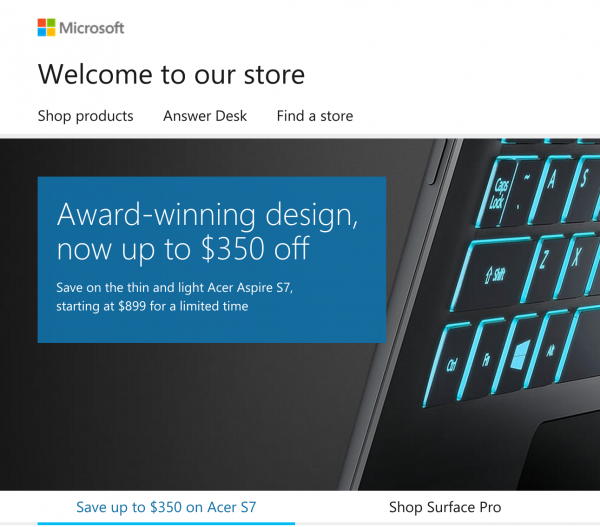
If you live in the United States, Microsoft Store online is newly redesigned and celebrates with big savings on the Acer Aspire S7, up to $350 off. The ultra-thin Windows PC is clearly a MacBook Air competitor. The 11-inch model is now available for as little as $899. Lest memory fails me, I saw the same deal inside the physical San Diego Store on Friday night.
The makeover marks the first of many. Microsoft plans to overhaul the online shop in all 228 markets. The new home page is more spacious, with lots more white space and prominently links to three subshops — Student, Small Business and Developer.
Microsoft opened the online store concurrently with its retail shops, the first of which in October 2009. The store here in San Diego opened in June 2010. The company now runs more than 65 shops in Canada and the United States. So, for most potential buyers anywhere, online is the only option buying direct from Microsoft.
Among benefits buying direct rather than retailer or reseller: No crapware, free shipping and free returns.
Circling back to the S7, it’s a hellva bargain compared to MacBook Air. The laptops are similar size and weight. With Microsoft’s discount, the entry-level S7 and MBA have 1.7GHz Intel Core i5 processors, same amount of memory (4GB) and similar size-screens (11.6 inches); otherwise, differences are pronounced. The S7 has twice the solid-state storage (128GB versus 64GB) and higher screen resolution (1920 by 1080 versus 1366 by 768), for $100 less ($899 vs $999). Screen resolution alone is huge benefit for the Windows 8 laptop.
Regarding the 13-inch entry-level models, Apple’s has slight processor edge — 1.8GHz versus 1.7GHz processor and same amount of memory and storage. But Microsoft’s deal puts the S7 two-hundred bucks less, $999, again with higher screen resolution (1920 by 1080 versus 1440 by 900).