Author: Alan Buckingham

  • Xbox finally gets its own news blog

    Only a mere twelve years after the first console launched, Microsoft finally decides that its Xbox platform may just be a success and that, just perhaps, customers may wish to know what is going on with it. This has not been so much an issue, thanks to Major Nelson and third-party gaming sites, but it is still a nice, and much needed, touch.

    The new site, simply named Xbox Wire, is being run by Lisa Gurry, Senior Director of Public Relations for Xbox. Gurry kicks off the new site with a welcome message to all fans of the popular gaming platform. “In preparation, we’re launching Xbox Wire — a news blog to help you keep up with the latest Xbox news. You will be able to follow our journey as we bring you the best in games and entertainment and along the way we’ll introduce you to the people, places and technology that bring it all to life” Gurry writes.

    The new site also rolls Major Nelson blog posts into its content so that users have a one-stop shop for gaming news, though Larry Hryb is listed simply as “Xbox Wire staff”.

    The announcement comes at an opportune time, given that Microsoft is set to unveil the next generation of Xbox on May 21. Gurry also includes a picture of the giant tent being constructed on the Redmond campus in advance of the big day. “We can’t wait to share our vision for Xbox and give you a real taste of the future. We’re working hard behind-the-scenes to make it a magical day” she tells us.

    There is little known about the upcoming device — even the name has remained a secret. Speculation, however, runs rampant across the internet. Perhaps Xbox Wire may provide a hint before the release.

  • Evernote and Twitter announce Google Glass apps

    With Google I/O in full swing, and Glass a hot topic of discussion these days, two companies have revealed plans to release apps for Google’s new wearable computing system. Social network Twitter and note-taking giant Evernote are both on board with the intriguing futuristic gadget.

    Evernote’s Andrew Sinkov announces that the company is “excited to unveil a first look at the Evernote experience on Glass”. Sinkove goes on to explain “our current implementation focuses on two actions. First, you’ll be able to quickly capture a photo or short video and send it to your Evernote account from the Google Glass sharing menu. Second, you can choose a note from Evernote Web and send it directly into the Glass Timeline so that you have it available right in your field of view when you need it”.

    Evernote says it believes that wearables are the next frontier in consumer technology, and it plans to adapt to this range of devices.

    Meanwhile Twitter, not to be outdone, unveiled its own Glass app, which is predominantly used for photo sharing. “With Twitter for Google Glass, you can share photos to Twitter. The Tweet will automatically include the text, ‘Just shared a photo #throughglass‘” says Shiv Ramamurthi, an engineering manager for the company.

    Beyond photos, the company also plans for the ability to keep up with your feed, including notifications of direct messages and tweets from those you follow.

    Like it or not, and reactions are all across the board, it seems wearable computing, like Glass and smartwatches, is here for the long term. Are you ready for it?

  • Leaked Microsoft ‘Scroogled’ video may be the best yet

    We don’t often cover leaks here at BetaNews — we want confirmation on things. So, when I saw a Microsoft Scroogled video making the rounds I was initially skeptical, though it looked authentic enough. It turns out the video is real and a Microsoft spokesperson I contacted, while refusing to issue a statement, did acknowledge as much.

    “It was an internal video that was leaked” I was told, but further comment was refused. I am not sure why because while I found the last two releases of Scroogled videos to be ridiculous — simply jokes depicting Office beating up on Google Docs and giving consumers no reason why to choose Office 365 over the Google Solution.

    While this one also does nothing to promote the Microsoft alternative, it does at least attempt to show why users may want to avoid Google. It also does so in a clever fashion — utilizing the search giant’s own “Now Everywhere” campaign against it.

    The ad is entirely animated, showing the Chrome “bouncing ball” as it hits different devices and grabs money from users — all set to Beethoven’s symphony. The little emblem even sucks cash right out of a user’s pocket.

    The only question is why was this internal, while videos that attempt to make no point other than humor using B-list celebrities were pushed to the masses? Microsoft’s attacks on Google may remain ineffectual, and perhaps contribute to the company’s recent problems, but sometimes they do provide amusement.

  • Microsoft announces dates for European Surface Pro launches

    We already knew that Surface Pro was coming to Europe, but what we didn’t know was exactly when. The company today announces the dates for availability, and the rollout begins in France on  May 17, continuing to the United Kingdom on May 23. It wraps up with a broad May 30 release in Austria, Belgium, Denmark, Finland, Ireland, Italy, Luxembourg, the Netherlands, Norway, Portugal, Spain, Sweden, and Switzerland, and one more big day in Germany on May 31.

    There’s more to come, but Brian Hall, General Manager of the Microsoft Surface team concedes that “some markets are still confirming timing so aren’t included here”.

    Yesterday my colleague Wayne Williams reported that Microsoft was offering a free cover to UK residents who purchase Surface RT before the end of June, but it turns out Microsoft will be offering the same deal to purchasers in Austria, Belgium, Denmark, Finland, France, Germany, Ireland, Italy, Luxembourg, Netherlands, Norway, Portugal, Russia, Spain, Sweden, and Switzerland.

    Making Surface available in Europe is a giant step for Microsoft’s hopes of getting its first tablet to the masses and making the device, and the operating system, a success.

  • Telefónica provides Microsoft with 130,000 new Office 365 users

    While Microsoft continues to attack Google using its “Scroogled” campaign, the company also adds to its corporate user base at a steady, and perhaps increasing, rate. Ironically, less than a week after taking on Google Docs with not one, but two videos, Microsoft adds another major corporation to its Office 365 subscriber list, this time in the form of Telefónica, a major provider of integrated communication solutions.

    Telefónica will add 130,000 employees to the Microsoft cloud solution, not only using Office 365, but also Yammer. “Over the past 18 months, we have built very strong foundations and are now ready to move to the cloud,” said Adrian Steel, the European production hub lead and global director at Telefónica. Steel goes on to explain “Deploying Office 365 and Yammer is this next step in bringing our global workforce to the forefront of seamless communication and collaboration while still operating at the level of speed and execution we’re known for”.

    Following a successful proof of concept that was carried out last year, Telefónica has commenced initial deployments across Europe, The communications giant prepares to later continue in Latin America. It also claims plans to utilize Microsoft Cloud Vantage Services to assist in the migration to the cloud.

    The company is spread across 24 countries and eight languages and has cited the translation service as one of the main attractions in this decision. Yammer, Lync and SkyDrive were also mentioned. And all of this comes smack in the middle of Google I/O — perhaps intentionally.

    Photo credit: Pressmaster/Shutterstock

  • New Mac spyware discovered at Oslo conference

    Today security firm F-Secure announces the discovery of a new Mac-based spyware program, the latest in what has become a small, but growing trend. Attacks have previously affected Apple itself, as well as users in the wild. The latest problem was discovered at a recent conference in Oslo, Norway.

    The Oslo Freedom Forum, an event that is designed around the world’s most influential dissidents, innovators, journalists, philanthropists, and policymakers, just wrapped up on May 15. During a workshop on freedom of speech, Jacob Applebaum, an independent computer security researcher, discovered a new and previously unknown backdoor on an African activist’s Mac.

    F-Secure is currently investigating this, but has found that it is signed with an Apple Developer ID. The security firm also has determined that the program dumps screenshots into a folder called MacApp and that there are two C&C servers related to this attack, neither of which could be reached — one is unresolved, while the other is “forbidden”.

    F-Secure has dubbed this malware with the catchy name of “Backdoor: OSX/KitM.A. (SHA1: 4395a2da164e09721700815ea3f816cddb9d676e)”, and is continuing its investigation.

    Ironically, the Oslo Freedom Forum revolves around helping users to secure their devices against government monitoring. The finding is just one more reminder that Macs are no more secure than Windows, just simply less targeted.

    Photo Credit: Brian A Jackson/ShutterStock

  • Google unveils updated Maps

    This comes as little surprise, with rumors and leaks being rampant, but Google today unveils a new version of its popular Maps application at its I/O conference. A sign-up page had briefly been available earlier in the day, allowing users a glimpse at the new features. Then of course, there is a listing for “Google Maps: Into the Future” right on the conference site. Now we receive confirmation.

    The new update brings a number of features that do, in fact, bring the service “into the future”. The updates are for both mobile (tablet and smartphone) and browser — some for each.

    Google began by pointing out that Maps launched an API back in 2005 and now boasts one million users, while Maps itself now has one billion monthly customers. Google also discussed its success, and accuracy, on the iPhone (take that Apple) before getting down to what we all wanted to know — what is new in this latest version of the famous mapping program.

    Well, for starters there are new ratings for restaurants provided by Zagat integration, users will also get offers for the locations they find — for instance you may find a $1 off at Starbucks coupon.

    As for mapping itself, there is now dynamic rerouting to get you around traffic, new transit maps and options, as well as the ability to upload Photosphere images to Maps for any location. There’s an Explore feature that lets users find interesting locations in their current area (museums, parks and the like), a brand new search that includes reviews from friends, Google Now-like cards and 3D images courtesy of Street View. Mapping can even highlight roads when a destination is clicked — displaying labels on previously unnamed roads and showing routes to the destination.

    Perhaps the coolest feature may be the integration of Google Sky which now shows real time imagery. When users zoom out to view the whole Earth,  they can see clouds, the position of the sun and even where the Earth is in its rotation.

    Features like Sky are available now, while others, like Explore, will be coming this summer. The latest version can be seen at maps.google.com/preview.

  • No new Nexus, but how about a Google branded Galaxy S4?

    One thing that surrounds Google I/O is rumors — almost as much as an Apple event. We have heard of an X phone from Motorola, we have seen a possible Nexus 5 from LG, and the latest is a Google branded version of the new Samsung Galaxy S4. So which one is the winner in this strange sweepstakes?

    The latest rumor turns out to be the most accurate, as Google unveils its own flavor of the Samsung Galaxy S4. The Android maker is taking the new darling of the smartphone market and making it a Nexus phone, just not in name.

    The S4 will run the latest version of Android and Google promises it will receive prompt updates whenever an updated version of the mobile operating system is released. The Google S4 will be sold directly through the Play store beginning June 26. The 16 GB model will be LTE, compatible with AT&T and T-Mobile and comes unlocked and with an unlocked bootloader.

    Pricing manages to generate a few groans from the I/O audience, as $649 is considerably more than a Nexus 4, but customers can likely look at the lack of a contract as a way of off-setting the cost, and the Galaxy S4 is certainly a step up.

  • Roku 3 interface rolling out to older devices

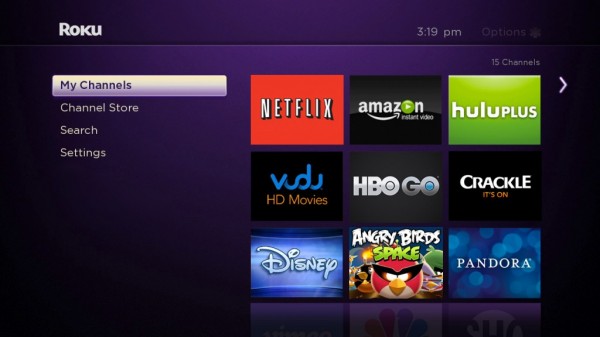
    On April 8th, Roku rolled out its latest set-top box, known as the Roku 3. The little device made a splash with its new user interface and unique remote control that allows customers to plug in headphones for private listening, while still sitting back on the couch or moving around the home.

    Now Roku’s Tom Markworth announces that the popular new UI will start becoming available on older devices. “We’ve begun rolling out the new interface to supported Roku players as a free upgrade, and we know many of you have been waiting impatiently” Markworth states.

    The latest version is 5.0, build 804X, and will be coming to Roku 2 XS (model 3100), Roku 2 XD (model 3050), Roku 2 HD (model 3000), Roku LT (models 2400 & 2450), Roku HD (model 2500) and the Roku Streaming Stick (models 3400 & 3420). The set-top box maker promises all customers will be receive this within the next two weeks. However, users can force the update by heading to Settings > Software update > Check now. The new Search feature is available in the US only, so those in other markets shouldn’t get their hopes up.

    Earlier Roku models (not named above) will not receive the update, but the device is not expensive, so if you are using one that is incompatible, then it may be time to move on to a newer model.

  • Google ghaH* — Bing now speaks Klingon

    Google has added numerous languages to its Google Translate for Android app. A week ago it added 16 more choices, but sadly Klingon wasn’t among them. In fact one of our readers, blindwanderer, even observed: “You won’t ever see Klingon, Klingon as a language is more tightly controlled by its creators than De Beers controls diamonds”. Which is particularly interesting given what language Bing can now speak.

    The Microsoft service announces that it has partnered with Marc Okrand and Paramount Pictures to bring Klingon to the translation table. “Now in a few simple clicks you can translate text from English to Klingon (and vice versa!) Available via the web here and also as an update to Bing Translator for Windows Phone 8, regardless of whether you’re new to the Star Trek universe or fresh from a convention, we’ve got you covered,” the search team promises.

    This is done, of course, in honor of the new movie — Star Trek: Into Darkness — which hits theaters on May 16th. Bing wants to help fans celebrate the latest release from director J.J. Abrams which even features a cameo from Leonard Nimoy. The movie may well be the first of the major summer blockbusters for 2013.

    Are you going to see the flick? Have you always secretly wanted to learn Klingon? This week you get the chance to accomplish both of these goals.

    *Take that Google

  • Skype arrives on Blackberry Z10

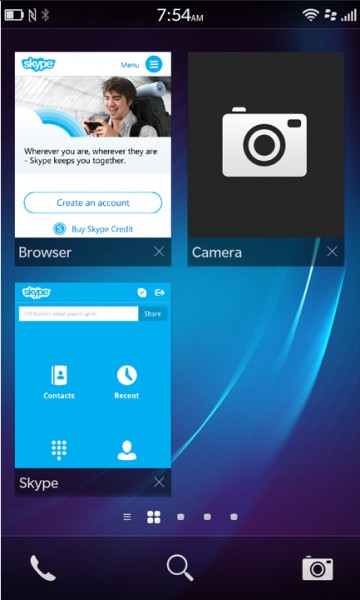
    Microsoft has been busy with its Skype toy recently, and today announces that it’s bringing the popular communication service to yet another mobile platform — BlackBerry’s new Z10 handset.

    Microsoft released a preview version of the app for the Q10 back in April, but now with Blackberry 10.1 rolling out to Z10, owners of this device can begin using that Preview version as well. Microsoft’s Linda Summers announces the company is “working closely with BlackBerry to give users the best possible Skype experience on the Z10, just as we have for the Q10”.

    The app, while being a beta, is full-featured and integrates with the phone book and the BlackBerry Hub. Once your Z10 receives the new 10.1 update then you can download Skype from BlackBerry World.

    Summers points out customers should “remember this release is still in preview version. We will continue working with BlackBerry over the next months to refine the performance of the Skype app. So keep an eye for any new Skype updates on BlackBerry World for your device”.

    The app is free, currently at version 3.1.439.21, and requires version 10.1 of the mobile OS. Customers can use it to place voice and video calls to users on any mobile platform or on Mac and Windows.

  • Xbox 360 adds Twitch streaming games

    Microsoft is on the verge of announcing the next Xbox, with an event scheduled for May 21. But that has not stopped the company from continuing to update the existing model. Granted, the new console will not be released that day and, even when it does hit the retail market, many customers will continue to use the older model, so it makes sense for support to continue.

    The latest addition is a new Twitch app. In a brief statement, Xbox Live chief Larry Hryb, AKA Major Nelson, alerts us that “today, we’re launching one of the most asked for apps on Xbox LIVE”. Hryb goes on to explain what to expect — “Gold subscribers in the U.S. will have access to 300 of the most popular streams from the service. Users can view top channels by popularity or individual game and the dashboard features curated channels, tournaments and shows happening now”.

    The app release also ties into that upcoming announcement, as Hryb explains. “In addition to launching the app today on Xbox 360, Twitch will also host an exclusive broadcast following the May 21st #XboxRevealed event next week. I’ll moderate the broadcast live at 3p ET/12m PT live via the new Twitch app on Xbox 360 and also online at www.twitch.tv“.

    Microsoft has been concentrating more on the TV side of the Xbox platform recently, adding numerous additional home entertainment options. The company aims for its console to become the ultimate living room hub — replacing various set-top boxes while also offering the most popular video games on the market. The addition of Twitch is one more piece to the puzzle.

  • RunKeeper overhauls its website

    If you happen to be a runner then you have a plethora of choices these days for tracking every bit of workout information that you could possibly have wanted to know, and likely some you did not. There are websites, mobile apps and even watches that know more about you than, well, you do.

    One of the most popular is called RunKeeper. The service falls into every category I named and even comes with Pebble Watch, in addition to its own watch. Now the service brings a major overhaul to the web side of things. “We created RunKeeper to be a powerful personal trainer in your pocket, but many of you look to our website to do things like drill deeper in your workout tracking, interact with friends, and connect with other partner apps” the company claims.

    RunKeeper was concerned that some feature were too buried to be useful and that some were even duplicated, making it more confusing to customers. The refresh is designed to change that.

    The company promises that it has “taken the time to give RunKeeper.com the revamping it was due (especially considering the spiffy new redesigns our mobile apps got earlier this year). Now the website offers the same inviting, fun, and helpful experience that RunKeeper for iPhone and Android do (we hope)”.

    The top navigation is simpler and more intuitive, the ‘Feed’ button will show you what your friends are up to, and the ‘Me’ button gives you activity history, fitness reports, training plans and routes.

    The new updates are a welcome change for users who already experienced many of these features in mobile form, but were likely frustrated by what the website offered.

    Photo Credits: ostill/Shutterstock

  • SkyDrive gets photo timeline, faster uploads

    Cloud storage solution SkyDrive is getting additional functionality. Microsoft is banking on the service becoming the primary storage method for those who are part of the company’s ecosystem. The software giant has made SkyDrive a focus in both Windows 8 and Office 2013 / 365 Home Premium.

    Microsoft’s Omar Shahine announces that “starting today and rolling out over the next 48 hours, we’re making it easier for you to see all of your photos in SkyDrive across all your albums and folders based on a timeline view”. With timeline view you will be able to scroll down to navigate through all of the images. They are organized into groups by event and time.

    Shahine describes it thus — “Take 20 pictures at a birthday party with your phone, and then a photo of your parking spot at the airport a few hours later? Now they’ll appear as two different groups in the timeline”.

    Timeline is not the only update SkyDrive users can expect. Microsoft also promises to improve upload times by two to three times. It does so through changes to both the app and the server code.

    The company also promises full resolution uploads of photos and videos in all markets where Windows Phone 8 is available, as well as a new thumbnail view, with improved readability of the files and folders you have in SkyDrive. This also features the introduction of new thumbnails for your PowerPoint and Word files.

    As stated by Shahine, the update is rolling out gradually and should reach all users within the next 48 hours. Microsoft claims photos are the most common file type seen in SkyDrive.

  • GFI Software issues advisory in advance of Patch Tuesday

    Tomorrow is what is commonly known as Patch Tuesday in the lands of Microsoft and Adobe. It’s the time of the month when the two software giants attempt to fix the bugs and security holes in their software by issuing a series of updates that are intended to benefit users. The practice of waiting to issue these updates is debatable, especially when exploits are available in the wild.

    These updates, at least in the case of Microsoft, can also cause as much harm as good. Given that possibility, security company GFI issued an advisory in advance of the upcoming patches. “In light of the reboot loop problems resulting from the Microsoft patches issued in April, businesses need to have the ability to test patches, or have a trusted third-party test them, before deploying on corporate networks and PCs, in order to minimize potential downtime caused by a faulty patch”  says Cristian Florian, product manager at GFI Software.

    GFI contends that there needs to be insight into patching liabilities and a need for an understanding for businesses about what they are installing and how it will affect their IT systems. Given the endless reboot cycle that some Windows 7 computers suffered last month, this is a fair contention.

    Many IT departments hold off on these updates, pending testing. However that is also not a great solution as it leaves systems vulnerable to attacks from hackers who reverse-engineer the flaws once they are disclosed.

    “All the updates included in tomorrow’s Patch Tuesday have been listed as critical and are important for businesses to deploy” adds Florian. “They will remove some vulnerabilities that could be exploited to gain backdoor access to an organization’s network”.

    Photo Credit: zimmytws/Shutterstock

  • Amazon introduces ‘Coins’ to Kindle Fire market

    Amazon wishes to confuse its Kindle Fire market in much the same way Microsoft does with Xbox Points. Today the online retail giant announces “Coins”, a new form of virtual currency that tablet customers can use to make purchases both in the app store, as well as in-app.

    “Amazon Coins is an easy way to purchase apps and in-app items on Kindle Fire, and for developers it’s another opportunity to drive traffic, downloads and increased monetization” Amazon claims. While this seems to add disorder, there is a silver lining. For one, customers will receive up to a ten percent discount when buying Coins to make purchases, as opposed to using good old fashion real currency.

    “To celebrate the launch, existing and new Kindle Fire customers in the US have had 500 free Coins — a $5 value — deposited into their Amazon accounts today” the company tells us. “We will continue to add more ways to earn and spend Coins on a wider range of content and activities — today is Day One for Coins” claims Mike George, Vice President of Apps and Games at Amazon.

    As for developers, they will continue to earn their standard 70 percent revenue share when customers make purchases using Amazon Coins. No changes to developer accounts will be required.

    While the discount available seems a win for customers, these type of virtual currencies tend to confuse marketplace shoppers just as often as benefiting them. We shall see if Amazon can make this work better than most.

  • MultiPLX is latest RSS alternative to dance on Reader’s grave [review]

    I am long done with rattling on about Google’s decision to kill Reader. I get it. RSS is popular with our crowd — the tech writers and those who follow multiple blogs and wish for an easy way to keep up. That is where the service excels. But, let’s face it — the vast majority of people do not use this technology. My wife and kids, savvy computer users, would not know what RSS was if I asked.

    However, the software has a niche, and sometimes a niche is all that is needed for a successful business. We have alternatives in Feedly, The Old Reader, Feedspot and Digg, which has bun in the oven. There are lesser-known options as well, but most users seem to be destined for one of these already established programs. Several have had to beef up server capacity and bandwidth to cope with new-found popularity.

    New Kid on the Block

    This brings us to MultiPLX — the latest web app to step into the game. Do not expect to try it out right away — it is in private beta for now, but you can enter your email and wait for an invitation — there is a work-around that I will get to, though. The app calls itself “the real Google Reader alternative”, but is it?

    “MultiPLX is a visual RSS Reader and works as a full web service, designed from ground-up to be as scalable and fast as Google Reader”, the Walnut Creek, Cal-based startup tells us. “Although there are many variants that are trying to imitate Google Reader at the moment, most of them are desktop clients or mobile apps that depend on Google Reader engine. MultiPLX is a full web based service with a back-end that can scale-up to serve millions of users, and billions of feed posts each day with a speed that is unmatched even in desktop clients”, Emre Kosmaz MultiPLX founder says.

    That is a lot of hype to live up to. Can the service handle the pressure? To find out I got a hands-on look at what it has to offer, though bear in mind that it is still in the early stages of development.

    The Default Interface

    By default, and you can see this even if you do not have an invite, MultiPLX has a modern look. There is a newspaper style layout going on here. Four columns grace the screen in an endless scroll — much like Bing image search uses. This is a far cry from Google Reader and many of the alternatives.

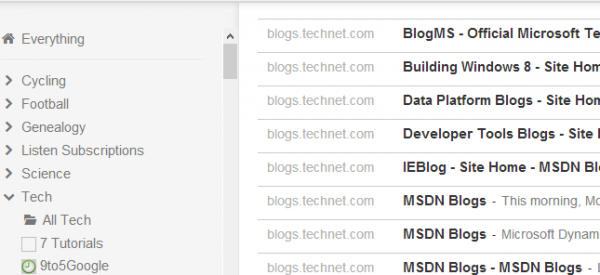
    Perhaps you will love it, embrace the modern styling, the magazine look with the newspaper layout. Images are large enough to be recognizable and and the beginnings of posts can be easily read. If you just want Google Reader back, though, fear not. MultiPLX has not left you behind in favor of this.

    Bring Back My Reader!

    If you are like me, then you may be here because you just want Google Reader functionality. This is only a mouse-click away. Note the bar across the bottom of the screen — large red letters will tell you “Google Reader users can now use MultiPLX in list view. Click here to see how it works”.

    Voila! Transportation to throwback nirvana. But hey, we all liked Reader and few embrace change — just ask those who rail against Windows 8! The list view transforms your screen into a Reader-like look, no questions asked, no settings to fiddle with.
    Settings

    The settings page consists of several options displayed down the left column — Profile Settings, Discover / Add Content, Manage Followed, Advanced Settings and Import / Export.

    The last will be your first stop because this is only useful after you have imported your feeds. Google Takeout makes it easy to grab an XML file of all your data. However, if you are coming from Feedly then I am afraid you are out of luck — the service inexplicably contains no export ability.
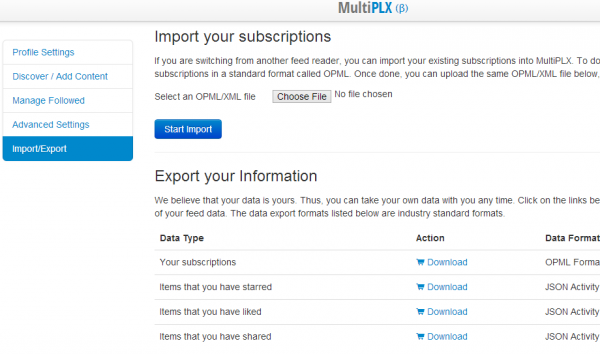
    Manage Followed allows you to change names of feeds and add and remove categories to keep everything organized. Advanced Settings provides the usual array, while the others in the list are mostly self-explanatory.

    The Verdict

    MultiPLX makes a decent alternative for disenfranchised Reader customers, but the web app still has a ways to go. Having an export option is certainly a plus — hint to Feedly. The option to use a Reader-style view is also nice. However, the left column has a bit of jumbled look, thanks to feeds with longer names being wrapped around, making it more difficult to find something at a glance.

    Oh, and as for that hint about getting into the service now without having to await an invitation? You can use the promotion code GOOGLEREADER to get your invitation email right away.

    Photo Credit: Blade Dancer/Shutterstock

  • Microsoft releases two sad ‘Scroogled’ ads attacking Google Docs

    Despite the almost laughable nature of the Scroogled campaign, Microsoft continues to push it. The company slams Gmail, but that is not enough. Jake Zborowski, senior product manager for Microsoft Office, releases not one, but two blog posts that attack Google Docs. Both are accompanied by ads — low resolution videos that view like someone pulled them from the cutting-room floor.

    “Converting Office files into Google Apps is a gamble” Zborowski claims in one post. “Why take the gamble on converting your Office files to Google Docs when you can use Microsoft Office and the Microsoft Office Web Apps to create, share and edit your Office files with your content intact”, he explains. A new casino-themed ad accompanies the post and features B-list celebrities Rob Schneider and Pete Rose.

    Rose tells viewers that Google Docs is too big a gamble even for him, while Schneider portrays what resembles a comedic used-car salesman, only transferred to the casino floor. Perhaps this is the only work these two can find these days?

    In a second post Zborowski asks us to “see what happens to team productivity when you choose a productivity suite that has deficiencies”. This is followed by a second ad featuring a basketball game between Office and Google Docs. You can probably guess the outcome of this competition.

    Neither video does a single thing to tell us what Office can do, but instead only focuses on the Google Docs attack. Microsoft serves little more than a political-style mud-slinging campaign. Perhaps if the company really is looking to convert users of the Google platform it may wish to focus on explaining what makes Office the better solution instead of concentrating its efforts on attacks and ad budget on has-been celebrities. Or do the A-list celebs all use Google Docs?

    Worse, as my colleague Joe Wilcox pointed out this morning, Microsoft did not even produce the videos in HD, you get 360p with these little gems. What does that tell you?

  • Bing and Facebook up in a tree, k-i-s-s-i-n-g

    Way back in 2007, Microsoft purchased a fraction of Facebook. The social network returned the favor in February by buying Atlas. The two tech goliaths are still smitten with one another, and today we learn that Microsoft search engine Bing gets closer to your friends.

    Now the search engine is integrating Facebook comments directly into the sidebar that appears to the right side of search results. “Starting today, you will see comments on a relevant Facebook post within sidebar, as well as the ability add your own, all without having to leave Bing. You can also Like a post directly from Bing. Now you can see what your friends might know about what you’re searching for and engage with them directly without leaving the search page”, Nektarios Ioannides, program manager for Bing, explains.

    What does this mean? Say you are searching for an artist’s ticket information. If your friend has posted this data in a Facebook post or comment, it will now be visible within those search results. “I comment directly to her post letting her know that I’d love to join her for the concert. I’ve gone from simply browsing to attending a concert in just a few easy steps – all thanks to Bing”, Ioannides says.

    To make this work for yourself, simply go to www.bing.com and in the top, right corner of the page connect your Facebook account to Bing. Microsoft promises to honor your account security settings, at least until the next security vulnerability is discovered.

    Photo Credit: DL Pohl/Shutterstock

  • Adobe security failure of the DAY: 160K SSNs exposed

    Yesterday I wrote about Adobe’s latest security nightmare, this time involving web development environment ColdFusion. I also stressed that while aware of the problem, the company didn’t plan a fix until May 14, during its next monthly patch release. For the Washington state court, this is not soon enough.

    A ColdFusion vulnerability exposed 160,000 Social Security numbers and the driver’s license numbers and names of a million people. Before hitting the panic button, realize that if you have had no legal issues then you are likely safe.

    Social security numbers of those booked into a city or county jail in the state of Washington between September 2011 and December 2012 are compromised. Likewise are the drivers license numbers of anyone who received a DUI citation in Washington State between 1989 and 2011, had a traffic case in Washington State filed or resolved in a district or municipal court between 2011 and 2012 or had a superior court criminal case in Washington State filed against them or resolved between 2011 and 2012.

    The court discovered the breaches in late February, but waited to issue a statement, warning those who may have compromised information:

    Once the breach was discovered, AOC took immediate action to further secure the environment and begin investigation and analysis into the depth and severity of the breach. In addition, AOC collaborated with the Washington State Consolidated Technology Services (CTS) and the Multi-State Information Sharing & Analysis Center (MS-ISAC) for internet security, who provided valuable information in determining the scope of this security breach. MS-ISAC is a focal point for cyber threat prevention, protection, response and recovery for the nation’s state, local, territorial and tribal governments. The MS-ISAC 24×7 cyber security operations center provides real-time network monitoring, early cyber threat warnings and advisories, vulnerability identification, and mitigation and incident response.

    The court stresses that no financial data was obtained and that it has “implemented significant security enhancements to ensure that our systems and data are secure and to prevent the potential for future compromise”.

    As for Adobe? The company will get around to fixing this latest problem next week, along with the PDF flaw that is being utilized in the wild to compromise your Reader app — the one you should not be using.

    Photo Credit: OleGunnarUA/Shutterstock