Author: Harvard Gazette Online

  • Other notable 1950 graduates

    In the 60th Anniversary Report for the Class of 1950, where alumni update classmates on the happenings in their lives, here’s a small glimpse.

    Robert Bly — Bly, the author of several collections of poetry, including “The Light Around the Body,” which won the National Book Award in 1967, also has authored books of nonfiction, translated the works of dozens of non-English-speaking poets, and edited countless anthologies. He has been awarded Guggenheim, Rockefeller, and National Endowment for the Arts fellowships, and currently lives on a farm in western Minnesota, where he is the state’s poet laureate.

    Edward Gorey — The one-time roommate of Frank O’Hara (see later entry), Gorey is most widely known for his macabre illustrations. He often wrote under pseudonyms that were anagrams of his name, notably Ogdred Weary, and illustrated works by Samuel Beckett, Charles Dickens, and T.S. Eliot, among others. He won a Tony Award in 1977 for his costume designs for “Dracula.” Gorey died in 2000, and his former Cape Cod home in Yarmouthport is now a museum called the Edward Gorey House.

    Henry Kissinger ’50, A.M. ’50, Ph.D. ’54 — Former national security adviser and secretary of state Kissinger is a renowned political mind still sought out by world leaders. The German-born political scientist received the Nobel Peace Prize in 1973 for establishing a ceasefire and helping to orchestrate the U.S. withdrawal from Vietnam. He resides in New York City.

    Frank O’Hara — Once a piano student at the New England Conservatory, O’Hara became an English concentrator at Harvard, where he met poetic luminary John Ashbery ’49, who first published O’Hara’s spunky and autobiographical poems in the Harvard Advocate. Known for “Lunch Poems,” his most popular book, O’Hara was a figurehead of the New York School of poets. He died in 1966.

    George Plimpton — Journalist, writer, and actor Plimpton enrolled at Harvard in 1944, but graduated in 1950 after a leave for military service. He had a lengthy and eclectic career, becoming the first editor-in-chief of the Paris Review. As a writer for Sports Illustrated, he famously sparred with boxers Archie Moore and Sugar Ray Robinson. He made a brief cameo in “Good Will Hunting,” among other films. He died in 2003.

  • Creating worldwide change

    For Ateeq Nosher, a bloody conflict in the 1980s meant growing up in a refugee camp far from home.

    But next month he is headed back to his country of birth, Afghanistan, equipped with a master’s degree from Harvard Kennedy School (HKS) and a desire to make a difference in his homeland, which is again mired in a violent internal struggle.

    While at Harvard, Nosher took part in an integrated curriculum aimed at solving some of the world’s most pressing problems. Building on his HKS experience, he will work with Afghanistan’s central bank in Kabul as director general of its monetary policy department, where he will help to control the nation’s inflation and exchange rates.

    “If I take asylum and stay in the United States, I will be nothing in my country in five years,” said Nosher. “I have to go and compete.” He is optimistic about Afghanistan’s future, and said its increasingly competitive environment was spurred by the return of many students and professionals who fled in 2001, when the latest round of fighting began.

    Nosher is one of the more than 650 graduates from the Kennedy School’s Master in Public Administration in International Development program (M.P.A./I.D.), which includes leaders in the government, nonprofit, and for-profit sectors who are making a major impact on international development.

    The program was conceived in 1998, when economist Jeffrey Sachs, then teaching at HKS, noted the rise of Asia and China. That signaled the start of “an unprecedented era of modern history that would change all the rules of the world,” he told a recent reunion gathering on May 14.

    Sachs, now director of the Earth Institute at Columbia University, realized the potential impact of such globalization, and wanted to create a degree at HKS that offered a multidisciplinary approach to international development. He was looking for a tight focus on practice and policy, one that would help to address critical problems such as AIDS, malaria, climate change, and looming global shortages of water and food.

    With all that in mind, Sachs pitched what he called his “irresistible idea” to HKS administrators. They quickly understood, he said, the importance of developing a graduate-level program that would represent a “vigorous way to proceed” in the field.

    “Jeff Sachs had an idea whose time had come,” said Carol Finney, director the program since its inception in 1998. “He understood that a lot of international development work was being done by people who had Ph.D.s in economics, but that economics was just one of many points of view that needed to be brought to bear on this topic.”

    Now graduating its 10th class, the M.P.A./I.D. is the newest degree at HKS. The program maintains a strong focus on economic and quantitative methods, but also incorporates course work in management, governance, politics, and law. In the second year of the two-year program, students choose electives that allow them to explore related issues such as poverty, health, education, and human rights.

    “In this program, we were saying: Let’s take what we know about these various fields and see how we can we use that to solve real policy problems in the word,” said Finney.

    The program has another goal, to attract students from countries with developing or transitional economies. Each year, about two-thirds of new M.P.A./I.D. students come from such countries. The hope is that students will train at Harvard and then return to their homelands, said Finney, or that they will represent the interests of their countries while working for multinational organizations such as the World Bank or the International Monetary Fund.

    A decade out, that hope has been realized, she said. HKS graduates of the program are making an impact globally. Demian Sanchez ’05 works as the social policy adviser for the Mexican presidency. Emily Stanger ’08 is a program manager for the Liberia-United Nations Joint Program on Women’s Economic Empowerment. Vuk Jeremic ’03 is the minister of foreign affairs in Serbia. Tomás Recart Balze ’08 is the founder of Enseña Chile (Teach Chile), which is modeled after Teach for America.

    After graduating from the program, Poranee “Pam” Kingpetcharat ’05 took a job with a consulting firm specializing in international development and globalization.

    The HKS program perfectly prepared her for her current work with organizations such as the Ford Foundation and the Bill & Melinda Gates Foundation as well as the United Nations, where she aids peacekeeping operations, she said, helping her understand how to “move people politically once you come up with a great idea.”

    The HKS program also provided her with a vast network of contacts.

    “There isn’t a day that goes by that I am not calling up some other graduate, talking about development or brainstorming with them ideas or concepts, or even [calling] my professors. … It’s really amazing.”

    And while the world faces huge problems, “the M.P.A./I.D. program to my mind exemplifies the ways that we can respond,” Sachs told the reunion crowd gathered at the JFK Forum. “We need to have the heart, we need to have the mindset, we need to have the generosity of spirit, and I think the M.P.A./I.D. is a phenomenal base for that. It’s a real triumph.”

  • Harvey Goldman

    Harvey Goldman, M.D. was born on May 25, 1932 in Philadelphia, Pennsylvania, the city in which he spent his formative years. He received an A.B. degree in mathematics in 1953 and his M.D. in 1957, both from Temple University, where he was elected to membership in the Alpha Omega Alpha honor society. After a rotating internship at Philadelphia General Hospital, he did his residency in pathology at Beth Israel Hospital in Boston. In 1964, following a two-year assignment as a pathologist at the U. S. Naval Hospital in Great Lakes, Michigan, he returned to Boston, Beth Israel Hospital and Harvard Medical School (HMS). Over the next 45 years, he developed a stellar academic career. Beginning as an Instructor, he rose through the ranks to become in 1976 Professor of Pathology at HMS and also in the Harvard-Massachusetts Institute of Technology Division of Health Sciences and Technology (HST), a separate academic track to train physician scientists. In 1989, Harvey left Beth Israel Hospital to become Chairman of Pathology at both the New England Deaconess and the New England Baptist Hospitals, positions he held until 1996 when the Beth Israel and Deaconess Hospitals merged to become the Beth Israel Deaconess Medical Center (BIDMC). At BIDMC, he served as Senior Pathologist and Vice Chairman of the Department of Pathology until his death. For many years he was also a consultant in gastrointestinal pathology at several other Harvard institutions, including Children’s Hospital, Brigham and Women’s Hospital, and the Dana-Farber Cancer Institute. Dr. Goldman died on April 6, 2009 from complications of a hematologic disorder. He is survived by his wife, Dr. Eleonora (Nora) Galvanek, herself a distinguished Harvard pathologist; daughter Vierka; son Sasha; son Dr. Palko Goldman and his wife, Dr. Lida Nabati; and grandson Jasper.

    Harvey Goldman was a “quadruple threat”: teacher and mentor, clinician, clinical researcher, and administrator, listed in the order of his preference, although he excelled in all facets of academia. He was first an outstanding teacher at HMS, at Beth Israel Hospital/BIDMC and at the national and international levels. At HMS, he not only taught for many years in the basic pathology course and the gastrointestinal pathophysiology block but also in the cardiovascular, renal, and respiratory pathophysiology courses. For 14 years he was the Pathology Coordinator for an elective Systemic Pathology Course for third- and fourth-year medical students He served as Chairman of the HST Human Pathology Course from 1971-1988, and supervised the elective Pathology Clerkship at Beth Israel Hospital for 18 years. As an administrator, he completed terms as Chairman of the Preclinical Promotion Board, the Curriculum Committee, the Pathology Education Committee, and the Faculty Teaching Activity Committee. An important mandate of the latter group was to quantify and elevate the role of teaching as a criterion for academic promotion, a role previously under-recognized at HMS. Success in these endeavors resulted in his being chosen to serve a five-year term as Faculty Dean for Medical Education (1988-1993). In this capacity, he played an important part in implementing the conversion of the preclinical curriculum from a lecture-based to a small group, tutorial-based, interactive format; i.e., the HMS New Pathway. He received multiple teaching awards from the medical students between 1970 and 2006, culminating in his being awarded the Special Faculty Prize for Sustained Excellence in Teaching in 2007. Harvey’s interests in teaching also extended to the postgraduate level, and he was a dedicated and beloved teacher of scores of pathology residents and fellows. At BIDMC, Harvey was the first recipient of the newly created Resident Teaching Award in Anatomic Pathology in 2001; in addition, he was also selected that year for the S. Robert Stone Honorary Teaching Award, a yearly prize given to an outstanding clinician-educator at the medical center.

    Dr. Goldman was also a giant in teaching at the national and international levels. He was a founding member of the Gastrointestinal Pathology Society (now the Roger Haggitt Gastrointestinal Pathology Society) and served as its president (1982-1983). He was also active in the New England Society of Pathologists (President, 1992-1993), the Crohn’s and Colitis Foundation, and the International Academy of Pathology (North America vice-president). However, he is best remembered for his contributions to the United States and Canadian Academy of Pathology (USCAP), the society for which he was a tireless advocate. He served on nearly all of its committees, was Chairman of the Education Committee, a member of the governing council, led courses (his gastrointestinal mucosal biopsy course ran for over 10 years by popular demand), and was its President (1999-2000). At the time of his death, he was enthusiastically engaged in planning, with two other BIDMC faculty, a new Short Course on gastrointestinal pathology. His many contributions to USCAP were recognized by his receipt of both the F.K. Mostofi Distinguished Service Award (1995) and the Distinguished Pathologist Award (2006). His abilities as an educator were also recognized by his many invitations to serve as a visiting professor, lecturer, or course director at numerous institutions and professional society meetings throughout the United States, Canada, and Europe as well as forays to Israel, Argentina, and the Far East.

    Dr. Goldman was not only a master educator but also an outstanding surgical pathologist and investigator in the field of gastrointestinal pathology. Interpretation of gastrointestinal mucosal biopsies is now so well established that it is difficult to recall that in the 1960’s, the use of flexible endoscopy, with the ability to sample esophageal, gastric, small-intestinal, and colonic mucosa, was in its infancy. Harvey was one of the pioneers in advancing study of mucosal specimens and correlating the findings with clinical and imaging data to obtain accurate diagnoses. His studies, often in collaboration with other pathologists and clinicians, resulted in major contributions in many areas including reflux esophagitis, allergic gastrointestinal disorders, inflammatory bowel disease and Barrett’s esophagus. Of particular note was his contribution to establishing criteria for the diagnosis of dysplasia in both inflammatory bowel disease and Barrett’s esophagus. In addition to publishing numerous original articles on these subjects, Harvey co-edited two editions of a major textbook on GI pathology and published a monograph on GI mucosal biopsies. His two-part paper on the usefulness of GI mucosal biopsies, published in 1982 in “Human Pathology,” remains a landmark review that is still widely referenced.

    There was a personal side to Harvey that was equally, or even more, important to him than his public achievements. No matter how busy he was, Harvey was devoted to his family and always found time to share their lives. As his son Palko said, “He really made a point to get out of work at 5:30 and participate in our Little League games and our homework. But at the same time, he would have to get back to work, and I have this image of him working at the dining room table until the early hours of the morning. Lots of people sacrifice their careers for their family or the opposite. I really think my father excelled at both and sacrificed neither.” Everyone who worked with him knew he wanted you to succeed; he could be a firm but constructive critic in the preparation of lectures, abstracts, and manuscripts, always with the goal of improving the material at hand. Even during the several months of his final illness, he continued to teach residents and fellows on a daily basis, and kept in constant, supportive contact with colleagues who were ill or hospitalized. As his daughter Vierka said, “He really experienced joy in other people’s successes. A lot of people pretend to, but they’re secretly jealous, and he really wasn’t like that, which is a very rare quality.” About 35 years ago, Harvey and his wife Eleonora discovered a tiny resort on the Adriatic coast of Italy. They formed a warm and lasting bond with the Italian family who owned the “pensione” at which they stayed. Among all the foreign destinations he knew, this became the resort of choice for relaxation, and he and his wife returned for a two-week holiday every year, becoming the adopted US component of an extended Italian family.

    In 1991, Harvey had a heart attack and immediately quit smoking. At his family’s suggestion, he used his former cigarette money to buy two season tickets for Red Sox games. For the rest of his life, he combined his love of baseball with his love of reading. He brought a book to every Red Sox game, and would read between innings and even during protracted innings, a fact observed by his fellow season ticket holders. His son Palko recalls that, “One night when a non-season ticket holder a few seats down remarked, ‘Look at the guy reading a book. How can you read a book at a baseball game?’ Someone responded, ‘He watches a thousand innings a year.’” Ironically, Harvey died on the date that was scheduled to be opening day of the 2009 Red Sox season.

    On November 17, 2009, a symposium was held in the rotunda of the Joseph B. Martin Conference Center to celebrate Dr. Goldman’s life and achievements. Dean Jeffrey Flier reviewed Harvey’s many accomplishments in teaching, noting that “his clear, elegant, well-organized communication style, his personal warmth and his consensus-building skills translated into several educational leadership positions at HMS.” He read from the nomination for the Special Faculty Prize for Sustained Excellence in Teaching that Harvey received two years ago: “He knows GI pathology like the back of his hand and he is a motivator of medical students. Regarding his ability to teach: being in his Castle Society GI path group, he was like the Pied Piper attracting all the students from all sections. He is also interested in the personal lives and well-being of medical students, as evidenced by his frequent lunches with many students in the class. He even sent food to a student who was studying late at the Medical Education Center!” Dean Flier further noted that at the time Harvey was appointed Faculty Dean of Medical Education, an HMS publication quoted Harvey as saying: “I derive great joy from teaching pathology.” Dean Flier stated that “it brings me great joy to know that Harvey felt uplifted by his work at HMS, as we were so fortunate to be uplifted by him.”

    Robert Najarian, M.D., gastrointestinal pathology fellow at BIDMC, remembered Dr. Goldman as the “ultimate educator,” noting that “humor was his hammer.” When one resident was correct on two of three diagnoses and thought that that was pretty good, Harvey responded that “2 out of 3 was excellent in baseball but awful in pathology.”

    Henry Appelman, M.D., Professor of Pathology at the University of Michigan and Harvey’s colleague for more than 30 years, remembered Dr Goldman as “a pioneer in gastrointestinal pathology, a superior intellect, a creative mind.” Dr. Appelman noted that Harvey, he, and a few other contemporaries were founders of the field of gastrointestinal pathology and we “had no one to teach us so we taught ourselves.” Harvey was “at or near the top of the list of the most important people in gastrointestinal pathology over the past 40 years.”

    Fred Silva, Executive Vice President, USCAP, spoke warmly of his associations with Harvey over the course of more than 25 years at USCAP. Referring to the enormous influence that Harvey had in educating generations of medical students and pathologists, he concluded by applying to Harvey the inscription on the gravestone of Sir Christopher Wren: “LECTOR, SI MONUMENTUM REQUIRIS, CIRCUMSPICE,” which translates as “reader, if you seek his memorial – look around you.”

    In recognition of Dr. Goldman’s monumental contributions to the teaching of pathology, the Department of Pathology at Beth Israel Deaconess Medical Center and the USCAP have jointly endowed an award named for Dr. Goldman to be given to a master educator in pathology. This award will be bestowed each year at the annual meeting of the USCAP. Finally, as a lasting memorial to Harvey’s presence in pathology at BIDMC, the main departmental conference room in which he spent thousands of hours teaching residents and fellows has been named the Harvey Goldman, MD Conference Room and bears his portrait and a commemorative plaque.

    Professor Harvey Goldman was a giant in the field of pathology, and he is sorely missed as a friend and colleague.

    Respectfully submitted,

    Harold F. Dvorak, M.D.
    Stuart J. Schnitt, M.D.
    Donald A. Antonioli, M.D.

  • Sparking a passion

    Study, research, and public service have taken Melissa Tran ’10 around the world. You’d never guess that four years ago she was reluctant to leave her home near San Jose, Calif., to attend college 3,000 miles away.

    She said that during her first year she felt insecure and wondered if she might be an example of that Harvard urban legend, the “admissions mistake.”

    “It wasn’t until after my sophomore year, when I went abroad and started working on my thesis, when I realized that, ‘Hey, I am actually doing really cool things,’ ” said Tran. “Now, I am the person that my freshman self hoped to become someday.”

    When she arrived at Harvard, she knew she was interested in public service, but was undecided about her concentration, stuck between history and sociology. The class that sparked her passion and solidified her path was an overview of contemporary American immigration taught by Mary Waters, M.E. Zukerman Professor of Sociology.

    During the summer after her sophomore year, Tran interned at a nonprofit in Argentina through the David Rockefeller Center for Latin American Studies. She also traveled to Uruguay and Peru. Tran spent the fall term of her junior year studying in Seville, Spain. Not one to stay put for long, while in Europe she also visited Morocco, Portugal, Germany, France, and Gibraltar.

    While her peers expressed concern that she might miss out on opportunities at Harvard while abroad, she said that these globe-trotting experiences have defined her time at Harvard.

    “I have done things that I never thought that I would do or would want to do,” said Tran. “For example, when I went to Peru for the week after Argentina, I backpacked by myself for four days. And I was completely by myself. I just had this little backpack. I never thought that my Spanish would be good enough to do that. I never thought that I would be able to get the nerve to do that by myself.”

    Last summer, Tran worked with recent Harvard graduates in Ho Chi Minh City, Vietnam, where her parents were born and raised. The opportunity came through Harvard’s Office of Career Services Lowe Loan Fund for career exploration.

    Most recently, Tran traveled to Mexico to conduct research for her thesis about the social networking Web site miAltos, which connects immigrants from the Los Altos region of Mexico with friends and family back home. It primarily includes those who hail from San Julián, a city within Los Altos. After interviewing residents of San Julián about their experiences on the site, Tran flew to Chicago to interview former residents who had moved to the United States and stayed in touch with loved ones through miAltos.

    The Pforzheimer House resident has also advocated for immigrant rights as president of Harvard College Act on a Dream, a student organization working to help undocumented students gain citizenship. The group has raised awareness on the Harvard campus about the Development, Relief and Education for Alien Minors (DREAM) Act, legislation that would give undocumented students a pathway to citizenship. Many people are unaware that there are undocumented students at U.S. colleges, Tran said. Often they came to America at a young age, attended high school here, and have lived typical American lives.

    Her Harvard experience has opened up the world to her, but it has also brought her closer to home, empowering her to fight for immigrant and undocumented-students’ rights. The students’ experiences, she said, are not  dissimilar from her own as the daughter of immigrants.

    Tran noted that she had no control over the fact that she was born in  the United States, just as many undocumented immigrants had no control over the fact that they were brought into this country at young ages. “The injustice comes from the fact that I will have limitless opportunities when I graduate in May, but they will have almost none,” she said.

    Next year, Tran plans to continue in public service and immigrant rights advocacy, and she says she is itching to travel again.

  • HAA names Harvard Medalists

    The Harvard Alumni Association has announced the recipients of the 2010 Harvard Medal: Nina Archabal ’62, M.A.T. ’63, Paul Buttenwieser ’60, M.D. ’64, C. Kevin Landry ’66, and Dean Whitla, Ed. ’60.

    The Harvard Medal was first given in 1981, and the principal objective of the awarding of the medal is to recognize extraordinary service to Harvard University. President Drew Faust will present the medals during the annual meeting of the Harvard Alumni Association on the afternoon of Commencement, May 27.

    Nina Archabal cares deeply for Harvard, and her service has been substantial. A member of Harvard’s Board of Overseers from 1997 to 2003, she served as vice chair of its executive committee and chair of its standing committee on Schools, the College, and Continuing Education. She also served as an Overseer liaison for the Center for Hellenic Studies, Dumbarton Oaks, and the Committee on Women Undergraduates. As chair of the visiting committee for the Peabody Museum, she shares her insight on how to advance the core mission of all of Harvard’s museums. Additionally, she was a member of the committees to visit the Department of Anthropology and the University Library.

    A resident of Minnesota since 1965, she was a longtime member of the Radcliffe Club of Minnesota and supports the work of the Harvard Club of Minnesota. She has been with the Minnesota Historical Society since 1977, and has served as chair, director, and state historic preservation officer. Additionally, she has chaired the United States Committee of the International Council of Museums since 2005, and she served as a trustee of the Library of Congress American Folklife Center and as chair of the American Association of Museums. President Clinton awarded her the National Humanities Medal in 1997.

    She and her husband, John, have a son, John.

    Paul Buttenwieser is unequaled in the breadth of his involvement across the University, and beyond Harvard he is deeply involved in causes that address issues in education, the arts, poverty, and social justice.

    As an Overseer from 2001 to 2007 he served on visiting committees to the Graduate School of Education, where he participated in shaping the new Doctorate in Education Leadership program, as well as to the College, and the Departments of Music, English, Psychology, Visual and Environmental Studies, and Government.

    He has been deeply involved in class reunion fundraising and is co-chair of the Reunion Gift Steering Committee for the Class of 1960’s 50th reunion. He also co-chaired his 35th and 40th reunions and was a member of the 25th Reunion Gift Committee. He is a member of the Boston Major Gifts Committee, Harvard Art Museum’s Director’s Advisory Council, and the Faculty of Arts and Sciences (FAS) Science, Teaching, and Research Planning Committee, and he is a trustee of the American Repertory Theater. Additionally, he was a member of the Phillips Brooks House Association Committee, the FAS Financial Aid Council, and Harvard Medical School’s Campaign Committee.

    A practicing psychiatrist, novelist, arts advocate, and community volunteer, Buttenwieser and his wife, Catherine, founded the Family-to-Family Project in response to the crisis of family homelessness. They have three children, Stephen ’89, M.D. ’01, Susan, and Janet.

    C. Kevin Landry is unparalleled in his support for Harvard College and is a leader among Boston-area alumni as a co-chair of the Boston FAS Major Gifts Committee. Additionally, Landry serves as a member of the Committee on University Resources and the FAS Dean’s Council, and has been a leader of his College Class, co-chairing the class’s 25th, 30th, 35th, 40th, and 45th Reunion Gift Committees. He received The Flood Leadership Award and the David T.W. McCord ’21 Award in recognition of his extraordinary leadership and service to the Harvard College Fund.

    Landry has played a significant role in how hands-on science is taught to undergraduates through the funding of the Jeremy Knowles Undergraduate Teaching Laboratory, the first interdisciplinary teaching space on campus that supports active learning across the sciences and engineering. He is also a loyal fan of the Department of Athletics, endowing the women’s ice hockey head coach position and improving the overall conditions of the Bright Hockey Center.

    He is chairman of TA Associates, one of the oldest private equity firms in the country, and is a member of the Private Equity Hall of Fame. Additionally, he is a trustee of the Museum of Fine Arts and a former trustee of Middlesex School.

    He and his wife, Barrie, have three children, Kimberly ’93, Ed.M. ’01, Jennifer ’99, and Christopher.

    Dean Whitla is one of Harvard’s quiet heroes. Having served as founder and director of Harvard’s Summer Institute on College Admissions for 45 years, he researched and advocated for better practices in the use of nationwide tests and for stronger financial aid programs for underrepresented, low-income college students, enabling admissions committees everywhere to accommodate the changing educational and social climate.

    Whitla’s own research explored college teaching and learning, and how to increase student diversity and educational effectiveness. Chief Justice Sandra Day O’Connor cited his research during the landmark University of Michigan cases Gratz v. Bollinger and Grutter v. Bollinger, which allowed the continuance of affirmative action.

    Earlier in his career he worked in Nigeria to help improve the offerings of a Harvard-sponsored secondary school.

    He served as director of the Office of Instructional Research and Evaluation, the Harvard-Danforth Center for Teaching and Learning, and its successor, the Bok Center for Teaching and Learning. A former Allston Burr Senior Tutor in Lowell House, he was a lecturer in the Graduate School of Education, chairing its program in counseling and consulting psychology. Additionally, he twice directed the reaccreditation process for the University, and was a longtime member of the Harvard College Committee on Admissions.

    He continues his service as a freshman adviser, a member of the Lowell House Senior Common Room, co-director of a research project at the Medical School, and an adviser to the Harvard Faculty Club Board of Advisors.

  • Harvard Theatre Collection Curator Fredric Woodbridge Wilson dies at 62

    Fredric Woodbridge Wilson, curator of the Harvard Theatre Collection and resident of Watertown, Mass., died on May 15 of pancreatic cancer. He was 62.

    In his 13 years at Harvard, Wilson curated more than 40 exhibitions, many of which explored his favorite corner of theatrical history, 19th century British theater, including theatrical caricatures, pantomime, Toy Theater, and Gilbert and Sullivan operas, a subject in which he was widely considered an expert.

    Wilson was born in Point Pleasant, N.J., on Sept. 8, 1947. Raised on the Jersey shore, Wilson attended Lehigh University, initially as a physics major, but became the university’s first-ever music major, graduating in 1969. At Lehigh he developed a deep interest in choral music, and from there pursued a graduate degree in musicology at New York University, where he conducted several choirs.

    In 1981, Wilson was appointed to the staff of the Pierpont Morgan Library, now the Morgan Library and Museum, after having become a familiar presence there as a researcher in music and opera. At the Morgan Library, Wilson curated several exhibitions — most importantly a show in 1989 on the Gilbert and Sullivan operas that was one of the library’s largest exhibitions ever — before coming to Harvard. A week after taking his new position, Wilson was awarded a fellowship by the Guggenheim Foundation for research in the history of theatrical publishing.

    Wilson is the author of many books, including most recently, “The Theatrical World of Angus McBean” (2009). He lectured widely; was an active member of the Society of Printers, the Harvard Musical Association, the Old Cambridge Shakespeare Association, the Signet Society at Harvard, and the Senior Common Room of Lowell House; and was a proprietor of the Boston Athenaeum. At Harvard, he organized major symposia on the choreographer George Balanchine in 2004. His last (and largest) exhibition, which opened in April 2009, was a centenary celebration of Serge Diaghilev’s Ballets Russes.

    He is survived by a sister, Elaine Chapman Mazzara, a brother-in-law, Walter Mazzara, and two nieces. Arrangements are private.

  • Daniel Tosteson

    At a Meeting of the Faculty of Medicine, May 20, 2010, the following Minute was placed upon the records.

    Daniel Charles Tosteson, former Dean of the Harvard Faculty of Medicine and Caroline Shields Walker Distinguished Professor of Cell Biology died on May 27, 2009, after a long and courageous struggle with Parkinson’s disease. His 20 year’s leadership of the Harvard Medical Faculty was marked by innovation, change and renewal. His imprint on the Medical School will be felt for generations to come. The works of his stewardship included: a robust and revolutionary course-of-study for medical students; a vitalized graduate program in the medical sciences generally acknowledged for its excellence; exceptional appointments to leadership positions in basic and clinical departments; new initiatives in the social as well as the life sciences basic to medicine; improved and expanded physical facilities for teaching and research; and extraordinary increments to the Medical School’s resource base.

    Dan Tosteson was born in Milwaukee on February 5, 1925. His father, Alexis, was a civil engineer and his mother, Dilys, was the youngest of 13 children born into a Welsh coal mining family that had immigrated to the United States. Dan had a childhood interest in sailing begun with a small center-board boat on Lake Michigan. A daring skipper, he once capsized and sank his craft; this did not deter him from a life-long love affair with the sea and sailing. At Wauwatosa High School he played quarterback on the football team. On matriculating at Harvard College in 1942, he continued to play football, seriously injuring one knee.

    One of us (AR), started at Harvard College with Dan as Tuition Scholars working at the Harvard Union. Dan’s youthful enthusiasm and zest for life coupled with a fearless willingness to address problems made an impression on his classmate who thought of him as a “young Viking”, one with a vigorous and aggressive outlook. Both joined the Harvard program for training naval officers. Dan, taking the war-time accelerated plan, enrolled at Harvard Medical School in 1944.

    As a student at HMS, Dan was intrigued by salt and water homeostasis and spent a year working with Eugene Landis, Head of the Department of Physiology. This interest in ion-transport absorbed him for the rest of his life. During his residency at The Presbyterian Hospital in New York City he became curious about the properties of red-blood-cell membranes and pursued that curiosity as a post-doctoral fellow at Brookhaven, NIH, Copenhagen, and Cambridge.

    Dan’s first faculty appointment, in 1958, was to the Physiology Department at Washington University. Within three years, he was called to chair the Physiology and Pharmacology Department at Duke University, and later appointed a James B. Duke Distinguished Professor. While at Duke, he played an increasingly active role in the American Physiological Society, ultimately becoming its President. At the same time, he began to fervently address issues in the education of medical students, playing a major role in an imaginative curricular reform at Duke as well as actively engaging colleagues at the American Association of Medical Colleges. Addressing the Association as the Alan Gregg memorial lecturer in 1980, he said:

    “We are in early stages of a profound transformation of all aspects of medical education. The depth of this transformation reflects the radical changes in our views of man as organism that are arising from new discoveries in molecular and cellular biology. These changes constitute one of the great revolutions in the history of human understanding, comparable to the structure of the solar system, or of electricity, or of atoms, or of biological evolution … we are, in some ways, at dawn on the eighth day of creation”.

    Dan was clearly marked for high academic leadership. In 1975, he was appointed Dean of the Pritzker School of Medicine at the University of Chicago. Two years later, he was called by one of us (DB) to Harvard Medical School.

    With an ambitious agenda for his time as Dean of the Harvard Faculty of Medicine as well as Dean of Harvard Medical School, Dan’s first thought was to the organization of his office. He expanded the existing leadership group by creating separate offices for clinical, student, academic, and administrative affairs, recruiting senior individuals to fill those positions. He began immediately, as he did each summer, to review the situation at the School with this group and select a very short list of key priorities. He worked with them to develop a strategy for achieving each one and made sure throughout the year that he was never too diverted from his priorities by the endless duties and crises, great and small, which crowd the calendar of every dean. Once he chose an objective, he was tireless in pursuing it. When one goal was reached, he would turn his attention to the next. In any single year, the number of priorities may have seemed small. Over the entire span of his deanship, however, he was able to accomplish much more than he could possibly have done had he attempted to deal with every issue at once. The result was a record of accomplishment that is remarkable by any measure.

    His approach to reform of medical education is an example. He appreciated that the explosion in molecular biology and rapid advances in medical technology meant that the canon of medical knowledge would continually be modified in every medical student’s professional lifetime and preparation for rapid change needed to be the basis for learning the elements of biomedical and clinical science. Moreover, in addition to providing students with tools for gaining and evaluating new knowledge, medical schools needed also to be responsible for the acquisition of those skills and attitudes that all nascent physicians should share.

    At a summer decanal retreat in 1979, two years into his deanship, a three-part strategy was annunciated. 1) generate faculty interest; 2) plan a new curriculum; and 3) obtain faculty approval. In time, a fourth imperative became apparent: find funding for the enterprise.

    Generating faculty interest was approached through a series of annual workshops and symposia. The symposia brought in outside speakers who addressed various educational issues inside and out side of medicine. The workshops were wide-ranging internal dialogues among the School’s students and faculty.

    In 1982, Dan felt there were sufficient numbers of faculty engaged to begin a planning process. Planning groups produced a thoughtful set of attitudes and professional characteristics, skills, and knowledge on which to build a course-of-study. Other groups built on these to fill out the details of a curriculum that would incorporate case-based, small-group learning

    In the winter of 1985, this new curriculum, known as the New Pathway, was approved as a demonstration project for 24 students. The number was increased to 40 in the next year and in the following year was adopted for the entire first-year class except for those in the Harvard-MIT (HST) program. At the same time, a new educational building was completed, designed to accommodate the tutorials and societies that were hallmarks of the New Pathway.

    Dan’s aspirations for HMS went beyond the education of medical students. An active scientist from his days as a medical student, he had forged a noteworthy career in the field of membrane transport. He brought this interest with him on returning to Harvard; his wife Magdalena was an active collaborator and maintained their laboratory on a day-to-day basis. Thus, it was natural that Dan be concerned about the School’s activities in the sciences basic to medicine, as he called them. Shortly after his arrival a new Department of Genetics was established and one of us (PL) came from NIH to lead it. (Serendipitously, the MGH shortly afterwards started an effort in molecular biology which was incorporated into the new department, now represented both at the School and in a hospital.) In time, all with the interests of strengthening and integrating core basic sciences, other new or reorganized departments emerged representing contemporary thrusts in biomedical research. For each of these, a world-wide search was conducted to find the best possible leader.

    With this new emphasis, it was imperative to grow and reorganize graduate study in the Division of Medical Sciences. With dedicated work from within the science faculty, new courses-of-study were fashioned for graduate students and their numbers greatly increased. The program became and remains of the greatest attraction to undergraduates from this country and abroad. This emphasis on both medical and scientific education converged in the MD-PhD program, and this activity was expanded dramatically. At the same time, physical aspects of scientific research were not neglected; laboratories were refurbished and additional space created.

    The social sciences basic to medicine were also not overlooked. A Department of Social Medicine under Leon Eisenberg gathered faculty members concerned with anthropology, sociology, history, ethnography, and medical economics. A Department of Health Care policy was established under one of us (BM) with a span of interests that included: health care financing; quality of, access to, and costs of care; among other areas.

    Dan cared deeply about each function and every constituency of the Medical School. He cared about the achievements of faculty members, enjoying their successes and working tirelessly and fulfilling gaps wherever he detected them. He cared about students, not just about their education, but about the quality of the lives they led during their years at the School. One of us (RS) recalls fondly that whenever approached by a student, most commonly during his walks through the Quadrangle, he was always ready to listen and respond to student suggestions, providing prompt follow-up as needed. He was most proud of student achievements inside and outside of academia.

    Dan’s accomplishments were recognized both at home and abroad: ten honorary degrees including one from Harvard; the Abraham Flexner Award for Distinguished Service to Medical Education; presidency of the American Academy of Arts and Sciences; membership in the Institute of Medicine, fellowships in the American Association for the Advancement of Science and the Danish Royal Society; as well as appointment to numerous advisory and visiting committees.

    Despite all of this, he was easily approachable and a good listener. He was passionate about medicine and science and his enthusiasm for discovery was infectious. He was a tireless advocate for HMS: he took its causes seriously and wanted his listeners to feel them also. This sincerity is what made him such an effective spokesperson and fundraiser; under his stewardship the School’s endowment burgeoned.

    After retiring form the deanship, Dan was able to spend more time at his retreat on the Damariscotta River. He loved sailing with family and friends on his sloop, Balena, beyond the seal-packed rocks out of East Boothbay. On such occasions, he would often, and enthusiastically, sing sea chanteys; his intimates sung one as the bell sounded and his ashes distributed in this hauntingly beautiful surround.

    Dan Tosteson is survived by his wife, Magdalena, a brother, Thomas, his sons Joshua and Tor, his daughters Ingrid, Zoe, Heather, and Carrie; and five grandchildren. They are joined by many others in mourning the loss of his company.

    Respectfully submitted,

    Derek Bok
    Philip Leder
    Barbara McNeil
    Alexander Rich
    Michael Rosenblatt
    Robert Sackstein
    James Adelstein, Chair

  • From Ivy to military

    On the eve of their graduation from Harvard College, 11 of the military’s newest officers received their commissions at a ceremony today (May 26) in crowded, sun-splashed Tercentenary Theatre.

    Honored from the Class of 2010 were David F. Boswell, Josue Guerra, Sarah A. Harvey, and Karl J. Kmiecik (U.S. Army second lieutenants); Talya Havice and Shawna L. Sinnott (U.S. Marine Corps second lieutenants); and Joshua D. Foote, Michael B. Kaehler, Christi E. Morrissey, Katherine E. O’Donnell, and Olivia Volkoff (U.S. Navy ensigns).

    A 10th student, Alex Prado, will receive his U.S. Army commission this summer. He graduates Thursday (May 27) with a master’s degree in public policy from the Harvard Kennedy School.

    Administering their oaths was Michael G. Vickers, U.S. assistant secretary of defense for special operations, low-intensity conflict, and interdependent capabilities. During the 1980s, he masterminded the Central Intelligence Agency’s arming of the Mujahideen rebels in Afghanistan, a step that many say spelled doom for invading Soviet troops.

    Vickers thanked the parents of the new officers for instilling in them “honor, courage, respect, and selfless service.”

    He called the dozen students arrayed on stage “the very best our nation has to offer,” praising them for volunteering in a time of war. “You have elected to forgo a more comfortable life,” said Vickers, a Special Forces soldier from 1973 to 1986, “and with eyes wide open have courageously and selflessly offered to put yourselves in harm’s way on behalf of your fellow citizens.”

    He warned them too, saying that the hardest challenges are still ahead, and that to surmount those obstacles they would do well to listen to the combat-seasoned soldiers under their command.

    Former interim U.S. Sen. Paul G. Kirk Jr. ’60, J.D. ’64, a Boston lawyer and veteran — as well as a Reserve Officers’ Training Corps (ROTC) graduate at Harvard — offered more words of praise and advice.

    “You were the first in your class to answer a fundamental question,” he said of the new officers, not “What shall I do with my Harvard degree? No, your question was more profound. You asked yourselves … what shall I do with my citizenship?”

    Kirk added, “A Harvard College education also teaches us to remember always our responsibilities as American citizens.”

    He praised the students for volunteering. “In doing so, you bring honor to yourselves and to your families. You bring honor to your classmates and to this University, and — not least — you have honored your country.”

    Kirk was an aide to U.S. Sen. Robert F. Kennedy during his presidential run in 1968, served as chairman of the Democratic National Committee, and most recently filled a Senate seat following the death of Sen. Edward M. “Ted” Kennedy of Massachusetts.

    Harvard President Drew Faust, herself the daughter of a decorated World War II veteran, was also on hand, as she always is during ceremonies honoring the University’s links to the military.

    “Take what Harvard has given you,” she told the new officers, praising them for their fitness, intellect, and courage. “Generate a new surge of ideas to use in the nation’s service. Help reinforce the long tradition of ties between Harvard and the military, as we share hopes that changing circumstances will soon enable us to further strengthen those bonds.”

    Student cadets and midshipmen drill and study with units at the Massachusetts Institute of Technology. This year, Harvard has 20 undergraduates enrolled in ROTC.

    A pioneering former ROTC member took a bow at the ceremony, Charles “Chuck” DePriest ’77. He cross-enrolled at the Massachusetts Institute of Technology, opening a new route — after much University debate — to such training. A radiologist, DePriest spent 10 years on active duty with the U.S. Air Force and retired as a major. With him was Oscar “Butch” DePriest ’74, who took his ROTC commission while in dental school at Boston University. He is a brigadier general in the U.S. Army Reserves.

    The brothers are great-grandsons of Chicago Republican Oscar Stanton De Priest (1871-1951), the son of former slaves who was the first African American elected to Congress in the 20th century.

    Just before the ceremony, David Boswell ’10 stood waiting, his uniformed shoulders bare of insignia. Behind him was a boyhood in the Solomon Islands, where he scoured the jungles for World War II artifacts. Ahead is a career as an officer in the Army Medical Service Corps, where he will train as a medical evacuation helicopter pilot.

    Is ROTC the end of a long adventure? “Yes,” said Boswell, “and the beginning of another long adventure.”

  • Harvard continues Yellow Ribbon Program

    Harvard President Drew Faust has renewed the University’s partnership with the U.S. Department of Veterans Affairs to assist eligible veterans in meeting the costs of their education through the Yellow Ribbon Program. Last year, in the program’s inaugural year, 69 Harvard student-veterans received more than $350,000 in institutional assistance that was matched by the VA for tuition costs. Building on this effort, all of Harvard’s Schools are participating again this year. About 180 veterans were enrolled at Harvard this academic year.

  • Baccalaureate service 2010


  • Take your passport and go, Amanpour says

    CNN international correspondent Christiane Amanpour urged Harvard’s graduating class to take a year before plunging into the job market and head overseas to work on the myriad problems facing the world.

    “I hope you will take this moment to think about traveling,” Amanpour said. “There is so much opportunity out in the developing part of the world … where I have been for the past 27-odd years. People are waiting for you. They’re waiting for an army of energetic idealists like you to help build small businesses, to run schools, to teach class … It will change your lives, and it will set you on the road to your future.”

    Amanpour, who has been a fixture on the front lines of conflicts and disasters overseas, was the main speaker for this year’s Class Day ceremonies, traditionally organized by the seniors and held the day before Commencement. In her 25-minute speech Wednesday (May 26), Amanpour hearkened back to the Marshall Plan, the massive European aid effort unveiled at Harvard’s 1947 Commencement by Secretary of State George Marshall. Just two years after the end of World War II, he outlined the assistance that was pivotal in helping Europe to rebuild from its rubble. Today, Amanpour said, America’s challenge is similar, involving stabilizing Iraq, Afghanistan, Pakistan, Yemen, and Haiti, all important to America’s peace and security.

    “Beyond the armies and treasure of the United States deployed to these places, they need armies of people like you who are graduating today, civilians wielding … high ideals, smart ideas, smartly deployed to really make development work,” Amanpour said.

    Amanpour delivered her address in Harvard Yard’s Tercentenary Theatre. Amanpour said she too was graduating, after a fashion, moving on after 27 years at CNN to host ABC’s Sunday morning “This Week” program.

    She was one of several speakers to address the seniors during Class Day, which offers a less formal setting than Commencement’s scripted rites and provides a chance for class members and College officials to address those attending.

    Harvard College Dean Evelynn Hammonds briefed the students on what was coming Commencement Day, describing the exercises as “full of incantation and free of explanation,” and warning the students that the time will likely pass quickly for them, joking that it may seem especially quick since they probably won’t be paying attention.

    Hammonds said the students will be sent into the world to “advance knowledge, promote understanding, and serve society,” goals she hoped they’d advance. She also added a personal farewell to the students and wished them luck.

    The ceremonies also featured two Harvard orations, delivered by MacKenzie Sigalos and Benjamin Schwartz, the humorous Ivy orations, delivered by James Wilsterman and Alexandra Petri, and remarks by class officers and the president-elect of the Harvard Alumni Association, Robert Bowie.

    Bowie said that though departing Harvard will be tinged with sadness for the students, they are embarking on an exciting journey. Although the closeness of House life will be gone, the students will become part of an alumni network that spans the world and can prove helpful virtually anywhere.

    The Ames Awards, given annually to the man and woman who have dedicated themselves to service, this year went to Talya Havice, who took a leave from Harvard in 2001 to join the Marine Corps and who was commissioned a second lieutenant earlier in the afternoon, and Adam Travis, who worked tirelessly for the Harvard Square Homeless Shelter.

    Amanpour, who got her start at then-fledgling CNN in 1983 after graduating from the University of Rhode Island, urged students to take risks and work in some field that they’re passionate about, that will spur them to work hard, and increase their chances of becoming successful.

    “Mastery, mission, purpose: Those … were my greatest motivators,” Amanpour said. “Right now, I passionately wish for all of you to find something that sets you on fire, that fills you with joy, and love, and commitment.”

    Despite the economic difficulties now facing journalism, Amanpour said, there is still as large a need for quality, professional journalism as ever. Amanpour called journalism “a public trust” and a critical element of democracy.

    Other prominent speakers who have headlined Class Day include NBC’s “Today” show anchor Matt Lauer last year, Federal Reserve Board chairman Ben Bernanke in 2008, and former President Bill Clinton in 2007. Earlier speakers have ranged from the serious (humanitarian Mother Teresa) to the silly (comedian Sacha Baron Cohen).

  • Commence wonderment

    Ah, Harvard lore. It can be befuddling if you don’t know the history behind these age-old Commencement conventions.

    Salvete omnes!
    That’s “Hello, everyone!” in Latin, in case you didn’t know.

    And during Morning Exercises, when degrees are conferred and Tercentenary Theatre is overtaken by thousands of guests, that greeting will be shouted, ushering in two graduating seniors and one graduate student to offer orations in one of Harvard’s oldest traditions.

    But just who are these speech-givers, and how did they get here?

    In April, Harvard’s Commencement Office holds an open speech-writing competition for graduating seniors. Long ago, these orations were given in Greek, Latin, or Hebrew, and were mainly thesis defenses. But times have changed, and students now address current issues and events, or speak of lessons learned from their years at Harvard — all in just five minutes (and only one speech is in Latin).

    Final auditions involve a live reading in front of an audience and take place in late April. A panel of professors, deans, and other officials measures each candidate; after all, these are the only speeches delivered during the Morning Exercises ceremony, and they have to be good.

    Fun fact: Only graduating seniors are given translations of the Latin speech. So unless you’re versed in the ancient language, you’re out of luck. Here are the scheduled orators:

    Mary Anne Marks, Latin oration

    Mary Anne Marks (Photo by John Chase | Harvard Staff Photographer)

    Queens, N.Y., native Mary Anne Marks is a classics and English joint concentrator who fell in love with the Latin language by studying Cicero’s Catilinarian Orations. “The links between Latin and Romance languages are fascinating, and, at the same time, Latin has the ability to say things in ways that are not available to Romance languages or to English,” said Marks. “I mused about ideas for the speech for weeks before setting pen to paper, and, once I’d picked a topic, I consulted with friends and acquaintances from various departments to make sure it spoke to their experiences at Harvard.” In the fall, Marks is headed to Ann Arbor, Mich., to enter a community of Catholic teaching nuns called the Dominican Sisters of Mary, Mother of the Eucharist, where after three years of classes in the convent on theological and ecclesiastical topics, she’ll attain a teaching certificate at a local university and teach in Catholic schools. “I’ve always thought about being a nun but came to Harvard planning to go to graduate school and perhaps also do some other things before entering,” she recalled. “I decided in January of last year to enter right after college, but a master’s or Ph.D. is still a possibility. One of the exciting things about being a nun is that one never knows what the future holds!”

    Chiamaka Nwakeze, undergraduate oration

    Chiamaka Nwakeze (Photo by John Chase | Harvard Staff Photographer)

    After writing six speeches, neurobiology concentrator Chiamaka Nwakeze decided on “the one.” “Applying for the orations competition challenged me to distill four years at Harvard into a four-minute speech,” Nwakeze said, “and speaking at graduation will be an additional challenge.” But she’s ready. Nwakeze cites her Nigerian parents’ “immigrant work ethic,” which “significantly shaped who I am,” she said. Over her four years, she has been the vice president of programming for the Harvard Premedical Society, co-editor in chief of the student-run journal Harvard Brain, business chair of the National Symposium for the Advancement of Women in Science (where she helped to raise more than $10,000 for its conference), and a public speaking and writing tutor at the Harvard Allston Education Portal. Next, this New Rochelle, N.Y., native is off to Yale to work as a research lab assistant for biochemist Arthur Horwich, and plans to enroll in a M.D./Ph.D. program thereafter.

    Jimmy Tingle, graduate oration

    Jimmy Tingle (Photo by Stephanie Mitchell | Harvard Staff Photographer)

    “I never in a million years thought I would be speaking at Harvard Commencement,” said Jimmy Tingle, entertainer, Cambridge native, and now Harvard Kennedy School (HKS) graduate. Tingle, who already boasts a successful career as a comedian, began thinking about going back to school in 2007 when his Davis Square (Somerville, Mass.) enterprise, Jimmy Tingle’s Off Broadway Theater, closed. “I wanted to do something completely different and evaluate my life and career,” he recalled. Before studying public administration at HKS, Tingle was often featured in film and television and was even a commentator for “60 Minutes.” Social and political themes are common in Tingle’s routines, and he plans to continue to write, perform, pursue more work on radio and TV, and “explore how I can better use entertainment to effect social change.” Yet, after all his accomplishments, Tingle still can’t believe his luck in landing one of the biggest gigs of all: Harvard Commencement. He joked: “Looking over the list of distinguished Commencement speakers, Tingle does have a nice ring to it. Only in America! Only at Harvard!”

    Uncommon throne
    There’s nothing truer than Harvard loving a good ritual. But a three-legged chair? Stranger things have happened here.

    Purchased by Harvard President Edward Holyoke, who served from 1737 to 1769, the famed seat now rests in the Fogg Art Museum, where it’s removed at Commencement for Harvard’s president to repose in. But the chair’s unique look matches its precarious origin and history.

    Furniture historians wager that this unusual Jacobean chair — a “three-square turned chair” — was made either in England or Wales between 1550 and 1600. Not even Holyoke knew the facts and was stumped when visitors wondered about it.

    But this President’s Chair was not always tucked away for special occasions. Old reports suggest it resided in one of Harvard’s libraries, and gave young men the right to kiss any lady he was showing around, and who happened to sit in it.

    Few will argue the strange regal quality of the chair, but its usage was intended for something far less romantic than royalty and making out. Its true destiny was as a domestic piece of furniture. That’s right, just your average, everyday, humble chair. Who would’ve thought?

    Ticket to ride
    Harvard Commencement begins with the cry, “Sheriff, pray give us order!”

    That would be a call to the Middlesex and Suffolk county sheriffs, who will be wearing handsome top hats, morning coats, and striped pants with swords and scabbards at the belt. And they’ll be riding white horses.

    Pounding his staff three times, the Middlesex sheriff will signal the start of Commencement, decreeing, “This meeting will be in order.”

    As lore has it, the sheriffs were originally invited during the 17th century to control unruly or drunk students and alumni by horseback. Today, smartly dressed sheriffs continue fêting Commencement atop those noble alabaster steeds — with a few bumps in their road.

    In 1970, Middlesex County Sheriff John J. Buckley announced he would not attend Commencement because he refused to wear the traditional required dress. In the 1930s, something similar occurred when two Massachusetts governors chided Harvard for its dress code. Later, Gov. Paul Dever outraged officials by arriving in a tuxedo and straw hat.

    Another year, Gov. James Michael Curley appeared in silk stockings, knee britches, a powdered wig, and a three-cornered hat with flowing plume. When officials objected to his overwrought attire, Curley procured his copy of the Statutes of the Massachusetts Bay Colony — which had a dress code of its own — and proclaimed that he was the only person in attendance who was properly dressed.

    Speak easy
    Highlights of Commencement include those sometimes famous, sometimes groundbreaking, but ultimately unforgettable, speechmakers. There are two speakers: one for Class Day, one for Afternoon Exercises.

    The Senior Class Committee has invited Class Day speakers since 1968, when Coretta Scott King delivered an inaugural address, taking the place of her husband, the Rev. Martin Luther King Jr., who had been assassinated two months earlier. She told the crowd: “Your generation must speak out with righteous indignation against the forces which are seeking to destroy us.”

    Past speakers have been as varied as last year’s Matt Lauer, co-anchor of NBC’s “Today,” to former President Bill Clinton, comedian Conan O’Brien ’85, singer and activist Bono, baseball legend Hank Aaron, charitable leader Mother Teresa, television anchorman Walter Cronkite, and comedian Rodney Dangerfield, to today’s speaker, journalist and chief international correspondent for CNN Christiane Amanpour.

    The speaker for Afternoon Exercises is determined by the University president and the president of the Harvard Alumni Association, who undergo cloak-and-dagger negotiations for months and keep their selection veiled until February, when an official announcement is made. This year’s speaker is former Supreme Court Justice David Souter ’61, LL.B. ’66.

    Honorands are also kept confidential until Commencement Day — though that didn’t stop the German media. In 1964, news of West German Chancellor Ludwig Erhard’s honorary degree spread through German news outlets, eventually reaching Harvard when a Crimson reporter wrote about it.

    All members of the University community are invited to propose candidates for honorary degrees. Nominations are sent to a committee composed of the Corporation, the Board of Overseers, and senior faculty members.

    Did you know that Benjamin Franklin received the first honorary degree in 1753? Or that more than 2,000 honorary degrees were conferred before one was granted to a woman? That went to Helen Keller, Radcliffe Class of 1904.

    Honorands must receive their degrees in person.

    It was a very good year
    Though Harvard College was established in 1636, the first graduating class took six years to complete its studies.

    Held in 1642, the foundational Commencement graduated just nine men in a Harvard Yard ceremony. It was considered a festival for six nearby towns, and comprised a weekend of feasting, merrymaking, and, of course, drinking. Many officials and residents came from afar to take in the pageantry.

    Yet in the 17th century, the month of celebration was not in May or June, but in September, a time when most graduates began careers as clergymen or teachers.

    Though dubbed “the oldest continuous springtime festival in North America,” there have been breaks in Commencement’s line.

    In fact, it has been canceled nine times, for reasons varying from smallpox to the Revolutionary War. Heavy rains forced Commencement indoors to Sanders Theatre in 1968, marking the first indoor exercises since 1922. However, today’s Commencement reliably takes place al fresco at Tercentenary Theatre — rain or shine.

    Bells du jour
    When Morning Exercises are over, bells across Cambridge will ring for 15 minutes. No, it’s not a fire drill or citywide warning — just another well-oiled practice.

    At 11:30 a.m., for the 21st consecutive year, bells will ring from the Memorial Church tower, Lowell House, the Harvard Business School, Christ Church Cambridge, the Harvard Divinity School in Andover Hall, the Church of the New Jerusalem, First Church Congregational, First Parish Unitarian Universalist, St. Paul Roman Catholic Church, St. Peter’s Roman Catholic Church, University Lutheran Church, Holy Trinity Armenian Apostolic Church, North Prospect United Church of Christ, and St. Anthony’s Church.

    For exiting graduates, the bells offer a reverent, jubilant sound, a festive marker for a treasured turning point.

  • Embracing the unscripted life

    In a time of global change and uncertainty, Harvard continues to support, encourage, challenge, and prepare its students to face times of calm and crisis and help them to understand that “life never follows a script,” Harvard President Drew Faust told the College’s Class of 2010 on Tuesday (May 25).

    Faust’s remarks in the Memorial Church were part of the annual Baccalaureate Address, a Commencement week ritual dating to 1642 that gathers seniors for an informal farewell from the University’s president and the clergy.

    In her speech, Faust recalled the words of Robert F. Kennedy, who addressed South African students in 1966 who were fighting to end apartheid. Kennedy, said Faust, told those students that they lived in times of danger and uncertainty, but also in times of great possibility.

    “Now you have your own uncertainties and dangers and your own scripts to write,” Faust told the seniors. “The world has never needed you more. And we send you into that world with our confidence — our confidence in your commitment and our confidence in your abilities to create a script from the unexpected for which you are so well prepared.”

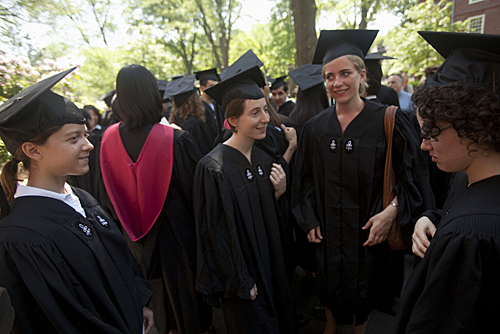
    On the hottest day of the year, the young men and women poured into the sweltering Memorial Church, dressed in their traditional black caps and gowns for their Harvard farewell.

    The time-honored ceremony included readings from Hindu scripture, the Holy Quran, the New Testament, the Hebrew Bible, and the Analects of Confucius. In addition, there were comments from the Rev. Peter J. Gomes, the Plummer Professor of Christian Morals and Pusey Minister in the Memorial Church.

    As is customary, Gomes was stationed at the church’s front steps and welcomed the seniors, who processed in a long line that snaked through the Old Yard. He greeted them with a solemn nod or friendly word.

    Faust said that changes at Harvard, ranging from the reforms in its financial aid programs to the successful introduction of a new undergraduate General Education curriculum, combined with a changing global landscape, provided lessons for the seniors that were “too important to forget.”

    Her first lesson concerned humility.

    “If Harvard graduates were writing the book on it, someone once said, the title would have to be ‘Humility and How I Achieved It,’ ” Faust joked. But, she added, “humility, in fact, is what makes learning possible — the sense of ignorance fueling the desire to overcome it.”

    Reiterating her “parking space theory of life,” Faust encouraged the seniors, in her second lesson, to be risk takers and aim for goals where they can do what they love.

    “Don’t park 10 blocks away from your destination because you think you’ll never find a closer space. Go to where you want to be. You can always circle back to where you have to be.”

    The students were well aware of her third important lesson, she said, that “the world really needs you,” acknowledging that they had already developed “a deep sense of obligation” through extensive humanitarian work and volunteer efforts.

    “You need to be the authors, the entrepreneurs, of your own lives,” offered Faust as her final lesson. “And this part I don’t have to tell you either. You are already doing it,” she said, referring to student projects such as a nonprofit group that built a girls school in Afghanistan. She also mentioned a soccer ball, born out of an engineering class assignment, that “can store energy and convert a playground ballgame into a power source for people in developing nations.”

    “Keep asking the big, irrelevant questions; keep thinking beyond the present,” Faust told the students. “Then live what you have learned.”

    Senior and Adams House resident Crystal Chang, a molecular and cellular biology concentrator who has plans to attend dental school, said Faust’s theme of embracing a life that doesn’t go according to a script is a message that everyone can appreciate.

    “It was very encouraging and very inspiring at the same time,” she said.

  • Intellect, rigor, tradition

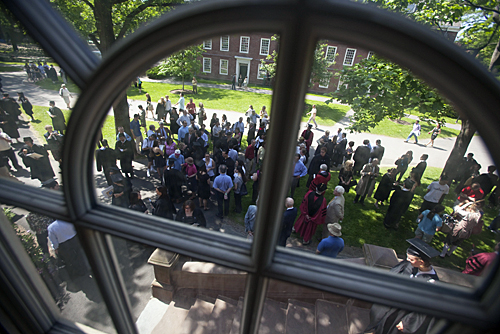
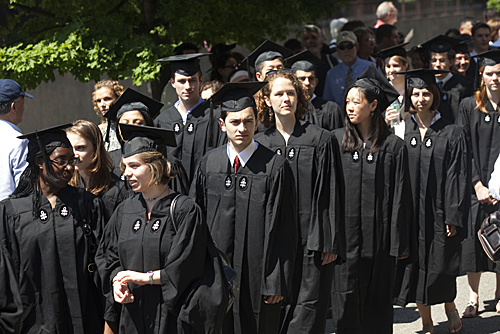
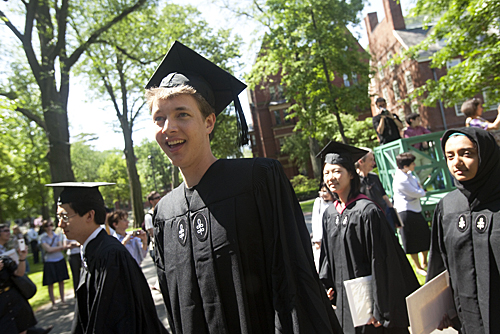
    In the welcome shade of the verdant trees outside Harvard Hall on this scorching morning (May 25), Trevor Bakker ’10 and 71 other Phi Beta Kappa honorees lined up in their caps and gowns for the traditional fife-and-drum procession to Sanders Theatre.

    “It’s the beginning of a celebration,” said the Holland, Mich., senior, who said he landed among the University’s highest achievers without ever drinking coffee. “There are a few of us.”

    At Harvard, 24 juniors are elected to Phi Beta Kappa every spring, and 48 seniors each fall. Membership cannot exceed 10 percent of the graduating class.

    The Literary Exercises have been a Harvard tradition since the 18th century, and take place each year on Tuesday of Commencement Week. Harvard’s Phi Beta Kappa chapter, called Alpha Iota of Massachusetts since 1995, is the oldest continuously running chapter in the United States.

    Today’s Literary Exercises, the 220th, included three musical interludes by the Harvard-Radcliffe Collegium Musicum. The last (another tradition) is Harvard’s “College Hymn,” which exhorts new graduates “for Right ever bravely to live.”

    To help the graduates find rightness, two addresses are at the heart of the exercises ceremony. One is by a poet, who reads a work written for the occasion. The other is by an “orator,” a guest invited to offer timely discourse.

    This year’s Phi Beta Kappa poet was D.A. Powell, a Georgia-born writer who teaches English at the University of San Francisco. He was once the Briggs-Copeland Lecturer in Poetry at Harvard.

    Powell, a prize-winning experimental poet, read his new poem “Panic in the Year Zero,” whose title was inspired by a 1962 movie about nuclear apocalypse. He is a lover of puns and edgy themes, including AIDS. His first three collections of poetry — “Tea,” “Lunch,” and “Cocktails” — are considered a trilogy on the disease.

    “In the time I have been alive,” said Powell, “we have lived under the threat of some sort of extinction. And I think that the mission of this poem is to say: enough.” As he writes:

    Enough with the apocalypse, already.

    Think of all the history you’ve read. It started somewhere.

    It started at absolute zero, is what you thought.

    Just because you couldn’t know what came before.

    But imagine: something did.

    Doing the honors as orator was Natalie Zemon Davis, A.M. ’50, LL.D. ’96, a pioneering cultural historian of the early modern period who teaches at the University of Toronto and is professor emerita at Princeton University. Her discourse, a glimpse at past orations and what they promise for the future, was titled “The Possibilities of Friendship.”

    Davis is a figure of some renown in the history of women and gender, and in 1971 at the University of Toronto co-founded one of the first courses on the subject in North America.

    Her oration marked how the concept of friendship — a central Phi Beta Kappa value — has waxed and waned over the years, as traditions of “sentimental union” through literature vied with stricter measures of academic excellence. But friendship is a mark of hope and excellence in the modern world, said Davis, who looked at the cooperation among Palestinian and Israeli doctors, whose nations are riven by war.

    Friendship can “blaze anew,” she said, “illuminating a landscape that may seem desolate but can still carry within in it bridges of truth, truth-telling, and understanding.”

    The Literary Exercises are also traditionally when the winners of the annual Alpha Iota Prize for Excellence in Teaching are announced. Prizes this year went to Lawrence Buell, Powell M. Cabot Professor of American Literature; Benjamin M. Friedman, William Joseph Maier Professor of Political Economy; and Richard J. Tarrant, Pope Professor of the Latin Language and Literature.

    Caps and gowns

    Caps and gowns

    Senior Phi Beta Kappa honorees congregate outside Harvard Hall before processing to Sanders Theatre.

    Excitement builds

    Excitement builds

    Johanna Rodda ’10 (from left), Liza Flum ’10, Caroline Bleeke ’10, and Diana Wise ’10 chat excitedly in the soaring heat before heading to PBK’s Literary Exercises, a Harvard tradition since the 18th century.

    Keeping the beat

    Keeping the beat

    Rap-rap-rapping her drum, Rachel Hawkins ’12 leads the procession of PBK honorees — and lets everyone know it.

    A green scene

    A green scene

    Amid the greenery of the Yard, PBK honorees mingle with attendees in a relatively small Commencement fete — on Commencement morning, the Yard fills with more than 30,000 visitors.

    There they go

    There they go

    PBK honorees make their way to Sanders Theatre, where they’ll be delighted by the poetry of D.A. Powell and an oration by Natalie Zemon Davis, A.M. ’50, LL.D. ’96, a pioneering cultural historian.

    No frowns here

    No frowns here

    Phi Beta Kappa inductee Trevor Bakker ’10 is just one of the 72 seniors being honored for academic excellence. And, surprisingly, he did it all without coffee’s jolt. “There are a few of us,” he said.

    The stage is set

    The stage is set

    Inside grand Sanders Theatre, the stage is illuminated with scholars who are winners of the annual Alpha Iota Prize for Excellence in Teaching.

    Steady now

    Steady now

    Director of choral activities Jameson Marvin conducts the Harvard-Radcliffe Collegium Musicum for three songs, including “College Hymn,” which exhorts new graduates “for Right ever bravely to live.”

    'The Possibilities of Friendship'

    ‘The Possibilities of Friendship’

    Natalie Zemon Davis, A.M. ’50, LL.D. ’96, takes the podium for her speech, “The Possibilities of Friendship,” which offered a glimpse at past orations and what they promise for the future.

    Three in a row

    Three in a row

    Harvard College Dean Evelynn Hammonds (center) is flanked by President Drew Faust and Everett Mendelsohn, continuing education/special program instructor and research professor of the history of science.

    'Panic in the Year Zero'

    ‘Panic in the Year Zero’

    Before reading his poem “Panic in the Year Zero,” poet D.A. Powell said, “In the time I have been alive, we have lived under the threat of some sort of extinction. And I think that the mission of this poem is to say: enough.”

    Over here!

    Over here!

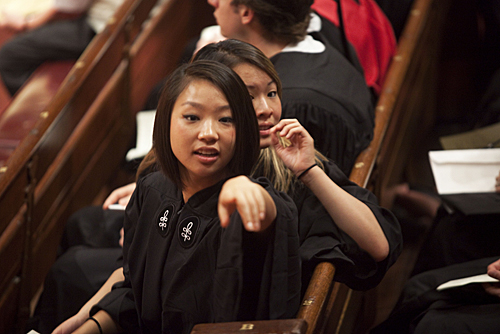
    Sarah Yun ’10 (front) and Melissa Tran ’10 look for friends and relatives inside the theater.

    Photo slideshow: Phi Beta Kappa Literary Exercises 2010

    Kris Snibbe/Harvard Staff Photographer

  • Phi Beta Kappa elects 99

    Ninety-nine seniors from the Class of 2010 were recently elected to the Harvard College chapter of Phi Beta Kappa (PBK), Alpha Iota of Massachusetts, in the senior final election on May 11. Other members of the graduating class were inducted in two previous elections.

    The following seniors, including their Houses and concentrations, were inducted:

    Adams House

    Joseph Jiazong Lee, applied mathematics
    Tracey Chen Shi, economics
    James MacLeod Sterne, history

    Cabot House

    Max Joseph Kornblith, social studies
    Veronica Rey Koven-Matasy, classics
    Joshua James Nuni, social studies
    Hann-Shuin Yew, molecular and cellular biology

    Currier House

    Sara Avery Bartolino, government
    Christopher Tsung-jer Chen, molecular and cellular biology
    Victoria Jeannette Crutchfield, literature
    Jiashuo Feng, applied mathematics
    Jonathan Shulman Greenstein, economics
    Karen Aline McKinnon, Earth and planetary sciences
    Anjali Motgi, social studies
    Bradley Edward Oppenheimer, history and literature

    Dunster House

    Marino Felipe Auffant, history
    Allison Sarah Brandt, anthropology
    Alyce Michelle DeCarteret, anthropology
    Hannah Elyse Hausauer, psychology
    Joseph Matthew Stujenske, neurobiology

    Eliot House

    Samuel James Bjork, chemistry
    Kelly Ngoc-Nhu Diep, history of science
    Jessica Lindsay Fleischer, history and literature
    Jonathan Sidney Gould, social studies
    Laurence Henry Moses Holland, philosophy
    Natasa Kovacevic, economics
    Sondra Hope Lavigne, organismic and evolutionary biology
    Tracy Lingchen Meng, economics
    Sarah Wang, economics
    Elizabeth Jianing Zhang, neurobiology

    Kirkland House

    Kiran Narayan Bhat, government
    Matthew Hagop Ghazarian, government
    Amrita Goyal, organismic and evolutionary biology
    Shaun Patrick Hughes, German
    Robert Cameron Parker, economics
    Laura Paul Starkston, mathematics
    Hannah Sarina Yohalem, history of art and architecture

    Leverett House

    Caroline Anne Bleeke, English
    Samuel Keller Bonsey, history and literature
    Warakorn Kulalert, molecular and cellular biology
    Joseph John Michalakes, social studies
    Sarah Nazpari Schwartz Moshary, economics
    Grace Kathryn Ryan, anthropology
    Charlotte Allen Seid, chemical and physical biology
    Anna Shabalov, history
    Nafees Asiya Syed, government
    George Jing Xu, engineering sciences
    Chen Yan, chemical and physical biology
    Linda Yao, applied mathematics
    Anna Yuan-Yuan Zhang, economics
    Yifang Zhang, East Asian studies

    Lowell House

    Sophie Margaret Alexander, literature
    Maria Igorevna Baryakhtar, physics
    Philip Jad Daniel, economics
    Susan E. DeWolf, neurobiology
    Caitlin Leigh Lewarch, human evolutionary biology
    Linda Yang Liu, English
    Jessica Marie Luna, sociology
    Stephanie Nicole Miller, sociology
    Manisha Pandita, economics
    Rachel Sophie Storch, folklore and mythology
    Yongtian Tan, molecular and cellular biology
    Hannah Rose Trachtman, economics
    Jenny Yuan-Xing Wang, chemistry and physics

    Mather House

    Ekaterina Botchkina, philosophy
    David Tomas Escamilla, economics
    Liza Danielle Cork Flum, English
    Dan Ang Gong, neurobiology
    Men Young Lee, physics
    Caitriona Loretta Jennings McGovern, special concentrations
    Johanna Sarah Rodda, English
    Aliza Laura Stone, visual and environmental studies
    Christopher Tsong-Kai Wu, economics

    Pforzheimer House

    Michael James Buckley, applied mathematics
    Kledin Dobi, mathematics
    Robert Vincent Fitzsimmons, history of science
    Katherine Clark Harris, history
    John Samuel Riley, history
    Katherine Christine Wilson, history of science
    Sarah Yun, government

    Quincy House

    Melissa Rose Alpert, government
    Melissa Suzel Deas, sociology
    Daniel William Deighton, Romance languages and literatures
    Lillian Meili Fang, visual and environmental studies
    Jane Su Jiang, English
    Matthew Daniel Klayman, history
    Elijah Forrest O’Connor, special concentrations
    Charles Emerson Riggs, history
    William Marc Ruben, economics
    Meicheng Shi, economics
    Molly Riordan Siegel, history of science
    Benjamin James Tuyp, engineering sciences

    Winthrop House

    Elena Decatur Butler, applied mathematics
    Lee Hilton Dietterich, organismic and evolutionary biology
    Samantha Tsai-Wei Fang, economics
    William Veta Leiter, social studies
    Jennifer Alys Lo, molecular and cellular biology
    Kevin Zhou, government
    Olga Igorevna Zverovich, mathematics

  • Fostering a dream

    On May 27, thousands of students are graduating from Harvard. Each has a successful past to relate, and a promising future to embrace. In a series of profiles, Gazette writers showcase some of these stellar graduates.

    Kim Snodgrass clearly remembers Dec. 11, 1998. It was her first day in the sixth grade, and the beginning of her steady education — as well as her salvation.

    “From then on, I never missed a day of school,” said the master’s student at the Harvard Graduate School of Education’s (HGSE) Risk and Prevention Program, who will graduate today armed with ambition and a story of overcoming adversity.

    Snodgrass, a fresh-faced, blued-eyed blonde, could be a poster child for the stereotypical Californian. She could also be a poster child for foster care.

    As a young girl, she and her family were on the run. They camped out in the mountains and hopped to and from motels and shelters across southern California. They skipped out on apartments whenever the rent was due. They stole to survive, walking out of grocery stores with carts full of food, or filling up the car at gas stations, and then driving away without paying.

    “That is what we were so used to, stealing things and getting what we needed whenever we needed it.”

    Snodgrass watched as her stepfather and mother’s addiction to drugs and alcohol broke the family apart, gradually “disintegrating” her parents in the process. Eventually, her mother lost all rights to her five children. Between age 5 and 11, Snodgrass was in and out of at least 10 foster homes. Finally, at age 16, her long-term foster family adopted her, her younger brother, Max, and sister, Jennifer.

    “I always knew from an early age what [my mother and stepfather] were doing was wrong, and I made a pact to myself that I was going to get myself out of this hole. I was not ever going to touch drugs or alcohol or smoke, and I was going to make it.”

    Though she had only had sporadic formal schooling before sixth grade, she knew her escape route depended on education. She became a driven student and excelled academically.

    “I used my education as my savior. It was like my thing that I could always go back to, no matter what happened in my life.”

    Snodgrass attended the University of California, Irvine, where she studied community and public service. It was there that she dedicated herself to helping foster care children.

    “When I entered college, I thought I needed a college degree to have a successful family. As a sophomore, I thought I needed a college degree to change the foster care population, as I found out that only 50 percent of foster youth graduate from high school. My junior year, I realized that I needed a graduate degree to really make an impact and help train others about how they can make change to make an even bigger impact.”

    With her new master’s degree, she hopes to provide foster care children with access to support systems and mentors who can help them to develop important life skills and succeed in high school and college. As part of her program at Harvard, she developed an intervention method to help foster care youth transition to college and beyond, and is currently working with an HGSE alumna to explore using her program at a local nonprofit.

    While at Harvard, she also produced an educational video about the foster care system, founded the club REACH (which stands for Realizing Every Action Creates Hope) to raise awareness about foster care youth in school, and worked on a model for a charter school designed for foster care children in connection with the Orangewood Children’s Foundation, a nonprofit in Santa Ana, Calif.

    She also made time to teach at two local schools. The fast pace is the standard for Snodgrass, who admitted that the overachiever mentality is something of a coping mechanism, one that offers her life a certain kind of balance.

    “I cram people into every second of the day. My schedule is back to back to back. It’s something that helps [keep] me from sitting down and crying. I don’t just dwell on the past, I think, ‘What can I do tomorrow?’”

    After Harvard, “the possibilities are endless,” said Snodgrass, who sees herself getting a Ph.D. and working in the policy realm, or running a charter school or nonprofit.

    But one thing is certain. Citing research that shows that children who face difficult challenges often succeed with the support of just one encouraging voice, Snodgrass sees her future mission clearly.

    “So many people helped me get where I am today. I want to go back and help others. My mission is to be a child advocate, and become that voice for them.”

    Her Harvard experience has helped her too, and prepared her to help others.

    “Harvard was 100 percent where I was supposed to be,” said Snodgrass. “I am going to have a big tool kit when I leave.”

    More graduate profiles will be available in the May 27 print issue of the Harvard Gazette as well as online.

  • The man with a Commencement plan

    Inside an office where Julia Child used to film her cooking show, Jason Luke is whipping up another kind of dish: Commencement.

    It’s a historic backdrop like Child’s set that adds extra mystique to Luke’s job as associate director of custodial and support services for University Operations Services. That’s a mouthful, but behind the long title is a Frank Sinatra-loving ultra-preparer. And he has to be. It is spring, after all.

    April and May are no ordinary months. Commencement is easily the busiest time at the University, but especially so for Luke. That’s when he — to quote a sticker on a file cabinet in his office — earns the moniker “The Man.”

    “When Yardfest [an annual spring concert for undergraduates] gets here in April, I’m like ‘OK, here we go,’ ” said Luke. “Then after that, it gets pretty intense.”

    In the off-season, Luke oversees a staff of 250 custodians and handles logistics and support for other Harvard events peppered throughout the academic year. But nothing compares with the end-of-year weekly soirée of Class Day, Morning Exercises, alumni reunions, and the hundreds of other happenings, which he helps coordinate under Commencement Director Grace Scheibner and the Harvard Alumni Association. Then, after months of intense planning, Luke rounds up his crew, a bevy of student workers, and gets cookin’.

    There are countless components that make up Commencement, according to Luke, ranging from the small to the massive. Take, for instance, dorm rooms. Those have to be turned around for alumni visitors after vacating students are gone, then turned around again in time for summer school. And think of all the technical equipment that goes into staging a large-scale production — cords and cables and speakers, oh my!

    “Commencement is a year-round thing,” said Luke, who also coordinates labor, seating, staging, tenting, setting up, and breaking down. “But at the beginning of May, we start taking the equipment out of storage. We take inventory, we see what’s damaged or missing, then we start working in the Yard.”

    But who better to tackle all this than one of Harvard’s own? Luke, a one-time concentrator in English and American literature, graduated in 1994. As a student, he worked for the student dorm crew on facilities maintenance, a precursor to the 15 years he has now worked at Harvard.

    Right before Commencement, Luke moves onto campus to better manage his massive workload. “I set up another office in Sever Hall, and then I usually stay in Wigglesworth for 10 days,” he said. “I just don’t go home at all.”

    “I pull a couple of all-nighters, at least,” he says. “I probably get about three or four hours of sleep a night for 10 days.”

    His assistant stays in the dorm room with him. “We don’t want to oversleep, so we can wake each other up this way. The pace of the week is just so hectic.”

    Imagine, for instance, setting up chairs and other infrastructure for about 32,000 Commencement attendees.

    “There’s a very, very specific setup for the chairs,” said Luke. “It takes several days. We have specific counts for each section.” He and his staff arrange them meticulously well before Commencement. But because events are already going on, Luke and his team don’t just arrange them once, but several times.

    “People are coming into the Yard, moving the chairs, things get changed,” he said. “You’ve got to redo it, recount it, over and over and over.”

    When Commencement ends, there are more events on Luke’s horizon. Sustainability is another project he is working on. He has helped to integrate four nontoxic products into everyday cleaning use, including a disinfectant, and he has brought in microfiber cloths in place of throwaway paper towels.

    But by July or August he vows to take a well-deserved vacation. He’ll stream a little Sinatra (whose mug bedecks Luke’s office walls), or maybe Nat King Cole and Bobby Darin. He’ll don his trademark Tilley, an indestructible and UVA/UVB ray-blocking hat, and get down to the business of just relaxing. “If people need to find me,” he said, “look for the hat.”

  • Pumping up sports spirits

    On May 27, thousands of students are graduating from Harvard. Each has a successful past to relate, and a promising future to embrace. In a series of profiles, Gazette writers showcase some of these stellar graduates.

    It would have been hard to miss Cheng Ho ’10 at Harvard’s athletic events. He’s usually the one mixed in with the crowds, displaying a boatload of Crimson spirit.

    A Harvard running back in the fall, a super fan in the winter, Ho has been revered by fans and coaches alike for his crowd-igniting antics as a fan as well as for his contributions as a member of the football team.

    As a fan, Ho was an integral part of a marketing campaign that boosted attendance at men’s basketball games this season. This culminated in an unprecedented sellout, bringing 2,195 to Lavietes Pavilion in a showdown match against Cornell. A month and a half later, Ho helped to draw a record 13,285 spectators to Harvard Stadium to watch the men’s lacrosse team take on Duke, just 437 fans shy of the NCAA regular-season record. Where the upbeat Ho went, the fans followed.

    And yet for Ho, Crimson football — and Harvard for that matter — almost never happened.

    Born and raised in Taiwan until age 13, Ho was thrust into maturity at a young age. His father lost an eight-year battle with liver cancer, and because his mother had her own struggle with schizophrenia, she was unable to care for Ho and his sister alone.

    Eventually, the siblings found themselves in the adoptive care of their aunt and uncle in Georgia, and that was the move that changed Ho’s life.

    “I’m very fortunate because I shouldn’t be alive right now, to be honest,” Ho said. “My sister and I probably would have been wandering the streets of Taipei if it wasn’t for my aunt and uncle.”

    Despite strong family support, initially the adjustment to a new culture was a challenge for Ho because of his limited knowledge of English.

    “English was very frustrating, because I consider myself pretty social. … The initial two months were the most frustrating,” he said. “I remember holding this electronic translator and trying to read just a paragraph of a science textbook, and it took me like two hours. … I would have to look up every single word.”

    Searching for something, anything, he could find to ease him through his transition, Ho found sports to be the perfect therapy.

    “Sports really opened up a new world for me, as far as being able to gain confidence and being able to socialize with people,” he said.

    Although Ho’s first love was basketball, living in the South meant being indoctrinated in football, something he didn’t comprehend when living in Taiwan. “The first time I watched a game of football was back in Taiwan. And I was just thinking: ‘Man, these people are crazy. This is such a stupid sport. I would never be able to, and want to, play this sport, ever.’ So I flipped the channel, and that was that,” Ho said.

    That changed, of course, because it wasn’t long before Ho’s athleticism on the basketball court prompted friends and coaches to persuade him to give the gridiron a shot.

    “Initially, it was really confusing because I didn’t know any of the rules, the shape of the football was really weird, and I couldn’t hold on to it,” he said. “I couldn’t really understand English, so I would run in the opposite direction. … It was complete chaos.”

    Eventually the chaos subsided, and over time, he began to excel on the field. Ho sent highlight tapes to several Division I football programs across the country, and teams began to show interest, including Harvard.

    After spending a postgraduate year in Connecticut to improve his English and prepare for the rigors of college, Ho was admitted to Harvard, and was ready to take Cambridge by storm in more ways than one.

    During his freshman year in 2006, he was behind future NFL running back Clifton Dawson ’07 on the depth chart, and then had a breakout season as a sophomore. In his first collegiate start at Holy Cross, he racked up 24 carries for 116 yards, including a 47-yard touchdown run. That season, Ho finished second in the Ivy League in rushing with 722 yards and eight touchdowns. His play helped the Crimson to an undefeated (7-0) Ivy League championship run and earned him a spot on the All Ivy second team.

    It was his best, and only full season at Harvard, as he spent the next two years hampered by injuries, and only played in eight games as an upperclassman. Although injuries shortened his career, Ho remained an integral part of the team, as well as a leader and an inspiration to the Harvard community.

    “He obviously took the long road to Harvard figuratively and literally. And because of that … he really has, as much as any kid we’ve had here, embraced everything that is Harvard, and has taken advantage of the education on the field, the education in the classroom, the education on campus,” said head football coach Tim Murphy.

    “He’ll be remembered for his love of life, his leadership by example, and his extreme pride in being a part of the Harvard community as a whole, not just a Harvard football player.”

    Next in the series: Kim Snodgrass gives a voice to foster children.

  • Art, printmaking, and science

    Printmaking was a new technology in the 16th century, and artists who created prints for scientific texts not only illustrated the books, they enabled scientific advances by helping early scientists to visualize findings in ways they hadn’t before, according to curators of a new exhibit sponsored by the Collection of Historical Scientific Instruments.

    The exhibit, “Paper Worlds: Printing Knowledge in Early Modern Europe,” is on the second floor of the Science Center in the temporary exhibit space managed by the Collection of Historical Scientific Instruments. It was created by 10 graduate students and a Harvard paper conservator studying the history of science and the history of art and architecture. It was the product of a graduate student seminar, “Prints and the Production of Knowledge in Early Modern Europe,” taught by Susan Dackerman, the Carl A. Weyerhaeuser Curator of Prints at the Harvard Art Museum, and by Katharine Park, the Samuel Zemurray Jr. and Doris Zemurray Stone Radcliffe Professor of the History of Science.

    Students who signed up for the class were involved in a semester-long exhibit-building exercise that included conducting background research, searching Harvard’s various museum collections for appropriate material, designing and building the exhibit itself, and even creating a 100-page catalog and accompanying Web material.

    Adam Jasienski, a graduate student in the history of art and architecture, said a major benefit of the class was being able to handle so much historical material that is studied in other classes, but that students rarely get to see.

    “I’m an early modernist, but we don’t have a class that gets you so close to these objects,” Jasienski said.

    Stephanie Dick, a graduate student in the history of science, agreed, saying that the course provided a hands-on lesson in material culture.

    “I find it interesting in the history of science, we are interested in material culture, but we rarely really deal with materials,” Dick said. “This class was an in-your-face experience in the materiality of materials.”

    The idea for the class grew out of a series of seminars on prints and knowledge that Dackerman and Park collaborated on over the past several years. It is an unusual collaboration, teaming up the seemingly disparate disciplines of art history and the history of science. But Dackerman and Park’s take on the importance of printmaking to early scientific efforts binds the two disciplines together.

    “Artists were already looking at natural objects and describing them in detail, but scholars weren’t,” Park said. “The visual skills of looking and seeing, which are part of the skill set of artists, began to be integrated into the skill set of doctors and medical professionals. Scientists became more interested in the details of scientific reality.”

    Robin Kelsey, the Shirley Carter Burden Professor of Photography and chair of the Harvard University Committee on the Arts, said that although there have been student-created exhibits at Harvard before, what’s special about the printmaking exhibit is that its creation was integrated into the course, as opposed to the individual student efforts that resulted in most prior student-created exhibitions.

    “To my mind, this is exemplary. It’s a terrific initiative and a great way to bring the collections and students together and produce new ways of thinking,” Kelsey said.

    Kelsey said he believes this sort of effort will be happening more because the University is committed to making its collections’ vast resources a more integral part of student education.

    Associate Provost for Arts and Culture Lori Gross echoed Kelsey’s comments, saying that better integrating the collections into Harvard’s educational mission is a key recommendation of the 2008 report of the Task Force on the Arts.

    “‘Paper Worlds’ is an eloquent manifestation of a key recommendation of the Task Force on the Arts,” Gross said. “By integrating Harvard’s vast collections with innovative courses, the power of these amazing resources can reverberate through faculty, museum curators, and students to enrich the University as a whole.”

    The exhibit, Dackerman said, is interdisciplinary, drawing on materials from several Harvard museums, including the Houghton Library, the Countway Library of Medicine, the Botany Libraries at the Harvard University Herbaria, the Harvard Art Museum, and the Collection of Historical Scientific Instruments.

    “The students used the vast resources within the Harvard collections to create an interdisciplinary exhibition on how printmaking enabled the production of new knowledge in the fields of botany, anatomy, astronomy, cartography, [and others],” Dackerman said. “It allowed knowledge to be conceptualized in new ways. Printmakers’ roles were not merely that of illustrators, but as participants in the creation of knowledge in those proto-scientific fields.”

    The exhibit itself is organized around several themes: Thinking Visually, which emphasized the relationships between early modern theories of cognition and emotion; Animating Bodies, exploring how anatomical prints were used to produce knowledge of the body; Constructing Scale, illustrating that the prints often showed details and features beyond simple reflections of their subject matter; Printing Time, exploring engraved instruments such as sundials in relationship to printed images depicting the passage of time; and Making Prints, explaining the printmaking process itself.

    The exhibit features several notable pieces, including a 16th century botanical encyclopedia and the woodblock used to make its intricate prints, sundials and engravings, single-leaf sheets and book illustrations, as well as several scientific instruments.

    “Paper Worlds: Printing Knowledge in Early Modern Europe,” is on display through Aug. 27. The gallery is open from 11 a.m. to 4 p.m., Mondays through Fridays.

  • Poetry on ice, paper

    On May 27, thousands of students are graduating from Harvard. Each has a successful past to relate, and a promising future to embrace. In a series of profiles, Gazette writers showcase some of these stellar graduates.

    There’s ice-skating, and there’s poetry. And then there’s ice-skating poetry written by a former professional athlete who is a pre-med English concentrator. Loren Galler Rabinowitz is all of the above and — if you can believe it — more.

    Galler Rabinowitz, who grew up in Brookline, Mass., and Barbados, already has lived a full life. From the ages of 2 to 20, her home was on the ice, where she eventually traveled around the world competing professionally with her skating partner David Mitchell, garnering acclaim as U.S. Junior Champions and 2004 bronze medalists at the U.S. Figure Skating Championships. But, she said, she always knew she’d eventually land at Harvard.

    “I think one of the most important things for me as a professional athlete was that I always took school very seriously,” said Galler Rabinowitz, who attended high school full time, even after training for four hours each morning. She deferred enrollment at Harvard to compete professionally for two more years after graduation, taking up residence at Adams House in 2007.

    “One of the things that I knew I was going to miss when I stopped skating was the constant creative outlet,” said Galler Rabinowitz, “so I signed up for a creative writing course as a freshman.”

    She eventually was chosen as a thesis advisee by Pulitzer Prize-winning poet Jorie Graham, the Boylston Professor of Rhetoric and Oratory, from nearly 100 creative-writing thesis applications.

    Her 70-plus-page manuscript, “The Invisible Encyclopedia of Dance,” recalls the tenuous stake on which glory rests, and evokes dance moves using the skater’s trademark measured precision — only on the poetic line. In “Ice Dancer,” Galler Rabinowitz writes: “The position must be maintained. / There is only up or down. / There are only laurels or sorrow.”

    The poems also delve into headier matter, such as sickness and death. In the fall of 2008, Galler Rabinowitz began shadowing a pastor at Mount Auburn Hospital. Her grandmother, a Holocaust survivor and 50-year New Orleans resident, had died in the aftermath of Hurricane Katrina. “I was very interested in how people deal with loss,” recalled Galler Rabinowitz.

    “One of the things that most draws me to becoming a doctor is a sense of compassion and being a humanitarian,” she said. “That’s missing from medical education now. It’s sort of technical and diagnostic. I want to make the experience of going to the doctor’s office enjoyable and not terrifying.”

    Now Galler Rabinowitz is considering medical schools and eventually wants to enter pediatrics. Medicine wasn’t always a career goal, but her parents are also physicians, and, she said, “They’re so passionate that it’s infectious.”

    But medicine might wait a few years, too. Galler Rabinowitz is eyeing some of Boston’s M.F.A. programs in creative writing and may divert elsewhere, at least for a little while.

    But this juggling is nothing new. Even at Harvard, Galler Rabinowitz coached youth ice skaters, waking every morning at 5:30 to meet them on the ice. That quickly led to her tutoring them and advising with SATs and college prep.

    “One of the things that’s so interesting is how much of my skate training — discipline, work ethic, attention to detail, creativity — has been applicable to my activities at Harvard. I really like being able to show my young students the ways they can apply what they learn on the ice to all sorts of things they’re doing,” she said. “I think a lot of my successes at Harvard were due to that very specific training.”

    Galler Rabinowitz is also adamant about giving back. Every Christmas she runs a charity event at the Charles Hotel in Cambridge, raising money for Globe Santa and even teaching a few skating lessons. “I get to do good things and wear a sparkly dress,” she said. “What could be better?”

    And then there’s less glamorous fieldwork. Galler Rabinowitz frequently volunteers at her mother’s Barbados-based clinic that treats malnourished children. She’s also taught creative writing classes in a shelter for abused women and children there.

    Though her classmates often looked her up on Wikipedia, there’s no sign any of her well-chronicled achievements have gone to her head.

    “I’ve had the privilege of competing at the highest athletic level and attending Harvard,” Galler Rabinowitz said. “And I didn’t really anticipate being able to merge my love of writing and being a future physician, but it really worked out that way.”

    Next in the series: Cheng Ho and the tragedy that changed his life.