Author: Harvard Gazette Online

  • It’s Arts First at Harvard

    Spring at Harvard typically signifies Commencement, but before those robed scholars dart off into the wider world, the annual Arts First Festival happens.

    For four days, this year from April 29 to May 2, Arts First invades the sidewalks of Harvard Square and 43 venues across campus, with hundreds of student performers and arts opportunities. Sponsored by the Office for the Arts (OfA), the festival boasts everything from the eclectic to the outlandish, with something for kids and adults alike.

    Consider the ever-popular Sunken Garden Children’s Theater, which this year takes “The Ugly Ducking” to new heights during an outdoor performance by zany undergraduates. Not your cup of tea? What about “Fat Men in Skirts!!!?!,” which, according to the OFA Web site, is “a dark comedy by Nicky Silver that will make you rethink the nature of monkeys!!!?!” Yes, that’s the play’s actual description. Too avant-something? The Radcliffe Dramatic Club updates and revitalizes “Godspell.”

    And then there’s music, sweet music. Goodbye Horses rocks the Cambridge Queen’s Head Pub; the Harvard College Madrigal Singers appear at Adolphus Busch Hall; and bluegrass from the Harvard College American Music Association will echo through the Yard. And those are just a few of the offerings.

    Kicking off the festival is the presentation of the Harvard Arts Medal to Catherine Lord ’70 by President Drew Faust inside New College Theatre at 5 p.m. today (April 29).

    Lord, a visual artist, writer, and curator who addresses issues of feminism, cultural politics, and colonialism, is the 17th distinguished Harvard or Radcliffe alum or faculty member to receive this accolade for excellence in the arts and contributions to education and the public good through arts. Past medalists have included poet John Ashbery ’49, composer John Adams ’69, M.A. ’72, cellist Yo-Yo Ma ’76, filmmaker Mira Nair ’79, and saxophonist Joshua Redman ’91.

    Best of all? It’s mostly free. For a complete schedule and ticketing information, visit the Arts First calendar online.

  • What makes a life significant?

    It is somehow comforting to know that one of the greatest minds of the past 100 years had a hard time making up his own mind.

    William James, the oldest child in a celebrated American family and a pioneer in psychology and philosophy, was apparently a famous ditherer. “He’s just like a blob of mercury,” his sister Alice wrote. “You cannot put a mental finger upon him.”

    Better than that, perhaps, James was a man of restless intelligence. While teaching at Harvard, he explored medicine, the mind, religion, and all the big questions that still beset people.

    One of those questions was: “What makes a life significant?” — the title of a lecture James delivered at Harvard in 1900. (The answer, in sum, was to be awake to the significance of other people, and to escape that “great cloud bank of ancestral blindness” that leads to intolerance and cruelty.)

    The same question was also the title of a panel on Monday (April 26), which celebrated James’ life and marked the centennial year of his death.

    James Kloppenberg, a 40-year James scholar and Harvard’s Charles Warren Professor of American History, moderated the panel, and began with a question of his own: What relationship does James’ thought have to “our own cultural moment?”

    Panelists Louis Menand, Sissela Bok, and Cornel West arrived at variations on the same answer: that James lives on into the 21st century, still a formative, formidable mind.

    Menand, Harvard’s Anne T. and Robert M. Bass Professor of English, said James was the equivalent of today’s public intellectual. He still offers a lesson to the modern world, said Menand: Beware of training and revering only specialists. James, after all, was not trained in anything he excelled in, and his schooling was as scattershot as it was fervent.

    Bok, a philosopher who is Senior Visiting Fellow at the Harvard Center for Population and Development Studies, said one of James’ ideas, to harness the energy of making war to the pursuit of making peace, would find purchase today. “He would surely be encouraged,” she said, at the vitality of doing public service, both inside and outside the university.

    It is worth noting too that James’ “non-militarism” was at odds with the tenor of his own time, said Bok, and James “agonized over the increasingly aggressive role his country was taking” in the world.

    And in another modern echo, she said, James worried that peace-loving men carried no weight equivalent to the warriors of the day.

    In answer to his own doubts, James wrote “The Moral Equivalent of War,” a 1906 essay in which he proposed harnessing “manly” virtues to the cause of peace. “The martial type of character,” he wrote, “can be bred without war.”

    He had a similar thought in “What Makes a Life Significant?” inspired by a train ride back from the Assembly Grounds in Chautauqua, N.Y. This “Sabbatical city” of sobriety, peace, and order, this “human drama without a villain or a pang,” James wrote, made him suddenly long “for something primordial and savage, even though it were as bad as an Armenian massacre.”

    But if humans yearn for “everlasting battle” or visions of “human nature strained to its uttermost and on the rack,” he mused, why reach for war? Why not satisfy the same urges with hard labor — with pick, ax, scythe, and shovel. Such work, James wrote, reveals “the great fields of heroism lying around me.”

    West, a former Harvard scholar who is the Class of 1943 University Professor at Princeton, said James had a sense of what the modern world needs now: “non-market values like love, empathy, benevolence, and sacrifice for others.”

    He also had a sense that greatness could be something “different than success,” said West. “William James,” he wished out loud, “speak to us in 2010.”

    James might bring another lesson forward into the 21st century: Leave your mind free, open, and skeptical.

    It stood him in good stead that James lacked a systematic education, said Menand, author of “The Metaphysical Club,” a 2001 primer on pragmatism and other intellectual currents in James’ post-Civil War America.

    Menand outlined the hopscotch schooling of James, whose father moved the family from place to place — back and forth to Europe — settling sometimes for only months in one place. By age 13, James had already attended 10 schools.

    By 1861, James was enrolled at the Lawrence Scientific School at Harvard, where he quickly jumped from engineering to anatomy to natural history and finally to medicine. A medical degree from Harvard in 1869 was the only credential James ever earned, and it was one he never used. He went on to do pioneering work in psychology and then philosophy. In the end, said Menand, James remained “a restless spirit.”

    Through it all, James had a capacious, welcoming intelligence, said Kloppenberg.

    The philosopher’s summer home in New Hampshire had nine doors, and “they all opened out,” he said, “consistent with James’ approach to the world.”

    Those open doors invited in the big questions.

    The meaning of life, said Bok, “is a question people keep asking.”

    Celebrating William James

    In a continuing James celebration this year, Harvard’s Houghton Library will house “Life is in the Transitions: William James, 1842-1910,” an exhibit of sketches, manuscripts, lecture notes, and letters, from Aug. 16 to Dec. 23. Houghton will host the final day of an Aug. 13-16 conference on James, “In the Footsteps of William James: A Symposium on the Legacy — and the Ongoing Uses — of James’s Work.” It’s co-sponsored by the William James Society and the Chocorua (N.H.) Community Association. (For more information, visit the William James Society Web site.)

  • Ending on a high note

    A few minutes in Jameson “Jim” Marvin’s presence, and it’s easy to guess his line of work. The man likes to use his hands.

    It’s a useful trait for a music conductor.

    But Marvin, who has led Harvard’s choral program for more than 30 years with a passion for making music and friends, will end his time at the University on a high note when he retires at the end of the year.

    “The choral program is in great shape, and I am in pretty good shape, so I think it’s time to go.”

    To get a true sense of Marvin’s impressive Harvard career, just glance at the ceiling of his lofty Paine Hall office. Plastered high overhead and on every inch of available wall are the colorful posters of the countless concerts he has conducted since taking over as Harvard’s director of choral activities and senior lecturer on music.

    The California native was tapped to head the choral program in 1978, beating out 160 applicants after responding to an ad in The New York Times.

    “It was so exciting. I loved it,” Marvin said of the intense interview and audition process led by students that included brief turns conducting the all men’s Harvard Glee Club, the women’s Radcliffe Choral Society, and the mixed voice Harvard-Radcliffe Collegium Musicum, three of the four groups that make up Harvard’s Holden Choirs.

    During his tenure, the outgoing Marvin has led all three groups, created another large community and student choir, developed a training course for young singers, added assistant choral director positions for each choir, taught classes in beginning and advanced conducting and masterpieces of choral literature, and performed everything from Bach and Beethoven to Barber and Bernstein.

    “This is a really, really wonderful, full program, and I am really proud of it. And I am very, very lucky to have been here to have helped shape it.”

    Shaping and perfecting the music requires hard work, said Marvin, who admits to being “strongly tenacious” at times in order to get the best sound possible. But the reward, he said, is always worth the effort.

    “Ultimately, through a wonderful rehearsal or performance that brings a piece to an extremely high level, the students may be inspired, and can experience an enriching quality of transcendence … [which] touches them deeply.”

    His students laud his commitment to excellence, passion for music, and dedication to his singers.

    “He really wanted to help us perform wonderful music, but also really truly enjoy our experience,” said Cara Ferrentino ’08, Harvard Law School’s sustainability coordinator, who sang all four years with the Radcliffe Choral Society.

    Marvin grew and developed the triumvirate of choruses for accomplished singers and also founded two programs to help singers with less vocal experience, but an equal love of song.

    In 1979 he created the Harvard-Radcliffe Chorus, a choir that combines students, faculty, and staff members, as well as community residents. The 180-voice choir helps younger singers to get “a little extra experience and guidance.” He also created the “Choir-in-Progress” course, which helps beginning singers develop voice and music techniques.

    Marvin is as gracious as he is gregarious. He is quick to praise former associate director Beverly Taylor with helping to develop Harvard’s choral program. He calls his current associate conductor Kevin Leong his “right-hand man,” and credits the Office for the Arts for its ongoing support.

    “So many people helped make the program what it is today.”

    His own love of music developed early. As a boy he learned to sing from his grandparents. Later he took piano lessons and recalled sneaking down to the piano in the early morning hours to practice music that left him “in a swoon of a mood.” In high school he sang in a church choir, where he was introduced to the sacred songs that would lead him to his love of Renaissance music.

    When he was tapped to lead a group of his fraternity brothers in an annual singing competition while at the University of California, Santa Barbara, his conducting die was cast.

    “I realized I liked to stand in front of people and lead. But the fact that I could hear and help them fix and get better and better is what began to convince me that I really could do this.”

    Marvin went on to receive his master’s in choral conducting from Stanford University and his doctorate in choral music from the University of Illinois. He was assistant professor of music at Vassar College before arriving at Harvard.

    He has toured yearly with the Harvard choirs, enjoying singing trips to countries like New Zealand, Australia, China, and Brazil. He laughed, recalling a ride on the back of an ostrich on a trip to South Africa, and smiled proudly in remembering a performance with the choirs at New York’s famed Lincoln Center. Marvin’s choirs are frequently selected to perform at the regional and national conference of the American Choral Directors Association.

    “I can’t imagine the Holden Choirs without him,” said Jack Megan, director of the Office for the Arts,” but I believe they will thrive because of what Jim has accomplished.”

    Marvin’s Harvard tenure has been as much about the people as it has been about performance. He is most proud of having created a community of “kindred spirits” who share his love and enthusiasm for music and friendship.

    Paying tribute

    In tribute to Marvin, more than 400 alumni from the choirs will return to campus this weekend (April 30 to May 2) to celebrate his long career with a series of receptions and group sings, and a special tribute concert at Sanders Theatre.

  • Language of learning

    Descending the cafeteria stairs at the Harvard Kennedy School (HKS), Ildiko Voller-Szenci greeted a classmate from Germany. A few steps later, she hailed a friend from Ecuador. Then she encountered one of the School’s executive education groups, composed of students from the far corners of the world. A sprinkling of languages peppered the hallway conversations.

    “The languages spoken here and the connections that they represent to the world are just amazing,” said Voller-Szenci, who is Hungarian but also speaks English, French, and Russian.

    Such diversity — HKS students come from more than 70 countries — is mirrored across the University, which has 4,131 full-time international students. That eclectic mix makes for a lush linguistic landscape, one that becomes even richer after factoring in the more than 80 ancient and modern languages taught through the Faculty of Arts and Sciences (FAS) and other Schools.

    In an increasingly global economy, mastery of languages is often a critical component to success. Languages have long been a pivotal part of Harvard’s curriculum and a key to learning. Their study, University educators say, develops cognitive skills, fosters connections to foreign markets, preserves ancient traditions and histories, and cultivates a crucial understanding and appreciation of the world.

    An FAS course booklet lists the expected German, French, and Spanish. But it also lists Akkadian, Avestan, Kikongo, Old English, Sogdian, Twi, Scottish Gaelic, Urdu, and Uyghur. The myriad choices amount to a crossword puzzle fan’s paradise.

    Simply put, said Diana Sorensen, Harvard’s dean of arts and humanities, “The University offers the most comprehensive language studies program in the nation.”

    In addition to studying many languages, students also are enrolling in a growing array of classes that reflect the widening ripples of a globalized world.

    Sorensen, who is also James F. Rothenberg Professor of Romance Languages and Literatures and of comparative literature, has spearheaded development of the Foreign Language Advisory Group, a collection of language teachers from across the University who meet monthly to explore professional development opportunities and new language initiatives and innovations.

    For the past three years, Sorensen and her group have worked to expand the language curriculum to include “bridge” courses involving history, art, and culture, which are taught in a foreign language, and to build connections between the language courses and the content courses taught at upper levels.

    Cross-cultural classes

    Students now can take courses on China’s Cultural Revolution, taught in Mandarin, or learn about the history and politics of the Islamic world in a class taught in Arabic.

    “We were noticing that while students would get to a certain level in their language classes, they needed further encouragement to become more proficient and more deeply immersed in everything that a language can make available to them,” said Sorensen. “These courses help students understand that a language and its culture are profoundly intertwined, and that with sustained study it is possible to reach higher levels of proficiency and immersion in the cultural realm.”

    Understanding another part of the world better, said Sorensen, also is an avenue for transcultural understanding.

    “When you can understand that culture in its language, and its whole outlook, you are immediately receptive to areas where conflict could be averted,” she said. “I do think if we want to train global citizens and global leaders, having them equipped with this kind of transcultural literacy at a deep level is one of the goals of the university of the 21st century.”

    The Foreign Language Advisory Group also has created a course for graduate students who teach languages at Harvard, one that examines the complex nature of language acquisition and specific teaching practices.

    Sorensen said the panel gives “language teaching a stronger profile at the University, so it is seen as a crucial aspect of one’s cultural training.”

    For Russian native Maria Polinsky, who studies languages’ complex architecture for a living, exploring another language offers students more than just the chance to experience another culture. Such study challenges the brain and helps to develop key cognitive skills. Polinsky, professor of linguistics, said that while languages offer important windows into culture, folklore, film, and literature, their ability to help people build up the executive function of the brain is an equally compelling attraction.

    “By teaching students languages, we are helping enhance their cognitive functions, keeping their brains a little more active,” she said.

    Polinsky said studies suggest that people raised in bilingual households develop a much stronger executive function, or ability to multitask. Research also indicates that bilingual children are much less likely to succumb to dementia later in life.

    According to Polinsky, it’s not too late for college students to reap the mental benefits that come from learning a language.

    “We can still catch them early enough and enhance the utility of learning another language, and hopefully we can give them the skills they will take with them when they graduate,” she said. “By keeping language instruction at Harvard at a very high level, we are giving them this idea that this is important.”

    Preserver of antiquity

    Another important aspect of linguistic study is Harvard’s role as preserver of antiquity.

    Tucked behind an innocuous-looking door in Harvard’s Peabody Museum of Archaeology and Ethnology is the office of Marc Zender, who explores and speaks ancient and forgotten languages and teaches them to eager Harvard undergraduates.

    Zender’s specialty is Classic Mayan hieroglyphic writing. Though the ancient classical Mayan language is no longer in use, there are 30 related, descendant languages still spoken. Through the study of those “close cousins,” with the help of historical linguistics, Zender said, researchers can reconstruct how the ancient language would have been structured and even how it sounded.

    Helping students to appreciate language as a tool for understanding lets them “look over the shoulder of ancient scribes” and read what was important to cultures during their time, Zender said.

    “The basic message is that language is our major vehicle for communication even today. Nothing has really replaced being able to either speak to other people or to write, which also so vividly captures a language and a culture.”

    Last year, the lecturer on anthropology had more than 300 students in his elective “Digging Glyphs: Adventures in Decipherment.” The class, which attracts undergraduates from a range of concentrations, makes use of the collections in the Peabody and in Harvard’s Semitic Museum. Students attend weekly section meetings in the museums to explore the markings on pottery and tablets of ancient civilizations.

    “They can literally touch the past,” said Zender, “and from a language direction, when something has writing on it and you can literally read it aloud, it makes the object come alive.”

    Peter Machinist, Hancock Professor of Hebrew and Other Oriental Languages and an authority on the Hebrew Bible and ancient Mesopotamia, agrees that a key to understanding ancient societies is the careful study of language.

    “Biblical thought and indeed the intellectual cultural traditions of most societies are communicated especially through languages,” said Machinist. “The choice and orchestration of words provide a clue to what the meaning of the world was about.”

    But for Machinist, the study of language also offers students a window on today’s world.

    “I’d like to think that the work that I and colleagues do, even if it deals with classical or even more remote antiquity, has a bearing on the contemporary scene, because at issue are traditions that are not dead,” he said, noting that the current Iran and Iraq disputes have echoes in those of ancient Persia and Mesopotamia.

    “I am not suggesting that reading ancient texts is going to solve our problems in this region tomorrow, but it is going to give us a sense of whom we are talking to there, of what fundamental social, cultural, and ecological realities we are facing, which we ignore at our peril.”

    The earlier requirement

    Harvard College’s early language requirement was demanding and included three mandatory years of Hebrew, Greek, Aramaic, and Syriac. It was assumed that students entering Harvard had a full knowledge of Latin.

    While today’s requirement is much less rigorous, and many undergraduates entering Harvard can test out of required language classes before they arrive on campus, many students choose to continue studying another language, taking advantage of the University’s vast resources to explore written and spoken words and cultures.

    Currently, 154 Harvard students are concentrating in one of the University’s language concentration programs, which include East Asian Studies, Germanic Languages and Literatures, Near Eastern Languages and Civilizations, Romance Languages and Literatures, Sanskrit and Indian Studies, and Slavic Languages and Literatures.

    To further encourage students to continue their linguistic studies, the University adopted a language citation program in 1998 that recognizes advanced language learning at the College. The achievement is noted in students’ official transcripts, and students receive printed citations that recognize their accomplishments along with their diplomas.

    In its first year, the program had 77 participants. Last year, 441 students received language citations. In 2006, FAS also established secondary fields as part of the curriculum. Undergraduates can now declare a secondary field of study in 46 areas, including nine language-based programs.

    Languages and related programs also abound in Harvard’s other Schools. Harvard Law School has a class that teaches students Spanish language skills in a legal context. At the Harvard Business School, the student association recently began offering Berlitz Method language classes to first- and second-year students in Mandarin, Spanish, French, Portuguese, and Hindi.

    In summer, the Harvard Divinity School offers language instruction geared to theological and religious studies, with courses such as elementary biblical Hebrew.

    “Dead” language lives

    Additionally, students regularly gather to speak at informal “language tables” hosted by the various Houses. For the past several years, a small but dedicated group of graduate and undergraduate students has met in an Italian restaurant to order pizza and chat, not in Italian, but in Latin. The students from Harvard’s Department of the Classics don’t let the fact that Latin is technically a “dead” language deter their enthusiasm.

    “It’s hard to stop and think of the Latin for cell phone,” said junior Sara Mills, a classics concentrator and president of the Harvard Classical Club, which organizes the weekly event. The club has developed its own lexicon to translate modern terms such as “resident dean” or “Boylston Hall.”

    The most amusing moments from the gatherings, which are sponsored by the department, often come in the form of a bemused waiter who tries to pick up their words, or from neighboring diners who whisper incredulously, “They can’t be speaking Latin.”

    “We just smile, sheepishly” said Mills.

  • Kanter honored by Good Housekeeping Magazine

    Rosabeth Moss Kanter, the Ernest L. Arbuckle Professor of Business Administration at Harvard Business School and chair/director of the Interfaculty Initiative on Advanced Leadership, has been named one of the “125 women who changed our world” over the past 125 years by Good Housekeeping in the May 2010 issue (released April 13) for the magazine’s 125th anniversary.

    She was cited for her “ground breaking research on the toll of tokenism, work/family conflicts, fostering diversity, and the creation of successful organizations,” which “has helped women become stronger, more strategic leaders.”

    On April 23 she was honored with the 2010 International Leadership Award from the Association of Leadership Professionals at its annual meeting in Fort Worth, Texas.

  • Evening with Champions

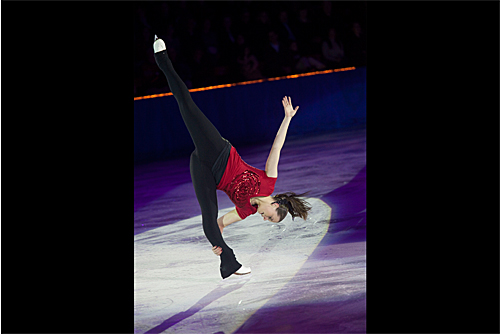
    With her spotlight purring like an old projector, Linda Yao ’10 used a steady hand to follow the cast of famed figure skaters as they shaved graceful ribbons into the ice during “An Evening with Champions.” “La Vie en Rose,” sung by Louis Armstrong, played over the loudspeakers, and a kaleidoscope of light bathed the ice.

    Over 40 years, the skating event has raised $2.4 million for the Jimmy Fund of the Dana-Farber Cancer Institute. Brett Michael Giblin ’11, who co-chaired the event, said, “I truly believe that the reason this weekend was such a rousing success, from the incredible skating to the nearly perfect execution, was due to the fact that our volunteers were able to keep the objective that they were working toward — helping children with cancer — in the forefront of their minds.”

    The event struck a personal chord with 2006 Olympics skater Emily Hughes ’11, who first visited Harvard to participate in the event in 2006 to pay tribute to her mother, a cancer survivor. Hughes said, “I’m happy and excited that I can do this every year, and that it can go to a worthy cause. Cancer research has a more personal feel for me.”

    Shadow dancing

    Shadow dancing

    Paul Wylie ’91 and 1976 Olympic medalist Dorothy Hamill move under the spotlight during the 40th anniversary of the Jimmy Fund benefit “An Evening with Champions,” sponsored by Harvard.

    Get a leg up

    Get a leg up

    All at once Emily Hughes ’11 dips low and aims high.

    Sisters in arms

    Sisters in arms

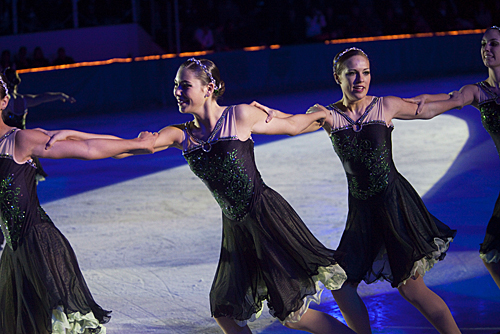
    Dazzling bodices and frilly dresses are just a few pleasures of skating. Here, members of Team Excel Junior, which features skaters from 18 New England regions, manage to be both identically dressed and distinctive.

    There is a light

    There is a light

    Linda Yao ’10, wearing her winter coat, operates the spotlight for skaters. Hey, it’s an ice rink after all!

    A shoulder to drape on

    A shoulder to drape on

    Kimberly Navarro rides the back of partner Brent Bommentre.

    Ice blue

    Ice blue

    An expansive shot of the Bright Hockey Center displays the color, whirlwind, and fun of the night’s event.

    Photo slideshow: An Evening with Champions

    Kris Snibbe/Harvard Staff Photographer

  • Enriquez named associate curator of modern and contemporary art

    The Harvard Art Museum announced the appointment of Mary Schneider Enriquez as Houghton Associate Curator of Modern and Contemporary Art in the museum’s Department of Modern and Contemporary Art, effective April 5.

    Schneider Enriquez has been Latin American art adviser to the Art Museum since 2002, working with the museum’s director and curatorial staff to identify collection and programmatic opportunities in Latin American art. She brings a long history of curatorial, academic, and administrative experience to this position, including undergraduate teaching, independent curatorial and advisory work for institutions across the United States, art criticism, and fundraising.

    “I am pleased to welcome Mary to our staff,” said Thomas W. Lentz, Elizabeth and John Moors Cabot Director of the Harvard Art Museum. “With her long and varied background in the art world, especially in Latin America, and as someone who already has an intimate knowledge of the Art Museum and Harvard University, she brings a distinct perspective to this position.”

  • Peering into gearworks of FDA

    Topping off at 800 pages, “Reputation and Power: Organizational Image and Pharmaceutical Regulation at the FDA” is Daniel Carpenter’s opus.

    Carpenter, the Allie S. Freed Professor of Government and director of the Center for American Political Studies, became fascinated with the Food and Drug Administration (FDA) 20 years ago “because the agency was always in the news and because its decisions were so controversial at the same time that the agency was so highly respected in scientific and popular circles.”

    But Carpenter said the research on the FDA then was “incredibly simplistic. In these works, the FDA is either great or it’s horrible; it’s either purely altruistic or it’s power-hungry. A number of well-informed scholars and careful observers of the agency told me the same thing: namely, that previous treatments had oversimplified the agency. I wanted to step outside of those binary narratives.”

    One of his approaches was examining the FDA’s reputation. “A big part of the FDA’s power comes from the way it is viewed by different audiences,” said Carpenter. “So I spent a lot of time not only in the records and archives of the FDA, but in the records of medical associations and researchers, drug companies, research hospitals like Mayo Clinic and M.D. Anderson, European and Indian drug regulators and health agencies, politicians, and Supreme Court justices, social movement organizations, and interest groups.”

    Behind the scenes, much of what happens at “research universities around the world is dependent upon FDA rules, regulations, and discussions,” said Carpenter.

    But what about the American people? Have they become disillusioned by dodgy pharmaceuticals and lawsuits?

    “For the audience of the mass public, the FDA’s reputation is compelling because people believe that the agency has kept them safe, and that the FDA generally ‘gets it right,’” he noted.

    “The most vivid event in building this reputation was FDA officer Frances Kelsey’s refusal to let thalidomide on the U.S. market,” he said. “When that drug was marketed in Europe and Australia, thousands of children were born with irreversible birth defects, and there were uncounted stillbirths and abortions.” (Kelsey’s photo is on the cover of the book.)

    “The general public does, on the whole, trust the FDA, though not as much as it used to,” said Carpenter, who believes the next five to 10 years will be critical for the agency.

    “Reputation and Power” also chronicles pivotal FDA decisions, from the 1980s AIDS crisis to oral contraceptives, to chemotherapy, to phased trials and manufacturing.

    “This has been 12 years, over 100 archival collections, and three continents of research in the making,” said Carpenter. “I think my proudest moment came when Richard Merrill, a former FDA general counsel and the nation’s top legal scholar on drug regulation — and a tough critic — told me that the book was the best treatment of new drug regulation he had ever seen. From someone who lived it and studied it for decades, that was a nice endorsement.”

  • Steven Pinker wins George A. Miller Prize in Cognitive Neuroscience

    Steven Pinker, the Johnstone Family Professor of Psychology in the Department of Psychology, was named this year’s winner of the George A. Miller Prize in Cognitive Neuroscience, presented by the James S. McDonnell Foundation. Winners of the award are honored for a career of “distinguished and sustained scholarship and research at the cutting-edge of cognitive neuroscience,” and for “extraordinary innovation and high impact on international scientific thinking.”

    Pinker, who conducts research on language and cognition, delivered the George A. Miller Lecture on April 18 at the annual meeting of the Cognitive Neuroscience Society.

  • EPA recognizes Harvard as a leader in green power purchasers

    Harvard University has been announced as one of three schools in the Ivy League that were recognized by the U.S. Environmental Protection Agency as 2009-10 Collective Conference Champions for using green power. The Collective Conference Champions Award recognizes the conference, and its respective participating schools, whose collective green power purchase was the largest among all participating conferences.

    Since April 2006, the EPA’s Green Power Partnership has tracked and recognized the collegiate athletic conferences with the highest combined green power purchases in the nation. The EPA recognized Harvard University for its purchase, which contributed to making the Ivy League the challenge’s largest overall purchaser of green power.

    Harvard’s voluntary use of nearly 32 million kilowatt-hours (kwh) of green power represents 10 percent of the school’s annual electricity usage. Harvard is purchasing a utility green power product and renewable energy certificates from Essex Hydro Associates and Sterling Planet. In addition, the school generates on-site renewable electricity, which helps to reduce the environmental impacts associated with the campus’s electricity use.

    The EPA estimates that Harvard University’s purchase of nearly 32 million kwh of green power is equivalent to the CO2 emissions from the electricity use of nearly 3,000 average American homes each year or has the equivalent impact of reducing the CO2 emissions of more than 4,000 passenger cars annually. The Ivy League’s collective green power purchase of more than 225 million kwh of green power is equivalent to the CO2 emissions from the electricity use of nearly 20,000 average American homes or the annual CO2 emissions of nearly 31,000 cars.

    Twenty-six collegiate conferences and 54 colleges and universities competed in the 2009-10 challenge, collectively purchasing nearly 1.2 billion kwh of green power. The EPA will extend the College and University Green Power Challenge for a fifth year, to conclude in spring of 2011. The EPA’s Green Power Challenge is open to all U.S. colleges, universities, and conferences. In order to qualify, a collegiate athletic conference must include at least one school that qualifies as a Green Power Partner, and the conference must collectively meet EPA’s minimum conference purchase requirement.

    For more information about the EPA’s College and University Green Power Challenge, visit the Challenge Web site.

  • Shinagel receives service citation

    Michael Shinagel, Harvard dean of Continuing Education and University Extension, is the recipient of the 2010 Walton S. Bittner Service Citation from the University Continuing Education Association (UCEA). The award recognizes him for his outstanding contributions to continuing education at Harvard, and for service of major significance to UCEA.

    Among Shinagel’s achievements cited are his work with Harvard’s human resource department to establish the Tuition Assistance Plan (TAP) in 1976; his expansion of the Harvard Extension School from fewer than 200 courses and 6,000 students in 1975, to more than 600 courses and 14,000 students today; the creation of Harvard Extension School master’s degree programs in the liberal arts that have graduated 2,000 individuals to date; and his service as editor of UCEA’s “Continuing Higher Education Review” for the past 13 years.

    Admired by his continuing education decanal counterparts around the world, Shinagel’s contributions to his institution and UCEA are summed up by Mary McIntire, dean of Continuing Studies, Rice University: “Mike generously helps all who seek his advice or opinion. He encourages younger people in the field, not only by example, but by maintaining an active interest in their careers and accomplishments. He has succeeded so admirably at Harvard, in the community, and in the field … we are fortunate to have him among us.”

  • Kaelin among Canada Gairdner Award recipients

    William Kaelin, professor of medicine at Dana-Farber Cancer Institute, has been named one of seven recipients of the 2010 Canada Gairdner Award. The award, which was created in 1959 to recognize and reward the achievements of medical researchers whose work contributes significantly to improving the quality of human life, is among the most prestigious awards in biomedical science.

    Kaelin’s research seeks to identify the molecular mechanisms that allow cells to detect a shortage of oxygen and respond by making new red blood cells and blood vessels. His work may pave the way for therapies that manipulate oxygen to treat diseases ranging from heart disease and anemia to cancer.

    “Bill has made groundbreaking discoveries that have transformed our understanding of many forms of cancer,” said Edward J. Benz Jr., the Richard and Susan Smith Professor of Medicine, professor of Pediatrics, and professor of pathology at Dana-Farber. “His work has also pointed the way to new strategies to find better therapies for these tumors. He is very deserving of this recognition and has also brought honor to the Dana-Farber.”

  • Lifetime achievement award presented to Spengler and Buckley

    The New England Office of the U.S. Environmental Protection Agency (EPA) has awarded the Harvard Extension School’s John Spengler and George Buckley an Environmental Merit Lifetime Achievement Award in recognition of their exceptional work and commitment to the environment. The award recognizes the two as outstanding environmental advocates who have dedicated their lives toward preserving and protecting the New England region’s natural resources.

    Spengler is director of the Sustainability and Environmental Management Program at Harvard Extension School and Akira Yamaguchi Professor of Environmental Health and Human Habitation at the Harvard School of Public Health. Buckley is assistant director of the Sustainability and Environmental Management Program. They received their awards at a special ceremony in Boston on April 22, the 40th anniversary of Earth Day.

    “This is well-deserved recognition for Jack Spengler and George Buckley,” said Michael Shinagel, Harvard dean of Continuing Education and University Extension. “Their commitment to the environment transcends the classroom and provides an inspiring model for our graduate sustainability and environmental management students to follow.”

  • Walton appointed assistant professor of African American religions

    Social ethicist and African American religious studies scholar Jonathan Walton has been named assistant professor of African American religions at Harvard Divinity School (HDS), effective July 1.

    Walton is currently an assistant professor of religious studies at the University of California, Riverside. His research addresses the intersections among religion, politics, and popular culture.

    “Harvard Divinity School is among the premier centers of theological education and hubs of academic inquiry,” Walton said. “I am honored and humbled to join such an amazing scholarly community, particularly since HDS has a proven track record of neither resting on its reputation nor being lulled asleep by its laurels. Its continued commitment to recruiting and cultivating cutting-edge scholars of religion in general, and of American religion in particular, makes it the place I want to be.”

    To read the full story, visit the Harvard Divinity School Web site.

  • Building on tradition

    For the first time in more than three centuries, a Native American home stands in Harvard Yard.

    Over three days, a group of Harvard students built a traditional Wampanoag home, called a wetu, near the site of Harvard’s Indian College, one of the first buildings on campus, constructed to house students from nearby tribes.

    The structure, of a size that might have housed a small family, was built of traditional materials: long, thin poles lashed together with long strips of bark and sheathed in larger rectangular bark squares. It was left unfinished on one side to let passersby view its interior.

    Kelsey Leonard, a senior and member of Long Island’s Shinnecock tribe, said the project was conceived as a way to commemorate the 360th anniversary of Harvard’s 1650 charter, which dedicated the institution to the education of English and Indian youth alike.

    In addition, Leonard said, the project was also intended to commemorate the Indian College, built in 1655, the foundation of which was uncovered last fall by an archaeology class digging in the Yard.

    Leonard was joined by other members of the student group Native Americans at Harvard College in the effort. She said the work, which included stripping bark from the thin poles, was sometimes tedious, but “therapeutic.” The students labored in shifts, trading off tasks as they left to attend class.

    College administrators and officials at the Peabody Museum of Archaeology and Ethnology, who took a lead role in the Yard dig that unearthed the Indian College’s foundation, said that though they handled some of the logistical necessities, the project was largely student conceived and run.

    Leonard said that Harvard’s first Native American students were part of a cultural exchange between the English settlers and the local tribes as the two groups sought to understand each other better.

    “We wanted to find a way to continue that exchange, so we’re building the first wetu in Harvard Yard,” Leonard said. “It’s been a very good experience, very positive.”

    The wetu will stand in the Yard through Arts First weekend and be dismantled on May 3.

    Tiffany Smalley, a junior and Aquinnah Wampanoag who co-directed the project with Leonard, said during the wetu’s opening ceremony April 22 that the project has made her optimistic about the future of Native Americans at Harvard and helped her understand a little more about her own native culture.

    “Personally, I’m learning more and more how to honor my ancestors and how to honor [specific] spaces,” Smalley said.

    The wetu was constructed with help from the Aquinnah Wampanoag of Gay Head, based on Martha’s Vineyard. Tribal council member Jonathan Perry directed the construction, providing traditional materials.

    Perry, who has worked on constructing traditional structures like wetus and dugout canoes for several years, said traditional wetus varied widely in size. The largest could stretch 200 feet and be 40 feet wide. Building them was typically a community effort, done by men. But women owned the structures in their matrilinear culture, with a man moving to a woman’s wetu after marriage, Perry said. The frame was typically constructed of cedar saplings, which are insect- and rot-resistant and considered a sacred wood. The floor was white sand. The thick outer bark sheathing of the structure was typically taken from chestnut and elm trees — giants of the New England forest that today have been devastated by disease. For the Yard’s wetu, Perry provided bark from poplar trees.

    Because native people moved with the seasons, families often owned two homes, Perry said. Because they spent most of their time outdoors, homes were relatively small, providing protected space for sleeping and shelter from harsh weather.

    To honor those people, students began construction with a ceremony acknowledging the native people who lived there.

    The wetu “is significant because of the fact that this place for thousands and thousands of years was home to many native people,” Perry said.

    Home stretch

    Home stretch

    Mike Veino ’13 (left) and Tommy Miller ’11 help Jonathan Perry (center) construct a traditional Wampanoag home, called a “wetu,” in Harvard Yard.

    Knifework

    Knifework

    Tiffany Smalley ’11 assists with materials for the wetu. Poles were lashed together with long strips of bark and sheathed in larger rectangular bark squares.

    Tree house

    Tree house

    Aquinnah Wampanoag tribe member Elizabeth Perry helps fashion the inside walls of the wetu, which are made from thick panels of bark.

    Hatchet job

    Hatchet job

    Tommy Miller ’11 tools around with the foundational poles for the wetu.

    Ties that bind

    Ties that bind

    Here, cedar bark is peeled and moistened before it’s used to fasten the the wetu together.

    Welcome home

    Welcome home

    The wetu is open for passersby to check out its interior. It will remain on display through May 3.

    Photo slideshow: Building a wetu

    Kris Snibbe/Harvard Staff Photographer

  • Classical literature of India ‘unlocked’

    Harvard University and Harvard University Press (HUP) announced recently that the Murty family of Bangalore, India, has established a new publication series, the Murty Classical Library of India, with a generous gift of $5.2 million. The dual-language series aims both to serve the needs of the general reading public and to enhance scholarship in the field.

    Harvard Provost Steven E. Hyman noted that the Murty family gift will enable HUP to present the literary cultures of India to a global readership in an unprecedented manner. “The Murty Classical Library of India will make the classical heritage of India accessible worldwide for generations to come,” said Hyman. “We are truly grateful to the Murty family for their vision and leadership in making this historic initiative a reality.”

    The Murty family’s endowed series will serve to bring the classical literature of India, much of which remains locked in its original language, to a global audience, making many works available for the first time in English and showcasing the contributions of Indian literature to world civilization. Narayana Murty said of the new series, “I am happy that Harvard University Press is anchoring this publishing project.” His wife, Sudha, agreed: “We are happy to participate in this exciting project of bringing the rich literary heritage of India to far corners of the world.”

    Under the direction of General Editor Sheldon Pollock, William B. Ransford Professor of Sanskrit and Indian Studies at Columbia University, and aided by an international editorial board composed of distinguished scholars, translators will provide contemporary English versions of works originally composed in Bengali, Gujarati, Kannada, Marathi, Persian, Punjabi, Sanskrit, Tamil, Telugu, Urdu, and other Indian languages.

    Each volume will present the English translation with the original text in the appropriate Indic script on the facing page. The books will be supplemented by scholarly introductions, expert commentary, and textual notes, all with the goal of establishing Murty Classical Library volumes as the most authoritative editions available.

    The Murty family’s vision has already begun to impress notable scholars, such as Harvard’s Thomas W. Lamont University Professor and Professor of Economics and Philosophy Amartya Sen, who expressed his appreciation for the initiative. “There are few intellectual gaps in the world that are as glaring as the abysmal ignorance of Indian classics in the Western world. It is wonderful that the Murty Classical Library of India is taking up the challenge of filling this gap, through a new commitment of the Harvard University Press, backed by the discerning enthusiasm of the Murty family, and the excellent leadership of Sheldon Pollock — an outstanding Sanskritist and classical scholar. This will be a big contribution to advancing global understanding that is so much needed in the world today.”

    HUP plans to make the works available in both print and digital formats. The first volumes are scheduled for publication in fall 2013. An Indian edition is being planned.

    Founded in 1913, Harvard University Press is a major publisher of nonfiction, scholarly, and general interest books with offices in Cambridge (Mass.), New York, and London.

  • The invention of childhood innocence

    When Robin Bernstein was a little girl, she perused textbooks belonging to her mother, who was pursuing a degree in early childhood education.

    “Of course I didn’t understand them,” said Bernstein, assistant professor of studies of women, gender, and sexuality, and of history and literature. “But I knew that she was studying a category of people, and that I was in that category. I was very aware of myself as a child. That’s how I first became interested in childhood as an area of knowledge — as a way of thinking about the world.”

    Bernstein’s new book, “Racial Innocence: Performing American Childhood in Black and White” (New York University Press), examines the weaving together of childhood, innocence, and race in the late 19th and early 20th centuries, a period that included slavery, Reconstruction, post-Reconstruction disenfranchisement of African Americans, the New Negro Movement, and the early Civil Rights Movement.

    “Three hundred years ago, there was no assumption that children were innocent,” said Bernstein. “That idea only became common sense in the United States in the early 19th century. Once the idea of childhood became laminated to the idea of innocence, children could be used strategically in political arguments. Children made these arguments appear to be apolitical, or simply evocations of truth.”

    Some people very consciously employed children to gain sympathy for their perspectives. In the influential novel “Uncle Tom’s Cabin,” Harriet Beecher Stowe places Little Eva, an angelic, white child, in a loving relationship with an adult slave.

    “The two characters are very tender with each other,” said Bernstein. “This is Stowe’s way of making Uncle Tom seem innocent and, by extension, making abolition itself seem innocent as well.”

    Other figures, Bernstein argues, unintentionally affected racial issues in the United States. In 1915, Johnny Gruelle appropriated blackface imagery to create Raggedy Ann. He deliberately chose such imagery not to make a political statement, but to tap into a source of mass appeal. Bernstein traces Raggedy Ann’s blackface minstrel roots back to the 1840s.

    “I would argue that this is part of the reason that Raggedy Ann is still popular,” she said. “Not because we consciously perceive blackface imagery, but because blackface imagery is one of the deepest aspects of American popular culture.”

    “Ever since innocence entangled with childhood, that connection has always been raced,” said Bernstein. “It was not just any childhood, it was specifically white childhood that was entangled with innocence. This entanglement was a way of excluding non-white children from innocence and from childhood. Popular culture suggested that if they weren’t innocent, then they weren’t children. If they weren’t white, they weren’t innocent.”

    In the final chapter of the book, Bernstein looks at how African Americans seized on the idea of childhood innocence and recaptured that notion for black children in the 1920s.

    “They fought back against the idea that black children were not children, were not innocent,” she explained. “They seized on this rhetoric and used it for anti-racist projects.”

    In her epilogue, Bernstein re-examines the psychological tests conducted in the 1940s by Kenneth and Mamie Clark, which were indirectly cited in the U.S. Supreme Court’s landmark Brown v. Board of Education decision against segregated schools as proof of “psychic harm” arising from societal racism. In these tests, black children were asked a series of questions about brown and pink dolls; most subjects expressed a preference for the pink dolls.

    Bernstein both acknowledges and pushes beyond the common critique of the Clark tests, that choice of dolls does not necessarily index self-esteem. The Clarks, she argues, were uncovering racism as knit through dolls for 150 years.

    “What their research shows very reliably is preferences in dolls, so I decided to put their tests into the context of the history of dolls. What you see is children having a very sophisticated understanding of standardized practices of play. You see children’s expertise in children’s culture.”

    The use of children in political arguments, Bernstein said, continues even today.

    “I’m looking at the origins of how the idea of ‘saving the children’ became useful and meaningful. My book ends in the early 20th century, but aspects of what I’m studying absolutely continue. If you want to make a political argument, just add the ‘do it for the children’ rhetoric, and it suddenly becomes a lot more persuasive.”

  • One Report: Integrated Reporting for a Sustainable Strategy

    Harvard Business School Senior Lecturer Robert G. Eccles and his co-writer explain how business’s use of integrated and transparent reporting of financial and nonfinancial results adds value to companies, their shareholders, and the overall sustainability of society.

  • No Small Matter: Science on the Nanoscale

    Felice Frankel, a research associate in systems biology at Harvard Medical School, and her co-author help to explain nanoscale technology with a book of thorough explanations and colorful, illustrative photographs.

  • Beauty Imagined: A History of the Global Beauty Industry

    From the emergence of the beauty industry in the 19th century, Geoffrey Jones, the Isidor Straus Professor of Business History, traces such beauty bastions as Coty, Estée Lauder, and Avon, and how they made beauty a full-time fascination and business.