Author: Heritage

  • S.O.S.: Americans Foresee U.S. Military Decline Ahead

    On 03.02.10 12:00 PM posted by Mackenzie Eaglen

    A recent Gallup poll shows that Americans see the U.S. as the world’s top military power now but doubt whether this will be true in 20 years. Only about a third of Americans believe the U.S. will still be ranked first militarily in 2029.

    Americans are intuitively smart, and they have taken note of a disturbing trend occurring outside the headlines: investment in military modernization is declining during a time of rapid military buildups abroad. They are right to be concerned.

    In recent months, Heritage has drawn attention to several areas where the U.S. Armed Forces are at risk of losing vital capabilities the nation has enjoyed for the last half-century. Continued cuts in future defense investments proposed in President Obama’s 2010 and now 2011 budgets are putting long-held U.S. military advantages in jeopardy. These cuts are coming at a time when the U.S. military is already experiencing shrinking margins of technological superiority relative to the rest of the world.

    Evidence of the potential decline can be found in two examples, including the submarine force and tactical fighter aircraft fleet.*For one thing,*the U.S. submarine fleet is projected to bottom out at 41 boats by 2028 (PDF) — far fewer than the Navy’s stated requirement. At the same time, China is developing sophisticated undersea warfare capabilities and investing substantial sums in developing and acquiring new submarines and underwater mines that could heavily damage U.S. fleets in a naval confrontation.

    The second example: In just over a decade, the Air Force fighter gap will grow to over 800 planes (PDF) if current plans progress without congressional intervention. While U.S. fighter fleet requirements continue to go unmet, Russia and China are developing highly modern fighters, such as the futuristic fifth-generation Sukhoi T-50 unveiled by Russia in January. Equally worrisome, the U.S. is consolidating now toward having only one fighter production line in operation. Meanwhile, Russia and China together have 12 fighter and bomber lines open today.
    A shifting military balance does not bode well for American security or for global stability. Declining defense capabilities limit the foreign-policy options of current and future administrations and jeopardize security commitments while undermining national interests.

    To prevent the U.S. from losing its rank as an unmatched military power, Congress must prioritize military modernization. This will require raising the defense budget topline and preventing runaway entitlement spending from encroaching upon the defense budget. It will also require constraining the growth in military health-care spending and other overhead costs that are chipping away at investment in modern equipment.

    Cross-Posted on National Review’s “The Corner” blog.

    http://blog.heritage.org/2010/03/02/…decline-ahead/

  • Supreme Court Takes Up Chicago Gun Ban Case Today

    On 03.02.10 05:48 AM posted by Deborah O’Malley

    This morning, the Supreme Court will hear oral argument in McDonald v. Chicago, a landmark case addressing whether states can deny the rights of their citizens to keep and bear arms.* This question was left open by the Supreme Court’s groundbreaking yet common sense decision in Heller v. District of Columbia, in which the Court concluded, yes, the Second Amendment does actually protect an individual right to keep and bear arms.* The successful lawyer for Heller, Alan Gura, will be the lead counsel in McDonald as well.

    Inevitably, all eyes will be focused on the Court’s newest justice, Sonia Sotomayor, who received criticism during her confirmation hearings for her previous treatment of the Second Amendment as a judge on the Second Circuit.* In Maloney v. Cuomo, Sotomayor ruled that Second Amendment rights do not apply to the states, and that the Second Amendment does not even implicate a fundamental right—and she reached this decision even after the Supreme Court recognized an individual right to bear arms in Heller.* After a brief hat-tip of recognition to Heller, Sotomayor based her decision on outdated precedent applying a different provision of the Constitution—so outdated in fact that the line of cases did not even recognize that the states were bound to respect the First Amendment, let alone the Second.

    Additionally, prior to the Heller ruling, she had joined an unpublished opinion flatly stating that the right to possess a gun is “clearly not a fundamental right.” *This and her decision in Maloney have led many to worry about her fidelity to the Second Amendment.* During her confirmation hearings, she defended her ruling in Maloney by claiming she was simply following precedent.* However, especially now that she sits on the High Court, she is no longer bound by a decision that virtually everyone concedes is inconsistent with subsequent Supreme Court case law.

    This case will have huge implications on one of the few enumerated rights in our Constitution.* If the Court does not recognize that the individual right to bear arms is incorporated against the states, this would permit states to completely ban gun possession. This possibility only serves to highlight the importance of the Supreme Court in American life.* It is inevitable that there will be at least one or two vacancies giving way to one or two new justices sitting on the Court even yet this year.* These justices are given authority over the protection of our most fundamental rights, including the basic right of self-defense that is enshrined in our Constitution.

    http://blog.heritage.org/2010/03/02/…an-case-today/

  • Morning Bell: ?The American Public Is Not Behind This Bill?

    On 03.02.10 06:15 AM posted by Conn Carroll

    After more than a year of $862 billion dollar deficit stimulus bills, national-debt-doubling federal budgets, and government takeovers of the auto industry, it is difficult to remember that President Barack Obama actually ran as a moderate in many ways. On his way to a 53% – 46% win over Sen. John McCain (R-AZ), then-Sen. Obama promised to “cut taxes for 95% of workers and their familiesexpand the Army by 65,000 and the Marines by 27,000, and enact “a net spending cut” for the federal government. Obama promised lower taxes, a strong defense and shrinking the size of government. No wonder independents in nine states that went for President George Bush in 2000 and 2004 switched their vote to Obama in 2008 (CO, FL, IN, IA, NV, NM, NC, OH and VA). But now those independents are beginning to reassess. Public Policy Polling (a liberal polling firm)*notes that Obama now has a negative approval rating in every state that he flipped from the Bush column to his in 2008.

    And now President Obama has lost one of his biggest and earliest supporters on his signature issue: health care. Yesterday, when pressed on CNBC if he would be in favor of scrapping the Senate health care bill, Warren Buffett responded: “I would be.” Specifically, Buffett believes that the Senate bill will not contain health care costs: “We have a health system that, in terms of cost, is really out of control, and if you take this line and you project what has been happening into the future, we will get less and less competitive. So, we need something else. Unfortunately, we came up with a bill that really doesn’t attack the cost situation that much and we have to have a fundamental change.” Buffett is correct on both fronts: 1) the President’s own Centers for Medicare and Medicaid Services (CMS) has reported that the Senate health care bill would raise national health expenditures $234 billion by 2019; and 2) our current system is completely unable to control exploding health care costs.

    So why is our current system completely unable to control costs? For the same reason most Americans over-eat at buffets: when you don’t have to pay for each plate of food, you usually eat more. In recent decades, the percentage of health care spending paid “out of pocket” by patients has fallen substantially, from 52% in 1965 to only 15% in 2005. Instead of patients paying for the care they receive, our system is built around a third-party payment system where the government and insurance companies are the ones who actually pay for individual medical expenses. When prices are determined through administrative procedures rather than market processes, both patients and producers are anesthetized from normal market incentives to reduce prices and spending. That is why our health care costs are rising so rapidly.

    And every major pillar of Obamacare makes the third-party-payer problem worse: mandates that limit out-of-pocket spending by patients, mandates that extend the minimum benefits insurance must cover, a massive expansion of Medicaid, and lower limits on the tax deductibility of out-of-pocket spending. And the one measure that the left once pointed to as its key cost-reducing measure – the taxing of expensive health insurance plans – has been gutted and pushed back until 2018, when any honest observer knows it will never be implemented. Commenting on the state of health care reform, Buffet told CNBC yesterday:

    If it was a choice today between plan A, which is what we’ve got, or plan B, what is in front of — the Senate bill, I would vote for the Senate bill. But I would much rather see a plan C that really attacks costs. And I think that’s what the American public wants to see. I mean, the American public is not behind this bill. And we need the American public behind the bill, because it’s going to have to do some tough things.

    The current system is unsustainable. We do need heath care reform. But not reform that is opposed by the vast majority of the American people and makes the core problem of the current system worse. The President should follow Buffett’s advice, scrap the current bill and start over.

    Quick Hits:

    http://blog.heritage.org/2010/03/02/…ind-this-bill/

  • Buffett to Obama: Scrap Current Bill and Start Over

    On 03.01.10 02:42 PM posted by Kathryn Nix

    </p>Last week’s <ahref="http://blog.heritage.org/2010/02/25/health-care-summit-wrap-up/">bipartisan summit on health care reform seems to have done little, if anything, to build support for the President’s vision of health care reform.* Strong opposition to the Democrats’ proposals <ahref="http://www.rasmussenreports.com/public_content/politics/current_events/healthcare/september_2009/health_care_reform">remains the position of a majority of Americans.* And now, even the President’s biggest fans are following suit.

    In an<ahref="http://www.politico.com/news/stories/0310/33693.html"> interview‘ with CNBC, Warren Buffett, a Democrat and supporter of President Obama, advised the President to follow the <ahref="http://www.rasmussenreports.com/public_content/politics/current_events/healthcare/february_2010/61_say_congress_should_start_all_over_again_on_hea lth_care">wishes of the American people to scrap the current health care legislation and start over.* Buffett <ahref="http://www.politico.com/news/stories/0310/33693.html">highlighted the failure of Democrats’ proposals to address cost as his biggest concern:

    We have a health system that, in terms of costs, is really out of control…And if you take this line and you project what has been happening into the future, we will get less and less competitive. So we need something else.

    But concerning the current proposals before Congress, Buffett <ahref="http://www.politico.com/news/stories/0310/33693.html">lamented that, “unfortunately, we came up with a bill that really doesn’t attack the cost situation that much.” Buffet’s concerns have been certified by the President’s own Centers for Medicare and Medicaid Services who have reported that <ahref="http://enzi.senate.gov/public/index.cfm?FuseAction=Files.View&FileStore_id=85899 a92-a646-4bca-87b6-81ae629e753">the Senate health care bill would raise national health expenditures by $234 billion by 2019.<spanid="more-27725"></span>

    Buffett advised that the President scrap all the backroom deals and unpopular provisions of the current bills, and focus primarily on cost.* Buffett explained that lowering costs should even take precedence over expanding access to care, since he does not believe “in insuring more people till you attack the cost aspect of this.” Since <ahref="http://www.heritage.org/Research/HealthCare/bg2369.cfm">cost is one of the current roadblocks to expanding accessibility of coverage, the President would be wise to heed Buffett’s advice.

    Buffett also addressed one of the most crucial reasons behind the need for the President and congressional Democrats to start over on health care reform, and that is the profound absence of support among the American people.* <ahref="http://www.politico.com/news/stories/0310/33693.html">Said Buffett:

    If it was a choice today between plan A, which is what we’ve got, or plan B, what is in front of — the Senate bill, I would vote for the Senate bill. But I would much rather see a plan C that really attacks costs. And I think that’s what the American public wants to see. I mean, the American public is not behind this bill. And we need the American public behind the bill, because it’s going to have to do some tough things.

    Democrats’ health care proposals would overhaul one sixth of the nation’s economy through an unpopular federal takeover of the health care system.

    As Warren Buffett’s interview with CNBC showcases, even the Left’s biggest fans are coming to realize this is a bad idea.* As talk of passing a bill through reconciliation <ahref="http://www.washingtonpost.com/wp-dyn/content/article/2010/02/28/AR2010022803243.html?nav=hcmodule">intensifies, Democrats should instead take into consideration the other options before them, which include several<ahref="http://www.heritage.org/Research/HealthCare/bg2377.cfm"> incremental changes that would garner bipartisan support in Congress and among the American people.

    http://blog.heritage.org/2010/03/01/…nd-start-over/

  • A Second Tragedy in the Americas: Earthquake Tests Chile’s Resilience

    On 03.01.10 03:00 PM posted by Ray Walser

    <ahref="http://blog.heritage.org/wp-content/uploads/chile-earthquake-100301.jpg"></p>Less than two months after the January 12 earthquake in Haiti, another Hemispheric neighbor has fallen victim to the ravages of nature. The earthquake that struck Chile in the early hours of February 27 measured 8.8 on the Richter scale and was <ahref="http://online.wsj.com/article/SB10001424052748704231304575091611248294970.html"> one of the most powerful quakes in a century.

    Again as they did in response to the massive Haiti earthquake, the American people stand with President Barack Obama in <ahref="http://www.whitehouse.gov/blog/2010/02/27/information-chilean-earthquake-and-tsunami-warnings">expressing condolences and in offering support to the Chilean people in face of such a horrific natural disaster.

    Chile is an important friend of the U.S., a robust free trade partner, and a vibrant democracy with respect for representative democracy and individual rights. It possesses a professional military and police force capable of responding to the current disorder and disruption caused by the massive devastation of the earthquake.

    <spanid="more-27734"></span>Chile’s deep commitment to free market policies earned it a <ahref="http://www.heritage.org/index/Country/Chile">#10 overall ranking the 2010 Index of Economic Freedom, the highest degree of economic freedom in the South and Central American/Caribbean. This commitment also makes Chile more resilient and better able to surmount what are certain to be the enormous economic costs imposed by the earthquake.

    The tragedy will cast a somber shadow over the government transition scheduled for March 11 when the center-left presidency of Michelle Bachelet and social democratic Concertacion coalition yields executive power to the center-right government of President-elect Sebastian Piñera. Chileans can be counted on to put partisan politics aside as they respond to a national crisis.

    For the moment, Chile has <ahref="http://www.nytimes.com/2010/03/02/world/americas/02chile.html">requested from the United Nations help with mobile bridges, generators, water filtration equipment, field hospitals and surgical centers, as well as assistance from damage-assessment teams.

    When Secretary of State Hillary Clinton briefly visits Chile on March 3, she should be forthcoming in helping facilitate a positive U.S. response to these requests.

    http://blog.heritage.org/2010/03/01/…9s-resilience/

  • Seeing the World Through Nancy Pelosi?s Eyes

    On 03.01.10 09:39 AM posted by Rory Cooper

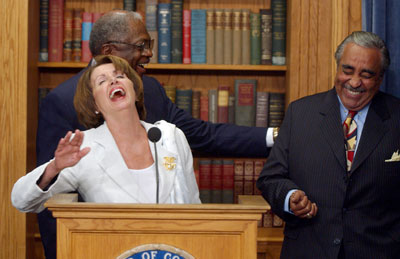
    <ahref="http://blog.heritage.org/wp-content/uploads/Pelosi_Rangel_Laughing09022.jpg"></p>After last week’s disastrous health care summit for the President and his supporters, the left has been scrambling to save face and sell the public not on their plan, but on using the reconciliation process to jam it past the American people. They’ve simply given up on earning any form of widespread public support for the plan, which America has loudly rejected. In fact, the only bipartisan effort in Washington these days is against the Obama-Reid-Pelosi health care agenda. Large numbers of Democrats have joined Republicans doing everything they can to stop Obamacare in its tracks.* Of course, this bipartisanship is strangely labeled obstructionism in today’s media environment.

    So now, we have the last respite of the left, forcing their members to either take votes that could end their political careers or bypassing them altogether by only requiring 50 senators and the vice president to pass a bill. Judging from the weekend’s news, the leader of this back door movement is Speaker Nancy Pelosi (D-CA). The Speaker took to the airwaves to vigorously defend the Democrat plan to pass their health care spending bill, regardless of the lack of Democrat support. Here are a few gems from the weekend:<spanid="more-27675"></span>

    Speaker Pelosi told CNN’s Candy Crowley on State of the Union: “No, I don’t think…<ahref="http://www.politico.com/playbook/0210/playbook971.html">there isn’t a bill. When we have a bill, which we will in a matter of days, then that is the bill that we can sell.” The fact that there isn’t a bill must come as a surprise to the House members who narrowly passed their plan in the middle of the night on November 8, 2009. At the time, Pelosi said: “<ahref="http://www.cnn.com/2009/POLITICS/11/07/health.care/index.html">Oh what a night.”

    It must also come as a surprise to the U.S. Senators who narrowly passed their version <ahref="http://www.washingtonpost.com/wp-dyn/content/article/2009/12/24/AR2009122400662.html">just after dawn on Christmas Eve. And it must also come as a surprise to President Obama who last week released an outline of proposed changes to the Senate bill which everyone in Washington presumes is the baseline for the continued debate.* In fact, there are currently two bills being considered by the Speaker, the Senate bill which needs a vote in the House and the reconciliation amendment which yes, hasn’t been drafted yet.

    Speaker Pelosi would like to presume the American people have missed the last year of debate and are unfamiliar with their plans. However, the American public are very well informed of the Democrat plan, and as Candy Crowley rightly pointed out: “We looked at our polling numbers, just from yesterday, we had <ahref="http://www.politico.com/playbook/0210/playbook971.html">almost three-quarters of Americans who said they need to drop this bill…”

    Also on State of the Union, Speaker Pelosi said: “<ahref="http://thehill.com/homenews/house/84089-pelosi-gop-has-had-its-day-217-healthcare-votes-in-sight">A bill can be bipartisan without bipartisan votes.” Simply saying as your bill represents the views of your opponents, despite them arguing otherwise, does not make a bill bipartisan. This rose colored view of consensus ignores the opposition to this bill from Democrats themselves. To avoid reconciliation in the Senate, Democrats would only need to convince one single Republican to vote with their caucus. Unfortunately, they don’t even have the full support of their own caucus to reach 59 votes. Reconciliation — using 50 Senators and Vice President Biden to use a budget procedure to pass the bill — would disenfranchise Democrats in the Senate as well as Republicans.

    Knowing well that American families at Tea Parties across America have articulated the growing consensus against Obamacare better than anyone, Speaker Pelosi said: “We share some of the views of the tea partiers in terms of the role of special interest in Washington, D.C.” Oh, how far we’ve come. It was only last year that she accused this grassroots groundswell of being an “AstroTurf,” or fraudulent movement. She said: “<ahref="http://www.youtube.com/watch?v=b4UujNkWfGE">They’re carrying swastikas and symbols like that to a town hall meeting on health care.”

    Finally, we have recognition by the Speaker that the vote will be one that could be politically costly for Democrats. Pelosi told Elizabeth Vargas on ABC’s This Week: “<ahref="http://abcnews.go.com/ThisWeek/week-transcript-house-speaker-nancy-pelosi-sen-lamar/story?id=9955285">We’re not here just to self perpetuate our service in Congress.” Of course, nothing is more costly than the number of sweetheart deals the Speaker will need to create to buy support, as Senate Majority Leader Harry Reid (D-NV) previously did in his chamber.

    Speaker Pelosi is clearly optimistic that with the right amount of arm-twisting and legislative trickery, the left can salvage their health care agenda. She should transfer that optimism to her view of the American people. They’ve read her plan. They understand her plan. And they may forgive her if she tables it and starts over as three quarters of Americans are demanding.

    http://blog.heritage.org/2010/03/01/…-pelosis-eyes/

  • The Unlimited Prosecution Act Goes on Trial

    On 03.01.10 10:40 AM posted by Conn Carroll

    <ahref="http://blog.heritage.org/wp-content/uploads/overcrim.jpg"></p>This afternoon, the Supreme Court will hear oral argument in Skilling v. U.S. Most <ahref="http://abcnews.go.com/print?id=9954946">media coverage so far seems to be focusing on former Enron CEO Jeffrey Skilling’s request for an entirely new trial based on claims that the District Court where he was convicted failed to ensure an impartial jury when they refused to transfer the trial out of Houston.

    While every American’s Sixth Amendment right to an impartial jury is important, many limited government conservatives (and civil libertarian liberals) are much more concerned with the fate of Skilling’s other challenge … to the 1988 “honest services fraud” statute, which states: “For the purposes of this chapter, the term, scheme or artifice to defraud includes a scheme or artifice to deprive another of the intangible right of honest services.” What could possibly be wrong with that?<spanid="more-27672"></span>

    The problem is that the statute then fails to provide any guidance as to what an “intangible right of honest services” is or how to tell when someone has been deprived of that right. This allows prosecutors to terrorize Americans with prosecutions for acts they had no idea were crimes.

    For example, prosecutors nabbed one Wisconsin state civil servant for failing to follow every detail of the state’s arcane administrative rules on procurement. The convicted civil servant’s crime? She awarded the contract to the lowest bidder which prosecutors argued made her supervisors look better and thus increased her job security. In other words, she was convicted of saving the taxpayers money!

    And prosecution are not limited to the public sector. <ahref="http://online.wsj.com/article/SB123379864724350423.html">The Wall Street Journal notes:

    In the mid-1990’s, federal prosecutors in Texas successfully brought a charge against three men’s-basketball coaches at Baylor University, a private school, for scheming to obtain credits and scholarships for players, in violation of National Collegiate Athletic Association rules. Baylor, the court found, was deprived of honest services.

    Everybody, civil servants and private citizens, has a moral obligation to be honest. But the government has no business giving prosecutors a blank check to punish dishonesty criminally whenever they see fit. The “honest services fraud” statute is just one more example of the <ahref="http://www.overcriminalized.com/">Overcriminalization of our country. There are now over 4,450 federal criminal penalties on the books and Congress seems to want use criminal law to “solve” <ahref="http://blog.heritage.org/2009/03/04/criminalizing-our-way-out-of-the-crisis/">every problem in the nation. No wonder 56% of Americans tell CNN they think the federal government has become so large and powerful that it poses an <ahref="http://www.cnn.com/2010/POLITICS/02/26/citizens.rights.poll/">immediate threat to the rights and freedoms of ordinary citizens.

    Hopefully the power of the federal government to send Americans to jail for trivial conduct will start being rolled back today.

    http://blog.heritage.org/2010/03/01/…goes-on-trial/

  • Not Only Do They Not Have the Votes?

    On 03.01.10 11:30 AM posted by Conn Carroll

    </p>…they don’t even have a plan on how to get them! Speaker Nancy Pelosi (D-CA)<ahref="http://www.nytimes.com/2010/03/01/us/politics/01talkshows.html?partner=rss&emc=rss"> insisted this weekend that she “will be able to get the votes needed to pass sweeping health care legislation in the House.” What this really means is that she does not have those votes right now. And if you were watching the television yesterday it quickly became apparent that the leadership in the House has no idea how they are going to get them. First Speaker Pelosi on <ahref="http://abcnews.go.com/print?id=9955285">This Week:

    VARGAS: If — but the point is when it does finally come to vote on it in the House, you’re certain that you can muster the 217 votes that you need…even with the differences over abortion language? Things…
    PELOSI: Yes.
    VARGAS:… that there are members of the House who voted in favor of it before, who are now saying, “We can’t vote for this bill, because of the Senate language on abortion?
    PELOSI: Well let me say I have this in three — just so you know how we sequence this. First we zero in on what the policy will be. And that is what we’ll be doing — following the president’s summit yesterday.
    Secondly, we’ll see what the Senate can do. What is the substance? And what is the Senate prepared to do? And then we’ll go to the third step as to what my — my members will vote for.

    Meanwhile, Pelosi’s second-in-command, Majority Leader Steny Hoyer (D-MD) was singing a different tune on <ahref="http://www.cbsnews.com/htdocs/pdf/FTN_022810.pdf">Face the Nation:<spanid="more-27699"></span>

    BOB SCHIEFFER: We’re back now with our panel. Steny Hoyer, there’s been a lot of back and forth. Senators say the House has to go first. Some in the House are reluctant to go before the Senate goes. Are you, number one, willing to go first and don’t you have to?
    REPRESENTATIVE STENY HOYER: We– whether we’re willing or not, we have to go first if we’re going to correct some of the things that the House disagrees with, correct, change so that we can reach agreement, the House will have to move first on some sort of corrections or reconciliation bill

    http://blog.heritage.org/2010/03/01/…ave-the-votes/

  • Justice for Embattled Executive Branch Lawyers

    On 03.01.10 12:30 PM posted by Andrew Odell

    <ahref="http://blog.heritage.org/wp-content/uploads/gavel-scalesjustice-100301.jpg"></p>Last month,* Associate Deputy Attorney General David Margolis <ahref="http://www.washingtontimes.com/news/2010/feb/20/doj-no-misconduct-bush-interrogation-lawyers/?feat=article_top10_shared">cleared the names of former Department of Justice lawyers John Yoo and Jay Bybee. Disparagingly labeled the “Torture Lawyers” <ahref="http://www.nytimes.com/2010/02/25/opinion/25thur1.html?ref=opinion">by the New York Times, Yoo and Bybee wrote the now-infamous memos offering legal advice to the Bush administration that authorized the use of enhanced interrogation techniques in questioning high-level terrorists. Overruling the Office of Professional Responsibility’s (OPR) finding of “professional misconduct,” Margolis found that Yoo and Bybee acted in good faith, ethically serving their clients in the Executive Branch in <ahref="http://online.wsj.com/article/SB10001424052748704757904575078182303405948.html"> time of war.

    This comes as no surprise, Heritage Foundation Senior Legal Fellow Hans von Spakovsky <ahref="http://www.washingtontimes.com/news/2010/feb/24/a-vindication-of-interrogation/">explains because the OPR’s investigation and report was a total sham and part of an ideological witch hunt. Indeed, “The OPR criticisms would be laughable if this were not so serious.” As just one example, OPR found Yoo and Bybee guilty of misconduct for not citing an unpublished Ninth Circuit opinion, even though the Court’s own rules forbid citations to unpublished opinions. A violation of this rule, von Spakovsky notes, “can subject a lawyer to sanctions for professional misconduct.”<spanid="more-27719"></span> Furthermore, the OPR extensively cited Professor David Luban of Georgetown University as an expert to support their claim that Bybee and Yoo expounded “advanced novel legal theories” and “ignored relevant authority.” But “they failed to mention that their supposed expert isn’t even a lawyer,” von Spakovksy points out. Rather, Luban has a doctorate in philosophy, has never practiced law, and—pointing to the entirely political nature of the investigation—“is a longtime critic of the Bush administration.” The OPR also repeatedly claimed that Yoo and Bybee had violated the rules of the District of Columbia Bar, even though they were not members of that Bar and were not required to be as Justice Department lawyers. Von Spakovsky points out the irony of the OPR’s demonstrated “basic lack of competence—the exact charge by OPR against Mr. Yoo and Mr. Bybee.”

    Most consequentially, however, is the OPR’s criticism of Yoo and Bybee for not “considering the moral implications” of enhanced interrogation techniques. Critics often censure the two for supposedly offering legal justification for torture, but Yoo and Bybee “were tasked with providing pure legal analysis—not moral and social critiques.” Indeed, such a flagrant injection of politics into legal matters reveals this investigation for the “malicious, partisan witch hunt” it was, making “what OPR did (and almost got away with doing) extremely perilous.” The extremely liberal OPR’s irresponsible conduct will undoubtedly make future Justice attorneys more hesitant to provide the “frank legal advice” the executive branch needs unless OPR’s incompetence is exposed more broadly.

    Andrew Odell currently is a member of the Young Leaders Program at the Heritage Foundation. For more information on interning at Heritage, please visit:*<ahref="http://www.heritage.org/about/departments/ylp.cfm">http://www.heritage.org/about/departments/ylp.cfm

    http://blog.heritage.org/2010/03/01/27719/

  • ?Meddling? and Clinton’s Global War on Censorship

    On 03.01.10 01:51 PM posted by Aaron Church

    <ahref="http://blog.heritage.org/wp-content/uploads/Clinton1.jpg"></p>Now, not only are we engaged in a War on Terror, but according to the U.S. State Department, apparently a Global War on Censorship. As President Barack Obama extends the hand of reconciliation to distasteful regimes, Secretary of State Hillary Clinton is simultaneously declaring open war on many of these same states’ control of private-media access. Addressing the issue of media censorship in the wake of Google’s well-publicized row with China, Secretary Clinton asserted that, although “new technologies do not take sides in the struggle for freedom and progress, the United States does.”

    This seems a hard-tack against the placatory tone of the administration to date, typified by President Obama’s refusal to “<ahref="http://www.google.com/hostednews/afp/article/ALeqM5ibVJZAoZP9hKAGa5Fc9iOIbAElsw">meddle” in Iran’s domestic affairs following <ahref="http://www.heritage.org/Research/PublicDiplomacy/wm2497.cfm">Iranian elections, until the overwhelming tide of Western sentiment rendered his cherished middle ground absolutely <ahref="http://www.guardian.co.uk/world/2009/jun/23/obama-condemns-crackdown-iran-protests">untenable. By the administrations’ own measure, Secretary Clinton’s strategy of what Time Magazine’s Ken Stier calls “actively undermining” foreign government’s ability to limit speech (such as China’s limiting of internet searches) makes “meddling” seem like a <ahref="http://www.time.com/time/nation/article/0,8599,1960477,00.html">minor matter. Though Secretary Clinton’s recognition of the foundational importance of the freedom of speech and the press must be commended, the Obama administration’s inconsistency on this issue threatens the credibility of America’s foreign policy and commitment to liberty.

    <spanid="more-27728"></span>Though the State Department has begun leveraging more “<ahref="http://www.heritage.org/Research/PublicDiplomacy/bg2346.cfm">new technologies” such as internet and mobile phones to as part of its’ overall public diplomacy strategy in places such as Afghanistan, Pakistan and Iraq, Secretary Clinton’s announcement detaches freedom of information from any overall strategy and declares open season on <ahref="http://www.heritage.org/Research/WorldwideFreedom/hl1130.cfm">repressive governments world-wide. As Mr. Stier aptly pointed out, China employs over 50,000 government workers controlling China’s cyber space in an effort the United States does not likely have the resources or resolve to counter. This is to say nothing of the repercussions such a carte-blanche assault will have on some of the U.S. more tenuous international relationships.

    Getting back to the essential principle that commitment of resources by the State Department should act as part of wider U.S. strategy, subservient to standing U.S. foreign policy. This policy in turn must reflect our commitment to the foundational liberties, such as freedom of expression upon which our society is founded. It is essential, however, that the State Department understand that championing ideals and undermining governments are separate endeavors. We must always commit ourselves to freedom, but intervention against foreign governments should only be approached with utmost prudence.

    http://blog.heritage.org/2010/03/01/…on-censorship/

  • Biofuels Not So Enviro-Friendly

    On 03.01.10 02:09 PM posted by Nick Loris

    Switching from fossil fuels to allegedly cleaner fuels may not be as good for the environment as advertised says the United Kingdom’s Times. Similar to the renewable fuels mandate in the United States, the UK has a Renewable Transport Fuel Obligation that requires 3.25% of fuel sold to come from crops – increasing to 13 percent by 2020. A new government study suggests that biofuels may <ahref="http://www.timesonline.co.uk/tol/news/environment/article7044708.ece">actually be worse for the environment:

    The findings show that the Department for Transport’s target for raising the level of biofuel in all fuel sold in Britain will result in millions of acres of forest being logged or burnt down and converted to plantations. The study, likely to force a review of the target, concludes that some of the most commonly-used biofuel crops fail to meet the minimum sustainability standard set by the European Commission.

    Under the standard, each litre of biofuel should reduce emissions by at least 35 per cent compared with burning a litre of fossil fuel. Yet the study shows that palm oil increases emissions by 31 per cent because of the carbon released when forest and grassland is turned into plantations. Rape seed and soy also fail to meet the standard.”

    <spanid="more-27736"></span>

    Similar concerns have been raised in the United States, particularly with ethanol. The 2005 energy bill contained the first-ever requirement that renewable fuels be mixed into the gasoline supply. The 2007 energy bill increased the mandate substantially to 36 billion gallons by 2022.

    Many environmental organizations <ahref="http://www.sierraclub.org/sierra/200701/decoder.asp.">have raised concerns about the increased inputs of energy, pesticides, and fertilizer needed to grow more corn.The same is true for the stress on water supplies, especially now that corn production <ahref="http://www.edf.org/page.cfm?tagID=1550.">is being expanded in locales where rainfall is insufficient and irrigation is needed. Even land that is now protected under federal conservation programs may soon be cleared for corn.

    In addition, the facilities that turn corn into ethanol create emissions issues of their own. The goal of the ethanol mandate was to reduce carbon dioxide emissions, but after taking into account the carbon dioxide emitted from ethanol production, the reduction in emissions is modest.

    It would be wise for the UK to reconsider it’s renewable fuel obligation and it would be <ahref="http://www.heritage.org/research/energyandenvironment/wm1925.cfm#_ftnref7">wise for the United States to do the same.

    http://blog.heritage.org/2010/03/01/…viro-friendly/

  • Vermont Yanks the Rug Out From Under its Nuclear Future

    On 03.01.10 02:28 PM posted by Jeff Witt

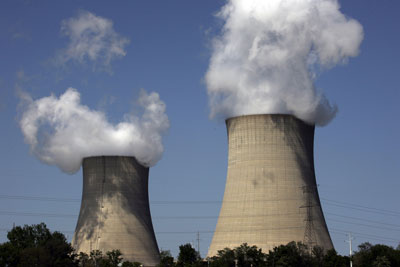
    <ahref="http://blog.heritage.org/wp-content/uploads/nuclear_power_cooling_tower.jpg"></p>In a highly publicized decision last week, the Vermont Senate <ahref="http://www.burlingtonfreepress.com/article/20100225/NEWS03/100224051/-1/TOPICS0202/Senate-pulls-plug-on-Vermont-Yankee">voted to potentially close the Vermont Yankee nuclear power plant, the state’s only nuclear plant. *The non-binding vote marked the culmination of a year-long debate in Vermont as to whether the state should renew the operating license of Vermont Yankee, a 37-year old plant that is seeking a 20-year operating extension.* Unfortunately, this decision was more about perception than fact.

    The tide had been turning against Vermont Yankee as news emerged that the plant had been leaking <ahref="http://www.nrc.gov/reactors/operating/ops-experience/tritium/rn-groundwater.html">tritium, a weakly radioactive hydrogen isotope produced in the course of operating a nuclear power reactor, from underground pipes.* The plant owner’s public relations effort in response to the leaks was inadequate and disorganized.* Indeed, they had originally stated last year before the leak that <ahref="http://www.burlingtonfreepress.com/article/20100225/NEWS03/2250305/Internal-report-Entergy-did-not-intentionally-mislead-about-pipes">the underground pipes did not exist.* Regardless of intent, much of the public felt misled, which created opposition to the relicensing effort.

    When it comes to nuclear energy, <ahref="http://www.heritage.org/Research/EnergyandEnvironment/bg2087.cfm">fact is one thing and perception is another.* The fact of the tritium leak is that it was minor in scope and did not threaten public health or safety.* Vermont Yankee has been safely operated for over 37 years, and officials from the federal <ahref="http://www.wcax.com/Global/story.asp?S=11978382">Nuclear Regulatory Commission informed Vermont lawmakers that there is no reason to close the plant.<spanid="more-27726"></span>

    Further, while public health and safety is not imperiled by Vermont Yankee, the economic and environmental future of the state could be jeopardized by needlessly closing down the plant.* Nuclear accounts for <ahref="http://tonto.eia.doe.gov/state/state_energy_profiles.cfm?sid=VT">a higher percentage of electricity generation in Vermont than in any other state: around 75 percent.* And since Vermont Yankee is the only nuclear plant in the state, it is responsible for every bit of that production.

    Shutting down Vermont Yankee now, when the state has no viable power alternative, will result in substantially higher electricity rates.* One analysis from a year ago estimated a <ahref="http://www.rutlandherald.com/article/20090206/NEWS02/902060338/1003/NEWS02">19 percent to 39 percent increase in the cost of electricity.* Given that <ahref="http://tonto.eia.doe.gov/state/state_energy_profiles.cfm?sid=VT">Vermont households and businesses already pay 30 percent more than the national average, such rates could be devastating for the state’s economy.

    Then there are the environmental facts.* The truth is that Vermont enjoys emissions-free electricity because of Vermont Yankee.* What’s going to replace it?* Wind?* Solar?* Hardly.* Not only are these sources expensive, they are intermittent and require massive amounts of land to produce a similar amount of energy.* Natural gas and coal could provide Vermont with the electricity, but building a new plant when the existing one is working just fine is a monumental waste of resources.

    And one more thing: the <ahref="http://www.safecleanreliable.com/vermont.htm">650 jobs at the Vermont Yankee plant will be lost if the vote stands.

    Then there is perception.* Spills and leaks of radioactive materials should never be taken lightly; they should, however, be viewed reasonably and dispassionately.* Considering the facts of Vermont Yankee’s tritium leak in light of its 37-year safety record and the overwhelming economic and environmental benefits, closing the plant down early is a travesty. *But that is what happens when perception drives policy, which is <ahref="http://www.heritage.org/Research/EnergyandEnvironment/wm2811.cfm">too often the case when it comes to nuclear energy<ahref="http://www.heritage.org/Research/EnergyandEnvironment/wm2811.cfm">.

    http://blog.heritage.org/2010/03/01/…uclear-future/

  • House and Senate Cloakroom: March 1-5, 2010

    On 03.01.10 06:00 AM posted by Dan Holler

    The House Cloakroom: March 1 – 5, 2010

    Analysis

    The House will be in for a short week, only taking votes on Tuesday, Wednesday, and Thursday. The fallout from President Obama’s health care summit will continue to take center stage this week as negotiations continue to bring a health care vote to the House and Senate floors once again.* House Majority Leader Steny Hoyer said to expect “further action on jobs” this week but it is unclear what exactly that means. *Also expected on the floor next week is a bill out of the Education and Labor Committee, worrying some private schools as well as those who disagree with a Washington-centric one-size-fits-all policy.

    Major Floor Action

    • Expect legislation to extend some expiring provisions on things like unemployment insurance, highways, the “Doc Fix”, satellite TV and perhaps others.
    • Still-to-be-defined jobs measures
    • <atitle="http://frwebgate.access.gpo.gov/cgi-bin/getdoc.cgi?dbname=111_cong_bills&docid=f:h4247rh.t xt.pdf" href="http://frwebgate.access.gpo.gov/cgi-bin/getdoc.cgi?dbname=111_cong_bills&docid=f:h4247rh.t xt.pdf">HR 4247 The Preventing Harmful Restraint and Seclusion in School Acts

    Major Committee Action

    • The <atitle="http://appropriations.house.gov/" href="http://appropriations.house.gov/">House Appropriations Subcommittees will continue to hold hearings on proposed fiscal 2011 appropriations.
    • The <atitle="http://armedservices.house.gov/" href="http://armedservices.house.gov/">House Armed Services Committee will hold a hearing on Navy Shipbuilding.
    • Several Committees will continue to hold hearings on the 2011 budget requests.<spanid="more-27625"></span>

    The Senate Cloakroom: March 1 – 5, 2010

    Analysis

    While the Senate focuses on the shiny object of government job creation and tax extenders, the real action will take place behind closed doors as Majority Leader Harry Reid (D-NV) and his deputies explore their options on Obamacare.* Following last week’s health care summit and the President’s assertion that there are indeed “ philosophical disagreements,” the <atitle="http://blog.heritage.org/2010/02/24/obamacare-and-health-care-nuclear-option-violate-first-principles/" href="http://blog.heritage.org/2010/02/24/obamacare-and-health-care-nuclear-option-violate-first-principles/">stage seems set for reconciliation.* If the Senator Reid does go nuclear, the entire Congressional agenda, including talks on financial regulatory reform, could well be thrown into chaos.

    Major Floor Action

    • On Monday, the Senate will take up H.R.4213, which will serve as the vehicle an extension of jobless benefits, COBRA insurance and numerous health payments offered by Senator Max Baucus (D-MT).* Numerous tax provisions will also be extended in the bill.

    Major Committee Action

    • The <atitle="http://hsgac.senate.gov/public/index.cfm?FuseAction=Hearings.Hearing&Hearing_ID=c 5606ab3-bfba-414a-b735-ef35a4adc677" href="http://hsgac.senate.gov/public/index.cfm?FuseAction=Hearings.Hearing&Hearing_ID=c 5606ab3-bfba-414a-b735-ef35a4adc677">Homeland Security Committee will hold a hearing on <atitle="http://www.heritage.org/Research/HomelandSecurity/wm2679.cfm" href="http://www.heritage.org/Research/HomelandSecurity/wm2679.cfm">chemical security.
    • The <atitle="http://finance.senate.gov/sitepages/hearing030310.html" href="http://finance.senate.gov/sitepages/hearing030310.html">Finance Committee will hold a hearing on the <atitle="http://www.heritage.org/index/" href="http://www.heritage.org/index/">2010 trade agenda.
    • The <atitle="http://armed-services.senate.gov/e_witnesslist.cfm?id=4420" href="http://armed-services.senate.gov/e_witnesslist.cfm?id=4420">Armed Services Committee will hold a hearing on the <atitle="http://www.heritage.org/Research/NationalSecurity/bg2375.cfm" href="http://www.heritage.org/Research/NationalSecurity/bg2375.cfm">2011 Air Force budget.
    • The <atitle="http://epw.senate.gov/public/index.cfm?FuseAction=Hearings.Hearing&Hearing_id=0 780a976-802a-23ad-42f3-03e35b75a30a" href="http://epw.senate.gov/public/index.cfm?FuseAction=Hearings.Hearing&Hearing_id=0 780a976-802a-23ad-42f3-03e35b75a30a">Environment and Public Works Committee will hold a hearing on the <atitle="http://www.heritage.org/Research/EnergyandEnvironment/wm2795.cfm" href="http://www.heritage.org/Research/EnergyandEnvironment/wm2795.cfm">Clean Air Act.

    http://blog.heritage.org/2010/03/01/…arch-1-5-2010/

  • Morning Bell: The Edifice Falls

    On 03.01.10 06:28 AM posted by Mike Gonzalez

    <ahref="http://blog.heritage.org/wp-content/uploads/captrade2trillionbig.jpg">

    <ahref="http://blog.heritage.org/wp-content/uploads/captrade2trilliontax.jpg"></p>Having failed to convince the country that we should reorder one-sixth of our economy (health care) in one fell swoop, liberals in the Administration and Congress are now doubling down and moving on to the next big thing. This time it’s the transformation of everything, through climate legislation. One could almost stand agape, admiring the boldness of the overreach, were not so much prosperity at stake.

    The latest attempt to force the U.S. economy to turn away from readily available, affordable fuels and leaving it to the tender mercies of untried, experimental and expensive technologies is a bipartisan effort by Sens. John Kerry (D-MA), Lindsey Graham (R-SC) and Joseph Lieberman (I-CT). A legislative package from them, according to <ahref="http://www.washingtonpost.com/wp-dyn/content/article/2010/02/26/AR2010022606084.html">The Washington Post on Saturday, would individually cap how much traditional energy the main pillars of the American economy would be able to use. This would of course cripple our economy and threaten our prosperity. Any doubts about how broad and deep this effort is are dispelled by reading the following paragraph in the Post:

    According to several sources familiar with the process, the lawmakers are looking at cutting the nation’s greenhouse gas output by targeting, in separate ways, three major sources of emissions: electric utilities, transportation and industry.

    The reason the Senators could not act through their preferred vehicle, a “cap-and-trade” scheme that would put an across-the-economy ceiling on the use of traditional sources of fuel such as coal, oil and natural gas—above which companies using these fuels would have to pay for extra rights—is that the whole edifice of global warming is now falling apart.

    It is collapsing with such rapidity that it is worth pausing from time to time to take stock.<spanid="more-27613"></span>

    The foundations of such edifice rest on a single assumption. This hypothesis—one that drove many people, even some reasonable ones, to contemplate upending the world as we know it — is that that traditional fuels will have cataclysmic consequences on the environment because they emit gases that make the world too hot.

    The authority to turn this assumption into fact rested largely on a U.N. document -*<ahref="http://www.ipcc.ch/publications_and_data/publications_and_data_reports.htm#1">the Intergovernmental Panel on Climate Change’s 2007 report -*which declared climate change “unequivocal” and its man-made origin “very likely.” The purpose of the IPCC report was to turn hypothesis into fact.

    The reason Sens. Kerry, Graham and Lieberman had to turn away from cap-and-trade, and target industries individually, is that the idea of an iron-clad scientific consensus is now being revealed to be a bit, shall we say, exaggerated. The IPCC’s turning of hypothesis into fact now looks less like the scientific process and more like the magician you paid $50 an hour to pull flowers out of hats at your daughter’s birthday.

    The first scales began to come off the global warming edifice in November, when <ahref="http://www.popularmechanics.com/science/earth/4338343.html">emails from the University of East Anglia in the UK revealed how scientists at that key global research center had tried to suppress the opinion of peers who dissented from their view and hid evidence that countered the theory of man-made global warming.

    Then the U.N.’s Copenhagen summit that was supposed to produce a global agreement to replace the expiring Kyoto Protocol <ahref="http://www.guardian.co.uk/commentisfree/cif-green/2009/dec/21/copenhagen-failure-obama-climate-change">fell apart in December, with the key countries refusing to hobble their own economies for the sake of science that was less and less there.

    Then, last month it started to become clear that the 2007 IPCC report was more hollow than hallowed. Its claims that <ahref="http://www.reuters.com/article/idUSTRE61C1V420100213">half the Netherlands is below sea level was off by a factor of two. Ditto for the outlandish fear-mongering that the glaciers of the Himalayas would melt by 2035. The IPCC was forced to admit that, actually,*<ahref="http://www.guardian.co.uk/environment/2010/jan/20/ipcc-himalayan-glaciers-mistake">its projections were that that would happen by 2350. Oops!

    Then last Friday, the news pages of <ahref="http://online.wsj.com/article/SB10001424052748704188104575083681319834978.html?K EYWORDS=Rajendra+Pachauri">The Wall Street Journal published yet one more devastating story on the IPCC and its hapless chairman, Rajendra Pachauri. The front page story detailed how inconclusive science, political pressure and shoddy administration all led to the Cassandra-like pronouncements of the IPCC report. Imagine that: politicians putting pressure on scientists to come up with theories that would vastly add to their regulatory and taxing powers.

    Things have gotten so desperate that Al Gore himself had to come out of seclusion and pen a piece for <ahref="http://www.nytimes.com/2010/02/28/opinion/28gore.html">The New York Times. On Saturday he implored readers that all these cascading events didn’t amount to a hill of beans. The article was vintage Gore. Let’s say it was not restrained. Here’s Gore on what will happen if we fail to act now:

    Our grandchildren would one day look back on us as a criminal generation that had selfishly and blithely ignored clear warnings that their fate was in our hands.

    The former Vice President and failed presidential candidate was so exercised he even took a jab at FOX, apparently blaming it for the troubles global warming is experiencing: “Some news media organizations now present showmen masquerading as political thinkers who package hatred and divisiveness as entertainment.”

    Alas for Gore, Pachauri, et al., the climate alarums are working less and less not because of FOX, but because the alarmists overreached. Even an embarrassed U.N. was forced to announce Saturday that an independent board of scientists will be appointed to review the workings of the IPCC.

    Unfortunately, climategate and IPCCgate have not put a dent on the Obama Administration’s plan to (mis)use the Environmental Protection Agency to regulate CO2, and thereby the companies that power our nation. Its Administrator Lisa Jackson was <ahref="http://www.washingtonpost.com/wp-dyn/content/article/2010/02/22/AR2010022204829.html">out in front of Congress last week again repeating the <ahref="http://blog.heritage.org/2010/02/19/hype-of-global-warming-far-scarier-than-science-shows/">same shibboleths on a scientific consensus on global warming. This should make us all wonder if stopping global warming really was ever the end game.

    As for Sens. Kerry, Graham and Lieberman, their reaction is to slap carbon controls on individual sectors of the economy separately, instead of setting a national target through cap-and-trade. The foundations for doing cap-and-trade have been torn asunder. Our research shows that cap-and-trade would be a <ahref="http://blog.heritage.org/wp-content/uploads/captrade2trillionbig.jpg">$1.9 trillion tax on businesses over eight years, more expensive than the Vietnam War, Hurricane Katrina or the New Deal. But taxing the different pillars of our economy individually would be just as economically suicidal.

    Sen. Kerry told the Post last week about his legislative effort, “What people need to understand about this bill is this really is a jobs bill, an economic transformation for America, an energy independence bill and a health/pollution-reduction bill that has enormous benefits for the country,” Kerry said. Notice he said nothing about global warming or climate change, the reason we were supposed to take this long walk off a short pier. Notice also he didn’t say it was about handing the political class the reins of the private economy. Kerry, Graham and Lieberman want electric power to be first on the economic chopping block. Previous analysis of similarly severe carbon cuts project electricity prices will rise over 70 percent, even after adjusting for inflation. Not only is this a nightmare for household utility bills, the higher cost will hit consumers over and over since businesses must pass on their higher costs as well.

    You can follow Mike Gonzalez on <ahref="http://twitter.com/">Twitter @<ahref="http://twitter.com/Gundisalvus">Gundisalvus

    Quick Hits:

    • The latest <ahref="http://www.cnn.com/2010/POLITICS/02/26/citizens.rights.poll/">CNN poll shows that 56% of Americans say they think the federal government has become so large and powerful that it poses an immediate threat to the rights and freedoms of ordinary citizens.
    • If you missed the seven-and-a-half-hour health summit Thursday, Heritage has compiled a <ahref="http://blog.heritage.org/2010/02/26/video-the-four-minute-guide-to-the-seven-hour-summit/">four minute highlight reel here.
    • Because his ethical lapses have not <ahref=" http://www.politico.com/news/stories/0210/33668.html">“jeopardized our country in any way,” Speaker Nancy Pelosi (D-CA) will let Ways and Means Chairman Charles Rangel (D-NY) keep his leadership post.
    • Senior aides are telling The New York Times that President Obama will <ahref="http://www.nytimes.com/2010/03/01/us/politics/01nuke.html?ref=todayspaper">permanently reduce America’s nuclear arsenal by thousands of weapons.
    • Gov. Mitch Daniels (R-IN) <ahref=" http://online.wsj.com/article/SB10001424052748704231304575091600470293066.html?m od=WSJ_Opinion_LEFTTopOpinion">shows how Health Savings Accounts (HSAs) have increased satisfaction while bringing down health care costs in his state.

    http://blog.heritage.org/2010/03/01/…ifice-falls-2/

  • What Transparency Looks Like to the Obama White House

    On 02.28.10 06:00 AM posted by Mike Brownfield

    <ahref="http://blog.heritage.org/wp-content/uploads/Chamber-Docs-10-2-261.jpg"></p>Things that are transparent: Saran Wrap, glass, water. Things that aren’t transparent: brick walls, mountains, the White House Council on Environmental Quality (CEQ).

    Or so it would seem, if you take a look at the CEQ’s response to a <ahref="http://www.chamberpost.com/2010/02/transparency-incarnate.html">Freedom of Information Act (FOIA) request issued by the U.S. Chamber of Commerce, in which the Chamber asked for the release of documents relating to agency records on global warming.

    As the <ahref="http://www.chamberpost.com/2010/02/transparency-incarnate.html">Chamber notes, “CEQ had identified 87 documents totaling 759 pages that were responsive to our request. HOWEVER, they could not release most of the documents because they ‘originated’ with another agency.”

    So what did CEQ produce? An entirely blacked-out, redacted, Sharpie-markered e-mail, pictured above. (You can also take a look at <ahref="http://chamberpost.typepad.com/files/foia.pdf">a PDF of the document, courtesy of the Chamber.)

    <spanid="more-27534"></span>

    The Chamber says the response to their FOIA is astonishing, given President Barack Obama’s call for transparency beginning with day one in office:

    On his very first full day in office, President Obama sent a memorandum to his executive agencies extolling the virtues of transparency and open government and directing them to facilitate public access to information. To further that directive, Obama issued a second memorandum encouraging agencies to “adopt a presumption in favor of disclosure” when responding to public requests under the Freedom of Information Act (FOIA):

    “The Freedom of Information Act should be administered with a clear presumption: In the face of doubt, openness prevails. The Government should not keep information confidential merely because public officials might be embarrassed by disclosure, because errors and failures might be revealed, or because of speculative or abstract fears. …In responding to requests under the FOIA, executive branch agencies (agencies) should act promptly and in a spirit of cooperation, recognizing that such agencies are servants of the public. All agencies should adopt a presumption in favor of disclosure, in order to renew their commitment to the principles embodied in FOIA, and to usher in a new era of open Government. The presumption of disclosure should be applied to all decisions involving FOIA.”

    This isn’t the first case of a less-than-transparent White House.

    In January, <ahref="http://blog.heritage.org/2010/01/07/federal-court-fines-obama-administration-for-lack-of-transparency/">we wrote about another case of executive office stonewalling relating to the Justice Department’s dismissal of a voter-intimidation case against the New Black Panther party. As Heritage’s Hans Von Spakovsky wrote, “The department has denied requests for information about the case from newspapers and members of Congress, and is refusing to comply with subpoenas issued by the U.S. Commission on Civil Rights.” Von Spakovsky <ahref="http://blog.heritage.org/2010/01/07/federal-court-fines-obama-administration-for-lack-of-transparency/">detailed other cases of obfuscation, too.

    Then there’s the <ahref="http://blog.heritage.org/2010/01/14/morning-bell-behind-closed-doors-unions-win-you-lose/">lengthy behind-closed-doors health care reform negotiations that took place in January, despite President Obama’s repeated campaign pledge to broadcast meetings in public and on C-SPAN. Who was involved in those meetings? President Obama, Speaker Nancy Pelosi (D-CA), Majority Leader Harry Reid (D-NV) and nine other lawmakers. Separately, three union presidents also met behind-closed-doors with administration officials, presumably about health care. <ahref="http://dyn.politico.com/printstory.cfm?uuid=2A70964B-18FE-70B2-A829E83E3A056B6C">Politico noted: “Those involved in the talks sought to keep details of their progress under wraps.”

    While Thursday’s lengthy health care summit took place in front of cameras, it occurred well after President Obama’s health care proposal was hammered out. Transparency came awfully late in the process.

    Given the <ahref="http://blog.heritage.org/2010/02/15/climategate-concessions/">rash of stories about serious flaws in data and conclusions pertaining to global warming, policymakers must be open, honest and transparent about the underlying data that form the basis for calls to enact radical – and economically devastating – environmental policies. Openness should prevail, so the American people can be informed.

    http://blog.heritage.org/2010/02/28/…a-white-house/

  • Pentagon Report Underscores Urgent Need for More Taiwan Arms

    On 02.27.10 10:21 AM posted by Dean Cheng

    <ahref="http://blog.heritage.org/wp-content/uploads/2009/11/taiwanfighterjet091116.jpg"></p>With the public release of a*<ahref="https://email.heritage.org/exchweb/bin/redir.asp?URL=http://www.defensenews.com/story.php?i=4508720%26c=ASI%26s=AIR" target="_blank">US Defense Intelligence Agency (DIA) report on Taiwan’s air power, there is now a public US government assessment of Taiwan’s ability to fend off Chinese attack. And while the report does not directly state how well Taiwan would do against the PLA, there is little reason for optimism under current conditions. Three of the four aircraft in the Taiwan air force inventory are problematic: its F-5s are reaching the end of their operational life; the Ching-Kuo Indigenous Defense Fighter has limited ability to sustain high sortie rates; while the operations and maintenance costs of the Mirage-2000 are so high as to affect operational readiness.

    In this light, Taiwan’s standing request for 66 additional American-built F-16s to supplement current defensive capabilities is*<ahref="https://email.heritage.org/exchweb/bin/redir.asp?URL=http://www.heritage.org/Research/AsiaandthePacific/bg2379.cfm" target="_blank">more urgent than ever. So far, both the Bush and Obama administrations have withheld them from Taiwan.<spanid="more-27608"></span>

    Delaying the sale of these fighters not only undermines the ability of Taiwan to defend itself, especially in light of the weaknesses that the US Department of Defense has identified, but also raises questions of US commitment to Taiwan consistent with the Taiwan Relations Act.

    Alternatively, if the intent is to delay the sale until a later date in the hopes of currying favor with Beijing, the Chinese reaction to the recent visit of the Dalai Lama, after*<ahref="https://email.heritage.org/exchweb/bin/redir.asp?URL=http://www.foxnews.com/opinion/2010/02/18/dean-cheng-heritage-obama-dalai-lama-meeting-white-house-china/" target="_blank">President Obama had delayed it last year, should provide food for thought. Beijing’s view, on both the visit and Taiwan arms sale, is that it is*fundamentally illegitimate for the United States to engage in such actions, whenever they might occur. Putting off the sale, like the visit, will no more lead to Chinese approval than a delay in visiting the dentist will make a cavity go away.

    In this light, the administration should bite the bullet, and*<ahref="https://email.heritage.org/exchweb/bin/redir.asp?URL=http://blog.heritage.org/2010/01/29/fine-now-sell-taiwan-the-f-16s/" target="_blank">proceed with F-16 sales to Taiwan.

    http://blog.heritage.org/2010/02/27/…e-taiwan-arms/

  • Pull Your Weight, Europe

    On 02.27.10 07:15 AM posted by Sally McNamara

    </p>European leaders were shocked this week when Defense Secretary Robert Gates told a NATO audience that the alliance faces a “crisis” because the continent has largely demilitarized. Why the surprise — have they been in a coma?

    Europe’s free defense ride — thanks to the rock-solid US security guarantee within the NATO alliance — has been a problem for decades. Taking the US protective umbrella for granted, the continent has raided defense budgets to cover its ever-growing welfare bills.

    Just four of NATO’s European members (Bulgaria, France, Greece and Britain) spend the alliance’s recommended benchmark of 2 percent of gross domestic product on defense. Just 2.7 percent of Europe’s 2 million military personnel were deployed overseas in 2007, reflecting badly on NATO’s 1999 pledge to engage in important “out of area” operations.

    And it’s no recent trend. Back in 1999, for the NATO air campaign against Serbia, the US provided 100 percent of NATO’s jamming capability, 90 percent of the air-to-ground surveillance and 80 percent of the air-refueling tankers. US fighters and bombers delivered 90 percent of the precision-guided munitions.

    The divide’s grown even worse since 9/11, as America has moved into a new political and security space. Now Gates seems to be saying, “Enough’s enough.” America finally appears unwilling to continue shouldering such a disproportionate amount of the regional and global security burden.<spanid="more-27580"></span>

    Why now? It’s Afghanistan, stupid.

    The inequitable sharing of risks and responsibilities playing out there has raised the stakes considerably: America and Britain account for nearly 60,000 of the 86,000 NATO troops. And many more US forces serve outside NATO: By July, we’ll have almost 100,000 in-country; France, Germany, Italy and Spain combined have just 12,000.

    But the true disparity is worse. Take one of the crudest indicators of a nation’s commitment to the mission: troop losses. Nowhere do we see a starker picture of who’s actually doing the fighting — and who’s not.

    America has lost 1,006 servicemen and -women in Afghanistan. Britain has lost 265 — more than the rest of Europe combined. (It is past time for President Obama to recognize the sacrifice of British servicemen alongside the US military.)

    Through 2008, many assumed that continental Europe wasn’t stepping up to the plate because its leaders didn’t like George W. Bush. But nothing’s changed with Obama in the White House: When he asks for more support for Afghanistan, the countries that step up are the same ones that responded to Bush.

    When Obama threw his weight behind Gen. Stanley McChrystal’s new strategy, he plainly expected Europe to commit at least 10,000 more troops plus equipment, trainers and money. Yet Europe is sending just over 7,000 more troops — and at least 1,500 of them will come from non-NATO members, including 900 from war-torn Georgia.

    And even those numbers overstate Europe’s contribution — because what most of these troops can do is strictly limited by their home governments. As Gates said in 2008, “Some allies are willing to fight and die to protect people’s security, and others are not.”

    Although NATO closely guards the comprehensive list of “national caveats,” NATO Supreme Commander Adm. James Stavridis said last June that there were 69. Here’s some of the caveats we know about:

    • German troops are restricted to conducting operations in northern Afghanistan before nighttime and never more than two hours away from a well-equipped hospital.
    • Turkish troops are restricted to Kabul.
    • Troops from most southern European nations are barred from fighting in snow.
    • One country prohibits troops from other nations from flying in its aircraft.

    Worse, caveats are sometimes unofficial, unwritten and not declared until an operation’s underway, presenting military leaders with the risk that troops they’re counting on can become unavailable after combat’s begun.

    Nor is Europe pulling its weight in training and development in Afghanistan. A key part of McChrystal’s counterinsurgency strategy is a rapid expansion of the Afghan Security Forces, requiring nearly 2,500 added NATO or EU trainers. The European Union has dispatched just 281 personnel, only some of them actually trainers. Most are restricted to Kabul, teaching Afghan policemen such pointless tasks as how to issue speeding tickets.

    With a few honorable exceptions (such as Britain, Poland, Denmark, Estonia and the Netherlands), NATO’s European members (especially France, Germany, Italy and Spain) have stinted on resources for the UN-mandated mission in Afghanistan. That is, they’ve not only provided too few troops (with too many national caveats) but also too few helicopters.

    Save for such warrior nations as Britain, Europe today fundamentally lacks both the military resources and (more important) the political will to fight long wars abroad.

    But America doesn’t have the luxury of choosing its wars. And if Europe still believes that the trans-Atlantic security alliance is in its best interests, then it’s going to have to recalibrate its attitude toward war-fighting — and it’s going to have to start with Afghanistan.

    http://blog.heritage.org/2010/02/27/…weight-europe/

  • Video: The Four-Minute Guide to the Seven-Hour Summit

    On 02.26.10 02:23 PM posted by Brandon Stewart

    </p>Yesterday’s health care summit may well come to be seen as an important turning point in the health care debate. While the future of health care reform remains in doubt, the debate yesterday helped*demonstrate*to the American people the sharp differences in ideology and substance that form the gap between liberal and conservative solutions to our current healthcare problems.

    For those who did not watch all seven hours, we have compiled the day’s highlights into one video.<spanid="more-27464"></span>

    http://blog.heritage.org/2010/02/26/…n-hour-summit/

  • Vice-President Biden Misses a Chance to Help the Middle Class

    On 02.26.10 02:30 PM posted by Rea Hederman

    <ahref="http://blog.heritage.org/wp-content/uploads/2009/05/bidenmoron090514.jpg"></p>Vice-President Biden recently released the report of his task force on how to <ahref="http://www.whitehouse.gov/sites/default/files/microsites/100226-annual-report-middle-class.pdf">help the middle class. While there are a few excellent recommendations, most of the report focuses on failed policy prescriptions of the past. An early indication on the biased nature of the report is the early admission that labor unions contributed heavily to the writing of the report, while business input is sparse in comparison.

    The report claims that middle class income has been stagnant since the 1970’s, and middle class families need the hand of government to get ahead. The report plays fast and loose with the numbers as its focuses on families hides the rise of single-parent families. While the report correctly focuses on the rise of single parents contributing to income inequality, the report does not compare a middle class married family with a single parent family. Married couples have moved steadily up the economic ladder.

    The report also focuses on wage income, while ignoring the fact that benefits such as retirement and health have been quickly increasing. Evidence omitted from the report shows that overall compensation, which includes all benefits, closely tracks productivity, both having roughly doubled over the past forty years. Since 1970, <ahref="http://www.heritage.org/Research/Labor/wm1943.cfm">wages have grown 94 percent while productivity has grown 120 percent.<spanid="more-27588"></span>

    The overstatement of income inequality would not be as harmful, except Vice-President’s recommendations would slow economic growth and waste taxpayer dollars. For example, the reports calls for increased unionization and the implementation of assured union jobs at government pay levels.Recently however, the General Accounting Office concluded that adherence to cumbersome labor rules from Washington <ahref="http://www.gao.gov/highlights/d10383high.pdf">slows construction projects and <ahref="http://www.heritage.org/Research/Labor/wm2253.cfm">other evidence shows that it increases costs.

    While most of the other solutions involve more government spending and subsidies, there are some good ideas that would help middle class families. Primarily, the Administration would create a mechanism to automatically enroll workers into IRA savings accounts. Small businesses would be given a tax credit to offset administrative costs. This is a real solution that helps more workers take advantage of some of the best aspects of the US economy.

    More provisions such as the auto-IRA would have valuable in helping the middle class. Other good ideas would be to promote better schools, more stable families and a decline in out of wedlock birth, since these are <ahref="http://www.economicmobility.org/assets/pdfs/PEW_EMP_PATHWAYS.pdf">impediments to mobility. Instead, Vice-President Biden is focusing on turning back the clock to a period of increased unionism and government subsidies for government-approved behavior.

    http://blog.heritage.org/2010/02/26/…-middle-class/

  • Will Education Standards Really Help Failing Schools?

    On 02.26.10 08:00 AM posted by Lindsey Burke

    President Obama’s proposal Monday to link Title I funding to adoption of education standards has the education world abuzz. During a speech to the National Governor’s Association, President Obama stated:

    I want to commend all of you for acting collectively through the National Governors Association to develop common standards that will better position our students for success.and today, I’m announcing steps to encourage and support all states to transition to college and career-ready standards on behalf of America’s students.
    First, as a condition of receiving access to Title I funds, we will ask all states to put in place a plan to adopt and certify standards that are college and career-ready in reading and math. Once you’ve got those standards in place, you’ll be able to better compete for funds to improve teaching and upgrade curricula and to make sure that we’re delivering for our kids, we’re launching a competition to reward states that join together to develop the highest-quality, cutting edge assessments required to measure progress; and we’ll help support their implementation.

    What does this imply for the supposedly “voluntary” common standards effort underway in many states? The New York Times ran this statement from the White House:

    ‘In better aligning the law to support college- and career-ready standards, its proposed rewrite of the No Child Left Behind law would ‘require all states to adopt and certify that they have college- and career-ready standards which may include common standards developed by a state-led consortium, as a condition of qualifying for Title I funding’

    Even the Fordham Foundation, which has supported the common standards movement, has raised strong concerns about the new proposal. Andy Smarick writes:

    This is big and interesting news when combined with the administration’s push, via RTT [Race to the Top], for common or national standards. This could potentially mean that a state that refuses to give up its age-old prerogative to unilaterally determine the content of its academic standards could disqualify itself from hundreds of millions of federal funds annually.

    What remains to be seen is if states like Texas or Alaska that are balking at the national standards push would be able to argue that their non-common standards are “college- and career-ready.

    I do wonder, however, if a governor might stand up after the president’s speech and ask: ‘Mr. President, your secretary of education continues to say that the federal government doesn’t have the answer and that Washington should get out of the way and allow states to make the most important decisions in K-12 schooling. How exactly does that square with your message today that states will lose access to Title I funds unless we relinquish our right to make the final call on arguably the most important K-12 matter: what our students learn?’

    Great question. The Obama administration has billed the common standards movement as a voluntary effort by 48 states to adopt what the NGA/CCSSO deem the academic content all students across the country need to know. While Race to the Top creates a strong federal incentive for their adoption – the $4.35 billion in competitive grants has just been increased by another $1.35 billion – this move to link Title I funds to their adoption would up the ante considerably. Nearly every school district in America participates in the $14.5 billion Title I program. The program was the original 1965 federal intervention into local education to provide extra funding for low-income children. In other words, Title I represents perhaps the most powerful leverage Washington has over local education.

    This would put tremendous pressure, for example, on a state such as Texas, which until now has declined to participate in the common standards movement and RttT grants. But it may be difficult to eschew its share of Title I funding for low-income school districts.

    In addition to these concerns about federal funding and administration pressure, the actual content of the standards have some experts questioning the wisdom of adopting the NGA/CCSSO plan. In a joint press release issued Tuesday, the Pioneer Institute for Public Policy (Massachusetts) and the Pacific Research Institute (California) raise concerns about the negative impact on state education reforms across the country:

    ‘With the façade of voluntary adoption gone and this looking more like a federal takeover of educational standards, Massachusetts and other states that have gotten their acts together over the last 15 years have a choice to make,’ says James Stergios, executive director of Pioneer Institute in Massachusetts. ‘Since education reform, Massachusetts and its localities have invested $90 billion in our schools; the feds not even hitting 10 percent of school spending. We implemented hard-won reforms centered on our liberal arts-rich academic frameworks. Why would we give that up – why would we give up leading the nation on national assessments and college entrance tests, and competing with the best nations in math and science to line up behind standards that look more like West Virginia’s than the nation’s best?’

    Lance Izumi, Koret Senior Fellow and Senior Director of Education Studies at the Pacific Research Institute states:

    ‘This new study underscores the serious pitfalls of the current headlong effort of the Obama administration to push states to adopt common, i.e. national, standards. The drafting process has been opaque and the draft standards are not well written or sufficiently rigorous, which is especially disturbing for states like California and Massachusetts that already have high standards. California went through a very transparent and deliberative process to adopt its rigorous standards, so it would be tragic if these well-functioning and highly praised state standards were replaced by academically inferior national standards.

    Even as the administration’s health care proposals assert greater federal control over that sector, early signs are that its ideas for this year’s looming education debate are moving in the same direction. And that’s the wrong direction for America’s students.

    http://blog.heritage.org/2010/02/26/…iling-schools/