Author: Heritage

  • A Nuclear Iran, An Inexperienced EU Foreign Minister

    On 02.11.10 09:30 AM posted by Sally McNamara

    <ahref="http://blog.heritage.org/wp-content/uploads/catherine-ashton.jpg"></p>Iran’s <ahref="http://www.dw-world.de/dw/article/0,,5238404,00.html">announcement today that it is a nuclear state makes the appointment of the spectacularly inexperienced Catherine Ashton as EU Foreign Minister even more ridiculous.

    Her speech at the Munich Security Conference last weekend was a snoozer of epic proportions – even by Brussels standards. However, it was her statements on Iran which beggar belief. At exactly the time when everyone’s patience has finally run out with Iran, Mrs. Ashton decides, not to side with French President Nicolas Sarkozy in calling for sanctions forthwith, but instead, publicly sides with the Chinese Foreign Minister, stating: “[the] possibilities of dialogue are not exhausted.” She went on to make her position very clear: let’s not be hasty in discussing sanctions. It’s a shame that she didn’t let the State Department know, since they insisted the possibility of sanctions would be discussed within “a few days.”

    <spanid="more-26229"></span>

    Those remarks came just before <ahref="http://www.dw-world.de/dw/article/0,,5238404,00.html">Iran’s nuclear proclamation, and news that continues its <ahref="http://blogs.wsj.com/digits/2010/02/10/twitter-buzz-over-irans-gmail-ban/ ">crackdown on e-mail and social media, such as Gmail and Twitter. With Iran’s threat to wipe Israel “off the face of the earth,” Europe and Washington should cooperate to impose targeted and heavy sanctions immediately — regardless of U.N. Security Council backing or the lack thereof. It also can’t afford to rule other options out, including a last-resort use of force against Iran.

    After revelations that Ashton returns to London every Friday for intense coaching from the foreign office to catch up on everything she doesn’t know about foreign policy, it’s clear that she now needs a new speechwriter too.

    Adding insult to injury, Mrs. Ashton has taken over from Javier Solana as head of the EU3+3 (the six powers involved in talks with Iran). With no credibility and negligible experience on the world stage, Mrs. Ashton should do the honorable thing and hand chairmanship of the group over to her British or American colleagues.

    The EU has long been out of its depth in dealing with Iran, and consistently underestimated their commitment to pursuing the illicit development of nuclear weapons. EU negotiations have allowed Iran to play for time and the ostrich-like Mrs. Ashton continues to stick her head in the sand, saying <ahref="http://www.ejpress.org/article/news/eastern_europe/42321">she doesn’t understand why Iran continues to break the rules. The time for half-measures and engagement strategies is over. Now is the time for action.

    http://blog.heritage.org/2010/02/11/…eign-minister/

  • Ahmadinejad: Iran is a “Nuclear State”

    On 02.11.10 10:12 AM posted by James Phillips

    </p>Iranian President Mahmoud Ahmadinejad today used the annual celebration of the anniversary of Iran’s Islamic revolution to announce that Iran has become a <ahref="http://apnews.myway.com/article/20100211/D9DPTTKO0.html">“nuclear state.” Although the bombastic dictator has made this claim before, his exultant announcement came shortly after Iran had announced that it would enrich uranium to the 20 percent level that it claims it needs to fuel a research reactor that is scheduled to run out of fuel later this year.

    Ahmadinejad proclaimed: “I want to announce with a loud voice here that the first package of 20 percent fuel was produced and provided to the scientists.” In a speech broadcast live on state television he said: “We have the capability to enrich uranium more than 20 percent or 80 percent but we don’t enrich (to this level) because we don’t need it.” He told the crowd: “When we say we do not manufacture the bomb, we mean it, and we do not believe in manufacturing a bomb. If we wanted to manufacture a bomb, we would announce it.”

    Ahmadinejad spoke before a <ahref="http://news.bbc.co.uk/2/low/middle_east/8509765.stm">huge crowd in Tehran mobilized by the regime, in part by transporting loyalists in from outlying regions. The opposition Green Movement also staged counter-demonstrations despite the attacks and intimidating tactics used by Iran’s police, Revolutionary Guards, and Basij militia. Many opposition leaders were attacked by thugs when they tried to meet with protesters. Presidential candidate Mehdi Karrubi and former President Mohamed Khatami were physically beaten.<spanid="more-26256"></span>

    Opposition sources charged that the police also fired tear gas and shots at an opposition rally led by Mir Hossein Mousavi, <ahref="http://www.reuters.com/article/idUSHAF12980220100211">Ahmadinejad’s chief rival in the fraudulent presidential elections last June.

    Ahmadinejad yesterday also made a phone call to Syrian leader Bashar Assad in which he <ahref="http://www.reuters.com/article/idUSTRE61A1ER20100211">warned Israel against attacking Syria, Lebanon or elsewhere in the region. “If the Zionist regime should repeat its mistakes and initiate a military operation, then it must be resisted with full force to put an end to it once and for all.” Tensions have been rising along Israel’s border with Lebanon, which was the battlefield for a 34-day war between Israel and the Hezbollah terrorist group in 2006. Hezbollah has been supplied with thousands of Iranian-made rockets and other weapons and has regained its military muscle in southern Lebanon after losing many gunmen and much territory in 2006. Ahmadinejad’s phone call is a pointed signal to Israel that if it launches a preventive strike at Iran’s nuclear program, then Tehran will order Hezbollah to launch terrorist and rocket attacks against Israel.

    Iran’s provocative defiance of five U.N. Security Council resolutions and three sets of sanctions now puts additional pressure on the United States and other concerned countries to respond with much stronger sanctions. But China, <ahref="http://in.news.yahoo.com/137/20100211/760/twl-analysis-china-silence-signals-softe.html">which has opposed additional sanctions under the pretense that more sanctions would derail negotiations, is not likely to be cooperative.

    And Russia also has defended Iran’s interests at the Security Council and cannot be trusted to support effective sanctions against Iran.

    The United States is pushing for the strongest possible sanctions at the U.N. Security Council but the end result of these efforts will not approach the “crippling sanctions” that the Obama Administration has promised. Washington therefore must think outside the U.N. box and press its allies and other countries to impose stronger sanctions outside the U.N. framework. Iran would be hard hit by bans on foreign investment, gasoline exports, trade with firms affiliated with the Islamic Revolutionary Guard Corps and other measures undertaken by the European Union, Japan, India, the Gulf Cooperation Council or other countries.

    But before it can ask other countries to impose stronger sanctions, <ahref="http://www.heritage.org/Research/Iran/wm2647.cfm">the Obama Administration should support stronger U.S. sanctions which both houses of Congress have voted to approve.

    The Obama Administration also should <ahref="http://blog.heritage.org/2009/12/31/needed-a-reagan-like-policy-for-iran/">take a lesson from Ronald Reagan and support Iran’s freedom-seeking opposition movement.

    Given the failure of the Obama Administration’s engagement policy to halt Iran’s nuclear efforts, Israel soon may be forced to take military action against Iran. For a look at the implications for the United States, see:
    <ahref="http://www.heritage.org/Research/MiddleEast/bg2361.cfm">An Israeli Preventive Attack on Iran’s Nuclear Sites: Implications for the United States.

    For more on U.S. Iran policy, see: <ahref="http://www.heritage.org/Research/Middleeast/iranbriefingroom.cfm">Iran Briefing Room

    http://blog.heritage.org/2010/02/11/…tate%e2%80%9d/

  • Time for Regime Change in Iran

    On 02.11.10 11:00 AM posted by Helle Dale

    <ahref="http://blog.heritage.org/wp-content/uploads/iranian-prez-welcomed100128.jpg"><imgsrc="http://blog.heritage.org/wp-content/uploads/iranian-prez-welcomed100128.jpg" alt="" title="Iranian President Mahmoud Ahmadinejad welcomed back to Tehran after a visit to the UN" width="400" height="250" class="alignnone size-full wp-image-25161" /></p>If ever there was a case for regime change, today’s Iran is it. Today on the anniversary of the revolution that brought the country’s authoritarian, theocratic government to power offers an opportunity to rectify the mistake made by the Obama administration last summer when it failed to lend material support to Iran’s burgeoning pro-democracy movement. The “don’t rock the boat” approach has not worked — as was amply clear at the time that it would not do. In fact, it was dangerously naive. The notion that the ayatollahs would somehow like the United States and the political system it represents if only we would leave them to oppress their own population has been disprove. Supreme leader Ayatollah Khameni promised to deliver a “punch” to the west on this Iran’s day of celebration, if such it can be called.

    <ahref="http://www.dailymail.co.uk/news/worldnews/article-1250127/Iran-Revolution-day-protests-Islamic-Republic-nuclear-state.html">Iran’s leaders want to be treated with the respect accorded nuclear states, like North Korea, and its wants to assert regional dominance. Neither of these are in the interest of the United States, Israel, or indeed the Middle East as a whole. Iran is again warming the world of its ambitions, boasting about the ability to process 20 percent purified enriched uranium, which places it on the way to weapons grade quality — in addition to censoring, imprisoning and oppressing its own political dissidents. The Tehran regime is not just antithetical to American values, it is regionally destabilizing. More often than not, the two go hand in hand around the world.<spanid="more-26270"></span>

    This is why the tools of American public diplomacy should be deployed in the service of pro-democracy movements and regime change in Iran. Iranians desperately need independent, trustworthy information — such as provided by Radio Free Iran, the U.S. government’s surrogate broadcaster. Funding for its programs should be generously increased, particularly focused on radio as the medium as television is vulnerable due to the visibility of satellite dishes. Internet is clearly sensitive to government control and interference, as is cell phone serve, which makes them vulnerable. Yet in the age of new technology, total control remains extremely hard to maintain and the U.S. government should continue to work with Iranians abroad setting up pro-democracy websites. Funding is difficult to funnel to the Iranian opposition and often evokes suspicion if bearing the mark of the U.S. government. Yet, working through third purity organizations will provide opportunities.

    And most of all, the U.S. government should announce that regime change is official U.S. policy, which will certainly lend moral support to Iranians under sever pressure at home. By now, it should be amply clear that accommodation is not going to lead anywhere but more of the same threatening Iranian behavior.

    http://blog.heritage.org/2010/02/11/…hange-in-iran/

  • The Road to Recovery: Restore Economic Liberty to America

    On 02.11.10 11:00 AM posted by Brandon Stewart

    <ahref="http://blog.heritage.org/wp-content/uploads/100211-shopping-mall.jpg"></p>At <ahref="http://www.huffingtonpost.com/nelson-davis/america-vs-canada_b_450168.html">The Huffington Post Nelson Davis, Executive Producer of MAKING IT! Minority Success Stories, describes his recent discovery of The Heritage Foundation’s <ahref="http://www.heritage.org/Index/">2010 Index of Economic Freedom. He came across the Index for the first time this year and while surprised by the results—showing a decrease in economic freedom in the U.S.—he found himself agreeing with the analysis. Growing up along the Canadian border, he had always assumed that America was the world’s leader in economic freedom:<spanid="more-26217"></span>

    You see, I grew up on the Canadian border in Niagara Falls, New York and I worked in radio and television in Canada’s capital, Ottawa for over ten years. My first business ownership was there when, with a partner, we opened Fat Albert’s Subs and Pizza. While every country has its entrepreneurial class and awe inspiring success stories, I never thought of our frigidly frolicking neighbors as being really business friendly. In fact, a feeling of heavy taxation and questionable national priorities is what prompted me to return to the U.S. and to work my trade here in the much warmer Golden State.

    But now, with this year’s Index, he’s had to adjust that view and begin to think about the root causes:

    So what did the U.S., a country built on the entrepreneurial spirit, do to lose our footing? According to The Heritage Foundation, we are now lacking in the areas of monetary freedom and property rights. Our government’s reactions to the economic and financial crises of the past couple of years are seen as interventionist. They say that the Washington gang’s actions discourage entrepreneurship, accelerate job losses, and weigh us down with record setting deficits. In countries such as South Korea, Germany, and Poland (yes, Poland) they defied the economic pressures and maintained or expanded economic freedom as measured by Heritage.

    I agree with the Heritage Foundation folks that private and free enterprise does the best job of reducing poverty. Heavily regulated economies have an internal friction that slows or prevents forward movement and puts a chill on ambition. The public sector simply does not create value in the marketplace or incentivize its participants to be better and faster. High rank elected officials often talk about change, but they are really mired in the status quo.

    What America needs is a return to the economic freedom that we have traditionally enjoyed. As Davis says, “We should be humbled by the fact that the economic freedom that lifted America to be the most prosperous country in the world is being systematically eroded and compromised.” The only way to turn this around is to <ahref="http://www.heritage.org/Research/Economy/wm2796.cfm">reverse course, unburden entrepreneurs, and let the private sector do what it does best—create jobs and lasting growth.

    http://blog.heritage.org/2010/02/11/…ty-to-america/

  • Record Snowfall Doesn’t Stop Record Federal Spending

    On 02.11.10 12:00 PM posted by Jessica LaHousse

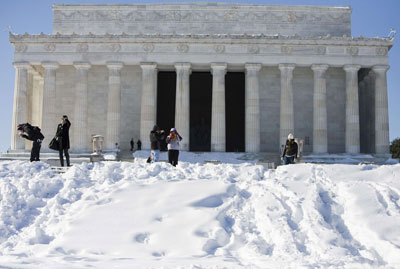
    <ahref="http://blog.heritage.org/wp-content/uploads/snow-dc.jpg"></p>While two brutal snowstorms pounded the Washington, DC, area, the government was busy wasting money to the tune of $100 million a day. Extreme weather conditions forced the government to close for four and a half days straight, costing tax payers $450 million in lost productivity, <ahref="http://www.foxnews.com/politics/2010/02/10/governments-million-day-loss-snowstorm/">according to a Fox News report.

    Wondering how much $100 million really is for the government? Last spring, when President Barack Obama ordered his cabinet secretaries to cut $100 million in spending, Heritage’s Ken McIntyre <ahref="http://www.heritage.org/Press/ALAChart/alachart-detail.cfm?customel_datapageid_244663=317720">took a look at what $100 million really means. For some context that will knock your socks off, he cited the following observation from Senator Mitch McConnell (R-KY):

    We’ll spend about that much every single day just on interest payments for the $787 billion stimulus bill that Congress passed.

    <spanid="more-26219"></span>

    All that interest was for on an expensive stimulus package that <ahref="http://www.heritage.org/Research/Economy/wm2799.cfm">may or may not have had any impact on the struggling economy. Which would you rather spend your hard-earned tax dollars on: one day of stimulus interest payments or one of the federal government’s operating expenses?

    Furthering his analysis, McIntyre <ahref="http://www.heritage.org/Press/ALAChart/alachart-detail.cfm?customel_datapageid_244663=317720">also cited Paul Krugman, a New York Times columnist and economist, who compared $100 million to an entire year of federal spending:

    Let’s say the administration finds $100 million in efficiencies every working day for the rest of the Obama administration’s first term. That’s still around $80 billion, or around 2 percent of one year’s federal spending.

    To the average American tax payer, $100 million might seem staggering; most people won’t see that much money over the course of their entire lives. But, for the government, it is quite a different story, as <ahref="http://www.heritage.org/Press/ALAChart/alachart-detail.cfm?customel_datapageid_244663=317720">McIn tyre points out, “Actually, $100 million might as well be nothing next to federal spending exploding well past $3.5 trillion.”

    It looks like wasting $450 million dollars is just a drop in the bucket for the federal government. <ahref="http://www.washingtonpost.com/wp-dyn/content/article/2010/02/11/AR2010021100995.html?hpid=topnews">The record snowfall may have stopped Washington for a few days, but <ahref="http://www.heritage.org/Research/Features/BudgetChartbook/Federal-Spending-Skyrocketing.aspx">record government spending, and its effects, are sure to linger long after the snow is gone.

    Jessica LaHousse currently is a member of the Young Leaders Program at the Heritage Foundation. For more information on interning at Heritage, please visit: <ahref="http://www.heritage.org/about/departments/ylp.cfm">http://www.heritage.org/about/departments/ylp.cfm

    http://blog.heritage.org/2010/02/11/…eral-spending/

  • What Scientific Method?

    On 02.11.10 01:00 PM posted by Guinevere Nell

    <ahref="http://blog.heritage.org/wp-content/uploads/100211-obama-economic-team.jpg"></p>The White House Council of Economic Advisers (CEA) has released <ahref="http://www.whitehouse.gov/administration/eop/cea/economic-report-of-the-President">a projection of jobs created by the economic stimulus bill. However, the method they used to get these numbers <ahref="http://www.heritage.org/Research/Economy/wm2799.cfm">falls short of basic scientific standards. The CEA modeled a potential outcome for the economy without the stimulus, basing it on historical data. They then compared this computer simulation with the actual data about what occurred with the stimulus – and have declared that the stimulus worked.

    This method would be met with a failing grade in any decent university economics course. A projection of a potential economic outcome based on a model must be compared with a baseline scenario produced by that same model. This is basic: the policy simulation must be compared with a baseline. Instead, the White House compared a simulation with empirical data!<spanid="more-26239"></span>

    This is absurd because any slightly different assumption in a simulation will produce a different result. When comparing with a baseline these can be controlled—we can see what assumptions went into the baseline scenario and which went into the simulation of the policy. There are no hidden tricks. But if a simulation is compared to empirical data, we have no way to know why the two differ. It could be anything.

    What were the assumptions in this simulation, I wonder? Do they not know that they must use a baseline—or was this a purposeful political maneuver?

    http://blog.heritage.org/2010/02/11/…ods-be-damned/

  • Tax Hikes for the Middle Class?

    On 02.11.10 01:30 PM posted by Todd Thurman

    <ahref="http://blog.heritage.org/wp-content/uploads/Obama_Rhetoric090413.jpg"></p>Remember the <ahref="http://www.barackobama.com/pdf/taxes/Factsheet_Tax_Plan_FINAL.pdf">promise of the 2008 Presidential election?

    No family making less than $250,000 will see
    their taxes increase

    Well, now, the option to tax the middle class is “<ahref="http://www.businessweek.com/news/2010-02-11/obama-agnostic-on-deficit-cuts-won-t-prejudge-tax-increases.html">on the table“. Of course, <ahref="http://blog.heritage.org/2009/05/15/obamas-tax-hikes-already-hurting-the-poor/">as we have pointed out, he has already broken that pledge. But now, Obama is ready to admit it. According to Bloomberg:

    President Barack Obama said he is “agnostic” about raising taxes on households making less than $250,000 as part of a broad effort to rein in the budget deficit.

    Instead of taxing everyone to try and reduce the deficit, <ahref="http://www.heritage.org/Research/budget/wm2787.cfm">why not cut spending? That would make it possible for Obama to follow through on his <ahref="http://www.cnn.com/2008/POLITICS/10/19/ct.presidentialdebate3.transcript/index.html">promise to cut out programs that <ahref="http://blog.heritage.org/2010/02/01/with-head-start-failing-white-house-proposes-9-3-billion-for-new-preschool-program/">don’t <ahref="http://www.heritage.org/Research/Economy/wm2799.cfm">work and focus on programs that do work. So far, we have only seen him <ahref="http://www.heritage.org/Press/Commentary/ed011510e.cfm">cut programs that work and <ahref="http://blog.heritage.org/2010/02/05/morning-bell-second-stimulus-same-as-the-first/">give more funds to programs that don’t work.<spanid="more-26268"></span>

    Now, it seems that the middle class might have to pay for the failed policies and failed programs. It seems unfair and the President knows this. In his State of the Union address <ahref="http://www.whitehouse.gov/the-press-office/remarks-president-state-union-address">he stated:

    For these Americans and so many others, change has not come fast enough.* Some are frustrated; some are angry.* They don’t understand why it seems like bad behavior on Wall Street is rewarded, but hard work on Main Street isn’t.

    We have already seen at a state level that higher spending and higher taxes <ahref="http://blog.heritage.org/2009/05/21/morning-bell-californias-high-tax-high-spending-disaster/">does not work to sustain the economy. That kind of thinking has nearly bankrupted California and Obama and the liberals in Congress want to continue in the same direction.

    Heritage expert Brian Riedl <ahref="http://http://www.heritage.org/Research/Budget/sr0063.cfm">has pointed out that simply reducing spending per household to the level Ronald Reagan had it at, we could balance the budget In 2009, we spent over $33,000 per household, $8,000 more than we spent in 2008. We’re continuing down the road of more spending, higher taxes, and less benefits.

    http://blog.heritage.org/2010/02/11/…-middle-class/

  • Education Savings Accounts at Risk in 2011, Unless Congress Acts

    On 02.11.10 02:29 PM posted by Patrick Tyrrell

    <ahref="http://blog.heritage.org/wp-content/uploads/lecture-hall.jpg"></p>Coverdell Education Savings Accounts were created in 2001 to empower parents with greater options for their children’s education, but unless Congress takes action, those accounts could change in 2011.

    Currently, parents who send their children to private schools because they’re not satisfied with the public school quality or culture have to pay twice: once in taxes for public schools, and a second time for their private school tuition. Coverdell accounts are one small way to help lift some of this burden by letting parents save for these education costs in tax-free accounts.

    The accounts allow parents to keep more of their own money to be used for paying educational expenses for children in grades Kindergarten through 12th grade. They may also be used for college expenses without being hit with a tax on the money that’s been saved for those expenses.

    <spanid="more-26290"></span>If Congress fails to act, parents will no longer be able to use the tax-deferred savings they have accumulated for pre-college expenses. If this happens, then expiration will violate President Obama’s pledge not to raise taxes on people making less than $250,000 a year because, as it stands, Coverdell accounts are exempt from capital gains taxes when used for primary or secondary expenses such as private school tuition, a new computer, or school supplies.

    The extra revenue brought into the federal government by prohibiting Coverdells from being used for all educational expenses is miniscule; but to prohibit it, to change the rules of the game after savers have been investing their $2,000 Coverdell contributions per year tax-free for up to ten years, is unreasonable and unfair. Perhaps members of Congress have such an ax to grind against the American people sending their children to private schools that they will allow the rules regarding Coverdell accounts to be altered, but that would be a big mistake.

    For one thing, to do so, would be to chip away at a rock that is the American Dream. These accounts only allow a parent or guardian to contribute $2000 per child per year. That contribution, however, may be invested in stocks, bonds, mutual funds, exchange traded funds and notes, and a variety of other investment options. The choices of what investments to make are up to the Coverdell Education Account owner. For small time investors–the ones who didn’t reap the vast payouts from the bailout of Wall Street’s giant investment banks–this is a carrot the Federal Government has no business taking away. Politicians should not penalize Main Street due to a proverbial ax they have to grind against individuals who wish to save and invest.

    If the Coverdell Educational Savings account is allowed to expire, then a penny saved will no longer be a penny earned towards investing in a better education in 2011.

    http://blog.heritage.org/2010/02/11/…congress-acts/

  • Morning Bell: Global Warming ? Is There Anything It Can?t Do?

    On 02.11.10 06:36 AM posted by Conn Carroll

    Tomorrow, NBC (which is owned by General Electric) will begin broadcasting the 2010 Winter Olympics from Vancouver, Canada. Only two events are scheduled for the opening day (alpine skiing and ski jumping), but even those events will be difficult to pull off. Why? There is no snow in Vancouver. And International Olympic Committee President Jacques Rogge knows exactly what is to blame: global warming. Rogge tells AFP: “Global warming of course is a worry, it is a worry for the entire world.”

    Considering that NBC/GE* has already received billions in TARP bailout cash from the Obama administration and is actively lobbying for a global warming energy tax bill so that it can receive billions more in government green-energy subsidies on top of the millions it already receives, we are sure to hear lots from NBC announcers about how the lack of snow in Vancouver is just another reason Washington needs to act now to stop global warming.

    But back in Washington, the global warming scare-monger crowd is singing a slightly different tune. Facing record snowfalls, Time is reporting: “Snowstorm: East Coast Blizzard Tied to Climate Change.” But do not confuse this headline with Robert F. Kennedy Jr.’s column from two years ago claiming that global warming was causing “anemic winters” in the Washington region.

    No snow, too much snow. It does not matter to the enviroleft crowd. For them, global warming always is to blame. That is the whole reason the movement made a deliberate decision earlier this decade to stop calling it “global warming” and start calling it “climate change.” That way they could expand the universe of terrible things they could plausibly blame on global warming. One British citizen even maintains a comprehensive list of everything the enviroleft has tried to blame on global warming including: Atlantic ocean less salty, Atlantic ocean more salty, Earth slowing down, Earth spinning faster, fish bigger, fish shrinking, and (most importantly) beer better, beer worse.

    The media are not the only ones complicit in the climate fear industry. The 2007 Nobel Prize-winning Intergovernmental Panel on Climate Change (which is the most prestigious scientific body charged with determining what is and is not settled science) has also been found to be cooking the books. In just the past year, the IPCC’s 2007 report has been exposed for overstating the science on glacier loss in the Himalayas, crop loss in Africa, Amazon rain forest depletion and damage from weather catastrophes.

    Here is what we do know: the cap-and-trade system in Europe is completely failing to reduce carbon emissions; the cap-and-trade system proposed here in the United States would do nothing to affect global temperatures, but would do trillions of dollars of damage to the U.S. economy.

    Something to think about while you shovel out your driveway today.

    Quick Hits:

    http://blog.heritage.org/2010/02/11/…ng-it-cant-do/

  • PLA Threatens Chinese Economy

    On 02.11.10 07:45 AM posted by Derek Scissors and Dean Cheng

    China’s*People’s Liberation Army (PLA) this month has been trying to threaten the U.S. economically. However, their plan could actually harm China, not America.

    Many, many*Chinese see reunification with Taiwan as a deep emotional issue. But much of the PLA sees it as a way to pad the military budget.*Any attention to Taiwan has Chinese generals demanding some sort of strong action or another, while naturally observing that the controversy justifies more money for them.

    This happened again with the recent announcement by the Obama Administration that*it will*provide limited*arms to Taiwan.*The PLA trotted out its most bellicose officers.*These worthies*promptly argued, among other things, that*China should respond to the arms sale with a bond sale, selling down holdings of American bonds.

    Bring it on, guys.

    The idea that China has*important*influence over the United States through its bond holdings is a myth.*If*a picture is worth a thousand words, the graphic to the right should be particularly valuable.

    There are only two real economic possibilities:

    1) China sells bonds, for a purely political reason, and finds strong demand from everyone else, here and around the world.

    China*then holds less U.S. government*bonds and others (American banks,*the*Japanese government, ordinary people, and so on)*hold more.

    2) China tries to sell American government bonds, for a purely political reason, but*no one else wants them.*Even in this case there still is no threat to the U.S.

    That’s because China’s attempted sale has nothing to do with the U.S. economy.*People and countries do not*buy*American bonds because China does, they buy because it’s the best financial*option for some particular amount of money.*How good an option it is changes with economic conditions, such as our horrible budget deficit.*But how valuable U.S. government bonds are does not change because the PRC is throwing a tantrum about Taiwan arms. Other buyers of our bonds will ignore this, and there’s even a fun twist.

    If the Chinese government actually listened to PLA bluster and made a grand announcement about selling bonds, they might feel they have to follow through or lose credibility.*But in the case of no one wanting them, that will not work at first.* To find buyers, China would then have to cut the price and take losses on the bonds.

    If that opportunity were to arise, The Heritage Foundation suggests that the Department of the*Treasury buy*the*bonds at the*lower price saving taxpayers a bit of the money the U.S. government is wasting.*At the end of the day, China could have done the U.S. a favor.

    Thanks for the help, PLA.

    http://blog.heritage.org/2010/02/11/…inese-economy/

  • How About Some Transparency on Offshore Drilling?

    On 02.11.10 07:51 AM posted by Nick Loris

    If Energy Freedom Day seems like a long time ago, it was. It’s been since September of 2008 since the Congressional restrictions on energy leasing in 85 percent of America’s territorial waters, which have been renewed annually since 1982, were allowed to lapse. Along with the White House restrictions rescinded by President Bush, it opened nearly all of our federally controlled waters for energy leasing. A lot has happened since, but there’s been no real movement forward on drilling.

    The leasing process began with a comment period – extended six months by Department of Interior Secretary Ken Salazar. Vince Haley details the subsequent actions from the government:

    “More than four months after the comment period ended, the Department of the Interior has failed to make any public announcement about the results, even though sources have told American Solutions for months the comments show a 2-1 advantage in support of offshore drilling.

    It took American Solutions almost four months and the power of the Freedom of Information Act to finally uncover indirect confirmation that, out of over 530,000 comments submitted, pro-drilling comments outnumbered anti-drilling comments by a 2-1 margin.

    In an email dated October 27, 2009, Liz Birnbaum, director of the Minerals Management Service, informs other Interior officials that a preliminary tabulation of the results of the comment period had not yet gone to Secretary Salazar, adding “[s]o the Secretary can honestly say in response to any questions that he’s [SIC] has not yet seen the analysis of the comments – staff is still working on it. I did, however, confirm to him the 2-1 split that these guys [at American Solutions] are emphasizing.”

    46,573 people used The Heritage Foundation’s Free Our Energy site to submit comments to the Department of the Interior.* In essence, the administration is saying: We’ll be transparent, except when it doesn’t behoove us to be.

    The process of leasing and subsequent exploration and drilling takes a number of years. In fact, those opposed to drilling often argue that since it takes years for the oil to become commercially available, we shouldn’t be doing that. Of course, they’ve been saying that for decades and that oil could be on the market if we acted then.

    Instead, logical personality would reduce the time period it takes for the drill to hit the ground. Part of the delays are due to multiple layers of regulatory red tape, and several opportunities for anti-energy activists to file administrative appeals and lawsuits. Several bills, including the Drill Now Act, the No Cost Stimulus and The American Energy Act attempt to do this. Any sound policy would:

    • Permanently End Bans on Offshore Drilling in Atlantic, Pacific, Eastern Gulf of Mexico and Oil Shale Areas.

    • Expedite Leasing Process: Allows the Mineral Management Service to being preleasing and leasing activities immediately, without the need to completely write a new 5-year leasing plan.

    • Expedite Judicial Review of Environmental Lawsuits: Allow only 90 days to submit a legal case to U.S. District Courts. Any appeal of a district court can only be made in the U.S. District Court of Appeals in D.C. Limits judicial review for how the Secretary enforces laws.

    Government inaction simply doesn’t make sense. Offshore drilling will create jobs and increase energy supply without cost to the taxpayer. It will create revenues for financially strapped state government and increase revenues for federal governments. President Obama said in his State of the Union address that we should make tough decisions about offshore drilling. It sounds like a pretty easy decision.

    http://blog.heritage.org/2010/02/11/…hore-drilling/

  • Consensus for Marriage Vote in DC

    On 02.10.10 02:00 PM posted by Chuck Donovan

    Last week the District of Columbia’s Board of Elections and Ethics (BOEE) rejected, for the third time, a request by five D.C. citizens to put the issue of same-sex marriage to a popular vote.

    If the Board’s decision is upheld by the D.C. Superior Court and appeals fail, only the U.S. Congress will be able to ensure that a vote occurs before the same-sex marriage law approved by the D.C. Council takes effect early next month. Advocates of the traditional definition of marriage, represented by the public interest law firm Alliance Defense Fund, immediately filed an appeal of the BOEE ruling last Friday, and they are seeking an expedited ruling on the public’s right to vote under the D.C. Charter.

    Now it appears that a solid majority of D.C. citizens, including a sizable number of supporters of same-sex marriage, favor allowing the people of the District of vote on the issue. In a poll conducted by The Washington Post published on Sunday, 59% of D.C. adults said that they favor allowing the people of the city to vote on the issue. This despite the fact that, according to the poll, 56% of D.C. residents favor same-sex marriage and only 35% are opposed. There is also a racial split among D.C. adults. Eighty-three percent of D.C.’s white residents favor same-sex marriage, while only 37% of black D.C. residents do. The poll had a sample size of 1,135 and a margin of error of plus or minus three percent.

    Adding to the pressure for a vote is new legislation introduced in the U.S. House of Representatives by Rep. Jason Chaffetz (R-UT) and the U.S. Senate by Robert Bennett (R-UT), which would disallow implementation of the same-sex marriage law until the people of D.C. have had a change to vote on the measure. Thirty-one other U.S. jurisdictions have exercised that option and rejected same-sex marriage at the ballot box. Residents of the nation’s capital should enjoy that same option, regardless of the outcome on Election Day.

    http://blog.heritage.org/2010/02/10/…ge-vote-in-dc/

  • The DC Blizzard: More Proof of Global Warming!

    On 02.10.10 02:07 PM posted by Robert Book, Ph.D.

    We knew this was coming eventually. It came from Bryan Walsh, writing in Time:

    As the blizzard-bound residents of the mid-Atlantic region get ready to dig themselves out of the third major storm of the season, they may stop to wonder two things: Why haven’t we bothered to invest in a snow blower, and what happened to climate change?
    …
    …There is some evidence that climate change could in fact make such massive snowstorms more common, even as the world continues to warm. … That’s in part because of global warming — hotter air can hold more moisture, so when a storm gathers it can unleash massive amounts of snow.

    The real problem is not that this explanation is wrong — in fact, the “more-moisture-there, more-snow-here” theory is actually somewhat plausible. Of course, in the next sentence Walsh points out the opposite:

    Colder air, by contrast, is drier; if we were in a truly vicious cold snap, like the one that occurred over much of the East Coast during parts of January, we would be unlikely to see heavy snowfall.

    The real problem is with both claims taken together: last year’s relative lack of snow was cited as proof of global warming, and this year’s over-abundance of snow is also cited as proof of global warming. A theory that is considered confirmed by whatever happens, no matter what happens, is not a scientific theory at all. It’s like Petr Beckmann’s example of an “inherently irrefutable” claim, which is that there is a second moon orbiting the earth which has zero mass and becomes transparent when illuminated. That theory is entirely consistent with such an object never being observed — which means it can never be disproved no matter how false it is.

    So it is with global warming. If there is lower-than-average snow it’s due to global warming (“too warm for snow to form”) and if there is higher-than-average snow it’s due to global warming (“more moisture there, more snow here”), and if snowfall is average, the two cancel out. If northern Europe as a less severe winter, it’s due to global warming making winters less cold; if northern Europe as a more severe winter, it’s due to global warming interfering with the Gulf Stream.

    No matter what happens, it’s “proof” of global warming. It’s the theory that can never be disproved no matter how false it is. Which is to say, it’s not really a scientific theory at all.

    http://blog.heritage.org/2010/02/10/…lobal-warming/

  • Obama Knows Obamacare Increases Government Control, Right?

    On 02.10.10 04:00 PM posted by Conn Carroll

    At his impromptu press conference yesterday, President Barack Obama again defended his health care plan this time claiming:

    I don’t know if people noted, because during the health care debate everybody was saying the President is trying to take over — a government takeover of health care. I don’t know if anybody noticed that for the first time this year you saw more people getting health care from government than you did from the private sector — not because of anything we did, but because more and more people are losing their health care from their employers. It’s becoming unaffordable. That’s what we’re trying to prevent.

    First of all, we definitely noted the Centers for Medicare and Medicaid Services (CMS) report the President references above. But more importantly, if we are to take the President at his word, and believe him when he says he wants to prevent a government takeover of health care, then he should know that his plan is the exact wrong direction to go.

    In a separate report on the Senate health bill issued earlier this year, the CMS projected that over half (18 million) of the 33 million Americans who would gain health insurance because of Obamacare, would do so by enrolling in Medicaid … which is a government run health care program. And another 2 million would enroll in Medicaid for supplemental coverage.

    The President also said yesterday:

    We’ve got to control costs, both for families and businesses, but also for our government. Everybody out there who talks about deficits has to acknowledge that the single biggest driver of our deficits is health care spending. We cannot deal with our deficits and debt long term unless we get a handle on that. So that has to be part of a package.

    But guess what? According to that same CMS report, Obamacare would increase, not decrease, U.S. health expenditures by $234 billion by 2019.

    President Obama said of his February 25th health care infomercial:

    Let’s establish some common facts. Let’s establish what the issues are, what the problems are, and let’s test out in front of the American people what ideas work and what ideas don’t. And if we can establish that factual accuracy about how different approaches would work, then I think we can make some progress.

    As the facts above clearly show, if reducing health care spending and stopping the government takeover of health care are your priorities, then Obamacare needs to be scrapped and Congress needs to start over.

    http://blog.heritage.org/2010/02/10/…control-right/

  • Morning Bell: Is USA Today Serving the Goals of Al-Qaeda?

    On 02.10.10 06:46 AM posted by Conn Carroll

    Yesterday, <ahref="http://blogs.usatoday.com/oped/2010/02/debate-on-war-on-terror-our-view-national-security-team-fails-to-inspire-confidence.html">USA Today ran an editorial on the Obama administration’s handling of terrorism, writing: “Officials’ handling of Christmas Day attack looks like amateur hour.” Graciously given the space to respond to this charge, Obama administration Deputy National Security Adviser for Homeland Security and Counterterrorism John Brennan <ahref="http://blogs.usatoday.com/oped/2010/02/opposing-view-we-need-no-lectures.html?csp=34">replied: “Politically motivated criticism and unfounded fear-mongering only serve the goals of al-Qaeda.”

    Got that? The Obama administration considers any criticism of its national security policies, even from as benign a source as USA Today, as serving “the goals of al-Qaeda.” And the problems with Brennan’s letter don’t end there:

    Interrogation Contradictions: First Brennan asserts that “Umar Farouk Abdulmutallab was thoroughly interrogated and provided important information.” But just one sentence later Brennan admits: “The most important breakthrough occurred after Abdulmutallab was read his rights.” So which is it? Was the first interrogation so thorough that no active and useful intelligence was lost, or did “the most important breakthrough” come <ahref="http://www.weeklystandard.com/blogs/what-we-lost-while-abdulmutallab-clammed">over a month later, giving al-Qaeda a month’s head start?<spanid="more-26074"></span>

    Coordination Contradictions: Brennan asserts “Senior counterterrorism officials from the White House, the intelligence community and the military were all actively discussing this case before he was Mirandized and supported the decision to charge him in criminal court.” But this has been directly contradicted by the sworn testimony of <ahref="http://blog.newsweek.com/blogs/declassified/archive/2010/01/20/intel-chief-s-comments-infuriate-obama-officials.aspx">National Intelligence Director Dennis Blair and <ahref="http://blogs.usatoday.com/oped/2010/02/debate-on-war-on-terror-our-view-national-security-team-fails-to-inspire-confidence.html">FBI Director Robert Mueller. Someone is not telling the truth about a vital national security matter. Congress must investigate.

    False Miranda History: Brennan writes: “Would-be shoe bomber Richard Reid was read his Miranda rights five minutes after being taken off a plane he tried to blow up. The same people who criticize the president today were silent back then.” But Brennan leaves out the fact that Reid was arrested in December 2001, before the <ahref="http://www.heritage.org/research/nationalsecurity/enemydetention/">military detention system was in place. This is like accusing George Washington of treason for not using machine guns against the British. He didn’t use them because they didn’t exist yet!

    Military vs. Civilian Custody: Brennan writes: “There is little difference between military and civilian custody, other than an interrogator with a uniform. The suspect gets access to a lawyer, and interrogation rules are nearly identical.” That is perhaps the most fatuous sentence in Brennan’s op-ed. The roles of lawyers in the civilian and military system are completely different. In military custody, <ahref="http://www.heritage.org/research/nationalsecurity/enemydetention/">detainees are not read their Miranda rights and their lawyer’s purpose is to challenge his detention as an enemy combatant. Under civilian custody, <ahref="http://volokh.com/2010/02/03/eric-holder-letter-to-senators-on-abdulmutallab/">the suspect is read his Miranda rights and his lawyer is there to make sure he does not say anything that will incriminate himself. The situations are completely different, not “nearly identical.”

    Military vs. Civilian Trials: “Cries to try terrorists only in military courts lack foundation.” The false choice of all civilian or all military trials is what lacks foundation. There are hundreds of witnesses who stand ready to testify and send Umar Farouk Abdulmutallab to jail. We do not need his testimony to be admissible. There is nothing stopping the administration from questioning Abdulmutallab as an enemy combatant without reading him Miranda rights and then trying him in civilian court later.

    Last month, <ahref="http://www.washingtonpost.com/wp-dyn/content/article/2010/01/22/AR2010012204349.html">The Washington Post editorial board, who has endorsed every single Democratic Presidential candidate since 1988, wrote:

    UMAR FAROUK Abdulmutallab was nabbed in Detroit on board Northwest Flight 253 after trying unsuccessfully to ignite explosives sewn into his underwear. The Obama administration had three options: It could charge him in federal court. It could detain him as an enemy belligerent. Or it could hold him for prolonged questioning and later indict him, ensuring that nothing Mr. Abdulmutallab said during questioning was used against him in court.

    It is now clear that the administration did not give serious thought to anything but Door No. 1. This was myopic, irresponsible and potentially dangerous.

    Myopic. Irresponsible. Potentially dangerous. That is a spot-on assessment of the Obama administration’s knee-jerk Miranda-rights-for-everyone counterterrorism policy. And admitting as much would be the first step to defeating, not supporting, al-Qaeda.

    Quick Hits:

    • President Barack Obama’s goal of achieving bipartisanship succeeded yesterday when <ahref="http://www.politico.com/news/stories/0210/32757.html">both Speaker Nancy Pelosi (D-CA) and Minority Leader John Boehner (R-OH) expressed opposition to different parts of the President’s agenda at a closed door meeting at the White House.
    • According to <ahref="http://abcnews.go.com/WN/wind-power-equal-job-power/story?id=9759949">ABC News, the $2 billion from Obama’s failed stimulus that was spent on wind energy has not created American jobs, since 80% of the money went to foreign manufacturers of wind turbines.
    • Senior Chinese military officers have proposed that <ahref="http://www.reuters.com/article/idUSTRE6183KG20100209">China could possibly sell some U.S. bonds to punish Washington for its latest round of arms sales to Taiwan.
    • According to Reporters Without Borders, <ahref="http://www.nytimes.com/2010/02/10/world/middleeast/10arrests.html?ref=todayspaper">Iran now has more journalists in prison than any other country in the world, with at least 65 in custody.
    • According to a <ahref="http://www.washingtonpost.com/wp-dyn/content/article/2010/02/10/AR2010021000010.html">new Washington Post poll, more than seven in 10 Americans disapprove of the job Congress is doing, and as many say they’re inclined to look for new congressional representation, much like in 1994 and 2006.

    http://blog.heritage.org/2010/02/10/…s-of-al-qaeda/

  • The Roadmap to Real Health Care Reform

    On 02.10.10 08:00 AM posted by Vivek Rajasekhar

    <ahref="http://blog.heritage.org/wp-content/uploads/2009/11/paul-ryan.jpg"></p>During his State of the Union Address, President Obama declared that “there will be many different opinions and ideas about how to achieve reform, and that is why I’m bringing together businesses and workers, doctors and health care providers, Democrats and Republicans to begin work on this issue next week.” One public servant providing practical solutions is Rep. Paul Ryan (R-WI), who recently introduced his <ahref="http://www.house.gov/ryan/roadmap/roadmap.htm">Roadmap for America’s Future Act of 2010. The Ryan bill outlines clear, sound principles to reform entitlement spending and health care. The Roadmap’s health care provisions would bend the cost curve in health spending, make insurance more affordable and accessible, and create a consumer-driven, highly-competitive system. This is how it is done:

    1. Changing the Tax Treatment of Health Coverage
    Current tax treatment of health insurance gives preference to employer-based coverage by making benefits tax free to the employee and the employer alike. Obviously, this tax policy only benefits those who receive coverage through their employer. It benefits those who also have the biggest benefit packages, usually, but not always, the wealthy. Ryan’s “Roadmap”replaces this inequitable system through creating a system of refundable tax credits of $2,300 for individuals and $5,700 for families for the purchase of health coverage. As Heritage experts have <ahref="http://www.heritage.org/research/healthcare/wm2518.cfm">pointed out this will transform the market to respond to patients’ needs, allow portability of insurance between jobs, and further the goal of universal access.<spanid="more-26092"></span>

    Replacing the tax exclusion with a health care tax credit would not only help the middle class buy insurance and extend coverage to the uninsured; it would also set in place powerful incentives to reduce the rapid growth in health care expenditures…individuals and families will have the ability to choose the health plan they want, own it, and take it with them from job to job. This tax credit would also have the added benefit of allowing individuals and families to decide how much of their compensation comes to them in the form of health insurance

    2. Promoting State- Based Reform and Exchanges
    The Ryan “Roadmap” would create a Federal-State partnership to help states that wanted to do so create State Health Insurance Exchanges, featuring high-risk pools combined with guaranteed access to care with affordable premiums. A state health insurance exchange can be designed many different ways. The key question is what is the objective of such an exchange. For consumers who want to own and control their health insurance, and take it with them from job to job, a properly designed state exchange, as Heritage’s Robert Moffit <ahref="http://www.heritage.org/Research/Healthcare/wm1230.cfm">argues, can make it easy for employees , especially those in small businesses to compare and buy affordable health plans. It can unleash the free market forces of choice and competition. An exchange designed to restrict health options, as is now being promoted by the Left, is just another regulatory roadblock to personal freedom.

    3. Allow Interstate Purchasing of Health Coverage
    Congressman Ryan’s proposal would also allow individuals to use their refundable tax credits towards the purchase of health insurance policies in any state. As Moffit <ahref="http://www.heritage.org/Research/HealthCare/wm1164.cfm">explains, interstate competition would lead to broader and more intense competition, greater personal choice and more affordable coverage, and would secure value for consumers’ dollars.

    The nonpartisan Congressional Budget Office <ahref="http://www.cbo.gov/doc.cfm?index=10851">evaluated Congressman Ryan’s Roadmap favorably, finding that “[The health insurance tax credit] could impose significant downward pressure on… the growth of overall spending on health care.” The Roadmap would also reform Medicare, putting it on more solid fiscal ground and molding it into a more consumer-driven system.

    Even the President has kind words to say about the Rep. Ryan’s Roadmap, calling it a <ahref="http://www.ireport.com/docs/DOC-401841">“detailed” and “legitimate” plan to tackle our fiscal crisis. The question before the taxpayers is whether the president and the congressional leadership are really serious about pursuing bipartisan reform, or whether they want to continue to push the massive and unpopular House and Senate bills that are so unpopular with the American people.

    http://blog.heritage.org/2010/02/10/…h-care-reform/

  • Why China’s Economic and Military Growth Does Not Mean World Leadership

    On 02.10.10 09:16 AM posted by Thomas DeCaro

    <ahref="http://blog.heritage.org/wp-content/uploads/china-stock-market-100125.jpg"></p>Despite China’s 8.7 percent economic growth last year, double-digit annual increases in defense spending since the early 1990s, and holding $800 billion in U.S. treasuries, it is far from overtaking the U.S. role as global leader.* Its closed economy, undervalued currency, and state-controlled exports keep getting in the way.

    In a <ahref="http://www.heritage.org/Press/Commentary/ed021010a.cfm">recent column, Heritage Vice President Kim Holmes explains why. The Chinese invest heavily in our economy because it’s freer than their own. China only comes in at <ahref="http://www.heritage.org/Index/Ranking.aspx">140th out of 179 economies ranked in the latest <ahref="http://www.heritage.org/Index/">Heritage Foundation/Wall Street Journal Index of Economic Freedom. Its controlled economic system blocks the very domestic reforms that China needs to lead in an open economic system. Even its growing military strength is no qualifier for great leadership status, because its actions do not foster confidence and trust. Finally, its values are not globally shared.<spanid="more-26111"></span>

    If China is ever to rise to the level of a trusted global partner, it needs to abandon its authoritarian ways, loosen its grip on the economy, expand freedoms, and become a democracy.* Only democracies, Holmes points out, provide the kind of accountability that builds trust. And thus only democracies “can lay true claim to world leadership.”

    http://blog.heritage.org/2010/02/10/…ld-leadership/

  • Health Care Summit the Wrong Approach to Bipartisan Health Care Reform

    On 02.10.10 10:00 AM posted by Kathryn Nix

    Later this month, President Obama’s health care summit will aim to highlight input from both Democrats and Republicans.* This last ditch effort for bipartisanship appears encouraging on the surface, but <ahref="http://community.npr.org/ver1.0/Direct/Process">many predict it will mean little more than theatrics and sound bites, rather than actual inclusion for the minority in the legislative process.

    If the President were serious about moving forward on health care with bipartisan support, he would conduct this meeting in a more serious manner.* Rather than create a public illusion of “reaching out”, the President would engage in serious discussions with not only Republicans, but with state and local legislators who also will play a role in enacting reform.* Most importantly, <ahref="../2010/02/09/obamas-health-care-summit-%e2%80%93-gimmick-or-negotiation/">the President would ask legislators to start afresh by abandoning current legislation and creating an improved bill from scratch.* By bringing both parties to the table to draft the legislation in the first place, lawmakers are more likely to find common ground on how best to proceed.* And, <ahref="http://healthcare.nationaljournal.com/2010/02/obama-health-summit-republican.php">as Heritage’s Stuart Butler pointed out in a recent article in the National Journal, there is plenty of common ground to be found.* <ahref="http://healthcare.nationaljournal.com/2010/02/obama-health-summit-republican.php">Butler highlights the following areas as those which would address serious problems in our health care system with bipartisan support:

    • A firm Republican commitment to achieving affordable coverage for all Americans in annual stages, starting now, in return for a WH agreement to scale the current bills way back. <spanid="more-26100"></span>
    • A package of insurance reforms, such as extending HIPAA, designed to deal with pre-existing conditions.
    • An agreement to provide states funding to address high-risk and chronically ill Americans through high-risk pools. In addition, giving states legislative waivers for left or right ideas to expand coverage — eg through the bipartisan <ahref="http://www.heritage.org/Research/HealthCare/wm1190.cfm">Baldwin-Price House bill.
    • An overhaul of the tax treatment of private health coverage to make it efficient and to provide cost-reducing incentives — limiting the tax exclusion by income to finance better tax relief for those who need it to afford coverage.

    An effective and bipartisan health care bill is obtainable, but to achieve this, Congress and the President must seek it in a more sincere and productive manner.* The President’s summit on health care is the wrong approach.

    http://blog.heritage.org/2010/02/10/…h-care-reform/

  • Outside the Beltway: Luaus in Illinois? Sure, When Pork Is What?s for Dinner!

    On 02.10.10 11:00 AM posted by Mike Brownfield

    <ahref="http://blog.heritage.org/wp-content/uploads/luau.jpg"></p>$1,100 for Hawaiian party props and luaus? $78,066 to promote quail? $6,500 for a 4,000-gallon live bass fish tank? $10,000 for a Batman party? $353,165 to fund car racing?

    Congratulations, Illinoisans, <ahref="http://www.chicagotribune.com/news/opinion/ct-talk-illinois-piglet-report-0210-20100209,0,224056.story">you’re funding all this and more with your hard-earned taxpayer dollars, courtesy of your state government in Springfield.

    But those pet projects are a mere drop in the bucket compared to the $350 million in Illinois state government pork barrel spending the Illinois Policy Institute (IPI) identifies in its “<ahref="http://illinoispolicy.org/uploads/files/2010PigletBook.pdf">2010 Illinois Piglet Book,” released Tuesday.

    <spanid="more-26096"></span>

    That wasteful spending should come as troubling news for Illinois residents. The state “faces a historic budget crisis” and “chronic overspending on non-essential functions” that has “stretched the state’s finances to the breaking point,” <ahref="http://illinoispolicy.org/uploads/files/2010PigletBook.pdf">as reported by the IPI’s Nicole Kurokawa.

    Kurokawa writes that there is a dramatic disparity between the state’s projected revenue and budgeted spending, in addition to a marked increase in public employees:

    Bizarrely, the state refuses to address its underlying spending problem, knowing full well that it does not have the money to pay for its current budget, much less its outstanding debt. The governor’s original 2010 budget called for $31.5 billion in general fund spending, despite the well-acknowledged fact that the state would only take in $27 billion in revenue. In addition, the state’s employment rolls are higher than ever.

    Illinois’ problem isn’t a question of plunging revenue; in fact, as IPI reports, the state is projected to have roughly the same revenue in 2010 as it had in 2004. Kurokawa concludes that the problem is that “politicians’ wish lists have just gotten longer.”

    The Land of Lincoln, unfortunately, is not alone in its spending woes. A <ahref="http://www.pewcenteronthestates.org/report_detail.aspx?id=56044">study last year by The Pew Center on the States found that <ahref="http://blog.heritage.org/2009/11/12/outside-the-beltway-california%E2%80%99s-nightmare-the-future-for-other-states/">at least nine states, in addition to Illinois, are beset by dangerous economic conditions, brought on in part by budgetary spending gaps (in addition to growing unemployment, high foreclosure rates, difficulty in managing long-term fiscal matters and other factors.)

    What solutions are politicians proposing in Illinois? IPI notes that, “Rather than addressing their spending addiction, many elected officials insist that the only way to solve the problem that they created is through raising taxes, further penalizing citizens.”

    Perhaps a better way might be to start cutting spending and save the luaus and car races for later.

    http://blog.heritage.org/2010/02/10/…ts-for-dinner/

  • Solar Subsidies Fail to Create Green Jobs, Again

    On 02.10.10 12:00 PM posted by Brandon Stewart

    <ahref="http://blog.heritage.org/wp-content/uploads/100210wind-turbines.jpg"></p>As we reported in <ahref="http://blog.heritage.org/2010/02/10/morning-bell-is-usa-today-serving-the-goals-of-al-qaeda/">today’s Morning Bell,*<ahref="http://abcnews.go.com/WN/wind-power-equal-job-power/story?id=9759949"> ABC News reports that despite massive amounts of stimulus funding being spent on wind farms—nearly $2 billion—the vast majority (80%) of it has been spent on overseas companies. ABC contacted Russ Choma at the*<ahref="http://investigativereportingworkshop.org/investigations/wind-energy-funds-going-overseas/story/renewable-energy-money-still-going-abroad/" target="external">Investigative Reporting Workshop who suggested*that the project has resulted in nearly 6,000 jobs for overseas manufacturers and only a few hundred over here.

    To add insult to injury, ABC’s Jonathan Karl reports that “<ahref="http://www.awea.org/newsroom/releases/01-26-10_AWEA_Q4_and_Year-End_Report_Release.html" target="external">a recent report by American Wind Energy Association showed a drop in U.S. wind manufacturing jobs last year.” That’s right — even with a government-subsidized demand, wind manufacturing decreased.<spanid="more-26093"></span>

    As Foundry readers may remember, this not the first time that China has benefited from a country deciding to waste its money subsidizing the green projects. Derek Scissors <ahref="http://blog.heritage.org/2009/08/25/solar-swindle/">reported back in August how Chinese companies were benefiting from Germany’s decision to heavily subsidize solar power.

    But protectionism isn’t the answer—the plan would be a stinker even if we managed to keep all the manufacturing inside the United States.*As <ahref="http://blog.heritage.org/2010/01/08/obamas-green-jobs-plan-will-do-more-harm-than-good/">Nick Lorris explained last month, “green jobs” have a bad track record when it comes to creating jobs here in this country:

    In Baltimore, for instance, stimulus dollars have been spent to patch roads, install newer furnaces and painting rooftops white to conserve energy. According to the*Washington Post’s Alec MacGillis, none of these projects, as well as others, have created a single job. Another example is in the state of Indiana, where companies*<ahref="http://www.washingtonpost.com/wp-dyn/content/article/2009/11/06/AR2009110603919.html?nav=rss_business">have “weatherized 82 homes out of its three-year goal of 25,000, and reported zero new jobs from the spending.”

    Similar examples are legion. The point is that when and if renewable energy becomes cost-efficient, it will be adopted by private industry and wont need subsidies. Government intervention in the energy field only serves to elevate certain players—regardless of their efficiency and cost—above others. As <ahref="http://blog.heritage.org/2010/02/02/wind-mills-not-spinning-not-creating-jobs/">we wrote last week:

    And the reason the government has to pick winners is because the losers (coal, natural gas, and nuclear)*<ahref="http://www.latimes.com/business/la-fi-green-jobs2-2010feb02,0,6156904.story">supply electricity at a much cheaper rate. So not only do Americans have to fund the construction of windmills as taxpayers, they’ll also have to pay as energy consumers for pricier electricity. This is not creating competition; it’s market distortion.

    In light of this news, the folks at the Department of Energy must be pretty*embarrassed, right? Think again:

    Matt Rogers, the senior adviser to the Secretary of Energy for the Recovery Act, denied there was a problem.

    “The recovery act is creating jobs in the U.S. for American workers,” said Rogers, “That is what the recovery act is about, that is what it is doing. Every dollar from the recovery act is going to create jobs for the American workers here in the U.S.”

    This just further highlights the disconnect between the Administration and many Americans. While this White House continues to boast about all the jobs “saved or created” by the stimulus bill, Americans continue to respond with one refrain: “Where are the jobs?” It seems that even when the evidence of the failed stimulus is in front of them, it isn’t enough to convince this Administration that they need to reevaluate their policies.

    http://blog.heritage.org/2010/02/10/…en-jobs-again/