Author: Heritage

  • Morning Bell: The Road to a New Nuclear Arms Race

    On 04.06.10 05:44 AM posted by Conn Carroll

    <ahref="http://blog.heritage.org/wp-content/uploads/Obama-Putin-10-04-06.jpg"></p>Later today, the Obama administration will release the Nuclear Posture Review (NPR) which <atitle="http://www.washingtonpost.com/wp-dyn/content/article/2010/04/05/AR2010040504174.html" href="http://www.washingtonpost.com/wp-dyn/content/article/2010/04/05/AR2010040504174.html">will set the framework for decisions on U.S. nuclear policy for the next five to 10 years. Coupled with the follow-on Strategic Arms Reduction Treaty (START II) to be signed in Prague this Thursday, these documents begin to implement the <atitle="http://www.nationaljournal.com/njmagazine/nj_20090530_1512.php" href="http://www.nationaljournal.com/njmagazine/nj_20090530_1512.php">“road to zero” nuclear dream President Barack Obama outlined in Czech Republic last year. their exclusive interview with President Obama about the NPR, David Sanger and Peter Baker report in <atitle="http://www.nytimes.com/2010/04/06/world/06arms.html?ref=todayspaper" href="http://www.nytimes.com/2010/04/06/world/06arms.html?ref=todayspaper">The New York Times:
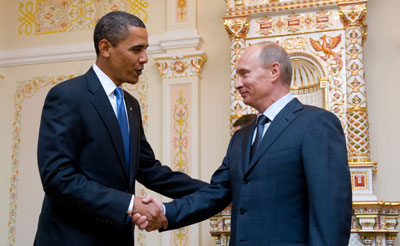
    Discussing his approach to nuclear security the day before formally releasing his new strategy, Mr. Obama described his policy as part of a broader effort to edge the world toward making nuclear weapons obsolete, and to create incentives for countries to give up any nuclear ambitions. To set an example, the new strategy renounces the development of any new nuclear weapons, overruling the initial position of his own defense secretary.

    Unfortunately for Americans, President Obama’s new strategy will have the exact opposite result of its intended effect. Instead of incentivizing countries to give up nuclear ambitions, it creates new incentives for them to maintain or develop their own nuclear programs. <spanid="more-30609"></span> First look at the Russians, who clearly still see their nuclear weapons as the cornerstone of their defense, no matter how much President Obama wishes it were otherwise. Moscow has no interest in diminishing its own nuclear arsenal, but it is perfectly happy to allow the Obama administration to weaken the U.S. deterrent until it is on equal footing with Russia’s currently mediocre might.

    A country like Iran is equally unimpressed with President Obama’s unilateral disarmament strategy. Tehran wants to be the pre-eminent power in the Middle East, and as a nuclear state it can more credibly make that claim. But more importantly, nuclear weapons would also boost the current regime’s domestic survival. Nuclear powers do not mess in the internal affairs of other nuclear powers. Witness Tiananmen Square. The ayatollahs believe that, when they have the bomb, they can crush the freedom-loving opposition with total impunity. They are counting the days.

    First START and now the NPR demonstrate a shift by the Obama administration away from relying on nuclear deterrence to protect America and toward reliance on unverifiable international treaties. But as President Obama makes our nuclear arsenal smaller, less reliable and less usable, it becomes a far less credible deterrent to nuclear attack. Rather than serve as an example for other nation’s to follow, President Obama’s nuclear weakness will only give America’s enemies every incentive to advance their own programs. The President’s arms control “road” is more likely to lead to a new arms race, rather than to “zero.”

    To provide some stark reality to the Obama administration’s dreams of a nuke-free world, The Heritage Foundation and the American Enterprise Institute’s Center for Defense Studies are hosting a <atitle="http://www.heritage.org/Events/2010/04/Questioning-Obamas-Nuclear-Agenda" href="http://www.heritage.org/Events/2010/04/Questioning-Obamas-Nuclear-Agenda">Conservative Counter Summit to Question the Obama Nuclear Agenda. The first event is today at Heritage, and you can watch it online <atitle="http://www.heritage.org/Events/2010/04/Questioning-Obamas-Nuclear-Agenda" href="http://www.heritage.org/Events/2010/04/Questioning-Obamas-Nuclear-Agenda">here beginning at 10 AM EDT. The second event will be at AEI shortly after Congress reconvenes.

    Quick Hits:

    • According to a new report by the <ahref="http://www.usatoday.com/news/washington/2010-04-05-ethics_N.htm">Office of Government Ethics, two dozen of President Obama’s political appointees worked as registered lobbyists during the two years prior to joining the administration, and 22 appointees received waivers that allowed them to participate in matters in which their former employers or clients had an interest.
    • The owner and majority shareholder of General Motors – the Obama administration – announced they would fine rival Toyota the <ahref="http://online.wsj.com/article/SB20001424052702304017404575166201889934186.html"> maximum penalty allowed by law for the non-unionized automaker’s gas-pedal safety problems.
    • Energy and anti-tax groups are collecting signatures to put a <ahref=" http://online.wsj.com/article/SB10001424052702304620304575165843688369042.html?m od=WSJ_hpp_MIDDLENexttoWhatsNewsThird">repeal of Gov. Arnold Schwarzenegger’s (R) cap and trade law on the California ballot this fall.
    • According to <ahref="http://www.gallup.com/poll/127220/Americans-Prioritize-Energy-Environment-First-Time.aspx">Gallup, for the first time in the question’s 10-year history, more Americans say the United States should prioritize development of energy supplies over protecting the environment.
    • Cincinnati is just one area of the country where after the passage of Obamacare <ahref="http://cincinnati.bizjournals.com/cincinnati/stories/2010/04/05/story11.html?b=1270440000^3129981&ana=e_vert">“the re are simply not enough primary-care providers available to take care of all these newly insured individuals.”
    http://blog.heritage.org/2010/04/06/…ear-arms-race/

  • Side Effects: Obamacare Fueling Higher Insurance Costs

    On 04.05.10 08:00 AM posted by Kathryn Nix

    <ahref="http://blog.heritage.org/tag/side-effects/"></p>Despite <ahref="http://voices.washingtonpost.com/ezra-klein/2009/11/cbo_estimates_that_senate_heal.html">all <ahref="http://www.speaker.gov/newsroom/legislation?id=0361">the <ahref="http://www.barackobama.com/pdf/issues/HealthCareFullPlan.pdf">talk about how Obamacare would lower health care costs, it’s already becoming clear that it just won’t be the case.

    <ahref="http://www.indystar.com/article/20100330/BUSINESS03/3300336/Insurance-premiums-outrun-reform">The Indianapolis Star reports that companies can expect employee health insurance costs to rise even faster. “Driven by worries about the economy and possibly the effects of health-care reform, [health insurers] are raising rates this year for family coverage through employer-sponsored plans… from 8 percent to 21 percent, which is considerably higher than the 5 percent increase the Kaiser Family Foundation reported in 2009.”<spanid="more-30559"></span>

    Employers will undoubtedly pass the price hikes on to their employees or switch to less expensive plans with higher deductibles, lesser coverage or both.* Those outcomes aren’t exactly hallmarks of successful health care reform.

    The Obamacare legislation <ahref="http://blog.heritage.org/wp-content/uploads/timeline_chart3-26final.pdf">contained numerous “reforms” (PDF)*that can’t help but escalate costs or lower benefits for those who get their health coverage through their jobs. In addition to the new taxes on high-value “Cadillac” health insurance plans, there are increases in the Medicare Part A hospital insurance tax for high earners.* And there are broad fees on the pharmaceutical and insurance industries that will be passed on to consumers at all income levels.

    During his final push to win passage of the health bill, President Obama <ahref="http://www.americanthinker.com/blog/2010/03/obama_you_will_see_premiums_fa.html">told a crowd in Strongsville, Ohio, that premiums would “fall by as much as 3,000 percent” under his plan. The evidence rolling in shows that the President not only misspoke, he got the entire direction of premium costs under Obamacare exactly wrong.

    Heritage has long promoted putting health coverage decisions in the hands of patients, not government bureaucrats.* To learn more on how to do that, <ahref="http://www.heritage.org/Research/Reports/2009/10/Health-Care-Reform-Rational-Alternatives-to-the-Congressional-Leadership-Bills">click here.

    http://blog.heritage.org/2010/04/05/…surance-costs/

  • Foreign Thinking Missing in Foreign Policy

    On 04.05.10 09:00 AM posted by James Carafano

    <ahref="http://blog.heritage.org/wp-content/uploads/START100405.jpg"><imgsrc="http://blog.heritage.org/wp-content/uploads/START100405.jpg" alt="Obama and Medvedev" title="START100405" width="350" height="300" class="alignnone size-full wp-image-30570" /></p>Treaties are just words. Deeds matter more. We were supposed to have learned that lesson from the fallout after World War I.

    That global conflict was billed as “the war to end all wars.” The Versailles Treaty was meant to seal the deal. But its words couldn’t stop the German military.

    The treaty aimed to prevent Germany from producing cutting-edge weaponry. The Kaiser’s U-boats, for example, had taken a dreadful toll during the war.

    So the treaty forbid all future “construction and purchase of all underwater vessels, even for commercial purposes … in Germany.” The Germans consequently used foreign dummy corporations to build and test their new and improved U-boat designs while Karl Doenitz developed the “wolf pack” tactics that would make Nazi submarines the scourge of the Atlantic during World War II.<spanid="more-30567"></span>

    The treaty also placed great restrictions on German air forces. It said nothing, however, about rockets or missiles. Wernher Von Braun brought that loophole to the attention of the German high command. In turn, it bankrolled development of the world’s first military missile — the A4. During World War II, 3,000 of them rained down on Britain.

    Measuring intentions is an important part of negotiating any treaty. Yet this basic tenet of foreign policy seems to elude our current administration. Case in point: the new arms control treaty the president plans to sign.

    President Obama believes that reducing nuclear arms in concert with Moscow is the first step on the “road to zero.” Unfortunately, the Russians don’t.

    Moscow sees its nuclear weapons as the cornerstone of its defense. Moreover, its unspoken threat of nuclear attack is central to the success of its foreign policy. Significantly diminishing those resources is the last thing Russia plans on doing.

    Moscow does, however, want to see the U.S. nuclear deterrent reduced to an equal footing with its mediocre might. It also wants U.S. conventional strike capabilities and missile defense to be on the table.

    As the U.S. deterrent shrinks, others will step up — not down. The president arms control “road” is more likely to lead to a new arms race, rather than to “zero.”

    Our Iran policy looks much the same. The White House offered to negotiate with Tehran, believing Iran could be talked out of building nuclear weapons. But the mullahs want nuclear weapons, desperately.

    Put aside the fact that their leaders shout for “death to Israel” and speak of a “world without America.” They have other reasons to go “nuclear.”

    Tehran wants to be the pre-eminent power in the Middle East. As a nuclear state, it could dictate to its neighbors and Europe as well.

    Nuclear weapons would also boost the mullahs’ bent for internal repression. Nuclear powers do not mess in the internal affairs of other nuclear powers. Witness Tiananmen Square. The ayatollahs believe that, when they have the bomb, they can crush the freedom-loving opposition with total impunity. They are counting the days.

    The White House seems averse to confronting enemies like Iran or competitors like Russia. (Though it criticizes our friends readily enough.) Instead, it prefers to assume “shared interest” where none exists.

    Engagement must be based on reality, not assumptions or simple hope. When it comes to keeping the peace, negotiated words are never enough.

    <divid="TixyyLink">Cross-Posted at the <ahref="http://www.washingtonexaminer.com/">Washington Examiner <ahref="http://www.washingtonexaminer.com/opinion/columns/Foreign-thinking-missing-in-foreign-policy-89874752.html#ixzz0kEqKPiRB">here.</div>

    http://blog.heritage.org/2010/04/05/…oreign-policy/

  • Declaring Independence from the Energy Independence Mindset

    On 04.05.10 10:00 AM posted by Ben Lieberman

    <ahref="http://blog.heritage.org/wp-content/uploads/OffShoreOil.jpg"></p><ahref="http://views.washingtonpost.com/climate-change/panelists/ben_lieberman/2010/04/declaring_indpendence_from_energy_independence_min dset.html">The Washington Post asks: “What does it mean for a nation to be energy independent? Is it realistic and if so how should that be achieved?”
    Energy Independence is a mixed bag — both good and bad energy policy ideas are promoted under its banner. The bad outweighs the good, and in any event energy independence shouldn’t supplant free markets as the overarching principle for sound energy policy.

    Among the few good ideas spurred by the desire to achieve energy independence is expanding domestic energy production. As it is, the great majority of energy-rich federal lands and offshore areas have not been leased for oil exploration and drilling. The President has recently paid lip service to expanded access, but in reality his Department of the Interior spent its first year rolling out an unprecedented crackdown on energy leasing. Granted, increased domestic drilling will not end oil imports, but it would lead to greater supplies of oil and lower prices as well as thousands of new energy industry jobs. It is well worth pursuing for those reasons.<spanid="more-30575"></span>

    Among the bad energy independence ideas is the mandate for domestic renewable fuels, chiefly corn-based ethanol. Thanks to a Bush-era law, 12 billion gallons of it must be added to the gasoline supply in 2010. Ethanol raises the cost of driving – which is why proponents needed a law forcing the rest of us to use it – and the diversion of nearly a third of the corn crop from food to fuel use has raised food prices as well. The real losers are American consumers, not the Saudi oil sheikhs, Iran’s regime, or Hugo Chavez.

    Perhaps worst of all is costly global warming policy. Cap and trade and other measures were not selling as environmental policy — the public has shown little concern about global warming – so they have been repackaged by supporters as energy independence policy (as well as jobs policy, hence all the green jobs rhetoric). It may make for an improved sales pitch but it doesn’t add up. The main target of global warming legislation is coal, the one energy source America has in overwhelming abundance. Oil imports would not be reduced very much, but U.S. electric rates would, in the words of President Obama, “necessarily skyrocket.”

    Most of the energy independence agenda is a policy boomerang – it is supposed to hurt the oil rich enemies of America but ends up hurting Americans instead. There are better ways of dealing with such regimes – and certainly better ways of meeting our nation’s energy needs.

    <ahref="http://views.washingtonpost.com/climate-change/panelists/ben_lieberman/2010/04/declaring_indpendence_from_energy_independence_min dset.html">Cross-posted at <ahref="http://views.washingtonpost.com/climate-change/">The Washington Post’s Planet Panel.

    http://blog.heritage.org/2010/04/05/…dence-mindset/

  • How Does U.S. Defense Spending Compare with Other Countries?

    On 04.05.10 11:00 AM posted by Conn Carroll

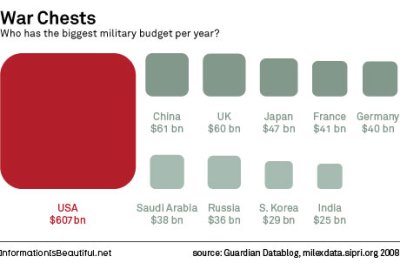
    <ahref="http://blog.heritage.org/wp-content/uploads/defspend1.jpg"></p>In 2008, the United States spent $607 billion on our military. Far more than any other country as British author <ahref="http://www.davidmccandless.com/bio.htm">David McCandless illustrates in the graphic to the right. But as McCandless goes on to show in the rest of this <ahref="http://www.guardian.co.uk/news/datablog/2010/apr/01/information-is-beautiful-military-spending">Datablog post, focusing on spending totals alone doe not provide an accurate context to judge U.S. military spending by. The U.S. is a wealthy country with a larger Gross Domestic Product (GDP) than Japan, Germany, and China combined. McCandless compensated for this fact and you can see the result after the jump:<spanid="more-30583"></span>
    <ahref="http://blog.heritage.org/wp-content/uploads/defspendgdp.jpg">

    At 4% of GDP U.S. spending on defense is tied for 8th world wide. And in a <ahref="http://www.heritage.org/budgetchartbook/Defense-Spending-on-the-Decline-Despite-War-on-Terror.aspx">historical context it is far below average. Throughout the 1960s the U.S. spent almost 9% of GDP on defense and even during President Ronald Reagan’s defense build up, military spending topped out at 6%. Considering that the U.S. is actively fighting two wars, if anything this amount is too low. Heritage fellow Mackenzie Eaglen details how President Barack Obama’s most recent budget proposals fail to protect the core defense budget <ahref="http://beta.heritage.org/Research/Reports/2010/02/President-Obamas-2011-Budget-How-Congress-Can-Reform-Defense-Spending-and-Address-Shortfalls">here.

    http://blog.heritage.org/2010/04/05/…her-countries/

  • High Sticking: The Flaws of the IPCC and the Hockey Stick Model

    On 04.05.10 11:17 AM posted by Nick Loris

    Rajendra Pachauri , chairman of the Intergovernmental Panel on Climate Change (IPCC), responded to the errors exposed in the IPCC report saying that “Scientists are demonised because of one error in 3000 pages of evidence.” Truth be told, there were several errors uncovered in the report including questionable sources in the assessment of mountain ice reduction in the Andes, Alps and Africa as well as acknowledged overstating crop loss in Africa, Amazon rain forest depletion, sea level increases in the Netherlands. But Pachauri only acknowledges that the Himalayan glaciers will melt by 2035 or sooner was speculative at best. The reality is the IPCC reports have significant flaws; they simply aren’t picked up by the mainstream media.

    Take the hockey stick theory, for instance. The theory is best explained by a <ahref="http://1.bp.blogspot.com/_gLv0n3B4neg/SXPGuKiXflI/AAAAAAAAF1c/W8dVYzVAIWs/s400/Hockey_stick_chart_ipcc_large.jpg">graph that shows a time-series of global temperatures with current and future temperatures increasing at such rapid rates that it resembles the blade of a hockey stick. The <ahref="http://1.bp.blogspot.com/_gLv0n3B4neg/SXPGuKiXflI/AAAAAAAAF1c/W8dVYzVAIWs/s400/Hockey_stick_chart_ipcc_large.jpg">graph appeared six times in the IPCC’s 2001 report. Andrew Montford’s new book, The Hockey Stick Illusion, reveals that the problems with the hockey stick theory go back much further than Climategate. In a review of the book, the Prospect Magazine’s Matt Ridley <ahref="http://www.prospectmagazine.co.uk/2010/03/the-case-against-the-hockey-stick/">writes:

    “The emails that were l<ahref="http://www.prospectmagazine.co.uk/2010/02/too-hot-to-handle/">eaked from the University of East Anglia late last year are not proof of this; they are merely the icing on the lake, proof that some of the scientists closest to the hockey stick knew all along that it was problematic. Andrew Montford’s book, despite its subtitle, is not about the emails, which are tagged on as a last chapter. It is instead built around the long, lonely struggle of one man— Stephen McIntyre—to understand how the hockey stick was made, with what data and what programs. A retired mining entrepreneur with a mathematical bent, McIntyre asked the senior author of the hockey stick graph, Michael Mann, for the data and the programs in 2003, so he could check it himself. This was five years after the graph had been published, but Mann had never been asked for them before. McIntyre quickly found errors: mislocated series, infilled gaps, truncated records, old data extrapolated forwards where new was available, and so on.

    <spanid="more-30596"></span>

    Not all the data showed a 20th century uptick either. In fact just 20 series out of 159 did, and these were nearly all based on tree rings. In some cases, the same tree ring sets had been used in different series. In the end the entire graph got its shape from a few bristlecone and foxtail pines in the western United States; a messy tree-ring data set from the Gaspé Peninsula in Canada; another Canadian set that had been truncated 17 years too early called, splendidly, Twisted Tree Heartrot Hill; and a superseded series from Siberian larch trees. There were problems with all these series: for example, the bristlecone pines were probably growing faster in the 20th century because of more carbon dioxide in the air, or recovery after “strip bark” damage, not because of temperature change.

    This was bad enough; worse was to come. Mann soon stopped cooperating, yet, after a long struggle, McIntyre found out enough about Mann’s programs to work out what he had done. The result was shocking. He had standardised the data by “short-centering” them—essentially subtracting them from a 20th century average rather than an average of the whole period. This meant that the principal component analysis “mined” the data for anything with a 20th century uptick, and gave it vastly more weight than data indicating, say, a medieval warm spell.”

    Ridley’s book isn’t the only evidence. Fred Singer recently published an 800 page report entitled, “<ahref="http://www.nipccreport.org/">Climate Change Reconsidered” that questions and debunks many of the conclusions found by the IPCC report. An article written last year by Kesten C. Green, J. Scott Armstrong and scientist Willie Soon write that scientists in many respects are being paid to make, at best, guesses or projections of how climate change actually works and what temperatures will be like in the future. They <ahref="http://rationalargumentator.com/issue230/forecastsuseless.html">say, “The models employed by James Hansen and the IPCC are not based on scientific forecasting principles. There is no empirical evidence that they provide long-term forecasts that are as accurate as forecasting that global average temperatures won’t change. Hansen’s, and the IPCC’s, forecasts, and the recommendations based on them, should be ignored.”

    This especially includes costly regulations on carbon dioxide and other greenhouse gases our government is willing to impose because the IPCC recommends CO2 is a threat to our health and environment.

    http://blog.heritage.org/2010/04/05/…y-stick-model/

  • Morning Bell: Red Tape Rising

    On 04.05.10 05:40 AM posted by Conn Carroll

    Just three days after President Barack Obama’s health plan was signed into law, AT&T announced that due to an obscure tax change in the bill, the nation’s largest telephone company would take a $1 billion hit to its bottom line this quarter. According to health benefits analysts this tax law modification would shave as much as $14 billion from U.S. corporate profits. While it would have been better had these tax losses been made more public before Congress voted, at least these tax charges are transparent and easily quantifiable enough to get noticed by the American people. Unfortunately the same cannot be said of the hundreds of new regulations that the federal government will enforce as it tries to implement Obama’s redistributionist health agenda.

    In addition to the federal government’s explicit taxes and spending, Americans are also burdened with a slew of hidden taxes imposed by an ever-increasing number of regulations. More than 50 agencies have a hand in federal regulatory policy, enforcing more than 150,000 pages of rules. Many of these regulations provide needed benefits. Most Americans would agree on the need for security regulations to protect citizens from terrorist attacks, although the extent and scope of those rules may be subject to debate. But each regulation comes at a cost–a “regulatory tax” imposed on all Americans. According to a 2005 study commissioned by the Small Business Administration, the cost of all regulations then on the books was some $1.1 trillion per year.

    Worse than the existing size of our country’s regulatory burden, is the pace at which it has been growing. Contrary to what most liberals and media elites would have you believe, President George Bush had a decidedly mixed record on regulation. While he should be praised for strengthening the role of the Office of Information and Regulatory Affairs (OIRA) in screening new regulations, by every objectively measurable metric the size and scope of the regulatory state grew significantly under his tenure. And President Bush’s last years in office were his worst. In 2008 36 major regulations were enacted by the Bush administration, and in 2009 some $15 billion in new regulatory costs were imposed on the American people.

    President Bush doesn’t deserve all the blame for that $15 billion in new costs for 2009. About $4.4 billion is attributable to regulations approved by the Obama administration. While that may seem like a significant decrease, it is actually an ominous sign when put in context. Regulatory activity always increases near the end of a presidency and is slower at the beginning. So in President Bush’s first year, he enacted only one major rule and he was in his third year in office before the new regulatory costs he inflicted on the American people hit President Obama’s one-year $4 billion mark. And that $4 billion does not yet include all the regulations for Obamacare. Or all of the regulations Obama’s EPA wants to pass under the Clean Air Act. Or any of the new financial regulations that Rep. Barney Frank (D-MA) and Sen. Chris Dodd (D-CT) want to inflict on the American people.

    There are some things Congress can do now to help better manage the onslaught of federal regulations. First the authority and scope of OIRA should be protected. Establishing a sunset date for all new regulations would also help. But ultimately things will not change for the better until policymakers exercise the will and resolve to guard against the deluge. As Rep. Paul Ryan (R-WI) asked last week: “If Congress can’t control what a few mortgage finance bureaucrats do with your dollars, why would anyone trust Congress to control what tens of thousands of bureaucrats will do with your health? … Should unchecked centralized government be allowed to grow and grow in power … or should its powers be limited and returned to the people?”

    Quick Hits:

    • According to economists, our nation’s 9.7% unemployment rate is likely to be driven higher as more people look for work as the economy finally recovers.
    • After spending $700 billion bailing out Wall Street, the Obama administration plans to start a $21 million pilot program to help small businesses.
    • After one week of the White House campaign to sell Obamacare, support for the bill has decreased in the CBS News poll from 48% – 37% against to 53% – 32% against.
    • Speaking about the Obama administration’s signature education policy initiative, Race to the Top, Colorado Gov. Bill Ritter (D) said: “It was like the Olympic Games, and we were an American skater with a Soviet judge from the 1980s.”
    • According to a new Gallup poll of self-proclaimed Tea Party supporters, the age, educational background, employment status, and race of the Tea Party movement is “quite representative of the public at large.”

    http://blog.heritage.org/2010/04/05/…d-tape-rising/

  • Of Myths, Opinions, Taxes, and Guacamole

    On 04.05.10 06:19 AM posted by J.D. Foster

    Roberton Williams and Rosanne Altshuler’s Five Myths About Your Taxes in the Washington Post on Sunday was such a useful piece one hesitates to criticize, but one confusion is so unfortunate that a correction is necessary.

    In all, the authors got about 3 and a half right out of five, which at the start of baseball season is really pretty good. They were right when pointing out that most people (75 percent by their estimates) pay some federal tax, even the many of the poor and virtually all the rich. They were also right when dispelling the myths that most people’s taxes are way too complicated, and that a victory over the IRS is getting a big refund. That’s three.

    The authors were half right when they said that tax hikes can’t close the budget deficit. Taxes would have to rise to crushing levels to do that. Where the authors fell short is they failed to mention this means massive spending cuts are inevitable. And not just any spending cuts. Just as you can’t close the deficit with tax hikes, you can’t make a dent in the necessary spending cuts through discretionary spending. It’s got to be the entitlements – Social Security, Medicare, and Medicaid. It’s not enough to say what won’t close the deficit when you know perfectly well what will.

    The one the authors really got wrong is when they argued it’s a myth that we’re overtaxed. Unlike the other “myths” they cite and address with factual evidence, this so-called myth is entirely a matter of personal opinion. The co-authors believe we should be taxed more heavily. That’s a perfectly fair opinion, though one with which I and apparently most Americans are in strong disagreement. But it is an opinion, not a fact or a myth. Compounding the confusion is the evidence the authors present.

    The authors correctly point out that most developed countries have much higher total taxes than we do. This neither proves nor even implies we are not overtaxed. It only affirms that these other countries have chosen more government and less economic growth, jobs, and income. After all, if more tax is bad for the economy, less tax would be better. There’s nothing sacred or correct about the current level of taxation. To suggest that heavier foreign tax loads evidences that we’re not overtaxed is like the guy at the bar slurring to the bartender that he hasn’t had too much to drink by pointing to his buddy nearby who’s now passed out with his face in the guacamole dip.

    http://blog.heritage.org/2010/04/05/…and-guacamole/

  • Time to Stand and Deliver Education Reform: A Tribute to Jaime Escalante

    On 04.05.10 07:00 AM posted by Rachel Sheffield

    Former East Los Angeles high school teacher, Jaime Escalante, whose exemplary teaching led to the inspiring film Stand and Deliver, passed away last week. As a math teacher at Garfield High School, Escalante was able to motivate inner-city students to achieve top scores on advanced placement calculus. His influence on the school’s math program and its students led to its becoming one of the top public high schools in the country for the number of advanced placement calculus students it produced. Only four other public high schools nationwide could boast greater success. Not even the neighboring, upscale Beverly Hills High outpaced them. Today we would say that Mr. Escalante was closing the achievement gap.

    Then why was he ousted as the head of the school’s math department in the early 90s? Andrew Coulson reports in the Wall Street Journal that it was due to the opposition of teacher’s unions. Not wanting to turn students away, Escalante would fill his classroom with upwards of 50 students, whereas the union only allowed 35. However, because his students still excelled it lowered the union’s bargaining power and created resentment. As a result, Escalante left the school. Its math program no longer achieves near the same level of success.

    An educational system that sacrifices the education of its children at the hands of powerful interests groups is a broken system.

    A most recent example of this dysfunction is the opposition to the D.C. Opportunity Scholarship Program. Similar to Mr. Escalante’s success, this program has helped inner-city students in D.C. succeed. This program provides children from low-income families in D.C.–one of the lowest-achieving school districts in the nation–with a scholarship to attend a private school of their choice. The latest study results show that these students are outpacing their peers in the public schools. Furthermore, the scholarships cost less than half of the price taxpayers spend to send a child to a failing D.C. public school. Yet, Congress has blocked new students from entering the program and wants to shut it down, again due to opposition from teachers’ unions.

    Instead, the Obama administration is proposing similar, top-down approaches that have failed in the past. The most recent National Assessment of Educational Progress report shows that American students’ math and reading scores have remained relatively flat, despite continual increases in federal education spending. Greater control at the federal level will only lead to more constraints that discourage innovators like Escalante and programs like the DC Opportunity Scholarship, as well as other ground-breaking successes, such as the KIPP charter schools around the nation.

    Florida can also be looked to as an example of success when states innovate outside the bureaucratic boxes handed down from Washington. A variety of school reform options have been put in place there–including school choice options–and unlike student scores in the rest of the nation, children from the Sunshine State are improving their test scores. Once again these innovations have led to a diminishing achievement gap, with Hispanic and African American students making the greatest gains. Hispanic students in Florida now outpace or tie the reading scores of all students in 30 states; and fourth-grade African American students in the state outpace or tie all children in 8 states.

    If the United States wants to improve education and help children succeed, it can no longer afford to bend to the will of special interest groups. Driving away the talent of those like Mr. Escalante and blocking programs that pull D.C. children out of failing schools and up to greater achievement, are reprehensible. As did Jaime Escalante, we need to stand for children and deliver them the best educational options.

    http://blog.heritage.org/2010/04/05/…ime-escalante/

  • Cuba: Change Is Not One Sided

    On 04.03.10 07:35 AM posted by Michael Orion Powell

    </p>Leftist love for the Marxist Cuban regime manifests regularly. Just this Monday in the New York Times Marc Lacey had an item titled <ahref="http://www.nytimes.com/2010/03/29/world/americas/29cuba.html?scp=4&sq=cuba&st=cse">“Dreaming of Cuban Profits in Post-Embargo World.” The article was a bit odd, most notably for the unreal caption of a photo of tourists driving a 1952 Cadillac along El Malecón, describing the scene as “a pleasure that few Americans have experienced in decades.” The caption had a double meaning, as not only have Americans not visited El Malecón since the Revolution, but Americans haven’t experienced the pleasure of driving ancient automobiles because they have an open economy and a standard of living that allows them to buy new cars.<spanid="more-30447"></span>

    Much of the article explores the plans of political leaders like Senator Byron L. Dorgan (D-ND), who has proposed revocation of the ban on travel to Cuba. The Miami Herald reports that travel between the two states <ahref="http://www.miamiherald.com/2009/10/04/1266976/us-cuba-travel-flourishing.html">has begun to flourish as the possibility of the lift of a ban appears to be imminent. This must raise the hopes of many ex-patriots who have had a difficult time going back to visit their relatives, but such an action must also come with signs of liberalization on the part of Cuba.

    Lacey’s post-embargo Cuba sure sounds wonderful, but it forgets about the actions that must first be taken by Cuba. While engagement by the United States was useful, the Soviet Union and China did not open thanks to American diplomacy alone. Actions taken by those countries’ respective leadership were key. Gorbachev engaged in a policy of glasnost (“openness”) that played an invaluable role in the dissolution of the Soviet empire. Chinese leader Deng Xiaoping opened his country to investment and the start of private competition <ahref="http://books.google.ca/books?id=mDS0GW7FH_0C&pg=PA179&dq=#v=onepage&q=sin gapore&f=false">(with countries like Singapore as a model). There’s little sign of such a shift in Cuba. While Cuban President Raul Castro has made signs of being willing to talk to the United States, those moves have <ahref="http://havanajournal.com/politics/entry/fidel-castro-interferes-with-president-raul-castros-engagement-with-us/">been interfered with by Raul’s brother Fidel.

    A freer Cuba would be beneficial to everyone. It is important, however, to remember that this is a transformation that can only happen through a change in Cuba’s policies, toward a more pluralist, democratic political system and more open economy. It is not a transformation that can happen simply through a change in our policies toward Cuba.

    Michael Orion Powell is currently a member of the Young Leaders Program at the Heritage Foundation. For more information on interning at Heritage, please visit: <atitle="http://www.heritage.org/About/Internships-Young-Leaders/The-Heritage-Foundation-Internship-Program" href="http://www.heritage.org/About/Internships-Young-Leaders/The-Heritage-Foundation-Internship-Program">http://www.heritage.org/About/Intern…rnship-Program

    http://blog.heritage.org/2010/04/03/…not-one-sided/

  • The Nuclear Counter Summit

    On 04.02.10 08:30 AM posted by Jeffrey Chatterton

    One year after President Obama announced his desire to rid the world of nuclear weapons, his nuclear agenda is taking center-stage in American foreign policy. This week, the president will sign a new arms control agreement with Russia in Prague before he hosts the Nuclear Security Summit in Washington, DC. At any moment the Administration is expected to release its 2010 Nuclear Posture Review, which adds to the momentum building towards the Nuclear Non-proliferation Treaty Review in May.

    As the president moves forward with his nuclear agenda, Americans need to know the implications of these decisions. The Heritage Foundation and the American Enterprise Institute’s Center for Defense studies invite you to “Questioning Obama’s Nuclear Agenda: The Conservative Counter Summit” to be held at the Heritage Foundation on Tuesday, April 6.

    President Obama believes these treaties and meetings will strengthen his case for a world free of nuclear weapons. Surely, what happens over the next couple of months will significantly shape the future of the U.S. nuclear arsenal, its missile defense program, and the strength, security, and defense of its interests and alliance relationships around the world.

    However, the president’s vision of a world without nuclear weapons is driving actions that are likely to increase proliferation and increase the risk of nuclear war, while putting the U.S. at greater risk. Two panels featuring distinguished national security and defense experts will discuss the Administration’s policies and the alternatives the U.S. should pursue to protect itself and its allies from the threat of nuclear weapons.

    The first panel begins at 10am. Please click here to register.

    Jeffrey Chatterton currently is a member of the Young Leaders Program at the Heritage Foundation. For more information on interning at Heritage, please visit: http://www.heritage.org/About/Intern…rnship-Program

    http://blog.heritage.org/2010/04/02/…ounter-summit/

  • Silence No Solution for Iran-Venezuela Problem

    On 04.02.10 09:00 AM posted by Ray Walser

    In his most recent congressional testimony the State Department’s Assistant Secretary for Western Hemisphere Affairs Arturo Valenzuela successfully managed to outline Obama Administration policy for Latin America without once mentioning Hugo Chavez or Iran. *Such a glaring omission speaks volumes about the Obama readiness to “speak no evil” and bury its concerns about Iran’s cooperation with Venezuela in classified intelligence briefs safely removed from public scrutiny.

    Fortunately, independent researchers, undaunted by the silence of the intelligence community and unfazed by upbeat diplomatic rhetoric, continue to expose the growing ties between Iran and Venezuela via drug, terror, nuclear, and anti-American connections.

    In a recent policy paper by former National Security Council official Dr. Norman Bailey concluded: “Iranian participation in drug trafficking through Venezuela to Central America, Mexico, the United States, the Caribbean and to Europe through West Africa is extensive.”** Bailey warned that “Iranian penetration into the Western Hemisphere is indeed a security threat to the United States and the rest of the Hemisphere.”

    Investigative reporter Douglas* Farah, who has devoted more than a decade to exposing global international criminal and terrorist regularly describes the drug-terror-nuclear pipeline that runs between Caracas and Tehran. *He focuses on Iranian-Venezuelan preparations for asymmetrical warfare and their mutual “hatred of the United States and desire to see it disappear from the face of the earth.” *Farah warns it would be “imprudent to dismiss this alignment [between Iran and Venezuela] as an annoyance. *It is, instead, a direct and growing threat to the United States and Latin America.”

    Former Ambassador to the OAS and Assistant Secretary for the Western Hemisphere Roger Noriega has highlighted the budding nuclear relationship between Iran and Venezuela as did Manhattan district attorney Roger M. Morgenthau.

    Heritage Foundation research has also highlighted Chavez terrorist links and readiness to make Caracas a Mecca for would-be and actual terrorists.

    Warns senior scholar Dr. Jaime Suchlicki of the University of Miami, “the lessons of the Cuban missile crisis of 1962 should increase our uneasiness about Chavez’s adventurism and Iranian motivations in Latin America.

    Unfortunately, just as the Obama Administration gears up for a showdown with Iran over its nuclear weapons program, it steadfastly refuses to acknowledge the emerging Iran-Venezuela threat in Latin America.

    http://blog.heritage.org/2010/04/02/…zuela-problem/

  • A First Glance at the New Jobs Numbers

    On 04.02.10 09:30 AM posted by Rea Hederman

    The March jobs report contained some of the good news that analysts have been waiting for. First, private hiring increased by 123,000 jobs, with every sector except financial and information adding jobs. Second, revisions to the employment reports of the previous months were revised upwards. Third, the unemployment rate remained flat at 9.7 percent, despite a tick up in the labor force. (Often, the unemployment rate increases as workers return to the labor force after the worst of a recession has passed. In this case, the labor force increased by 398,000, with most of the workers finding jobs, according to the household survey.) Fourth, both the household and establishment surveys are pointing in the same direction — showing job growth. Finally, hours worked continued its upward climb, matching this recovery’s January high.

    There is some volatility to these numbers, as teenagers accounted for almost a third of new entrants into the labor force. The teenage unemployment rate sharply increased to 26.1 percent as many of the teenagers were unable to find work. But 325,000 adult men also entered or reentered the labor force, and enough of them found jobs to keep their unemployment rate at 10.0 percent. Overall, the labor force participation has climbed for four straight months but is still well below the pre-recession level.

    So, the good news is that hiring has resumed and job growth should be consistent throughout the rest of the year. The bad news is that job growth is not yet robust enough to lower the unemployment rate. While hiring is likely to increase as the recovery strengthens, the labor-market recovery is going to be quite slow, especially as compared to some of the previous recessions. Part of the slack of the labor market is indicated by the fact that nominal earnings per hour actually fell in March. This slight dip is due in part to the new hires coming in at entry-level positions with commensurately lower pay. Long-term unemployment is going to remain a problem as the average duration of unemployment now exceeds 31 weeks, a new high.

    Cross-posted at The Corner.

    http://blog.heritage.org/2010/04/02/…-jobs-numbers/

  • Video: When It Comes to Health Care, the Left Doesn?t ?Worry About the Constitution?

    On 04.02.10 10:00 AM posted by Conn Carroll

    Rep. Phil Hare (D-IL) voted for Obamacare. When questioned by his constituents to identify what part of the Constitution empowers the federal government to force Americans to buy health insurance, Rep. Hare replies: “I don’t worry about the Constitution on this to be honest.” We applaud Rep. Hare for his honesty, but his vote for Obamacare already proved he does not care if the legislation he votes for is unconstitutional. As The Wall Street Journal explains this morning:

    All human activity arguably has some economic footprint. So if Congress can force Americans to buy a product, the question is what remains of the government of limited and enumerated powers, as provided in Article I. The only remaining restraint on federal power would be the Bill of Rights, though the Founders considered those 10 amendments to be an affirmation of the rights inherent in the rest of the Constitution, not the only restraint on government. If the insurance mandate stands, then why can’t Congress insist that Americans buy GM cars, or that obese Americans eat their vegetables or pay a fat tax penalty?

    This is why a 1994 Congressional Budget Office Memorandum wrote about the individual mandate: “The government has never required people to buy any good or service as a condition of lawful residence in the United States. An individual mandate would have two features that, in combination, would make it unique. First, it would impose a duty on individuals as members of society. Second, it would require people to purchase a specific service that would be heavily regulated by the federal government.”

    As Constitutional scholars Randy Barnett, Nathaniel Stewart and Todd Gaziano have documented, the individual mandate can not be justified by the Article I, section 8 taxing clause either:

    Should it adopt any of these constitutional taxing and spending measures, Congress would have to incur the political costs arising from increasing the income tax and the long-term budget implications of issuing tax credits. Precisely to avoid incurring these political costs, Congress is calling fines in the Internal Revenue Code “shared responsibility penalties” so that persons fund the cost of its new regulatory scheme by channeling money through private insurance companies in the form of “premiums.” It is likely that the Supreme Court will find this effort to avoid political and fiscal accountability a pretextual assertion of Congress’s taxation powers and therefore, unconstitutional.

    But Rep. Hale says he does not care about any of this. Fair enough. But he has his facts wrong on what he says he cares about too. At the end of the video Hale says: “At the end of the day, I want to bring insurance to every person who lives in this country.” When the videographer points out that Obamacare does not do that, Hare replies: “Says who, you?”

    No Rep. Crane. Says the Congressional Budget Office. According to the CBO, after nearly $1 trillion in new spending Obamacare would still leave 23 million Americans without health insurance.

    http://blog.heritage.org/2010/04/02/…-constitution/

  • Red Tape Rising: Regulation in the Obama Era

    On 04.02.10 10:07 AM posted by Steve Keen

    Americans are endlessly paying taxes–on their income, on their property, on almost anything they purchase. But the heavy burden that the U.S. government places on its citizens does not stop there. It continues with a slew of hidden taxes imposed by an ever-larger number of government regulations. These regulatory taxes do not appear on any balance sheet, yet cost Americans about $1 trillion every year.

    The recently released Heritage Backgrounder, “Red Tape Rising: Regulation in the Obama Era,” measures the regulatory impact of the outgoing Bush Administration and the new Obama Administration (following up on earlier assessments released in 2004 and 2008).

    Specifically, the report finds that:

    • During fiscal year 2009, regulations costing some $14 billion were adopted by the Bush and Obama Administrations, more than in any year since 1992.
    • A majority of these new regulatory costs were imposed by the outgoing Bush Administration, although costs imposed by the Obama White House were large for an incoming Administration.
    • Regulatory burdens will likely increase at even higher rates in 2010, given regulatory efforts in health care, energy, financial services, telecommunications, and elsewhere.

    Anyone who uses electricity, drives a car, has a job, visits a doctor, owns stocks, or patronizes a bank is affected by federal regulation and should take note of this report.

    http://blog.heritage.org/2010/04/02/…the-obama-era/

  • US-China Trade: Only A Temporary Reprieve

    On 04.02.10 10:30 AM posted by Derek Scissors, Ph.D.

    Today’s papers give the impression of a collective exhale on U.S.-China relations. Chinese President Hu Jintao is coming to Washington for a global nuclear security summit and that means a trade war over exchange rates has been averted.

    However, a better term than “averted” is “postponed.”

    It is probably true that Washington and Beijing have an agreement: the U.S. will not label the PRC a currency manipulator and China will make some sort of policy change at or before the end of the bilateral Strategic and Economic Dialogue in late May. Unfortunately, a change in policy concerning the RMB (a.k.a. the yuan) will have little effect on trade and will not be enough to pacify Congress.

    CATO’s Dan Ikenson has a good op-ed in The Wall Street Journal pointing out the small net impact on the American economy of previous changes in the value of the RMB. The value of the RMB just isn’t very important to American jobs. It’s hard to connect trade with just one country to the jobs picture in the U.S and, even if there is a connection, the Sino-American trade deficit doesn’t actually drop when the RMB rises.

    An exceptionally large revaluation of the RMB would have some impact, but this is where the political side enters. Beijing loves stability. The PRC will probably copy or nearly copy the 2005-2008 scenario, with a very small RMB revaluation at the beginning and a slow climb after that. And the 2005-2008 revaluation did nothing for the trade deficit or American jobs.

    Congress is going to realize this, sooner or later. Either the coming Chinese policy change will be immediately dismissed as not enough or, because the RMB doesn’t actually matter much, the revaluation won’t have anything like the impact Congress wants. Then we’ll be right back to where we were as of a few days ago.

    To make genuine progress in Sino-American economic relations, the spotlight has to move off the exchange rate. On the U.S. side, by far the biggest problem is the budget deficit and diversion of resources to debt service, bailouts, and other unproductive government programs.

    There are many problems on the Chinese side, which is why so many people around the U.S. are angry. But the RMB is just an easy target, not a good one. Far better would be to push the PRC – it won’t be easy – to cut subsidies for state-owned firms. These firms are protected from competition, get free land, endless loans, and so on. Eliminating subsidies isn’t going to happen. But reducing them will open the door for more U.S. goods and services to reach Chinese consumers.

    http://blog.heritage.org/2010/04/02/…rary-reprieve/

  • Prepared for Disaster?

    On 04.02.10 11:00 AM posted by Jeffrey Chatterton

    The Pentagon’s Quadrennial Defense Review (QDR), which outlines future threats to the United States, recommends cutting the number of military forces prepared to respond to a weapons-of-mass-destruction attack against America. The recommendation to downsize U.S. Northern Command personnel will expand one of three Consequence Management Response Forces (CCMRFs) while moving personnel in the other two brigade-sized forces to Homeland Response Forces in each of the 10 Federal Emergency Agency (FEMA) districts.

    In this past Monday’s Washington Examiner, Dr. James Carafano writes, “The Pentagon argues that less is actually more, because it has split the troops into smaller force packages that can get to a disaster area faster. But while smaller may be OK for small disasters, it won’t work for big ones.”

    Current Pentagon officials argue that the new set-up will improve the response time of the first CCMRF to a potential chemical, biological, radiological, nuclear, or high-yield explosive attack on U.S. soil. But critics argue that the three full-size CCMRFs are necessary in the event of a WMD event.

    The Defense Department’s former homeland defense chief, Paul McHale, told Inside Defense, “If implemented as written, the QDR decision will place our country at great risk.” Senator Joe Lieberman (I-CT) also worries about losing two brigade-sized forces to 10 smaller Homeland Response Forces, which would be less effective during catastrophic attack. The QDR recommendations don’t appear to match the demands placed on these response forces to protect American citizens.

    “These troops need strong working relationships with emergency responders across the nation and the ability to deploy on short notice,” argues Carafano. “Yet, the Pentagon is pitching for less, not more — and the reason why is pretty simple. The entire review process was a rubber-stamp exercise forced to conform to budget decisions already made by — or foisted on — Gates.”

    Jeffrey Chatterton currently is a member of the Young Leaders Program at the Heritage Foundation. For more information on interning at Heritage, please visit: http://www.heritage.org/About/Intern…rnship-Program

    http://blog.heritage.org/2010/04/02/…-for-disaster/

  • Vouchers Do Not Harm Public Schools

    On 04.02.10 12:00 PM posted by Jason Richwine

    Opponents of school choice worry that public schools will suffer when competition is introduced.* They cite the diversion of money away from public schools and the “creaming” of the best students into private schools, leaving the neediest children even worse off than before.* But how realistic is this scenario?

    A new report from the National Center for Policy Analysis marshals powerful evidence that school voucher programs do not hurt students who remain in public schools, and they may even help.

    From 1998 to 2008, the Edgewood Voucher Program (EVP) offered private school tuition support to all families in the Edgewood school district, which is located in a low-income section of San Antonio, Texas.* Since EVP was privately funded, no government money was diverted from public schools.* However, large numbers of students did leave the public schools for private ones.* EVP serves as a case study, therefore, on whether public school students suffer when some of their peers transfer away.

    The answer is a firm “no.”* Test scores and graduation rates went up in the Edgewood school district during the course of EVP.* Whether these gains were directly caused by EVP is difficult to ascertain, since vouchers were open to all comers rather than subject to a randomized lottery that would have provided the “gold standard” experiment.

    Nonetheless, the empirical debate is over whether EVP’s effect on public schools was zero or positive.* When the progress of Edgewood public schools is compared to similar districts that had no voucher program, the data do not plausibly support any negative effect of EVP.

    With school choice increasingly looking like a “no lose” proposition for private and public school students alike, will the Obama administration take notice?

    http://blog.heritage.org/2010/04/02/…ublic-schools/

  • North Korean Economic Freedom: How Low Can You Go?

    On 04.02.10 01:00 PM posted by Anthony B. Kim

    While we are moving into spring, North Korean leaders have decided to stay out in the cold of economic isolationism. In a move sure to solidify its position in the Heritage Foundation’s Index of Economic Freedom, North Korea signaled April 1 that it would gradually terminate its experiment with free market system. It’s no joke!

    As reported in The New York Times, “North Korea will phase out private markets and restore its state-controlled system, a North Korean government economist said in an interview broadcast late Thursday amid signs that the North was retreating from years of free market experiments.”

    According to the 2010 Index, North Korea’s economic freedom score is mere 1.0 out of the 0-100 scale, which not surprisingly marks its economy as the least free in the world. Since the early 1990s, North Korea has replaced the doctrine of Marxism–Leninism with the late Kim Il-Sung’s juche (self-reliance) as the official state ideology. The country’s impoverished population is heavily dependent on government subsidies in housing and food rations, though even the state-run rationing system has deteriorated significantly in recent years.

    http://blog.heritage.org/2010/04/02/…ow-can-you-go/

  • Using Intel to Target Terrorists: Not a Novel Concept

    On 04.02.10 08:00 AM posted by Jena McNeill

    It’s difficult to know how to react to the ‘new’ TSA security rules announced by the Obama Administration. On one hand, the good news is that the Administration is abandoning the silly process put in place after the Christmas Day plot of targeting 14 suspicious countries for secondary inspection. Any terrorist with half a brain would recognize that this is easily avoidable by simply flying through another country, not on the list.

    However, the Administration has announced that its new policy would involve “surgically targeting” terrorists on “characteristics of suspected terrorists.” This should leave Americans scratching their heads. Why should using intelligence to target terrorists be a new concept to President Obama? This is the true essence of counterterrorism, and a risk-based layered approach is a best practice of security.

    Let’s not fool ourselves. The President understands that targeting terrorists on intelligence works. There are at least 30 examples—plots that have been foiled since 9/11 demonstrate how intelligence can be used effectively. But Obama has faced tremendous pressure from the left to water-down the intelligence system. The terror trials, his effort to close Gitmo, and the pressure to prosecute CIA employees are all examples.

    Perhaps President Obama now understands, in the wake of the Christmas Day plot, that you can’t child proof the TSA screening line by stopping legitimate passengers from bringing in 4.5 ounce bottles of liquid or by making Americans take off their shoes. If so, this is a good revelation and a step forward towards stopping terrorists even more effectively.

    Draconian security measures may seem like the great equalizer. By making everyone do it, it doesn’t offend anyone, it doesn’t involve hard choices, and it doesn’t involve standing up to detractors. But it doesn’t make Americans safer.

    http://blog.heritage.org/2010/04/02/…novel-concept/