Author: Kate Torgovnick

  • 8 great talks about love

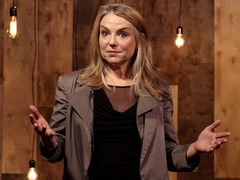
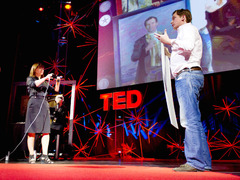
    Esther-Perel-imageEsther Perel begins today’s talk with an intriguing question: “Why does good sex so often fade even for couples who continue to love each other as much as ever?” It’s a question that’s highly appropriate to think about on Valentine’s Day.
    Esther Perel: The secret to desire in a long-term relationshipEsther Perel: The secret to desire in a long-term relationship
    Perel, the author of the book Mating in Captivity, offers a compelling theory for why desire is so hard to maintain in long-term relationships: on the one hand, a relationship must satisfy our deep-seated need for security, dependability and permanence while at the same time meeting our equally strong need for adventure, mystery and the unexpected. It’s a paradox so many couples feel: that great intimacy does not necessarily make for great sex.

    For a fascinating look at why we’re experiencing this “crisis of desire” (hint: it’s the first time in history when we’ve expected marriage to be about passion) and how we can boost out erotic intelligence within the space of a great relationship, watch this talk. And below, more great TED Talks in the areas of love, passion and sex.

  • 7 things we learned about online dating from the co-founder of OKCupid

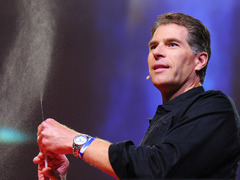
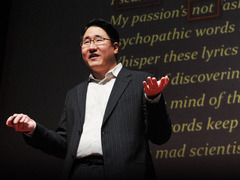
    Online-datingFew people know more about online dating that Christian Rudder, co-founder and editorial director of OKCupid. Privy to the vast mountains of data created as millions of people answer questions about what they’re looking for in love, search through profiles of people in their area and flirtatiously message each other, Rudder has learned a lot from the numbers. This week, Rudder gave us insight into OKCupid’s dating algorithm in a TED-Ed lesson and came to our New York office to speak as part of our miniature TED about love, sex and family. To help you get in the Valentine’s Day spirit, here are some surprising facts we learned from Rudder about online dating behavior.

    1. Women are more likely to get responses than guys. For a guy who writes a woman on OKCupid without any previous flirtation, he has a 25% chance of getting a reply from her. But for women who are cold-writing a guy — there’s a 40% chance she will get a reply.
    2. Women’s perception of men’s attractiveness may be more warped than men’s perception of women’s appearance. With the rise of pornography, plastic surgery and airbrushing, many people wonder — do guys know what real women look like anymore? The answer appears to be yes. When Rudder showed us a graph of the ratings men give to women on an attractiveness scale of 1 to 5 through OKCupid, there’s a normal distribution with fewer women falling at the 1 and 5 extremes and the grand majority getting ratings in the middle. However, when women rate men on a scale of 1 to 5 on attractiveness through the site, the graph skews sharply towards the lower end. Women overall rate many men as a 1, and shockingly few as a 4 or 5. Jokes Rudder, “A 3.8 for a guy is basically Hollywood material.”
    3. Still, men tend to email the most attractive women. While guys can clearly appreciate women in the center of the attractiveness spectrum,  that doesn’t mean they don’t aim for the top. Men of all levels of attractiveness tend to send the most emails to the few women rated across the board as a 5.
    4. Message length doesn’t appear to matter. Rudder was sure that longer messages would up a person’s chances of getting a response from the object of their affection. But it’s not true. Whether a message is the length of a tweet or the length of a novella doesn’t seem to matter in terms of chances for a reply. The numbers listed in item #1 hold tight — men have a 25% chance of getting a response and women have a 40% chance.
    5. If you don’t hear back quickly, you probably won’t. Rudder took a look at the length of time elapsed before a person replies to a message and how it corresponds to the likelihood that they will respond. In a fascinating twist, half of all replies are sent by the seven-hour mark. There’s a big drop-off from there in the chances of a reply. “Seven hours is the half-life of your hopes and dreams,” joked Rudder.
    6. Not all replies turn into dates. Getting a reply on OKCupid is half the battle — but it isn’t everything. There’s only about a 30% chance that a reply will turn into an actual conversation — a correspondence that lasts for three exchanges or longer.
    7. Despite the startling statistics, people do fall in love through the site. Every day, about 500 people disable their OKCupid profiles for a very specific reason: they met someone through the site that they’re embarking on a relationship with.

    What have your online dating experiences been like? Which of these facts surprises you the most?

  • Disagreements on the TED stage: Speaker debates over the years

    Debate-mainTED2013 kicks off in just 11 days and, in the very first session, will be a lively debate between Robert J. Gordon and Erik Brynjolfsson. While Gordon will talk about how our current ecosystem of innovation is too focused on gadgetry, and thus isn’t enough to solve the big problems of the future, Brynjolfsson will share how the digital revolution is propelling us forward rapidly. It’s shaping up to be a fascinating discussion — one that may well change your mind.

    This will hardly be the first time that two TED speakers have verbally jousted oon the TED stage. Here, sets of TED speakers who have disagreed — either in an official debate or in separate talks — to give you a taste of what to expect at TED2013, where the TED Blog will be reporting live every second.

    Paul Zak vs. Molly Crockett: Is oxytocin the moral molecule?

    In these two talks given a year apart, neuroscience experts Paul Zak and Molly Crockett disagree on what we can say about oxytocin.

    Paul Zak: Trust, morality -- and oxytocin?Paul Zak: Trust, morality — and oxytocin?Paul Zak: Trust, morality — and oxytocin?
    Morality is a distinctively human trait and it might be because of the hormone oxytocin. In this talk from TEDGlobal 2011, neuroeconomist Paul shares his 10-year search for what he calls “the moral molecule” and reveals his studies on how oxytocin boosts trustworthiness, empathy and even the desire to give money to charity.
    Molly Crockett: Beware neuro-bunkMolly Crockett: Beware neuro-bunkMolly Crockett: Beware neuro-bunk
    Neuroscientist Molly Crockett wants everyone to spot “neuro-fiction” — claims that overshoot our current understanding of the brain. Crockett evokes Zak’s work with oxytocin. According to Crockett, studies on oxytocin “are scientifically valid and they have been replicated, but they’re not the full story.” She explains, “Other studies have shown that boosting oxytocin increases envy, it increases gloating. Oxytocin can bias people to favor their own group.”

    Peter Diamandis vs. Paul Gilding: What will the future look like?

    Diamandis-debateBecause these two speakers expressed such different views at TED2012, TED Curator Chris Anderson invited the pair onstage for a formal debate.

    Peter Diamandis: Abundance is our future
    At TED2012, activist Peter Diamandis explains that — yes — news reports may sound doomsday, but that we are actually living in the most peaceful and abundant time of human existence. He imagines a future where humans continue to invent and innovate to solve the challenges that face us.
    Paul Gilding: The Earth is full
    Also speaking at TED2012, writer Paul Gilding spoke from a very different viewpoint — saying that humans have not only filled the world with our bodies, waste and things, but that we used up all our resources. He worries that, if we stay on the same path, it could be the end of this civilization.

    Rick Warren vs. Dan Dennett: Do our lives have purpose?

    Dan Dennett couldn’t help but respond directly to Rick Warren at TED2006, after hearing his talk.

    Rick Warren: A life of purposeRick Warren: A life of purpose
    Rick Warren: A life of purpose
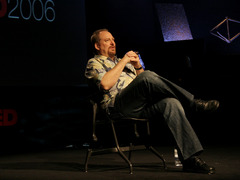
    At TED2006, pastor Rick Warren said, “I believe spiritual emptiness is a universal disease.” He explained his belief in God, and how he thinks each one of us is here for a specific purpose that matters, and describes his crisis of purpose in the wake of releasing a best-selling book.
    Dan Dennett: Responding to Pastor Rick WarrenDan Dennett: Responding to Pastor Rick Warren
    Dan Dennett: Responding to Pastor Rick Warren
    Speaking at the same conference, philosopher Dan Dennett suggests that religions are natural phenomenon, evolving over time to survive. Dennett says that life — both ours and that of animals — has been designed by evolution, and lacks an individual purpose.

    Stewart Brand vs. Mark Z. Jacobson: Nuclear energy?

    >

    Before you watch this debate from TED2010, try this experiment: Ask yourself, who do you agree with now? Watch the debate. And then — ask yourself again.

    Stewart Brand: Nuclear energy is our best bet
    During an onstage debate held at TED2010, futurist Stewart Brand explained why he is in favor of nuclear energy — because it is far more feasible on a large scale than either wind or solar power. “If all of your electricity in your lifetime came from nuclear [energy], the waste from that lifetime of electricity would go in a Coke can,” he says.
    Mark Z. Jacobsen: Nuclear energy is short-sighted
    Meanwhile, environmental engineer Mark Z. Jacobsen countered that nuclear power has extreme downsides, producing far more carbon dioxide and air pollution than other alternative energies. To boot, nuclear power plants takes far longer to build, meaning we’ll have to stick with coal power for the foreseeable future. Not to mention that nuclear power could enhance nuclear weapon proliferation.

    Note: This post was originally published on August 6, 2012, and was updated with a new introduction and set of examples on Feb. 13, 2013.

  • Math class without hand calculation? Estonia is moving toward it

    Conrad-Wolfram-computer-mathMath class should be fascinating, right? At TED2010, Conrad Wolfram suggests that one reason it often isn’t is hand calculation. Conrad Wolfram: Teaching kids real math with computersConrad Wolfram: Teaching kids real math with computersMost students spend years in math class learning to work sums by hand that a computer can now do. After all, computers are far better at calculation than human beings will ever be, while people are far better at defining problems and coming up with creative solutions.

    Wolfram’s website, ComputerBasedMath.org, supports curriculums that allow teachers to focus on real-world math problems, so students can study concepts rather than calculation. As Wolfram says on the site:

    “Rather than topics like solving quadratic equations or factorizing polynomials, Computer-Based Math focuses on using the power of math to solve real-world problems like, ‘Should I insure my mobile?,’ ‘How long will I live?’ or ‘What makes a beautiful shape?’”

    This week, Wolfram announced its first test country: Estonia will be using the program to create a new statistics curriculum for students. Pilot testing of the curriculum in 30 classrooms will start in early 2014. From there, they plan to roll it out to all schools shortly after completing testing in September 2014.

    Why adopt this program? The country’s Minister of Education and Research, Jaak Aaviksoo, says, “We want to lead the world in rethinking education in the technology-driven world.”

  • A look at OKCupid’s algorithm: Getting personal with TED-Ed for Valentine’s Day

    How, exactly, does online dating work? In this perfect-for-Valentine’s-Day TED-Ed lesson, OKCupid co-founder Christian Rudder walks you through how the dating website does its matching — by using a carefully-honed algorithm to create a compatability rating for two potential daters. In this fascinating video, Rudder shares how the site lets daters decide which factors are most important to them — and then crunches the numbers behind the scenes.

    TED-Ed animator Franz Palomares jumped at the chance to animate this lesson — for a very specific reason. The TED-ED blog interviewed him to find out why.

    We heard there was a special reason you wanted to work on this particular lesson. What was your inspiration?

    The general inspiration was very personal. Seven years ago, I met my wife on a dating website! So I felt a great attachment to sharing this lesson.

    Artistically, I had a lot of different inspirations. I knew immediately that I wanted to split it into two categories. One a very personal and human side, represented by hand-drawn characters — the match that is being made by the algorithm. And then a technical side, represented by the 3D words and the heart transitions. The hearts falling are based on the raining code from the Matrix. I thought it would be a fun way to indicate that the program was working.

    That male character certainly looks familiar. How did you decide what the characters would look like in the animation?

    Ha. The two characters that represent the users were easy. I knew from the moment I took on this lesson that I would work in some drawings of my wife and myself. From there, I decided I should include a character that looks like Christian to be the narrator.

    Read the rest of the interview on the TED-Ed blog »

  • Who controls the world? Resources for understanding this visualization of the global economy

    Occupy Wall Street’s slogan “We are the 99%” had been echoing through the United States and the world for just over a month when James B. Glattfelder and his co-authors released the study “The Network of Global Corporate Control” in October 2011. The study was a scientific look at our global economy, revealing how control flows like water through pipes — some thin, some thick — between people and companies. The finding: that control of our economy is highly tightly concentrated into a small core of top players, leaving us all vulnerable to fast-spreading economic distress.

    James B. Glattfelder: Who controls the world?James B. Glattfelder: Who controls the world?

    In today’s talk, filmed at TEDxZurich, Glattfelder reveals that the impetus of the study wasn’t at all to validate global protesters. Instead, the study was conducted out of a desire to understand the laws that govern our economy, in the same way that we understand the laws that govern the physical world around us. Glattfelder and his co-authors Stefania Vitali and Stefano Battiston are complex systems theorists, meaning that they study a whole — for example, an ant colony or the human brain — as more than just the sum of its part. Complexity theory examines interactions between parts, looking for the simple rules that emerge when viewed en masse.

    “Ideas relating to finance, economics and politics are very often tainted by people’s personal ideologies. I hope that this complexity perspective allows for some common ground to be found, “ Glattfelder says in today’s talk. “It would be great if it has the power to help end the gridlock of conflicting ideas, which appear to be paralyzing our global world. Reality is so complex — we need to move away from dogma. But this is only my personal ideology.”

    To hear more about how the study was conducted, watch this talk. And to learn more about the results, and how they were received, keep reading.

    To answer the question, “Who controls the world?” the study looked at ownership networks, breaking it down to nodes (such as firms, people, governments, foundations), links (the percentage of ownership) and value. Overall, the study looked at:

    • 13 million ownership relations
    • 43,000 transnational corporations
    • 600,000 nodes
    • 1 million links

    At the top of this post is a 3D rendering of all the connections in this study. The dots represent the transnational corporations, nodes and links. Any section of it looks something like this.

    Global-Control-1

    As Glattfelder explains, in this ecosystem of transnational corporations, there is a periphery and there is a center — a connected network that contains about 75% of all the players. Nestled in this center is what the study calls the core. This core contains 1,300 highly connected nodes. While only 36% of transnational corporations are in this core, they make up 95% of the value of the entire network. This image will help to illustrate the core.

    Global-control-2

    The authors of this study also assigned each player in this system a degree of influence. And overall, they found that the 737 top shareholders have the potential to control 80% of all the transnational corporations’ value. These top shareholders are mostly financial institutions in the US and UK. The first 10 on the list:

    1. Barclays plc
    2. Capital Group Companies Inc.
    3. FMR Corporation
    4. AXA
    5. State Street Corporation
    6. JP Morgan Chase & Co.
    7. Legal & General Group plc
    8. Vanguard Group Inc.
    9. UBS AG
    10. Merrill Lynch & Co Inc.

    Download the full list here »

    But their findings get even more extreme. The 146 top players in the core — representing just .024% of all the nodes studied — have the ability to control about 40% of transnational corporations’ value. This high degree of interconnectivity means that not only are we all highly influenced by a few — but that their distress is able to spread like wildfire.

    The study, published in PLOS ONE at just the right time, quickly went viral. Read the study in its entirety »

    Or check out some of the stories that ran about it:

    As the story spread, Glattfeld and his co-authors took on the issue of whether their study was a proof of a conspiracy.

    “Our study does NOT claim that the actors in the core are colluding. NOR does it claim that this structure is the result of some intentional design. We actually think that it probably emerges ‘naturally,’ as a result of simple mechanisms that are at work in the market,” they write here. “What we claim is that further studies are needed to investigate the implications of such a structure, because it is very well possible that it is [endangers] market competition and financial stability.”

  • Barack Obama’s 2013 State of the Union: Talks for deeper thinking on the issues

    State-of-the-UnionPresident Barack Obama ended his 2013 State of the Union address just minutes ago saying, “We are citizens. It’s a word that doesn’t just describe our nationality or legal status. It describes the way we’re made … Well into our third century as a nation, it remains the task of us all, as citizens of these United States, to be the authors of the next great chapter in our American story.”

    Read the full text of Obama’s speech. Or think more about the issues brought up in it by watching these TED Talks and Playlists.

    War and peace:

    Jobs and the economy:

    Science, innovation, invention:

    Leading the world:

    And of course, SOTU hero Desiline Victor:

  • A miniature TED all about love

    TED@250-mainSome people go over-the-top for Valentine’s Days, showering their loved ones with candy and roses. Others bemoan Valentine’s Day as the ultimate Hallmark holiday. Wherever you stand on this spectrum — as Cupid pulls back his bow this week — it’s hard not to think about your own relationship or lack thereof. It’s a question deeply embedded in all our minds: what, exactly, does it mean to love in our technology-soaked era?

    Helen Fisher: The brain in loveHelen Fisher: The brain in love

    Inspired by Helen Fisher’s classic TED Talk, “The brain in love,” we invited three speakers with big ideas on relationships, sex and family to our New York office for a TED@250 salon, part of a program to tackle timely topics. Love was certainly in the air.

    After a screening of the incredibly sweet office-romance film “Post-It Love,” Christian Rudder stepped to the stage. The co-founder and editorial director of OKCupid, Rudder set out to parse some of the data pouring into the site at all times from its users. For example, Rudder shared that when a man on the site writes a woman without any previous interaction, he has a 25% chance of getting a response from her. Meanwhile, women cold-writing men through the site have a 40% chance of a reply. Rudder shared another interesting tidbit — that half of responses are sent to a message are sent with seven hours. As Rudder put it to a big laugh, “Seven hours is basically the half-life of your hopes and dreams.”

    TED@250-RudderBut Rudder shared an inspiring bit of news. Every day, 500 people deactivate their OKCupid profiles because they met someone through the site. “All it takes is one,” says Rudder. This sentiment was echoed in the ahhhh-worthy Google video, “Parisian Love,” which tells a moving love story via search.

    Bruce Feiler, author of Walking the Bible and the new book The Secrets of Happy Families, stepped up next to share the surprising thing that has revolutionized his family life: agile programming. A method of software development, agile breaks down large projects into small, do-able bits — allowing people throughout the process to give feedback as they go. Agile was developed in opposition to the “waterfall method,” where people in charge determine the flow of the project and people inside the process have no input.

    TED@250-FeilerApplying this to a family means creating detailed daily checklists. “You can’t underestimate the power of making a checkmark,” says Feiler. “It works in offices and it works with kids.” Agile in the home also involves having weekly meetings to talk about what went well over the course of seven days and what needs improvement. And Feiler reveals a surprising fact about his twin 8-year-olds: that they’re able to pick their own punishments and they generally give themselves harsher ones than their parents would have picked.

    Finally, we heard from Esther Perel, author of Mating in Captivity, who spoke about keeping passion in long-term relationships now that human beings “live twice as long” as we used to. Perel nailed the basic challenge of modern relationships — that, on the one hand, they must to satisfy our deep-seated need for security, dependability and permanence while at the same time meeting our equally strong need for adventure, mystery and the unexpected.

    TED@250-Perel“Can we want what we already have?” Perel asked. The answer is yes. But because Perel sees desire as the space between the self and the other, she reveals that this can be achieved in some counter-intuitive ways — in part by being more selfish and savoring moments of absence. Her thoughts were truly surprising and inspiring.

    Stay tuned for these great talks on TED.com and the TED Blog in the upcoming weeks.

    Photos by Cloe Shasha

  • Inanimate objects brought to life: 7 intriguing talks

    ErikSchlangenRoads need constant repair. Rain, snow and other moisture seeps into the asphalt and — if it freezes — expands, breaking it apart and creating potholes.

    Erik Schlangen: A "self-healing" asphaltErik Schlangen: A "self-healing" asphalt

    In today’s talk, given at TEDxDelft, civil engineer Erik Schlangen reveals a fascinating solution: a road that is able to heal. He gives a demonstration of a new type of asphalt, which incorporates tiny strands of steel. He breaks a piece of it in half and puts it in the microwave for two minutes. He takes it out, fully formed again.

    The application? This asphalt can be laid on a road. According to Schlangen’s tests, it will last about four years before it gets damaged. At that point, an induction machine would drive over the road, catalyzing its ability to repair itself. Schlangen imagines that roads could last twice as long if made of this material.

    To see this amazing demonstration, watch the talk. And here, more TED Talks about infusing inanimate materials with life-like qualities.

    Theo Jansen: My creations, a new form of lifeTheo Jansen: My creations, a new form of lifeTheo Jansen: My creations, a new form of life
    Theo Jansen makes animal-like sculptures out of plastic tubing, drink bottles and foam. And yet, they are able to walk and move — even live on their own in herds on the beach and protect themselves from storms. At TED2007, Jansen shows us these creatures in motion.
    Lee Cronin: Making matter come aliveLee Cronin: Making matter come aliveLee Cronin: Making matter come alive
    It’s amazing that the organic, living world arose out of inorganic, dead matter. In this talk from TEDGlobal 2011, chemist Lee Cronin wonders: can we create life, if we define life as anything that can evolve? (See our playlist of talks to celebrate Charles Darwin’s birthday.)
    Todd Kuiken: A prosthetic arm that "feels"Todd Kuiken: A prosthetic arm that "feels"Todd Kuiken: A prosthetic arm that “feels”
    Both a doctor and an engineer, Todd Kuiken is creating a prosthetic arm that not only performs tasks — but that is able to connect to a person’s nervous system. At TEDGlobal 2011, he brings a patient on stage to demonstrate how it gives more control and a sensation of feeling.
    Reuben Margolin: Sculpting waves in wood and timeReuben Margolin: Sculpting waves in wood and timeReuben Margolin: Sculpting waves in wood and time
    Kinetic sculptor Reuben Margolin creates stunning, meditative pieces that move — emulating the patterns of falling raindrops and undulating waves. In this talk at TED2012, Margolin introduces us to his sculptures, including “Double Raindrop,” which he calls “the most talkative” of his works.
    Thomas Heatherwick: Building the Seed CathedralThomas Heatherwick: Building the Seed CathedralThomas Heatherwick: Building the Seed Cathedral
    At TED2011, architect Thomas Heatherwick shows off his bio-inspired designs, including a moving bridge that “kisses itself,” constricting into a circle and then unfurling over a body of water. He also shows us the “Seed Cathedral,” a building made of plants and dedicated to growth.
    Suzanne Lee: Grow your own clothesSuzanne Lee: Grow your own clothesSuzanne Lee: Grow your own clothes
    Cloth can be sewn and worn. But can it be grown? In this talk from TED2011, Suzanne Lee shares how she creates living material for her fashion designs. Get ready to see how kombucha — a mix of bacteria, yeasts and micro-organisms — ferments into a vegetable leather.
    Matt Mills: Image recognition that triggers augmented realityMatt Mills: Image recognition that triggers augmented realityMatt Mills: Image recognition that triggers augmented reality
    Aurasma is a app that can make paintings dance and newspapers talk. At TEDGlobal 2012, Matt Mills and Tamara Roukaerts demonstrate this technology, which uses a smartphone to overlay video content over something static — thanks to an image trigger. (Give Aurasma a test drive through this TED Blog post.)

  • Talks to celebrate Charles Darwin’s birthday

    Charles-Darwin

    The day was February 12, 1809. The place was Shrewsbury, England. The person born there: Charles Darwin. With the publication of his classic, On the Origins of Species, Darwin set the wheels in motion for a dramatic transformation of the way human beings understand the world and how we came to exist in it . Here, seven speakers who’ve discussed what Darwin proposed on the TED stage:

    Steven Johnson: Where good ideas come from
    “Darwin himself, in his autobiography, tells the story of coming up with the idea for natural selection as a classic ‘eureka!’ moment. He’s in his study, it’s October of 1893 …”

    Michael Pollan gives a plant’s eye view
    “Who’s the more sophisticated species? Well, we’re all equally sophisticated. We’ve been evolving just as long, along different paths. It’s a cure for self-importance, a way to sort of make us feel the Darwinian idea.”

    Robert Full on engineering and evolution
    “Really, evolution works more like a tinkerer than an engineer.  This is really important when you begin to look at animals.”

    Dan Dennett: Cute, sexy, sweet, funny
    “I’m going around the world giving talks about Darwin, and usually what I’m talking about is Darwin’s strange inversion of reasoning. Now that title, that phrase, comes from a critic …”

    Jonathan Haidt: Religion, evolution and the ecstasy of self-transcendence
    “In The Descent of Man, Charles Darwin wrote a great deal about the evolution of morality. Where did it come from? Why do we have it?”

    Juan Enriquez: Will our kids be a different species?
    “The first place where you would expect to see enormous evolutionary pressure today, both because of the inputs — which are becoming massive — and because of the plasticity of the organ, is the brain.”

    Dennis Dutton: A Darwinian theory of beauty
    “How can we explain this universality? The best answer lies in trying to reconstruct a Darwinian evolutionary history of artistic and aesthetic tastes. We need to reverse-engineer them.”

  • 10 fun facts about Vancouver and Whistler

    Whistler

    Whistler is the perfect locale for the movers and shakers of TEDActive 2014.

    TED is ready to learn every word to “O Canada.” For TED2014 — our 30th anniversary spectacular themed “The Next Chapter” — we are moving our annual West Coast conference to Vancouver, Canada. There, we’ll enjoy sweeping views of the harbor and North Shore Mountains, a theater custom-built to maximize the impact of talks and the return of 100 beloved TED speakers from the past. While TED2014 takes place in this spectacular city, TEDActive 2014 will be just 90 minutes away in the gorgeous ski resort of Whistler, pictured above.

    With registration just opened for TED2014 and TEDActive 2014, here are some fun facts about Vancouver and Whistler to get you in the British Columbian spirit.

    Vancouver is Canada’s third largest metropolitan area, with a population of 2.3 million. It is also one of Canada’s most diverse cities — 53% of residents do not speak English as their first language. [StatCan]

    Originally known as Gastown, Vancouver sprouted up around the Hastings Mill sawmill and tavern, established in 1867. Twenty years later, the city was incorporated and named after Captain George Vancouver, of the British Royal Navy, who explored the Pacific Northwest, Hawaii and Australia. [Wikipedia]

    Some bands and musicians who’ve called Vancouver home: The New Pornographers, Tegan and Sara, Kid Koala, Bryan Adams, Sarah McLachlan, Heart and Michael Bublé. [Wikipedia]

    Stanley Park, Vancouver’s largest, is 1001 acres—making it 10% bigger than New York City’s Central Park. [Canadian Geographic]

    Vancouver is sometimes referred to as Hollywood North. It is second to Los Angeles in television production and third behind New York and Los Angeles in film production. 21 Jump Street, Fringe, The L Word, Smallville, Hellcats, Battlestar Gallactica, MacGyver, and The X-Files were all filmed there. [Wikipedia]

    In 1971, Greenpeace was established in Vancouver, and the city has its sights set on becoming the world’s greenest city by 2020. [Vancouver.ca]

    Whistler Mountain was once known as London Mountain because of the fog at its base. The name Whistler was inspired by the unique noises made by the hoary marmot, which make their home there. [Whistler’s Base]

    Now visited by more than 2 million annually, Whistler was basically undeveloped until the 1960s. Whistler Mountain opened in 1966 with an eye toward a bid for the 1968 Winter Olympic Games. [Wikipedia]

    Currently, Whistler gets an average of 469 inches of snow a year. [Whistler.com]

    When Vancouver hosted the Winter Olympics in 2010, more than 2,800 athletes were housed at the Olympic Village at Whistler. In that Olympics, Canada set the record for most gold medals won by a country in a single Winter Olympic games — an honor held by the Soviet Union since 1976 and only matched by Norway in 2002. [Wikipedia]

    Vancouver

    The view from the roof of the Vancouver Convention Centre, where TED2014 will be held.

  • When education is not a given: 8 inspiring talks

    ShabanaBasijRasikhFrom age 6 through age 11, Shabana Basij-Rasikh risked her life to go to school. The Taliban had banned girls in Afghanistan from studying at universities and other educational institutions and, thus, Basij-Rasikh dressed as a boy, posing as an escort for her older sister. Together, the two would place their books in grocery bags and sneak off to a secret school.

    Shabana Basij-Rasikh: Dare to educate Afghan girlsShabana Basij-Rasikh: Dare to educate Afghan girls

    “Each day, we took a different route so that no one would suspect where we were going,” says Basij-Rasikh in today’s powerful talk. “The school was in a house, more than 100 of us packed into one living room … We all knew we were risking our lives — the students, the parents, the teachers.”

    When the Taliban fell in 2001, Basij-Rasikh’s father was thrilled that his daughters would be able to return to a traditional school. Still, says Basij-Rasikh, her family’s commitment to education for its daughters was not the norm. In Afghanistan, only 6 percent of women 25 or older received any formal education.

    “I was very lucky to grow up in a family where education was prized and daughters were treasured,” says Basij-Rasikh, a recent graduate of Middlebury College in the United States. “During the Taliban years, I remember there were times I would get so frustrated by our life and always being scared. I would want to quit. But my father would say, ‘Listen, my daughter. You can lose everything you own in your life. Your money can be stolen. You can be forced to leave your home in a war. The one thing that will always remain with you is what is up here. If we have to sell our blood to pay your school fees, we will.’”

    After college, Basij-Rasikh returned home and co-founded SOLA, the School of Leadership Afghanistan, the first boarding school for girls in Afghanistan. And yet sadly, getting an education is still a risk in the country. To hear a shocking story of one of Basij-Rasikh’s students whose family was targeted by terrorists — simply for sending their daughter to SOLA — watch today’s talk.

    Here, more talks from people who went to great lengths to get, or give, an education.

    Kakenya Ntaiya: The first school for Maasai girls
    For Maasai girls, childhood is focused on preparing them for marriage, which will happen for many as early as age 12 or 13. With great reverence for her culture, Kakenya Ntaiya shares how she agreed to participate in a genital mutilation ceremony … in exchange for permission to continue her education. In this talk from TEDxMidAtlantic, she reveals why it was so important to her to go to college, become a teacher and start the first all-girls school in her village — all with the support of her elders.

    Shukla Bose on educating poor children
    Activist Shukla Bose admits that she and her compatriates with the Parikrma Humanity Foundation were mind-boggled when they first set out to educate the children of India’s slums — 200 million of whom should be in school but simply aren’t. In this talk from TEDIndia 2009, Bose explains how they put the statistics out of mind and went about their mission in the only way they could — by going one child at a time.

    Sheryl WuDunn: Our century’s greatest injustice
    At TEDGlobal 2010, journalist Sheryl WuDunn takes us to rural China — where a star pupil was pulled out of school because her family couldn’t justify paying the $13 annual fee when she’d be working a rice paddy for the rest of her life. WuDunn shows how the donations for the education of this one student changed not only her life but her family’s and her entire village’s. A stirring talk about how education for the world’s women can lead to all of our advancement.

    Sugata Mitra shares how kids teach themselves
    Why should educational technology be focused in schools that already have good teachers and resources? In this talk from LIFT 2007, Sugata Mitra shares why it is important to focus technology in schools in rural areas, slums and shanty towns — because that’s where it can have the most impact. Here, Mitra narrates his Hole in the Wall experiment in New Delhi in 1999, where a computer was embedded into a wall, and local children flocked to it — learning and teaching each other.

    Neil Turok makes his TED Prize wish
    Neil Turok grew up in South Africa, where his parents were imprisoned for resisting racism. He spent his formative years as a refugee in Kenya and Tanzania. As Turok accepted the TED Prize in 2008, he shared the story of how he became interested in theoretical physics. The keys: being inspired by the wisdom of village children around him, many of whom didn’t have a formal education, and by a school teacher who posed the question: “What banged during the Big Bang?”

    Charles Leadbeater on education innovation in the slums
    In the favelas of Rio or the slums of Kibera, traditional schools simply will not work because they depend on professionals and high-cost infrastructure — not to mention that their curriculums do not connect to the lives of students. At the TEDSalon London 2010, Charles Leadbeater looks at different approaches — like putting computers in community centers and serving up lessons through mobile phones. It’s education plus technology that is the key, Leadbeater shows.

    Leymah Gbowee: Unlock the intelligence, passion, greatness of girls
    Nobel Peace Prize winner Leymah Gbowee is haunted by the untapped potential of the girls she’s met on her travels across Liberia. In this talk, she tells some of these girls’ stories and calls on us all to foster the educational growth of girls — and to encourage the great inventions, innovations and breakthroughs they may be able to fuel if nurtured.

  • On musical creativity: A talk to watch as you discuss the Grammy winners

    Mumford-&-SonsThe 2013 Grammy Awards, which aired last night, offered up many a surprise with indie-tinged acts grabbing major awards over more established contenders.  British folk-rockers Mumford & Sons (above) won the award for Album of the Year for Babel while electronic master Charles Limb: Your brain on improvCharles Limb: Your brain on improvGotye took home Record of the Year for his infectious song “Somebody That I Used To Know.” Meanwhile, the Black Keys will have the most trophies to add to their award shelf after winning four awards.

    With such creativity represented on the stage, it made us think: “What goes on in the mind of a musician?” Here, a talk from music lover and surgeon Charles Limb, where he reveals what he found from putting jazz musicians and rappers in an fMRI as they improvised »

  • Bracing for Nemo? Talks to watch while snowed in

    BlizzardIn the Northeastern United States, there is only one thing the mind today: snow. Weather.com, responsible for naming the coming blizzard, warns that winter storm Nemo will be “crippling.” The New York Times reports that it may bring the heaviest snowfall in a century to many areas. Meanwhile, Buzzfeed is showing images of the storm from space.

    What should you do if you get snowed in, with an internet connection? Watch these TED Talks to get in the arctic spirit:

    Want to ignore the weather and just watch something inspiring? Check out our 20 most-watched talks of all time »

  • 8 views of Tirana, Albania — with its bright, multicolored buildings

    Tirana-4b

    A view of a street in Tirana, where the buildings have been splashed with color— for a political purpose. Photo: Merlin and Rebecca

    Edi Rama — the mayor of Tirana, Albania, for 11 years — was an artist before a politician.

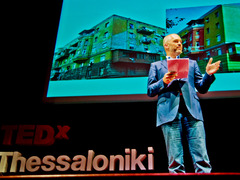
    “I still paint. I love the joy that color can give to our lives and to our communities,” says Rama in today’s talk, filmed at TEDxThessaloniki. Edi Rama: Take back your city with paintEdi Rama: Take back your city with paint“I try to bring something of the artist in me to my politics.”

    Tirana, Albania’s capital city, was downtrodden when Rama took office. The city budget was squandered, corruption was rampant and crime was the norm. But Rama had an idea to raise the spirits of his town — he painted a grey building a bright orange.

    As Rama set out to have more of the city painted in loud colors and bold designs, he met resistance from other countries in the European Union. He was asked to opt for more neutral colors.

    “I told them no. Compromise in colors is grey,” explains Rama. “When colors came out everywhere, a mood of change started transforming the spirit of the people … People started to drop less litter in the streets. They started to pay taxes. They started to feel something they’d forgotten … Beauty was giving people a feeling of being protected. This was not a misplaced feeling — crime did fall.”

    To hear more about the radical transformation of Tirana, and about Rama’s thoughts on how politicians are not all the same and can bring hope to people through seemingly small actions, watch his moving talk. And here, see just some of the buildings in Tirana that got the color treatment.

    Tirana-1

    The first building in Tirana to get splashed with paint. Here is the before and after comparison. Photo: Edi Rama

    Tirana-2

    The before and after of an apartment building. Photo: Edi Rama

    Tirana-3

    Yet another gorgeously multicolored building. Photo: David Dufresne/Flickr

    Tirana-4

    Rama says, “As a result of the project, international artists turned whole living blocks in central Tirana into unique works of contemporary art. “ Photo: David Dufresne/Flickr

    Tirana-5

    An undulating rainbow on the side of a building. Photo: David Dufresne/Flickr

    This building gets the block treatment.  Photo: David Dufresne/Flickr

    This building gets the block treatment. Photo: David Dufresne/Flickr

    Tirana-9

    A building gets the blues. Photo: Merlin and Rebecca

  • Visualizing the volunteers of TEDxTehran

    TEDxTehran-mainAt TEDxTehran, one volunteer is a gold medal swimmer. Another is a personal chef. Of the volunteers for this event, which will take place on February 14, 75% are bilingual. Meanwhile, 30% speak three languages.

    Organizer Sara Mohammadi decided to create a visualization, below, of the TEDxTehran volunteers because the process of interviewing them was so inspiring.

    “What was amazing and overwhelming was the diversity of our volunteer applicants,” she says. “There was so much passion in every single one of the 60 interviews that we did … It left a lasting impression on me about the untapped potential of Iranian youth and their willingness to create. I just wanted to give some color and a voice to all those people who applied as volunteers, who came to for Tehran interviews — some taking trains from other cities — and also to underline that TEDxTehran is only made possible because of a group of local Iranians who are volunteering their time, skill and energy for a non-profit cause.”

    Below, see the infographic for this event, as well as some very cool speaker posters.

    TEDxTehran-poster

    TEDxTehran3

    TEDxTehran2

    TEDxTehran1

  • 14 people who’ve time-lapsed their lives, filming one second a day

    Cesar-KuriyamaAs he approached his 30th birthday, artist Cesar Kuriyama noticed that time seemed to be evaporating. And thus, he began work on a project called 1 Second Everyday.

    Cesar Kuriyama: One second every dayCesar Kuriyama: One second every day

    “Basically, I’m recording one second of every day of my life for the rest of my life—chronologically compiling these one-second, tiny slices of my life into one single continuous video,” says Kuriyama in today’s talk. Why? “I hate not remembering things that I’ve done in the past,” he says.

    When Kuriyama turns 40, he’ll have a one-hour video encapsulating his 30s. And when he turns 80, he’ll have a five-hour video spanning 50 years. In this talk, he reveals what he recorded in the first 365 days of the project — both the glorious and the painful.

    Naturally, Kuriyama was curious what others would do with this tool. And so he took to Kickstarter, where more than 11,000 people funded his efforts to create a 1 Second Everyday app. It’s available for iOS now, and will soon be available for Android.  Below, see some of the videos created with it.

    Ryan Kawailani Ozawa—who describes himself as a father, husband and web geek—downloaded the app for the new year. Here’s his January 2013, in a beautiful 31 seconds.


    A friend of Kuriyama’s, Kathy Monahan set out to record all of 2012, editing the footage together herself since the app wasn’t available yet. Watch her year unfold, from concerts to learning how to use a crossbow.


    Arseny Vez of in St. Petersburg, Russia, shares his January 2012 using the app.

    Think 1 Second Everyday is for the dogs? Possibly. Here, a user has captured January 2013 in the life of their dog, Henry.

    A look at January 2013 in Amsterdam.

    From ultrasounds to what’s for dinner, John Mezzepesa captured December 2012 and January 2013.

    Ben Nesvig’s French bulldog is just one of the stars of his video of January 2013.

    Martha Denton filmed January 2013 in New York City, Milwaukee and Detroit.

    Pedro Sostre edited together one second from every iPhone video he’s taken over the past five years.

    Robbie Marr brings you January 2013 in Brighton, England.

    Chicken and waffles figure greatly in Oliver Church’s 2013 thus far.

    Laura Ferenc captured both December and January 2013. She writes, “This left-brain heavy, non-creative bookkeeper is taking a bit more time noticing things each day.”

    The second half of 2013, as captured by Collin Ferry.

  • The year of the introvert: A Q&A with Susan Cain on the release of her paperback

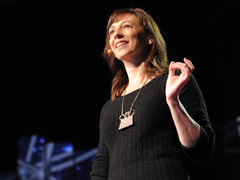
    Susan-CainAt TED2012, Susan Cain asked us to stop the madness. That is: the group work madness. At offices and schools around the globe, the desire for collaboration has led to an onslaught of open floor plans and group projects where individuals aren’t given much space to think on their own. And this is a big problem, Cain explained, because a third to half of people in the world are introverts. They thrive on their own and feel at their best in quiet moments, without over-stimulation.

    While our culture tends to laud extroverts — people who are outgoing, social and high on charisma — Cain stood up for the introverts of the world in her talk.
    Susan Cain: The power of introvertsSusan Cain: The power of introverts

    “Our most important institutions, our schools and our workplaces, they are designed mostly for extroverts and for extroverts’ need for lots of stimulation,” says Cain. “This is our loss for sure, but it is also our colleagues’ loss and our communities’ loss. And at the risk of sounding grandiose, it is the world’s loss. Because when it comes to creativity and to leadership, we need introverts doing what they do best.”

    In the past year, Cain’s talk has been viewed nearly 4 million times. Meanwhile, her book Quiet: The Power of Introverts in a World that Can’t Stop Talking became a New York Times bestseller. With the paperback of the book now on bookstore shelves, the TED Blog spoke — softly — to Cain about the experience of the past year.

    Do you feel like Quiet has made a dent in the cultural bias toward extroversion?

    Yes, and it started within minutes of giving my TED talk! One member of the audience was Jim Hackett, the CEO of Steelcase — a self-identified introvert and just a lovely fellow. He told me he’d been thinking for years about ways to encourage employee privacy at work. His company has spent the last year working on this question. And Herman Miller, the office furniture manufacturer, is following the same path.

    Since then, I’ve heard from other businesses who are using the ideas in Quiet to rethink their corporate culture, and from schools asking their teachers to read the book and question practices like grading children on class participation.

    I’ve also heard many stories of individuals empowered by the message of the book. Just last night, I met a lovely young woman who said she’d always wanted to be an entrepreneur but was afraid she was too quiet to pull it off. But after she saw my TED talk, she started her own company.

    What are some of the most basic things we can do in schools and offices to make sure introverts are in their element and that their voices get heard?


    In workplaces, we need to dramatically rethink open office design. These spaces are so economical that I don’t expect them to disappear, but they desperately need to be balanced with private nooks and crannies. Also, it’s fine to organize people into teams, but that doesn’t mean the actual work has to get done collectively. Most people think better when they’re on their own and not subject to constant interruption and scrutiny.

    In schools, I am just going to repeat what I said in my TED talk, almost a year ago now: stop the madness for constant groupwork. Constant groupwork is even bad for extroverted kids. According to psychologist Anders Ericsson’s research on how people become stars, excellence depends not on talent but on sustained, deliberate practice that is often conducted in solitude.

    Now that you’ve been speaking about this book for a year, do you feel any more extroverted?

    No way! Yes, I’m more comfortable giving speeches than I used to be. Yes, I feel lucky and grateful to connect with so many great audiences. But I will always feel most at peace when I’m home with my family, or lounging around a café with my laptop and a latte in hand.

    If you were starting over in writing this book today, what would you include that wasn’t in the original text?


    I wouldn’t change much about the book. But I wish I’d had reader resources ready and waiting to go, at publication date. Every day, teachers and businesspeople ask me for tools they can use to harness the talents of the introverts in their lives. And regular people ask me for help with dating, schmoozing, public speaking and career choices.

    Right now I’m developing an online course in public speaking for introverts. And I’m planning a young-adult version of Quiet. But there’s so much more to do.

    The truth is, this is a job not for one person but for hundreds, thousands, maybe millions. Luckily, many other people have started to write about and work on these issues, too. (I’ve listed some of them in the “Resources” area of my website.) There truly is a Quiet Revolution afoot. I really hope that people reading this will think about the places in your own world that you’re in a position to influence.

    Is there anything new that readers will find in the paperback?


    Yes, lots of stuff. The paperback now opens with my 10-point manifesto for introverts. And in the back of the book, there’s a new reader’s guide, list of introverts in literature, and other resources — tips on public speaking for introverts, tips for parenting an introverted child. Also, tips for educators.

    Want more? You can find Cain on Facebook. Or head to her very comprehensive website »

  • 6 talks for thinking about the Arab Spring

    Two years ago, waves of revolution swept through the Middle East. On February 17, 2011 — two months after civil resistance began in Tunisia and less than a month after the people of Egypt rose up in Tahrir Square — revolt began in Libya to oust dictator Muammar Qaddafi.

    Activist Zahra’ Langhi was part of the “day of rage” that eventually led to Qaddafi’s toppling. But the cost was high — a six month war in which almost 50,000 people lost their lives. In today’s powerful talk, Langhi turns her eye to the incredible task of rebuilding the country.

    “Qaddafi left behind a heavy burden — a legacy of tyranny and corruption. For four decades, Qaddafi’s tyrannical regime destroyed the infrastructure, as well as the culture and moral fabric, of Libyan society,” says Langhi. “I was keen — along with many other women — to rebuild Libyan civil society, calling for an inclusive and just transition to democracy.”

    To that end, Langhi co-founded the Libyan Women’s Platform for Peace (LWPP), a group lobbying for women to be included as the Libyan government was reformed. In this talk, Langhi explains the “zipper list,” an initiative the group championed which called for political parties to alternate male and female candidates, weaving both genders onto their ballots. At first, this worked remarkably well.

    “However, bit by bit, the euphoria of the elections — and of the revolution as a whole — was fading out, for every day we were waking up to the news of violence,” says Langhi. “Our society, shaped by a revolutionary mindset, became more polarized and driven away from the ideas and principles — freedom, dignity, social justice — that we first held. Intolerance, exclusion and revenge became the post-math of the revolution.”

    Today, Langhi questions whether “rage” was the right path out of dictatorship. In this talk, she posits that perhaps what her country needed more than quantitative representation of women in government was the qualitative representation of traditionally feminine values like compassion, mercy and consensus building. To hear Langhi’s important thoughts on what needs to happen after a revolution, watch her talk.

    Here, more TED Talks about revolution in the Middle East.

    Wael Ghonim: Inside the Egyptian revolution
    Google executive Wael Ghonim helped galvanize Egypt’s revolution by creating a Facebook page memorializing a man who was tortured by Mubarak’s regime. Still, he says, in the Egyptian revolution, no one was a hero — because everyone was a hero. In this talk from TEDxCairo, Wael Ghonim tells the story of the first two months of the revolution — a story we now know is still in progress.

    Bahia Shehab: A thousand times no
    In Arabic, there is a phrase: “No, and a thousand times no.”  As revolution spread through Egypt, art historian Bahia Shehab took up her stencil and proclaimed “a thousand times no” to dictators, to military rule, to violence against women. In this brave talk from TEDGlobal 2012, Shehab shares her previously anonymous work with the world.

    Srdja Popovic: How to topple a dictator
    Why was 2011 such a pivotal year for people-powered revolutions? In this talk from TEDxKrakow, Srdja Popovic — himself a part of the movement that toppled Milosevic in 2000 — looks at why these revolutions gained so much footing. He outlines the skills and tactics needed to oust a dictator. Most surprising: a sense of humor.

    Wadah Khanfar: A historic moment in the Arab world
    The former head of Al Jazeera, Wadah Khanfar has a unique perspective on the Arab Spring. “Change was imposed on us and people rejected that because they thought it was alien to the culture,” he says in this Talk from TED2011.  “Always, we believed, change should spring from within.” Here, Khanfar speaks with great optimism about revolutions in Egypt, Tunisia, Libya and beyond.

    Dalia Mogahed: The attitudes that sparked the Arab Spring
    It’s the opposite of what one would expect: as Egypt grew in wealth, its people’s satisfaction plummeted. This was what Dalia Mogahed, the director of the Gallup Center for Muslim Studies, saw even before the Arab Spring. In this talk from TEDxSummit, she shares some of the grievances she saw in survey data — which sprung not out of distrust of the West, but admiration.

  • How sibling rivalry may influence the Super Bowl

    Super-Bowl

    On Sunday in New Orleans, the San Francisco 49ers will face off with the Baltimore Ravens in Super Bowl XLVII. For the first time in Super Bowl history, the head coaches of the two opposing football teams are brothers. John Harbaugh, the older of the brothers, has been the head coach for the Ravens since 2008. Meanwhile, Jim Harbaugh — younger brother and a former NFL quarterback himself — is the head coach of the 49ers. And to make the story even more complicated, Jay Harbaugh — the 23-year-old son of Jim — is a coaching intern for Baltimore, working alongside his uncle.

    So how might this sibling relationship shape Sunday’s matchup? Here’s a TED Talk that gives some insight.

    In this talk from TEDxAsheville, Jeffrey Kluger explores the power of the sibling bond. Being the favorite or the screw-up, the pretty one or the smart one — these are things that frame a person’s life. He talks about why siblings often go into the same field — because one sibling saw the other getting attention for a specific achievement, and direct competition was encouraged — leading to jockeying that can last a lifetime. Making this stew even worse: that 70% of fathers and 65% of mothers outwardly express a preference for one child over another.

    So which brother will win on Sunday? That’s a question up there with, “What will Beyoncé sing during halftime?” and “Which Super Bowl ad will win TED’s third annual Ads Worth Spreading search?” A past winner was this classic: “Born of Fire.”

    url-1