Author: Kate Torgovnick

  • A school in the cloud: Sugata Mitra accepts the TED Prize at TED2013

    TED2013_0035634_D41_4381

    It’s a question on so many minds: what will the future of education look like?

    Ken Robinson says schools kill creativityKen Robinson says schools kill creativity It’s something Sir Ken Robinson has asked for decades. And tonight in Session 3 of TED2013, Robinson got the opportunity to announce the winner of the 2013 TED Prize, someone who has a bold answer.

    “So many kids are disengaged from education and there’s a tendency to confuse testing with learning,” says Robinson in his introduction. “What drives learning is curiosity, questioning … What fires people up to learn is having their mind opened up by possibilities.”

    And with that, he revealed the winner of the $1 million TED Prize: education innovator Sugata Mitra, who has given two TED Talks over the years and released a TED ebook called Beyond The Hole in The Wall.

    TED2013_0035945_D41_4606

    Mitra wants children around the globe, in addition to traditional schooling, to get a chance to participate in self-organized learning. Translation: to spend time in learning environments where they are given the space to explore on their own, make discoveries and share them with their peers. In his talk from the TED stage, Mitra offered a bold wish: to help design the future of learning by supporting children in tapping into their innate sense of wonder. To this end, Mitra asked the TED community to help him create the School in the Cloud, a learning lab in India where children can embark on intellectual adventures, connecting with information and mentors online. He also asked the community, wherever they may be, to create child-driven learning environments for the kids in their own lives.

    In his talk, Mitra points out that schooling as it exists now was created 300 years ago in the British Empire.

    Sugata Mitra: The child-driven educationSugata Mitra: The child-driven education “The Victorians created a global computer made up of people. It’s called the bureaucratic administrative machine,” says Mitra, in the bold opening of his talk. “In order to keep that running, you need lots and lots of people. They must be identical to each other … So they created a system, called school, to make parts [for this human computer]. They must have good handwriting, they must be able to read, and they must be able to add, subtract and do division.”

    But these skills aren’t as necessary with the advent of computers.“It’s quite fashionable to say education system is broken,” says Mitra. “It’s not, It’s wonderfully constructed — it’s just that we don’t need it anymore. It’s outdated.”

    We can’t imagine the technology of the future, and thus we can’t know what jobs we’ll need the skills for. So Mitra suggests that education should be about developing the ability to learn anything on one’s own.

    Mitra has a history of research to back up this wish. In 1999, he began what he calls his “hole in the wall” experiment. He carved a hole in a wall in a Delhi slum — about three feet high — and placed a computer in it. Kids had gathered around within a matter of hours and asked Mitra questions about what this thing was. He responded “I don’t know,” and walked away.

    Soon the kids were surfing the internet — and teaching each other how to do it more effectively.

    Mitra repeated the experiment 300 miles away, where computers even less familiar. He installed a mysterious computer on the side of a road. A few months later, he returned and found kids playing games on it. Remembers Mitra, “They said, ‘We want a faster processor and a better mouse.’”

    Another thing these kids said that was music to his ears: “You’ve given us a machine that works only in English, so we had to teach ourselves English.”

    Mitra says, “It was the first time I heard the words ‘teach ourselves’ said so casually.”

    Mitra kept testing, seeing if rural students could learn different pronunciation simply by talking into a speech-to-text engine until it understood them. They did it. And then he went even more absurd. He asked:  Can Tamil-speaking 12-year-olds learn the biotech of DNA replication by themselves on a streetside computer in English?
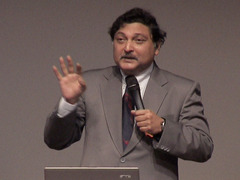
    Sugata Mitra shows how kids teach themselvesSugata Mitra shows how kids teach themselvesSlowly but surely, over months, the kids began to learn the material — showing understanding of concepts far advanced for their age. In three months, with a test, they went from 0% comprehension to 30%. But Mitra wanted to see if he could go further. He brought in a 22-year-old woman with no knowledge of the subject to tutor the kids, using “the method of the grandmother.” Instead of traditional instructing, she simply gave encouragement. The kids’ test comprehension scores jumped.

    “We live in a world where, when we want to know something, we can learn it in two minutes,” says Mitra. “Could it be, the devastating question, that we’re heading towards a future where knowing is obsolete?”

    Mitra isn’t ready to say that, but he is willing to challenge traditional modes of education based on teaching, testing and regurgitation. As Mitra explains, punishments and exams are seen as threats by kids. He says that these are tools no longer needed outside of the age of empire. Mitra urges us all to shift the incentive for education from threat to pleasure.

    Mitra shared another one of his experiments — the “granny cloud,” a community of retired teachers who Skyped into learning centers and encouraged children with questions and assignments. He calls this type of environment a SOLE — a self-organized learning environment. It’s based on a curriculum of questions that set curiosity free, varying forms of peer assessment and certification without examination.

    “If we let the educational process be a self-organizing organism, learning emerges,” says Mitra. “It’s not about making learning happen, it’s about letting education happen.”

    Mitra’s $1 million TED Prize is not a gift– it’s seed money to fund a global  initiative toward this vision. The money will help Mitra break ground on the School in the Cloud in India this very year. This school will serve as both an education and research center to further explore approaches to self-directed learning. It will be managed by cloud technology, but with an adult supervisor always on hand. The plans for the school will be open-sourced.

    But Mitra is asking for your help, too.

    He has released a toolkit for parents, educators and teachers who want to create SOLEs. The online resource will help them support kids (8-12 years old) as they tap into their innate sense of wonder. The key: asking big questions. For example, “If a meteroite was coming toward the earth, how would you figure out if it was going to hit?” Mitra has been amazed with how kids come up with new approaches to questions like this.

    Closing his talk, Mitra shared an anecdote. “A little girl was following me around. I said, ‘I want to give a computer to everyone,’” recalls Mitra. “She reached out her hand and she said to me, ‘Get on with it.’”

    TED2013_0035961_D41_4622

  • Make the most of your 20s: Meg Jay at TED2013

    TED2013_0035112_D41_4014

    In her 20s, Meg Jay saw her first psychotherapy client, Alex, who was there to talk about her guy problems. Jay didn’t take the sessions all too seriously at first. But then her supervisor gave her a wakeup call. While Jay said, “Sure she’s dating down and sleeping with a knucklehead. But she’s not gonna marry the guy.” Her supervisor responded, “Not yet. But she might marry the next one. The best time to work on Alex’s marriage is before she has one.”

    For Jay, it was an a-ha moment. She realized that 30 is not the new 20. The 20s are not a throwaway decade — they’re a developmental sweet spot as it is when the seeds of marriage, family and career are planted.

    There are 50 million 20-somethings in the US — that’s 15% of population. And Jay wants them to consider themselves adults, and know that this period is as important for their development as the first five years of life. Because the first 10 years of a career have an exponential impact on how much money a person is going to earn. Love is the same way: Half of Americans are with their future partner by the age of 30.

    “Claiming your 20s is one of simplest things you can do for work, happiness, love, maybe even for the world,” says Jay. ”We know your brain caps off its second and last growth spurt in your 20s as it rewires itself for adulthood. Which means whatever you want to change, now is the time to change it.”

    Jay worries that messages in the media about the changing timetable of adulthood, and the 20s being an “extended adolescence,” are trivializing this important decade. These messages encourage 20-somethings not to take action on the things that matter to them most. It leads them to think,  ”As long as I get good job by 30, I’m fine.” Or that dating is just a game, and that they should stay with someone who is just “fun.” The result: they waste valuable time.

    Jay also takes issue with the phrase “you can’t pick your family, but can pick your friends.” Because you can pick your family — your own. Jay notices that many people feel pressured by time on this big decision. “Grabbing whoever you’re living with or sleeping with when everyone on Facebook starts walking down the aisle is not progress,” she says. She wants 20-somethings to be as intentional with love as they are with work.

    “Too many 30-somethings and 40-somethings look at themselves and say about their 20s, ‘What was I doing? What was I thinking?’” says Jay. “When a lot has been pushed to your 30s, there is enormous 30-something pressure to start a family, have your career, pick a city. Many of these things are incompatible to do all at once.”

    So what can 20-somethings do? They can own their adulthood. They can invest in identity capital—courses, skills, friends—that add value toward who they might want to be. They can work on building a wide social network, instead of a tightknit one that doesn’t allow for outside opportunities.

    Jay explains, “Twenty-somethings are like airplanes, just taking off from LAX heading for somewhere west. A slight change in course on takeoff is the difference between landing in Alaska or Fiji.”

  • Embrace the shake: Phil Hansen at TED2013

    TED2013_0033237_D41_5040

    Photo: James Duncan Davidson

    In art school, Phil Hansen developed a shake in his hand. He couldn’t so much as draw a straight line anymore. After years of excelling in pointillism, his tight grip of the pen had caused permanent nerve damage.

    “To me this was doomsday. This was the destruction of my dream of becoming an artist,” says Hansen in his talk in Session 2 of TED2013.  ”I left art school and, then, I left art completely.”

    Hansen was lost. But a neurologist helped him find his way again with three words: “embrace the shake.”

    At this unusual prompting, Hansen decided to let his hands do what they wanted to do — make scribbles. He realized that he could create beautiful portraits using this approach. He started experimenting, using his feet to paint or a blowtorch to create faces in wood.

    “Embracing the limitation can actually drive creativity,” says Hansen, who describes a moment of unproductivity that came, ironically, when he had all the supplies he needed. “We need to first be limited in order to become limitless.”

    Some of Hansen’s surprising works:

    • a portrait on stacked Starbucks cups
    • a painting done with karate chops
    • asking people to tell him stories about life-changing moments, which he then wrote on a revolving canvas
    • live worms assembled into an image
    • a tattooed banana, created with pushpins
    • a painting done with hamburger grease

    Hansen also found himself fascinated with the idea of destroying a piece after creating it. Calling it Goodbye Art, he made a scultpture of Jimi Hendrix out of matchsticks — and then burned it. He did works in frozen wine and sidewalk chalk. He also set up images in candles, blown out before they fully existed, and only captured on time-lapse video.

    “Destruction brought me back to a neutral place where felt refreshed,” Hansen says. “As I destroyed each project, I was learning to let go — let go of failures, let go of imperfections. I found myself in a constant state of creation, thinking only of what’s next and coming up with more ideas than ever.”

    Hansen thinks this might be a good process for others, too.

    “Now when run into barrier or find myself creativly stumped, I sometimes still struggle … but I try to remind myself of the possibilities,” he says. “Perhaps instead of telling each other to seize the day, maybe we can remind ourselves each day to seize the limitations.”

  • It’s time for TED!: The stage revealed

    DSC04129
    The TED2013 stage might make you want to climb. Inspired by a treehouse, the spectacular stage brings together huge, winding tree limbs and structures that evoke the Swiss Family Robinson. The stage features multiple levels which speakers can utilize for their talk. We’ve given up the red carpet this year, yes, but added a new detail we love: the waving TED flag. To sum it up: it’s our most playful stage yet.

    Get ready for session 1, “Progress Enigma,” starting at 11am PST. Follow along here on the TED Blog, where we’ll be writing a recap of each speaker’s talk, in real time.

  • Amanda Palmer’s TED Talk is 8 feet long

    Amanda-Palmer-roll

    Amanda Palmer — performer, writer, former Dresden Dolls frontwoman — speaks at TED2013 on Wednesday morning. And to prep, she rendered her talk on paper in Sharpie. She writes on Tumblr, “It is about eight feet long. I am taking this as a good omen.”

    Back in Boston, the “Queen of Kickstarter” also held a prep party with friends — which was covered by The Boston Globe. Look for her talk in Session 4 on Wednesday.

  • Gallery: Scenes from the start of TED2013

    Day-One-1

    The day has finally arrived. TED2013, “The Young. The Wise. The Undiscovered,” kicked off today with attendees pouring into the Long Beach Performing Arts Center in California. At 1:15pm, the conference officially started with two sessions of talks from the TED Fellows, young innovators from across the globe with exciting work to share. And tonight, there’s a special session called “Inside TED,” where we reveal the inner workings of our office and the exciting directions TED plans to go from here.

    In this gallery, find images from the first day of TED2013, taken by James Duncan Davidson, Michael Brands and Ryan Lash.

    Day-One-2

    A social space at the Long Beach Performing Arts Center, just waiting to be filled with attendees.

    Day-One-7

    Over the weekend, speaker Yu “Jordy” Fu set up her sculpture of cut paper—called “Cloud”—in the entrance to TED2013.

    Day-One-3

    Now, the sculpture is beautifully lit.

    Day-One-4

    Self-assembling toys from TED Fellow Skylar Tibbitts, who’ll be debuting a new technology in the TED Fellows session 2.

    Day-One-5

    Over the weekend, staff sets up Target’s social space called “A Mind for Design” — an ode to brainwaves.


  • Don’t miss a beat of TED2013: How to follow along

    TED2013Welcome to The Young. The Wise. The Undiscovered. After a year of planning — including a 14-city worldwide talent search to find new ideas and untold stories — TED2013 begins today with two sessions of talks from the amazing TED Fellows. Tomorrow at 11am Pacific time, mainstage talks begin with Session 1: Progress Enigma.

    So how can you follow along with TED2013 from home? There are many options.

    • The TED Blog. We’ll be covering the conference beat-by-beat — writing about each of the 70+ speakers as well as sharing behind-the-scenes photos, incredible quotes and more. The goal: to bring you inside TED2013 by painting a vivid picture of the proceedings in Long Beach. Come back and visit often. You can even subscribe to the TED Blog by email to receive notification as new stories are posted, or keep up to date via our RSS feed.
    • The TED2013 Conference Portal. A special section of TED.com dedicated to the conference, this page will pull in the best of our TED Blog coverage and highlight the great moments from TED2013.
    • Sign up for the TED Daily Email. Beginning on Tuesday, we’ll be posting incredible talks from TED2013, one per day, on TED.com. Have the talks from TED2013, and beyond, delivered to your email inbox as they go live.
    • Follow us @TEDNews. We’ll be tweeting out the most compelling quotes, facts and moments of the day — sparingly — from this Twitter feed dedicated to all the news from TED.
    • Or follow us at @TEDLiveHQ. For those who want to follow the TED2013 action more closely, this Twitter feed will give you the minute-by-minute coverage.
    • Follow us on Facebook. Here, we’ll be posting the talk of the day, plus behind-the-scenes images, incredible quotes, breaking news and end-of-the-day wrap-ups.
    • Watch session 3 live. On Tuesday, February 26, we’ll be livestreaming session 3 of TED beginning at 5pm Pacific Standard time. Do not miss — this is when we’ll be revealing the winner of the $1 million TED Prize.

    And below, meet the bloggers who’ll be covering TED2013:

    HelenHelen Walters is TED’s new Ideas Editor. She’s been writing for TED.com, off and on, since 2007 and last year was part of our marathon coverage of TED2012 and TEDGlobal 2012, where she wrote, in four days, an estimated 39,000 words. Formerly the editor of innovation and design at Bloomberg Businessweek, Helen blogs, tweets, writes, and talks about design at events around the world.
    BenBen Lillie is a contributing editor for TED.com. He is also the director of The Story Collider, a storytelling event where people share true, personal stories about how science intersected with their lives. Ben is a Moth StorySLAM champion and also happens to be an ex-High Energy Particle Physicist.
    ThuThu-Huong Ha is TED’s Editorial Projects Specialist, who wrote one of the most popular TED Blog posts of 2012, “Why the eff didn’t you watch these talks?” Thu is the author of the book Hail Caesar, which she started writing when she was 14 and finished at age 17. Thu likes unexpected etymologies and good street food.
    KateKate Torgovnick is TED’s staff writer. A former Jane Magazine staffer, she’s written about religious tattoos for The New York Times, done a history of umlauts in pop music, and examined cities where women rule for Time. Her book Cheer!: Inside the Secret World of College Cheerleaders inspired the TV show, Hellcats. She also runs Kate-book.com — the only blog for Kates, by Kates and about Kates.

  • Knight Foundation gives TED $985K grant to advance the use of technology to turn ideas into action

    A scene from the Knight Foundation / TED workshop on Sunday, February 24, 2013. Photo: Michael Brands

    A scene from the Knight Foundation / TED workshop on Sunday, February 24, 2013. Photo: Michael Brands

    The Knight Foundation announced today a grant to TED — $985K to help TED leverage technology to turn TED.com into an action platform, one that allows members of the TED community to work on amplifying and measuring the impact of ideas as they ripple through society, producing technology tools and best practices for connected action. The grant is part of Knight’s Tech for Engagement Initiative.

    “Understanding how ideas turn into action is a key priority for many in our community,” says TED’s own Chris Anderson. “We’re excited to be building a new web feature to track the impact some of our talks have.”


    On Sunday, the Knight Foundation held a workshop in advance of TED2013 to bring together close to 20 people with expertise in online engagement from the business, tech, academic and nonprofit sectors to brainstorm guiding principles and tactics for the development of TED.com as an action platform. The Knight grant will support the development and evolution of that platform. It will also support two TED fellows dedicated to Tech for Engagement projects.

    Meanwhile, the Knight Foundation is co-sponsoring a social space that is hosting several TED Challenges at TED2013, as well as funding the TED Fellows Program; Knight is also a supporter of the City 2.0 initiative.

    TED is among three recipients of major grants from the Knight Foundation announced today. Code for America, which connects a network of tech-enthusiasts with cities that need their web expertise, received a $5 million grant to expand its four programs to 13 communities. GovLab — which is housed at New York University and teaches students to design, build and implement tech solutions to problems — received a grant of $3.12 million.

    Damian Thorman, Knight’s director of national programs, finds common threads among these grants and actions.

    “We believe in the power of connected action,” he says. “The field of tech for engagement is young, and [it] needs infrastructure to develop to its full potential.”

  • TED speakers who’ve won Oscars

    OscarsThink quick: what was the best film of 2012? Amour, Argo, Beasts of the Southern Wild, Django Unchained, Les Miserables, Life of Pi, Lincoln, Silver Linings Playbook or Zero Dark Thirty? This question will be decided tonight at the 85th annual Academy Awards. As you prepare your Oscars ballot and debate whether Seth MacFarlane will make a great host (is it just coincidence that he made a movie called Ted this year?), here is a celebration of TED speakers who have won Oscars.

    Al Gore warns on latest climate trendsAl Gore warns on latest climate trends Al Gore, who has given three TED Talks in total, won Best Documentary for An Inconvenient Truth in 2006. Three years later, at TED2009, he showed the latest climate data, revealing that damage to the planet was accelerating more quickly than expected. He also offered a potential solution: clean coal.
    Rob Legato: The art of creating aweRob Legato: The art of creating awe Rob Legato has won multiple Oscars for Best Visual Effects — for Hugo, Titanic and Apollo 13. At TEDGlobal 2012, he gave the talk “The art of creating awe,” revealing snippets of how the memorable effects in each were created. He also shared his penchant for recreating moments that actually happened on film. (See Legato’s picks for the 5 movies that floored him visually.)
    Andrew Stanton: The clues to a great storyAndrew Stanton: The clues to a great story Director Andrew Stanton won Best Animated Feature for WALL-E and Finding Nemo. He also gave the talk “The clues to a great story” at TED2012. His bold idea: starting at the end and working back to the beginning.
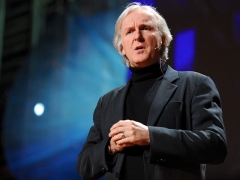
    James Cameron: Before Avatar ... a curious boyJames Cameron: Before Avatar … a curious boy James Cameron has been nominated for six Academy Awards and won three. Known for his ability to create engrossing worlds, in the talk “Before Avatar … a curious boy” at TED2010, Cameron shares why he has long been enthralled by the fantastic.
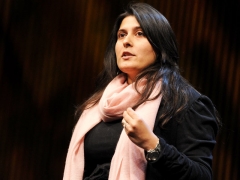
    Sharmeen Obaid-Chinoy: Inside a school for suicide bombersSharmeen Obaid-Chinoy: Inside a school for suicide bombers The 2012 documentary Saving Face follows a plastic surgeon as he journeys through Pakistan, performing reconstructive surgery for women who’ve been the victims of acid attacks. The powerful film won the Oscar for Best Documentary. At TED2010, director Sharmeen Obaid-Chinoy — a TED Senior Fellow — shared footage from another project, taking us “Inside a school for suicide bombers.”

    Jane Fonda: Life's third actJane Fonda: Life's third act Jane Fonda won her first Oscar for Klute in 1971, and her second for Coming Home in 1978. At TEDxWomen 2011, the actress and exercise video enthusiast shared her thoughts on “Life’s third act.”
    Jeff Skoll makes movies that matterJeff Skoll makes movies that matter At TED 2007, Jeff Skoll gave us the one rule he has for picking projects to produce: that they must be movies that matter. Skoll’s film company, Participant Media, has made five Oscar winners, including Syriana, An Inconvenient Truth and The Help.
    Don Levy: A cinematic journey through visual effectsDon Levy: A cinematic journey through visual effects Don Levy took us through a cinematic journey of visual effects with the help of the Academy of Motion Picture Arts and Sciences at TED2012. The head of marketing and public relations for Sony Pictures Imageworks, he led the awards campaigns for the studio’s first win, for the short The ChubbChubbs in 2003, through their win for Best Visual Effects for Spider-Man 2 in 2005.

    Other TED connections worth noting:

    • Producer Jake Eberts — known for taking on bold projects like Chariots of Fire, Gandhi, Dances with Wolves and March of the Penguins — has been involved with the making of movies that garnered 66 Oscar nominations, including nine Best Picture nominees. Eberts sadly passed away in 2012, but before his death, often showed film clips at TED — generally unposted because the footage was embargoed. Here, a recap of his talk from TED2009.
    • Morgan Spurlock, who gave the talk “The greatest TED Talk ever sold” at TED2011, was nominated for his documentary Super-Size Me.
    • Composer James Horner won two Oscars for his work in Titanic, including Best Original Song for “My Heart Will Go On.” Horner desconstructed a scene from the epic film at TED2005.
    • Jeffrey Katzenberg, founder and CEO of DreamWorks Animation, spoke several times at TED in the early days. His company made Beauty and the Beast, the first animated film to be nominated for Best Picture, and won Best Animated Feature Film in 2001 for Shrek.
    • Producer Lawrence Bender, whose films have gotten 29 Academy Award nominations in total, has also spoken briefly at a TED.
    • Ben Affleck, who created a playlist of his favorite TED Talks, directed and starred in Argo — nominated for seven awards this year, including Best Picture and Adapted Screenplay.
    • Longtime TED community member Philipp Engelhorn got a Best Picture nod this year for Beasts of the Southern Wild, which he executive produced.

  • LinkedIn Influencers on TED2013: Tips for speakers, tips for conference-goers

    Nilofer-MerchantLinkedIn’s Influencers are 200+ of the thought leaders in their fields.  And since several of them will be heading to TED2013, both as speakers and as attendees, the site has invited several to write about the experience. Check out LinkedIn’s TED2013 feature page for these essays, as well as curated articles about the conference from around the internet. Below, some of our favorite excerpts.

    Secrets from a TED2013 speaker: Preparing for the “Talk of One’s Life”

    By Nilofer Merchant

    A few days from now, I’ll be delivering a talk on the main TED stage. Right alongside Bono, the world-famous rockstar .

    Giving a TED Talk is often characterized as “giving the talk of your life.” But this one is even more significant for me: It’s my chance to redeem myself. I spoke in 2012 at TEDGlobal, but I wasn’t thrilled with my performance. I did alright, but I didn’t deliver a seriously kick-ass talk, and I hope to apply what I’ve learned. Read the full of the essay »

    How to Get the Most from a Conference

    By Don Peppers

    As an author and professional speaker I’ve personally attended more than a thousand conventions, conferences and trade shows in dozens of different countries over the last 20 years – big and small, open-enrollment and single-company, exciting and boring, entertaining and academic. Attending conferences is one of the perks of “living mouth to hand” as I do, and I almost always benefit in some way.

    But not all conferences have content as thrilling as TED or networking opportunities as rich as SXSW. I’ve even found myself at one or two conferences that drew more speakers than attendees, which tends to suck the energy out of everything. So it pays to know how to get the most benefit from an event. Read the full essay »

    The TED Talk that Changed My Company

    By Geni Whitehouse

    It was May of 2010. A group of accountants convened in San Francisco to gain pearls of wisdom from thought leader Edi Osborne and her team at Mentor Plus. She started the gathering with Simon Sinek’s video on TED.com. Edi then lead us through a series of discussions that included a question for each CPA in attendance.

    The video has a simple message, but its implications were huge. For most of us, it was easier to talk about how and what we did. Understanding why we were there and what we believed took some time. Read the full essay »

    3 tips for TED Speakers (and other talkers)

    By Dan Pink

    Okay, so yeah. TED is amazing. It’s a culture-shaping, era-defining, not entirely uncontroversial extravapalooza that has earned the mind share, eyeballs, and admiration of tens of millions of global citizens. I had a chance to do a TED Talk a few years ago. And a short time after that, my pal Bruno Giussani, one of TED’s impresarios, asked me to write up some advice for future speakers.

    In honor of this year’s TED conference, I’m reprising that guidance for LinkedIn readers — and anyone else trying to move others by standing and delivering. Here are my three key tips. Read the full essay »

    Read more on LinkedIn »

  • A look at TED, from 1984 through the present

    JR-in-TED-lettersThe first TED was held in 1984, the year George Orwell imagined in his classic novel. The second was held in 1990. In 2006, TED Talks were offered online for the first time, free to anyone across the world who wanted to watch. In 2009, TED moved to its current home in Long Beach, California.
    As we prepare for TED2013 — the anticipation of this year’s crop of bold, inspiring talks tingling through our minds — it also feels like a great time to look back. Here, a stroll down TED memory lane with 16 classic talks, starting at the very beginning. Watch these talks to get in the spirit for TED2013: The Young. The Wise. The Undiscovered. — which kicks off Monday, February 25. We’ll be covering every moment of the conference here on the TED Blog, with posts on each speaker, plus photos, galleries and more.

    But before the new, the nostalgia …

    Nicholas Negroponte, in 1984, makes 5 predictionsNicholas Negroponte, in 1984, makes 5 predictions
    Nicholas Negroponte, in 1984, makes 5 predictions
    Nicholas Negroponte, the founder of MIT Media Lab, must have consulted a crystal ball when writing his talk for our very first TED conference in1984. Here, he predicts what’s next in tech with startling accuracy: CD-ROMs, web interfaces, service kiosks, the touchscreen interface of the iPhone and his own One Laptop per Child project.
    Frank Gehry as a young rebelFrank Gehry as a young rebel
    Frank Gehry as a young rebel
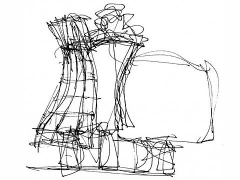
    Architect Frank Gehry is now a legend. But at TED2, in 1990, his work was just becoming known in the mainstream, two years after his first retrospective exhibit at New York’s Whitney Museum. In this talk, he walks us through his early work — from the American Center in Paris to his own house in Venice Beach.
    Danny Hillis: Back to the future (of 1994)Danny Hillis: Back to the future (of 1994)
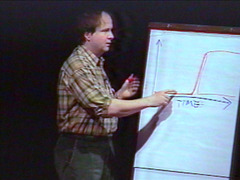
    Danny Hillis: Back to the future
    Technology seems to be advancing at an increasingly rapid clip. In this talk, given at TED6 in 1994, Danny Hillis shares an intriguing theory as to why this appears to be the case — it may have something to do with evolution itself. Note: the pad and paper, as this was pre-PowerPoint.
    Paul MacCready on nature vs. humansPaul MacCready on nature vs. humans
    Paul MacCready on nature vs. humans
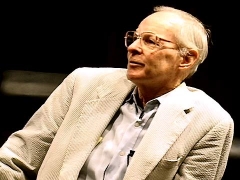
    At TED8, in 1998, Paul MacCready describes our world as one where humans have dominated nature. And so, he says, we have a responsibility to protect it for the next generation. In an early call for us to respect our planet, MacCready shares his contributions: the electric car, solar planes and efficient gliders.
    Eva Zeisel on the playful search for beautyEva Zeisel on the playful search for beauty
    Eva Zeisel on the playful search for beauty
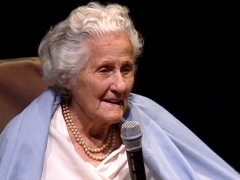
    Ceramics designer Eva Zeisel has been working since 1926. At TED11, in 2001, she shared how a sense of play and a love of beauty has kept her work fresh for decades.
    Kary Mullis celebrates the experimentKary Mullis celebrates the experiment
    Kary Mullis celebrates the experiment
    The experiment is a beautiful thing, says biochemist Kary Mullis in this talk from TED2002. Here, he marvels at the fact that the experiment is only 350 years old and shares stories — some very old, some his own — about the wonder of scientific inquiry.
    Steven Johnson on the Web as a citySteven Johnson on the Web as a city
    Steven Johnson on the Web as a city
    At TED2003, Steven Johnson gives us a captivating analogy for understanding the internet. In this talk, he shows how both are built by many, yet controlled by no one, and that both are intricately interconnected while being an accumulation of independent parts. And notice that he’s the first person on this list to stand up?
    Sheila Patek clocks the fastest animalsSheila Patek clocks the fastest animals
    Sheila Patek clocks the fastest animals
    Who knew that mantis shrimp were so fast? At TED2004, biologist Sheila Patek shared her work studying incredibly fast animal movements and how her research on mantis-shrimp feeding requires a camera that records at 20,000 frames per second.
    Kevin Kelly: How technology evolvesKevin Kelly: How technology evolves
    Kevin Kelly: How technology evolves
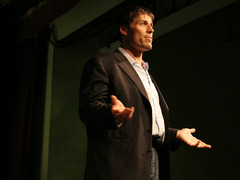
    Kevin Kelly is the founding executive editor of Wired and the former publisher/editor of the Whole Earth Review. In this talk from TED2005, he asks an unusual question: What does technology want? Because its movement toward complexity reminds him of evolution.
    Tony Robbins: Why we do what we doTony Robbins: Why we do what we do
    Tony Robbins: Why we do what we do

    For TED2006, Tony Robbins whittled down his 50-hour workshop to its essence — looking at the why behind the things we do. This talk is one of the first six posted on TED.com along with talks from Al Gore, David Pogue, Majora Carter, Ken Robinson and Hans Rosling.
    Ngozi Okonjo-Iweala: Want to help Africa? Do business hereNgozi Okonjo-Iweala: Want to help Africa? Do business here
    Ngozi Okonjo-Iweala: Want to help Africa? Do business here
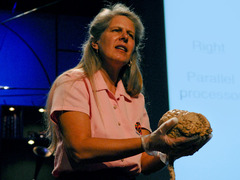
    The first woman to hold the post of Finance Minister of Nigeria, Ngozi Okonjo-Iweala worries that people are only familiar with the Africa of malaria, HIV, deep poverty, government corruption and ethnic conflicts. In this talk from TED2007, she introduces us to the Africa that is changing and quickly becoming a place of opportunity.
    Jill Bolte Taylor's stroke of insightJill Bolte Taylor's stroke of insight
    Jill Bolte Taylor’s stroke of insight
    At TED2008, Jill Bolte Taylor brought the house down with this talk, the second most-viewed on TED.com. In this talk, Bolte Taylor shares the terrifying morning when she had a stroke, and was helpless as her brain function shut down. It’s an amazing story — one that will never let you take the human brain for granted again.
    Bill Gates: Mosquitos, malaria and educationBill Gates: Mosquitos, malaria and education

    Bill Gates: Mosquitos, malaria and education
    Bill Gates made TED2009 into instant news when he opened a jar of mosquitos in the theater. His point: that there are certain problems that do not get the attention they deserve because there is no market incentive to solve then. A passionate and funny talk that connects the dots between seemingly far-flung factors.
    Jane McGonigal: Gaming can make a better worldJane McGonigal: Gaming can make a better world
    Jane McGonigal: Gaming can make a better world
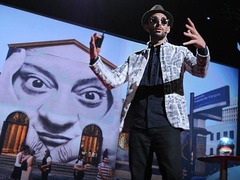
    Video game designer Jane McGonigal viscerally disagrees that video games are a distraction from solving the problems of the world. At TED2010, she outlines a bold plan  to tackle some of these problems through games with a social purpose.
    JR's TED Prize wish: Use art to turn the world inside outJR's TED Prize wish: Use art to turn the world inside out
    JR’s TED Prize wish: Use art to turn the world inside out
    Artist JR’s oversized posters have created dialogues in cities across the world, bringing attention to the faces of people who are too often forgotten. In this talk from TED2011, JR shares his wish — for people everywhere to join him in a global art project.
    Bryan Stevenson: We need to talk about an injusticeBryan Stevenson: We need to talk about an injustice
    Bryan Stevenson: We need to talk about an injustice
    The United States has the highest incarceration rate in the world. At TED2012, Bryan Stevenson looks at how this distorts sharply around race and socioeconomics, creating a sense of despair in minority communities. It’s a personal and moving talk — one that set TED2012 on fire.

    Stay tuned to the TED Blog for full coverage of TED2013 »

  • 4 surprising lessons about education learned from data collected around the world

    AndreasSchleicherEducation is generally thought of as a domestic policy issue. But what can we learn by looking at education on the global scale?

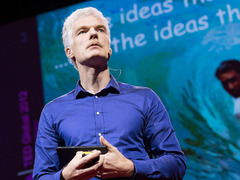
    Andreas Schleicher: Use data to build better schoolsAndreas Schleicher: Use data to build better schools

    In today’s talk, given at TEDGlobal 2012, Andreas Schleicher introduces us to a test that measures school systems and student achievement in countries across the globe—PISA (the Programme for International Student Assessment), an initiative of the OECD (Organisation for Economic Co-operation and Development). PISA not only tests students on their mathematical understanding, reading level and ability to apply learning to new problems, but also looks at what teachers get paid, how long the school day is, what the average class size is and whether quality of education is uniform across schools and social stratifications. It even measures cultural attitudes, like whether people in the country expect all students to achieve or only a small segment of them to. It’s this broad approach to data collection that makes PISA so powerful, says Schleicher.

    “The test of life is not whether we can remember what we learn in school, but whether we are prepared for change,” says Schleicher. “Whether we are prepared for jobs that haven’t been created and to use technology that haven’t been invented to solve problems we just can’t anticipate today.”

    Education-level-by-countryIn the 1960s, the United States led the world in the number of students graduating high school. But by the 1990s, it had become 13th—not because their standards dropped, as Schleicher points out, but because so many other countries raised the level of education they were providing. In the same time period, Korea went from number 27 on this measure to number 1. Similarly, in 2000, Germany ranked low on PISA, their scores revealing wide disparity between schools. The ranking kicked off a national debate that forced policymakers to react and, nine years later, their system showed great improvement. The point: that countries are able to make drastic improvements in education in relatively short periods of time. And now, school systems can learn from each other.

    “Of course you can’t copy and paste education systems wholesale,” says Schleicher. “But these comparisons have identified a range of factors that high-performing systems share.”

    To hear what these factors are, watch this talk. And here, some surprising initial findings that PISA has uncovered.

    1.    Extracurriculars may not be just extras.

    For educators and politicians looking to trim education costs, extracurriculars seem like an obvious place to start. But PISA data suggests that extracurriculars may have direct links to performance. In a PISA survey from 2006, principals were asked about the kinds of science extracurricular activities they provided — like field trips, science fairs and science clubs. And students in schools where these things were commonly offered performed better in science — and this held true even after accounting for socio-economic background. Students in these schools also reported having a greater belief in their ability to tackle science-related problems and simply reported enjoying science more. Read more on the OECD Education Today blog.

    2.    Big spending does not necessarily make for a better school system.

    Education-spending-per-student-by-country

    On this graph, which shows PISA’s latest data from 2009, the size of the dot represents how much a country spends per student on education. This is mapped onto a graph that shows reading performance of students and socio-economic disparity seen across student performance. Interestingly, the biggest dots do not rise to the top here. Many of the school systems charting the best on both performance and equity actually spend moderately per student.

    In his talk, Schleicher shows how two countries can make very different decisions on how they spend their education dollars. He takes a look at Korea and Luxembourg, which spend comparably. While Korea spends heavily on teacher compensation and development, as well as on having a longer school day, Luxembourg focuses on keeping small class sizes. The point: it’s not what you spend, but how you spend it.

    3.    Performance-based pay may not make for better teachers.

    In a recent study, PISA looked at whether basing teachers’ pay on their effectiveness has results when it comes to student performance. They surveyed school systems where performance determines base salary, annual supplemental payments, and incidental supplemental payments. Overall, there appeared to be no relationship between student performance and whether teachers receiving one of these kinds of performance-based pay. However, when the countries were divided into nations where teachers are low paid (recieving less than 15% of the GDP per capita) versus ones where teachers are well paid (getting more than 15% of the GDP per capita), a pattern emerged. In countries where teachers are low-paid but have a performance-based pay system in place, students performed better on PISA measures. However, in countries where teachers are well paid and performance-based pay system was used, students actually performed worse. Read more on the OECD Education Today blog. 

    4. Private schools are not across the board better than public schools.

    It’s a question many parents want answered: will my child get a better education at a public or private school? The answer is that it depends. Analysis of PISA data shows that students in private schools do tend to perform better than students who attend public schools. However, there are several important caveats. When they controlled for socio-economic context — i.e. looking at public and private school in the same social strata — students performed equally well on PISA measures. And interestingly, in countries with a higher percentage of private schools, students do not perform better overall than those with lower percentages. Read more in PISA On Focus.

  • TED Radio Hour’s new season to premiere on March 1

    ted-radio-hour_300px
    Mark your calendars, please: TED Radio Hour returns to the NPR airwaves on Friday, March 1. After a popular first season — named the Best New Audio Podcast of 2012 by iTunes — NPR and TED have expanded the series into a weekly program. And for its second season, TED Radio Hour also has a new host — Guy Raz, who you probably know as the host of Weekend All Things Considered and the creator of Three-Minute Fiction.

    Each episode of TED Radio Hour will turn an extraordinary idea inside out, using incredible speakers from the TED stage as a jumping off point. With music and lush soundscapes, each episode takes you on a journey that may well flip your perspective. (Listen to the preview below.) The first two episodes of the 30-part season will be “The Unquiet Mind,” premiering on NPR on March 1, and “Peering Into Space,” debuting on March 8. Podcasts of the show will also be available through iTunes.

    Download: 60-sec-2-0.wav

    Stay tuned to the TED Blog next week for an interview with Guy Raz, where we’ll share which episodes he’s most excited for this season … and his secret skill.

  • TED Fellow Shalini Kantayya bravely shares her story of sexual assault in India

    Shalini-KantayyaAs protests roll through India, calling for punishment of six men who brutally gang raped a 23-year-old woman on a public bus in December with fatal results, TED Fellow Shalini Kantayya has written a powerful op-ed for The New York Times detailing her own sexual assault in India. Kantayya shares that event was traumatizing — a fact multiplied by the shocking indifference she received from both American and Indian authorities as she sought justice.

    Kantayya was in India, filming a documentary about political street theater, years ago. She awoke one night in her hotel room to find a man holding her down on her bed, his hands violently over her mouth. She recognized the man as the waiter who had served her dinner that night in the hotel restaurant.

    “I was biting and kicking, using every ounce of my energy to fight for my life. My mouth was badly bleeding and in the struggle we fell to the floor,” writes Kantayya. “He picked up his lungi and said, ‘I’ll leave. Don’t tell the manager.’ Then he ran out and shut the door. Did he really think he could try and rape me in my sleep, without protest and that I wouldn’t tell? Yes. He did. He counted on the fact that he lived in a culture that blamed the victim — that the stigma associated with sexual assault would force a woman to keep quiet. And although I had escaped the worst-case scenario, and prevented a rape, the nightmare was far from over.”

    As Kantayya writes, no one responded to her complaints — not the hotel, nor the police, nor American authorities. The incident haunted her for years. She suffered from deep depression and was eventually diagnosed with PTSD.

    Writes Kantayya, “The recent gang rapes in India are a reminder to all of us that the rapists are not the only persons who are guilty. The onlookers, the institutions that turn a blind eye, and fail to implement comprehensive policies to address sexual assault are complicit in the violence. When these crimes are swept under the carpet, it perpetuates a culture of silence.”

    At TED2013, speaker Lakshmi Pratury will also share her effort to break this culture of silence, with her project Billionaires of Moments. This website — also on Facebook — aims to “pay homage to the young rape victim from Delhi.” It is an open forum for people to post their reactions to the brutal crime, share interesting articles and resources, and have their own stories heard. Pratury’s website went live just yesterday and already has a long scroll of entries — from women and outraged men, alike.

    Stay tuned to the TED Blog for coverage of Pratury’s talk on Thursday, February 28 — as well as all the talks from TED2013.

  • 8 talks on fighting corruption

    Afra-RaymondWhen CL Financial — the largest financial institution in Trinidad and Tobago — collapsed in January of 2009, its bailout was far more sweeping than those offered in other countries.

    Afra Raymond: Three myths about corruptionAfra Raymond: Three myths about corruption
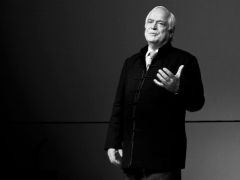
    “In an unprecedented fit of generosity — and I use that word carefully — the government of the day made a written commitment to repay all of the creditors,” says Afra Raymond in today’s talk. “It’s not just like Wall Street. Trinidad and Tobago is a place with different laws of physics.”

    In today’s talk, given at TEDxPortofSpain — which happened to be held inside Trinidad and Tobago’s Central Bank — Raymond calls for greater transparency and accountability in his government’s financial dealings. In the talk, he takes a look at several recent examples of government corruption — as well as one that has haunted him for 30 years. While Trinidad and Tobago became wealthy in the 1970s as the value of oil increased, the government quickly ran out of funds. In 1982, the Prime Minister revealed that only 1 out of every 3 dollars that had been earmarked for development had been used to produce goods and services. Sadly, 2 out of every 3 dollars had been wasted or stolen.

    To hear more about these cases of corruption — and the three myths of corruption that Raymond wants to break — watch this brave talk. And here, more talks on government corruption in countries like England, Kenya, Germany and India, that show that this is a problem without borders.

    Peter Eigen: How to expose the corruptPeter Eigen: How to expose the corrupt
    Peter Eigen: How to expose the corrupt
    Pervasive government corruption is at the root of many of the world’s most challenging social problems. In this talk from TEDxBerlin, Peter Eigen shares what his organization, Transparency International, is doing to counter it.
    Heather Brooke: My battle to expose government corruptionHeather Brooke: My battle to expose government corruption
    Heather Brooke: My battle to expose government corruption
    Tenaciously following through on Freedom of Information Act requests about members of Parliament and their expenses, journalist Heather Brooke uncovered a scandal that led to six ministers tendering their resignation. At TEDGlobal 2012, she shares the importance of checking in on our leaders.
    Shaffi Mather: A new way to fight corruptionShaffi Mather: A new way to fight corruption

    Shaffi Mather: A new way to fight corruption
    Shaffi Mather started 1298 for Ambulance, a life-saving service that brought ambulance transportation to parts of India. At TEDIndia 2009, he shares a bold idea for a company to fight corruption in public service.
    Ngozi Okonjo-Iweala: Want to help Africa? Do business hereNgozi Okonjo-Iweala: Want to help Africa? Do business here
    Ngozi Okonjo-Iweala: Want to help Africa? Do business here
    Most people know about — and maybe even expect — corruption in Africa. But at TED2008, Ngozi Okonjo-Iweala shares the lesser-told story of reform in many African nations.
    Sanjay Pradhan: How open data is changing international aidSanjay Pradhan: How open data is changing international aid
    Sanjay Pradhan: How open data is changing international aid
    Sanjay Pradhan of the World Bank Institute got a taste of corruption at just 6 years old, when a contractor, hoping to get government work from his father, delivered a cart of sweets to their doorstep. At TEDGlobal 2012, he shares how the experience shaped his approach to international aid.
    George Ayittey on Cheetahs vs. HipposGeorge Ayittey on Cheetahs vs. Hippos
    George Ayittey: “Cheetahs” vs. “hippos” in African politics
    Ghanaian economist George Ayittey unleashes a torrent of controlled anger toward corrupt leaders across Africa — and calls on the “Cheetah generation” to take back the continent.
    David Bismark: E-voting without fraudDavid Bismark: E-voting without fraud
    David Bismark: E-voting without fraud
    David Bismark demos a new system for voting that contains a simple, verifiable way to prevent fraud and miscounting — while keeping each person’s vote secret.

  • Chris Anderson livetweets: What makes an outstanding TED Talk? What are the challenges ahead for TED? And more…

    Chris-Anderson-imageTED curator Chris Anderson took to Twitter earlier today, spending an hour answering any question thrown his way by a TED enthusiast. The questions ranged from, “How will Americans respond to TED’s move to Vancouver?” to “Have you ever had someone present in sign language? See a full recap of the conversation here and, below, read some of the highlights.

  • 7 talks on monkeys, and 7 talks on mind control

    monkey-brainMiguel Nicolelis begins today’s talk by showing you what a brainstorm looks and sounds like.

    Miguel Nicolelis: A monkey that controls a robot with its thoughts. No, really.Miguel Nicolelis: A monkey that controls a robot with its thoughts. No, really.

    “This is 100 brain cells firing,” says Nicolelis. “Everything that defines what human nature is comes from these storms that roll over the hills and valleys of our brains and define our memories, our beliefs, our feelings, our plans for the future.”

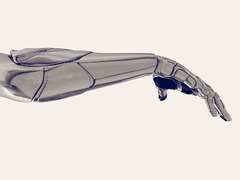
    In this talk, given at TEDMed, Nicolelis describes how his team created what they call a “brain machine interface” which uses censors to listen to brainstorms, extract their motor messages, translate them into digital commands and send them to artificial device to reproduce movement. What does this mean? A monkey, named Aurora, whose brainwaves controlled, first, a robotic arm that played video games for her and, next, a human-like avatar six times her size on the other side of the world.

    To hear more about how this works, and the implications it could have for those who’ve lost motor function — as well as for us all — watch this mind-bending talk. Here, more talks on monkeys and brain control.

    Talks on monkeys:

    1. Isabel Behncke: Evolution’s gift of play, from bonobo apes to humans
    2. Laurie Santos: A monkey economy as irrational as ours
    3. Lauren Brent: Watching monkeys make friends
    4. Frans de Waal: Moral behavior in animals
    5. Susan Savage-Rumbaugh: The gentle genius of bonobos
    6. Spencer Wells builds a family tree for humanity
    7. Jane Goodall helps humans and animals live together

    Talks on mind control:

    1. Tan Le: A headset that reads your brain waves
    2. Ariel Garten: Know thyself, with a brain scanner
    3. José del R. Millán: Mind-controlled machines
    4. Daniel Wolpert: The real reason for brains
    5. Rebecca Saxe: How brains make moral judgments
    6. Kwabena Boahen on a computer that works like the brain
    7. Ed Boyden: A light switch for neurons

  • Who’s the guy in the new Apple ad? Meet Mathieu Lehanneur

    It’s alive.

    The new Apple iPad ad, titled “Alive,” debuted last night and features a gorgeous glimpse of the recently updated TED mobile app. The spot also highlights TED speaker Mathieu Lehanneur, a designer who looks to science and nature for inspiration for problem-solving objects. Lehanneur is the man behind the living air purifier Andrea– a space age terrarium that uses plants to metabolize toxins in the air — and Local River, a mash-up of an aquarium and herb garden for locavores. His designs marry the living and the synthetic in order to tackle environmental problems.

    Mathieu Lehanneur demos science-inspired designMathieu Lehanneur demos science-inspired design

    In his talk from TEDGlobal 2009, Lehanneur demoed a handful of his most fascinating creations — like a rolling ball that neutralizes noise pollution and a week-long antibiotic course all in one layered pill. But what has Lehanneur been working on since? According to his website, his latest invention is Isaac & Graham (named to honor Sir Isaac Newton and Alexander Graham Bell), an emergency phone for hikers that generates power by the dropping of a weight. In addition to a solo show at the Grand Hornu Museum in Belgium, Lehanneur has also designed a WikiBar for The Lab Store in Paris and Take Time!, a creation that is halfway between a pocket watch and a pendulum.

  • TED Weekends takes a look at the orgasm

    Mary-RoachJournalist Mary Roach has investigated the nitty gritty of space travel, cadaver research and the afterlife. But at TED2009, she shared some of her most fascinating research yet … into the orgasm.
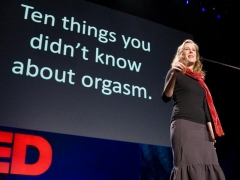
    Mary Roach: 10 things you didn't know about orgasmMary Roach: 10 things you didn't know about orgasm

    In her talk “10 things you didn’t know about orgasm,” Roach digs deep into scientific research in sexuality — much of it recent, much of it ancient — and shares several hilarious and disturbing thoughts. It’s simply a must-watch. This week’s TED Weekends on the Huffington Post digs deeper into the talk, with essays from Roach and several others. Read some selections here.

    Mary Roach: Let’s Talk About Orgasm

    In 2009, I walked onto the TED stage and gave a talk that included video of a Danish pig inseminator. The topic of the talk was orgasm, and the video related to a centuries-old debate over “upsuck”: that is, whether the contractions of the uterus during orgasm serve to draw the semen toward the egg and boost the odds of conception. In pigs, research suggests, this is the case. The inseminator up on the screen was practicing the Five-Point Stimulation Plan, a technique developed by Denmark’s National Committee for Pig Production, following research that showed a 6 percent higher farrowing rate among titillated sows. In other words, as a group, they produced 6 percent more piglets than sows inseminated while idly standing around the sty.

    William Masters and Virginia Johnson, the pioneering sex researchers of the ’50s and ’60s, were upsuck skeptics. They didn’t believe orgasm facilitated conception, at least not in humans, and they worried that the belief might be hobbling fertility research. So they set out to prove their case. Read the full essay >>

    Marnia Robinson: Why Stop Orgasm Research at Climax?

    Mary Roach’s irreverent orgasm trivia reminds us that researchers, like porn makers, tend to snap their notebooks shut right after the money shot. Yet some of the most intriguing findings about orgasm may lie beyond its brief fireworks. Post-O data could one day help solve all kinds of mysteries, such as why lovers’ libidos often go out of sync — especially after those initial“honeymoon poppers” wear off.

    After a rat satiates himself sexually (which is how rats normally mate, and requires an average of 2.5 hours and up to 7 ejaculations), he exhibits a pronounced 4-day cycle. He’s a bit fragile. His sexual motivation (libido) is nil-to-sluggish, and he’s hyper-reactive to a range of drugs. Why does this happen? Read the full essay >>

    Robert Koehler: The Sex Closet

    Mary Roach’s TEDTalk is about … well, our giggling, collective discomfort with the human body and its processes.

    While we can publicly talk about sex in all its thrilling messiness with a little more candor than we could a few generations back, we still live most of our lives within an invisible envelope of politeness. What interested me about the video at least as much as the actual stuff I learned — for instance, that the longest ejaculation of sperm Dr. Kinsey ever measured was 8 ft. — was the fact that the TED audience (and I) laughed at it all. Why is this so funny? Why does explicit commentary on sexual arcana summon up the public guffaws? Read the full essay >>

  • 6 excerpts from Korean novelist Young-ha Kim

    Young-ha-Kim-booksYoung-ha Kim has a simple message for us all: get out there and create some art. Are you getting tense, just from the suggestion?

    Young-ha Kim: Be an artist, right now!Young-ha Kim: Be an artist, right now!

    In today’s talk, given at TEDxSeoul and TED’s first ever in Korean, Kim says, “You think, ‘I’m too busy. I don’t have time for art.’ There are hundreds of reasons why we can’t be artists right now. Don’t they just pop into your head? … Perhaps you think art is for the gifted or for the professional trained. Or perhaps you think you’ve strayed too far from art.”

    When we were kids, says Kim, we were constantly creating art — drawing on the wall, making up dances, singing nonsense lyrics, putting on plays for our family, making up stories, building sandcastles. But as we get older, this impulse dulls. Not only because we hear judgment from others, but because we start taking formal lessons and it becomes less about having fun and more about doing something well.

    “Art is about going a little nuts … Kids do art for fun. It’s playing,” he says. “If you continue to act like an artist as you get older, you’ll increasingly feel pressure. People will question your actions.”

    So what happens? According to Kim, we suppress our artistic spirit. We learn to be critics, rather than taking the risk of making. Kim calls us “dictators with a remote control,“ yelling at the people on reality-TV dance and singing competitions for a flat note.

    To hear more about this tragedy — and what we can do to overcome it — watch this hilarious talk. An especially amazing image in it: Kim writing fast and furious, so that the artistic devil cannot catch him and fill his head with doubts.

    Young-ha Kim is one of the most popular writers of his generation in Korea. The author of five novels, four short story collections and numerous essays, Kim’s work mixes high and low genres and focuses on the meaning of Korean identity in increasingly globalized world.

    How popular is Kim in Korea? Not only has he won many a literary award, but two of his books have been turned into feature films with a third on the way. In fact, at the Jeonju International Film Festival taking place in spring 2013, there will be an entire program of short films based on Young-ha Kim’s short stories. Fans have even created “Kim Young-ha Bingo,” where you read 50 pages of any of his works and mark off the themes he touches on in those pages — from art references to paranoia.

    Here, some excerpts from Kim’s works, to get you better acquainted with this writer. Even though he is more interested in making sure you start typing than read what he’s created.

    From his debut book, I Have the Right to Destroy Myself

    I’m looking at Jacques-Louis David’s 1793 oil painting, “The Death of Marat,” printed in an art book. The Jacobin revolutionary Jean-Paul Marat lies murdered in his bath. His head is wrapped in a towel, like a turban, and his hand, draped alongside the tub, holds a pen. Marat has expired — bloodied — nestled between the colors of white and green. The work exudes calm and quiet. You can almost hear a requiem. The fatal knife lies abandoned at the bottom of the canvas.

    I’ve already tried to make a copy of this painting several times. The most difficult part is Marat’s expression; he always comes out looking too sedate. In David’s Marat, you can see neither the dejection nor the relief of the man who has escaped life’s suffering. His Marat is peaceful but pained, filled with hatred but also with understanding. Through a dead man’s expression David manages to realize all of our conflicting innermost emotions. Read more »

    Marilyn Monroe and Lady Gaga’s Korea (excerpted from Words without Borders)

    Marilyn Monroe came to South Korea in February of 1954. While honeymooning in Tokyo with Joe DiMaggio, she had boarded a military plane and was en route to Seoul even before the marriage was fully consummated. At the airport, she was swarmed by hundreds of GIs who had been awaiting her arrival. When she came down the gangway, Monroe was dressed in a flight suit. Reporters noted that “half of the buttons on the top were undone, offering tantalizing glimpses of her chest, which got the troops even more riled up.” According to Korean news reports from the time, the GIs were disappointed to see her immediately board a helicopter bound for the frontlines and asked her when she would return, to which she “turned on the charm like a mother comforting a child” and replied, “I’ll be right back.”

    By February of 1954, the Korean War, which had lasted for three years, had already been brought to an end under the pretext of a ceasefire, but tens of thousands of American soldiers were still stationed in South Korea. Monroe gave dozens of performances, visited wounded soldiers in field hospitals, and posed on top of tanks. In archival photos, the soldiers’ excitement as they greet her is palpable. In colorless, dirt-covered barracks, Monroe alone stands out in color, as if someone had come along later and Photoshopped her into the pictures. Before thousands of soldiers seated on a low hill devoid of even a single tree, she spreads her arms wide and sings in time with a piano. The images look like they could have come from a 1960s rock festival. Read the rest of the essay »

    From his latest book, Black Flower

    With his head thrust into the swamp filled with swaying weeds, many things swarmed before Ijeong’s eyes. All were pieces of the scenery of Jemulpo that he thought he had long ago forgotten. Nothing had disappeared: the flute-playing eunuch, the fugitive priest, the spirit-possessed shaman with the turned-in teeth, the girl who smelled of roe deer blood, the poor members of the royal family, the starving discharged soldiers, even the revolutionary’s barber — they all waited for Ijeong with smiling faces in front of the Japanese-style building on the hill in Jemulpo.

    How could all of these things be so vivid with closed eyes? Ijeong was mystified. He opened his eyes and everything disappeared. A booted foot pushed on the nape of his neck, shoving his head deep into the bottom of the swamp. Foul water and plankton rushed into his lungs. Read more »

    Ice Cream (excerpted from the Asia Literary Review)

    “Can you smell the petrol?” Mina asked him. Eugene tilted his end.

    “I’m not sure, but something’s off.”

    “C’mon, we’ve been eating these bars for ages.”

    “This one doesn’t taste right. I’m telling you, it stinks of petrol.” She was already washing her mouth out. Eugene put the remainder of the ice-cream bar in his mouth. “Are you nuts?!” she cried. He ignored her, swirling it around with his tongue, trying to detect the smell. He then spat out the mouthful.

    “You’re right. It does smell like petrol.”

    It all began when the International Monetary Fund seized control of South Korea like an occupying army. The football team were hopeless, the economy desperate and the entire nation felt as if it were on its last legs. Read the rest of the story »

    The Man Who Sold His Shadow (excerpted from Words without Borders)

    Here’s a question we all ask ourselves at least once when we’re young: Where does that starlight come from? It’s been there before I was born, and before my grandmother, and her grandmother were born. So just how far is that star from Earth? The curiosity of children is insatiable. They’ll grab a flashlight and aim it at the stars and think, “This light will get there someday, won’t it? When I’m dead, and my grandchildren are gone, and their grandchildren as well.” Whimsical thoughts, of course. Not a chance that light so faint will still be sparkling thousands of light-years from now. That’s our universe: a place where light much stronger than this vanishes without a trace.

    And another childish question: Does a bird in mid-flight have a shadow? How can such a small, light thing be burdened by something as clumsy as a shadow? But birds certainly do have a shadow. Sometimes, just sometimes, when I watch a flock fly by I have a feeling that something dark and black is flitting past. It’s subtle enough that you’ll miss it if you’re not fully concentrating on it. When the moon covers the sun, we have a solar eclipse. What do you call it when birds do that? Read the rest of the story »

    Honor Killing (a story on a napkin in Esquire)

    She was twenty-one, with fair, beautiful skin. Even when bare, her face glowed, always radiant and dewy. This was precisely why the dermatologist’s office hired her as the receptionist. Her job was simple. All she had to do was write down the patients’ names, tell them in a friendly voice, “please take a seat until we call your name,” find their charts, and hand them over to the nurses. Her glowing, translucent skin created high expectations, encouraging the patients to pour their trust in the office, which bustled with a sudden increase in patients. Read the second paragraph of this very short story »