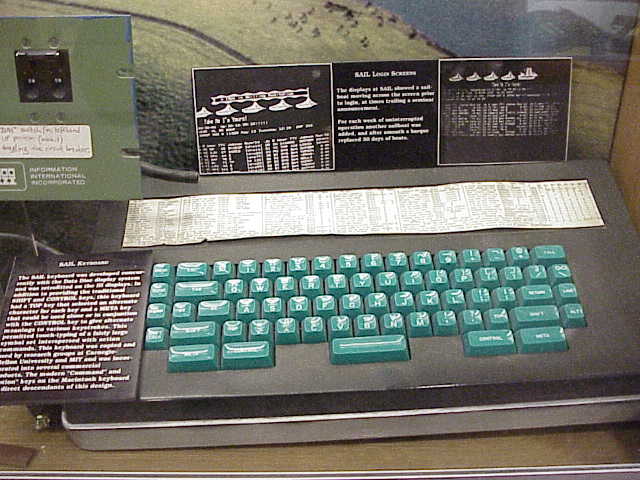
Debate rages among philosophers, linguists, and psychologists: does Quigley know that he knows that he will die?
Author: Mark Liberman
-
Quote query
In reference to the witticism “Anything you can do, I can do meta”, cited in “Doing Meta: from meta-language to meta-clippy“, 1/32/3007, Michael Smith asked:
I was wondering whether you were ever given, or able to find, a citation for “Anything you can do, I can do meta” earlier than the reported use by Samuel Hahn in 1991.
Let me explain my interest. Each year the Department of Philosophy at Princeton makes a t-shirt for the graduating class with a quotation of their choice on it. This year they’ve chosen “Anything you can do, I can do meta”, but of course they have no idea who said it. I’d quite like to be able to tell them when it first appeared in print, if that’s known.
Prof. Smith followed up with this post scriptum:
After a little further searching on Google I came up with the attached article from 1979 (see p.1230, footnote 2). However, if you know of an earlier citation, or of a credit to someone other than Lipson, I’d be grateful if you would let me know.
The attached article is Arthur Allen Leff, “Unspeakable ethics, unnatural law“, Duke Law Journal, December 1979. The passage in question reads as follows:
I shall first try to prove to your satisfaction that there cannot be any normative system ultimately based on anything except human will. I shall then try to trace some fo the scars left on recent jurisprudential writings by this growing, and apparently terrifying, realization. Finally, I shall say a few things about — of all things — law and the way in which the impossibility of normative grounding hecessarily shapes attitudes toward constitutional interpretation.2
2. My colleague, Leon Lipson, once described a certain species of legal writing as, “Anything you can do, I can do meta.” What follows is a pure instantiation of his category.
Arthur Allen Leff (1935-1981) was at Yale Law School, and so was Leon Lipson, who died in 1996. I don’t know enough about the language of law professors in the 1970s to understand the background of their use of meta.
I’m pretty sure that I heard this phrase used around the MIT AI Lab, Xerox PARC, etc., no later than 1978 and probably during the 1972-1975 period, in the context of language/meta-language issues coming out of logic and philosophy of language, and imported into discussion of programming language semantics as well as general theories of meaning. Note also that keyboards at SAIL as well as at MIT had meta keys (I think) in the late 1960s, but certainly by the mid-70s.
Can anyone document a more specific source for the quotation? (The discussion in my 2007 post, though inconclusive, is a place to start.)
The limiting time would be 1946, the date of Irving Berlin’s musical Annie Get Your Gun, in which “Anything you can do, I can do better” is the climactic song.
[Here’s a maddeningly open-textured memory — time and place uncertain, validity also uncertain. I think this was around 1978, maybe at MIT, maybe somewhere else, and Brian Smith was giving a talk about the ideas on computational “reflection” (a way for “a computational system to ‘reason’ effectively and consquentially about its own inference processes”) that were eventually laid out in his 1982 MIT PhD thesis. Afterwards, someone in the audience raised his hand and said “So what you’re saying is, ‘anything you can do, I can do meta’”. Or maybe not, and someone made the joke about Brian’s work in some other context. In either case, I don’t think it was the first time that I heard the phrase.]
-
Spelling rage
Jesse Sheidlower points out a “VERY strongly worded spelling/punctuation rant”, to be found here.
(Unless you have a very large screen, you’ll want to use “right-click>>Open link in new window”, or maybe try this link instead. Warning: some NSFW text in VERY large type…)
This seems to reach rage-o-meter values not seen since the “pilotless drone” episode.
-
The defend-your-turf area?
OK, I’m back in Philadelphia and my copy of Louann Brizendine’s The Male Brain has arrived. I still haven’t had time to read it, but I promised to look up the business about the dorsal premammillary nucleus, so here goes.
You’ll recall that Dr. Brizendine’s opinion piece at cnn.com (“Love, sex, and the male brain“, 3/24/2010) asserted thatOur brains are mostly alike. We are the same species, after all. But the differences can sometimes make it seem like we are worlds apart.
The “defend your turf” area — dorsal premammillary nucleus — is larger in the male brain and contains special circuits to detect territorial challenges by other males. And his amygdala, the alarm system for threats, fear and danger is also larger in men. These brain differences make men more alert than women to potential turf threats.
And Vaughan Bell at Mind Hacks countered that
Male and female humans are indeed the same species, but we are not a species which has a dorsal premammillary nucleus because it’s only been identified in the rat.
Furthermore, there is no reliable evidence that amygdala size differs between the sexes in humans and a recent study that looked specifically at this issue found no difference.
His link with respect to amygdala size was specific (J. Brabec et al., “Volumetry of the human amygdala – An anatomical study”, Psychiatry Res 2010), and completely contradicted Brizendine’s assertion.
But in the case of the dorsal premammillary nucleus, Vaughan could give only a link to a PubMed search, which might perhaps have missed something; so I wondered what specific support Brizendine might have cited in the book for this point.
Indeed, The Male Brain displays the same impressive flourish of endnotes and references as The Female Brain did. It has 135 pages of text, 41 pages of endnotes, and 83 pages of references. I’ll be interested to see whether the notes and references are related to the claims in the text in the same way. In several tedious posts (e.g. here, here and here), I followed up the notes and references behind specific claims in The Female Brain, and found a surprising lack of relevant connection.
I’m not sure how much more of such sleuthing I’ve got the energy for, but I promised to check out that dorsal premammillary nucleus, so here goes. (Regular readers won’t be surprised to learn that this turns out to be another beautiful example of Explanatory Neurophilia.)
The Male Brain‘s index gives us these page references for dorsal premammillary nucleus:
emotional lives of men and, 110, 111, 170-71
function of, xv
Pages xv-xvi are a picture of “The Male Brain” with ten areas singled out for attention. The header says that
Scientists think of brain areas like the ACC, TPJ, and RCZ ad being “hubs” of brain activation, sending electrical signals to other areas of the brain, causing behaviors to occur or not occur.
The third of the ten key areas (maybe more later on the nine others) is listed this way:
3. DORSAL PREMAMMILLARY NUCLEUS (DPN): The defend-your-turf area, it lies deep inside the hypothalamus and contains the circuitry for a male’s instinctive one-upmanship, territorial defense, fear, and aggression. It’s larger in males than in females and contains special circuits to detect territorial challenges by other males, making men more sensitive to potential turf threats.
There are no endnotes for this section. A quick check of the literature reveals that the DPN in rats is involved in a number of things that have nothing to do with intra-species turf defense, e.g. as described in D. Caroline Blanchard et al., “Dorsal premammillary nucleus differentially modulates defensive behaviors induced by different threat stimuli in rats“, Neuroscience Letters 345:145-148, 2003:
Lesions of the dorsal premammillary nucleus (PMd) have been reported to produce dramatic reductions in responsivity of rats to a live cat. Such lesions provide a means of analyzing the potentially differential neural systems involved in different defensive behaviors, and the relationship between these systems and concepts such as anxiety. Rats with bilateral electrolytic lesions of the PMd were run in an elevated plus maze (EPM), exposed first to cat odor and then to a live cat, and assessed for postshock freezing and locomotion. PMd lesions produced a dramatic reduction in freezing, avoidance, and stretch attend to the cat odor stimulus, and reduction in freezing, with greater activity, and enhanced stretch approach to cat exposure. However, PMd lesions had minimal effects in the EPM, and postshock freezing scores were unchanged. These results confirm earlier findings of reduced defensiveness of PMd-lesioned rats to a cat, extending the pattern of reduced defensiveness to cat odor stimuli as well, but also suggest that such lesions have few effects on nonolfactory threat stimuli.
In other words, the DPN is involved in rats’ (passive) defensive responses to the presence of a cat, or even just to cat odor, but not to other sorts of threats such as the open arms of a maze, or an electric shock to the foot, where odor is not involved. Thus the DPN is more (and also less) than “the defend-your-turf area” in rats — it responds to predator threats as well as threats from dominant conspecifics, but it’s apparently not involved in more active or aggressive forms of defense. Who knows what its homologue’s functions are in humans – but presumably the mediation of instinctive “freezing, avoidance, and stretch” responses to cat odor are not among them.
Page 110 of The Male Brain tells us:
Evolutionary biologists suggest that behaviors like bluffing, posturing, and fighting have evolved to protect males, especially from opponents within their own species. Instinctive male-male competition and hierarchical fighting is driven by both hormones and brain circuits. A special area in the male brain’s hypothalamus, the dorsal premammillary nucleus, or DPN, has been discovered, in rats, to contain circuitry for this instinctive one-upmanship. In humans, this one-upmanship and drive for status-seeking is found in men worldwide; it’s not just a habit or a cultural tradition but more like a design feature of the male brain.
Here (unlike in the earlier passage) the DPN size business is explicitly linked to research on rat brains, and the connection to human males is made only by implication.
The endnotes (p. 170) give us this:
110 circuitry for this instinctive one-upmanship: Motta 2009 found an area in the male brain’s hypothalamus, called the DPN, is activated for instinctive one-upmanship in male rats for territory protection against higher-ranking males.
That’s S.C. Motta and M. Goto, “Dissecting the brain’s fear system reveals the hypothalamus is critical for responding in subordinate conspecific intruders“, PNAS 106(12):4870-75, 2009.
As this study notes, lesion studies had previously established that (in rats) “the site most responsive to predatory threats” (specifically, cats) is “the tiny dorsal premammillary nucleus (PMD)”, though other parts of the hypothalamus are also involved. Motta and Goto’s contribution:
The experiments reported here were designed to test the hypothesis that the hypothalamus also plays a critical role in the processing and expression of fear responses to another natural danger—a dominant conspecific. For this, hypothalamic activation in response to a predator or a dominant conspecific was compared and it was shown that the PMD is critical for fear expression in both situations, supporting a critical role for the hypothalamus in both responses. Furthermore, despite similar behavior patterns displayed in both threatening situations, predator and dominant conspecific threats are processed by differentiable components of the fear system.
The dependent variable that they looked at was not “activation” in the sense of direct measures of electrical activity, but rather upregulation of the protein product Fos. Interestingly, the PMD (their acronym for the dorsal premammillary nucleus) is the part of the hypothalamus most similarly affected by the threats posed by predators and by dominant conspecifics:
Hypothalamic patterns of neuronal activation are thus strikingly different in animals exposed to a natural predator or a dominant conspecific, although they are not entirely separate. In particular, the PMD was clearly activated in both experimental groups. Careful anatomical inspection indicates, however, that PMD activation patterns are not identical in the 2 groups. Cell count analysis confirms that exposure to a predator or a dominant conspecific massively induces Fos upregulation in the PMD (F3,21 = 129.9, P < 0.0001) and that, whereas predator exposure upregulation is centered in ventrolateral regions of the PMD (PMDvl), upregulation following exposure to a conspecific resident is centered in dorsomedial regions of the nucleus.
So what we have — in male rats — is that the DPN is activated by threats from cats and from dominant conspecifics; and that the (overlapping) effects of these two threats are centered in slightly different parts of the (“tiny”) DPN, with the effect of the alpha rats being centered in dorsomedial (as opposed to ventrolateral) regions.
This is a long ways from identifying the DPN, even in rats, as “the defend-your-turf area” that “contains the circuitry for a male’s instinctive one-upmanship, territorial defense, fear, and aggression“, especially because the rat-response involved (to both predators and dominant conspecifics) is “freezing” or other passive defense reactions, not “boxing” or other aggressive or active defense behaviors, much less the general pattern of “bluffing, posturing, and fighting” that Brizendine attributes to this brain region.
(By the way, I’m also somewhat taken aback by the unsupported assertion that “drive for status-seeking” is “a design feature of the male brain”, given years of science and fiction suggesting — if anything — the opposite sexual stereotype. For a survey of one set of issues in the linguistic area, see Elizabeth Gordon, “Sex, speech and stereotypes: Why women use prestige speech forms more than men“, Language in Society 26:47-63, 1997. As a crude check on the validity of the cross-cultural concept here, a search on Google Scholar for male status-seeking returns 2,220 items, while a search for female status-seeking returns 2,050 — a random example being “Empirical Tests of Status Consumption: Evidence from Women’s Cosmetics“.)
Page 111 tells us the story of “Neil”, a patient who is anxious about the fact that the president of his firm has decided to retire:
If we could peek back into Neil’s brain in this atmosphere of unstable hierarchy, we’d see what was causing his emotional roller-coaster ride. When he thought his prospects for VP looked promising, we’d see his brain area for anticipating rewards activating, and he’d feel good. But when he thought George might get the promotion, we’d see his territoriality circuits in the DPN activating, and he’d feel haunted by the threat of losing face and forfeiting his place in the hierarchy.
Assuming that he’s a rat, that is, and that he’s “freezing” because a dominant rat has entered his cage. (In fact, Neil’s turmoil is caused by the fact that the dominant male is leaving the cage, thus putting the status hierarchy in doubt — Brizendine doesn’t cite any studies that show DPN activation in rats as a result of status uncertainty.)
There are no new footnotes for this passage — Brizendine has simply transferred some partly-analogous research from rats, where her interpretation is oversimplified and over-interpreted, to men, where we have no idea whatsoever whether Neil’s DPN is playing any special role at all in his turmoil, and certainly no idea whether it’s playing a sex-specific role.
Pages 170-171: Page 170 contains the note relevant to page 110, discussed above. Page 171 contains notes to pages 112-113 of the text, none of which say anything whatever about the DPN.
So I’m afraid that Vaughan Bell was right — Louann Brizendine’s assertions in her CNN piece about the DPN are based entirely on rat research. I think he might have gone too far in asserting that this structure “[has] only been identified in the rat”. At least, if I understand Clifford B. Saper, “Hypothalamus“, chapter 17 (pp. 513-550) in The Human Nervous System, 2004, there’s a homologous region in the human brain (though I can’t figure out for sure whether the same name is used). But there seems to be no evidence as to whether its size is sexually differentiated, and what functions it might have.
In another respect, Vaughan didn’t go far enough in calling her claims into question, since even if men and women were exactly like male and female rats in the relevant respects, she’d be elevating to the status of “the defend-your-turf area” a brain region that mediates freezing reactions to cat odor (but not non-smell-related threats) and similar passive reactions to (the smell of?) dominant conspecifics.
In thinking about these things, I recommend taking a look at Geert de Vries & Per Södersten, “Sex differences in the brain: The relation between structure and function“, Hormones and Behavior 55(5):589-596, 2009. Their abstract:
In the fifty years since the organizational hypothesis was proposed, many sex differences have been found in behavior as well as structure of the brain that depend on the organizational effects of gonadal hormones early in development. Remarkably, in most cases we do not understand how the two are related. This paper makes the case that overstating the magnitude or constancy of sex differences in behavior and too narrowly interpreting the functional consequences of structural differences are significant roadblocks in resolving this issue.
They close with this observation on “The dual function hypothesis”:
In prairie voles, the presence of a sex difference in the brain clearly does not correlate with the size of a sex difference in behavior. The species with the largest sex difference in VP [vasopressin] innervation reported to date shows some of the least conspicuous sex differences in social behavior. Apparently, the sex difference in VP can cause as well as prevent sex difference in social behavior. Because there is no reason that this dual function is VP’s prerogative, we suggested that in general sex differences in brain structure may cause as well as prevent sex differences in specific behaviors or centrally regulated functions. This dual function hypothesis is perfectly testable. To take the VP system as an example, one would predict in the former case, that blocking VP neurotransmission would blunt or eliminate sex differences and in the latter case that the same treatment would cause a sex difference that wasn’t there before. In fact, such tests have already been done; treatment with a VP antagonist blocked social recognition memory in male but not in female rats, thereby creating a new sex difference. Related to this, the V1a receptor knock-out mouse has a behavioral phenotype in males but not in females, exactly what one would predict for a system that is more important for a function in one sex than in the other.
-
My hovercraft is full of ham
Today’s Doonesbury explores the problem of over-ambitious translation:
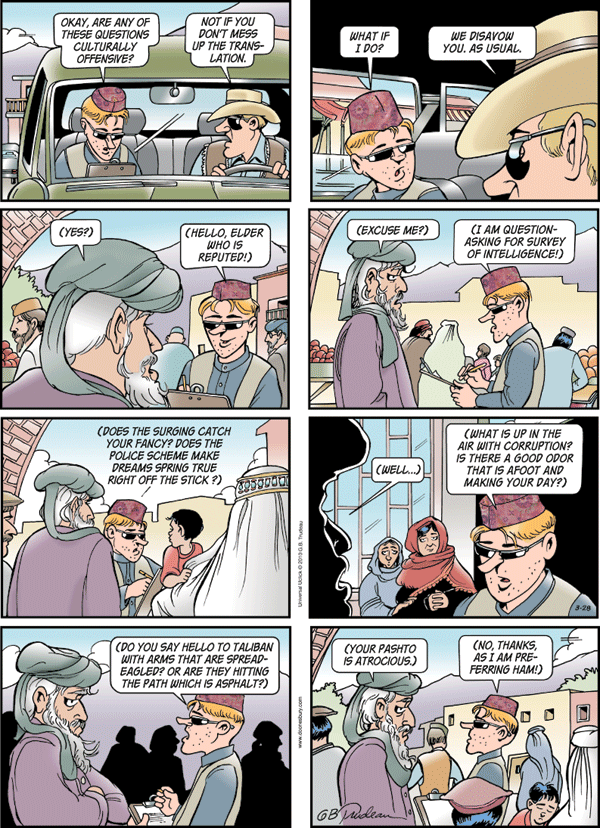
This is more realistic, but less funny, than the classic Monty Python Dirty Hungarian Phrasebook sketch:
(And then there’s Sir Richard Burton’s English/Harari Phrasebook, from the appendix to First Footsteps in East Africa…)
-
Radok? Boramander? Zulif?
According to CNN (“At least 7 arrested after raids in three states“, 3/28/1010):
Federal authorities plan to unseal charges Monday against several people arrested in a series of weekend raids in Michigan, Ohio and Indiana, prosecutors in Detroit said Sunday. […]
Mike Lackomar, a county leader for the Southeast Michigan Volunteer Militia, said the target of the raid was a Christian militia group called the Hutaree. The group proclaims on a Web site that it is “preparing for the end time battles to keep the testimony of Jesus Christ alive.”
The origin of the group’s name, Hutaree, is not explained on what seems to be their web site. And there are other linguistic mysteries to be found there, including their system of paramilitary ranks.
One of their web pages gives this list:
RANKS:
RADOK [RD]
BORAMANDER [BM]
ZULIF [ZL]
ARKON [AK]
GOLD RIFLEMAN [GR]
SILVER RIFLEMAN [SR]
BRONZE RIFLEMAN [BR]
LUKORE [LK]
MASTER GUNNER [MG]
SENIOR GUNNER [SG]
GUNNER [GN]I don’t see basis in biblical or military history for Radok, Boramander, Zulif, Arkon, and Lukore. They sound kind of like Pokémon names (e.g. Arbok, Charmander, Zubat, Rokon), but there’s no precedent there either.
Ideas?
Update — details of the indictments are discussed here and here:
Update #2 — Pictures of eight of the nine people indicted are shown here. Their ranks are not indicated, but the accompanying article does say that their leader, David Brian Stone, “also used the name ‘Captain Hutaree’”. You’d think that he’d be a (the?) Radok, not just a mere Captain. So I wonder whether the ranks on their web page might be some peculiar sort of joke.
Certainly someone involved in building the web site has a quirky sense of humor, as shown in the “Beast Watch” page, which mingles apparently serious stuff about implantable chips and RFID bracelets as versions of the “mark of the beast”, and a link to an oh-so-serious discussions of “the potential beast government” in Europe (they think Javier Solana may be the antiChrist) and the question of a “pre-trib rapture” (they think not), with the following set of jokes about “The beast’s number”:
670 – Approximate number of the Beast
DCLXVI – Roman numeral of the Beast
666.0000000 – Number of the High Precision Beast
665.9999954 – Number of the Pentium Beast
0.666 – Number of the Millibeast
/666 – Beast Common Denominator
666 x sq. rt (-1) – Imaginary number of the Beast
1010011010 – Binary of the Beast
1-666 – Area code of the Beast
00666 – Zip code of the Beast
1-900-666-0666 – Live Beasts! Call Now! Only $6.66/minute. (Must be over 18)
$665.95 – Retail price of the Beast
$710.36 – Price of the Beast plus 6.66% state sales tax
$769.95 – Price of the Beast with all accessories and replacement soul
$606.66 – Price of the Beast at Wal-Mart
$566.66 – Price of the Beast at Costco
Phillips 666 – Gasoline of the Beast
Route 666 – Way of the Beast
666 F – Oven temperature for roast Beast
666k – Retirement plan of the Beast
666 mg – Recommended Daily Allowance of Beast
6.66 % – 5 year CD interest rate at First Beast of Hell National Bank ($666 minimum deposit)
6-6-6.xls – Spreadsheet of the Beast
Word 6.66 – Word Processor of the Beast
666i – BMW of the Beast
DSM-666 (revised) – Diagnostic and Statistical Manual of the Beast
668 – Next-door neighbor of the Beast -
Anarthrous irony
There’s been a lot of discussion of what Joe Biden apparently said to Barack Obama at the HCR signing ceremony:
When he turns to the president, some combination of careful listening and lip-reading suggests that Biden said “((this is)) a big fucking deal”.
I’m not interested in whether and how the FCC should get involved in the use of a taboo word on the air — or whether it matters that you need a good imagination to be sure that you heard it – but rather in something about the part of the remark that remains if we leave the taboo word out.
As the OED tells us, “a big deal” (with or without the taboo intensifier) is an American expression for “Something considered important; a cause for excitement or concern.” But the phrase is also “Used as an ironical exclamation to express one’s contempt for something regarded as impressive or important by another person.”
However, the contemptuous sense seems to be associated specifically with the exclamatory fragment “big deal”, where the determiner is omitted. That version can’t be used predicatively: “This is big deal” might be the boast of a Russian who never mastered the English determiner system, but it’s not something that a native speaker would say “to express contempt for something regarded as impressive by another person”.
Idiomatic contempt aside, the anarthrous exclamatory fragment “big deal” is syntactically regular, in that there are lots of other adjective+noun combinations used in a similar way. Some of them are also normally ironic, like “smooth move”, but most may be sincere: “good man”, “nice try”, “cute shoes”, “great idea”, …
There are always corresponding regular nouns phrases, like “a great idea” or “those cute shoes”. But the idiomatic irony associated with “big deal” seems to be limited to the isolated exclamatory form — and in the same way, the isolated exclamatory form in that case seems to be only the ironic idiom.
Thus vice-president Biden said “((that’s)) a big fucking deal”, and, I imagine, meant it sincerely. But if he’d said just “big fucking deal” it would have been a deflating attempt to subvert the moment.
The anarthrous exclamatory fragments are constrained in ways that are not entirely clear to me. For example, if you taste some soup with too much salt in it, you can certainly exclaim “wow, this soup is really salty!”, but the anarthrous exclamative “salty soup!” doesn’t seem to me to work.
Perhaps the exclamations are supposed to be at least nominally positive. Thus “tasty soup!” works, and “spicy soup!” seem appropriate if you like it that way, but not if you don’t. But “tough luck!”, though expressing support for the victim, involves a negative judgment about the event. I bet that someone has studied this.
The idiomatic irony of “big deal!” means that the valence constraint is inverted — you can safely say “big deal!” only to express contempt, not to express admiration. Luckily for president Obama, vice-president Biden seems to have started his remark with “this is a…”. Otherwise, the commentariat would be buzzing a different buzz.
-
What’s the Male Brain made of?
The cover of Louann Brizendine’s new book The Male Brain is puzzling.
The Female Brain’s cover was straightforward. Thus the original US edition showed the Female Brain as a tangled curly phone cord (facing left):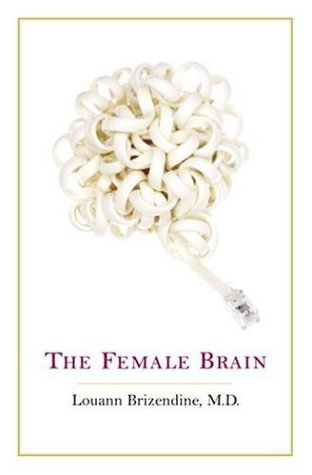
(Does anybody under the age of 35 or so actually recognize what that is anymore, by the way?)
The UK edition depicted a woman’s brain as an overstuffed purse (facing right):

But I can’t make sense of the cover of the U.S. edition of The Male Brain (except that whatever the cover’s brain made of, it’s facing left again):
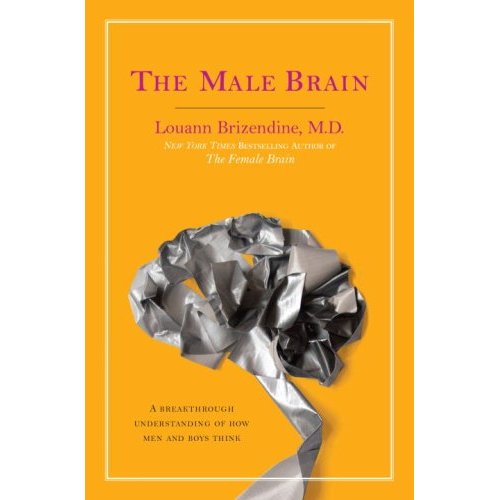
It’s not snips and snails and puppy dog tails. It looks kind of like a gray satin ribbon, which doesn’t really make much metaphorical sense. Crumpled oddly-shiny toilet paper? Duct tape? I’m stumped.
-
The male brain
Louann’s Brizendine’s The Male Brain has just come out. I haven’t read it yet — for some reason, the publisher didn’t send me a review copy — and so I’ll reserve judgment until my copy arrives. But Vaughan Bell at Mind Hacks has an evaluation (“Brizendine, true to stereotype“, 3/24/2010) based on an Opinion piece by Brizendine on CNN ‘s web site (“Love, sex, and the male brain“, 3/24/2010).
Judging by that Op-Ed, Dr. Brizendine’s new book is cut from the same cloth as her earlier one, The Female Brain. (See here, here and here for links to previous LL discussion.) Vaughan quotes this passage from the CNN piece
Our brains are mostly alike. We are the same species, after all. But the differences can sometimes make it seem like we are worlds apart.
The “defend your turf” area — dorsal premammillary nucleus — is larger in the male brain and contains special circuits to detect territorial challenges by other males. And his amygdala, the alarm system for threats, fear and danger is also larger in men. These brain differences make men more alert than women to potential turf threats.
and notes that
Male and female humans are indeed the same species, but we are not a species which has a dorsal premammillary nucleus because it’s only been identified in the rat.
Furthermore, there is no reliable evidence that amygdala size differs between the sexes in humans and a recent study that looked specifically at this issue found no difference.
The reference to sex (non-)differences in amygdala size is specific and telling (J. Brabec et al., “Volumetry of the human amygdala – An anatomical study”, Psychiatry Res 2010). Dr. Brizendine is clearly up to her old tricks here, confidently setting out “scientific facts” that are unsupported (or even contradicted) by the scientific literature.
But the issue about the dorsal premammillary nucleus is less clear to me — Vaughan bases his debunking on a PubMed search, which does turn up only references to work in rodents. But maybe Brizendine has found some work that measures this small and obscure piece of the brain in male and female humans — I’ll take a look at the footnote(s) provided for this point in her book. (I don’t expect to find anything relevant, alas, but fair is fair.)
Overall, as Vaughan points out,
The rest of the article is full of Brizendine’s usual style which is to take a common stereotype of male or female behaviour and than to ‘explain’ it with a overly-simple, one dimensional and usually not directly tested brain explanation.
He cites this specific example:
All that testosterone drives the “Man Trance”– that glazed-eye look a man gets when he sees breasts. As a woman who was among the ranks of the early feminists, I wish I could say that men can stop themselves from entering this trance. But the truth is, they can’t. Their visual brain circuits are always on the lookout for fertile mates. Whether or not they intend to pursue a visual enticement, they have to check out the goods.
His comment:
Got that? Testosterone is responsible for men looking at breasts, perhaps even falling into an irresistible tit-driven trance, and we can’t help it. Are there any scientific studies on whether hooter staring is related to testosterone levels? (Sadly) No.
In general, this new book certainly looks like another collection of what I’ve called scientific bible stories:
As I’ve watched the reaction to Louann Brizendine’s book over the past few months, I’ve concluded that “scientific studies” like these have taken over the place that bible stories used to occupy. It’s only fundamentalists like me who worry about whether they’re true. For most people, it’s only important that they’re morally instructive.
What would the producers of CNN Headline News, NPR’s “Wait, wait, don’t tell me” or the BBC’s “Have I got news for you” say, if presented with evidence that they’ve been peddling falsehoods? I imagine that their reaction would be roughly like that of an Episcopalian Sunday-school teacher, confronted with evidence from DNA phylogeny that the animals of the world could not possibly have gone through the genetic bottleneck required by the story of Noah’s ark. I mean, lighten up, man, it’s just a story.
-
Hegans
You’ve met the femivores, now “Meet the Hegans“.
-
Tarski’s theory of truth as a reason to leave linguistics?
According to Elif Batuman, “Confessions of an Accidental Literary Scholar“, The Chronicle Review, 2/12/2010:
I didn’t care about truth; I cared about beauty. It took me many years—it took the experience of lived time—to realize that they really are the same thing.
In the meantime, I became a linguistics major. I wanted to learn the raw mechanism of language, the pure form itself. For the foreign-language requirement, I enrolled in beginning Russian: Maybe someday I could answer my mother’s question about what Tolstoy was really trying to say in Anna Karenina.
The nail in the coffin of my brief career as a linguist was probably a seminar I took that winter about the philosophy of language. The aim of this seminar was to formulate a theory that would explain to a Martian “what it is that we know when we know a language.” I could not imagine a more objectless, melancholy project. The solution turned out to consist of a series of propositions having the form “‘Snow is white’ is true if snow is white.” The professor, a gaunt logician with a wild mane of red hair, wrote this sentence on the board during nearly every class, and we would discuss why it wasn’t trivial. Outside the window, snow piled deeper and deeper.
By contrast with the philosophy of language and my other classes in psycholinguistics, syntax, and phonetics, beginning Russian struck me as profoundly human. I had expected linguistics (the general study of language) to resemble a story, and Russian (the study of a particular language) to resemble a set of rules, but the reality was just the opposite.
Apparently Batuman was an undergraduate at Harvard, so some people whose 02138-ology is more current than mine should be able to decode the identity of that gaunt logician. Good academic gossip, I guess, but I don’t care much (although I do wonder what department (s)he was in). Rather, I’m interested in the idea that Tarski’s theory of truth should be the critical factor in a young woman’s decision to abandon linguistics.
According to the Stanford Encyclopedia of Philosophy,
Alfred Tarski (1901–1983) described himself as “a mathematician (as well as a logician, and perhaps a philosopher of a sort)” (1944, p. 369). He is widely considered as one of the greatest logicians of the twentieth century (often regarded as second only to Gödel), and thus as one of the greatest logicians of all time. Among philosophers he is especially known for his mathematical characterizations of the concepts of truth and logical consequence for sentences of classical formalized languages, and to a lesser extent for his mathematical characterization of the concept of a logical constant for expressions of those same languages. Among logicians and mathematicians he is in addition famous for his work on set theory, model theory and algebra, which includes results and developments such as the Banach-Tarski paradox, the theorem on the indefinability of truth (see section 2 below), the completeness and decidability of elementary algebra and geometry, and the notions of cardinal, ordinal, relation and cylindric algebras.
I’ve often complained about the fact that linguistics as an academic discipline formed late, left with scraps from the table of many already well-established fields: anthropology, education, literary studies, classical and modern languages, mathematics, philosophy, psychology, sociology, speech pathology, and so on. For both external and internal reasons, the field has tended to accept a narrow definition of its scope, at the same time as many other fields (especially anthropology and language departments) have largely lost interest in linguistic analysis.
In philosophy, the “linguistic turn” (which Tarski took part in) was given that name only on its tombstone, so to speak. When language was at the center of philosophy, for better or for worse, linguistics as an academic field got little or no bureaucratic benefit. Now the philosophers’ focus has mostly shifted.
And the only time (as far as I can tell) that the Chronicle of Higher Education has ever referred to Tarski, he’s the intellectual bad guy in an anecdote about abandoning linguistics for literary studies. Typical.
-
Talking Osage
An interesting discussion by Ryan Red Corn about efforts to revive the Osage language:
No longer than a short while after the program got up and running did the tribe watch its last first language Osage speaker pass away, Lucille Roubedeaux.
As Uncle Mogre explained, “This is the last train out. If we can’t get it done this time around, then that’s it. There is no more after this. That’s it.” Everyone who ever heard those words fully understood the gravity of the situation, and decided that they did not want the language dying on their watch, including myself. […]
With the introduction of the language department, dedicated students and teachers started to create new speakers for the first time in only God knows how many years. It’s quite literally been close to 200 years since the last time the number of Osage speakers INCREASED. It’s difficult to take into account what this scrappy bunch of Osages has done until you put it into perspective. The Vatican even called to verify the miracle (Ok I made that last part up).
As you can imagine, opinions (and actions) about the importantance of language revitalization efforts vary:
Not long after bearing witness to this feat, I found myself at an Indigenous language conference in Stroud, Oklahoma. Story after story, I heard language department directors talk about battling their respective tribal governments over their efforts to preserve their respective community’s languages. You should have seen the looks on their faces as I explained in Osage country we had created a situation where it was political suicide to go AGAINST the language. I proudly boasted the triumphs of Uncle Mogre and his crew to a bunch of drop jawed faces. Of course some of the elders in the room didn’t believe me simply because they know Osages are always bragging and making stuff up that isn’t true to make themselves sound real keen. I’ll admit I might have embellished a little…..but not much. Honest. We just want to put our best foot forward. Be the best we can. It’s a pretty simple yet good philosophy to live by.
My tales of Uncle Mogre’s language exploits went far and wide, causing other programs to come check it out for themselves. They came to see how a program with no first language speakers, being led by a man with no formal training in education or linguistics, sufficiently funded by his tribal government had attained such a feat.
But:
Fast forward to January, 2010. The Osage Nation Government passes a budget bill that cuts $120,000.00 with six line items receiving $1 in their budgets. Ouch… Meat Pie sale anyone?
Still:
Last weekend right off the heels of the budget cuts, about fifteen Osages met, on their own dollar, at the White Hair Museum between Fairfax and Hominy. They met for the language program’s monthly language immersion event.; usually meeting once a month on a Sunday at various places like museums or the zoo etc. I have been to a few of these events and always enjoy myself.
We were greeted by Stephanie Rapp in the entrance where we looked at ribbonwork, old pictures, videos and books. I was accompanied by my freshly anointed pregnant wife Electa. We sat around talking as much Osage as we could for the better part of the afternoon.
I am hoping this program remains well supported by its government. I want those waterboys at the end of the bench to have what I have enjoyed from this program over these last years. And most importantly I want the program to make possible my dream of creating the first, first language speaker our family has had since my grandpa spoke as a young boy. An audacious braggadocios improbable feat I know. But then again I’m Osage I can’t help but do it up right. WA.SHKA^ as they say, do the best you can. I’m about to be a dad. I got to start thinking about these types of things.
You see…regardless of whether or not those in the Osage Nation Congress who pushed for these cuts and then voted this budget to the Chief’s desk to be signed realize it or not, Osages are going to convene. On their own dollars if necessary, and simply do one thing. Talk. About what isn’t the point. The point is, they will talk.
Some useful background information is here.
[Hat tip to Carrie Shanafelt.]
-
Disfluency gap
Is there one? Chris asks the question, citing a collection of LL posts.
Though George W. Bush certainly took his share of (in my opinion) unfair criticism on this issue, I should point out that Howie Carr’s long-running Wizard of Uhs feature was focused on Ted Kennedy, and there’s been a fairly large-scale attempt to transfer this epithet to Barack Obama, which hasn’t really caught on, except in a diluted form as the Teleprompter Meme.
-
Guys
Erin McKean, “Hey guys! Yes, ladies, this means you“, Boston Globe, 3/21/2010:
In the study of peevology, language subdivision, one of the more fertile areas of inquiry is the long list of things that people are annoyed to be called. Not the truly offensive terms — none of which can be printed here, and all of which have a level of discomfort far higher than “pet peeve’’ — but the more general terms, whose offense is often magnified when they’re used by strangers involved in a commercial transaction.
Some people hate to be called “honey,’’ or “sugar.’’ A few feel that any use of “hey’’ as an attention-getter is rude (with the classic retort being “Hey is for horses’’). Others believe that being called “ma’am’’ ages them 10 years. But one of the more widespread vocative peeves, at least for women, is being addressed as “you guys.’’
Whether it’s the group e-mail that opens “Hi Guys!’’ or the waiter who says “OK, guys, your table is ready,’’ the use of “you guys’’ for groups of mixed gender (and even for all-female groups) can send the needle on many peeve-ometers into the red.
Later in the article, Erin makes an important point:
Just to be clear, I’m not saying that anyone, male or female, doesn’t have the right to be offended at being called “you guys.’’ This is America; you’re allowed to be offended by whatever you choose. You can be offended at not being addressed “Commander SnorkelFritz, Hero Third Class of The Loompian Hegemony,’’ and I will fully support your indignation…and not just because I want to see your uniform, commander.
And she’s not kidding about the uniform, by the way.
-
Common Core State Standards
Sandra Wilde writes:
The National Governors’ Association has just published a draft version of new Common Core State Standards for English Language Arts and Literacy in History/Social Sciences, which are open for public comment. I’m an education professor in the area of literacy with a special interest in grammar and related topics, and was wondering if you or other authors of Language Log would be interested in creating a post about them, since I know there have often been comments on the blog about published grammar advice for teachers. These standards are a big deal, since 48 states have agreed to adopt them. They’re likely to have a big impact on curriculum for the foreseeable future.
SW suggests that LL readers may want to read the draft and submit comments, and that some discussion in LL posts and comments may be useful. According to the commoncore.org web site, “These standards are now open for public comment until Friday, April 2″.
I haven’t had a chance to do more than skim the draft, but meanwhile, the comments section on this post is open.
-
Two cultures
Many years ago, as a grad student attending an LSA summer institute, I took a course from Harvey Sacks and Emanuel Schegloff based on their work with Gail Jefferson, published as “A simplest systematics for the organization of turn-taking in conversation“, Language 1974. That paper’s abstract:
The organization of taking turns to talk is fundamental to conversation, as well as to other speech-exchange systems. A model for the turn-taking organization for conversation is proposed, and is examined for its compatibility with a list of grossly observable facts about conversation. The results of the examination suggest that, at least, a model for turn-taking in conversation will be characterized as locally-managed, party-administered, interactionally controlled, and sensitive to recipient design. Several general consequences of the model are explicated, and contrasts are sketched with turn-taking organizations for other speech-exchange systems.
At the recent IEEE ICASSP meeting in Dallas, one of the papers that caught my eye was Chi-Chun Lee and Shrikanth Narayanan, “Predicting interruptions in dyadic interactions“, ICASSP 2010. Their paper starts like this:
During dyadic spontaneous human conversation, interruptions occur frequently and often correspond to breaks in the information flow between conversation partners. Accurately predicting such dialog events not only provides insights into the modeling of human interactions and conversational turntaking behaviors but can also be used as an essential module in the design of natural human-machine interface. Further, we can capture information such as the likely interruption conditions and interrupter’s signallings by incorporating both conversation agents in the prediction model (we define in this paper the interrupter as the person who takes over the speaking turn and the interruptee as the person who yields the turn). This modeling is predicated on the knowledge that conversation flow is the result of the interplay between interlocutor behaviors. The proposed prediction incorporates cues from both speakers to obtain improved prediction accuracy.
This work comes out of Shrikanth Narayanan‘s SAIL (“Signal Analysis and Interpretation Laboratory”) at USC, where a lot of interesting work is done. But before going on to tell you a little more about this work on interruption-prediction, I want to note the curious lack of communication between the disciplinary configurations represented by these two quoted passages.
Reading the two passages, an outsider might think that the researchers responsible for them were working on the same range of problems, and even in the same general disciplinary tradition, modulo the changes to be expected over a timespan of 35 years. But in fact, they come from two radically different traditions, which may or may not be mutually intelligible, but in any case are almost entirely without any direct communication.
Manny Schegloff is still an active researcher, in the sociology department at UCLA, roughly ten miles away from USC. I suppose that Schegloff and Narayanan must know of one another’s existence. However, in documents on SAIL’s website, Schegloff is never cited or mentioned. (This is not an indexing problem, since e.g. Liz Shriberg is cited 49 times, as well she should be. ) And the lack of communication is apparently mutual — Narayanan is apparently not mentioned in any of Schegloff’s publications.
I wouldn’t normally comment on this sort of thing, but I couldn’t quite resist the irony of two researchers working on communicative interaction, at institutions less than ten miles apart, without any communicative interaction. Still, I should make it clear that this is not a matter of personal relationships, as far as I know, but rather the typical circumstance of disciplinary isolation. The world of speech and language research could be described as a sort of intellectual Balkans, except that the norm is not so much mutual hatred as mutual ignorance. There are at least half a dozen major cultures, and dozens more minor ones, all living and working more or less as if they were separated by impassable mountains and unfordable rivers.
OK, back to Lee and Narayanan’s interesting work on interruption:
We used the IEMOCAP database for the present study. It was collected for the purpose of studying different modalities in expressive spoken dialog interaction. The database was recorded in five dyadic sessions, and each session consists of a different pair of male and female actors both acting out scripted plays and engaging in spontaneous dialogs in hypothetical real-life scenarios. In this paper, we are interested in the spontaneous portions of the database since they closely resemble real-life conversation. During each spontaneous dialog, 61 markers (two on the head, 53 on the face, and three on each hand) were attached to one of the interlocutors to record (x, y, z) positions of each marker.
Here’s what the marker positions were like:
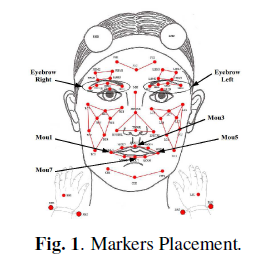
The basis of the study was a comparison of 130 interruptions and 252 “smooth transitions”: In total, we annotated 1763 turn transitions in which 1558 were smooth transitions and 215 were interruptions. Since the distribution of these two types of turn transitions is highly unequal, we downsampled the data by including only three sessions (six subjects) of the IEMOCAP database with three dialogs chosen for each recording session. Subjects and dialogs were selected to include a majority of the annotated interruptions. In total, there are 382 turn transitions annotated with 130 interruptions and 252 smooth transitions used as our dataset in this paper.
Thus in classifying transitions as “interruption” or “smooth”, the baseline performance is what you get by always guessing “smooth”, namely 252/382 = 66%. Using the face and body-gesture features of the interrupte, and various acoustic features of the interruptee, both taken during a one-second period prior to the transition, Lee and Narayanan were able to do a bit better than this:
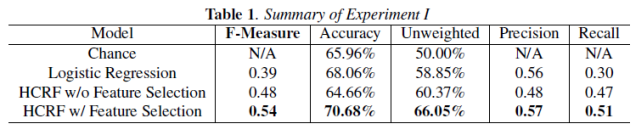
Logistic regression got them to 68%, and a “hidden conditional random field” model, with some special attention to feature selection, got them nearly to 71%. (The “Precision” and “Recall” values mean that in their best-performing model, 57% of the transitions predicted to be interruptions actually were interruptions, while 51% of the interruptions were predicted to be such. And they used a cross-validation approach, so that the numbers are not inflated by testing on the training set.)
The most striking fact about this result, it seems to me, is that interruptions turn out to be so hard to predict, at least in this particular collection of interactions. I wouldn’t have predicted that.
They also tried predictions based only on one side or the other of the interaction. Here again, the results are a bit surprising:
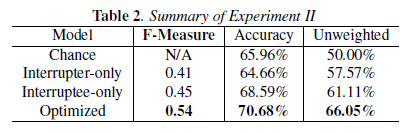
In other words, when they try to predict interruptions solely from the interrupter’s face and body kinematics, they do a bit worse than chance. Predicting solely on the basis of the interruptee’s audio features, they do somewhat better.
[Note to self: someday post about the relationship of this work to Yuan, Liberman & Cieri, “Towards an integrated understanding of speech overlaps in conversation“, ICPhS 2007.]
-
Parse this
Doug Henschen, “SAS DataFlux Unit Bows Unified Data Management Platform“, Intelligent Enterprise, 2/23/2010.
Inspection of the article reveals that bow is a transitive verb meaning “cause to take a bow (of metaphorical introduction)”, i.e. “introduce”.
The causative is a regular formation, and a short verb meaning “introduce” has surely been something headline writers wanted for a long time, so why don’t we see this more often?
Maybe it’s because causative bow retains enough of its root meaning to be uncomfortably close to the more traditional causative uses, such as the one that the OED glosses as “To cause to stoop, to crush (as a load does)”, as in
1671 MILTON Samson 698 With sickness and disease thou bow’st them down.
1725 POPE Odyss. XI. 239 And bow his age with sorrow to the tomb.A “Dataflux Unit” is an especially unfortunate subject, from this perspective.
-
Clinical applications of speech technology
I’m spending this week at IEEE ICASSP 2010 in Dallas. ICASSP stands for “International Conference on Acoustics, Speech and Signal Processing”, and it’s one of those enormous meetings with a couple of thousand attendees. This one has more than 120 sessions, with presentations on topics ranging from “Pareto-Optimal Solutions of Nash Bargaining Resource Allocation Games with Spectral Mask and Total Power Constraints” to “Matching Canvas Weave Patterns from Processing X-Ray Images of Master Paintings”.
The large number of parallel sessions make it impossible for any one person to attend more than a tiny fraction of the interesting papers, but luckily, ICASSP is one of the (many) conferences that now require would-be presenters to submit a paper (in this case, 4 pages), not just a short abstract. All accepted papers are then published on a CD given to attendees.
This practice is an enormous step up, in all respects, from the old-fashioned idea of submitting an abstract of a couple of hundred words. It makes it possible for the program committee to referee submissions on a rational basis. What is even more important, it means that the conference proceedings become a crucial mode of technical communication. In many subfields, such conference papers (typically made available for free in reprint archives or on authors’ home pages) now play a more important role than journal publication does.
[I wish that the LSA would totter into the 1980s and join this trend…]
I’ll illustrate the value of such conference papers with one example that I stumbled across yesterday. If I have time, I’ll blog about some others later on.
The specific ICASSP paper that I’m talking about is Athanasios Tsanas et al., “Enhanced Classical Dysphonia Measures and Sparse Regression for Telemonitoring of Parkinson’s Disease Progression“. Their abstract:
Dysphonia measures are signal processing algorithms that offer an objective method for characterizing voice disorders from recorded speech signals. In this paper, we study disordered voices of people with Parkinson’s disease (PD). Here, we demonstrate that a simple logarithmic transformation of these dysphonia measures can significantly enhance their potential for identifying subtle changes in PD symptoms. The superiority of the log-transformed measures is reflected in feature selection results using Bayesian Least Absolute Shrinkage and Selection Operator (LASSO) linear regression. We demonstrate the effectiveness of this enhancement in the emerging application of automated characterization of PD symptom progression from voice signals, rated on the Unified Parkinson’s Disease Rating Scale (UPDRS), the gold standard clinical metric for PD. Using least squares regression, we show that UPDRS can be accurately predicted to within six points of the clinicians’ observations.
That “within six points” should be interpreted with respect to the overall range of the metric (which is 0-176 for the total UPDRS, and 0-108 for the motor portion of the scale), and also with respect to the distribution of values among the 42 subjects in this study. This last distribution is not clearly specified in the paper, but we do learn that
The 42 subjects (28 males) had an age range (mean ± std) 64.4 ± 9.24 years, average motor-UPDRS 20.84 ± 8.82 points and average total UPDRS 28.44 ± 11.52 points.
The dysphonia measures used were based on subjects’ attempts to produce extended steady-state vowel sounds, and included various variations on standard phonetic measurements of jitter (local perturbation in pitch), shimmer (local perturbations of amplitude) , and harmonics-to-noise ratio (breathiness).
As this table suggests, the core result was simply that these dysphonia measures predicted the clinician’s numerical judgments within about seven to nine points.
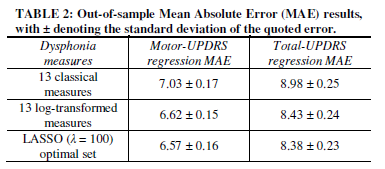
The paper’s technical innovations (log transform of the jitter and shimmer measures, and subsequent feature selection) improved this baseline performance by about 7%. (Let me note in passing that the authors use ten-fold cross-validation and other appropriate techniques in making these estimates. This is worth noting, since researchers in disciplines like psychology and sociology sometimes report regression residuals or similar results without doing this, thus in effect testing on their training material and offering an inflated idea of the quality of their predictions.)
I don’t know enough about the distribution of UPDRS values in the subject pool, or the typical repeatability of clinicians’ UPDRS assignments to individual patients, to evaluate this description of the residuals. And I don’t know enough about the clinical management of Parkinson’s patients to evaluate how useful this level of prediction would be as a monitoring tool, by itself or in combination with other inputs. But to my eye — that of someone who understands the speech science and the basic statistical issues reasonably well, and has a superficial understanding of the medical issues — this looks promising.
More generally, I’m convinced that it’s possible to quantify many speech- and language-based diagnostic indicators,with sensitivity, specificity, and repeatability that compare favorably with many of the physiological tests in common use today. And these linguistic tests are totally non-invasive, require no apparatus other than a microphone and a computer, and in many cases can be administered remotely.
Considering the possible benefits, there’s remarkably little research of this kind, overall, and so I was happy to find a specific example of such high quality.
(Note that I could get this far in learning about this conference presentation because it exists as a coherent document, published in the conference proceedings and also on the authors’ web site. If ICASSP were run like the LSA meeting, with a 200-word abstract being the only concrete record of a presentation, I wouldn’t be writing this. And even if the live presentation (in this case a poster) had caught my eye, I might never have remembered to follow up on it.)
[Update 3/21/2010: — In reference to this post, Athanasios Tsanas writes:
Your concerns there are right: the distribution of the motor-UPDRS and total-UPDRS scores are not mentioned (roughly these are Gaussian shape like, with a peak almost in the middle of the range of values). Clinically, I got the impression that medics are satisfied with UPDRS estimates within about 5 points of their evaluations – which is the inter-rater variability, i.e. the UPDRS difference that might occur in the evaluation of patients between two trained clinicians. In fact, my latest results suggest we can do considerably better than that, further endorsing the argument of using speech signals to track average Parkinson’s disease symptom severity. These new results are derived by using some novel nonlinear speech signal processing algorithms which complement the already established measures, and we are submitting a paper describing all that soon.
]
-
Otatsiihtaissiiststakio piksi makamo ta psswia
 According to Nancy Montgomery, “Army unit recruiting ‘innovative thinkers’“, Stars and Stripes 3/18/2010, that’s the motto of the U.S. Army’s Asymmetric Warfare Group. It’s said to be the Blackfoot version of the English phrase “Normal is the cycle on a washing machine”.
The Army Institute of Heraldry’s page on the AWG shows its shoulder sleeve insignia to be “a black circular device edged with a 1/8 inch (.32 cm) black border, a red horizontal arrow, pointing to the left”, as shown in the upper right corner of this post. But the banner on the AWG’s own page shows the same insignia with the cited motto in red around the circumference of the patch, as reproduced below:

The Stars and Stripes article says that the motto “came from a book about the Vietnam War […] [and] was translated in honor of an AWG member who was a member of the Blackfoot Nation.”
Versions of the saying “Normal is (just|only|nothing_but) the|a cycle|setting on the|a washing machine” has been around for a while, and it sounds like a Vietnam-era kind of sentiment. The phrase apparently is used in John McAfee’s 1993 Vietnam novel Slow walk in a sad rain, and given the description of the AWG in Stars and Stripes, and the description of the book in this review, it may well be the source of the motto:
The story begins in Special Forces A Camp, number 413, twenty miles from the Cambodian border. The camp’s Green Berets, dividing their time between boredom and terror, are ostensibly led by a captain, the narrator of the story. But the officer actually takes his cue from an aggressive sergeant named Shotgun who is alternately crazy and wise, but always irresistibly, frighteningly dangerous. The altogether appropriate motto of A Camp is “Normal is a cycle on a washing machine.” Commanding officers issue orders that have no meaning; weapons are used in ways that are the grotesque opposite of their original design. And in an experience that has a real-life counterpart, the Green Berets stumble on a shocking alliance between the CIA and North Vietnam, something they realize they must destroy — even at the cost of bringing both sides down on them.
Can anyone verify the accuracy of the translation into Blackfoot, preferably with an interlinear analysis?
-
AP editors slander authors
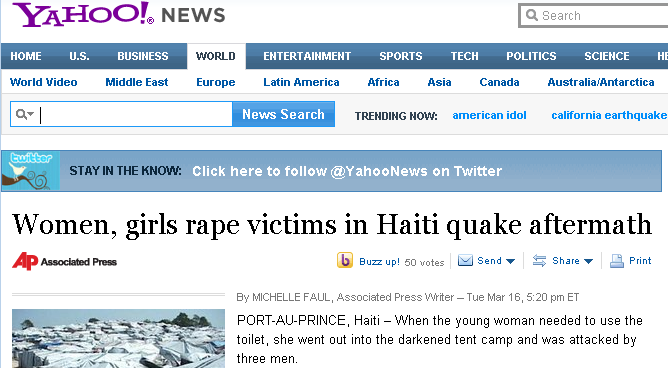
This Yahoo News headline shocked Bethany M.: “Women, girls rape victims in Haiti quake aftermath“, 3/16/2010.
Then she realized that the headline writer meant rape to be a noun rather than a verb, and she was even more upset.Just in case someone wakes up and changes this classic crash blossom:
The same AP headline ran unchanged in the Washington Post and elsewhere:

Bethany may also be distressed to read that “Nurses to be offered training to help rape victims“.