Author: Pan-African News Wire

  • Obama’s National Security Policy Towards Africa: The First Year

    Obama’s national security policy towards Africa: The first year

    Daniel Volman
    2010-01-20, Issue 466

    http://pambazuka.org/en/category/features/61614

    A year into his presidency, Barack Obama is essentially following the same course of militarised action in Africa pursued by his predecessors over the past decade, writes Daniel Volman. A consequence of the US president’s faith in the necessity of the global war on terror and pragmatic political concerns around retaining oil supplies, Obama’s approach to Africa has been entirely rooted in asserting his country’s military might, Volman concludes.

    When Barack Obama took office as president of the United States in January 2009, it was widely expected that he would dramatically change, or even reverse, the militarised and unilateral national security policy toward Africa (as well as toward other parts of the world) that had been pursued by the Bush administration. For many, expectations about the Obama administration’s approach to Africa were raised even higher by the speech that Obama delivered in Ghana in July 2009 and by the tour of Africa that Secretary of State Hillary Clinton made in August 2009. But, after one year in office, it is clear that the Obama administration is essentially following the same policy that has guided US military involvement in Africa for more than a decade.

    Thus, in its budget request for the State Department for the 2010 financial year the Obama administration proposed significant increases in US arms sales and military training programmes for African countries, as well as for regional programmes on the continent.

    These included the Foreign Military Financing Program (to pay for arms sales to African countries), the International Military Education and Training Program (to train African military officers in the United States), the Trans-Saharan Counter-Terrorism Partnership and the East African Regional Strategic Initiative (to provide training and equipment to the military forces of countries in North Africa, West Africa and East Africa), the International Narcotics Control and Law Enforcement Program (to provide equipment, infrastructure and training to police and other law enforcement units in Africa), military training programmes to help implement peace agreements (in Sudan, Liberia and the Democratic Republic of Congo), the African Contingency Operations and Training Assistance Program (to provide training and equipment to a number of African military forces to enhance their ability to conduct peacekeeping operations and other military activities), and to several anti-terrorism programmes including the Anti-Terrorism Assistance Program, the Terrorist Interdiction Program, the Counterterrorism Financing Program and the Counterterrorism Engagement Program (to provide training and equipment to African countries and build ties with key political leaders on the continent).

    And in its budget request for the Defense Department for the 2010 financial year, the Obama administration asked for $278 million to fund the operations of the new Africa Command (AFRICOM) and the Trans-Sahara Counter-Terrorism Partnership programme from the AFRICOM headquarters in Stuttgart, Germany.

    In addition, the administration requested $60 million in Defense Department funding in the 2010 financial year to pay for the operations of the Combined Joint Task Force-Horn of Africa (CJTF-HOA), as well as $249 million to pay for the operation of the 500-acre CJTF-HOA base at Camp Lemonier in Djibouti and $41.8 million for major base improvement construction projects at the base.

    In addition to the Obama administration’s budget requests, the statement made by Secretary Clinton during her visit to Nigeria in August 2009 provided another indication that the new administration would continue the militarised and unilateral national security policy of its predecessor toward Africa.

    Following her meeting in Nigeria with Ojo Maduekwe, the foreign minister, and Godwin Abbe, the new minister of defence, Secretary Clinton was asked what the US government intended to do to help the Nigerian government establish stability and security in the Niger Delta.

    ‘Well, the defense minister was present at the second larger meeting that the foreign minister convened,’ she said, ‘and he had some very specific suggestions as to how the United States could assist the Nigerian Government in their efforts, which we think are very promising, to try to bring peace and stability to the Niger Delta. We will be following up on those.

    There is nothing that has been decided. But we have a very good working relationship between our two militaries. So I will be talking with my counterpart, the Secretary of Defense, and we will, through our joint efforts, through our bi-national commission mechanism, determine what Nigeria would want from us for help, because we know this is an internal matter, we know this is up to the Nigerian people and their government to resolve, and then look to see how we would offer that assistance.’

    Thus, in addition to the security assistance programmes in the budget request for the 2010 financial year, the Obama administration is now considering providing even more military support to the Nigerian government for use in the Niger Delta if the current amnesty programme collapses, as many analysts expect, and the government resumes military operations against insurgent forces in this vital oil-producing region (which produces 10 per cent of America’s total oil imports).

    Further indications of the Obama administration’s national security policy toward Africa are provided by its decision to expand US military involvement in Somalia and its decision to continue the Bush administration’s policy of unilateral military attacks against alleged al Qaeda operatives in that country.

    In June 2009, a senior State Department official (presumed to have been Assistant Secretary of State Johnnie Carson) revealed that the Obama administration had initiated a programme of indirect military support for the Transitional Federal Government (TFG) of Somalia (the internationally recognised government of the country, although it only exercises control over a small part of the capital, Mogadishu, and a few other towns in the southern part of the country).

    According to the official, the US government was providing funding to the TFG to finance weapons purchases and had also asked the governments of Uganda and Burundi (which have deployed troops to Mogadishu under an African Union mandate to protect the TFG) to transfer weaponry from their own stockpiles to the armed forces of the TFG in exchange for promises that the US government would reimburse them. In addition, the US government made its base in Djibouti available to other governments for them to provide military training to the armed forces of the TFG.

    During her visit to Kenya in August 2009, Secretary of State Hillary Clinton announced that the US government would ‘continue to provide equipment and training to the TFG’, stating ‘very early in the administration, I made the decision, which the President supported, to accelerate and provide aid to the TFG’. She went on to declare that al Shabaab, the Islamist insurgent group fighting to overthrow the TFG, was ‘a terrorist group with links to al-Qaeda and other foreign military networks’ and that they ‘see Somalia as a future haven for global terrorism’.

    ‘There is no doubt’, Secretary Clinton stated, ‘that al-Shabaab wants to obtain control over Somalia to use it as a base from which to influence and even infiltrate surrounding countries and launch attacks against countries far and near.’ Thus, ‘if al-Shabaab were to obtain a haven in Somalia, which would then attract al-Qaeda and other terrorist actors, it would be a threat to the United States’.

    The US government arranged for the delivery of an initial supply of approximately 40 tons of small arms and ammunition worth approximately $10 million to the TFG between May and August of 2009 from the stockpiles of the AU peacekeeping force, along with between $1 million and $2 million in cash to the TFG to finance its own arms purchase, and the delivery of another 40 tons of small arms and ammunition over the following months. A number of other governments – including Kenya, Uganda, Burundi and France – are also reported to have sent military personnel to the US base in Djibouti to provide military training to TFG troops.

    According to a report by the Associated Press, American officials ‘say the US military is not conducting the training and will not put any forces in Somalia’. Other countries were conducting the training, the Associated Press reported, because ‘the [Obama] administration is making a concerted effort to avoid putting any American footprint in Somalia, which would risk alienating allies and add to charges by Islamic extremists of a Western takeover.’ However, it has since become clear that most of the arms and training has been transferred to al Shabaab, either by Islamic militants who had infiltrated the TFG military forces or as a result of the sale of the weapons and ammunition on the black market.

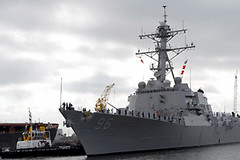
    Then, in August, US Special Forces troops attacked and killed Saleh Ali Saleh Nabhan, an alleged al Qaeda operative who was accused of being involved in the bombing of the US embassies in Kenya and Tanzania in August 1998, as well as other al Qaeda operations in East Africa. The US Special Forces troops carried out the attack from onboard several helicopters that had been launched from a US Navy warship off the Somali coast, using machine guns and automatic assault rifles to strafe a convoy of four-wheel drive vehicles carrying Nabhan and his retinue.

    Following the initial assault, the helicopters landed so that their troops could seize Nabhan’s body for positive identification. It is likely that the Obama administration will conduct further military operations in Somalia since, in the words of Vice Admiral Robert Moeller, the deputy commander of AFRICOM, ‘the threat posed by al-Shabaab is something that we pay very, very close attention to’.

    And in October 2009, the Obama administration announced a major new security assistance package for Mali that was delivered on 20 October 2009. The package – valued at $4.5 to $5 million (2.3 billion CFA) and which includes 37 Land Cruiser pickup trucks, communication equipment, replacement parts, clothing and other individual equipment – is intended to enhance Mali’s ability to transport and communicate with internal security (counter-insurgency) units throughout the country and control its borders.

    The security assistance package is officially known as a ‘Counter Terrorism Train and Equip’ (CTTE) programme. Although ostensibly intended to help Mali deal with potential threats from AQIM (al Qaeda in the Islamic Maghreb), it is more likely to be used against Tuareg insurgent forces.

    In addition, between April and June of 2009, 300 US Special Forces personnel were deployed to Mali to train Malian military forces at three local bases and, according to Lieutenant Colonel Louis Sombora, deputy commander of Mali’s 33rd Parachute Regiment (which was the recipient of the new US military aid package), more than 95 per cent of his soldiers have received US military training.

    And in early November 2009, US Air Force Brigadier General Michael W. Callan, vice commander of the US Air Force Africa (the Air Force contingent based in Europe and dedicated to AFRICOM), visited Mali along with other US military personnel in order to inspect local military forces (including the 33rd Parachute Regiment) and tour local military facilities. According to Lieutenant Colonel Marshall Mantiply, defense attaché at the US embassy in Bamako, ‘we are working with the Mali ministry of defense on a ten-year plan’ to enhance the country’s military capabilities.

    The aid package to Mali is just the latest instance of America’s growing military involvement in the Sahel region. In his testimony before the Senate Subcommittee on Africa hearing on ‘Counter-terrorism in the Sahel’ on 17 November 2009, Secretary of State for Africa Johnnie Carson identified Mali – along with Algeria, Mali, and Mauritania – as one of the ‘key countries’ in the region for the US counter-terrorism strategy. ‘We believe that our work with Mali to support more professional units capable of improving the security environment in the country will have future benefits if they are sustained’, he stated.

    It is clear, therefore, that President Obama has decided to follow the path marked out for Africa by the Clinton and Bush administrations, one based on the use of military force to ensure that America can satisfy its continuing addiction to oil and to deal with the threat posed by al Qaeda and other Islamist extremist groups, rather than chart a new path passed on a partnership with the people of Africa and other countries that have a stake on the continent (including China) to promote sustainable economic development, democracy and human rights in Africa and a global energy order based on the use of clean, safe and renewable resources.

    This is the consequence of two factors. To begin with, President Obama genuinely believes in the strategy of the global war on terrorism and thinks that Africa must be a central battlefield in America’s military campaign against al Qaeda and other Islamist extremist groups.

    Many analysts believe that terrorism does not constitute a significant threat to America’s national security interests and that it would be far more effective to treat terrorism as a crime and to reduce the threat of terrorism by employing traditional law enforcement techniques. But, as demonstrated by the president’s decision to escalate US military operations in Afghanistan, Somalia and Mali, the Obama administration is determined to use military force instead, despite the evidence that – as US military analysts argue – this only helps to strengthen terrorist groups and jeopardises other US security interests.

    And with regard to America’s growing dependence on African oil supplies, President Obama understands the danger of relying upon the importation of a vital resource from unstable countries ruled by repressive, undemocratic regimes and the necessity of reducing America’s reliance on the use of oil and other non-renewable sources of energy.

    But, for understandable reasons, he has concluded that there is simply very little that he can do to achieve this goal during the limited time that he will be in office. He knows that it will take at least several decades to make the radical changes that will be necessary to develop alternative sources of energy, particularly to fuel cars and other means of transportation (if this is even technically feasible).

    And he knows that – in the meantime – public support for his presidency and for his party depends on the continued supply of reliable and relatively inexpensive supplies of gas and other petroleum-based energy to the American people, more than only other single factor. In the event of a substantial disruption in the supply of oil from Nigeria or any other major African supplier, he realises that he will be under irresistible political pressure to employ the only instrument that he has at his disposal – US military forces – to try to keep Africa’s oil flowing.

    BROUGHT TO YOU BY PAMBAZUKA NEWS

    * Daniel Volman is the director of the African Security Research Project in Washington DC. He is a specialist on US military policy in Africa and African security issues and has been conducting research and writing on these issues for more than 30 years.
    * Please send comments to [email protected] or comment online at Pambazuka News.

  • Thousands Protest in Venezuela

    Sunday, January 24, 2010
    03:57 Mecca time, 00:57 GMT

    Thousands protest in Venezuela

    Chavez nationalised a chain of French controlled supermarkets on charges of price gauging

    Thousands of protesters have turned out in Venezuela, both in support of Hugo Chavez, the president, and against him, signaling a heated political climate ahead of the 2010 elections.

    Organised by the opposition to coincide with the anniversary of the downfall of General Marcos Perez Jimenez, a former dictator who was overthrown in the late 1950s, protesters marched to the centre of Caracus, the Venezuelan capital.

    “2010 is the year of change for all of Venezuela … when hatred will be overcome by unity,” Julio Borges, an opposition leader told crowds of supporters on Saturday.

    Andres Velasquez, another opposition leader, told the crowd the opposition movement was “building unity to bring about the end of the dictatorial regime.”

    Politicians critical of Chavez criticised the country’s high crime rates and electricity rationing ordered by the government in response to an energy crisis stemming from a drought that drained the country’s dams, as well as currency devaluation.

    The marches were the first since Chavez sharply devalued the bolivar currency and deployed soldiers to stop retailers hiking prices.

    Government support

    Thousands of government supporters also poured into western Caracas to hear a speech delivered by Chavez in which he told followers he embodied the heart and soul of the Venezuelan people.

    “I demand absolute loyalty to my leadership… anything else is betrayal,” Chavez said.

    “I am not an individual, I am the people. It’s my duty to demand respect for the people.

    “Let’s expand our socialist project,” he said.

    One supporter said he “came from far away to be here, to defend the revolution and the movement led by commander Hugo Chavez”.

    “Things aren’t all as we would like them to be, but we know that El Comandante is doing what he can to help us, the poor,” Yorbert Rodriguez, a 39-year-old bricklayer, said.

    Over 5,000 police and national guard troops were deployed along march routes to prevent clashes between rivals. There were no reports of arrests or violence, which has marred numerous political rallies in the past.

    Venezuela will hold elections in September in which Chavez hopes to secure at least two thirds of seats to maintain his current legislative majority.

    According to opinion polls, the popularity of the leftest leader, which approached 60 per cent approval at the beginning of 2009, has reduced to less than 50 per cent.

    Chavez, a vocal opposer of US influence in the region, has held onto power since 1999 and remains popular, especially among the country’s poor majority.

    Source: Agencies

  • ANCYL Leader Malema, Tripartite Alliance Smoke Peace Pipe

    Malema, tripartite alliance smoke peace pipe

    January 23 2010, 6:20:00

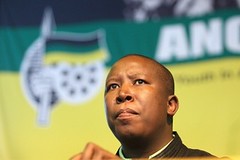
    ANC Youth League President Julius Malema says he has made peace with tripartite alliance members following his heckling by SACP officials in Polokwane last December. Malema was addressing students at the Free State University.

    Malema says differences in opinion do not mean there is a crisis in the alliance. He says there should be robust discussion in dealing with challenges.

    Malema also said language issues and lack of financing should not be used as excuses to marginalise previously disadvantaged students.

    He was speaking at the Free State University’s main campus in Bloemfontein where South African Students Congress “Right to Learn” campaign was launched yesterday. The purpose is to ensure that all students get compulsory and free education.

    Malema said he is also concerned about what he said are racist activities at the Free State.

  • Mantashe Stresses Unity at ANC Celebrations in South Africa

    Mantashe stresses unity at ANC celebrations

    ANDRE GROBLER | BOSHOF, SOUTH AFRICA – Jan 23 2010 18:16

    The African National Congress was out of the “crisis mode” which had occupied its members during 2009, ANC secretary general Gwede Mantashe said on Saturday.

    Addressing the party’s 98th birthday celebration in Boshof in the Free Sate, Mantashe focused on unity within the alliance and the forthcoming municipal elections.

    He said the ANC must work for unity in the party and that it [unity] was not a luxury but “a must have”.

    Mantashe steered clear of allegations of tensions between him and ANC national executive member Tokyo Sexwale, referring only to recent headlines of the alliance being in turmoil.

    “Some of that was manufactured of course,” he said.

    Asked about the apparent tussle between the two ANC heavyweights, Mantashe denied it, and said: “It’s seen by all of you [the media], except us”.

    This follows speculation that unity in the tripartite alliance was in trouble after ANC Youth League president Julius Malema and NEC member Billy Masetla were booed at the South African Communist Party (SACP) special conference in Polokwane in December.

    Mantashe said the ANC had the responsibility to protect the alliance and lead it.

    “Ours is not a paper alliance. Instead it’s a living organism born out of the struggle.”

    Mantashe said the alliance consisted of independent bodies and that it was not “correct” to expend effort in dividing it.

    Echoing calls by Free State premier Ace Magashule, Mantashe said the debate on the election of new leadership in the ANC for 2012 should not deteriorate into a conspiracy.

    “The debate should be comprehensive and not individualistic,” he said.

    Mantashe said the party were aware of councillors who were positioning themselves for the forthcoming local government elections.

    He warned against municipal protests which had been used to discredit councillors in an effort to get rid of them.

    “It’s to get them out, so that others can take their place.”

    He urged communities to retain experienced and hard-working councillors. – Sapa

    Source: Mail & Guardian Online
    Web Address: http://www.mg.co.za/article/2010-01-23-mantashe-stresses-unity-at-anc-celebrations

  • Detroit Emergency Meeting on Haiti: Humanitarian Mission or Military Occupation?

    Emergency Meeting on Haiti–

    U.S. Imperialism: No Friend of Haiti
    Humanitarian Mission or Military Occupation?

    —————————————————————————————-
    Speakers Include:

    -Abayomi Azikiwe, Pan-African News Wire editor on the history of U.S. foreign policy toward Haiti
    -Sandra Hines, Moratorium NOW! Coalition on the disaster from Detroit to Haiti
    -Kevin Carey, Detroit People’s Task Force/MECAWI on the role of multi-national corporations in Haiti
    -Andrea Egypt, Moratorium NOW! and MECAWI on the quake itself and its impact
    -Kris Hamel, Workers World managing editor on the news coverage involving the Haiti quake
    -Derek Grigsby of MECAWI will chair the meeting
    —————————————————————————————
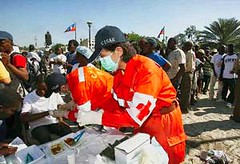
    The earthquake that struck Haiti on January 12 has caused extensive damage and the deaths of untold numbers of people. The U.S. administration has announced the deployment of 10,000 troops and a humanitarian relief effort to the tune of $100 million. However, the history of U.S. involvement with Haiti goes back to the 1700s when the African people rose up against French slavery and imperialism. Haiti won its independece in 1804, but was not recognized by the U.S. until the Civil War. Haiti has suffered a blockade for over 200 years. The U.S. has militarily occupied Haiti on numerous occasions from 1915-1934, 1994, 2004 and 2010.

    Come to this public meeting to find out the true history of Haiti and what you can do to help the surviving victims of the earthquake. We must demand the permanent lifting of the deportation orders on Haitians, the withdrawal of U.S. military troops from the country and the return of the ousted President Jean Bertrand Aristide, who was overthrown by the U.S. and exiled in 2004.

    Date: Saturday, Jan. 23, 5:00-8:00pm
    Location: 5920 Second Avenue at Antoinette
    Sponsor: Workers World Party, Detroit Branch
    Contact: 313.671.3715 or 887.4344
    Recent news reports will be featured and dinner will be serve.

  • ANC-SACP Update: Mantashe Plays Down Alliance Tensions

    ANC’s time bomb

    MMANALEDI MATABOGE | JOHANNESBURG, SOUTH AFRICA – Jan 22 2010 06:54

    The ANC admits that “something is bound to give” if tensions between it and the South African Communist Party are not defused.

    The internal report in which the party raises this alarm has surfaced at the same time as the alliance partners have closed ranks and smothered public venting after some ANC delegates were booed at the communists’ special congress in December.

    Prepared by national executive committee member and Human Settlements Minister Tokyo Sexwale, the report warns that optimistic public posturing should not distract the party from resolving inter-party problems honestly.

    The Mail & Guardian is in possession of the document, which has now caused public bickering after Sexwale said some in the party were trying to disown it.

    “While our public standpoint is a correct one, to close ranks, the truth is that we should not do so only to paper over the cracks of ­differences,” Sexwale’s report says. It urges the ANC to address its ­differences with its allies and within the party itself through the “crucible” of debates.

    The booing incident could have been resolved amicably, the report says, but became “distracting and destructive” because of “rapidly escalating levels of inter- and intra-alliance political tensions, hostility, mistrust, mutual suspicion, ­disinformation campaigns, public ­slander and other ills that have come to characterise our day-to-day ­political existence”.

    The ANC downplayed Sexwale’s report this week, saying the national working committee needs to ­process it with other reports from all ANC delegates to the SACP ­conference.

    Sexwale is perceived to be on the side of those who want ANC secretary general Gwede Mantashe to be removed at the next congress in 2012. The M&G understands that reports from other delegates are expected to ­“neutralise” his document.

    Aggrieved comrades

    Sexwale expressed his willingness to run for the ANC presidency in 2007, a few months before the Polokwane conference, but later withdrew to support Jacob Zuma. He is therefore seen by some as still preparing to stand for ANC presidency.

    A public argument ensued this week in the form of statements sent from the offices of Sexwale and ANC secretary general Gwede Mantashe about the validity of Sexwale’s report.

    “Any suggestion that the report has ‘no status’ in the ANC is both false and dubious — in fact, it would be mischievous to attempt to disown this report,” said Sexwale in a media statement.

    In the report Sexwale says he had a discussion with Mantashe and ANC deputy president Kgalema Motlanthe before compiling the report.

    Mantashe and SACP general secretary Blade Nzimande receive severe criticism in the report for offering, after the heckling of ANC delegates at the SACP congress, an intervention that was “advisory” rather than “condemning”.

    “It would not be far-fetched to describe their intervention as less than equal to the situation, clearly leaving the targeted comrades still feeling aggrieved,” Sexwale’s report reads.

    He warns that divisions within the ANC’s lower structures could explode if the party continues to downplay the seriousness of internal battles. While it was a blessing that none of the speakers at the ANC’s recent 98th birthday celebrations were booed, “sooner or later, in this unhappy atmosphere, something is bound to give”, Sexwale writes.

    “How long should the people endure a situation where day in and day out national discourse is dominated by tripartite alliance bickering, back-biting and butchering of individual reputations?” his report asks.

    The ANC’s national working ­committee will discuss Sexwale’s report with others from ANC delegates to the SACP conference and table a combined report to the NEC before the party meets the communist party to iron out the differences.

    ‘Nothing wrong with Mantashe’s two hats’

    Veteran South African Communist Party leader and ANC national executive committee (NEC) member Thenjiwe Mtintso has joined the battle over communist influence in the ANC by stoutly defending the ruling party’s secretary general, Gwede Mantashe.

    Justifying Mantashe’s “two hats” — he is also SACP chairperson — Mtintso said there is nothing wrong with holding senior positions in the ANC and the SACP simultaneously.

    Mtintso, South Africa’s ambassador in Rome, was formerly the ANC’s deputy secretary general while an SACP central committee member.

    Interviewed this week, she said leaders should use the language of the party they are representing when they speak.

    “When I’m in the ANC I report to the ANC; when I get to the SACP I analyse what was discussed without being the informer,” she said.

    Mantashe has come under heavy fire over his two positions, with ANC Youth League president Julius Malema leading the charge.

    Mtintso asked why there were no perceived contradictions when Joe Slovo, former SACP general secretary, served on the ANC NEC and became housing minister.

    “When he built houses did he build communist houses? No. He was working and speaking as an ANC minister.”

    She said: “Why do people question whether you’re speaking as an ANC or SACP leader when we’re one?”

    Tensions between Malema and Mantashe were exacerbated by the heckling of members of an ANC delegation that included the youth leader at the recent SACP congress in Polokwane.

    Malema insisted that he spoke to Mantashe as ANC secretary general when voicing his unhappiness, despite Mantashe attending the event as an SACP delegate. The youth leader then walked out.

    Mtintso said she had rebuked communist delegates at the party’s 10th congress in 1998 when they sang anti-Gear (growth, employment and redistribution strategy) songs as former president Nelson Mandela arrived to address the conference.

    She had defended Mandela against humiliation by communist delegates who wanted to debate the policy in his presence.

    “I decided that I should be the one to articulate the views of the communist party on Gear. I was chairing that session, I was not representing the ANC.”

    She had told Mandela that the SACP might not recognise the part of his speech that warned alliance partners against public attacks on the ANC over Gear.

    The ANC NEC later discussed whether Mtintso should have articulated the views of the ­communist party while holding the position of ANC deputy secretary general. Despite this, said Mtintso, the ­alliance continued to function ­normally.

    “The truth is that we do not want capitalists, but we stay with them because they are part of the ­struggle.”

    However, Mtintso acknowledged that it was sometimes hard to ­satisfy both sides while holding two ­positions.

    She supported Mantashe’s decision to deny Malema an opportunity to address the SACP congress.

    “Some think he should have allowed Malema to talk, some of us think that he should not have allowed him to talk. I think he [Mantashe] managed it well.”

    Mtintso said it was the fight for state resources that was behind the “artificial” two-hats debate.

    “When you compete you want to find any stone that you can throw at the next person.”

    The debate died down outside election and congress times, but came up during “the internal distributing of positions”.

    Source: Mail & Guardian Online
    Web Address: http://www.mg.co.za/article/2010-01-22-ancs-time-bomb

    Mantashe plays down alliance tensions

    JOHANNESBURG, SOUTH AFRICA Jan 18 2010 13:25

    The leadership of the African National Congress (ANC) will not be drawn into “street fights” over positions, the party’s secretary general, Gwede Mantashe, said in Johannesburg on Monday.

    “We are not going to get into that street fight,” he said, referring to reports that Mantashe was falling out of favour as secretary general.

    He said reports that the ANC Youth League was against him were “neither here nor there”.

    Mantashe watered down tensions within the ruling alliance between the African National Congress, the South African Communist Party (SACP) and the Congress of South African Trade Unions (Cosatu).

    He dismissed weekend reports indicating that President Jacob Zuma was called upon at the weekend national executive committee (NEC) meeting to intervene and call for unity or else the ANC would “implode”.

    Mantashe, in his report back on the party’s weekend lekgotla (meeting), said it had reaffirmed the position of the January 8 statement that the ANC, as “the leader of the alliance and strategic centre of power, must take responsibility for providing political direction to the alliance”.

    “The NEC will initiate a broad discussion on the history, law and current tasks of the alliance and its constituent past as a matter of urgency.

    “We must manage the contradictions inherent to the alliance in a manner that builds the unity of purpose, understanding of distinct roles and programmes of each component,” he said.

    He also urged alliance members to conduct themselves in a “manner befitting revolutionaries”, and called on them to respect each other’s organisational integrity, enforce discipline, avoid public spats and resolve problems within bilateral and other alliance forums.

    He said last year’s booing of ANC Youth League president Julius Malema and NEC member Billy Masetlha at an SACP conference would be discussed in a bilateral meeting with the SACP. The meeting would take place once the ANC’s national working committee had seen the report from the ANC delegation that attended the conference.

    ANC head of policy Jeff Radebe said the report would determine how the ANC engaged its ally during the meeting.

    Radebe said the focus of the NEC meeting was on how the ANC would work differently in future.

    “The issue of performance measurement is one of the paramount approaches … what we are interested in is the implementation of ANC policies,” he said.

    Radebe reiterated that the relationship within the ruling alliance was strengthened after the Polokwane conference in 2007, adding that there was a need to cement the strong relations at provincial and local level.

    ‘A process, not an event’

    The ANC’s top brass also agreed with the January 8 statement on municipal employees holding leadership positions in political parties. Zuma, speaking in Kimberley at the ANC’s 98th anniversary celebrations, said the party intended to make local government a key focus for service provision in 2010.

    “We are of the view that municipal employees should not hold leadership positions in political parties … and we will tighten our deployment procedures to ensure that we deploy comrades with political integrity and professional competence.”

    This was criticised by the South African Municipal Workers’ Union last week, who felt that the ANC was attempting to “de-politicise and de-unionise” municipalities.

    The ANC’s 10-point plan to turn around local government, which had been debated within the party since last year, would go to Cabinet and a local government summit in April for further discussion.

    “Turnaround in itself is a process, not an event,” Mantashe said.

    The ANC wanted to prevent a repeat of the 2009 service-delivery protests around the country.

    The NEC also agreed that the ANC, “as opposed to government”, needed to come up with a mechanism to monitor and review the performance of its members deployed in government.

    The outcome of the NEC lekgotla would guide a Cabinet lekgotla to take place next Wednesday, as well as Zuma’s State of the Nation address in February.

    “In the words of ANC president comrade Jacob Zuma, ‘2010 is the year of action for effective service delivery to help people, and there will be no room for cynicism, laziness, lamenting and incompetence’,” Mantashe said. — Sapa

    Source: Mail & Guardian Online
    Web Address: http://www.mg.co.za/article/2010-01-18-mantashe-plays-down-alliance-tensions

    ANC Youth League targets Mantashe

    MANDY ROSSOUW – Jan 15 2010 14:28

    The African National Congress Youth League (ANCYL) is planning a fightback against the so-called “hostile left takeover” of the ANC and has developed a plan to weaken ANC secretary general Gwede Mantashe — who also serves as the chairperson of the South African Communist Party (SACP).

    The league is disappointed with the way in which President Jacob Zuma handled the public spat between ANC and SACP members, ANCYL insiders say. The brawling reached a crescendo when delegates at December’s SACP special congress in Polokwane booed ANCYL president Julius Malema off the stage.

    “Zuma is not leading the organisation as we expected him to,” a youth league insider told the Mail & Guardian. “He is not protecting the organisation from the left, because he has debts to pay with them. When he needed support after he was fired, he just accepted help from everyone, and now he is paying for that.”

    The insider was quick to point out that this did not mean the league wanted to unseat Zuma — but rather that it wants him to play a decisive leadership role.

    Zuma made only vague statements about the unity of the alliance at the ANC’s birthday celebrations in Kimberley last weekend, where it was clear that tensions between Malema and the SACP have not been resolved. Master of ceremonies Fikile Mbalula, the deputy police minister, had to ask the rebel SACP attendees to stop singing struggle songs so that the birthday cake could be cut.

    He also asked ANC members who received the party’s annual awards to put away banners reading “Hands Off Our Youth League President!” while they were on stage receiving trophies.

    Given Zuma’s perceived lack of decisive action, the league has decided to take matters into its own hands and “take the ANC back”. At the same time it will promote Mbalula, its choice for ANC secretary general in 2012.

    The plan takes aim at Mantashe, whom league insiders say has divided loyalties because of his dual SACP and ANC roles. “The first step is to weaken him, to make sure that the avenues through which he can build support [are] closed down,” said one insider.

    At branch level, the ANCYL has already started warning ordinary ANC members of the “rooi gevaar”, urging them to ensure that Mantashe is not returned as secretary general.

    “We will make sure he does not get opportunities to speak at branch meetings,” one league leader told the M&G.

    “He has access to branches because at the end of the day he audits them to check whether they are allowed to go to [the 2012 elective] conference.

    “But we will make sure that our delegates go there. Even the communists in the branches will be isolated.”

    Step two will be to continue to attack Mantashe’s dual role in the ANC and SACP by claiming that it is untenable for a modern organisation such as the ANC to have a leader with other responsibilities as well.

    “We will make sure that people keep that in the back of their minds all the time,” the ANCYL leader said.

    Prominent communists such as SACP general secretary Blade Nzimande will not receive invitations to speak at branches. “We will not invite them. Even in my branch, I will make sure they don’t come here,” an ANCYL branch chairperson in Gauteng told the M&G.

    While denouncing Mantashe, the league will promote Mbalula, showing how he has risen to power within the ANC and government in a short time and has managed to make the ANC more youth-friendly, modern and forward-looking, insiders say.

    “People know Mbalula and know that he came through the ANC ranks. Even if he is young, he represents the real ANC.”

    Some in the ANCYL suggest the league is quietly acknowledging that former president Thabo Mbeki’s strategy of keeping the communists “in their place” obviated the “hostile takeover by the left” that some in the ANC now fear.

    The ANC’s national general council is due to take place in September, and it is here that the youth league’s push to nationalise mines will be discussed.

    Although the general council has the power to revisit leadership positions, the league will bide its time until the 2012 conference before formally putting up its candidate.

    Source: Mail & Guardian Online
    Web Address: http://www.mg.co.za/article/2010-01-15-anc-youth-league-targets-mantashe

  • Dialogue on African Women in Politics Takes Place in Abuja

    ‘Gender equality is crucial to progress’

    Written by Misbahu Bashir
    Nigerian Daily Trust
    Thursday, 21 January 2010 23:55

    Society cannot progress unless unless men and women, young and old, have equal chances to achieve their potential, the Chairman of Media Trust Limited, Malam Kabiru A. Yusuf has said.

    Yusuf made the remark at the 7th Annual Trust Dialogue with the theme ‘The African Woman and Politics’ in Abuja yesterday. “It is accepted by even the most obdurate male chauvinist, that women are the natural partners of men in the home. But when it comes to their role in wider society, in the economy, politics, art and culture, many men are unwilling to concede them their due. But society cannot progress unless all of us, men and women, young and old, have equal chance to achieve our potential,” he said.

    He commended ex-president Olusegun Obasanjo who was the chairman of the occasion, for appointing more women into his cabinet and other arms of government, than any other previous administration, during his tenure as civilian president from 1999 to 2007.

    He said the Obasanjo government was the first in Nigeria, to give women high profile positions such as Minister for Finance, Minister for Foreign Affairs, Minister of State for Defence, Minister for Education, A justice of the Supreme Court and Nigeria’s representative at the United Nations.

    Guest speakers at the occasion included Winnie Madhikizela Mandela, Senator Bucknor-Akerele, Samia Iyaba Christina Nkrumah and Hajia Naja’atu Mohammed.

    How we’re building on Nkrumah’s legacies –Samia

    Written by Abbas Jimoh
    Nigerian Daily Trust
    Thursday, 21 January 2010 23:57

    African women have a crucial role to play in Africa’s renaissance envisioned by the late Ghanaian leader, Dr. Kwame Nkrumah.

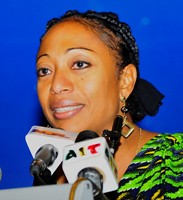
    This was the submission of Nkrumah’s daughter, Ms Samia Nkrumah, a member of the Ghanaian parliament, while speaking yesterday in Abuja at the 7th Annual Trust Dialogue with the theme, “The African Woman and Politics”.

    “The African woman will spearhead the march towards the New African that Osagyefo (Nkrumah) had evoked on the eve of our political independence in 1957, the ‘New African’ who is conscious of the African personality. This concept is not associated with a particular state, language, religion, political system, or colour of skin. It takes account of our diversity, the influence of Christianity, Islam and our African Traditions in our societies today.

    “This revival entails revisiting and re-engineering that vision and adapting it to changing circumstances in the present time, and in the process underscoring the urgency of our concern. The call for economic self-reliance, social justice, national cohesion, and greater continental integration acquire special relevance today because sustainable economic development that impact on us all but with special economic development, is still out of reach. This re-awakening, therefore, cannot happen without the active participation of African women in policy decisions,” Samia said.

    Samia who called for urgent need to invest in new abilities to increase and improve the quality of production and women empowerment, said, “In order to improve access to credit, we have adopted in my constituency in Ghana, a private company to run a micro-credit scheme to give cheap credit to women to begin small-scale businesses. In my district in the furthest south west of Ghana, we have embarked on a scholarship scheme aimed at awarding scholarship to brilliant but needy students to pursue tertiary education with emphasis wherever possible on female students. We have also initiated an ICT resource centre project to provide basic computer training to all schools in the vicinity.”

    She said it was the women that helped shaped and nurtured the vision at inception, stating that women traders and small business holders were the key supporters of the Convention People’s Party (CPP), founded by late Nkrumah to usher Ghana to independence.

    She added that the CPP has passed a law allowing for the nomination of 10 women to the National Assembly, which has radically legitimized women’s role in nation building as it gave them opportunity and political space to contribute to national developmental agenda.

    She said, “Despite the fact that women make up 51 percent of Ghana’s population, this figure is not reflected at the decision making level. The cold fact however is that we have fallen short of the 30 percent representation stipulated by the United Nations that would make decision-making truly meaningful in any society.

    This evidently implies that women in Africa still have a tall order, but this is not insurmountable. People like Yaa Asantewa of Ghana, Queen Amina of Zaria here in Nigeria and recent icons like Winnie Mandela, Wangari Mathai and Ellen Johnson Sirleaf, who have collectively made a statement with a very loud voice: It is possible for us to make a difference in our people’s lives.”

    Samia also sympathised with Nigerians on the Jos crisis and what she called constitutional challenge on the absence of President Umaru Yar’adua,.

    ‘Nothing about us without us’

    Written by Austine Odo
    Friday, 22 January 2010 00:01

    The legendary Mrs. Winnie Madikizela-Mandela speaking at the 7th Trust Annual Dialogue in Abuja yesterday.
    Women should rise up to the challenge of their marginalisation in male-dominated society by declaring that “Nothing about us without us” and proceed to swell the ranks of all social and political structures where the future of Mankind is discussed, legendary anti-apartheid fighter Mrs. Winnie Madikizela Mandela said in Abuja yesterday.

    Delivering her speech at the 7th Trust Annual Dialogue, she said in ensuring that women claim their rightful place in political life, their engagement should not be limited to “the business of politics”, but should extend to discussion about “the politics of business”.

    “As multi-cultural societies representing different regions, we have pivotal roles to play in shaping our regional and continental agenda. Women should be the backbone of our economies. As we address our economic agenda we must also address women’s issues and their daily struggles to build a better life for all.

    Above all, as we seek to articulate a women’s agenda we should commit ourselves to development goals, to address issues related to the elimination of all kinds of racial discrimination and to promote gender equality and mainstreaming a gender perspective in public policies”, she said.

    In doing so, she said, a new internationalism, which has been key to women’s movements for emancipation in previous decades, is being formed.

    Mrs Mandela said Africa is seized with laying the foundations for sustainable social and economic development and that the task was difficult since only enduring ideas and reinforced foundations could withstand the ravages of time. She also noted that armed with the experience of struggle, women’s efforts must be geared towards building a new and different reality which she acknowledged, would be their unique contribution to the world.

    But she recognized unity among women as a principle upon which this struggle must radiate, citing the success of South Africa’s African National Congress (ANC) in the liberation struggle.

    “We cannot achieve this by mere proclamation. We need to be organized and build and strengthen our organizations. We will need to deepen and entrench democracy in our ranks to enable us robustly debate and interrogate the best way forward to realize our full potential. We can only build an unstoppable wave of collective energies if we are able to reach out to one another”, she said.

    Noting that the principle of unity holds true for women in politics, Winnie Mandela said women are their own liberators, and unity must find expression in the way in which they approach their social, political, cultural and economic development. This struggle, she added, must like all struggles, have its own detractors, and women would need to respond to the detractors with words that have also inspired their struggle for liberation, that is, a people united shall never be defeated.

    “Yes, we need to believe in our capacity to overcome our painful history of marginalization when we can be seen and not heard. This path will not be easy, we will stumble and falter, but we will need to focus ourselves on our prize- the emancipation of women, and that of humanity itself. For as long as women are not free, then the freedom that we speak about is incomplete. As we stumble and struggle in this quest, we should regard failures, when they occur, not as finite moments, but as occasions for a new beginning”, she said.

    She noted that as women seek to articulate their agenda, they should submit to development goals, to address issues related to the elimination of all kinds of racial discrimination and promote gender equality and mainstreaming a gender perspective in public policies.

    “It is very important that we too assert ourselves as women of a new generation addressing the demands of new times and eager to fulfil our mission”, she added.

    Akerele: Why women are harmstrung in politics

    Written by Misbahu Bashir
    Nigerian Daily Trust
    Thursday, 21 January 2010 23:58

    The former Deputy Governor of Lagos State Senator Kofoworola Bucknor-Akerele has said the reason why women in Africa do not get equal chance as men in politics is that political parties are dominated by men.

    Akerele made the remarks yesterday at the 7th Annual Trust Dialogue tagged ‘The African woman and politics’. She said women have in the last 50 years failed to achieve equality with men because the African society still believes that a woman still lacks the financial capability to run political campaign and political parties are dominated by men. She said men are reluctant to back women for elective positions and that women have been brainwashed into supporting men rather than their own gender. According to her, the African society still believes that women are better at domestic aspects and not good in governance. Women are also discouraged from politics by violence and thuggery.

    She said party positions are dominated by men and women are marginalized in decision making process in most of African countries. In few countries including South Africa some political parties have reserved some position to the women. “The African National Congress of (ANC) of South Africa must be commended for acceptance of 50% of positions for women in the party. Many other political parties in Africa only reserve few positions for women in their parties,” she said. Women marginalization in politics is obvious in Nigeria where parties have little or positions reserved for women. “An example is the Peoples Democratic Party (PDP) which in the National Executives comprising of 50 positions, apart from the National Women Leader and 2 Deputiess, only 2 ex-officio positions from the six geographical zones are reserved for women,” she said.

    She said in order to allow for more participation of African women in politics, countries must entrench in their constitutions some limitations to women representation. She said countries that have adopted quota system or affirmative actions have fared better than those that have not. “The first country to include a 20% quota representation in its constitution, Tanzania, has now upgraded that to 30% in its constitution. Burundi followed with 30% and then Rwanda,” she said.

    “Ruwanda has 56.3% female representation in parliaments while South Africa has 44.3%. Angola has 37.3%, Uganda 31.8% and Nigeria 7%. By contrast Nigeria with 7% female representation in parliament does not subscribe to the affirmative action,” she said.

    She most countries in Africa have adopted universal adult suffrage and political systems of their former colonial masters which instead of uplifting the standard of women, marginalized women. “Many women who had taken part in struggle for independence found that they were marginalized when it came to being fielded for parliamentary seats or political appointments,” she said.

    Commenting about the problems in Africa, she said ignorance, disease, lack of infrastructure and corruptions have led to the failure of economic growth and development.

    She said people have lost faith in the political system where few men use their ill gotten wealth in most cases to corrupt and criminalize the democratic process. “Unfortunately this corruption of the democratic process has led to a feeling of helplessness with the populace. What we need to do is to rebrand the people especially the men who are now in control of our affairs,” she said.

    Women don’t support women politicians – Naja’atu

    Written by Suleiman M. Bisalla
    Nigerian Daily Trust
    Thursday, 21 January 2010 23:26

    In spite of their numerical strength, Nigerian women have failed to be supportive of women candidates during elections in order to achieve their desire for adequate representation in government, politician and woman activist Hajiya Naja’atu Mohammed has said.

    Speaking at the Annual Trust Dialogue in Abuja yesterday, Hajiya Naja’atu said this problem amongst the women folk has aggravated the existing political plight already imposed by their male counterparts in the political space who prefer to see them only “as sex objects and instruments of pleasure”.

    She recalled that when she came out to contest for the leadership of Students Union at the Ahmadu Bello University years back, she earned names from some female students rather than solidarity.

    She also identified other impediments of women in Nigerian politics to include financial constraints, harassment and intimidation by men politicians.

    Naja’atu who was at the forefront of the Buhari presidential campaign in 2003, said with what she has seen in Nigerian politics so far, no Nigerian women should expect to get power on a platter of gold because their male counterparts will be most unwilling to soften the ground.

    “Let no woman be under any illusion that she will get power on the platter of gold,” she said stressing that if men can go to war for the control of resources, they will certainly not allow breathing space for women in politics.

    She also recalled that after leading the Buhari Campaign to all nooks and cranny of Nigeria, some male politicians began to ask why Buhari should be so close to a woman. That, she said, came towards the end to the campaign when victory seemed close.

    She said in her political career, she has received many death threats, but each time, she emerged more determined to pursue her political goals.

    The woman activist said many male politicians go into politics for personal aggrandisement unlike women who have passion for development and wellbeing of the people.

    She also advised women to remain focused on their mission and vision. “Women have a choice when they assume leadership position to go the way of men or be themselves; the liberators that they are supposed to be. If you decide to go the way of men, you will end up using what you have to get what you want, like they say, and when you do that you are nothing but ‘suya’,” she said.

    “But if you have a mission and you have an objective and you want to make a difference, then you must also be prepared to take the consequences. You must be prepared to be assassinated,” she said.

  • Some Politicians, Professional Groups Utilized in US Regime Change Strategy for Nigeria

    Jos: Jonathan orders army into crisis-prone areas

    Written by Habeeb I. Pindiga
    Nigerian Daily Trust
    Thursday, 21 January 2010 23:29

    Vice President Goodluck Jonathan last night ordered the army to take over security in and around Jos, Plateau State, to prevent further clashes, which have killed more than 400 this week.

    “I have today ordered the army to lead the security forces and take over the entire security of the affected areas, including those areas that are considered prone to risk,” Jonathan said in a live television broadcast to the nation. “The security forces have the overwhelming mandate of the federal government to arrest the situation urgently.”

    Internecine violence between Muslims and Christians broke out in Jos on Sunday, when a group of Christian youths allegedly tried to stop a Muslim man from rebuilding his home that was destroyed in the November 2008 clashes.

    Below is the text of the vice president’s speech:

    “It is with a heavy heart that I speak to you today. We have all been witnesses to the resurgence of the crisis in Jos, the Plateau State capital. My heart goes out to all those who have lost loved ones as well as their property in this unwarranted carnage.

    “From the time the crisis began on Sunday, I gave directives to all the relevant security agencies to do everything within the limits of the law to bring the situation under control.

    “What is happening in Jos has taken on the colouration of sheer wickedness and man’s inhumanity to man, and there is absolutely no justification for this. The federal government will not fold its hands while fellow citizens are brutalised and murdered at will.

    “Such acts in a plural society such as ours, are sinful, both in the eyes of God and man. We shall not condone them. The Federal Government will confront these ugly developments with all the might and resources at its disposal. Of this, there must be no doubt.

    “Therefore, I have today ordered the army to lead the Security Forces to take over the entire security of the affected areas, including those areas that are considered prone to risk. The security forces have the overwhelming mandate of the Federal Government to arrest the situation urgently.

    “I use this occasion to warn all ethnic, political, and religious and opinion leaders in Plateau state and nationwide to desist forthwith from further inflaming the situation.. The security agencies have been directed to place any such persons under close watch. Those found to have engineered, encouraged or fanned the embers of this crisis, through their actions or pronouncements, will be arrested and speedily brought to justice.

    “We will not allow any one hide under the canopy of group action to evade justice. Crime, in all its gravity, is an individual responsibility, not a communal affair. The Federal Government is determined to secure convictions of the perpetrators of this crime, no matter how highly placed.

    “I want to assure all Nigerians, that the Federal Government has the capacity to protect, defend and preserve the lives and property of all citizens, irrespective of ethnic affiliation or creed. Let me also seize this opportunity to assure foreign nationals of their safety.

    “I have held daily meetings with the leadership of our security services, and have received daily updates on the situation in Jos and environs. Let me assure all that the Federal Government is on top of the situation, and that the crisis is being brought under control.

    “The fundamental principle of the Constitution which we are sworn to uphold, is to ensure the safety and well being of all Nigerians wherever they find themselves in the country. In this regard, I want to assure all citizens and foreigners alike, that the Federal Government will continue to guarantee the fundamental freedoms enshrined in the Constitution of our country.”

    Nigeria on Brink of Imminent Collapse, Says NBA

    From Christopher Isiguzo in Enugu, 01.22.2010
    ThisDay

    Irked by the religious crisis in Jos, Plateau State, which culminated in the loss of several lives and destruction of properties, the Nigeria Bar Association (NBA) yesterday in Enugu, said unless urgent steps were taken to address the crisis, Nigeria may as well be on the brinks of imminent collapse.

    The association also reiterated its call for the immediate swearing-in of Vice-President Goodluck Jonathan as Acting President, insisting that with the avalanche of crisis facing the nation; it might be difficult to allow the nation to remain without a clear cut directive on the Vice President to take decisions.

    “Having a bed-ridden Commander-in-Chief in this confused state is anarchy. To deny this confirms one’s culpability as an accessory to the crime of treason,” NBA noted.

    The association, while condemning the violence, noted that for such unfortunate development to befall Nigeria shortly after being branded a terrorist nation by the United States and with President Umaru Musa Yar’Adua away from the country, was symptomatic of the imminent failure of Nigeria as a state.

    President of the association, Mr. Rotimi Akereledolu, SAN who made the statement in a speech he delivered during the valedictory session for late Chief Andrew Anyamene, SAN, at the premises of the Enugu State High Court on Thursday, expressed dismay over the wanton destruction of lives and properties in the city, but noted that such violence would continue to recur because no one has ever been tried and convicted for these horrendous crimes since the Maitatsine religious riots of 1981.

    According to him, the disrespect for what is good and predilection for the weird and obscene had exposed the hypocrites in those who rushed to condemn the categorisation of Nigeria as a terrorist state in the wake of the failed terrorist attempt by Farouk Mutallab on Christmas day.

    He explained that though it was wrong to tar the rest of the citizenry with the terrorist brush because of one boy who has been alienated from his root, but he submitted that this does not justify the castigation of the US which has declared that it is in a state of war and feel obligated to protect its citizens by any means possible.

    To criticise the American government for putting Nigeria on its watch list, he added, was to expand the scope of ignorance and hypocrisy beyond acceptable limits.

    He said that a country under attack owes no one any explanation as to how it resolves to confront its challenges, stressing that “our leaderless government is to blame for the incompetent manner with which the delicate issue was handled.”

    “Can we truly deny the possibility of real penetration of these (terrorist) organizations in our country today with the recurrent incidents of religious violence in some states? What explanation can we offer the rest of the world for the current madness in Jos shortly after that of Bauchi? How many times have Nigerians become refugees in their own country because of acts which border on lunacy freely perpetrated by some unscrupulous elements under the guise of religion? Our security agents have proved themselves unworthy of trust reposed in them by the people of this country in this regard,” he noted.

    Akeredolu stated that the judiciary which stands as the last bastion of hope for the common man faces a daunting task of remaining steadfast for the protection of the rights of the people freely trodden by holders of ephemeral power and the defence of basic law of the land.

    He therefore urged judicial officers to remain above board, pointing out that certain decisions and administrative acts emanating from the hallowed chamber of the judiciary cast a slur on the collective integrity of judicial personnel and help to sustain the state of confusion in the land.

    The NBA boss acknowledged the heroic decisions at different levels of the courts and the courage exhibited by some judicial officers in cases involving highly placed personalities; he nevertheless charged the judiciary not to depart from the path of rectitude to satisfy the cravings of corrupt elements in the polity.

    Obasanjo to Yar’adua: Take the path of honour

    Written by Suleiman Bisalla
    Nigerian Daily Trust
    Friday, 22 January 2010 00:02

    President Umaru Yar’adua should consider “taking the path of honour and the path of morality” by resigning from his office in view of his serious health challenges, former president Chief Olusegun Obasanjo said in Abuja yesterday. Obasanjo, who was chairman at the 7th Trust Annual Dialogue, was responding to a question by a young man from the audience, who asked him whether he chose Yar’adua as his successor in 2006-07 “out of wickedness.”

    The question caused a stir in the jam-packed Congress Hall of the Transcorp Hilton Hotel, venue of the dialogue, but Obasanjo retrieved the microphone and began to answer. He said, “When in the year 2006 the idea came up as to succession, I was convinced in my mind that a Southerner succeeding me will not augur well for Nigeria. [Murmurs in the audience]. You may not agree with that, you may agree. I was convinced in my mind [about] that.

    “Now, I was looking for somebody who will succeed me who has three important qualities. One, he has enough intellectual capacity to run the affairs of Nigeria. Two, he has sufficient personal integrity to run the affairs of Nigeria. Three, he is sufficiently broad minded in knowledge, politically, religiously, socially, whatever to manage the affairs of Nigeria.

    “These three were important and very paramount in my mind. [From the audience, someone shouted, “What about health?” There was a brief commotion as many people said, “Let him [i.e. Obasanjo] finish!”]. Wait, wait, wait! You may hear what you have never heard…Then Umaru Yar’adua who is now the President, I know he had kidney problem and was under dialysis. Some time earlier, he had gone abroad when he was governor of Katsina. When the idea was for him to contest, I asked him and he gave me a medical report and the medical report showed that he had come off dialysis.

    “I asked experts, who then told me that if you were under dialysis or you are on dialysis and you are no longer on dialysis, it means you have had a successful kidney transplant and that you can live for as long as God may wish you to live.

    “Now, who am I and who are you not to accept that? [Applause]. Wait, wait, wait! That was the situation and I…now that you want to hear…He went to campaign and we were campaigning together. And you will remember that at one stage of the campaign, he was run down. Chairman of our party then, Ahmadu Ali, was also run down. Ahmadu Ali didn’t go abroad but he [Yar’adua] went abroad for check up. And then there was rumour that he was dead and I called him and put the telephone on speaker. And I said, ‘Umoru, are you dead or not?’ [Applause and laughter]. And you heard his voice live and kicking! He came back and continued the campaign. That was the true situation, and to the best of my knowledge he wasn’t on dialysis after that. When the issue of dialysis came, he was well into his first term, which must mean one thing; that the kidney transplant is failing, if it hasn’t failed. That you cannot blame on anybody! You cannot even blame it on him (Yar’adua)!

    “So for people to say that I, Olusegun Obasanjo, deliberately picked somebody who is an invalid, I think it is the height of insult. How can I put so much into this country both in peace and in war and then think of giving this country to somebody who will run it down” [Applause]. How can I? Even if you don’t have the fear of God you will not think that way…And you said [referring to the man who asked the question] there is constitutional crisis, I will not comment on that.

    What I needed to say on that, I had said it as the chairman of my Board of Trustees last week and I won’t say anything more. The one that I need to say is the fact that nobody picked Yar’adua so that he will not perform. If I did that God will punish me. Yes because I love this country so much that there is no reason why I should do that.

    But wait, if you take up an appointment, a job, elected, appointed, whatever it is and then your health starts saying, ‘I will not be able to deliver’, to satisfy yourself and the people that you are supposed to serve, then there is the path of honour and the path of morality. And if you don’t know that, then you don’t know anything.”

  • Cuba and the South African Anti-Apartheid Struggle

    Cuba and the South African Anti-Apartheid Struggle

    Nicole Sarmiento
    21 January 2010
    Analysis

    Cuba’s relations with African liberation movements began as early as the 1960s, and shortly after the triumph of the struggle against the Batista dictatorship. Members of the Cuban leadership travelled to Algiers to build formal relations with the Algerian National Liberation Front (Gleijeses, 1996a). Che Guevara’s trip around the African continent in 1963 was a significant turning point in strengthening Cuba’s relationship with liberation movements around the continent. In interviews with former commanders of Umkhonto we Sizwe (MK) and senior members of the MK Military Veterans Association, a number of the senior MK leadership met with Guevara in Algiers that year to discuss strengthening relations, the nature of the armed struggle and a number of other questions related to the role of liberation movements on the continent.[1] The relationship began at the political level and occurred in the space of international institutions, but it extended as well to clandestine meetings (such as those of Guevara in Algeria and Tanzania in 1963) and the beginning of direct assistance to liberation movements.[2]

    In 1961 at the first Summit of Heads of State and Government of the Non-Aligned Movement (NAM) in Belgrade, then president of Cuba, Osvaldo DorticÃ’s Torrado, condemned the apartheid government of South Africa and its policies.[3] Cuban officials began to speak out against the apartheid government and its internal policies at international conferences, summits, meetings and assemblies, repeatedly calling for resolutions and definitive decisions on the elimination of the policy of apartheid in South Africa.[4]

    A number of central leaders of the anti-apartheid struggle have mentioned the weight of Cuban assistance to South Africa’s road to end white minority rule – from Nelson Mandela and Chris Hani, to cultural leaders such as Wally Serote and James Matthews. However, little academic work has been done on actually uncovering the nature of those relations. In the following article, I will try to outline the general character of those relations based on recently conducted research. I look at the policy carried out by the Cuban regime and civil society towards South Africa’s struggle to end apartheid. However, it is necessary to contextualise relations with South Africa during this period as intimately tied to Cuba’s overall policy in Africa and assistance to the anti-colonial struggle.

    CUBA IN SOUTHERN AFRICA

    A significant aspect of Cuba’s foreign policy was voicing its strong stance against the apartheid regime at international fora. Cuba’s support for UN Resolution 435 as well as its direct support to the Angolan struggle to defend its independence from apartheid military incursions forms the centrepiece of Cuban policy towards southern African liberation movements. Cuba’s role in Angola was central to its policy towards the South African liberation movements, as it provided a territorial base of support to the movement in exile and the military wing of the African National Congress (ANC). Angola was also a place where MK and South West African People’s Organisation (SWAPO) soldiers received military training, education and other skills from Cuban military instructors.[5] Alfred Nzo, then general secretary of the ANC, read a message in 1975 that reiterated South Africans’ support for Cuba’s assistance in Angola fighting alongside Angolan, MK and SWAPO troops against the South African military invasion. He noted that Cuba’s assistance to the Angolans was ‘invaluable help for crushing South Africa’s evil racist and imperialist aggression’.[6]

    At the first congress of the Cuban Communist Party, Jorge Risquet Valdés stated that Cuba’s assistance to and presence in Angola from 1975 was opening up the possibility of extending Cuba’s assistance to the South African resistance.[7] In 1977 the Novo Katengue training centre for MK combatants was established.

    Interviews with members of ANC and South African Communist Party (SACP) leadership, as well as former senior members of MK, point to the Cuban role in the southern African region as fundamental to understanding Cuba’s role in assisting the anti-apartheid struggle in South Africa. These respondents make the assessment that the role of Cuba in Angola was central to speeding up the end of apartheid in South Africa and the independence of Namibia, and facilitated assistance to the South African liberation movements.

    It is difficult to separate the dynamics of the struggle within South Africa as well as the development of liberation movements without taking into account the political and military developments in the southern African region. Angola laid the platform for strengthening direct engagement at the military and political level between Cuba and the liberation movements from South Africa. Cuba’s support for revolutionary change in the Americas and Africa reached a high point in Angola in 1988.[8] Before 1975 around 2,000 Cuban soldiers and aid workers had gone to Africa. By 1988 the figures reached over 450,000.[9]

    Despite the assumption of Cuba acting as a Cold War proxy, recent scholarly work on Cuba’s role in Angola illustrates that the Cuban leadership has consistently acted autonomously in its foreign policy. Although much has been written on this period of the southern African history, very little has been written on Cuban involvement in South Africa, and much less from the perspective of participants.[10] Most accounts mention Cuba’s involvement as a rental army of the Soviet Union, as a subservient player to the Cold War rivalry, as a rogue affair guided by the personality of one individual, or mention the Cuban role in passing. The few scholars who take Cuban foreign policy as a serious area of study, avoiding the pitfalls of repeating simplistic and cynical characterisations of Cuban foreign policy, remain the following: Gleijeses (2003, 2006, 2009), Saney (2006, 2009), Dosman (2008) and Lopez Blanch (2008). These accounts consistently reveal autonomy of foreign policy and formulation of aims and motives based on autochthonous experiences and aims.

    CUBA’S POLICY TOWARDS SOUTH AFRICA

    Encountering scholarly work, interviews and primary documents on Cuba’s collaboration with the anti-apartheid struggle is difficult. An explanation is provided by LÃ’pez Blanch (2008): ‘Most contacts, visits and exchanges were extremely secretive to protect South African revolutionaries who were persecuted by the regime.’ Even the SACP Seventh Congress in 1989, the last one to be held outside South Africa, was prepared, held, and had delegates flown to Cuba in strict secrecy. The congress was unknown to the president of the former Soviet Union, Mikhail Gorbachev, when he visited Cuba only three days before the Congress was held.[11] The process of de-classification of official documents is not complete in Cuba or in South Africa and thus further research, time and resources would need to be dedicated to unearthing some of the more specific questions pertaining to these relations.

    Nonetheless, the data gained from the various qualitative interviews carried out in the process of this research point to extensive relations between Cuba and the ANC, SACP and trade union leadership, and particularly with MK as well as in terms of the development of internal discussions within the ANC and SACP on central political questions. The training of female cadres within the liberation struggle via the Federation of Cuban Women, as well as using Cuba as a platform for the South African liberation movement to exchange with other liberation movements from around the world was also part of the relations between the Cuban state and civil society and the South African liberation movements. A senior ANC/SACP leader recalls: ‘Our secretary general Nzo went to the first conference in Cuba – the Tri-continental – in the ’60s. From then onwards a link was established, a formal political link, both with the SACP and the ANC.'[12].The expansion of relations in the 1970s included military cooperation and training to MK, political relations between both the Cuban state and liberation movements, educational and medical cooperation. The next sections will give an overview of some of those relations.

    ANC MISSION IN HAVANA AND RELATIONS WITH MK

    Nelson Mandela’s speech at Matanzas, Cuba in 1991 speaks about the founding of the armed wing of the ANC and the launch of the armed resistance to apartheid. MK was launched on 16 December 1961, and the manifesto of MK was made public via an illegal radio broadcast given by Walter Sisulu. Mandela speaks of the earliest contact with Cubans:

    ‘I must say that when we wanted to take up arms we approached numerous Western governments for assistance and we were never able to see any but the most junior ministers. When we visited Cuba we were received by the highest officials and were immediately offered whatever we wanted and needed. That was our earliest experience with Cuban internationalism’ (Mandela, 1991:22).

    The official ANC Cuba Mission was set up in Havana in 1978 with Alex la Guma as the central representative of the mission. La Guma was also a well known novelist and poet, and was the head of the ANC mission in Cuba until his death in 1988. The ANC mission was paid for by the Cuban government, and was the centre of anti-apartheid political activity in the Caribbean. On the level of military cooperation, Joe Slovo and Joe Modise were the individuals responsible at the highest levels of coordinating all military cooperation between Cuba and the South African liberation movements. Relations on the level of military training began in the 1970s with the increased Cuban involvement in Angola; however, according to the respondents, political discussions took place on numerous occasions between the Cubans and the ANC, SACP and MK leadership in terms of the nature of the armed struggle.

    Much of Cuba’s contact with the anti-apartheid alliance took place in different parts of southern Africa, and meetings occurred between Cuban leadership and ANC and SACP leadership in Lusaka, Conakry as well as Harare and other cities in the region. From 1976 until 1988 almost all MK training took place in Angola by Cubans and Soviets, mainly in the Novo Katengue camp. The most significant MK and SWAPO training camp on the African continent at the time was Novo Katengue. According to Ronnie Kasrils (2009:3): ‘We had a major camp, which had about 500 people training there at any one time, a year at a time, called Novo Katengue […] It was our most advanced camp. And that is where the Cubans immediately came in and provided the infrastructure.'[13]

    The political lull that took place within South Africa around 1963 until the late 60s, during which most of the anti-apartheid organisations were forced to go underground and few young recruits were joining MK. The events in Angola in 1975 and the Soweto uprising in 1976 changed this domestic dynamic: A wave of recruits began to join the liberation movement and particularly MK[14]. The Cubans were central in setting up a camp to train these young cadres as well as to provide more advanced military training to cadres who had already excelled in the basic courses. The Novo Katengue camp was established for basic military, guerrilla-style training, and then a specialised course was organised for those who graduated the main course. This was carried out by the Cubans in the urban area of Benguele. Kasrils (2009) describes the type of training specialisations: ‘…how to engage in urban guerrilla warfare, use of disguises, special rendezvous arrangements, burying of weaponry…’ The camp was bombed by the South Africans in 1979.[15] The cadres in the camp were moved to several other camps around Angola, and the Cuban training and assistance decreased, due to the agreement of gradual Cuban troop withdrawal from Angola which began around 1977.

    However, the assistance between Cuba and MK, along with relations with the anti-apartheid alliance, continued throughout this period into the 1990s. The Angolans also had asked some Cuban forces to stay, given the SADF arming of UNITA and its presence in Namibia represented a major threat to Angola sovereignty. An increase in Cuban assistance begins in 1985, sending larger numbers of MK troops from Luanda to Havana for training. Kasrils (2009) describes how following discussions between Cubans and senior ANC, SACP and MK interlocutors, a specialised training regime was set up inside Cuba, which would receive South Africans in small groups.[16] From 1986-1989, much more specialised training of underground cells and smuggling of weapons, among other training occurring in Cuba. After 1988 ANC/MK instructors took over the training, as Cuba had then begun its withdrawal from Angola following the New York Accords on 11 December 1988.

    On 29 October 1989 a mass rally of 80,000 people was held in Soweto and Walter Sisulu gave the main speech, with a call to maintain the armed struggle. From 1988 through the early 1990s, a number of discussions with the anti-apartheid alliance leadership took place in Havana and in the Cuban embassy in Lusaka, involving discussions of continuing military training and assistance to MK as well as the sending of equipment and armaments. Joe Slovo visited the Cuban embassy in Lusaka, Zambia in 1989, and made a request for special armaments. LÃ’pez Blanch (2008) writes of a meeting between Chris Hani, Timothy Makwena and other high level MK leaders at the Cuban embassy in Lusaka, in May of 1990 to discuss the training of officers for the future South African National Defence Force. Secret meetings between Cubans and ANC and SACP leadership took place in Lusaka and Harare in June 1987. Cuban documents from July 1990 detail that armaments were delivered to the ANC/MK in 1987, 1988 and 1989. The report also states that 403 MK combatants had received special training by Cubans at the time. In May 1990 in Lusaka, there was meeting between Cubans and Chris Hani: ‘Hani stated that Cuba meant a lot to the ANC and to South Africa, and that it was one of the few friends that the ANC had at the moment, which is why it looked to Cuba, not only because of its high degree of technical and combative specialisation, but because of the ideological role that would be played by the personnel trained on the island’ (LÃ’pez Blanch, 2008). Much remains to be learned on the side of military cooperation between Cuba and the liberation movement in South Africa, and for this more interviews would have to be carried out, as well as the declassification of official documents in South African and Cuban archives.

    WOMEN, EDUCATION AND CIVIL SOCIETY

    Cuban relations with the anti-apartheid alliance existed on multiple levels. Students from South Africa studied in Cuba, and young MK cadres who had little basic education were sent to Cuba to upgrade their levels of education and prepare for a future democratic state. Political education also took place for leaders within the Women’s Section of the ANC, organised by the Federation of Cuban Women (FMC).

    Education agreements were made between Cuba and the ANC and the SACP, providing education to South Africans with all expenses paid by the Cuban state. In 1976 the first South African student arrived in Havana, and in 1977 the first group of South African students arrived in the Isle of Pines, which later was to be called the Isle of Youth.[17] Twenty-three students from South Africa came in 1986 and 107 in 1988. Alfred Nzo and Oliver Tambo had planned to send a large contingent of South Africans to receive education in Cuba. This eventually did not happen due to the wave of political activity in South Africa that began in 1988, the events in Cuito Cuanavale and subsequently the de-criminalisation of liberation organisations. By 2005, 272 South African students had graduated from Cuban universities and technical schools (115 from university and 157 at technical schools). As of 2005, over 400 South African youths were studying for free in Cuba. According to Thenjiwe Mtintso, former South African ambassador to Cuba, ‘out of every 20 South Africans who studied in Cuba, 15 today practice their specialties in the public sector’.[18]

    The FMC began its assistance to woman involved in national liberation struggles from all over the Third World. In February 1975, the FMC opened the Fé del Valle School for women, which provided a wide variety of education and training over a ten month period, with all expenses paid by the FMC. Thenjiwe Mtintso, who was a senior MK Commander and member of the SACP Central Committee, was one of the women educated in Cuba who spent time training at the Fé del Valle School. The education programme that the FMC had begun was principally in political, cultural and ideological training (LÃ’pez Blanch, 2008). By 1976 there were around 300 women in the programme from different countries.

    At the level of civil society, Cubans were involved in elevating the status of the anti-apartheid struggle to the level of popular consciousness. In May of 1981, Cuba had helped organise an international anti-apartheid conference in Paris. Cuba participated in June 1981 at the International Conference on Sanctions against South Africa – and pushed for a more hard line stand against apartheid than the one which had been drafted by the Western European states and the US.[19] In 1986, Cuba began its own anti-apartheid committee that would work with anti-apartheid committees all over the world on numerous issues. It became known as the Cuban Anti-Apartheid Committee.

    Cuba awarded leaders of the South African resistance with numerous awards, from Nelson Mandela to Oliver Tambo, and cultural icons such as Miriam Makeba and Alex la Guma. Anti-apartheid protests were organised in Havana, and the Organisation of Solidarity with the People of Africa, Asia and Latin America (OSPAAAL) popularised protest art that highlighted the struggle against apartheid and the war in Vietnam.

    THE 1989 SACP CONGRESS AND A NEW ERA OF RELATIONS

    Numerous important visits, with messages between Cubans and the South African resistance also took place throughout the 1960s and 1970s, intensifying after 1975[20]. In 1990 John Nkadimeng, then general secretary of the South African Congress of Trade Unions (SACTU) and a member of the National Executive Committee of the ANC as well as member of the SACP, visited Cuba. During the trip he had extensive meetings with Cuba’s state-affiliated trade unions. Nkadimeng became South Africa’s first ambassador to Cuba following the end of apartheid in 1994, which was the first new embassy established after democratic elections in 1994[21]. Nkadimeng (2009) and Gonzalez Gonzalez (2009) described the close relations between the Cuban Workers’ Federation (CTC) and the militant South African trade unions part of the anti-apartheid alliance. Numerous meetings were held in Cuba between the CTC and SACTU, and then later with COSATU[22].

    The seventh Congress of the South African Communist Party, the last to be held outside of South Africa, took place in Cuba in 1989. Several leaders of the anti-apartheid alliance attended and the meeting was guarded with complete secrecy due to the difficult moment in which it was taking place and the underground existence of the SACP and liberation movements. John Nkadimeng (2009) states, ‘It was very important because it was a mark of respect and recognition of socialist Cuba. The role they played’.[23]

    Following the decriminalisation of political organisations in 1990, the first Cuban meeting with Mandela took place at the celebration in Windhoek in 1990, and then Mandela’s 23-26 July 1991 visit to Cuba, in which he spoke to a mass rally at Matanzas. The rally celebrated the 38th anniversary of the attack on the Moncada Barracks, which marked the beginning of the Cuban revolutionary struggle. Cuba was Mandela’s first country to visit outside of Africa since his release from prison, and it was a significant show of solidarity. After the ANC triumph in the 1994 election, Cuba and South Africa began formal diplomatic ties – and Cuba was the first country recognised diplomatically by the ANC government elected in 1994. A new page of Cuban assistance to South Africa began, today geared towards social development.

    Nicole Sarmiento is a graduate student based in Cape Town, South Africa.

    NOTES

    [1] See interview with Senior MK Commander, 2009; Mxolisi Ndlovu, 2006; Thomas, 1997.

    [2] Grovogui, 2003; Young, 2001; Gleijeses, 2003; Lopez Blanch, 2008; Interview with Senior MK Commander, 2009; Mxolisi Ndlovu, 2006; Younis, 2000; Kasrils, 2004.

    [3] This occurred at a time when few Western governments dared to speak out against the South African government and its policies, and many were supporting as well as aiding the regime with weapons that were used to oppress the vast majority of South Africa’s population.

    [4] Lopez Blanch, 2008.

    [5] Interview with Kasrils, 2009; Interview with Pahad, 2009; Interview with Nkadimeng, 2009; Mtintso, 2008; Kasrils, 2008.

    [6] Nzo quoted in Lopez Blanch, 2008.

    [7] Interview with Senior MK Commander, 2009; Mxolisi Ndlovu, 2006; Thomas, 1997.

    [8] George, 2005; Gleijeses, 2006.

    [9]Gleijeses, 2006.

    [10] Dosman, 2008; Saney, 2004.

    [11] Lopez Blanch, 2008.

    [12] Interview with Pahad, 2009.

    [13] Motumi (1994) writes that between 1977 and 1988 almost all MK military training took place in Angola.

    [14] Interview with Kasrils, 2009; Motumi, 1994; Ellis and Sechaba, 1992.

    [15] Only a few Cubans and South Africans were killed, because the Cubans and the ANC/MK had managed to receive intelligence reports about the possibility of an SADF bombing of the camp. At the time the bombing occurred the camp was almost entirely evacuated (Dosman, 2009; Lopez Blanch, 2008; Kasrils, 2004; Interview with Kasrils, 2009; Motumi, 1994).

    [16] This was apart from the students who were sent from South Africa to study in Cuba, who were usually unaware of other cooperation or relations taking place on the island between ANC/MK and Cuba.

    [17] Lopez Blanch, 2008.

    [18] Mtintso quoted in Lopez Blanch, 2008.

    [19] Lopez Blanch, 2008.

    [20] Some of the visits to Cuba of South African resistance leaders include the 1988 visit by Cyril Ramaphosa, then general secretary of the South African National Union of Mineworkers. In 1989 Thabo Mbeki visited Cuba.

    [21] According the Nkadimeng (2009), ‘I felt that Mandela had honoured me by sending me to Cuba, a country that was prepared to do anything for South Africa’.

    [22] Gonzalez Gonzalez (2009) states that the close relations between trade unions of the two countries has furthermore extended after 1994, and numerous CTC leaders from Cuba have travelled to meetings with COSATU, to continue relations and exchange among workers’ federations.

    [23] Aziz Pahad (2009) recalls of the SACP Congress, ‘[…] there was no surprise that the Congress would take place in Cuba for many of us’.

  • China-Zimbabwe Relations Set to Grow

    Sino-Zim relations set to grow

    Herald Reporter

    BILATERAL relations between Zimbabwe and China are set to grow further this year as the two countries celebrate 30 years of co-operation.

    Ties between Zimbabwe and China date back to the liberation struggle but were formalised when Zimbabwe gained Independence in 1980.

    China provided Zimbabwe’s guerillas with training, logistical and material support to wage the struggle.

    China has provided approximately US$300 million to Zimbabwe in direct assistance over the past three years in addition to undertaking construction projects.

    Beijing has also stood solidly behind Zimbabwe during attempts by Britain and the United States to have Zimbabwe on the agenda of the United Nations Security Council.

    Speaking at the launch of the 30th Anniversary Celebrations of Zimbabwe-China Diplomatic Relations in Harare yesterday, Beijing’s Ambassador here, Mr Xin Shunkang, said relations were as vigorous as ever.

    “The two countries have enjoyed frequent high-level contacts, enhanced political mutual trust and ever-deepening co-operation in such fields as economic development and trade, culture, education, health and military affairs as well as close consultation and co-ordination in international and regional affairs.

    “The Chinese side highly appreciates Zimbabwe’s firm commitment to the One-China Policy and its support of China’s great cause of reunification.

    “The Chinese government and people value its traditional friendship with Zimbabwe; view Zimbabwe as a trustworthy friend and important partner.”

    Mr Xin said China would continue supporting Zimbabwe’s fight against illegal Western economic sanctions that are hurting ordinary people.

    “Our government does not agree to any forms of sanctions against Zimbabwe. As long as they do not benefit the people of Zimbabwe they should be lifted.”

    The ambassador said 2009 was meaningful for Sino-Zimbabwe relations with the two maintaining high level exchanges to deepen practical economic, political and cultural co-operation.

    “We saw thousands of Zimbabwean people visit China, from officials to businessmen, from youths to women, from Zanu-PF to MDC.”

    He said Foreign Affairs Minister Simbarashe Mumbengegwi would soon visit his Chinese counterpart Mr Yang Jiechi.

    Beijing, the ambassador said, would strive to fully implement its promises to Zimbabwe and the continent at large as pledged at the Forum on China-Africa Co-operation in Egypt last year.

    Zimbabwe and China recently signed two agreements on the provision of a US$46 million concessional loan and US$7.35 million for NetOne’s expansion programme.

    “We also propose to build two solar power projects for Zimbabwe, support Chinese financial institutes in setting up special fund for small and medium scale Zimbabwean businesses and send one agricultural team to Zimbabwe,” Mr Xin said.

    He said the fifth Joint commission between China and Zimbabwe will be held in May to further stimulate bilateral investment.

    To promote cultural and people-to-people exchanges, the Chinese soccer team will play Zimbabwe’s Warriors. There will also be a Chinese Film Festival among other activities.

  • Britain to Maintain Sanctions Against Zimbabwe

    Britain to maintain sanctions

    Herald Reporters

    BRITAIN will maintain its illegal sanctions on Zimbabwe and will only remove them at the MDCs’ request, a senior official in London has said.

    Answering oral questions in the House of Commons on Tuesday, British Secretary for Foreign and Commonwealth Affairs Mr David Miliband said the ruinous embargo would only be lifted upon such a request and that EU would adopt a step-by-step approach on sanctions.

    “In respect of sanctions, we have made it clear that they can be lifted only in a calibrated way, as progress is made. I do not think that it is right to say that the choice is between lifting all sanctions and lifting none at all.

    “We have to calibrate our response to the progress on the ground, and, above all, to be guided by what the MDC says to us about the conditions under which it is working and leading the country,” Mr Miliband said.

    He admitted that the widely-criticised sanctions were affecting a wide spectrum of Zimbabwe’s economy.

    He said the European Union would convene its routine annual meeting on Zimbabwe next month.

    The bloc’s previous meetings have only served to underline Western hostility towards Harare, which angered the former by embarking on the historic Fast Track Land Reform Programme in 2000.

    Sanctions, which were imposed at the MDC’s request, remain the biggest outstanding issue to the Global Political Agreement signed by the country’s three main political parties.

    The MDC formations agreed in the GPA to play a leading role in lobbying for their removal.

    Mr Miliband also dismissed speculation that charges against MDC-T treasurer Roy Bennett were a form of harassment saying it was “not quite right to refer to the detention of Roy Bennett as a continued threat to him through a legal case”.

    Bennett faces charges of illegally possessing dangerous weapons for purposes of terrorism and banditry. Mr Miliband commended Sadc facilitator to the GPA and South African President Jacob Zuma for playing “a careful hand” in handling negotiations for the full implementation of the agreement.

    “The position of the South Africans has certainly been to urge adherence to the GPA, which requires compromise on all sides, and I do not think that they have been less than even-handed in the way in which they have done that,” he said.

    South Africa has been under pressure from the EU and America to influence events in Zimbabwe.

    Former South African President Thabo Mbeki, who successfully brokered the GPA, was often criticised for his “quiet diplomacy”.

  • South African Law: Modern and Customary

    Bound by the bill of rights

    NOLUTHANDO NTLOKWANA | JOHANNESBURG, SOUTH AFRICA – Jan 20 2010 14:15

    Recognising our rich cultural diversity, the Constitution provides for and protects the freedom to participate in the cultural life of one’s choice, but only in a manner that is consistent with it. It accords parity of esteem to all our cultures and enjoins the courts to interpret and develop customary law in a manner that promotes the spirit, purport and objects of the Bill of Rights.

    Underpinning both the imperative to recognise constitutionally compliant cultural practices and to develop unconstitutional practices in such a manner as to render them constitutionally compliant, and thus of equal force, is a call for cultural tolerance.

    Three contrasting examples in recent months show what the constitutional imperative, on the one hand, to respect cultural diversity and, on the other, to interpret and develop customary law in a manner that promotes the spirit, purport and objects of the Bill of Rights means in reality.

    The first example arose in the recent KwaZulu-Natal High Court matter of Stephanus Smit, NO and Others v His Majesty King Goodwill Zwelithini Kabhekuzulu and is a clear illustration of what is meant by cultural tolerance and respect.

    This matter dealt with the Zulu practice of ukweshwama, which is a traditional thanksgiving observed by Zulus and is celebrated before the harvesting of crops. The ritual involves killing a bull with bare hands. Animal Rights Africa sought an interdict against the killing of the bull, saying that the way the bull is killed constitutes cruelty to animals.

    No interdict

    The court did not grant the interdict sought because expert evidence satisfied it that the cultural practice did not in fact constitute cruelty to animals. The court held that the applicant’s uncritical acceptance of rumours about the true practice was symptomatic of an intolerance of cultural diversity.

    Viewed in a historic perspective, it was indicative of a historical desire to inflict mainstream cultures of Western society on African cultures. This attitude was premised on a misguided belief that the applicant had a right to interfere with the religious and cultural practices of others that they found intolerable to their own beliefs.

    The second example illustrates an instance where society should not tolerate a cultural practice that can never be rendered constitutionally compliant. It involves the ukuthwala (“abduction”) practice, which involves abducting girls as young as 12 and forcing them to marry men who are old enough to be their grandfathers.

    This practice is unconstitutional and unlawful, and no amount of development will permit it to pass constitutional muster. It violates the right to dignity, the right to education and the right to freedom and security of the person, and it is not in the best interest of the child. The third example arose in a settlement reached by the Congress of Traditional Leaders of South Africa (Contralesa) in the Equality Court regarding initiation and illustrates how practices that violate provisions of the Bill of Rights can nonetheless be developed in such a manner that they pass constitutional muster while retaining the core of the ­custom.

    Dignity undermined

    The case involved Justice Alliance South Africa and Others v Yamani and Others. In his application, young Bonani Yamani said that by being forced to go through traditional circumcision, his human dignity was seriously undermined.

    In terms of the settlement, which was made an order of court, Contralesa accepted the right of adult males to choose whether to attend traditional circumcision schools according to their religious beliefs. In delivering the order, Judge Yusuf Ebrahim emphasised that consent was essential if the practice was to be both lawful and pass constitutional muster. The case was not about declaring traditional circumcision unlawful; instead, it developed it to bring it in line with the Constitution.

    The settlement reached with Contralesa is of great significance. For although the Constitution requires that the courts develop customary law in a way that promotes the Bill of Rights, this body is arguably better placed to do so. This is so because of the complex nature of many customs such as ukweshwama, which in most instances involve invoking ancestral spirits.

    Since the members of this tribunal are themselves immersed in those spirits, it would be better placed to interpret and develop customs in a manner that aligns them with the Constitution while retaining their spiritual and other essences. It is thus appropriate that the Constitution does not only enjoin the courts to develop customs, but also binds tribunals and other forums to do so.

    Noluthando Ntlokwana is assistant director of the Centre for Constitutional Rights

    Source: Mail & Guardian Online
    Web Address: http://www.mg.co.za/article/2010-01-20-bound-by-the-bill-of-rights

    By force of law

    TEMBEKA NCUKAITOBI | JOHANNESBURG, SOUTH AFRICA – Jan 20 2010 13:58

    What is the role of traditional authorities in a modern and democratic setting? Framing the question in these terms might obscure rather than reveal the fundamental question raised by a case the Constitutional Court will hear in March: what is the role of customary law in a democratic setting?

    Recasting the question is not an exercise in semantics. It situates traditional authorities as institutions that administer a given set of rules or regulations contained in an overarching body of law — African customary law.

    The Constitutional Court case concerns the constitutional validity of the Communal Land Rights Act.

    The case is brought by four rural communities in Limpopo, and concerns the scope and powers of traditional authorities over rural communities, particularly regarding the administration of land and allocation of resources.

    The characterisation of a custom as law distinguishes it from ordinary cultural practices or traditions. Law imposes obligation (the absence of choice) and consequences (punitive and otherwise) for non-compliance.

    Royal conviction

    Recently, the king of the abaThembu, Buyelekhaya Dalindyebo, was convicted of serious crimes, including assault, murder and arson. The judgment is remarkable because the crimes were committed by the king himself, the very embodiment of ubuThembu

    The crimes were also committed against the abaThembu, the people whose name is used to explain the source and justification of Dalindyebo’s power.

    As someone who was raised in the Transkei, where customary law was widely practised, I asked myself whether I ought to be horrified at the conduct of the king; and whether in fact Dalindyebo’s conduct was a manifestation of a deeper problem with an unelected, unregulated and ultimately unaccountable institution.

    I concluded that the conduct of the king should come as no surprise; we have been here before. Kaizer Matanzima was a traditional leader, even though of lesser seniority than he claimed. His notorious abuses of power are too numerous to mention.

    However, Matanzima’s excesses could be explained by the illegitimacy of the system that produced and granted him power — apartheid. By contrast, apartheid cannot explain Dalindyebo’s crimes. In both cases, however, obligation is imposed on the subjects and there are severe, even deadly, consequences for non-compliance with decisions of customary authorities.

    Modernity and tradition

    The existence of obligation exposes a tension inherent in a legal system that prizes a plurality of legal systems. Legal systems shape human conduct and behaviour. The co-existence of different legal systems creates a tension between modernity and tradition.

    Contemporaries often claim that cultural practices such as polygamy signify a return to the Dark Ages. What they ignore is the reality that 20-million South Africans observe a customary law system in one form or another.

    These people do not live in the Dark Ages; they live in contemporary South Africa. Their use of traditional systems within an overarching constitutional system shows that what is often presented as a choice between modernity and tradition is in fact a false choice. Modernity and tradition are not mutually exclusive. They intersect, collide and overlap in a number of dazzling ways.

    But I am running ahead of myself. Dalindyebo’s abuse of traditional authority reflects a manifest deficit in the theorisation of customary law and authority.

    As a consequence, the law is often confused with the institutions designed for its implementation. This confusion does not apply uniquely to customary law: police are often confused with the law, and so too are judges, lawyers, prosecutors and so on.

    The separation of customary law from its institutions requires us to engage in a challenging exercise of finding meaning in customary law. That process does not occur in a legal vacuum: it occurs in a context set by the Constitution. The fact of the explicit recognition of customary law by the Constitution places its existence and legal effect beyond dispute.

    But that is as far as it goes: setting the base, not the limit. What exactly is the limit? The limit lies in recognising that there is in fact no single system of customary law — customary law cannot exclusively be found in ossified codes or pronouncements of traditional leaders. It is a multiplicity of different systems of laws.

    Nuanced approaches

    Groups of the amaMpondomise may, for instance, share similar geographic areas with the amaMpondo, but follow different customs. Over time, such customs mutate into law. However, they remain different and require nuanced approaches in application.

    Second, customary law is neither old nor static. In fact, customary law is modern and dynamic. It changes with the social context. In the 2008 case of Nwamita, it was argued that the customary law prevented a woman from being appointed as a Hosi, or chief. The Constitutional Court found that customary law, when interpreted in the light of the Constitution, did not countenance gender discrimination. Accordingly, a woman could, under customary law, assume the position of chief.

    Third, customary law can be found by observing the social practices of the people affected by it. Those practices occur in the present, not the past. In short, customary law is living law.

    If customary law is living law, a question of broader significance emerges. What is its relationship with the Constitution? The Constitution explicitly answers this. The Constitution is the supreme law of the country and any law inconsistent with it is invalid.
    Customary law, therefore, has no life separate and distinct from the Constitution. Its existence, authority and force are drawn from the Constitution. In application, therefore, customary law must be suffused with the values of dignity, equality and freedom — values that are central to the country’s project of constitutionalism.

    Tembeka Ngcukaitobi is the director of the Constitutional Litigation Unit of the Legal Resources Centre. He writes in his personal capacity

    Source: Mail & Guardian Online
    Web Address: http://www.mg.co.za/article/2010-01-20-by-force-of-law

  • Obama: Defending the Interest of Empire

    Obama: Defending the ‘interests of empire’

    Demba Moussa Dembele
    2010-01-20, Issue 466
    http://pambazuka.org/en/category/features/61612

    For those anticipating sweeping, immediate change from Barack Obama’s election to the US presidency, the results of the president’s first year in office will undoubtedly have proven profoundly disappointing, writes Demba Moussa Dembele. Just as his Accra address was rooted in patronising references to ‘corruption’ and ‘tribalism’, it should be always borne in mind that Obama operates and will continue to operate first and foremost in defence of the ‘interests of empire’, Dembele stresses.

    The election of Barack Obama to the Presidency of the United States elicited worldwide enthusiasm and raised hopes for change, especially in Africa and much of the global South. One year later, what remains of that enthusiasm, of the immense hopes and even expectations that his election had raised? For sure, one year is not enough to assess the record of his administration. But some decisions and actions during the last 12 months may give an indication of the kind of policies he intends to conduct for the duration of his term.

    POSITIVE CHANGES

    One of the most important changes in the international arena has been the end of the contempt for the United Nations and the embrace of multilateralism in tackling world affairs. This is reflected in the recognition of a greater role for the United Nations in dealing with global issues. One illustration of this shift is the participation of President Obama himself accompanied by a huge US delegation in the UN summit on climate change in Copenhagen in December 2009. Another positive change is the new approach to the Iranian and North Korean nuclear issues. Instead of threats and intimidation, President Obama has given priority to negotiations and diplomacy, even if it may remain some hidden agenda.

    Overall, with Obama, the United States is projecting the image of a country that is less arrogant and seeks to restore good or normal relations with other countries and peoples of the world. The Cairo speech, addressed to the Muslim world, is certainly one of the most important illustrations of that new image that the US is trying to project with Barack Obama. By extending a friendly hand to the Muslim world and by distinguishing between Islam as a religion of peace and those who are using it as a political tool, he opened the door to restoring trust between the US and large parts of the Muslim world.

    DISAPPOINTMENTS

    But these positive changes cannot mask the big disappointments of the first Obama year, especially in Latin America and Africa. With Cuba, it is almost the status quo, despite some timid steps and Cuba’s gestures of goodwill and overtures. The goodwill displayed during the Summit of the Americas in Trinidad and Tobago, with a handshake with President Hugo Chávez, was not followed by a real break from Bush policies with regard to Venezuela, Bolivia and other progressive governments in South America. The signing with Colombia of an agreement to station US troops near the border with Venezuela did not sit well with most Latin American countries, even with some ‘moderates’ like Brazil. Then, the coup in Honduras and its consequences dealt a big blow to the credibility of the Obama administration in the region. After condemning – mildly – the coup, the US finally remained indulgent with the illegitimate regime and hailed the elections organised by the coup leaders as ‘step toward the restoration of democracy’.

    The boycott of the Durban Review Conference on Racism held in Geneva in April 2009 was another big disappointment for all progressive forces inside and outside the United States. Several African-American organisations reacted very angrily to this boycott, which was seen as an ominous signal of how the Obama administration would handle issues of racism and discrimination inside and outside the United States.

    AFRICA: WHAT’S NEW?

    Maybe one of the greatest disappointments is Obama’s attitude towards Africa. Several observers had expected to see Africa high on his administration’s agenda. But so far, there is more continuity with past policies than innovation.

    The Accra address

    The Accra address gave an illustration of that continuity. That address was supposed to outline Obama’s ‘vision’ for Africa. In fact, in Accra, he insisted more on the familiar clichés manufactured by Western imperialist ideology and mainstream media about Africa than on outlining a new vision for Africa–US relations. He spent more time condemning ‘corruption’, ‘tribalism’, ‘bad governance’ than talking about the real structural obstacles to Africa’s development, obstacles inherited from centuries of domination, plunder and exploitation by Western countries and corporations.

    When he alluded to colonialism and Western responsibility in the current situation of the continent, it was to stress that this responsibility is secondary to Africa’s own responsibility. In his opinion, conflicts in Africa and weak economic and social indicators are all Africa’s fault. There was not a single word about the hand of Western powers – the US in the lead – in provoking and encouraging conflicts, staging military coups and assassinations in order to perpetuate the continent’s destabilisation and their control over its resources.

    This position is consistent with Western countries’ attempt to convince public opinion – inside and outside Africa – that a few decades of neocolonial rule and imperialist intervention in all areas have erased centuries of destruction of the African mind, of genocide and of the looting of Africa’s wealth and resources.

    Some Africans have praised Obama for insisting on ‘good governance’ and ‘solid institutions’. But the IMF (International Monetary Fund) and the World Bank have been preaching the same gospel since 1989.[1] When Obama said that Africa’s development ‘depends on good governance’, this is a code word for neoliberal policies to make African countries more ‘attractive’ to foreign investors and put in place an ‘enabling environment’ for the promotion of the private sector – a speech Africans have heard before from the World Bank and the IMF!

    Even more importantly, his Accra address was noticeable for its omissions. For instance, he mentioned President Kwame Nkrumah just once and as a footnote. But even more puzzling was his total silence about a great African-American and companion Nkrumah, W.E.B. DuBois. There was not a single word for DuBois, who is buried in Accra, just a few yards from the US embassy! DuBois is one of the founding fathers of the National Association for the Advancement of Colored People (NAACP), the oldest human rights organisation in the United States. He is also one of the fathers of Pan-Africanism, which explains why he went to Ghana to help Nkrumah after his country’s independence. But above all, DuBois is one of the foremost intellectuals of the 20th century, which is why Harvard University has named an institute after him, to honour his scholarly achievements. And that institute is chaired by Professor Henry Louis Gates, Jr., whom Barack Obama calls his friend.

    The shadow of AFRICOM

    Obama’s visit to Ghana was dubbed as a premium to ‘democracy’ and ‘good governance’. And the US government hailed the visit as an opportunity to ‘strengthen the U.S. relationship with one of [our] most trusted partners in sub-Saharan Africa, and to highlight the critical role that sound governance and civil society play in promoting lasting development.'[2]

    But in reality, the visit was about promoting the US interests in a region rich in crude oil and minerals. Obama has not abandoned his predecessor’s idea of installing the headquarters of the Africa Command (AFRICOM) in Africa. It is the pursuit of that strategy that led Obama to Ghana in the hope that this country may accept to host AFRICOM, given its ‘stability’ and proximity to the Gulf of Guinea.

    Some US analysts have come to the conclusion that the Obama administration is even trying to enhance Bush’s policies toward Africa: ‘While Africans condemned U.S. military policy in Africa under the Bush administration, the Obama administration has not only mirrored Bush’s approach, but has in fact enhanced it. President George W. Bush established Africa as a foreign policy priority in 2003, when he announced that 25% of oil imported to the United States should come from Africa. Like the Cold War, the Global War on Terror establishes a rationale for bolstering U.S. military presence and support in Africa. Yet official pronouncement of U.S. policy is routinely presented as if neither of these two developments occurred.'[3]

    While official statements tend to present the Obama administration’s policies toward Africa as only aiming at bolstering economic development and preventing conflicts, they are contradicted by actual policies. In the eyes of the same analyst, the agenda outlined by the US government for public consumption is different from the real agenda. He noted that the fiscal year 2010 budget ‘doubles the size of AFRICOM’s funds’ and there has been the ‘doubling of financial support for counterterrorism projects throughout the continent – including increased funds for weapons, military training and education at a time when US foreign aid money is stagnating’.[4]

    In light of the above, it is fair to say that with regard to Africa, there is nothing new, there is no bold vision for a different type of relationship in the 21st century as some had expected. Apparently, his ‘African blood’ made no difference!

    SERVING THE INTERESTS OF THE EMPIRE

    Of course, only those who are naïve may think that Obama’s ‘African blood’ would lead him to have a special agenda for Africa. This is why some of his most enthusiastic supporters on the continent, who were expecting massive flows of ‘aid’, are disappointed with his policies.

    But what these people seem to ignore is that Obama was elected to defend and promote the interests of the United States. And those interests do not necessarily coincide with African interests. And to achieve this goal, he will resort to any means. In his Nobel speech in Oslo, Norway, on 10 December, he was very explicit about that by saying that he would not hesitate to use force to defend and protect the interests of the United States.

    From that perspective, the decisions and actions of Barack Obama aim to promote first and foremost the interests of the empire, that is, the interests of US multinational corporations and banks, the interests of Wall Street, as well as the interests of the military–industrial complex. The election of Obama did not change the goals of the empire to hold on to world leadership by strengthening its hegemonic role in world affairs. So, behind the rhetoric lies the shadow of the empire, which as despotic, cynical and ruthless as ever.

    CONCLUSION

    It is difficult to see a shift in these policies in the medium term. In fact, the mid-term elections of November 2010 risk costing the Democratic Party if the economy does not show signs of recovery and if the situation in Afghanistan keeps deteriorating. The eventual loss of a majority in Congress would make Obama’s task even more difficult.

    It is almost certain that if things don’t improve before November, especially on the economic front, Barack Obama will be confronted with a more complex situation and even more daunting challenges, at home and abroad. If a more hostile Congress emerges after the November elections, there will be little hope that the ‘change’ he advocated during his campaign may ever be achieved.

    BROUGHT TO YOU BY PAMBAZUKA NEWS

    * Demba Moussa Dembele is the director of the African Forum on Alternatives and a member of the 2011 Dakar World Social Forum organising committee.
    * Please send comments to [email protected] or comment online at Pambazuka News.

    NOTES
    [1] See Sub-Saharan Africa: From Crisis to Sustainable Growth: A Long-Term Perspective Study. Washington, DC, The World Bank
    [2] ‘Straight Talk: Revealing the Real US Africa-Policy’, Foreign Policy in Focus, Washington, DC, July 2009
    [3] Ibid
    [4] Ibid

  • The Right Testicle of Hell: History of a Haitian Holocaust

    The right testicle of Hell: History of a Haitian holocaust

    Blackwater before drinking water

    Greg Palast
    2010-01-21, Issue 466
    http://pambazuka.org/en/category/features/61624

    cc Wikimedia‘There’s no such thing as a ‘natural’ disaster,’ writes Greg Palast, ‘200,000 Haitians have been slaughtered by slum housing and IMF “austerity” plans.’ Palast takes a look both at international community’s response to the Haiti earthquake and at its role in impoverishing a nation that was once the wealthiest in the western hemisphere.

    1. Bless the President for having rescue teams in the air almost immediately. That was President Olafur Grimsson of Iceland. On Wednesday, the AP reported that the President of the United States promised, ‘The initial contingent of 2,000 Marines could be deployed to the quake-ravaged country within the next few days.’ ‘In a few days,’ Mr Obama?

    2. There’s no such thing as a ‘natural’ disaster. 200,000 Haitians have been slaughtered by slum housing and IMF ‘austerity’ plans.

    3. A friend of mine called. Do I know a journalist who could get medicine to her father? And she added, trying to hold her voice together, ‘My sister, she’s under the rubble. Is anyone going who can help, anyone?’ Should I tell her, ‘Obama will have Marines there in “a few days’‘’?

    4. China deployed rescuers with sniffer dogs within 48 hours. China, Mr President. China: 8,000 miles distant. Miami: 700 miles close. US bases in Puerto Rico: Right there.

    5. Obama’s Defence Secretary Robert Gates said, ‘I don’t know how this government could have responded faster or more comprehensively than it has.’ We know Gates doesn’t know.

    6. From my own work in the field, I know that Federal Emergency Management Agency (FEMA) has access to ready-to-go potable water, generators, mobile medical equipment and more for hurricane relief on the Gulf Coast. It’s all still there. Army Lieutenant General Russel Honoré, who served as the task force commander for emergency response after Hurricane Katrina, told the Christian Science Monitor, ‘I thought we had learned that from Katrina, take food and water and start evacuating people.’ Maybe we learned but, apparently, Gates and the Defence Department missed school that day.

    7. Send in the Marines. That’s America’s response. That’s what we’re good at. The aircraft carrier USS Carl Vinson finally showed up after three days. With what? It was dramatically deployed – without any emergency relief supplies. It has sidewinder missiles and 19 helicopters.

    8. But don’t worry, the International Search and Rescue Team, fully equipped and self-sufficient for up to seven days in the field, deployed immediately with ten metric tons of tools and equipment, three tons of water, tents, advanced communication equipment and water purifying capability. They’re from Iceland.

    9. Gates wouldn’t send in food and water because, he said, there was no ‘structure … to provide security.’ For Gates, appointed by Bush and allowed to hang around by Obama, it’s security first. That was his lesson from Hurricane Katrina. Blackwater before drinking water.

    10. Previous US presidents have acted far more swiftly in getting troops on the ground on that island. Haiti is the right half of the island of Hispaniola. It’s treated like the right testicle of Hell. The Dominican Republic, the left. In 1965, when Dominicans demanded the return of Juan Bosch, their elected President, deposed by a junta, Lyndon Johnson reacted to this crisis rapidly, landing 45,000 US Marines on the beaches to prevent the return of the elected president.

    11. How did Haiti end up so economically weakened, with infrastructure, from hospitals to water systems, busted or non-existent – there are two fire stations in the entire nation – and infrastructure so frail that the nation was simply waiting for ‘nature’ to finish it off?

    Don’t blame Mother Nature for all this death and destruction. That dishonour goes to Papa Doc and Baby Doc, the Duvalier dictatorship, which looted the nation for 28 years. Papa and his Baby put an estimated 80 per cent of world aid into their own pockets – with the complicity of the US government happy to have the Duvaliers and their voodoo militia, Tonton Macoutes, as allies in the Cold War. (The war was easily won: The Duvaliers’ death squads murdered as many as 60,000 opponents of the regime.)

    12. What Papa and Baby didn’t run off with, the IMF finished off through its ‘austerity’ plans. An austerity plan is a form of voodoo orchestrated by economists zomby-fied by an irrational belief that cutting government services will somehow help a nation prosper.

    13. In 1991, five years after the murderous Baby fled, Haitians elected a priest, Jean-Bertrand Aristide, who resisted the IMF’s austerity diktats. Within months, the military, to the applause of Papa George H.W. Bush, deposed him. History repeats itself, first as tragedy, then as farce. The farce was George W. Bush. In 2004, after the priest Aristide was re-elected President, he was kidnapped and removed again, to the applause of Baby Bush.

    14. Haiti was once a wealthy nation, the wealthiest in the hemisphere, worth more, wrote Voltaire in the 18th century, than that rocky, cold colony known as New England. Haiti’s wealth was in black gold: Slaves. But then the slaves rebelled – and have been paying for it ever since.

    From 1825 to 1947, France forced Haiti to pay an annual fee to reimburse the profits lost by French slaveholders caused by their slaves’ successful uprising. Rather than enslave individual Haitians, France thought it more efficient to simply enslave the entire nation.

    15. Secretary Gates tells us, ‘There are just some certain facts of life that affect how quickly you can do some of these things.’ The Navy’s hospital boat will be there in, oh, a week or so. Heckuva job, Brownie!

    16. Note just received from my friend. Her sister was found, dead; and her other sister had to bury her. Her father needs his anti-seizure medicines. That’s a fact of life too, Mr. President.

    Through our journalism network, we are trying to get my friend’s medicines to her father. If any reader does have someone getting into or near Port-au-Prince, please contact [email protected] immediately.

    Urgently recommended reading – The Black Jacobins: Toussaint L’Ouverture and the San Domingo Revolution, the history of the successful slave uprising in Hispaniola by the brilliant C.L.R. James.

    BROUGHT TO YOU BY PAMBAZUKA NEWS

    * This article first appeared on Greg Palast.com
    * Greg Palast is an investigative journalist and author of the New York Times bestseller, Armed Madhouse.
    * Please send comments to [email protected] or comment online at Pambazuka News.

  • Ping Seeks Compromise in Madagascar

    Ping seeks compromise in Madagascar

    By Alain Iloniaina

    Antananarivo – The African Union’s top diplomat, Jean Ping, opened talks seeking an end to Madagascar’s year-long political crisis on Thursday with a call to its feuding leaders to respect last year’s power-sharing deals.
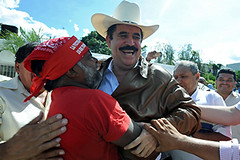
    An AU document containing compromise proposals and seen by Reuters urged the formation of a consensus government and said the institutions set out in last year’s accords “must be established and made operational without delay”.

    The consensus prime minister, Eugene Mangalaza, who was dismissed by President Andry Rajoelina last month, should be re-appointed, it said, adding that legislative and presidential elections should be held by October.

    Two of the four main political movements confirmed they had received the document from Ping. It was not immediately clear whether this was a final compromise or the starting point for negotiations.

    Rajoelina, Africa’s youngest leader, has in recent weeks torn up a series of internationally brokered power-sharing deals, appointed a military prime minister and is intent on unilaterally organising legislative elections in March.

    There are concerns in the opposition and among donor countries that an election hastily organised by a government not recognised internationally will not be free and fair.

    “Elections must be held within a time frame that allows for the guarantee of their credibility and transparency,” the document said. – Reuters

    Reuters

    Published on the Web by IOL on 2010-01-21 22:29:05

  • U.S. Aid to Haiti Comes With Strings Attached

    U.S. aid comes with strings attached

    By Sara Flounders
    Published Jan 20, 2010 8:38 PM

    How much is $100 million in U.S. aid to Haiti really worth? $100 million is less than what the U.S. spends in five hours on the wars and occupation in Afghanistan and Iraq.

    The $100 million President Barack Obama promised in emergency aid to Haiti for earthquake relief sounds like a lot of money. But it is a tiny amount when compared to what the rulers of France and the United States stole from Haiti and its people over centuries.

    The U.S. imposed 60 years of sanctions and blockade on Haiti after the victory of the first successful slave revolution in history. This blockade impoverished Haiti. France demanded in 1825, with warships in the harbor, that Haiti repay French slave owners $21 billion for the value of the enslaved Africans who were liberated. Haiti was forced to pay interest on this debt for more than 100 years.

    U.S.-supported dictator Jean-Claude “Baby Doc” Duvalier diverted $500 million in U.S. loans into his personal bank accounts in just the last six years before he fled the country. But the Haitian people still had to repay all the Duvalier loans.

    Billions of dollars in debt, Haiti was forced to accept an International Monetary Fund structural adjustment program that promised “debt forgiveness.” This IMF program destroyed Haiti’s sustainable agriculture, bankrupted its cash crops of rice and sugar, raised the price of electricity, and froze pay on public transit, infrastructure and vital social service providers such as doctors, nurses and teachers.

    Haiti’s debt to the Inter-American Development Bank was not “forgiven.” It is more than $500 million — five times the amount of U.S. aid pledged for earthquake relief.

    It is always important to remember that whatever U.S. imperialism gives with one hand, it takes away with the other. The IMF announced on Jan. 14, the same day that President Obama promised $100 million in aid, that it would be adding a $100 million loan to its current program in Haiti. This only leaves Haiti further in debt.

    $100 million is just 7 percent of the $1.4 billion that Haitian workers in the Diaspora send home to their families every year. Half of the population of Haiti lives on less than $1 a day. Yet this U.S. aid and U.S. loan will force even more Haitians to immigrate to find work for their families’ survival.

    The people of Haiti are owed reparations from the U.S. and French banks, which have extracted billions of dollars in profits from Haiti for hundreds of years. $100 million is far less than 1 percent of the $18 billion that Goldman Sachs executives will receive in bonuses this year, after a $700 billion U.S. government bailout of the banks.

    And $100 million in U.S. aid to Haiti comes with a high price tag: U.S. military occupation.
    ——————————————————————————–
    Articles copyright 1995-2010 Workers World. Verbatim copying and distribution of this entire article is permitted in any medium without royalty provided this notice is preserved.

    Workers World, 55 W. 17 St., NY, NY 10011
    Email: [email protected]
    Page printed from:
    http://www.workers.org/2010/world/us_aid_0128/

  • Cuba, China, Venezuela Send Immediate Assistance to Haiti

    Cuba, China, Venezuela send immediate assistance

    By Deirdre Griswold
    Published Jan 20, 2010 8:26 PM

    As soon as the devastating earthquake struck Haiti on Jan. 12, Cuban doctors began saving lives.

    Years before this monumental disaster hit, Cuba had set up a medical mission in Haiti to provide health care in areas where there had been little or none; Cubans also were training Haitian medical workers in basic first aid. When the quake struck, these teams quickly went into emergency mode.

    A relief plane from Venezuela was among the first to land in the stricken country, where normal services had ground to a halt. Venezuelan and Brazilian doctors soon joined the Cuban teams, who were accustomed to working in spartan conditions and had their own generators to power surgical equipment.

    Other Cuban doctors who had been working in Haiti, but were in Cuba on vacation when the quake occurred, quickly returned. They were joined by additional Cuban surgeons experienced in working in difficult situations and Haitian doctors who had been training in Cuban medical schools in various specialties.

    Within less than 24 hours, Cuban medical personnel in Haiti had already assisted hundreds of patients — a figure that grew to thousands by the weekend.

    Fidel Castro used his newspaper column “Reflections” on Jan. 16 to relay to the Cuban people the gist of a report from the head of the Cuban medical brigade:

    “The ‘Delmas 33 Hospital’ is already operational. It has three operating rooms, its own power generation plants, doctors’ visits areas, etcetera, but is absolutely full.

    “Twelve Chilean doctors have joined in. One of them is an anesthesiologist. There are also eight Venezuelan doctors and nine Spanish nuns. It was expected that, at any moment, 18 Spaniards, to whom the U.N. and the Haitian Public Health authorities had handed over the control of the hospital, would come, but they lacked some emergency supplies that had not arrived, so they have decided to join us and start working immediately.

    “Thirty-two Haitian resident doctors were sent in; six of them were going straight to Carrefour, a place that was totally devastated. Traveling with them were also the three Cuban surgical teams that arrived here yesterday.

    “We are operating the following medical facilities at Port-au-Prince: ‘La Renaissance’ Hospital, the Social Insurance Hospital, and the Peace Hospital. Four Comprehensive Diagnostics Centers are already working.”

    At the same time that the Cuban government was coordinating relief for Haiti, it also, in less than an hour, evacuated 30,000 Cubans from low-lying towns on the coast opposite Haiti, until fears of a possible tsunami had subsided.

    Chinese search and rescue team

    At 2 a.m. on Jan. 14, about 32 hours after the quake, a plane landed in Port-au-Prince with a search and rescue team from China — which had its own earthquake catastrophe just two years ago. The plane had left China within hours of hearing of Haiti’s urgent need and flew halfway around the world.

    The China Earthquake Administration reported that the team worked for more than 60 hours pulling people out of collapsed buildings in the capital. According to China Daily, the team “started working with peacekeeping forces from Brazil and Nepal and rescue teams from the U.S. and France.

    “They had retrieved the bodies of some United Nations officials, including U.N. chief in Haiti Hedi Annabi and Luiz Da Costa, deputy special representative of the U.N. general secretary in Haiti, in addition to eight Chinese police officers.

    “The team also set up a medical station to offer treatment for patients pulled out of debris and medical support to medical and security personnel. The team will continue search and rescue work in other parts of Haiti in coordination with the U.N., the CEA said.”

    Hou Shike, chief doctor of the Chinese medical team, reported that the team had already treated more than 200 patients with severe trauma.

    Three days later, on Jan. 17, a Chinese transport plane arrived in Port-au-Prince with 90 tons of supplies, including medicines, tents, emergency lights, water purification supplies, food, drinking water and clothing.

    Also on Jan. 17, President Hugo Chávez of Venezuela pledged his country would provide as much fuel as Haiti needed to generate electricity and provide transport.

    U.S.-controlled airport a ‘bottleneck’

    Meanwhile, the Haitian government, now barely able to function, turned over control of its international airport to the U.S. Washington’s first priority was to rush in thousands of troops. This has already brought criticism from aid groups.

    Doctors Without Borders, based in Geneva, said the U.S.-controlled airport was a supply bottleneck and that there was “little sign of significant aid distribution.” (Telegraph [Britain], Jan. 18) The aid group said a flight carrying its own inflatable hospital was denied landing clearance and the material was being trucked overland from the Dominican Republic, delaying its arrival by 24 hours.

    “French, Brazilian and other officials had earlier complained about the airport’s refusal to allow their supply planes to land. A World Food Program official told The New York Times that the Americans’ priorities were out of sync, allowing too many U.S. military flights and too few aid deliveries.

    “Alain Joyandet, French cooperation minister, said he had protested to Washington about the U.S. military’s management of the airport, where he said a French medical aid flight had been turned away.” (Telegraph)

    China Daily on Jan. 18 in a report from Port-au-Prince said that aid distribution was in general “random, chaotic and minimal.” It described how crowds jostled for food and water “as U.S. military helicopters swooped down to throw out boxes of water bottles and rations. A reporter also saw foreign aid workers tossing packets of food to desperate Haitians.

    “’The distribution is totally disorganized. They are not identifying the people who need the water. The sick and the old have no chance,’ said Estime Pierre Deny, standing at the back of a crowd looking for water with his empty plastic container.”

    The Chinese paper added that “Dozens of countries have sent planes with rescue teams, doctors, tents, food, medicine and other supplies, but faced a bottleneck at Port-au-Prince’s small airport.”

    It is very difficult to find coverage in the U.S. corporate media of what socialist and progressive countries are doing to help Haiti. Perhaps it is because they don’t put a price tag on their sacrifice? We do hear a lot about the $100 million that the Obama administration is promising. But on the ground, when thousands are dying every day from lack of water, food and medicine, that promise of greenbacks down the line isn’t enough.

    E-mail: [email protected]
    ——————————————————————————–
    Articles copyright 1995-2010 Workers World. Verbatim copying and distribution of this entire article is permitted in any medium without royalty provided this notice is preserved.

    Workers World, 55 W. 17 St., NY, NY 10011
    Email: [email protected]
    Page printed from:
    http://www.workers.org/2010/world/cuba_china_venezuela_0128/

  • Nightmare in Haiti: Untreated Illness and Injury

    January 21, 2010

    Nightmare in Haiti: Untreated Illness and Injury

    By MARC LACEY
    New York Times

    PORT-AU-PRINCE, Haiti — A strong aftershock rattled Haiti once again on Wednesday, causing even more physical damage and further traumatizing the jittery population. But the authorities said the biggest dangers now facing survivors of last week’s major earthquake were untreated wounds and rising disease, not falling debris.

    Because of untreated injuries, infectious diseases and dismal sanitary conditions, health workers said that the natural disaster that struck Haiti more than a week ago remained a major medical crisis and that, unless quickly controlled, it would continue to take large numbers of lives in the days and weeks ahead.

    “There are still thousands of patients with major fractures, major wounds, that have not been treated yet,” said Dr. Eduardo de Marchena, a University of Miami cardiologist who oversaw a tent hospital near the airport where hundreds of severely injured people were being tended. “There are people, many people, who are going to die unless they’re treated.”

    For the seriously ill, the chances of surviving may depend on leaving Haiti entirely. On Wednesday morning, a paramedic rushed up to Dr. de Marchena with news of a newborn who had arrived at another clinic in dire condition. After hearing that the baby could barely breathe, Dr. de Marchena said, “Should I get him airlifted to the United States?”

    The paramedic hesitated for a moment, and the doctor said, “Do it.” The baby was soon boarded for medical care in Miami.

    In the squatter camps now scattered across this capital, there are still people writhing in pain, their injuries bound up by relatives but not yet seen by a doctor eight days after the quake struck. On top of that, the many bodies still in the wreckage increase the risk of diseases spreading, especially, experts say, if there is rain.

    Getting food and water to displaced people is also crucial to staving off more deaths, relief workers said. As of Wednesday, the World Food Program reported that it had distributed food to more than 200,000 people, but it acknowledged that it could take as long as a month for relief food to get to the two million or more people in need.

    At some of the hospitals and clinics now treating survivors, the conditions are as basic as can be, with vodka to sterilize instruments and health workers going to the market to buy hacksaws for amputations.

    At General Hospital in here Port-au-Prince, the water and power are both out, medical supplies are running low and fuel for generators is hard to come by, doctors reported. Other hospitals are even worse off, though, with patients moved outside into the open air.

    Still, health experts were arriving in Haiti from Israel, Cuba, Portugal and other countries, many with stocks of medicine and supplies as well as extensive experience in disaster conditions.

    And the United States Navy hospital ship Comfort pulled up off the Haitian coast to handle the worst-off patients. A helicopter landing pad was cleared near General Hospital to evacuate the critically injured there.

    But integrating all the health professionals into a coherent system will take time. “Nobody knows how many doctors, how many nurses have come to Haiti,” said Dr. Henriette Chamouillet, head of the World Health Organization in Haiti. “No one is providing the government with the data it needs.”

    Another grievance among some health professionals was that the American military was not giving enough of a priority to humanitarian aid. Doctors Without Borders has complained that more than one of its planes carrying vital medical equipment has been kept from landing at the airport here, costing lives.

    Despite all the incoming help, Partners in Health, an organization that has been providing health care in Haiti for two decades, estimated that 20,000 Haitians were dying daily from lack of surgery. But that figure was not backed up by other aid organizations in Haiti and appeared to be much higher than other estimates of the continuing death toll from injuries. The W.H.O. said it was just beginning to gather epidemiological data to assess how much the quake’s toll, which is still uncertain, might rise.

    One of the keys to bolstering the response, said Dr. Paul Farmer, a co-founder of Partners in Health and deputy United Nations envoy to Haiti, was to unify the disparate aid efforts. “Everyone’s doing their own thing, and we need to bring them together,” he said in an interview.

    The continued tremors were not helping the situation. The latest aftershock, which had a magnitude of 6.1, came around 6 a.m. on Wednesday and was centered on Gressier, a village west of Port-au-Prince. The most powerful tremor to hit Haiti since the initial earthquake on Jan. 12, it caused some additional damage to the ravaged capital and surrounding areas, although the United Nations said it was still assessing how much.

    At the tented hospital run by Miami doctors, patients were shrieking and trying to squirm out of their cots when the aftershock came. The situation was still more dire at University Hospital, where patients and staff members evacuated the building and many traumatized Haitians feared going back in.

    Squatting on the sidewalk in central Port-au-Prince, her thigh bandaged from an injury suffered during the main quake, Ange Toussaint, 55, smiled broadly. “I’m here,” she said. “It happened again, and I’m still here. Wow!”

    There were some early efforts to address the psychological toll of the earthquake.

    At the University of Haiti, which hardly showed any damage, Jean Robert Cheri, a professor of psychology, sent a team of student trauma counselors into the streets.

    “We are sending them out with basic instructions,” he said. “First, listen to people, let them verbalize their feelings. Second, don’t promise them any material aid, because you can’t deliver.”

    Mr. Cheri said that the students’ studies had been interrupted for the foreseeable future and that putting their lessons to work would help both them and the country.

    “Look, it’s not going to be easy because they’re traumatized themselves,” he said of his students. “I myself am a psychologist who needs therapy. When I go to sleep, I dream of houses falling down.”

    Deborah Sontag contributed reporting.

  • China Recovers From Global Slump

    Thursday, January 21, 2010
    19:04 Mecca time, 16:04 GMT

    China ‘recovers’ from global slump

    China has declared itself the first major economy to recover from the global economic downturn as data showed economic growth accelerated to 10.7 per cent in the final quarter of 2009.

    GDP for the whole year totalled 8.7 per cent according to government figures released on Thursday, easily beating targets.

    However, the raft of data released by the National Bureau of Statistics also showed inflation picking up, adding to pressure on the government to prevent overheating in the economy.

    “China has become the first, on the whole, to achieve recovery and stabilisation in its economy,” Ma Jiantang, the bureau’s commissioner, told reporters in Beijing.

    But he added that in the face of ongoing “uncertainties” and a weak global outlook, the government would avoid major changes in economic policy.

    The figures put China’s total gross domestic output for 2009 at $4.9 trillion, bringing it closer to overtaking Japan as the world’s number two economy after the US.

    ‘Developing country’

    Nonetheless, Ma stressed that China sees itself as a developing country with a wide income disparity between its urban and rural populations.

    Average income for city dwellers in 2009 was $2,700, he said, while in the populous countryside it was just $752.

    “Despite the increase in our GDP and economic strength, we still have to recognise that China is a developing country,” Ma told a news conference. “We have to be keenly aware of that.”

    China’s leaders have said stimulus spending will continue but are worried about rising prices and have ordered banks to curb lending after a record surge in 2009.

    According to Thursday’s figures, consumer prices picked up in the fourth quarter of 2009 after falling for much of the year.

    Prices rose 0.6 per cent in November from a year earlier and spiked by 1.9 per cent in December.

    “That’s a huge jump,” Ken Peng, an economist with Citigroup, told the Associated Press.

    He said it was the sharpest one-month rise in inflation since February 2008, when China was suffering record consumer price hikes.

    Peng said the data showed it was time for the government to call a halt to stimulus measures.

    Inflation

    The spectre of inflation is especially politically sensitive in China, because rising prices erode the economic gains that the ruling Communist party has made the basis of its claim to power.

    But Tom Orlik, a Beijing-based economist for Stone & McCarthy Research Associates, said the problem for the government will be to “manage the withdrawal of the stimulus without scaring the markets or pulling the rug out from under the recovery.”

    “Turning the taps off might be a bigger challenge than turning them on,” he wrote in a report.

    In the past year China adopted what it called a “moderately loose” monetary policy and embarked on an unprecedented four-trillion-yuan ($586bn) spending spree to keep the economy growing amid the global downturn.

    In recent months however the government reversed course and called for “reasonable” lending as inflation fears rose, following a surge in the amount of new loans.

    On Wednesday the country’s top banking regulator said the government will closely monitor credit.

    Liu Mingkang, the chairman of the China Banking Regulatory Commission, said China will rein in credit after last year’s explosive growth but had no plans to stop banks lending.

    Bubble worries

    China’s biggest rise in inflation in 13 months underlined the broader challenges of breakneck growth, and came as the World Bank warned anew that the country could face an economic bubble.

    In the Global Economic Prospects 2010 report published on Wednesday the World Bank said it sees “signs of bubbles” in the Chinese economy, a problem it said the government has acknowledged.

    The annual report said the Chinese economy is projected to continue to lead global growth this year, expanding at a pace of 9.0 per cent, dwarfing the global rate of 2.7 per cent.

    “We can already see some signs of bubbles and signs of tensions in the Chinese economy, in particular in the housing sector,” Andrew Burns, the lead author, said in Washington ahead of the report’s release.

    Burns, who is the head of the bank’s macroeconomic forecasting, said China’s “low domestic interest rate and the “particular nature” of its fiscal stimulus was “putting strains on the economy and forcing the government to step back”.

    Michael Pettis, a finance professor from Peking University, told Al Jazeera the stimulus to boost investments may lead to China seeing increased debt and rising non-performing loans in its banking system because not all investments were viable or sustainable.

    Referring to reports of bubbles in the stock market or real estate, Pettis said the wealth impact in the case of a collapse in either sector “will be less than what people think because most Chinese save in bank deposits”.

    A much bigger worry is if a collapse in real estate prices leads to non-performing loans in the banking system, he said.

    “The real risk is not a bubble in the stock market or in the real estate market,” he added.

    “The real risk is that we’re continuing to increase capacity in a world in which demand is contracting… there is no need for all this increase in capacity.”

    Source: Al Jazeera and agencies

  • Ousted President Manuel Zelaya of Honduras Might Leave for the Dominican Republic

    January 21, 2010

    Manuel Zelaya ‘might leave Honduras for Dominican Republic’

    Manuel Zelaya has been living in the Brazilian Embassy in Tegucigalpa since his deposal as President

    Manuel Zelaya, the ousted Honduran president, said today that he might leave the country after the Dominican Republic offered him a haven as an “honoured guest”.

    Mr Zelaya, who has been living in the Brazilian Embassy in Tegucigalpa since he slipped back to Honduras in September after being deposed three months earlier, said that he welcomed the offer from Dominican Republic President Leonel Fernández, who had signed an agreement with Honduran President-elect Porfirio Lobo to let him in to the country.

    “This agreement allows me to maintain my dignity and the position bestowed on me by the people of Honduras,” Mr Zelaya said in a statement.

    The accord, signed in Santo Domingo today by Mr Lobo, Mr Fernández and representatives of Honduras’s major political parties, stipulates that the former President, his family members and his circle of advisers can enter the Dominican Republic on January 27 when Mr Lobo takes office after winning the November 29 election.

    If he takes up the offer it will bring an end to his state of political limbo after he was escorted out of the country at gunpoint in June. He has always denied his critics’ accusations that he was attempting to stay in office past his legal term but if he stepped foot outside the Brazilian embassy he would be liable for arrest.

    Negotiations over Mr Zelaya’s future have intensified as January 27 draws closer. His demand that he be returned to power was weakened after Mr Lob’s election win was recognised by a number of countries, including the United States.

    Last November Mr Zelaya refused an offer of safe passage by Mexico after Robert Micheletti, the interim President, imposed the condition that he be granted political asylum, which Mr Zelaya said would invalidate his claim to the presidency.

    If he leaves for the Dominican Republic when his term officially ends he will have put an end to his political career in Honduras.