Category: Energy

  • Energy saving Multitap ambient light gets powered by wasted energy

    energy saving multitap_1

    Eco Factor: Energy-saving socket strip doubles as ambient light if energy is being wasted.

    We all connect appliances to a multiple socket strip, but even after using them they’re often left connected to the strip in standby mode, which wastes energy as all appliances consume a small amount of energy even during standby. Industrial designers Dong Hoon Han, Hwa Yong Shin and Dong Jin Shin have come up with a device that provides ambient light and also alerts the user about energy wastage.

    (more…)

  • Ambient Light Concept Pleasantly Reminds You Your Gadgets Are Wasting Energy [Concepts]

    It’ll be at least a decade before the Bloom Box solves our energy crisis. In the meantime, you’re gonna have to turn off your gadgets. This concept uses ambient light to gently remind you which are still sucking power.

    The design bears the creatively-sequenced name Saving Energy Multitap, and it’s intended as a replacement for your power strip. Instead of letting plugged-in gadgets’ extra juice go to waste, the Multitap uses it to power a panel of four ambient lights. The lights announce which devices are running and double as touch-sensitive switches to let you easily turn them off.

    The idea is a nice one but, it seems to me, flawed; if I have to choose between basking in a soothing orange glow and being 100% energy efficient by turning all my electronics off, I’m not sure I’m always going to make the right choice. [Yanko Design]


  • RFK Jr. explains why nuclear power isn’t green and coal isn’t cheap

    By Harriet Blake
    Green Right Now

    As passionate as his father was about civil rights, Robert F. Kennedy Jr. is equally so about the environment.

    Robert Kennedy Jr.

    Robert Kennedy Jr.

    In a lecture in Fort Worth on Wednesday, the 56-year-old son of the late Senator, advocated for moving the nation to green energy, which he doesn’t see as encompassing nuclear power.

    Coal is not the only power-producing industry that needs scrubbing, said the longtime environmentalist, nuclear energy is simply not safe. “Nuclear energy is the most catastrophic form of energy. No bank will finance it…[and] no insurance company will insure it,” he said.

    “It’s not just a bunch of hippies saying it’s unsafe. There are spills all the time into the Hudson,” says Kennedy, who serves as chief prosecuting attorney for Riverkeeper, whose mission is the restoration of the Hudson River. Three Mile Island was not the last accident despite what nuclear advocates say.

    He made it clear that lobbyists for fossil fuel and polluting energy industries are powerful and dangerous. The nuclear industry, for example, managed to find a way to get a Congressional exemption that leaves them free from damage. “All homeowners’ policies in the U.S. exclude radiation from the nuclear industry,” he said.

    Kennedy believes greed has taken over the utility companies as well. “Utility companies make money by selling more energy – even if the energy is green. We need to change the rules,” he says. “Don’t reward bad behavior.”

    He believes it’s a question of loyalty. “Instead of being loyal to their shareholders, company leaders need to be loyal to our nation,” he says.

    Along with serving on the boards of green energy companies, Kennedy, a resident of Mount Kisco, N.Y., has led the efforts to protect New York City’s water supply, both through Riverkeeper and as a senior attorney for the Natural Resources Defense Council. He is the president of Waterkeeper Alliance and a professor and supervising attorney at Pace University School of Law’s Environmental Litigation clinic. (After getting his undergraduate degree from Harvard and law degree from the University of Virginia, he picked up a masters in environmental law from Pace.)

    As a partner with Silicon Valley’s VantagePoint Ventures, he is involved firsthand with green energy. VantagePoint funds an array of emerging clean tech and green energy companies., including solar, algae fuel and energy conservation businesses.

    During his lecture at Texas Christian University, Kennedy also addressed the coal industry’s claims that coal is clean and cheap. It is neither, he says.

    The problem is that once a coal plant is built, there are many hidden costs such as pollution and healthcare.

    “More than 60,000 Americans are killed each year due to ozone particulate pollution,” he says. In addition, every fish in the United States is affected by dangerous levels of mercury, thanks to the coal industry. That mercury level also has grown in humans. Babies being born to women with high mercury levels have a higher percentage of illness ranging from autism to mental retardation.

    On the other hand, “Once a solar plant is built, the energy is free forever.” There are no pollution and health costs, and no strings attached, he said.

    Using coal to produce electricity is a destructive business from the beginning of the process, says Kennedy, who opposes the mountain-top removal mining in Appalachia in which ancient mountains are sheared off to get to the coal. The practice destroys forests and the resulting debris pollutes area rivers. (Coal companies say they ameliorate the damage by planting new trees, but environmentalists say these saplings cannot replace the mature forests; that erosion, runoff and river pollution are not abated.)

    Kennedy recalled his father being against what was then known as strip-mining. “He told me, [the coal industry] is not just destroying the environment, but permanently impoverishing the surrounding communities. They’re doing this so they can break the unions.”

    It’s particularly a shame because Appalachia, Kennedy points out, “is the oldest ecosystem on the continent.”

    “Today,” he says, “ninety-nine percent of coal in West Virginia is owned by Wall Street bankers such as JP Morgan and Chase.” The reason? Many of the homeowners were tricked into selling their mineral rights because they didn’t know any better. “The coal industry has liquidated the people of West Virginia of their cash,” he says.

    Kennedy says he’s not just fighting for ecosystems and halting the destruction of the environment. “It’s about the subversion of American democracy, the public process and transparency in government.

    “Government is supposed to protect us,” but because of the influence polluting companies and lobbyists wield in Washington, that’s not happening.

    Interestingly enough, he says, “every nation that has attempted ‘de-carbonization’, has prospered afterward. In Iceland, they became scared of global warming and within 15 years, went from being the poorest nation in Europe to the fourth richest. Sweden is another example. After Sweden de-carbonized and closed their nuclear facilities, they prospered. Tons of entrepreneurs came in as clean energy was introduced.”

    He named Brazil and Costa Rica as having robust economies after they de-carbonized as well.

    Robert Kennedy Jr. speaks at TCU.

    Robert Kennedy Jr. speaks at TCU.

    Kennedy would like to see an increase in geothermal power, which he uses at his home in New York. “Geothermal,” he says, “is an underutilized resource. It’s been unexploited until now, but it could be a boon, especially in Texas where you already have holes in the ground from gas/oil drilling.” His home also has solar panels and between the two forms of energy, his home generates more power than he can use, which he then sells back to the utility company. “But you can’t do this in all states. This needs to be fixed. We need to reward efficiency; and punish inefficiency. We should be able to turn every home into a power plant.”

    Another resource he’d like to see used more is wind. “There’s enough wind in the states of North Dakota, Minnesota and Texas to power the entire country,” he says.

    The Obama Administration faces some major obstacles, Kennedy says. “We need to get rid of the subsidies that give breaks to dirty energy. And we have to build an electric grid that can accommodate the entire country.”

    Kennedy compares the effort to the interstate highway system that was built during the Eisenhower years. The United States has the technology, Kennedy says. “And we have the resources – wind that blows at night; and sun that shines by day…We can put PVCs on every south-facing roof in the country.” Taking advantage of these green energies should be a no-brainer.

    The TCU lecture was part of the Frost Foundation Lectureship for Global Issues, sponsored by the TCU Center for International Studies.

    Copyright © 2010 Green Right Now | Distributed by GRN Network

  • Bacteria colonies could grow nanowires to create a living battery

    bacteria colony

    Eco Factor: Bacteria colony reacts with mud and seawater to generate electricity.

    Scientists have for long known that bacteria can generate electricity when mixed with mud and seawater, which led to the development of microbial fuel cells. However, till date these researchers weren’t able to provide the reasons of just how bacteria create electric networks that serve as long distance communication.

    (more…)

  • 3Tier Group Finishes Map of the World’s Wind, Solar Energy Hotspots

    3tier
    Luke Timmerman wrote:

    Seattle-based 3Tier Group set an audacious goal two years ago of remapping the world to find the best spots to generate solar and wind power, and now it’s done. Of course, that means it’s time for 3Tier to show this information is truly valuable to customers.

    3Tier finished its map of the world’s wind currents in November 2008, and yesterday it announced the completion of the solar map. This was truly a project cut out for the supercomputer it has in Seattle’s Westin building. 3Tier captured data from five different stationary satellites, and took half-hour snapshots of sun patterns on Earth over the past 10 to 13 years, zeroing in on squares as narrow as 3.3 kilometers across. (You can look at a thumbnail version of the map below. Click on it for a larger version.)

    By taking so many repeated glimpses over time, and over such a small surface area, 3Tier hopes to provide power companies with deeply detailed information which ought to be useful before they plunk down $100 million or $200 million to build a renewable power plant, says 3Tier CEO Ken Westrick.

    “This way you can account for cloud cover, and get a much better idea of the transient behavior of the clouds,” Westrick says.

    This will be an important year to test 3Tier’s business plan, which rests on selling access to this data on the ebb and flow of the sun and wind. The company, founded in 1999, raised $10 million in December 2008 to finish the remapping project. But the economy didn’t do 3Tier any favors last year, as a lot of alternative energy projects slowed down or shifted into a wait and see mode. 3Tier laid off an undisclosed number of workers last September, and revamped its business to de-emphasize consulting, allowing customers to access their datasets over the Internet and customize their own dashboards for forecasting and power assessment. The company has “gotten traction,” with this strategy since last fall, and is “close” to operating at a profit, said Westrick, without providing specific numbers. The company now has about 60 employees, he says.3tiermaps

    I pressed Westrick on how this new solar map is really different from whatever his customers have access to now, to give me a better idea of how useful this might be to them. The main competition in the U.S. is from the National Renewable Energy Laboratory (NREL), Westrick says. The big difference is that NREL’s map looks at the U.S. in 10-kilometer wide squares, and takes snapshots every three hours. So the 3Tier map, as Westrick says, is higher resolution, which ought to account for the finicky behavior of clouds (something we Northwesterners know all about). Clouds obviously count for a lot in the solar world, because they have a direct effect on how much power a solar plant can throw off.

    “We think our accuracy is a little higher, and when you’re spending $100 million to $200 million on a project, you want to look at another source of data,” Westrick says. “It’s a good idea to get a second opinion.”

    A potentially bigger opportunity for 3Tier, however, is in other parts of the world that are getting aggressive about renewable energy, and don’t have access to any data from a government agency like NREL. India and Australia don’t have access to anything like the 3Tier solar map from another source, and the company has established offices with good potential to attract customers there, Westrick says. Europe is another promising market for solar power, particularly Spain, although 3Tier has found Europe to be “hard to break into.”

    Now that the data is in, I wondered which results really surprised the people at 3Tier. After all, who needs a supercomputer to tell them the sun is powerful in Arizona, Australia, and Spain? It turns out that a lot of previous attempts at solar mapping relied on averaging, which made those places look promising on a map, but there’s actually more nuance when 3Tier dug deeper. In India, for example, 3Tier found a lot of month to month variability, in which so-called “sunny areas” on the map had more cloud cover at certain parts of the year. If, say, the highly populated coastal areas have peak electricity demand at a time when the clouds are overhead, and the best solar resources are inland at those moments, that’s something you’d want to know before breaking ground on a new plant, Westrick says.

    “You need to ask, ‘Is the resource, the sun, there when you need it?’” Westrick says.


  • Chinese data suggests strength for crude oil

    The idea that emerging markets will be the key source of demand growth for crude oil in the coming years is nothing new. However, the latest import demand data from China underpins this development.

    The country processed a record 374.6 million metric tons of crude in 2009, or 7.5 million barrels a day (bpd), according to China Mainland Marketing Research. China may boost refining capacity by more than 10% by 2014, which would lead to higher oil imports, according to estimates from Poten & Partners.

    All this suggests the recent price strength in crude has a solid base.

    UBS Wealth Management Research expects China’s domestic oil production to peak at around 4 milliom bpd, which means increases in production will need to be met with higher imports.

    Saudi Arabia’s exports to China already exceed the volume shipped to the United States and Chinese crude oil demand could surpass 9 million bpd in 2010, UBS noted.

    Chinese oil imports also rose by more than 1 million bpd in the fourth quarter of 2009 compared to the same period a year earlier. Since the base effects in demand are yet to show up, the investment bank thinkgs year-on-year changes in demand could reach almost 2 million bpd in the first quarter of 2010.

    This is not to say the United States no longer matters. It remains the world’s largest consumer of crude oil. However, there is no need for U.S. demand to increase sharply.

    “We only need demand to stabilize followed by a gradual recovery,” UBS said. “We think the U.S. economy should deliver such a scenario, especially with leading indicators pointing to a recovery in economic activity.”

    The message: stay long crude oil. UBS thinks prices have room to move into the US$90 to US$100 per barrel range.

    Jonathan Ratner

  • Luminus Devices Nabs $19M, Aveo Sets IPO Range, Thermo Fisher Scientific Reportedly Makes $6 B Move on Millipore, & More Boston-Area Deals News

    Rebecca Zacks wrote:

    It was a good week for venture dealmaking among New England’s tech and life sciences firms.

    —Needham, MA-based Stata Venture Partners led a $7 million Series B financing round for NABsys, a Providence, RI-based firm developing a DNA sequencing technology that employs silicon chips for rapid electronic detection of DNA sequences.

    —Boston-based Battery Ventures sold Woburn, MA-based analytic instrument maker Nova Analytics, which it helped buy out in 2003, for an undisclosed sum to White Plains, NY-based ITT.

    —EveryScape, a Waltham, MA-based operator of a website providing navigable, 360-degree views of metropolitan, suburban, and rural areas, raised $6 million in a Series C funding round led by SK Telecom Americas, and joined by Draper Fisher Jurvetson and Dace Ventures.

    —North End Technologies, a robotics and communications company in Waltham, raised $2.5 million from Castile Ventures, company executives, and angel investors, and converted $1.8 million in preexisting debt to equity, according to CEO Brad Kayton.

    —Boston-based Fluent Mobile, maker of the iPhone news-aggregating app Fluent News Reader, raised $1.25 million in equity funding, according to a regulatory filing.

    —Milwaukee, WI-based Merge Healthcare (NASDAQ: MERG) made a $6.05 per share buyout offer for Boston-based radiology information management company Amicas (NASDAQ: AMCS). Amicas’ board of directors deemed the offer risky, though, and urged …Next Page »


  • World Energy Unveils “Demand Response” Auctions, Disrupting a Market Dominated by Boston’s EnerNOC

    World Energy Logo
    Wade Roush wrote:

    It’s so costly and complicated to build new generating plants these days that utilities would rather prepare for periods of peak demand, such as hot summer days, by buying “negawatts”—that is, by agreeing to pay big customers like factories, stores, and municipalities to dial back their electricity use when called upon. EnerNOC (NASDAQ: ENOC), a sweetheart of the Boston technology community since its 2007 IPO, has built a big business around pooling customers who want to participate in these so-called “demand response” programs and remotely managing their electricity use when the call comes in from grid operators. EnerNOC profits by keeping a percentage of the operators’ per-megawatt payments.

    But while EnerNOC is the largest and most successful of the so-called “curtailment service providers” (CSPs), there is growing competition in its industry—and now the company is getting some very unwelcome news. World Energy (NASDAQ: XWES), a Worcester, MA-based company known for operating online reverse auctions in which energy suppliers compete to win contracts with big customers, announced today that it’s getting into the demand response market. This means that for the first time, customers in deregulated electricity markets who want to be paid for their curtailable load will be able to solicit bids online from competing curtailment service providers, then choose the provider offering the highest price (meaning the most attractive percentage split).

    EnerNOC, in other words, is gradually losing its first-mover advantage. It may soon have to cope with a market in which it’s no longer the first and only curtailment service provider to approach new customers, but instead must compete with dozens of other providers in electronic auctions specifically designed to drive bidders’ profit margins down.

    The irony is that EnerNOC, which built its business on smoothing out inefficiencies in electrical supply and demand, is now seeing that business disrupted by another young, technology-based company that sees the demand response market itself as inefficient.

    From World Energy’s point of view, customers thinking about joining demand response pools have had no way, up to now, to determine the fair market value of their curtailable load. Indeed, it sees its auction service as providing both competition and transparency. It’s portraying the service, which it has already tested in the “PJM” grid region covering 13 Midwest and Middle Atlantic states, as …Next Page »


  • America’s First Wave Power Farm Consists of Ten Buoys, Costs $60 Million, Powers 400 Homes [Energy]

    Ten 200 ton buoys—each measuring 150 feet by 40 feet—are being installed off the coast of Oregon to build America’s first wave power farm. They’ll power 400 homes by harnessing “the energy of wave motion.” Worth $60 million?

    Of course, of course. Clean, renewable energy is almost always worth it. The trouble with wave farms is that they haven’t shown much success yet. They’re currently about six times as costly as wind farms, are easily damaged by large waves, and the first ones didn’t work out so well:

    The world’s first commercial wind wave farm opened in 2008 in Portugal, but power production was suspended due to financial difficulties. Moreover, two years ago, a Canadian-produced wave power device sank off Oregon’s coast.

    Yikes. I’m sure that in the long run we’ll start seeing positive results, but it looks like the path there will be long and expensive. [USA Today via Good via InhabitatThanks to GitEmSteveDave for catching the typo!]


  • General Compression Announces $17M Series A Round

    Howard Lovy wrote:

    General Compression, a Newton, MA-based energy storage company, announced today that it has “it has closed over $17 million in commitments to its Series A round of funding.” The funding, from U.S. Renewables Group and Duke Energy, will be used to build General Compression’s first commercial-scale wind power storage unit this year. The company declined to elaborate on its press release (pdf here), which did not specify if the $17 million is all new equity investment; General Compression sold $4.8 million in convertible securities in 2007 according to an SEC filing (a pdf of which is here). The startup’s energy storage system uses compressed air to save wind energy and send it out on transmission lines in a reliable way, as Wade described a few years back.


  • Pivotal Investments Seeks to Build Regional Network of Future Cleantech Leaders

    Pivotal Leaders
    Gregory T. Huang wrote:

    There has been a lot of talk in the past year (and the past month) about the need to build a critical mass of cleantech and alternative energy companies in the Northwest. Now one venture firm in Portland, OR, is doing something about it, by assembling a talent pool of people with the ability to run serious cleantech companies.

    Pivotal Investments, an early-stage venture fund focused on cleantech and sustainability, is organizing what it’s calling Pivotal Leaders—a new network of community-nominated entrepreneurs and executives who will be voted the most promising candidates to lead new companies in this emerging sector. Nominations are open now, and Pivotal is looking to compile and vet a list of roughly 50 top cleantech business leaders who have ties to Washington, Oregon, Idaho, or British Columbia, by mid-June. The plan will be to organize four or five networking events around these leaders, in different cities, in the second half of the year.

    The proposed network strikes me as exactly the sort of dedicated effort the Northwest needs to get more cleantech investors in Vancouver, BC, for instance, to talk to entrepreneurs and big companies in Portland and Seattle, and vice versa. That, in turn, could help call more national attention to the region and spur its efforts to become a true leader in energy and sustainability—or at least better compete with companies in California and other parts of the country. “We’re interested in building the ecosystem here for green, cleantech jobs,” says Gregg Semler, co-founder and managing director of Pivotal Investments. “This is an enormous economic opportunity for the region.”

    Semler says the Pivotal list will address “a problem that deals with the future.” That is, the community knows who’s running cleantech companies today, he says, but what about five years from now? “To attract capital, you need strong business leaders who can captain these companies. That builds confidence in the investors and sources of capital,” Semler says.

    Pivotal Leaders will most likely be made up of a mix of early-stage entrepreneurs, executives from big companies focused on areas like software or green buildings, and others from traditional business backgrounds who have a strong interest in energy and green technologies. Semler didn’t name any names or offer up any specific examples yet, but he stressed that nominations will be open for the next few weeks, and that Pivotal wants to hear from the innovation community.

    On the investment side, Semler says his venture firm is currently looking at potential deals in solar power, green buildings, agriculture, and energy efficiency. Although cleantech opportunities are still at an early stage, he says, the markets they address are big, global, and mature. And, of course, part of Pivotal’s plan with its new network is to build relationships with the best young talent the Northwest has to offer—and then consider investing in their startups.

    “Our hope is that when these people decide to start a company, they’ll call us,” Semler says. “We want to get to know these people, so they feel confident that we’re a great source of capital and have a strong network to help them grow their company.”


  • Exploding Batteries to Make Them Safer [Batteries]

    How do you build a safer battery? By doing horrible things to it. At Sandia National Laboratories, lithium-ion batteries—the kind that are inside your laptop and cars—are pulverized, overcharged and just plain exploded.

    The idea’s to find faults in the batteries so battery makers can fix them. What’s depressing is that the lab’s underfunded and apparently still looks like it’s out of the Cold War, with ancient equipment and tinfoil wrapped around lines for safety. This is even as the lab has alerted battery makers to the kinds of serious problems that cause batteries to you know, explode—leading the industry to create backup systems like mechanical circuit breakers when batteries get too hot.

    Check out the full profile at the WSJ, it’s eye-popping, and not just for the detailed descriptions of how the lab tortures the hell out of batteries. [WSJvia Techmeme]


  • Drought, Climate Change Jeopardize and Complicate Hydropower Policies Around the World

    Climate change is expected to bring less precipitation and more extreme droughts to certain parts of the world, causing electricity shortages in hydro-reliant countries.

    Countries Relying on HydropowerOn Tuesday Venezuela’s Energy Minister, Ali Rodriguez, said the government would consider purchasing electricity from Colombia, contradicting a statement from the country’s Vice President Elias Jaua given earlier this week. One day before Rodriguez’s announcement, Jaua said he’d reject the Colombian proposal because Venezuela would “power up its own electricity system,” according to Business Week.

    These conflicting statements reflect the already confused and poorly managed policies officials have attempted to implement against the country’s worst drought in nearly a century.

    In January, electricity rationing in Caracas was suspended after one day because of the chaos created by the power cuts to traffic signals and protests. As a result, energy consumption decreased by only two percent compared to last year–-far short of the goal of a 20 percent reduction, Bloomberg reports.

    The source of 70 percent of Venezuela’s electricity is the Guri dam. Low reservoir levels have forced power generation to be curtailed. At its current rate, the water level will drop to critical lows by the summer, in which case all power generation would stop.

    Critics argue that if the government had invested more money in the energy sector, Venezuela would have other sources available during the crisis.

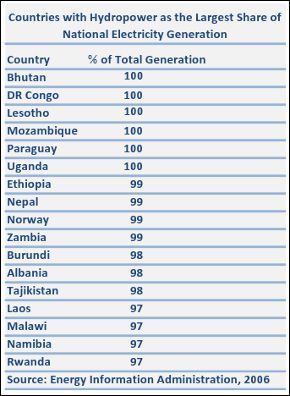
    The country’s energy struggles mirror problems in the rest of the hydro-reliant world. Many countries, especially in Africa, use hydroelectric dams to produce nearly all their electricity.

    The threat of more extreme drought from climate change is an uncertain variable for many hydroelectric producers. Climate models predict an overall decrease in precipitation and river runoff for the mid-latitude, sub-tropic and dry-tropic areas-–where hydropower is currently the primary source of electricity.

    Persistent low water levels in rivers and reservoir cause power cuts, which hinder economic growth and reduce revenue from electricity sales, limiting the ability of an electric utility to maintain the dam.

    Some countries have recognized the risk and are already moving toward a more diversified energy future.

    After a 2009 drought that led to two months of power rationing, Kenyan Prime Minister Raila Odinga said “the country can no longer continue to rely on hydro-electric power supply,” Business Week reported. Nearly 70 percent of its electricity comes from hydropower.

    Kenya is seeking up to $1 billion from international bond markets to finance geothermal and wind energy projects, Business Week reports.

    Source: Business Week, Bloomberg

  • Boston-Power Adds Ex-GM Exec to Board, Prepares to Take On Automotive Battery Market

    Boston-Power Logo
    Wade Roush wrote:

    Around the time Steve Jobs unveiled the Apple iPad, a funny Photoshopped picture began making the rounds on the Web, showing Jobs with four iPhones crudely lashed together with duct tape. The picture’s unspoken message, of course, was that the iPad is just a big iPhone.

    Well, something like that is actually coming true in the automotive battery field. It turns out that you can make a pretty good battery for a hybrid electric vehicle by assembling lots of small lithium-ion laptop battery cells—up to 2,000 of them, in fact—into one big pack.

    This is the approach being pursued by Boston-Power, the Westborough, MA, startup best known for making the environmentally friendly Sonata batteries used in many Hewlett-Packard notebook computers. And in a sign that Boston-Power is getting serious about marketing its so-called Swing cells to electric-vehicle makers, the company is expected to announce today the appointment of retired General Motors executive Robert Purcell to its board of directors.

    As the leader of GM’s Advanced Technology Vehicles Group from 1994 to 2002, Purcell helped to launch the EV-1, GM’s first modern electric vehicle, as well as an electric pickup truck and early hybrid cars. He went on to lead global sales, planning, and strategic alliances for GM’s Powertrain Group, managing $2 billion a year in direct engine and transmission sales and $1 billion in licensing activity.

    In other words, he’s been around the block a few times in the automotive industry. And while he says he’s “seen a lot of things” in his work with GM and its partners, he’s never seen a car powered by the equivalent of 2,000 laptop batteries.

    “Of course, this isn’t just as simple as strapping together a bunch of laptop cells,” Purcell told Xconomy last week. “It’s about integrating from cell to module and then from module to pack. Boston-Power has some very clever ideas about how to do that in a cost-effective way. And this isn’t a science fair project—they are doing the hands-on work to move from cell to module to pack in a way that will work in a typical light-duty passenger vehicle.”

    Boston-Power has been eyeing the transportation market since 2008, when it expanded the R&D facilities at its Westborough headquarters and began to build prototype battery packs for power-assisted bikes and scooters. So far, the company has tested Swing-based battery packs in just a few hundred cars—but Christina Lampe-Onnerud, the company’s founder and CEO, predicts that eventually the Swing and other lithium-ion batteries will completely …Next Page »


  • Student-Built "Black Widow" Racer Gets 2,752 Miles Per Gallon [Automobiles]

    Engineering students at the California Polytechnic State University are showing off the updated Black Widow, their entry for the upcoming Shell Eco-Marathon contest, and it involves some unusual numbers: 3 (wheels); 3 (horsepower engine); and 2,752 (miles per gallon).

    The team has been working on the vehicle since 2005, and with each successive year they’ve managed to shed weight and ramp up mileage. In its current state it weighs only 96 pounds, and can hit a top speed of 30 MPH with its Honda 50cc engine.

    In the last three Shell Eco-Marathons—a competition for student-made, energy-efficient vehicles—the Black Widow placed either first or second. The competition takes place at the end of March, and this year the California Polytechnic State team will double its chances by entering a second vehicle, also with three wheels, in the Urban Concept category.

    The Black Widow may not be the fastest car or the most powerful, but it will almost certainly get you where you need to go. [Wired via Inhabitat]


  • ENERGY-SOUTHERN AFRICA: Small Is Beautiful, Say Independent Power Producers

    By Servaas van den Bosch WINDHOEK, Feb 20 (IPS) Independent power producers argue that small hydroelectric plants have a key role to play in avoiding an energy shortfall in the Southern African region.

    Cheap power from South Africa – which derives most of its 40,000 MW from coal-fired plants – has delayed investments in the Southern African Development Community's (SADC) electricity sector for three decades. But South Africa's surplus is drying up and countries are scrambling to build up generating capacity.

    "No significant new power plant has been built or commissioned in SADC since 1975," says Simson Haulofu, generation manager of Namibia national power utility Nampower.

    "Hydropower is the most logical answer to our predicament," he says. "It's clean, cheap and never runs out."

    The case for generating energy from Africa's rivers seems straightforward. "The continent has only tapped 20 percent of its 100,000 megawatt hydropower potential," calculates Katai Kachasa, general manager of the independent Lunsemfwa hydropower station in Zambia.

    "Africa has 12 percent of the world's hydropower potential, but has harnessed relatively little (of this)," adds Lewanga Tesha, senior manager hydro generation of the Tanzania Electric Supply Company. "This is strange, because after nuclear power it is the cheapest energy source per unit of electricity, followed by respectively coal, gas, oil, wind and solar."

    According to World Bank figures, hydropower contributed 36 percent of Africa's power generation portfolio, or 76,000 GW/h per year, compared to 4 million GW/h per year that is theoretically possible.

    But backed by international development finance institutions, African governments have concentrated on large hydropower projects like Zimbabwe’s Kariba dam, Ghana’s Akosombo dam on the Volta and the extensive Gilgel Gibe project in Ethiopia.

    A 2008 study of the Southern African power sector by market researcher Frost & Sullivan, found national power utilities showed limited interest in developing such projects. Where funds are available – and South Africa's Eskom is the utility most actively raising capital – investment is usually geared towards large-scale projects which promise to deliver power at a lower cost per unit.

    But even when large projects are successfully funded, constructed and brought online, they may not answer the particular needs of a growing continent.

    "It's just not feasible to erect an 80 kilometre power line to power an isolated town, the provider will not make back the investment in a hundred years," says Haulofu.

    Zambia's Kachasa argues small hydroelectric plants are the route countries must pursue. "Grand projects are hard to fund and are immensely complex to realise," says Kachasa. "Why not engage local IPPs to make small units of 5 or 10 MW at a cost of US$10 to US$15 million? Such a project can unlock a specific region, even where they don't feed into the grid."

    A 10 MW plant could power an African town of 50,000 people.

    Estimates of the untapped potential for small hydro plants in Africa range to over 60,000 MW, but only several hundred megawatts of capacity has been built. Independent producers argue that low tariffs and the monopoly position of national power utilities – which often function as generator, single-buyer, distributor – are obstacles to filling that gap, complain IPPs.

    "Countries must open up the regime, make the playing field clear and predictable," says Kachasa. "If the tariffs are not cost-reflective no one will come."

    Southern African electricity tariffs, says Frost & Sullivan, are the lowest in the world, but raising prices for consumers and industry counters development goals of governments. A way out of the predicament would be to create incentives without immediately raising the tariffs, counter the IPPs.

    "IPPs in East Africa have benefited from (value-added tax) exemptions and waived import taxes," says John Berry of IPP Bujagali Energy in Uganda. "By reducing the costs, hydro-resources can be developed and the tariff can rise over time."

    IPPs complain that incentives for smaller independent producers are still missing in Southern Africa.

    "But that’s not an issue of price," says Electricity Control Board of Namibia CEO Siseho Simasiku, who argues the region is moving towards a cost-reflective tariff.

    "If it wasn’t for the financial downturn we would have been there already, now it will take another two years. For green energy we already offer IPPs a competitive tariff."

    Simasiku accuses the region’s parastatals of protectionism. "It’s the power utilities that simply do not want competition. After three years of negotiating with an IPP that wants to build a windfarm on the coast, Nampower still hasn’t signed a Power Purchase Agreement. In South Africa Eskom shows exactly the same reluctance."

    Simasiku says the attitude of national power utilities compels regulators to take action. "In 2010 we will put in place regulations that force the parastatal to open up the regime."

    Since Uganda liberalised its electricity market in 1993, IPPs have initiated hydropower projects that, when completed, will triple the country’s total generating capacity, adding 565 MW of hydropower.

  • The Empower Chair Makes You Work to Charge Your Phone [Concept]

    Ever struggle to find a free outlet while waiting around at an airport? I bet it would be far easier to get a quick charge if everyone had to work to get some electricity like with these concept rocking chairs.

    The Empower rocking chairs take advantage of kinetic energy to generate power and prolong your gadgets’ lives, but you actually have to sit there and rock back-and-forth-and-back-and-forth-and-back-and-oh-my-God-just-let-me-be-lazy-and-charge-something! [Inhabitat]


  • ARPA-E Director Arun Majumdar Meets with Bill Gates, Advises Local Startups, Speaks at UW

    ARPA-E
    Gregory T. Huang wrote:

    There’s no better way to kick off a Seattle visit than to have a two-hour meeting with Bill Gates. That was Arun Majumdar’s morning yesterday.

    The director of ARPA-E, the new $400 million research agency within the U.S. Department of Energy, was on tour to promote novel energy R&D programs and get feedback from innovators across the country. He and Gates had an in-depth discussion about energy and climate change—some of the greatest problems facing humanity, and what Majumdar called “the challenge of our lifetime.” Earlier this week, Gates addressed these same points in his talk at the TED conference in California, calling for very fast-paced “miracle” innovations to increase energy efficiency and production while reducing carbon emissions.

    It sounds like Gates and Majumdar are very much on the same page. Before being appointed to lead ARPA-E, where he reports to Energy Secretary Steven Chu, Majumdar was a professor of mechanical engineering and materials science at UC Berkeley, and also led research programs at Lawrence Berkeley National Laboratory. His expertise includes energy conversion, transport, and storage, from the nano-scale level to large energy systems.

    After his meeting with Gates yesterday, Majumdar convened a group of about a dozen local energy entrepreneurs and investors, including Lars Johansson and Byron McCann of Northwest Energy Angels, Rick LeFaivre of OVP Venture Partners and the UW Center for Commercialization, Alla Weinstein of Principle Power, Rick Luebbe of EnerG2, Christina Lomasney of Modumetal, Jill Watz of Vulcan Capital, Niki Parekh of Bio Architecture Lab, Dan Rosen from Alliance of Angels, Chris Tagge of LivinGreen Materials, David Kaplan from V2Green (GridPoint), and Daniel Malarkey of the Washington State Department of Commerce.

    Those I talked to after the meeting were very positive. They said Majumdar stressed the importance of risk-taking in R&D, and sought feedback from local leaders on things like who the customer will be for ARPA-E projects. This is a critical issue. The whole effort is modeled after the Defense Advanced Research Projects Agency (DARPA), which has the Department of Defense as its main customer, and falls under a centralized policy. In the case of ARPA-E, however, Majumdar is navigating a discontinuous set of customers—essentially the entire energy market.

    Arun Majumdar (image courtesy of Lawrence Berkeley National Lab)

    One key takeaway from the entrepreneur meeting was that the U.S. government needs to create a technology “pull” as well as a push. Majumdar noted in the meeting—as he also did in a recent presentation to Congress—that government is one of the largest consumers of energy (think buildings, transportation, and so on). So ARPA-E needs to use that power to create adoption and purchasing standards, as local leaders discussed with Majumdar.

    “The U.S. government can come back and say, ‘We’re going to create a buying policy,’ and only buy production processes that have [a higher] level of efficiency,” says Lomasney from Modumetal, a Seattle-based nanotech startup that hopes to reinvent the metals industry. “ARPA-E has to supply the technology, but it also has to be the first adopter.”

    Majumdar also gave a public talk at the University of Washington yesterday, hosted by the Department of Computer Science & Engineering. The theme was to address the “three Sputniks of …Next Page »


  • Home energy management: Big players are plugging into the potential

    By Bill Sullivan
    Green Right Now

    Lately, it seems, just about everyone is taking an interest in helping you manage your home energy consumption.

    Hohm is Microsoft's bid to get into home energy management. Image: microsoft.com

    Hohm is Microsoft's attempt to get into home energy management. (Image: microsoft.com)

    Microsoft weighed in with its Hohm offering last summer. Google touts its PowerMeter service. Apple is patenting a system to optimize the powering of your network of iPods, laptops, and electronic gadgets. Intel has added an energy component to its Home Dashboard Concept.

    Small wonder. According to a December, 2009, report from Pike Research, the market for home energy management systems and energy information displays (EIDs) will include 28.1 million users worldwide by 2015.

    “Energy information displays are the face of the smart grid,” managing director Clint Wheelock said. “These systems will provide consumers with an unprecedented level of visibility into, and control over, the consumption of electricity within their homes, providing a significant opportunity for efficiency improvements and cost savings.”

    Pike forecasts that in-home display devices will be the largest EID category, with 14.4 million units shipped by 2015. Web-based dashboards also will be a major component with 11.1 million users, followed by mobile phone energy applications with 2.6 million.

    Image: Pike Research

    Image: Pike Research

    With that kind of interest, Pike notes, the vendor landscape is crowded and competitive. In addition to the aforementioned heavy hitters, Pike cites Control4, eMeter, Energate, Energy Inc., Green Energy Options, GridPoint, Onzo, OpenPeak, Silver Spring Networks, and Tendril Networks as potential major players.

    Obviously, plenty of folks have come to believe there is money to be made in helping you save some green of your own. For the moment, however, there seems to be less than universal agreement on just how to go about all that.

    Here’s a look at some of the contenders and their current approach:

    Microsoft Hohm: We start here simply because Hohm is one of the more accessible of the new tools. It’s also free, and your home doesn’t have to be equipped with one of the new Advanced Metering Systems to use it (although this last point seems to be a decidedly mixed bag).

    Hohm allows you to answer up to 200 questions, describing your residence and appliances in detail. If your local utility is on board (and very few are at the moment), you can have your consumption fed directly into Hohm. If not, you can enter the numbers yourself. If you are really lazy, you can do as little as punch in your zip code to get information of average costs where you live.

    The more data you enter, the more relevant your feedback will be. Hohm (the names stems from “ohm,” a unit of electrical resistance) will produce a pie chart of average consumption in different categories (heating, cooling, lighting, etc.) It also offers a look at where you stand on a spectrum of efficient and inefficient homes in your area, based on monthly energy costs. Your zip code allows the program to use analytics to factor in weather patterns, etc.

    Once a profile is established, Hohm offers a set of recommendations to help you trim consumption, anything from replacing your hot water heater to changing out windows, doors, or insulation. By using Microsoft’s Bing search engine, you also can access information on contractors in your area who can help you with those improvements or repairs.

    One problem: Without the “smart” meter, Hohm is only as good as the information you plug into it. When I entered my usage for the period between Dec. 21 and Jan. 21, for instance, the program distributed it evenly over those days. I’m pretty sure more of that usage came between Dec. 21 and Jan. 1, when Christmas tree lights were burning and people were coming and going.

    Microsoft emphasizes that Hohm will get better as more people use it and the analytics become more refined. At the moment, Hohm has some good information and fun bells and whistles, but news you can use — “What time of day is my peak usage? How do things change when the kids are home?” – still requires more on the hardware end.

    Google's Powermeter is designed to work with "smart" meters. Photo: Green Right Now

    Google's Powermeter is designed to work with "smart" meters. Photo: Green Right Now

    Google PowerMeter: This is a Web application for monitoring home energy use that requires an advanced or “smart” meter. The company has partnered with utilities and smart meter manufacturers to offer an energy-tracking dashboard through the meter.

    Another option: The Energy Detective, a home-monitoring device from Energy, Inc. Eventually, Google plans to add features, including providing consumers with information to help ratchet down power use during peak times to get cheaper rates.

    Currently, PowerMeter delivers more detailed and specific information than Hohm. The downside: You either need a smart meter, or you’ll need to spend some cash on The Energy Detective (TED) to make that connection.

    A bit later to the game,  Apple has applied for a pair of patents to monitor how power is supplied to electronics such as computers and iPods.

    One is called “Intelligent Power Monitoring” and describes a system that would allow consumers to reduce energy use by providing better tools to control how connected devices are powered. For instance, users could learn when to schedule charging to take advantage of off-peak rates or how to put devices in hibernate mode.

    The other patent application – “Intelligent Power-enabled Communications Port” – suggests a system that could distribute an efficient amount of power to a range of electronics. The idea calls for using the wiring of buildings to run direct current devices without using AC to DC adapters. The port also would be able to deliver and store data over home wires.

    Intel, meanwhile, has launched a Web site supporting its Intelligent Home Energy Management Proof of Concept. A touch screen device allows people to record video messages or (through third-party applications) track packages or access online yellow pages. The energy component will help families control and reduce energy use.

    As the Pike report suggests, the list of contenders expands regularly. At this year’s Consumer Electronics Show, General Electric and Whirlpool unveiled plans to work with display maker OpenPeak to monitor energy cost and control over appliances.

    How will all this information be gathered? That, too, is an issue with more than one potential solution. Many companies anticipate using wireless home networks to allow appliances, a central console, and smart meters to communicate. Another alternative is to use smart plugs, electrical outlets that will allow for energy management without the presence of a smart meter.

    Bottom line: Interest is growing, big players are charging in, and there are plenty of strategies for cornering the home energy management market. For consumers looking to save money and be a little more green, competition figures to be a good thing.

    Copyright © 2010 Green Right Now | Distributed by GRN Network

  • Michael Williams Gives Hungry CPAC Crowd a Healthy Portion of Climate Denialism

    Texas Railroad Commissioner and U.S. Senate candidate Michael Williams — sporting an incandescent blue bow tie — drew huge cheers from the CPAC crowd this morning with boilerplate rhetoric attacking Democratic efforts to reduce carbon emissions.

    After being introduced as a man whose job dealt with oil and gas as much as railroads, he told an eager audience that there’s no greater threat to America than “the fantasy called global warming.”

    “CO2 is a commodity,” he said, “It’s not a waste; it’s not a pollutant.”

    He questioned the science behind global warming and said that Democrats who criticized President Bush’s preemptive warfare in Iraq had no right to flaunt “preemptive warming” now. He also received a standing ovation for a call to drill for oil in Alaska’s Arctic National Wildlife Refuge.

    After the crowd’s tepid response to Rep. Steve King’s (R-Iowa) drawn-out allusions to President Obama’s “mojo,” it’s clear what kind of rhetoric this CPAC audience wants to hear.