Category: Mobile

  • Next-gen battery tech can charge a smartphone in seconds

    Next-gen battery can charge a smartphone within seconds

    Mobile devices have come a long way in a short period of time. It seems as if smartphones and tablets are capable of just about anything, however battery restrictions are holding these powerful devices back. The rate of innovation has not be been the same in the battery field and users are forced to bring chargers with them wherever they go. Researchers at the University of Illinois at Urbana-Champaign are looking to change that with a new lithium-ion battery that is 2,000 times more powerful than comparable  technologies.

    Continue reading…

  • First Samsung devices with flexible displays could be delayed

    First Samsung devices with a flexible display could be delayed
    Samsung is said to have hit a bump in the road during development of its flexible display technology. According to ETNews, the company has run into a problem with its encapsulation technology and may be forced to delay its flexible displays. Manufacturing was reportedly going as planned, however the encapsulation process, which protects the display from moisture and oxygen, was said to be adding significant time to production. A Samsung spokesperson told the Korean newspaper that the company is now exploring new encapsulation technology that will shorten the process to less than two minutes.

    Continue reading…

  • iOS vs. Android: All the numbers in one place

    iOS vs. Android: All the numbers in one place
    It’s the biggest battle in mobile — Apple’s iOS vs. Google’s Android. The two platforms are opposites in a number of key areas, but they do have one thing in common: they’re both hugely popular right now. Market research firms constantly pit one mobile platform against the other in an effort to identify trends for their clients, but different data from different firms tends to paint different pictures. In an effort to provide a more comprehensive analysis of the iOS vs. Android battle, TIME’s Harry McCracken compiled recent data from a wide range of key sources. In the end, Android clearly controls more of the market while iOS pulls in more money, but that’s hardly the whole story. For the rest of McCracken’s conclusions, check out his full analysis.

  • Nexus Tablet Sales Estimate Shows The Nexus 10 Is Probably Not A Popular Option

    nexus10-1

    Nexus tablet device sales remain a bit nebulous, since Google doesn’t give out specific numbers around them. But industry watchers, and Benedict Evans in particular, often try to pierce the veil to find out where the Nexus brand stands compared to the rest of the industry when it comes to sales. The Nexus 10, it seems, probably pales in comparison to most.

    The tablet, manufactured by OEM partner Samsung, went on sale in November of last year, just shortly after the iPad mini, and based on Evans’ estimates from modeling active Android users, combined with information from Google’s development data based on screen sizes and resolution in use. Based on there being 680 million active Android users by the end of April, Evans says that that means 6.8 million Nexus 7 devices total, and only around 10 percent of that, or 680,000 Nexus 10s.

    As Evans notes, Apple sold somewhere near 10 million iPads during just the final two months of Q4 2012 by comparison. It also announced total iPad sales for its first fiscal quarter of 2013 of 22.9 million iPads total, including bot the iPad mini and the standard iPad. To say that Google’s efforts with the larger Nexus tablet so far haven’t had customers rushing to stores would be fair, even if Evans’ estimate is only loosely accurate.

    Google is said to be preparing to debut a next-generation Nexus 10 already, with an improved CPU and GPU. But the issue here is not really about device quality; many found the Nexus 10 a fine performer, especially compared to many other larger Android devices from other sources.

    Google’s line of self-branded hardware has never been fully about selling product. They started out being more about acting as reference designs, to show OEM partners what was possible with the platform. Lately, thanks to extreme affordability and increasingly impressive hardware like the Nexus 4, however, they’re becoming more popular with general consumers. But an LG-made smartphone that fits a need most consumers already know they have, with a proven product category like the Android smartphone is a far cry from a 10-inch Android tablet, which the market has so far shown little interest in, no matter what the source or the price.

    The inflection point for Android tablet sales still has yet to appear. Google’s Nexus efforts in this case could be a crucial element of helping that happen, but only if the company can also start to aggressively expand software options tailored for Android tablets and make sure customers are aware of why they might want such a device.

  • BlackBerry’s QNX Inks Deal With 7digital For In-Car Music Service, Gears Up For Automotive Rivalry With Apple

    qnx

    BlackBerry has been hit hard by Apple and Android in the enterprise smartphone market, and now it’s making some moves to make sure that it doesn’t face the same fate in the automotive segment. QNX, BlackBerry’s operating system subsidiary that makes the new BB10 operating system, today announced that it would be adding music streaming service 7digital into its in-car entertainment and information system, QNX CAR.

    The deal gives QNX more leverage against Google and its own car ambitions, as well as Apple, which has made some moves into the automotive segment, and is the world’s biggest seller of digital music today. The QNX deal will see access to 7digital’s catalog of 23 million tracks, and HTML5-based music store, via the QNX system; the music service will work across the 40 countries where 7digital already has licensing agreements. It follows on the heels of QNX deals with other music providers including Pandora, Tune In, and Slacker.

    (As a point of comparison on footprint, yesterday music streaming service Spotify added several new markets in Asia, Latin America and Europe to its global coverage, and now works in 28 countries.)

    QNX says that this will in turn mean that automotive OEMs and others working on in-car systems can now build customized digital music stores into QNX-based “infotainment systems.” These will link up with 7digital’s wider service across mobile and web platforms so that subscribers can access their music on all of them.

    The move is another sign of how everything, including cars, are fair hardware game today. “The lines between in-car systems, mobile devices, and the web are blurring,” said Derek Kuhn, vice president of sales and marketing at QNX Software Systems, in a statement. “Our partnership with 7digital is a testament to how well digital music services can be integrated into a seamless automotive user experience.”

    At the same time, digital music specifically has a huge opportunity in the next generation of cars — something companies like Spotify and Apple are also considering as they also look to integrate with new platforms.

    “Connected and mobile devices have changed the way music is consumed, but one thing that hasn’t is people’s desire to listen to music in the car,” said Ben Drury, CEO of 7digital. “We’re already working with partners in the automotive sector and now, for the first time, automotive companies using the QNX CAR platform can leverage our HTML5 music store, where their customers can access the largest collection of digital music from the convenience of their vehicles.”

    For 7digital, this is another way of making sure its service remains relevant for its existing subscribers. It already has a strong relationship with BlackBerry; the service is preloaded on a range of the company’s smartphones, including the newest BB10 devices. The company, based in the UK, has raised $18.5 million to date, with its named investors including Sutton Place Managers and Balderton Capital. Its last round of funding, $10 million in October 2012, came from “two public technology companies.” I’ve reached out to 7digital to ask if BlackBerry happens to be one of them.

    Samsung is another strong partner of 7digital; the streaming company powers the world’s biggest smartphone maker’s Music Hub music service. 7digital also works on Pioneer’s in-car system.

    For its part, QNX, which was acquired by BlackBerry in 2010 as part of its bigger drive to update its mobile platform, has been an early and strong player in in-car systems for years already, and it works with companies like Audi, Toyota, BMW, Porsche, Honda and Land Rover.

    Interestingly, it has something in common with BlackBerry in that both have reputations as workhorses. “The only way to make this software malfunction is to fire a bullet into the computer running it,” an automotive customer once said of QNX.

    But as the mobile industry has shown us many times, it’s not always the early movers who are the long-term winners in this space.

    While QNX has built a reputation with reliable in-car navigation and other legacy car-computer systems, in the new age of connected everything, the car could well become a hot battleground, like the smartphone is already, in the bigger war of ecosystems. QNX has been, like others, developing next-generation systems to meet that demand.

    There are already companies working on ways of synchronizing the apps in one’s phone with those in the car, and companies like Apple and Google, as well as automotive companies themselves, all want a piece of the action. Cars and car news featured prominently at both the CES and MWC events earlier this year.

    The bigger risk for BlackBerry is that QNX goes the way of its crown jewel, the BlackBerry smartphone, which was once the default smartphone — the only smartphone in many cases — used by enterprises. These days, it’s a different picture. IDC noted last November that iPhones are bing bought “in droves” instead of BlackBerry handsets. Some of this is down to individual users bringing in their own devices; and some is down to larger corporate contracts.
  • Samsung Galaxy S4 launches on seven U.S. carriers in April [updated]

    Samsung looks to change the game with the Galaxy S4, launching on seven U.S. carriers in April
    When BGR previewed the Samsung Galaxy S4 back in March, we called it the Android smartphone by which all others will be judged in 2013. As Samsung announced on Wednesday morning, Judgement Day is coming this month on every major wireless carrier in the United States. The world’s top smartphone maker has confirmed that its new flagship smartphone will launch on seven different carriers in April, including AT&T, Sprint, T-Mobile and Verizon Wireless, U.S. Cellular, Cricket and C Spire. The Galaxy S4 will also be available at a number of the nation’s leading electronics retailers beginning this month, including Best Buy, Best Buy Mobile, Costco, RadioShack, Sam’s Club, Staples, Target and Walmart. Specific pricing and launch dates will be announced by individual carriers in the coming weeks, and Samsung’s full press release follows below.

    Continue reading…

  • Jolla Confirms It Will Show Its Debut Handset Next Month And Kick Off “Pre-Sales Campaign” For Fans After Mid-May

    Sailfish

    Jolla, the Finnish startup comprised of ex-Nokians who left to keep the MeeGo fire burning, has confirmed it will be showing off its first handset next month, and kicking off a “pre-sales” campaign to allow fans to register to buy the phone. Although Jolla has demoed its Sailfish UI in some detail before, it has generally been tight-lipped about its plans for the device’s hardware design — so next month will mean another big reveal.

    Jolla had previously pegged the second half of this year for its debut device launch. Today it has confirmed to TechCrunch that this launch timeframe is not changing, despite its intention to show the phone next month. It provided the following emailed statement confirming the pre-sales campaign and noting that the shipping timeframe remains the same:


    Jolla will showcase its first device in May. The exact timing of the introduction will be announced later. A pre-sales campaign is expected to start after mid-May. The campaign is currently being planned and further details will be available at the time of the product introduction. The sales start of the first Jolla device will take place during the second half of 2013 as earlier announced.

    The pre-sales campaign was reported earlier in Finnish publication digitoday, which ran an interview with Jolla chairman Antti Saarnio. According to the  interview (translated from the Finnish by Google translate), the pre-sales campaign will be a “Kickstarter-style” crowdfunding campaign, whereby early backers can expect to get a device with a few special extras compared to buyers who pile in later.

    Jolla told TechCrunch via Twitter that the pre-sales campaign is not a crowdfunding campaign to fund the initial production run, rather it’s a “pre-sales is for the fans to sign up their interest and make sure they get the device first”. However the distinction between a pre-sales campaign for fans and a crowdfunding campaign to fund production is a minimal one, and mostly a difference of emphasis.

    In its interview with digitoday, Saarnio apparently talks about taking “advance payments” and “pre-payments” from fans who register to buy the device — payments that “will not be so great as to constitute a threshold for the fans” but will be tiered, allowing them to get a more “tailored” phone, the more they pay.

    Jolla has not, however, confirmed this down payments detail separately to TechCrunch. Its statement suggests it is still finalising plans for the pre-sales campaign.

    The pre-sales campaign is clearly part of Jolla’s marketing and community-building efforts to spread the word about Sailfish and build momentum behind it. But taking down payments ahead of production would also make sense for a startup with limited resources to build hardware and one that is competing in such as fiercely competitive space, against smartphone makers with such huge resources.

  • If You Pre-Ordered Google Glass, Here’s What To Expect Once Your Number Is Called

    puppy-glasses

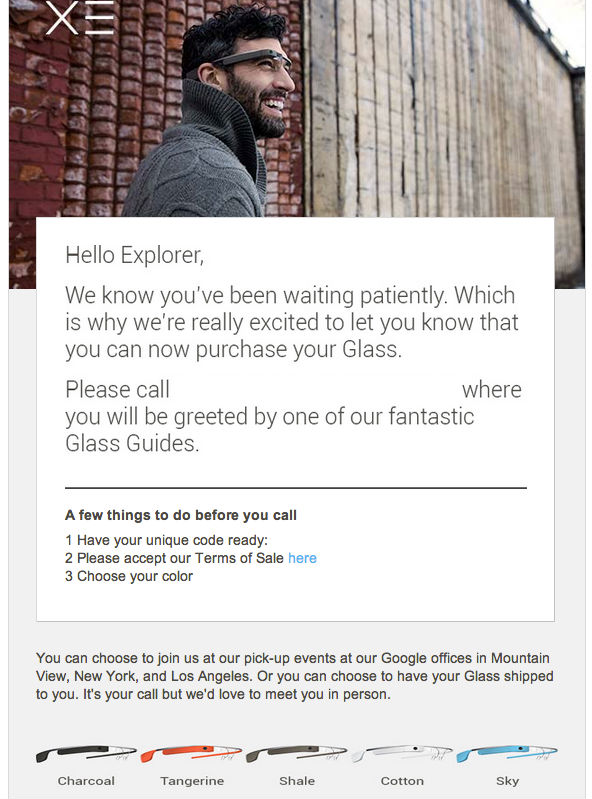
    If you were one of the people who signed up last year at Google’s I/O conference to be a part of the “Glass Explorer” program, you might be getting your instructions on how to actually…purchase the thing and get it into your geeky little hands.

    In case you weren’t sure, Google Glass is real, and they’re shipping as we speak.

    Today, my number was called and I received the following email, which comes along with a phone number to call, a unique code and a link to a “Glass Safety Notices and Terms of Sale” that you must accept before you place your order:

    Google said in its previous email to Glass Explorers that 2,000 were pre-ordered, and I was number 933. That means that the company is filling out requests for units pretty quickly, if they’re going in order. (UPDATE: We’re told by other Glass Explorers that the fulfillment is not going in order.) Sure, some people might not follow through once they actually face dropping over $1,500 for them, but it’s safe to venture a guess that most will opt to purchase them.

    When you call the number, which I’ve blanked out from the email, you’re asked for your unique code. The process is pretty quick and you can decide on whether you’d like to pick your Glass up or have it shipped to you. Sadly, the tangerine and sky colors were already out of stock, so I opted to pick up the “shale” flavor of grey.

    I set up an appointment to pick them up in Mountain View tomorrow. I’m told that if you pick them up in person, in either Mountain View, New York or Los Angeles, you’ll meet with a member of the Glass team to have them fitted properly and then get a basic walk-through of the device and operating system. You’re also encouraged to “bring a friend.”

    The person on the phone was extremely nice, congratulating me on getting the device along the way. After all, to try these things out, and be on the cutting edge of technology, you’re dropping some serious cash.

    Since the Glass Mirror API developer guide documentation is out, along with the API itself, more developers will start creating applications on top of the Glass platform once they get their hands on them. It certainly doesn’t hurt that some of the biggests VCs in Silicon Valley are lining up to fund these projects, too. I’m personally looking forward to creating a recipe application that will let me flip through ingredients and directions, hands-free, while I cook. Amazing, huh?

    Plenty of questions remain about Google Glass, especially as to whether mainstream consumers will actually want them, how often people will actually wear them and how awkward things will be when you’re sitting across the table from someone who has a camera connected to the Internet in front of their eyeball. Having said that, Glass has gotten people excited, and you’re going to start seeing at least 2,000 more of them in the wild very soon.

  • Designer unveils $15 million iPhone 5 with 26-carat black diamond home button

    Designer unveils $15 million iPhone 5 with 26-carat black diamond home button
    We have seen luxury phones encrusted with diamonds before, and some of them are worth more than $1 million. But a British designer named Stuart Hughes is now raising the bar with an iPhone 5 that costs £10 million, or more than $15 million USD. The gimmick of this particular Apple piece is that its home button is made of a 26-carat black diamond. The marketing babble on the website is satisfyingly nutty: “Diamond is distinctive in the way it reflects light. It has a unique brilliance and also breaks the light up into spectral colours, which reflect within the stone as it is moved.” It is also pretty cool that a product description page for a £10 million device manages to misspell the word “chassis.”

    Continue reading…

  • Windows Phone boss calls Android ‘kind of a mess’ despite being world’s biggest mobile OS

    Windows Phone chief calls Android 'kind of a mess' despite being world's most popular mobile OS
    Everything we’ve seen so far indicates that Windows Phone 8 is barely making a dent in the consumer market or the enterprise market while Android and iOS remain the world’s two most popular mobile operating systems. Regardless, Microsoft’s Windows Phone division chief Terry Myerson described Android as “kind of a mess” during AllThingsD’s D: Dive Into Mobile conference this week because Samsung has been the only vendor to consistently turn a profit from selling Android smartphones. Myerson said that because of this, there is “clearly mutiny in the Starship Android” and implied that more vendors would start looking away from Android and toward other operating systems, presumably including Windows Phone.

  • Motorola and Google plan to fight against the rise of phablets

    Motorola plans to fight against the rise of phablets
    Manufacturers have continued to blur the line between smartphones and tablets with screen sizes on smartphones reaching as high as 6.3-inches. Sales of phablets have taken off since the release of Samsung’s Galaxy Note and an increasing number of companies now have plans to release their own oversized devices. Motorola will not be one of these companies, however. Jim Wicks, Motorola’s design chief, revealed in an interview with PCMag that the company has adopted the philosophy that “better is better” rather than “bigger is better.” The executive noted that Google has been spending the past eight months on next-generation Motorola phones and has “seen positive feedback and collaboration.”

    Continue reading…

  • Microsoft exec says no plans to launch Surface phone

    Microsoft executive claims Surface phone isn't in the works
    Microsoft has long been rumored to be building a flagship Surface smartphone for its Windows Phone operating system. In fact, we know there’s a Surface phone in the works, though launch plans are up in the air at this point. Those waiting for the phone to hit store shelves got some bad news on Tuesday as Microsoft’s corporate vice president of Windows Phone, Terry Myerson, denied that the handset will launch anytime soon while speaking at AllThingsD’s Dive Into Mobile conference. The executive said that if Microsoft were to produce its own smartphone it would be an effort to provide a unique user experience that its Windows Phone partners are not able to achieve, Business Insider reported. For the time being, however, he believes that partners such as HTC and Nokia are already providing a great mobile experience to users.

  • BlackBerry reportedly getting into the phablet game with 5-inch ‘Z10-like’ smartphone

    BlackBerry reportedly getting into the 'phablet' game with 5-inch 'Z10-like' smartphone
    BlackBerry fans who love big displays should be very happy with the latest research note from Jefferies analyst Peter Misek. Per Barron’s, Misek believes that BlackBerry is working on two to three new models that will launch by the end of the year, including a 5-inch “Z10-like device” that will likely launch in the holiday quarter. Misek says that the other two devices will be “a mid-range (i.e., ~$400) keyboard” device like the upcoming BlackBerry Q10 and  “a mid-range touch” device. Misek also refuted reports that the BlackBerry Z10 was seeing high return rates and said that “our checks indicate typical return rates” so far.

  • Google chairman says Facebook Home is ‘what open source is all about’

    Google chairman says 'fantastic' Facebook Home is 'what open source is all about'
    Android users may not like Facebook Home very much, but Google chairman Eric Schmidt sounds like an enthusiastic supporter. During AllThingsD’s D: Dive Into Mobile conference on Tuesday, Schmidt called Facebook’s Android overlay “fantastic” and said it was a creative tweaking of the operating system that was “what open source is all about.” Schmidt’s endorsement of Facebook Home is particularly interesting because there has been speculation that Google would clamp down on third-party Android overlays in the future so it could keep its own services such as Gmail and YouTube at the center of the Android experience. But if Schmidt’s comments are any indication, then Google may be more welcoming of software overlays such as Facebook Home than many had assumed.

  • Smartwatch Market Could Be A Third The Size Of The Netbook Market This Year (Maybe)

    1477041425_bc134130c7

    It’s almost like Apple, Google, Samsung and Microsoft have actually launched smartwatches. Except of course they haven’t. But who cares! Analyst house ABI Research has been stroking its collective beard and come up with a forecast for the size of the nascent smartwatch market. And — drum roll please! — it reckons you can bank on more than 1.2 million of the wrist-strapped gizmos shipping this year.

    Put another way, that’s about as many Raspberry Pi microcomputers shipped in its first year on sale. Or just over a third as many netbooks are predicted to ship this year (3.97 million units globally, according to IHS iSuppli). Which means smartwatches could be about as popular as a niche gadget for learning about computing/making a DIY robot, but less popular than the PC that’s cannonballing towards extinction the quickest.

    Which sounds about as plausible as any guesstimate produced prior to any mainstream tech companies actually launching product. If you’re in the business of reading tea  leaves it helps if you wait for someone to make a brew before doing divinations.

    ABI says its “market intelligence” of the “strong potential emergence of smart watches” — note the careful hedge, and don’t bet the farm on this one just yet — is based on the emergence over the past nine months of “a number of new smart watches”, which is likely referring to Kickstarter-funded Pebble and its myriad of wrist-coveting, crowdfunded competitors.

    The analyst also says its forecast is based on ”contributing factors” that it reckons are encouraging the smartwatch market to (maybe) emerge from its Kickstarter-powered chrysalis and (possibly) blossom into a standalone butterfly — namely:

    …the high penetration of smartphones in many world markets, the wide availability and low cost of MEMS sensors, energy efficient connectivity technologies such as Bluetooth 4.0, and a flourishing app ecosystem.

    Even though the smartwatch market remains a partially formed, largely limp-wristed creature, listlessly stuck within its chrysalis of potential, ABI has already spotted four categories hoping to fly in the months and years ahead — aka: notification types (such as MetaWatch and Cookoo); voice operational smartwatches (such as Martian); hybrid smartwatches; and completely independent smartwatches — i.e. smartwatches that have their own OS and aren’t just playing second fiddle to a smartphone.

    In the latter category, ABI cites I’m Watch as an example but also suggests that other “possible archetypes” could be “Apple’s hotly anticipated iWatch, Samsung’s Galaxy Altius and Microsoft[‘s ‘Windows Watch’, or whatever catchy name Redmond ends up bestowing on it, if indeed it ends up making such a thing at all]. If Mark Zuckerberg or Jeff Bezos or Justin Bieber decide to launch their own Android-powered smartwatches ABI would presumably add those in here too.

    “Smartwatches that replicate the functionality of a mobile handset or smartphone are not yet commercially feasible, though the technologies are certainly being prepared,” adds senior analyst Joshua Flood in a quasi-illuminating statement of the potential factors that could influence this nascent market’s potential as the hands on our (non-smart)watches push inexorably on.

    [Image by Telstar Logistics via Flickr]

  • iPhone 5S said to feature new 12-megapixel camera with improved low-light shooting

    iPhone 5S said to include new 12-megapixel camera with improved low-light shooting
    Apple’s next-generation “iPhone 5S” will reportedly feature an upgraded 12-megapixel camera with improved image capture capabilities in low light. The report comes from Tinhte.vn, which has on occasion accurately reported details of unannounced Apple devices in the past. The Vietnamese tech blog names Wonderful Saigon Electrics, the Vietnamese arm of a China-based mobile camera component supplier, as its source. No other details were provided, though Tinhte.vn notes that its source at Wonderful Saigon Electrics accurately stated that the iPhone 5 would include an 8-megapixel camera last year while rumors of an upgraded 10-megapixel module were circulating. Apple’s iPhone 5S is expected to launch this summer with an upgraded processor, a new camera and possibly new color options.

  • Andy Rubin admits Android was originally intended for cameras, not smartphones

    Andy Rubin admits Android wasn't intended for smartphones but rather smart cameras
    The Android operating system millions of people rely on each and every day to power their smartphones and tablets almost never was. Andy Rubin, the creator and former head of Android, revealed in a speech at the Japan New Economy Summit in Tokyo on Tuesday that the platform was originally envisioned as an operating system for smart cameras.

    Continue reading…

  • Google’s Schmidt teases Motorola’s upcoming phones as daily Android activations reach 1.5 million

    Google's Schmidt describes Motorola's next devices as 'phones-plus'

    Google chairman Eric Schmidt on Tuesday teased Android fans by saying that Motorola is working on a “phenomenal” set of new devices that he’s describing as “phones-plus,” implying that they have some special new features added to them that current smartphones don’t offer. Schmidt, who made his remarks about future Motorola projects at AllThingsD’s D: Dive Into Mobile conference, declined to offer any further details about what “phones-plus” would entail, but it’s a good bet that they’ll be more than just high-end smartphones with cutting-edge specs.

    Continue reading…

  • AT&T opens Galaxy S4 preorders, confirms April 30th ship date

    AT&T opens Galaxy S4 preorders, confirms April 30th launch date
    It looks like Samsung’s Galaxy S4, one of the most highly anticipated smartphones of year, finally has a ship date on the nation’s leading smartphone carrier. AT&T on Tuesday made the Galaxy S4 available for preorder starting at $199.99 on a two-year agreement for the 16GB model. The phone will ship by April 30th according to the carrier’s website, and Engadget reports that handsets will be delivered to those who preorder by Friday, May 3rd. The Samsung Galaxy S4 features a 5-inch Super AMOLED display with full HD resolution, a quad-core Snapdragon processor, a 13-megapixel camera, 2GB of RAM, up to 64GB of internal storage and Android 4.2 Jelly Bean.

  • With Smartphones, Consumers Think Brand And Price First, Carriers Second, Finds Compete/Google Research

    Old Cash Register

    The growth in smartphone usage — supported by ever-faster mobile network speeds — is also giving rise to a much more competitive landscape among carriers, handset makers and other phone retailers targeting consumers on the hunt for new devices. Google today is releasing a report it compiled in partnership with Compete to show how that is playing out in one market in particular, the U.S. It shows that while carriers may still hold the key to making a call or getting online with a smartphone, when it comes to buying one, carriers are taking a backseat as users seek out brands and best prices first, with carriers as the follow-up to that.

    Here is the graphic from Google’s report that spells out how the retail landscape is changing:

    Google notes that while we are still seeing some competition among handsets, it’s on the decline. Some 66% of users surveyed in March 2013 noted that they considered 2 or more handsets when buying their last device in the past year. That number, however, is down by 9% over 2011.

    This speaks to the continuing consolidation we’re seeing in overall smartphone rankings, where brands like Samsung and Apple increasingly dominate in sales, to the detriment of companies like Nokia, HTC, RIM and others. (These figures out earlier this month from Kantar Worldpanel put iOS and Android sales at nearly 93% of all smartphone sales in the U.S. in the last three months, with Samsung very much the biggest of the Android OEMs.)

    But look over to the next graphic and you can see quite the opposite trend. When it comes to considering carriers, some 47% of users are these days considering more than one, with that number up by 134%: in other words, carriers are gradually losing their brand grip. And I’d hazard to guess that carriers come into the equation with a heavy price rider: with those offering the best deals getting more attention if a user isn’t locked into a plan elsewhere. That’s further demonstrated by the fact that these days, 30% of consumers switch carriers when they’re upgrading, a rise of 39%.

    Although a lot of people made a big deal about users switching to Verizon when it finally started to carry the iPhone in 2011, after years of exclusivity on AT&T’s (less good quality, they argued) network, the Google/Compete numbers seem to tell a slightly different story: It found that one-third of buyers select phones first, and carriers second, with 25% of those purchasing devices in the last year doing so because they wanted the “latest and greatest.” So much for network quality. Meanwhile, upgrade eligibility, which ties users in to signing with the same carrier, only motivated 9% of purchases.

    Indeed, there are other signs that many of the stronger controls by carriers are on the wane. T-Mobile’s big marketing push in the U.S. as the “Un-carrier” plays testament to that, as do services like Three in the UK, which lets users sign up to smartphone tariffs on rolling, monthly contracts. (Yes, you can argue as Darrell has that these are more marketing tactics, with the user getting billed one way or the other; but all the same tariffs that further decouple phone services from contracts are on the rise.)

    Among its other findings — unsurprisingly highlighted by a company that makes the bulk of its revenues from digital advertising — Google said it found that 80% of all mobile phone shoppers research for their handsets online, although the majority (61%) of sales are still completed in physical stores, with another 4% on the phone. It also found that the trend for multi-screen content consumption is also being echoed in mobile device shopping habits: the number of those using mobile handsets and tablets to look up info about mobile phones has tripled; with one-third taking that browsing into stores themselves. That’s also seen a rise in video usage too, with those browsing for phones online including 30 minutes or more of video-watching as part of their research.

    As with other kinds of technology, younger demographics are proving to be the least price sensitive: 62% of 18-34 year-olds spent over $100 on phone purchases last year, Google notes.

    Google will be publishing the full report on its retail blog later today.