Category: Mobile
-
Android’s market share lead over iOS explodes to eight points in the U.S.
-
Android And Windows Phone Gain, BlackBerry Loses In Smartphone OS Share According To Kantar

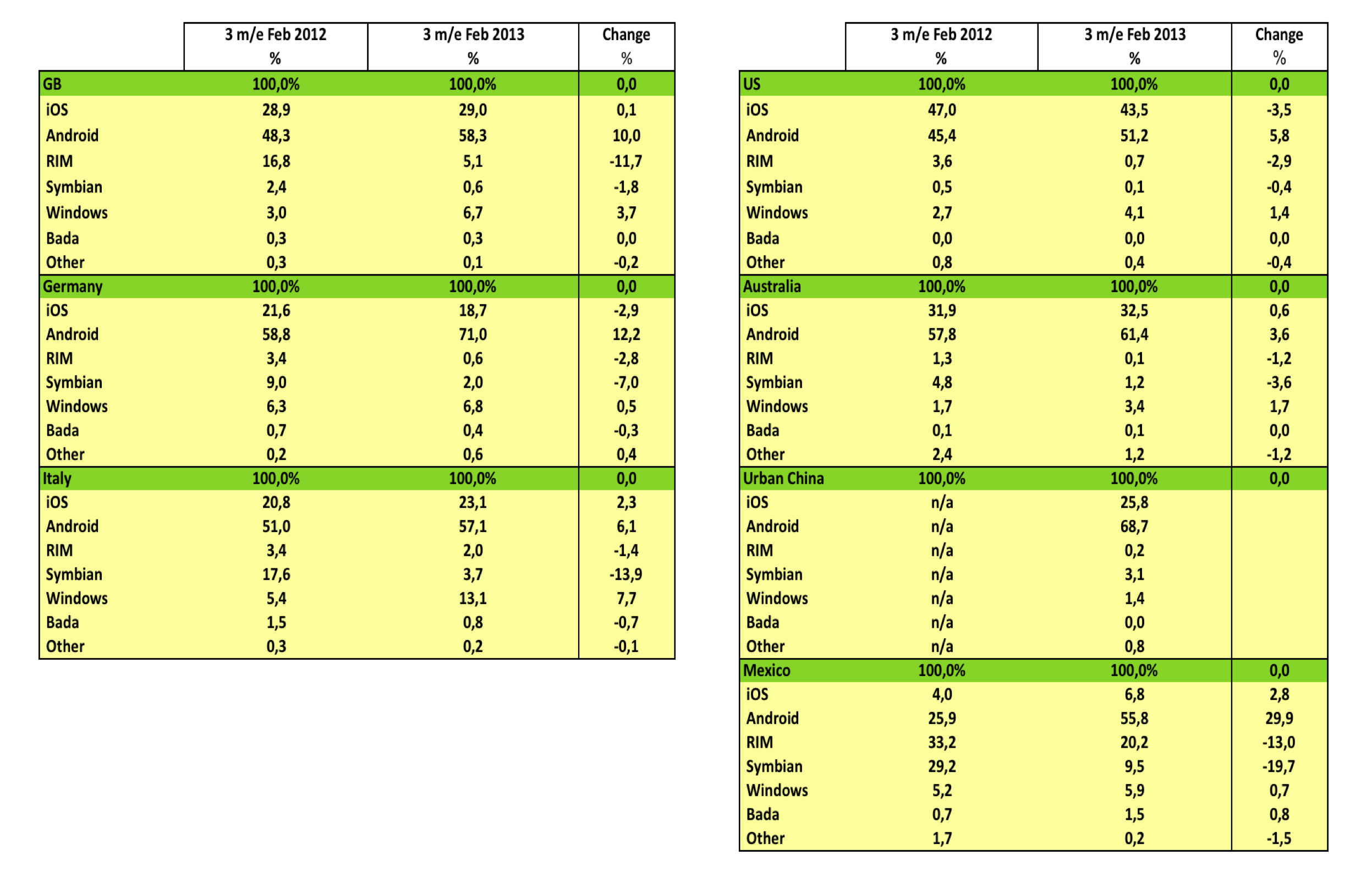
The big winners in the three-month period ending in February in terms of smartphone share globally and in the U.S. were Android and Windows Phone, according to Kantar Worldpanel, with BlackBerry experiencing significant declines in consumer interest and iOS remaining fairly level in most markets. The bad news for BlackBerry is that it saw its smartphone OS share decline even in the U.K., where it launched BB10 and its new hardware at the end of January.
Windows Phone isn’t really posing a threat to iOS or Android, which continue to dominate smartphone share is all markets, but it is starting to pull away from BlackBerry and Symbian when it comes to making a strong showing as a third place contender. In the U.S., Windows accounted for 4.1 percent of smartphone sales in the three-month period ending February 2013, up from 2.7 percent for the year-ago quarter. BlackBerry, by contrast, represented only 0.7 percent of smartphone sales in the U.S. according to Kantar, down from 3.6 percent during the same time in 2012.
In the U.K., BlackBerry slid from 16.8 percent of all smartphone sales in the three-month period ending in February last year, to just 5.1 percent of sales for the same span in 2013. That’s a drop of 11.u7 percentage points, during a period that included a full month of BB10 device sales. BlackBerry itself claimed 1 million devices shipped for its most recent fiscal quarter, which included BB10 launches in Canada and the U.K., but when pressed about how much of that represented actual sales, execs hedged and noted that it was “sort of” closer to between two-thirds and three-quarters of that 1 million figure on its investor conference call.
Android’s performance has likewise been strong, with big increases in many markets, including Great Britain, Germany, and Mexico. And while iOS remains relatively stable, with either small slides or gains across the board, it isn’t losing significant ground to the competition in any market: Android is eating space given up by legacy players like Symbian, which in most cases is dropping share quicker than BlackBerry. BlackBerry has the most to lose, however, since Symbian is no longer being actively developed. We’ll see if the gradual worldwide rollout of BB10 can reverse some of the losses being reported by Kantar in the coming months.
-
What it takes to be a mobile hit: Five friends, zero VC dollars and lots of chutzpah
Remember back to 2009, when the iTunes App Store was just over a year old and the iPad hadn’t even hit our hot little hands? At that time corporate spending on mobile was mainly about advertising to consumers — give me an app! — or freaking out about employees bringing in their own devices. But five college seniors looked at the burgeoning mobile environment and saw an opportunity.
Not the same opportunity as the creators of Angry Birds, or any number of design shops that popped up to help stores, online publications and everyone else build apps. No, these five founders — who met in a an aviation club at the University of Texas at Austin — saw in mobile the chance to make substantive changes in how enterprises do business. So they founded a company — Mutual Mobile — to do it.
The bootstrapped startup has built a successful business developing mobile apps for companies as varied as Google and Adidas. Companies such as this one, a quiet success that has gone relatively unheralded in the press, are defining our shift to mobile, as much as the obvious hits are. Here’s how it did it.
Lesson 1: Find your passion, the follow it
Mutual Mobile made its debut in April 2009 in Austin and two months later signed PeopleFinders.com as its first client. It wasn’t an enterprise company, but it was money in the bank, and the resulting app (Are They Really Single?) was more than just porting that company’s website to a mobile platform. Instead it took the premise behind the site — doing background checks and lookups on people — and packaged that expertise into a single purpose mobile app for checking out if that person you just met at the bar was really single.

It took one month for PeopleFinders.com to recoup the cost of developing the app. “That’s how powerful a mobile experience done right can be for a business,” says John Arrow, the CEO of Mutual Mobile.
Several other clients soon followed until the firm was doing well, with about 75 employees by the end of 2010 and 100 revenue-generating clients. But with the launch of the iPad that year, and some self reflection from Arrow, the team realized that the consumer business might be big, but it wasn’t what they cared about. So Mutual Mobile started firing its clients.

The result was those two dips in revenue as it ditched lucrative consumer-facing customers, including its last holdout Adidas, so it could focus on the enterprise and what they needed. “It was a tough decision to make, but it was the right one for us,” Arrow said. “And while it was hard to see those dips in revenue, we knew where we wanted to go.”
Today the firm only has 48 clients and $26 million in revenue — all from enterprise companies — at the end of 2012. Plus, it has 375 people who are thinking about mobile computing as more than just apps, but as an overall trend toward computing everywhere.
Identify the real trend
What does Arrow find so compelling about developing mobile products for enterprise customers? It’s not the devices.
“Apple isn’t going to make an iPhone 15,” Arrow says. “If you think that, you’re not thinking about mobile in the right way.” For him mobile is shorthand for adapting the computing to our daily lives and habits as opposed to expecting us to adapt to them. Sure, we may still need desktop computers, but Arrow is confident that computing will be everywhere.

The Briggo coffee-making robot lives inside that cube.
For example, his firm last year built an application for a robotic coffee kiosk on the University of Texas campus for a company called Briggo. Students and professors can order their coffee through their phones or at the kiosk and pick up a made-to-order beverage on the way to their class. The app tracks their location and gives the wait time for their coffees based on where they are as well as how busy the machine making the coffee is.
Other examples are further out there, such as the research Mutual Mobile is doing on haptics — the vibrations your phone makes are an example of haptics — as a source of ambient information. Arrow wonders if it might become a type of code for conveying information, akin to Braille. He sees it having potential in places like airplane cockpits or other information-dense environments, but stresses that its use in an actual product is at least six months out.
No VC means no one to break your fall
In the meantime, Arrow’s staying focused on the business, which he said he wants to grow to $100 million in revenue by 2015. This is a big number for a company that is entirely bootstrapped and has no venture capital investment. Arrow says he’s well on his way to achieving that goal. But to get to this point he’s had to do some detective work in the early days trying to find enterprise customers — or partners with enterprise customers — that were ready to change the way they did business with regard to mobile computing.
His first enterprise client came really early on, and is still with Mutual Mobile. The customer, Greenway Medical wants to help doctors use mobile devices when completing rounds and to access patient records. But getting Greenway as a client was more about Greenway seeing the iPod touch as a potential solution and seeking someone — anyone — who might be able to help, and stumbling on the young Mutual Mobile.

The Greenway Medical iPad app.
It was also important that they would trust an unnamed startup headed by a 20-something CEO. When Arrow co-founded Mutual Mobile he was 21. This week he had his 26th birthday. That was one reason that Mutual Mobile veered into serving consumer clients such as PeopleFinder.com or Gowalla. Those clients were eager for mobile apps and trusted startups.
“Back in 2009 there weren’t enterprises betting on mobility and we had to figure out how to bootstrap this company when there wasn’t even an addressable market yet,” Arrow said. “We knew consumer was our only option … and when Philips and Google and Verizon came around later we were able to apply all that we had learned. If we had started this company in the early part of 2011 or late 2010 we would have lacked credibility and had no infrastructure and no skillset to help, and clients would have been right to avoid this immature company.”
Arrow also thinks that if he had VC backing he wouldn’t have been able to pass up the lure of easy dollars from more consumer-facing clients. Those dips in revenue may never have happened. He probably would have also been asked to move his company from Austin to the Bay Area. So far he’s content to stay VC free, but given the appetite VCs have for putting dollars into older companies with big sales in hot markets, someone may convince him.
In the meantime, Arrow and Mutual Mobile are content to ride a massive wave of interest in enterprise mobile. One of the strongest signals for Mutual Mobile may have come last month when IBM announced its mobile first initiative, validating the type of experience and work that Mutual Mobile has been pushing on its clients since 2009.

Related research and analysis from GigaOM Pro:
Subscriber content. Sign up for a free trial.- Connected world: the consumer technology revolution
- What the Google-Motorola deal means for Android, Microsoft and the mobile industry
- Analyzing the wearable computing market


-
Google Glass Early Adopters Want To Build Learning, Healthcare, Accessibility & Safety Apps

Wondering who has won a Google Glass? Stanford PhD student Andrej Karpathy has used Twitter’s API to compile a partial list of the so far close to 4,000 winners of Google’s Glass Explorers first adopter competition who applied to buy the high tech specs via Twitter. Google still hasn’t confirmed that the last Glass winners have been named yet so there may yet be a few more invites to go out. Update: Karpathy’s list has now been updated to 4238 people, so Glass invites are still going out today.
Big G has been busy this past week sending out notifications to winners of its #ifihadglass purchase campaign (and even rescinding a few that failed to live up to its T&Cs). Winners don’t actually win a free pair of Glass. Rather they get a VIP pass to spend $1,500 to be among the first group of folks to own a pair of the Glass Explorer Edition of Google’s high tech specs. So it’s a high stakes, high visibility marketing competition as Google seeks to both evangelise, humanise and normalise a technology that’s new, different and impossible to ignore — being as it sits right on the face.
Successful applicants on the Twitter list (whose Twitter descriptions are shown above in Word Cloud form) include famous names such as former Speaker of the House, Newt Gingrich, who pledged “#ifihadglass i would take it on tours of zoos and museums to share the animals and fossils”, and — at the polar opposite end of the celebrity spectrum — electronica singer songwriter Imogen Heap who wants to ”hook them up w/my gloves to help me navigate music making in 3D”.
As you’d expect, the list of winners is heavy on performers and extroverts promising to livestream their gig/music/show/art/sports activity/skydive. There are also a fair few marketing types — pledging to do stuff like “learn & write how it will change marketing & brands”. But — more interesting than either of these categories — are the developers with app ideas for Glass. Earlier this month Google demoed some of its own Glass apps such as Gmail, and also showed a few third party apps from the likes of the New York Times, Evernote and Path. But Glass will fly or die based on cool new apps that likely don’t exist on other platforms yet.
I’ve collated a list (see below) of some of the app ideas that Glass winners are pledging to create — and, beyond the obvious use-cases of recording and streaming a first person perspective, themes for potential Glass apps are already emerging. Education, healthcare, accessibility and safety application ideas are plentiful among this wave of Glass early adopters (albeit, these developers likely haven’t had a chance to properly live with Glass yet).
It looks likely that Glass will be the tech arena where augmented reality can seriously take off — thanks to both the natural visual overlay and the hands-free nature of the device. On smartphones and tablets AR remains something of a gimmick, since the user has to hold the device up to create a field-of-vision overlay — limiting how they can interact with it and how long they can use it for. Neither are problems for Glass.
I would create information retrieval apps that work with the Glass #ifihadglass – like repair information, etc. [link]
we build an entirely new shopping app leveraging the power of glass+android. [link]
I’d make a http://t.co/WWcsHNbZcD app so that little “icons of trust” hover over user heads. I’d know who to trust, instantly/ [link]
I’d build an application for travelers to keep in touch with their loved ones. Show beauty is in the eye of the Glass holder. [link]
I’d develop a micro-expression detector that would enable appropriate responses to the sometimes subtle reactions in others. [link]
I would develop innovative apps for publications [link]
I’d create an app that had real-time information about cabs when you looked at their taxi number using AR #ifihadglass [link]
Being partially blind, #ifihadglass I’d use it to augment my lack of peripheral vision, use presence apps to avoid bumping into others, etc.[link]
I’d help develop new applications for its use in health & medicine & inspire others to as well http://t.co/JKNXWI4Dyk [link]
I’d write apps for smartwatches that display tokens for the Glass to pick up and display expanded information @projectglass [link]
I’d make mashups with @LeapMotionDev for augmented reality apps like these http://t.co/JZlTdeD0rc and evangelize to devs [link]
I would develop a driving safety app to help decrease driver distraction, detect drowsiness, and display upcoming road concerns [link]
I’d create a ski app to show you speed, distance, calories. Take action pics in series. Add sensors to jacket for more safety. [link]
i’d create a skill/barter app where people could indicate skills/goods they have/need for trade. Haves/needs appear overhead.[link]
I’d create the ultimate nerd app — crosshairs. [link]
I create an app to show people how much carbon energy they were using. [link]
develop apps that can be useful for parents and children like medical [link]
I’d make an app that converts the sheet music you see into a MIDI file. =D [link]
I’d explore applications for education [link]
I would build apps for people who shop. [link]
I would create an input and recall application for just.me – an app that enables us to capture, share and remember our life. [link]
I would build an app to display key running and heart rate data to me while I run and bike/ [link]
I’d create an app called momento that allowed me to remember where things are by using playback. [link]
I would build applications for dentists, doctors, and manufacturers to empower the industrial AR dream. [link]
I would build a dating app (that would inevitably be deemed creepy). [link]
i’d create an app to help ppl with their dieting/eating habits by showing you nutrition info for things you eat. (hook me up) [link]
I will create a face recognition app to remind me the name of the people I meet and count how much time I spend with them. [link]
I would explore and write about the possible retail applications… i.e., shop my glass off [link]
I would develop a location and image recognition based augmented reality app for blind or visually impaired people. [link]
I would build a persistent knowledge AI: build an application to automatically bring search results apropos of conversation [link]
I would develop some kind of app to help children develop art skills. [link]
I would immediately start on my commute/family trip tracking assistance app, and wear glass daily on… http://t.co/T7dneqFsfN [link]
To prevent and reduce obesity, with an app that records physical activity and food intake to provide nutritional guide #ifihadglass [link]
Check out Tour, a concept guided tour app for Google Glass #ifihadglass . Making the invisible visible http://t.co/GZsFZrvVi1 [link]
I would write an app to identify lawmakers on the fly. A covert visual shazam. [link]
I’d write an app to make it easier to read nutrition facts on processed food [link]
We would use our AR to make the best ever #travel app with information about monument/landscape and boards translation overlay #ifihadglass[link]
I want to make an app that helps deaf people “see” what others are talking about. [link]
I would build a speedometer app to track my top and average speeds while luging, http://t.co/RnDFKyFw5w [link]
build an app that suggests people to meet based on who is nearby. [link]
I would write a running app that would show the @strava route names and course records of whatever streets I was running on[link]
I would use the heads-up/subject-overlay attributes to make better apps for healthcare professionals, researchers and students [link]
I would work to find applications for its use in hospitals and other healthcare settings. [link]
I would create GhostRunner. An application that enables me to run against my own best time. Visually. http://t.co/wF2loUrOqz [link]
I would create an app that uses facial recognition to reunite lost pets with their parents #ifihadglass http://t.co/zVaD80lWwv [link]
I would build an app capable of taking billboards, and replacing them with things you are trying to remember (or cat pictures).[link]
I would create an app to have the “Yellow Line” at football games in real life. http://t.co/REmY5GrX [link]
I would create a Marine Navigation application for both the casual cruiser and racing sailor #WindSpeed #BuoyLocations [link]
Customer service application that utilizes live video from callers to walk them through solutions #ifihadglass [link]
I’d build an app to identify fashion on the street and find a place to purchase it. #iloveyourdress #wheredidyougetit [link]
I’d write an app that records a minute buffer of video that will save to Google Drive on command. Document amazing things. [link]
I would make a doorbell app, so I could see who’s knocking and easily let them in. http://t.co/fL4gJ3w1DF [link]
#ifihadglass remind people of their appointments, would use Google maps to figure out when to send reminder, ie farther away, earlier ping [link]
Innovate: App 2 reduce gun violence! http://t.co/zCzxF5ESfv [link]
Hands-free teaching! No longer tethered to a laptop or Elmo, limitless creative & practical classrm applications! [link]
Hate it when your Dr. always looks down during your appointment? I’m going to change that with Glass. http://t.co/LnW8po2FfV #ifihadglass [link]
I would create an app to let general aviation pilots prep and fly their airplanes via checklists they can see in the glass. [link]
I’d build in voice-control for all of our features in our products so that customers could use our apps while on the treadmill. [link]
I will test my AR android app for climbing, suggesting improvements, and sharing this experience with the climbing community[link]
I would create an app that would make people, especially young women like myself, feel safe in their current surroundings. [link]
I will develop a driver-training app to detect improper driving behaviors and provide training feedback. [link]
I would develop an application to enable the communication with deaf people by showing a live transcription in Google Glass 1/2 [link]
develop an application for musicians, by entering into a database that would help tablature to play the instrument [link]
I would develop an app that could suggest desired recipes by simply looking into my fridge and scanning its food items [link]
i’d develop an app to help waiters keep track of tables, orders and customer preferences [link]
i would create an app measuring stress levels by the size of your pupils. Data could show stress visualised across the world [link]
I would create a gps app that gave historical information. [link]
I’d develop an app that would alert parents when their teenager isn’t paying attention to the road while driving. [link]
4 Architecture app Glasses could be conected with SketchUp so the clients could se the building proposals directlly on site. [link]
Develop app integrating BIM – construction workers build with greater speed and accuracy – designers visualize concepts in situ [link]
I’d create apps for retailers to survey merchandise, check stock and order replenishments automatically – by looking at shelves [link]
I’d build an app to help first responders get the information they need while keeping their eyes on the subject. [link]
Make an app or hardware mod that understands mood to change UX (based on pupil dilation) #ifihadglass [link]
I would construct a real-time medical history taking app that would record & upload doctor/patient interactions into an EMR! [link]
I’d make apps to control all my Internet of Things with #Android@Home.[link]
I would develop an application that makes home improvement projects easier by replacing measuring tapes and standard box levels [link]
I would develop location aware applications, like auto translate of detected text, information on objects seen etc. [link]
Program smart subtitles to reality. Hyperlink objects. Design apps for self-directed learning #edtech http://t.co/QGE49Q82uC [link]
I would design an app to notify the deaf when a loud noise identifies a hazard outside of their field of view [link]
Use it to create an app the rewards users when they throw their trash away, would take pics to validate it [link]
I would make an application that enables users to crowdsource live coverage of public events. #youtube2 [link]
Think about applications for use with kids and learning disabilities. [link]
I would make them Wi-Fi intuitive with app support so that you can use them to adjust settings on your DSLR or GoPro. [link]
I’d build tools to make quantifying the self across multiple domains easier, more transparent, and more effective than ever. [link]
I’d build info sharing tools for enriching IRL conversations. If I search for something, the friends with me should see result. [link]
-
A Facebook phone: Is this the final brick in the social network’s walled garden?
Looks like it’s that time of year again — the time when rumors of a “Facebook phone” pop up like tulips after a spring rainstorm. This time around, it was a cryptic announcement from the social network about a mobile event next week that set the rumor mill in motion: since the invitation mentioned Android, the speculation is that the company will finally announce a handset that has full Facebook functionality integrated into it. It’s easy to see how this would help the social network build engagement and possibly monetize mobile, but do users really want one?
The invitation to the press event on April 4 said “Come see our new home on Android,” and since Facebook likely wouldn’t have an entire press conference just to announce a new app for the Google operating system, expectations turned to something more: namely, the much-hyped Facebook phone. According to TechCrunch, the launch will see the social network introduce a device from HTC that runs a modified version of the Android operating system and has Facebook’s newsfeed, photo uploading, messaging and other features integrated into it.
Next to a full-fledged Apple TV, the “Facebook phone” is probably one of the longest-running rumors in the technology space. The first reports started filtering out over three years ago, when Om and others heard reports of an INQ unit that would run a modified version of Android and offer some kind of integrated Facebook functionality. The company released a device called the CloudTouch in 2011 but it went nowhere. HTC actually came out with a couple of phones that offered something similar, but neither did well, and the rumor mill continued to foretell the coming of the *real* Facebook phone.
Owning the platform would provide more control

Facebook CEO Mark Zuckerberg categorically denied that the company was working on a phone last fall, but some saw wiggle room in his comments, since he seemed to be talking about Facebook actually building the hardware itself. Blogger-turned-VC MG Siegler wrote about the imminent launch of true Facebook phone in January, and said that it was coming soon. But January came and went with no phone. Siegler says he now believes that the phone is coming next week, and that it will be everything he said it would be: a dedicated device running a version of Android with Facebook built in.
As much as some critics of the idea — including our own mobile expert Kevin Fitchard, who debated the idea with Kevin Tofel — question whether there is any point to Facebook releasing its own phone, it’s worth noting that the same kind of scepticism greeted the many reports about an Apple phone in the months and years leading up to the launch of the first iPhone. Too risky, many industry analysts said — no point in trying to enter a crowded market with commodity pricing, nothing to offer that would make it better than the existing players, etc.
Perhaps Mark Zuckerberg won’t be happy until he releases a phone and tries to break Apple’s grip on the smartphone industry. But it’s more likely the Facebook founder’s interest in a phone stems from a desire to capture users — and their all-important data — in as many different ways as possible. Zuckerberg has already stated that his interests are almost entirely focused on mobile, since that is where a growing amount of user activity is coming from. Owning the platform in some sense would just make it easier to offer a user a one-stop experience.
At the moment, Facebook has a somewhat fragmented approach to the phone: there is the main Facebook app, but there’s also the Instagram app — which the social network acquired for close to $1 billion because it saw the photo-sharing community as a clear and present danger — and the standalone Facebook messenger app, and its Poke app. The company seems to be trying to find as many entry points for users as possible to engage with the network, and a phone with more integration could help.
But does anyone actually want one?

Owning a platform is the ultimate step in building a mobile walled garden: Apple is the obvious role model here, with its ownership of the app ecosystem and control over access to the device in every way, all of which has created hundreds of billions of dollars in market value. And both Google and Amazon are doing their best to own their own ecosystems, with Android and the Kindle platform — and even Microsoft has given it the old college try with the Windows phone. Facebook at this point is probably feeling left out by having to play ball with everyone else’s OS or device.
So Facebook’s interest in having such a device is fairly obvious. What’s less obvious is whether a large enough group of the social network’s users would be interested in having one. What would they gain? They can already have Facebook present on their home screen, and they can upload photos to it automatically in the background as they take them, and they can use Facebook’s messaging app instead of the texting feature in their phone — although increasing numbers of young users seem to be opting for SnapChat and other options.
In many ways, the release of a Facebook-branded phone — if that is in fact what the company has in mind for next week — seems more like a desperate move to recapture some of the relevance the social network used to have, especially with younger mobile users. Unfortunately for Facebook, that may be something that is beyond its abilities, no matter how impressive the device itself is.
Image courtesy of Shutterstock / D. Hammond

Related research and analysis from GigaOM Pro:
Subscriber content. Sign up for a free trial.- Hyperlocal: opportunities for publishers and developers
- Mobile Q2: Smartphone growth surges; iPad’s rule continues
- Analyzing the wearable computing market

-
Where Have All The Physical QWERTYs Gone?
It’s approaching three years since I emailed and got a reply from the late Steve Jobs. The topic of my caffeine-fueled missive that sunny day in June 2010 was the industry’s move towards touch-based interfaces and, specifically, Apple’s one-size-fits-all approach regarding the iPhone’s lack of a physical QWERTY keyboard.
I have a disability that can make touch and other physically demanding interfaces more challenging, I explained to Jobs, and whereas the mouse-driven GUI that he helped usher in with the Macintosh had inadvertently put me on a level playing field, were touch to ever become the dominant mode of input, it had the potential to turn that world upside down.
“That’s obviously a bit dramatic”, I wrote on TechCrunch at the time. “There will always be lots of different products on the market, but it’s a possibility nonetheless.” Fast forward to 2013 and what was only a possibility has all but become a reality. Survey the mobile landscape and it’s filled with people fondling their giant slabs of touch, happily typing away on glass.
At this point I know I’ll likely get ripped apart in the comments. In the battle of the physical vs virtual QWERTY, the market has spoken, they’ll say, and those who don’t favour touch are squarely out of touch. And sadly, the evidence is heavily stacked on their side of the argument.
Survey the mobile landscape and it’s filled with people fondling their giant slabs of touch, happily typing away on glass
In the first few years of the iPhone’s existence, a ton of hybrid physical QWERTY/touch smartphones from competitors entered the market, ready to differentiate themselves from Apple by talking up their superior typing experience. But they failed to stop the Cupertino juggernaught. Typing on glass, while not ideal, was good enough. Arguably it wasn’t until Android OEMs ditched their, largely, clunky slide-out keyboards and wholesale copied and then supersized Apple’s all touch form-factor, did they begin to turn back the tide.
Meanwhile, continues the argument, the likes of Nokia fell by the wayside, plagued by an antiquated user interface that, in a desperate and confused attempt to respond to the market, tried and failed to crowbar in touch before the company finally jumped onto Microsoft’s Windows Phone platform, sans physical QWERTY.
Furthermore, BlackBerry, which seemingly built its whole business off the back of its physical QWERTY-touting credentials, chose to release its first comeback device as the BB10-powered Z10, another all touch grey slab, rather than the Q10, which combines touch with a physical QWERTY in the best BlackBerry candybar tradition. It’s also been suggested that the Canadian handset maker may even view the Q10’s hybrid approach as a way to wean its traditional customers off a physical keyboard entirely, a gateway device if you will.
So yes, putting aside the fact that the market can only speak to what is put in front of it — I can’t recall a single candybar QWERTY powered by Android that was anything more than a mid-tier or low end device — it would seem that the market has indeed spoken.
But it may not have had the final word yet.
That’s if — and it’s a big if — the BlackBerry Q10, when it finally hits the market next month, surprises everybody and sells in sufficient numbers to smash through the totalitarian all touch screen. And just like the Mac had ensured before it, for this hack and others like me, 2013 won’t be like 1984 after all.
-
The Dash Car Dongle Wants To Make You A Better Driver By Syncing With Your iPhone
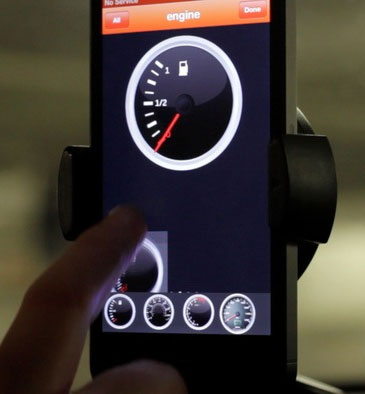
I love my tiny little Mazda, but I’ll be honest — I still don’t completely understand how it works. That’s never really bothered me before (I’d much rather geek out over a phone or something) but a Kickstarter project from a small team in Boston has me itching to pay more attention to what’s really going on under the hood. Long story short, Dash combines a Bluetooth 4.0-enabled dongle that plugs into your car’s on-board diagnostics port with an iPhone app that gives you up-to-date information how on your car is holding up.
Yes, I know that probably sounds very familiar.
We’ve seen a few startups tapping into that particular port recently — Carvoyant inked deals with local auto dealers to more broadly distribute its always-on diagnostics and tracking gadget earlier this year, and Y Combinator-backed Automatic got plenty of attention for taking a similar concept and combining it with an awfully handsome iPhone app interface. Dash’s approach seems to resemble the latter slightly more than the former, but at their core they’re all trying to accomplish the same mission: to improve the driving experience by shining light on data that wasn’t always easily accessible.
So should you consider Dash over something like the ultra-slick Automatic when both devices are both slated to cost around $69? That all comes down to how you feel about the little tricks that set Dash apart from the oft-hyped California startup’s service.
In addition to tracking fuel usage, passing along notifications when your car’s components have gone awry and letting people locate their cars on a map, Dash users can use their smartphone as a secondary display of sorts for realtime information like current speed, engine RPM, and fuel economy. The big idea behind latter is that you’ll be able to find an environmentally-friendly sweet spot while cruising along, though chances are you’ve already got some sort of indicator telling you how fuel-efficient your driving is if you’re driving a more recent car. Still, since U.S. cars from as far back as 1996 have ODB ports there are plenty of drivers who could stand to benefit from this sort of info.
Oh, and a side note: if Dash appeals to you because your car’s built-in speedometer and tachometer don’t work, you should really get that taken care of first.
In case you were hoping to bring your social fixation into your car too, all that driving data can be automatically uploaded to an associated online Dash account. From there people can compare their own metrics to their fellow Dash users and pick up on best practices for squeezing optimal performance out of their rides (sadly, there doesn’t seem to be a way to mock them mercilessly for driving like your grandmother). What’s more, users can also record and share in-car video with speed and engine information overlaid on top of it, well, just because.
Those of you looking to make your iPhone an extension of your car have to consider that the Dash still seems like a long way from fruition. At time of writing the team’s Kickstarter campaign has raised just over $15,000 from backers, and is ultimately shooting to top $750,000 before May 11. Should the Dash team meet that lofty goal though, they hope to get the first batch of dongles out sometime this June — just in time for summer roadtrip season. Sadly, just like with Automatic, Android users will have to wait until later in the year to get their mobile car diagnostics on.
-
Survey: Samsung takes the lead from Nokia, BlackBerry in key emerging markets

-
Samsung’s eight-core Exynos 5 Octa processor will support LTE, but won’t be available in U.S.

-
Apple’s Long-Rumored Game Controller May Soon See The Light Of Day

I’ve long believed that touchscreens leave a certain something to be desired when it comes to playing games, and if a new (and very curious) report holds true, Apple may feel the same way. According to PocketGamer.biz’s Jon Jordan, Apple has been meeting with developers on-site at this year’s Game Developers Conference in San Francisco to talk about a forthcoming Apple game controller.
Jordan’s multiple developer sources claim that the Cupertino company has booked a meeting room under an assumed name to talk about the game-centric device, though they weren’t able to shed any light on what the thing will look like or when it will actually see the light of day. That said, Apple is expected to hold an iPad-centric event in April so it’s possible that this controller may be officially unveiled in just a few weeks.
At first glance, the prospect of Apple churning out a game controller of all things seems downright silly, but after chewing on it for a while the notion doesn’t seem quite as outlandish. You’d be hard-pressed to think of OS X as prominent a platform for gaming as Windows is (though some big-league developers are working to change that), but iOS plays home to a staggering number of games and it’s not inconceivable to think that Apple would want to enhance the sorts of gaming experiences available to iPhone, iPod and iPad users. As such, a game controller seems like the sort of thing that Apple would agonize over getting right, and it appears that Apple may have been doing just that.
In the site’s 2012 review of the 3rd generation iPad, AnandTech’s Anand Lal Shimpi and Vivek Gowri let slip a tantalizing tidbit when discussing the iPad’s faculty as a gaming machine: ”I know of an internal Apple project to bring a physical controller to market, but whether or not it will ever see the light of day remains to be seen,” the review reads.
What’s more Apple has been seen bulking itself up with patents that relate to a potential gaming push for at least a few years now. This patent from 2008 describes an accessory that wraps around a portable electronic device with touchscreen (sound familiar?) and includes a standard D-Pad and button, while this one spotted in 2012 takes a slightly different approach. Either way, these patents plus the AnandTech comments make it rather clear that Apple has been mulling over a physical game controller (or something like it) and it may be time for those ambitions to come to fruition.
I’ve reached out to Apple, but the company has declined to comment.
(Also, here’s hoping it looks nothing like the Pippin controller pictured above.)
-
Apple patent filing shows experimental iPhone design with no buttons, ‘wraparound’ screen

-
Vine Makes Videos Embeddable via Web and Mobile
Today, Vine has finally made their six-second videos embeddable across the web. They’ve also updated their iOS app to allow for embedding (as well as the ability to share other people’s Vines on Facebook and Twitter).
“When we launched Vine, we described posts as ‘little windows into the people, settings, ideas and objects that make up your life.’ With today’s update, you can display them almost anywhere,” says Vine.
When you reach the embed screen, you can choose your size as well as two modes – simple mode and postcard mode.
Simple embeds simply show the Vine, with the pertinent information like user, description, hashtags, etc. shown when you hover.
Postcard mode shows all of that info in a white frame around the Vine video:
In order to embed a Vine via the iOS app, tap on the “…” button within any Vine video. Click “share this post” and then finally “embed.” you’ll get an email with the code, which will take you to the embed page. Make your size and mode selections and there you go. Copy the code and put it up on your site. It’s not exactly without its annoyances, but it’s about as easy as embedding on through an app could be.

You can embed your own Vines, or anyone else’s Vine as long as they’ve already shared it on Facebook or Twitter.
-
The most likely buyer of Nokia or BlackBerry now in talks to acquire NEC’s handset unit

-
Google’s ‘Babble’ cross-platform messaging service gets detailed in purported leak

-
WSJ: Facebook plans to clog up Android home screens with status updates

-
iPhone 5S announcement rumored for June 20th, launch in July

-
Unlike AT&T, Verizon reportedly putting promotional muscle behind BlackBerry Z10 launch

-
Sprint, Softbank agree to ditch Huawei over spy concerns

-
‘Facebook Phone’ rumors again flare up after Facebook sends out event invitation

-
T-Mobile iPhone 5 prices revealed for 32GB and 64GB models