Category: Mobile
-
BlackBerry’s best hope said to be as a ‘niche player’ going forward
-
Apple Appears In Court In China To Defend Against Siri Patent Infringement Claim

Apple is in court again in China, defending another of its products from attack based on pre-existing claims from a Chinese company. This time around it’s Siri, Apple’s virtual assistant, that has landed it in Chinese legal trouble, after last year another company took issue with the iPad trademark resulting in a $60 million settlement deal.
The claim this time is from Zhizhen Technology Co., a Shanghai company that holds a patent for voice recognition software for its “Xiao i Robot,” software that was originally patented back in 2004. Siri, Inc. was founded in 2007, after being spun out of SRI International and before being acquired by Apple in 2010. Zhizhen first filed suit back in July last year, at which time this video supposedly demonstrating a version of Xiao i Robot in action on a Lenovo device surfaced.
Xiao i Robot can be installed on smart TVs, and is employed by countries around the world in customer service functions, according to an article from Shanghai Daily published back in June 2012. The tech has apparently been used by 360buy.com, as well as the Chinese government and a number of other enterprise customers.
Zhizhen told says it will ask Apple to “stop manufacturing and selling products using its patent rights, once Apple’s infringement is confirmed,” one of its lawyers told the AFP. Should it be successful, it may also seek compensation down the road for any damage done by Siri to its financials to date. Apple had asked for the case to be dropped, and was rejected in that effort, the lawyer said. Today’s hearing paves the way for a full trial beginning in July 2013.
Recently, Apple has fallen under attack by Chinese media for customer service and return policy complaints. The company has responded on its official website to respond to some of these attacks, but analysts suggest this could be part of an effort to encourage more consumption of home-grown tech solutions by Chinese consumers. China also recently partnered with Ubuntu creator Canonical to develop a China-specific open source operating system that seems in part designed to wean its IT sector off of foreign-developed software tools.
-
IDC: Tablet Sales Grew 78.4% YoY In 2012 – Expected To Pass Desktop Sales In 2013, Portable PCs In 2014
Strong growth in tablet sales is helping to drive overall growth in the global smart connected device market, according to analyst IDC, as the market reshapes itself with mobility at its core. Posting a new report for full year 2012 and projections through to 2017, the analyst notes that market expansion last year was “largely driven” by 78.4% year-over-year growth in tablet shipments — which exceeded 128 million units. But this is just the beginning for tablets: IDC expects tablet shipments to surpass desktop PCs in 2013, and portable PCs in 2014.
Overall, worldwide shipments of smart connected devices grew 29.1% year over year in 2012, and the entire market pushed past one billion units shipped, with a total market value of $576.9 billion.
IDC said it expects tablets to grow their share of the overall smart devices market from 10.7% in 2012, to an estimated 16% by 2017 — with a projected growth rate of 174.5% between 2012 and 2017. Over the same period, the desktop PC category will have negative growth of -5%, and will slide from 12.4% share in 2012 to 6% share in 2017.
Portable PCs are also project to take a declining share of the market, dropping from a 16.8% share in 2012 down to 11% estimated for 2017. The category will still see some growth, according to IDC, which is projecting 19.3% growth for portables over 2012 to 2017. But the powerhouse growth is in the tablets and smartphone categories — the latter projected to also grow by triple-digits (109.9%).
This year IDC said it expects the tablet market to reach “a new high” of 190 million shipment units, with year-on-year growth of 48.7%. While the smartphone market is expected to grow 27.2% to 918.5 million units.
“Consumers and business buyers are now starting to see smartphones, tablets, and PCs as a single continuum of connected devices separated primarily by screen size,” said Bob O’Donnell, IDC Program Vice President for Clients and Displays, in a statement. “Each of these devices is primarily used for data applications and different individuals choose different sets of screen sizes in order to fit their unique needs. These kinds of developments are creating exciting new opportunities that will continue to drive the smart connected devices market forward in a positive way.”
Powered by growth in the tablet and smartphone categories, IDC predicts the worldwide smart connected device market will continue to “surge” — with shipments forecast to surpass 2.2 billion units and revenues reaching $814.3 billion in 2017. By 2017, 83% of the market is projected to be comprised of smartphones and tablets, up from 70.8% in 2012.
Returning to 2012, IDC noted that in Q4 of the year Apple significantly closed the gap with market leader Samsung in the quarter, thanks to the combination of its refreshed smartphone (iPhone 5) and new smaller tablet (iPad Mini). Apple took 20.3% unit shipment share in the quarter versus 21.2% for Samsung, according to IDC. On a revenue basis, Apple continued to dominate with 30.7% share versus 20.4% share for Samsung.
-
HTC reportedly planning DROID DNA successor

-
Audioair Wants To Unlock Audio From Muted TVs Everywhere And Give Your Local Bar A New Way To Advertise
If you’ve ever been in a sports bar with your friends to watch a big game, you’ve likely run into the “muting” problem. While the bar may have two dozen TVs, each might be playing a different game, and there’s either too much sound or none at all. At most local restaurants, bars, airports and health clubs, you’ll find TVs muted for this very reason.
Some have opted to, say, put speakers on tables in their bars to project sound more directly, but the problem is that this puts a damper on any socializing you planned to do with your friends and fellow bar mates. Might just be me, but repeatedly yelling “WHAT DID YOU SAY?!” over the audio can detract from the viewing experience. After all, you’re really there to enjoy some quality time with friends — the thrilling play-by-play isn’t the only attraction.
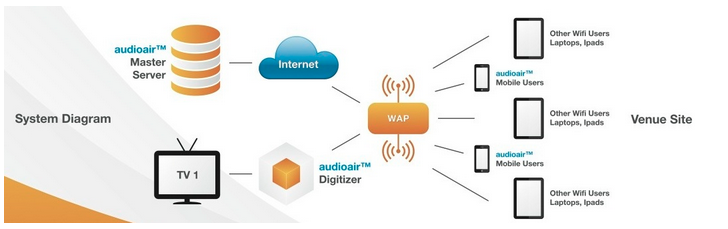
Durango, Colorado-based Airborne Media is hoping to offer another solution with a new product called Audioair, which aims to turn smartphones into your own personal listening device to help unlock sound from the tens of millions of muted TVs out there. Essentially, Airborne wants to put its audio solution anywhere an un-muted TV would add to the location’s overall noise pollution — every airport, hospital, sports bar, stadium or health club in the U.S.
But how does it work, you ask? Users download Audioair’s free mobile app, which taps into the sound system (via Wi-Fi) at any Audioair subscriber location, allowing you to determine which TV you want to listen to, projecting the audio through your smartphone so you can listen from your pocket or through headphones. Airborne is currently piloting its solution at 47 sites, including sports bars, restaurants, student health facilities and even a large resort casino, and plans to be in 800 locations by the end of the third quarter.
To help get Audioair off the ground, the startup has raised $3 million in seed funding, $1 million of which is convertible debt, from a handful of local investors. But, let’s be honest, creating a personal audio channel for muted TVs has some appeal, but it could be subject to a fairly limited use case. It’s not difficult to imagine significant others and friends the world over not being particularly pleased when, in the middle of a conversation, you throw in your headphones to hear the local play-by-play.
Plus, Airborne has to convince enough restaurants that it’s a good idea to invest in their on-premise hardware and buy another TV for their in-venue display. How does it hope to accomplish that tall order?
Airborne believes that its technology can help change the consumer experience within a multitude of these noisy environments and bridge the gap between mobile devices and customer engagement displays. So, not only does it want to provide a better audio experience for the end user, it wants to act as an interactive social networking experience and dedicated, location-based advertising network for bars, restaurants and any local venue.
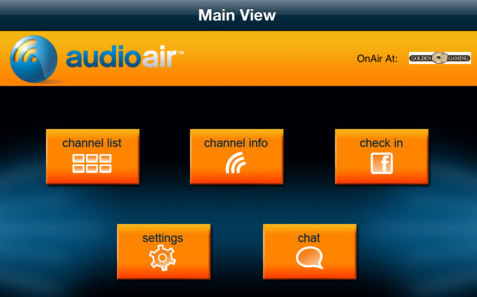
The service allows users to chat with other people in the venue directly through the Audioair app, along with checking-in and adding content from their phones to the sports bar’s local network. This adds a social networking element to the end-user experience; in the meantime, Audioair allows venues to display local advertising on the user’s phone or on a 42-inch digital display that they install in the bar.
At the outset, the startup has been offering discounts on the cost of the TV (and the installations themselves) to reduce friction for early customer acquisition, but the idea is that — once/if this catches on, bars will be paying for the cost out of their own pockets.
Audioair charges a monthly fee, which will be an add-on to the fees bars are already paying to DirectTV and so on for cable, but the idea is that the product can help venues reduce the perceived (and actual cost) by helping them attract more customers who stay on the premises longer — because they can actually hear the sound of the game.
On top of that, bars can distribute on-site promotions through Audioair’s digital display and mobile app, facilitating increased spend, while engaging customers in an in-bar, interactive social and ad network.
Venues can then share in the ad revenue gained from their displays, while receiving analytics on how customers are interacting, what they’re sharing and so on. They can also disseminate the needed info publicly or privately as needed (think personalized hospital, airport alerts).
The Airborne Media founders said that they see revenue coming from three buckets — advertising, installation and licensing — with revenue initially coming from subscription and installation and advertising revenue becoming the main stream over time. As to the licensing piece, the team says that they’ve filed for eight patents on their system (which are currently pending), which could help them manufacture some defensibility for a model that could become vulnerable to competition from big players as prices on hardware continue to drop.
Audioair also tries to sweeten the deal by providing an optional on-site server to manage the local, network and cloud-based content and, by splitting a portion of the advertising revenue with the owner, the startup wants to help them cover the cost of the subscription fee and grow their own revenues over time.
The Audioair creators also believe they have a leg up on the competition because it has inked a partnership deal with one of the original commercial DirecTV installers, which has exclusive territory rights to a big chunk of real estate — from Florida to Washington, D.C. It provides DirecTV service and support to over 5,000 restaurants and will be helping Airborne make installations throughout its territory, which the founders believe will be critical to helping it expand its footprint.
Again, it seems like a niche play, but if something like this is going to work, it could be a multi-pronged approach that’s not only an audio helper but a local information and advertising system, complete with hardware support and revenue sharing. There are 38,000 sports bars and restaurants in the U.S., 28,000 health clubs and plenty of airports, casinos and college campuses where Audioair could potentially have some appeal.
If the startup is able to keep its prices from stifling those venues that are willing to give it a try — and surmount the potential “this is too complicated” reaction from local venues — while offering real value-add on the advertising side (and some better design of its mobile interface), there’s a chance Audioair could have some real legs.
-
Sprint rumored to launch HTC ‘Tiara’ and Samsung Ativ S Windows Phones this summer

-
Hands-on with T-Mobile’s 4G LTE network

-
T-Mobile’s ‘UNcarrier’ initiative is gimmicky but still an improvement from the status quo

-
AT&T issues one-word response to T-Mobile attacks: ‘Whatever’

-
Why Nokia still has one last shot to make waves in China with its new ultra-cheap Lumia

-
Add Bluetooth To Any Speaker With The Vamp, A Mobile Receiver With High-Quality Sound

The Jambox (or its many equivalents) is fine, but I much prefer the experience of visiting second-hand shops around the city in hopes of finding a tower speaker relic that smells musty but still has a richness of sound and vintage appeal. Now a new Kickstarter project wants to help make sure proper speakers (the kind with removable cloth covers built strictly for sound first and style second) can easily take advantage of Bluetooth.
The Vamp is a little cube that has old-school positive and negative speaker cable connectors, along with 3.5mm audio input in case your device doesn’t have Bluetooth, a micro USB port for power and an on-off switch. It offers an internal rechargeable battery good for over 10 hours of use, and can be plugged in for continuous power as well. One of its most impressive tricks is a built-in magnet that pairs with a supplied metallic disc to attach to any vertical surface for convenient placement.
The problems the Vamp addresses that other Bluetooth stereo receivers don’t include style, affordability and sound. It offers high-quality mono audio, which is intended to be used with speakers made for high-quality sound output. It’s expected to retail for £45 (and is available via Kickstarter pre-order for £35), and maybe best of all, it doesn’t require a constant external power source, unlike a lot of similar options. You could actually take it with you to a friend’s house and wire their existing setup for Bluetooth sound, without an electrical engineering degree or access to the back of their home audio receiver.
The Vamp is created by UK-based product designer Paul Cocksedge, who has worked on products for BMW, Swarovski, Sony and Hermes. Some of his past work is exhibited in the Museum of Modern Art in London. Cocksedge and his studio have worked on sound amplification projects in the past, include gadgets that naturally enhance sound from mobile devices like iPhones. The Vamp looks to be their first proper electronic device, but working prototypes have already found favor with early reviewers.
The Vamp claims to have sound quality that’s “richer and more textured” than the standard Bluetooth portable speaker available, and it looks to go quite a bit louder as well. Quality concerns aside, it’s a nice, relatively inexpensive way to upcycle speakers that in many cases have only gotten better with age, and are being rudely pushed out by younger models.
-
iPhone found to be more ‘vulnerable’ than Android smartphones

-
Poor HTC can’t win: HTC One preorders hit all time high as its launch slips to overlap with Galaxy S4

-
Galaxy S4 coming to T-Mobile May 1st for $99 up front

-
T-Mobile launches LTE network in 7 major markets

-
T-Mobile to sell the iPhone 5 for $99 on April 12th

-
Live from T-Mobile’s ‘UNcarrier’ event

-
Nokia Plays Up Asha’s Smartphone Cred With New Premium Developer Program

Nokia’s Asha line of less-expensive smartphones, not developed on Microsoft’s Windows Phone but Nokia’s own proprietary OS, is getting a new boost of attention today. The company is unveiling a new (and free) premium developer program for Asha developers. Modelled on a premium program started for Lumia developers last year, those participating will get extra developer resources, credits towards promoting finished apps in Nokia’s app storefront or via advertising in other apps, and a free device.
Not only will this help to boost the number of apps in the Nokia store, but it furthers the idea of Asha as the “other” smartphone line being pushed by Nokia — and not just another high-end feature phone. As IHS analyst Ian Fogg noted after seeing the news: “Nokia builds the case for Asha to be considered a smartphone.”
Nokia says that for developers to be considered, there are some criteria to be met. For “stage-one productivity membership” (this includes extra developer support, the free device and expanded remote access), a developer need to have at least two apps built for any mobile platform and currently in any mobile store (not just those run by Nokia itself). For “stage-two” membership (this includes the promotional options of either app store placements or $500 worth of advertising), the developers need to agree to develop and publish at least one app for the Nokia Store to work on an Asha device.
The Lumia premium developer program, Nokia says, has proven to be its most successful developer program ever.
But if Nokia’s Lumia line is considered its “flagship” fleet of smartphones, then the Asha devices are the company’s ever-essential workhorses.
In Nokia’s Q4 results that it reported in January, the company announced 9.3 million Asha devices sold, more than twice the number of Lumia devices (at 4.4 million). While Nokia has been working hard to create Lumia handsets that are stretching ever further into the low cost segment — the most recent being the $180 520 handset unveiled at the Mobile World Congress this year — Asha devices were already there, with devices going for under $100 already unveiled last year.
This fact makes the Asha and ever-more important link in the chain that Nokia has to be careful not to break as it tries to bring its vast population of users in emerging markets on to Nokia smart devices, rather losing them to the rival Android ecosystem as led by Samsung, Huawei and dozens of other handset makers. Samsung in particular has approached the market with an aggressive device strategy across virtually every mobile handset price point (and feature set).
The developer program and its stated purpose to create apps for Asha devices is very much part of that strategy. As Apple has very conclusively proven both with the iPhone and iPad tablet, one of the biggest draws to a particular piece of hardware is the software that you will be able to use on it. We’ve reached out to Nokia to ask how many apps are available for Asha phones today, and will update this post as we learn more.
The idea, of course, are for those apps to be quality as well as in quantity. “We want to reward apps that really engage the user,” Kenny Mathers, director of developer programs and monetisation at Nokia, said in a statement. “We’ll be looking for high-quality graphics and user interface, plus great user reviews, with a minimum rating of four stars from at least 25 Nokia Store user reviews.”
-
Google Launches Tool To Help You Calculate Mobile Value
Google announced the launch of a new initiative to help marketers better understand the impact of mobile on their businesses both online and offline. It’s called Full Value of Mobile, and has a page on Google’s “GoMo” site here.
The page has a calculator, which helps businesses consider online and offline conversions by rethinking conversion paths. The calculator lets you enter data manually or upload your Google Click Type report.

“We live in a world of constant connectivity, where mobility is bridging the digital and physical worlds,” says Johanna Werther, Head of Google’s Mobile Ads Marketing. “With smartphones in hand, people are taking a variety of online and offline actions, like calling a business, downloading an app, looking for directions to a store, or starting research that leads to a purchase on another device. We’re working hard to account for these new paths to purchase in AdWords, like the recent addition of calls as conversions to AdWords reporting. Still, with more work to be done to improve measurement tools, most marketers still account only for sales happening on a mobile site and aren’t seeing the full picture.”
“This new consumer behavior is now the norm, with a recent study showing that nearly three of ten mobile searches result in visiting a store, calling a business, or making a purchase online,” adds Werther. “Some smart marketers are already investing in understanding how mobile drives sales through these new customer paths. For example, adidas, in partnership with their agency iProspect, felt that mobile was converting in ways beyond their mobile website, so they created a simple yet powerful attribution model to understand how mobile is driving customers into stores. As a result, adidas found that each click on their store locator button was worth $3.20, which has changed the way they view their digital investment.”
You can look at that case study here, if you like.
In addition to the calculator, the Full Value of Mobile site includes videos that illustrate mobile conversion paths, case studies, which highlight proven mobile strategies, and tips for measurement. Google says the step-by-step wizard for uploading data with the calculator amounts to about a thirty-minute process.
-
Apple Patents Battery-Saving Multi-Touch Displays That Don’t Need To Be Active To Work
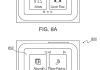
Apple was granted a patent Tuesday by the USPTO (via AppleInsider) that describes a system for implementing multi-touch in a mobile device even when there the display itself isn’t actively showing any images. It’s a neat trick, and one that could help portable gadgets save battery life by not invoking the most battery-hungry element in their construction nearly as frequently.
The patent also notes that the screen doesn’t have to be off for these no-look commands to work; a user could do things like swipe a finger in circle to change volume or tracks, for instance, even while a display is active. That adds new control options, but also makes it possible to both remove external buttons should a design benefit from that, and also make the device easier to use when in a pocket or clipped to an armband or waist during a workout.
While the display is inactive, the patent describes that it could use gestures that mirror the button press actions on current iPod and iPhone headphone remotes. So, a single click could play/pause, a double click could skip tracks, and a long press could call up Siri, for instance.
In terms of recognizing when touch is and is not wanted, the patent suggests implementing a special mode that would allow it to both keep the screen dark but also receive touch inputs. This might involve a way to activate a mode between a full lock and a completely on and active device, which can be selected specifically for when a user is commuting or using the device while working out, but disabled when there’s risk of accidental touch.
It’s an interesting patent, and one which Apple has shown off as working with its previous iPod nano design, which essentially featured a square display and little else in terms of physical buttons. The trick might be making this work in such a way that it still completely eliminates any chance of accidental input – the lock screen concept is synonymous with touchscreen devices for a reason, after all.
Not activating the screen as much as possible is the key to prolonging device battery life, though, so it’s good to see Apple looking at ways to deal with that primary limiting factor. It’s no e-ink display built into the back of a smartphone, but it’s something.