Category: News

  • Celebrity Deaths Drive the Biggest Wikipedia Traffic Spikes

    As a culture, we are fascinated by celebrities, death, and the death of celebrities. I’m sure you already knew that, but some interesting new stats from the world of Wikipedia prove it.

    Wikipedia user West.andrew.g has been looking at the popularity trends of Wikipedia articles over the past few years and has just published those findings in The Signpost, Wikipedia’s community newspaper. He breaks “popular” articles into two categories: isolated popularity and consistent popularity. The latter are articles that simply receive the most traffic, at all times. The top articles on this list include Facebook, United States, YouTube, Google, Sex, Justin Bieber – no big surprises there.

    But it’s the isolated popularity of certain Wikipedia articles that’s truly interesting.

    If you want your Wikipedia article to experience a surge in traffic, you have to die or play at the Super Bowl.

    Five of the top eight biggest spikes (measured in an influx of traffic in a one-hour period) occured due to celebrity deaths – Whitney Houston, Amy Winehouse, Steve Jobs, Osama bin Laden, and Ryan Dunn. Two of the spikes were for Super Bowl halftime shows – Madonna and The Who.

    Whitney Houston’s Wikipedia page saw 425.6 views per second during an hour-long period on February 12th, 2012.

    Other than deaths and the Super Bowl, other things that can drive traffic spikes to Wikipedia articles are being featured as the subject of a Google Doodle, being a TV show with a concerted “second-screen” effort, and being linked to on a site like reddit (Today I learned…).

    [The Signpost via The Verge]

  • Bieber Apology On SNL Addresses Weed Bust

    Justin Bieber was the host of “Saturday Night Live” over the weekend, and like any good host, he didn’t pull any punches when it came time to make fun of himself.

    The 18-year old appeared in full nerd-gear in a sketch called “The Miley Cyrus Show”–where he was head of her fan club–and addressed some of the more negative things that have been said about him while in character.

    “He looks like a lesbian… I heard he still has his baby teeth,” he said during the sketch, in which he expressed disbelief that Miley Cyrus was friends with that “douche” Justin Bieber.

    He also took a moment to address the controversy surrounding those photos of him that turned up last month which allegedly show him smoking pot at a party.

    “I also heard he got busted for smoking weed and he’s really sorry about it and people make mistakes and he’s never gonna do it again,” his character said.

    Bieber has had a rough few months after a breakup with longtime girlfriend Selena Gomez and the death of a photographer who was killed while crossing a busy highway while trying to snap a shot of Bieber’s car. The singer wasn’t in the vehicle at the time.

  • Mars Rover Curiosity Drills a Rock, Makes History

    After months of careful planning and tests, Mars rover Curiosity has finally used its hammering drill to collect a bedrock sample on Mars. The event marks the first time any rover has drilled into a rock on the red planet.

    Curiosity left a hole 0.63 inches (1.6 cm) wide and 2.5 inches (6.4 cm) deep in a flat, veiny rock named “John Klein.” As the rover drilled into the rock, rock powder traveled up flutes on the drill bit, which has holding chambers for the powder. The sample obtained by the rover should help researchers determine whether the rock was ever underwater.

    “The most advanced planetary robot ever designed is now a fully operating analytical laboratory on Mars,” said John Grunsfeld, NASA associate administrator for the Science Mission Directorate. “This is the biggest milestone accomplishment for the Curiosity team since the sky-crane landing last August, another proud day for America.”

    Over the next few days, the rock powder will be processed and tested to determine its mineral make-up and chemical composition.

    “We’ll take the powder we acquired and swish it around to scrub the internal surfaces of the drill bit assembly,” said Scott McCloskey, drill systems engineer at NASA’s Jet Propulsion Laboratory (JPL). “Then we’ll use the arm to transfer the powder out of the drill into the scoop, which will be our first chance to see the acquired sample.”

    The successful drilling marks another milestone for the rover itself. All of Curiosity’s instruments have now been tested on Mars, and the rover has been deemed fully operational.

    “Building a tool to interact forcefully with unpredictable rocks on Mars required an ambitious development and testing program,” said Louise Jandura, chief engineer for Curiosity’s sample system at JPL. “To get to the point of making this hole in a rock on Mars, we made eight drills and bored more than 1,200 holes in 20 types of rock on Earth.”

  • Inflatable Robots And More Discussed At Google Event [Solve for X]

    Google hosted its Solve for X Event last week, and has now released the presentations.

    Solve for X is a gathering of scientists, entrepreneurs, and innovators, who come together to present “moonshot” proposals, as Google calls them. These are ideas aimed at solving big problems in the world. It’s kind of TED Talks-esque.

    Last year’s presentations discussed drug delivery, imaging the mind’s eye, collaborative science, resource reclamation, etc. You can view some of those here.

    Here are some of the new ones on topics like replacing plastics, sustainable meat, inflatable robots, economic energy storage, space exploration, malaria eradication, and Alzheimer’s diagnostics:

    “One of the reasons we created Solve for X was to provide a collaborative forum to celebrate and help innovators who are in the process of attempting to bring radically innovative solutions to reality—attempting moonshots,” say Solve for X creators/co-hosts Megan Smith and Astro Teller. “Moonshots aim to make something 10x better, not just 10 percent. We need many more of us to take on and support moonshots if we are to solve the seemingly intractable problems we face in the world. To do that, we need to better celebrate the audacity of the attempt itself—at the start and in process.”

    Google has updated some features on SolveForX.com, including the ability to submit moonshots, “join and declare your X” and watch more ideas from other partners.

  • Microsoft Surface Pro May Cause Spontaneous Office Dance Offs

    The Surface RT’s ad campaign was defined by one thing – synchronized dancing. It was a little strange considering the ad didn’t even tell the consumer what Surface was or what it could do. It just showed a lot of hip youngsters (and a sweet, old couple) getting down with their new tablet/PC hybrid. People must have liked the ad though as it’s back again in the new Surface Pro advertisement.

    The new Surface Pro ad features a similar dance routine as before, but now it’s set in an office environment. The new setting raises a whole host of new questions. Will the Surface Pro lead to spontaneous flash mobs during the quarterly meeting? Will it inspire the vice president of the company to take up beatboxing? Microsoft seemingly confirms all of these scenarios to be the case.

    Now, this latest ad may have you running off to pick up a Surface Pro, but I feel that I must temper your expectations. A report from CNET says that the 128 GB Surface Pro is sold out nearly everywhere. Microsoft may have intentionally understocked the Surface Pro after seeing the Surface RT’s weak retail performance. That seems to have not been the case, however, and now the company is “working with [its] retail partners” to get more 128GB models into the hands of consumers.

    If you can find one, let us know if it causes spontaneous office dance offs.

  • Lessons from a Failed Social Entrepreneur

    During my first year at Harvard Business School, I decided to start a new business. I set up a team, choose a name, secured a URL, and Zoosa was born. My theory was that by leveraging the collective expertise of skilled professionals, we could have a significant impact on the social sector. Zoosa was intended to be a platform where volunteers shared their activities and connected with others, creating a positive feedback loop. The idea was that this would encourage some people to deepen their efforts and others to become new volunteers. Unfortunately, I had never worked for an early-stage business or in the social enterprise space. The result? My business failed.

    My story is not unique. Though we don’t often talk about failure in the social sector, I’ve seen numerous entrepreneurs waste countless hours working late into the nights and stubbornly plugging away throughout weekends. Even worse, many forfeit the opportunity to have a full time job in order to “follow their passion” as a first-time entrepreneur. They watch their social lives melt away at the same rate as their savings.

    That’s what I did. And it took me 2 years to put a bullet in Zoosa. I pivoted from a skills-based volunteering website to a platform for corporate social responsibility to a third concept — you’d use Facebook for your personal social network, Linkedin for your professional social network, and Zoosa for your social impact network. Ultimately, I didn’t have the industry knowledge or the professional expertise to realize the vision. Eventually, I did two things that every social entrepreneur should do: set aside my ego and went back to step one — getting smart.

    Here’s my advice for any social entrepreneur who’s decided she’s got the next big idea:

    Put your ego away. How often have you heard an entrepreneur — or a want-to-be entrepreneur — say they want to run their own business? It’s almost as if they’re starting with the end point and working backwards. They want to run a business and so they look for an “idea”. Sometimes they’re clever enough to at least look for a real problem to solve — but not always. Instead of focusing on what you want to be or what you want to achieve, think about what it is that someone else truly needs. You and your ego should be beside the point.

    Get smart first. Entrepreneurs-in-the-making are often convinced they have the next big idea for an app or product or service. Do they know anything about building an app? Well, no. But they want to run a business. So they dive in. They’ve heard from others that entrepreneurship is about persistence in the face of adversity. So they persevere, even when the market is giving them negative feedback. This feedback is especially tough to hear for social entrepreneurs. Failure may be doubly hard when the market is saying no, but the social need still exists. Getting smart requires you spend time in the field you want to run a business in. Volunteer or get a job working in the industry or with the clients you want to serve. Enduring adversity is important but without the right experience and exposure to the field, you’re unlikely to succeed.

    Failure is not necessarily a bad thing but it has consequences. Consider how many nonprofits offer duplicative services or solutions, or early on learn that their original hypothesis is flawed. In all of those cases, the wasted time, effort, and capital only hurt the stakeholders — the folks the entrepreneur wants to help in the first place. Ego wins and stakeholders lose.

    In the three years since I let Zoosa finally die, I’ve become an expert in building sales, marketing, and business development teams for early stage ventures. I’ve worked closely with several very successful entrepreneurs and investors and they’ve taught me a lot about everything from leadership to fundraising to recruiting. They’re helping me get smart.

    I plan to go back into social enterprise, and maybe even run my own business. But for now I’m content to focus on my passion: helping entrepreneurs build their businesses.

    Before you don the social entrepreneur title and dive into building your enterprise consider if you need more experience to realize your idea. If you do, set down your entrepreneur ego and find a job. You need to get smart to make a difference.

    Follow the Scaling Social Impact insight center on Twitter @ScalingSocial and register to stay informed and give us feedback.

  • New From NAP 2013-02-11 08:56:43

    Prepublication Now Available

    Rising health care costs are a central fiscal challenge confronting the United States. National spending on health care currently accounts for 18 percent of gross domestic product (GDP), but is anticipated to increase to 25 percent of GDP by 2037. The Bipartisan Policy Center argues that “this rapid growth in health expenditures creates an unsustainable burden on America’s economy, with far-reaching consequences”. These consequences include crowding out many national priorities, including investments in education, infrastructure, and research; stagnation of employee wages; and decreased international competitiveness.In spite of health care costs that far exceed those of other countries, health outcomes in the United States are not considerably better.

    With the goal of ensuring that patients have access to high-quality, affordable cancer care, the Institute of Medicine’s (IOM’s) National Cancer Policy Forum convened a public workshop, Delivering Affordable Cancer Care in the 21st Century, October 8-9, 2012, in Washington, DC. Delivering Affordable Cancer Care in the 21st Century summarizes the workshop.

    [Read the full report]

    Topics: Health and Medicine

  • Faith Hill: Braces Were Red Carpet Accessory

    Faith Hill has become more popular than ever in recent years, due in part to the fact that she’s taken to flaunting her gams during the opening for Sunday night football. But the country star flaunted something else on the red carpet at last night’s Grammy Awards: braces.

    The 45-year old looked elegant and classic in a LBD with a loose updo, but her teeth were the object of everyone’s attention. Hill says she wore braces as a kid and often forgot to wear her retainer, requiring some maintenance later in life.

    “Kids, wear your retainer!” she said.

    Hill and husband Tim McGraw took the stage together at the awards show to present. McGraw recently opened up in an interview about his decision to cut alcohol out of his life altogether, saying it gave him more energy onstage and left him feeling like a better role model for the couple’s children. The country crooner just released a new album and says he feels he’s moving in a new direction.

    “I really feel like this new album is not a culmination of the things I’ve done, it’s a new beginning of the things I am going to do. I want to enjoy my career and having my family. I have a busy life, but it is a fulfilling life,” he said.

  • Your Job Ads Are Driving Away Talent

    I read job ads in my spare time. People send me especially ridiculous ones just to make me laugh. The other day I read one that began promisingly enough with, “If you’re ready to work hard on a top-drawer team of hard-chargers, keep reading” and then went on to list twenty-two tedious, “Essential Job Qualifications” that could only serve to eliminate any actual top-drawer candidates who bothered to apply. After the hard-charger opening, that job ad fell right back into the usual territory (“are you good enough for us?“) without bothering to give the reader any good reason to consider the available job worth his or her time or interest.

    The recruiting process is broken, and if we need evidence we only have to look at any job listing.

    Here’s how a typical recruiting ad begins: “Acme Explosives has an immediate need for…” Really — Acme has a need? My husband, who grew up on the South Side of Chicago, loves to say, “People in Hell need ice water.” The company has a need. So what? Is that supposed to make a top-drawer hard-charging job-seeker’s heart beat faster?

    If we want to hire sharp people in our organizations, we need to market to them. We can’t assume they’ll happily crawl over whatever piles of broken glass we put in front of them (online honesty tests, writing tests, three-week Radio Silence zones, terse auto-responders, and the like) in order to work for us. We have to be willing to woo as well as vet them. And we have to put a human voice into our horribly bureaucratic, robotic job listings.

    Here’s another one: “The Selected Candidate will possess nine years of experience in tax accounting.” The Selected Candidate will possess? Now we’re marketing to the talent community by talking right past them. This ad all but says “Yeah, the Selected Candidate will have this and we’ll interview that guy — not YOUR sorry ass.” It’s insulting to address job-seekers this way. Who’s ever seen commercial that describes its customers in the third person, as though the viewer couldn’t possibly be in the target audience? This is the opposite of marketing.

    Unfortunately, too many HR chiefs and hiring managers labor under the delusion that sharp and switched-on people are dying to apply for their jobs, even when they’re not. Every day, a CEO tells me that it’s hard to find talent. They say that the only people they see in interviews are non-creative thinkers and yes-men (and -women). These executives don’t see their role in the dysfunctional-recruitment soap opera, which is keeping the smartest and sparkiest people away.

    In the e-commerce world, marketers pay close attention to the abandonment rate for online shopping carts. When you start to make a purchase online and then drop out before the deal is done, that’s an abandoned cart. Corporate leaders should be paying just as close attention to the abandonment of applications on the company’s ATS (applicant tracking system) portal. When job-seekers start the process and then drop out, that’s a failure for the employer. If we knew how badly our employer branding (the kind that prospective job applicants see) was hurting us in the talent acquisition arena, we might spend more time and energy writing genuine, human job ads in plain English and rethinking the whole red-tape-laden hiring process.

    Until we do that, we can keep kvetching about how hard it is to find talent, but we can only delude ourselves for so long. Eventually, we’re going to have to look in the mirror and see that we’ve created the talent shortages we complain about, by driving the best candidates — the ones with the most options in the talent marketplace, that is — away with a stick. There’s time to bring them back, if we act fast. Is your organization up to it?

  • Get your questions ready — President Obama returns for a new Google+ Hangout

    Towards the end of January, United States Vice President Joe Biden participated in a “Fireside Hangout” on Google+ to talk about reducing gun violence. A week later it was the turn of Domestic Policy Director Cecilia Munoz who used Google’s social network to discuss immigration reform.

    And next up it will be US President Obama himself taking part in the 21st century equivalent of FDR’s famous radio addresses.

    Days after delivering the State of the Union to Congress, and just as he did in 2012, the President will be answering a selection of top-voted questions in a live-streamed interview.

    Selected participants will ask their own questions, but if you have something to say you can head to the White House YouTube channel and submit a video or text question there.

    You can submit or vote on topics you’d like to hear the President address until 11:59 p.m. ET on Wednesday, February 13. The hangout itself will be on Thursday at 4:50 p.m. ET.

    So do you plan on getting involved and what questions would you like the President to answer?

    Photo Credit: Pete Souza/The White House

  • You can still get 50GB of free cloud storage with Box

    With cloud services like MediaFire and Mega offering generous free storage straight off the bat, the spotlight slowly fades away from other players and their abysmal free space offers. Box, however, has decided if you can’t beat them, join them and is currently providing the same mind-boggling 50GB of free cloud storage, courtesy of Dell.

    The offer has been available for a couple of days and comes with no expiration date on the storage limit. Even though it’s associated with Dell there is no limitation requiring you to sign up using a Dell device, such as computer or tablet. Any user can take advantage of the 50GB of free cloud storage just by providing the first name, last name, email address, password and phone number.

    For those who embrace a mobile lifestyle, Box is a better match than MediaFire and Mega as it offers apps for Android, iOS, Windows 8/RT and Windows Phone. The service is also available on the newly-launched BlackBerry 10, courtesy of BlackBerry which develops the app.

    Photo Credit: Sergej Khakimullin/Shutterstock

  • Morning Advantage: Education Is a Rotten Tree

    “School is broken and everyone knows it.” Clay Shirky puts it rather baldly in this essay on The Awl, pointing out (complete with chart) that even as tuitions at four-year colleges have risen (up 72% at public colleges since 2000), graduates’ earnings have declined (down 14.7% in the same span). “Things that can’t last, don’t.”

    Enter MOOCs — Massively open online courses, “a lightning strike on a rotten tree,” in Shirky’s terms. “Most stories have focused on the lightning, on MOOCs as the flashy new thing. I want to talk about the tree.”

    The problem with the debate about MOOCs and how disruptively innovative they really are, he says, is that most of us are picturing the wrong thing being disrupted: 18-year-old valedictorians heading off to Swarthmore. In fact, the majority of college students today are over 23. Most of them are attending community colleges, and many pursuing something other than a bachelor’s degree. They’re not living in dorms; they’re commuting. And they want a more convenient, cheaper way to get an education.

    Reading the full piece is a good exercise for any strategist or innovator; you can’t help but wonder how many of your assumptions about your own industry are wrong.

    FLOCKING TOGETHER IS FOR THE BIRDS

    When Cliques Hold You Back, and When They Help (INSEAD Knowledge)

    For a working paper called “Does Homophily Affect Performance?” INSEAD professor Martin Gargiulo and Singapore Management University assistant professor Gokhan Ertug studied 1,746 investment bankers (a field they chose because of its reliance on knowledge-transfer between workers). Their conclusion: early on in your career, homophily — hanging out with people like yourself — can be helpful, perhaps because we’re more likely to share information with our peers. But after your first promotion, the value of hanging out with similar folks declines; we need more diverse information from a more diverse crowd to continue to succeed. Gargiulo’s advice: actively manage your network. The higher up you go, the more diverse it should be.

    UNSEXY BUT EFFECTIVE

    Long Live Email (CFO)

    Marketers may be pigging out on social media, but it’s email that still brings home the bacon. That’s the conclusion Taylor Provost reaches after reviewing the data. For instance, Forrester tracked 77,000 transactions over two weeks and found that 30% of them began with the customer via an email. Just 1% came through social media. Not only do more of us spend time in our email inboxes, but email analytics are still far superior to social media tracking, letting marketers refine their search and target us with ever-more-relevant offers. Now if you’ll excuse me, there’s a cashmere sale at J.Crew I need to get to.

    BONUS BITS:

    The Power of the $pinoff

    iPad Accessories Now Include a Longbow (FT.com)
    Another Book Deal for Twilight Fanfic (Jezebel)
    Before Every Movie Was a Sequel: The Decline of the Spec Script (Vanity Fair)

  • Take total control of your HOSTS file with HostsMan

    The Windows HOSTS file is based on a simple idea — it just redirects specific domain names to your preferred IP address — but this has some very useful applications. If you want to block access to a particular website, for instance, just add its domain name to HOSTS, point it to an IP address representing your local system (127.0.0.1, usually), and you won’t be able to reach the site in any browser.

    But that’s just the start. You could also use HOSTS to block advertising servers, and known malicious sites. And sometimes malware will tweak your HOSTS file to gain control over your internet access. If you want to review all this then you could just open HOSTS in Notepad, but HostsMan could be a much better option — it’s a compact, portable and free HOSTS file manager with a stack of features.

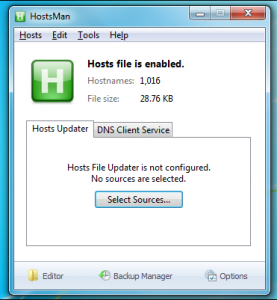
    Launch HostsMan as an administrator and you might start by viewing your own HOSTS file. Click Editor, the file will appear, and you can browse it to see what entries (if any) it contains.

    There are plenty of editing options here. Right-click and you’ll find options to create, edit, disable or delete entries, copy them to and from the clipboard, and add comments. An Edit > Find option contains a powerful search feature, with regular expression support, to help you locate particular entries. And useful management features include options to delete the empty lines in a file, the comments, and more.

    And better still, if you’re worried about malware then you can ask the program to look for possible hijacked HOSTS entries, or just display any which have been created or modified recently.

    HostsMan has another very useful security function elsewhere, though in its Hosts Updater. This provides built-in access to seven popular HOSTS files which can help to block ad servers, known malicious sites, and so on. You can add more sources if necessary, then import these to update your own HOSTS file.

    It’s worth keeping in mind that an incorrectly updated HOSTS file can cause problems, perhaps blocking access to sites you’d like to reach (especially relevant as this is a beta version, and bugs are to be expected). Fortunately HostsMan also includes a backup tool where you can save your current HOSTS file, and restore it later if necessary. Click Tools > Backup Manager, then Create Backup to save your current HOSTS. Or, if you want to return to the default Windows HOSTS setup with no redirections at all, click “* Original Hosts *” > Restore Backup.

    And just in case this isn’t enough, HostsMan also contains several time-saving shortcuts. If a HOSTS file change doesn’t work right away, for instance, it could be because Windows has cached the previous IP address; click Tools > Flush DNS Cache to try again. Or, if you want to update or access the file yourself, there’s no need to manually browse to it: just click Tools > Open Hosts Folder, and there are menu entries to open it in Explorer, a command window or PowerShell.

    There are plenty of powerful functions here, and as HostsMan 4 is also in beta right now it’s probably not a good choice for networking beginners.

    If you’re already used to exploring your HOSTS file, though, the program should prove an excellent assistant which will make the management process very much easier.

    Photo Credit Konstantinos Kokkinis/Shutterstock

  • State of the Union 2013: President Obama’s Speech is Just the Beginning

    With Tuesday's State of the Union address only 39 hours away (9:00 p.m. ET), we're putting the final touches on a week that's jam-packed with opportunities to respond to the speech, get answers to your questions and join an online video-chat with the President.

    In addition to some things that have been really popular for past "SOTU" Addresses, we've got some exciting new features to introduce. Here's the rundown:

    When the President addresses the nation, the White House will provide something you can't find anywhere else: an enhanced version of the speech that offers charts, facts and other info as the President speaks (check out last year's here). You can watch live on WhiteHouse.gov/SOTU, through the White House mobile apps for iPhone, Android and iPad, and also on the official White House presences on YouTube, Google+HuluFacebook, and Ustream. And if you'd like, you can embed the stream on your own site.

    read more

  • Of snakes, dragons and fund managers

    The Year of the Snake is considered one of the less auspicious in the 12-year Chinese zodiac cycle. And 2013 is the year of the Black Water Snake, which comes around once every 60 years and is seen as the least fortuitous. How China’s stock markets turn out after years of poor performance remains to be seen but the snake is providing banks and asset managers with plenty of food for thought. Many of them have been gazing into the crystal ball to see what 2013 may hold for Chinese markets.

    Fidelity Worldwide investments highlights the ‘Snakes and Ladders’ that could influence Chinese equities this year. (They have a great accompanying illustration)

    Fidelity’s Raymond Ma reckons  there are six ‘R’s’ that could act as ‘ladders’ to buoy Chinese equity markets this year: recovery, reverse, reform, reflation, re-rating and rally. Under snakes he names inflation, a continued depreciation of the Japanese yen, excessive corporate debt/equity issuance,  a prolonged euro zone crisis and an earlier-than-expected end to quantitative easing in the United States.

    But past snake years  have been the worst of the cycle for world markets, analysts at CMC Markets point out. Their analysis shows that  the S&P 500 and Hong Kong’s Hang Seng have generally posted losses, while UK returns have been below average. The Hang Seng has fared particularly poorly (down four snake years in a row with average losses of 16.7 percent) So, will the curse hold this year, CMC ask:

    Will the year of the snake bite equities in 2013?

    Agnes Deng, Head of HK China Equity at Baring Asset Management, is more optimistic. Water snakes have a reputation for transformation, in the same way that China’s economy is undergoing change. Moreover, Chinese zodiac snakes are female or yin, Deng says, contrasting the Snake with the “moody, broody, male yang energy” of the Dragon last year.  (Incidentally the supposedly auspicious Year of the Dragon, 2012, provided little cheer for Chinese equities). Deng says:

    If the Black Water Snake holds true to form, it is our belief that the behaviour of the Chinese equity market in 2013 should be more suited to many investors than the unpredictability generally experienced last year under the gaze of the Dragon – a creature characterised by its dramatic and often volatile nature…..Like the Black Water Snake, the Chinese economy can be flexible, dynamic and is hard-working as it looks to achieve superior growth supported by what we see as strong fundamentals in the consumer sector, underpinned by rising domestic demand and a growing middle class.

    She adds:

    Like the Black Water Snake’s preference for having carefully thought-out tactics, we expect our bottom-up stock selection process to be of benefit, especially in the consumer and industrial sectors.

    A lot may depend on the birth year of the investor however. Stephen Jen at SLJ Macro Partners:

    In the Year of the Snake, there should be great fortune for those who are intuitive and cunning – the two traits of a snake.

  • Russia’s consumers — a promise for the stock market

    As we wrote here last week, Russian bond markets are bracing for a flood of foreign capital. But there appears to be a surprising lack of interest in Russian equities.

    Russia’s stock market trades on average at 5 times forward earnings, less than half the valuation for broader emerging markets. That’s cheaper than unstable countries such as Pakistan or those in dire economic straits such as Greece. But here’s the rub. Look within the market and here are some of the most expensive companies in emerging markets — mostly consumer-facing names. Retailers such as Dixy and Magnit and internet provider Yandex trade at up to 25 times forward earnings. These compare to some of the turbo-charged valuations in typically expensive markets such as India.

    A recent note from Russia’s Sberbank has some interesting numbers on Russia’s consumer potential. Sberbank tracks a hypothetical Russian middle class family, the Ivanovs, to see how consumer confidence is shaping up (According to SB their data are broader in scope than the government’s official consumer confidence survey).

    The survey found the Ivanovs to be surprisingly upbeat — almost half of those surveyed expected an improvement in their personal wealth in 2013 compared with 2012. More than 40 percent of people plan to change their car within the next two years, 92 percent own their own homes and half of those said they planned to upgrade to a newer flat in the near term.

    Companies that should benefit, according to Sberbank, include Dixy and Magnit; homebuilders Pik and Etalon; Yandex andanother internet firm Mail.ru; mobile providers MTS and Megafon; and banks VTB and Vozrozhdenie.  Carmakers should do well too — Russia is tipped to overtake Germany as Europe’s biggest car market by mid-decade and sales grew last year by 22 percent in value to $77 billion, a recent study from Ernst & Young finds.

    So do these stocks justify their valuation premiums? Sberbank’s chief strategist Chris Weafer thinks so. He says consumer-focused companies can expect higher revenue growth in Russia than other emerging markets. Here are some numbers:

    Based on an annual median income of $15,000, more than half Russia’s households would be considered middle class, versus a third in Brazil, 21 percent in China and 11 percent in India.

    Wealthy households are also more prevalent in Russia, with 15 percent of households having income above $50,000 versus 5 percent in Brazil, 2 percent in China and 1 percent in India. (However, in absolute terms, wealthy Russians are likely to be fewer in number than in the other BRICs due to the country’s smaller population).

    All this is good news and not just for Russian retailers, of course. With Russia now a fully-fledged member of the World Trade Organisation, foreign manufacturers of cars to cosmetics can also grab a slice of this market. But for the broader Russian stock market, the reality is less exuberant. Consumer and banking stocks account for less than 30 percent of the index. The rest is made up of energy and commodity companies, many of them state-controlled, and those are the companies trading at heavy discounts.

  • Dedicated YouTube channel coming to British TV

    Freesat, the BBC and ITV-backed satellite TV operator, has unveiled plans to launch a dedicated YouTube channel from next month. This will be the first time Google’s service has been made available through a free-to-air provider in the UK.

    Available by the end of March, the YouTube channel will be the very latest iteration built on HTML 5 and, according to Freesat, offer a “TV-optimized, visually stunning and fully interactive viewing experience”. Viewers will be able access videos to watch through the main programming guide.

    Peter Sherman, Product Marketing Manager for YouTube said, “We’re happy to be working with Freesat so that Freesat users can now access YouTube from the platform. Our creator community is developing quality content that will delight and inspire viewers and we’re pleased to be able to bring it to people in new ways”.

    Freesat customers require a set-top box to access the service but do not have to pay a subscription fee. The service launched in 2008 and has just sold its 3 millionth product.

    Photo Credit M.Stasy/Shutterstock

  • Create animated GIFs from YouTube videos with Any GIF Animator

    From a Captain Picard facepalm to a dancing Homer Simpson, there’s an animated GIF for every occasion. Which is one reason why they’re still regularly used in emails, forum posts, on web pages and so on. (Although another is probably compatibility: unlike more modern technologies, such as HTML5 or CSS3, animated GIFs work just about everywhere.)

    If you’re tired of reposting one of the standard animations, though, why not create a new GIF of your own? It’s surprisingly easy. Any GIF Animator imports just about any video or YouTube clip, and once you’ve zoomed in on the section you’d like to use, can have a quality animated GIF ready and online in just a few seconds.

    After a quick installation (no adware, but the program does ask to install Media Player Codec Pack Lite) you’re able to import your first video. The program can open a wide range of formats (3GP, ASF, AVI, DAT, FLV, MKV, MOV, MP4, MPEG, RAM/RM/ RMVB, TS, VOB, WEBM, WMV), and it’ll also download YouTube clips if you just provide the appropriate URL.

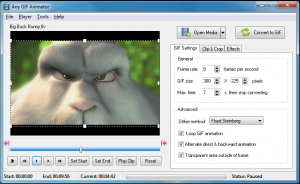
    An embedded media player then allows you to browse through your video clip, find and mark the section you’d like to convert. Oddly, you can’t step through the movie in frames — the smallest increment is a tenth of a second — so you’re not able to be as precise as we’d like. But otherwise this is a fairly simple operation, and you’ll quickly have your core clip ready.

    If you’d like fine control over your animation then the good news is that Any GIF Animator provides lots of configuration options. So you can set the GIF’s size and frame rate; crop the image; tweak saturation, brightness and contrast; add a text caption, choose the best dithering method, set the animation type (looping, direction) and more.

    But if you’re not sure whether you need any of this, or are just in a hurry, then you can just accept the default settings — they work well, most of the time.

    And when you’re happy with the clip, all you have to do is click “Convert to GIF” and Any GIF Animator will process your chosen video, create an animated GIF version, and upload it to the AnyGif server, where you’ll be given the URLs you need to share the clip with others.
    One very obvious issue here is that the program doesn’t offer you a choice about uploading animations — it just does it. And your GIF will then immediately be visible to anyone who visits the site, so bear that in mind before you create anything of a, well, personal nature. (We’d also urge caution if you’re looking for something family-friendly; the program itself is fine, but view what others are creating on the website and you’ll find plenty of porn.)

    Perhaps most annoyingly, Any GIF Animator doesn’t even provide an option to save a local copy of your animation. If you want to do this then you’ll need to either allow it to be uploaded, then save it from your browser, or make a copy of the temporary file the program creates — see C:\Users\[UserName]\AppData\Roaming\Any GIF Animator, for instance, or search your system for out.gif.

    There’s a lot to like about Any GIF Animator, then, and you can use it right now to produce quality animations. The program also has some significant annoyances, though, and it really needs a local save option to be added very soon.

    Photo Credit: Alex Kosev/Shutterstock

  • Shervin Pishevar is leaving Menlo VC to start Sherpa, a startup foundry

    shervin-pishevar-MenloVentures_0485_72High profile entrepreneur Shervin Pishevar has carved out a big slice of attention in Silicon Valley. When he is not hobnobbing with Presidents and crown princes, Pishevar, who co-founded Webs.com and Social Gaming Network, is busy talking up companies he has invested in on behalf of Sandhill Road firm, Menlo Ventures.

    We heard about Pishevar’s exit a few days ago and since then have independently confirmed with two sources that he is leaving the firm he joined as a managing director in 2011. Shervin confirmed his exit. He will stay on an adviser to Menlo and is going to join Uber as a strategic adviser. In addition, he plans to start a new company — Sherpa, which is a combination of startup foundry and a fund.

    He explained that Sherpa is a company helping to build other companies, and it will be working with large corporations and other founders to come up with ideas. He declined to offer any details except that he is partnering with Scott Stanford, a Goldman Sachs investment banker, for this new project.

    During his tenure at Menlo, Pishevar had invested in companies such as Uber, Fab, Getaround and Cinemagram. Pishevar is one of the most liked people in the entrepreneur community. He was an angel investor in about three dozen companies before joining Menlo Ventures in 2011.

    Related research and analysis from GigaOM Pro:
    Subscriber content. Sign up for a free trial.

  • How battery improvements will revolutionize the design of the electric car

    Tesla could have never created the Model S — it’s second-generation electric car that won Motor Trend’s car of the year award for 2012 — with battery technology from a few decades ago, said Tesla’s CTO and co-founder J.B. Straubel at the Cleantech Investor Summit last week. He explained, “The type of vehicle we can create is fundamentally different every time that tech [batteries] moves a little forward.”

    While battery innovation appears gradual, the incremental leaps add up over time. Battery innovation is improving around 5 to 8 percent per year, which can deliver a doubling in core performance metrics every ten years, which is ultimately really “revolutionary” said Straubel. Because of the large size and heavy physical weight of batteries involved with electric cars, the impact of battery innovation on the design of the car can be even more significant than Moore’s Law has on some computing products, added Straubel.

    For car design, “It’s almost as if the properties of steel were improving at a rate of 5 to 8 percent per year,” said Straubel.

    Tesla Model S

    The new design and engineering of the Model S has been Tesla’s differentiator, and it is what the company is hoping will help it move into profitability and success as a more mainstream auto maker down the road. The car is one of the first electric cars in the world that was designed from the ground up as electric. In contrast most auto makers that have built electric cars have taken an existing traditional gas-powered car and put batteries in it.

    The Model S, in comparison, has placed the battery along the bottom of the car, so that it doesn’t take up seating and storage space, and also so that the car has a low center of gravity and is more aerodynamic. The Tesla Roadster (it’s first car) and the Nissan LEAF are based on the bodies of gas-powered cars.

    Shai Agassi, the founder and former CEO of Better Place, also touted the importance of the rate of battery innovation during his talk at the Cleantech Investor Summit. He said the energy density of batteries goes up 15 percent every 18 months; the cost per kilowatt hour goes down 15 percent every 18 months; the life cycles of the batteries (how many times it can charge and recharge) goes up 15 percent every 18 months; and the cost per lifecycle-mile does down 50 percent every 18 months. “If you don’t like the margins in this [electric car] business just wait 12 months,” said Agassi.

    The crucial factor for both Tesla and Better Place will be surviving in an early market place as these improvements emerge. As with all startups, timing and execution will be key.

    Related research and analysis from GigaOM Pro:
    Subscriber content. Sign up for a free trial.