Blog

  • Bike, hike, run: 3 apps to take with you outdoors [video]

    Now that it’s (technically) spring, you’re probably ready to get outside and soak up some vitamin D — I know I am. The iOS App Store is filled with sports and activity apps, but these are three I’ve been using and I recommend: Spotcycle, AllTrails and WalkTracker Pro.

    If you’re into bike-sharing, Spotcycle is an app that will help you find bikes closest to you to rent and show you the closest place to return your rental. The app won’t work everywhere, but it will work in a lot of places: eight countries and two dozen U.S. cities so far. The bikes tracked on Spotcycle are usually part of local public bike-sharing programs; they require memberships, but anyone can sign up.

    AllTrails is basically Yelp for trails: it’s a location-based trail guide that will help you find a trail closest to you that fits your preferences. You can search by type of activity — running, hiking, riding, snowshoeing, rowing, and more — as well as by kid-friendliness and wheelchair accessibility. It also packs a ton of user reviews and tips for those who’ve experienced the trails before.

    And once you’ve found your bike or trail, WalkTracker Pro is a great app you can use to track the distance you cover and the calories you burn.

    The video below will walk you through each app:

    Related research and analysis from GigaOM Pro:
    Subscriber content. Sign up for a free trial.


  • Honoring Martin Luther King Jr. With Our Lives

    Today marks the 45th anniversary of the death of one of America’s great heroes and a giant of the Civil Rights Movement, Dr. Martin Luther King Jr.

    Dr. King was working on the frontlines of a movement in Memphis to support the sanitation workers on strike when his life was taken. It was there that he gave his last speech, I’ve Been on a Mountaintop.

    Today, we pause and reflect on Dr. King’s extraordinary life and his tireless work to bend the arc of the moral universe toward justice. We stand on the shoulders of so many of our Civil Rights heroes who we’ve lost, such as Dr. King, Dorothy Height, and Rosa Parks. Yet their legacy continues.   

    This August, we also mark the 50th anniversary of the March on Washington, when thousands descended upon the capital to rally for civil and economic rights for all Americans. It was there, at the Lincoln Memorial, that Dr. King gave his most iconic speech, I Have a Dream.

    Since Dr. King’s untimely and tragic death, we have strived to advance his ideals and realize his dream for all Americans to have the same economic and social opportunities.

    read more

  • Foursquare Gives Businesses Incentive to Offer Specials on 4sqDay

    If you’re a local business and are thinking about celebrating the upcoming 4sqDay 2013 with a special, Foursquare is giving you another little incentive to make that decision easier.

    Foursquare has just announced that they will be automatically featuring any business that offers a Foursquare special in the search results on foursquare.com.

    “It’s a great way to get even more eyes on your business!” says the company.

    And if you plan to run a special, Foursquare says that you should print out this sign and plant it on your window, counter, or wherever.

    Foursquare is pretty flexible on what kinds of specials you can run through their service. It can be monetary – like 10% off upon check-in. Or it can be a reward for a frequent customer or for the mayor. Foursquare makes an example of one local business who offered an express check-out line for those who checked-in on Foursquare.

    4sqDay (Foursquare Day) is going on its 4th year this year. It’s alway celebrated on April 16th (4/16…4×4=16, get it?). The first 4sqDay was celebrated in 2010 in Tampa Bay. It was originally begun by Foursquare users but in 2011, after the success of the new holiday in an unofficial capacity, some cities hopped on the bandwagon. New York City Mayor Michael Bloomberg actually issued an official proclamation declaring 4/16 4sqDay in the city.

  • Microsoft releases half-ready Windows Phone app sale site

    I suppose I could be charitable and say Microsoft’s heart is in the right place with its latest Windows Phone announcement. The fact is rivals like Amazon and Google needed some good competition from new kid on the mobile block. The Amazon Android App Store offers a paid app for free everyday and Google Play regularly has sales for various causes for celebration that the company cooks up. Microsoft has reason to come up with a bit of competition against those things, and today does just that.

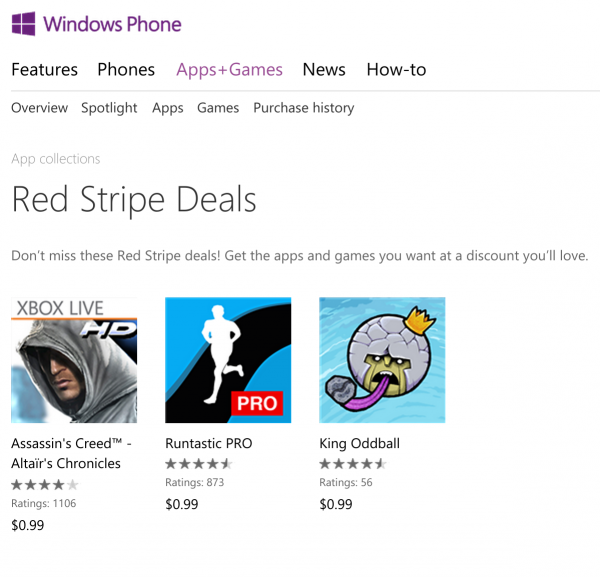
    The company announces its new “Red Stripe Deals” site and, no, it has nothing to do with Jamaican beer. The new site is a collection of apps and games that have been discounted for Windows Phone customers. The concept is a great idea and is sure to be a hit for the mobile audience.

    So why do I complain of the launch? Not because of the concept, but because the company chose to announce before it was actually ready. When Microsoft’s Michael Stroh told us of the site it had exactly one app — RunKeeper. As of this writing, the sale site has progressed to the three apps that Stroh promises, all of them at $0.99.

    Red Stripe Deals is certainly a good concept and I have no doubt that Microsoft will continue to update with what it calls “weekly bargains on stellar apps and games”. However, if the company truly wishes to compete with Android and iOS then it may wish to consider giving the site a bit more variety, especially given that Amazon offers seven paid apps for free every week.

  • Apple’s long-term edge in the tablet market seen as ‘highly unlikely’ to erode

    Apple Tablet Market
    Apple’s (AAPL) iPad has one big advantage going for it that the iPhone can’t match: it doesn’t rely on wireless carriers to be distributors. Barron’s points us to a new note from Bernstein Research analyst Toni Sacconaghi outlining the reasons why it’s “highly unlikely” that Apple’s share of the tablet market will ever fall to the level of its smartphone market share. The most important factor, writes Sacconaghi, is that “the iPad has stronger global distribution through Apple stores, carrier partners and network of resellers, including third-party retail outlets (e.g., Best Buy, Wal-Mart, carrier stores) and third-party websites (e.g., Amazon.com).” In contrast, the iPhone is distributed by just 240 carriers worldwide, which Sacconaghi notes is “significantly lower than Samsung (005930) and Nokia (NOK), which have essentially global distribution, and Blackberry (BBRY), which is distributed by >2x the number of carriers.”

  • Intel inside & out: trademark filings point towards Intel Media plans

    Intel’s plan to enter the media biz is looking more ambitious by the day: The company applied for a series of trademarks last week that seem to be related to the TV service it is going to launch out of its Intel Media unit. Intel filed three applications with the U.S. Patent and Trademark Office for trademarks on “Intel inside & out,” and the services described in these filings all fit Intel’s plans for its TV venture.

    And while looking into these filings, I also stumbled across a seemingly related filing made a few months ago in secrecy that hints at possible branding strategies, and further highlights the ambitious scope of Intel’s TV plans.

    Intel goes all out for its media service

    Intel filed for three trademarks for Intel inside & out at the end of March in an attempt to secure the rights for both the phrase as well as two logo renditions. The applications cover a broad and somewhat random description of devices, including everything from set-top boxes to personal digital assistants, video cameras and media players. However, the description of associated services is a little more telling, and includes “providing text, data, image, audio, video, gaming and multimedia content for a fee or pre-paid subscription.” Also covered are:

    “On demand transmission and services of data, audio, video, gaming and multimedia content; broadcasting services; teleconferencing; electronic transmission and streaming of movies, music, video, gaming and multimedia content;”

    And it gets even more detailed:

    “Entertainment Services; providing a database featuring audio, videos, television programs, motion pictures, games, current events and entertainment news, sports, games, cultural events, social, and entertainment-related programs; electronic games services provided by means of the internet;”

    All of these items seem to describe Intel’s plans for its TV service pretty well. The company has been mum on some key details, but Intel Media boss Eric Huggers said in February that he wants to launch a full-blown TV subscription service that competes with cable, offering live broadcast feeds, on-demand content and an iPlayer-like TV catch-up service.

    Oh, and the company will also make its own device, which it intends to sell through retail partners as well as on its own website, which is why the trademark application also includes a mention of “online retail of consumer electronic equipment and devices.”

    But wait, there’s more

    The Intel inside & out trademark applications were filed by Katherine M. Basile, an attorney with Novak Druce & Quipp LLP, a Cupertino-based law firm that has been doing these kinds of applications for Intel for a number of years now. Centrino, Atom and the original Intel Inside were all registered as trademarks by Basile.

    The home of the mysterious 12307 Company LLC. Is it a shell company, used by Intel to trademark a possible Intel TV brand?

    This is the home of the mysterious 12307 Company LLC. Is it a shell company, used by Intel to trademark a possible Intel TV brand?

    But when I looked at her past filings, I stumbled across something curious: Back in September, she filed a trademark for Arlo, which features a description virtually identical to the one that’s part of the Intel inside and out application. Whole paragraphs seem to have been copied and pasted, including key descriptions like the one defining “broadcasting services; teleconferencing; electronic transmission and streaming of movies, music, video, gaming and multimedia content.”

    However, Arlo wasn’t filed for Intel, but for an entity called 12307 Company LLC. That company was incorporated in Delaware in 2007, but it never applied for any other trademarks than Arlo. A quick check with the Delaware Department of State showed that its business address is in the famous Corporation Trust Center in Wilmington, Delaware, where it shares a mailbox with some 200,000 other companies. It’s a shell company, meant to hide the involvement of another entity.

    So what does all of this mean?

    Before we jump to conclusions about these trademarks, it’s worth remembering that companies don’t always act on their trademark filings. It’s possible that Intel filed for an inside & out trademark, and used 12307 Company to secure the trademark for Arlo, but won’t actually use either of them once it unveils its TV service. It’s possible, but somewhat unlikely, that Intel and 12307 Company don’t have any connection at all, and just filed virtually identical trademark applications through the same lawyer by accident. (Yeah, I don’t buy that one either.)

    And of course, it is also possible that we are going to see an Arlo-branded TV service, powered by Intel inside & out, emerge later this year. An Intel Media spokesperson declined to comment on Intel inside and out as well as Arlo, instead sending me the following statement:

    “We haven’t shared any info on the brand beyond confirming that we will introduce a new and unique brand when our product comes to market later this year.”

    However, the bigger point here is that Intel isn’t just content with building a service that streams cable channels to your TV. Huggers told me during an interview in February that he wants to target all screens, and that this is part of a bigger plan to transform Intel. Turn the chip maker into a company that delivers and monetizes services running on those chips.

    TV is only one piece of that puzzle, and your TV set is only one of many screens. Some of the other offerings mentioned in the filings, like video gaming and teleconferencing or even the notion of a multiscreen cloud media platform, are the logical next steps. Intel seems to be getting ready to embark on this journey, and in the process reinvent itself — inside and out.

    Related research and analysis from GigaOM Pro:
    Subscriber content. Sign up for a free trial.


  • Joss Stone Murder Plot Suspects Convicted

    In 2011 two men were arrested in England for plotting to rob and murder pop star Joss Stone.

    According to a report in The Telegraph, the men, Junior Bradshaw and Kevin Liverpool, have been convicted on conspiracy to to cause grievous bodily harm and conspiracy to rob. Liverpool has been sentenced to life in prison, and will serve a minimum of 10 years and eight months. Bradshaw’s sentencing was postponed.

    According to the Telegraph report, the pair were found near the singer’s home with a “samurai sword” and knives. At one point the criminals asked a mailman for directions to Stone’s house. The amateur criminals were reported to have had notes outlining a plot to behead Stone and dump her body in a river.

    The motive for the men’s plot isn’t entirely clear, though notes written by the men contained references to the British Royal family. The writings referred to the fact that Stone had been invited to the Prince William’s wedding in 2011. The men also mentioned Eminem, Beyonce, R. Kelly and Chris Brown.

    Stone’s mother addressed the media after the convictions, thanking supporters on her daughter’s behalf and expressing relief that the men are behind bars.

  • Roger Ebert Dies Following “Leave Of Presence” Announcement

    Roger Ebert, probably the most well known film critic there is, has died at the age of 70 after a long battle with cancer.

    The news comes just after Ebert announced that he would be taking “a leave of presence” as his cancer returned. In his post on his blog at the Chicago Sun-Times site, Ebert wrote:

    At this point in my life, in addition to writing about movies, I may write about what it’s like to cope with health challenges and the limitations they can force upon you. It really stinks that the cancer has returned and that I have spent too many days in the hospital. So on bad days I may write about the vulnerability that accompanies illness. On good days, I may wax ecstatic about a movie so good it transports me beyond illness.

    Some notable remarks from the Twitterverse:

  • BrightSource’s cancelled projects highlight hurdles for desert solar thermal plants

    Solar thermal company BrightSource has seen two of its contracts — to sell power from its desert solar farms to utilities — cancelled since the beginning of 2013. The situation highlights the hurdles that such large solar thermal power plants face, while rooftop solar panels continue to drop in price and are increasingly being installed.

    Solar thermal technology uses mirrors to concentrated the sun’s rays to a liquid-filled collector point, which heats up and produces steam and powers a steam tubine, delivering electricity. Solar panels, on the other hand, convert sunlight directly into electricity.

    This week utility PG&E and BrightSource agreed to mutually terminate agreements for PG&E to buy solar power from two 250 MW planned solar power plants, called Hidden Hills, located in Inyo County, near the Nevada border. The projects are estimated to cost a combined $2.6 billion, and the companies said the contract was terminated due to “challenges associated with the project schedule and uncertainty around the timing of transmission upgrades.”

    A crane placing a mirror into place at Ivanpah

    BrightSource has been focused on adding energy storage technology to its projects, which would make its power plants more robust and be able to provide energy when the sun isn’t shining. BrightSource says its Hidden Hills site is a good candidate for a solar farm with the storage technology, but that such a change would require an amendment to the permit application and a reopening of the record to go over the new layout and plan. Suspending the current application saves time and expense, BrightSource spokesperson Keely Wachs tells me.

    Back in January utility Southern California Edison and BrightSource also agreed to terminate a contract for a 200 MW solar plant for its Rio Mesa 2 project near Blythe, California. The California Public Utilities Commission had denied an adjacent contract next to Rio Mesa 2 due to cost concerns last year, and BrightSource suspended permitting for both Rio Mesa 1 and 2 earlier this year.

    There's three transmission lines at Ivanpah

    There’s three transmission lines at Ivanpah

    BrightSource is completing its flagship solar thermal project called Ivanpah in the desert near Las Vegas this year. Wachs says that BrightSource is also currently focused on its Palen solar project in Riverside County, which has already been permitted by the California Energy Commission.

    But still, the hurdles for BrightSource’s solar power plant contracts illustrate some of the inherent difficulties with trying to build massive solar plants, filled with mirrors and trackers and towers. Such large solar farms need transmission lines to shuttle the power to the cities that will use it, but transmission lines can be controversial, expensive and take a very long time to deploy.

    Environmental reports can also take many months and a lot of money. Protests from environmentalists have derailed, and added significant costs, to solar thermal projects.

    While solar thermal projects face such hurdles, solar panels continue to drop in price and are being deployed at a rapid pace. As GigaOM Pro research analyst explained this week: “3313 megawatts came online in the U.S. in 2012, a 76 percent increase over 2011 with GTM Research predicting that we’ll see continued growth up to 4300 megawatts this year.” And in particular utility-scale solar panel projects grew 134 percent last year and accounted for more than half of installed solar.

    Related research and analysis from GigaOM Pro:
    Subscriber content. Sign up for a free trial.


  • Creating a Workplace that Really Works

    A common refrain is, “We have to do more with less.” A common result is feelings among employees of overload and burnout. With higher demands and fewer resources, what’s the solution?

    Tony Schwartz, CEO of the Energy Project and a contributor to HBR’s Blog Network, sees the key as energizing the workplace through “sustainable engagement.” This requires that organizations shift from the traditional focus on getting more out of people to investing instead in meeting people’s core needs so they are freed, fueled, and inspired to deliver sustainable high performance.

    Tune in now to hear Schwartz describe what sustainable engagement is, why it matters, and how organizations can create it.

  • Why Facebook Home bothers me: It destroys any notion of privacy

    23-remake-of-path-menu One of the great things about attending Facebook’s events is that one gets to see Mark Zuckerberg mature as a chief executive and hone his presentation skills. And today, he didn’t disappoint in his ability to spin a large corpus of media corps. It was all claps for “four-colors on HTC First” and ideas “inspired” by the likes of Amazon Kindle (ads) and Path. But what he did most brilliantly was obfuscate the difference between an app (Home) the user experience layer and the operating system.

    Zuckerberg did that for two reasons: First, to buy his company time to build a proper OS that will come to us in dribs and drabs and then will wash over us suddenly, like a riptide. And secondly, to convince people that ”Home” is just like any other app. Unfortunately, Facebook’s Home is not as benign as that.

    In fact, Facebook Home should put privacy advocates on alert, for this application erodes any idea of privacy. If you install this, then it is very likely that Facebook is going to be able to track your every move, and every little action. It is a future I wrote about a few days ago, and let me explain using that very same context.

    DSC02446

    The new Home app/UX/quasi-OS is deeply integrated into the Android environment. It takes an effort to shut it down,  because Home’s whole premise is to be always on and be the dashboard to your social world. It wants to be the start button for apps that are on your Android device, which in turn will give Facebook a deep insight on what is popular. And of course, it can build an app that mimics the functionality of that popular, fast-growing mobile app. I have seen it done before, both on other platforms and on Facebook.

    But there is a bigger worry. The phone’s GPS can send constant information back to the Facebook servers, telling it your whereabouts at any time.

    So if your phone doesn’t move from a single location between the hours of 10 p.m. and 6 a.m. for say a week or so, Facebook can quickly deduce the location of your home. Facebook will be able to pin-point on a map where your home is, whether you share your personal address with the site or not. It can start to build a bigger and better profile of you on its servers. It can start to correlate all of your relationships, all of the places you shop, all of the restaurants you dine in and other such data. The data from accelerometer inside your phone could tell it if you are walking, running or driving. As Zuckerberg said – unlike the iPhone and iOS, Android allows Facebook to do whatever it wants on the platform, and that means accessing the hardware as well.

    This future is going to happen – and it is too late to debate. However, the problem is that Facebook is going to use all this data — not to improve our lives – but to target better marketing and advertising messages at us. Zuckerberg made no bones about the fact that Facebook will be pushing ads on Home.

    And most importantly it is Facebook, a company that is known to have played loose-and-easy with consumer privacy and data since its very inception, asking for forgiveness whenever we caught them with its hand in the cookie jar. I don’t think we can be that forgiving or reactive with Facebook on the mobile. It is time to ask for simple, granular and easy to understand privacy and data collection policies from Facebook, especially for mobile. We need to ask our legislative representatives to understand that Facebook wants to go from our desktops and browsers, right into our home – place where we need to be private.

    Related research and analysis from GigaOM Pro:
    Subscriber content. Sign up for a free trial.


  • Facebook Home Will Gets Ads, At Some Point

    Today, Facebook announced Home, a deep integration of Facebook into Android that basically turns any phone that installs it into a Facebook Phone. Home, which will launch on April 12th, is a family of apps that when installed, turns your entire homescreen into one big Facebook experience.

    And the main aspect of that experience is the Cover Feed. It features all the fresh content from your Facebook news feed, basically turning your Android device into a photo-oriented, swipeable Facebook hub. You can like, comment, and view notifications directly from your Facebook Home screen – with no need to launch any sort of app. It’s without question the deepest Facebook integration any mobile OS has ever seen.

    And you can bet that Facebook it going to try to monetize it.

    After the event, CEO Mark Zuckerberg made it clear that ads will be coming to your Facebook Home Cover Feed.

    “There are no ads in this yet, I’m sure that one day there will be,” he said. He then repeated his answer when asked again about whether or not ads would be coming to the Cover Feed. According to Zuckerberg, ads are just another kind of content.

    C’mon. Don’t look so sour. You didn’t think that Facebook would build a grand new Android-based user experience and leave out the ads, did you?

    When Facebook Home launches, it will be downloadable on the HTC One X, HTC One X+, Samsung Galaxy S III and Samsung Galaxy Note II – and eventually the HTC One and Samsung Galaxy S4.

    And on that same day, the HTC First will launch as the first phone the comes with Facebook Home pre-installed.

  • HTC First phones Home

    Well, the rumors were false. Facebook didn’t release a phone today, not that I’m surprised. There are reasons why we write so few rumor stories here at BetaNews — they often are false. “We’re not building a phone. We’re not building an operating system”, CEO Mark Zuckerberg said early this afternoon. But the social network has launched an OEM program for the new Facebook Home, which displaces the default Android start screen. HTC is first partner. Aptly named then, the smartphone is called HTC First.

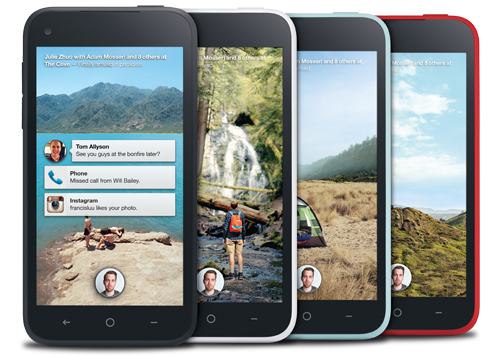
    Preorders start today, and the device will be available exclusively from AT&T, in four colors (black, pale blue, red and white), on April 12. Facebook Home, which also will be downloadable same day for HTC One X and One X+ and Samsung Galaxy S III and Note II, is First’s default experience. Essentially, the social network becomes primary user interface on top of Android.

    First sells for $99.99 with 2-year contractual commitment. By the specs, the smartphone is no screamer. Modest feature set includes 4.3-inch display, Qualcomm Snapdragon 400 dual-core processor, 4G LTE and Android 4.1. The preorder page is, as I write, a dead link. (How can you not laugh at that?)

    HTC First: 4.3-inch display with 1280 x 720 resolution. 1.4GHz Qualcomm 8930AA dual-core processor; 1GB RAM; 16GB storage; 5-megapixel front- and 1.6MP rear-facing cameras; 1080p video recording; 4G: LTE (850/1900 MHz), UMTS/HSPA/HSPA+ (850/900/1900/2100 MHz); GSM/GPRS/EDGE (850/900/1800/1900 MHz); Wi-Fi N; ambient-light and proximity sensors; digital compass; GPS + GLONASS; gyroscope; tri-axis accelerometer; 2000 mAh embedded battery; Facebook Home; and Android 4.1.

    Ralph de la Vega, AT&T Mobility president, claims that the “best device for Facebook Home is the HTC First”. I look at the other supported smartphones, which include HTC One and Samsung Galaxy S4 when available, and wonder: “Who is he kidding?”

    HTC’s listed specs are much better, and I wonder if AT&T can’t get them right or the “exclusive” is less than what other carriers will eventually get. Those specs, as HTC presents them: 5-inch 1080p display. 1.4GHz Qualcomm 8930AA dual-core processor; 1GB RAM; 16GB storage; 5-megapixel front- and 1.6MP rear-facing cameras; 1080p video recording; 4G: LTE (850/1900 MHz), UMTS/HSPA/HSPA+ (850/900/1900/2100 MHz); GSM/GPRS/EDGE (850/900/1800/1900 MHz); Wi-Fi N; ambient-light and proximity sensors; digital compass; GPS + GLONASS; gyroscope; tri-axis accelerometer; 2000 mAh embedded battery; Facebook Home; Instagram; and Android 4.1.

    Those specs look pretty good for a $100 phone with or without Facebook as primary UI. I’ll update when there is clarification that AT&T’s model is less or the PR people are just incapable of getting specs right.

    Update: The preorder page is now live and gives the 4.3-inch screen, and HTC lists both. Strike-outs and changes are reflected above. Features are modest compared to other smartphones capable of running Facebook Home.

    As for the Facebook experience, Home runs atop of Android. Zuckerberg observes that the three-decade-old current computing puts apps first, which, he claims doesn’t make sense for personal devices like smartphones and tablets. What if they were “designed around people not apps?” he asks. “It would feel very different”.

    Home presents Facebookers with Cover Feed, a bleeding edge-to-edge view into the latest posts. Users can view or interact, including tap to Like. There’s a real personal publication feel to the presentation. Cover Feed works in conjunction with Notifications.

    For communications, Home features Chat Heads, which is real-time messaging available from anywhere within the UI. Not to completely dismiss apps, there also is a launcher for accessing them.

    “With Home available right out of the box, you’re getting the best quality experience for connecting with your friends”, Zuckerberg asserts. But out of the box doesn’t mean out of luck everywhere else. Users of the above-mentioned other supported smartphones can download Facebook Home from Google Play starting April 12.

  • Plummeting Windows RT tablet prices point to potential flop

    Windows RT Tablet Demand
    Microsoft’s (MSFT) Windows RT platform for tablets has not been well received. The media was very critical in early looks at the new operating system, and reviews of Microsoft’s Surface tablet almost unanimously found that the stunning hardware was being held back by mediocre software. Consumer response to products doesn’t always mirror the sentiment of reviewers but in the case of Windows RT, it looks as though the mass market hasn’t shown much interest in Microsoft’s most recent tablet play.

    Continue reading…

  • Facebook Home Has A Few Perks For Developers As Well

    At its much hyped Android event today, Facebook unveiled Home, a custom set of apps that transform any ol’ Android phone into a Facebook phone. The event was mostly focused on what Home can do for users, but Facebook wants its stable of developers to know that Home is for them as well.

    First up, the Cover Feed is advantageous for developers as it lets users access app content as soon as they turn on their phone. Here’s the list of story types that can be shared via Cover Feed at the moment:

    Photos stories

  • Updating your profile photo
  • Updating your cover photo
  • Open graph stories with user generated photos
  • Liking a photo
  • Tagging someone on a photo
  • Commenting on a photo of someone
  • Sharing a Photo
  • Non-photo stories

  • Updating your status
  • Place check-in with a message
  • Sharing urls by clicking the “share” button on another story
  • Posting a url from your timeline
  • Page posts

  • Updates and photos from Page posts
  • Notifications are already a great engagement tool, but Facebook reckons that Home will make notifications even more engaging by making them “bigger” and “bolder.” The larger size will also make it easier for users to interact with notifications, thereby increasing your chances of having a user engage with your content.

    Facebook Messenger ensured that a user would leave your app if they got a message from a friend in the middle of playing a game. Home’s Chat Heads makes it so that messages appear on screen, even while using you app, and users can respond without ever having to close your app.

    Finally, Facebook says that its app launcher will make it easier for people to get to your apps more quickly. The launcher is fully customizable so a good app is likely to always be at the forefront of any launcher.

    Facebook will be updating Home every month so you can expect more developer updates as Facebook builds out Home into a more sophisticated product. I wouldn’t be surprised if we were to also a get few major Android SDK updates this year to address how apps can better take advantage of Home.

  • SIMMONS: How Taxpayer Money Gets Lost in the Wind

    WASHINGTON, D.C. – IER State and Regulatory Affairs Director Dan Simmons published an op-ed in U.S. News & World Report titled, How Taxpayer Money Gets Lost in the Wind. In the piece, Simmons dissects a recent study from the Government …

  • ‘The Drunken Botanist’ Author Amy Stewart Gives Google Talk

    Amy Stewart, author of The Drunken Botanist, recently gave a talk at Google. The company has now made the video available on its AtGoogleTalks YouTube channel for your enjoyment. So…enjoy.

    The talk is from March 26th.

    More recent @Google Talks here.

  • Bill O’Reilly, Laura Ingraham Argue Over “Thump the Bible” Comment

    Last week, conservative Fox News star Bill O’Reilly seemed to defend the supporters of gay marriage, saying that they have a “compelling argument.” At the same time, the pundit criticized opponents of gay marriage, stating that they haven’t been able “to do anything but thump the Bible.”

    Now, O’Reilly is having to defend his comments against a backlash of Christians who feel the host was criticizing their religion. O’Reilly brought conservative talk radio host Laura Ingraham onto The O’Reilly Factor to provide a warm body to whom he could further explain his comments.

    “If you’re going to stand up for heterosexual marriage and exclude gay marriage, if you’re going to do that, you’ve got to do it outside the Bible,” said O’Reilly. “You can’t cite the Bible, ’cause you’ll lose if you do it.”

    Ingraham told O’Reilly that she thinks his comments are “disrespectful” to Christians. O’Reilly went on to try and explain that he makes a distinction between Americans’ privately held beliefs and how public policy should be made, insisting that he meant no offense to Christians. He also went on to double-down on his “thump the Bible” comment.

    “There are Bible thumpers, and all they do is say, ‘I object to gay marriage ’cause God objects to it,” said O’Reilly. “You don’t win a policy debate in America with that.”

  • Facebook’s mission: Hammer WhatsApp and other messaging startups

    Facebook Home Analysis
    Much has been said about what Facebook’s (FB) new initiative means for app developers. But after today’s Facebook Home unveiling, it’s clear that there is one very specific app category that is Facebook’s current obsession: messaging apps. It is safe to say nobody expected two years ago that the popularity of WhatsApp, VINE and KakaoTalk would explode the way it did. WhatsApp hit 11 billion outbound messages on New Year’s Eve; China-driven WeChat has hit 300 million users; Korean KakaoTalk has reached 80 million users. All of these messaging platforms have created a surge of interest in group chats and photo-sharing — features that just happen to encroach on Facebook’s core territory. Even worse, Asian messaging apps have started morphing into social game hubs and WhatsApp is expected to launch an ambitious game initiative later in 2013. Today represented Facebook’s counterattack on these pesky messaging upstarts.

    Continue reading…

  • Oh Yeah, And Facebook Home Will Get Ads Too

    Facebook, as you’ve probably heard by now, introduced Facebook Home today at a press event. This is essentially Facebook’s way of taking over your Android device. You can learn more about it here.

    The main feature of the offering is called the Cover Feed. This sufaces the latest photos and updates from your News Feed on your homescreen, and lets you navigate through them by swiping.

    Facebook didn’t show off any ads when they were demonstrating the product, but at the event, CEO Mark Zuckerberg did indicate that ads will be a part of it eventually. He is quoted as saying, “There are no ads in this yet. I’m sure at some point there will be.”

    Here’s an ad for Facebook Home itself. And for more on the new HTC First phone, which comes with Facebook Home pre-installed, read this.

    Last week, Facebook announced real-time cookie-based Facebook Exchange ads in the news feed.