Blog

  • Meet The HTC First, The First Android Phone To Come Preloaded With Facebook Home

    44

    The torrent of leaks these past few days haven’t left much to the imagination, but HTC’s Peter Chou has just officially pulled back the curtain on the first phone to ship with Facebook Home — the HTC First — at Facebook’s Menlo Park headquarters.

    According to HTC CEO Peter Chou the First will be the “ultimate social phone,” though he declined to dig into the device’s specs during his brief moments on-stage. The device will ship in four colors, and will support AT&T’s LTE network right out of the gate. Can’t wait for your chance to take it for a spin? The First will be available for $99 (with a 2 year contract naturally) starting on April 12, and pre-orders for the device kick off today. Those of you outside the U.S. will be able to join in the fun shortly too, as Mark Zuckerberg also noted that the phone would find its way to UK carriers Orange and EE in short order.


    The mid-range First will be available in black, white, red and blue, and sports a 4.3-inch display that jibes with earlier reports. Facebook Home obviously serves to obscure the Android 4.1 Jelly Bean build that’s actually running the show, while one of Qualcomm’s dual-core Snapdragon 400 chipsets (and not the MSM8960 that was previously reported) provides the horsepower from inside that smooth, curved chassis. It’s not a bad looking phone and the internals aren’t quite as lousy as many had expected them to be, but all this begs a very important question — will anyone actually buy this phone when you can fire up Facebook Home on your (supported) Android handset for a whopping zero dollars?

    I mean, c’mon — I’m a sucker for even mildly neat hardware, but so far neither HTC nor AT&T (whose CEOs both appeared on-stage to talk about how darned great the thing is) could provide a compelling reason why it’s worth buying. LTE? A handsome design? Neither of those are exactly hard to come by these days, are they? Facebook has said that the First will feature better integration for all those notifications you’re bound to get than if you had just installed the app, but at this point there’s little way of knowing how big a difference it’ll actually make. HTC knows how to make great hardware and I don’t mean to diminish that, but a lame device that’s been put together well is still a lame device.

    This marks the second time that the social networking giant and the beleaguered Taiwanese OEM have collaborated on a peculiar hardware play. The first, if you’ll recall, were HTC Status (nee Chacha) and the Salsa released back in 2011– their main claim to fame was a dedicated Facebook button for quick access to your friends and feeds. Considering that neither device was exactly a runaway hit, it’s no surprise to see that Facebook and HTC have taken things in a different, more substantial direction with the One. Of course, the First is going to be the tip of the iceberg when it comes to Facebook Home devices — Zuckerberg also pointed to a Facebook Home Program which allows hardware manufacturers to build Facebook Home into their own forthcoming handsets.

  • Monster Energy – Ballistic B.J. Baldwin – #RECOIL

    BJ Baldwin

    I think we’ve just found the man (and the video) that dethrones Ken Block. This is B.J. Baldwin, trophy truck pilot and stuntman extraordinaire. His vehicle of choice, the Monster Energy 850-horsepower trophy truck that comes equipped with 34-inches of suspension travel and a 150 mph top end. Combine that with a hot chick driving a Nissan GT-R, a helicopter and a few slow-motion cameras and you’ve just developed the recipe for internet video stardom!

    Source: Youtube.com

  • What is a Modular Data Center?

    This is the second article in the Data Center Knowledge Guide to Modular Data Centers series.  The concept of a modular data center solution has eluded definition, if not comprehension. Through the short history of modular solutions and vendor marketing, a definition and categorization of solutions has emerged. A modular data center can be defined as more of an approach to data center design that incorporates contained units, many times in the form of prefabricated modules. The modular market started with an international standard approach in the shape of an ISO (International Standards Organization) shipping container and has evolved to a fledgling market of vendors that produce everything from containers to a variety of modular designed products and solutions for IT, power and cooling.

    In some ways the shift in IT such as cloud computing has been in parallel with modular data center approaches. Modular elements for both IT and the data center exist in:

     Modular Data Center v2

     Container vs. Modular

    Container:
    A data center product incorporating cus¬tomized infrastructure to support power or cooling infrastructure, or racks of IT equipment. Containers are built using an ISO (International Standards Organization) intermodal shipping container.
    Modular:
    An approach to data center design that implies either a prefabricated data center module or a deployment method for delivering data center infrastructure in a modular, quick and flexible method.

    The primary confusion in terms stems from container versus modular. A data center container is a particular package that is engineered and delivered as such — in an ISO shipping container. A container is not the same thing as modular, but a container can be a part of a modular data center. A modular data center references a deployment method and engineered solution for assembling a data center out of modular components in, many times, pre-fabricated solutions that enable scalability and a rapid delivery schedule.

    After the early development of containers, theories evolved and the hype cycle played out for a data center in a box. Numerous hardware vendors, independent companies and data center providers embraced the modular concept and presented their own engineered solution.

     The complete Data Center Knowledge Guide to Modular Data Centers is available for download in a PDF format and brought to you by IO. Click here to download the DCK Guide to Modular Data Centers.

  • Verizon is open to the idea of a no-contract world – if consumers are

    It will be an easy feat to follow T-Mobile and eliminate contract and subsidies – it’s just a question of whether consumers want them eliminated, Verizon CEO Lowell McAdam told CNET on Thursday.

    Speaking to reporters at a Verizon event in New York City, McAdam said the carrier would watch T-Mobile’s new no-contract strategy closely to see how consumers respond. “I’m happy when I see something different tried,” CNET quoted McAdam as saying. “We can react quickly to consumers’ shifting needs.”

    Lowell McAdam (right) with Google's Eric Schmidt

    Lowell McAdam (right) with Google’s Eric Schmidt

    To be honest, you wouldn’t expect McAdam to say anything different. In the past, carriers have expressed dissatisfaction with the subsidy model that dominates the U.S. mobile industry. That model dictates they sell increasingly expensive smartphones at cut-rate prices and thus take a big financial hit when they first sign up a new customer. Eventually they recoup those costs over the course of a two-year contract through higher service fees.

    Most carriers have already eliminated subsidies entirely for tablets, and as McAdam points out, they would more than willing to do so for phones, if customers are amendable. That said, Verizon has done quite well for itself with the current system — it has no reason to gunk up the works unless there is some massive shift in consumer sentiment.

    There’s a reason why T-Mobile was the carrier to challenge the long-established contract-and-subsidy model: it had nothing to lose. It is the smallest — by a big margin — of the four national operators, and for the last several years it has barely grown. You can call its Un-carrier strategy an act of genius or you can call it an act of desperation, but T-Mobile had to do something and had to do that something quick. McAdam only has to sit back and wait to see if it works. And he’ll likely have to wait a while since many of the customers who might be interested in what T-Mo is selling are still locked into contracts.

    So what if T-Mo’s new contract-free plans prove wildly successful? Would other carriers give up on contracts completely? I seriously doubt it. Verizon, AT&T and Sprint may have their issues with the subsidy model, but they also love to the stability of long-term contracts. The last thing they want is a constantly shifting customer base, in which huge numbers of subscribers turn over each quarter. Even if the carriers didn’t have to absorb device subsidies, there are still substantial costs associated with acquiring new customers. They would much rather just lock down the ones they have.

    All three carriers offer prepaid services for customers who demand or don’t qualify for postpaid services, and most carriers will sell you a postpaid plan without a contract if you pay for your device upfront. In fact, they benefit considerably if you do so because they’ll charge you the same monthly rates they do for subsidized customers – they get their cake and eat it too.

    That’s where I think the other carriers will have the biggest difficulty adjusting to contract-free models. To make that model the work they’ll have to charge lower voice, SMS and data rates to those customers who eschew subsidies. If carriers are no longer recouping the cost of the device, they can’t justify the rates they charge today. Lowering rates is not something they want to do.

    Related research and analysis from GigaOM Pro:
    Subscriber content. Sign up for a free trial.


  • Advised by Clearsight Advisors, Semphonic’s Sale to Ernst & Young is Completed

    Ernst & Young has completed its acquisition of Semphonic, a digital measurement and data analytics consulting firm. The merchant bank Clearsight Advisors served as the exclusive strategic and financial advisor to Semphonic, the firm announced today.

    PRESS RELEASE:

    Clearsight Advisors, Inc. (“Clearsight”) is pleased to announce the successful completion of a strategic transaction in the data analytics arena. Ernst & Young LLP announced that Semphonic, a leading digital measurement and data analytics consulting firm, has joined Ernst & Young in the U.S. Semphonic is focused on providing Fortune 500 clients with insights into complex customer interaction challenges they face across channels. Clearsight served as exclusive strategic and financial advisor to Semphonic. “We needed a firm who knew our industry, understood our company and had the right connections to strategic players. Clearsight set up a fast, seamless process that brought multiple bidders to the table and allowed us to stay focused on our business while finding the right deal and company. It was exactly the help we were looking for,” said Semphonic President, Gary Angel.

    This transaction continues Clearsight’s commitment in assisting owners and management teams of high growth businesses achieve their objectives.

    “This announcement provides for a natural extension of Ernst & Young LLP’s analytics offerings,” said Andy Rusnak, principal and leader of Ernst & Young LLP’s Enterprise Intelligence group. “Together, we can offer an even deeper analytic capability that can be applied to predictive and prescriptive analytic challenges across multiple sectors. This comes at a pivotal time when companies are asking themselves how best to improve the performance of their digital channel. Semphonic adds deep experience into the complex website and mobile app customer interaction challenges our clients may face in developing and executing their digital channel strategy. ”

    Semphonic, headquartered in Novato, California, was founded in 1997 and advises clients on customer segmentation and digital marketing.

    “With the specialized skills and methods from Semphonic, Ernst & Young LLP can now work with clients to address the entire digital channel by using advanced statistical methods, proprietary methods to analyze digital behavioral data and advanced digital customer segmentation,” said Gary Angel, Semphonic president and chief technology officer, who will serve as a principal in Ernst & Young LLP’s Advisory Services Enterprise Intelligence practice. “The firm’s clients now have the ability to improve the efficiency of their digital marketing spend, as well as their website and mobile experiences, and drive integrated and offline personalization and targeting.”

    Jim Sterne, founder of eMetrics Summit and chairman of the Digital Analytics Association, stated that Semphonic’s sharp focus on client success, while staying broadly informed on the vagaries of data proliferation has given them access to the latest tools, helped them create the most sought after techniques and allowed them to truly take a thought leadership position in the digital analytics industry. “Now, with Ernst & Young’s resources, we can expect another step-change in marketing optimization efficiency and competitive edge sharpening,” he added.

    About Clearsight Advisors
    Clearsight Advisors is an independent merchant banking firm dedicated to providing world-class M&A and capital raising solutions exclusively to growth-oriented Business and Technology services companies. Clearsight combines deep market insights across software, services and data. This market knowledge combined with superior strategic and financial advice allows Clearsight to act as a catalyst, enabling entrepreneurs, private equity owners and board of directors to successfully advance their vision. Clearsight Capital Advisors, Inc., a wholly owned subsidiary, is a registered member of FINRA & SIPC.

    The post Advised by Clearsight Advisors, Semphonic’s Sale to Ernst & Young is Completed appeared first on peHUB.

  • Armada Oil Completes Acquisition of Mesa Energy Holdings

    The Dallas-based exploration company Armada Oil and Mesa Energy Holdings today announced the closing of the asset purchase agreement and completion of the business combination of Armada Oil and Mesa on March 28, 2013. In completing the transaction, Armada Oil has acquired 100% of Mesa Energy, a wholly owned subsidiary of Mesa that holds substantially all of the assets of Mesa. In return, Mesa stockholders will be issued 0.40 shares of common stock of Armada Oil for each share of Mesa that they own as of the close of business on March 27, 2013.

    PRESS RELEASE:

    Armada Oil, Inc. (OTCBB: AOIL) (“Armada Oil”) (the “Company”) and Mesa Energy Holdings, Inc. (OTCBB: MSEH) (“Mesa”) today announced the closing of the Asset Purchase Agreement and completion of the business combination of Armada Oil and Mesa on March 28, 2013. Stockholders of Mesa should see their shares converted to Armada shares in their brokerage accounts this week. Those with paper certificates will receive a notification document from the transfer agent and will be able to choose how they would like their shares handled.

    In completing the transaction, Armada Oil has acquired 100% of Mesa Energy, Inc., a wholly owned subsidiary of Mesa that holds substantially all of the assets of Mesa. In return, Mesa stockholders will be issued 0.40 shares of common stock of Armada Oil for each share of Mesa that they own as of the close of business on March 27, 2013. The new share structure of the combined companies is approximately 54 million issued and outstanding shares of Armada Oil common stock, with Mesa and Armada Oil stockholders holding, respectively, approximately 62.4% and 37.6% of the combined company. In addition, Mesa will be dissolved. Armada Oil will be the surviving corporate entity and will relocate its headquarters to Dallas, Texas.

    It is anticipated that the combination of the two companies will enhance stockholder value by merging management teams with proven operational and public company experience, who will build upon a diversified asset base consisting of conventional producing properties in Louisiana as well as unconventional resource play opportunities in both the Niobrara formation in Wyoming and in the Mississippian Lime formation in Oklahoma. In the coming months, Armada Oil expects to seek a listing on a national exchange, increase liquidity, spur growth, and more fully and effectively exploit its asset base.

    Randy M. Griffin, Chairman and Chief Executive Officer of Armada Oil, commented: “This business combination is a major milestone for both companies and we are thrilled to use it as a stepping stone to building a balanced exploration and production company with enough critical mass to efficiently increase stockholder value.”

    James J. Cerna, Jr., President of Armada Oil commented: “Mesa’s team shares the same values and commitment to excellence as we do. Together, we believe the new Armada Oil has the ability to take the next major step by listing on an exchange and by continually striving to become an independent oil and gas production leader.”

    More information regarding the Asset Purchase Agreement and business combination can be found in Armada Oil’s Form 8-K filed with the SEC on March 29, 2013, which is available for review at www.sec.gov and on the Company’s new corporate website www.armadaoil.us.

    About Armada Oil, Inc.
    Armada Oil, Inc. (OTCBB: AOIL), headquartered in Dallas, Texas, is a growth-oriented Exploration and Production (E&P) company with a definitive focus on growing reserves and net asset value per share, primarily through the acquisition, development and enhancement of multiple onshore oil and natural gas producing properties as well as the development of highly diversified developmental drilling opportunities, both conventional and unconventional. The company currently owns producing oil properties in Plaquemines and Lafourche Parishes in Louisiana, developmental properties in Garfield and Major Counties, OK and Wyoming County, NY and strategic acreage positions in and around the Laramie and Hanna Basins in Southern Wyoming in the liquids-rich Niobrara Play.

    More information about Armada Oil may be found at http://www.armadaoil.us.

    Forward-Looking Statements
    Certain statements in this news release, which are not historical facts, including those relating to the Mesa and Armada Oil business combination, are forward-looking statements. These statements are subject to risks and uncertainties. Words such as “expects”, “intends”, “plans”, “may”, “could”, “should”, “anticipates”, “likely”, “believes” and words of similar import also identify forward-looking statements. Forward-looking statements are based on current facts and analyses and other information that are based on forecasts of future results, estimates of amounts not yet determined and assumptions of management. Actual results may differ materially from those currently anticipated due to a number of factors which may be beyond the reasonable control of the Company, including, but not limited to, the Company’s ability to locate and acquire suitable interests in oil and gas properties on terms acceptable to the Company, the availability and pricing of additional capital to finance operations and leasehold acquisitions, the ability of the Company to build and maintain a successful operations infrastructure, the intensity of competition and changes and volatility in energy prices. Readers are urged not to place undue reliance on the forward-looking statements, which speak only as of the date of this release. We assume no obligation to update any forward-looking statements in order to reflect any event or circumstance that may arise after the date of this release.

    The post Armada Oil Completes Acquisition of Mesa Energy Holdings appeared first on peHUB.

  • In quest to make every phone a ‘Facebook Phone,’ Facebook unveils Facebook Home for Android

    Facebook Home Android
    Though it surprised no one, Facebook (FB) on Thursday unveiled its highly anticipated “Home” software for Android during a press conference at its California headquarters. In line with earlier reports, Facebook debuted new software that takes over several core functions of Android smartphones and replaces them with features that tie into various Facebook services.

    Continue reading…

  • City of Akron Backs Orthodata with $1.1 Million

    The City’s Akron Development Corporation, through its Akron BioInvestment Funds, has invested $1.1 million in Orthodata, a Kentucky-based biomedical company that hopes to commercialize a new spine fusion sensor. Orthodata will also be relocating its headquarters to Akron.

    PRESS RELEASE:

    Akron, Ohio (March 27, 2013) – The City’s Akron Development Corporation, through its Akron BioInvestment Funds, LLC, has announced that a Kentucky biomedical company is relocating its headquarters to Akron, Ohio. The Akron BioInvestment Funds has provided financing to Orthodata, Inc in support of its effort to commercialize a new spine fusion sensor — an innovative diagnostic system that allows surgeons to accurately assess the success of spinal fusion and eliminate the need for unnecessary exploratory surgery while accelerating patients’ return to work after surgery. The Akron BioInvestment funding has enabled Orthodata to attract additional backing from various private sources throughout the country, totaling $1.1M.

    In return for the funding, Orthodata has relocated their operations, which includes research, development, and commercialization, to Akron, Ohio. As of tomorrow, Orthodata will be headquartered in the White Pond Crossing Development, off White Pond Drive. Initially the company will have 3-4 employees, but plans to expand as needed.

    “Being a Northeast Ohio native, I am excited to be spearheading the development of our transformational technology in Akron, Ohio,” said Ric Navarro, President and CEO of Orthodata, Inc. “We have interest and support from leading spine surgeons at the Crystal Clinic and MetroHealth System and look forward to working with the Austen BioInnovation Institute in Akron. Our spine fusion sensor, the IntelliRod™, will lead to lower costs, less radiation exposure for patients and new post-operative diagnostic data for surgeons.”

    OrthoData, Inc., founded by renowned spine surgeon Rolando M. Puno, M.D. and professors from the University of Louisville, is developing an implantable microelectronic spine fusion sensor. With over 400,000 spinal fusions in the US in 2010, the number of patients with continuing post-op pain is estimated as high as 30% in lumbar fusion cases. In a significant number of these patients, ruling out pseudoarthrosis is key to determining the next course of treatment. The current aggregate cost of this determination is over $1B per year in the US.

    The IntelliRod system will provide objective postoperative data complementing surgeon data currently collected from flexion extension x-rays and costly CT scans. The system is expected to be of particular benefit to the high risk fusion population including

    elderly, diabetics, smokers, obese and workers compensation patients. The company is currently seeking additional capital to complete animal studies and pilot human trials.

    “This is exactly why the City created the Akron BioInvestment Funds, LLC — to attract companies like Orthodata. Companies that help build-out our biomedical infrastructure and draw research and talented graduates from our area universities,” said Mayor Don Plusquellic. “The net result is more jobs for our citizens.”

    The post City of Akron Backs Orthodata with $1.1 Million appeared first on peHUB.

  • What is Facebook’s new Home on Android?

    It’s the question many people have asked since the social network announced its April 4 event one week ago. This live blog answers the question.

    Today’s “new Home on Android” follows by nearly a month, a massive user interface redesign, as Facebook unifies the look and feel across devices and puts more emphasis on mobile. Obviously Android is part of that. Paragraphs are reverse order, with newest up top. All times EDT.

    1:45 pm. Finished. That was quick.

    1:44 pm. Given how many people around the globe still don’t have the Internet or PCs, the definition of a computer isn’t set for anyone, or even most everyone. “A lot of that definition will be about people first”.

    1:42 pm. Zuckerberg is back, saying that in one sense Home is just an evolution of the Android app. But it’s more, flipping around the PC paradigm of apps first to people first, which makes more sense today.

    1:41 pm. HTC First sales start April 12 for $99.99. AT&T preorders begin today.

    1:38 pm. Facebook Home is preloaded and optimized for HTC First, which is available in four colors.

    1:37 pm. AT&T and HTC execs on stage. HTC First is the Facebook Home phone.

    1:36 pm. Wow. It’s an OEM program for Facebook.

    1:35 pm. “We’ve created the ‘Facebook Home Program’”, Zuckerberg says. AT&T and HTC have built the first phones with the experience.

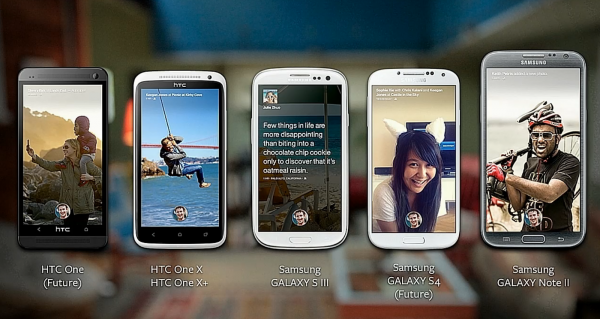
    1:33 pm. Facebook Home initially will be available April 12 for HTC One and One X and Samsung Galaxy S III, S4 and Note II. Well, so much for my Nexus 4.

    1:31 pm. Zuckerberg is back. “We think this is the best version of Facebook there is”.

    1:30 pm. Facebook will update Home monthly.

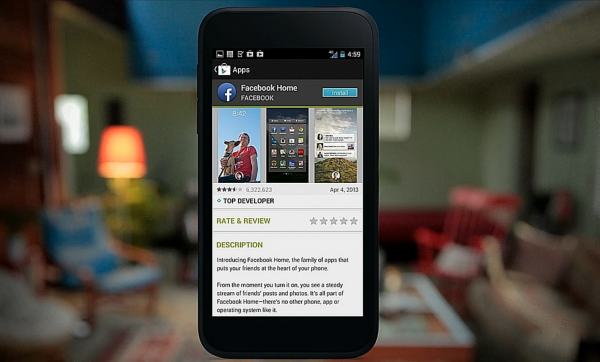
    1:28 pm. Home will be available from Google Play. The Facebook skin will be available for phones first and tablets within a few months.

    1:27 pm. “You can manage multiple conversations with a single tap”.

    1:26 pm. Texts and Facebook messages “share the same Chat head design”.

    1:25 pm. “You can quickly pop into these conversations” — over the app currently being used.

    1:24 pm. “With Chat Heads, you can talk to whoever, wherever you are in your phone.

    1:23 pm. Joey Flynn takes the stage to discuss the new messaging experience. “You should be able to talk to your friends wherever you are in your phone”.

    1:21 pm. Apps are still important, so there is a launcher to reach them.

    1:21 pm. Next up is Notifications. Idea is to shift focus away from apps to people, Mosseri says.

    1:20 pm. Mosseri calls Cover Feed the foundation “for what we’ve done”. The screen is beautiful, bleeding edge everything.

    1:18 pm. Adam Mosseri is on stage. Cover Feed anchors Home, when the phone is turned on.

    1:15 pm. He’s talking about something called Chat Heads. “Messaging is treated just like another app. We all want to talk to people not apps”. Chat Heads is available anywhere from Home.

    1:13 pm. “With Home you see your world through people, not apps”.

    1:12 pm. Facebook is introducing a new homescreen called “Home”. It’s a skin, but much more.

    1:11 pm. Zuckerberg spends some time praising Android for its openness and how that allows Facebook to extend from the core platform.

    1:10 pm. “We’re not building a phone. We’re not building an operating system”.

    1:08 pm. Facebook doesn’t want to build a phone that only a few people will use. “We want to build the best experience…on every phone”.

    1:08 pm. “We want to flip that around” — and bring people forward before apps.

    1:07 pm. “We have our phones with us all the time”, Zuckerberg says. “That’s being human”, he says referring to how we use phones to connect and communicate.

    1:06 pm. Zuckerberg asks what if phones were “designed around people not apps? It would feel very different”. He explains that the priority has been apps first, which no longer makes sense.

    1:05 pm. Twenty percent of time spent on phones is in Facebook, 25 percent when adding Instagram, Zuckerberg says. “We spend our lives sharing and connecting”.

    1:04 pm. CEO Mark Zuckerberg is on stage, talking about the new thing.

    1:03 pm. We’re late. I have audio music only so far.

  • Google cracks open access to its compute cloud — a little bit

    The Google Compute Engine — the company’s response to Amazon’s EC2 service — is starting to open the floodgates to new users. While technically still in preview — frankly what at Google is not in preview? — customers willing to plunk down $400 a month for Google Gold customer support can get access to GCE.

    Previously GCE was sort of an invite-only sort of thing, which made it analogous to a swank nightclub. If you can make it past the velvet rope and the surly bouncer — perhaps with a wad of cash — you’re in. Now you just need a couple hundred dollars a month. You could also sign up online for an account — but my nightclub analogy falls apart there. As a sweetener, Google also said it cut prices of its instances on average by 4 percent. It’s all outlined on the company’s blog.

    Google Compute Engine logoAs GigaOM has reported here and here, many see GCE — which debuted last June — as perhaps the only real competitor to AWS on the compute side. Third parties are starting to support its APIs and some businesses who want either an alternative to AWS or a supplement to it want to try it out.

    In February, RightScale, which helps customers monitor and manage their multi-cloud implementations, said it will resell and support GCE. That was right about the same time it started rolling out more comprehensive, tiered support options for  GCE, Google App Engine and other parts of its cloud empire.

    Of course, Amazon has ramped up its customer support options — especially for businesses — over the past year and rolled out better management tools as well.

    Google won’t divulge the number of current GCE users or talk about the wait list, but a third party with knowledge of the situation, said there is a huge backlog of would-be users — tens of thousands of them — waiting to get in.

    That’s some kind of rope line.

    Related research and analysis from GigaOM Pro:
    Subscriber content. Sign up for a free trial.


  • If You Were a Stock, Would You Bet On Yourself?

    My husband, Eric, is an armchair entrepreneur. He has ideated, seeded, started, funded, built, grown, and sold dozens of companies — 10 times over — all in his head.

    His best friend, Marc, is a finance guru. A whiz-kid investor who’s in it for the love of the game, not for the love of money. They are an unlikely pair: one a dreamer, the other the ultimate pragmatist.

    Last week, Marc posed a simple yet profound question: “If you were a stock, would you bet on yourself?”

    Eric’s response was swift and resounding. “Yes, I’d buy myself on margin,” he grinned. Because one day — one day — he was going to be a successful founder of [insert company name here].

    Marc’s question gave Eric the ultimate litmus test of self-confidence. Up until that point, my husband hemmed and hawed incessantly: “Am I capable? Am I good? Can I launch a successful business?” Thinking about whether he’d buy stock in Eric Co., versus buying shares in Apple or GE or Zynga, gave him a whole new way of thinking about the world.

    It doesn’t matter if you’re an entrepreneur, a general manager, a corporate lawyer, or a brand strategist. The question remains the same: Would you buy stock in yourself? Do you believe in your own potential so deeply and absolutely that you’d make that investment over any other?

    If your immediate reaction is “yes,” then you’re in great shape. You know what you are worth. You see your future value and potential, and know that you are increasing in value every day. You believe that whoever employs, engages, partners with you is lucky to have you on their side.

    If the question gives you pause, however, then you’ve got some work to do. If you wouldn’t buy stock in yourself, why not? What’s holding you back? Who or what could possibly be a better investment? Equally important, how can you improve your skill set, beef up your network, or make a lasting change to make your stock rise?

    As the workplace continues to evolve, each and every one us is a free agent. There’s no such thing as the 20-year gold watch for service; careers today are patchworks. Freelancers make up a third of U.S. workers and Millennials will have 15 to 20 jobs over the course of their lives. To stay competitive in this economy, you will need to continually disrupt and reinvent yourself. And if you don’t believe in your own abilities, no one else will. You need to buy into your own story.

    This, of course, makes us all in the business of sales. We are selling ourselves, our skill set, our vision, every day — when we’re looking for a new job, angling for a promotion, meeting a new client, competing for new business. And as any spokesperson or salesman knows, you’ve got to use and love your product. No one wants to buy a Surface that Oprah endorses from her iPad.

    Marc’s question to Eric lit a fire under his derriere. It served as a call to action, a shot of adrenaline — an “aha” moment where Eric said, “yes, I’d bet on myself.” And now he’s doing it: starting a venture he didn’t think he could.

    It turns out that self-confidence isn’t ambiguous or amorphous — it’s actually quite simple. Recognize your gifts and talents, and own them. Hone them. Invest in yourself until you feel comfortable convincing others to do the same. Then go out and sell your value proposition to live up to your potential.

  • Duff & Phelps Announces Nine New Managing Directors

    Duff & Phelps Corporation, a publicly traded, New York-based financial advisory and investment banking firm, has announced the appointment of nine new managing directors, including seven promotions and two new hires.

    PRESS RELEASE:

    Duff & Phelps Corporation (NYSE: DUF), a leading independent financial advisory and investment banking firm, has announced the appointment of nine new managing directors – including seven promotions and two new hires.

    “We are pleased that these nine outstanding leaders will enhance our team of managing directors,” said Noah Gottdiener, chief executive officer of Duff & Phelps. “Their technical skills and industry sector expertise will provide clients with independent counsel to help successfully navigate a wide range of transactions and special situations.”

    Duff & Phelps’ seven new managing director promotes include:

    -Greg Maxim works in the Austin office as a member of the Tax Services practice, specializing in local and state issues. He has more than 20 years of valuation and consulting experience in the energy industry. His knowledge of ad valorem complex property valuations, property tax management compliance, and tax incentives has positioned him to advise clients around the U.S. in the refining, chemical and utility sectors. Previously he has worked for Exxon USA and two of the Big Four accounting firms.

    -Judd Schneider works in the Boston office as part of the Valuation Advisory Services business. He has more than twelve years of experience valuing business enterprises, legal entities, debt and equity securities, intangible assets, intellectual property and derivative instruments for purposes of financial and tax reporting, M&A planning, tax reorganizations and restructurings. Schneider joined Duff & Phelps in connection with the firm’s acquisition of Standard & Poor’s Corporate Value Consulting business, which included PwC’s legacy valuation business; he had previously worked for PricewaterhouseCoopers.

    -Francisco Javier Zoido works in the London office as a member of the Valuation Advisory Services business, focusing primarily on clients in the Iberian Peninsula. He brings more than 12 years of experience in valuation and corporate finance. He has valued numerous business enterprises, financial assets, equity securities and intangible assets for purposes of financial planning and reporting, transaction advisory support, strategic planning and litigation support. Previously he has worked for a Spanish consulting firm and served as a manager in Ernst & Young’s Corporate Finance team in Madrid.

    -Steve Moon joined Duff & Phelps in 2000 and works in the Los Angeles office as a member of the Mergers & Acquisitions business responsible for the origination and execution of a broad range of Aerospace, Defense and Industrial M&A and corporate finance mandates. He brings more than 13 years of investment banking and corporate finance experience to each engagement. During his tenure with the firm, he has worked on sell-side, buy-side and equity and debt capital raising transactions for private equity, public corporations and private company clients. He was previously in the Private Placements Group at Libra Investments, where he executed on equity and debt transactions.

    -Christopher Gregory works in the New York office as a member of the Transaction Opinions practice. He has nine years of experience in executing engagements involving fairness opinions and solvency opinions; he also advises companies and their boards in the areas of M&A, corporate finance and valuation. Formerly a chemical engineer, he is focused on investment banking coverage of the chemicals industry.

    -Ekaterina Timaeva works in the New York office as part of the Transaction Advisory Services business. She brings approximately 10 years of experience providing corporate finance and due diligence services for both private equity and strategic clients around the world in such industries as manufacturing, aerospace and defense, consumer products, telecommunications, distribution, logistics and healthcare services. Previously she was a project manager and senior auditor at Rockwell Automation; before that, she spent five years in Arthur Andersen’s audit practice in Chicago and Moscow.

    -Tomas Stefanowski works in the New York office as part of the Valuation Advisory Services business. Focusing primarily on the consumer products industry, he has more than 14 years of experience performing valuations for M&A, financing, financial reporting and tax purposes. Further, he has handled numerous valuations of businesses, debt and equity securities and intangible assets for private equity and corporate clients around the world.

    Duff & Phelps’ two new managing director hires include:

    -Jeremy Bennett joins Duff & Phelps’ Global Restructuring Advisory business after working as a partner at several leading UK law firms – including Hammond Suddards Edge Solicitors (now Squire Sanders), JB Law and Cobbetts LLP, where he was Head of Business Recovery Services and National Head of Asset Based Lending. He will serve as leader of Duff & Phelps’ recently established office in Leeds, bringing a deep legal background and more than 20 years of experience in the corporate recovery market to the firm’s UK Restructuring practice.

    -Lisa Neimark comes to Duff & Phelps’ Investment Banking business from Capstone Advisory Group, LLC, where she was an Executive Director in the Restructuring Advisory practice and member of Valuation Services, LLC. She will work in Duff & Phelps’ Chicago office, bringing more than 20 years of leadership experience providing services related to mergers and acquisitions (M&A), restructuring and recapitalizations, business and strategic planning, valuation and capital markets.

    More information about the new managing directors can be found on the firm’s website, along with updates to the firm’s recent accomplishments. Updates include descriptions of significant transactions completed by each part of the business, client testimonials and market leadership data.

    About Duff & Phelps

    As a leading global financial advisory and investment banking firm, Duff & Phelps balances analytical skills, deep market insight and independence to help clients make sound decisions. The firm provides expertise in the areas of valuation, transactions, financial restructuring, alternative assets, disputes and taxation, with more than 1,000 employees serving clients from offices in North America, Europe and Asia. Investment banking services in the United States are provided by Duff & Phelps Securities, LLC; Pagemill Partners; and GCP Securities, LLC. Member FINRA/SIPC. M&A advisory services in the United Kingdom and Germany are provided by Duff & Phelps Securities Ltd. Duff & Phelps Securities Ltd. is authorized and regulated by the Financial Services Authority. For more information, visit www.duffandphelps.com. (NYSE: DUF)

    The post Duff & Phelps Announces Nine New Managing Directors appeared first on peHUB.

  • Remember Me’s Combat Looks To Be Pretty Brutal

    Remember Me, the memory altering action game that surprised everyone at last year’s E3, is ready to launch later in a few months. Now it’s up to Capcom to get people hyped for what’s looking like one of the best games of the year.

    The latest trailer for Remember Me details some of the enemies that players will be tasked with fighting in the game. If you want to know more about how you’ll fight these enemies, check out this previous combat trailer.

    Even as we get more diverse protagonists in games, we still can’t escape the dubstep laden quick-cut trailer. Oh well, I guess we can’t win every battle.

    Remember Me will launch on June 7 across the Xbox 360, PS3 and PC.

  • Flexiant raises $5.7M to push its cloud orchestration tools into the U.S.

    British cloud orchestration outfit Flexiant has picked up a fresh round of £3.75 million ($5.67 million) in funding, which it says it will use to push further into European and North American markets.

    Flexiant’s Cloud Orchestrator suite is aimed at service providers, mostly telcos, who want to become infrastructure-as-a-service (IaaS) wholesalers with minimal effort. The company’s biggest rivals are probably VMware and Citrix, although OnApp and Joyent also play in the same space to varying degrees.

    The funding is the largest tranche Flexiant has received thus far, taking its total funding to date to around £6 million. The cash comes from London-based private investors, rather than venture capital. “We have a strong local investor base,” CEO George Knox told me. “They’re investing in exposure to the cloud market – this is part of their balanced portfolio.”

    U.S. service providers in particular can now expect to have Flexiant knocking on their doors, Knox explained:

    “The money will allow us to continue to be innovative on the development process. We’re very focused… we don’t try and compete in the private cloud, on-premise space. This allows us to concentrate on the service provider space and in particular to put more focus into the U.S. service provider space. At the moment we’re still relatively unknown there. Even in the European market it’s only in the last 6-9 months that we’ve become known.”

    Interestingly, Knox claimed that OpenStack isn’t a particularly serious rival due to the needs of the Flexiant’s target market.

    “The service provider market doesn’t want to spend time, energy and money putting a whole lot of consultants to work,” he said. “We do get some organizations that are open source zealots but [the drivers of that] are in the IT department. As soon as you talk to the business people, [who are concerned with] how you get to market quickly and how do you monetize – they don’t want to go down the 9-12 month route.”

    Last month Flexiant also announced a partnership with France’s USharesoft. USharesoft has a “cloud software factory” product called UForge, which lets service providers automatically create and maintain full software stacks – applications included — as cloud server templates. These templates can now be published straight to the Flexiant Cloud Orchestrator image library, ready for self-provisioning.

    Flexiant says it picked up 14 customers in the first quarter of this year alone (and has recently been touting the Canadian service provider Cartika as a case-study customer).

    Related research and analysis from GigaOM Pro:
    Subscriber content. Sign up for a free trial.


  • Axesstel Secures $2.25 Million Loan from Silicon Valley Bank

    Axesstel, a San Diego-based maker of wireless voice, broadband access and connected home software, has secured a three-year, $2.25 million term loan with Silicon Valley Bank, the California bank subsidiary and commercial banking operation of SVB Financial Group.

    PRESS RELEASE:

    Axesstel (otcqb:AXST), a leading provider of wireless voice, broadband access and connected home solutions to the worldwide telecommunications market, announced that it has secured a three year $2.25 million term loan with Silicon Valley Bank. The company entered into an amendment of its $7.0 million accounts receivable credit facility to include provision of the term loan. Additional details concerning the amendment and the term loan are contained in the company’s Current Report on Form 8-K filed with the SEC.

    Patrick Gray, chief financial officer of Axesstel, said, “The addition of this term loan is one more step in the company’s drive to improve its working capital position. Teaming with Silicon Valley Bank, we have been able to significantly reduce our cost of borrowing on our accounts receivable credit facility, and have now secured this term loan to expand our capital base, all without dilution to our stockholders.”

    “We are pleased to extend this term loan to support the growth of Axesstel’s business,” said Frederick “Buzz” Kreppel, senior relationship manager for Silicon Valley Bank. “We appreciate that Axesstel has chosen Silicon Valley Bank for its banking needs, and that we have this opportunity to extend our relationship with the company.”

    About Axesstel, Inc.
    Axesstel (otcqb:AXST) is a leading provider of wireless voice, broadband access and connected home solutions for the worldwide telecommunications market. Axesstel’s best in class product portfolio includes phones, wire-line replacement terminals, 3G and 4G broadband gateway devices, and security alert systems. Its products are used for voice calling, high-speed data access and connected home management services. The company has supplied millions of devices to leading telecommunications operators and distributors in over 50 countries worldwide. Axesstel is headquartered in San Diego, California. For more information on Axesstel, visit www.axesstel.com.

    About Silicon Valley Bank
    Silicon Valley Bank (www.svb.com) is the premier bank for technology, life science, cleantech, venture capital, private equity and premium wine businesses. SVB provides industry knowledge and connections, financing, treasury management, corporate investment and international banking services to its clients worldwide through 28 U.S. offices and six international operations.

    Silicon Valley Bank is the California bank subsidiary and the commercial banking operation of SVB Financial Group. Banking services are provided by Silicon Valley Bank, a member of the FDIC and the Federal Reserve System. SVB Financial Group is also a member of the Federal Reserve System.

    (C) 2013 Axesstel, Inc. All rights reserved. The Axesstel logo is a trademark of Axesstel, Inc.

    “Safe Harbor” Statement under the Private Securities Litigation Reform Act of 1995: With the exception of historical information, the statements set forth above include forward-looking statements relating to market penetration and conditions, product capabilities and the timing of new product introductions which may affect future results and the future viability of Axesstel. Axesstel wishes to caution readers that actual results could differ materially from those suggested by the forward-looking statements due to risks and uncertainties and a number of important risk factors. Those factors include but are not limited to the risk factors noted in Axesstel’s filings with the Securities and Exchange Commission, including the need for additional working capital; economic and political instability in developing markets served by Axesstel; unforeseen manufacturing difficulties, unanticipated component shortages, competitive pricing pressures and the rapidly changing nature of technology and frequent introductions of new products and enhancements by competitors; the competitive nature of the markets for Axesstel’s products; product and customer mix; Axesstel’s need to gain market acceptance for its products; dependence on a limited number of large customers; potential intellectual property-related litigation; Axesstel’s need to attract and retain skilled personnel; and Axesstel’s reliance on its primary contract manufacturers. All forward-looking statements are qualified in their entirety by this cautionary statement, and Axesstel undertakes no obligation to revise or update this press release to reflect events or circumstances occurring after this press release.

    The post Axesstel Secures $2.25 Million Loan from Silicon Valley Bank appeared first on peHUB.
  • Purple Galaxy S III to hit Sprint on April 12th, $99 with mail-in rebate

    Sprint_Galaxy_S_III_Purple

    If you were excited about that purple Galaxy S III we told you about not too long ago, we’ve got a bit more information for you. We originally reported that the device would be available exclusively on Sprint sometime in April, and the latest leaks are pointing to April 12th. It’ll be available for $99, which is in line with the other Galaxy S III models Sprint offers, but does involve a $50 mail-in rebate. Either way, it’s a bargain for one of the best devices of last year, especially in such an eye-catching color.

    Who’s planning on picking one of these up when they’re available?

    source: Engadget

    Come comment on this article: Purple Galaxy S III to hit Sprint on April 12th, $99 with mail-in rebate

  • Live from Facebook’s Android event

    Facebook Home Liveblog
    Various reports over the past few years have suggested that Facebook (FB) is developing its own smartphone, but nothing has materialized yet. Instead, Facebook continues to expand its mobile products across various mobile platforms, and we expect the company to further its efforts today. According to earlier reports, Facebook will unveil new “Facebook Home” Android software that features deep integration with several Facebook services. The software is expected to be available across a number of Android smartphones, and rumors suggest it will be showcased on the upcoming “HTC First” smartphone rather than an own-brand “Facebook Phone.” All will be revealed momentarily though, and our live coverage of Facebook’s press conference follows below.

  • 60-Inch Apple TV Rumored Yet Again

    Is it finally coming? Finally, really, in real life coming?

    Those are the questions that have been surrounding the rumored (at this point mythic) Apple HDTV. Yearly predictions about the manufacture and shipping of an Apple ‘iTV‘ have repeatedly been proven false.

    Last year, cable companies were (plausibly) blamed for the product’s delay after pressing for a large amount of control over content during negotiations with Apple.

    At the beginning of 2013, analysts began switching up their game, predicting that the iTV would not be appearing during the coming year.

    This week, Topeka Capital Markets analyst Brian White has been quoted by BGR as saying, once again, that the iTV will launch in the second half of 2013.

    The analyst states the HDTV will 60 inches, with smaller sizes also available. He goes on to speculate that the device will come with an “iRing” finger interface device for the TV and a portable 9.7-inch tablet-like “mini-iTV” which can display content from the larger screen. White prices the TV set packages at around $1,500 to $2,500.

    So, those are the latest rumors about the fabled “iTV.” There’s even a possibility that they could even be accurate this time, but gamblers would be wise to place their bets elsewhere. The Brian White who outlined this week’s rumors is the same Brian White who relayed rumors that Sharp would begin shipping LCD display panels to Foxconn at the end of last summer.

  • WiFi-only Samsung Galaxy Camera on the way to US stores and will arrive “later this month”

    Samsung_Galaxy_Camera_Review_Redefining_The_Camera


    We certainly have a soft spot for the Samsung Galaxy Camera, but there are more than a few of you out there that loathed the fact it was a feature device for only a few wireless carriers. To that extent, Samsung has come out and confirmed it will release a WiFi-only version of the connected camera for those of us out here in the States. In case you’ve forgotten, the Galaxy Camera features a 1.4GHz quad-core chip, 1GB of RAM and most importantly, a decent 12MP camera complete with 21X optical zoom. The difference between the WiFi-only version and the cellular version: the WiFi-only version will run customers about $450, compared to $500 for the AT&T HSPA+ version and $550 for the Verizon variant. Hopefully with the loss of the cellular chip, we’ll see a reduction in the overall weight of the device.

    Expect to see the WiFi Galaxy Camera to hit stores “later this month”. In the meantime, hit the break to see Sammy’s full presser.


    Samsung GALAXY Camera (Wi-Fi) Now Available, Offers Advanced Photographic Prowess and Access to Android Apps

    New GALAXY Camera offers value to users seeking photo performance and connectivity

    RIDGEFIELD PARK, N.J. – April 4, 2013 – Samsung Electronics Co., Ltd, a global leader in digital media and convergence technologies, today announced the availability of the Samsung GALAXY Camera (Wi-Fi), introducing photo enthusiasts another option to further their creativity and sharing potential. Centered on the Android™ Jellybean 4.1 platform, the GALAXY Camera is a powerful point-and-shoot camera with a familiar, intuitive user interface and access to Android applications from the Google Play™ market.

    “The GALAXY Camera Wi-Fi successfully blends cutting-edge digital imaging technology with Samsung’s latest line of class-leading Android devices,” said Ron Gazzola, Vice President, Marketing for Digital Imaging, Samsung Electronics America. “Focusing on features that simplify the user experience, the GALAXY Camera Wi-Fi offers an intuitive approach to feature-rich photography, without the need to be constantly connected.”

    Boasting a 21x optical zoom, 16MP backside illuminated CMOS sensor and class-leading 4.8-inch HD Super Clear Touch LCD, the GALAXY Camera makes it easier than ever before to capture breathtaking images, edit them with users’ favorite apps and then share over Wi-Fi to family and friends.

    The GALAXY Camera’s photo interface blends the capabilities of advanced camera with an easy-to-use touch interface, so users can learn and grow with their photography with each use. An innovative Smart Mode places camera settings at users’ fingertips, letting them fine-tune and adjust settings like shutter speed, aperture and exposure by simply manipulating sliders on the screen. The GALAXY Camera also offers a selection of different scene modes to help users define the appropriate settings for a particular scenario, whether they want to capture flowing waterfalls, an action-packed sports event, and more.

    Editing with Ease:

    The GALAXY Camera integrates a new Photo Wizard tool, featuring a comprehensive set of 35 editing features, designed to take advantage of the camera’s high-resolution touchscreen and make powerful enhancements on-the-go. Additionally, the Smart Content Manager offers innovative organizational tools for photos, with options to quickly and easily create folders and tags or suggest which photos can be deleted if they don’t come out the way the user intended. Lastly, Samsung’s Paper Artist app allows users to creative stylize and edit their photos with options for users to create new images that appear to be sketch-drawings or watercolor paintings.

    Pricing and availability

    The Samsung GALAXY Camera (Wi-Fi) will be available later this month for $449.99 at www.samsung.com and authorized Samsung retailers. For more information on the Wi-Fi version of the Samsung GALAXY Camera and the full line of Samsung digital cameras, lenses and accessories, please visit www.samsung.com.


    Come comment on this article: WiFi-only Samsung Galaxy Camera on the way to US stores and will arrive “later this month”

  • Bill Gates, Paul Allen Recreate Iconic Photo 30+ Years Later

    Bill Gates and Microsoft co-founder Paul Allen haven’t always been on the best of terms, but it looks the the relationship has been mended enough to recreate a classic photo at a recent event.

    Allen tweeted out the pic featuring himself and Gates clothed appropriately, amidst old-school computers.

    Here’s the iconic photo from 1981, for comparison.

    Bill Gates Paul Allen classic photo

    The two were attending an event hosted by Allen at Allen’s Living Computer Museum in Seattle. The event was a reunion of sorts, with many early computing and tech pioneers in attendance. According to GeekWire, the staff worked to acquire the same old-school computer models to recreate the photo beforehand.

    Pretty cool, huh?