Blog

  • Reuters – Taylor Morrison Home Prices IPO

    Homebuilder Taylor Morrison Home Corp. priced its initial public offering of 23.8 million Class A shares between $20-$22 per share as it looks to cash in on investor interest in the recovering U.S. housing market. At the mid-point of the expected range, the company is looking to raise about $500 million. Scottsdale, Arizona-based Taylor Morrison is backed by Oaktree Capital Management, TPG Global and JH Investments Inc. Credit Suisse and Citigroup are lead underwriters to the offering.

    (Reuters) – Homebuilder Taylor Morrison Home Corp priced its initial public offering of 23.8 million Class A shares between $20-$22 per share as it looks to cash in on investor interest in the recovering U.S. housing market.

    At the mid-point of the expected range, the company is looking to raise about $500 million.

    Record-low mortgage rates and rising selling prices have driven up demand to levels that large U.S. builders are struggling to meet, creating room for smaller companies.

    Shares of Tri Pointe Homes LLC, which in January became the first U.S. homebuilder to go public in over a decade, and those of plywood and lumber maker Boise Cascade Co surged in their market debut.

    Scottsdale, Arizona-based Taylor Morrison is backed by Oaktree Capital Management, TPG Global and JH Investments Inc. Credit Suisse and Citigroup are lead underwriters to the offering.

    The post Reuters – Taylor Morrison Home Prices IPO appeared first on peHUB.

  • Tumi Holdings Prices Secondary Offering

    Tumi Holdings Inc. has priced a secondary offering of 10.1 million shares of its common stock at $21.10 per share. The selling stockholders, comprised of funds managed by or entities affiliated with Doughty Hanson & Co Managers Limited.

    PRESS RELEASE
    Tumi Holdings, Inc. (“Tumi”) (NYSE: TUMI) today announced the pricing of a secondary offering of 10,140,000 shares of its common stock at $21.10 per share.

    The selling stockholders, comprised of funds managed by or entities affiliated with Doughty Hanson & Co Managers Limited and certain other stockholders including two of Tumi’s executive officers, are offering all of the 10,140,000 shares. The underwriters have a 30-day option to purchase up to an additional 1,521,000 shares from certain selling stockholders. Tumi will not receive any proceeds from the sale of shares by the selling stockholders.

    Goldman, Sachs & Co. and Credit Suisse Securities (USA) LLC, along with J.P. Morgan Securities LLC, are acting as joint bookrunning managers, and William Blair & Company, L.L.C. and Jefferies LLC are acting as co-managers for the offering.

    The offering is being made only by means of a prospectus. A copy of the final prospectus related to the offering may be obtained, when available, by contacting Goldman, Sachs & Co., Attention: Prospectus Department, 200 West Street, New York, NY 10282, Telephone: 1-866-471-2526, Facsimile: 1-212-902-9316, Email: [email protected]; Credit Suisse Securities (USA) LLC, Attention: Prospectus Department, One Madison Avenue, New York, NY 10010, Telephone: 1-800-221-1037, Email: [email protected]; or J.P. Morgan Securities LLC, Attention: Broadridge Financial Solutions, 1155 Long Island Avenue, Edgewood, NY 11717, Telephone: 1-866-803-9204.

    The registration statement relating to the securities has been declared effective by the Securities and Exchange Commission. This press release shall not constitute an offer to sell or the solicitation of an offer to buy these securities, nor shall there be any sale of these securities in any state or jurisdiction in which such offer, solicitation or sale would be unlawful prior to registration or qualification under the securities laws of any such state or jurisdiction.

    About Tumi

    Tumi is the leading global brand of premium travel, business and lifestyle products and accessories. The brand is sold in approximately 200 stores from New York to Paris to London and Tokyo, as well as in the world’s top department, specialty, and travel retail stores in over 75 countries.

    The post Tumi Holdings Prices Secondary Offering appeared first on peHUB.

  • Facebook’s modified Android reportedly called ‘Facebook Home’

    Facebook Home Android
    It seems that Facebook (FB) has given a name to its new version of Android that will purportedly clog home screens with status updates. According to 9to5Google’s sources, Facebook is calling its new Android initiative “Facebook Home,” which fits in well with the notice the company sent out last week inviting people to “come see our new home on Android.” We still have no definitive word on precisely what this new “home” will entail, although The Wall Street Journal reported last week that Facebook is planning “new software for mobile devices powered by Google’s Android operating system that displays content from users’ Facebook accounts on a smartphone’s home screen.” Facebook’s event is scheduled to take place this coming Thursday.

  • Reuters – Toys R Us Withdraws IPO

    Toys R Us Inc. withdrew its proposed initial public offering on Friday, ending months of uncertainty as the world’s largest dedicated toy retailer also issued a quarterly report card showing disappointing results for the crucial holiday season. Toys R Us determined not to pursue the IPO due to unfavorable market conditions and executive leadership transition, Toys R Us spokeswoman Kathleen Waugh told Reuters. KKR & Co LP, Bain Capital and Vornado Realty Trust took Toys R Us private in 2005, in a $6.6 billion deal.

    (Reuters) – Toys R Us Inc TOY.UL withdrew its proposed initial public offering on Friday, ending months of uncertainty as the world’s largest dedicated toy retailer also issued a quarterly report card showing disappointing results for the crucial holiday season.

    Toys R Us determined not to pursue the IPO due to unfavorable market conditions and executive leadership transition, Toys R Us spokeswoman Kathleen Waugh told Reuters.

    Waugh did not give an update on the company’s search for a new CEO. In February, Gerald Storch decided to step down as Toys R Us chief executive, but he remains chairman of the board.

    The withdrawal of the IPO would not affect the toy retailer’s day-to-day operations, Waugh said, but declined any further comment.

    The resignation of Storch, 56, added to doubts about the retailer’s chances to return to being a public company this year, after filing for an initial public offering in May 2010.

    KKR & Co LP (KKR.N), Bain Capital and Vornado Realty Trust took Toys R Us private in 2005, in a $6.6 billion deal.

    While the company’s results were far better when it was originally considering the IPO, some owners thought they would be able to raise more if they waited, a source had told Reuters. But the results have lagged expectations since then.

    The company had postponed its IPO in 2011 due to weak market conditions and has since struggled with mounting interest expenses and weak sales. Sources had told Reuters in February that chances of this IPO happening were low.

    Toys R Us, which operates stores under its namesake brand and the Babies R Us and FAO Schwarz names, said total sales fell 3 percent in the fourth quarter to $5.77 billion while interest expense jumped 35 percent in the 14 weeks ended February 2. Net profit fell 30 percent to $240 million.

    The company’s performance in 2012 was hurt by a weak global economic environment, particularly in Europe and Japan, Storch said in a statement.

    Toys R Us first went public in April 1978 and operated as a public company until July 2005, when it was taken private.

    (Additional reporting by Himank Sharma in Bangalore; Editing by David Gregorio)

    The post Reuters – Toys R Us Withdraws IPO appeared first on peHUB.

  • Lynnwood Capital Buys Tantalex

    Canada’s Lynnwood Capital Inc. said Monday that it has entered into an agreement to buy Tantalex Corp. Tantalex shareholders will receive one Lynnwood Share for each Tantalex Share held, the firm said.

    PRESS RELEASE

    Lynnwood Capital Inc. (“Lynnwood”) , a capital pool company as defined under Policy 2.4 of the TSX Venture Exchange (the “TSXV”), is pleased to announce that it has entered into an agreement (the “Revised Letter Agreement”) dated March 18, 2013 and executed March 20, 2013 for the arm’s length acquisition of 100% of the common shares (the “Tantalex Shares”) of Tantalex Corporation (“Tantalex”). The Revised Letter Agreement supersedes and replaces the letter agreement (the “Letter Agreement”) dated May 9, 2012 between Lynnwood and Tantalex, previously announced on May 9, 2012, June 11, 2012, July 9, 2012 and October 4, 2012, which was meant to qualify as Lynnwood’s “qualifying transaction” as defined by the TSXV.

    About the Proposed Transaction

    Consistent with the terms of the Letter Agreement, Lynnwood and Tantalex still intend on combining their businesses by means of a triangular amalgamation (the “Amalgamation”). The Amalgamation will effectively provide for the acquisition of all of the outstanding equity interests of Tantalex by Lynnwood indirectly through a wholly owned federally incorporated subsidiary of Lynnwood (the “Amalgamation Entity”) in a transaction in which the shareholders of Tantalex will receive shares of Lynnwood (the “Lynnwood Shares”) and, if applicable, convertible securities of Lynnwood. As a result of the Amalgamation of Amalgamation Entity and Tantalex (the “Amalgamated Corporation”), Lynnwood will become the sole beneficial owner of all of the outstanding shares of Amalgamated Corporation. The Amalgamation will result in Lynnwood issuing to Tantalex shareholders one Lynnwood Share for each Tantalex Share held, and the convertible securities of Tantalex will be exchanged for convertible securities of Lynnwood on the same terms and conditions attached to such convertible securities prior to the Amalgamation.

    Pursuant to the terms of the Revised Letter Agreement and subject to completion of the concurrent Private Placement (defined below), satisfactory due diligence, receipt of all necessary regulatory and shareholder approvals, and other conditions which are typical for a business combination transaction of this type, the proposed acquisition of Tantalex will result in Lynnwood (i) delisting its common shares from the TSXV (the “Delisting”) resulting in the cancellation of 3,600,000 Lynnwood Shares pursuant to the policies of the TSXV and resulting in an aggregate of 2,050,000 Lynnwood Shares (assuming no existing convertible securities of Lynnwood are exercised) following completion of the Delisting, (ii) consolidating (the “Consolidation”) its securities resulting in an aggregate of approximately (subject to rounding) 1,118,731 Lynnwood Shares (assuming no existing convertible securities of Lynnwood are exercised) following completion of the Consolidation, (iii) seeking approval to list the Lynnwood Shares on the Canadian National Stock Exchange (the “CNSX”).

    Upon completion of the Delisting and Consolidation, there will be 1,118,731 Lynnwood Shares issued and outstanding and convertible securities (options) exercisable for 405,199 Lynnwood Shares. Currently there are 25,455,880 Tantalex Shares issued and outstanding and convertible securities exercisable for, or convertible into, 13,680,213 Tantalex Shares, not taking into account the Tantalex Shares to be issued pursuant to the Private Placement.

    Accordingly, upon closing of the Amalgamation, it is anticipated that Lynnwood will issue an aggregate of 25,455,880 Lynnwood Shares to the shareholders of Tantalex, and up to 15,000,000 Lynnwood Shares to purchasers in connection with the proposed Private Placement. Following completion of the Amalgamation the former shareholders of Tantalex will own approximately 61.23% of the Lynnwood Shares, current shareholders of Lynnwood will hold approximately 2.69% of the Lynnwood Shares and purchasers under the Private Placement will hold approximately 36.08% of the Lynnwood Shares (assuming the Private Placement is fully subscribed). Accordingly, the Amalgamation will constitute a reverse take-over of Lynnwood.

    The Amalgamation is an arm’s length transaction and therefore is not a related party transaction.

    Following completion of the Amalgamation, the Amalgamated Corporation will be a wholly owned subsidiary of Lynnwood. The parties also agreed that, subject to Exchange approval, a finder’s fee of $65,000 will be payable to Eosphoros Asset Management Incorporated in connection with the Amalgamation.

    After giving effect to the Amalgamation, it is expected that Lynnwood will carry on business under the name “Tantalex Resources Inc.” (or such other name as may be acceptable to applicable authorities) and the Lynnwood Shares are expected to be listed on the CNSX under a new trading symbol.

    Concurrent Private Placement

    In conjunction with the Amalgamation, Tantalex expects to complete a non-brokered private placement (the “Offering”) to raise gross proceeds of a maximum of $3,000,000 (the “Maximum Offering”) through the issuance of units (a “Unit”) at $0.20 per Unit. Each Unit shall consist of one Tantalex Share and one warrant (a “Warrant”), with each Warrant entitling the holder thereof to acquire one Tantalex Share at a price of $0.35 for a period of 24 months from the closing of the Amalgamation. Agents/finders will be entitled to a commission of 8% of the aggregate gross proceeds raised as well as agent’s options (the “Agent’s Options”) equal to 8% of the aggregate number of Units purchased. Each Agent’s Option will entitle the holder thereof to purchase one Tantalex Share at an exercise price of $0.20 per Tantalex Share for a period of 24 months from the closing of the Amalgamation.

    The net proceeds from the Private Placement will be used to finance Tantalex’s expenditures on its mineral properties and for general working capital.

    Proposed Management

    The proposed management of Tantalex following the completion of the Amalgamation will be as follows:

    Dave Gagnon, Chief Executive Officer and Director

    Dave Gagnon is currently the Chief Executive Officer of Tantalex and Chairman of Charbone Buckell ltd., a private equity firm focusing on mining investments. Mr. Gagnon began his career in 1981, developing international opportunities for a family business in the resources sector. In 1998, he put forward a partnership to develop internal markets with Expordev, a subsidiary of the Caisse de depot et placement du Quebec, and the participation of Bombardier Inc., SNC Lavalin Inc., Telesystems Inc., Bronterra and Export Development Canada (EDC). In 2000, Mr. Gagnon decided to focus its efforts on sustainable development and, more specifically, wind energy. Mr. Gagnon was the founder and Chief Executive Officer of AAER Inc. a public issuer involved in the renewable energy sector, prior to his involvement with Tantalex.

    Jean-Robert Pronovost, Chief Financial Officer and Director

    Jean-Robert Pronovost is currently the Chief Financial Officer of Tantalex and Managing Partner at Charbone Buckell ltd., a private equity firm focusing on mining investments. Before his involvement with Tantalex, Mr. Pronovost was a partner and co-founder of Cape Partners, a private equity advisory firm, and IUGO Capital, a family office venture capital firm with investments in Canada, the United States and Europe. Mr. Pronovost was responsible for direct investments, strategic divestitures as well as restructurings and acted as a board member of several portfolio companies. Previously, Mr. Pronovost spent four years at Credit Suisse First Boston advising on large mergers and acquisitions and executing public and private financings for Canadian and foreign corporate clients. He also worked six years at various positions at the Caisse de Depot et Placement du Quebec where he elaborated investment allocation strategies and securitization vehicles for alternative assets. He began his career at British Telecom as a financial analyst. Mr. Pronovost has a degree in economics and finance from Laval University and an MBA from UQAM.

    Michel Lebeuf, Corporate Secretary

    Mr. Lebeuf’s legal practice is focused on securities, particularly in the area of natural resources, institutional financing, corporate finance, as well as public and private mergers and acquisitions. He represents public corporations, securities brokers, purchasers, sellers, bankers and financial advisors, and he provides strategic advice with respect to access to public capital markets and securities matters, including

    structured products. Mr. Lebeuf has acted as counsel to international dealers in several offerings in the Eurobond international debt market, public and private corporations in various mergers and acquisitions, and issuers and underwriters in the context of public offerings and private placements in Canada, Europe, South America and North Africa. Has been involved, over the past two years, in many mining projects in Africa (Congo ROC and DRC), Ethiopia, Angola, etc. and is regularly contacted by mining promoters, mining companies and investment banking firms wanting to put together mining projects in these countries. He has expertise in corporate reorganizations, public and private divestitures, and institutional financing, and he regularly provides counsel to financial institutions regarding security requirements and the drafting of documents pertaining to enforcement proceedings.

    Bernard Lapointe, Independent Director

    Bernard Lapointe holds a B.A. in Geology from the University of Quebec at Montreal (1980), a master’s degree in structural geology from the University of Quebec at Chicoutimi (1984) and a PhD in mineral resources from the University of Quebec at Chicoutimi (1996). He is currently CEO of Arianne Resources Inc., a public issuer. Previously, he was Director of the Saguenay-Lac-Saint-Jean Mining Fund from 1993 to 1998. From 1988 to 1993, he acted as a geochemist analyst for the Centre for Research in Mineral Resources of the University of Quebec at Chicoutimi. From 1980 to 1987, he was consultant for different mining exploration companies and for the Department of Natural Resources. While working for the Department, he discovered the gold showings West of Schefferville, for which he won an award in 1986. He also did an internship at the Institut National de la Recherche Scientifique (INRS-Georessources). Mr. Lapointe has also been teaching since 1981 and has been published on numerous occasions.

    Ndongo Armel Rodrigue Dziengue, Vice-President African Operations and Director

    Mr. Dziengue serves as Executive Vice President, African Operations for Tantalex. Mr. Dziengue started his career with Carpentier and Associates, an investment advisory firm specializing in business development in developing countries. He then founded his own advisory firm, Ryn Consulting, based in Brazzaville, Republic of Congo, with representative offices in Paris, Luxembourg and Libreville, and has been advising Western corporations on investments and business development specifically in Africa for the last ten years. He is also the owner of commercial businesses in the Paris region. Mr. Dziengue completed a DEA (Diplome d’Etudes Approfondies) in International Relations at the Institute of political studies of Bucharest, Romania.

    Denis Belisle, Independent Director

    Mr. Denis Belisle, Esq. is the Corporate Secretary and a director of Oroplata Exploration Inc. and Vantex Resources Ltd. and he serves as the Chairman of Vanstar Mining Resources Inc. Mr. Belisle has been the General Manager of Legal Affairs, Human Resources and Technical Services at Societe de telediffusion du Quebec (Tele-Quebec) since 1996 and also serves as its General Secretary. He is a director of Arianne Resources Inc. and is the former Secretary of Arianne. He is a former director and Corporate Secretary of Vanstar Mining Resources Inc. and he is a former director of D”arianne Resources Inc. Mr. Belisle was admitted to the Quebec Bar in 1984.

    The information in this press release related to Tantalex, its business and the proposed management of Lynnwood following the completion of the Amalgamation was provided to Lynnwood by Tantalex.

    The information in this news release includes certain information and statements about management’s view of future events, expectations, plans and prospects that constitute forward looking statements. These statements are based upon assumptions that are subject to significant risks and uncertainties. Because of these risks and uncertainties and as a result of a variety of factors, the actual results, expectations, achievements or performance may differ materially from those anticipated and indicated by these

    forward-looking statements. Although Lynnwood believes that the expectations reflected in forward looking statements are reasonable, it can give no assurances that the expectations of any forward looking statements will prove to be correct. Except as required by law, Lynnwood disclaims any intention and assumes no obligation to update or revise any forward looking statements to reflect actual results, whether as a result of new information, future events, changes in assumptions, changes in factors affecting such forward looking statements or otherwise.

    Neither TSX Venture Exchange nor its Regulation Services Provider (as that term is defined in the policies of the TSX Venture Exchange) accepts responsibility for the adequacy or accuracy of this release.

    The post Lynnwood Capital Buys Tantalex appeared first on peHUB.

  • The Women’s Venture Capital Fund Names Advisory Board

    The Women’s Venture Capital Fund has announced the formation of an advisory board. Enrique Godreau III, Beth Horowitz, Michelle Lantow, Beau Laskey, Susan Sigl, and Reggie Van Lee were named advisors. The Women’s Venture Capital Fund invests in companies with “gender diverse” teams.

    PRESS RELEASE
    The Women’s Venture Capital Fund (WVCF) is very pleased to announce the formation of its Advisory Board comprised of venture capitalists on the West Coast and select limited partners.

    Enrique Godreau III is Co-Founder and Managing Director of GSharp Ventures and Venture Partner with 9Mile Labs. He was formerly Co-Founder and Managing Director of Voyager Capital, a Seattle-based venture capital firm.

    Beth Horowitz is Board Member of HSBC Bank Canada and former CEO of Amex Bank of Canada. She is also Member of Catalyst Canada Advisory Board and former member of Amex’s Global Diversity Council.

    Michelle Lantow is Chief Administrative Officer for New Seasons Market. She was formerly GAP’s VP of Finance and Investor Relations and Corporate Controller, President and CFO of lucy activewear, Inc. and CFO at McCormick and Schmick’s.

    Beau Laskey is a former Managing Director at Steamboat Ventures, the venture arm of the Walt Disney Company. He was previously Managing Director of EDF Ventures, an early stage VC firm based in San Diego.

    Susan Sigl is President and CEO of the Washington Technology Industry Association. She was the Co-Founder and General Partner of SeaPoint Ventures, a Seattle based VC firm, and past President of the Evergreen VC Association.

    Reggie Van Lee is an Executive Vice President of Booz Allen Hamilton DC where he leads the firm’s federal and commercial health businesses and their not-for-profit sectors. He is a Trustee of MIT and founding member of the Clinton Global Initiative.

    “The Women’s Venture Capital Fund has identified a compelling market opportunity to invest in early stage companies with good market traction and the potential to scale in capital efficient ways,” says Enrique Godreau III. “I look forward to helping the Women’s Venture Capital Fund and its portfolio companies succeed”.

    “We are honored to have such a distinguished group of Advisors who bring their deep experiences and skills to the Women’s Venture Capital Fund,” says Monica Dodi, Managing Director. “They’re an integral part of our expanding ecosystem to change the paradigm and invest in the best female entrepreneurs leading a new generation of successful companies.”

    ###

    The Women’s Venture Capital Fund invests in gender diverse teams leading capital efficient companies in digital media and sustainable products and services. The Fund targets early stage companies that demonstrate market traction with high growth potential. This investment strategy – coupled with a highly disciplined approach to sourcing, selecting, managing and exiting investments — now provides the potential for significant returns.

    For more information visit http://www.womensvcfund.com

    The post The Women’s Venture Capital Fund Names Advisory Board appeared first on peHUB.

  • Watch Live and Follow Online: The 2013 Easter Egg Roll

    Today, the President and First Lady will host more than 30,000 people from all 50 states on the South Lawn of the White House for the 135th annual Easter Egg Roll. The curated live stream (above) is new this year, and features historic facts about egg rolls past and will highlight select events throughout the day. 

    Check out the complete Easter Egg Roll line-up, and go to WH.gov/live to watch additional live streams, including a feed from the Storytime Stage, where this year's readers include NASCAR’s Danica Patrick, Minnesota Viking Adrian Peterson, Elmo, Abby, Gordon and Rosita from Sesame Street, the full cast of Super Sprowtz, The Wanted, and actress Quvenzhané Wallis, or you can tune in to the Rocking Egg Roll Stage to see performances from Jordin Sparks, Austin Mahone, Coco Jones, Sesame Street, and The Wanted. You can also watch cooking demonstrations of healthy family favorites from top chefs at the Play with Your Food station, and of course you can follow all the day's action on social media using the hashtag #EasterEggRoll or on Storify, below.

    [View the story “The 2013 #EasterEggRoll \”Be Healthy, Be Active, Be You!\”” on Storify]

    The 2013 #EasterEggRoll "Be Healthy, Be Active, Be You!"

    On Monday, April 1st 2013, the President and First Lady will host more than 30,000 people from all 50 states on the South Lawn of the White House for the 135th annual Easter Egg Roll. Watch live streams from the event at WH.gov/live and check out some highlights from the #EasterEggRoll below.

    Storified by Let’s Move!· Fri, Mar 29 2013 16:20:53

    Kids dancing, eggs rolling. @iamkidpresident and President Obama announce the White House #EasterEggRoll: youtu.be/f1OHJUc2QTUThe White House

    Kids Dancing, Eggs Rolling, Tune in!


    For more information head to WH.gov/EasterEggRoll. 


  • Deliv Seals $1M

    Deliv has raised $1 million in new capital from General Catalyst, Redpoint Ventures, Trinity Ventures, Operators Fund, and PivotNorth. The company partners with retailers to offer same-day delivery of products. The company is headquartered in Palo Alto, Calif.

    PRESS RELEASE

    Deliv today announced it has closed a $1 million funding round from General Catalyst, Redpoint Ventures, Trinity Ventures, Operators Fund, and PivotNorth following the successful completion of its same-day delivery service trials in the San Francisco Bay Area.

    The company is now set to roll out in multiple metropolitan locations across the U.S. including the San Francisco Bay Area, Atlanta, Boston, Chicago, Dallas, Houston, Los Angeles, Phoenix, Indianapolis, Miami, New York, Philadelphia, Seattle and Washington D.C.

    Deliv is disrupting the same-day delivery market by partnering directly with retailers and pricing same-day delivery the same – or lower – than standard delivery. This makes the traditionally premium service significantly more attractive to both consumers and retailers, driving significant volume and scale.

    In partnering with retailers, the Deliv “same-day delivery” button becomes a native part of the online or mobile checkout screen in the same way consumers select shipping options today from carriers such as FedEx and UPS. This retains the direct relationship between retailers and shoppers with no need for shoppers to go to third party sites or apps to purchase products and arrange delivery.

    Deliv drivers are made up of highly educated, experienced customer service and sales personnel. They are rated by customers and by Deliv’s operations team so the platform is able to prioritize the allocation of jobs to those with the highest ratings, ensuring a white glove consumer experience. Managing a community of these on-demand drivers across the country, the Deliv platform incorporates smart routing and full transparency including the ability for shoppers to watch their delivery on a map real time from pickup to their doorstep.

    “Amazon has disrupted the U.S. retail world and Deliv is helping multichannel retailers disrupt right back again,” said Daphne Carmeli, founder and CEO of Deliv. “Deliv’s retail partners will be in a position to provide same-day delivery as not just the most convenient choice, but also the most economical which we anticipate will have a significant impact on the U.S. retail landscape.”

    “Online and mobile commerce now represent significant proportions of a multichannel retailer’s business, and offering customer-centric services such as fast and convenient delivery options are becoming increasingly important. Deliv is at the right place at the right time with a significantly differentiated offering that will disrupt traditional models,” said Mike Smith, former COO of Walmart.com.

    “Deliv’s B2B approach to same-day delivery is spot on,” said Ajay Chopra, General Partner at Trinity Ventures. “National multichannel retailers are focusing on differentiated strategies to compete against Amazon. Deliv offers the most compelling same-day delivery solution for these large retailers. This enables the retailers to most strategically scale nationwide, ensuring the highest quality customer experience and preserves their direct relationship with their customers.”

    About Deliv

    Deliv partners with national multichannel retailers to provide low-cost, high quality same-day delivery via its quality-controlled fleet of crowdsourced drivers. The company is headquartered in Palo Alto, California and is backed by some of Silicon Valley’s leading venture capital firms.

    The post Deliv Seals $1M appeared first on peHUB.

  • GenNx360 Capital Partners Buys Horsburgh & Scott

    GenNx360 Capital Partners, a middle-market private equity firm, has acquired Horsburgh & Scott Co., a manufacturer of custom gearing parts. The terms of the deal were not released.

    PRESS RELEASE

    GenNx360 Capital Partners, a private equity firm focused on investing in middle market industrial business-to-business companies, has acquired Horsburgh & Scott Co. (“H&S”) for an undisclosed amount.

    Horsburgh & Scott is a market leading custom gearing manufacturer for the global marketplace. H&S manufactures, repairs, and services highly-engineered, customer specific industrial gears and gear drives for more than 400 customers throughout the world. It is one of a few companies that is both capable of, and specializing in, the manufacturing of medium and large diameter gears (up to 25 ft. in diameter) for a variety of end markets including steel, mining, wind, rail, and sugar. Over its 126 year history, H&S has developed the in-house engineering and manufacturing capability to offer its customers increased service factors that, in many cases, can expand equipment lifecycle. This, coupled with their overall product quality, customer application specific designs and exceptional customer service provides their installed base with superior performance. H&S employs over 200 people and is headquartered in Cleveland, Ohio, with two additional facilities in Ohio and one in Canada.

    “With its proven management team and talented group of engineers, strong brand, and excellent customer relationships, we are very excited about future prospects for H&S,” says Monty Yort, GenNx360 Managing Partner. “We expect to build on H&S’s legacy by leveraging our global C-suite relationships within the industry and executing on identified growth opportunities, both organically and through add-on acquisitions, as well as providing a valuable operating perspective to enhance an already exceptional company.”

    “Our goals are fully aligned with those of GenNx360. We are excited about this next step in the evolution of our company,” said Christopher Kete, H&S President and Chief Executive Officer. “GenNx360 has strong operational capabilities that perfectly fit our strategic focus for the next chapter.”

    About GenNx360 Capital Partners

    GenNx360 Capital Partners is a private equity firm focused on investing in industrial business-to-business companies in the middle market. It applies years of Fortune 50 operational and leadership experience to these investments to help drive growth and value creation. The firm primarily focuses on opportunities in the industrial machinery and components, oil and gas, transportation and logistics, agricultural, specialty chemicals, and aerospace sectors. GenNx360 was founded in 2006 and is headquartered in New York City, with additional offices in Seattle and Boston.

    For more information about GenNx360, please visit: www.gennx360.com

    About Horsburgh & Scott Co.

    Horsburgh & Scott, founded in 1886, is one of the world’s leading manufacturers of industrial gears and custom gear drives. With 350,000 square feet of manufacturing, repair, assembly and heat treat space, H&S can manufacture new gear components and gear boxes. It also provides teardown analysis and engineering upgrades that can expand equipment lifecycle. H&S gears and gear drives can be found in steel mills, aluminum facilities, tire and rubber plants, sugar mills, power plants, and wind turbines.

    The post GenNx360 Capital Partners Buys Horsburgh & Scott appeared first on peHUB.

  • Podcast: Why the digital age needs an effective content licensing strategy

    Historically publishers have lacked focus on licensing and syndicating digital content. The latest GigaOM Research podcast features Connected Consumer curator Paul Sweeting, who discusses how social media could play a role in improving digital content licensing, key tools in this space, and the impact on publishers and journalists.

    (download)

    iTunes

    Stitcher Radio

    SHOW NOTES
    Host: Adam Lesser
    Speaker: Paul Sweeting

    • Why content licensing hasn’t historically played a bigger role
    • Could social media nurture a business model around licensing
    • Key tools/startups in the licensing/syndication space
    • The legal context
    • What needs to happen going forward to create a syndication business
    • Impact on publishers and journalists
    PREVIOUS GIGAOM PODCAST EPISODES:

    Instgram’s Twit-storm, Netflix nabs Disney, GMail’s Pretty iPad App

    RoadMap re-run, our talk with Instagram’s Kevin Systrom

    iTunes 11, When Things Connect, Sun Volt

    What Aspiring New Media Stars Should Know About Agents and Managers

    Holiday Gadget Gift Guide

    War Tweets, Google TV and Nexus 4

    Director Jay Duplass on low-fi movies through high-tech

    Election Dissection, Ditching DSL and Dumping the iPad

    Sandy’s Social, Infrastructure Impact and Forstall

    Windows 8 Surfaces, and disruption eruption

    iPad Mini, iMac gets skinny

    Boxee Cloud DVR, Apple Rumors and Chromebook

    Commutist interview: Joy of X author Steven Strogatz

    Commutist podcast: Patent trolls, Costco ban and Passbook’s home run

    Commutist, meet Nerdist, and interview with Chris Hardwick

    T-Metro, Broadband Caps, Remembering Steve Jobs

    Apple’s iO-Mess, Dirty Data Centers and Tesla

    News from the Mobilize Conference

    Paul Tough: How Children Succeed and what you can learn from them

    The iPhone 5 Event

    Come on, Kindle, Light My 4G Fire

    Related research and analysis from GigaOM Pro:
    Subscriber content. Sign up for a free trial.

  • Morning Advantage: Rebranding Secrets from Narragansett Beer

    How do you breathe new life into an old brand? Writing for Inc., April Joyner looks at a handful of companies that have managed that transition, chief among them Narragansett Brewing. One lesson: while you might be tempted to win back the brand’s original (read: older) customers, that might be a fool’s errand. If a brand tanked, the original customers might never really trust it again. Instead, go after a younger crowd that may feel nostalgic for something they never got to try. (If that sounds sort of crazy, just think about bellbottoms or legwarmers. No one who tried them the first time went back for seconds when the trend returned).

    But relaunching a retro brand is a careful balance between retooling it to make it more relevant, and keeping it authentic. Narrangansett overcame that challenge by going back to the original recipe — easy enough, since the switch to cheaper materials had predicated the company’s fall. But for brands where the path forward is less obvious, it may be necessary to bring in new leadership. Says Rohit Deshpande at Harvard Business School, they’ll be less likely to be “prisoners of history.”

    NO ONE WANTS TO BE LAST

    The Race from the Bottom (Columbia Ideas at Work)

    In a series of experiments, professors from Columbia, Harvard, and Stanford found that, in lab simulations, people with a very small amount of money are more likely to take risks to move up the economic ladder (e.g., by gambling) and, when directed by researchers to give money away, less likely to donate funds to those even poorer. Instead, they gave cash to people with more money — since making a donation to those with less would have let those in that lowest income bracket leapfrog them. This parallels real-world studies that show that the workers most likely to oppose minimum-wage increases are those that make slightly more than minimum wage. The researchers’ theory? No one likes to be on the bottom of the pile.

    THIS MIGHT HURT

    The Best Way to Save Banking Is to Kill It (Bloomberg)

    Bloomberg View’s Matthew Klein offers a brief history of a very interesting idea that’s been backed over the decades by some brilliant economists (among them seeming ideological opposites Milton Friedman and James Tobin). It’s that deposit taking and lending really have no business being combined in the same institution. A safer system, Klein writes, would “back the deposits one-for-one with reserves at the central bank. Then fund loans not with deposits or other money-like liabilities but by tapping investors who understand they’ve put their savings at risk.” —Justin Fox

    BONUS BITS:

    Take Care, Now

    How to Create a Culture of Organizational Wellbeing (Gallup)
    Leadership Lessons from Game of Thrones (Fortune)
    The Rise of Executive Feminism (HBR.org)

  • Aye me hearties, Google now lets you search for treasure!

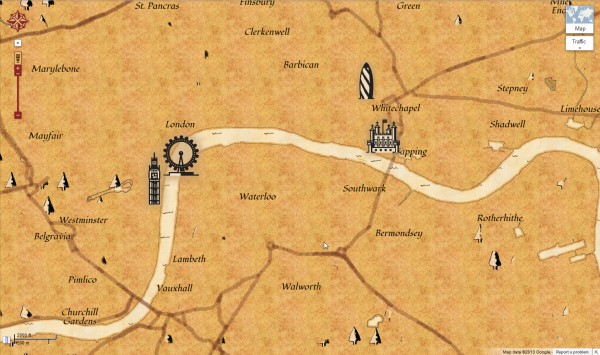
    Google really embraces 1 April and some of its fools are excellent. This year’s highlight, for me, is a new Treasure Hunting mode in Google Maps (I’m currently using Bing for all my mapping needs, but I had to switch back to Google just to try this).

    According to the search giant, “Treasure Maps is our Beta Maps technology and has certain system requirements. Your system may not be able to display at higher resolutions than paper print. Take care when unfolding the map to avoid ripping it”.

    Once activated, the view switches to a hand drawn map on parchment that features rivers, trees, cactus, and major landmarks. There are also treasure chests hidden around for you find. I’ve come across one so far (I tried searching for “treasure” in the search box, but to no avail), but I’ve also found a giant rabbit, a skull and crossbones, Psy doing Gangnam Style in Seoul, and other goodies

    In place of the usual Street View, there’s an amusing sepia “Telescope View” to peer through.

    Google has also created an amusing YouTube video to explain the reason for the new mapping mode.

    Something this good really needs to be kept for longer than one day. At the very least it should make a reappearance for International Talk Like A Pirate Day (19 Sept).

    Have you found anything good?

  • DuoFertility Is A Fertility Monitoring Sensor-Plus-Service That Helps Childless Couples Get Pregnant

    DuoFertility Colours 2

    UK startup DuoFertility is tackling a really tough problem: infertility. The company has built a sensor-plus-service business to predict the most fertile days of women who are having difficulty conceiving to improve the chances of conception — hence its tagline: “assisted natural conception”. There is no invasive technology involved, just a lot of number crunching.

    The startup’s approach sits somewhere in the middle of the competition in this space. It argues its technology is more sophisticated than more basic over-the-counter physical products such as home urine tests or body-basal-thermometers (which are also cheaper than DuoFertility’s offering), as the data captured by its wearable sensor is more accurate. Data is also sent back to DuoFertility staff for monitoring and reviewing – so it’s being looked at by specialist staff using bespoke algorithms rather than generalised models.

    On the other hand, the product is cheaper than a cycle of artificial insemination — and much cheaper than IVF. It’s also nowhere near as invasive as either of those alternatives. DuoFertility costs £495 with unlimited support vs around £800 for a cycle of artificial insemination (including drugs and tests) and around £4,5000 for a cycle of IVF, says CEO and co-founder Shamus Husheer.

    “It is this combination of both automated analysis and expert review of this data that sets us apart from anything else out there, and probably to a large extent explains why our pregnancy rates are so high for patients who are well past buying something off the shelf at the pharmacy,” he says

    “The really surprising thing is that, for only a relatively small increment in cost over the [more basic, competitor] at-home devices, DuoFertility gives a vastly higher pregnancy rate than artificial insemination, and even matches or exceeds that of IVF.”

    Success is a little difficult to measure, however, as a variety of factors have to be considered – as Husheer explains: “Although 80% of normally fertile women will get pregnant within their first year of trying to conceive, infertile couples (those who have been trying for more than two years) have only about a 12% chance of getting pregnant over a year. Therefore simply saying x% of patients will get pregnant is meaningless (or worse, misleading) – this does not however prevent some less scrupulous clinics and products from doing exactly this.

    “Therefore we publish our success rate data only on these ‘difficult cases’ of infertile patients, and specifically those who have qualified for or already been through IVF. We then break this data down by both female age and time trying for a baby, which are the most important factors in determining success rate. A peer-reviewed scientific paper on exactly this was published at the end of 2011, demonstrating a pregnancy rate that was higher than that from a cycle of IVF for every age group under 45 (the rates themselves ranging from over 40% to less than 15%).”

    The Technology

    So what exactly does DuoFertility’s technology do? The product consists of a wearable sensor, worn inside an adhesive patch so it remains attached day and night, which logs the woman’s “body temperature and movement thousands of times a day and night to calculate deep sleep core temperature”, plus a reader unit which receives the data from the sensor via a modified version of RFID. The reader calculates likely future fertility — based on “all of the information it has seen about you to date” (users can enter “a range of different parameters on the reader, from menstruation to ovulation pain to illness”).

    The reader connects to a PC via USB to display past and near future fertility charts. Additional data can then be added by the user, such as medical or home test results and notes for DuoFertility’s staff to read. And all the data is automatically transferred to DuoFertility’s servers in Cambridge, U.K. for analysis and expert review.

    “We use all of the data for each individual woman, and all of the thousands of others that we’re monitoring, to work out exactly which algorithms work for the woman most similar to this one,” says Husheer. “That allows us to dramatically improve the prediction of fertility, but also allows us to identify a range of underlying issues that may be preventing conception. There are of course many cases where the data does not perfectly fit any existing model, and so these cases are escalated to human fertility experts for review and, if necessary, a discussion with the patient or their doctor.”

    DuoFertility aims to identify the 42-78 hour monthly window when couples should be trying to conceive — and says that by continually monitoring women it can pick up on signs that a particular cycle is similar or different to a previous cycle, as well as compare a cycle to similar cycles in its database.

    “Basically, there is zero point in providing a prediction of ovulation down to the minute, if in fact it is five days wrong. Far better to give couples a realistic assessment of when they are likely to be fertile, and update this as we get more data. This means that for some couples ‘the goalposts move’ – they can quite literally see our algorithms updating the prediction when they connect to our servers. And if we recalculate something at our server, and they haven’t connected recently so might miss the newly calculated critical moment – we send an email or give them a call. That call has resulted in more than one baby,” adds Husheer.

    Of course not every couple will be able to get pregnant — even after using the product for a long time — so customer relationship management is a “pretty critical” component of the business. Raising false hope is certainly not part of DuoFertility’s business model, says Husheer — although he notes that for couples who can’t afford IVF, continuing to use DuoFertility despite poor “absolute chances” may be their best hope. ”We find that being absolutely crystal clear about this often makes for a difficult but ultimately necessary and productive conversation with the couple,” he says. The startup also offers refunds to new users if it believes it won’t be able to help them, and reviews users after four to five months (and regularly after that) to ensure continued use still makes sense for them.

    Starting up

    The idea for Duofertility was conceived during Husheer’s PhD research at Cambridge University. The link is indirect, since his research was actually building instruments for particle accelerators. “I realised that several of the instrumental techniques we used could be applied to human physiology, and specifically to monitoring fertility,” he tells TechCrunch. 

    Husheer (pictured right, with fellow co-founder Oriane Chausiaux) and a group of fellow graduate students – “scientists and medics”, some with PhDs in infertility – then got together and entered a university business plan competition in 2006, going on to win £20,000. The money funded a prototype and the filing of the first patent. “By mid 2007 we had brilliant data and several local Angel investors telling us to hurry up and graduate so that they could fund the project,” says Husheer. “Just 18 months and less than £1 million later, DuoFertility had been through design, development, trials, medical approvals and sold to the first customer.”

    The first DuoFertility was bought in May 2009, although Husheer says the first pregnancy was “actually somewhat before that” — during early trials. “Sales really stepped up when DuoFertility was stocked by the largest UK pharmacy chain, Boots, in 2011 as the result of our participating in a reality-TV show hunting for innovative new products for the major retailers,” he adds.

    Further funding came via the competition route, after DuoFertility won Qualcomm’s European QPrize in 2011. That in turn led to attention from Qualcomm’s venture capital arm. Husheer says the company has now raised a little over £2 million in funding from three Angel investor groups and from Qualcomm Ventures.

    Growing In The U.S.

    DuoFertility’s next big step will be raising its profile in the U.S. — by targeting key national medical conferences such as the American Congress of Obstetricians and Gynaecologists in May, and the American Society for Reproductive Medicine in October to properly enter the market. Husheer notes the company “recently achieved FDA clearance”, and although U.S. users can buy the device via DuoFertility’s website and be supported in using it, he says the business needs to spend time introducing the product to the medical community to make doctors aware of it and ensure they are happy to recommend it.

    “We have a small team on the ground in the U.S., calling on doctors in New York and California to introduce the product and make sure that DuoFertility fits into the way that they practice medicine. Over the next few months we will be hiring several more commercially focused people, both for activities directed at the medical community and the consumer — so any [TechCrunch] readers with experience in bringing similar technologies to market in the US should drop me a line,” says Husheer.

    “From a regulatory perspective we are clear to sell anywhere in the E.U. or U.S., and in several countries that accept their medical clearances (e.g. South Africa and many Arab states). As a company selling on the Internet it will be no surprise that we have patients in almost all of these places – in fact we now have babies on every continent except Antarctica. That said, our primary focus is the U.K. and U.S.,” he adds.

    Part of the issue with the U.S. market is that, for legal reasons, DuoFertility is not allowed to provide medical advice to the patient directly — but must work through the patient’s doctor. “This means their doctor is preferably included ‘in the loop’ from the beginning, however if the patient just uses DuoFertility without a doctor we can refer to a doctor we work with in their city if they need one,” Husheer adds.

    DuoFertility has more than 30 staff at present, working shifts to ensure U.S. timezones are covered. The number of staff is likely to rise over the next year — especially if the company  replicates its U.K. fertility centre on U.S. soil so that American couples can be monitored by staff in the same timezone.

    The company broke even in 2011 but has been ploughing investment into ramping up for the U.S. market so, overall, the business has not been profitable recently but Husheer says that’s all part of its growth plans: “Our investors seem to be very happy with this strategy, as everyone can see that the US will be the major market for us.”

  • Accidental Empires, Part 17 — Font Wars (Chapter 11)

    Seventeenth in a series. Love triangles were commonplace during the early days of the PC. Adobe, Apple and Microsoft engaged in such a relationship during the 1980s, and allegiances shifted — oh did they. This installment of Robert X. Cringely’s 1991 classic Accidental Empires shows how important is controlling a standard and getting others to adopt it.

    Of the 5 billion people in the world, there are only four who I’m pretty sure have stayed consistently on the good side of Steve Jobs. Three of them — Bill Atkinson, Rich Page, and Bud Tribble — all worked with Jobs at Apple Computer. Atkinson and Tribble are code gods, and Page is a hardware god. Page and Tribble left Apple with Jobs in 1985 to found NeXT Inc., their follow-on computer company, where they remain in charge of hardware and software development, respectively.

    So how did Atkinson, Page, and Tribble get off so easily when the rest of us have to suffer through the rhythmic pattern of being ignored, then seduced, then scourged by Jobs? Simple; among the three, they have the total brainpower of a typical Third World country, which is more than enough to make even Steve Jobs realize that he is, in comparison, a single-celled, carbon-based life form. Atkinson, Page, and Tribble have answers to questions that Jobs doesn’t even know he should ask.

    The fourth person who has remained a Steve Jobs favorite is John Warnock, founder of Adobe Systems. Warnock is the father that Steve Jobs always wished for. He’s also the man who made possible the Apple LaserWriter printer and desktop publishing. He’s the man who saved the Macintosh.

    Warnock, one of the world’s great programmers, has the technical ability that Jobs lacks. He has the tweedy, professorial style of a Robert Young, clearly contrasting with the blue-collar vibes of Paul Jobs, Steve’s adoptive father. Warnock has a passion, too, about just the sort of style issues that are so important to Jobs. Warnock is passionate about the way words and pictures look on a computer screen or on a printed page, and Jobs respects that passion.

    Both men are similar, too, in their unwillingness to compromise. They share a disdain for customers based on their conviction that the customer can’t even imagine what they (Steve and John) know. The customer is so primitive that he or she is not even qualified to say what they need.

    Welcome to the Adobe Zone.

    John Warnock’s rise to programming stardom is the computer science equivalent of Lana Turner’s being discovered sitting in Schwab’s Drugstore in Hollywood. He was a star overnight.

    A programmer’s life is spent implementing algorithms, which are just specific ways of getting things done in a computer program. Like chess, where you may have a Finkelstein opening or a Blumberg entrapment, most of what a programmer does is fitting other people’s algorithms to the local situation. But every good programmer has an algorithm or two that is all his or hers, and most programmers dream of that moment when they’ll see more clearly than they ever have before the answer to some incredibly complex programming problem, and their particular solution will be added to the algorithmic lore of programming. During their fifteen minutes of techno-fame, everyone who is anyone in the programming world will talk about the Clingenpeel shuffle or the Malcolm X sort.

    Most programmers don’t ever get that kind of instant glory, of course, but John Warnock did. Warnock’s chance came when he was a graduate student in mathematics, working at the University of Utah computer center, writing a mainframe program to automate class registration. It was a big, dumb program, and Warnock, who like every other man in Utah had a wife and kids to support, was doing it strictly for the money.

    Then Warnock’s mindless toil at the computer center was interrupted by a student who was working on a much more challenging problem. He was trying to write a graphics program to present on a video monitor an image of New York harbor as seen from the bridge of a ship. The program was supposed to run in real time, which meant that the video ship would be moving in the harbor, with the view slowly shifting as the ship changed position.

    The student was stumped by the problem of how to handle the view when one object moved in front of another. Say the video ship was sailing past the Statue of Liberty, and behind the statue was the New York skyline. As the ship moved forward, the buildings on the skyline should appear to shift behind the statue, and the program would have to decide which parts of the buildings were blocked by the statue and find a way to turn off just those parts of the image, shaping the region of turned-off image to fit along the irregular profile of the statue. Put together dozens of objects at varying distances, all shifting in front of or behind each other, and just the calculation of what could and couldn’t be visible was bringing the computer to its knees.

    “Why not do it this way?” Warnock asked, looking up from his class registration code and describing a way of solving the problem that had never been thought of before, a way so simple that it should have been obvious but had somehow gone unthought of by the brightest programming minds at the university. No big deal.

    Except that it was a big deal. Dumbfounded by Warnock’s casual brilliance, the student told his professor, who told the department chairman, who told the university president, who must have told God (this is Utah, remember), because the next thing he knew, Warnock was giving talks all over the country, describing how he solved the hidden surface problem. The class registration program was forever forgotten.

    Warnock switched his Ph.D. studies from mathematics to computer science, where the action was, and was soon one of the world’s experts on computer graphics.

    Computer graphics, the drawing of pictures on-screen and on-page, is very difficult stuff. It’s no accident that more than 80 percent of each human brain is devoted to processing visual data. Looking at a picture and deciding what it portrays is a major effort for humans, and often an impossible one for computers.

    Jump back to that image of New York harbor, which was to be part of a ship’s pilot training simulator ordered by the U.S. Maritime Academy. How do you store a three-dimensional picture of New York harbor inside a computer? One way would be to put a video camera in each window of a real ship and then sail that ship everywhere in the harbor to capture a video record of every vista. This would take months, of course, and it wouldn’t take into account changing weather or other ships moving around the harbor, but it would be a start. All the video images could then be digitized and stored in the computer. Deciding what view to display through each video window on the simulator would be just a matter of determining where the ship was supposed to be in the harbor and what direction it was facing, and then finding the appropriate video scene and displaying it. Easy, eh? But how much data storage would it require?

    Taking the low-buck route, we’ll require that the view only be in typical PC resolution of 640-by-400 picture elements (pixels), which means that each stored screen will hold 256,000 pixels.

    Since this is 8-bit color (8 bits per pixel), that means we’ll need 256,000 bytes of storage (8 bits make 1 byte) for each screen image. Accepting a certain jerkiness of apparent motion, we’ll need to capture images for the video database every ten feet, and at each of those points we’ll have to take a picture in at least eight different directions. That means that for every point in the harbor, we’ll need 2,048,000 bytes of storage. Still not too bad, but how many such picture points are there in New York harbor if we space them every ten feet? The harbor covers about 100 square miles, which works out to 27,878,400 points. So we’ll need just over 57 billion bytes of storage to represent New York harbor in this manner. Twenty years ago, when this exercise was going on in Utah, there was no computer storage system that could hold 57 billion bytes of data or even 5.7 billion bytes. It was impossible. And the system would have been terrifically limited in other ways, too. What would the view be like from the top of the Statue of Liberty? Don’t know. With all the data gathered at sea level, there is no way of knowing how the view would look from a higher altitude.

    The problem with this type of computer graphics system is that all we are doing is storing and calling up bits of data rather than twiddling them, as we should do. Computers are best used for processing data, not just retrieving them. That’s how Warnock and his buddies in Utah solved the data storage problem in their model of New York harbor. Rather than take pictures of the whole harbor, they described it to the computer.

    Most of New York harbor is empty water. Water is generally flat with a few small waves, it’s blue, and it lives its life at sea level. There I just described most of New York harbor in eighteen words, saving us at least 50 billion bytes of storage. What we’re building here is an imaging model, and it assumes that the default appearance of New York harbor is wet. Where it’s not wet—where there are piers or buildings or islands—I can describe those, too, by telling the computer what the object looks like and where it is positioned in space. What I’m actually doing is telling the computer how to draw a picture of the object, specifying characteristics like size, shape, and color. And if I’ve already described a tugboat, for example, and there are dozens of tugboats in the harbor that look alike, the next time I need to describe one I can just refer back to the earlier description, saying to draw another tugboat and another and another, with no additional storage required.

    This is the stuff that John Warnock thought about in Utah and later at Xerox PARC, where he and Martin Newell wrote a language they called JaM, for John and Martin. JaM provided a vocabulary for describing objects and positioning them in a three-dimensional database. JaM evolved into another language called Interpress, which was used to describe words and pictures to Xerox laser printers. When Warnock was on his own, after leaving Xerox, Interpress evolved into a language called PostScript. JaM, Interpress, and PostScript are really the same language, in fact, but for reasons having to do with copyrights and millions of dollars, we pretend that they are different.

    In PostScript, the language we’ll be talking about from now on, there is no difference between a tugboat or the letter E. That is, PostScript can be used to draw pictures of tugboats and pictures of the letter E, and to the PostScript language each is just a picture. There is no cultural or linguistic symbolism attached to the letter, which is, after all, just a group of straight and curved lines filled in with color.

    PostScript describes letters and numbers as mathematical formulas rather than as bit maps, which are just patterns of tiny dots on a page or screen. PostScript popularized the outline font, where a description of each letter is stored as a formula for lines and bezier curves and recipes for which parts of the character are to be filled with color and which parts are not. Outline fonts, because they are based on mathematical descriptions of each letter, are resolution independent; they can be scaled up or down in size and printed in as fine detail as the printer or typesetter is capable of producing. And like the image of a tugboat, which increases in detail as it sails closer, PostScript outline fonts contain “hints” that control how much detail is given up as type sizes get smaller, making smaller type sizes more readable than they otherwise would be.

    Before outline fonts can be printed, they have to be rasterized, which means that a description of which bits to print where on the page has to be generated. Before there were outline fonts, bit-mapped fonts were all there were, and they were generated in a few specific sizes by people called fontographers, not computers. But with PostScript and outline fonts, it’s as easy to generate a 10.5-point letter as the usual 10-, 12-, or 14-point versions.

    Warnock and his boss at Xerox, Chuck Geschke, tried for two years to get Xerox to turn Interpress into a commercial product. Then they decided to start their own company with the idea of building the most powerful printer in history, to which people would bring their work to be beautifully printed. Just as Big Blue imagined there was a market for only fifty IBM 650 mainframes, the two ex-Xerox guys thought the world needed only a few PostScript printers.

    Warnock and Geschke soon learned that venture capitalists don’t like to fund service businesses, so they next looked into creating a computer workstation with custom document preparation software that could be hooked into laser printers and typesetters, to be sold to typesetting firms and the printing departments of major corporations. Three months into that business, they discovered at least four competitors were already underway with similar plans and more money. They changed course yet again and became sellers of graphics systems software to computer companies, designers of printer controllers featuring their PostScript language, and the first seller of PostScript fonts.

    Adobe Systems was named after the creek that ran past Warnock’s garden in Los Altos, California. The new company defined the PostScript language and then began designing printer controllers that could interpret PostScript commands, rasterize the image, and direct a laser engine to print it on page. That’s about the time that Steve Jobs came along.

    The usual rule is that hardware has to exist before programmers will write software to run on it. There are a few exceptions to this rule, and one of these is PostScript, which is very advanced, very complex software that still doesn’t run very fast on today’s personal computers. PostScript was an order of magnitude more complex than most personal computer software of the mid-1980s. Tim Paterson’s Quick and Dirty Operating System was written in less than six months. Jonathan Sachs did 1-2-3 in a year. Paul Allen and Bill Gates pulled together Microsoft BASIC in six weeks. Even Andy Hertzfeld put less than two years into writing the system software for Macintosh. But PostScript took twenty man-years to perfect. It was the most advanced software ever to run on a personal computer, and few microcomputers were up to the task.

    The mainframe world, with its greater computing horsepower, might logically have embraced PostScript printers, so the fact that the personal computer was where PostScript made its mark is amazing, and is yet another testament to Steve Jobs’s will.

    The 128K Macintosh was a failure. It was an amazing design exercise that sat on a desk and did next to nothing, so not many people bought early Macs. The mood in Cupertino back in 1984 was gloomy. The Apple III, the Lisa, and now the Macintosh were all failures. The Apple II division was being ignored, the Lisa division was deliberately destroyed in a fit of Jobsian pique, and the Macintosh division was exhausted and depressed.

    Apple had $250 million sunk in the ground before it started making money on the Macintosh. Not even the enthusiasm of Steve Jobs could make the world see a 128K Mac with a floppy disk drive, two applications, and a dot-matrix printer as a viable business computer system.

    Apple employees may drink poisoned Kool-Aid, but Apple customers don’t.

    It was soon evident, even to Jobs, that the Macintosh needed a memory boost and a compelling application if it was going to succeed. The memory boost was easy, since Apple engineers had secretly included the ability to expand memory from 128K to 512K, in direct defiance of orders from Jobs. Coming up with the compelling application was harder; it demanded patience, which was never seen as a virtue at Apple.

    The application so useful that it compels people to buy a specific computer doesn’t have to be a spreadsheet, though that’s what it turned out to be for the Apple II and the IBM PC. Jobs and Sculley thought it would be a spreadsheet, too, that would spur sales of the Mac. They had high hopes for Lotus Jazz, which turned up too late and too slow to be a major factor in the market. There was, as always, a version of Microsoft’s Multiplan for the Mac, but that didn’t take off in the market either, primarily because the Mac, with its small screen and relatively high price, didn’t offer a superior environment for spreadsheet users. For running spreadsheets, at least, PCs were cheaper and had bigger screens, which was all that really mattered.

    For the Lisa, Apple had developed its own applications, figuring that the public would latch onto one of the seven as the compelling application. But while the Macintosh came with two bundled applications of its own — MacWrite and MacPaint — Jobs wanted to do things in as un-Lisa-like manner as possible, which meant that the compelling application would have to come from outside Apple.

    Mike Boich was put in charge of what became Apple’s Macintosh evangelism program. Evangelists like Alain Rossmann and Guy Kawasaki were sent out to bring the word of Macintosh to independent software developers, giving them free computers and technical support. They hoped that these efforts would produce the critical mass of applications needed for the Mac to survive and at least one compelling application that was needed for the Mac to succeed.

    There are lots of different personal computers in the world, and they all need software. But little software companies, which describes about 90 percent of the personal computer software companies around, can’t afford to make too many mistakes by developing applications for computers that fail in the marketplace. At Electronic Arts, Trip Hawkins claims to have been approached to develop software for sixty different computer types over six or seven years. Hawkins took a chance on eighteen of those systems, while most companies pick only one or two.

    When considering whether to develop for a different computer platform, software companies are swayed by an installed base — the number of computers of a given type that are already working in the world — by money, and by fear of being left behind technically. Boich, Rossmann, and Kawasaki had no installed base of Macintoshes to point to. They couldn’t claim that there were a million or 10 million Macintoshes in the world, with owners eager to buy new and innovative applications. And they didn’t have money to pay developers to do Mac applications — something that Hewlett-Packard and IBM had done in the past.

    The pitch that worked for the Apple evangelists was to cultivate the developers’ fear of falling behind technically. “Graphical user interfaces are the future of computing,” they’d say, “and this is the best graphical user interface on the market right now. If you aren’t developing for the Macintosh, five years from now your company won’t be in business, no matter what graphical platform is dominant then.”

    The argument worked, and 350 Macintosh applications were soon under development. But Apple still needed new technology that would set the Mac apart from its graphical competitors. The Lisa and the Xerox Star had not been ignored by Apple’s competitors, and a number of other graphical computing environments were announced in 1983, even before the Macintosh shipped.

    VisiCorp was betting (and losing) its corporate existence on a proprietary graphical user interface and software for IBM PCs and clones called VisiOn. VisiOn appeared in November 1983, more than a year after it was announced. With VisiOn, you got a mouse, a special circuit card that was installed inside the PC, and software including three applications — word processing, spreadsheet, and graphics. VisiOn offered no color, no icons, and it was slow — all for a list price of $1,795. The shipping version was supposed to have been twelve times faster than the demo; it wasn’t. Developers hated VisiOn because they had, to pay a big up-front fee to get the information needed to write programs (literally anti-evangelism) and then had to buy time on a Prime minicomputer, the only computer environment in which applications could be developed. VisiOn was a dud, but until it was actually out, failing in the world, it had a lot of people scared.

    One person who was definitely scared by VisiOn was Bill Gates of Microsoft, who stood transfixed through three complete VisiOn demonstrations at the Comdex computer trade show in 1982. Gates had Charles Simonyi fly down from Seattle just to see the VisiOn demo, then Gates immediately went back to Bellevue and started his own project to throw a graphical user interface on top of DOS. This was the Interface Manager, later called Microsoft Windows, which was announced in 1983 and shipped in 1985. Windows was slow, too, and there weren’t very many applications that supported the environment, but it fulfilled Gates’ goal, which was not to be the best graphical environment around, but simply to defend the DOS franchise. If the world wanted a graphical user interface, Gates would add one to DOS. If they want a pen-based interface, he’ll add one to DOS (it’s called Windows for Pen Computing). If the world wants voice recognition, or multimedia, or fingerpainting input, Gates will add it to DOS, because DOS, and the regular income it provides, year after year, funds everything else at Microsoft. DOS is Microsoft.

    Gates did Windows as a preemptive strike against VisiOn, and he developed Microsoft applications for the Macintosh, because it was clear that Windows would not be good enough to stop the Mac from becoming a success. Since he couldn’t beat the Macintosh, Gates supported it, and in turn gained knowledge of graphical environments. He also made an agreement with Apple allowing him to use certain Macintosh features in Windows, an agreement that later landed both companies in court.

    Finally, there was GEM, another graphical environment for the IBM PC, which appeared from Gary Kildall’s Digital Research, also in 1983. GEM is still out there, in fact, but the only GEM application of note is Ventura Publisher, a popular desktop publishing package for the IBM world, ironically sold by Xerox. Most Ventura users don’t even know they are using GEM.

    Apple needed an edge against all these would-be competitors, and that edge was the laser printer. Hewlett-Packard introduced its LaserJet printer in 1984, setting a new standard for PC printing, but Steve Jobs wanted something much, much better, and when he saw the work that Warnock and Geschke were doing at Adobe, he knew they could give him the sort of printer he wanted. HP’s LaserJet output looked as if it came from a typewriter, while Jobs was determined that his LaserWriter output would look like it came from a typesetter.

    Jobs used $2.5 million to buy 15 percent of Adobe, an extravagant move that was wildly unpopular among Apple’s top management, who generally gave up the money for lost and moved to keep Jobs from making other such investments in the future. Apple’s investment in Adobe was far from lost though. It eventually generated more than $10 billion in sales for Apple, and the stock was sold six years later for $89 million. Still, in 1984, conventional wisdom said the Adobe investment looked like a bad move.

    The Apple LaserWriter used the same laser print mechanism that HP’s LaserJet did. It also used a special controller card that placed inside the printer what was then Apple’s most powerful computer; the printer itself was a computer. Adobe designed a printer controller for the LaserWriter, and Apple designed one too. Jobs arrogantly claimed that nobody—not even Adobe—could engineer as well as Apple, so he chose to use the Apple-designed controller. For many years, this was the only non-Adobe-designed PostScript controller on the market. The first generation of competitive PostScript printers from other companies all used the rejected Adobe controller and were substantially faster as a result.

    The LaserWriter cost $7,000, too much for a printer that would be available to only a single microcomputer. Jobs, who still didn’t think that workers needed umbilical cords to their companies, saw the logic in at least having an umbilical cord to the LaserWriter, and so AppleTalk was born. AppleTalk was clever software that worked with the Zilog chip that controlled the Macintosh serial port, turning it into a medium-speed network connection. AppleTalk allowed up to thirty-two Macs to share a single LaserWriter.

    At the same time that he was ordering AppleTalk, Jobs still didn’t understand the need to link computers together to share information. This antinetwork bias, which was based on his concept of the lone computist — a digital Clint Eastwood character who, like Jobs, thought he needed nobody else — persisted even years later when the NeXT computer system was introduced in 1988. Though the NeXT had built-in Ethernet networking, Jobs was still insisting that the proper use of his computer was to transfer data on a removable disk. He felt so strongly about this that for the first year, he refused orders for NeXT computers that were specifically configured to store data for other computers on the network. That would have been an impure use of his machine.

    Adobe Systems rode fonts and printer software to more than $100 million in annual sales. By the time they reach that sales level, most software companies are being run by marketers rather than by programmers. The only two exceptions to this rule that I know of are Microsoft and Adobe — companies that are more alike than their founders would like to believe.

    Both Microsoft and Adobe think they are following the organizational model devised by Bob Taylor at Xerox PARC. But where Microsoft has a balkanized version of the Taylor model, got second-hand through Charles Simonyi, Warnock and Geschke got their inspiration directly from the master himself. Adobe is the closest a commercial software company can come to following Taylor’s organizational model and still make a profit.

    The problem, of course, is that Bob Taylor’s model isn’t a very good one for making products or profits — it was never intended to be — and Adobe has been able to do both only through extraordinary acts of will.

    As it was at PARC, what matters at Adobe is technology, not marketing. The people who matter are programmers, not marketers. Ideologically correct technology is more important than making money—a philosophy that clearly differentiates Adobe from Microsoft, where making money is the prime directive.

    John Warnock looks at Microsoft and sees only shoddy technology. Bill Gates looks at Adobe and sees PostScript monks who are ignoring the real world — the world controlled by Bill Gates. And it’s true; the people of Adobe see PostScript as a religion and hate Gates because he doesn’t buy into that religion.

    There is a part of John Warnock that would like to have the same fatherly relationship with Bill Gates that he already has with Steve Jobs. But their values are too far apart, and, unlike Steve, Bill already has a father.

    Being technologically correct is more important to Adobe than pleasing customers. In fact, pleasing customers is relatively unimportant. Early in 1985, for example, representatives from Apple came to ask Adobe’s help in making the Macintosh’s bitmapped fonts print faster. These were programmers from Adobe’s largest customer who had swallowed their pride to ask for help. Adobe said, “No.”

    “They wanted to dump screens [to the printer] faster, and they wanted Apple-specific features added to the printer,” Warnock explained to me years later. “Apple came to me and said, ‘We want you to extend PostScript in a way that is proprietary to Apple.’ I had to say no. What they asked would have destroyed the value of the PostScript standard in the long term.”

    If a customer that represented 75 percent of my income asked me to walk his dog, wash her car, teach their kids to read, or to help find a faster way to print bit-mapped fonts, I’d do it, even if it meant adding a couple proprietary features to PostScript, which already had lots of proprietary features — proprietary to Adobe.

    The scene with Apple was quickly forgotten, because putting bad experiences out of mind is the Adobe way. Adobe is like a family that pretends grandpa isn’t an alcoholic. Unlike Microsoft, with its screaming and willingness to occasionally ship schlock code, all that matters at Adobe is great technology and the appearance of calm.

    A Stanford M.B.A. was hired to work as Adobe’s first evangelist, trying to get independent software developers to write PostScript applications. Technical evangelism usually means going on the road — making contacts, distributing information, pushing the product. Adobe’s evangelist went more than a year without leaving the building on business. He spent his days up in the lab, playing with the programmers. His definition of evangelism was waiting for potential developers to call him, if they knew he existed at all. What’s amazing about this story is that this nonevangelist came under no criticism for his behavior. Nobody said a thing.

    Nobody said anything, too, when a technical support worker occasionally appeared at work wearing a skirt. Nobody said, “Interesting skirt, Glenn.” Nobody said anything.

    Some folks from Adobe came to visit InfoWorld one afternoon, and I asked about Display PostScript, a product that had been developed to bring PostScript fonts and graphics to Macintosh screens. Display PostScript had been licensed to Aldus for a new version of its PageMaker desktop publishing program called PageMaker Pro. But at the last minute, after the product was finished and the deal with Aldus was signed, Adobe decided that it didn’t want to do Display PostScript for the Macintosh after all. They took the product back, and scrambled hard to get Aldus to cancel PageMaker Pro, too. I wanted to know why they withdrew the product.

    The product marketing manager for PostScript, the person whose sole function was to think about how to get people to buy more PostScript, claimed to have never heard of Display PostScript for the Mac or of PageMaker Pro. He looked bewildered.

    “That was before you joined the company,” explained Steve MacDonald, an Adobe vice-president who was leading the group. ”You don’t tell new marketing people the history of their own products?” I asked, incredulous. “Or is it just the mistakes you don’t tell them about?”

    MacDonald shrugged.

    For all its apparent disdain for money, Adobe has an incredible ability to wring the stuff out of customers. In 1989, for example, every Adobe programmer, marketing executive, receptionist, and shipping clerk represented $357,000 in sales and $142,000 in profit. Adobe has the highest profit margins and the greatest sales per employee of any major computer hardware or software company, but such performance comes at a cost. Under the continual prodding of the company’s first chairman, a venture capitalist named Q. T. Wiles, Adobe worked hard to maximize earnings per share, which boosted the stock price. Warnock and Geschke, who didn’t know any better, did as Q. T. told them to.

    Q. T. is gone now, his Adobe shares sold, but the company is trapped by its own profitability. Earnings per share are supposed to only rise at successful companies. If you earned a dollar per share last year, you had better earn $1.20 per share this year. But Adobe, where 400 people are responsible for more than $150 million in sales, was stretched thin from the start. The only way that the company could keep its earnings going ever upward was to get more work out of the same employees, which means that the couple of dozen programmers who work most of the technical miracles are under terrific pressure to produce.

    This pressure to produce first became a problem when Warnock decided to do Adobe Illustrator, a PostScript drawing program for the Macintosh. Adobe’s customers to that point were companies like Apple and IBM, but Illustrator was meant to be sold to you and me, which meant that Adobe suddenly needed distributors, dealers, printers for manuals, duplicators for floppy disks—things that weren’t at all necessary when serving customers meant sending a reel of computer tape over to Cupertino in exchange for a few million dollars, thank you. But John Warnock wanted the world to have a PostScript drawing tool, and so the world would have a PostScript drawing tool. A brilliant programmer named Mike Schuster was pulled away from the company’s system software business to write the application as Warnock envisioned it.

    In the retail software business, you introduce a product and then immediately start doing revisions to stay current with technology and fix bugs. John Warnock didn’t know this. Adobe Illustrator appeared in 1986, and Schuster was sent to work on other things. They should have kept someone working on Illustrator, improving it and fixing bugs, but there just wasn’t enough spare programmer power to allow that. A version of Illustrator for the IBM PC followed that was so bad it came to be called the “landfill version” inside the company. PC Illustrator should have been revised instantly, but wasn’t.

    When Adobe finally got around to sprucing up the Macintosh version of Illustrator, they cleverly called the new version Illustrator 88, because it appeared in 1988. You could still buy Illustrator 88 in 1989, though. And in 1990. And even into 1991, when it was finally replaced by Illustrator 3.0. Adobe is not a marketing company.

    In 1988, Bill Gates asked John Warnock for PostScript code and fonts to be included with the next version of Windows. With Adobe’s help users would be able to see the same beautiful printing on-screen that they could print on a PostScript printer. Gates, who never pays for anything if he can avoid it, wanted the code for free. He argued that giving PostScript code to Microsoft would lead to a dramatic increase in Adobe’s business selling fonts, and Adobe would benefit overall. Warnock said, “No.”

    In September 1989, Apple Computer and Microsoft announced a strategic alliance against Adobe. As far as both companies were concerned, John Warnock had said “No” twice too often. Apple was giving Microsoft its software for building fonts in exchange for use of a PostScript clone that Microsoft had bought from a developer named Cal Bauer.

    Forty million Apple dollars were going to Adobe each year, and clever Apple programmers, who still remembered being rejected by Adobe in 1985, were arguing that it would be cheaper to roll their own printing technology than to continue buying Adobe’s.

    In mid-April, news had reached Adobe that Apple would soon announce the phasing out of PostScript in favor of its own code, to be included in the upcoming release of new Macintosh control software called System 7.0. A way had to be found fast to counter Apple’s strategy or change it.

    Only a few weeks after learning Apple’s decision — and before anything had been announced by Apple or Microsoft — Adobe Type Manager, or ATM, was announced — software that would bring Adobe fonts directly to Macintosh screens without the assistance of Apple since it would be sold directly to users. ATM, which would work only with fonts — with words rather than pictures — was replacing Display PostScript, which Adobe had already tried (and failed) to sell to Apple. ATM had the advantage over Apple’s System 7.0 software that it would work with older Macintoshes. Adobe’s underlying hope was that quick market acceptance of ATM would dissuade Apple from even setting out on its separate course.

    But Apple made its announcement anyway, sold all its Adobe shares, and joined forces with Microsoft to destroy its former ally. Adobe’s threat to both Apple and Microsoft was so great that the two companies conveniently ignored their own yearlong court battle over the vestiges of an earlier agreement allowing Microsoft to use the look and feel of Apple’s Macintosh computer in Microsoft Windows.

    Apple-Microsoft and Apple-Adobe are examples of strategic alliances as they are conducted in the personal computer industry. Like bears mating or teenage romances, strategic alliances are important but fleeting.

    Apple chose to be associated with Adobe only as long as the relationship worked to Apple’s advantage. No sticking with old friends through thick and thin here.

    For Microsoft, fonts and printing technology had been of little interest, since Gates saw as important what happened inside the box, not inside the printer. Then IBM decided it wanted the same fonts in both its computers and printers, only to discover that Microsoft, its traditional software development partner, had no font technology to offer. So IBM began working with Adobe and listening to the ideas of John Warnock.

    If IBM is God in the PC universe then Bill Gates is the pope. Warnock, now talking directly with IBM, was both a heretic and a threat to Gates. Warnock claimed that Gates was not a good servant of God, that Microsoft’s technology was inferior. Worse, Warnock was correct, and Gates knew it. Control of the universe in the box was at stake.

    Warnock and Adobe had to die, Gates decided, and if it took an unholy alliance with Apple and a temporary putting aside of legal conflicts between Microsoft and Apple to kill Adobe, then so be it.

    This passion play of Adobe, Apple, and Microsoft could have taken place between companies in many industries, but what sets the personal computer industry apart is that the products in question — Adobe Type Manager and Apple’s System 7.0 — did not even exist.

    Battles of midsized cars or two-ply toilet tissue take place on showroom floors and supermarket shelves, but in the personal computer industry, deals are cut and share prices fluctuate on the supposed attributes of products that have yet to be written or even fully designed. Apple’s offensive against Adobe was based on revealing the ongoing development of software that users could not expect to purchase for at least a year (two years, it turned out); Adobe’s response was a program that would take months to develop.

    ATM was announced, then developed, essentially by a single programmer who used to joke with the Adobe marketing manager about whether the product or its introduction would be done first.

    Both companies were dueling with intentions, backed up by the conviction of some computer hacker that given enough time and junk food, he could eventually write software that looked pretty much like what had just been announced with such fanfare.

    As I said, computer graphics software is very hard to do well. By the middle of 1991, Apple and Adobe had made friends again, in part because Microsoft had not been able to fulfill its part of the deal with Apple. “Our entry into the printer software business has not succeeded,” Bill Gates wrote in a memo to his top managers. “Offering a cheap PostScript clone turned out to not only be very hard but completely irrelevant to helping our other problems. We overestimated the threat of Adobe as a competitor and ended up making them an ‘enemy,’ while we hurt our relationship with Hewlett-Packard …”

    Overestimated the threat of Adobe as a competitor? In a way it’s true, because the computer world is moving on to other issues, leaving Adobe behind. Adobe makes more money than ever in its PostScript backwater, but is not wresting the operating system business from Microsoft, as both companies had expected.

    With its reliance on only a few very good programmers. Adobe was forced to defend its existing businesses at the cost of its future. John Warnock is still a better programmer than Bill Gates, but he’ll never be as savvy.

    Reprinted with permission

    Photo Credit: NinaMalyna/Shutterstock

  • Tesla ditches Model S with smallest battery, bumps up guidance

    Electric car maker Tesla Motors announced on Sunday night that it has decided to cancel production of the base version of its Model S electric car that has the smallest battery pack, at 40 kWh (or 160 mile range). Tesla says only 4 percent of customers had ordered that version.

    Tesla will continue to sell the Model S with 60 kWh (230 miles) and 85 kWh (300 miles) battery packs. Customers that already purchased the base Model S will get a 60 kWh version, but with software that will maintain the battery level to its 160 miles range.

    Tesla Model S

    The decision means that Tesla’s least expensive Model S will start at $62,400, instead of in the $50,000 range. Perhaps the move could also help boost Tesla’s margins on the Model S, which was around 8 percent at the end of 2012, and which Tesla is hoping will be closer to 25 percent later this year.

    Clearly Tesla’s early customers, at this stage, care more about having a larger range for the car than shaving off $10,000 from the car. Perhaps that could change for Tesla’s third electric car, which is supposed to be a more low cost mainstream car.

    At the same time that it streamlined its product line up, Tesla also announced that it has boosted its earnings guidance for the first quarter of 2013, due to 250 more Model S cars being delivered than expected. While Tesla had already reported that it expected to reach profitability on a non-GAAP basis (excluding non-cash options and warrant-related expenses) for the first quarter of 2013, Tesla now says that it expects to be profitable on a GAAP basis, too.

    The fourth quarter of 2012 was a breakthrough time for Tesla. The company moved into volume production, and started producing 400 Model S cars per week. Now Tesla just needs to continue to produce Model S cars at that volume and push up its margin to meet 25 percent so that it can morph into a profitable company on a recurring basis.

    Related research and analysis from GigaOM Pro:
    Subscriber content. Sign up for a free trial.

  • New Trump reality TV show would have CEOs swap jobs for a day

    Donald Trump is in negotiations with Fox and NBC to bring a new reality show to television, featuring corporate CEOs swapping roles. The concept is in advanced planning stages, with a mock-up pilot already shot and the two networks vying to add the series to their 2013-14 season. Normally, we don’t bother with entertainment news at BetaNews, but two of the confirmed chief executives will interest our readership — Apple’s Tim Cook and Steve Ballmer of Microsoft.



    Trump and NBC already have a working relationship on a number of projects from the original “The Apprentice” and its spin-offs. But Fox fiercely is negotiating rights, which aren’t bound by Trump’s existing contractual commitments with the Peacock network. News of the deal leaked Sunday night in an email accidentally — or accidentally on purpose — sent to several trade publications, including Variety. Leaks like this are often deliberate and designed to foil negotiations or to increase pressure on one of the parties.

    The Ballmer and Cook connection is a fascinating subplot. While nowhere as reclusive as Steve Jobs, his successor has given only a few, select public interviews. So Cook’s participation is at first surprising. But according to one of the documents attached to the leaked email, Trump put forth what I’ll call a crazy plan to boost ratings: Bring back Jobs from the dead, using a spiritualist to channel him from the afterlife. Cook agreed to participate on the condition Trump abandons the Jobs-psychic thing and threatened to pull Apple advertising from any network airing the channeling segment.

    But it’s that aspect which has Fox executives chomping for the reality show. Apparently, the network is so intrigued by the spiritualist thing that executives approached Trump about doing a dead celebrity channeling series. Ha! I can’t resist, please forgive me. The concept brings whole new meaning to channel surfing.

    But that’s a digression, while fascinating enough. The original concept is different. CEOs swap jobs for X time period. Producers want a week but only believe chief executives and their boards of directors will agree to 24 hours, according to one of two proposals attached to the leaked email.

    There are other problems, such as disclosure of trade secrets. How can one CEO realistically step into another’s role without learning something confidential about the other company? That goes for people filming the reality show, too. However, based on the proposals, Trump’s interest is the shock value of, say, Ballmer’s reaction to day-to-day operations at Apple and vice versa for Cook. The idea is to immerse the CEOs in their rival’s corporate culture, without participating in meetings or going places that would jeopardize proprietary information.

    In typical Trump “You’re Fired!” fashion, shock is the goal. The concept greatly appeals to Fox, according to the leaked email. But privately, in one series of attached memos, producers raised concerns that the reality show would embarrass chief executives and damage their reputations. For this reason, the Trump organization proposes shooting a complete set of 13 episodes before airing any of them — to prevent CEOs from dropping out of future filming after seeing the first segments. If either network accepts the proposal, the series, which is yet unnamed, wouldn’t air until January 2014.

    Trump or his producers have approached other CEOs about participating, some of which seem almost desperate for the publicity. Arianna Huffington, Marissa Mayer and Mark Zuckerberg are among some of the other chief executives on the shortlist. Each episode would focus on just two of them swapping jobs. A second proposal has execs from totally different businesses making the switch.

    April Fools!

    Photo Credit: Zaptik/Shutterstock

  • Mycotoxins are contaminating these 10 food staples

    Fungi produce secondary metabolites called mycotoxins. Mycotoxins were discovered in 1962 in London, England, when a peanut ground meal was found to have caused approximately 100,000 turkey deaths. Metabolites from the common fungi Aspergillus flavus had contaminated…
  • Melatonin treats migraine headaches

    (NaturalNews)A recent study showed that melatonin is an effective treatment for migraine headaches. The study Study participants had a history of 2 to 8 migraines per month. They were divided into three groups, those taking 3 mg of melatonin, 25 mg of amityptyline (an antidepressant…

  • U.S. government plans to scan your private emails using cybersecurity program as a cover

    As mainstream political and media figures head-fake the country with near wall-to-wall coverage of whether men and women should be allowed to marry each other, the U.S. government is planning to snoop through more and more of your private email, using the “threat of…
  • Healing rights and healing rites: An interview with Nick Polizzi of ‘The Sacred Science’

    We often take a stand for our healing rights – the right to have the treatment, the food, and the environment that provides us with what we need to heal. One filmmaker says that while healing rights are essential, there is also much to discover in healing rites that…