The literary world gasped on Thursday when Amazon announced it had acquired Goodreads, a popular social networks that lets book lovers connect and share reviews with one another. The deal gives Amazon control of an influential literary taste-maker and provides it with access to wealth of new book data — a development that is not sitting well with the Authors Guild.
“Amazon’s acquisition of Goodreads is a textbook example of how modern Internet monopolies can be built,” said Guild president Scott Turow in a statement issued on Friday. Turow claims that Amazon sought to eliminate Goodreads as a future competitor and that it has “squelched” an important source of independent discussion and reviews.
It’s unlikely anything so dramatic will occur in the short term. As executives from Goodreads and Amazon told my colleague Laura Owen, the book network will remain for now a stand-alone site and the first goal of the merger is to “do no harm.”
In the longer term, though, the data and marketing insight Amazon receives from Goodreads is likely to strengthen the retailer’s already powerful position in book selling. The question of whether this will lead to an Amazon “monopoly” is another matter altogether. Under American rules on vertical integration, a company breaks anti-trust laws only it obtains a dominant positions and abuses that position to harm consumers.
Turow and the Authors Guild have already been vociferous critics of Amazon. Last year, Turow accused the company of using discounting to “destroy bookselling.” More recently, the Guild joined with the Association of American Publishers to demand that Amazon be denied control over new internet suffixes “.book” and “.author.”
Complexity creep is ruining Google’s social network, much like Facebook before the recent, and quite exciting, redesign. I use G+ mainly on mobile devices, and that experience is in the outhouse — and, whew, does it stink — following this week’s app update. Just four days ago. It seems like four years. My use of the service has collapsed. There is too much clutter, too much distraction. The user experience on Nexus 10 is analogous to going from a vast, wide-open forest to thicket and bramble.
But the larger problem is change, change, change. Google constantly modifies the Plus user interface — experiments really — and users are lab rats.
I tweeted three days ago: “I’m sick of being a Google+ beta tester. How many more times will the mobile app design change? I love new things, but this…” To which Adam Hall (who works for Microsoft) replied: “What’s the foot traffic like now? Population growth? I took a peek early on but was a ghost town so gave up”. I answered: “There is plenty of foot traffic. But Google keeps rearranging rooms and putting up new walls. Is that a door or closet?” He suggested “maze”. I answered: “LOL. Yes! Lab rats running the maze. So is it some quirky Google intelligence test?”
Google geeks gone wild — that’s how the situation looks to me. Maybe the constant redesigns are an IQ test from the math whizzes in Mountain View, Calif. Worse, maybe the people building this thing can’t make up their minds — or there’s a committee somewhere, essentially a group mind, that can’t decide anything. Can you say “Borg”, baby? Perhaps Google takes too much community feedback or, worse, there is no plan at all, which wouldn’t be uncommon in Silicon Valley. Big brains think up little feature enhancements and throw them in the pot without considering how they might affect the stew’s taste.
Cha-cha-cha-changes
Maze is apt analogy, because the path keeps changing. I’m amazed at the radical makeovers taking place every few months — that’s to the website, too, but mobile is far more dramatic.
In December, when reviewing Nexus 10, I boasted: “I much prefer Google+ on a tablet to the service running in a PC browser”. I sure as hell can’t say that now. Take a look at the screenshot above, captured this morning. There is a whole lot of clutter, more posts per page and distracting movement from comments that flash by underneath post images.
Consider the May 2012 update, for which Google’s Vic Gundotra posted screenshots from a smartphone and compare to images of the newest design here. (There are also two screenshots below — darker is the older and lighter is newer.) These are quite different designs in less than a year, and I simply single them out. The dramatic changeovers are more frequent.
The big, December Google+ update isn’t so radical (screenshots here and here) from this week’s, on smartphones. The bigger change came months earlier. Little more than a month after the May 2012 Android update, Google radically redesigned the mobile app.
The screenshot left is how Google+ for Android looked in May 2012. The one right is the appearance following the big, March 2013 update.
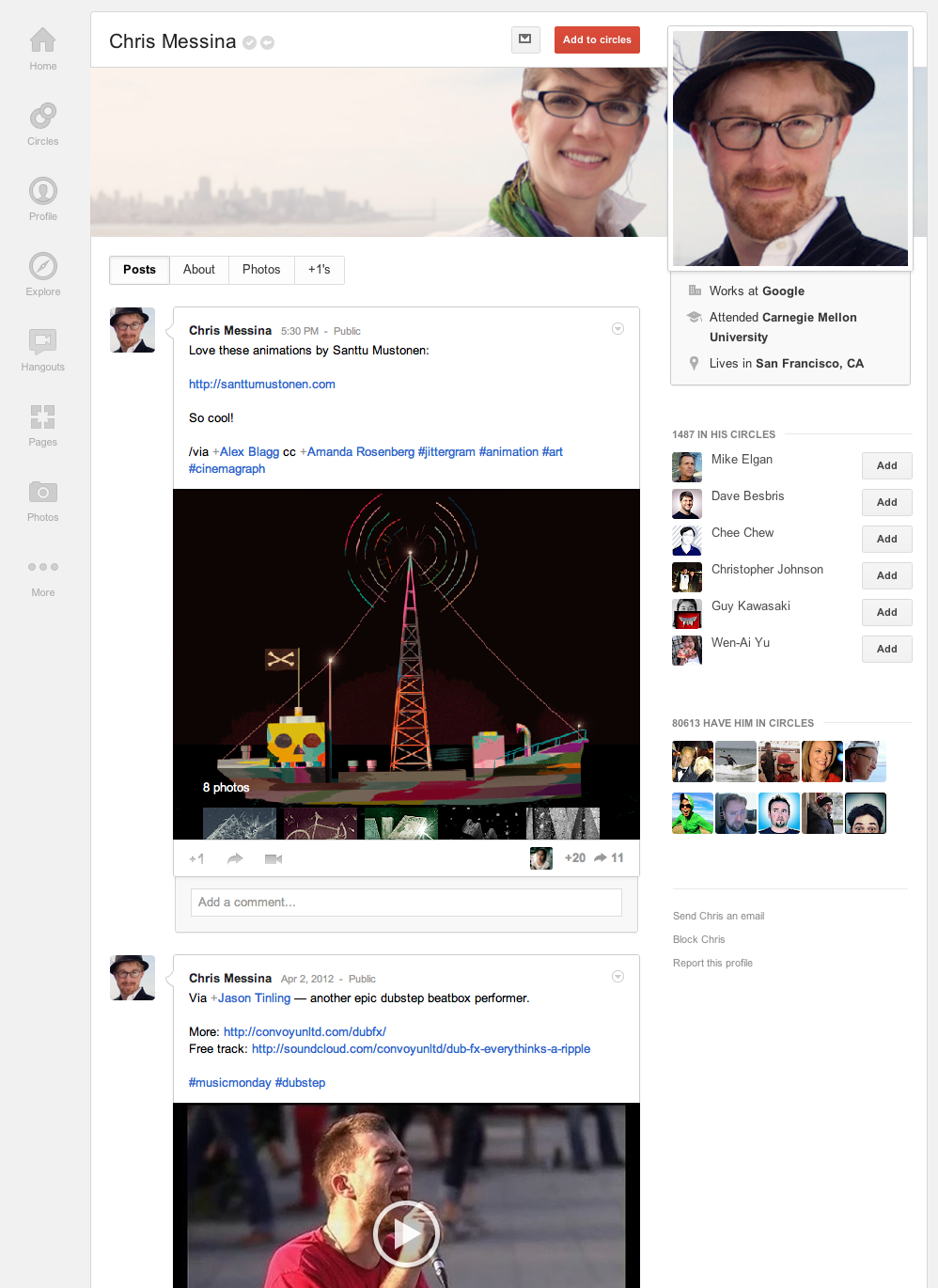
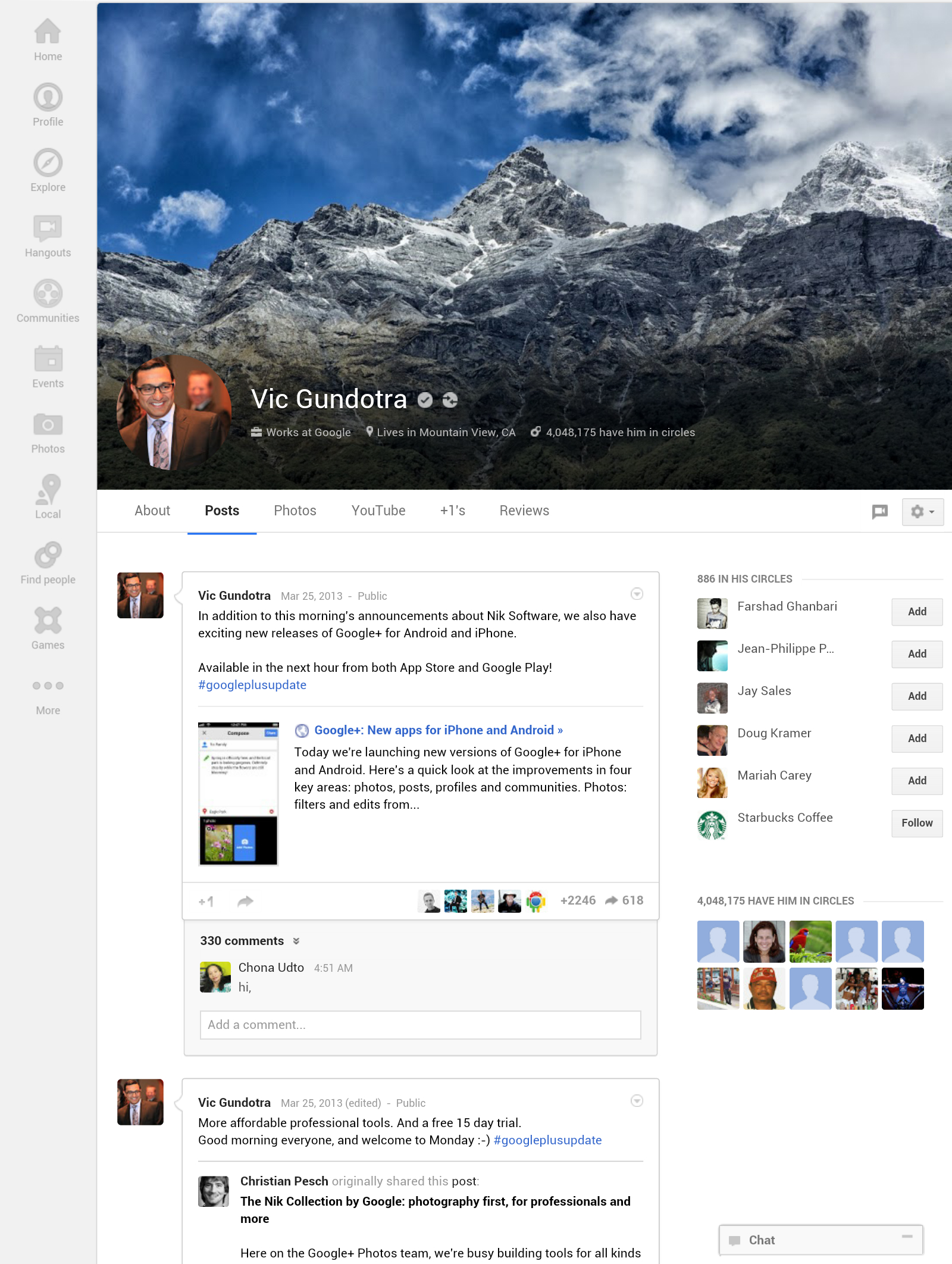
Google+ clutter creep comes to the website, too. Consider how the user Profile looked in April 2012 compared to major changes Google made earlier this month.
I’m a big supporter of change and have past praised Google for improving the social network, regularly. But there is a whole lot more clutter and distraction today than a year ago. Much of that is more tolerable on the web, but, in my view, unacceptable on mobile. Google asks too much of the eyes.
Image left is the Google+ profile in April 2012 and the right March 2013, as viewed on the web.
The problem is bigger, and this goes back to the idea of the ever-changing maze. There are very good reasons why smart companies think through and implement user motifs they keep for years. Most people balk at change, finding comfort in familiar motifs around which they develop habits that speed interaction. Facebook is the criminal of constant, cluttered redesigns. Social network street punk Google is little better.
For me, realization of my lab rat status and seeing no spoils in the new maze ahead is actually liberating. I will start spending more time on other social networks in the coming weeks, and less on Google+. I’m not abandoning or boycotting, just reallocating my time.
Expedia’s remarkably moving short film, “Find Your Understanding,” tells the true story of man named Artie Goldstein and his journey to accept his daughter Jill Goldstein’s marriage to another woman, Nikki Weiss. As the world waits for the Supreme Court decision on the Defense Against Marriage Act, millions have viewed this socially-conscious ad online. But in a poignant twist of fate, the film has done more than just open the hearts of its viewers. This piece — which was named one of TED’s Ads Worth Spreading — has played a significant role in helping Nikki secure parental rights of her son, Adler.
According to an article on Creativity Online, Nikki and Jill had agreed to participate in the film because they wanted to set a positive example for families struggling to come to terms with their gay children. And while the film shows footage of the couple’s wedding in 2010, the pair were not legally married under federal law. So when Jill gave birth on their second wedding anniversary, Nikki had to convince a social worker to allow her to adopt her own son in order to be legally considered as his parent.
The meeting with the social worker did not begin warmly. While taking Nikki’s fingerprints, she grilled Nikki about her relationship to Jill, “when we’ve known each other since we were children,” Nikki tells Creativity. But when the social worker asked the Weiss-Goldsteins about how their families felt about their relationship, they played her Expedia’s film. The social worker broke down in tears, and, as Nikki said, “I don’t think there were any more questions after that.” Nikki’s adoption of Adler becomes final on April 17th.
Sadly, Mr. Goldstein will not be able to see the impact of his eloquent and touching soliloquy on his path to acceptance of his daughter’s marriage. He passed away in January. But Nikki said that the Expedia film remains as a “love letter” from her father in law.
William Gelner, creative director at 180 LA, the agency behind the film, spoke to the TED Blog about “Find Your Understanding.” He says that it is proof that there needn’t be a “dividing line between doing good and [doing] business. Too rarely do we realize that, as advertising people, we have the ability to truly influence culture for the better.”
Gelner’s words embrace the spirit of Ads Worth Spreading, which TED created to recognize and award advertising that truly resonates with consumers. By boldly standing up for its values and talking to its audience like people rather than robotic purchasers, Expedia has gained new respect and a community of supporters.
As Gelner tells us, “[This ad] opened hearts, minds, and hopefully soon, the law books on the issue of marriage equality.”
Get to know more about Jill and Nikki, whose wedding was originally documented for an episode of The Real L Word, in the videos below:
Jennifer Lopez is a big draw for any event. So big, that she can demand the staff at events do just about anything to please her. Unfortunately, there comes a point at which demands become too big to fulfill.
The New York Post is reporting that Lopez lost out on a potentially huge gig due to outrageous demands. The singer was reportedly in talks to headline the opening ceremony of India’s Premier League cricket tournament.
The paper’s unnamed sources stated that Lopez was asking for a private plane and hotel rooms for “an army of stylists, assistants, and a personal chef.” The event’s organizers balked at the demands, and Lopez will not be singing at the popular sporting event. The post quotes one source as saying the singer’s demands were “outrageous” and that she “effectively priced herself out of the event.”
Lopez recently appeared as a 2011 host on the Fox karaoke competition American Idol and starred alongside Jason Statham in the movie Parker, which was released in January. The singer is currently working on a new album that is due out this summer.
Country music group Gunnar & The Grizzly Boys have a new video for their song “Could Be Me,” which looks like they hijacked Google’s Street View imagery by appearing in a set of photos.
Oh, and the video is actually called, “Redneck Country Band Ambushes Google Street View Car!”
On the YouTube page for the video, it says, “To protect our friends at Google who bent the rules to make this video possible (and their jobs), we can’t disclose when and where this was filmed.”
The video was submitted to reddit, and as the top comment on reddit points out, “It’s not really Google Street; it’s just some clever guys. The first tip off is that no one’s face is blurred out.”
“It is from Rob Bliss a guy from my old home town who designs viral events,” notes another redditor. ” “He has done alot of this in grand rapids MI.”
Indeed, Rob Bliss Creative’s site and Facebook Page are promoted on the video page.
Samsung (005930) announced its new eight-core Exynos 5 Octa processor earlier this year and it was believed that the chipset was only compatible with 3G radios. The company has confirmed, however, that this is not the case. Samsung’s official twitter account revealed that the Exynos chipset is fully capable of connecting to 4G wireless networks and supports up to 20 LTE bands. The LTE-equipped Galaxy S4 will rely on Qualcomm’s (QCOM) new Snapdragon 600 processor, while international 3G models will use a Exynos chipset. It is speculated that Samsung would not have been able to manufacture enough Exynos chips in time for the launch of its latest smartphone and instead had to turn to Qualcomm.
Gamers love watching other people play games. It’s the only way to explain of popularity of Let’s Plays and live streams on YouTube, Twitch.tv and other sites. The only problem is that those who do live streams must have video capture equipment or software thus preventing a number of players from broadcasting their exploits.
At GDC 2013, YouTube announced its intentions to change all that with a new API that allows game developers to integrate YouTube live streaming into their games. Call of Duty: Black Ops 2 proved the API’s popularity last year when the game allowed players to live-stream matches without the use of any third-party program.
YouTube isn’t reserving live-streaming capabilities just for the hardcore crowd eiher. The API will be available to iOS and Android developers soon so mobile gamers can start sharing their screen with the world in real time.
An interesting aspect of the new API is that YouTube may be helping content creators monetize their streams. There are tools in the API that would allow live-streamers to drop ads in the middle of their stream. It’s unknown if the live streamer would actually be able to make money off of their content though. Some publishers have rules in regards to monetization of in-game video so those rules may be left up to them.
These APIs come at a time when YouTube faces stiff competition from other established, and more gamer centric, live streaming services like Twitch.tv. Twitch still requires extra software or hardware to stream, however, so YouTube’s APIs may just help bring more streamers and viewers to its side.
Searchmetrics has put out a white paper analyzing Google’s use of Universal Search results for its various vertical offerings, finding a “dramatic reduction” in the number and proportion of shopping integrations displayed in results during 2012. The reduction, according to the study, coincides with Google’s switch to the paid Google Shopping model in the U.S.
Interestingly, the number of video integrations has been reduced as well. Historically, video results have been the most frequently displayed form of Universal Search in Google’s results. On the flip side, there has been an increase in news integrations, in addition to an increase in news sources.
The study examines videos, images, maps, shopping and news in Universal Search.
“Turning to the analysis, there was hardly any change to the distribution of market shares before the spring,” the study’s authors write. “Video has long been the most important form of Universal Search integration, followed at some distance by image integrations and shopping results. Nearly all of the curves remain very stable until March/April, with one exception: the integration of videos peaked slightly after March, before falling back gently in July through August to the starting figure of the spring. Since then the percentage share of video integrations in Universal Search has fallen continuously.”
I’ve long believed that touchscreens leave a certain something to be desired when it comes to playing games, and if a new (and very curious) report holds true, Apple may feel the same way. According to PocketGamer.biz’s Jon Jordan, Apple has been meeting with developers on-site at this year’s Game Developers Conference in San Francisco to talk about a forthcoming Apple game controller.
Jordan’s multiple developer sources claim that the Cupertino company has booked a meeting room under an assumed name to talk about the game-centric device, though they weren’t able to shed any light on what the thing will look like or when it will actually see the light of day. That said, Apple is expected to hold an iPad-centric event in April so it’s possible that this controller may be officially unveiled in just a few weeks.
At first glance, the prospect of Apple churning out a game controller of all things seems downright silly, but after chewing on it for a while the notion doesn’t seem quite as outlandish. You’d be hard-pressed to think of OS X as prominent a platform for gaming as Windows is (though some big-league developers are working to change that), but iOS plays home to a staggering number of games and it’s not inconceivable to think that Apple would want to enhance the sorts of gaming experiences available to iPhone, iPod and iPad users. As such, a game controller seems like the sort of thing that Apple would agonize over getting right, and it appears that Apple may have been doing just that.
In the site’s 2012 review of the 3rd generation iPad, AnandTech’s Anand Lal Shimpi and Vivek Gowri let slip a tantalizing tidbit when discussing the iPad’s faculty as a gaming machine: ”I know of an internal Apple project to bring a physical controller to market, but whether or not it will ever see the light of day remains to be seen,” the review reads.
What’s more Apple has been seen bulking itself up with patents that relate to a potential gaming push for at least a few years now. This patent from 2008 describes an accessory that wraps around a portable electronic device with touchscreen (sound familiar?) and includes a standard D-Pad and button, while this one spotted in 2012 takes a slightly different approach. Either way, these patents plus the AnandTech comments make it rather clear that Apple has been mulling over a physical game controller (or something like it) and it may be time for those ambitions to come to fruition.
I’ve reached out to Apple, but the company has declined to comment.
(Also, here’s hoping it looks nothing like the Pippin controller pictured above.)
“The role of citizens in our democracy does not end with your vote. America’s never been about what can be done for us. It’s about what can be done by us together through the hard and frustrating, but necessary work of self-government.” — President Barack Obama, November 7, 2012
Since the first day of the Obama Administration, the Federal government has worked to make government more efficient, effective, and responsive to citizens’ needs. The Administration has harnessed new technology to engage the public, worked to disclose information more quickly, and given citizens a greater voice in decision-making.
In September 2011, the Administration’s work was launched on the world stage when President Obama and other world leaders endorsed the principles of the global Open Government Partnership (OGP). As part of our commitment to OGP, the United States launched the National Action Plan, a set of twenty-six concrete commitments that help increase public integrity, promote public participation, manage public resources more effectively, and improve public services. Praised by civil society organizations and the public, the Plan stands as a great example of what we can do as a country when government, civil society, and the public collaborate together. As the President has said, “Put simply, our countries are stronger when we engage citizens beyond the halls of government.”
Today, we are proud to report that the United States has fulfilled twenty-four of those commitments. You can read more about the implementation of our National Action Plan here. Some highlights include:
In September 2009, the President announced that—for the first time in history—White House visitor records would be made available to the public on an ongoing basis. Today, the White House releases visitor records that were generated in December 2012. This release brings the total number of records made public by this White House to more than 3.1 million—all of which can be viewed in our Disclosures section.
Ed. note: For more information, check out Ethics.gov.
Games for the Weekend is a weekly feature aimed at helping you avoid doing something constructive with your downtime. Each Friday we’ll be recommending a game for Mac, iPhone or iPad that we think is awesome. Here is one cool enough to keep you busy during this weekend.
Blueprint 3D ($0.99 iPhone, $2.99 iPad) is a three-dimensional puzzle game where you construct two-dimensional pictures. It is the sort of puzzle game that you really need to have a knack for gaining the proper perspective on things.
Think crop circles and wheat fields. Imagine standing on the ground on the middle of a wheat field. You can’t really see what you are standing in, it just looks like flattened grass. If you are familiar with the anamorphic sculptures of artist Jonty Hurwitz, like the The Thinker on display in the lobby of Tower 42 in London, then you start to understand how Blueprint 3D works. There are collections of lines, marks and dashes arranged in three-dimensional space, that when viewed from exactly the correct position, reveal a two-dimensional drawing. The trick is finding the proper perspective in order to see the drawing.
The mechanics of this puzzle game are straightforward. The way things move on the screen is similar to how they move in a 3D drawing tool. You can rotate and spin the object in every possible diction; it’s very similar in fact to how Google Earth can pitch, roll and rotate planet Earth in order to see various locations. Use one finger to spin the objects into the screen, and use two fingers to rotate the objects on the screen. The image you start out with can be inverted, tilted and flipped over backwards. It’s up to you to figure out just how to move things around, in order to reveal what the image truly is.
There are three difficulty settings for each level, and they do make things much more challenging. What makes the Normal setting somewhat easy to complete is the fact that there are words, equations and numbers on many of the diagrams that you will tend to focus on. Lining up letters to make up common words is a whole lot easier than trying to figure out what shape a bunch of random lines makes. As you move on to Advanced, you lose these visual cues and are forced to figure out the actual shape. With the Pro setting, the various line segments are broken into different layers that must be moved into place individually. This proves to be much more difficult as you are challenged to figure out what you are looking at by manipulating only one part of the picture at a time.
There are over 300 levels to play that are organized into 11 themes. As you start to get the hang of the game, you will start to race through each level in a minute or two, especially in Normal difficulty. You may want to challenge yourself by playing either Advanced or Pro difficulty before you gain familiarity with the objects in Normal difficulty. If you cannot figure out what the picture is in Pro before the timer runs out, then decrease the difficulty to Advanced, start the timer over again, and see if it is any easier. Only when you cannot figure out how to solve the puzzle in Advanced difficulty, should you then try it out in Normal difficulty. This seems to be backwards, but I found this method of play to be much more challenging.
What makes this game truly amazing is the fact that you can create your own levels from photos in your library or ones you take in the game with the camera. Each image is processed much like a photo is turned into a drawing or a cartoon character with other apps available in the App Store. There are some basic slider controls that allow you to tweak the look of the final design. You can even touch up the final image by erasing what does not belong. When finished, you then choose the background theme and save your levels locally. After you play the level yourself, you can share it online via email, Facebook or Twitter.
I had some fun creating levels based off of designs used in patents Apple has submitted. One of my favorites was a design Apple used for the famous glass staircase used in its retail stores. You can of course use the designs of your own house car or workplace. You can even try it out with the artwork created by children (it works best with line drawings). So take some time this weekend and look at the objects in your life from a different perspective.
This week on the TechCrunch Gadgets Podcast we celebrate episode number two of everyone’s favorite audio file! We also talk about 3D printing, the Ouya console, and the Facebook Fone AKA the FF.
This week we are joined by our quiet intern, Michael Seo.
We are slowly by surely working the kinks out of this process, so bear with us. However, we invite you to enjoy our weekly podcasts every Friday at 3pm Eastern and appreciate all those who listened to our inaugural effort last week. 17,000 listens is nothing to sneeze at and we sincerely love you for putting up with us.
Why would any organization set up a system that discourages experts from sharing their business-critical knowledge?
Obviously, no leader deliberately set out to do such a thing. Yet it happens all the time when companies make a practice of hiring back retirees as consultants to perform the same functions they did before, at higher pay.
Prior to 2008, GE Global Research Center (GEGRC) followed this process. A scientist or engineer would retire from the organization, wait the mandatory six months, and then field a call from a former manager with an offer to re-engage. The corresponding consulting fees, combined with their pension, generated an income not too different from the person’s pre-retirement salary, with far fewer hours worked. In HR groups around (and beyond) the company, this scenario was the norm. Retirees were simply another, albeit expensive, form of contingent labor. And the arrangement seemed like a win-win. The retiree satisfied financial and personal goals while the organization reinserted someone with unrivaled knowledge and expertise into a project and took its time sourcing replacement talent.
So what was wrong with this picture? For one thing, at GEGRC, internal analysis predicted a potential tsunami of retirements hitting the two top technical levels between 2008 and 2013. That meant a costly practice could get prohibitively expensive. Worse, the rehiring agreements were structured only to provide project continuity, not to retain or transfer knowledge. After all, why would a soon-to-be or recent retiree want to impart his smarts? Most wanted to be paid, and to be missed, when they eventually quit for good.
Not all the knowledge in the head of every departing employee is valuable, of course. Some may be outdated or strategically irrelevant. But at GEGRC and many other companies, increasing numbers of Baby Boomers walking out the door are taking a lot of valuable deep smarts — that is, business-critical, experience-based knowledge about not only technical issues but also “soft skills” like customer relations, project management, creative team leadership and stakeholder management — with them. That can be devastating to competitive advantage.
Ironically, the financial downturn of 2008 gave GEGRC an opportunity to change. In an effort to reduce costs, the organization forbade re-hiring of retirees in 2009. An outcry ensued, of course, but management and HR began to face the painful fact that they had been aiding and abetting a vicious cycle of capability dependency and knowledge loss.
For a while, would-be retirees simply stayed on longer than they had planned. And it was that lull in departures which allowed the organization to redesign some of its incentives, practices and culture. It launched a significant knowledge-sharing program drawing on some of the advice outlined in this article and set up a phased retirement program, offering flexible work schedules and leaves of absence to spend more time with family or to winter in a warmer climate. GEGRC still has a handful of returned retirees, but a condition of rehiring is that they agree to teach and mentor others or otherwise contribute to the long-term capabilities of their successors. They are not permitted to merely resume their preretirement roles.
Companies must work harder to make sure retirees pass on their valuable knowledge. Until more do, they will continue to undermine their own long-term capabilities.
As you may remember, Facebook was painted red on Tuesday as marriage equality supporters changed their profile pictures to a red and pink equals sign to show their support of the cause.
The image was shared by the Human Rights Campaign’s Facebook page, who repurposed their normal blue and yellow logo to show support for same-sex marriage as the U.S. Supreme Court began to hear arguments in two relevant cases.
Facebook’s data science team has analyzed the campaign, and has provided us with a neat little map of all the counties in the U.S. The redder the county, the more profile pic changes its Facebook users made on that day.
Look, we’re not saying that there are no marriage equality supporters in the south, or that everyone in California or Michigan supports same-sex marriage. We’re just saying that the look of this map leaves nobody around here surprised.
Facebook notes a not all that curious trend. Apparently, many of the top 25 counties in the country that showed the most love for HRC’s marriage equality campaign house colleges – Orange (University of North Carolina), Durham (Duke University), Monroe (Indiana University), Johnson (University of Iowa), Athens (Ohio University), Dane (University of Wisconsin), Boulder (University of Colorado), and Travis (University of Texas at Austin).
Apart from that, San Francisco County, San Mateo County, and Washington, D.C. also ranked high on the list for changed profile pics.
Facebook’s data team has some more interesting insights about HRC’s campaign. Here’s a couple:
120% more people across the network changed their profile picture on Tuesday compared to the previous Tuesday.
Those closest to the age of 30 were the most likely users to update their profile picture.
Females were slightly more likely (2.3%) to change their profile pic.
Facebook closes their study with this:
“For a long time, when people stood up for a cause and weren’t all physically standing shoulder to shoulder, the size of their impact wasn’t immediately apparent. But today, we can see the spread of an idea online in greater detail than ever before. That’s data well worth finding.”
Poor Matt Lauer. In-between dealing with the fallout from this week’s New York Magazine expose on the troubled firing of Ann Curry from the Today Show and apologizing to former interns over Twitter, the man just can’t seem to get along with his newest female co-host.
Lauer and co-host Savannah Guthrie were out in Times Square doing a segment on vacuum cleaners this morning when Guthrie had a little trouble operating the confusing device. As the segment wrapped up, Lauer cracked that it was “the first time Savannah has ever vacuumed.”
Guthrie took offense to the joke and let fly with a spontaneous one-finger salute in Lauer’s direction.
Guthrie has since claimed via Twitter that she actually raised her index finger, not her middle finger:
However, viewers who saw the live performance are feeling pretty certain that Guthrie’s middle finger was the one raised. Watch the video below and decide for yourself:
Whichever finger that was, the intent behind it was clear, though the gesture certainly seems playful rather than mean-spirited. Either way, I think we can all agree that the vacuum cleaner salesperson needs to work on her pitch.
Despite its immense popularity among OS X media players, iTunes is not the most convenient tool for playing music leisurely, especially when taking into account the broken functionality of version 11.0.
It offers powerful features for the more experienced users, yet it’s not that much appealing for the casual music listener. Needless to say, many simpler alt… (read more)
While it’s unlikely to ever see the light of day, Apple (AAPL) has apparently been experimenting with a radical new design for the iPhone whose casing looks much more like a fourth-generation iPod nano than a typical smartphone. A recently published patent filing spotted by The Telegraph shows that Apple has been toying around with a device that features a curved display with no side bezels and no buttons anywhere on its case. Apple envisions that the curved display will be made from flexible material that can present “an illusion of depth perception” capable of “mimicking a 3D experience.” Apple also says that users would be able to control the volume on the phone “by holding a finger over the volume indicator” and “expanding the volume control over the entire left side of the device,” thus eliminating any need for a volume button.
The next-generation of game consoles is quickly approaching, but there are some who claim that we don’t need new hardware. The argument usually focuses on how there’s still ways to squeeze more power out of the current generation of consoles, and how games still haven’t reached their full potential.
At GDC 2013, Epic Games smashed that argument to bits with its latest real-time demo of Unreal Engine 4. The technology on display just isn’t currently possible on existing hardware, and it’s exciting to think what developers will do with it once they have the power to do so.
The most exciting part about this tech demo is that it’s running on currently available hardware. Epic confirmed that the demo was running on a single, unmodified Nvidia GTX 680. So, we know that Unreal games built on the PC will look great, but it will be interesting to see how the engine works with the AMD hardware in the PS4 and next Xbox.
There are seven different words in Dothraki for striking another person with a sword. Among them: “hlizifikh,” a wild but powerful strike; “hrakkarikh,”a quick and accurate strike; and “gezrikh,” a fake-out or decoy strike. But you won’t find these words in George R. R. Martin’s epic series A Song of Ice and Fire, which is where Dothraki originated as the language of the eponymous horse-riding warriors; rather these and more than 3,000 other words were developed by David Peterson, the world’s authority on Dothraki.
At TED2013, Peterson gave this fascinating TED University talk on the process of creating Dothraki for the TV series Game of Thrones. Based on Martin’s books, the HBO series premieres its third season on Sunday.
Peterson, who has a masters in linguistics from UC San Diego, was teaching English composition at Fullerton College when he heard that HBO was hiring someone to develop Dothraki for Game of Thrones. For the next four years Peterson developed the Dothraki grammar and wrote a dictionary of around 3,400 words.
Peterson is also the alien language and culture consultant at SyFy’s Defiance and the president of the Language Creation Society (LCS), which is made up of conlangers – creators of conlangs, or constructed languages.
Language enthusiasts have been creating languages from scratch since at least the twelfth century: for fun, for secret communication with loved ones, in pursuit of the perfect language. Conlangs have surged in popularity in recent years thanks to films and TV series like Avatar (whose characters speak Na’Vi), Lord of the Rings (Elvish) and Game of Thrones; the grandaddy of pop-culture conlangs is Star Trek‘s Klingon, a widely studied language almost as popular as Esperanto. (Both Klingon and Esperanto are available as subtitles on TED.com).
In the conlang community, Peterson is a hero. The same goes for John Quijada, the creator of Ithkuil, who was recently profiled by Joshua Foer in the New Yorker. Ithkuil seeks to encode as much information as possible in as small a space as possible, with as little ambiguity as possible. Is Ithkuil the perfect conlang? Perhaps. But Peterson says that he has never put much stock in the idea of perfection.
“Language,” he says, “is a system. We humans aren’t. We’re quite imperfect. When it comes to using even a perfect system, we will break it in some way.”
As Peterson says in his talk, a big part of the process of naturalizing conlangs is attempting to imitate the quirks and idiosyncrasies of a natural language as it evolves over time. In developing Dothraki, Peterson started by imagining how the Dothraki people would have spoken 1,000 years in the past. Creating a protolanguage allowed Peterson to evolve Dothraki “organically,” changing its sounds, grammar and semantics. But how do you create linguistic regression?
The first challenge in imagining a lost culture is to unlearn what you know about modern technology in order to grasp a linguistic view of the world before, say, books and medicine. Says Peterson, “You become part historian, part archaeologist, part detective. You say, ‘Here were my resources, how did I know all this stuff?’”
In the case of the Dothraki, there’s the added fact that the speakers exist in a fictional world, so their history is technically unknown, yet still must be realistic to the legions of fans scrutinizing the books and show.
(Why not just call up George R.R. Martin and ask? Not an option. According to Peterson, Martin is pleased with the existence of Dothraki but not especially invested in it, given how busy he is. In fact, he’s the one who occasionally calls up Peterson for a translation. Peterson happily gives it to him.)
But some aspects of Dothraki history are available to Peterson. Martin very clearly based the Dothraki on the Mongolians of the Silk Road era, with aspects of some Native American cultures mixed in. So Peterson draws on these sources for naming flora and fauna. Recently Peterson found out that in Mongolian there are two different words for animal poop, depending on whether it’s fresh or dry. (Dry animal poop is used for fires in winter, since it burns longer.) Now, he says, the Dothraki language makes this distinction, too.
Where existing context is not available, a conlanger can bring his or her own experiences to the language, as in the case of the Dothraki word for “to dream.” Peterson wanted to capture the essence of dreaming, which for him means feeling, while sleeping, that there’s no other life or world. Peterson started with the word for wood and changed it to its adjective form, wooden, or “ido.” Since in Dothraki wood is used to describe fake swords, “wooden” comes to be synonymous with “fake.” A dream then becomes a wooden life, a fake life. In Dothraki, to dream, or “thirat atthiraride,” literally means “to live a wooden life.”
While many conlangs are created for fictional characters, the majority are not. But a language is nothing without its speaker — so how do conlangers deal with the fact that their speakers have no history or culture? Is it possible to create a naturalized conlang without also creating an entire world around it? Indeed, it’s a challenge that Peterson discovered late. Initially he wasn’t interested in creating cultures, but realized that if you don’t have a very specific idea of who is speaking the language, your language automatically carries a whole host of cultural assumptions — probably yours.
An example Peterson often gives is creating a native word for “book.” It seems like a simple task, but this actually assumes quite a lot about the speakers: that they have a written form of their language; that they have something to write down; that they have some value for literature or scholarship; that literature or scholarship exists; that they’ve invented paper; that they’ve invented styluses, ink and book binding. One word, a world of assumptions.
As president of the LCS, Peterson communicates with and celebrates conlangers all over the world, handing out the annual Smiley Award to the year’s best created language. So what makes a good conlanger? “It’s a combination of somebody who is very technically minded, who is very good with puzzles or coding,” says Peterson. “And somebody who has a literary bone inside them, who is a big reader and loves stories.”
This marriage of the technical and aesthetic explains why Peterson’s favorite conlang is Sylvia Sotomayor’s Kēlen, which defies a universal element of language: It has no verbs. It’s common for created languages to have alien or unnatural constraints, says Peterson, but Sotomayor beautifully naturalized hers, bringing artistry to an engineered system.








 Blueprint 3D ($0.99





 Despite its immense popularity among OS X media players, iTunes is not the most convenient tool for playing music leisurely, especially when taking into account the broken functionality of version 11.0.


