Blog

  • Morning Advantage: What Google Tells the Government About You

    Google just added new information to its “Transparency Report” to tell users how the company handles government requests for personal information (like what you provide when you sign up for a Google Account, or the contents of an email) — which, according to Shara Tibken at CNET, is happening more and more often: “In the second half of 2012, Google received 8,438 U.S. requests for information, up 6 percent from the first half of 2012. Globally, Google received 21,389 requests, up 2 percent from the first half of the year.” Google’s Chief Legal Officer David Drummond wrote in a blog post that “it’s important for law enforcement agencies to pursue illegal activity and keep the public safe. We’re a law-abiding company, and we don’t want our services to be used in harmful ways. But it’s just as important that laws protect you against overly broad requests for your personal information.”

    In a nutshell, Google will review requests for your information (and will verify that there’s a search warrant) before complying, and will notify users about legal demands when possible.

    SELF-MADE WOMEN

    China Produces Outsized Numbers of Super-Rich Women (Reuters Magazine)

    Women are making huge gains in the middle class around the world, but at the summit of wealth and economic power, they are almost entirely absent. Except in China. Half of the women in the world who earn their way to billion-dollar fortunes are in China, writes Chrystia Freeland. One explanation is that China’s family structure helps women get to the top. Close connections between generations mean grandmothers often help raise grandchildren, and there’s little stigma for Chinese mothers who don’t take care of their children. Plus the one-child policy means smaller families and thus less time spent nurturing them. — Andy O’Connell

    THE MBA’S REDUCED ROI

    MBA’s Salary-Enhancing Power Slashed (The Financial Times)

    Bad news for MBAs. The paper’s latest global business school rankings show that students are shelling out more money for their degrees but earning less when they graduate. One bright spot: the gap between salaries paid to female MBAs and those paid to their male counterparts is narrowing. But in a shrinking compensation pool, that’s not much comfort. Oh, and the rankings: HBS (which is, of course, the parent organization of HBR) ousts Stanford for the top spot. — Alison Beard

    BONUS BITS:

    Say What?

    Smart Organizations Should Also Be Stupid, Says New Theory (Science Daily)
    Building the Telepresent Robotic Boss of the Future (POPSCI)
    What Twitter Really Looks Like (The Atlantic)

  • Startup Gridco wants to build a next-gen power grid that looks like the Internet

    Will tomorrow’s power grid look much more like the Internet than it does today with decentralized and distributed networking? That’s the idea behind Gridco Systems, a startup founded by Naimish Patel, a serial entrepreneur who previously was the co-founding CTO of optical networking company Sycamore Networks. Patel and his team are using digital solid state transformers and software that ingests data in real time to create a new type of distributed control and power electronics networking product for utilities that looks far more like an Internet network product than a utility tool.

    Three-year-old Gridco is selling this networking gear and software to utilities to enable them to have greater control over their networks and to be able to maintain a greater degree of reliability, more similar to the reliability that Internet companies currently have, and utilities rarely have. The promise is that potential utility customers can have self-healing, and smarter grids, so when one section of a grid goes down, other areas of the grid can route around that section and the overall system can maintain function.

    With old-school electromechanical grid equipment, which is the dominant form of grid power electronics today,  it’s hard to create this type a resilient grid. The sector needs digital control systems, says Patel, to enable the installation of widespread solar panels and wind turbines. These type of new solid state transformers are new, and so is the combo of using them with more sophisticated digital networking tools.

    Gridco has raised a little over $20 million so far, from investors including General Catalyst, North Bridge venture partners, Lux Capital, and RockPort Capital. This is a Series A round, so you can imagine that the company might raise quite a few more rounds before it matures.

    Patel tells me he wanted to create a product in the power grid industry because of the “massive opportunity” for “an industry that sorely needs it.” He likes “solving big problems,” says Patel, as does his investors. The team is still a small group, though Patel wouldn’t name how many employees the company has. The company also was mum on all details of its technology.

    “The network could embody the best of telco networks, delivering higher degrees of reliability to the distribution network,” says Patel. Patel wouldn’t tell me which utilities were trialling its technology, but said the company is engaged in talks around pilots for a variety of vendors.

    The clear draw back of this technology is that because it’s a replacement product, meant to replace the current old mechanical transformers, utilities — and their rate approval boards — might take awhile to justify the investment.

  • There’s something you should know about Apple

    Panic in Cupertino: Headless chickens run around smacking into one another, because they don’t know they’re dead.

    That’s the fundamental problem with Apple, and this situation is largely independent of recent stock price declines that analysts, bloggers, reporters and other writers can’t opine enough about. Falling shares are part of a necessary correction, as reality displaces perception. To understand what’s happening now, you need to look into the past — three years, which by Internet counting is like a lifetime.

    Three years. I want you to repeat “three years” like a mantra while reading this analysis. That’s all it took for Apple’s recent rise and about all it could take for the fall. The company isn’t going away and surely will remain successful for a long time — just more as a niche brand, as it was before. That is, unless CEO Tim Cook and company do something dramatic, like apply the “David Thinking” that spurred success in the past, while giving up status quo approach for the future (that’s something I don’t expect).

    History Lesson

    In September 2009, the Financial Accounting Standards Board changed reporting rules that greatly benefitted Apple. Beforehand, the company deferred a portion of iPhone revenue over 24 months, rather than put it all on the books at once. Reasoning: iPhone buyers commit to two-year contracts for subsidized pricing (they pay less than devices cost) and Apple delivers iOS updates over time. The new rules let Apple realize revenue immediately, and the company adopted the change with fiscal 2010 first quarter results. Three years ago this month.

    The change was dramatic. Apple beat analyst revenue consensus by more than $3.5 billion, reaching $15.6 billion. The company didn’t stop there, but revised earnings reports going back two years, essentially raising revenue after the fact. “Not since the Soviet Union, have I seen any entity so brazenly try to rewrite history”, I accused. There was blatant (although not illegal) manipulation in the restatement, and its breadth and suddenness.

    The past revision was huge. For example, for fiscal fourth quarter 2008, Apple reported $7.9 billion revenue and net profits of $1.14 billion. The company shipped 6.9 million iPhones, but only reported revenue of $806 million. The revised figures raised revenue to $11.52 billion and net profit to $2.25 billion. The difference: $3.62 billion revenue and $1.11 billion net income. Apple didn’t report the revised results in those past quarters. You can change the historical record, but not the past or decisions Apple investors made three months or eight quarters earlier.

    The accounting change, along with iPad and iPhone 4 sales success, hugely lifted Apple revenue and profit in 2010. So much that in April 2011, I posted a chart showing the gains. During calendar 2010, Apple revenue rose from $13.5 billion in first quarter to $26.7 billion in the last and profit from $3.1 billion to $6 billion. So, both nearly doubled. iOS revenue more than doubled — and then some — to $15.9 billion from $6.4 billion.

    Margin Call

    Since, Apple is nothing short of an amazing money making machine, and that’s more than about accounting changes. For calendar 2012, revenue reached $164.7 billion. The difference ($88.46 billion) is more than Apple total revenue for calendar 2010 ($76.24 billion). Profit more than doubled, from $16.7 billion to $39.58 billion. If things are so good now, why is the share price so bad?
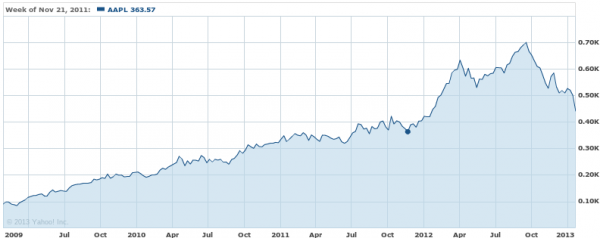
    Apple’s problem isn’t past or present, but the future and whether its decline will be as fast as the meteoric rise. Three years. The stock chart above shows steady overall climb, beginning in early 2009 through November 2011, when a steep ascent started. Apple shares soared 94 percent, before reaching a record high in September 2012. As Apple shares rose, analysts, bloggers, reporters and other writers chattered about the stock reaching $1,000 (all time high was $705.07) and market cap reaching 1 trillion. I looked askance as usual, but, that’s just me. So given the hype, Apple’s decline since is quite shocking. At close of market today, shares are down 36 percent.

    While shares fall, revenues rise. Except Apple missed Wall Street consensus two quarters in a row, which causes some people to be nutty about the stock. Meanwhile, during calendar fourth quarter, gross margin plummeted to 38.6 percent from 44.7 percent a year earlier and 40 percent from Q3. The company forecasts gross margin between 37.5 percent and 38.5 percent for calendar first quarter.

    iPad already tugs margins downward, as iPad mini cannibalizes larger slate sales. By my math, iPad category average selling prices fell 12.3 percent quarter on quarter — from $535 to $467. Year over year, iPad ASPs are down $101, Apple’s CFO admits. Only the company’s inability to manufacture enough minis to meet demand kept matters from being worse. “Our iPad units grew faster than our iPad revenue in the December quarter”, he says. “We would expect iPad ASPs to be down quite a bit in the March quarter on a year-over-year basis for the same reasons”.

    Feel the Pinch

    Something else risks margins. In November 2011 analysis “Apple is the new Dell“, I recounted how real-time manufacturing gave the Windows PC maker supply chain advantage over competitors. Apple has accomplished similar feat by using economies of scale and sheer influence to lock in lucrative component price deals that lock out competitor access.

    As I explained then about these competitors: “They’ll adapt and improve Apple’s supply-chain recipe, just like Dell’s PC competitors did a decade ago. As significant, as more manufacturing capacity comes online, Apple won’t as easily get the best prices or, by monopolizing supply, shut out competitors producing smartphones, tablets and other connected mobile devices. As components become more readily available and for lower costs, competitors can improve margins and still lower selling prices against products like iPhone and iPad”. That situation absolutely is underway right now.
    But there’s something more: All the bad buzz about Apple fosters perceived weakness that suppliers and other partners will exploit. You must understand market retribution dynamics. The powerful are often punished when weakened. Microsoft and Nokia are examples. As Apple’s reputation and share price fall, so will its muscle. Apple’s success makes it unpopular in many quarters, and nowhere more than among partners that felt gave away more than than wanted or received less of the gravy than they feel deserved. The situation makes way for competitors like Samsung, which already is a major component supplier, to lock in some good deals of its own.

    All this happens as Apple’s most important, iPhone, faces increased risk. During calendar fourth quarter, iOS smartphone share fell to 22 percent from 23.6 percent a year earlier, according to Strategy Analytics. Meanwhile, Android rose to 70.1 percent from 51.3 percent. For all 2012, iOS nudged up to 19.4 percent from 19 percent share, while Android reached 68.4 percent, up from 48.7 percent. The differences between the quarter and year, strongly suggest sales surge at the end, for Android, which forebodes poorly for Apple when iOS got big lift from iPhone 5’s recent launch.

    During calendar Q4 iPhone revenue rose to $30.67 billion from $16.25 billion three months earlier. The device accounted for 56.3 percent of all Apple revenue and 52.7 percent a year earlier. Any risk to iPhone hurts the whole company.

    What’s a Year?

    All this leads me back to the three years theme and how quickly a company’s fortunes can change and how fast the collective human brain is to forget. Hell, not even three years but one. Or less. As previously mentioned, in 10 months Apple shares rose 94 percent (leading to predictions about how high they could go) only to fall nearly 40 percent in another five (leading to speculation how low the stock will fall).

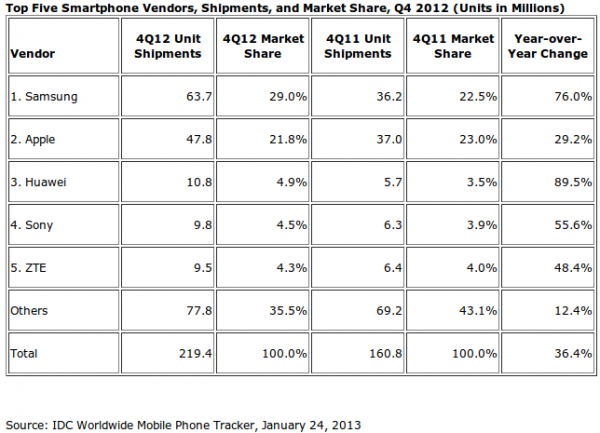
    Apple rival Samsung is startling example, too. In fourth quarter 2011, Apple actually shipped more smartphones than Samsung — 23 million and 22.5 million, respectively, according to IDC. A year later, Samsung shipments rose 76 percent, with 63.7 million smartphones to Apple’s 47.8 million.

    But Samsung claimed glory sooner, in Q1 2012, beating out Nokia in global handset shipments and Apple in smartphones, according to Strategy Analytics. The South Korean manufacturer’s rise was fast, ah hum, like Apple’s. In just 10 quarters, Samsung went from a bottom-feeding 5 percent smartphone share to top-dog 29 percent.

    Nokia invented the smartphone in the mid-1990s and was the undisputed global handset leader for years, even after Apple released iPhone. But in just three years, the Finnish-phone maker’s fortunes collapsed. Smartphone share in Q4, according to strategy analytics: 3 percent. Three years earlier: 39.2 percent. Many of the markets Nokia dominated three years ago belong mostly to Samsung and somewhat to Apple.

    Research in Motion is another example, with smartphone share ahead of Apple in Q4 2009 — 20.2 percent to 16.4 percent, respectively. Three years later, Strategy Analytics lumps RIM with Other.

    We forget how fast fortunes are made or lost. Apple’s rise is a three-year story, and it’s fall can be just as fast — as impossible as such decline might seem to many. Cloud-connected devices form a highly complex and dynamic market. Anything can happen. Apple won’t go down easy, but I promise that there will be a pileup of competitors, and even partners, seeking to do just that.

    Photo Credit: Joe Wilcox

  • Building for scale: Boundary processes 5 terabytes of data daily

    Looking back on his first year at the helm of the network monitoring company, Boundary CEO Gary Read (pictured) sees progress by all sorts of metrics, but still has his eye on the future.

    Whereas application-performance-management providers such as AppDynamics and New Relic help clients zero in on problematic code inside applications, Boundary looks out for issues slowing down the network, including the application itself.

    Based in San Francisco, Boundary has more than doubled its workforce, going from 12 employees to 28 since Read joined the company last January. Since launching in November 2011, Boundary has grown its clientele to 600 customers, 76 of whom pay for the company’s services. And the amount of data flowing into the company’s infrastructure from clients has grown substantially, from less than half a terabyte to more than 5 terabytes daily. For comparison Facebook stores 1 percent of that amount every 24 hours, according to a November post from the social networking company.

    Amount of network and application data Boundary has processed per day in recent months

    Amount of network and application data Boundary has processed per day in recent months

    Annual revenue has gone up, too, although Read declined to provide figures.

    Some infrastructure hiccups have accompanied all that growth.

    “So definitely as you continue to scale the system, it’s very difficult to test a system like this to unlimited scalability, and so as you continue to push more and more data then it will show itself in different parts of our platform, and different tiers in the application may start to run out of horsepower, or we may start to hit certain limitations in particular areas,” Read said. “We’ve seen that twice already … . In one case, we had to use solid-state disks instead of physical disks. … In another case, we’ve had to add more servers and more processing thru that infrastructure, to deal with us starting to get to capacity limits in what we could be processing.”

    More challenges could lie ahead, Read said.

    As more clients sign up for monthly or yearly contracts, more data is entering the equation. Boundary could open a second data center, exclusively for paid users, to offer better service, Read said. A service that processes one gigabyte is available to users free of charge.

    “With just the sheer volume of data being dealt with so very, very quickly, and so much insight given quickly into that data, this is something where we’re really starting to move into ground that’s never been attacked before,” Read said. And as that data grows it seems so far Read has been able to scale Boundary’s infrastructure. So far he said that the amount the company spends on infrastructure is declining as a percentage of revenue, which is to be expected since the company over-provisioned on its hardware in the early days.

    However, as time passes and Read contemplates adding more capacity, he’s confident that Boundary can continue to scale both the infrastructure and its business model. Given how useful network monitoring can be for cloud-based applications Boundary should prepare for more customers and more competition, such as the newly launched Lyatiss.

  • Grubwithus launches a social dining app for the impatient: GrubTonight

    Ever had the urge to go out to dinner at a restaurant but couldn’t find anyone to dine with? Social dining startup Grubwithus might just have an app for you. Over the weekend it launched GrubTonight, an iPhone app that allows strangers in the same city to meet up for impromptu meals with just a few hours notice. Think of it as a tweetup with a set menu.

    If you’re not familiar, Grubwithus is Los Angeles-based startup that specializes in organizing group meals for people with similar interests. Users sign up for a Grubwithus account, and then start signing up for dinners, organized weeks in advance around themes such as the love of sushi or a fascination with Ron Paul. Grubwithus pre-arranges set meals with partner restaurants, and diners prepay their bills before attending. Once there everyone only needs to cover their drink tabs.

    Grubwithus GrubTonight appGrubTonight works in a similar way, though much accelerated. The iPhone-only app — Grubwithus probably isn’t hosting any Android-lover meals just yet — alerts members to dinners being held that night along with their menus and locations. Unlike the regular Grubwithus dinners, there’s no theme, just social interaction. Diners again prepay and they receive a confirmation an hour before the meal is held. At launch, GrubTonight is only offering up meals in the LA area, but the company said it would expand to more cities in the coming months.

    Grubwithus said that the app is focused on immediacy, making it ideal for business travelers, tourists looking to meet each other or the locals or as a means for the newly relocated to meet the community. If a group of diners hit it off they can meet for future meals using the social tools in the larger Grubwithus network.

    Grubwithus is one of many startups exploring the idea of a “real-life” social network built around the communal table, but it’s developed more momentum than most. A Y Combinator alum, Grubwithus raised $1.6 million in seed funding from Ashton Kutcher, Andreessen Horowitz, First Round Capital, Aviv Nevo, and other angel investors.

    Last year, it announced a $5 million Series A round led by LA VC GRP Partners. In February it used some of those funds to buy up Canadian “supper club” startup The Social Feed, allowing it to expand internationally. In addition to LA, Grubwithus is now organizing meals in Chicago, New York, San Francisco and San Jose, Toronto and Washington, D.C.

    Photo courtesy of Shutterstock user corepics

  • VMware sharpens its focus — and its knife

    VMware’s future is all about hybrid cloud, software-defined data center and end-user computing, and not so much about other things in its portfolio which will be “de-emphasized” this coming year, VMware CEO Pat Gelsinger told analysts on the company’s fourth quarter earnings call Monday night.

    vmware-logo“I’ve learned the importance of prioritization and execution,”  said Gelsinger, an Intel and EMC veteran executive who came aboard as VMware CEO five months ago. ”We will focus first on a portfolio rationalization around the products our customers care most about. Our decision to  commit our cloud application efforts to Pivotal is an example. And we will realign resources as we scale back in some areas,” he said.

    The Pivotal Initiative, a spin off of VMware and EMC that will provide cloud and big data applications will draw on VMware’s Cloud Foundry platform as a service, vFabric Java framework, and Cetas big data resources as well as Greenplum analytics and Pivotal Labs agile development expertise from EMC.

    Key to VMware: Focus, focus, focus

    Gelsinger did not name areas that will be subject to cutbacks, but CFO Jonathan Chadwick said Sliderocket will be sidelined. VMware bought  SlideRocket and its slide presentation software in 2011. It was seen as a complement to the Zimbra productivity software purchased earlier from Yahoo. Depending on how VMware defines end user computing — my guess is it means desktop virtualization rather than desktop apps — I’d expect more cuts in this area.

    The company will also cut 900 jobs. “VMware added 6,700 people over three years and we’ll continue to grow, invest and hire in support of our focus areas,” Gelsinger said. “We expect to close fiscal 2013 up 1,000 people.”

    There was no information given about the Pivotal Initiative spin out but Gelsinger promised more discussion of that will come at a March 13 at VMware EMC Strategy Summit in New York.

    As for earnings, for its fourth quarter, VMware logged a profit of $206 million, or 47 cents per share, up from $200 million, or 46 cents per share, for the year-ago period.  Revenue grew 22 percent year-over-year to $1.29 billion with adjusted net income at 81 cents a share, beating estimates of 78 cents  per share on revenue of $1.28 billion.

    More to the point though was low guidance for the upcoming quarter. VMware expects first quarter revenue to come in between $1.17 billion to $1.19 billion, short of  consensus estimates of $1.25 billion and that spooked investors who drove the price down in extended hours trading.

    Moving on from server virtualization

    VMware is at a crossroads. It continues to lead the market in server virtualization but faces increasing competition there from Microsoft Hyper-V, and open-source Xen and KVM alternatives there. So it’s changing the conversation to network virtualization which is a key underpinning of the aforementioned software-defined data center. VMware is counting on its $1.26 billion buyout of Nicira to give it a leg up in that network virtualization quest.

  • Get iOS 6.1 NOW

    Apple today released iOS 6.1, which is available via over-the-air download. The update extends 4G LTE support to 36 additional carriers, bringing the total to 70. High-speed data is also available to 23 more carriers for iPad. Apple already supports LTE in Australia, Canada, Japan, South Korea, United Kingdom and United States, among others. New coverage extends to Denmark, Finland, Italy, Philippines, Switzerland and some Middle Eastern countries, to name a few.

    “If you look at the total of all of these and the incremental subscribers that are in those countries, that’s over 300 million”, Apple CEO Tim Cook boasts. Availability and adoption aren’t the same thing. IHS iSuppli sees global LTE subscribers reaching 198.1 million this year, up from 92.3 million — that’s 115 percent — in 2012. The analyst firm forecasts 139 percent compound annual growth rate through 2016, with 1 billion expected subscribers.

    In that respect, LTE is more an investment in the future. By contrast, with Nexus 4 smartphone and Nexus 7 tablet, Google chose HSPA+, which is more broadly deployed, allowing the release of lower-cost devices. For example, the Nexus 7 with cellular radio sells for $299, compared to $459 for iPad mini, with half the storage; comparable, price is $559. Nexus 4 with 16GB storage sells for $349 from Google, unlocked. The comparable, unlocked iPhone is $649.

    Apple claims 500 million cumulative iOS device sales through end of 2012. There are “nearly 300 million iPhone, iPad and iPod touch devices on iOS 6 in just five months”, Phil Schiller, Apple’s senior senior veep of global marketing, says. That’s 60 percent on the newest version — likely more considering not all devices sold are still being used.

    By stark contrast, only 10.2 percent of Android users are on newest version Jelly Bean. Apple’s advantage is controlling OS updates rather than letting either carriers or manufacturers do so.

    Since I don’t own any iOS devices, there is nothing to say about using the software. So, please, give us your report.

    Photo Credit: Joe Wilcox

  • On our reading list: Al Gore takes a look at The Future

    Al Gore: Averting the climate crisisAl Gore: Averting the climate crisisAl Gore posits an intriguing question in his newest book, on shelves tomorrow, January 29: can we change the future? But this book isn’t about peering into a crystal ball.  In The Future: Six Drivers of Global Change, Gore — who’s spoken at TED multiple times — breaks down the factors that are changing our world at an unprecedented pace, leaving many of us feeling something akin to temporal whiplash. As Gore outlines, these forces are: ever-increasing economic globalization, the development of a “global mind” via instant communication, a global balance of power with multiple centers, an economic compass pointing toward unsustainable growth, revolutions in the field of genomics and biotech,Al Gore: New thinking on the climate crisisAl Gore: New thinking on the climate crisis and a disruption of the relationship between people and the earth’s ecosystems.

    “What do you think about when you hear the phrase ‘the future?’ Is it a hopeful place? Is it a little scary? Does it seem like things are speeding up more than in the past?” Gore asks in a trailer for the book, above. “Well, they are. There are large forces that are shaping and reordering the world we’ve always known.”

    But he promises that the tome isn’t all doom and gloom.Al Gore warns on latest climate trendsAl Gore warns on latest climate trends

    “No matter where in the world we live, we face a choice—either to be swept along by the powerful currents of technological change and economic determinism into a future that may threaten our deepest values. Or shape the future in ways that protect human dignity and reflect the aspirations of people and nations throughout the world,” he says. “Mapping the future is a risky undertaking. Perhaps the only thing riskier is doing nothing.”

  • Sierra Wireless sells 3G/4G modem biz to NetGear, refocuses on the internet of things

    The company that coined the term AirCard will make AirCards no more. Sierra Wireless is selling its 3G/4G modem business to NetGear, which take over the manufacture of its line of mobile hotspots, wireless dongles and data cards.

    NetGear will pay $138 million in cash and assume $6.5 million in liabilities as part of the transaction, which will allow the popular Wi-Fi router maker to expand beyond wired and Wi-Fi networking into the cellular market.

    External modems were once Sierra’s bread and butter, but over the last five years it began to focus much more an embedded radio modules and the machine-to-machine market, making a few key acquisitions along the way. Meanwhile cellular modems are becoming more of a commodity business.

    Sierra has probably seen the writing on the wall. As more smartphones and tablets come with their own hotspot capabilities there will be less need for stand-alone modems, so it’s a market it seems ready to concede to Novatel, Option and networking gear makers like NetGear.

    Meanwhile, as the internet of things take shapes more and more devices will start sporting cellular radio connectivity – not just laptops and tablets but also home appliances, cars and even wearable electronics. It’s in those devices Sierra wants to embed its connectivity.

  • President Obama Welcomes the Miami Heat to the White House

    President Obama accepts a basketball from LeBron James of the Miami Heat, Jan. 28, 2013

    President Barack Obama accepts a basketball from LeBron James during a ceremony honoring the Miami Heat and their 2012 NBA Championship victory, in the East Room of the White House Jan. 28, 2013.

    (Official White House Photo by Lawrence Jackson)

    As NBA world champions, the Miami Heat are used to receiving honors and acclaim, but during a reception today with President Obama, the team's standout forward — and reigning league MVP — LeBron James made it clear that this celebration was unlike any other. "We're in the White House right now," he said. "This is like, hey, mama, I made it."

    The team was invited to commemorate their award-winning 2012 season, but in his remarks, President Obama thanked the group for spending time with some wounded warriors at Walter Reed, and paid tribute to the important role team leaders including James, Chris Bosh and captain Dwayne Wade, also play off the court:

    One of the things I’m proudest of is that they take their roles as fathers seriously.  And for all the young men out there who are looking up to them all the time, for them to see somebody who cares about their kids and is there for them day in and day out, that's a good message to send.  It’s a positive message to send, and we’re very proud of them for that. 

    read more

  • Twitter acquires Crashlytics team for mobile app development

    Twitter and the Cambridge-based startup Crashlytics have announced that they’re joining forces, bringing the team that has helped other startups test their mobile versions for potential bugs and crashes into the fold at Twitter.

    Crashlytics wrote on the company blog Monday about their plans for mobile app development in tandem with Twitter:

    We built Crashlytics to deliver the world’s most powerful and lightest-weight crash reporting solution. With us, developers gain instant visibility into the precise line of code that caused a crash, enabling them to more easily fix issues. Since our iOS launch, we’ve had the privilege of working with thousands of incredible app developers, from those building independent passion-projects to many of the top iOS apps available today – Twitter, Vine, Yelp, Kayak, TaskRabbit, and Waze, to name just a few.

    Going forward, we’re thrilled to work with the incredible team at Twitter. We share a passion for innovating on mobile and building world-class applications. Joining forces will accelerate our build-out, allowing us to leverage Twitter’s infrastructure to deliver new features faster than ever.

    The Crashlytics team hails from Cambridge, and the Boston Globe profiled the company in April 2012, where the founders discussed their motivation for starting the company to help other startups understand what was causing crashes on mobile. Presumably Crashlytics will be working on Twitter’s mobile app to improve performance, which is crucial as Twitter tries to improve reliability and scales out the company going forward.

  • In the platform wars, open is ultimately more valuable than closed, says Betaworks

    When it comes to the future of the web, there are a few incubator-style seed investors that are worth paying attention to, and New York-based Betaworks is likely at or near the top of that list — founder and CEO John Borthwick has been an early proponent of some of the foundational shifts in social media and web services, including the rise of Twitter. In the latest version of his letter to shareholders and in a phone interview with GigaOM, Borthwick said that one of the themes he finds most compelling is the ongoing tension between the open web and closed platforms like Facebook, Apple and even Twitter. And in the end, he says, open will prevail.

    Although Facebook may look indestructible on the social networking side, with its $70-billion market cap and its billion-plus user base, and Twitter may seem equally dominant in another aspect of the real-time information economy, Borthwick argues in his letter that these big, incumbent platforms “are not as well positioned for the future as you might think.” For one thing, he says the drive to monetize these platforms is pitting the needs of those companies against the interests of their users:

    “One of the big stories of 2013 is the rising tide of tension between what the users want to do on a platform and what that platform’s owners want their users to do, in order to expose them to an adequate quantum of advertising. Platforms feel they have to impose controls to get users to do what the users don’t want to do naturally. It is reasonable to expect that some of these platforms will overplay their hands, creating significant opportunities for new social networks to emerge.”

    The islands won’t prosper like the oceans

    In an era when bandwidth is so readily available, and users have become accustomed to all of their data living somewhere in the cloud — a philosophy that has ironically been encouraged by those same incumbent platforms — Borthwick argues that many users are “ready, willing and able to move” to another network or service if push comes to shove. Having attracted users so rapidly in part by teaching them how “rootless and transient” their relationships can be, he says, some of these companies will ultimately learn how easy it is to lose touch with their user base.

    “Platforms are typically trying to control and centralize experiences with the opposing tension being the pull of their users at the edge. As billions more users join these networks over the next few years, the pull of the edge will get even stronger. That pull will make centralized architecture models hard, if not impossible, to execute against. There will be exceptions, but the islands won’t prosper like the oceans.”

    location-map-610x407

    Even with a company like Apple, which many would say is the quintessential closed and controlling platform, Borthwick argues there is evidence of how powerful open can be: namely, the response when Apple shut out Google’s map application in favor of its own lower-quality application. The response from users seems to be part of a larger trend in which many are switching from Apple apps and services to Google ones (I wrote about some of my own experiences in that area recently, and why I am considering switching to an Android).

    In our interview, Borthwick made it clear that openness does not necessarily equal free, and that some bastions of openness such as Google are only free at certain layers of what he calls the application “stack” — so, for example, Gmail and Google Maps are open, but the search algorithm is not. The Betaworks founder also agreed with Benchmark partner Bill Gurley, who said in a post last year that Google is very good at building “moats” around its core properties by offering free versions of software and services that integrate with them. Android arguably fits that strategy, Borthwick said.

    Open systems are more resilient and more valuable

    In any case, for Betaworks and its companies and offerings — which include the revived version of Digg and a range of experimental apps like Tapestry, as well as established companies like Chartbeat and Bitly — Borthwick says that open will remain the key to long-term viability and success. And closed platforms such as Facebook (and Twitter, which he argues is becoming more and more closed in an attempt to monetize its user base as quickly as possible) are growing more and more risky:

    “It is a core Betaworks conviction that open systems will prove more compelling, more resilient and more valuable to users than closed. Or to say it perhaps a bit more precisely: In a multiplatform world where open and closed systems will always co-exist, the force and power of openness will ensure the existence of a viable ecosystem for application and service builders like betaworks.”

    There are plenty of other things worth reading in the letter, including an assessment of the evolution in financing for venture-backed startups (something the company and its seed-stage, incubator-style focus are clearly a part of) as well as the implications of the “contextual internet,” in which apps and services respond more intelligently to what we are doing and where we are doing it. And Borthwick argues that data will be the killer factor for any company that wants to become successful, whether with advertising or any other content. Read the whole thing here.

    Post and thumbnail images courtesy of Shutterstock / Luis Santos and Flickr user Dunechaser

  • Internet Explorer 10 Adoption Slow Going, Still Strong Overall

    In a perfect world, everybody who uses Internet Explorer would be on the latest version so all the problems affecting IE8 wouldn’t be happening. Unfortunately, or fortunately depending on who you ask, IE10 is only available on Windows 8. That means Microsoft’s latest browser isn’t doing super well in its second month on the market since Windows 8 isn’t doing that well either.

    Despite having sold 60 million Windows 8 licenses since launching at the end of October, the latest browser marketshare numbers from Net Applications shows that Internet Explorer 10 hasn’t even cracked one percent yet. Being exclusive to Windows 8 isn’t doing the browser any favors. There’s a beta for IE10 on Windows 7, but it has received little to no publicity from Microsoft. It probably didn’t add much to these numbers.

    That being said, Internet Explorer is still king. Overall, the browser still has a majority of the browser marketshare at 54.77 percent. When broken down, the constantly hacked Internet Explorer 8 is used the most with 23 percent of the marketshare and the much safer Internet Explorer 9 coming in 21 percent.

    As for the other browsers, Firefox and Chrome are still battling it out for second place. Firefox was in the lead in December with 19.82 percent of the market while Chrome lagged closely behind with 18.04 percent. Safari and Opera came in at 5.24 percent and 1.71 percent respectively.

    In mobile browsers, Apple Safari for iOS is still by and large the dominant force with 60.56 percent of the marketshare. The generic Android browser and Opera Mini are the only other mobile browsers with percentages in the double digits with 22.10 percent and 10.71 percent respectively. Chrome is picking up pace, however, as it has increased from 0 percent to 1.48 percent in only a year. Not bad for a relative newcomer to the mobile browser scene.

  • Tina Fey: Mean Girls Musical May Happen

    Though Tina Fey is, perhaps, most well-known for hosting the Weekend Update segment of Saturday Night Live and playing Liz Lemon on 30 Rock, one turning point in her career can be traced to the movie Mean Girls.

    Mean Girls was written by Fey, and even starred the comedian herself as a disrespected high school math teacher. Though the movie was marketed as a teen comedy about backstabbing popular girls, the smart humor in the flick managed to make it a cult-classic and a hit with critics. Mean Girls was also one of the last movies to feature a pre-meltdown Lindsay Lohan, and is Amanda Seyfried’s first movie.

    Now, it appears that even more Mean Girls could be on the way.

    In an interview with E! on the red carpet at the Screen Actors Guild (SAG) Awards, Fey revealed that the rumored Mean Girls musical is actually in the works.

    “I would love to,” said Fey when asked about the project. “I’m trying to develop it, actually, with my husband, who does all the music for 30 Rock and I think Paramount’s on-board.”

  • Google invites you to hack Chrome OS

    Google is moving forward with Chrome, both the web browser and the operating system, quickly and seems to be gaining traction. Sure, the browser is popular, but the OS struggled early on, but new notebooks, err…Chromebooks, have been getting a lot of attention, including TV ads in the United States.

    However, the search giant has learned that security is pretty important to the end-user, and probably more so to those looking at these computers, because buyers probably tend to be more on the “techie” side. That is why Google has annually invited people to “hack” Chrome in an effort to find and fix flaws.

    Today the Mountain View, Calf.-based company announced this year’s “hackathon”, titled “Pwnium 3”. Hackers and security researchers are invited to attend the CanSecWest conference and take their best shots.

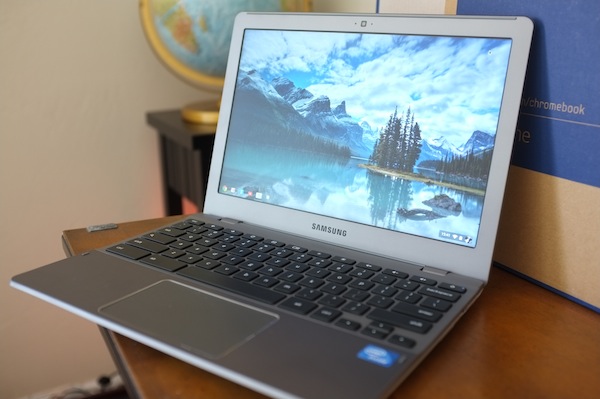
    Chris Evans of the Google security team announces today that the “attack must be demonstrated against a base (WiFi) model of the Samsung Series 5 550 Chromebook, running the latest stable version of Chrome OS. Any installed software (including the kernel and drivers, etc.) may be used to attempt the attack”.

    So, why would you be inclined to try this, aside from the obvious bragging rights? There are some pretty good reasons, and they involve financial gain for the successful “hack”. Evans outlines those details as well.

    • $110,000: browser or system level compromise in guest mode or as a logged-in user, delivered via a web page.
    • $150,000: compromise with device persistence — guest to guest with interim reboot, delivered via a web page.

    That should be more than enough incentive to pack up your bags and fly to Vancouver, British Columbia. CanSecWest will take place March 6-8 of this year.

    Photo Credit: Joe Wilcox

  • Suh Saves Man In Pool (Man Happens To Be Comedian Louie Anderson)

    Ndamukong Suh, the famous (or infamous, if you prefer) defensive tackle for the Detroit Lions reportedly saved comedian Louie Anderson from drowning (along with help from famed diver Greg Louganis). You couldn’t make this up.

    Suh is to appear on Splash, a reality show about diving, a move even his teammates have reportedly spoken out against. I guess it’s a good thing for Anderson he was there. TMZ reports:

    Sources close to the production tell TMZ, Louie — who’s a contestant on the show — was practicing his dives on Wednesday when he became a little too bushed to pull himself up the ladder … falling back into the water again and again.

    We’re told Louie eventually had to be rescued by Suh and divemaster Greg Louganis — who physically lifted the foundering funnyman to the poolside. Louie then sat coughing up water for several seconds.

    So, there’s at least one more person that probably doesn’t have a problem with Suh, despite his bad reputation as a dirty player.

    The episode on which Suh will appear will air on Tuesday, March 19 at 8:00 PM on ABC.

    Suh recorded two tackles in the Pro Bowl on Sunday.

    Image: Ndamukong Suh (img.ly)

  • After a rise and fall, BlackBerry 10 is RIM’s last, best comeback attempt

    The year was 1999 when Research In Motion first unveiled its initial BlackBerry email pager, the beginning of a strong product brand that continues to this day. In that time, the ubiquitous BlackBerry has grown beyond a simple email machine to capable smartphones in 2003, gathering a cult-like following of “crackberry” users.

    blackberrysGiven that success, it once seemed unfathomable that RIM wouldn’t easily be one of the world’s top 5 smartphone makers, yet in 2012 it barely held on to the fifth spot as Samsung, Apple, Nokia and HTC sold more smartphones. Put in perspective: RIM’s 32.5 million smartphones sold all year were easily trumped by Apple 47.8 million handsets sold in the final quarter of 2012 alone.

    As quickly as RIM’s BlackBerry rose to the top in the first half of the last decade, it just as quickly fell behind the touchscreen smartphone revolution started by Apple in 2007. Now, after several years of losing market share and stalling growth of its BlackBerry subscriber base, RIM is rebooting the product line this week with the debut of BlackBerry 10.

    Not the first time for a comeback effort

    This isn’t the first of RIM’s attempts to compete with the current crop of smartphones. 2008 saw RIM debut the BlackBerry Storm, an all touch device that created little more than a drizzle in the market. In 2010, the company launched the BlackBerry Torch 9800 along with the BlackBerry 6 operating system and a WebKit browser. But after using an evaluation device, I felt — as did others, based on meager sales — the Torch was an evolution of the same old BlackBerry experience, not the revolution that RIM really needed at the time.

    playbook4Aware that it needed something new for the future, that same year saw RIM purchase QNX Software Solutions from Harman International. At the time, QNX was used for many in-car information and entertainment systems. RIM’s BlackBerry PlayBook tablet was the first RIM product to use a QNX-based platform and while it was good at what it did, the slate was missing key features: A native email client for one, and direct access to RIM’s popular BBM messaging service.

    Amid those feature misses and lackluster sales, I suggested that RIM made a mistake by putting QNX on a tablet before using it to power BlackBerry smartphones. In hindsight, however, it appears that RIM had little choice: It was reportedly having problems getting the BBM service on PlayBooks because the service is limited to a single device per user. And it took nearly a year to get a native email app on the tablet. It appears to me now — as it did then — that RIM was simply trying to beat others into the nascent and quickly growing tablet market that began in earnest with the iPad in 2010. As a result, it launched a product well before perfecting the experience.

    So why is this time different?

    We’ll know more after Wednesday’s BB 10 launch in New York City, but hints of potential success for RIM are popping up all over the web. First up is the hardware, expected to be two initial handsets; one with a physical keyboard and one, dubbed the Z10, without. From the various leaked images and video of what’s likely a developer phone model in use, they appear perfectly capable and comparable in performance to other high-end smartphones available today.

    bb10-iphone5What about the operating system? Considering that RIM originally planned to have a new platform on phones by early 2012, it has had an extra year to work on BB 10. That year proved tumultuous with the co-CEOs stepping down, market share dropping, pleas to developers to stay the course and barely any growth in BlackBerry subscribers. From the little bit of BB 10 I’ve seen so far, however, the wait may be worth it.

    Expect to hear much about BlackBerry Flow at the launch event: This is RIM’s tightly integrated method of quickly navigating through the operating system in a consistent manner. BlackBerry Hub is the centralized communications center while the BlackBerry software keyboard should provide for fast, accurate entry.

    There’s more to smartphone success than hardware and the OS, however. It seems like RIM has also learned the lesson that mobile apps and content deals are also important. On the app side, the company has put enormous effort into courting developers, even poking fun at itself in a music video. (Hear what RIM’s Alec Saunders has to say about that in our podcast interview.)

    As a result, tens of thousands of apps are likely to be available once the new devices launch. And just today, RIM shared details of its unified content store, listing out all of the media partners, along with news of next-day television content availability. Add in support from carriers — all four major operators in the US plan to sell the new BlackBerry devices — and the puzzle pieces of potential are all there.

    The most likely outcome

    What are the odds that Research In Motion has a hit with the new BlackBerry 10 devices? I’ll have a better idea when I attend the launch event, of course — and I’ll be live-blogging from there — but based on the limited information I have so far, RIM should at least be staying in the smartphone game.

    As I’ve said to many over the past few months, the new devices should appeal to current BlackBerry owners. My unanswered question now is: Will there be enough to sway people away from iOS and Android phones? Until we know more, I think it’s a safe bet that RIM keeps its current user-base happy and possibly steals some market share from its peers.

    Either way, if RIM delivers what I expect in BB 10, it stays relevant in a market where nearly 6 billion people don’t yet have a smartphone. There’s much growth to be found yet, even if BB 10 doesn’t unseat the current smartphone incumbents. But even with the right recipe and ingredients, there’s no guarantees for RIM. Challenges still loom for the company as whole and maintaining a sliver of market share may not be enough for the long road ahead.

  • Facebook for iOS Gets Voice Messaging, In-App Video Recording

    Facebook has just rolled out an update to its iOS app that brings features that previously launched on Facebook Messenger for both iOS and Android.

    Starting today, you can now send voice messages from within the Facebook app.

    Earlier this month, Facebook added voice messaging to its Facebook Messenger app. That was later bolstered with free VoIP calling in the U.S. and Canada from within the app.

    Users now also have the ability to record and share videos from inside the app as well.

    The last update to Facebook for iOS was a speed boost back in mid-December.

    You can grab the updated app from the App Store right now.

  • Office 2013 launches January 29 in NYC

    Microsoft is announcing something Office-related tomorrow, January 29th. That much is clear given all of the evidence that popped up over the weekend and has continued to mount today. Still, the company likes to hold some secrets and stating something emphatically would be inappropriate reporting on my part. However, trying to connect the dots is a fun exercise that we certainly can do.

    First, over the weekend a new website from Microsoft appeared with a teaser message —  “Coming January 29th. More time to do the things you want. #timeto365”.

    Then today, John Callaham reported on Neowin that actress Felicity Huffman, of Desperate Housewives fame,  had posted a tweet that stated “Packing up to brave the cold in NYC to help launch MS Office 365, use it, love it. Excited to see some plays”. Okay that last sentence is irrelevant to this story, but it was part of the entire quote. Even Microsoft’s own Twitter account tweets teasers.

    We also have heard that Office 2013, which is integrated with the online Office 365, will launch in early 2013 — we even have received pricing details.

    Still, as I stated earlier, Microsoft is playing the Apple game these days. Attempting to keep secrets and hold big press events. When I reached out earlier to a spokesperson I was told, despite all of this, that “we have nothing more to share at this time”. So, we wait until tomorrow for what seems obvious, but can not yet be called official, despite the best evidence and hunches.

    Oh, hell, surely the official Office Twitter account is confirmation enough. Could Microsoft be any less obvious?

  • German rights holders sue YouTube in escalating royalty fight

    German music rights group GEMA has filed a lawsuit against YouTube, alleging that the video site is misleading users about the details of an ongoing licensing dispute between the two parties. The lawsuit is the latest escalation in that dispute, which has been going on since 2010, and resulted in German YouTube users being unable to view many popular music videos on the site. GEMA is now asking a Munich-based court to issue a cease-and-desist order in order to prevent YouTube from blaming GEMA for this mess.

    I know, it’s confusing, but bear with me. Here’s what happened so far: GEMA, which represents recording artists as well as publishers, wants YouTube to pay a fee for each and every video viewed on the site that contains music of one of the artists represented by GEMA (which include every major label artist, as well as most indies). YouTube has rejected that approach, and instead wants to pay a percentage of the ad revenue it makes with those videos.

    Negotiations between both parties broke down in 2010, and GEMA asked YouTube to block videos containing music of some 600 artists. YouTube responded by blocking a wide range of videos, telling users that these videos are “unfortunately not available in Germany” because they could contain music for which GEMA hadn’t granted the rights to YouTube.

    GEMA officials have long complained that this wasn’t true, suggesting instead that YouTube simply didn’t pay for licenses to these rights. Of course, the licenses that YouTube is offering are based on the rates that YouTube is challenging, so it’s pretty much semantics and fingerpointing.

    Except, most users are upset about GEMA, and the group apparently doesn’t want to shoulder all the blame anymore. GEMA’s CEO Harald Heker told local paper Wirtschaftswoche that YouTube’s handling of the blocking is “pure demagogy.”

    A YouTube spokesperson sent me the following comment about the lawsuit:

    “YouTube believes that rights holders and artists should benefit from their work. We have dozens of collection society deals in place across more than 40 countries because we provide an important source of income for musicians and a platform where new artists can be discovered and promoted. We are open for negotiations to find a solution with GEMA compatible with YouTube’s business model so that we can again provide a source of revenue for musicians and a vibrant platform for music lovers in Germany.”

    So there you have it. Each side wants to sound completely reasonable as, all the while, the actual licensing dispute drags out further and further. At this point, it’s pretty unlikely that German YouTube users are going to get access to their music videos any time soon.

    Image courtesy of Flickr user  nyghtowl.