Author: Alan Buckingham

  • Digg survey: Two in 10 ‘check Google Reader many times a day’

    The furor over Google Reader’s eminent demise, while quieter, is by no means over. Today, Digg pours gasoline on the fire, by publishing results from a survey about subscription habits. Late last month, the social news site announced intentions to build its own RSS solution. The company made the task the number one priority and immediately began asking for feedback. Among the 17,000 people who signed up to help shape the product, 8,000 returned surveys.

    Keep in mind this is a self-selected group of people most likely to use RSS and doesn’t really represent the habits of most Internet users. Results show that “80 percent of respondents check Google Reader many times a day, and 40 percent follow more than 100 feeds”. In addition, more than 75 percent of the respondents say they use Google Reader for both work and play and the the most popular response to question “If there’s one thing you could remove from Google Reader what would it be”? is “nothing”.

    Digg is working furiously to use this data to build the new app, but warns that “we’ll need to make sure we have some serious infrastructure in place to support that kind of usage for launch”. However, the social service also cautions that every capability may not be in place at the time of the beta launch, though it gives no timeframe for that introduction.

    Digg isn’t alone filling the void Reader’s imminent demise will leave. Feedly received 500,000 new users in the days following Google’s death notice, while other services, like The Old Reader, have simply come close to unusable in the wake.

    Google has simply shot itself in the foot with this move — the market was there, but the company foolishly thinks that the elimination of Reader will somehow force more users to the Google+ social network in order to scan news. However, the services are not related and Google has only alienated customers and created a feeling of distrust among its once-faithful base.

    Photo Credit: NinaMalyna/Shutterstock

  • Google actively plans for your demise

    They say nothing is certain but death and taxes. Google has experience avoiding the latter and wants you to plan for the former. While I can only assume that Google would prefer you stick around and use its services and click on the ads for as long as possible, the company has a Plan B. Despite the incredible attempts being made by both medical science and Ray Kurzweil, the search giant goes in another direction. Instead of memorializing you online as some sites allow you to plan for, Google prefers you simply plan what happens to your account when the Grim Reaper comes calling.

    The company has released a new settings page so you choose what happens when your account becomes inactive. While Google will not actually come out and use the word “death”, it certainly does an excellent job implying that this is what is meant — perhaps the company did not consult with Mr. Kurzweil, its director of engineering and author of the book The Singularity Is Near: A True Story About the Future.

    Google’s new settings page provides a number of options, including, first and foremost, an alert system to let you know your account has become inactive — you know, just in case you have not “moved on”. The alert can be set to message you by either email or text before phase two kicks in — handy for those who opt to be buried with their phones. As the company puts it “there are many situations that might prevent you from accessing or using your Google account”.

    If the worst has come to pass then you can also choose what happens from that point on. Customers can add contacts whom they wish to be notified regarding the fact that their Google account is no longer active, share data with those included on the list and even set the account to be deleted on their behalf. The page claims “using Inactive Account Manager, you can decide if and when your account is treated as inactive, what happens with your data and who is notified”.

    It is a sad, but inevitable need that Google is filling with this new service. Perhaps the company and Kurzweil could devote more time to circumventing this need than preparing for it. This may be a bit more important than self-driving cars and glasses that shoot video.

    Photo Credit: Fer Gregory/Shutterstock

  • Project GeoFlow gets public preview

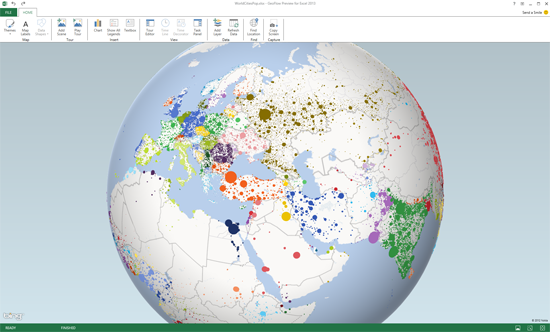
    Microsoft announced GeoFlow at the SharePoint conference in November 2012 and today rolled out a public preview of the 3-D mashup that combines the Office spreadsheet app Excel with Bing maps to allow you to plot geographic and temporal data visually.

    Microsoft Research claims that GeoFlow “enables information workers to discover and share new insights from data through rich, 3-D data on a globe and fluid, cinematic guided tours—virtual cinematography moving through data”. The app evolved out of the WorldWide Telescope project. “We built a gigantic virtual telescope, but to do so, we had to build an engine that could visualize the universe. If we can visualize the universe, we can visualize almost anything else”, Microsoft Research principal researcher Curtis Wong explains.

    Wong says that with GeoFlow the goal was to bring dynamic and interactive data visualization to the business world. “We wanted to explore new tools that could help us understand the large-scale temporal and geospatial trends that affect businesses” Wong says.

    The project was greenlighted way back in June 2011, but has taken some time in development. “Sometimes research requires a long-term view”, Wong states.

    Now every users can begin experimenting with GeoFlow, but you will need to be running either Microsoft Office Professional Plus 2013 or Office 365 ProPlus in order to give it a test run.

  • Dropbox for web and Android updated

    Yesterday Dropbox for business received a big update with single sign-on. Now, today, the company rolls out new features for the consumer version of its cloud storage service. New updates have been added to the PC, Mac, Linux, web and Android apps, but those on iOS will have to wait.

    All versions receive support for six additional languages — Russian, Polish, Indonesian, Malaysian, and Traditional and Simplified Chinese. Reginald Harris of Dropbox claims the company has translated 553,800 words in 43,662 lines of code to make this possible. Harris states this enables “sharing your most important stuff with friends and family — no matter where in the world they are or what language they speak”.

    In addition an update has rolled out to Android devices bringing the service to version to 2.3.5 and adding support for viewing all photos in your Dropbox, a feature that began being tested on the web back in January of this year. The new version also adds the aforementioned new languages and the usual performance enhancements.

    Dropbox, which was founded by MIT students in 2007, now has more than 100 million users worldwide and claims usage in 95 percent of the Fortune 500 companies.

    Photo credit: mojito.mak[dog]gmail[dot]com/Shutterstock

  • Dropbox single sign-on means business

    Dropbox adds features gangbusters in an effort to compete with rivals like SkyDrive, which is now built into Office 2013 and will get deeper Windows integration when “Blue” is released. Now Dropbox for business has announced it will be adding single sign-on, or SSO, a feature the company claims is near the top of the request list from business users.

    Dropbox’s Anand Subramani claims the company is working with Ping Identity, Okta, OneLogin, Centrify, and Symplified to make this new feature a reality. If a company has already built its own SAML-based federated authentication process then it will work with Dropbox also. Once logged in to your system, there’s no need to sign in to Dropbox separately. Subramani also promises that “using the industry-standard Security Assertion Markup Language (SAML), this implementation of single sign-on integrates easily with any large identity provider your company may use as long as it also supports SAML”.

    The cloud storage company also boasts few numbers. For instance, Dropbox claims its service is now used by 95 percent of Fortune 500 companies and more than two million businesses overall. It also claims that those businesses move over 600 million files to Dropbox every week.

    The new update is available now and Dropbox promises that it will continue to innovate with new features for corporate customers, though there were no hints given regarding what will be next.

    Photo Credit: Fer Gregory/Shutterstock

  • Office 365 scores a big win with ABB

    Microsoft has been racking up contracts between Office 365 and businesses and governments recently, including eight new ones just announced in March. Now the company may have made its biggest score yet, partnering with world-wide power and productivity company ABB.

    According to Andy Tidd, chief information officer at ABB Group, “Office 365 and Yammer will enable us to transform communication and collaboration among our employees, surfacing the best and most innovative ideas across the organization”.

    ABB operates in 100 countries around the world and employs some 145,000 people. The company will be transitioning from multiple IT collaboration and messaging solutions to Office 365 to provide a single platform for productivity, communication, collaboration and enterprise social in the cloud.

    Microsoft’s Chief Operating Officer Kevin Turner states: “When you remove barriers to productivity and innovation and enable employees to collaborate and communicate even more freely and seamlessly across organizational and geographical boundaries, incredible things happen”.

    Microsoft goes on to promise a long-term cost savings of 15-20 percent in travel expenses alone thanks to the service’s online meeting capabilities. It’s a major win for Microsoft and another sign that the company is not going away anytime soon, despite what some would have you believe.

  • Google Play 4 app rolls out

    Late last week rumors surfaced that Google Play store would update, which according to the APK file is officially version 4.0.25, and sporting a whole new look. Today that news becomes official as Google confirmes that the latest version is beginning its slow, but steady, march to Android smartphones and tablets.


    Michael Siliski, group product manager for Google Play, announces that “today we’ve started rolling out a redesigned Google Play store on Android phones and tablets that is simple, clean and, most importantly, helps you find great entertainment, fast”.

    The complete redesign of the app is focused on content, with larger images, similarly themed content grouped together, new recommendations and simplified purchasing, according to the announcement. Also in my quick look at the the new version, the My Apps page has also changed, with a brand new look. All of these updates are coming to any device that is running Android 2.2 (Froyo) or newer, so almost nobody should be left out. But, remember, while Google Play runs on most devices, the store displays apps your Android version supports.

    No need to go rushing to your device yet because Google claims that people around the world will get the latest Google Play over the next few weeks, meaning this is a gradual roll out, though an APK file has already made its way out onto the Internet. So, if you just can’t wait, and do not mind taking your chances, then very little snooping around is required to get the update today, as I have already done.

  • Pandora now has 200 million music lovers

    If you have followed me for anytime now then you probably already know that I am a happy Pandora customer. The music app gets me through my days in my lonely office of one. It turns out, I am not the only fan of the streaming service as I have 200 million friends joining me.

    Pandora announces that it has passed that milestone after eight years in the market. While the personalized radio service came online back in 2005, it took until July of 2011 to reach the first 100 million users, but growth has obviously expanded exponentially since then.

    Pandora founder Tim Westergren says, “We started this company to help people discover and enjoy music they love, and to help artists reach and grow their audiences. Only in our wildest dreams did we imagine what it would become. It is now clear that radio is changing, and that’s great news for music fans and for the tens of thousands of working artists who now have a home on the air”.

    There are also some rather interesting statistics that come along with the announcement. For instance, Pandora claims that it streams 200 million songs before 10 am daily, listeners have personalized their stations with more than 25 billion thumbs, last month Pandora played more than 100,000 unique artists and more than 1 million unique songs and more than 140 million listeners have tuned in to Pandora on a mobile device.

    Statistics for how many of those customers were on paid accounts versus free were not included in the announcement. Personally, I find the $3.99 fee a small price for the lack of ads and unlimited mobile streaming — I listen on my phone as opposed to my PC.

    Photo Credit: Regissercom/Shutterstock

  • Microsoft rolls out Office 2010 SP2 beta

    By now a number of you have probably joined me in moving on to Office 2013, either the desktop version or the new Office 365 Home Premium subscription adaptation of the suite. However, there is nothing wrong with the previous Office 2010 release of the product, and many users and businesses are still running that software.

    For those, there is some good news this morning — Microsoft has released a beta version of Service Pack 2 for Office 2010. The SP2 beta also includes Sharepoint 2010 support as well. In addition, it has improved support for Internet Explorer 10 and Windows 8, updates for system reliability, program compatibility, security and more.

    According to the Microsoft Office Sustained Engineering Team, “As of today, customers can download the beta for Office 2010 and SharePoint 2010 SP2. In addition to updates for the desktop and server apps, this beta also includes full-product SKUs of SharePoint and related server products, updated to install on Windows Server 2012”.

    The download is free, but of course you need a Microsoft account for logging in, and there is the usual terms of service that you must agree to in order to download and install the update. Both 32-bit and 64-bit versions are available. Microsoft does not say how long the beta period will last.

    Photo credit: kurhan/Shutterstock

  • Game time: Bing talks NCAA championship

    Tonight is the big game, the culmination of March Madness despite the month having changed to April. It is one of the most heavily followed sports tournaments and betters win and lose fortunes with their brackets. This year Louisville and Michigan square off on the court for a chance at history.

    While Bing, the Microsoft search engine, does not pretend to make predictions about which college will emerge on top when the final buzzer sounds, the service did release a bit of data about what fans are searching for in the time leading up to the showdown.

    If searches won championships then it appears that number one seed Lousiville would have this game in the bag, as Bing reports it as the more popular term. Microsoft’s search team also tells us that “while Kevin Ware won’t be playing in the championship game, he is still the most searched player of the tournament. He is followed closely by Michigan point guard Trey Burk”.

    Finally, the search engine reports that the mascot battle is also being won by Lousiville, with the Cardinals being more sought after than the Wolverives.

    Of course, none of this means a thing once tip-off occurs. It also is not a stretch of the imagination to think the number one seed entering the tournament would be the most searched for. Still, the statistics are fun and something to occupy us as we await game time later this evening.

    Photo Credit: IDAL/Shutterstock

  • HP makes a Moonshot

    Before you think that Hewlett Packard is joining the Jeff Bezos-Elon Musk space race, I should clarify that the new HP Moonshot is actually a server that the company unveiled today. HP hopes that this new architecture will be a revelation to the current server market with a number of new features.

    First, HP promises, not the moon, but that Moonshot will use 89 percent less energy, 80 percent less space and cost 77 percent less, compared to traditional servers.

    HP’s Gizmo Gladstone (I didn’t make that name up) claims the hardware will improve the Internet by “hooking up companies on the backend to better handle all the challenges that come with processing cloud, social, mobile and big data”. Meanwhile CEO Meg Whitman says “HP Moonshot marks the beginning of a new style of IT that will change the infrastructure economics and lay the foundation for the next 20 billion devices”.

    This second-generation Moonshot server is more energy efficient and smaller, according to the company, because it is built from chips more commonly found in smartphones and tablets and each chassis shares traditional components including the fabric, HP Integrated Lights-Out management, power supply and cooling fans. HP also claims it can support up to 1,800 servers per rack.

    The first HP ProLiant Moonshot server is available with the Intel Atom S1200 processor and support for web-hosting workloads. The company claims it is already using Moonshot to power HP.com and handle three million visitors daily. Get out your checkbook because the price begins at $61,875.

    Photo Credit: Michal Ninger/Shutterstock

  • Are you ready? Messenger merges with Skype

    By now you probably already know that Microsoft Messenger is going away in favor of uber-communication app Skype, which Microsoft purchased back in 2011 for a whopping $8.5 billion. The app, released back in 2003, is slowly being merged into Microsoft products. In fact, the latest iteration of Office, 365 Home Premium, comes with free Skype minutes as part of the package.

    Today is that day when Messenger officially merges with Skype. Until now, users had the option, strongly urged by Microsoft, to make this move on their own. That no longer is just an option. The company sent out a warning email back on March 21.

    As you may have heard, starting April 8th, 2013 we are bringing the great features of Messenger and Skype together, including your IM and contact list. (April 8th is the first day that you may be required to upgrade to Skype).

    We know saying goodbye can be hard, but don’t worry. Not only will all your Messenger contacts appear in Skype when you upgrade and sign-in, but you can also redeem a free welcome gift. Follow the instructions below to enjoy calls to landlines and mobiles around the world, group video calling, group screen sharing (and more) absolutely free for a month. We want to thank you for being a Messenger customer and even more, are excited to welcome you to Skype!

    Messenger has had a long run, having been around since 1999, but today the official obituary can be written. This is just one more part of the massive scaling down Microsoft is doing with its Live suite of apps, which are now known simply as Windows Essentials.

    Photo Credit: olly/Shutterstock

  • Make Google TV your living room entertainment hub

    A month ago I made a major change in my living room, moving from HTPC running Windows 7 to Vizio Co-Star Google TV box. While the move saved a lot of shelf space, that was not the goal. My living room computer was old and slow, Windows Media Center no longer received real investment from Microsoft and developers had largely come to ignore the platform — I only got Hulu on it via a hack.

    Your first question may be how I can watch and record TV now, but that is not an issue. I never used WMC for that because I have DirecTV, which does not support input to WMC, although the company had once planned to do so before scrapping the idea. So, my HTPC was simply used for viewing our collection of ripped DVDs and digital photos, as well as listening to our large music collection through the living room home theater speakers and those on the outdoor patio. In other words, I never used WMC to its full potential.

    WMC also does not have a web browser, meaning it needed to exited or minimized whenever we wanted to visit a site like YouTube, Pandora or a network TV site.

    But, how do you get all of that home media onto Google TV?

    Plex Media Server and App

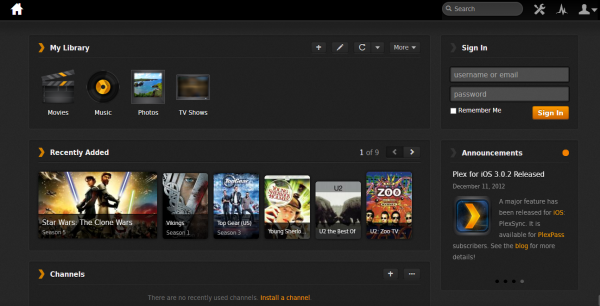
    Plex is incredibly simple to set up. You will need to add the media server portion to a home computer, preferably a PC that is always on — never goes to sleep. Once installed the app is controlled through a dashboard in whatever web browser you have set as your default — simply click the icon in your system tray to launch it.

    The media server easily allows you to add Movies, home videos, TV shows, music and pictures. Those are pre-set categories, but you can also create your own.

    Plex also provides an Android app that is specifically made for Google TV. Simply access the app and you get a clean simple menu for all of the above mentioned categories, along with any you have created.

    Both the server and app are free.

    Watch and Record TV with PlayOn

    If you do wish to watch and record shows through Google TV then PlayOn will fill that need. The service is not free, but very reasonably priced and provides a number of channels such as the basic networks, ESPN, Cartoon Network, CNN, Discovery and many others. It also supports HBO GO, Netflix and Amazon. For an additional annual fee you can record shows to the cloud DVR for later viewing.

    PlayOn is compatible with many devices — pretty much any that support DLNA. In fact, for a good price you can purchase a Roku with PlayOn pre-installed, along with a subscription included.

    More Apps

    Both Amazon and Netflix, depending of which you prefer, work on Google TV. Version 3 of the operating system brings a native Amazon Prime app, which is a huge deal for those of us who use Prime as our movie and TV show platform of choice.

    Pandora also makes a native app for the operating system. Like other apps, you need only sign in one time. If your audio is output through a receiver with external speakers then this is especially nice.

    There are launchers, like Open Launcher for Google TV, if you prefer to change the look of your set top box. There are also other video sources like Redux TV and more.

    What apps do you prefer on your Google TV? I am always on the lookout now for cool new ones, so let me know in the comments below.

  • Microsoft is nowhere near death’s door

    I am both a Microsoft fanboy and hater, depending on which day I read comments from our BetaNews faithful. The truth be known, I consider myself neither. I would say it this way: I am a fanboy of what works and is useful to me and hater of everything on the opposite side of that line. I use products from many manufacturers, but yes, Microsoft powers all of my home computers, save the server, which is FreeBSD. Google is also a big part of my daily life, as is Adobe and many lesser-knowns.

    For two days now, debate rages across the Internet about an analyst’s content that Microsoft could be irrelevant within four years. I could do nothing but laugh when I read this. This revelation derives from Gartner report that states: “While there will be some individuals who retain both a personal PC and a tablet, especially those who use either or both for work and play, most will be satisfied with the experience they get from a tablet as their main computing device”. Some individuals? By that, do you mean those who have jobs?

    Getting Down to Business

    Little more than a year ago, I worked in an IT department for a major U.S. bank. I will spare you the details of downsizing that led me here. What I can point out is that the company, with more than 5,000 employees, was not exactly heading into the tablet era. When I left, the financial institution was only just “testing” Windows 7 for an upcoming upgrade from the current XP workstations, which were upgraded from NT. Tablets were not on the horizon. For the record, Windows 8 was already available via Developer Preview at this point. Heck, we had only just moved from Internet Explorer 6 to IE 7 the previous year.

    My point: Business is going nowhere away from Microsoft any time soon, let alone within the next four years. No serious corporation is going to give its employees tablets to do a job in customer service or most any other position.

    For the record, this is strike one against Microsoft’s irrelevance.

    Going Home

    Tablets and smartphones are great devices to have. They are useful sitting on a nightstand or from the sofa while watching television. Let me know when you can use them for real word processing or for software like genealogy, photo and video editing, file conversion or any of those other processor-intensive apps many families use frequently.

    I doubt many homes plan to be without a computer anytime in the near future. Laptop or desktop, it has a place. My kids may want tablets, but they do not want them when they have a school paper to write or research to do.

    Strike two.

    Out in the Real World

    Perhaps the analysts forget how much of their “bubble” world is actually powered by the Redmond, Wash.-based company. Let me take this opportunity to remind them.

    I am sure several drive Ford cars, powered by Microsoft Sync. I am sure all use ATM machines powered by Windows embedded, as are the registers in the stores they shop at. In fact, Home Depot just recently announced it would be moving registers and other devices to Windows Embedded 8 —  a real shame since Microsoft is going away.

    Strike three.

    Rumors of Microsoft’s Demise Have Been Greatly Exagerated

    Microsoft may decline in the future, but lower PC sales simply indicate the robustness of today’s hardware. Tablets and smartphones have become the throw-away devices for which we frequently buy replacements. The PC is not going anywhere anytime soon and neither Apple operating systems nor Linux will power the device in the majority of homes.

    Microsoft is not perfect. Lord knows I have my share of problems with its products and the sometimes boneheaded decisions it makes. But folks, get real — ninety-percent market share does not vanish overnight, or even in four years. Forget the tablets and phones, computers simply are nowhere near death’s door, as some would have you believe. Nor is Microsoft.

  • Hide your Bitcoins from Skype!

    Another day, another threat to your computer. Kaspersky Labs is reporting that your faithful communication app may in fact be looking to steal your virtual money right out of your virtual pocket. The attack is underway in many locations around the world, and this is not the first malware to target Skype, just the latest and potentially most costly for users.

    Kaspersky’s Dmitry Bestuzhev reports that the latest curse on Skype “turns the infected machine to a slave of the bitcoin generator”. The attack affects users in Russia, Poland, Costa Rica, Spain, Germany, Ukraine, Italy and is spreading to other locations, but the initial dropper is downloaded from a server located in India and the malware connects to its C2 server located in Germany.

    Once the malware is on a victim’s computer, it begins usurping the PC’s processing power in the service of mining Bitcoins. The Bitcoin network is reliant on a rather complex system that creates each Bitcoin and verifies that it is valid and is being spent by the owner of the Bitcoins. The process requires a lot of processing power, and that is exactly what the attackers behind this malware are after. This news follows closely on the heels of a DDoS attack of Bitcoin Exchange service Mt. Gox.

    The biggest clue is if your machine begins ramping up CPU usage. You need to look into why it is doing that, though that is something you should always do, virus fear or not. According to Bestuzhev “as I said the campaign is quite active. If you see your machine is working hard, using all available CPU resources, you may be infected”. As of this writing, a single Bitcoin is worth $115.

    Photo Credit: Seleznev Oleg/Shutterstock

  • Microsoft’s clueless response to ‘always on’ Xbox

    I should first clarify that the “clueless” response is not an official Microsoft comment, but comes from one employee who took it upon himself to cause the entire company trouble. We have been hearing a lot of rumors regarding the next Xbox that is expected to be announced at the upcoming E3 gaming conference, which kicks off June 5. Much of what has been floating around the internet surrounds anticipation of the “720” being an “always-connected” device. In other words, customers would not be able to game without an internet connection.

    The furor around “always on” is mostly about DRM and the used-game market, but it also means that no game would play if your connection happened to go down. Microsoft has never confirmed this to be the case, though it also has not refuted the possibility.

    Now Adam Orth, the Creative Director at Microsoft Studios, has decided to take to his Twitter account and tackle the rumors and, in the process, insult pretty much everyone who followed him. Part of the exchange that took place is what follows.

    Adam_Orth – Sorry I don’t get the drama around having an “always on” console. Every device now is “always on”. That’s the world we live in. #dealwithit

    Manveerheir – Did you learn nothing from Diablo III or SimCity? You know some people’s internet goes out right? Deal with it is Sh***y response.

    Adam_Orth – Electricity goes out too.

    Manveerheir – You’ve live in LA, SF, Seattle…very connected places. Try living in Janesville, WI or Blacksburg, VA.

    Adam_Oth – Why on earth would I live there?

    Soon after this happened, Orth’s Twitter account was changed to private, meaning nobody who is not following him can read the exchange and all followers must be approved.

    As I previously stated, we really have no idea if the next Xbox will actually ship with this “feature”, though Orth seemed to indicate that it could. In my opinion, it would result in a huge backlash against Microsoft, as if Orth has not already caused the company enough trouble.

    Photo Credit: Denis Belyaevskiy/Shutterstock

  • Microsoft releases Advance Security Bulletin for April

    Patch Tuesday is almost upon us yet again. As is its custom, Microsoft has released a monthly Advance Security Bulletin to let customers know what to expect next week. There are nine bulletins headed our way on April 9, with two of them being considered critical.
    Per standard procedures, Microsoft does not release details of the patches until the updates are actually live. This is done in an effort to prevent the bad guys from knowing the vulnerabilities and attempting to take advantage of them  between now and the update release. There is, however, nothing to protect those users who fail to install Windows updates in a timely fashion.

    This time around fixes are coming for all versions of Internet Explorer going back to IE 6 (please tell me you are not still running that). The updates will also cover Infopath 2010, Sharepoint Server 2010, Sharepoint Server 2013, Sharepoint Foundation 2010, Office Web Apps, Windows Defender, Windows operating system versions XP, 7, 8 and RT and Windows Server 2003, 2008 and 2012.

    This pretty much covers everything except Windows Home Server, so all of you can expect an update and reboot to be coming your way next week.

    Photo Credit: zimmytws/Shutterstock

  • Microsoft releases half-ready Windows Phone app sale site

    I suppose I could be charitable and say Microsoft’s heart is in the right place with its latest Windows Phone announcement. The fact is rivals like Amazon and Google needed some good competition from new kid on the mobile block. The Amazon Android App Store offers a paid app for free everyday and Google Play regularly has sales for various causes for celebration that the company cooks up. Microsoft has reason to come up with a bit of competition against those things, and today does just that.

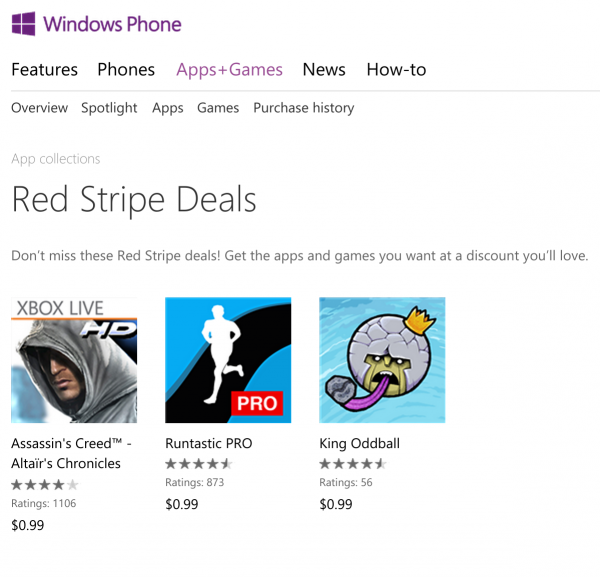
    The company announces its new “Red Stripe Deals” site and, no, it has nothing to do with Jamaican beer. The new site is a collection of apps and games that have been discounted for Windows Phone customers. The concept is a great idea and is sure to be a hit for the mobile audience.

    So why do I complain of the launch? Not because of the concept, but because the company chose to announce before it was actually ready. When Microsoft’s Michael Stroh told us of the site it had exactly one app — RunKeeper. As of this writing, the sale site has progressed to the three apps that Stroh promises, all of them at $0.99.

    Red Stripe Deals is certainly a good concept and I have no doubt that Microsoft will continue to update with what it calls “weekly bargains on stellar apps and games”. However, if the company truly wishes to compete with Android and iOS then it may wish to consider giving the site a bit more variety, especially given that Amazon offers seven paid apps for free every week.

  • There’s a thriving malware market, and you’re the commodity

    If you listen to security companies then you may come to believe that the Internet is one big dark alley. Of course the industry has a vested interest in having you believe that you are in more or less perpetual danger. Now Dr. Web, the antivirus company, has released its monthly threat report, and the danger is almost as bad as the industry wants you to think.

    The most “popular” threat during the month of March was Trojan.hosts programs: “Hosts file containing DNS server IP addresses has been compromised 186,496 times, which constitutes over 10 percent of the detected threat total”. The threat is commonly spread through malicious or compromised web sites. In early 2013 the files were being detected at a rate of over 9,500 infections per day.

    The security firm also reports that the botnet known as “Win32.Rmnet.12” is growing at a rather alarming rate. “As of December 2012, the total number of infected machines was 6.5 million, and by March 27, 2013, it reached 8,593,330, an increase of two million over the first three months of 2013”, the company says. The news of this growth is bad enough, but the explantation of what it is is even worse.

    The file infector Win32.Rmnet.12 can perform backdoor tasks at the command of a remote server and also steal passwords stored by popular FTP clients. That stolen information can then be used to mount network attacks or infect sites. The virus can also embed content into loaded web pages, redirect a browser to a site specified by criminals and send user information to remote hosts. Oh, and it can also self-replicate.

    And then there is the malware that has been awarded the “threat of the month” medal. This, Dr. Web’s report claims, goes to Trojan.ArchiveLock.20. This little beauty can place all of your important files in password-protected WinRAR archives. Then all you have to do is pay the hacker for the privilege of getting back your own documents.

    This one is also spreading according to the report: “Earlier the Trojan targeted only Russian users, but in March multiple incidents involving the program were registered in European countries such as France and Spain. In the short period from March 23 to 26, 150 Italian users whose systems were compromised by the malware contacted Doctor Web’s technical support and that number is rising”.

    The company also touched on Trojan.Yontoo.1, the Mac virus we previously covered and names a new piece of Android malware that goes by the moniker of “Android.BiggBoss”.

    In short, despite most platforms and users gaining better security in recent times, the attackers continue to innovate just as fast as any software maker, and sometimes much more quickly. Add that to the number of innocent users who remain clueless about much of this and you have the perfect recipe for a thriving malware market.

    Photo Credit: Oxlock/Shutterstock

  • One year later, nearly half of Instagrammers use Android

    Kids. They grow up so fast. It seems like just yesterday that my Android phone finally became a member of the Instagram generation, only just “slightly” behind all of those iPhones out there. Now the social photo sharing service is celebrating its one year anniversary on the Google-based mobile operating system.

    Philip McAllister, of the Instagram Android team, announces that “One year ago today we launched Instagram for Android. In less than a day, over a million people downloaded the app, and now nearly half of all Instagrammers use the Android app to share photos with friends, family and the world”.

    Since then the service has been used around the world to capture images ranging from spectacular photography to natural disasters and epic world events. McAllister explains that “Major events such as Brazil’s Círio de Nazaré festival, the 85th birthday of Thailand’s King Bhumibol, and a streak of severe thunderstorms throughout Malaysia have been captured by Android Instagrammers”.

    While I use the app less often than I should, it has been handy for capturing and sharing many pictures in the time I have had it, including one image that I even used right here on BetaNews last holiday season when the service saw a record 226 images uploaded per second on Thanksgiving day. With the financial backing of Facebook now behind it, there is no telling how far Instagram can go.