Author: Darrell Etherington

  • Intel’s Dual-Core CloverTrail+ Atom Z2580 Impresses, But Likely Won’t Be Intel’s Smartphone Savior

    intel-z2580-atom-clover

    Intel officially launched its new dual-core “CloverTrail+” Atom system-on-a-chip today at MWC in Barcelona. The CloverTrail+ is a direct successor to Intel’s first smartphone SoC, Medfield, but gets its name from the company’s tablet-focused CloverTrail platform. The Atom Z2580 dual-core processor is the top-of-the-line SKU in the new lineup, which you can see powering a mobile graphics rendering demo featuring Epic Citadel in the video above.

    Intel’s new CloverTrail+ line still uses the same 32nm architecture of its predecessor, which means it likely won’t get significantly better power performance requirements (though Intel is claiming its software approach will actually help it beat ARM designs), but the chip should power significantly improved phone designs. Intel’s reference designs for the chip include its new Intel XMM 6360 modem, which can theoretically take advantage of full HSPA+ 42Mbps network speeds. It also has an improved GPU (hence the demo above), packs in 2GB of RAM, up to 256GB of NAND flash storage, a 16MP camera with a 2MP front-facing shooter, and Android 4.2.

    Intel isn’t matching up to the competition on paper, but it’s pushing dual-core mobile chips to their max speeds, whereas most quad-core designs have to be clocked down to maintain optimal operating temperature and power consumption. CloverTrail+ phones are expected to ship in late 2013, and we’ll likely see many more actual OEM hardware based on the tech, as compared to last time around with Medfield. Intel is still hurting by using the 32nm construction vs. the 28nm format employed by its biggest competitors Qualcomm and Nvidia, both of which also now offer integrated LTE modes with their latest gen SoC designs.

    But Intel’s real splash will come when Bay Trail debuts, which is a 22nm full redesign of Atom, with native quad-core processing. That should give it the edge over its competitors when it comes to power consumption, as they’ll likely still be using 28nm designs. If Intel is going to take a serious run at mobile relevance, it’ll be with Bay Trail, not CloverTrail+, despite admirable improvements made with this generation.

  • Sony’s New NEX-3N Mirrorless Delivers A Big Sensor In A Tiny Body, Could Be The New King Of Beginner ILCs

    NEX-3N_wSELP1650_BK_1

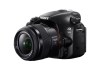
    Sony today unveiled a new NEX camera, the NEx-3N. The new body is the latest addition to the company’s celebrated lineup of mirrorless interchangeable lens cameras, and it manages to be the smallest and lightest camera available in that category to also house an APS-C sensor. The 16.1 megapixel CMOS sensor is right on par with those found in full-sized entry-level DSLRs, and allows the camera to snap photos up to ISO 16000, which means it should be a fairly strong low-light performer.

    The NEX-3N ships with Sony’s new Auto Object Framing technology, which allows it to pick out macro or moving subjects in addition to one or two people, and re-compose pictures while preserving the original to give a photographer a host of shots to choose from a single exposure. The tech even boost the cropped image to full resolution automatically using Sony’s resolution-enhancing processing algorithm. The NEX-3N also inherits the BIONZ processor from the a99 full-frame, meaning it can handle selective noise reduction like the new a58 DSLT. It also has a 7.5cm LCD screen that flips up 180 degrees for expert selfies.


    Design-wise, the NEX-3N is a departure from Sony’s existing lineup, thanks to a redesigned front grip that takes up less space than the one on the NEX-F3. Overall it looks more like Sony’s recent compact cameras, like the RX1 and the X100, and that’s a very good thing. Paired with the 16-50 f/3.5-5.6 retractable zoom lens (which will be available for the NEX-3N in a kit package), the whole thing presents a much smaller, more streamlined overall package that approaches true pocketability. Sony’s 16-50 retracts when not in use, making it much smaller than most kit zooms with the same range.

    Judging by the reviews of Sony’s NEX line of ILC cameras, this should be quite the contender at $500 (with the 16-50mm) when it arrives in April. It’ll be available in both black and white versions.

    Sony’s imaging department has been on a roll for a while now, and the company is doing a particularly good job of innovating with features at the top end and then making sure they percolate down the line, as with the Auto Object Framing tech being introduced here. With this entry-level NEX device, it isn’t doing much on the numbers side (the F3 has 16 megapixels and the same maximum ISO), but the outside redesign that shaves some precious space from the camera, along with the introduction of new consumer photog-friendly features, while keeping the price low, is likely a better strategy than improving a boring spec sheet.

  • Asus Debuts New 5-inch, 1080p, Snapdragon 600-Powered PadFone Infinity Smartphone-Tablet Hybrid, Coming April 2013 For €999

    padfone3

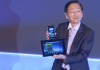
    Asus introduced the new Padfone Infinity today at MWC in Barcelona. The successor to the company’s hybrid tablet/smartphone has a redesign with an aluminum back and edge-to-edge glass display, a 5-inch display with 1920 x 1080 resolution and 441 PPI. The LTE phone can plug into a 10-inch tablet dock, which itself offers 1920 x 1200 resolution.

    The PadFone Infinity boasts a 13-megapixel camera with an f/2.0 aperture camera, with a dedicated image sensor to boost low-light capture. It can also grab 1080p HD video, and there’s a 2-megapixel shooter on the front. Asus is also very proud of the PadFone’s redesigned rear speaker, and onboard digital audio equalizer software, which allows users to optimize sound depending on their environment.


    The PadFone logo on the back is also an NFC antenna, and the phone is powered by a 1.7GHz Qualcomm Snapdragon 600 quad-core processor to help it handle the magic of switching from phone to tablet mode. The PadFone Infinity also has 2GB of RAM on board, 64GB of Flash storage, and ships with 50GB of Asus’ cloud storage. It has voice input, and offers hands-free operation via Asus Echo for use in-car, as an alarm clock, and more. The company seems to be offering it up as somewhat of a Siri competitor.

    Battery life on the device is advertised at 19 hours talk time, 6.5 hours browsing, 9 hours of video playback and 410 hours standby time. The PadFone Station tablet compoent also acts as a battery pack, with 57 hours talk time, 19.5 hours browsing, 27 hours video playback and 1230 hours standby time.

    Asus’ latest single-sim tablet/smartphone combo is coming to European markets in Apri 2013, and will cost €999 euro, or around $1325 U.S. The PadFone has traditionally been much more successful internationally than in the U.S., so it’s very likely we’ll see it in overseas market before (if) it makes its way stateside.

  • Sony’s New a58 DSLT Camera Features People And Object Autofocus Tracking, Selective Digital Noise Reduction

    SLT-A58_wSAL1855-2_4

    Sony today announced a new entry-priced DSLT (Digital Single Lens Translucent) camera, the a58, priced at $600 bundled with a newly designed 18-55mm zoom kit lens, and coming to retail in April this year. The a58 pushes the needle forward for Sony’s DSLR-style interchangeable lens line, with a nice hop-on point for the company’s Translucent Mirror tech for consumers looking to get into more pro-style gear.

    The 20.1 megapixel camera succeeds the widely respected Sony a57, which also used SLT to help it deliver fast burst mode photography with continuous focus lock. The a58 has a few new tricks up its sleeve, including a new sensor and new BIONZ processor, which allows it to selectively dial down digital image noise and sharpness in different parts of the same photograph, meaning it can preserve detail in lighted areas and make blacks much blacker in others, which should be particularly useful for nighttime photography.

    There’s also a brand new OLED electronic viewfinder on board, which improves on the version in the original with improved color rendering and 100 percent field of view. But the biggest trick up the a58′s sleeve is the introduction of autofocus lock-on tech not only for human subjects, but also for objects. The Auto Object Framing tech is the next generation of Sony’s Auto Portrait Framing feature, and allows the camera to pick out people, moving objects or macro subjects and track those, keeping them in focus and also framing and cropping them for  alternate, re-composed shots alongside the originals.


    The a58 uses Sony’s A-mount system lenses, and the company is also introducing new versions of those today. Three new A-mount lenses make their debut alongside the new body, including the DT 18-55mm F3.5-5.6 SAM II lens which is the new kit lens for the entry-level DSLT. It has the same AF motor as the previous generation, but should have quieter focusing performance, good for shooting video. The new design should also reduce flare and ghosting, Sony says. It will arrive in May for $220 as a standalone lens.

    Also new to the line are the Carl Zeis Planar T* 50mm F1.4 ZA SSM lens, giving pros a nice, fast portrait and all-around lens designed for use with full-frame sensors, with dust and moisture resistance. This one arrives in May and will cost around $1500 when it does. Finally, Sony is also adding a new big pricey zoom, the 70-400mm F4-5.6 G SSM II telephoto, which has improved AF responsiveness and is designed to be used to track and capture fast-moving subjects for HD video. It’ll be $2200 or thereabouts when it arrives in July.

    Sony’s camera division is doing very interesting things lately, and the a58 looks to be a nice improvement on the a57 and a near-perfect entry-point for consumers looking to step up to a DSLR-category device, but who are also looking for a host of features that should make handling the more powerful gear easier. With all the new bells and whistles, buyers should be able to get great pics out of the a58 without much of a learning curve.

  • Developers Lead When It Comes To The Future Of iOS User Interface Design

    haze

    Apple hasn’t done much to change the way iOS works at its core, in terms of navigating within and between apps and the home screen. In fact, iOS is maybe the mobile OS that has remained the most fundamentally the same since its introduction, at least among those that are still in active use. But while Apple hasn’t been making huge changes to the basic iOS user interface, third-party developers have been pushing the boundaries and creating great examples of how things could be better for a next-generation version of Apple’s mobile OS.

    The requirements for capturing attention in the App Store have changed dramatically over the last few years. When Apple’s mobile software store was new, just releasing an app at all could nab headlines and significant download numbers. But now it takes something special, especially when you’re building an app whose job is already adequately handled by countless competitors with existing apps.

    That special ingredient lately has come in the form of innovative new methods for user interaction. Designs that do away with buttons, standard user interface elements suggested by Apple and built into the iOS development SDK, mean taking risks since you’re asking customers to start in unfamiliar territory, but in the base cases, they also result in a kind of new life for your iOS device.


    Gestures are where it’s at for a lot of the newest apps out there. Gestures handle everything from data entry, to deleting and adding new items, to switching views and updating information. Apps like to-do list Clear began to expand the concept of what developers could do with touch-based interfaces, and lately others have taken up the case and pushed the boundaries even further.

    Now there’s a whole cadre of apps that are doing similar things, including two featured this week by Apple: budget management app Bdgt and weather app Haze. Weather apps seem particularly ripe for this kind of change in design, with Solar also offering a similar experience. But no category seems likely to be left untouched: Mailbox uses a lot of gesture navigation not seen elsewhere for its inbox management commands, and Rise is a new alarm for iOS that hides virtually every control interface, relying entirely on finger swipes and drags and eschewing anything resembling a button.

    Some of the interaction methods introduced in these apps are so intuitive you find yourself trying to use them throughout iOS and in other apps. For example, swiping left and right to access settings or preferences, or swiping down and up to switch views and access additional info. The good news is Apple need only pay close attention to what these third-party devs are doing to start charting a path to fresh new interface design for iOS. It’s beyond time the mobile OS got a significant, modern upgrade, and there are plenty of developers out there who are already helping that happen.

  • Google Glass Targeting End Of 2013 Consumer Release, With Price Tag Under $1,500

    glass-model-logo-google

    Google seems to be looking to bring its ambitious Google Glass wearable computer to market much faster than many likely anticipated, according to the Verge. Google told the site that it hopes to have a “fully-polished” version of Glass available for sale to ordinary consumers by the end of 2013. The cost will be under the $1,500 Google was asking for developer-targeted editions of the headsets put up for pre-order first at Google I/O, and then again earlier this week.

    This is the most clear Google has been yet about its public release schedule for the headset-mounted computing device. The company had previously been reported to be targeting a year-end 2013 consumer release, with a price point around that of current smartphones, according to a report from last February by the New York Times’ Nick Bilton. Then in June 2012, Google co-founder Sergey Brin suggested that a rough timeline for developer and consumer availability would put the device in the hands of the general public in 2014.

    This time, a Google official has said directly that the company is targeting an end-of-year release date, so there’s little room for different interpretations there, and the credibility of the source isn’t up for debate. Google’s recent release to a broader audience beyond just developers via an application process indicates things might be moving quicker than the company previously expected.

    The Verge also got some extended hands-on time with Glass, and notes that it is compatible with iPhone devices as well as Android handsets. They also came away convinced that this is something that Google will eventually be able to turn into a device with mass-market appeal, whether or not it’s quite at that stage by the time it hopefully hits shelves later this year.

  • Why Every Analyst Is In Love With The Siren Song Of The Low-Cost iPhone

    iphone-family

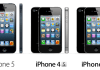
    For almost as long as Apple’s iPhone has been in existence, analysts have claimed to see visions of a low-cost version of the device aimed at developing and prepaid markets. It’s easy to see why these visions have grown in magnitude and gained a more vocal following over the years: entering that market would, in theory, broaden Apple’s potential appeal by hundreds of millions of new customers. But I refer to the low-cost iPhone as a “siren song” for a reason – there’s a significant potential downside if Apple tries such a device and fails to impress.

    The latest buzz around a budget iPhone device is being generated by a new investor note from Morgan Stanley analyst Katy Huberty (via Business Insider), who provided three reasons for why she and her firm see a low-cost iPhone on the horizon. The iPad mini’s success in China and Brazil, Chinese consumers gravitating to the latest iPhone over older models, and surprise iPhone 4 demand were all seen as indicators that Apple will go budget in the near future.

    Huberty met with Apple CFO Peter Oppenheimer before penning the report, but she doesn’t directly attribute any of her reasoning for a cheaper iPhone to him directly. Other encounters between analysts and Apple execs have also left similar impressions, and Tim Cook even went so far as to tell Bernstein’s Toni Sacconaghi that the company had specific “clever things” planned to target the prepaid market, and that the company wasn’t “ceding any market” despite its continued efforts to target higher-end smartphone buyers.

    Recently, there have been more indications that Apple might be going low-cost with a new iPhone design, including reports from the supply chain that a new model will come out with a plastic body and design cues from the current iPod touch. More reliable sources, including the Wall Street Journal and Bloomberg, have also chimed in (though they’ve thrown out the same idea in the past, actually right around when Tim Cook made his original statements to Sacconaghi).

    A cheap iPhone is a tantalizing story because it’s a tantalizing product for investors, for consumers and for Apple itself. But Apple’s concern isn’t beating competitors on price, as it has said time and time again; it’s about delivering a no-compromise experience. So long as it can do that at a price point that makes more sense for the prepaid market, it would be happy to field such a device. The iPad mini is another example of Apple waiting to build a product people clamored for until it could get the experience up to its standards, and waiting has proven the right strategy there.

    With a cheap iPhone, striking that balance is even more important. Apple has to deliver a product that allows it to maintain its reputation as a mobile platform with the best consumer experience. Doing anything else would invite comparison to other “good enough” budget products from rivals, which would undermine all of Apple’s efforts to brand itself as a premium maker of hardware and software. It’s a slippery slope, which is why, despite allusions made by Cook two years ago to a strategy that embraces the pre-paid market, we’ve seen little, if any deviation from its standard course since then.

    Analysts love the idea of a low-cost iPhone because it looks like ripe, juicy, low-hanging fruit. But Apple is rightfully cautious because it has built a brand on produce from higher up in the tree. Huawei and ZTE have shown how it can be difficult to start as a budget brand and claw your way up in consumer eyes, and their marketing struggles are probably a good indication of why Apple, if it is going to go after the prepaid crowd, will have to do so very, very carefully to avoid being lost in the deep.

  • Nokia To Go Downmarket At MWC To Better Compete With Huawei And ZTE, Report Says

    Nokia 206

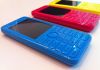
    Windows Phone 8 is Nokia’s big play for the future, but as a result of focusing on those devices and their higher-end target market, the company is giving up ground to firms like Huawei and ZTE with lower end devices. But the Finnish company may be looking to get its budget-friendly groove back with the introduction of new, basic handsets not based on Microsoft’s mobile OS, to be unveiled at MWC next week according to Reuters.

    The tails of new models come from “company sources,” according to Reuters, and suggest Nokia will introduce “cut-price” hardware in multiple handsets, as well as a single new Lumia device on Windows Phone 8, but one designed with affordability in mind. Nokia already offers the budget Lumia 620, a $249 smartphone with Microsoft’s latest OS onboard, but that’s still over $200, whereas the average selling price of Nokia mobile phones in general was € 31 in 2012, Reuters notes, with net sales of mobile phones accounting for € 9.44 billion in sales in 2012 for the company.

    Nokia has had tremendous success with its Series 40 line of devices, as Natasha noted in an article late last year, but even that market where it has traditionally been strong is under attack from rival manufacturers. Nokia is failing to attract audiences in its traditionally strong markets with even low-cost Lumia handsets. And it’s losing share fast to Huawei and ZTE, which are quickly charging up the ranks of global handset manufacturers thanks to an emphatic focus on lower end devices.

    Nokia’s candle is burning at both ends, with the company facing threats in both smartphones and with low-end devices. The company said to “expect a lot of things” in 2013 based on the Series 40 platform at the end of 2012, and it looks likely we’ll see some of those things unveiled at MWC. A revamped Series 4 line could definitely help shore up its shrinking share of the under $100 market, and if a new Lumia can break the $200 barrier, we might see Nokia win back some precious smartphone share as well.

  • Tablets Take Off In 2012 According To Millennial, With Kindle Fire And iPad Mini Seeing Rapid Growth

    Screen Shot 2013-02-22 at 7.05.39 AM

    In a new report from mobile ad platform Millennial Media, the company compiles its data on mobile device share across its network for all of 2012, revealing that tablets in particular accounted for a rising percentage of impressions, with Android devices stepping up their game considerably. The Kindle Fire and Samsung tablets were the big share winners, helping Android slates grab a considerable 41 percent of the tablet mix, compared to 58 percent for Apple.

    Millennial didn’t actually break out the overall values of tablet traffic in its 2011 report, but you can see from its February 2011 snapshot that the tablet/e-reader and other category had iOS at 80 percent share, with Android at just 17 percent and other at 3 percent. Android has clearly gained a lot of ground, then, and the main OEMs reaping the benefits of that growth are Samsung, which has 45 percent of the Android tablet share, and Amazon, which managed to acquire 26 percent thanks to the release of the second-generation Kindle Fire line, representing over 500 percent growth from its share in 2011.

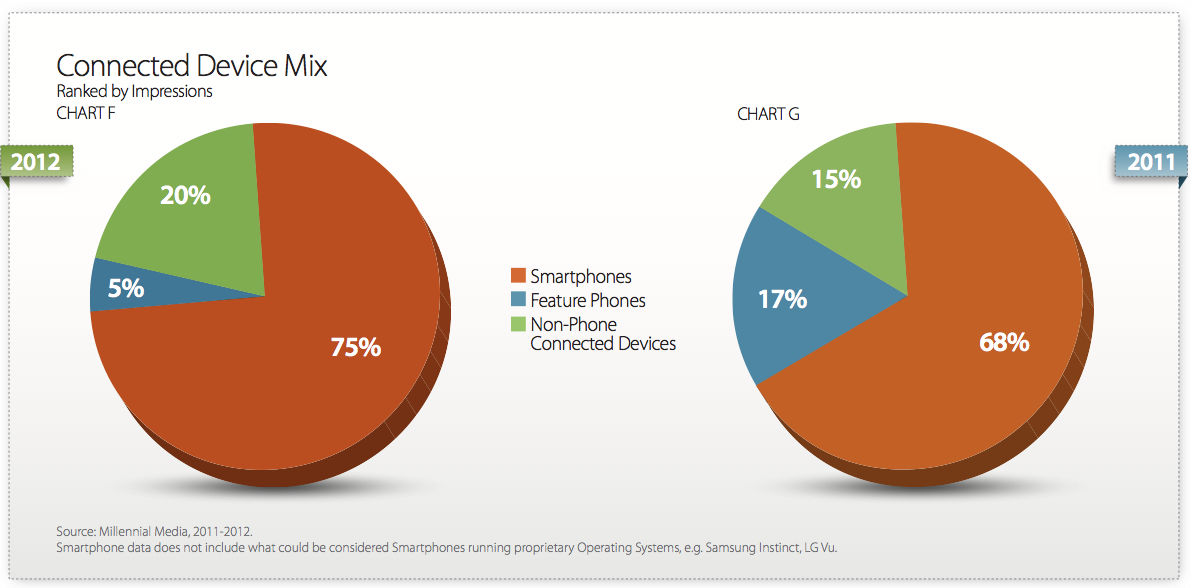
    Smartphone share also grew during the year, up from 68 percent to 75 percent, with non-phone connected devices (including tablets) also growing considerably as well, from 15 to 25 percent. The feature phone category gave up tons of ground, going from 17 percent to 5 percent share. Overall OS mix, despite Android’s tablet gains, actually didn’t shift all that much, with Android gaining one percentage point overall in 2012 versus 2011, and iOS losing one. BlackBerry remained steady in third, and Windows Phone gained a single percentage point.

    Millennial notes that Android continues to take up more places in the top 20 mobile phones list on its platform, while Apple continues to be the market leader with its devices in each respective category, generating an outsized helping of traffic share from just a few core devices. The iPhone ranks number one among mobile phones, growing its share from 14.67 percent in 2011 to 15.59 percent in 2012. Samsung took over the number two spot from BlackBerry with its Galaxy S line, with 4.24 percent of impressions for 2012, growing 182 percent year-over-year.

    The iPad mini was among Apple’s strongest performers, growing its share of impressions at an average daily rate of 28 percent within just weeks of its initial launch. Millennial says that’s a new best for the 7-inch tablet category, eclipsing the rapid 19 percent daily average established by the original Kindle Fire during its launch back in 2011. Overall, the picture that’s shaping up looks like it will see smartphone share start to even out as they eclipse feature phones entirely, with tablets making up an increasingly important piece of the pie, if the trends Millennial is seeing continue.

  • Google’s Chromebook Pixel Looks Like A Pricey Boondoggle, Or The Platypus Of The Notebook World

    Platypus_BrokenRiver_QLD_Australia2

    Google unveiled is fabled Pixel Chromebook today, and the thing does indeed have what looks to be a gorgeous, high-resolution display. It also has a touchscreen, as rumored, and the list gets more confusing from there. 32GB (or 64GB) of onboard storage? ChromeOS? A 3:2 screen ratio? A $1299 starting price tag? Huh?

    The device is meant to be upscale, Google admits, but for a machine aiming at power users, it’s a device surprisingly devoid of power features. ChromeOS is, for all its strengths, still essentially a browser, after all. This thing can’t run Photoshop, which you’d be able to do no problem if you spend $100 less and get a 13-inch MacBook Air. It can play back movies on that gorgeous screen, but not in as many file formats or with as much ease as you could manage with a Lenovo Yoga 13, also cheaper at $1,049. It can accept touch input, which could be exciting, but then again might not, and that’s hardly a feature worth risking a cool $1300 for.

    Which isn’t to say the Pixel isn’t attractive. It’s a looker, to be sure, and something I’d definitely be interested in owning myself. The 1TB of Google Drive storage and the LTE radio on the $1449 model make for an attractive package, so long as you’re already deeply committed to Google’s cloud storage ecosystem. But a gadget blogger wanting something and an everyday consumer being willing to cough up over $1,000 for it are two entirely different things, and the Pixel has too many of those moments that make you tilt your head slightly to provide any chance at success in that regard.

    ChromeOS is a risky proposition on a $249 laptop for most people. It’s still just too new, and too untested in a world where you’ll attract far fewer headaches just going with OS X or Windows. With a price tag that makes it almost an impulse buy, it’s an understandable risk. At $1299, it’s not.

    ChromeOS is a risky proposition on a $249 laptop for most people

    Google doesn’t always care about marketability for its first generation devices. It originally tried to sell the Nexus One direct for $529, a price many felt was too high, contributing to the eventual failure of that experiment. The Pixel is also introduced as “a laptop that brings together the best in hardware, software, and design to inspire future innovation” on Google’s website, meaning it probably isn’t intended to fly off the shelves, but more to light a fire under hardware partners and developers.

    Still, announcing a consumer launch (including a retail partnership with Best Buy) for the Chromebook Pixel (a device that looks like the notebook world’s equivalent of a hastily assembled Lego project built from memory) just comes off as weird. I once lauded Google’s strategy in going for cheap, ubiquitous data network access with previous hardware launches, and I’m all for technical innovation that explores new territory. But I see no answer to the question of “Why?” when it comes to the Pixel.

  • Canon Launching Its MREAL Headset March 1st, Will Allow Designers To Prototype Using Augmented Reality

    20130221_hiRes_interactivedemo

    Canon announced the launch of its MREAL system for “mixed reality” today, which includes a head-mounted display that allows wearers to combine virtual objects with the real world in 3D, which essentially sounds like a product designer’s dream. On the consumer side, augmented reality hasn’t done a great job of proving itself generally useful at this point, but in an industrial design setting, the payoff could be big, and that’s why Canon’s MREAL is priced at a professional-level $125,000.

    The MREAL headset isn’t nearly as sleek as Google Glass, and instead of projecting info on transparent displays, it actually takes in video of your surroundings, runs it through a computer which supplies the virtual elements, and then delivers a live video feed to dual displays mounted in the visor strapped to a user’s face. It’s not light and all-day wearable like Glass, but it means the system can deliver extremely clear 3D computer-generated images that blend more realistically with a user’s actual surroundings, which is exactly what you want if you’re designing a coffee table for a specific living room space, for instance, or want to see what a car concept looks like under showroom lights before you build a physical model.

    The $125,000 price tag and $25,000 annual maintenance fee might prohibit ordinary folks from picking up one of these, but the system’s impact could be felt at all levels, and in addition to being used by designers and engineers, might make its way to show floors for augmented reality consumer demonstrations. It also could make it easier for inventors pitching an idea to investors to provide a more realistic look at what a finished hardware product would look like, without building an actual prototype. If you’re making an iPhone case, the cost doesn’t really justify it, but if you’re a Lit Motors trying to sell the next generation of personal transportation, it begins to look like a much better bargain on the balance sheet.

    Plus, this launch of innovative interactive design tools from an established player invites startups to try to build equivalent low-cost solutions to disrupt the market. I’d love to see a hardware prototyping app come out for Google Glass when third-party devs start building for it, which could potentially bring the cost of AR prototyping down to a more manageable, startup-friendly level.

  • New Google Glass Patent Is The Most Comprehensive Yet For Google’s Face-Based Wearable Computer

    glass-1

    The USPTO has published a new patent application today from Google, which describes in comprehensive detail the complete system that would go on to become Google Glass, originally filed in August of 2011. The newly discovered patent describes not only individual components of Glass as we’ve seen previously, but the overall system, including display, frames, image projection and capture, wireless connections, sensors and more.

    Some of the technical drawings included in the patent look a lot like the Google Glass we’ve come to know and love from its public appearance adorning sky divers and tech company founders who could be mistaken for jewel thieves. But others depict designs that resemble cheap paper 3D glasses, and hipster specs you might expect to see at Warby Parker. Google is clearly looking at multiple ways to bring Glass to market, aside from the sci-fi style visor it’s been showing around.

    The text of the patent gets into extreme technical detail, offering a granular look at how Glass actually functions. It describes how the lens mounted display would operate in relation to the movement of a wearer’s head to keep the projected image consistent, and how objects in the real world can be overlaid with digital images to create augmented reality experiences. It goes into detail about various configurations of glasses arms and where the housing for the ‘brains’ of the device could be located relative to the rest of the glasses apparatus, and talks about building touch-sensitive surfaces into frame to accept user input.

    Google also describes the limitations of current wearable tech interfaces in a section on background, which it uses to essentially give a reasoning for its creation of Google Glass. Existing systems were, in a word, deficient according to the company’s filing:

    Both head-mounted and heads-up displays can be connected to a video source that receives a video signal that the device can read and convert into the image that they present to the user. The video source can be received from a portable device such as a video player, a portable media player or computers […] The functionality of these types of displays is, however, limited to passive actions wherein the display simply receives information from an external source and presents it to the wearer in limited forms. Accordingly, further advances in wearable devices including displays have been needed.

    Some of the more interesting elements from the detailed description of the patent include alternative display methods. We’ve seen the use of lens-mounted displays in the current prototype, but the patent also describes alternatives including “a laser or LED source and scanning system [that] could be used to draw a raster display directly onto the retina of one or more of the user’s eyes.”  That sounds a little terrifying but also potentially exciting.

    Overall, the patent is primarily about locking down Google’s IP with respect to the Glass project in as technically detailed a manner as possible, but it’s an interesting read for gadget heads or engineers who want to learn more about the nitty gritty background behind Google’s most daring consumer hardware project.

  • This New Apple Patent Could Be The Design For A Radical iWatch With A Wraparound Display

    13.02.21-Wearable-3

    Apple has a number of patents on wearable computing, but a new application spotted by AppleInsider blends some old and some new tech to provide a vision of what it might conceivably look like as a shipping product. The patent in question describes a wrist-mounted flexible screen, built on a support structure that closely resembles the “slap bracelets” children of the nineties will likely recall. When worn, the screen could provide an unbroken display that wraps all the way around the wearer’s wrist.

    Apple even uses the slap bracelet directly as an example of how the device would work in its patent filing. Besides provoking nostalgia in people my age, the design would make it possible to use the device in both curled (worn) and flattened forms, acting as a different kind of display in either scenario. When on the wrist, Apple describes a sensor that would allow the watch to recognize where the end is, so that it can manage universal sizing while still wrapping a display around the wrist without any overlapping visuals.

    The patent describes some software functionality, which begins to get at what an Apple iWatch might offer that others building smart watches can’t or don’t yet do. It could be used to “adjust the order of a current playlist,” review “a list of recent phone calls,” type out a message reply via a “simple virtual keyboard configuration across the face of the flexible display.” Apple even suggests using it as an input device for controlling and navigating apps like Maps. If you had trouble conceiving how an iWatch might actually revolutionize wearable computing, this patent’s description of features begins to answer that.

    Apple’s patent describes making use of solar power and kinetic energy to help prolong battery life, and it includes provisions for a number of other ways to affix it to a user’s wrist, including snaps and velcro, meaning the slap bracelet look could give way to something much more in keeping with traditional watch design. But what’s most interesting is the functionality described in the patent: it shows how Apple, working with its own hardware and software in ways that third-party manufacturers aren’t able to could greatly extend the usefulness of a wrist-mounted, smartphone connected device.

    The iWatch is rumored to be in production, with reports from Bloomberg, the New York Times and the Wall Street Journal all surfacing recently. We’ve seen iWatch-related patents before, including ones that describe elements of this slap bracelet system, but this is the most complete patent to date and the timing feels more than coincidental as a result.

  • PS4 Is Sony’s Last Stand, And It’s Wasting It On A Tired Strategy That Ignores How The Gamer Is Changing

    Screen Shot 2013-02-20 at 6.17.09 PM

    Sony’s PlayStation 4 made its grand debut today in a presentation with all the theatrical flair to be expected from an electronics company that’s also a media company that’s also a producer and publisher of blockbuster video games. But the pomp hides a hurting heart: Sony’s FY 2012 financial results saw it swallow a $5.74 billion loss, with PS3, PSP and PS2 hardware sales all down versus the previous year. And Microsoft is playing the home media center card to perfection, hedging bets against a future where a dedicated gaming console isn’t the draw it once was.

    Sony did more than unveil a next-gen gaming platform today: it answered the question of how it would adapt to this changing world. And the answer might not be what you were expecting: Sony made a point of saying it was moving away from the living room, and putting the gamer at the center of the new platform. The company then went on to talk for at least 10 minutes about hardware and specs, and after a brief interlude to discuss cloud gaming, launched into a series of gaming demos. Which, if you’ve ever seen gaming demo videos, delivered exactly what you’d expect. And that was not excitement.

    There was another Killzone, which looked pretty much like the others with better graphics. There was a racing simulator that was supposedly about some innovative team play, but whose developer focused on showing suede textures more than anything else. Then there was Sucker Punch’s Infamous spinoff game about mutant, which is actually decently cool since I really liked the first two Infamous titles. There were some indie games, which were more interesting than the AAA titles if only because they offered a little variety. Then there were a bunch more games from usual suspects like Square Enix and Ubisoft, Blizzard with a Diablo III port, and Bungie’s latest. But overall the message was clear: Sony’s PS4 is an evolution, not an about-face, or a realization that being a game console might not mean what it used to mean.

    Here’s a typical reaction to what Sony was showing off during the bulk of its presentation, in case you think I’m only expressing my own opinion:

    Later they brought out the Move controller. That’s crazy, Sony. You’re crazy if you think the Move controller will be saved by the PS4 when across the aisle is the Kinect with its hands-free, truly innovative full body movie tracking. If you think people will build 3D sculptures with a wand with a ball on the end you’ve absolutely lost your mind. There’s something to be said for trying something different, but these are things that are already better done by existing tools, or by competitors. Cutting their losses would’ve been a better strategy with the Move.

    What was missing from Sony was a discussion of anything that could’ve made it a more broadly appealing device. Sony needed the introduction of streaming media partners; cable and satellite providers willing to use it for IPTV delivery; integration that would make connections with mobile devices more than just a way to have a tiny screen for select, old games and some leftover social functions; at a bare minimum it needed a physical device, and a date beyond “Holiday 2013.” It (and we, as potential customers) needed way more than a falling back on graphics, eye candy and tech demos, which may have served the gaming industry well in the past, but which have done nothing to stem the rising tide of mobile platforms like iOS and Android.

  • Gaikai Cloud Gaming In PlayStation 4 Brings Easy Free Trials Of Games, Sharing, Spectating And Remote Play

    scaled-008

    Gaikai’s Dave Perry took the stage at the PS4 event today to describe how Gaikai would be adding cloud gaming elements to the PS4, which will make it possible to jump in and try games in the PlayStation store, make sharing with your friends a snap, and also invite spectators and get friends to help you by remotely taking over your game.

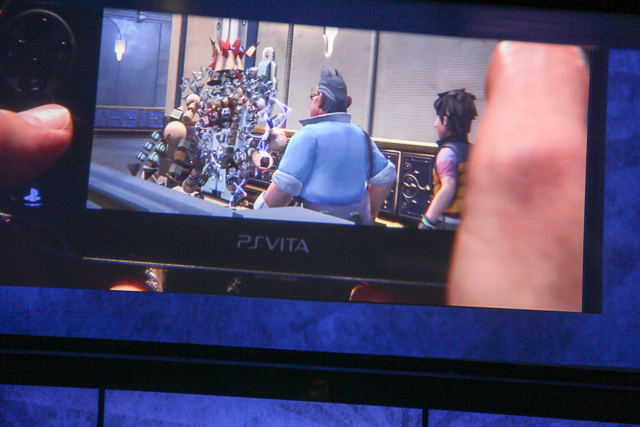
    The PS Vita will also finally get a lot more useful, thanks to Remote Play. Perry said that the team has dramatically reduced transmission times, turning the PS4 into a server and the Vita into a client allowing for remote play of titles run on the PS4 direct to the Vita. It’s exactly like the Wii U, but with a controller you can walk away with and use as a standalone mobile console.

    The ability to easily jump right into PS4 games and try out titles via streamed gaming is a huge addition for Sony, which had more limited demo capability in the PS3 PlayStation store which required sizeable downloads when it was even available (which wasn’t for every title). Inviting players to join and watch your game also includes the ability for spectators to chim with with on-screen comments as you play, and the ability to take over your controller to help you out if you run into trouble. It’s a much more social version of Nintendo’s handholding modes in recent releases.

    Will gamers opt to call a friend, so to speak, instead of jumping on GameFAQs? That’s a good question, but clearly the company is doing everything it can to try and build a real social network, instead of the loosely affiliated group of often crude, sometimes racist anonymized gamers that made up the PlayStation Network of the past.

  • Sony Officially Unveils The PlayStation 4: X86 CPU And 8GB Memory, But About Experiences, Not Specs

    Screen Shot 2013-02-20 at 6.17.09 PM

    Sony had an event today and as expected, it introduced the PlayStation 4. The next-gen platform is designed to shift focus from the living room to the gamer, Sony said, and overall, PlayStation’s approach is meant to make it possible for gamers to play wherever they want, whenever they want.

    PS4 lead system architect Mark Cerny talked about how the evolution of the PS4 came about, saying it began five years ago, earlier on in the life of the PS3. The PS3 was a first step, which was designed to connect to a variety of services, but it was limited because of how early it launched in that world, Cerny said.

    “Much less value is found today in blast processing or a system-on-a-chip,” Cerny said. He suggested tech could interfere with design innovation. The tech remains important, he stressed, but the idea was to create a platform that was all about experience. Sound familiar? That’s because it’s a tune Apple and Steve Jobs started playing years ago when they realized the spec race was a nonstarter in the mobile phone world.

    “By game creators, for game creators. It is a powerful and accessible system,” Cerny said on stage, suggesting that this time around there was a strong emphasis on ease of development, hence the use of a standard x86 PC CPU. The GPU is designed for use with “practical tasks,” he said, with the overall goal of making development a painless experience.

    Essentially, the PS4 is an advanced, x86-based personal computer, which means that it should be easy for developers to build. All of this is clearly an answer to a major complaint from studios about the previous generation, which was infamously tricky to master from a software perspective.

    Sony also unveiled a redesigned DualShock 4 controller, which has the Vita-style touchpad depicted in rumors, ad works with a 3D “stereo” camera accessory to track its movements in a loose approximation of what’s possible with Microsoft’s Xbox Kinect.

    The hardware is clearly also borrowing some tricks from mobile games. It has save states that allow users to quickly freeze and resume gameplay, without having to save just by switching on and off the console. There’s also background downloading, which allows digital titles to be played before they’re even completely on your local drive.

    Social is another key tentpole for the PS4, according to Cerny. He described a new function that allows you to quickly pause and upload gameplay videos as easily as you might have done with static screenshots in the past. There’s also spectator functionality for watching “celebrities” gaming, something which seems to have been borrowed from Twitter’s success with famous members. Networking will also be based around real names and profile pictures, instead of strictly on gamer tags and avatars, too, and all of this will plug into mobile apps to help gamers stay in touch.

  • With $650K In Seed Funding, YC-Backed Upverter Chases The Dream Of A Hardware Startup Revolution

    Screen Shot 2013-02-20 at 1.43.14 PM

    Toronto’s Upverter is a startup that’s poised to effect change that could reshape the landscape of entrepreneurship. That’s not something you can say about most of the businesses we cover on a daily basis, whether or not they have good ideas. But it’s definitely true of Upverter, the company that’s hoping to build a cloud-based hardware engineering platform that can match and overtake its desktop-based counterparts within the next few years.

    So what would that mean for the messy, expensive business of hardware prototyping and product creation? Nothing less than the beginning of a new era, according to Upverter CEO and co-founder Zak Homuth.

    “The three of us that founded the company all kind of come from a mixed hardware/software background, we all studied electrical engineering, we all worked co-op jobs at startups all around the world, did a little bit of hardware and a little bit of software,” he explained in an interview. “And then we got together to try to improve the rate of innovation with hardware. We all ran away from it, because it was easier to build software than to build hardware, and we wanted to fix that, because we wanted to build hardware personally.”


    The idea was to make tools that would allow Homuth and his co-founders to build a hardware company as their next startup venture, so they quit their jobs, sold their possessions to get some working capital and moved to Homuth’s parents basements, with the nascent idea of building an engineering platform that lives entirely in the cloud. For the fledgling startup, the question was whether or not they could build a GitHub for hardware, how cloud-based it could be, and whether that was something anyone even wanted. Flash forward four months.

    “Then we got into Y Combinator, picked the company up, moved it down to Mountain View and got this shitty little townhouse across from YC,” he said. “By that time we’d figured out that the solution to the version control problem, the innovation problem, the crowdsourcing problem was to move it all to the cloud, and specifically the tools. Because if you move the tools to the cloud you make it possible to control the file format, so that you can do version control, you can control consumption, you can control the viewer.”

    Upverter launched a very simple version to a very controlled group before coming out of YC, and then took that MVP-style product into something that could be used by the general public in September of 2011. “It couldn’t really do much,” Homuth admits. “But it was the line in the sand that allowed us to say ‘Does anybody wanted to do engineering this way, instead of the way you’ve been doing it for 30 years?’ and we got enough ‘yesses’ that we kept working on it.”

    The company has since been tracking down money, building out its tools to a point where they actually compete with existing design tools, via a release just a few short months ago. Upverter has raised $650,000 so far from angel investors, including YouTube founding team member Christina Brodbeck, and Xobni co-founder Adam Smith, and that has managed to allow them to build a software tool that begins to be able to compete with existing tools. But there’s still a long way to go, Homuth says.

    “It’s not at parity by any means, it can’t do everything that $100,000 software can do yet, but you can do non-zero stuff,” he said. “You can actually get stuff manufactured, you can actually simulate, you can actually manage a product’s life cycle, you can actually design. And that was step one in our three step plan to change engineering.”

    Step two is to get the platform to parity with existing tools

    Step two is to get the platform to that parity point, where it can compete with existing tools on an equal footing with legacy software. Getting to a point where they can design equally well in a browser as with a desktop tool is around six months away, according to Homuth, at which point Upverter will be able to start building out its sales and marketing team. Once it gets there, Upverter will have built in a little over three years what legacy CAD companies have taken 30 years to create. The next goal, beyond that, is to become the “Rosetta Stone of engineering,” meaning that no matter how you come at engineering, no matter what tools you’re using, it’ll translate and you can work with anyone else in the world on the same files and on the same projects.

    Upverter’s ultimate goal is still at least a couple of years away, Homuth says, and the time it takes to get there will be dependent on what kind of money the startup can raise. He’s actively looking for fresh investment now, while also continuing to add to the 10,000-strong user base it has managed to attract so far.

    The rise of Upverter means a potential explosion on the horizon for hardware startups, which is why the company is hosting a hardware hackathon with Y Combinator on February 23rd. Making hardware engineering collaborative, affordable and easy to access can have a tremendous impact on the cost of doing business and risks associated with creating new hardware, which is why Upverter achieving its goals could lead to a new revolution for hardware startups, incubators and investors alike.

    If you happen to be one of those hardware startups, Upverter is offering free team accounts to TC readers. Just follow this link to sign up.
  • The Nifty MiniDrive Gives Your MacBook Air Or Pro More Internal, Removable Flash Storage

    IMG_6534

    MacBooks are on a straightforward path to becoming closed case devices, with very little in the way of aftermarket expandability options for consumers. Which is why the Nifty MiniDrive Kickstarter project seemed so promising: It’s a microSD card adapter that fits flush with the side of your MacBook Pro or Air, which means you can add up to 64GB of additional flash storage via a port that many people probably only use very occasionally anyway.

    It’d be easy to do this yourself if Apple used the kind of spring-loaded, flush-mount SD card slot you see on a lot of Windows PCs, but as it is, when using standard SD cards and adapters, the end protrudes about a third of an inch out of the side of the computer, which means keeping something there permanently will invite disaster if you’re putting it in and out of a bag with any frequency. The Nifty MiniDrive fixes that, with a design that’s custom-fit for the different models of MacBook (there’s an Air version, one for the MacBook Pro and another for the 15-inch Retina Pro).

    Removing the card requires a special tool that Nifty ships with each MiniDrive, which is not unlike a SIM-card tray ejector, but with a hook so that it can catch the recessed groove found on the adapter itself. It’s a remarkably effective design, which works well in practice. Losing a MiniDrive tool would mean your drive is stuck in the SD card slot, but you can fashion your own removal tool from a staple or paper clip should it ever come to that, so it isn’t a huge concern. Plus, these are designed to be used mostly by people who don’t require frequent access to that port anyways.


    As you can now get microSD cards in capacities ranging up to 64GB, with 128GB possibly to follow soon, that adds a considerable amount of extra disk space in a package that adds almost no weight to your existing setup, and doesn’t change the outside physical profile of your machine. On my 128GB MacBook Air, the Nifty MiniDrive with a $60 64GB microSD Class 10 card gives me 50 percent more storage. And if I fill it up, it’s easy enough to swap out another drive, keeping the first microSD card close at hand in case I need to retrieve something from the archive.

    Although only made of plastic and glue (plus the metal connectors), the two Nifty MiniDrives (one for 15-inch Retina Mac and one for 13-inch Air) I have are performing well. They’ve survived multiple removals without incident, the silver finish on their endcaps matches the color of the MacBook’s aluminum case perfectly, and OS X instantly recognizes the drives when inserted. In an age of Wi-Fi cameras and mostly cramped SSD storage, they’re a great little addition to any Mac notebook setup, and should be available to order soon from Nifty’s website.

  • OTG Lays The Foundation For A Connected Airport That Speaks Your Language, Whatever That Language May Be

    iPad GUI PSD

    OTG, the restaurateur that made waves when it installed free access iPads in some of the world’s busiest international airport hubs last year, is improving its existing system with the deployment of a translation system that will allow it to provide translation of its restaurant menus in 13 different languages. The system is already live in test deployments at locations like Toronto’s Pearson airport, and CEO Rick Blatstein tells me it’s already having a positive impact on sales at OTG-run restaurants.

    But the effort, which will soon encompass 20 languages and see wider deployment in more of the airports where OTG is already operating in North America, including LaGuardia and Minneapolis-St. Paul. Blatstein said that his company quickly saw the value in offering multi-lingual support after realizing that at Pearson, for example, English is the first language of only around 40 percent of travelers at any given time on average.

    “We have all of our menus and everything translated and tested ahead of time so that when you push the flag of your language, it automatically translates that for you,” Blatstein said. The idea is to make travelers feel more at ease, since they’re able to communicate in their own language. Ordering can happen right from the iPad kiosks, meaning there’s no chance of encountering language barrier problems between travelers and serving staff.

    OTG’s iPad deployment also provides travelers with access to Facebook, Twitter, flight status information, and more without charging them, with the aim of making air passengers feel less like a captive audience and more like a treasured guest when spending time in the airports that many frequent travelers likely know all too well. The translation service, applied at launch to restaurant offerings, is a first step according to Blatstein, and one that will eventually make its way to the company’s offerings outside of its restaurateur endeavors, too. Customers could soon order commercial goods from iPads in the language of their choice, Blatstein suggests, or set up accommodations or ground transit at their destination ahead of time.

    Airports can maintain multi-lingual staff, and cater to the most common languages spoken at their hubs, but you can’t cater to all the various people from every neck of the woods at every location all of the time. But with an iPad-supplemented customer service model with built-in translation services, you actually might be able to be everything to everyone. OTG isn’t quite there yet, but it’s making big steps in that direction, and that could make air travel (or at least the parts in between) much more pleasant for all involved.

  • Apple Says It Was Targeted By The Same Hackers That Hit Facebook, Will Release Protection Software Tuesday

    Apple-Logo-MacBook

    Apple has revealed that it was attacked by the same group that went after Facebook in a recent attempt to break that network’s security. The company says a “small number” of its employees’ Macs were affected, but there is “no evidence that any data left Apple,” according to a report by Reuters. The company will be issuing software to prevent customers from being attacked in the same manner, Apple said.

    Apple’s report follows the news from Facebook on Friday that it was targeted by hackers apparently operating out of China. Facebook also reported that none of its users’ data was compromised through the attack. Apple is said to be workign with law enforcement on trying to find the source of the hacking attempt, and will be releasing a software tool aimed at its customers to help them protect their own Macs against the malware used by the unidentified assailant.

    The goal for both Apple and Facebook, in being the source of these reports about attacks on their own companies is to be proactive and get out ahead of the news, in order to reassure customers that they’re doing everything possible to ensure the security of any data they hold. The object lesson of Sony’s PlayStation network breach, and the ensuing criticism and lawsuits that resulted from it being perceived as “slow” to notify outsiders of the attack is probably one cause of heightened transparency on the part of companies facing cyber-security threats.

    For Apple, admitting to a security breach is a rare occurrence. The company acknowledged some 400 iTunes accounts were hacked back in 2010 in response to customer complaints, but this kind of pre-emptive move indicates that we’re likely dealing with a different level of security threat altogether. On the plus side, account data seems not to have been leaked, and this means authorities will have the help of two technology giants and their considerable resources in tracking the perpetrators down.