Author: Kate Torgovnick

  • Talks to watch as you buy tickets for “Star Trek Into Darkness”

    Last night, many boldly ventured where no man had gone before: to see Star Trek Into Darkness, which opened in some theaters at midnight. The film, which is a sequel to JJ Abrams’ 2009 reboot of the classic series, has been highly anticipated ever since its lyrical trailer materialized late last year. Writes critic Betsy Sharkey of The Los Angeles Times, “So many things are done right that even with the bombast, Into Darkness is the best of this summer’s biggies thus far. It’s a great deal of brash fun, and it should satisfy all those basic Trekkie cravings.”

    Here, two talks to watch as you buy tickets for the movie’s official opening tonight. First, a talk from JJ Abrams himself, “The mystery box,” given at TED2007:

    And second, check out this talk from the incredible George Takei, aka the original Captain Sulu. At TEDxBroadway, the actor talks about why he’s created a musical about Japanese-American internment:

  • Urinalysis: There’s now an app for that

    Urinalysis-app

    uChek uses the iPhone’s camera to capture the color changes in commercially available urine dipsticks. Results of the test can be stored, emailed and analyzed over time.

    It may not be glamorous, but it’s true – each year, urinary tract infections lead to more than 9 million doctor visits in the United States alone. But the infection can now be tested for through an iPhone app — uChek — developed by TEDFellow Myshkin Ingawale. This app could also be an effective tool for diabetics whose doctors have recommended regular urine analysis, and for the monitoring of bladder, liver and kidney disorders. It could also be a powerful tool for healthcare professionals in the developing world who hope to bring testing to patients wherever they are, instead of the other way around.

    Ingawale, who previously created the noninvasive anemia diagnosis tool ToucHb, has just released the app, which was demoed at TED2013. But there have been adjustments made since.

    “Early prototypes like the one demoed at TED 2013 were ‘work in process’ and were susceptible to certain ambient light changes and movement errors, and when checked against a conventional laboratory urinalyser it showed lower accuracy,” Ingawale says in a Q&A with the TED Fellows blog. “We made some design changes in the system — most notably, the introduction of our patent-pending ‘cuboid’ — a foldable, reusable stand for the iPhone, which improved the accuracy of the new system, making it comparable with a laboratory urinalyser.”

    Ingawale explains that the changes were needed to move uChek from being considered a “wellness tool” to being a “medical device.”

    Next up for Ingwale — expanding uChek to Android and other platforms. And, of course, coming up with new ideas for medical apps. “This is our first really big initiative in the world of apps,” he says. “We are looking forward to seeing where this road leads.”

  • Broccoli takes a magical journey in the trailer for Mary Roach’s new book

    Mary Roach is the kind of journalist who gets excited about the details of embalming, court cases involving ghosts and the mechanics of how exactly one uses the bathroom in space. So we are excitedly awaiting the release of her new book, Gulp, in which she explores the eccentricities of the digestive system. We have to admit, we are pretty amused by this trailer for the book, in which broccoli rides the roller coaster of the alimentary canal and then plays a little intestinal skeeball.

    Watch the trailer and then watch Roach’s amazing TED Talk, “10 things you didn’t know orgasm.”

    And bonus: check out Jon Ronson’s talk “Strange answers to the psychopath test,” as Ronson had the honor of reviewing Gulp in The New York Times.

  • Bill Gates, designer? Yes. Public Interest Design honors 100 global thinkers who are designing social good

    Good design has the power to improve lives. Yesterday, Public Interest Design — a group dedicated to design for social good — released the Global Public Interest Design 100, a list of 100 “designers” (including some people you really might not expect) who are designing for the good of all. We love this sweeping list of 100 architects, designers, policymakers, visualizers, funders and educators who — even if they have no design training — are changing the world with great design thinking.

    “Lists like this are useful in shining a light on unseen leaders and unheard voices,” says John Cary, the curator of Public Interest Design, who worked with Autodesk to research the list and create an interactive graphic of it. The list offers a new lens on some favorite TED speakers and TED Fellows — because, it turns out, they’re designers. Below, a look at these honorees:

    • William Kamkwamba made the list for designing and building a windmill that brought electricity to his home and village in rural Malawi. Did we mention that he was 14 at the time? He shares the story in his TED Talk “How I harnessed the wind.”
    • Bunker Roy was honored for his Barefoot College, which seeks to make communities self-sufficient by teaching skills in energy, health, waste management and more. He talks more about his for-the-poor-only college in the talk “Learning from a barefoot movement.”
    • Amos Winter, who founded Global Research Innovation and Technology, made the list for his work on products like the Leveraged Freedom Chair. In this talk, he shares more about the development of this “Cheap all-terrain wheelchair.”
    • Zainab Salbi was honored for founding Women for Women International, which helps survivors of war recover from crisis. Her TED Talk “Women, wartime and the dream of peace” is simply incredible.
    • TED Fellow Jodie Wu’s Global Cycle Solutions has created a bike-powered maize sheller and phone-charger. These unique designs landed her a spot on the list.
    • Alastair Parvin was honored for his work on Wikihouse, an open source construction set that lets anyone build. His talk from TED2013, “The DIY house of the future,” will premiere on TED.com next week. Stay tuned.

    Below, check out a static version of Public Interest Design’s Global 100 graphic. And head to PublicInterestDesign.org to play with the interactive version »

    GlobalPID100

  • 10 stunning images from Liu Bolin, the disappearing man

    Liu_Bolin_Hiding_in_New_York_No.7_Made_In_China_photograph_2012

    Hiding in New York No. 7 — Made in China, 2012. Photo: courtesy of Eli Klein Fine Art, © Liu Bolin

    Liu Bolin’s images invite a game akin to Where’s Waldo?. In some of the Chinese artist’s incredible photos, it’s clear where he is standing; in others, like the one above, it’s much harder to spot the outline of his body at all. It’s for this that Bolin has been called “The Invisible Man.”

    Liu Bolin: The invisible manLiu Bolin: The invisible manIn today’s TED Talk, Bolin shares the meaning behind these images — that they are a way to examine the relationship between culture and its development, and to speak for those who are rendered invisible by the Chinese government, by consumer culture or simply by the circumstances of history.

    “From the beginning, this series has a protesting, reflective and uncompromising spirit,” says Bolin.  “I think that in art, an artist’s attitude is the most important element. If an artwork is to touch someone, it must be the result of not only technique, but also the artist’s thinking and struggles in life.”

    In this talk, Bolin shows us the very first image in the series, taken in November of 2005. He reveals many, many more images too, giving a peak into his process of being painted into the background — which can take anywhere from 3 to 4 hours to 3 to 4 days. The talk ends with a timelapse, showing how Bolin disappeared into the TED stage. Watch the talk now »

    Meanwhile, in this gallery, Bolin shares many more of his fantastical and powerful images, courtesy of Eli Klein Fine Art.

    Liu_Bolin_HITC_No.92_Temple_of_Heaven_photograph_2010

    Hiding in the City No. 92 — Temple of Heaven, 2010. Photo: courtesy of Eli Klein Fine Art, © Liu Bolin

    Liu_Bolin_Teatro_alla_Scala_photograph_2010

    Teatro alla Scala, 2010. Photo: courtesy of Eli Klein Fine Art, © Liu Bolin

    Liu_Bolin_HITC_Moblie_Phone_photograph_2012

    Hiding in the City — Mobile Phone, 2012. Photo: courtesy of Eli Klein Fine Art, © Liu Bolin

    Liu_Bolin_HITC_No.91_Great_Wall_Photograph_2010

    Hiding in the City No. 91 — Great Wall, 2010. Photo: courtesy of Eli Klein Fine Art, © Liu Bolin

    Liu_Bolin_HITC_Family_Photo_photograph_2012

    Hiding in the City — Family Photo, 2012. Photo: courtesy of Eli Klein Fine Art, © Liu Bolin

    Liu_Bolin_HITC_No.86_Bird's_Nest_photograph_2009

    Hiding in the City No. 86 — Bird’s Nest, 2009. Photo: courtesy of Eli Klein Fine Art, © Liu Bolin

    Liu-Bolin-officers

    Hiding in the City No. 16 and No. 17 — People’s Policeman, 2006. Photo: courtesy of Eli Klein Fine Art, © Liu Bolin

    Liu_Bolin_Dragon_Series_Panel_3_of_9_photograph_2010

    Dragon Series — Panel 3 of 9, 2010. Photo: courtesy of Eli Klein Fine Art, © Liu Bolin

    Liu_Bolin_HITC_No.71_Bulldozer_photograph_2008

    Hiding in the City No. 71 — Bulldozer, 2008. Photo: courtesy of Eli Klein Fine Art, © Liu Bolin

    Liu_Bolin_HITC_No.94_In_the_Woods_photograph_2010

    Hiding in the City No. 94 — In The Woods, 2010. Photo: courtesy of Eli Klein Fine Art, © Liu Bolin

    Read a Q&A with Bolin from TED2013, in which he talks a bit more about his process »

    For more information on Liu Bolin, and to see much more of his work, head to his site at Eli Klein Fine Art »

  • 7 talks that will encourage you to talk to strangers

    Maria-Bezaitis-at-TED@IntelIn today’s talk, Intel engineer Maria Bezaitis brings up a fascinating point: why is the phrase “don’t talk to strangers” such a part of our cultural zeitgeist?

    Maria Bezaitis: The surprising need for strangenessMaria Bezaitis: The surprising need for strangeness “When we’re at our best, we reach out to people who are not like us because when we do that, we learn,” says Bezaitis, in this talk given at TED@Intel. “In today’s digital world, strangers are quite frankly not the point. The point we should be worried about is how much strangeness are we getting?”

    To hear what she means by this, watch the talk. And below, check out more talks on the great things that can happen when we talk to people we don’t already know.

    Hannah Brencher: Love letters to strangersHannah Brencher: Love letters to strangersHannah Brencher: Love letters to strangers
    Hannah Brencher doesn’t just start casual chats with strangers – she writes them intimate, handwritten letters. In this talk from the TED@NewYork salon, Brencher explains how she lifted herself out of her post-college depression by leaving letters for strangers to find – and how this grew into a worldwide initiative intended to give anyone who needs it a boost.
    Frank Warren: Half a million secretsFrank Warren: Half a million secretsFrank Warren: Half a million secrets
    PostSecret.com is a place that uses the anonymity of the internet to allow strangers to tell each other their deepest secrets — the things they would never dare to tell loved ones. In this talk from TED2012, Frank Warren shares how he developed this site, and reveals just a few of the half-million therapeutic secrets that have been sent to him.
    Robin Chase: Excuse me, may I rent your car?Robin Chase: Excuse me, may I rent your car?Robin Chase: Excuse me, may I rent your car?
    Sure, you might give directions to a stranger if they ask you on the street. But would you loan them your car? In this talk from TEDGlobal 2012, Robin Chase of Zipcar outlines her latest idea – Buzzcar, a French startup that lets people rent their cars to others, including people they don’t know, in a protected, good-for-all-involved way.
    Rachel Botsman: The case for collaborative consumptionRachel Botsman: The case for collaborative consumptionRachel Botsman: The case for collaborative consumption
    Human beings are wired to share. And a new slate of online businesses are providing avenues to match “Person A’s haves with Person C’s wants,” says Rachel Botsman. In this talk from TEDxSydney, she shares the underpinnings of this new economy that depends on a wide network of strangers cooperating.
    Jane McGonigal: Gaming can make a better worldJane McGonigal: Gaming can make a better worldJane McGonigal: Gaming can make a better world
    Strangers gather to play online games like World of Warcraft for a total of three billion hours a week. In this talk from TED2010, game designer Jane McGonigal shows how that collaborative power could be used to tackle real-world problems like poverty, climate change and obesity. (Here, read about 10 online games with a social purpose.)
    Hyeonseo Lee: My escape from North KoreaHyeonseo Lee: My escape from North KoreaHyeonseo Lee: My escape from North Korea
    In this powerful talk from TED2013, Hyeonseo Lee explains how a stranger helped her bail her family out of jail as she helped them escape from North Korea. She says, “The kind stranger symbolized new hope for me – and for the North Korean people when we needed it most.”

    Bonus: In the TED Book, How Did You End Up Here?: The Surprising Ways Our Questions Connect Us, Davy Rothbart compiles 100 brilliant questions to help you break the ice with strangers. In this interview with the TED Blog about the book, the creator of Found magazine answers the question, “What do you think we gain from posing questions to people we don’t know?”

  • Ron Finley inspires young gardeners across country

    David-Lozano-2

    David Lozano of San Antonio was inspired to plant a community garden after watching Ron Finley’s talk. Photo: courtesy of David Lozano

    Ron Finley is motivating people across the country to pick up a shovel and “get gangsta” by planting fruits, vegetables and herbs in their neighborhood.

    Ron Finley: A guerilla gardener in South Central LARon Finley: A guerilla gardener in South Central LASince appearing on the TED2013 stage to talk about why he plants edible gardens in the nooks and crannies of South Central Los Angeles, Finley has been profiled in The New York Times and appeared on Russell Brand’s talk show, BrandX. On Saturday, Finley was featured in this CBS News segment, which tells the story of Terence Satler, a 20-year-old who once dreamed of playing football but now is in culinary school. He says that gardening alongside Finley taught him the joy of food.

    “The most extensive knowledge I’ve acquired so far has been through Ron’s garden,” Satler tells the CBS cameras. “He has things you would never see. Especially in my ‘hood.”

    We in the TED office are also hearing stories of those influenced by Finley to pick up a trowel.

    In April, David Lozano of San Antonio watched Finley’s talk and wrote the gardener, saying, “I saw you on TED yesterday and have watched [your talk] three times since … Needless to say my household is going to plant a food garden for everyone to enjoy. We live just two miles south of the Alamo in San Antonio… How do you deal with stray dogs digging up the garden? And could you give me a suggestion what kind of herbs and vegetables you would have a novice gardener plant?”

    Last week, Lozano wrote Finley to share an update, with images attached.

    “These pictures are of everything when it was planted last month. In the whiskey barrel, we planted zucchini. We decided to not plant directly in the ground due to the metal recycling plants refuse in the air close to our house,” he wrote. ”The neighborhood grocery store has been planted for a month now. We are getting our first jalapeños.”


    David-Lozano-3

    Lozano’s zucchini, planted in a whiskey barrel. Photo: courtesy of David Lozano

    David-Lozano-1

    More herbs and vegetables in a planter. Photo: David Lozano


  • Meet the three new TEDGlobal speakers, and a few others making the news

    We are excited to introduce you to three new speakers who’ve been added to the program for TEDGlobal 2013, themed “Think Again.”

    First, jazz-pop singer Jamie Cullum will take the stage to perform during session 10, “Imagined Beauty.” Just last week, Cullum released this nerdily adorable video — shot in one continuous Steadicam take — for the song “Everything You Didn’t Do.” Check it out above and marvel at the incredibly quick scene changes.

    Photographer Fabian Oefner has also been added to the TEDGlobal program. Oefner brings together science and art in his stunning visualizations, which are meant to give us a sense of awe at the natural forces at work around us each and every day. In March, Oefner wowed us with the project “Black Hole,” which used the centripetal force of a spinning drill to splatter acrylic paint in the most beautiful patterns – all captured in millisecond through a unique sensor rig. See the images and how they were created on his website.

    Finally, sustainability expert Johan Rockström is rounding out the program, taking the stage during session 8 “State of Nations.” Rockström recently published the book Bankrupting Nature: Denying Our Planetary Boundaries about the deep denial our culture is in about the magnitude of environmental challenges ahead. At TEDGlobal, he’ll speak about how this impending crisis may be an opportunity to spur innovative thinking.

    Check out the full lineup of TEDGlobal 2013 speakers here, and read their detailed bios. Below, a few other speakers who made the news this week:

    • As we read the news that U.S. beekeepers lost 1 in 3 of honeybee this winter – due to a deadly combination of pesticides, fungicides, parasites, viruses and malnutrition – we couldn’t help but think of bee scholar Marla Spivak, who’ll speak during the session “Listening to Nature.” Her talk will no doubt be poignant given this recent development. She tells the TED Blog: “It’s good that the complexity of the bee issue to coming to light:  Bees are dying from multiple, interacting causes. Sometimes one factor is the driver (e.g., parasitic mites or viruses), sometimes poor nutrition, sometimes drought, sometimes pesticides, but in the end, all these factors interact to weaken bees.  Our bees, all of our bees (honey bees and all the thousands of species of wild bee pollinators) need help. While scientists figure out causes and solutions to the pathogens, parasites and pesticide problems, everyone can help by planting flowers and keeping them clean of pesticides.”
      .
    • In this great profile of frequent TED speaker Marco Tempest in Wired, Apollo Robbins — the so-called “gentleman thief” and session 4 speaker — stops by his loft and discusses the differences in their magic. Says Robbins, “Marco approaches the craft through his passion for innovation and technology. I approach the craft through the study of applied deception.”

    In other news, we’ll be paying particular attention to session two, “Those Flying Things,” which focuses on debate about drones. While the session will feature fascinating demonstrations of how drones can be used to great end, we also can’t forget their potential to be used in war. Jody Williams, who gave the talk “A realistic vision for world peace” at TEDWomen, recently launched a campaign against robot warfare. She tells the TED Blog, “While we in the Campaign to Stop Killer Robots follow work on drones, we are not addressing them in the Campaign. We are seeking a pre-emptive ban on lethal robotic weapons on the land, in the sea and in the air that would be able to target and kill human beings on their own. With no human involvement. Terrifying.”

  • A video that will give you hope in the next generation

    Walt Cochran, a teacher in Kansas City, shared this touching video with us for Education Week about his children — one disabled, one not — who make you think about the depth of the sibling relationship. Lindsay, 10, suffers from a form of Muscular Dystrophy called Spinal Muscular Atrophy and has been in a wheelchair since she was 2 years old. Meanwhile her older brother Trent, 12, sees his role as not just protective older brother, but as an ambassador to remind others that kids with disabilities can do anything they put their mind to with the help of technology and support of loving relationships. Really, we dare you not to shed a tear while watching this.

    This video feels especially relevant today given a comment we noticed on John Legend’s performance of “True Colors,” from Caroline Playle, who gave a talk at TEDxKingsCollege. She writes, “This just made me cry. My 5 year old son has Down’s Syndrome and attends a mainstream school. The teachers and assistants have been amazing and he has lots of friends. Little people see a person — not a syndrome — and really do see my son’s true colours and strengths shining through. I hope through inclusion, both at school and within communities, we can breed a new generation of acceptance.”

    Watch Legend’s performance below:

  • TEDsters in the news: Ron Finley dubbed ‘Appleseed with an Attitude,’ Malcolm London on his TED Talks Education poem

    Ron-Finley-at-TED2013

    Ron Finley electrified the audience at TED2013 with his fresh take on guerilla gardening. Photo: James Duncan Davidson

    This weekend, we opened up the Style section of The New York Times to see a very familiar face — renegade gardener Ron Finley, whose talk “A guerilla gardener in South Central LA” now has more than 900,000 views. In the article, Finley describes what he calls “the TED effect” — the slew of interest that his electric talk at TED2013 has brought from celebrities, television shows and companies with collaboration ideas. Finley’s down-to-earth response?

    “All the attention in the world won’t do my dishes,” he tells the paper.

    Meanwhile, Malcolm London — the 20-year-old poet who will appear in Tuesday night’s TED Talks Education special on PBS — was interviewed in The Chicago Tribune this weekend. “On Tuesday night, if you tune into PBS’ one-hour special ‘TED Talks Education,’ you’ll see host John Legend and an array of prominent speakers, including Bill Gates, giving impassioned talks about ways to reinvent education,” the article reads. “You’ll also see Chicago’s Malcolm Xavier London performing a spoken-word poem about the racial and class tensions he experienced as a double honors student growing up in the tough Austin neighborhood while attending the more well-to-do Lincoln Park High School.”

    The article asks London tough questions about his low GPA in high school and the fact that, while he’s teaching poetry, he hasn’t yet gone to college. He tells the paper that his high school performance was, in a way, a protest.

    “I would leave my neighborhood and go to school, and I was seeing how divided the city was,” London says. “I felt whatever I was learning in class, wasn’t teaching me why people on the West Side were dying every day … I knew that four years later I’d be able to get into a distinguished college, but school wasn’t teaching me how to survive or better my community, and I wanted to change where I came from.”

    Also in the news: TED-Ed was just named one of TIME magazine’s “50 Best Websites of 2013.”

  • A virtual field trip to CERN, via Google Glass

    Take a bike ride down the 27-kilometer Large Hadron Collider — thanks to a lucky Google Glass winner, whose ride-along video premiered Friday during TEDxCERN.

    Andrew Vanden Heuvel always dreamed of being an astronaut; he ended up becoming a pioneering online physics teacher. So when he was selected to be one of the first to try out Google Glass, he knew exactly what he wanted to do: travel to Switzerland, go to CERN (aka the European Laboratory for Particle Physics), check out the Large Hadron Collider and beam the live footage back to a classroom.

    More: Sergey Brin talked about the impetus for creating Google Glass, the tech giant’s new augmented-reality headset, at TED2013.

    At TED2008, Brian Cox explained what the LHC is looking for: the elusive Higgs boson.

  • A new playlist from Sir Ken Robinson, the most-watched speaker on TED.com

    Sir Ken Robinson is not just an amazing orator — he is the most-viewed speaker on TED.com. His three talks have been viewed an astounding 21.5 million times, making him the sneezing baby panda of the TED ecosystem. Naturally, this made us curious: what talks does Robinson absolutely love?

    In this new playlist, Robinson selects 10 talks about education that he finds both inspiring and insightful. His list, given in no particular order, contains talks from Alison Gopnik on what babies think, TED Prize winner Sugata Mitra on his vision of a School in the Cloud, and Shane Koyczan on the ways bullying sticks with us.

    TED playlists are collections of talks around a topic, built to illuminate ideas in context. A new playlist is added every week. We hope you enjoy this installment.

  • TED Weekends emphasizes the importance of the student-teacher relationship

    Rita-Pierson-at-TED-Talks-Education

    Rita Pierson and Sir Ken Robinson both give incredible talks in the PBS special TED Talks Education. Photo: Ryan Lash

    As the daughter and granddaughter of educators, teaching is in Rita Pierson’s blood. In this talkRita Pierson: Every kid needs a championRita Pierson: Every kid needs a champion a teaser of next Tuesday’s TED Talks Education on PBS — Pierson is going to make you wish you had been lucky enough to be her student. Pierson believes deeply in forming strong bonds with her students: through simple things like apologizing, laughing and just acknowledging their successes, even in times when they are technically failing.

    Pierson challenges other teachers to understand the power of relationships. And this week’s TED Weekends on the Huffington Post explores the influence of connections in the classroom. We are especially excited about this edition because it contains not only a beautiful essay from Pierson, but also an offering from the most-watched speaker on TED.com, Sir Ken Robinson, who also appear in TED Talks Education. Read excerpts of both amazing essays below.

    Rita F. Pierson: This Will Make You Appreciate Your Elementary School Teacher

    Teachers don’t make a lot of money. They are usually not deemed worthy of news coverage unless there is a scandal or a strike. Most of the time, their major accomplishments are shared only with colleagues and family members and not the media. The celebration is often cut short by some catastrophe the next day. Yet, in spite of the highs and lows, I cannot think of another profession that brings both joy and challenge on a daily basis.

    In the spring of my career, I found myself questioning the choice of my life’s work. The students did not appear to be motivated, the paperwork was overwhelming and the constant change of educational direction was discouraging. But, I just could not seem bring myself to do anything else. “Next year”, I would say. “Next year I will switch jobs, make more money and have far less stress.”

    Next year just never came. I am now in year 40. And while I am no longer in the classroom or at the schoolhouse, I remain an educator. It finally dawned on me that there was no other profession that would let me change children’s minds and have an impact on their future, long after the school day and school year were over. For every student that finally “got it,” for every rookie teacher that said, “you inspired me to stay,” I get the raise that never quite made it to my paycheck. Read more »

    Sir Ken Robinson: Why We Need to Reform Education Now

    What should America do about its disastrous high school dropout rate? That’s the focus of TED Talks Education, the first ever TED/PBS television special, hosted by John Legend, the award-winning musician. The program looks not only at what’s going wrong in high schools, but how to put it right. As it happens, the solution is not a mystery; but putting it into practice will involve a major shift in current policies.

    In 1970, the U.S. had the highest rates of high school graduation in the world, now it has one of the lowest. According to the OECD, the overall U.S. graduation rate is now around 75 percent, which puts America 23rd out of 28 countries surveyed. In some communities the graduation rate is less than 50 percent. About 7,000 young people ‘drop out’ of the nation’s high schools every day, close to 1.5 million a year. The social and economic costs are enormous.

    Research indicates that in general, high school graduates are more likely to find employment, to earn at higher levels and to pay more taxes than non-graduates. They’re more likely to go on to college or other learning programs. They’re more likely to engage positively in their communities and less likely to depend on social programs. It’s not true, of course, that pulling out of high school inevitably leads young people into trouble. Many high school ‘drop outs’ have gone on to have extraordinary, successful lives. What is true is that a very high proportion people who are long-term unemployed, homeless, on welfare or in the correctional system do not have high school diplomas. Read more »

  • Physicists from CERN team up with TED-Ed to create five lessons that make particle physics child’s play

    Particle physics. To some, the words may produce anxiety. And while, yes, it is complicated — it is far from incomprehensible. Today, the European Laboratory for Particle Physics, better known as CERN, held its first TEDx event, an illuminating look at how particle physics intersects with other disciplines.

    As part of TEDxCERN, physicists from the famous institution, home of  the Large Hadron Collider (and birthplace of the Word Wide Web), teamed up with animators from TED-Ed to create easy-to-understand animated lessons that explain concepts like dark matter, big data and the Higgs boson in lay terms.

    Below, watch all five animations and find out: How did the universe begin? What’s up with antimatter? And why is everyone so excited about the Higgs boson? Enjoyable whether you are new to these terms or have been studying them for years.

    The beginning of the universe, for beginners. (Lesson by Tom Whyntie, animation by Hornet Inc.)
    How did the universe begin — and how is it expanding? CERN physicist Tom Whyntie shows how cosmologists and particle physicists explore these questions by replicating the heat, energy and activity of the first few seconds of our universe, from right after the Big Bang.

    Exploration on the Big Data frontier. (Lesson by Tim Smith, animation by TED-Ed.)
    There is a mind-boggling amount of data floating around our society. Physicists at CERN have been pondering how to store and share their data for decades – stimulating globalization of the internet along the way, while “solving” their big data problem. Tim Smith plots CERN’s involvement with big data from 50 years ago to today.

    Dark matter: The matter we can’t see. (Lesson by James Gillies, animation by TED-Ed.)
    The Greeks had a simple and elegant formula for the universe: earth, fire, wind and water. Turns out there’s more to it than that — a lot more. Visible matter (and that goes beyond the four Greek elements) comprises only 4% of the universe. CERN scientist James Gillies tells us what accounts for the remaining 96% (dark matter and dark energy) and how we might go about detecting it.

    What happened to antimatter? (Lesson by Rolf Landua, animation by TED-Ed.)
    Particles come in pairs, which is why there should be an equal amount of matter and antimatter in the universe. Yet scientists have not been able to detect antimatter in the visible universe. Where is this missing particle? CERN scientist Rolf Landua returns to the seconds after the Big Bang to explain the disparity that allows humans to exist today.

    The basics of boson. (Lesson by Dave Barney and Steven Goldfarb, animation by Jeanette Nørgaard.)
    In 2012, scientists at CERN discovered evidence of the Higgs boson. The what? The Higgs boson is one of two types of fundamental particles, and it’s a particular game-changer in the field of particle physics, proving how particles gain mass. Using the Socratic method, CERN scientists Dave Barney and Steve Goldfarb explain the exciting implications of the Higgs boson.

  • The teachers who inspired us, and even changed the trajectories of our lives

    Rita-Pierson-at-TED-Talks-Education

    Rita Pierson leads off TED Talks Education, our first televised event, which will air on PBS on May 7. Photo: Ryan Lash

    Rita Pierson is the kind of teacher you wish you had. An educator for 40 years, she is funny, sharp and simply has a way with words — so much so that today’s talk feels a bit like a sermon.

    Rita Pierson: Every kid needs a championRita Pierson: Every kid needs a championIn this talk, Pierson shares the secret to teaching students, especially those from disadvantaged backgrounds — make personal connections with them.

    “I have had classes so low, so academically deficient that I cried. I wondered, ‘How am I going to take this group in nine months from where they are to where they need to be?” says Pierson, in this amazing talk. “I came up with a bright idea … I gave them a saying: ‘I am somebody. I was somebody when I came and I’ll be a better somebody when I leave. I am powerful and I am strong. I deserve the education that I get here’ … You say it long enough, it starts to be a part of you.”

    Pierson’s talk will open our first-ever television special, TED Talks Education, which airs Tuesday, May 7 at 10/9c on PBS. It will be an exhilarating night, featuring talks from educators and innovators with bold ideas, plus performances from host John Legend. Set your DVRs and read lots more here »

    In honor of Rita Pierson and TED Talks Education, I asked the TED staff: who is that one teacher who just really, truly influenced you?

    “The teacher who changed my life was, serendipitously, my English teacher for kindergarten, 7th grade and senior year of high school. Ms. Barbato taught me how to write eloquently (I hope!), and she had this unexplained faith in me that really galvanized me as a student. What she taught me stuck with me through college and beyond.” —Olivier Sherman, Distribution Coordinator

    “Mr. Eric Yang was only in his mid-twenties when I had him as my AP government teacher, but he was unforgettable. He was the first teacher I had who made keeping up with current events mandatory, forcing us to read news sources on our own time and not just from the textbook. He exuded discipline, and that was contagious.” —Thu-Huong Ha, Editorial Projects Specialist

    “Mrs. Bailey was my English teacher. I loved her. I was the younger sister of an already very successful big sister, and that was a cloud over my head too. She held my hand and brought me into the sun with her love of the English language. She recommended books just to me, she made me feel special and I just couldn’t get enough of her. I went on a school trip to Amsterdam with her and she brought her husband, who was an artist. She changed my life.” —Juliet Blake, TED TV (who executive produced TED Talks Education)

    “Mrs. Mendelson, my 8th-grade English teacher. This was my first year living in the U.S. I think she set the stage for future learning and she’s the main reason I have such good English right now, both written and spoken. So, thank you, Mrs. Mendelson.”  —Ruben Marcos, intern

    “I still recall how awesome my 6th-grade teacher, Mr. Fawess, was. Middle school in general is basically Hades. I was extremely small, super nerdy, and had a unibrow, asthma and glasses — plus I left school once a week to take classes at the local high school. I got picked on a lot. Mr. Fawess came up with all these ways to take my mind off that — he talked to me about bullying and how to let things roll off your shoulder and gave me books I could read outside of class. He got me thinking about college early and what kinds of subjects I was most interested in. I consider myself lucky to have had such an inspiring teacher. If only he had discouraged me from dressing up as the skunk in our annual school play.” —Amanda Ellis, TEDx Projects Coordinator

    “Robert Baldwin’s class ‘Essay and Inquiry.’ Every day: Walk into class. Sit down. Look at the handout on every desk. Read it. Start writing. Class ends — stop writing. Every day. Except Wednesday, when we’d put the desks in a circle and everyone would read something they’d written. The prompts were everything from simple questions like, “What’s your favorite memory of trees?” to readings from Rachel Carson or W.B. Yeats or Orson Welles. It was a whirlwind of ideas, and the constant writing forced us to wrestle with them, and (tritely but correctly) ourselves. It was like a boot camp in thinking. People I know who took, and loved, that class went on to some of the most amazing careers. Every time we get together, we gush about the quiet, unassuming, force of nature that was Mr. Baldwin. He would have hated that last sentence, because the metaphor is strained. But he also taught us to ignore authority, so I’m writing it anyway.” —Ben Lillie, Writer/Editor

    “Mrs. Lewis, my 5th-grade teacher, read to us every week. She made us put our heads on the desk and close our eyes and then read wonderful stories to us: The Golden Pine Cone, The Diamond Feather ... It made our imaginations come alive.” Janet McCartney, Director of Events

    “My junior high school science teacher, Dr. Ernie Roy, with his outsized laugh and booming voice, was one of my very favorite teachers. He demonstrated to us how important we were to him by making what were obviously personal sacrifices on our behalf: when the lab needed equipment, we knew he had purchased some of it on his own; when we couldn’t get a bus for a field trip, he took a few of us in his own car (something which could have gotten him into quite a bit of trouble); and when a big science fair deadline loomed large, he opened the lab every weekend to help us with our experiments. At a point in my life when I didn’t have a lot of guidance or positive role models, he taught me a lot more than science; he taught me, by example, the power of sacrifice, discipline and self-respect.” —Michael McWatters, UX Architect

    “Dr. Heller, my 10th-grade social studies teacher, taught me that passion is the key to learning. I had never met anyone from kindergarten to 10th grade that matched his raw passion for the meaning behind historical events, and it was so contagious.” —Deron Triff, Director of Distribution

    “Rene Arcilla, a professor of Educational Philosophy at NYU, changed the way I think.  Prior to that class, I hadn’t truly been challenged about what *I* actually thought — much of my educational life was about regurgitating answers. Rene was the first teacher who asked me questions that he/we didn’t know the answers to. Realizing that I had to actually provide the answers from within myself, and not look to an outside source, was very difficult at first. It was a muscle I had to build. I owe a lot of who I am today — and even this job — to the introspective, critical and philosophical thinking I learned from Rene’s classes.” —Susan Zimmerman, Executive Assistant to the Curator

    “Mr. Downey — 7th- and 8th-grade Humanities. Still the hardest class I’ve ever taken!  I’d credit Mr. Downey with helping me think more expansively about the world. Right before 8th-grade graduation, he showed us Dead Poets Society, and on the final day of class we all agreed to stand on our desks and recite ‘O Captain, my captain.’ It was all very dramatic and I think there were tears.” —Jennifer Gilhooley, Partnership Development

    “I took my first painting class my sophomore year of high school and fell in love with it. My teacher, Ms. Bowen, told me I could use the art studio whenever I wanted to, and gave me access to all kinds of new paints and canvasses. I spent almost every lunch period there for a few years, and regularly stayed in the studio after school ended. One day, Ms. Bowen told me that a parent of a student I had painted expressed interest in buying the painting of her daughter. After that first sale, I painted portraits of kids in my school on a commission basis, and continued to do so for the remainder of my high school experience. Thanks to Ms. Bowen’s mentorship, I felt empowered to try to make money from something I was passionate about and loved to do. Here is one of the paintings.” —Cloe Shasha, TED Projects Coordinator

    “I had a chemistry teacher, Mr. Sampson, who used to meet me at school an hour before it started to tutor me when the material wasn’t clicking. That was the first class I had ever really struggled with, and he made this investment to help me get through the material — but more importantly learn that I could teach myself anything.” —Stephanie Kent, Special Projects

    “On the first day of my Elementary Italian Immersion class, I asked to be excused to use the restroom in English. Professor Agostini kept speaking rapidly in Italian as I squirmed in my seat. Since she seemed unclear about my request, I asked her again to no avail. Finally, I flipped through my brand-new Italian-English dictionary and discovered the words, ‘Posso usare il bagno per favore.’ Suddenly, she flashed me a smile, handed me the key, told me where to go in Italian, and pointed to my dictionary so I could learn how to follow her directions. Even though I only studied with her for one semester, I will never forget that I emerged from her class knowing intermediate-level Italian.” —Jamia Wilson, TED Prize Storyteller

    “My history teacher in high school, Mr. Cook, challenged us to think hard about what happened in the past and directly related it to what was happening around us. He gave us ways to try and predict what could happen in the future. He was the first person to make me take ownership of what it meant to be a citizen and the social responsibility that came with that. Because he taught ‘World History’ rather than a regionally specific class, we learned extensively about other countries, and I am convinced he is the reason that I went abroad to Ghana in college and I am now still an avid traveler today.” —Samantha Kelly, Fellows Group

    “The professor who taught me Intro to Women and Gender Studies my sophomore year of college completely changed my framework for thinking about human relationships within a hierarchy. She brought coffee and tea to class for us every morning to congratulate us for being so dedicated to learning as to choose an 8:30 a.m. class. When I emailed her to say I’d be out sick, she sent me a get-well e-card. And when, in a fit of undergraduate irresponsibility, I simply failed to do an assignment, she wasn’t the least bit mad — instead, I received a phone call from her a week after the end of the semester informing me that, because I’d done such good work, she couldn’t bear to give me the B+ I numerically deserved. It was incredible to see how fully she lived the subject she taught; the philosophy of compassion and equality.” —Morton Bast, Editorial Assistant

    “My high school photography teacher, Susan Now. I’m convinced that the support I got from Susan got me through high school. Two years later, when I was freaked out about transferring colleges, I, without hesitation, called her for advice. She made me feel comfortable and challenged me to speak up and be confident with expressing myself as a student. So valuable!” — Ella Saunders-Crivello, Partnerships Coordinator

    “Cliff Simon, one of my college professors, taught me that wisdom is the greatest pursuit, our skills and passions are transferable, and that fear will only ever always hold us back.  To this day, he’s a great mentor.  We’re now great friends, and I even officiated his wedding ceremony.” —Jordan Reeves, TED-Ed Community Manager

    “My 10th-grade biology teacher spoke and interacted with me like I was a grown-up individual and not one of a batch of ‘kids.’ He made us all fascinated with the subjects he taught because he spoke to us not at us. I always worked hard to match that capacity that he saw in me. He was only in his 50s when, a few years after I graduated, he died suddenly of a heart attack. Lots of sad former students.” —Ladan Wise, Product Development Manager

    “Stephen O’Leary, my professor and mentor at the University of Southern California, showed me that the quality of my thinking could be directly traced to the quality of the authors I referenced in my bibliography. This realization motivated me to both seek and challenge everything I have read ever since. This habit likely played a part in me finding myself so passionate about being a part of TED.” —Sarah Shewey, TEDActive Program Producer

    “My high school art teacher was equal parts smart and silly, and always insightful. Mr. Miller showed a bunch of restless seniors that art class wasn’t just about memorizing which painters influenced which periods. Instead, he taught us that art was — at its core — an exciting way to touch both the head and the heart. Mr. Miller took our  class to the Met in New York one warm spring afternoon, a trip I’ll never forget. Great art, he told us, was about great ideas, and not simply the pleasing arrangement of color, shape and form. Thank you, Russ Miller.” —Jim Daly, TED Books 

    “Mrs. Presley, my 1st-grade teacher, advanced my reading skills to full-on chapter book independence … and for that I’ll be forever grateful! But the most valuable gift she gave me was self-esteem. At my school, we’d bring a brown bag lunch with our name written on the bag. I always wanted a middle name like the other kids, and this daily ritual made me feel the lack. I must have let my mom know, because she started to write middle names on my bag. At first it started: ‘Marla Ruby Mitchnick.’ Then ‘Marla Ruby Diamond Mitchnick,’ and then ‘Marla Ruby Diamond Violet Mitchnick,’ and so on. Mrs. Presley never skipped a single syllable — she just read it straight through, and I felt like a beloved and fortunate person with a beautiful name, surrounded by wonderful friends.” —Marla Mitchnick, Film + Video Editor

    “I signed up for Journalism 1 in high school having no idea what I was getting myself into. Marcie Pachino ran a rigorous course on the joys of telling other people’s stories and on the extreme responsibility that comes with reporting news that might otherwise go unheard. She was kind and inspiring, but wouldn’t hesitate to give you an edit of an article that simply read ‘Ugh’ in big red letters. The key: you always knew she was right. I went on to become a journalist professionally and, in all my years of writing, I’ve never encountered a more demanding editor.” —Kate Torgovnick, Writer (the author of this post)

    “Professor Stephen Commins completely changed my  learning experience at UCLA. He pushed the boundaries of what I thought I could accomplish as an undergrad, and having him as my research professor improved my quality of education tenfold. I’ll never forget in my last lecture with him, he left our class with this piece of advice: to work on poverty domestically before attempting to help those abroad, because you aren’t truly a development professional until you have done both.” —Chiara Baldanza, Coordinator

    “My high school English teacher Veronica Stephenson went above and beyond to allow me the opportunity to dive into theater and acting in a very underfunded arts community. She saw passion in me, and engaged it by spending a lot of her own time and effort to help me pursue something I loved. I learned so much from her and got more personalized experience than I probably would have from a more arts-focused curriculum due solely to her faith in me.” —Emilie Soffe, Office Coordinator

    Now it’s your turn. Who is the teacher who most inspired you? Please share in your comments.

  • TEDxCERN is about to begin — watch along

    TEDxCERNFor the past 59 years, the European Organization for Nuclear Research — better known as CERN — has been a nucleus of innovation, bringing us both the World Wide Web in 1983 and last year’s discovery of what appears to be the Higgs boson. Today, CERN will host its first TEDx event, with speakers ranging from Nobel Prize laureate astrophysicist George Smoot to Britney Wegner, the 18-year-old winner of the Google Science Fair. The event will feature thinkers working hard to understand our universe, showing how physics intersects with, well, almost any discipline of thought out there.

    TEDxCERN will not be a closed door event. More than 25 universities, laboratories and organizations around the world will be tuning in. In fact, anyone anywhere in the world with a curiosity about how and why the universe exists is welcome to watch through a free webcast.

    The webcast begins at 13:45 (CEST) — that’s 7:45am (EST) to anyone living on the East Coast — and will run until 20:00. Watch here »

    Below, some TED Talks to get you hyped for the event:

    Still not sure if you want to watch? Read 6 reasons to tune in »

  • A possible answer for preventing sewage from flowing into waterways in extreme weather

    During Hurricane Sandy, 10 billion gallons of raw sewage were released into the rivers, canals and bays of New York and New Jersey — and into homes and buildings that were flooded in the storm. This shocking number comes from a report by Climate Central. As reported in The New York Times earlier this week, the sludge would have been enough to cover Central Park in a 41-foot tall blanket of muck.

    “Our sewage infrastructure isn’t designed to handle this type of storm surge,” explained Dr. Alyson Kenward, the principal author of the report.

    Right before Hurricane Sandy, architect Ate Atema gave a talk in the TED office (part of our then-new TED@250 series) with an idea for something that might alleviate this very problem in cities like New York: street creeks.

    In this talk, Atema explained that “CSO” does not stand for Chicago Symphony Orchestra — it stands for Combined Sewage Overflow, which happens when storm surge overwhelms sewage pipes and causes them to overflow into waterways. Surprisingly, CSOs happen by design. In the 1900s, underground sewer systems were built on a one-pipe model that flows storm runoff and sewage through the same pipes. The pipes were angled so that, when overwhelmed, sewage-tainted water would flow into local waterways, rather than back into homes. Many cities like New York have simply not been able to upgrade these systems.

    Atema’s idea is to create separate channels for storm runoff, keeping it separate from sewage by building creeks alongside streets that capture rainwater and flow it into waterways. The creeks are designed with catch basins that weed out street trash and cisterns able to catch the “first flush” of rainwater — which picks up 80% of street pollution contamination. The creeks can be planted with trees and grass, making them into a amenity for a block while treating contamination.

    To hear more about how street creeks would work, watch this talk. Want to hear more about New York’s Gowanus Canal? Watch the talk “Reviving New York’s rivers – with oysters.”

  • Two ways of thinking about social media: digital tattoos and virtual shadows

    Digital-livesAt concerts, lighters once swayed in the air during poignant moments, the audience belting out lyrics together in a moment of catharsis. Today, the group sing-alongs still happen, but the air shines with a different glow: the light of cell phones.
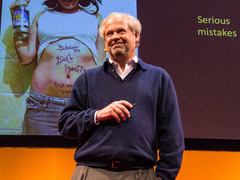
    Last week, while seeing a favorite band, I couldn’t help but notice the sea of undulating phones around me. With my view partially obstructed by shoulders, I found my eyes constantly settling onto the glowing screen of the guy in front of me, who was recording each and every song. The screen allowed me to see clearly, and yet it seemed a strange mediation of a moment that is all about the present. Yes, by recording the full show, you get to watch it later. But what did you really experience in the first place?

    Juan Enriquez: Your online life, permanent as a tattooJuan Enriquez: Your online life, permanent as a tattooMeanwhile, the group standing beside me at this concert had faces flushed from a little too much alcohol. They had their phones out too, the flashes going off periodically as they snapped shot after shot — arms excitedly slinging around each other. As soon as a photo was taken, they’d lean into the capturing phone and laugh as its owner typed out a message and posted it on Facebook. Was the liquor-soaked moment really one they wanted to share with everyone, co-workers included?

    Both today’s talk, “Juan Enriquez: Your online life, permanent as a tattoo,” and today’s new TED Book from Damon Brown, Our Virtual Shadow: Why We Are Obsessed with Documenting Our Lives Onlinetake reflective looks at the nuances of what it means to have an online record of life. In his talk, Enriquez classifies social media fragments as “digital tattoos,” while Brown characterizes this mediated life as our “virtual shadow.”

    Which concept meshes more with your view of our digital lives? Here, a deeper look at the two concepts.

    What are they?

    Digital tattoos:

    “Tattoos really do shout,” says Enriquez in his talk. “What if Facebook, Twitter, Google, LinkedIn, cell phones, GPS, FourSquare, Yelp, Travel Advisor — all these things you deal with every day — turn out to be electronic tattoos? And what if they provide as much information about who and what you are as any tattoo ever would?”

    Virtual shadow:

    As Brown writes in his book, “More than ever, we’re now focused on documenting and building the history of our lives, not on living the life unfolding right in front of us. It’s all about the check-in, the status update, the captured moment, rather than being fully present day to day. We’re each focused on what I call our virtual shadow: a collected narrative that, like a physical shadow, is symbolic of where our real selves have been, albeit a few steps behind.”

    Is this a brand-new problem? Nope:

    Digital tattoos:

    “The Greeks thought about what happens when Gods, humans and immortality mix for a long time,” Enriquez says in the talk. “Lesson #1: Sisyphus. He did a horrible thing and was condemned for all time to roll this rock up — and it would roll back down. It’s a little like your reputation. Once you get that electronic tattoo, you’re going to be rolling up and down for a long time.”

    Virtual shadow:

    “Socrates had as much trouble with then-new technologies as we do with modern tech. Words were meant to be spoken, Socrates believed, rather than written down,” Brown tells the TED Blog. In his book, he adds, “[It’s] the same conflict humans have had throughout time: how do we successfully capture a potentially significant moment? It is the prehistoric caveman making images on the wall, the elementary-school class creating a time capsule, every man in an army platoon getting the same tattoo right before a battle.”

    What’s the most disconcerting new technology out there?

    Digital tattoos:

    Says Enriquez, “Facial recognition is getting really good … Companies like Face.com now have about 18 billion faces online.”

    Virtual shadow:

    Writes Brown, “Google Glass can take pictures and video, check your email, text your friends, and surf the web — in short, it can record your whole life … Google claimed that they weren’t built for everyday use, but I doubt Apple planned on people texting while walking, either.”

    How do we escape the grip our online lives have over us?

    Digital tattoos:

    Enriquez tells us, “Be cautious when faced with the choice of doing something boneheaded on Twitter or Facebook. Give it 12 hours.”

    Virtual Shadow:

    Brown writes, “The best way to separate mundane short-term memories from important long-term memories is to simply be as present as possible … The more aware you are of your surroundings, the more your brain can create a cohesive, solid memory. A rich memory — for instance, making love for the first time — isn’t created by an isolated sensation, like a gentle touch or the smell of a cologne, but from the collecting and connecting of all those inputs into one unforgettable multisensory experience. The brain doesn’t need better tools; it just needs us to be as present as possible when things are actually happening.”

    How do photos and video play into this?

    Digital tattoos:

    “People don’t understand how quickly this has changed,” Enriquez tells the TED Blog. “There weren’t a lot of videos of September 11, because it was a pain in the rear to take video on 9/11. You needed a large camera and battery pack – you had to set up the camera. Now every one of us carries HD in our pockets … HD video is so simple, cheap and easy to use that it can affect a presidential campaign, like what happened with Romney.” He adds, “This 24-second news cycle, where a presidential candidate says something stupid on air and, ‘Gotcha!,’ is now beginning to apply to other people’s lives.”

    Virtual shadow:

    Brown writes in the book, “My favorite uncle shared some good news: He had pictures — hundreds of pictures — from our wedding day. He’d gotten some gorgeous shots, he said, and he couldn’t wait to send them to us. He also told me that he couldn’t wait to get the official video, since he’d been distracted and missed a lot. He was excited to watch a recap of what had happened while he was busy trying to capture the beautiful moments as they were actually happening.”

    Is there potential for good with social media?

    Digital tattoos:

    “The really neat thing is that this is exactly the kind of stuff that allows a group like TED to be so successful and spread ideas,” Enriquez tells us. “And that allows Twitter to spread ideas in a very powerful way — to take on governments, take on bad officials, expose corruption, start movements, do Kickstarter. I’m not arguing [social media] shouldn’t exist. I’m saying that precisely because this stuff is so powerful, we should be careful.”

    Virtual shadow:

    “There is definitely much good that comes from social media. I’m a huge Twitter fan …. I think we just need to ask the same question we do with other activities: Is this affecting my quality of life?” he says to the TED Blog. “Saying technology is making us less attentive is a copout. Technology has always been an issue for us, whether it was a child in the ’50s watching too much TV or a caveman playing with a new discovery called fire. Like our ancestors, what we really need to do is find a smart way to integrate our newfound technology into our lives.”

    So where do you stand, do you feel like the bits and pieces of you online are your digital tattoos, or that they comprise your virtual shadow? Or perhaps a little bit of both?

    Watch Juan Enriquez’s TED Talk on digital tattoos »

    Read Damon Brown’s TED Book about virtual shadows »

  • Camille Seaman named a Knight Fellow

    Camille-Seaman-at-TED2013

    Photo: James Duncan Davidson

    Photographer Camille Seaman sees the personality in elements of nature. The TED Fellow thrilled us at TED2011 with her haunting photos of polar ice — some glaciers timid, others proud and defiant — and, at TED2013, shared stunning images of supercell clouds, which she characterizes as “lovely monsters.”

    We are very excited that Seaman has been named a 2013-14 John S. Knight Journalism Fellow for the U.S., joining the eight international fellows named earlier this month. The Fellows participate in classes, lectures and symposiums at Stanford University, while working on an innovation proposal. Seaman’s project is, “A website that applies indigenous perspectives and wisdom to current environmental stories and issues.”

  • 3 teenage thinkers with big ideas for energy

    Taylor Wilson has been called “The Boy Who Played With Fusion” by Popular Science magazine. At age 9, Wilson stunned tour guides at the U.S. Space and Rocket Center in Huntsville, Alabama, with his complex understanding of rocket science. At 12, he set out to make a “star in a jar.” By 14, Wilson had become the youngest person to achieve nuclear fusion with a working reactor. Built in his parents’ garage, the deuterium-hurling device is now housed in the physics department of the University of Nevado, Reno.

    At TED2013, Wilson made his second appearance on the TED stage, above. Now 19, he arrived with a bold new idea — a way to make nuclear energy safe and portable, on a scale where it has the potential to address the global energy crisis. In today’s talk, Wilson shares his latest innovation — Small Modular Fission Reactors. These reactors are small, meaning that they can be built in factories and shipped around the globe. They run on already-molten material, so meltdowns won’t be an issue. They’re installed three meters underground, making them hard to tamper with, and yet, in the event of a disaster, the core can be drained to a tank underneath, stopping the reaction. And while traditional nuclear power plants run for 18 months before needing refueling, the small-scale versions could run for up to 30 years, after which they could be sealed for discarding.

    To hear how these reactors work — and a few potential applications, from bringing carbon-free energy to the developing world to propelling rockets into space — watch this talk.

    A year ago, at TED2012, Wilson took the TED stage to talk about the nuclear fusion reactor he created in his basement. “I would like to make the case that nuclear fusion will be … our energy future,” he says in this talk, “Yup, I built a nuclear fusion reactor.” “I’d also like to make the case that kids can really change the world.”

    Wilson isn’t the only teenager who has shared an energy innovation on the TED stage. At TEDGlobal 2007, William Kamkwamba answered questions about his incredible creation – a homemade windmill he built at age 14.

    Kamkwamba set out to make a windmill to bring electricity to his family’s home in rural Malawi. He got the basic plans from a library book, reimagining the design out of spare parts, like a bicycle frame and plastic pipes. Kamkwamba made significant alterations in the design to improve upon it, adding an extra blade to increase the windmill’s power production. In the end, the windmill created 12 watts of energy – enough to power four lightbulbs and two radios in his family’s home.  At TEDGlobal 2009, he returned to the stage to tell the story in more detail in the talk “How I harnessed the wind.”

    After his TED experience, Kamkwamba set his sights on building a bigger windmill to pump water and power irrigation for his entire village. Kwambama’s story was recently the subject of the documentary William and the Windmill, which won the Grand Jury Award at SXSW.

    Bill Gross, the founder of Idealab, is an adult now. But in his talk from TED2003, he revealed that he started his first energy company — called Solar Devices — when he was 15 years old, building on what he learned in school about how parabolas could concentrate rays of light onto a single point. At the height of the gas shortage in 1973, Gross developed his own design for a Stirling engine in metal shop.

    “I sold the plans for this engine and for this dish in the back of Popular Science magazine, for $4 each,” he says in this talk, “Bill Gross on new energy.” “I earned enough money to pay for my first year of Caltech.”

    Want more talks with ideas for energy (regardless of the speaker’s age)? Watch the TED playlist “The End of Oil.” It begins with Wilson’s talk about his nuclear fusion reactor, continues with Donald Sadoway sharing the missing link to renewable energy, and continues with eight more great ideas for moving beyond our reliance on oil.