The TED office is abuzz about two high-profile mentions this week.
First, we were excited to see ourselves included in The New York Times crossword puzzle for the third time on Thursday. The clue for 12 down: “______ talks, offerers of ‘ideas worth spreading.’”
We were also amused to see TEDx referenced in The New Yorker’s Shouts & Murmurs column. Called “My recurring nightmares,” by Yoni Brenner, nightmare number two begins, “Backstage at the Saskatchewan convention center, I’m about to deliver an inspirational lecture on cosmetic dentistry for tedxSaskatoon when I suddenly realize that not only do I not know the first thing about dentistry; I’m also wanted by the Canadian authorities for outfitting a moose with a bowler hat, with the intent to teach him canasta.” Read the rest here.
A year ago today, the TED-Ed website launched. Since then, the site has published 175 original animated lessons, ranging from “How simple ideas lead to scientific discoveries“ to “Insults by Shakespeare,” with visits from more than 2,750,000 people. Teachers have used the site to create roughly 2,000 lessons per month around YouTube videos. (Here’s how.)
For an adorable look at more stats from TED-Ed’s first year, head to the TED-Ed blog. Below, we celebrate TED-Ed’s first birthday with our 10 favorite characters from TED-Ed lessons so far.
How is chemistry like dating? Educator Aaron Sams explains in the lesson “How to speed up chemical reactions (and get a date).” Meet Harriet, the red-headed scientist who, in high school, had a run-in with a crush in the hallway that led to a prom date. The process was strangely similar to the way particles move.
In the incredible lesson “Inside a cartoonist’s world,” from The New Yorker cartoonist Liza Donnelly, this character shows the process of how cartoonists work. They are the playwright, director, stage designer, choreographer, and costume designer of these miniature, drawn plays.
Mmmm, pizza. It’s delicious — but also messy to eat. In the lesson “Pizza physics (New York-style)” this animated slice talks you through how to eat pizza neatly, while teaching you the mathematical and physics principals involved in the act.
This green guy represents big unknown numbers — like the number of piano tuners in the city of Chicago and the number of M&Ms in a gigantic bin. In this lesson from educator Michael Mitchell, “A clever way to estimate enormous numbers,” learn a very cool way to estimate using the power of ten.
Affectionately dubbed “yarn lady,” this character appears in the lesson “How do cancer cells behave differently from healthy ones?” Why the name? Because her organs and body are literally made of yarn – some crocheted, some knitted, some simply balled. Find out why the animators chose yarn (and seeds and candy) to bring this lesson to life in this how-to blog post.
John Lloyd gave a classic TED Talk back in 2009 about the many things in the universe that are invisible. The talk got a magical, animated TED-Ed redux this year, in the lesson “What’s invisible? More than you think.” In it, Lloyd becomes a very knowledgeable park ranger walking you through the wonder of the world.
These adorable line drawings are an animated renderings of educator Aaron Reedy and his wife, who was pregnant at the time. In the lesson “Sex determination. More complicated than you thought,” Reedy outlines the surprising factors that helped determine whether he’d have a daughter or a son.
All heroes — from Harry Potter to Katniss Everdeen — are related to this generic hero and his journey. He appears in the lesson “What makes a hero?” in which educator Matthew Winkler walks you through the characteristics and life paths that all heroes have in common.
How did the Earth, not to mention all of space, begin? In this lesson from CERN physicist Tom Whyntie, “The beginning of the universe, for beginners,” we find out. The lesson stars a talking sun, but the highlight for us is the appearance of Edwin Hubble, the scientist who first noticed that our universe is expanding — evidence of the big bang.
We love this fireman and dog from the lesson “Capturing authentic narratives,” from Michele Weldon. The lesson lays out the basics of good journalism — asking interesting questions while interviewing sources from official channels, sources who were affected by the story and sources who have interesting background information.
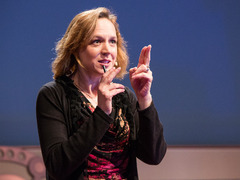
Jennifer Healey remembers totaling her car as a teenager. She was cruising down the highway, when she noticed the brake lights on the car in front of her go on. She assumed the car was slowing down, but it came to a halting, abrupt stop. Healey, now a research scientist at Intel working on mobile internet devices, simply couldn’t stop in time and felt powerless as her car smashed into the one in front of her. No one was hurt, but the experience stuck with her.
Jennifer Healey: If cars could talk, accidents might be avoidable“I want you to think a little about what the driving experience is like now. You get in your car, close the door and you’re in a glass bubble,” says Healey in today’s talk, given at TED@Intel. “You can’t really sense the world around you. You’re in this extended body. You’re tasked with navigating it down roadways in and amongst other metal giants at superhuman speeds. And all you have to guide you are your two eyes.”
Healey has an idea for how to make driving significantly safer – let our cars talk to each other and share data about their position and velocity, so they can do the work of avoiding accidents for us. Healey points out that this method would give us a sense of all the cars on the road – not just the ones in our field of vision. There would be no surprise motorcycle pulling around you or truck coming out of nowhere, because your car would know exactly where these other vehicles have been and would be able to predict where they’re going. Vehicles would be able to create the safest routes for all parties on the road, actively avoiding accidents.
Healey says that testing for this system has been done in computer simulations and is now moving to robotic models.
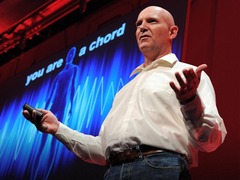
Julian Treasure takes the stage at TEDGlobal 2009, sharing the shocking fact that — when you can hear others talking in an open office — productivity dips by 66%.
“This paper is based on exhaustive review of academic papers, and reports from national governments and multinational bodies, going back some 40 years,” it begins. “The research examines the causes and impacts of sound on our health, recovery from illness or surgery, our ability to absorb information and learn, our productivity, and general sense of wellbeing.”
Read the paper in full, or check out some of the most fascinating facts below.
The estimated cost of noise pollution is $30.8 billion a year — and that’s just in Europe. The World Health Organization Europe’s 2011 report, “Burden of disease from environmental noise,” analyzes the relationship between environmental noise and health. In this study, they calculate the financial cost of lost work days, healthcare treatment, impaired learning and decreased productivity due to noise. The total they came up with is staggering, considering they’re looking at just one continent. .
Each year, noise pollution takes a day off the life of every adult and child in Europe. This same study also looked at the cost of noise pollution in terms of lost life expectancy. Shockingly, they determined that every 365 days, one million years are taken off European’s collective life expectancy — averaging to a day per person. .
If you can hear someone talking while you’re reading or writing, your productivity dips by up to 66%. Open floor-plan offices distract workers without them even noticing it. In a classic study published in the British Journal of Psychology in 1998, researchers found that employers were highly distracted when they could hear conversation around them, and less able to perform their duties. Another classic study found that noise in the office also correlated to increased stress hormone levels and a lower willingness to engage with others. According to Sound Agency case study, when sound masking technology was used in an office, there was a 46% improvement in employees’ ability to concentrate and their short term memory accuracy increased 10 percent. .
The average noise level in many classrooms is not just associated with impaired learning — but with permanent hearing loss. Noise can deeply affect learning too. The WHO recommends a noise level in classrooms akin to that you’d find in a library — 35 decibels. However, a study in Germany found that the actual average noise volume in classrooms is 65 decibels — a level associated with permanent hearing loss. As Treasure outlines in this talk, for a student sitting in the fourth row of a traditional classroom, speech intelligibility is just 50 percent — meaning that they only hear half of what their teacher says. .
A 20 decibel increase in aircraft noise is enough to delay a student’s reading level by up to 8 months. A study published in the American Journal of Epidemiology in 2006 looked at 2000 students between the ages of 9 and 10 in schools in The Netherlands, Spain and the U.K. — many in schools near airports. They found that aircraft noise was associated with impaired reading comprehension. .
50% of teachers have experienced damage to their voice from talking over classroom noise. A study of teachers published in the Journal of Speech, Language and Hearing Research in 2004, noted another side-effect of noise pollution in classrooms — 50% of teachers have suffered irreversible damage to their voices. Why? Because as the environment gets noisier, we speak more loudly. .
The average noise level in some hospital wards not only impedes healing — but could legally require hearing protection. The WHO recommends noise levels in hospital wards to stay around 35 decibels. But a study in the US found the average noise level in hospital wards is actually closer to 95 decibels — just 10 decibels beyond the noise level at which U.S. federal law requires ear protection for prolonged exposure. Sleep is crucial for patient recovery, and yet with the constant beeps, tones and shuffling, the body feels that it is under threat. Not to mention that staff errors increase the greater the level of distracting noise. .
Noise pollution may possibly even contribute to crime. When the city of Lancaster, California, installed a sound system featuring birdsong along a half-mile stretch of a main road, there was a 15 percent reduction in reported crime, according to an article in The Wall Street Journal. Similarly, when the London Underground started playing classical music at a crime-heavy station, robberies fell by 33% while assaults on staff dropped 25%, says The Independent.
Below, an infographic further outlining the problem.
TED is in the business of online videos. And so we were very intrigued by this question from Michael Stevens, the creator of the popular educational YouTube channel Vsauce: how much does a video weigh?
In today’s talk, a TED-Ed lesson filmed at TEDActive, he answers. Watch it above to find out how to measure the immeasurable. But beyond that, Stevens also shares why he creates online lessons centered around off-beat questions.
“Asking a strange question is a great way to get people in,” explains Stevens. “Sparking curiosity is great bait—it’s a great way to catch a human. Once you’ve caught them, you can accidentally teach a lot of things.”
Below, some of our favorite questions Stevens has posed in videos.
What color is a mirror?
Is the five-second rule true?
What if every single person in the world jumped at once?
Artist JR’s Inside Out photo truck is parked in Times Square in New York City through May 10 for a project he calls “Art vs. Advertising.” Photo: Instagram.com/newyorkermag
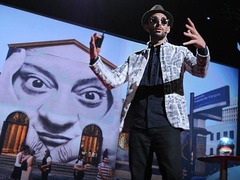
JR's TED Prize wish: Use art to turn the world inside outWith a photobooth truck in tow, he performed actions in Red Hook and the Rockaways, two areas hit hard by Hurricane Sandy in the fall. Now, JR is parking the truck in Times Square for a full two weeks, through May 10. Oh, and did I mention that he’s also taking over the Instagram account @newyorkermag for seven days to post some of the best images he captures through it all?
This has been an exceptionally busy time for JR. In addition to the documentary and New York actions, JR also recently released the digital book, The Wrinkles of the City, Los Angeles – an ode to the inhabitants of the city who’ve lived there for decades, through myriad cultural changes. Right before heading to New York, JR stopped in Berlin, where he and his crew similarly pasted 15 walls with images of older Berliners. At the same time, JR also released an app which allows fans to browse Inside Out projects across the world through a beautiful map.
JR takes a self portrait of his team on the red carpet of the Tribeca Film Festival. The documentary, “INSIDE OUT: The People’s Art Project,” premiered on April 20. TED’s own Anna Verghese was on hand and said of the premiere, “Alastair Siddon’s film is a glowing testament to the passion and commitment of the hundreds of thousands of people JR’s wish has inspired worldwide.” Photo: Instagram.com/jr/
A shot of Inside Out posters on what used to be a boardwalk in The Rockaways. Photo: Instagram.com/jr/
Residents of Red Hook paste up Inside Out images — as JR announces that he’s taking over The New Yorker’s Instagram account. Photo: Instagram.com/jr/
The Inside Out truck stationed in Times Square. Says TED’s Anna Verghese, who was there as it parked, “Hundreds of people descended upon Times Square to share their faces and stories. It’s a great reminder of the power of art to start a conversation.” Photo: Instagram.com/jr/
An arial shot as more people paste their Inside Out images in the center of Times Square. Photo: Instagram.com/jr/
An image of a building in Los Angeles, included in JR’s iPad book, “The Wrinkles of the City, Los Angeles.” Photo: JR-art.net
Another view of a pasted building in Los Angeles. Photo: JR-art.net
The wrinkles of Berlin. Photo: JR-art.net
A screenshot of a new app that lets you look up INSIDE OUT projects by their location. Photo: JR-art.net
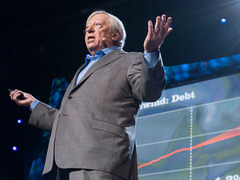
Robert Gordon: The death of innovation, the end of growthEconomists Robert Gordon and Erik Brynjolffson see very different things when they look at the stagnation of the U.S. economy in recent years. It’s almost as if they’re looking at an optical illusion image – one seeing a candlestick while the other sees two faces just inches apart. In today’s talks, they both outlined their thoughts.
Gordon sees the candlestick — he believes that the growth could be tapering off for good and that our best innovations may be behind us. As he points out, between 1900 and 1960, we went from traveling by a horse and buggy to taking Boeing 707s. But in the sixty years since, we haven’t learned to go any faster at a mass commercial level. What’s wrong? In his talk, he outlines four headwinds which are keeping us from continued growth at the pace of the past two centuries: demographics, education, debt and inequality.
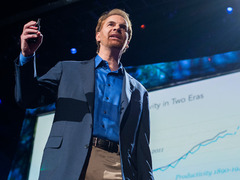
Erik Brynjolfsson: The key to growth? Race with the machinesMeanwhile, Brynjolfsson sees the faces. He says that the stagnation may simply be growing pains as we move from an economy based on production to one based on ideas. He also looks to the past for an example, taking us back 120 years to the Second Industrial Revolution. While all the tools were in place for mass production, it took three decades for productivity to skyrocket. The first generation of managers — who had old ideas about systems and workflows – had to age out of the system for growth to start. This is where Brynjolfsson thinks we are now. He sees another wave of innovation in our future — if humans can learn to work alongside computers and robots in more symbiotic ways.
Click the links above to watch these two fascinating talks. And then watch this 12-minute debate between the Gordon and Brynjolfsson on what it means to work today … and what it will mean in the future.
Do you think we are witnessing the end of innovation? Is growth over? Did either speaker here change your opinion? Explain in the comments.
Planet Earth doesn’t exactly have a birthday. But every year on April 22, we celebrate Earth Day — the anniversary of the moment the environmental movement went mass.
According to EarthDay.org, Earth Day was founded in 1970 by U.S. Senator Gaylord Nelson, who called for a “national teach-in on the environment” after witnessing the terrible effects of the 1969 oil spill in Santa Barbara, California. The first Earth Day brought major actions to the streets of many major U.S. Cities. For fun, check out this vintage newscast from after that first Earth Day.
Earth Day went global in 1990 and, today, is celebrated in an estimated 192 countries. Which makes today the perfect day to take time to appreciate the land, air, oceans and wildlife that sustain us — and to think about how our lives, both individually and as a group, affect the environment. To that end, here are 12 talks — some reflective, some terrifying, some beautiful, some galvanizing — to watch today.
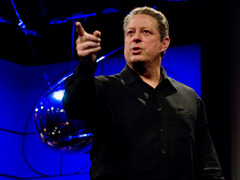
Al Gore: New thinking on the climate crisis Al Gore: New thinking on the climate crisis Former vice president Al Gore flipped the way so many think about global warming in the documentary An Inconvenient Truth. Two years after the doc’s release, he returned to the TED stage with a new presentation … showing that the impact of climate change may be even worse than scientists had predicted.
Louie Schwartzberg: Nature. Beauty. Gratitude. Louie Schwartzberg: Nature. Beauty. Gratitude. Louie Schwartzberg is a master of time-lapse photography, and his images of flowers dancing as they bloom will pierce your heart. In this talk from TEDxSF, he invites Benedictine monk David Steindl-Rast to lead a meditation on gratefulness for the beauty and bounty that surrounds us.
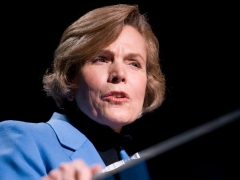
Sylvia Earle's TED Prize wish to protect our oceans Sylvia Earle’s TED Prize wish to protect our oceans Ocean researcher Sylvia Earle knows that the waters of the deep contain amazing wonder. And yet, she worries that they are quickly becoming a “paradise lost.” Watch Earle accept the TED Prize at TED2009 and unveil Mission Blue, an initiative to protect our oceans. As she puts it, “No blue, no green. If you think the ocean isn’t important, imagine Earth without it. Mars comes to mind.”
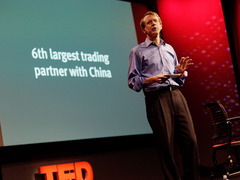
John Doerr sees salvation and profit in greentech John Doerr sees salvation and profit in greentech Silicon Valley legend John Doerr had an ‘aha’ moment when his 15 year old daughter accused him and his generation of ruining the planet. In this talk from TED2007, he gives a personal, heartfelt call for investors to look at clean energy, and for big companies to make the little changes that will add up over time.
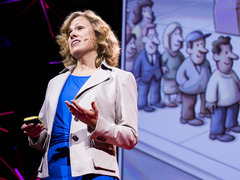
Vicki Arroyo: Let's prepare for our new climate Vicki Arroyo: Let’s prepare for our new climate As our climate changes, many areas of the world — including major cities like New Orleans — are at risk of flooding and drought. In this talk from TEDGlobal 2012, Vivki Arroyo calls on use to prepare now, by sharing examples of cities that are planning ahead and implementing big projects that take these risks as a given.
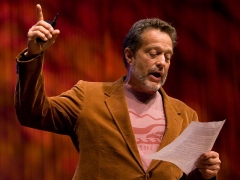
Capt. Charles Moore on the seas of plastic Capt. Charles Moore on the seas of plastic We recycle a “diddly-point-squat” percentage of the plastics we use. The result — they end up in the oceans. In this talk from TED2009, Captain Charles Moore shows us the Great Pacific Garbage Patch — an endless floating wasteland of plastic. His call to all of us: to stop our throwaway mentality and stop the plastic on land.
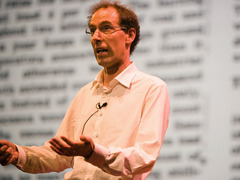
David Keith's unusual climate change idea David Keith’s unusual climate change idea Environmental scientist David Keith bemoans the fact that we’ve been reading the same headlines about the environment since the 1950s, while achieving very little to change them. In this talk from TEDSalon 2007 Hot Science, he shares a bold idea: What if we released a huge cloud of ash into the atmosphere to deflect sunlight and heat?
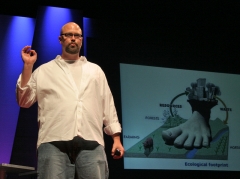
Alex Steffen: The route to a sustainable future Alex Steffen: The route to a sustainable future If people across the globe had the ecological footprint of those in the United States, we’d need 5 to 7 planets to sustain it all, says Alex Steffen at TEDGlobal 2005. But of course, we only get one. Here, he asks us to actively reduce our footprint, especially as the consumer lifestyle spreads across the globe.
There’s something oddly satisfying about hearing something gross — something that automatically scrunches your face and makes you cover your eyes, though maybe opening two fingers so that you can sort-of, kind-of see. That’s why we created the new TED Playlist called GROSS!
Included in this playlist: Marcel Dicke’s rousing case for why we should eat insects. Kees Moeliker on how discovering a live duck copulating with a dead duck changed his life. And Marcus Byrne’s love letter to the dance of the dung beetle, which allows it to roll poop over great distances.
TED playlists are collections of talks around a topic, built for you in a thoughtful sequence to illuminate ideas in context. A new playlist is added every week. We hope you enjoy this installment.
In 2004, Frank Warren began a massive undertaking: he distributed 3,000 blank postcards and invited strangers to share their secrets with him. This project grew into PostSecret.com – which now holds more than half a million secrets. Warren found that this initiative reveals our common fears, hopes, loves and desires – which are otherwise invisible. With Post Secret, he gives people the opportunity to anonymously relieve their silent burdens.
Secrets can be transformative: Sharing a secret with another person, or just with ourselves, can change who we are.
Two questions I often hear are: Do you think these anonymous secrets are true? And what happens if you get a secret about a serious crime?
I think of each postcard as a work of art, and as self-revelatory art. Secrets can have different layers of truth. Some can be both true and false; others can become true over time depending on our choices.
Sometimes a secret we keep from ourselves only becomes true after we read it on a stranger’s postcard. Early in the project I received this email:
“Dear Frank, Do you know that I left my boyfriend of a year and a half because of the postcard that read, ‘His temper is so scary, I’ve lost all my opinions.’ It hadn’t even occurred to me what was happening, and it took a total stranger writing it down to make me realize what the hell was going on in my life.” Read the full essay »
I recently did a study that, among other things, looked at the secrets and lies that people keep from their spouse or committed partner. You know, the person who we share vows with, the person who we say “I love you” to, the person we share a bed and a life with — that person. The national and international study of 80,000 people, part of which appears in The Normal Bar (with Chrisanna Northrup and Jim Witte) indicates that secrets and lies are commonplace in relationships, not only in the United States, but in the world. 43 percent of men and 33 percent of women say they keep major secrets from each other — in fact, 27 percent of people who said they were in an “extremely happy relationship” also admitted to having major secrets from their partner.
In France and Italy , big secrets seem to be a way of life; approximately 75 percent of men and women there said they had them. As for lies, 75 percent of our men, and 71 percent of the women said they occasionally lie to their partner-and that was even true for 69 percent of the happiest couples. Read the full essay »
Social@Ogilvy, the blog from advertising and marketing firm Ogilvy & Mathers about trends and insights in social media, was very inspired by this blog post. And so they created this very cool graphic recap of it. Check it out above, complete with a rocketing office chair.
We all know what it feels like to stand in a place that overwhelms our eyes with splendor, to hear a piece of music that seems to pluck the strings of our heart, to behold a face whose shape is pleasing. Beauty: it’s a thing we all know and are drawn to. And yet what is it that makes something beautiful?
Today’s TED Radio Hour asks this deceptively simple question. It begins with violinst Robert Gupta, reflecting on the instinct musicians have to know when something is simply lovely. Next, we hear from Denis Dutton, who looks at the universality of beauty as a gift from our ancient ancestors and the emotions they attached to the things that helped them survive. After, psychologist Nancy Etcoff explains why those we love are so beautiful to us.
In the second half of the show, model Cameron Russell talks about the decisions she made in her talk which went viral earlier this year, all about why she’s a model. Her explanation: “Because I won a genetic lottery.” Civic leader Bill Strickland describes how the magic of the potters’ wheel changed his life, and how he seeks to do the same for the youth of Pittsburgh through his arts education center. And designer Richard Seymour shares why beauty is not so much a thing in and of itself, but a feeling.
It’s an inspiring hour of great moments from TED Talks, embedded in a soundscape of music and fresh interviews. As Strickland says in the show, “When I think of beauty, I think of life and hope and all of its enormous possibilities. “
BLACK now travels the world as a yo-yo champion. But when he was 14, he had low self-esteem. Photo: James Duncan Davidson
Yo-yo world champion BLACK admits that the first time he picked up his instrument of choice, at age 14, he couldn’t figure out the simplest of tricks. But after a week of practice, he started to understand its movement and dynamics.
BLACK: My journey to yo-yo masteryIn today’s talk, given at TED2013, BLACK remembers, “I thought, ‘The yo-yo is something for me to be good at. For the first time in my life, I found my passion.’”
BLACK practiced for hours a day and, four years later, won the World Yo-Yo Contest. But when fame and fortune failed to follow, he put the yo-yo aside and studied to be a systems engineer.
In the end, though, he says couldn’t stay away. He won the World Yo-Yo Contest for a second time in 2007 and, from there, he hasn’t looked back, taking his unusual performance art all around the world.
“I wanted to show on stage how spectacular the yo-yo could be, to change the public image of the yo-yo,” he says. “What I’ve learned with the yo-yo is that if I make enough efforts with huge passion, there’s no impossible.”
Ten years ago, TIME Magazine inaugurated its list of the “100 Most Influential People in the World.” In the interceding decade, the unveiling of the annual list has become an anticipated event with readers ready to gorge on glossy articles and debate the inclusion of controversial inductees. Today, the magazine posted its 10th list of influence, the “2013 Time 100.”
This year, we are excited to see several TED alums on the list. Elon Musk, founder of SpaceX and Tesla, was named a “Titan” in a piece written by Richard Branson. (Watch Branson’s TED Talk, “Life at 30,000 feet.”) Sheryl Sandberg, who recently released the book Lean In, also was dubbed a Titan. Daphne Koller, who co-created the website Coursera, was listed as a “Pioneer,” along with her venture partner Andrew Ng. And Michelle Obama made the list of “Icons.”
Below, watch their TED Talks.
We’d also love to give a shout-out to Perry Chen, who was a TED Fellow in 2010. The CEO of Kickstarter, he has intrinsically changed the landscape of funding, and was named a “Pioneer” by TIME.
Three fascinating speakers have been added to the lineup for TEDGlobal 2013, which kicks off in Edinburgh, Scotland, June 10 to 14.
First, Anne-Marie Slaughter, who exploded the conversation about women’s work-life balance with her July/August 2012 The Atlantic article, “Why Women Still Can’t Have It All,” will join the conference to lend her expertise on policy and work. Slaughter, who’ll become president of the New America Foundation in September, will speak during session 1, “The Moment of Truth.”
Brazilian neuroscientist Suzana Herculano-Heuzel will also take the TEDGlobal stage. Herculano-Heuzel created “brain soup” in order to count the number of neurons in the human brain. She will speak during session 5, “Listening to Nature,” as her latest work has her studying elephant and whale brains.
The final new addition to the program: Andras Forgacs, the co-founder and CEO of Modern Meadow, a company which is “bio-printing” meat and leather. In other words: no animal will be killed in the making of the final consumer products.
The 70+ presenters at TEDGlobal 2013 are an enthralling bunch. Here’s a look at some of the other speakers who’ve been in the news recently.
What, you ask, is an “airborne ecologist?” Last week, The Economist took a look at Gregory Asner’s work studying the hunting patterns of lions from a twin propeller plane. What is the benefit? The ability to make a 3D map of an area and chart animal movement through it — without having to catch animals in the act.
Shereen El Feki’s new book, Sex and the Citadel, was reviewed last week by Janet Maslin of The New York Times. Maslin writes, “Though she warns her readers that she is not writing an encyclopedia or staging a peep show, Ms. El Feki does ask an array of highly personal questions about present-day sexual relations in Muslim societies, with particular emphasis on Egypt, Tunisia, Lebanon, the United Arab Emirates and Morocco.”
Financial Times interviewed Michael Sandel over a seafood lunch in a piece subtitled, “The Harvard philosopher and ‘moral rock star’ on Obama, education’s new frontiers and the shortcomings of markets.” In a great moment in the interview, Sandel shares why thousands of people attend his lectures: “There is an enormous hunger to engage in big questions that matter,” he says.
“You know when you have a bird, and it’s been in a cage all its life? When you open the cage door, it doesn’t want to leave. It was that moment.” Women’s rights activist Manal Al-Sharif quoted in a recent The Wall Street Journalprofile describing how she felt the first time she got behind the wheel of a car in Saudi Arabia.
Reviewer Hari Kunzru of The New York Times mentions Lesley Hazleton’s first TED Talk, “On reading the Koran,” in his review of her new book, a biography of Muhammad. He writes, “Hazleton approaches her subject with scrupulous respect … In 2010, she gave a TED talk debunking some of the more egregious myths about the Koran, notably the salaciously Orientalist ‘72 virgins.’ This is a writer who is working to dispel contradictions, not sharpen them.”
A study on whether false memories can curb a person’s desire to drink alcohol by Elizabeth Loftus was featured on TIME.com last week.
We can’t wait for these speakers to make us “Think Again” at TEDGlobal 2013.
Joshua Prager uses his journalistic eye to tell his own story at TED2013. Photo: James Duncan Davidson
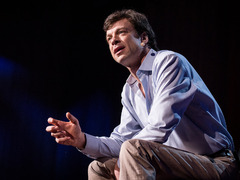
Almost twenty-three years ago, Joshua Prager experienced a moment that could only be described as “a great hinge in my life,” one that divided it “like the spine of an open book.” Just 19 years old then, Prager was in Israel for a year after high school. He was sitting in the backseat of a minibus bound for Jerusalem when a truck behind him lost control and slammed into the corner where he sat. His neck broke and, in a second, he went from an athletic teen to a hemiplegic. It would be weeks before he could breathe on his own, four months before he would leave the hospital. For the next four years, he navigated the world in a wheelchair, then a cane and braces – and embarked on a career as a journalist for The Wall Street Journal.
“[He was] a man I never met, but who had changed my life,” says Prager in this wrenching talk. “So on an overcast morning in January, I headed north in a silver Chevy to find a man – and some peace.”
Prager had returned to live in Jerusalem once before, after college. While there, he’d read Abed’s testimony from the morning after the accident and felt an intense wave of emotion.
“It was the first time I’d felt anger toward this man and it came from magical thinking. On this Xeroxed sheet of paper the crash had not yet happened,” says Prager. “Abed could still turn his wheel left so I would see him whoosh by out my window … and I would remain whole.”
He contacted Abed on that trip, but the two didn’t meet. It was only last year — as Prager wrote a book about his experience — that he realized he needed to meet Abed face-to face. “Finally I understood why,” says Prager. “To hear this man say two words: I’m sorry.”
To hear how Prager found Abed, watch this talk. In it, he shares the unexpected trajectories this meeting took — and the lessons this unpredictable encounter taught him about human nature and the core of our identities.
Of course, Prager was only able to tell a sliver of his story in an18-minute talk. He shares much, much more in his book Half-Life: Reflections from Jerusalem on a Broken Neck. Below, two excerpts from this recently released book – one from the prologue and one short selection from later.
Through the faded blue metal frame of my open window, I watch the morning light approach. It crests the skinny cypress trees atop the hill just over the valley, rolls down the bone rooftops of Jabal Mukabbir, rises to ripen the red-yellow nectarines on my sill three stories above Naomi Street. My floor, tiles of salmon and olive, brightens, and my glass tabletop reflects the worn copy of The Diving Bell and the Butterfly upon it.
The light reminds me that I have just come back to Jerusalem and I smile at a thought: “I will walk before the Lord in the land of the living.” I appropriated the sentence long ago from the Psalmist and I slide my left foot into my plastic brace, calf-high and erect in an empty brown shoe. I take hold of my wooden cane and walk to the staircase. There is no handrail on my right so I descend the three flights slowly, right forearm pressed against the powdery concrete wall, left hand unable to grasp the banister available to it, left leg — hard to bend–preceding the right down each of 55 steps.
I turn right on Naomi Street, right again on Hebron. My left foot is closer to the street than my right. Sidewalks the world over slant down toward the gutter and I am careful to give the extra smidgeon of clearance the slope affords to the half of me that swings forward from the hip. I have now done so for half my life.
Before May 16, 1990, I had not noticed the slant underfoot. Nor, as I ran over rise and fall, had I contemplated much what made me me, or that unfairness has theological implications, or that life might end each and every day.
But right now, because my neck broke, I am carrying a question to a windmill aware not only of the topography of the stone molars below but also, as every day, of these higher burdens.
And yet, I am lucky. Twenty-two years ago, at the base of the hill that rises to Jerusalem, a careless truck driver almost killed me as I sat in the back of a minibus. He would have but for the machines and people and tubes that saw to it that my body breathed and fed and pissed. A medical jet flew me home to New York where at age 19, I quietly observed the goings-on; I could not speak or move or feel anything below my neck save one well placed prick of a needle.
Improbably, the swelling in my neck receded. I would walk in the land of the living! But imbalanced. My right side moved freely. My left, restrained by spasticity, a neurological tightness of sorts, did not; it furled and shook. A doctor explained that I was further divided: I had Brown-Séquard syndrome which roughly meant that one half of me could move better, the other half feel.
I told myself to work now and think later. And so I pushed myself, learned to eat and dress and steady a suppository in spastic fingers, to sit and stand and walk. Walking, however gratifying, was at any real length an impractical exhaustion, and I used a wheelchair for four years until, back in Israel after college, I put in another year of exercise and rose from the chair for good. I returned to New York and became a journalist, walking through six continents with an ankle brace and cane, typing articles and a book with one finger.
I tried to write of the crash but failed. Instead, for a decade, I wrote of secrets. There was the reclusive boy who inherited the royalties to the classic children’s book Goodnight Moon. There was the hidden scheme that led to baseball’s most famous moment, The Shot Heard Round the World. There was the only-ever anonymous recipient of a Pulitzer Prize, a photographer in Iran. There were the unknown suicides of the parents of the most famous missing person in World War II.
It took a friend to point out to me the obvious: all of these stories mirrored my own, each centering on a life that changed in an instant — owing if not to a crash than to an inheritance, a swing of a bat, a click of a shutter, an arrest. Each of us had a before and an after. I had been working through my lot after all.
A second friend helped me to see that I was, in effect, forcing my subjects — one solved secret at a time — to live with their altering moment just as I did: openly. Whereas a depressed person can choose to conceal her disability, to meet me is to see that I use a cane.
But as I continue now on my walk and turn left onto King David, I am less sure of what I, not others, see in me and my broken neck.
I have returned to Jerusalem to find this out, to become again whole where I was once divided.
I cross to the right side of the street so that my left leg is to the curb and I see the windmill ahead amidst cypress and carob and olive trees. It is beautiful, a narrowing white stone cylinder with an iron cap and sail. A wealthy Brit named Moses Montefiore had it built in 1857 to encourage Jews to leave the safe but confined walled city just over the valley and support themselves milling flour. Though a community rooted about the mill, the mill was not used for long.
I turn into the park, step onto its stone path and walk between puffs of rosemary toward the windmill. I have walked a mile and my back is tight–all that swinging of a leg–and I put my right hand on my hip and lean back quickly at the waist. I hear the familiar crack deep in my back, my left leg stiffens and kicks forward, my left arm bends and shakes in spastic confusion. I balance flamingo-like a few seconds on my right leg, then sit.
I reach the windmill and look up. And then I, who once ran about it, asks my question: with no wind and no mill, are you still a windmill?
***
I am standing on a rooftop in the old walled city of Jerusalem when at 4:04 on a Friday afternoon a siren sounds as it does here every week. It stops and the Sabbath, silent, begins. And I remember another silence that followed another great sound not far away. For the crash blew out my eardrum and for a time, I heard nothing.
And then the world was full of noise — beeps and alarms and intercoms and voices — and I was silent. And the absence of my voice was audible. So I listened and heard what I had not before — the wee squeak of a first sneeze, the echo of smacked lips, the soft click of my thumb pressing a blue square button embossed with the white silhouette of a nurse.
In the quiet of my first night at Sinai, I heard a scream. It was a sustained, bloodcurdling scream, a woman in a horror film. My body jerked. The scream stopped, then returned, words articulated but incomprehensible. Then more screams descending into a frantic cough.
Then I saw her — a girl, maybe 16, skinny and tall, with half her head shaved and long dark scraggly hair falling from the other. She looked like a demon and ran screaming from my door.
My heart pounded. I began to sweat. My call bell was clipped to the railing on the right of my bed and I put my thumb on it and pressed. No one came. The screaming continued. Sweat wet my face and I pressed the button repeatedly. Where was help?! I felt dizzy. It occurred to me that perhaps there had been a mistake: I had been sent to a mental institution! Minutes passed. I was dizzy, drenched and bewildered when the nurse entered my room and told me that the girl had been in a car accident and could not speak.
I calmed. I listened. I thought of the girl. Wrote William Carlos Williams: “The poem springs from the half-spoken words of such patients….”
Time passed and I readied for bed one night when a man I could not see began to moan. Minutes passed and still he moaned and then an hour passed and I was exhausted and began to count the moans and time the moans, their metronomic parabolic rise and fall. The nurses did not make the moans stop and the moans continued for nights until the man was gone and I did not care to where.
There was more noise too. Margaret was loud. Tufts of black and white hair did not conceal a scar on her scalp and she blurted out unpleasant words and glowered at all. And one Saturday night as my father recited a prayer to mark the end of the Sabbath and I held a forbidden candle, middle-aged Margaret pushed open my door with her foot and wheeled in.
My father stopped. We closed the door. Margaret looked at the flame and we looked at Margaret. Her expression contorted. “You can’t have fire,” she said.
“Hi Margaret,” I said.
“Hi sunshine.”
I explained that this was a special candle and the fire was a secret. Margaret listened as my father resumed the prayer. She left and never told.
Years passed and I thought of Margaret and the moaning man and the screaming girl and their half-spoken words and my own words that were whole. And I appreciated the words I spoke more for having once not been able to speak them. Wrote Melville: “Truly to enjoy bodily warmth, some small part of you must be cold, for there is no quality in this world that is not what it is merely by contrast.”
Contrast. It is the short sentence that stands out in contradistinction to the long, the sound to the silence. You are mindful of what you do not have and so are truly mindful of what you do have. And if the gods are kind, you truly enjoy what you have. That is the one singular gift you may receive when you live in a hospital or break your neck or are sick or lose someone you love or suffer in any existential way. You know death and so may wake each morning pulsing with ruddy life. Some part of you is cold and so another part may truly enjoy what it is to be warm. And even to be cold. When one winter morning years after the crash, I stepped onto a tile floor and the underside of my left foot felt a flash of cold stone, nerves at last awake, it was exhilarating, a gust of snow.
So how did Prager come to TED? He spoke at the New York stop of our worldwide talent search. There he gave a shorter talk, about reaching his “half-life” – the exact moment when he had lived as long after the crash as he had before. Below, hear what he spent this moment, which calls “a looming uber-anniversary.”
In the past 30 years, major advances have been made when it comes to treating several serious diseases. Today, there are 85% fewer deaths from leukemia and 63% fewer fatalities from heart disease than there were then. Meanwhile, while AIDS was once considered a death sentence, people with the disease can now live to old age. Not to mention that a remarkable third of the people who have strokes not only live — but leave the hospital without any disability.
Thomas Insel: Toward a new understanding of mental illness “These are just remarkable changes,” says Thomas Insel, Director of the National Institute of Mental Health, in today’s talk given at TEDxCaltech. “All of them boil down to understanding something about the disease that has allowed us to detect early and intervene early.”
Sadly though, Insel says, the news isn’t good across the board. The rate of suicide, he says, has not changed at all over the last three decades. About 90% of suicides are related to mental illness. And while 1 in 5 people will be affected by a psychiatric disorder, scientists still understand dangerously little about these diseases. In fact, says Insel, we don’t even know what to call them. The terms preferred at the moment – “mental disorders” and “behavioral disorders” — are misleading, because they point to symptoms rather than to the disease itself.
“Both of those terms which have been in play for a century or more are actually now impediments to progress,” says Insel. “What we need conceptually here is to rethink these disorders as ‘brain disorders.’”
In this talk, Insel reveals why he believes we are about to turn a corner in understanding the brain, which he calls an “organ of surreal complexity.” As scientists get a better understanding of its workings and development, they’ll start to understand the patterns of brain disorders. It’s possible that, as with heart disease, scientists will be able to identify risk factors. To hear how this could lead to early detection of brain disorders — and even interventions before a person so much as experiences or displays symptoms — watch this fascinating talk.
“The good news stories in medicine are early detection and early intervention,” explains Insel. “If we waited until the heart attack, we would be sacrificing 1.1 million lives every year in this country to heart disease. That’s precisely what we do when we decide that everyone with one of these brain disorders has a ‘behavioral disorder’ – we wait until the behavior becomes manifest.”
Insel’s talk reminds us of two powerful TED playlists.
First it reminds us of the list “All Kinds of Minds,” which features several TED Talks from people who’ve had the experience of living with a brain disorder. It begins with legal scholar Elyn Saks describing her own experience of schizophrenia, moves on to activist autism activist Temple Grandin describing how her mind works, and builds to Joshua Walters, who is bipolar, asking: What’s the balance between medicating craziness away and riding its creative edge?
Insel’s talk also reminds us of the playlist “How does my brain work?,” which brings together talks about incredible research that’s helping scientists better understand our minds. It begins with neuroscientist Daniel Wolport giving a fascinating theory on why the brain evolved, moves on to Allan Jones and his initiative to map of the brain, and ends with Michael Merzenich giving evidence of the brain’s plasticity.
In the day since the Boston Marathon was interrupted by two bomb blasts – which killed three and injured 100 – a meme has emerged online: “Look for the helpers.” The quote comes from Fred Rogers, who shared in his tome The Mister Rogers Parenting Book, “When I was a boy and I would see scary things in the news, my mother would say to me, ‘Look for the helpers.’ You will always find people who are helping.”
In the images of the terrible scene in Boston yesterday, the helpers are obvious – bystanders attending to the injured, paramedics rushing to the scene, police and marathon volunteers helping the crowd. Even Google swung into action, creating a person finder app for those with loved ones at the marathon finish line.
We love the idea of looking for the helpers. To keep you inspired on a hard day, here are some talks from brave helpers:
Alberto Cairo: There are no scraps of men. In this talk, Cairo explains why he keeps his prosthetic limb clinics open, even during fighting in Afghanistan – because by giving people new limbs, he’s able to help restore their inherent dignity.
Zainab Saibi: Women, wartime and the dream of peace. In this talk, Zainab Salbi turns her attention to the “backline” of war – the women who keep normal life moving even through terrible moments of violence.
Rick Smolan tells the story of a girl. On an assignment to photograph children in Southeast Asia fathered and abandoned by American soldiers, Rick Smolan encountered an amazing 11-year-old girl. Here, he tells the story of how he arranged her adoption in a moment of crisis.
Scilla Elworthy: Fighting with non-violence. How do we respond to brute force without raising arms? Peace activist Scilla Elworthy evokes the examples of some of the greatest helpers — Aung San Suu Kyi, Mahatma Gandhi and Nelson Mandela – to give insight.
Inge Missmahl brings peace to the minds of Afghanistan. In all of Afghanistan, there are just a handful of psychiatrists. By building mental care into the health system of the nation, Inge Missmahl is greatly helping a society long riddled by trauma.
Your brain is three and a half pounds of tissue — and yet it’s the key to everything you experience. The National Geographic Channel show Brain Games seeks to give a better understanding of it – by looking at how the brain focuses, processes fears, makes decisions and much more. The show is hosted by Jason Silva, the “performance philosopher” who creates fast-moving films about ideas – like this exploration of last year’s TEDGlobal theme, “Radical Openness.”
Brain Games returns to the air next Monday, April 22, with the episode “Focus Pocus.” In the episode, TEDGlobal 2013 speakerApollo Robbins, the “gentleman thief,” joins Silva and psychologist Brian Scholl, director of Yale University’s Perception and Cognition Lab, for a look at how the brain focuses on important details – or at least, those it thinks are important.
Below, watch Silva talk about how we focus — and over-extend our focus — in today’s media landscape:
And Robbins describes how he uses the brain’s tools of focus for sleight-of-hand and, in the process, makes a pen disappear:
If you’ve Googled anything this morning, you’ve probably noticed that the site’s logo features an orb-shaped graph instead of a second ‘o,’ plus all sorts of equations like “V –E + F = 2.” The doodle is an homage to Swiss mathematician Leonhard Euler, who was born on this day in 1707. The man responsible for geometry, trigonometry, algebra, number theory and infinitesimal calculus, he also made significant contributions to the world of physics, mechanics, fluid dynamics and astronomy. He’s considered one of the most game-changing mathematicians ever.
Here, three great TED Talks about math to help you celebrate his birthday.
 The TED office is abuzz about two high-profile mentions this week.


 Jennifer Healey remembers totaling her car as a teenager. She was cruising down the highway, when she noticed the brake lights on the car in front of her go on. She assumed the car was slowing down, but it came to a halting, abrupt stop. Healey, now a research scientist at Intel working on mobile internet devices, simply couldn’t stop in time and felt powerless as her car smashed into the one in front of her. No one was hurt, but the experience stuck with her.
 Jennifer Healey: If cars could talk, accidents might be avoidable


 Julian Treasure: Shh! Sound health in 8 steps


 JR's TED Prize wish: Use art to turn the world inside out


 Robert Gordon: The death of innovation, the end of growth
 Erik Brynjolfsson: The key to growth? Race with the machines

 Planet Earth doesn’t exactly have a birthday. But every year on April 22, we celebrate Earth Day — the anniversary of the moment the environmental movement went mass.
 Al Gore: New thinking on the climate crisis
 Louie Schwartzberg: Nature. Beauty. Gratitude.
 Sylvia Earle's TED Prize wish to protect our oceans
 John Doerr sees salvation and profit in greentech
 Vicki Arroyo: Let's prepare for our new climate
 Karen Bass: Unseen footage, untamed nature
 James Hansen: Why I must speak out about climate change
 Capt. Charles Moore on the seas of plastic
 David Keith's unusual climate change idea
 Cesar Harada: A novel idea for cleaning up oil spills
 Alex Steffen: The route to a sustainable future
 James Balog: Time-lapse proof of extreme ice loss


 Frank Warren: Half a million secrets


 We all know what it feels like to stand in a place that overwhelms our eyes with splendor, to hear a piece of music that seems to pluck the strings of our heart, to behold a face whose shape is pleasing. Beauty: it’s a thing we all know and are drawn to. And yet what is it that makes something beautiful?


 BLACK: My journey to yo-yo mastery

 Ten years ago, TIME Magazine inaugurated its list of the “100 Most Influential People in the World.” In the interceding decade, the unveiling of the annual list has become an anticipated event with readers ready to gorge on glossy articles and debate the inclusion of controversial inductees. Today, the magazine posted its 10th list of influence, the “

 Three fascinating speakers have been added to the lineup for


 Joshua Prager: In search of the man who broke my neck

 In the past 30 years, major advances have been made when it comes to treating several serious diseases. Today, there are 85% fewer deaths from leukemia and 63% fewer fatalities from heart disease than there were then. Meanwhile, while AIDS was once considered a death sentence, people with the disease can now live to old age. Not to mention that a remarkable third of the people who have strokes not only live — but leave the hospital without any disability.
 Thomas Insel: Toward a new understanding of mental illness


 Your brain is three and a half pounds of tissue — and yet it’s the key to everything you experience. The National Geographic Channel show

 If you’ve Googled anything this morning, you’ve probably noticed that the site’s logo features an orb-shaped graph instead of a second ‘o,’ plus all sorts of equations like “V –E + F = 2.” The doodle is an homage to Swiss mathematician Leonhard Euler, who was born on this day in 1707. The man responsible for geometry, trigonometry, algebra, number theory and infinitesimal calculus, he also made significant contributions to the world of physics, mechanics, fluid dynamics and astronomy. He’s considered one of the most game-changing mathematicians ever.

