At 10 AM BST, Nokia’s highly anticipated press event kicks off in London. Details are scarce at the moment, but what we can tell you for sure is that the Finnish phone manufacturer is preparing the “next installment”.
What could that be? Well, yesterday, three days after the Lumia 928 was unveiled, Nokia’s UK arm teased a new Lumia Windows Phone which takes some design cues from the Verizon-exclusive handset. Speculation aside, we are looking forward to seeing what Nokia has in store for us.
The webcast kicks off at 10 AM BST (that’s 5 AM Eastern Time) and we’ll be liveblogging it here. All updates will be in reverse chronological order, meaning the latest ones are first (and first ones are last). You’ll need to hit the refresh button to get the newest updates.
Tomorrow, Nokia will host a press event in London, where the company says it will unveil “the next installment“. And, judging by a teaser released on Monday, it appears to be a new Lumia Window Phone. This comes just three days after the Finnish maker showcased the Lumia 928, which is coming exclusively to US mobile operator Verizon.
The teaser, posted by Nokia’s UK arm on YouTube, reveals straight from its title — “The new Nokia Lumia is coming…” — that the company will announce a new Lumia device. Although there is no specific date provided (but when is there one with a teaser?), based on timing we can presume that the smartphone will be presented at tomorrow’s press event.
The video shows a number of design cues, starting with the Nokia logo, the speaker grill on top and the front-facing camera to the right. There is also a silver-colored trim (on the side) and back panel covering the smartphone.
The video, however, focuses mostly on the back-facing camera, which Nokia says is able to capture “more than your eyes can see”. The main shooter is surrounded by a bump in the back panel and dual flash lights positioned right below it.
The bump around the back-facing camera suggests one of two things — either the device is thinner than the shooter allows in order to sit flush with the case or there is actually a bigger sensor than the handset can handle without getting too thick.
With most of the mobile operators today relying on 3G underpinnings, and few actually using 4G backbones, the concept of yet another generation of cellular networks is unfathomable. After all, most of us still struggle to watch 1080p videos on YouTube without buffering and we know that developing, testing, approving and rolling out a new cellular technology doesn’t happen overnight. If 4G is of any indication, it might not happen even years after vetting it.
But, on Monday, Samsung announced that it has developed “the world’s first adaptive array transceiver technology operating in the millimeter-wave Ka bands”, that is designed for cellular communications. That’s a mouthful, but it is actually a device which paves the way for the fifth-generation networks. And if the speed part is true, count me in, whenever it arrives.
Samsung says that 5G networks will deliver “data transmission up to several hundred times faster than current 4G networks”, while providing “speeds up to several tens of Gbps” for each base station.
The company’s adaptive array transceiver technology transmits data, at up to two kilometers, with maximum speeds of 1.056 Gbps. It all sounds a bit surreal, but this could dramatically change the way we use mobile devices and make room for a new breed of cloud services.
We could fully use cloud storage to actually store and access our data from the cloud without having to grab a cup of coffee while it arrives on our smartphones or tablets. The majority of large downloads can happen within minutes or even seconds, at least theoretically. The bottleneck would shift from data speeds onto carrier data caps and cloud service providers.
As the company says: “Samsung’s new technology will allow users to transmit massive data files including high quality digital movies practically without limitation. As a result, subscribers will be able to enjoy a wide range of services such as 3D movies and games, real-time streaming of ultra high-definition (UHD) content, and remote medical services”.
But there is something you should know. As I previously mentioned, vetting a new cellular technology can take time and, therefore, Samsung does not expect to offer the necessary devices anytime soon. The company says that it plans to commercialize 5G equipment by 2020, a tad under seven years down the road.
Late yesterday, cloud storage provider Box released updated apps for Windows 8 and Windows Phone 8. The latest iterations come with new features which are designed to “give users and businesses better control and enhanced security over their content”. Let’s take a look at the changes.
The most noteworthy feature introduced on Box for Windows 8 and Windows Phone 8 is the ability to manage (add, change and remove) access permissions for any collaborator in any folder, which the user owns. This functionality is aimed at both users, like students working together on an assignment, and businesses, which need in-depth collaboration features to manage a project.
Users who have two-step authentication enabled can now use security codes to log into the Box apps for Windows 8 and Windows Phone 8, after receiving them via text message. This brings the company’s offerings in line with SkyDrive, which has offered the feature ever since Microsoft enabled it (admittedly, in mid-April).
The final new feature is aimed at businesses. IT administrators can enforce certain policies for the Box apps, such as requiring an application-specific password, using a custom lock timeout and restrict local downloads, all meant to improve security.
On Windows 8 and Windows Phone 8, Box announced that its mobile apps have reached in excess of 500,000 downloads combined, hence the reason for the company’s continuous support of the two platforms.
By contrast other major cloud storage providers have only released apps for one operating system (like Dropbox with Windows 8) or none at all (the most prominent example being Google).
On Monday, Sony unveiled a new smartphone called the Xperia ZR. The handset shares some its underpinnings with the company’s current flagship, the Xperia Z, but according to the Japanese electronics giant it features “the highest level of water-resistance for capturing photos and Full HD videos underwater”.
The Xperia ZR can be used to record 1080p videos and shoot stills in up to 1.5 meters of “fresh water” for up to half an hour. The smartphone is also dust-resistant and meets the IP55 and IP58 protection standards. This means that the Xperia ZR can survive the usual water encounters, including a drop in the toilet (as long as it doesn’t crack at impact) and a coffee spill, as well as keep dust away from its insides.
The Xperia ZR packs a 4.6-inch TFT display with a resolution of 720 by 1280 and the Mobile BRAVIA Engine 2 technology. Power comes from a 1.5 GHz Qualcomm Snapdragon S4 Pro processor, an Adreno 320 GPU (Graphics Processing Unit), 2 GB of RAM and a removable 2,300 mAh battery, similar (bar the battery) to the Xperia Z and flagships from 2012 like the Google Nexus 4 and LG Optimus G. The handset comes with 8 GB of internal storage aided by a microSD card slot.
Like the Xperia Z, the Xperia ZR features a 13 MP back-facing camera capable of recording 1080p video. But, unlike its bigger brother which ships with a 2.1 MP shooter on the front, the handset only sports a 0.3 MP front-facing camera capable of recording video of VGA quality (640 by 840 pixels).
In terms of connectivity, the smartphone features support for 4G LTE and HSPA+ cellular networks; Wi-Fi; HDMI; GPS with Glonass support; DLNA; Bluetooth 4.0; NFC (Near Field Communication); USB 2.0 and comes with the usual array of sensors.
The Xperia ZR comes in at 131.3 x 67.3 x 10.5 mm and weighs 138 grams. The handset ships with Android 4.1 Jelly Bean onboard, backed by Sony’s own launcher and suite of branded apps.
The smartphone will be available from Q2 2013 in “various global markets”. The price, as usual, will likely depend on the region.
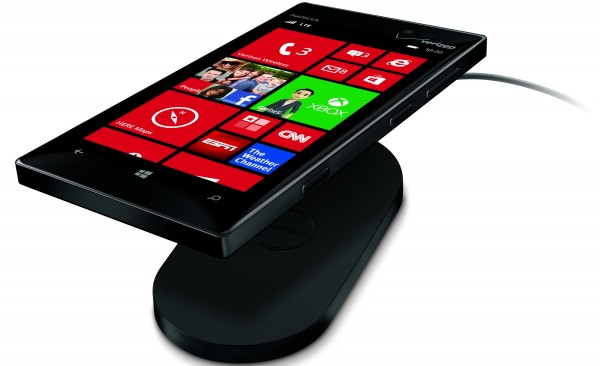
On Friday, Nokia ended days of teases, officially taking the wraps off the Lumia 928 Windows Phone 8 smartphone. The handset, which will be available exclusively at US mobile operator Verizon, showcases a departure in design from current flagship, Lumia 920, while delivering similar hardware and software specifications.
The Lumia 928 packs a 4.5-inch OLED display with a resolution of 768 by 1280 and 334 pixels per inch, protected by Corning’s Gorilla Glass. The screen can be operated using gloves or long fingernails (women should love this). Power comes from a 1.5 GHz dual-core Qualcomm Snapdragon MSM8960 processor, 1GB of RAM and a 2000 mAh battery. The 32 GB internal storage is non-expandable.
The smartphone features a 1.2-megapixel front-facing camera capable of 720p video recording. On the back there is an 8.7 MP PureView shooter with Carl Zeiss Tessar f/2.0 lens, 1.4 sensor, OIS (Optical Image Stabilization) that is capable of 1080p video recording. The Lumia 928 uses a Xenon flash to take still photos and an LED flash for videos.
Nokia says that users will experience “high-amplitude audio capture” while shooting videos thanks to three built-in microphones, which can “record sound naturally and distortion-free, up to 140db”. The company also touts a better speaker, which is located on the back of the device and delivers sound at “one to two Decibels higher than anything else out there” — so Nokia claims. That should please those listening to music using the built-in speaker in public, while annoying passersby.
Just like Lumia 920, the Lumia 928 ships with built-in Qi wireless charging support and works with Nokia’s current accessories for the job, like the Wireless Charging Pillow by Fatboy (basically a wireless charging plate with a nicely designed fabric cover on top) and the JBL PlayUP speakers (which feature wireless charging support).
In the connectivity department the smartphone delivers support for 4G LTE networks; Wi-Fi 802.11 a/b/g/n; Bluetooth 3.0 + EDR; microUSB 2.0; A-GPS with Glonass support; NFC (Near Field Communication) and the usual array of sensors including accelerometer, magnetometer and ambient light sensor, among others.
In the software department, Lumia 928 provides access to Nokia’s exclusive app collection for Windows Phone 8, which includes the complete HERE suite (HERE City Lens, HERE Drive+ Beta, HERE Maps and HERE Transit), Nokia Music, Nokia Express, Burton and MICHELIN Travel, among others.
The Lumia 928 measures 5.24 x 2.71 x 0.44 inches and weighs 5.7 ounces (133 x 68.8 x 11.1 mm and 161.59 grams), which means that it is taller, narrower, thicker and lighter than the 920 (130.3 x 70.8 x 10.7 mm and 185 grams). The Lumia 928 still has a generous footprint compared to its older brother.
The Lumia 928 arrives in black or white, starting May 16, on Verizon’s online and brick-and-mortar stores. On a two-year contract, the smartphone runs for $99 after a $50 mail-in rebate. Early adopters, however, “for a limited time”, will receive a $25 credit that can be used to purchase Windows Phone apps and games.
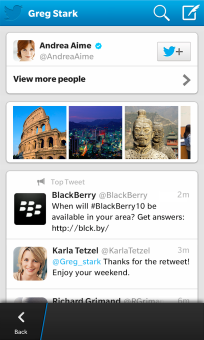
Late yesterday, Canadian manufacturer BlackBerry announced yet another range of updates for the LinkedIn and Twitter apps on BlackBerry 10. The latest iterations are designed to bring the social networking apps on par with their Android, iOS and Windows Phone counterparts and, according to BlackBerry, to “make it easier than ever to stay connected and do more with your social and professional contacts, while on the go”.
Twitter is on its third noteworthy update in the past couple of months — the first one arrived in early-March while the second released weeks later. The latest iteration sports two major improvements, the first of which is the ability to display more content while searching. Users can view photos, relevant profiles and searches as well as tweets and top tweets on the same page.
The second improvement is less important by comparison. Twitter users on BlackBery 10 can now take advantage of automatic caching, which is designed to deliver the latest updates from the feed without manually refreshing it. This feature is already available on other platforms such as Windows Phone.
By contrast, the LinkedIn app is on its second major update in the last two months, with the previous one arriving in early-March alongside Twitter. There are a couple of notable new features introduced in the latest iteration.
The first one is the ability to import address book information from BlackBerry 10 to LinkedIn, which allows users to discover their existing contacts on the business-oriented social network.
LinkedIn users on BlackBerry 10 can view more information about companies, such as their description, available job listings, news and updates, similar companies as well as connection details.
The LinkedIn app on BlackBerry 10 now sports a number of UI related changes that BlackBerry says includes “improved visual styling, better pull-down functionalities for refreshes, touch-down feedback on clicking list items, and more” and “inbox enhancements, deleting and archiving messages, people search improvements, and the ability to update your profile photo from within the app”.
On Friday, Finnish handset maker Nokia announced that the Play To app for Windows Phone 8 made the grade from experimental to stable version and is now publicly available to download from the Store. Previously, the DLNA app could only be installed through Nokia’ Beta Labs.
According to the company, Play To brings DLNA to all of Nokia’s Windows Phone 8 handsets available today like Lumia 920, 720 and 520, among others. Compared to the experimental version that I detailed little over two weeks ago, the stable Play To app ships with a number of bug fixes but without any new features onboard.
What Can It Do?
Play To can be used to share different types of multimedia content, including music, pictures and videos from a Lumia Windows Phone 8 smartphone, via Wi-Fi, to a DLNA-compatible device such as Microsoft’s Xbox gaming console on certain TVs.
Nokia says that, at least at the moment, the app does not support the Sony PlayStation 3 gaming console, the “Denon AVR and some other music receivers”. Judging by the comments from the app’s Store reviews, it doesn’t seem to work even with Microsoft’s or Nokia’s homebrew apps.
Mixed Feedback
Reviewer Henry, who gives the app a two-star rating, says: “Useless until it supports Xbox music or Nokia music. Two stars for effort”. Another user, Timothy, says that Play To is more constrictive: “Doesn’t work with most of my media”, although the reviewer gave the app a three-star rating.
Others appear to enjoy the app. Anthony says: “Super easy setup. Works on my Dish Hopper. It found it right away, connected and started playing videos, pics”. “A little buggy but my God this awesome. Please keep developing and improving this!”, says another reviewer.
Nokia encourages users to continue to provide feedback via a Beta Labs forum for Play To. Within the last 24 hours, a large part of the topics created by users are related to compatibility issues with various devices.
“However, we want to be open and frank in the communication and some issues are such that we haven’t been able to fix in the application side and will require a future firmware update”, Nokia says.
After many nightlies and a couple of stable monthly builds, the team of developers behind CyanogenMod, one of the most popular custom green droid distributions, announced the first release candidate for CyanogenMod 10.1. The latest stable build is based on Android 4.2 and arrives just under six months after Google rolled out the second Jelly Bean iteration.
“The 10.1 branch is quickly approaching the point where a ‘final’ build is due”, says the team of developers responsible for the project. “This will be one of (if not the last) milestone releases before a 10.1.0 is pushed out. These builds will appear as they complete the build process”.
The CyanogenMod 10.1 Release Candidate 1 is available for a significant number of devices including Google’s Galaxy Nexus (international, Verizon and Sprint versions), Nexus 4, Nexus 7 and Nexus 10, the US variants of the Samsung Galaxy S III, the Galaxy Tab 2 7.0 and Galaxy Tab 2 10.1 among others.
The builds come with the usual CyanogenMod customization tweaks including the Trebuchet launcher, improved quick settings tiles, support for more camera settings as well as other enhancements atop of Google’s Android 4.2 Jelly Bean.
Late yesterday, Microsoft announced that Windows Phone 8 users from all over the world can now finally take advantage of the complete photo and video backup feature offered by its smartphone operating system. This comes a tad over six months after the Windows Phone 8 release in late-October, last year. A little too late, wouldn’t you agree?
Previously, users from a number of regions were constricted to use a dumbed-down backup feature that only allowed automatically upload of low-resolution pictures (no video support) straight to SkyDrive. “We just started to light this up, so be patient if you don’t see it right away. The change could take a few days to roll out around the globe”, Aaron Sauvé, Microsoft senior program manager says.
To be honest I haven’t even noticed that this dumbed-down feature was even available. I have owned the HTC Windows Phone 8X and the Nokia Lumia 920 (which is still with me today) and on both smartphones, with US regional settings, the complete photo and video backup options are available and fully working. And I’m using it as intended in the land of Dracula, so I don’t understand why Microsoft decided to take it slow.
But, there is an excuse, albeit not one that makes a lot of sense to me. “As you can imagine, backing up high-res photos and videos involves a lot of data”, says Microsoft. “To ensure we could provide a quality experience in each market, we deliberately took things slow and planned a staged roll out of the feature”.
So what’s the actual holdup? Clearly, the only separating factor between having this full-size backup feature and its dumbed-down version is the regional settings option, and not the actual country where the user lives. The feature uses solely the available SkyDrive storage, and nothing more. And if users already have a SkyDrive account (which is required for the feature to work) why screw them over?
I’ll admit, I’m a sucker for subscriptions. I subscribe to receive periodic emails with the latest discounts for tech gear, car news or any other bits of useful information (well, at least to me). Maybe there’s something nice out there that I want to know about. But because the emails keep coming in at different times of the day, going through each and every one would be a waste of time.
Cloud service Unroll.Me promises to solve the problem of subscription overload by allowing its users to wrap those emails into one big daily digest. Although the unsubscribe option is also available, the idea is to give folks the ability to actually make the best of the stuff that keeps coming in without, likely, losing track of vacation deals or the latest social updates.
At the moment, Unroll.Me is only compatible with Gmail including Google Apps for Business (uses Oauth) and Yahoo! (uses IMAP). The team behind the project, however, says that AOL and other email service integration is coming, although there is no clear ETA as to when that will happen. So how does it work?
After the user logs in, Unroll.Me goes through the inbox looking for subscriptions. Once the cloud service finds the corresponding emails, it presents the user with two options: Add to rollup (combine subscriptions into one daily digest) and Unsubscribe.
Users can choose when and how to receive the bulk emails — in the morning, afternoon or evening and in grid or list view — as well as manage the rollup and re-subscribe in case of a change of heart — still want that vacation deal? Unroll.Me can also automatically add new emails to the rollup, an option that should be enabled by default.
The cloud service will create an email folder once the first rollup arrives and allows the users to view the batch of subscriptions by category (like everything, entertainment or social).
Unroll.me is quite easy to use even for inexperienced users and features a pretty slick design. The only thing that I miss right now is email service integration with Outlook.com.
On Wednesday, Finnish smartphone manufacturer Nokia released two updates for its Chat and Ringtone Maker Windows Phone apps. The changelog lists minor improvements rather than significant enhancements, focusing on expanding the list of supported markets and media formats, respectively.
Nokia Chat for Windows Phone, which comes with Yahoo Messenger integration, is now also available for those in Argentina, Chile, Colombia, Finland, Indonesia, Malaysia, Mexico, Peru, Spain and Venezuela. The text messaging service still doesn’t allow users to log in using a Yahoo Messenger handle, so if you plan on using the app to chat you will have to add the necessary contacts manually.
Nokia introduced Chat nearly two weeks ago with support for Lumia users from Australia, Canada, India, Nigeria, South Africa, New Zealand, United Kingdom and United States.
Ringtone Maker, which is designed to give Lumia users the ability to create ringtones from existing tunes, now supports four new file formats — AAC, M4A, MWA and WMA — and sports “other fixes” meant to “improve stability and usability”.
Nokia Chat and Ringtone Maker are available to download through Nokia’s Beta Labs. A Nokia account is required in order to grab the apps.
How many memorable video ads about phones have you seen so far? Off the top of my head I can only think of just two recent ones, both released by Microsoft. The first one is from late-October, last year, and features Steve Ballmer discussing his HTC Windows Phone 8X and the second, unveiled little over a week ago, stars the Lumia 920 in an Android vs iOS fanboy war at a wedding.
Both videos are memorable in the sense that they allow us, the viewers, to actually relate to the folks presented in the two scenarios. We are users of different social networks, send and receive emails and messages each day, have friends who are Android or iOS fanboys and so on. Now, by contrast, Nokia’s new Lumia 928 video ad is one of the weakest attempts at wooing viewers. It lacks any sort of panache or wit.
The video ad pits the Lumia 928 against Apple’s iPhone 5 and Samsung’s Galaxy S III in a low-light video shoot during a carousel ride at Adventureland, in Farmingdale, New York. The first thing that crossed my mind is: “Why is Nokia trying so hard to beat last year’s flagships?”
Yes, they are both very popular today but the Galaxy S4 is already here touting better features than its predecessor and the iPhone 5 is nearly eight months old. Is Nokia trying to tell us that it can release a smartphone with a better camera when the competition is close to oblivion? If so then job well done, Nokia.
Upon further and closer inspection, the ad presents a different problem — when displaying the side-by-side comparisons, the videos shot with the three smartphones are not even synced. This would be fine had this been an amateurish comparison, but it bears Nokia’s logo.
The results are obvious — the Lumia 928 takes the crown.
I tend to take any shootouts coming from the Finnish manufacturer with a grain of salt. Nokia has already screwed things up once by faking a video. Allegedly shot with the Lumia 920, in the ad a professional-grade camera was used instead. Considering how easy it is to manipulate the outcome of any shootout, it sure looks like Nokia could detail the testing procedures a bit.
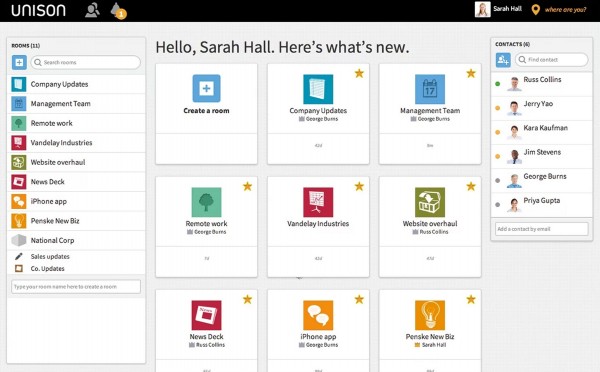
After introducing Android and iOS apps, enterprise social network Unison has shifted its focus from mobile handsets to large team collaboration, introducing the ability to voice chat with up to 250 users straight from the browser. The feature is currently available only through the official Chrome app.
Compared to the traditional way of doing things on Unison — text chatting — the latest feature allows users and members of large teams to interact in a more personal way. Voice is also more immediate than writing and can trigger a faster response, something which can be helpful when dealing with fast-approaching deadlines or other critical scenarios. In some cases, businesses can also replace the traditional phone conference and, therefore, rely less on other services for basic but essential tasks.
But why provide this feature only through Chrome? “We support the other popular browsers, but we optimize for Chrome and will enable our full audio/video capabilities there — right inside the browser, with no software or plug-ins required”, Unison says.
The enterprise social network also tells me that Chrome users will be able to take advantage of other two new features. Unison says that in the upcoming period desktop notifications as well as one-to-one voice and video chats will be enabled.
These two features will enable Unison users to take their voice and video discussions private and see the latest updates from fellow users without having the browser tab opened in the foreground. That should drive up productivity and enable Unison to better compete against other services such as Yammer.
Little over a month ago, AT&T announced that on a two-year contract the Samsung Galaxy S4 in 32GB storage trim will be available for $249.99. In the meantime the 16GB version hit the mobile operator’s stores for $50 less, but even today the 32GB Galaxy S4 is still nowhere to be seen.
On its Twitter account, AT&T sheds some light on the matter and reveals that the 32GB Galaxy S4 is available starting this Friday, May 10. In just a couple of days prospective customers will be able to purchase the smartphone for $249.99 alongside a two-year contract and qualifying plans.
The 32GB Galaxy S4 only runs for $50 more on top of what AT&T charges for the 16GB version, but provides twice the storage capacity. Considering that Android 4.2 Jelly Bean and adjacent apps can take a significant part of the built-in storage, the larger capacity model might make more sense for demanding users.
By comparison the price difference between the 16GB and 32GB Apple iPhone 5 storage trims is $100 — twice as much. AT&T charges $199.99 and $299.99 for the 16GB and 32GB version, respectively, of the fruit-branded smartphone.
Even if you’re not the biggest Windows Phone enthusiast I’m quite sure you have heard or read about the alleged Lumia 928 that Nokia is to unveil sometime soon. I will not bore you with the rumored specs, release date or carrier on which the device is assumed to surface, but can confirm that the Lumia 928 is definitely real.
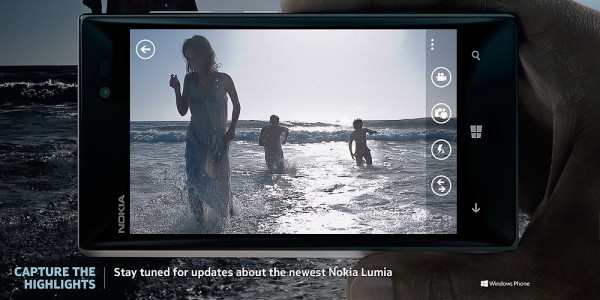
The Finnish maker, likely to keep the rumors flowing, released a picture showcasing a device referred to as “the newest Nokia Lumia” smartphone. There is no reference of the name in the photo, but the link address clearly says Lumia 928.
The Lumia 928 appears to embody a different design to that of the Lumia 920. The screen is positioned further down the front panel, the Nokia logo is on the left instead of on the right and there is no noticeable camera button on the right side of the device. That last bit may be down to some Photoshopping, as Nokia devices will not likely ditch the camera shutter anytime soon.
There is also a silver-colored frame surrounding the Lumia 928 (with the physical buttons of the same color), which may indicate that Nokia will go with an aluminum body this time around, instead of the polycarbonate used in the Lumia 920. Other visible details include the front-facing camera and nearby sensor, the speaker grill and the three capacitive buttons (back, home and search), none of which is actually surprising.
There are no telltale signs that indicate any other specifications whatsoever. The photo features the Windows Phone logo in the bottom-right side, but makes no mention of the actual version that the Lumia 928 will sport.
There is also a “Capture The Highlights” motto in the bottom-left side, which judging by the magazine ad from Vanity Fair, implies the use of the PureView technology as the picture captured with the Lumia 928 is brighter than the surroundings appear to be. The printed ad also reveals that the smartphone will be available on Verizon.
Judging by all the heavy criticism hitting the interwebs each day one would rightfully assume that Microsoft is on the wrong path with Windows 8. The operating system is often blamed for declining PC shipments, an user interface designed only for touchscreen devices or a scarce Modern UI app ecosystem filled with knockoffs. So, therefore, Windows 8 must be a clear sales miss, right?
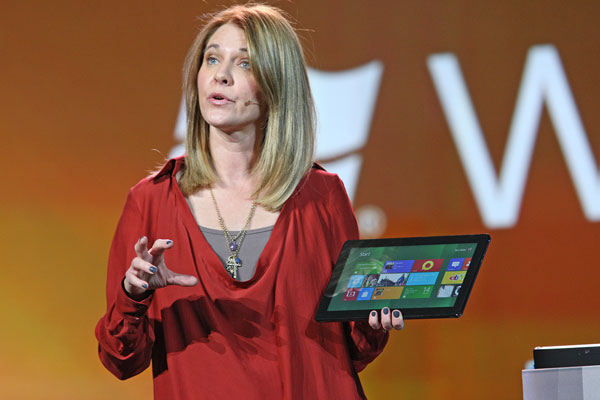
Today, Tami Reller, Windows & Windows Live CFO, boasts about 100 million Windows 8 licenses, a figure which does not fall in line with what every naysayer leads you to believe. “This number includes Windows licenses that ship on a new tablet or PC, as well as upgrades to Windows 8. This is up from the 60 million license number we provided in January. We’ve also seen the number of certified devices for Windows 8 and Window RT grow to 2,400 devices, and we’re seeing more and more touch devices in the mix”.
That sales figure is an astonishing feat. Assuming that Microsoft charges an average of $30 per license — a number suggested by my colleague Joe Wilcox — Windows 8 generated $3 billion in revenue. That number is likely higher considering that the $15 upgrade offer ended in late-February, more than two months ago, so basically every version is available at full-price ever since. Really, $3 billion is nothing to sneeze at.
As usual, Microsoft does not provide a sales breakdown between upgrades to Windows 8 and new devices offered with Windows 8. That leaves room for interpretation, suggesting that a significant part of the 100 million licenses sold thus far comes from upgrades.
In Q1 2013, PC manufacturers shipped a tad over 76 million units, a number that includes devices running operating systems other than Windows 8 such as Windows 7, OS X and Linux-based distributions. The same applies to the little over 90 million PC shipments from Q4 2012. At the time, devices with Windows 8 (due to its early vintage) were likely fewer than those running other operating systems. And, despite declining shipments, Microsoft still thinks the PC is here to stay.
“The PC is very much alive and increasingly mobile”, Reller says. “The PC is also part of a much broader device market of tablets and PCs. Windows 8 was built to fully participate in this broader and increasingly mobile device market. The PC part of the market is rapidly evolving to include new convertible devices and amazing new touch laptops, and all-in-ones”.
Reller says that the number of apps available in the app store increased six fold since Windows 8 launched. Over the course of six months (presumably since the consumer release), app downloads exceeded 250 million. Also, users have downloaded nearly 90 percent of the Windows Store apps each month. The last figure should encourage developers to take more interest in Windows 8/RT.
Reller also discusses Windows Blue. The Windows 8 update “will provide more options for businesses, and give consumers more options for work and play. The Windows Blue update is also an opportunity for us to respond to the customer feedback that we’ve been closely listening to since the launch of Windows 8 and Windows RT. From a company-wide perspective, Windows Blue is part of a broader effort to advance our devices and services for Microsoft”.
Windows Blue arrives later this year and will be available “across an increasingly broad array of form factors of all sizes, display, battery life and performance”. That falls in line with the plans to offer “a new suite of small touch devices powered by Windows”, revealed by Microsoft nearly four weeks ago.
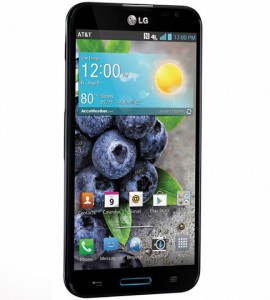
US mobile operator AT&T has officially announced that starting tomorrow, May 3, the Optimus G Pro is available for pre-order from its online store. The smartphone, which was unveiled in mid-February, will go on sale a week after, from May 10, exclusively from AT&T.
The price of the Optimus G Pro falls in line with that of its fierce competition. On a two-year contract LG’s Android smartphone flagship runs for $199.99, on par with Apple’s iPhone 5, BlackBerry’s Z10, HTC’s One and Samsung’s Galaxy S4. By contrast, the similarly-sized Galaxy Note II is available for $299.99 on a two-year contract.
Customers can also bring down the price of the Optimus G Pro to $99.99, alongside the same contract length, by trading-in a “recent model smartphone” to the US mobile operator. The device must be “no more than three years old and in good, working condition”.
Some of the highlights of the Optimus G Pro include: 5.5-inch IPS display with a resolution of 1080 by 1920 and a 440 ppi (pixels per inch) density; 1.7 GHz quad-core Qualcomm Snapdragon 600 processor; 2 GB of RAM; 3,140 mAh battery; 32 GB of internal storage; microSD card slot; 13 MP back-facing camera with dual recording and support for 1080p video recording; 2.1 MP front shooter with dual recording and 1080p video recording support; Android 4.1.2 Jelly Bean.
Last month Google altered the method of collecting data for its Android distribution charts, now measuring the popularity of the operating system iterations by visits to the app store instead of check-ins to the company’s servers as before. The move significantly changed the results compared to the previous month, but is there a noticeable difference that is felt in the Android distribution charts for May?
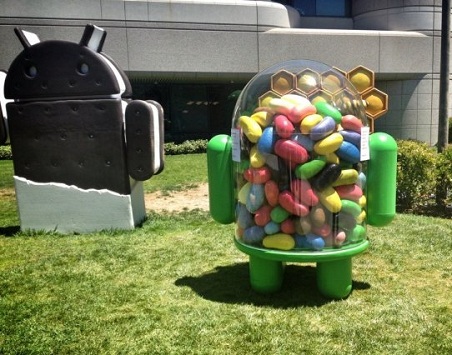
Based on the number of devices visiting Google Play during the 14 days ending May 1, Jelly Bean now ranks as the most popular Android sweet, after Gingerbread. With a combined distribution level of 29.4 percent, for Android 4.1 and Android 4.2, Jelly Bean surpassed Ice Cream Sandwich, which now runs on 27.5 percent of all droids.
The Jelly Beans
Altogether, Jelly Bean has grown by 4.4 percentage points from 25 percent distribution level, which translates into a 17.6 percent increase compared to the previous data set from April. Android 4.1 rose to 2.3 percent from 2.0 percent — 0.3 percentage points higher — while Android 4.2 displayed a 3.1 percentage points rise to 26.1 percent in May from 23 percent distribution level in April.
Jelly Bean’s growth, as shown in the charts, appears to be influenced more by the number of devices sold with (and upgraded to) Android 4.1 rather than smartphones and tablets running Android 4.2. Alongside the likes of the the Samsung Galaxy S4 — which runs the second Jelly Bean iteration — Android 4.2 is bound to get a boost in distribution level over the upcoming months. The first Jelly Bean iteration is likely to keep its popularity crown largely intact in the upcoming period due to sales of devices still running Android 4.1, like the HTC One.
Ice Cream Sandwich
Android 4.0, versions 4.0.3 and 4.0.4, reached a 27.5 percent distribution level in May, a number 1.8 percentage points lower compared to the 29.3 percent distribution level from April. This translates into a 6.14 percent decrease over the course of a single month.
Considering that new devices tend to run Android iterations from the Jelly Bean family, the fact that Android 4.0’s popularity slowly decreases each month (bar last month when Google changed the data collection method) shouldn’t come as a surprise.
The Older Sweets
Android 3.2 still runs on 0.1 percent of all droids, a number 0.1 percentage points lower compared to the data released in April. That’s a 50 percent decrease over the course of a single month, but normal considering the scarce popularity that Honeycomb enjoyed after it was unveiled and the number of Android tablets swarming on the market which may have swayed fondleslab owners towards newer devices.
If you were hoping for Gingerbread to be finally surpassed by a newer sweet, you are going to be disappointed. Android 2.3 — versions 2.3 to 2.3.2. and 2.3.3 to 2.3.7 — reached a combined distribution level of 38.5 percent. 0.1 percent for the former version and 38.4 percent for the latter.
That’s 1.3 percentage points lower from 39.8 percent in the month before, which implies a 3.26 percent decrease since April. Gingerbread’s popularity, as expected, will go down further in the upcoming months.
Froyo, Eclair and Donut — the only Android iterations from the charts older than Gingerbread — reached a combined distribution level of 5.5 percent, 0.3 percentage points lower than the 5.8 percent in the month before. The 5.17 percent decrease is influenced by droid users switching to a newer device.
What Comes Next?
Google used to provide a historical dataset, but the search giant removed it when the new data collection method was implemented last month. Although we don’t have a solid enough basis for comparison purposes, it’s fair to assume that the trend depicted in May will continue over the upcoming months at least until Google releases a new Android iteration (it’s bound to happen sometime).
With the purpose of further improving the user experience on Lumia smartphones, Nokia adds its own apps atop of Windows Phone 8. Most of the extra software is available to download directly from the Nokia collection inside the app store, but the remaining few are hidden from prying eyes.
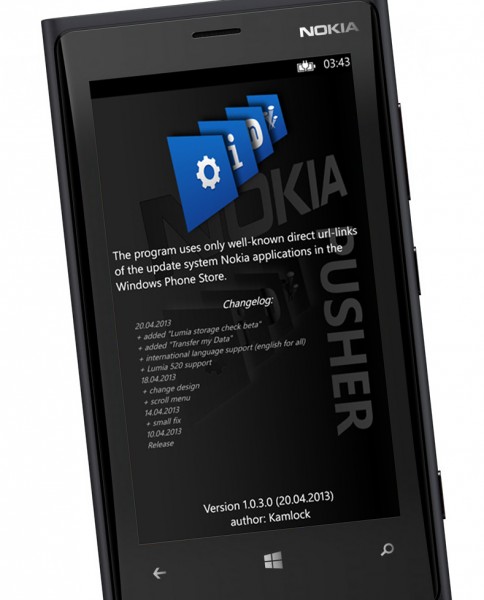
When an update arrives, Lumia users can only wait for the Store app to display a counter and afterwards allow them to install the latest update. And, as Windows Phone users know, that can take some time — a day or even longer sometimes. So what are your options? Well, you can look up QR codes and scan them or just use the LUMIA pusher app, which allows you to update every single extra right from your Lumia smartphone.
The Nokia account, extras+info, accessories, network+, feedback to Nokia, access point, display+touch and audio apps, which are all available to use through the Windows Phone Settings menu, can be updated to the latest version using LUMIA pusher.
The user only has to tap on the item’s name and LUMIA pusher will display the app’s page inside the Windows Phone app store. From there, the user can check for reviews and write a new one, share the app via social networks, email or message, read the description, report the app, view the necessary permissions, and so on.
LUMIA pusher can also be used to install and update a couple of other exclusive apps such as Transfer my Data and Lumia Storage Check Beta and update the Yandex search engine for Russian Lumia users. That’s just the bonus. The developers should add other software as well, especially from Nokia Beta Labs.
I like the ease of use that LUMIA pusher delivers, but there is one major caveat. If you have a light background enabled on Windows Phone 8 the app will not take it into account as it normally would.
The background is dark, which shouldn’t normally be a problem, but instead of keeping the white text with the light background (as it does with the dark one), the app instead uses black for the text. Needless to say, you can’t see much.
 At 10 AM BST, Nokia’s highly anticipated press event kicks off in London. Details are scarce at the moment, but what we can tell you for sure is that the Finnish phone manufacturer is preparing the “next installment”.
 Tomorrow, Nokia will host a press event in London, where the company says it will unveil “
 With most of the mobile operators today relying on 3G underpinnings, and few actually using 4G backbones, the concept of yet another generation of cellular networks is unfathomable. After all, most of us still struggle to watch 1080p videos on YouTube without buffering and we know that developing, testing, approving and rolling out a new cellular technology doesn’t happen overnight. If 4G is of any indication, it might not happen even years after vetting it.
 Late yesterday, cloud storage provider Box released updated apps for Windows 8 and Windows Phone 8. The latest iterations come with new features which are designed to “give users and businesses better control and enhanced security over their content”. Let’s take a look at the changes.

 Late yesterday, Canadian manufacturer BlackBerry announced yet another range of updates for the LinkedIn and Twitter apps on BlackBerry 10. The latest iterations are designed to bring the social networking apps on par with their Android, iOS and Windows Phone counterparts and,
  On Friday, Finnish handset maker Nokia announced that the Play To app for Windows Phone 8 made the grade from experimental to stable version and is now publicly available to download from the Store. Previously, the DLNA app could only be
  After many

 US mobile operator AT&T has officially announced that starting tomorrow, May 3, the Optimus G Pro is available for pre-order from its online store. The smartphone, which was
  Last month Google altered the method of collecting data for its Android distribution charts, now measuring the popularity of the operating system iterations
  With the purpose of further improving the user experience on