Author: Pan-African News Wire

  • Somalia TFG Leader Rejects Direct U.S. Military Intervention

    Somalia president rejects direct American military intervention

    Mar 21, 2010 – 9:04:46 AM

    Somalia’s interim president Sheikh Sharif Sheikh Ahmed says he does not welcome direct military intervention from the US to support his fragile government in overcoming the powerful insurgents

    “We are requesting the US not engage in direct military in Somalia but provide us with support in rebuilding the forces and weapons,”said Sheikh Sharif who added that he would not allow foreign country to directly intervene in his country.

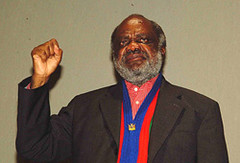
    Sheikh Sharif Ahmed, President of TFG of Somalia
    “Our forces have prepared well and can do the job of flushing terrorist out the country and that is why we are requesting non military interference,” President Ahmed said.

    He said the African Union troops are in the country as part of peace efforts which his government welcomes.

    Ahmed’s comments come after senior US security officials announced that Washington is ready to provide air support in the war against the powerful insurgents in the restive capital Mogadishu.

    Senior U.S. military commander in the region, William Ward told a Senate hearing on Somalia that the war against the insurgents is “something that we would look to do in support.”

    GAROWE ONLINE

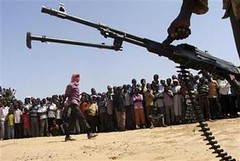
  • Somalia Senior Commander of Al-Shabaab Assassinated

    Somali Islamist commander killed

    A senior commander of the Somali Islamist group, al-Shabab, has been shot dead at close range as he left a mosque in the city of Kismayo.

    Unidentified gunmen shot Sheikh Daud Ali Hasan several times, inside an area of Somalia held by his own forces.

    Sheikh Hasan was in charge of front-line operations in the town of Dhobley, near the Kenyan border.

    Al-Shabab said it arrested several people and would bring them before a court, but did not identify them.

    # Al-Shabab – Alleged to have links with al-Qaeda – Has foreign fighters in its ranks – Well organised militarily and logistically
    # Hizbul-Islam – Led by Hassan Dahir Aweys – Aweys led al-Itihad al-Islamiya, put on US terror list in 2001 – Home-grown Islamist movement

    Rival Islamist groups in the vicinity, including Hizbul-Islam, have not said whether they were behind the killing.

    A witness, Ahmed Daud, said: “At least three masked men armed with pistols shot Sheikh Daud Ali Hasan several times in the head and the chest as he was coming out of a mosque in Kismayo.”

    The BBC’s Mohamed Olad Hassan in Mogadishu says Hizbul-Islam fighters launched an attack in Dhobly hours after the assassination – and claimed they had killed number of al-Shabab militants.

    Al-Shabab and Hizbul-Islam are fighting against the UN-backed, weak Somali government and the African Union soldiers.

    They have fought together in the capital against government forces and the AU peacekeepers, but in the southern Jubba regions the groups continue to fight each other.

    The dispute began last year when al-Shabab forcibly took control of Kismayo from Hizbul-Islam.

    Story from BBC NEWS:
    http://news.bbc.co.uk/go/pr/fr/-/2/hi/africa/8577986.stm
    Published: 2010/03/20 15:25:14 GMT

  • Fight School Closings, Teacher Layoffs!

    Fight school closings, teacher layoffs!

    Capitalist crisis invades public education

    By Fred Goldstein
    Published Mar 18, 2010 9:02 PM

    Capitalism is leaving tens of millions of workers without jobs. It is also abandoning millions of children to flounder in a chaotic education system, buffeted by school closings and teacher firings.

    The capitalist government in Washington has sharply escalated its ongoing assault on the public education system. Using the budget crisis as leverage and seizing on the deteriorating quality of schools in impoverished districts, government officials have intensified the campaign for charter-school privatization, school closings, and the firing of teachers and staff across the country.

    But the attack is not on all public education. Virtually all the target schools and school districts are in impoverished communities marginalized by capitalism, especially those that are heavily African-American and Latino/a.

    The ax falls on Kansas City

    The Kansas City, Mo., school board announced on March 10 that it will close 29 of its 61 public schools. About 700 jobs will be cut, including 285 teachers. The targeted school district is majority African-American.

    This school district has long been drained by redistricting and the flight to private schools and charter schools. It has been sued for racial discrimination. Its school population has gone from 77,000 to 13,400. The drop in enrollment, caused by poverty and privatization, and the budget crisis are being used as a pretext to further victimize children and their families by these brutal school closings.

    The crisis goes beyond Kansas City. On Feb. 23, the school board in Central Falls, R.I., announced that all its 93 teachers, administrators and support staff would be fired. The Central Falls school district is majority Latino/a. Other schools in Rhode Island are also under threat, including in Providence.

    On March 4, Boston school officials announced that all the teachers and staff at six public schools would have to reapply for their jobs. These six schools are among 35 on a target list as “underperforming.” The schools on the list face closures, firings and state takeovers.

    Cleveland plans 13 school closings. This includes breaking up high schools into “academies,” leaving a big opening for charter schools to move into the vacuum and get public funds.

    These examples could be multiplied many times over, from Detroit to Atlanta, Reno, Los Angeles, New York City — virtually across the country.

    Rat race to the top

    The immediate trigger is the $4.3 billion Race to the Top fund established by the Obama administration. President Barack Obama publicly praised the drastic firing of all the teachers in the Central Falls high school as an example of progress in education reform.

    The Race to the Top is a continuation of the No Child Left Behind program initiated by George W. Bush. Bush promoted charter schools, school vouchers and breaking union contracts — using merit pay and other devices — under the guise of improving teacher performance.

    The Race to the Top goes further. It specifies that states can apply for grants if they adopt one of the models specified by the program. These models include moving toward charter schools; firing the teaching staff and then allowing them to reapply for their jobs, but not hiring back more than 50 percent of those fired; and closing “underperforming” schools.

    This has touched off a rat race among government officials to get grant money by attacking teachers, closing schools, opening up to charter schools, using school vouchers to pay for private schools, and taking other measures to undermine public education and teacher organization.

    This reactionary development is an attempt to select out a small percentage of students for exposure to a superior education while leaving the vast majority behind. Those left behind are overwhelmingly children of the poor and the oppressed. This reality is exactly the opposite of what these programs promised.

    It is also important to note the motor force for charter schools: handing over the education system to private companies. It is not about these schools’ level of achievement.

    To date, the most authoritative study of charter schools was conducted by the Center for Research on Education Outcomes at Stanford University in 2009. The report is the first detailed national assessment of charter schools. It analyzed 70 percent of U.S.-based students attending charter schools and compared the academic progress of those students with that of demographically matched students in nearby public schools. The report found that 17 percent of charter schools reported academic gains that were significantly better than traditional public schools; 46 percent showed no difference from public schools; and 37 percent were significantly worse than their traditional public school counterparts.

    The authors of the report considered this a “sobering” finding about the quality of charter schools in the United States. Charter schools showed a significantly greater variation in quality as compared with the more standardized public schools. Many charter schools fell below public school performances and a few exceeded them significantly.

    Privatization: ‘The Big Enchilada’

    Jonathan Kozol, a well-known authority on public schools and author of the book “Death at an Early Age,” wrote an article entitled “The Big Enchilada” for Harper’s magazine of August 2007. It was about reading a stock market prospectus. Kozol wrote:

    “A group of analysts at an investment banking firm known as Montgomery Securities described the financial benefits to be derived from privatizing our public schools. ‘The education industry,’ according to these analysts, ‘represents, in our opinion, the final frontier of a number of sectors once under public control’ that ‘have either voluntarily opened’ or, they note in pointed terms, have ‘been forced’ to open up to private enterprise. Indeed, they write, ‘the education industry represents the largest market opportunity’ since health care services were privatized during the 1970s.

    “Referring to private education companies as ‘EMOs’ (Education Management Organizations), they note that college education also offers some ‘attractive investment returns’ for corporations, but then come back to what they see as the much greater profits to be gained by moving into public elementary and secondary schools. ‘The larger developing opportunity is in the K-12 EMO market, led by private elementary school providers,’ which, they emphasize, ‘are well positioned to exploit potential political reforms such as school vouchers.’ From the point of view of private profit, one of these analysts enthusiastically observes, ‘the K-12 market is the Big Enchilada.’” (See FIST statement, “Defend Education from ‘Disaster Capitalism,’” in the Workers World of March 4.)

    These two items speak volumes about the Race to the Top program. It is an attempt to put a big part of the public school system on a corporate model of cutthroat competition. The funds for the education of poor children are the object of this competition.

    This model has public school officials marketing their schools to the community to fend off the competition of charter schools. New York’s Harlem is a prime target of charter schools and has put the public schools under enormous pressure.

    For example, “River East Elementary on East 120th Street draws students throughout Harlem and typically has more applicants than seats. But at this time of year, staff members spend hours scurrying to day care centers, churches and apartment complexes to find prospective parents, said Katie Smith, the assistant principal. ‘We have to be out there constantly representing ourselves,’ Ms. Smith said.” (New York Times, March 10)

    The net result is that the capitalist establishment is using the economic crisis to accomplish three things: to wring profits out of the public education system; to solve its budget crisis on the backs of the people by closing schools; and to open up an anti-union campaign against the teachers by driving them into non-union charter schools and weakening the contracts of those who remain in the public system.

    This crisis demonstrates many things about the capitalist system at its present stage of crisis, when the opportunity for profitable investment in the real economy of production is narrowed by the crisis of overproduction and the saturation of markets.

    It shows that the vultures of finance capital will find every avenue possible to raid the public treasury in pursuit of profit, including forcing a crisis on the education system.

    This hurts students, parents, teachers and communities. This is the basis on which to unite against this plan of divide and conquer. It calls for a united mobilization to defend public education and make the bankers and bosses pay for a quality education for all.

    This is the richest country in the world, with a $14 trillion economy. There are hundreds of billions available for the schools. But these funds are being pocketed by the banks, the Pentagon, the corporations. There is enough money to give everyone a quality education.

    Articles copyright 1995-2010 Workers World. Verbatim copying and distribution of this entire article is permitted in any medium without royalty provided this notice is preserved.

    Workers World, 55 W. 17 St., NY, NY 10011
    Email: [email protected]
    Page printed from:
    http://www.workers.org/2010/us/public_education_0325/

  • Germans Oppose Assistance to Greece, Poll Says

    Germans oppose Greek aid, poll shows

    By Ralph Atkins in Frankfurt and Quentin Peel in Berlin
    Published: March 21 2010 22:00

    Fierce German resistance to helping crisis-hit Greece has emerged in a Financial Times opinion poll that strengthens the hand of Angela Merkel, the chancellor, hand before a possible European showdown this week over financial aid for Athens.

    Germans overwhelmingly opposed offering financial support to Greece as it struggles to control its public sector deficit and are strikingly more hostile than other Europeans, including the British, the FT/Harris poll showed. Almost a third of Germans believed Greece should be asked to leave the eurozone.

    Further highlighting flagging support for the euro, some 40 per cent of Germans also thought Europe’s biggest economy would be better off outside the single currency – a significantly higher level of scepticism than in France, Spain or Italy.

    The results follow a warning on Sunday by Ms Merkel against raising “false expectations” in financial markets of a eurozone bail-out package for Greece.

    In an interview on German radio which appeared to put her at odds with José Manuel Barroso, European Commission president, she insisted that Greece had not asked for money and no decision had been taken.

    The subject was not even on the agenda for a summit of European Union leaders in Brussels on Thursday, she said.

    Mr Barroso issued a statement on Friday that called on EU leaders to reach an explicit agreement this week. He warned that a lack of clarity was unsettling the markets. A likely solution would be a co-ordinated package of bilateral loans.

    Silvio Berlusconi, Italy’s prime minister, said on Sunday he was “absolutely in favour” of EU help for Greece.

    Ms Merkel’s interview is understood to have been recorded before Mr Barroso’s intervention, but it still represents the strongly held view in Berlin that Greece must put its drastic budget austerity programme into effect before any financial support can be agreed.

    “I do not see Greece needs money at the moment and the Greek government has confirmed that,” Ms Merkel said. “We do not want to create unrest in the markets by raising false expectations.”

    The German chancellor reiterated the German opinion that tougher sanctions were needed to police budget discipline in the eurozone, including a view that countries could be expelled from membership if they persistently offend against the stability and growth pact.

    Berlin is also fending off calls for its economic policies to be directed more at boosting domestic demand with the aim of reducing the country’s large trade surplus.

    In a letter to the FT published on Monday, Ulrich Wilhelm, government spokesman, said the discussion “ignores the fact that Europe as a whole must become more competitive” and warned that “a less stability orientated policy in Germany would damage the eurozone as a whole”.

    His comments amount to implicit criticism of Christine Lagarde, France’s finance minister, who asked last week in an FT interview if countries with surpluses could “do a little something?”

    Copyright The Financial Times Limited 2010. Print a single copy of this article for personal use. Contact us if you wish to print more to distribute to others.

  • Charlie Parker, a Genius Distilled

    Charlie Parker: a genius distilled

    London Guardian

    Charlie Parker lived hard, played hard, died young. Now an uncanny sculpture of him in his last months has resurfaced. Richard Williams on a story of jazz, art and devotion

    The last time Julie Macdonald saw Charlie Parker, he was catching a flight home from Los Angeles to New York for the funeral of his three-year-old daughter, Pree, who had died in hospital in the early hours of 6 March, 1954 after a long illness.

    Two nights earlier, Parker had been fired, for the second time in a week, by the owner of the Tiffany Club in Hollywood after behaving erratically and arguing with the management. He was staying at the Pasadena home of Macdonald, a sculptor, when he received the news of Pree’s death.

    His immediate reaction, in Macdonald’s recollection, was to drink heavily and send a series of increasingly desperate telegrams to his wife, Chan. The fourth and last read: MY DAUGHTER IS DEAD. I KNOW IT. I WILL BE THERE AS QUICK AS I CAN. IT IS VERY NICE TO BE OUT HERE. PEOPLE HAVE BEEN VERY NICE TO ME OUT HERE. I AM COMING IN RIGHT AWAY TAKE IT EASY. LET ME BE THE FIRST ONE TO APPROACH YOU. I AM YOUR HUSBAND. SINCERELY, CHARLIE PARKER.

    Then he poured a bottle of scotch down the toilet, gave away his remaining supply of heroin, and Macdonald drove him to the airport.

    Some time later, Macdonald began work on a sculpture of Parker’s head, for which she had been making preparatory sketches during his visits. Then 28 (five years younger than Parker), she was the daughter of an impressionist painter and had studied at the Chouinard Art Institute in LA. She had met Parker during one of his earlier visits to California, probably in 1952.

    It seems likely that they were a part of a gathering of artists, intellectuals and scenemakers who met at the Altadena ranch of the Turkish-born painter and sculptor Jirayr Zorthian in July that year, a short drive from Macdonald’s home. Zorthian’s guests had indulged in a collective striptease while Parker played; a surviving home recording of the event reveals the sound of the saxophonist – apparently fully clothed, despite voluble entreaties – playing Embraceable You, the Gershwin ballad emerging above the noises of ribaldry. At any rate, Parker and Macdonald became close friends and enjoyed long conversations as she took him to art shows around Los Angeles.

    After leaving to bury his child that Sunday morning in 1954, Parker would never return to California. He had only 12 months left to live, a year in which he and Chan attempted without success to create a quieter life for their family outside the city; in which his drinking worsened; in which he almost succeeded in killing himself by swallowing iodine; in which he committed himself to the psychiatric ward at New York’s Bellevue hospital; and in which he made his last recordings and played his final gigs, before dying of an accumulation of symptoms while watching television in the Fifth Avenue apartment of the Baroness Pannonica de Koenigswarter. Within days his followers were scrawling “Bird Lives!” on Manhattan walls.

    Stravinsky and a heroin habit

    When William Dickson, a retired architect living in Edinburgh, got in touch last month to tell me that he was the owner of a stone head of Charlie Parker, I knew exactly what he was talking about. It had to be Macdonald’s carving, which appeared on the cover of Down Beat magazine in 1965, an issue that commemorated the 10th anniversary of the saxophonist’s death.

    That black-and-white photograph had showed the head to be a work of great distinction, capturing the contradictory elements of Parker’s character. Macdonald carved a face which could be that of a child or an old man, simultaneously illuminated by innocence and exuding wisdom. Once seen, even in a reproduction, it was not easily forgotten. And here it was, 5,000 miles and 55 years from its point of origin, with a back-story that demanded to be told.

    A few years after Parker’s death, in a brief memoir of their relationship, Macdonald wrote warmly of his “ability to perceive” and of an intellect which, although untrained, was “prodigious”. “He listened to Shostakovich, Stravinsky and Bartók; looked at art from Egyptian sculpture to Picasso with the same intensity; and he remembered! Bird’s memory was uncanny. With that combination of perception and memory he translated experience through his horn. He caught the pulse of our times, the pressure, confusion and complexity, and more: sadness, sweetness and love.”

    That complexity is distilled in her rendering of Parker’s head. Carved out of pale, lightly striated sandstone from a nearby Pasadena quarry, it is a little less than twice life-size, weighs 275lb, and is pinned to a cube of polished black granite. Its individual features – the sightless eyes, the shapely nose, the slightly pursed mouth, the neat ears – are finely executed.

    The back of the head, covered with carefully worked hair, is distended like that of a newborn baby. It bears a striking resemblance both to an Egyptian head of the 15th dynasty, which Macdonald had showed Parker, and to the carvings made by the Yoruba people of West Africa between the 14th and 16th century, currently on show at the British Museum.

    Parker was capable of extremes of behaviour and appearance. Emerging from a midwestern background of no particular distinction, he became the second of jazz’s great instrumental soloists (after Louis Armstrong) to change the way music was played, engendering a cult which endures more than half a century after his death, continually refuelled by what the American critic Gary Giddins called “the relentless energy, the uncorrupted humanity of his music”.

    A man of vast and undiscriminating physical appetites, Parker could quote from the Rubaiyat of Omar Khayyam and planned to study composition with Edgard Varèse. Unreliable in every aspect of his life except the quality of his playing, he attempted to dissuade younger musicians from copying his heroin habit, but succeeded only in fostering a generation of imitators who thought that living the way he did would help them play like him, too – before discovering that no one could do that. The physician who signed his death certificate estimated his age to be between 50 and 60 (he was 34).

    From LA to Edinburgh

    Macdonald made at least one other sculpture of Parker, a full-length figure carved from lignum vitae, a dark hardwood. On 1 March, 1955, two weeks before his death, she wrote to jazz critic and historian Marshall Stearns mentioning a possible sale of the wood figure and offering to have it transported for viewing to the New York studio of the blind pianist and teacher Lennie Tristano.

    “I trust the price mentioned did not discourage you,” she wrote, adding a poignant postscript: “I would naturally be happy beyond words for Bird to see the carving if at all possible.” According to Peter Ind, the British bass player who lived in New York in the 1950s, studying and playing with Tristano, the piece remained in the East 32nd Street studio for some time, given “pride of place”.

    The stone head remained in Macdonald’s keeping until 1961, by which time the wood figure had passed into the possession of Robert Reisner, a New Yorker who had promoted Parker during the last phase of the saxophonist’s life. Reisner was compiling stories for a book titled Bird: The Legend of Charlie Parker, and Macdonald was among his contributors.

    When she indicated an interest in selling the stone head, Reisner put her in touch with another jazz fan, a wealthy Californian named George E Geisler. “It turned out,” Geisler later remembered, “that she had a chance to get a good deal on a Ferrari, and could use the money.” The piece remained in Geisler’s ownership for four decades.

    Macdonald went on to create around 400 other works, including many pieces based on animal figures. Her stone rendering of The Three Graces was installed outside the Downtown YMCA in LA, and she exhibited at the Pasadena Art Museum, the San Francisco Museum, and the LA County Museum of Art. She married twice and had two children; but by the end of the 1970s she was heavily addicted to cocaine and died of cancer in 1982, aged 55.

    When Geisler began to disperse his possessions in 2000, Macdonald’s stone head was sold to one of the world’s leading experts on Parker memorabilia. From there it passed into the hands of Dickson, who had returned to his native Edinburgh after retiring from his London practice several years earlier.

    Now 67, Dickson works as a photographer, surrounded by his own sizeable collection of material – records, concert posters, books, night-club handbills – from jazz’s post-war era, with Macdonald’s majestically resonant work as its centrepiece.

    Never shown to the public, the head has been seen only three times in photographic reproductions since it took shape: first in 1962 as an illustration in Reisner’s book, then on the cover of Down Beat, and finally in Esquire’s World of Jazz book in 1975.

    Dickson believes it deserves to be seen by a wider public but is uncertain of its appeal and value to institutions – or, indeed, what sort of institution would guarantee it an appropriate setting.

    Meanwhile, it sits in the unlikely surroundings of an Edinburgh studio, radiating its subject’s unique charisma, a direct physical link with one of modern music’s most remarkable figures.

  • President of Zimbabwe Graces Namibia’s 20th Anniversary Festivities

    President graces Namibia’s 20th anniversary festivities

    From Mabasa Sasa in WINDHOEK, Namibia
    Zimbabwe Sunday Mail

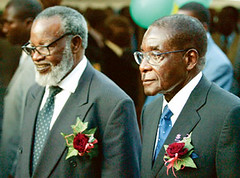
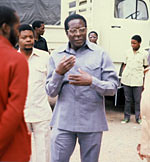
    PRESIDENT Mugabe arrived here yesterday to join several Heads of State and Government in celebrating Namibia’s 20th independence anniversary today.

    He is among 25 leaders who have been invited to grace the celebrations.

    President Mugabe was seen off at Harare International Airport by Vice President John Nkomo; the Chief Secretary to the President and Cabinet, Dr Misheck Sibanda; senior Government officials and service chiefs.

    Cde Nkomo will be acting President until Cde Mugabe returns home.
    The President was met in Windhoek by Zimbabwe’s Ambassador to Namibia Ms Chipo Zindoga.

    Among other Heads of State and Government expected is Cuban leader Cde Raul Castro, who will be making his second trip to Namibia in a year after visiting the country last June at President Hifikepunye Pohamba’s invitation.

    Cuba, along with the Frontline States, played a major role in Namibia’s fight against apartheid South Africa which culminated in independence in 1990.

    Zambian President Mr Rupiah Banda, President Jacob Zuma of South Africa, African Union chairman and President of Malawi Mr Bingu wa Mutharika and President Jose Eduardo dos Santos of Angola have confirmed their attendance.

    Nigeria’s Acting President Mr Goodluck Jonathan is also understood to be coming for the celebrations.

    Former Finnish president Martti Ahtisaari, who was a key player in the lead-up to Namibia’s independence, will also be in attendance.

    Ahtisaari was a special representative to Namibia for the then United Nations Secretary-General Javier Perez de Cuellar and also headed the UN Transitional Assistance Group for Namibia.

    The Namibian government has been carrying out a number of activities in the weeks building up to the celebrations.

    These have included public lectures addressed by high-ranking officials, art exhibitions and television broadcasts of specially produced programmes.

    The main celebrations take place today with regional events slated for next weekend.

    Today’s celebrations will also include the presidential inauguration following Cde Pohamba’s victory in elections last year.

    Namibia was first colonised by Germany in 1884 and after the First World War the League of Nations, the predecessor to the UN, mandated South Africa to administer the territory. When the League of Nations was dissolved in 1946, the UN ordered that all former German colonies be brought under a trusteeship system controlled by the world body.

    South Africa, which was about to formally establish apartheid, objected to this and started effectively occupying the country. In 1966, the UN General Assembly declared South Africa’s actions illegal and that same year, the current ruling party, Swapo, started the guerrilla attacks that eventually led to independence in 1990.

  • Namibian President Pohamba Salutes Former Frontline States Leaders

    Pohamba salutes former Frontline States leaders

    Zimbabwe Herald News Editor

    President Hifikepunye Pohamba has hailed the former Front Line States — of which Zimbabwe was a member — for the role the bloc played in ending apartheid in Namibia, as well as for the support it rendered his nation since independence.

    In his address soon after his inauguration for his second term of office in Windhoek yesterday, President Pohamba said international solidarity had made his country the success story that it is today.

    The inauguration was coupled with Namibia’s 20th independence anniversary celebrations.

    President Mugabe and several other Heads of State and Government or their representatives joined Namibia in yesterday’s double celebrations at the Independence Stadium.

    President Pohamba said: “I am humbled to see so many of our friends, brothers and sisters who represent the international community on this special occasion.

    “Our nation will forever be grateful to the fact that Namibia gained independence under the banner of international solidarity, freedom and justice.

    “We value the diplomatic and material support we received at our time of need.

    “I am aware that some nationals of the then Front Line States lost their lives as a result of the war for national liberation.

    “This notwithstanding, our brothers and sisters stood firm and never wavered.

    “We will always be grateful for the invaluable support we received from them.”

    Thousands of Namibians attended the celebrations held under the theme “A visionary nation on the road towards 2030”, in reference to Namibia’s target of becoming a developed country by that year.

    Other leaders who joined President Mugabe in congratulating Namibia on its two decades of independence were Presidents Armando Guebuza (Mozambique), Joseph Kabila (DRC), Jacob Zuma (South Africa), Jakaya Kikwete (Tanzania), Rupiah Banda (Zambia), Ian Khama (Botswana) and Dennis Sassou- Nguesso (Congo-Brazzaville).

    Also represented at a high level were Swaziland, Lesotho, Angola, Seychelles, Cuba, Mauritius, the Russian Federation, China, the Republic of Korea, Finland and Norway, among others.

    Former leaders in attendance included Dr Kenneth Kaunda (Zambia), Sir Ketumile Masire and Mr Festus Mogae (both Botswana), as well as former South African First Lady Mrs Zanele Mbeki, Angola’s Mrs Maria Neto and Tanzania’s Mrs Maria Nyerere.

    In his speech, President Pohamba added: “Today we have a dual celebration, namely my inauguration for the second term of office as the President of our Republic and the historic 20th anniversary of our nation’s freedom and independence.

    “On that historic day of 21 March 1990, following a protracted and bitter struggle for national liberation, we achieved our objective of political emancipation when we hoisted the Namibian flag of freedom, independence and sovereignty, and lowered the flag of apartheid colonialism.

    “The vote for freedom and democracy was, and remains, an irreversible choice by all our people.

    “We will forever remember our heroes and heroines

    who inspired us to fight for freedom and independence.

    “We fought many battles. We crossed many rivers of blood and we won a decisive victory on 21 March 1990.

    “The spirit of dedication and courage must continue to inspire us to confidently face the present and future challenges.”

    On Saturday evening, the Namibian leader conferred medals — some posthumously — on several individuals who had contributed immensely to the liberation of the land formerly known as South West Africa.

    Among those honoured were Dr Kaunda, President Nguesso, Oliver Tambo, Julius Nyerere and Agostino Neto.

    President Mugabe arrived in Namibia on Saturday to a warm and rapturous welcome from Zimbabweans living and working in that country.

    Foreign Affairs Minister Simbarashe Mumbengegwi accompanied him.

    He returned home last night and was met at Harare International Airport by Vice President John Nkomo, senior Government officials and service chiefs.

  • United Nations Chief Backs Palestinian Cause

    UN chief backs Palestinian cause

    AFP

    RAMALLAH. UN chief Ban Ki-moon yesterday said the international community “strongly supports” Palestinian efforts to build a viable state at the start of a visit aimed at reviving peace talks.

    He kicked off his two-day visit by meeting Palestinian Prime Minister Salam Fayyad in the West Bank political capital of Ramallah and praising his plan to build the institutions of an independent Palestinian state by mid-2011.

    Ban is also expected to meet senior Israeli officials and to visit the Hamas-run Gaza Strip, still largely in ruins following a 22-day Israeli military campaign launched in December 2008.

    Ban arrived in Ramallah a day after the Middle East diplomatic Quartet called for Israel to halt all settlement construction and for both sides to reach a peace deal by 2012.

    “The Quartet has sent a clear and strong message: we are strongly supporting your efforts to establish an independent and viable Palestinian state,” he told Fayyad ahead of the formal talks.

    At a joint Press conference after the meeting Ban called on both sides to revive talks suspended after the start of the Gaza war, saying “we have to get negotiations under way”.

    The Palestinians grudgingly agreed to US-led indirect talks earlier this month but those efforts largely fell apart two days later when Israel announced plans to build 1 600 new settler homes in mostly Arab east Jerusalem.

    Ban “condemned strongly” the decision to build the homes and warned that, “for the negotiations to succeed, it is vital that the parties act responsibly on the ground.

    “All settlement activity is illegal anywhere in the occupied territories, and this must stop,” he said.

    Fayyad had earlier taken Ban to a vantage point outside Ramallah to show him a large swathe of West Bank territory known as Area C which is under exclusive Israeli control and off limits to Palestinian development.

    From the observation point Ban could see Israel’s controversial separation fence, a Jewish settlement and the skyline of Jerusalem, where the Palestinians hope to locate their future capital.

    “The visit to Area C was an opportunity for the Secretary-General to see the difficulties that we face on a daily basis in our efforts to develop and build in preparation for our state,” Fayyad said at the Press conference.

    As part of his state-building plan, Fayyad has vowed to establish “positive facts on the ground” in Area C, which he said makes up some 60 percent of the occupied West Bank.

    Fayyad, a former World Bank economist, hailed the Quartet’s statement as “positive and comprehensive” but said more must be done, including allowing Palestinian security forces to operate throughout the West Bank. Last Friday, the Quartet (the European Union, Russia, the United Nations and the United States) issued an ambitious statement after a meeting of senior officials in Moscow aimed at getting moribund peace talks back on track.

    “The Quartet urges the government of Israel to freeze all settlement activity . . . to dismantle outposts erected since March 2001 and to refrain from demolitions and evictions in east Jerusalem,” it said.

    It also urged Israel and the Palestinians to resume talks on final status issues — security, borders, the fate of Palestinian refugees and the status of Jerusalem — and to reach a peace deal within 24 months.

    Israel has criticised the deadline, with Foreign Minister Avigdor Lieberman insisting that “peace cannot be imposed artificially and with an unrealistic calendar” during an address in Brussels.

    “This type of statement only harms the possibilities of reaching an accord.”

    Chief Palestinian negotiator Saeb Erakat welcomed the Quartet’s call, but asked for a mechanism to insure a complete settlement freeze.

    The Palestinians have demanded the freeze apply to mostly Arab east Jerusalem, which Israel seized in the 1967 Six Day War and unilaterally annexed in a move not recognised by any other government.

    Israel’s announcement regarding the 1 600 new homes in east Jerusalem infuriated the United States, in part because it coincided with a visit by US Vice-President Joe Biden.

    US Secretary of State Hillary Clinton has since discussed the matter directly with Israeli Prime Minister Benjamin Netanyahu, and last Friday Clinton insisted that the strong US reaction was “paying off”.

  • Zimbabwe 1980: The Shortest Campaign in History

    ‘1980: The shortest campaign in history’

    Courtesy of the Zimbabwe Sunday Mail

    This is a continuation of a series of aticles in the countdown to Zimbabwe’s 30th Anniversary of Independence.

    This is an open forum and we encourage Zimbweans to share their experiences. The following is a speech by the late Cde Eddison Zvobgo after the 1980 landslide election victory by Zanu-PF.

    THE strategy we decided on was a kind of Israeli military model: where you see everyone besieged, you don’t station troops at the border, but gather your few resources into a swift mailed punch.

    We put most of our resources into the launching rally in Highfield and when Cde Mugabe finally arrived, it was the largest rally ever seen in the country.

    Psychologically, that was devastating; the enemy went straight to the drawing boards.

    It was at that point that the enemy launched the stop-Mugabe campaign.

    Ultimately, they decided, if you can’t stop him, kill him.

    So I had to cancel our Bulawayo and Umtali (Mutare) rallies, out of that fear of more assassination attempts.

    In total, Cde Mugabe addressed three rallies.

    It was the shortest campaign in history. It would be like Ronald Reagan (former US president) addressing three meetings and then sitting at home.

    Meanwhile, (Bishop Abel) Muzorewa was criss-crossing the country, with Cde Mugabe sitting at home and me coming to brief him.
    It was really a very scientific election campaign on our part, though the outside world could not understand.

    If we had revealed our strategy and our confidence, the enemy would have done even more dastardly things and we would never have been allowed to win.

    The regime was hoist by its own petard.

    Having lied over the years, trying to project these “terrorists” as having no support, all hated by the people, as just a bunch of power-hungry malcontents who could never win a free and fair election, they couldn’t turn around and say, “these people are popular, let’s work hard”.

    That would have been contradicting their propaganda.

    The white population had been so thoroughly brainwashed — brainwashed by the radio, TV and the Press — that everybody went to bed cosy and comfortable, knowing that the pro-Western, pro-multinational Muzorewa would walk it.

    And that was, I think, to our advantage because when they woke up and found that not only had we won, but we had walked it, they were stunned.

    They felt they had been betrayed. That is the danger of muzzling the Press.

    The Press here had been muzzled for the duration of the war and had been forced into lying to the people.

    When these people woke up and realised they had been lied to over the years, the anger, shock and horror was manifest.

    –This speech was made by the late Cde Eddison Zvobgo soon after Zanu-PF registered an emphatic victory over other political parties in the 1980 elections that brought independence.

    Cde Zvobgo was speaking as the party’s Deputy Secretary for Information and Publicity.

    The speech was extracted from Julie Frederikse’s book: “None But Ourselves, Masses Versus Media in the Making of Zimbabwe”.

  • China to Respond If Hit by US Trade Sanctions

    China to respond if hit by US trade sanctions

    LANGI CHIANG AND KEN WILLS | BEIJING, CHINA – Mar 21 2010 09:12

    Beijing will take retaliatory steps if the United States declares China a currency manipulator and imposes trade sanctions, commerce minister Chen Deming said on Sunday, the latest salvo in a spat over the value of the yuan.

    Chen, speaking at the China Development Forum, again accused Washington of politicising the issue ahead of an April 15 deadline when the US Treasury must decide whether to declare China a currency manipulator.

    “The currency is a sovereign issue and should not be an issue to be discussed between two countries,” Chen said.

    “We think the renminbi [yuan] is not undervalued, but if the US Treasury gave an untrue reply for its own needs, we will wait and see. If such a reply is followed by trade sanctions, I think we will not do nothing. We will also respond if this means litigation under the global legal framework.”

    He did not specify how Beijing might respond.

    Political pressure is growing in Washington to declare China a currency manipulator, with some US senators threatening to slap duties on Chinese products if Beijing does not allow the yuan to rise.

    China has held its currency near 6,83 yuan to the dollar since mid-2008 in order to help China’s exporters weather the global financial crisis.

    But some US legislators say that has kept the yuan artificially undervalued by as much as 40%, causing imbalances in bilateral and global trade flows.

    Trade surplus ‘overstimated’

    Chen accused Washington of overestimating the size of China’s trade surplus with the United States, putting more pressure on the relationship between the world’s biggest and third-biggest economies.

    The defiant weekend comments stood in contrast to a ministry statement on Friday, which was widely interpreted as an attempt to bridge differences.

    The ministry said then that it would send a vice minister to Washington next week to try to ease trade frictions, although it specifically noted that China’s currency policy was off-limits.

    Speaking on Sunday, Chen said that any adjustment to the yuan’s value would not by itself resolve global trade imbalances, adding that China’s trade balance could turn to a deficit in March.

    He said that from 2005 to 2008, the yuan had appreciated by more than 20% while the country’s trade surplus increased. In 2009, he added, the yuan was steady but the trade surplus fell by 34%.

    “A country’s currency appreciation is very limited in helping to rebalance global trade,” he said. “I personally expect that China could possibly have a trade deficit in March.”

    Chen called on all countries to oppose any form of trade protectionism, a theme that echoed an earlier speech by Vice Premier Li Keqiang, though they did not mention specific countries. – Reuters

    Source: Mail & Guardian Online
    Web Address: http://www.mg.co.za/article/2010-03-21-china-to-respond-if-hit-by-us-trade-sanctions

  • Madagascar Crisis Puts Thousands Out of Work

    Madagascar crisis puts thousands out of work

    GREGOIRE POURTIER | ANTANANARIVO, MADAGASCAR
    – Mar 21 2010 08:07

    One year after the overthrow of Madagascar’s president, the Indian Ocean island is facing stiffer political penalties and economic sanctions that are plunging thousands into poverty.

    A deserted garment factory in the capital Antananarivo is one of the recent victims of the forcible power change that prompted the United States to halt a scheme allowing some African countries preferential access to its markets.

    Since the US suspended the Africa Growth and Opportunity Act (AGOA) in December, factory manager Richard Hurnungee has been struggling to liquidate the Cosmos plant.

    “Our client turned his back on us as well as my general manager and the financial director,” Hurnungee said bitterly, referring to the German Adidas label.

    Empty boardroom

    “I am left alone in Madagascar to do the liquidation,” he added, sitting in an empty board room with a pile of files and a laptop computer before him.

    In late January, one phone call from the firm’s Hong Kong owners halted production of thousands of items of Adidas apparel, and ordered immediate liquidation.

    At its peak, Cosmos was producing between 450 000 and 500 000 pieces of Adidas sportswear every month.

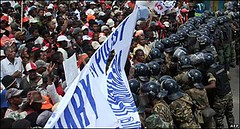
    Madagascar has been in a political crisis since the March 17 2009 power grab by then Antananarivo mayor Andry Rajoelina with the backing of the army.

    Regional blocs African Union and the Southern African Development Community suspended membership for the vast Indian Ocean island, while Washington halted humanitarian aid to the country after the coup.

    Travel bans

    On Wednesday, the AU went further by slapping travel bans and economic sanctions on Rajoelina and scores of his supporters, who defied an AU directive to implement accords to end the protracted impasse.

    This month, Cosmos’s 1 750 staff turned up at the shuttered factory to be paid a paltry 45 000 ariary (€15), half their monthly salary, sparking anger among those who had expected more money.

    “Our case is in court. The creditors have frozen our assets,” Hurnungee said.

    Production manager Parvez Jamdaty said: “We have to wait to see if we can sell what we produced or the machines.”

    About 30 factories under the AGOA scheme have been affected by the suspension and nearly 20 000 workers have been laid off.

    “I have no confidence that AGOA can resume in Madagascar,” said Jamdaty. The AGOA programme was set to end in 2015.

    Alongside Madagascar, Guinea and Niger also saw the US suspend the preferential market access scheme for disregard for democracy.

    Up to last year, Madagascar was one of the largest African textile exporters to the United States — with sales worth $250-million, the sector employed at least 50 000 workers directly.

    In November, Madagascar strongman Rajoelina signed a power-sharing agreement with his political rivals to end the turmoil, but later disregarded the deal.

    Madagascar is one of the world’s poorest nations, where three quarters of the population live on less than two dollars a day. – AFP

    Source: Mail & Guardian Online
    Web Address: http://www.mg.co.za/article/2010-03-21-madagascar-crisis-puts-thousands-out-of-work

  • South African Deputy President Kgalema Motlanthe Says Honour Sharpeville Victims, Defend Rights

    Motlanthe: Honour Sharpeville victims, defend rights

    JOHANNESBURG, SOUTH AFRICA Mar 21 2010 20:06

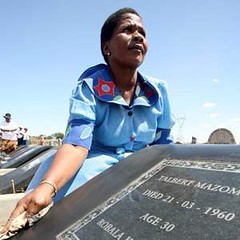
    South Africans should honour the victims of the 1960 Sharpeville massacre by protecting everyone’s human rights, Deputy President Kgalema Motlanthe said on Sunday.

    Motlanthe said South Africans had a responsibility to protect the Constitution and to honour those who gave their lives in the fight for freedom.

    “In effect, this means as public representatives, at local, provincial and national levels, we should always remember the dead because we are their living delegates as they have relinquished their rights to participate in this freedom we enjoy,” he said.

    “To adequately commemorate the victims and survivors of the Sharpeville massacre and other bloodbaths, we must ensure the progressive realisation of the socioeconomic rights as envisaged in the Bill of Rights.” Motlanthe said.

    “This means, as government, working with our social partners. We must strive to improve the quality of life of all our people by providing shelter, basic amenities, education, and security.”

    He also called on citizens to remain patient in the face of slow service delivery.

    “The freedom we enjoy today in South Africa means we must exercise our responsibilities diligently so that even those who are aggrieved by [the] slow pace of service delivery will not resort to burning public facilities, such as libraries and schools.

    “I believe freedom also obliges communities themselves to take ownership of protecting everyone’s human rights and protecting the vulnerable members of our society,” he said.

    Main threat

    However, opposition parties and civil organisations said the African National Congress (ANC) was the main threat to human rights in the country.

    “Our constitutional rights are threatened by greed, cronyism, corruption and power abuse,” said Democratic Alliance (DA) leader Helen Zille.

    “Our right to live free from fear is threatened by hate speech that incites violence and the government’s hired thugs who think they are above the law,” she said.

    Zille said these threats were not from outside forces and they had nothing to do with the legacy of the past.

    “They are recent threats to our human rights. And they come from the ruling party itself,” she said.

    Civil rights group Afrikanerbond said the government had treated the United Nations (UN) Committee for the Elimination of Racial Discrimination (CERD) with contempt by not complying with its regulations.

    Its chief secretary, Jan Bosman, pointed out that South Africa’s report on racism and discrimination was submitted five years late and its second report — due on January 9 — had still not been submitted.

    “In our celebration of Human Rights Day, we are extremely concerned about the South African government’s own commitment to human rights,” he said.

    ‘Social explosion’

    “It is becoming more and more a government that blindly approves or condones abuses against the Constitution and the Bill of Rights by not acting against any abuse or breach,” Bosman said.

    United Democratic Movement (UDM) leader, Bantu Holomisa, said a radical economic transformation was needed to avert a “social explosion” that South Africa managed to avert with the Convention for a Democratic South Africa (Codesa) in the 1990’s.

    “The creation of our economic egalitarian society cannot be left to the vagaries of the market forces that are inherent in current economic policy,” he said.

    “It is only then that we will be in a position to talk of the realisation of human rights in South Africa … when everyone reaps the fruits of the economy,” Holomisa said. – Sapa

    Source: Mail & Guardian Online
    Web Address: http://www.mg.co.za/article/2010-03-21-motlanthe-honour-sharpeville-victims-defend-rights

  • South African President Zuma Visits Namibia to Commemorate 20th Anniversary of Independence

    PR-ZUMA-NAMIBIA

    SAPA PR — PRESIDENT JACOB G. ZUMA ARRIVES IN NAMIBIA TO ATTEND THE 20TH ANNIVERSARY

    Mar 21, 2010 at 11:55 AM

    ISSUED BY: DEPARTMENT OF INTERNATIONAL RELATIONS AND COOPERATION

    ATTENTION: NEWS EDITORS

    21 MARCH 2010

    FOR IMMEDIATE RELEASE:

    PRESIDENT JACOB G. ZUMA ARRIVES IN NAMIBIA TO ATTEND THE 20TH
    ANNIVERSARY OF THE INDEPENDENCE OF NAMIBIA AND THE INAUGURATION OF
    THE COUNTRY’S PRESIDENT H. POHAMBA

    Today, Sunday 21 March 2010, President Jacob G. Zuma of the
    Repulic of South Africa, will attend the 20th independence
    anniversary of Namibia and the inauguration of His Excellency Mr H.
    Pohamba, for a second term as the President of the Republic of
    Namibia, at the country’s Independence Stadium.

    The celebrations were preceded by an Official Gala Dinner which
    was hosted by President Pohamba in honour of the Heads of
    States/Governments last night.

    President Zuma’s visit to Namibia comes shortly after his
    successful visit Zimbabwe where he met with the leadership of Zanu
    PF and MDC who are the signatory to the Global Peace Agreement in
    the Government of National Unity.

    The president is accompanied by South Africa’s International
    Relations and Cooperation Minister Maite Nkoana-Mashabane.

    For further information contact Ministerial Spokesperson Mr
    Malusi Mogale at 0826750380

    Issued by the Department of International Relations and
    Cooperation
    Private Bag x152
    Pretoria
    0001

  • China’s Growth Shifts the Geopolitics of Oil

    March 19, 2010

    China’s Growth Shifts the Geopolitics of Oil

    By JAD MOUAWAD
    New York Times

    Last summer, Saudi Arabia put the final bolt in its largest oil expansion project ever, opening a new field capable of pumping 1.2 million barrels a day — more than the entire production of Texas. The field, called Khurais, was part of an ambitious $60 billion program to increase the kingdom’s production to meet growing energy needs.

    It turns out the timing could not have been worse for Saudi Arabia.

    Only two years ago, consumers were clamoring for more supplies, OPEC producers were straining to increase their output, and prices were rising to record levels. But now, for the first time in more than a decade, the world has more oil than it needs.

    As demand slumped because of the global recession, Saudi Arabia was forced to shut about a quarter of its production. After raising its capacity to 12.5 million barrels a day, Saudi Arabia is now pumping about 8.5 million barrels a day, its lowest level since the early 1990s.

    “2009 was painful for us as it was for everybody else,” said Khalid A. al-Falih, the president and chief executive of Saudi Aramco, the kingdom’s state-owned oil giant, and a company veteran who was promoted to the top post at the beginning of last year. “We experienced the same cash flow constraints that everybody did. But we adjusted quickly and, certainly, everything that was strategic to us was not touched.”

    The recession also precipitated a milestone for Saudi Arabia and the global energy market. While China’s successful economic policies paved the way for a quick rebound there, the recession caused a deeper slowdown in the United States, slashing oil consumption by 10 percent from its 2005-7 peak. As a result, Saudi Arabia exported more oil to China than to the United States last year.

    While exports to the United States might rebound this year, in the long run the decline in American demand and the growing importance of China represent a fundamental shift in the geopolitics of oil.

    “We believe this is a long-term transition,” Mr. Falih said in a recent interview. “Demographic and economic trends are making it clear — the writing is on the wall. China is the growth market for petroleum.”

    Saudi officials have said they favor prices of around $80 a barrel. Despite soft demand and high levels of inventories, oil futures in New York have averaged $75 a barrel over the last six months. On Friday, they closed at $80.68.

    In the United States, some experts believe that energy-efficiency measures, as well as the government’s push for biofuels and its plans to limit carbon emissions, are putting the nation on a long-term path to lower oil consumption.

    The American talk about energy independence rankles Saudi officials, who maintain that the goal is unrealistic and could end up damaging energy markets by undermining investment now, thus leading to higher prices in the long run.

    Mr. Falih said he welcomed energy-efficiency measures but insisted that fossil fuels would dominate energy demand for decades.

    “I was here in the 1980s after the 1970s price shocks, and I remember all the debates,” Mr. Falih said. “But ultimately the policies were reasonable. And the United States continues to search for that reasonable ground.”

    Saudi officials have recognized that structural changes are taking place in the United States. A few months ago, Aramco sold its storage facilities in the Caribbean, a signal that it was abandoning the East Coast market, according to analysts. (The Saudis stopped striving to be the top foreign supplier to the United States years ago. The kingdom now trails Canada, Mexico and Venezuela for exports to the United States.)

    That is not to say the Saudis are cutting ties with the United States. Aramco is expanding its Motiva refinery, in Port Arthur, Tex., which it owns with Royal Dutch Shell, to increase its capacity to 600,000 barrels a day. That will make it the largest refinery in the United States, overtaking Exxon Mobil’s Baytown refinery.

    Edward L. Morse, an energy expert who heads global commodity research at Credit Suisse in New York, said the transformation was a healthy development in relations between Saudi Arabia and the United States. It also means the end of the “U.S. discount,” where Aramco sold oil to American refiners for about $1 a barrel less than to Asia.

    “The Saudis don’t see the need to subsidize their oil exports to the United States anymore,” Mr. Morse said.

    Last year, Saudi exports to the United States fell to 989,000 barrels a day, the lowest level in 22 years, from 1.5 million barrels a day the previous year, according to the Energy Information Administration.

    Meanwhile, Saudi sales to China surged above a million barrels a day last year, nearly doubling from the previous year. The kingdom now accounts for a quarter of Chinese oil imports.

    Saudi Aramco recently inaugurated a huge refinery in the Fujian province, in the southeast coast of China, which is projected to receive 200,000 barrels a day of Saudi crude, and is looking at a second project in the northeast city of Qingdao.

    It is also planning to build two refineries in Saudi Arabia, as joint ventures with Total and ConocoPhillips, that are primarily destined to ship products to Asia.

    India is also courting Saudi attention. After a visit in March to Riyadh by India’s prime minister, Saudi Arabia outlined a goal to double its exports to India. The kingdom already accounts for 25 percent of the Indian market after its exports grew sevenfold from 2000 to 2008.

    “Oil flows are shifting from West to East, and Saudi supplies that used to go to Europe and the United States are now headed for Asia,” said Jean-Jacques Mosconi, the senior vice president for strategy at Total of France.

    Brad Bourland, a former State Department official who heads research at Jadwa Investment in Riyadh, said: “Saudi Arabia used to be very much an American story, but those days are gone forever. That’s just a reflection of a globalized world and the rise of Asia. They now see their relationship with China as very strategic, and very long term.”

    Some energy and security experts have pointed out that the Saudi government is keen on displacing Iranian oil sales to China to persuade Beijing authorities to back tougher sanctions against Iran’s nuclear program, a position that has the support of the United States.

    “We know the Saudis and others have delivered the message to the Chinese that instability in the gulf is not in their interest,” Douglas C. Hengel, the deputy assistant secretary for energy, sanctions and commodities at the State Department, said last week during a conference in Houston.

    But Jon B. Alterman, a Middle East expert at the Center for Strategic and International Studies in Washington, said that the falling dependence of the United States on Saudi oil could turn into a problem for the Saudis, because the United States guarantees their security in the Persian Gulf.

    “The Saudis are particularly concerned about the shape of the global market where all the growth comes from the east and all the security comes from the west,” Mr. Alterman said.

    China’s oil demand is set to grow by 900,000 barrels a day in the next two years. Chinese oil consumption reached 8.5 million barrels a day last year, compared with 4.8 million in 2000. It will account for a third of the world’s total consumption growth this year.

    While China is by far the fastest-growing oil market in the world, the United States is still the top consumer: despite the slump, Americans consumed 18.5 million barrels a day in 2009. That amounts to 22 barrels of oil a year for each American, compared with 2.4 barrels for each Chinese.

    “To me, this is a long-term business,” said Mr. Falih during the interview.

    “And that is how I look at the United States and China — as markets for commodities that will be in demand for years.”

  • Somalia Resistance Movements Join Forces in Cyberspace

    Somali rebels join forces in cyberspace: U.N. report

    By Reuters

    NAIROBI (Reuters) – Armed rebel groups in Somalia are using the Internet for fundraising and recruitment, and they achieve better results through the Web than they do on the ground, a United Nations report said.

    The report by the U.N. Monitoring Group on Somalia also highlighted how the rebels use the Internet to spread information about making bombs and religious rulings.

    It cited a three-day, live fundraiser in May last year and another online forum in March 2009 attended by senior members of al Shabaab and Hizbul Islam, the two main rebel groups fighting the Western-backed government of President Sheikh Sharif Ahmed.

    “Al Shabaab and Hizbul Islam have regularly conducted joint forums, achieving a greater degree of cooperation in cyberspace than they do on the ground,” the report said.

    Al Shabaab launched a two-week online fundraiser for its fighters in August 2009, which drew senior regional rebel leaders and hundreds of participants in the Somali diaspora, the report said.

    Forum participants made pledges totaling more than $40,000 during the event at which the leaders told of the hardships facing fighters and their families.

    “The Internet continues to play an important role in propaganda, recruiting and fund-raising by Somali armed groups,” the monitoring group said.

    ONLINE FATWA

    The most active al Shabaab online outlet is www.alqimmah.net, established in September 2007 and registered in Sweden.

    The site is used to disseminate and produce the rebel group’s information material, “making it an integral part” of al Shabaab’s propaganda.

    Last August it posted a 47-page religious ruling, or fatwa, against the Djibouti peace process, which is aimed at putting together an inclusive Somali government.

    The fatwa has provided Somali rebel groups with religious justification for waging war against the government of Somalia.

    Alqimmah.net has also posted a link to a book entitled “The Science of Explosions and Explosives”.

    “The intention of the posting was apparently to make available to Shabaab supporters and sympathizers knowledge pertinent to bomb-making,” the report said.

    Al Shabaab is also using Internet forums to highlight its cooperation with foreign fighters who have joined its cause.

    In one example, the proceedings of a ceremony to thank foreign fighters, and reportedly, to celebrate the marriage of some 50 of them to Somali women as a way to integrate them into Somali society, were relayed to participants of an online forum.

    “The message was unmistakably to assure potential foreign volunteers that they could expect a similarly warm welcome if they joined the cause,” the report said.

    Other sites used to disseminate materials by al Shabaab cited in the report include somalimemo.com and ansarnet.info, while Hizbul Islam has links with jabiso.net, somalimirror.com and cadaalada.com and halgan.net.

    FAST INTERNET

    Despite its internal turmoil Somalia boasts some of the fastest Internet connections in Africa.

    “By 2005, when most of Africa was still putting this infrastructure in place, Somalia, with the help of a huge diaspora population, developed the fastest and cheapest internet and telecommunications,” said Rashid Abdi, Somalia analyst with the International Crisis Group.

    Abdi described al Shabaab’s use of the Internet as an increasingly common trend of “cyber-jihadism”, which is difficult to control.

    He cautioned against restricting Internet use in Somalia. “I would not recommend cutting off Somalia’s Internet. It is just a catalyst not a root cause,” he said, adding that it could also become a vehicle to help solve the conflict.

  • Confessed Killer of Malcolm X Is Granted Parole

    March 19, 2010

    Killer of Malcolm X Is Granted Parole

    By ANDY NEWMAN and JOHN ELIGON
    New York Times

    After being turned down for parole 16 times, Malcolm X’s only confessed assassin is about to gain his freedom.

    Thomas Hagan has been held since moments after shots rang out in the Audubon Ballroom in 1965. He has been on work release for more than two decades, but he still spends two days a week locked up at the Lincoln Correctional Facility on West 110th Street in Manhattan.

    On March 3, however, on his 17th try, Mr. Hagan was granted parole, the State Division of Parole said. His final release date is tentatively scheduled for April 28. The news was reported Thursday on The Village Voice’s Runnin’ Scared blog.

    Mr. Hagan, who turned 69 in jail on Tuesday, was a militant member of the Nation of Islam on Feb. 21, 1965, when Malcolm X was shot while giving a speech at the Audubon, in Washington Heights. Mr. Hagan, then known as Talmadge X. Hayer, was captured by the crowd and shot at and beaten before being rescued by the police.

    Two other men, Muhammad Abdul Aziz (then known as Norman 3X Butler) and Kahlil Islam (then Thomas 15X Johnson), were also charged with the murder. They maintained their innocence. Mr. Hagan did not, testifying at his trial in 1966 that he was responsible for the murder and that his co-defendants were innocent.

    All three men were sentenced to 20 years to life.

    Mr. Hagan said in a 1977 affidavit that he and several accomplices (not Mr. Aziz or Mr. Islam) decided to kill Malcolm X because he was a “hypocrite” who had “gone against the leader of the Nation of Islam,” Elijah Muhammad. Mr. Hagan said that after one man shot Malcolm X in the chest with a shotgun, he and another man fired several more rounds at him.

    Mr. Aziz was paroled in 1985, and in 1998 was named by Louis Farrakhan to be chief of security for the Harlem mosque that Malcolm X once headed. Mr. Islam was paroled in 1987.

    Mr. Hagan, who earned a master’s degree while in prison, according to a 2008 profile in The New York Post, was placed on work release in 1988. In 2008, he was spending his free days with his wife and children in Sunset Park, Brooklyn, and working in a fast food restaurant.

    “I’ve been incarcerated for 40 years, and I’ve had a good record all around,” he told The Post. “I don’t see any reason for holding me.”

  • WERC Appeal to Labor Leaders For a Solidarity Day III on Jobs, Peace and Justice

    WORKERS EMERGENCY RECOVERY CAMPAIGN
    P.O. Box 40009
    San Francisco, CA 94140
    Tel. 415-641-8616
    Email: [email protected]
    Website: www.wercampaign.org
    ——————–
    March 19, 2010

    Dear Sisters and Brothers,

    The Executive Council of the California Labor Federation, representing two million organized workers, over one-sixth of the membership of the AFL-CIO, passed a resolution on Feb. 23, 2010, calling on the AFL-CIO and Change to Win to organize a Solidarity Day III demonstration in Washington, D.C. for Jobs, Peace and Justice. Other unions and organizations that recently passed similar resolutions include the Labor for Single Payer Campaign — representing a broad array of local unions, labor councils and state federations — as well as the San Francisco Building Trades Council.

    These resolutions are in response to a deteriorating situation for working people. Unemployment continues unabated, home foreclosures are still rising, and because of the recession, many states are suffering huge budget deficits, meaning that they are slashing social services and funding for education so that even more people are losing their jobs. Instead of mounting a massive jobs-creation program, the federal government is contemplating reducing the federal deficit by attacking entitlement programs such as Social Security and Medicare.

    AFL-CIO President Richard Trumka has recently condemned these trends and offered a different approach: “The best way to fix the deficit is to create 10 million jobs now — the number of jobs needed to close our jobs deficit. This will require large amounts of public investment in the short term, which should be paid for in future years by taxing Wall Street.”

    In response to the Massachusetts Senate elections where Republican Scott Brown won, President Trumka also stated: “It’s not time to leave it to any political party to take care of us once we put them in office. It’s time to organize and mobilize as never before to make every elected or aspiring leader PROVE he or she will create the jobs we need in an economy we need with the health care we need. … I know we are the people who can mobilize a massive army to force elected leaders to deliver.”

    We agree with these statements by President Trumka. Now is the time to rely on ourselves, not on the politicians, and to mobilize a massive demonstration in Washington, D.C. for Jobs, Peace and Justice.

    Although small demonstrations are helpful, massive demonstrations, because they cannot be ignored by the media, place much more pressure on the politicians to do the right thing. Huge demonstrations give the participants the conviction that they are not alone, that they truly represent the interests of the majority of the people in this country, that our cause is just, and that we have the power to win. In this way these demonstrations enthuse and energize the participants who then want to continue the struggle.

    The AFL-CIO has recently launched a two-week campaign (see http://www.aflcio.org/mediacenter/prsptm/pr03112010.cfm) across the country, calling for rallies and demonstrations at the Big Six Wall Street banks (Bank of America, Citibank, Goldman Sachs, JP Morgan Chase, Morgan Stanley and Wells Fargo/Wachovia) in order to broadcast the following message: “It’s time to create good jobs now, and the big Wall Street banks that destroyed jobs should pay to restore them.” There are three demands: “Stop refusing to pay your fair share to restore the jobs you destroyed, stop fighting financial reform, and start lending to your communities, small businesses and others starved for credit.”

    We encourage you to attend one of these demonstrations and raise the idea of calling on the AFL-CIO and Change to Win to organize a massive demonstration of working people to demand that the government resolve the economic crisis in favor of working people by creating jobs and taxing Wall Street, rather than resolving the crisis at our expense so that the bankers can continue their outrageous bonuses.

    We have included a Model Resolution for such a Solidarity Day III demonstration below, along with an endorsement coupon. You will also find below an updated list of endorsers of this important campaign.

    We hope to hear back from you.

    In solidarity,

    Bill Leumer and Alan Benjamin
    Co-Conveners,
    Workers Emergency Recovery Campaign
    ********************
    MODEL RESOLUTION
    in Support of a Labor-Sponsored March on Washington
    For JOBS, PEACE & JUSTICE

    WHEREAS in the aftermath of the Massachusetts special senatorial election, AFL-CIO president Richard Trumka issued a statement declaring “It’s time to organize and mobilize as never before to make every elected or aspiring leader PROVE he or she will create the jobs we need in an economy we need with the health care we needs. I know we are the people who can mobilize a massive army to force elected leaders to deliver;” and

    WHEREAS despite the so-called economic recovery, the economic crisis for working people has continued unabated with growing unemployment and underemployment, rising home foreclosures and evictions, and the underfunding of public education and vitally needed social services; and

    WHEREAS the government has bestowed billions of bailout dollars on the financial institutions whose recklessness and greed created this economic crisis and who are rewarding those responsible with obscene gigantic bonuses; and

    WHEREAS the labor movement’s legislative priorities — a massive program for jobs, true universal health care, and enactment of the Employee Free Choice Act — are all in great peril; and

    WHEREAS while the government has no problem allocating a trillion dollars for two wars thousands of miles away, it has not committed funds critically needed to put America back to work, with health care and quality education for all; and

    WHEREAS right wing, anti-labor forces, such as the Tea Party movement, have brought hundreds of thousand of people into the streets to advance their reactionary demands; and

    WHEREAS there is a growing movement within the House of Labor to counter the right wing offensive against workers’ living standards with our own massive mobilization; and

    WHEREAS various union bodies, including the California Labor Federation (AFL-CIO), the South Carolina Labor Federation (AFL-CIO), the Labor for Single-Payer Campaign, the San Francisco Building Trades Council, the South Bay Labor Council (CA), Plumbers and Fitters Local 393, Troy Area Labor Council (NY), San Mateo Labor Council (CA) and the San Francisco Labor Council, AFL-CIO, the Council of New Jersey State College Locals (CNJSCL, AFT-AFL-CIO), among others, have adopted resolutions calling upon the AFL-CIO and Change to Win to organize a Solidarity Day III March on Washington D.C.. in the spring or summer of 2010 to demand jobs, health care, housing, full funding for public education and social services, and peace; now therefore be it

    RESOLVED that the ________ [NAME OF YOUR UNION/ORGANIZATION] joins with our brothers and sisters in calling for a labor-sponsored march on Washington for jobs, peace and justice, which would have the capability of mobilizing the kind of massive army Brother Trumka spoke of; and be it finally

    RESOLVED that a copy of this resolution be sent to the AFL-CIO and to Change to Win.
    ************************
    WERC ENDORSEMENT / FINANCIAL SUPPORT COUPON

    [ ] I endorse the Model Resolution [see above] Urging Support for a Solidarity Day III March in DC for Jobs, Peace and Justice.

    [ ] My union / organization endorses the Model Resolution Urging Support for a Solidarity Day III March in DC.

    [ ] I pledge a contribution of $ _____ toward your WERC financial campaign. My check will be made payable to “WERC” and mailed to WERC, P.O. Box 40009, San Francisco, CA 94140.

    NAME

    UNION/ORG (for info purposes only)

    CITY

    STATE

    ZIP

    TEL

    EMAIL

    (please fill out and return to [email protected])
    ********************
    Updated list of initial endorsers of Call for a Labor-Sponsored
    Demonstration in Washington for Jobs, Peace and Justice

    (as of March 19, 2010)

    – California Federation of Labor, AFL-CIO
    – South Carolina State, AFL-CIO
    – San Francisco Labor Council
    – South Bay Labor Council (San Jose, Calif.)
    – San Mateo Central Labor Council
    – Hartford (CT) Central Labor Council
    – Troy (NY) Central Labor Council
    – Labor For Single Payer Campaign
    – AFT Local 1021 (Los Angeles)
    – Council of New Jersey State College Locals (CNJSCL), AFT-AFL-CIO
    – Executive Council, AFT Missouri
    – National Jobs for All Coalition
    – California Peace and Freedom Party
    – Harlem Tenants Council
    – Harlem Antiwar Coalition
    – Bay Area Labor Committee for Peace and Justice
    – Ohio State Labor Party
    – Railroad Workers United
    – Painters and Dry Wall workers Local 93 (Bay Area)
    – Prosperity Agenda

    – Glen Ford (Black Agenda Report)
    – Donna Smith, American SiCKO, American Patients United
    – Harry Kelber (Labor Educator)
    – Sharon Black (Organizer, Bail Out the People Movement)
    – Monadel Herzallah (Arab American Union Members Council)
    – Andy Griggs (UTLA member)
    – Don Bechler (chair, Single Payer Now!)
    – Larry Duncan* (Labor Beat-Chicago)
    – Allan Fisher (AFT 2121)
    – Fred Hirsch (South Bay Labor Council)
    – Jerry Gordon (Ohio State Labor Party)
    – Bill Balderston (Bay Area Labor Committee for Peace and Justice)
    – Chris Silvera, Secretary-Treasurer, Teamsters Union Local 808
    – Kevin Zeese, Executive Director, Prosperity Agenda
    – Chris Driscoll,* Recording Secretary, Campaign for Fresh Air and Clean Politics
    – Alan L. Maki,* Director of Organizing Midwest Casino Workers Organizing Council
    – Joe Tonan,* Claremont Faculty Association, a Chapter of the California Teachers Association
    – Gregory W. Paquin,* Business Manager, Native American Indian Labor Union #12

    WERC Interim National Committee Members:

    – Kali Akuno, Malcolm X Grassroots Movement, Gulf Coast Reconstruction activist
    – Alan Benjamin,* Executive Committee member, San Francisco Labor Council
    – Mike Carano, Progressive Democrats of America
    – Colia Clark, Veteran, Civil Rights Movement
    – Donna Dewitt*, President, South Carolina AFL-CIO
    – Pat Gowens, National organizer, Welfare Warriors
    – Bill Leumer,* International Brotherhood of Teamsters, Local 853 (ret.)
    – Luis Magaña, Coordinator, Organization of Farmworkers of California (OTAC)
    – Cynthia McKinney, Former Member of Congress, 2009 Green Party presidential candidate
    – Jack Rasmus, Economist, Professor at St. Mary’s College
    – Al Rojas, Coordinator, Frente de Mexicanos en el Exterior
    – Marc Rich, United Teachers of Los Angeles
    – Cindy Sheehan, Gold Star mother, antiwar activist
    – Clarence Thomas, Member, ILWU Local 10
    – Mark Vorpahl*, SEIU Local 49, Portland, OR
    – Nancy Wohlforth*, Co-Pres., Pride at Work/AFL-CIO, Vice Pres.,California Federation of Labor

    (* titles & org. for id. only)
  • Detroit Demonstration Today Against War & Injustice, Gather Downtown, 4:00pm

    Three items:
    March 19 – Anti-war demonstration, 4 PM – NO PARKING at Central United Methodist Church
    March 23 – Demonstration at Mayor Bing’s State of the City Address, 5:30 PM
    March 27 – Town Hall Meeting – Jobs or Income for All, 1 PM
    ——————————————————————————–
    1)
    DEMONSTRATION AGAINST WAR & INJUSTICE

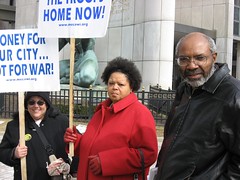
    MONEY FOR OUR CITY NOT WAR & BANK BAILOUTS!!!
    MARCH 19, 2010
    DETROIT, MI

    Please note: There is no free parking at the Central United Methodist Church.

    4:00 p.m. – Gather at the “Spirit of Detroit”, Woodward at Jefferson, Downtown
    4:30 p.m. – Rally and Speakout Against War and For Jobs, Income,
    Housing, Healthcare and Education
    5:00 p.m. – March thru Downtown to Central United Methodist Church, 23 E. Adams, 4th floor
    5:30 p.m. – Light Refreshments at Church
    6:00 p.m. – Roundtable Discussion on “How to End War and Win Social and Economic Justice”

    Sponsors:
    Michigan Emergency Committee Against War & Injustice (MECAWI)
    Moratorium NOW! Coalition to Stop Foreclosures, Evictions & Utility Shut-offs
    Fight Imperialism Stand Together (FIST)

    Endorsed by:
    The Michigan Coalition for Human Rights Youth Board
    The Detroit Coalition Against Police Brutality
    Coalition to Restore Hope to DPS
    Eleventh Hour for Peace
    Detroit Green Party

    For More Info: 313.671.3715/313. 887.6466
    http://www.mecawi.org
    ——————————————————————————–
    2)
    DEMONSTRATE AT MAYOR BING’S STATE OF THE CITY ADDRESS

    TUESDAY, MARCH 23, 2010 – 5:30 P.M.

    Max M. Fisher Music Center
    3711 Woodward Avenue, Detroit

    45% unemployed in the City of Detroit – Families losing their lives
    due to DTE shutoffs – Our neighborhoods destroyed by foreclosures and evictions – Detroit schools continuing to fail – City services
    diminished due to lay-offs…

    Instead of hare-brained schemes to “downsize the City” and lay-offs
    and privatization at behest of the banks, it’s time for the Mayor to
    stand up for the workers and poor who have been devastated by the
    economic depression.

    Mayor Bing: Declare a State of Economic Emergency in the City of Detroit!

    –Moratorium NOW to Stop all Foreclosures, Evictions and Utility
    Shutoffs in the City

    –Stop lay-offs and privatization – Balance the budget by suspending
    debt service to the banks

    –Request President Obama declare Detroit a Disaster Area and fund a Public Works Program to provide jobs now

    –Under Michigan law, specifically MCL 10.31 et. seq., upon
    application of the Mayor the governor can proclaim a state of
    emergency and designate the area involved. Mayor Bing, with the
    support of City Council, needs to formally apply to Governor –

    –Granholm to declare a State of Economic Emergency in Detroit, and
    demand she use her police powers to place a two-year Moratorium on foreclosures, evictions and utility shutoffs in the city. In
    addition, as part of the State of Emergency declaration, the Mayor
    must demand that the Governor apply to President Obama for money to bail out Detroit, the hardest-hit city in the country. We need funds to pay for jobs for youth to rebuild the houses that have been
    stripped and destroyed, and money to stop the destruction of public
    education and services in our city.

    Called by Moratorium Now! Coalition to Stop Foreclosures, Evictions & Utility Shut-Offs

    313-887-4344 http://www.moratorium-mi.org
    ——————————————————————————–
    3)

    On the 75th Anniversary of the W.P.A.

    Detroit Town Hall Meeting
    Speak Out for Jobs!
    Saturday – March 27, 2010 – 1 PM
    Central United Methodist Church, 2nd floor
    23 E. Adams, Detroit

    At the height of the Great Depression of the 1930’s President
    Roosevelt created the Works Progress Administration (renamed later as the Work Projects Administration) on April 8th, 1935. It was funded by the Emergency Relief Appropriation Act of 1935. The WPA put over 8 million unemployed people to work directly and was the largest employer in the United States at that time.

    Today, with tens of millions of workers – especially youth –
    unemployed, we need a real, public jobs program, NOW! We can’t wait for some imaginary future jobs from the banks and corporations who have already been bailed out with trillions of our tax dollars.

    The government can and must open hiring halls in every neighborhood and get people back to work. In the 1930’s the Detroit WPA built Western High School and City Airport and upgraded the Detroit Zoo among many other projects. There is plenty that needs doing immediately in Detroit – repairing roads and bridges, cleaning parks, insulating and fixing up thousands of vacant homes so no one is homeless or without heat.

    The Full Employment Act makes it the government’s duty to put everyone to work – it’s the law! Let’s organize and tell the politicians – A REAL, PUBLIC JOBS PROGRAM NOW!

    Sponsored by:

    Moratorium NOW! Coalition to Stop Foreclosures, Evictions and Utility Shutoffs;
    Michigan Emergency Committee Against War & Injustice

    313-887-4344
    http://www.mecawi.org
    http://www.moratorium-mi.org

  • Federal Judge Rules Oprah Winfrey Can Be Sued For Defamation of South African Woman

    Judge Rules Oprah Winfrey Can Be Sued for Defamation

    Trial Set to Begin March 29 in Philadelphia to Test Free Speech By a Most Public Figure

    By EAMON McNIFF
    March 18, 2010—

    Now that a Federal Judge has ruled Oprah Winfrey can be sued for defamation of character, plaintiff Nomvuyo Mzamane will have the task of taking on one of the world’s most famous women for doing what she does best: sharing her thoughts with the universe.

    The suit, slated to begin March 29 in Philadelphia, raises the question of whether a jury can distinguish between Winfrey the public figure, famous for deep chat sessions with guests on her show, and Winfrey the person who may or may not have defamed Mzamane when addressing a sexual abuse scandal at her school in Africa.

    “When you think of cases of public people being sued, there aren’t that many of them today,” Floyd Abrams, a famed First Amendment attorney, said in an interview with ABC News. “That’s because the law is generally protective of free speech, and because courts and juries are generally sensitive to the needs of protecting free speech.”

    In the 128-page opinion published March 15 in Mzamane v. Winfrey, U.S. District Judge Eduardo C. Robreno concluded that statements made by Winfrey at a November 2007 press conference were “capable of defamatory meaning.” The judge rejected arguments made by Winfrey’s lawyers that the remarks were merely “expressions of opinion.”

    According to court documents, in 2007 students at the school accused one of the dorm matrons, Virginia Tiny Makgobo, of sexual abuse, prompting Winfrey and the school’s executives to call in the authorities to investigate. Six girls have accused Makgobo of sexual abuse. She has pleaded not guilty, and her trial is ongoing.

    Following the allegations, Winfrey met with parents of the students, fired Mzamane as head of the Oprah Winfrey Leadership Academy School and held a press conference. Winfrey opened the elite boarding school for high-achieving poor South African girls near Johannesburg in January 2007

    Winfrey is quoted in court documents as saying: “I’m going to find a new head of the academy for the school. … Dorm parents are gone, [Mzamane] is gone,” in her meeting with the parents.

    According to the judge, that statement suggested Mzamame had a role in the alleged mistreatment of the students which would “clearly blacken plaintiff’s reputation or injure her in her profession.”

    “Plaintiff submits that despite her unblemished record of professional employment, she was unable to obtain a position in the educational field from the time of Winfrey’s public comments until August 2008. Furthermore, plaintiff asserts that she suffered personal humiliation and distress as a result of being wrongly associated with the misconduct at OWLAG due to Winfrey’s comments,” Robreno says.

    Winfrey was also quoted saying she “lost confidence” in Mzamane’s abilities as the school’s headmistress, and that “any person” who had caused harm to any student would not be returning to the school.

    “The average listener could interpret Winfrey’s statement that she has ‘lost confidence’ in plaintiff’s abilities, in conjunction with the preceding statement that ‘any person that has caused harm’ to the students would not be returning to OWLAG, to mean that plaintiff was not being retained due to the fact that she played some role in the ‘harm’ caused to the students,” Robreno wrote.

    According to a brief filed by Mzamane’s lawyers, Winfrey herself acknowledged the power of her words when she said in a deposition she thought only two people — President Barack Obama and his wife Michelle wielded more influence in the media.

    The court papers also quote Winfrey as saying “my mistake was trusting people, putting them in power, and allowing them to rule without me having daily contact to see what was going on.”

    “Winfrey’s characterization of her decision to delegate authority with respect to the students as a ‘mistake’ implies the existence of undisclosed facts unearthed during the internal investigation which indicated that the people put in ‘power,’ i.e., plaintiff, were engaged in wrongdoing,” Robreno wrote.

    “Winfrey indicted Ms. Mzamane for creating an atmosphere where the students’ voices were silenced,” Mzamane’s lawyers, including Timothy McGowan, said in their brief. “Simply put, the only reasonable inference to be drawn from the press conference was that Ms. Mzamane was let go because, at best, she disregarded claims of sexual abuse at [the school].”

    Winfrey’s lawyers tried to have the suit dismissed on the grounds that the comments she made were only her opinions. They also tried to move the trial to Chicago, where her show is based. Robreno said it could be tried in Pennsylvania, where Mzamane lived when she filed suit in 2008. Mzamane is seeking more than $250,000 in damages.

    “Oprah and Harpo await the opportunity to present the case in court,” her lawyer, Chip Babcock of Houston, said in a statement issued this week through Harpo, Winfrey’s production company, which is also a defendant in the suit.

    Babcock successfully defended Winfrey during her 1998 libel trial in Texas after she was sued over a segment on mad cow disease.

    Although the case has been allowed to proceed, Abrams said Mzamane has no easy task ahead of her, but not simply because she is facing off against Winfrey.

    “It’s true that libel law in America is generally protective of free speech. Plaintiffs have a difficult task in prevailing but not an impossible one,” he said.

    Winfrey’s fame and the media storm the trial will bring aside, Abrams is confident both parties will get a fair trial.

    “I think she [Winfrey] can get a fair trial, and I think the plaintiff can get a fair trial even if she is one of the most-admired women in America, because my experience is, juries are pretty good at parsing through to find out what the facts are,” Abrams said.

  • Nigeria Recalls Libya Ambassador

    Nigeria recalls Libya ambassador

    Nigeria has recalled its ambassador to Libya after leader Muammar Gaddafi suggested Nigeria be divided into two states – one Christian and one Muslim.

    The foreign ministry said the Libyan leader’s statement was “irresponsible”. Earlier in the week a senator had called Col Gaddafi a “mad man”.

    Col Gaddafi had suggested the split to prevent any more bloodshed between rival groups in central Nigeria.

    Hundreds have died this year in ethnic and religious violence around Jos.

    Although the violence in Nigeria generally takes place between Muslim and Christian communities, the underlying causes are a complex mix of political, social and economic grievances.

    Nigeria is roughly split between its largely Muslim north, and a Christian-dominated south.

    In a statement, the foreign ministry said it was recalling its Tripoli ambassador for “urgent negotiations” because of the “irresponsible utterances of Colonel Gaddafi”.

    “His theatrics and grandstanding at every auspicious occasion have become too numerous to recount,” said the statement.

    Col Gaddafi, until recently head of the African Union, praised the partition of India in 1947 as the kind of “historic, radical solution” that could benefit Nigeria.

    Splitting India in 1947 caused a breakdown of law and order in which at least 200,000 people died. Some estimates say one million people were killed.

    About 12 million people were left homeless and thousands were raped.

    An attempt by the Igbo people of south-eastern Nigeria to secede in 1967 sparked a war which left more than one million people dead.

    Story from BBC NEWS:
    http://news.bbc.co.uk/go/pr/fr/-/2/hi/africa/8575383.stm