Author: Pan-African News Wire

  • Detroit Coalition Strives For Proper Policing

    Posted: March 14, 2010

    Coalition strives for proper policing

    FBI shooting in Dearborn is current concern

    BY ZLATI MEYER
    FREE PRESS STAFF WRITER

    Ron Scott wasn’t happy.

    He sat at the Detroit Police Commission meeting, listening to a lengthy presentation about the status of video recording equipment in city police cars. He patiently waited for the public comment period.

    Then, he let loose.

    Scott lambasted the Detroit Police Department for not outfitting every car with cameras and questioned why gang-squad cars don’t have them like patrol cars do. He raised issues with the bidding process, the department’s culture, and whether there is a quota system for traffic stops.

    Finally, Scott challenged Chief Warren Evans to “come before the people.”

    “This is not a matter of cold statistics,” Scott said to the commissioners and a handful of others in attendance. “This is about life and death.”

    In Detroit, when the issue of police behaving badly comes up, no one comes to mind faster than Scott. As head of the Detroit Coalition Against Police Brutality, he fields thousands of phone calls a year from people who believe they were victimized, publicly criticizes police and holds vigils and rallies that sometimes draw a crowd — sometimes only a few people.

    “I never find it disheartening,” Scott said, “because we have gotten so much love and support from the people that we’re doing the right thing.”

    Activist keeping an eye on cops

    A crowded office on the eighth floor of a downtown Detroit building is the situation room where one man takes on one of the largest police departments in the United States.

    Though most people may not be familiar with Scott, chances are good they have heard about the cases for which he is fighting.

    Currently, the 62-year-old community organizer is trying to draw attention to two high-profile cases: the fatal shooting of Imam Luqman Ameen Abdullah during an FBI-led raid in Dearborn in October; and what appeared from television helicopter camera to be some police heavy-handedness on Andre Hardy after police said he led Michigan State Police and Detroit police on a high-speed chase on the Lodge Freeway earlier this month.

    It was the 1992 beating death of a black man at the hands of two white Detroit cops that helped spawn the coalition which Scott, a 1960s civil-rights activist turned TV producer, heads.

    “The Malice Green case really did create the synergy in the city and people were really upset about that,” Scott said.

    The Detroit Coalition Against Police Brutality was founded in 1996 by Wayne State University professor Gloria House and Marge Parsons. They were upset about crack and cocaine sentencing disparities and the large number of young African-American motorists police were pulling over. Scott was among the early members; he joined and became spokesman for the organization in 1996.
    Day-to-day concerns

    Since then, the coalition has protested, concerning Detroit, the record-high number of police shootings, hangings in local jails, the 2000 shooting of deaf Detroiter Errol Shaw, Officer Eugene Brown’s record nine shootings and the 2003 federal consent decree against the department. The group also raised awareness of last year’s police Taser death involving Warren police and the terrorism charge lobbed at a Clinton Township man who allegedly bit his neighbor.

    Over the years, the organization has grown and is now run from donated office space in Ron Glotta’s law office in the Michigan Building at 220 Bagley.

    Scott and a staff of 10-15 volunteers hear from people complaining of police brutality in metro Detroit. He said that the coalition handled 2,554 calls last year, tackled 10%-20% and referred the rest to attorneys, public agencies or other groups.

    The coalition operates on an annual budget of about $100,000, primarily made up of grants and in-kind donations. Scott expects an educational arm of the coalition that aims to promote peace in neighborhoods and raise awareness about the criminal justice and law enforcement systems will get 501(c) 3 status soon. The Internal Revenue Service designation makes a nonprofit organization formed for charitable or other purposes exempt from most federal taxes. Those organizations are prohibited from directly or indirectly participating in, or intervening in political campaigns involving candidates for elected offices.

    Scott has been asked to speak to groups around the country about countering police brutality. His cell phone is always on, an eloquent quote at the ready for news media callers.
    Incident in Greektown

    But the man who is the opposition to police brutality has experienced it. Scott said that in 1994, he was attacked by Detroit cops in Greektown after disputing a charge of loitering — thrown to the ground, kneed in the back and threatened.

    Perhaps that’s why he’s willing to take on authority, including Detroit’s police chiefs present and past.

    “Warren Evans is setting the department back,” Scott said. “It’s backward, backward, backward. Ella Bully-Cummings had some challenges, but she at least tried to set up a frame to work with the community. He’s slipped into this macho dream world.”

    Evans disagrees with Scott’s assessment of his oversight of Detroit police.

    “Advocacy from all segments of the community is helpful for the city and for the police department, quite frankly,” Evans said. However, he added that “when you criticize, you ought to have your facts right. Mr. Scott oftentimes does not have the facts or misconstrues.”

    Evans cited Scott’s claim that complaints are up, when the department’s figures show they are down. Scott also said he’s investigating eight or nine fatalities at the hands of police, but Evans said there were no shootings or in-custody deaths last year involving his department.

    “I’ve had a history with Ron Scott going back 20 something years,” Evans said. “Ron knows I’m not the enemy. He just has to pontificate.”

    Man behind the microphone

    The son of a teacher and postal worker, Scott’s professional life began behind a microphone of a different sort. He was a professional singer as a child before moving to radio. His broadcast career began at age 15. By college, that love of audio evolved from music into journalism, as it would later morph from radio to TV.

    In 1963, Scott marched with Martin Luther King Jr. But he said it was a three-hour speech by Black Panther Party leader Kathleen Cleaver in Detroit in 1968 that truly inspired him.

    “I saw the Black Panther Party and it was one moment of epiphany — this is what I should be doing,” he said in his whirlwind of a workspace, several yards from a poster with Malcolm X’s picture and a sign that read “Protect habeas corpus and jury of our peers.”

    Scott organized the Detroit chapter of the Black Panthers and began what would become a lifetime of community projects and consciousness-raising that outlasted the group — including a breakfast program for Detroit schoolchildren, the Jeffries Project rent strike, anti-apartheid divestment and support for liberation movements in Africa.

    “This really just congealed the fact that people my age literally have an impact on changing the world,” Scott said.

    Professionally, Scott was growing, too. He went to work for the Wayne County TB and Health Association, then in the 1970s segued into television, producing on local TV. He launched Ron Scott Video Productions in the 1980s, which still is in operation. Over the years, he blended his media savvy and love of activism by taking to politics and working with elected officials.

    As he takes on law-enforcement officials full-time now, his message is clear, whether shouting it at a rally or simply talking at a Police Commission meeting:

    “We’re not anti-police. We want to do the right thing.”

    Contact ZLATI MEYER: 313-223-4439 or [email protected]

  • Nearly 400 California Educators Receive Preliminary Pink Slips

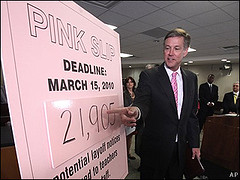
    Nearly 400 local educators receive preliminary pink slips by Monday deadline

    By J.M. BROWN
    Posted: 03/15/2010 07:53:48 PM PDT

    SANTA CRUZ – Just shy of 400 local K-12 teachers and other certificated employees received preliminary layoff notices by Monday’s state-mandated deadline, education officials reported.

    The 396 employees who received pink slips eliminating their jobs or cutting their hours for next fall represent the highest number in recent years, topping the 385 notices sent out last year. The figures represent the number of people affected by the cuts, not the number of positions cut, which is significantly lower because a number of employees work part time. The cuts also don’t include the number of non-teaching cuts districts will weigh in coming days.

    Many of the teaching pink slips are likely to be rescinded once districts have a clearer picture about the number of retirements and resignations are in the pipeline. But teachers and administrators agree the cuts, even if preliminary, destroy morale.

    The county’s two largest districts, Pajaro Valley Unified and Santa Cruz City Schools, sent notices to 275 and 80 employees, respectively, on top of a combined total of 120 adult education workers. Both districts have made cuts of about 10 percent in K-12 expenses and gutted adult education programs in the face of record slashing from a state mired in $20 billion of red ink.

    “It’s huge,” said Barry Kirschen, president of the Greater Santa Cruz Federation of Teachers, saying the district sent out more notices than necessary. Administrators say the March 15 deadline
    requires them to send out as many preliminary notices as they think they could need to balance the budget absent a cost-saving deal with teachers.

    Monday, the two sides tentatively agreed on a retirement incentive plan that will reduce the layoffs if approved by the school board. Forty-one teachers agreed to retire at the end of the school year under an offer to pay them 80 percent of their final salaries over time. In exchange, the district will cap K-3 class sizes at an average of 23 students per teacher, which is an increase of three from the current ratio.

    Kirschen said the retirements will equal nearly $900,000 in savings, or about 15 percent of the $5.4 million the district needs to trim. But Tanya Krause, the district’s assistant superintendent of human resources, said saving that much also would have meant laying off counselors with less seniority than some junior teachers who could be saved by the retirements – a trade-off she said the district isn’t willing to live with.

    In the meantime, both sides said they are getting closer to a furlough agreement that could mean nearly an additional $1 million in savings. Teachers are willing to take a reduction in work days, but details are still being negotiated.

    “We will have some calendar concessions, but I just don’t know how many and where on the calendar,” Krause said.

    Soquel Union Elementary School District is also weighing furloughs to reduce layoffs. The district sent 25 pink slips after having cut the equivalent of 16 full-time positions to save $1.5 million, or about 10 percent of last year’s budget.

    In Scotts Valley, where the budget had to be cut 9 percent, K-3 classes are growing to an average of 29 students, which led the school board to cut the equivalent of six elementary teaching positions. There were also cuts at the high school level, but retirements and other personnel changes brought the number of total workers who actually received a pink slip to eight, Superintendent Susan Silver said.

    Ann Codd, head of the Scotts Valley teachers union, said she believes the district worked hard not to send out more notices than absolutely necessary. But the sting of getting a pink slip is still devastating, she said, especially when there are few teaching jobs elsewhere.

    “It’s still really tough because some of these teachers are already part-time teachers because of previous reductions,” Codd said. “We understand it doesn’t come from the district, but rather the state’s mess.”

    Statewide, districts have cut 22,000 teachers and other certificated employees. Sixty percent of workers cut last year were later brought back, but education officials expect a greater number of notices to be made permanent this year due to a fourth consecutive year of deep state cuts.

    Monday, the state’s Recovery Task Force Director Herb K. Schultz urged Washington to send the second round of stabilization funds that are part of President Obama’s federal stimulus package. The U.S. Department of Education, which requires states to maintain education funding to be eligible for the money, has raised concerns about the California’s record of cutting schools to balance its budget.

    “California has met all federal requirements for the second distribution of stimulus funding for education,” Schultz said in a prepared statement. “I am disheartened that anyone would try to stand in the way of securing nearly a half a billion dollars in critical funding for our education system during these difficult economic times.”

    The Associated Press contributed to this report.

    Preliminary pink slips

    Below are the numbers of preliminary layoff notices issued in K-12 local public school districts by Monday, which was the statewide deadline for issuing pink slips to teachers, administrators and other certificated staff. The figures represent the number of employees who were sent layoff notices, not the number of positions cut, and do not include Adult Education teachers.

    Pajaro Valley Unified School District: 275

    Santa Cruz City Schools: 80

    Scotts Valley Unified School District: 8

    San Lorenzo Valley Unified School District: 3

    Soquel Union Elementary School District: 25

    Live Oak School District: 2

    County Office of Education: 3

    Four small school districts: 0

    TOTAL: 396

  • Israel Feeling Rising Anger From the U.S.

    March 15, 2010

    Israel Feeling Rising Anger From the U.S.

    By MARK LANDLER and ETHAN BRONNER
    New York Times

    WASHINGTON — An ill-timed municipal housing announcement in Jerusalem has mutated into one of the most serious conflicts between the United States and Israel in two decades, leaving a politically embarrassed Israeli government scrambling to respond to a tough list of demands by the Obama administration.

    The Obama administration has put Prime Minister Benjamin Netanyahu in a difficult political spot at home by insisting that the Israeli government halt a plan to build housing units in East Jerusalem. The administration also wants Mr. Netanyahu to commit to substantive negotiations with the Palestinians, after more than a year in which the peace process has been moribund.

    With the administration’s special envoy, George J. Mitchell, suddenly delaying his planned trip to Israel, the administration was expecting a call from Mr. Netanyahu, after a tense exchange last week with Secretary of State Hillary Rodham Clinton.

    On Monday, however, Mr. Netanyahu sounded a defiant note, telling the Israeli Parliament that construction of Jewish housing in Jerusalem was not a matter for negotiation.

    He is struggling to balance an increasingly unhappy ally in Washington with the restive right wing of his coalition government.

    The prospects for peace in the Middle East seemed murkier than ever, as a year’s worth of frustration on the part of President Obama and his aides seemed to boil over in its furious response to the housing announcement, which spoiled a visit to Israel by Vice President Joseph R. Biden Jr.

    “What happened to the vice president in Israel was unprecedented,” said a senior administration official, who spoke on the condition of anonymity. “Where it goes from here depends on the Israelis.”

    But the diplomatic standoff also has repercussions for the Obama administration. Its blunt criticism of Israel — delivered publicly by Mrs. Clinton in two television interviews on Friday and reiterated Sunday by Mr. Obama’s political adviser, David Axelrod — has set off a storm in Washington, with pro-Israel groups and several prominent lawmakers criticizing the administration for unfairly singling out a staunch American ally.

    “Let’s cut the family fighting,” said Senator Joseph I. Lieberman, independent of Connecticut. “It’s unnecessary; it’s destructive of our shared national interest. It’s time to lower voices, to get over the family feud between the U.S. and Israel. It just doesn’t serve anybody’s interests but our enemies’.”

    Relations between Israel and the United States have been uneasy ever since Mr. Obama took office with a plan to rekindle the peace process by coupling a demand for a full freeze in Jewish settlement construction with reciprocal confidence-building gestures by Arab countries.

    Neither happened, and Mr. Obama, who is not as popular in Israel as he is elsewhere around the world, was forced last September to make do with Mr. Netanyahu’s offer of a 10-month partial moratorium on settlements in the West Bank. But the president was outraged by the announcement of 1,600 housing units in an ultra-Orthodox neighborhood in East Jerusalem during Mr. Biden’s visit, administration officials said.

    Mr. Obama was deeply involved in the strategy and planning for Mr. Biden’s visit and orchestrated the response from Mr. Biden and Mrs. Clinton after it went awry, these officials said.

    The administration has used language intended to telegraph anger, defining the dispute not only in terms of the damage it could cause to the peace process but to the American relationship with Israel.

    “That is a whole different order of magnitude of importance,” said Daniel Levy, a former peace negotiator who is senior fellow and head of the Middle East Initiative at the New America Foundation, a research group.

    The last time relations between the United States and Israel became this strained, analysts said, was when James A. Baker, then secretary of state, clashed with the Israeli government in the early 1990s, also over settlement policy. The United States ended up withholding loan guarantees from Israel for a time.

    Mr. Netanyahu said the announcement of the housing development had surprised even him, and he apologized for its timing. But Mr. Obama feels that Mr. Netanyahu should have been in clearer control of the construction process and that he should have done what was needed to stop it, according to officials in Jerusalem and Washington.

    There is a feeling among officials in Washington that the Netanyahu government does not fully grasp how angry Obama officials have grown. But there are signs that it is sinking in.

    The Israeli ambassador in Washington, Michael B. Oren, used the word “crisis” about his country’s relations with Washington for the first time since taking up his job last year, in a telephone briefing to colleagues over the weekend, according to an Israeli official.

    Still, American and Israeli officials also made clear that the core security issues binding the two countries were not in jeopardy, and that what was happening was closer to a married couple having a bad fight rather than seeking a divorce.

    In the murky vocabulary of diplomacy, the scheduled talks due to start under American supervision are viewed by the Israelis mostly as “proximity” discussions, in other words procedural talks rather than substantive negotiations. But the Palestinians want the discussions to be as substantive as possible, an approach Mrs. Clinton demanded in her call to Mr. Netanyahu on Friday.

    The Israeli leader has said he is open to direct negotiations with the Palestinians. But the chief Palestinian negotiator, Saeb Erekat, said in an interview in his Ramallah office that the Palestinians and Israelis had exhausted direct negotiations and that it was time for America to take a more direct role. “We have a trust level below zero between the two sides,” he said.

    The settlement episode has enabled the administration to turn the tables on Mr. Netanyahu, some analysts say. But the question is whether it will be able to extract more concessions from him now.

    “The heart of the matter is whether the proximity talks are going to be productive, in the sense of opening a corridor to direct negotiations that will lead to a peace agreement,” said Martin Indyk, a former American ambassador to Israel.

    The timing of the dispute could not be more awkward for the administration, coming a week before the American Israel Public Affairs Committee, the most influential pro-Israel lobbying group, meets in Washington. Mr. Netanyahu and Mrs. Clinton are both scheduled to speak to the group, which has condemned the White House’s tough stance.

    Mr. Biden may meet with Mr. Netanyahu while he is here, officials said. But there is no meeting planned between Mr. Obama and Mr. Netanyahu because the president will be traveling in Indonesia and Australia, a conflict which one official joked suits the administration well right now. “This may not be the best time for a face-to-face,” he said.

    Mark Landler reported from Washington, and Ethan Bronner from Jerusalem. Helene Cooper contributed reporting from Washington.

  • Explosions Rocks Nigeria Amnesty Ceremony

    Explosions rock Nigeria amnesty ceremony

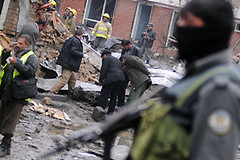
    WARRI, Nigeria (AFP) – Two explosions rocked the southern Nigerian oil city of Warri on Monday during talks on an amnesty for former rebel fighters in the oil-rich Niger Delta, a government official said.

    One device went off and after some few minutes another one was heard near the main hall where the event was taking place, sending large plumes of smoke into the air. It was not immediately clear whether anyone was injured.

    “There were car bombs, two of them. The first one exploded just as the governors came in and the second one was about 30 minutes later,” Delta State government spokesman Linus Chima to AFP.

    “I think the intention is obvious, just to scuttle the talks and make it seem as if Warri in Delta state is not safe,” he added.

    The blasts shattered windows, people were running, and the governors were rushed out of the conference room to their cars, an AFP reporter at the scene said.

    Soldiers were ordering everyone to evacuate the building.

    The blasts went off moments after the region’s main armed group MEND threatened to detonate three devices it had planted near the venue.

    Several hundred top officials and community leaders had gathered at the ceremony. At least four governors and the federal minister in charge of the region, Ufot Ekaette, were attending the ceremony organised by the independent newspaper Vanguard.

    Explosions hit Nigeria oil talks

    Two suspected car bombs have been set off in the Nigerian oil city of Warri, where officials were in talks over an amnesty for militants in the area.

    Witnesses said the explosions shattered windows at the state governor’s office and sent officials fleeing for cover.

    The militant group Movement for the Emancipation of the Niger Delta (Mend) had issued a bomb threat earlier.

    Several armed groups recently agreed to an amnesty, but some Mend leaders rejected the government’s offer.

    A Mend leader announced in January that a temporary ceasefire was over.

    Fair share?

    In Warri, witnesses reported seeing huge plumes of smoke rising into the air.

    There were no reports of injuries.

    “There were car bombs – two of them,” Delta State government spokesman Linus Chima told AFP news agency.

    “The first one exploded just as the governors came in and the second one was about 30 minutes later.”

    “I think the intention is obvious, just to scuttle the talks and make it seem as if Warri in Delta State is not safe.”

    The BBC’s Caroline Duffield in Lagos says the suspected use of car bombs is a significant change in tactics from Mend.

    She says it is not clear how many of the group’s top commanders are behind this attack. Until recently, many were insisting that despite all their frustration, they wanted to pursue the amnesty process.

    For years, armed groups have caused havoc in the oil-rich Niger Delta, abducting oil workers and sabotaging pipelines.

    They claim they are fighting for a fairer share of oil wealth for local people.

    But their critics say they use the money they get from illegal oil sales and ransoms to buy weapons and fund more militant activities.

    Story from BBC NEWS:
    http://news.bbc.co.uk/go/pr/fr/-/2/hi/africa/8567876.stm
    Published: 2010/03/15 13:06:13 GMT

  • Israelis Arrest Senior Palestinian Leader

    Israelis nab senior Hamas leader

    Jerusalem (CNN) — Israeli forces have arrested a senior Hamas operative they say is responsible for killing more than 70 Israelis in various terrorist attacks, the Israel Defense Forces said Sunday.

    Maher U’dda, who had been wanted since the end of the 1990s, was arrested Saturday night in a joint operation by Israeli police and security forces in Ramallah, on the West Bank, the IDF said.

    “Pinpoint intelligence information” from the Israel Security Agency led to the arrest, they said.

    U’dda, who is in his early 40s, was one of the founders of Hamas in Ramallah and lives in a village northeast of the city, the IDF said.

    In the early 1990s, he formed a Hamas cell in his village that abducted and interrogated Palestinians suspected of cooperating with Israel, the IDF said.

    The cell demanded weapons as ransom and used them in terrorist attacks, according to the IDF statement.

    Palestinian security forces investigated U’dda in 1998 and held him in a prison for several months, the IDF said.

    During the Palestinian uprising that began in 2000, U’dda helped organize and manage a Hamas military cell responsible for killing 10 Israelis, the IDF said.

    “U’dda’s arrest is the final stage of thwarting Hamas’ military headquarters in Ramallah, which executed various terror attacks and is responsible for the murder of more than 70 Israelis,” the IDF statement said.

    Find this article at:
    http://www.cnn.com/2010/WORLD/meast/03/14/israel.hamas.arrest/index.html

  • Taliban Web Site Claims Afghan Blast Were ‘Message’ to U.S.

    Taliban Web site claims Afghan blasts were ‘message’ to U.S. general

    Kabul, Afghanistan (CNN) — A series of deadly blasts in southern Afghanistan’s volatile Kandahar province on Saturday was a message to the top U.S. general in Afghanistan, according to a posting Sunday on a Taliban Web site.

    The “successful operation on Saturday … was primarily a message to Gen. Stanley McChrystal’s warning against their coming operation in Kandahar city,” said the statement by Taliban spokesman Qari Yousef Ahmadi on the site.

    McChrystal last week said coalition forces would launch a future operation to secure the province.

    Five explosions in Kandahar on Saturday left 35 people dead and wounded 57 others, according to Zemeri Bashary, spokesman for Afghanistan’s Interior Ministry. Officials said all but one of the blasts were suicide bombings.

    The first explosion — a suicide car bombing — took place near the province’s main prison. At the same time, a second suicide car bomb went off in front of the police headquarters, Bashary said.

    The third attack was carried out by a suicide bomber on a motorcycle, and another targeted a bus station.

    McChrystal has vowed that coalition forces “are absolutely going to secure Kandahar,” as security efforts expand in the country’s south.

    “We already are doing a lot of security operations in Kandahar, but it’s our intent — under President [Hamid] Karzai — to make an even greater effort there,” he told reporters Tuesday.

    McChrystal indicated a military operation could begin in the province as early as this summer, but both McChrystal and Mark Sedwill, the NATO senior civilian representative to the country, cautioned that much political groundwork lay ahead for NATO-led coalition troops before an offensive can begin. Just as in the recent Marjah operation, they said, the goal is to gain the support of the Afghan people.

    The push to secure Kandahar from what McChrystal calls a “menacing Taliban presence” is part of a larger counterinsurgency effort in southern Afghanistan. The effort started last month in Marjah in southern Helmand province.

    “The Mujahedeen’s successful operation in the heart of Kandahar city was a message to Stanley McChrystal and a reaction to the U.S. coming operation in Kandahar province,” said the Taliban Web site. “The Mujahedeen of the Islamic Emirate are fully prepared and ready to fight the Americans, NATO and their allies, no matter whichever part of Afghanistan they may be [in].”

    Saturday’s fatalities included 13 police officers and 22 civilians, including six women and three children. Among the wounded were 40 civilians and 17 police officers, Bashary said. The Taliban denied killing any civilians in the Web site statement.

    CNN’s Matiullah Mati contributed to this report.

    Find this article at:
    http://www.cnn.com/2010/WORLD/asiapcf/03/14/afghanistan.explosions/index.html

  • The Big Idea–It’s Bad Education Policy

    latimes.com/news/opinion/la-oravitch14-2010mar14,0,2024751.story

    latimes.com
    Opinion

    The Big Idea — it’s bad education policy

    One simple solution for our schools? A captivating promise, but a false one.

    By Diane Ravitch
    March 14, 2010

    There have been two features that regularly mark the history of U.S. public schools. Over the last century, our education system has been regularly captivated by a Big Idea — a savant or an organization that promised a simple solution to the problems of our schools. The second is that there are no simple solutions, no miracle cures to those problems.

    Education is a slow, arduous process that requires the work of willing students, dedicated teachers and supportive families, as well as a coherent curriculum.

    As an education historian, I have often warned against the seductive lure of grand ideas to reform education. Our national infatuation with education fads and reforms distracts us from the steady work that must be done.

    Our era is no different. We now face a wave of education reforms based on the belief that school choice, test-driven accountability and the resulting competition will dramatically improve student achievement.

    Once again, I find myself sounding the alarm that the latest vision of education reform is deeply flawed. But this time my warning carries a personal rebuke. For much of the last two decades, I was among those who jumped aboard the choice and accountability bandwagon.

    Choice and accountability, I believed, would offer a chance for poor children to escape failing schools. Testing and accountability, I thought, would cast sunshine on low-performing schools and lead to improvement. It all seemed to make sense, even if there was little empirical evidence, just promise and hope.

    Today there is empirical evidence, and it shows clearly that choice, competition and accountability as education reform levers are not working. But with confidence bordering on recklessness, the Obama administration is plunging ahead, pushing an aggressive program of school reform — codified in its signature Race to the Top program — that relies on the power of incentives and competition. This approach may well make schools worse, not better.

    Those who do not follow education closely may be tempted to think that, at long last, we’re finally turning the corner. What could be wrong with promoting charter schools to compete with public schools? Why shouldn’t we demand accountability from educators and use test scores to reward our best teachers and identify those who should find another job?

    Like the grand plans of previous eras, they sound sensible but will leave education no better off. Charter schools are no panacea. The nation now has about 5,000 of them, and they vary in quality. Some are excellent, some terrible; most are in between. Most studies have found that charters, on average, are no better than public schools.

    On the federal tests, known as the National Assessment of Educational Progress, from 2003 to 2009, charters have never outperformed public schools. Nor have black and Latino students in charter schools performed better than their counterparts in public schools.

    This is surprising, because charter schools have many advantages over public schools. Most charters choose their students by lottery. Those who sign up to win seats tend to be the most motivated students and families in the poorest communities. Charters are also free to “counsel out” students who are unable or unwilling to meet expectations. A study of KIPP charters in the San Francisco area found that 60% of those students who started the fifth grade were gone before the end of eighth grade. Most of those who left were low performers.

    Studies of charters in Boston, New York City and Washington have found that charters, as compared to public schools, have smaller percentages of the students who are generally hardest to educate — those with disabilities and English-language learners. Because the public schools must educate everyone, they end up with disproportionate numbers of the students the charters don’t want.

    So we’re left with the knowledge that a dramatic expansion in the number of privately managed schools is not likely to raise student achievement. Meanwhile, public schools will become schools of last resort for the unmotivated, the hardest to teach and those who didn’t win a seat in a charter school. If our goal is to destroy public education in America, this is precisely the right path.

    Nor is there evidence that student achievement will improve if teachers are evaluated by their students’ test scores. Some economists say that when students have four or five “great” teachers in a row, the achievement gap between racial groups disappears. The difficulty with this theory is that we do not have adequate measures of teacher excellence.

    Of course, it would be wonderful if all teachers were excellent, but many factors affect student scores other than their teacher, including students’ motivation, the schools’ curriculum, family support, poverty and distractions on testing day, such as the weather or even a dog barking in the school’s parking lot.

    The Obama education reform plan is an aggressive version of the Bush administration’s No Child Left Behind, under which many schools have narrowed their curriculum to the tested subjects of reading and math. This poor substitute for a well-rounded education, which includes subjects such as the arts, history, geography, civics, science and foreign language, hits low-income children the hardest, since they are the most likely to attend the kind of “failing school” that drills kids relentlessly on the basics.

    Emphasis on test scores already compels teachers to focus on test preparation. Holding teachers personally and exclusively accountable for test scores — a key feature of Race to the Top — will make this situation even worse. Test scores will determine salary, tenure, bonuses and sanctions, as teachers and schools compete with each other, survival-of-the-fittest style.

    Frustrated by a chronic lack of progress, business leaders and politicians expect that a stern dose of this sort of competition and incentives will improve education, but they are wrong. No other nation is taking such harsh lessons from the corporate sector and applying them to their schools. No nation with successful schools ignores everything but basic skills and testing. Schools work best when teachers collaborate to help their students and strive together for common goals, not when they compete for higher scores and bonuses.

    Having embraced the Republican agenda of choice, competition and accountability, the Obama administration is promoting the privatization of large segments of American education and undermining the profession of teaching. This toxic combination is the latest Big Idea in education reform. Like so many of its predecessors, it is not likely to improve education.

    Diane Ravitch, a historian of education, is the author of “The Death and Life of the Great American School System: How Testing and Choice Are Undermining Education.”

  • Oppose Big Business Takeover of Public Education, Mon., March 15, 5:30pm

    Oppose Big Business Takeover of Public Education

    Demonstrate at Robert Bobb’s State of Education Address

    Monday, March 15, 2010
    5:30 PM
    Renaissance High School
    6565 West Outer Drive (west of Hubbell St.)

    Parents, Teachers, and Students are calling for a mass demonstration to oppose the Big Business takeover and privatization of Detroit’s public education system and the removal of democratic control of our public schools.

    Emergency Financial Manager Robert Bobb will be delivering his State of Education Address to an audience of invited guests (not you.)

    For more information, please contact Sandra Hines at 313-778-4393.

    Endorsed by:
    Coalition to Restore Hope to DPS
    Safeway Transportation bus drivers
    Keep the Vote-No Takeover
    DPS Board Advisory Committee
    Michigan Emergency Committee Against War & Injustice
    Moratorium NOW! Coalition to Stop Foreclosures, Evictions, and Utility Shutoffs
    Hood Research
    Detroit Green Party
    Call ‘Em Out

  • Detroit Demonstration at Mayor Bing’s State of the City Address, Tues., March 23, 5:30pm

    DEMONSTRATE AT MAYOR BING’S

    STATE OF THE CITY ADDRESS

    TUESDAY, MARCH 23, 2010 – 5:30 P.M.

    Max M. Fisher Music Center
    3711 Woodward Avenue, Detroit

    45% unemployed in the City of Detroit – Families losing their lives due to DTE shutoffs – Our neighborhoods destroyed by foreclosures and evictions – Detroit schools continuing to fail – City services diminished due to lay-offs…

    Instead of hare-brained schemes to “downsize the City” and lay-offs and privatization at behest of the banks, it’s time for the Mayor to stand up for the workers and poor who have been devastated by the economic depression.

    Mayor Bing: Declare a State of Economic Emergency in the City of Detroit!

    * Moratorium NOW to Stop all Foreclosures, Evictions and Utility Shutoffs in the City
    * Stop lay-offs and privatization – Balance the budget by suspending debt service to the banks
    * Request President Obama declare Detroit a Disaster Area and fund a Public Works Program to provide jobs now

    Under Michigan law, specifically MCL 10.31 et. seq., upon application of the Mayor the governor can proclaim a state of emergency and designate the area involved. Mayor Bing, with the support of City Council, needs to formally apply to Governor Granholm to declare a State of Economic Emergency in Detroit, and demand she use her police powers to place a two-year Moratorium on foreclosures, evictions and utility shutoffs in the city.

    In addition, as part of the State of Emergency declaration, the Mayor must demand that the Governor apply to President Obama for money to bail out Detroit, the hardest-hit city in the country. We need funds to pay for jobs for youth to rebuild the houses that have been stripped and destroyed, and money to stop the destruction of public education and services in our city.

    Called by Moratorium Now! Coalition to Stop Foreclosures, Evictions & Utility Shut-Offs

    313-887-4344 www.moratorium-mi.org

  • Leaders Articulate National. Pan-African Interests Against Imperialism

    Leaders articulate national, Pan-African interests against imperialism

    AFRICAN FOCUS By Tafataona Mahoso
    Zimbabwe Sunday Mail

    Africans may learn from the Anglo-Saxon fear and hatred of Patrice Lumumba and President Robert Mugabe several historical insights:

    First is the hysterical, desperate desire among the Anglo-Saxon leaders, their media hacks and African collaborators to portray Lumumba and Mugabe in their respective times as crazy and isolated leaders hated by the African people. The progressive Belgian author Ludo de Witte exposes this false alibi effectively:

    “If it is true that Lumumba was an isolated politician, why did Brussels, Washington, (London) and New York set up such a gigantic and long-lasting military operation, including the deployment of several thousand Belgian soldiers and Blue Berets, operations of destabilisation, murder and corruption, as well as a huge media campaign? Surely the Western powers which led these operations did not ignite one of the biggest crises since the Second World War solely to get rid of an isolated . . . political leader (hated by the Congolese masses)?”

    The same question can be asked about the current onslaught on Zimbabwe and President Mugabe by the very same powers led by the US. Just read part of US President Barrack Obama’s renewal of former US President George W. Bush’s Executive Orders 13328 of 2003, 13391 of 2005 and 13469 of 2008 by invoking the International Emergency Economic Powers Act of the US. Obama’s renewal of these imperialist piracy powers extends George W. Bush by one year, calling the actions of President Mugabe’s government to empower the African majority “the unusual and extraordinary threat to the foreign policy of the United States of America” and suggesting that what Mugabe’s government has done through land reform and economic indigenisation and empowerment programmes has precipitated “a national emergency” in the US.

    Therefore, through Obama’s Bush order and through renewed EU sanctions against the same Zimbabwe — the entire Anglo-Saxon world is invited to throw against Zimbabwe everything they have, short of direct military intervention. No sane power would mobilise such awesome imperialist instruments against one unpopular, isolated and discredited leader!

    Second, the Anglo-Saxon powers have created such a huge anti-Mugabe media industry and mobilised their diplomatic, political and economic systems against Mugabe precisely because Mugabe has had the courage and privilege to pursue and implement the vision of African independence and sovereignty which Lumumba was never given a chance to put into practice.

    As Ludo de Witte testifies: “Patrice Lumumba totally broke away from the Congolese (petty-bourgeois) elite and its ambitions. He resolutely decided on real decolonisation to benefit the masses . . . Lumumba shaped a nationalism which rested on three . . . pillars: revolutionary and coherent nationalism, political action relying on a mass movement, and an internationalist perspective . . . The national democratic tasks were to free the country from the iron grip of imperialism and create an independent nation; to set up a democratic republic . . .; and finally to develop a truly national economy to meet the needs of the (African) population. The final objective was to build a unified nation state in which all peoples and regions (of Congo) considered themselves essential components of (Congolese) society.”

    In other words, the examples of Lumumba and Mugabe are feared by imperialist powers because they threaten not only the imperialist investment in divide-and-conquer strategies but also the African petty bourgeois class collaborating with imperialism through the cultivation of “tribal” chauvinism and factionalism.

    Here is a small sample of instances in which key players in the Congo crisis created an alibi for the Anglo-Saxon powers: Belgian African Affairs Minister Count Harold d’Aspremont to his Ambassador in Congo, Jan Vanden Bloock, on January 20 1961: “It seems to me a political necessity, firstly to ensure a tight guard, tight guard, repeat tight, on Lumumba, secondly, to avoid ill treatment and suppression.”

    Vanden Bloock’s reply: “Can assure you that no Belgian has been involved in guarding Lumumba and company so far, and never will be since Katangan authorities consider Lumumba’s treatment their own exclusive prerogative.”

    US State Department to US Consul William Canup, January 18 1961, paraphrased by Ludo de Witte:

    “Washington drew its consul’s attention to Press communiqués saying Lumumba had been beaten severely in the presence of a white officer. If this turned out to be true, Consul Canup was requested to let Tshombe know that “the US government deplores such treatment” and must insist he receive “humane treatment”.

    United Nations, after its Congo representative Andrew Cordier, a US citizen, had conspired with Congo President Kasavubu to put Lumumba under house arrest, deny him all media access and close all airports to anyone likely to assist the legitimate Congolese government of Prime Minister Lumumba:

    “UN representatives insisted they could not interfere in internal affairs and that, if the president (Kasavubu) could keep the initiative (to overthrow Lumumba), the presence of the Blue Berets could work to this advantage.”

    The US objection to reports of brutality was not to the ill-treatment of Lumumba and his colleagues. It was ill-treatment “in the presence of whites” which became an issue because that would be seen to mean that the whites controlled the brutality and approved of it. Such a view would mean the Anglo-Saxon powers would be blamed for the coup d’etat, the murders, and the massacres for which they should be expected to suffer consequences in Africa and beyond.

    White officers in Katanga who either participated in or were fully aware of the torture, beating and assassination of Prime Minister Lumumba and his two lieutenants included: Commander of the Gendermerie Major Guy Weber; Police Commissioner Frans Verscheure; Major Paul Perrard; Second Lieutenant Roger Leva; Armand Joe Verdickt; and Colonel Frederic Vandewalle. Belgian Minister of African Affairs Count Harold d’Aspremont in fact ordered the transfer of Lumumba and his colleagues from Leopoldville to Katanga with the intention of having them murdered by the traitor Moise Tshombe, who was ordered to accept the prisoners.

    Tshombe, Mobutu, Kasavubu and their puppet regimes were in fact being directed by the imperialist powers through Brussels. But the first official announcement of the deaths of the three Congolese leaders said that they had broken out of custody and run into a crowd of angry peasants who murdered them! Their bodies could not be found because African “tribesmen” were sworn cannibals!

    In Congo as in Zimbabwe there were strategic reasons for demanding a convincing system of African masks and alibis for Anglo-Saxon crimes. The first reason was East-West (and now North-South) relations. China and the Soviet Union were feared as powers that could exploit Anglo-Saxon crimes to gain influence in Congo; just as today China, India, Russia, Brazil, South Africa and Iran are also feared as trading partners who can render illegal sanctions ineffective against Zimbabwe and win popular local support for their bilateral relations. This explains persistent white Rhodesian attacks on South Africa and the recent ill-treatment of South African President Jacob Zuma by the British Press during Zuma’s visit in Britain in March 2010.

    The second reason for imperialist anxiety was African, Pan-African and NAM recognition for the Tshombe regime. Any African leader in Congo or Zimbabwe who appeared to be too much of an Anglo-Saxon puppet would not be recognised by independent Africa and NAM. That is why the US and Belgium had to sacrifice Tshombe and his puppet regime after using him.

    The third but not least strategic reason for imperialist anxiety was popular African opinion inside Congo and Zimbabwe and in the rest of Africa. Through the efforts of Kwame Nkrumah, Gamal Abdel Nasser, Sekou Toure, Julius Nyerere and Ahmed Ben Bella — the name “Tshombe” became the worst expression of African contempt for an African stooge and sell-out. As primary school children in Standard One and Two, we knew that to be called Tshombe was the worst curse on earth and in heaven.

    This popular African opinion was also most feared and therefore
    most manipulated by Anglo-Saxon powers because popular and properly informed African opinion could spell doom for their settlers, their companies, their ambassadors, spies, missionaries, journalists and NGOs who were also the main vehicles for manipulating African opinion and masking imperialist crimes. The US was, and still is, the master in creating masks and alibis. It relied on prior embedding, as John Perkins was to confirm in 2004 in his Confessions of an Economic Hitman. The CIA first attempted to kill Lumumba through poisoning. But by the time of the coup d’etat, the North Americans restricted themselves to facilitating Belgian crimes by providing logistical support and intelligence.

    Through the CIA, the United States created many masks for Anglo-Saxon intervention. Within Lumumba’s coalition government the CIA was already using Foreign Minister Justin Bomboko, President Joseph Kasavubu and Cyril Adoula to make internal requests and demands consistent with the US intervention strategy. For this reason, the US could afford to ignore Bomboko’s secret request for US marines and opt for use of soldiers of co-opted Third World states under the UN peacekeeping cover still controlled by the US. Bomboko had made that request behind Lumumba’s back.

    Therefore supposed UN officials, including UN Secretary-General Dag Hammarskjold, gave two sets of instructions to their subordinates in the peacekeeping mission: Secret operational orders for execution were according to US strategic goals; filed memoranda, telegrams and Press statements were only for diplomatic and rhetorical purposes and they adhered to UN rules which they pretended to enforce.

    The Belgian regime in Brussels made sure that all the ministers of the government of Katanga, including Tshombe himself, were controlled by white private secretaries who reported directly to Brussels or through the Belgian Ambassador. The secret order from Brussels to have Lumumba delivered to traitor Moise Tshombe was delivered to Tshombe by his white private secretary, Jacques Bartelous.

    In addition, correct information was relayed to Belgium and back either by hand or through telephone calls, while telegrams and filed memoranda carried the masking information intended to mislead the African population and the world at large.

    All the governments and media of the Anglo-Saxon powers claimed that Patrice Lumumba was arrested by his own fellow African leaders and later killed by ordinary villagers because he was universally hated.

    In the book From Congo to Soweto: US Foreign Policy Toward Africa since 1960, Henry F. Jackson demonstrates that the idea that Lumumba was killed by his own people because they suddenly started hating him is a blatant lie according to all the evidence available. In terms of our comparison of Congo in 1960 and Zimbabwe in 2010, it is clear that one contrast is that Robert Gabriel Mugabe is hated by Anglo-Saxon powers today for partly achieving what Lumumba could envision but not achieve in 1960: Jackson writes:

    The CIA and the Belgians instigated President Kasavubu to dismiss Lumumba as Prime Minister. The CIA then instigated the head of the UN mission, a US citizen by the name of Andrew Cordier, to deny Lumumba access to any media or to his party. The UN put Lumumba under house arrest. When Lumumba successfully escaped, it was the CIA who helped Mobutu and Kasavubu to intercept him before he could reach his supporters or any media outlet.

    The biggest lesson from all lessons we can learn from what happened to the African revolution in Congo in 1960 and what is happening to the African revolution in Zimbabwe in 2010 is that African interests can be secured against imperialism only if Africans unite behind those leaders who articulate national and Pan-African interests against imperialism.

  • Alabama Bus Drivers Defend Jobs, Education

    Alabama bus drivers defend jobs, education

    Published Mar 13, 2010 10:41 AM

    BULLETIN: As we go to press, the following update was posted to the SDS Tuscaloosa, Ala., Facebook page: “On March 9 at 2:30 a.m., First Transit and ATU came to an agreement on a contract. This is great news because as most of you know, if there was no contract in place by today, the drivers would be locked out and scabs would be running the buses today. It hasn’t been voted upon yet by the drivers, and we have few details, but we will keep you updated. Go ahead and ride the buses, and when you do, thank your drivers and congratulate them on the change that their courage has created.”

    By Minnie Bruce Pratt
    Tuscaloosa, Ala.

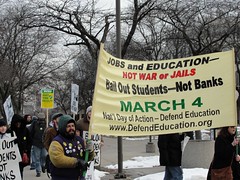
    A small, stalwart crowd rallied at the University of Alabama on March 4 in support of campus bus drivers fighting for their first union contract. A multinational group of protesters — including undergraduate and graduate students, faculty and a U of A alumnae — defended education by supporting them. The rally was organized by Tuscaloosa Students for a Democratic Society and Students in Solidarity with Crimson Ride Shuttle Drivers.

    Amalgamated Transit Union Local 1028 is in negotiation with First Transit, which was subcontracted by the university in 2007 to run the “Crimson Ride Shuttle.” Local 1208 has a majority African-American and substantially female membership. First Transit is a subsidiary of FirstGroup/First Transit International, which originated in the privatization of bus services in the United Kingdom, and now owns a controlling stake in Greyhound Bus Lines.

    David Collins, a former Crimson Ride driver, initiated the union by contacting the ATU in New York. He was later fired as the bus drivers voted to unionize last May. The university pays First Transit $55 an hour to transport students; the drivers are paid $9.50 an hour. At the rally Collins pointed out the extreme discrepancy, arguing that the surplus is simply “pocketed by the company” as profits. He noted the drivers are doing skilled work, requiring them to have a Class B operator’s license.

    In a video, “Empty Promises: ATU Crimson Ride Drivers Speak Out!” (available at vimeo.com), Local 1028 workers reveal how they were promised raises, bonuses, holiday pay and other benefits by the company, and have seen none of this materialize. Workers have to file for unemployment when the university is out for holiday or summer breaks.

    One worker said: “Last year what I made was almost poverty level. I’ve been a bus driver since 1956, I’ve just turned 74, and it would be hard for me to go out and find another job.” Another worker said: “I can’t hardly eat or feed my family, barely put gas in the car. I’ve got nieces and nephews working in restaurants making what I do, and I’m supposed to be the bread and butter of my family.”

    Another noted the attention the drivers give students: “We know who is graduating — and who is failing. We get them to their classes — and safely home from parties.”

    At the rally, Caroline James, a junior psychology and communications major, said the Crimson Ride bus drivers were defending education by showing students the living struggle. She noted that in general students lack information on labor issues and labor organizing.

    The local has gotten tremendous support in their struggle. On campus, the solidarity work for the bus drivers is being coordinated by Students in Support of the Crimson Ride Shuttle Drivers and SDS Tuscaloosa. The organizations set up teams to board the buses, leaflet other students, and speak out for the drivers while shuttling across campus. They were met with applause and pledges from students “not to ride.” In echo of the historic Montgomery Bus Boycott, Collins said the local’s message to students is: “Boycott the buses — no one should ride the buses” until First Transit meets the ATU Local 1208 demands.

    When First Transit was intransigent about negotiating, and university administrators said this was none of their business, the organizers mounted a ferocious call-in campaign to University of Alabama President Robert DeWitt. Hundreds of calls poured in and the administration finally made a statement that First Transit received adequate subsidies from the university to pay the drivers a fair wage, and if First Transit did not do so, the university would seek other transportation options.

    Linking the rally to the March 4 National Day of Action to Defend Education, SDS organizer Chapin Rose Gray stated: “Students and workers are all facing the effects of the economic crisis — students are facing tuition hikes and workers at schools are being hit with layoffs and pay cuts. Today, workers and students stood together to defend education against this crisis.”

    Gray also noted the clear connection between the billions spent by the U.S. to wage war in Iraq and Afghanistan and the cuts, tuition increases and wage squeezes in education. SDS Tuscaloosa plans a related protest on March 20, the anniversary of the most recent U.S. invasion of Iraq.

    Labor support is also strong and includes members of the ATU local in Jackson, Miss.; the West Alabama Labor Council; and International Association of Machinists Local Lodge 2003 in Daleville, Ala.

    Alabama leads the Southeast U.S. in workers represented by unions, at 212,000 — 12.3 percent of the workforce and rising. It is the only Southern state with double-digit percentage union membership.

    Professor Bob Robicheaux, chair of University of Alabama-Birmingham’s Department of Marketing, Industrial Distribution and Economics, echoed big business when he claimed that if Alabama loses its status as a “right to work” state, and instead has “strong organized labor,” the state will lose its “attraction” to U.S. and non-U.S. business. (Birmingham News, March 2)

    But the Crimson Shuttle bus drivers, and Alabama union workers, are putting big business on notice that the real rights in question are the right to a living wage and the right to a job.

    Articles copyright 1995-2010 Workers World. Verbatim copying and distribution of this entire article is permitted in any medium without royalty provided this notice is preserved.

    Workers World, 55 W. 17 St., NY, NY 10011
    Email: [email protected]

  • Texas Conservatives, Racists Win Curriculum Changes That Promote the Superiority of U.S. Capitalism

    March 12, 2010

    Texas Conservatives Win Curriculum Change

    By JAMES C. McKINLEY Jr.
    New York Times

    AUSTIN, Tex. — After three days of turbulent meetings, the Texas Board of Education on Friday approved a social studies curriculum that will put a conservative stamp on history and economics textbooks, stressing the superiority of American capitalism, questioning the Founding Fathers’ commitment to a purely secular government and presenting Republican political philosophies in a more positive light.

    The vote was 10 to 5 along party lines, with all the Republicans on the board voting for it.

    The board, whose members are elected, has influence beyond Texas because the state is one of the largest buyers of textbooks. In the digital age, however, that influence has diminished as technological advances have made it possible for publishers to tailor books to individual states.

    In recent years, board members have been locked in an ideological battle between a bloc of conservatives who question Darwin’s theory of evolution and believe the Founding Fathers were guided by Christian principles, and a handful of Democrats and moderate Republicans who have fought to preserve the teaching of Darwinism and the separation of church and state.

    Since January, Republicans on the board have passed more than 100 amendments to the 120-page curriculum standards affecting history, sociology and economics courses from elementary to high school. The standards were proposed by a panel of teachers.

    “We are adding balance,” said Dr. Don McLeroy, the leader of the conservative faction on the board, after the vote. “History has already been skewed. Academia is skewed too far to the left.”

    Battles over what to put in science and history books have taken place for years in the 20 states where state boards must adopt textbooks, most notably in California and Texas. But rarely in recent history has a group of conservative board members left such a mark on a social studies curriculum.

    Efforts by Hispanic board members to include more Latino figures as role models for the state’s large Hispanic population were consistently defeated, prompting one member, Mary Helen Berlanga, to storm out of a meeting late Thursday night, saying, “They can just pretend this is a white America and Hispanics don’t exist.”

    “They are going overboard, they are not experts, they are not historians,” she said. “They are rewriting history, not only of Texas but of the United States and the world.”

    The curriculum standards will now be published in a state register, opening them up for 30 days of public comment. A final vote will be taken in May, but given the Republican dominance of the board, it is unlikely that many changes will be made.

    The standards, reviewed every decade, serve as a template for textbook publishers, who must come before the board next year with drafts of their books. The board’s makeup will have changed by then because Dr. McLeroy lost in a primary this month to a more moderate Republican, and two others — one Democrat and one conservative Republican — announced they were not seeking re-election.

    There are seven members of the conservative bloc on the board, but they are often joined by one of the other three Republicans on crucial votes. There were no historians, sociologists or economists consulted at the meetings, though some members of the conservative bloc held themselves out as experts on certain topics.

    The conservative members maintain that they are trying to correct what they see as a liberal bias among the teachers who proposed the curriculum. To that end, they made dozens of minor changes aimed at calling into question, among other things, concepts like the separation of church and state and the secular nature of the American Revolution.

    “I reject the notion by the left of a constitutional separation of church and state,” said David Bradley, a conservative from Beaumont who works in real estate. “I have $1,000 for the charity of your choice if you can find it in the Constitution.”

    They also included a plank to ensure that students learn about “the conservative resurgence of the 1980s and 1990s, including Phyllis Schlafly, the Contract With America, the Heritage Foundation, the Moral Majority and the National Rifle Association.”

    Dr. McLeroy, a dentist by training, pushed through a change to the teaching of the civil rights movement to ensure that students study the violent philosophy of the Black Panthers in addition to the nonviolent approach of the Rev. Dr. Martin Luther King Jr. He also made sure that textbooks would mention the votes in Congress on civil rights legislation, which Republicans supported.

    “Republicans need a little credit for that,” he said. “I think it’s going to surprise some students.”

    Mr. Bradley won approval for an amendment saying students should study “the unintended consequences” of the Great Society legislation, affirmative action and Title IX legislation. He also won approval for an amendment stressing that Germans and Italians as well as Japanese were interned in the United States during World War II, to counter the idea that the internment of Japanese was motivated by racism.

    Other changes seem aimed at tamping down criticism of the right. Conservatives passed one amendment, for instance, requiring that the history of McCarthyism include “how the later release of the Venona papers confirmed suspicions of communist infiltration in U.S. government.” The Venona papers were transcripts of some 3,000 communications between the Soviet Union and its agents in the United States.

    Mavis B. Knight, a Democrat from Dallas, introduced an amendment requiring that students study the reasons “the founding fathers protected religious freedom in America by barring the government from promoting or disfavoring any particular religion above all others.”

    It was defeated on a party-line vote.

    After the vote, Ms. Knight said, “The social conservatives have perverted accurate history to fulfill their own agenda.”

    In economics, the revisions add Milton Friedman and Friedrich von Hayek, two champions of free-market economic theory, among the usual list of economists to be studied, like Adam Smith, Karl Marx and John Maynard Keynes. They also replaced the word “capitalism” throughout their texts with the “free-enterprise system.”

    “Let’s face it, capitalism does have a negative connotation,” said one conservative member, Terri Leo. “You know, ‘capitalist pig!’ ”

    In the field of sociology, another conservative member, Barbara Cargill, won passage of an amendment requiring the teaching of “the importance of personal responsibility for life choices” in a section on teenage suicide, dating violence, sexuality, drug use and eating disorders.

    “The topic of sociology tends to blame society for everything,” Ms. Cargill said.

    Even the course on world history did not escape the board’s scalpel.

    Cynthia Dunbar, a lawyer from Richmond who is a strict constitutionalist and thinks the nation was founded on Christian beliefs, managed to cut Thomas Jefferson from a list of figures whose writings inspired revolutions in the late 18th century and 19th century, replacing him with St. Thomas Aquinas, John Calvin and William Blackstone. (Jefferson is not well liked among conservatives on the board because he coined the term “separation between church and state.”)

    “The Enlightenment was not the only philosophy on which these revolutions were based,” Ms. Dunbar said.

  • Nigerians Demand To See President Yar’Adua

    Wednesday, March 10, 2010
    19:55 Mecca time, 16:55 GMT

    Nigerians demand to see president

    Yar’Adua, who returned to Nigeria on February 24, has not been seen in public for months

    Thousands of Nigerian activists have staged a march to demand the sacking of the cabinet and a public appearance by ailing President Umaru Yar’Adua.

    The police stopped around 5,000 protesters on Wednesday, who were led by prominent Lagos pastor Tunde Bakare.

    Marching toward the presidential villa, demonstrators had planned to present their demands to Goodluck Jonathan, the acting president.

    The secretary to the government of the federation, Yayale Ahmed, received the demands of the activists – which included the dissolution of the cabinet, divided over the health of Yar’Adua.

    “The acting president has asked me to assure you that your demands will be looked into with immediate effect. You want to know the status of health of the president… you will not be denied of it,” Ahmed told the protesters on Wednesday.

    Leadership confusion

    Yar’Adua, 58, who returned to Nigeria on February 24 after spending 93 days in Jeddah, where he was being treated for acute pericarditis, has not been seen in public since his arrival.

    His return threw the country into confusion and revived concerns of a leadership squabble just two weeks after Jonathan was installed as acting president.

    Information Minister Dora Akunyili has advised her colleagues to invoke the relevant section of the constitution which paves the way for his removal from office.

    She also accused Yar’Adua’s aides of lying about his health.

    The protesters, who were blocked from gaining entry into the national assembly, also demanded the implementation of the report of a committee on electoral reforms.

    Nigeria has a long history of flawed elections and activists have called for comprehensive electoral reforms ahead of the 2011 general elections.

    “We will continue to mobilise Nigerians… to engage in public action, including protests and strike action until these demands are fully implemented in the interest of peace, security and genuine democracy,” Bakare told reporters.

    Rural insecurity

    Protesters also demanded ministers be fired days after attacks on three villages near the central city of Jos left up to 200 people dead.

    Security concerns in rural Nigeria following deadly attacks on three villages outside Jos

    Sunday’s massacre of predominantly Christian villagers was blamed on Muslim pastoralists.

    The security forces faced heavy criticism over their failure to intervene to stop the latest killings when a curfew was meant to be in force.

    Although troop reinforcements have been deployed, Jonah Jang, governor of Plateau State, said security lapses had worsened the carnage.

    Jang said he had alerted Nigeria’s army commander about reports of movement around the area and had been told that troops would be heading there.

    “Three hours or so later, I was woken by a call that they [armed gangs] had started burning the village and people were being hacked to death” Jang said.

    “I tried to locate the commanders, I couldn’t get any of them on the telephone.”

    Nigerian media reported that the country’s national security adviser was sacked on Tuesday. However, it was not clear whether the sacking was linked to the latest sectarian violence.

    The chief of police for the Plateau State said on Wednesday that he had asked for extra help to control the level of violence in the area.

    “We have requested for reinforcements and have been reassured by the special general that reinforcement is on its way,” Ikechukwu Aduba said.

    Arrests made

    Aduba said that 49 people were to be charged with homicide and conspiracy, and that they had already confessed to being on a revenge mission.

    The violence came less than two months after sectarian killings in the region left more than 300 dead, most of them Muslims.

    Nigeria is almost evenly split between Muslims in the north and the predominantly Christian south.

    The recent bloodshed is limited to central Nigeria, where dozens of ethnic groups vie for control of fertile lands.

    The weekend killings add to the tally of thousands who already have perished in Africa’s most populous country in the last decade due to religious and political frictions.

    Nigerian media also reported that Jonathan Goodluck, the country’s acting president, had sacked Sarki Muktar, the national security adviser, on Tuesday.

    Source: agencies

  • 14 Killed in Pakistan Bombing

    Saturday, March 13, 2010
    17:19 Mecca time, 14:19 GMT

    Deaths in Pakistan Swat blast

    At least 14 people have been killed and 50 others wounded in a suicide attack in Pakistan’s Swat valley.

    The blast on Saturday at a security checkpoint in Saidu Sharif town comes just a day after a twin suicide attack on a military convoy in the city of Lahore killed at least 49 people.

    Speaking about Saturday’s blast, Qazi Jamil, a senior police official, said the attacker was trying to get into a government building used by police and security forces.

    The Reuters news agency reported another official as saying the bomber had been travelling in a rickshaw when he detonated his explosives.

    The Taliban claimed responsibility for the attack.

    The Lahore blasts a day earlier, which also targeted security forces, occurred in RA Bazaar, a residential and commercial neighbourhood in the city where several security agencies have facilities.

    “Two suicide bombers attacked within the span of 15 to 20 seconds and they were on foot,” Tariq Saleem Dogar, the chief of Punjab police, said.

    Serial blasts

    Hours later, residents across Lahore were urged to stay at home after five blasts targeted the Allamma Iqbal Town area.

    At least two people were reported killed in these explosions, which officials said were not very powerful.

    “These were locally made, low-intensity bombs in which a very small quantity of explosives was used,” Mazhar Ahmed, a bomb-disposal official, said.

    No group immediately claimed responsibility for Friday’s blasts, but the government blamed the Taliban.

    A suicide car bombing targeted a police intelligence building in the same city on Monday, killing 13 people.

    Pakistani authorities have said security crackdowns and offensives against Taliban strongholds have weakened the Pakistani Taliban.

    Hashem Ahelbarra, Al Jazeera’s correspondent reporting from Islamabad, the Pakistani capital, said the army offensives and recent arrests of the group’s leaders had been followed by a period of calm.

    But he said the latest attacks seemed to point to a fresh spike in violence.

    “Today’s attack in Lahore could be a clear message from the Taliban that although they were driven away from places like Swat, and their leadership is being hunted by the Americans and the Pakistani intelligence, they still have the capability to inflict maximum damage…,” he said.

    Source: Al Jazeera and agencies

  • Mogadishu Residents Told to Leave by US-backed Regime

    Mogadishu residents told to leave

    Mogadishu’s mayor has told residents to leave the Somali capital’s war zones, amid fierce battles with insurgents.

    At least 50 people have been killed in three days of Islamist insurgent attacks, witnesses and officials say.

    Mayor Abdurisaq Mohamed Nor said the long-anticipated government offensive may start soon, so residents should withdraw at least 2km (1.25 miles).

    About half of Mogadishu’s residents have already fled the city after two decades of conflict.

    The BBC’s Mohamed Olad Hassan in Mogadishu says this is the heaviest fighting since May 2009, when insurgents tried to topple the weak UN-backed government.

    He says those still in the city have not yet responded to the mayor’s call.

    “We urge the civilians to flee from the battle zones and go at least 2km away to avoid being hit,” Mr Nor said.

    The United Nations Refugee Agency estimates that some 33,000 people have been driven from their homes in Mogadishu over the past six weeks.

    ‘Trapped’

    Our reporter says government forces are shelling insurgent front lines, to stop them advancing towards the few areas under control of government forces, who are backed by African Union peacekeepers.

    “Some 200 insurgents aboard 12 vehicles mounted with machine guns came to our district and started to move towards the presidential palace,” said Mohamed Abdi Haji, a resident of Mogadishu’s northern Wardhigley area.

    “Government soldiers and AU peacekeepers bombed them with heavy artillery and forced them to retreat,” he said.

    Some of those fleeing the city told the BBC that many of their relatives and neighbours are trapped in the war zone.

    “My husband and six of my relatives and some of my neighbours are trapped inside their homes in north Mogadishu’s Abdulasiz district by landing mortars and bullets flying everywhere,” said Dahabo Duhulow, a mother of six.

    With his two-year-old son clasped to his chest, Adow Yusuf Da’ud said he had walked three hours through dangerous streets and alleyways to escape the fighting.

    “During the day and during the night, the shells were raining down into our residences,” Mr Da’ud said.

    “My oldest son is still there to take care of the house and the property.”

    The UNHCR said it was especially worried about the thousands of people who are unable to flee the capital.

    There are almost 1.5 million people now displaced within the country.

    For months now government leaders and its military commanders have been talking about an impending operation to seize control of the whole of Mogadishu.

    Our reporter says there are few civilians left in areas which often see battles but large numbers remain in some districts controlled by the insurgents.

    Story from BBC NEWS:
    http://news.bbc.co.uk/go/pr/fr/-/2/hi/africa/8563768.stm
    Published: 2010/03/12 09:58:15 GMT

  • Winnie Mandela Denies Maligning Former Republic of South Africa President Nelson Mandela

    Winnie denies maligning Mandela

    Winnie Mandela, the former wife of ex-President Nelson Mandela, has denied giving an interview accusing him of letting down black South Africans.

    Ms Madikizela-Mandela said the article, published in London’s Evening Standard newspaper this week, was a fabrication.

    The article was written by Nadira Naipaul, the wife of Nobel prize-winning author VS Naipaul.

    The Mandelas, who were both leaders in the struggle against South Africa’s minority white rule, divorced in 1996.

    The article quoted Ms Madikizela-Mandela as saying her former husband had “agreed to a bad deal for the blacks”.

    She was also quoted as saying that the Mandela name was “an albatross around the necks of my family”.

    She was said to have expressed disappointment that her former husband had lost some of his revolutionary spirit after 27 years in jail.

    But in a statement released on Friday through the Nelson Mandela Foundation, Ms Madikizela-Mandela said the article had been based on a “fabricated interview”.

    She called it “an inexplicable attempt to undermine the unity of my family, the legacy of Nelson Mandela and the high regard with which the name Mandela is held here and across the globe”.

    The Evening Standard defended its article saying Nadira Naipaul had visited Madikizela-Mandela at her home in Soweto near Johannesburg and spoken to her “at length about her experiences”.

    The newspaper added: “We cannot understand Winnie Mandela’s denial of an event and conversation which clearly took place.”

    The BBC’s Jonah Fisher in Johannesburg says there are few taboos in South African politics, but criticising Nelson Mandela is one of them.

    Mrs Madikizela-Mandela is a senior ANC member and sits on the party’s influential National Executive Committee (NEC).

    Mr Mandela became South Africa’s first democratic president in 1994.

    Story from BBC NEWS:
    http://news.bbc.co.uk/go/pr/fr/-/2/hi/africa/8564871.stm
    Published: 2010/03/12 16:39:11 GMT

  • Dreaded IMF on Africa: This Time It’s Different, They Say

    International Monetary Fund (Washington, DC)

    Africa: This Time It’s Different

    Dominique Strauss-Kahn
    12 March 2010

    My final destination in this week’s visit to Africa was Zambia, where I sought the views not just of the government but also of the people—in a town hall with civil society, students, and the media. Zambia has one of the highest economic growth rates in sub-Saharan Africa: 6.3 percent in 2009 and the outlook for 2010 appears positive.

    While recognizing that Zambia, just like Kenya and South Africa, has its own unique characteristics, I have pulled together some common threads from what I have been hearing in Africa over the past several days.

    Three main themes come through:

    First, Africa is a different place from how it is often portrayed in the popular media. Thanks to sound economic policies in many countries over the past decade or so, Africa has been able to withstand this crisis much better than has been the case in the past. The fact that the crisis hit Africa anyway does not mean that the policies were wrong. On the contrary, those policies helped to buffer Africa from the worst of the crisis, and they should now be strengthened. All three national leaders with whom I met—President Kibaki of Kenya, President Zuma of South Africa, and President Banda of Zambia—conveyed to me their strong sense of the policy agenda ahead.

    Second, the issue of governance emerged loudly, clearly, and frankly in my discussions in all three countries. In fact, I get the impression that it would be almost impossible to have a public discussion in Africa without this issue coming up. That’s a good thing and, again, very different from the past. At the same time, talking about governance and doing something about it are two different things. One encouraging point is clear to me: civil society in Africa has found its voice—and it calls for accountability. It calls for transparency. It calls out against corruption. If governments are wise—and I think most will be—they will listen to that voice more and more. Not only can that help give them further moral and political standing in the eyes of their people, it will help them to govern more effectively.

    Third, the question of Africa’s relationship with the world takes on an even greater importance in the 21st century global world than it did in the 20th century colonial world. I have said often now that Africa was an “innocent victim” of the crisis. And so it was. But nevertheless it was affected. Because global financial linkages with Africa are weak, the continent was hardly touched at first; but then the crisis deepened and Africa was hit hard in areas of investment, trade, and even aid (as crisis-hit donor countries sought ways to cut back on commitments). The lesson: no country is immune from global shocks.

    In my discussions in Africa, people often raised the issues of global financial regulation, global imbalances, and the global economic shift that is taking place—from the West to the East. The role of China in Africa, for example, is a topic that came up in all three countries I visited. Zambia’s special relationship with China, of course, goes back to the 1970s and the building of the famous TAZARA railroad. Economic relations between the two countries have intensified since then, primarily in the mining and construction sectors. Chinese investment in Zambia, and in Africa, is to be welcomed. At the same time, it is important that all foreign investment in Africa should make economic sense from the African perspective—and be fair.

    Finally, one other dimension of my discussions fell much closer to home: the role and reputation of the IMF. I found that the stereotype of the Fund as “the bad guy” persists in some quarters. I also found that there was not enough understanding—beyond official circles—of the major changes that the IMF has undertaken over the last couple of years: the tripling of our lending to sub-Saharan Africa, at zero interest rates, to help them weather the crisis; the streamlining of conditionality; the emphasis on countercyclical policy and the preservation of public spending, particularly for the social sectors. And more. This suggests to me the need for two things going forward:

    * the IMF needs to strengthen even further its policy advice in Africa, and
    * it must communicate and engage even more to counter the outdated image of the Fund, and to build a better understanding of who we really are today—and that the IMF is Africa’s institution.

    I leave Africa recognizing that the IMF has a way to go in strengthening its partnership with the continent. But at the same time—and building on the meeting that I had with the African countries in Tanzania last year—I leave encouraged that the journey is well under way.

    Dominique Strauss-Kahn is the Managing Director for the International Monetary Fund.

  • Namibia: Women Hip-Hop Artists Challenge Stereotypes

    Namibia: Female Hip-Hop Artists Challenge Stereotypes

    Servaas Van Den Bosch
    9 March 2010

    Windhoek — African hip-hop prides itself on a more positive portrayal of women, but traditional cultural attitudes towards women still dominate the industry, say Namibian female rappers.

    What started in the late Seventies as an expression of disenfranchised African-American youth in the Bronx of New York city, soon took root in Africa’s urban centres. In the townships of South Africa and Namibia, hip-hop morphed into kwaito and afropop and became an expression of post-apartheid identity.

    Though the independence struggle and exile that left social networks scattered created a space for Namibian women to break away from convention and take up careers in music, this freedom is fraught with contradictions.

    “There are not many places in Africa like Namibia where we can jump around the stage in our mini-skirts without causing an uproar,” says Frieda Haindaka from rap duo Gal Level. “But at the same time our biggest challenge is being females in a male dominated industry. We constantly have to prove ourselves. People just want to see two sexy girls on a stage and don’t think we can actually do anything.”

    Other female artists still feel the pull from a traditional Namibian background.

    “Of course we feel inferior to men,” affirms singer, Sally.

    “I used to be afraid of men. I would go to a show and there’s guy after guy wowing the crowd and I would just feel like: ‘oh my gosh what am I going to do? Maybe I should just turn around and go away.’

    “And men are not helpful,” she adds. “I walk into a studio and there’s seven guys hanging around with their kwaito attitude and their hip-hop thing going on, and they just stare at you like: ‘Pff . whacha gonna do lil’ mama?’ It makes me want to curl up in the corner immediately.”

    Despite the prejudice, some of the country’s female hip- hop artists are doing what they can to make music that sends young women listeners an inspiring and positive message.

    “In my lyrics I encourage women to work for their own bubblegum so to speak, and not depend on favours,” says two-time Channel O Music Award winner ‘Lady May’ (23), who released her third album last year.

    One of her hit singles is called Chokola (high heels) “When you are wearing high heels you feel powerful, you feel sexy, you feel like you can conquer the world. High heels give a woman confidence, but they also require focus and discipline, or you will fall over,” she explains.

    Sally’s track, ‘dollhouse’, is about a woman who breaks free from an abusive relationship. “Just because you are a man you cannot tell me who I should be,” she sings.

    But the demands of the industry and the competition for sales in a business where the macho standard is already set provides little space for activism.

    “I would love to make songs that really drive the point home, but hey, you also got to make the people dance,” Sally tells IPS.

    “We only have a handful of female artists that have made it in Namibia and none of them are as successful as their male counterparts,” says DJ Chè Ulenga of community radio station Base FM in Katutura township. Ulenga has seen many aspiring girls abandoning their dreams of becoming top selling artists.

    Ulenga told IPS pay is meagre in the industry, with managers routinely pocketing 50 percent of the fees, if the women get paid at all.

    “Women work on songs or videos that become hits but never get the recognition. Men just don’t take them seriously and refuse to invest in girls even if they sing a great hook or chorus.”

    “Girls are lied to all the time,” says Sally. “[Producers tell you] you will have your own album, you are going to make it, you will be a superstar. But soon enough the producer will be after you and the music stops.”

    The abuse and exploitation Sally recounts is routine in the male dominated music industry where many young women, hungry for a break with a hotshot producer, don’t ask too many questions.

    “When you are a nobody and desperate you are happy to be behind a mic,” says Sally.

  • US Denies Direct Military Aid to Somalia Transitional Authorities

    US Denies Direct Military Aid to Somali Transitional Authorities

    David Gollust | Washington12 March 2010

    The U.S. State Department’s chief Africa diplomat said Friday the United State is not providing direct military aid to Somalia’s Transitional Federal Government, the TFG. Assistant Secretary of State for African Affairs Johnnie Carson also told reporters the military position of the TFG is not as precarious as depicted in most news reports.

    The United States has acknowledged giving military advice and in the past brokering delivery of some weapons to the transitional authorities, while also providing training and logistical support for African Union peacekeepers in Somalia.

    But Assistant Secretary Carson says the United States has no military advisors or troops on the ground in Somalia and does not want to Americanize the long-running conflict there.

    Carson spoke to reporters at the State Department with the aim, he said, of refuting recent press reports – including an account by the New York Times – that covert U.S. forces may stage air strikes or otherwise become directly involved in helping the TFG in a planned offensive against Islamic insurgents. “The United States does not plan, does not direct, and does not coordinate the military operations of the TFG and we have not and will not be providing direct support for any potential military offensives. Further we are no providing, or paying for military advisers for the TFG. There is no desire to Americanize the conflict in Somalia,” he said.

    Fighting in the Somali capital Mogadishu has increased in recent days with insurgent fighters of the al-Shabab militia, said to be affiliated with al-Qaeda, fighting government troops and African peacekeepers near the national palace.

    The transitional administration of President Sheikh Ahmed Sharif is frequently described in news reports as controlling only a small area of the capital, but Carson said the tenacity of the TFG has long been understated. “I think the TFG has demonstrated an enormous capacity to survive. When Sheikh Sharif took office as the head of the TFG approximately 16 months ago, there were individuals who predicted that his government would fall within a matter of months and that he would not be able to reside and govern from Mogadishu. That has not been true,” he said.

    At the same time, Carson said the long-term solution in Somalia is political not military, and that the TFG needs to widen its base to include major clans and sub-clans, along with Islamic moderates who want peace and denounce Al-Shabab.

    The senior U.S. diplomat said a United Nations report this week that as much of half of the international food aid delivered to Somalia is being diverted to Islamist militants and others is a troubling allegation, but that the United States is still studying the document.

    Officials say annual U.S. food aid contributions to Somalia are about $150 million a year, and that a similar amount goes to support the Ugandan-led African Union peacekeeping force AMISOM, formed in 2007.

    Carson said direct U.S. aid to the TFG last year was about $12 million. He urged African states with an interest in regional stability to step up and contribute forces to AMISOM, which has never reached its authorized strength of 8,000 troops.

    Find this article at:
    http://www1.voanews.com/english/news/africa/US-Denies-Direct-Military-Aid-to-Somali-Transitional-Authorities-87516492.html

  • The Silencing of Black America Under Obama

    A frustrated caucus keeps complaints quiet

    By Michael Leahy
    Washington Post Staff Writer
    Friday, March 12, 2010; A01

    A year ago, members of the Congressional Black Caucus openly wept at Barack Obama’s inauguration. Slowly, that euphoria has given way to frustration that his administration has not done more for black America. Questions about how to elect him have been replaced by questions about how to prod him.

    For many, it is the surprise of a political lifetime that they find themselves wrestling with such quandaries. Alternately puzzled and disgruntled, CBC members say key people in the Obama administration have taken them for granted, in the belief that black members of Congress have no stomach for a fight with the country’s first black president.

    “We concluded they were just kind of listening to us and that then they would go back [to their offices] and conclude that we would do nothing,” Emanuel Cleaver II (D-Mo.), the vice chairman of the CBC, said of one dispute. “Because they had concluded there’s a black president in the White House and that, to some degree, the Black Caucus, you know, was constrained in expressing its desires. After a while, we said, ‘Hey, we see what’s going on and it’s nothing.’ “

    On Thursday, CBC members participated in a rare one-hour policy meeting with Obama at the White House to discuss their concerns, most notably their disappointment over a jobs bill that they regard as largely a package of tax breaks for employers, noticeably bereft of job-training programs, new infrastructure projects and summer employment opportunities for youth. Such issues are vital to the CBC, many of whose members represent districts with high levels of unemployment.

    In interviews with aides and members afterward, Obama was described as receptive to their message, even though he did not make any large-scale commitments. “He said he knew what unemployment looks like in ‘my own neighborhood in Chicago,’ ” recounted Cleaver, who stressed that he was speaking only for himself. “He said he wanted to do things as quickly as possible.”

    “There was no contention at all,” said Rep. Gregory W. Meeks (D-N.Y.). “The president is very clearly focused on jobs and job creation.”

    A White House official issued a statement that ignored any tensions with CBC members and stressed the administration’s goals: “President Obama is working to develop inclusive policies, whether in health care, education or the economy, that will have a broad impact on the American people, and Thursday’s meeting with the Congressional Black Caucus was a productive effort toward reaching that goal.”

    Not withstanding Thursday’s kind words, the CBC’s list of complaints with the White House runs from policy to personal. Despite the caucus’s entreaties, the administration has not provided targeted help to black communities and other struggling areas suffering from disproportionately high unemployment, members complain. Many caucus members say they feel largely ignored by key White House advisers. Their communication with Obama himself is minimal to nonexistent.

    Lifting boats

    Several CBC members and aides talk derisively of an oft-quoted Obama phrase: that a “rising tide” for America will “lift all boats.” They see it as rhetoric intended to justify why the administration has not focused on their communities at a time when unemployment among African Americans has climbed to 16.5 percent. “I can’t pass laws that say I’m just helping black folks,” Obama told the American Urban Radio Networks. “I’m the president of the United States. What I can do is make sure I’m passing laws that help people, particularly those who are most vulnerable.”

    Many in the 42-member, all-Democratic CBC passionately disagree. African Americans and Latinos “bear the brunt of this economic recession,” said Maxine Waters (Calif.). “We must not shy away from targeted public policy that seeks to address the specific and unique issues facing minority communities.”

    If Obama hears Waters’s point, it is from a distance. Friends of hers say she has had no phone calls from the president and no consistent contact with other administration officials despite her position as a subcommittee chairman and a key player on the House Financial Services Committee. Before Thursday’s meeting, neither she nor the CBC as a group had met with the president to discuss the jobs bill.

    Several prominent caucus members have expressed doubts about the interest of administration officials in African American issues, referring to figures including Treasury Secretary Timothy F. Geithner, White House Chief of Staff Rahm Emanuel, and senior adviser David Axelrod. They “haven’t had much involvement with minority communities in their careers, said Rep. Donald M. Payne (N.J.). “They’ve been in suites and boardrooms.”

    The most important discussions between CBC members and administration officials have been prompted by the threat of political crises.

    Such was the case in November when 10 caucus members on the House Financial Services Committee threatened a boycott of an administration-backed financial regulatory reform bill. They wanted additional support for jobless Americans who faced the possibility of losing their homes.

    Geithner, Emanuel and House Financial Services Committee Chairman Barney Frank (D-Mass.) sat down with the restive CBC members at the Rayburn House Office Building.

    The late-afternoon meeting was already tense when Geithner pondered a question about when small banks and emerging African American finance firms might have a chance to participate as key players in a government program. Geithner said that he “was always going to want to provide contracts to qualified people,” according to witnesses to the exchange, including Cleaver.

    Another person at the meeting — who spoke on the condition of anonymity — disputed Cleaver’s recollection, saying that Geithner indicated only that participating small banks had to meet “viability standards.” The source acknowledged that Geithner’s remark set off some disagreement, with a CBC member pointedly telling him that no one had suggested “loosening standards” to accommodate minority-operated banks.

    Since their meeting with Geithner and a subsequent boycott of a committee vote on the financial regulatory bill, CBC members have won some accommodations. The bill now includes $3 billion for low-interest loans to unemployed homeowners in danger of foreclosures and $1 billion for neighborhood stabilization programs. “I think the administration needed a very clear signal that we’re not messing around here,” said Rep. Keith Ellison (Minn.).

    Seeking clout

    For older CBC members, many of whom remember receiving calls from inveterate gabber and advice-seeker Bill Clinton during his presidency, Obama’s more distant style has involved adjustments. Asked whether he has received a call from the president since his inauguration, Payne looked up at his office ceiling and answered slowly: “I can’t remember.”

    Members point to the CBC’s four committee chairmanships and 18 subcommittee chairmanships as proof of its clout in the House. But several members said they have few African American contacts with substantial sway in the White House. Some caucus members talk wistfully of the last Democratic administration, where the late commerce secretary Ron Brown could relay CBC concerns to Clinton. “We knew Ron had the president’s ear, and he had status,” Payne said.

    White House officials are quick to dispute the notion that there are no African Americans under Obama who have influence. White House Deputy Chief of Staff Mona Sutphen points to Melody Barnes, the head of the White House Domestic Policy Council, and senior White House adviser Valerie Jarrett as African Americans with special access to the president.

    Rep. James E. Clyburn (S.C.), an Obama loyalist whom the White House asked to speak to The Washington Post for this article, said he is “very comfortable” with Jarrett. He voices no complaints about the administration’s strategies for dealing with high unemployment among African Americans, noting how the stimulus package has benefited parts of South Carolina.

    Caucus member generally take pains to distinguish their misgivings about some of the president’s top advisers from their personal commitment to Obama. Cleaver views the prospect of Obama’s 2012 reelection campaign as a referendum on the nation’s comfort level with an African American at the helm. “He’s got to succeed,” Cleaver said, emotion putting a catch in his voice.

    But Cleaver, Payne and other CBC members acknowledge the paradox they face. How can you express criticism of the administration without eventually confronting the man at the top?

    Some say that any public airing of their disagreements with Obama runs the risk of politically damaging the president and ultimately slowing the advancement of other African Americans. “He’s ours. He has to be more careful because he is the first black ever to be president,” said Rep. Diane Watson (Calif.). “. . . I want to help him, to protect him.”

    Others argue that the president has spent too much time trying to appease Republicans. “His detractors and political opponents want to try to cast him in the role of being some sort of partisan for African American issues,” Ellison said. “I think what he needs to do is just accept the fact that his detractors would say he couldn’t swim if he walked on water. . . . So why break your neck trying to please them?”

    In the wake of a recent report in the New York Times that raised questions about CBC fundraising practices and the decision by Rep. Charles B. Rangel (N.Y.) to give up his House Ways and Means chairmanship amid an ethics scandal, CBC members worry whether the administration will be willing to risk political capital on their behalf.

    Obama has a 91 percent approval rating among African Americans, according to the latest Gallup poll. But Clyburn cautions the administration against becoming complacent about that support. “Depressed [African American] voter turnout would be something no White House politico could do anything about in the next election.”

    Cleaver routinely hears the voices of the desperate in his district. “I’ve had people at home tell me, ‘I thought the president was going to do this and that,’ ” he said. But the votes of his African American constituents are solid, he insists. “Disappointment doesn’t equal disassociation,” he said.