Category: News

  • The MyDitto NAS Could Be The Simplest Cloud-Accessible Storage Solution [Storage]

    If you are looking for a network storage solution that you can access remotely, the MyDitto could be one of the simplest and surprisingly cost effective solutions out there.

    I say “could” because it’s impossible to pass judgement on the MyDitto without knowing the details on the software, but the device does handle RAID 0 or 1, it has USB ports for added storage and users can access their information from anywhere by simply plugging in a MyDitto USB key. Since no software is stored on the computer itself, it can be used on any computer without running a security risk. It’s also compatible with Windows, Mac and Linux as well as WinMo 6.1 and iPhone smartphone platforms.

    At $249 for a 1TB model it’s fairly affordable when compared to many Windows Home Server solutions, and there are no subscription fees—a big deal for remote access (although, it only comes with 2 USB keys, so extras will cost you). However, if you have a little more experience with home networking you might be interested in the Iomega IX2-200. It has loads of features for the price and it does it’s job well. [MyDitto via ChipChick]


  • Bigots I Have Loved

    racismstatue.jpg

    Promising that his all-white team alone was worthy of the scoreboard, his looming shrine, he thundered over the grunts and snarls of the boys scrimmaging on each end of the dry field. His players called him Boomer. The varsity was preparing to play a team with a black halfback, and I knew he had designated one of his runners to play the sacrificial role of the talented enemy halfback. From where I practiced with the junior varsity, I felt his booms: “Get the spook. Get that spook.”

    None of us boys walked off the field in protest of the metaphorical lynching. I admit this with difficulty, but we loved the racist coach, who is now honored on the wall of fame in the football stadium at my old high school. He was the only one of my high school teachers to contact me after my father died during my freshman year of college. He drove to my home, sat with my family at the kitchen table and shared gently his sympathy.

    Perhaps it’s insensitive of me to bring up my late coach in this way after so many years. When you’ve loved as many bigots as I have, knowing how to remember them can be as hard as that dusty, cracked ground upon which I felt the words “get that spook.” And perhaps Faulkner was mistaken and the past really is past — bigotry little more than a rusty whip handle unearthed at the site of a Mississippi plantation. I’ve heard that our current president is irrefutable evidence that bigotry in the United States is now a group of feeble old men peering watery-eyed through holes in tattered white sheets; that fear of racism is as irrational as fear of ghosts.

    Perhaps I should let bygones be bygones.

    A slur for a slur

    On my way home from work on election day, I stopped for a beer. The Irish bartender glanced at my Obama shirt and told a joke to the guy on the stool next to me. “Did you hear that Obama is ahead?”

    “No. Is he?”

    “Yes — but that will change when the white people get off work and vote.”

    I asked the same guy, “Do you know if they serve seven-course Irish dinners here?”

    “Whaddya mean?”

    “You know, a six-pack and a potato.”

    My wife is mostly Irish and I’m partly, but my retort by slur was inexcusable, and, anyhow, you could say that my spirit of reconciliation was found wanting. I knew that stupid hate might sputter like old grease on the grill as soon as my plug for Obama was noticed in that establishment where a patron can scribble whatever he desires on a dollar bill before the bartender tacks it to the wall above the bottles of whiskey. Where the father of our nation gushes, “I like Boobies!”

    Since election day, I’ve bought beer at the business where I heard the racist joke, and it wouldn’t be impolite of you to ask why. In my neck of the woods, that bar is one of the few with Guinness on tap, and I am a weak man, but the answer is also that some of my fellow Americans drink elbow to elbow there and — for me — climbing up on one of those stools can be like going home again.

    The first bigoted joke I heard as a child was told by a friend who had heard it from his father. In my backyard, my innocent friend asked, “What did God say when he made the second n——-?” I still hear the birdy, quavering voice of my friend — who walked to church with me on Sunday mornings — as he finishes the joke by assuming the Word of God. In the punch line, God does not remind us that He created all people in His image or demand an end to lynching and holocausts and laughter at hatred. Instead — on the green grass of my childhood — He says, “Oops, burnt another one.”

    Although I’ve made myself forget, surely I laughed. I was already fluent in the tongues of bigotry, though I never used the word dago in the presence of my best friend, who was Italian.

    Fear and loathing

    After he led us in prayer, thanking Our Father for supper, my own father made occasional ethnic slurs while telling us about his day at the power plant or commenting on some news he’d heard on the radio while driving home to our working-class New York town, where eventually Timothy McVeigh would grow up. Usually the slurs were spoken as if he were reporting the weather, but he was not so casual when race riots erupted in nearby Buffalo. He feared that the violence would spread to Pendleton, home to merely a few black families.

    We once ventured into the inner city to cheer the Buffalo Bills, the blue-collar defending champs of the upstart American Football League. My father parked the car on the small, yellowed yard of a house on mostly boarded-up Jefferson Avenue, paid the owner a two-dollar fee, and marched us to the game among an influx watched — predatorily, I imagined — by blacks sitting on front steps and porches, whole families bemused at the sight of so many whites staring straight ahead with silly terror in their eyes as they hurried up the avenue of false promises.

    Ticket scalpers and hot dog vendors hawked at busy intersections, and when we reached crumbling War Memorial Stadium — or the Old Rockpile, as it was called in western New York — my father said, for the second time that afternoon, “We’ll be lucky if our car isn’t stripped when we get back.”

    Somehow my father and the rest of us whites worrying toward the stadium had come to the backward conclusion that blacks had a history of harming whites. Dad and I had given little thought to what it felt like for the two blacks who attended my school or the few who labored at the power plant, but now we feared being in the minority. Inside the decaying but thick walls of the stadium, things would be made right again: the coaches and quarterbacks and security guards would be white like most of the fans.

    Even a boy could sense that football was the way America worked: a hierarchy of owner and directors and coaches and stars right on down to the wounded, grunting and anonymous offensive linemen on whose wide shoulder pads every touchdown rested. Yet our nation had two working-classes: one inside and one outside the walls.

    Anti-Catholic

    When he emigrated from the North of Ireland to the United States, my paternal great-grandfather carried the heirloom of anti-Catholic bigotry. Three generations of Phillipses lived in an Irish neighborhood of South Buffalo, and on their way home from public school my father and uncles and other Protestant boys often fought Catholic boys who were on their way home from parochial school.

    My grandfather referred to Catholics as cat-lickers, though he married one who agreed to give up her faith. Before I met the woman I would marry, who has kept her faith, I suspected that Catholics had tails and horns — a fear she has mostly dispelled.

    Until my grandfather took a new job in the power plant he had helped build, all of the Phillips men were disposable iron workers. In three separate accidents, my great-grandfather and two of his sons died on construction jobs. My grandfather broke two ribs and bruised a lung in another.

    My father inhaled welding fumes all day in a plant so polluted with coal dust and fly ash that if he wore a white shirt, no matter how long he had scrubbed his skin after work, the cloth would gray as he perspired. My maternal grandfather broke a leg on a road construction job; two other kin survived crushing injuries on logging jobs; another lost several fingers in a machine shop. Nearly every iron worker in the family had a damaged back before he reached retirement age, and they were among the lucky ones. When their bodies were broken or lifeless, industry purchased new bodies. Helplessly, my father knew this. On a sidewalk in a nearby town we once passed a stranger in a grandiose suit, glittering watch, gleaming shoes; my father spit on the concrete and muttered, “You son of a bitch.”

    My father, his killed grandfather and two killed uncles did put food on the table while they lived. They could have been limited to starvation wages or sent to the endless unemployment line; and weren’t they forever reminded? Aren’t we all? On some level they must have sensed that the privileged had twisted the word black into a definition for those who are perceived as lower class in America — and that their own skin pigment was no guarantee that they would be perceived as white.

    In his book How the Irish Became White, historian Noel Ignatiev could be referring to my kin when he notes of his depiction of oppressed 18th and 19th century Irish-Americans, “I hope I have shown that they were as radical in spirit as anyone in their circumstances might be, but that their radical impulses were betrayed by their decision to sign aboard the hunt for the white whale,” which, he adds, “in the end did not fetch them much in our Nantucket market.”

    During the hike to the Old Rockpile, Dad bought us lunch at a hamburger stand. On the sidewalk, he counted his change and realized that the black cashier had accidentally handed him a 20-dollar bill rather than a five; he got back in line, corrected the mistake, and explained to me, “They would have taken it out of her pay.” It was a warm autumn day, and as usual he was wearing a dark shirt that hid the coal dust, the blackness flushing from his pores as he perspired.

    Still white

    I never heard my mother use the racial epithets that were second nature to other adults in my family and neighborhood. I like to think she was too bright to be bigoted. She had graduated first in her high school class but didn’t attend college, as she explained it to me when I was a teenager, “because back then college was just for rich girls who wanted to find richer husbands.”

    She grew up with American Indians. Her father’s small, swampy farm edged within a half mile of the Tonawanda Indian Reservation, where, until he died in his 80s, one of her uncles lived with an Indian woman in a cabin with no toilet. My mother’s younger sister married a man from the reservation, and although my grandparents loved their half-Indian grandchildren, their complaints about “lazy Indians” were sometimes slung at their gainfully employed son-in-law, and they were sure that “them Indians must have took it” whenever a possession disappeared from the farm. Until my grandfather landed a job on a state road crew when he was in his 40s, they were poor, but my grandparents could always visit the reservation to witness destitute poverty, to be assured that though they couldn’t afford to buy more than three pairs of underwear for each of their daughters, they were still white.

    I was spending a weekend on the farm when the brother of my grandmother’s closest friend killed himself on the reservation. Charlie Moses lived with his sister, who telephoned my grandmother minutes after the rifle blast. Over the phone, my grandmother asked Arlene, “Was he drunk?” I begged them to take me along, but my grandparents ordered me to stay behind as they hurried out to their old American Motors sedan.

    Early the next morning they returned to the reservation to clean Arlene’s parlor, and I went fishing in the muddy creek that shaped the sinuous east and north boundaries of the farm. I returned to the yard hours later dragging a stringer of gasping and flopping bullheads and rock bass, tormented by a cloud of mosquitoes, and encountered my grandmother kneeling on the grass with her hands plunged in a pail of soapy, pink water. I asked what she was doing, and she replied, “Trying to get brains off these curtains.” She held up a curtain and said, “Who ever would have thought Charlie Moses had so much brains?”

    Civil rights

    We danced to James Brown and Aretha Franklin, and perhaps the sensual celebration awakened us to the images and calls of truth arisen. By then it was 1970 and some of us paid attention when our American history teacher taught about slavery, the KKK and racial segregation, and he asked, “How come you don’t see anyone except whites in this class?”

    Some of us were appalled by the old news footage of police assaulting peaceful civil-rights protesters with truncheons, torrents of water, snarling dogs and Southern law, and were stirred by the brave, truthful poetry of Reverend King, though by then he had been assassinated by a white supremacist.

    When the school board banned Eldridge Cleaver’s Soul on Ice from the library, a small group of us protested, not because we admired the author’s murderous, misogynistic rage but because we possessed some vague understanding that his eloquence was an incantation of Emerson’s self-reliance come home to roost. We argued that the school was supposed to be educating us, and Cleaver was an American reality.

    Of course, none of us walked off the football field: other players might have been granted our positions.

    Family debates

    Lincoln and Douglas we weren’t, but my father and I had a series of debates about racial issues. At first we disagreed about the banning of Soul on Ice, but as in all serious discussions involving race in America, we soon found it necessary to abolish boundaries and time — to visit George Wallace as well as Eldridge Cleaver, South Boston as well as Birmingham, and Africa as well as Harlem.

    He never argued overtly that blacks were genetically inferior, but my father was opposed to court-ordered integration of schools and affirmative action and believed that blacks had accumulated more rights and opportunities than had whites. I was 17. My mother, who knew her socially defined and confined place, listened in silence to our debates, which began during supper and lasted for hours.

    My father thought about our disagreements while at work and I at school, and each of us charged into the new evening armed with arguments we believed to be fresh and potent. My father actually asked a black worker at the power plant what he thought about the Black Panthers and reported triumphantly, “He told me they’re all crazy.”

    We debated for three or four evenings in a row and then, weary from arguments that seemed to be going nowhere except into a recycling bin, gave it a rest. We mostly avoided each other until he came to me after two days of quiet and said, “You know, all that black and white stuff we talked about, some of it you were right. You still got a lot to learn in life, but some of it you were right.”

    I nodded and looked away, embarrassed and proud like a son who has realized that for once his father has not let him win at basketball, that he has actually beaten his flawed hero. Which only goes to show that my father was right about one thing: even though I never again heard him utter a racial epithet, I still had a lot to learn about hate and love.

    Hiding

    He was slowly dying. Men seldom develop cancer of the prostate until at least age 50, but some studies have reported that welders have an earlier and higher incidence. He had been diagnosed with prostate cancer at age 40, and because it had already spread into his bones where it was inoperable, a surgeon had removed my father’s testicles to deprive the tumors of some of their hormonal fuel.

    He continued to limp into the power plant to support his family. On the days when he was in too much pain to work despite the drugs, his fellow welders did his jobs and hid him in a storage room so the big bosses wouldn’t know to fire him. He eventually found it impossible to climb the stairs to the second-floor time clock and took an early retirement, which lasted several months.

    He still was unable to wear a white shirt.


    Mark Phillips lives near Cuba, New York. His memoir, My Father’s Cabin, was published by Lyons Press in 2001.

    Photo copyright Don Nelson.


  • Thousands of Files Available from the Government Attic

    An interesting article was posted in the Washington Post site yesterday. The article deals with files on soldiers, celebrities, and non-celebrities alike that are easily available through the Freedom of Information Act. The info came from the GovernmentAttic.org website initially. Two major files are dealt with in the article:

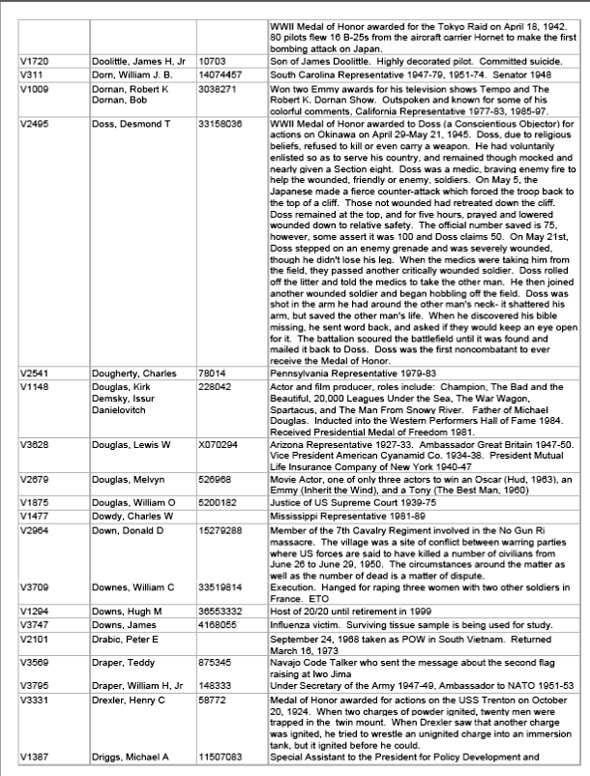
    The VIP List:The National Personnel Records Center has released a list of some 3,000 prominent former military service men and women whose service records may be obtained under the Freedom of Information Act. This list is made up of actors, singers, socialites, medal-of-honor winners, and other well-known folks. The list has about 3000 people on it.

    Following is an example of 1 of the pages (page 42 of 159). I picked the page, as it includes an entry for Desmond Doss – one of my childhood heroes of WWII.
    NPRC listing page for Desmond Doss

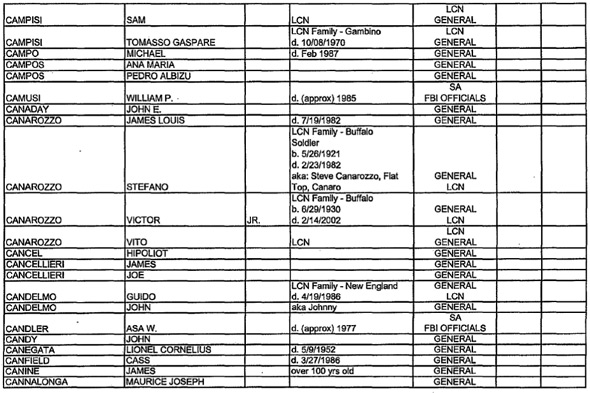
    The RIDS Dead List: This a list of the 17,000 people the FBI understands are deceased. It amounts to a list of notable or famous individuals for whom there are FBI files (usually) or cross references to FBI files. A word of warning – this listing is huge (809 pp) and takes quite a while to download – even if you have a high-speed connection. So be patient. You’ll have a black screen with seemingly nothing happening for a long time. I think it was a 5 to 10 minutes download for me, and I use Comcast cable.

    The following image is page 127 of the 809 page file. I took a screen shot of it, as it contains a line on Cass Canfield.

    FBI file Cass Canfield

    Check out the Washington Post article for more details.

  • Set an Effective Out-of-Office Message to Reduce Workload

    It’s easy to leave a short and ineffective out-of-office message, especially when you’re leaving it on the eve of a vacation or a conference you’re excited to attend. Doing so however, just ensures more work upon your return.

    Photo by makelessnoise.

    Over at Ian’s Messy Desk, Ian outlines how to create a good out-of-office message. First, what does a terrible out-of-office message sound like? At the worst end of things the message simply tells the caller that you’re not there which gives them nothing to work with except that you’re unavailable to help them or answer their questions. Ian suggests including:

    1. Dates of your absence. Let the contact know when you are out of the office. It helps them decide what their next step is going to be; whether to wait for your return or to direct their request elsewhere.
    2. Reason for absence. I like to let my contacts know whether I am on a business trip or vacation. A business trip means I am connected to the office in some way and might be able to respond to a message. If I’m on vacation, I’m out of contact range.
    3. Who to contact in your absence. I try and leave contact information for alternate contacts when I am out of the office; a minimum of one up to as many as are needed.

    The emphasis on the last entry is ours. Most of the phone calls you receive while you’re out of the office will be for matters that will need to be resolved while you are gone; if you leave proper contact information for the people who would most likely be able to resolve issues that crop up while you’re gone, you’re all the more likely to return to the office with those things done and taken care of. Leaving in ineffective message creates a mountain of work for you to wade through when you return.

    For more tips on leaving an effective message check out the full article at the link below. Have a tip or trick for leaving a good out-of-office message or any other aspect of preparing to be away from work? Let’s hear about it in the comments.

    Buy This Item: [Click here to buy this item]

    Read Original Article

  • Harold Ford, Harold Ford Jr

    Among the rooting section: financier Steven Rattner and his wife, Maureen White, prolific Democratic fundraisers. “Maureen and I worked hard for Harold in his last race because we think the world of him,” Rattner told the Times. “He has extraordinary drive and intelligence and will excel at anything that he chooses to do.”

    Other key backers include New York Board of Regents Chairman Merryl Tisch, whose husband, James Tisch, is chief executive of Loews Corp.; and HBO co-President Richard Plepler. Even Mayor Michael Bloomberg, a Republican who has publicly tangled with Gillibrand, is said to be open to the idea.

    Ford, who followed his father’s footsteps to the House, has a reputation as a formidable fundraiser, which could spell trouble for Gillibrand, who as of October had raised $5.5 million. As chairman of the centrist Democratic Leadership Council, he could appeal to independents. As an African American, he could attract national donors. And as a telegenic member of the media’s chattering classes, he would get lots of attention.
    So he packed up, headed to New York, and landed a high-paying job as an executive at Merrill Lynch. But his interest is clearly poltics (his father was a politician), as evidenced by his frequent TV appearances and continued role in the Democratic party.

    Wall Street would like him to run, Bloomberg would consider endorsing him, as would several other prominent Democrats. However for the sake of party unity, the very top players like Chuck Schumer would not be keen on a pitched primary battle among Democrats.

    But between this, and the wave of Democratic retirements, this is shaping up to be fascinating (and very bloody) midterm election.

    Share/Save/Bookmark

    Related posts:

    1. Parker Griffith, Parker Griffith Biography Griffith’s departure means the Democrats will still hold an advantage…
    2. Senate Health Care Bill Vote Result, Senate Health Care Democrats prevailed 60-40 over Republican opposition early Monday, voting…
    3. The Thin Man New Year’s Eve Thin Man Marathon [8 PM, TCM] Turner…

    Related posts brought to you by Yet Another Related Posts Plugin.

  • Livestream: FCC Chairman Julius Genachowski on Broadband Policy

    Today we’re coming to you live from the GigaOM HQ in San Francisco, where FCC Chairman Julius Genachowski has joined us to talk about broadband. The hour-long forum, which will kick off at 10 a.m. PT, will see Om and Stacey asking the chairman questions related to everything from broadband access to competition to innovation. Chairman Genachowski will then take questions from the audience. For those that are unable to attend in person, tweet your questions beforehand to @gigastacey or @om or shoot Stacey an email to her first name@ gigaom.com.

    We hope you can join us!

    Update: Here is an archived stream of the event:

    Watch live streaming video from gigaomtv at livestream.com

  • Los pobres se llevan el mayor impacto

    COPENHAGUE, TIERRAMÉRICA
    En los últimos 18 años, Honduras padeció más que casi todos los demás países del mundo por eventos climáticos extremos, señala un estudio sobre las pérdidas causadas por fenómenos meteorológicos, que fue difundido en el marco de la Cumbre mundial del clima.

    En todo el mundo, tormentas, inundaciones y olas de calor han causado pérdidas por 1,7 billones de dólares, además de 600 mil muertes, según el Índice Mundial de Riesgo Climático 2010.

    Las conclusiones
    En simultáneo, la Organización Meteorológica Mundial anunció en Copenhague que es muy probable que la década 2000-2009 haya sido la más calurosa desde que se comenzó a llevar registro de temperaturas, en 1850.
    Este año hubo olas de calor extremo en India, el norte de China y Australia.
    Además, se volvieron más frecuentes las temperaturas muy elevadas en el sur de América del Sur, plantea el informe.

    “Nuestros análisis muestran que, en particular, los países pobres son severamente afectados” por eventos meteorológicos extremos, dijo Sven Harmeling, autor del Índice en Germanwatch, una organización no gubernamental alemana que promueve la igualdad y la preservación de los medios de vida desde 1991.

    Honduras, Bangladesh y Birmania son los que padecieron la mayor combinación de muertes y pérdidas económicas entre 1990 y 2008, según el Índice.

    Lo que esperabanEn este contexto, era crucial que la Conferencia de las Partes de la Convención Marco de las Naciones Unidas sobre el Cambio Climático (COP-15), que se celebró del 7 al 18 de este mes en Copenhague, brinde un financiamiento predecible y a largo plazo para ayudar a países vulnerables como Honduras a adaptarse, declaró Christoph Bals, director político de Germanwatch.

    En el futuro
    Esto empeorará, a medida que el cambio climático intensifique las tormentas, inundaciones, sequías y olas de calor, dijo Sven Harmeling, autor del Índice en Germanwatch, en un comunicado.
    Durante milenios, las concentraciones de carbono en la atmósfera fueron, promedialmente, de 260 partes por millón (ppm), pero en los últimos 100 años aumentaron a 387 ppm, lo que provoca que más calor solar sea capturado, intensificando el efecto invernadero natural.
    Esa energía extra aumenta las temperaturas mundiales y produce más eventos climáticos extremos, señalan los científicos.

    Fuente Bibliográfica

  • Google: We Don’t Need No (or Much) Stinkin’ Storage

    Google’s new Nexus One is a great addition to the current lineup of smartphones on the market, one that performs impressively and boasts a sleek appearance and nifty features. But as both AllThingsD’s Walt Mossberg and the New York Times’ David Pogue point out, the phone’s built-in memory for storing mobile applications is notably inferior to that of the iPhone. The Nexus One allots only 190MB of its overall 4.5GB of memory for storing mobile apps, a tiny fraction of the app storage available on the Apple device.

    The limited app storage is in keeping with other Android-based handsets; the Motorola Droid from Verizon Wireless, for example, has been criticized for including just 256MB for such a purpose. And Google said yesterday that it will address the issue in a future release by enabling encryption on microSD cards, which will also serve to eliminate fears over pirated apps and allow users to store apps on the removable cards. Many consumers have yet to embrace removable memory, though, which can be a hassle for users unaccustomed to keeping their data anywhere but on the device itself.

    Google’s strategy in mobile (subscription required) seems aligned with its upcoming Chrome OS, which as Sebastian has noted works only with data stored in the cloud. For now, at least, it seems Google believes users don’t need much in the way of local resources. Only time will tell if consumers themselves agree.

    Related Research: Google’s Mobile Strategy
    Google’s mobile strategy is about more than just capturing new ad revenue — its about enabling innovation and boosting access.

    Image courtest Flickr user sindesign.

  • Precios para los Chevrolet Aveo, Captiva y Cruze

    chevroletaveo500.jpg
    Chevrolet ha dado a conocer los precios para toda su gama de los modelos Aveo, Captiva y Cruze. La mayoría, sino todos, han subido ligeramente el precio de la versión del año pasado. Hay que tener en cuenta que todos los precios son sin los descuentos correspondientes a cualquier plan 2000E, son los precios base.

    Chevrolet Aveo

    • 1.2i LS 84 CV 11.450 €
    • 1.2i LS 79 CV GPL 13.750 €
    • 1.4i LS 101 CV 13.300 €
    • 1.4i LT 101 CV 14.500 €
    • 1.4i LT 101 CV Aut. 15.550 €
    • Carrocería de tres puertas, sólo LS: -400 €

    Chevrolet Aveo Sedán

    • 1.2i LS 84 CV 11.100 €
    • 1.2i LS 79 CV GPL 13.400 €
    • 1.4i LS 101 CV 12.950 €
    • 1.4i LT 101 CV 14.100 €
    • 1.4i LT 101 CV Aut. 15.150 €

    Chevrolet Cruze

    • 1.6i L 113 CV 14.995 €
    • 1.6i LS 113 CV 16.475 €
    • 1.6i LS+ Clima 113 CV 17.725 €
    • 1.8i LT 141 CV 20.075 €
    • 1.8i LT 141 CV Aut. 21.175 €
    • 2.0 VCDI 125 LS 17.775 €
    • 2.0 VCDI 125 LS+ Clima 19.025 €
    • 2.0 VCDi 150 LT 20.725 €
    • 2.0 VCDI 150 LT Aut. 21.825 €

    Chevrolet Captiva

    • 2.4i LS 136 CV 24.750 €
    • 2.4i LS 128 CV GLP 27.250 €
    • 3.2i V6 LTX Aut. 230 CV 36.000 €
    • 2.0 VCDI 127 CV LS7 2WD 27.800 €
    • 2.0 VCDi 127 CV LS7+ 2WD 28.700 €
    • 2.0 VCDI 150 CV LT 31.250 €
    • 2.0 VCDI 150 CV LTX 34.000 €
    • 2.0 VCDI 150 CV LTX Aut. 35.550 €

    Vía | Tecnocoches


  • Keeping a writtten log

    Good morning! 🙂 Was wondering how many of you keep a written log of your daily bs testings, meals, etc. How long have you been writing it all down? What type of log do you use?

    Hope everyone’s having a good day. 🙂

  • Editorial: Education means more than just getting a job

    The annual UCLA survey of over 400,000 incoming college freshmen found a striking difference in their personal goals coming into college. Less than 50 percent cited “developing a meaningful philosophy of life” as essential or very important as an outcome of their college experience, whereas wealth was cited by 78 percent. In comparison to results from 1971, the change over time underscores a growing concern about careers in college over a college education unto itself. Four decades ago, 37 percent responded that wealth was a driving goal whereas 73 percent sought a meaningful life philosophy.

    In our current economic climate, it may seem natural for students to put more stress on how their major will translate into a lucrative career. Such careerism, however, cannot only have negative consequences for individual students later on in life, but may also come to define the American higher education systems. Some schools, due to decreasing or nonexistent enrollment, have begun to cut majors such as philosophy and classics. Some students may see these majors as dead-ends rather than as launching points to further education or employment. Yet, the value of a liberal education cannot be forgotten. Amid the declining value of the dollar, the value of a broad education still exists.

    The danger here is that a humanities education reaches beyond the short-term goal of financial stability into a long-term life education in thought and ethics. While Stanford students may feel mired in IHUM reading and discussion sections, we must also remember that we are among the people who will shape what our world will be. As such, we must be able to make difficult ethical choices and, hopefully, contribute more to society than the twin materialist goals of wealth and production.

    Not only does an education in the humanities have great value on a personal level, students often forget that employers look for skills beyond the limits of specific majors. The Association of American Colleges and Universities recently found that employers of recent college graduates value the following skills most highly: communication, critical thinking and creativity.

    The Editorial Board believes that students everywhere should remember the value of their college education not simply in terms of the dollar. Increasing tuition prices and the economy may be dark clouds on the horizon, but a comprehensive education in the humanities may be the silver lining. With many new sectors of our economy coming to the forefront, we cannot always predict what the job market will look like upon graduation. In such an ever-changing, globalized world, one cannot forget that communication and critical thinking are what break down cultural barriers and launch new ideas into the conversation. Colleges and universities should be sensitive to concerns about careers, but ensure that a broad education in humanities is not left in the past if students begin to move away from it. Just as emerging fields build upon prior research, the foundation of a university education should not be cast aside at the desire for the all-mighty dollar. In fact, building a college career on these cornerstones may be a better launching point into the real job market.

  • Visual Science: The Ultimate X-Ray Generator

    Pictured: A generator at the European Synchrotron Radiation Facility (ESRF) in France powers what are known as “kicker magnets,” which help direct beams of high-energy electrons that whiz around the facility at high speeds. Other magnets wiggle the circulating particle beams, causing them to emit intense X-rays. ESRF’s accelerator is the most powerful synchrotron light source in Europe. Researchers at the facility use this energetic radiation to probe the structures of diverse targets that include superstrong glass, fossils trapped in amber, and proteins produced by malaria parasites.

  • CES 2010: HP’s EliteBook 8440w and HP EliteBook 8540w Mobile Workstations

    elitebook 300x262 CES 2010: HPs EliteBook 8440w and HP EliteBook 8540w Mobile WorkstationsHP’s EliteBook Notebook PCs are aimed at business professionals that demand hardy laptops that still provide tons of performance. The system is made of HP DuraCase, HP DuraKeys, and metal hinges with steel pin axels and a reinforced display latch for 4 point lockdown. As a matter of fact, it’s so durable that it can has met durability tests under military standards (MIL-STD 810G). The system also has a spill resistant drain. But what makes the  8440w and 8540w especially unique is that it can be configured with workstation-class graphics and powerful Core i7 Processors.  Read on for each new system’s specs.
    _DSC0015HP EliteBook 8440w and HP EliteBook 8540w mobile workstations

    • HP DuraCase, HP DuraKeys, metal hinges with steel pin axels and reinforced display latch for 4 point lockdown
    • Meets durability tests under military standards (MIL-STD 810G), measuring levels of environmental reliability
    • Pre-loaded with HP SkyRoom, an affordable, high-definition videoconferencing software
    • Configurable choice of Intel® Unified Mobile Access (UMA) or NVIDIA graphics; the latest Intel processors and
    chipset and HD Plus resolution displays
    • HP QuickWeb HP QuickLook QuickWeb, 3, HP Power Assistant and spill-resistant drains
    • BFR/PVC free, underscoring HP’s commitment to the environment
    • HP Long Life Battery for up to a three year life span
    HP EliteBook 8440w and HP EliteBook 8540w mobile workstations
    • HP EliteBook 8440w represents HP’s first 14-inch mobile workstation
    • 15-inch HP EliteBook 8540w features USB 3.0 and support up to four DIMM slots
    • Gunmetal anodized-aluminum finish with full magnesium-alloy chassis
    • Outstanding workstation-class graphics and future Intel® Core™ and i7 processors
    • Available in January, starting at $1,499 U.S. (8540w) and $1,299 U.S. (8440w)


    HP EliteBook 8440p and HP EliteBook 8540p
    • Classic platinum anodized-aluminum finish and magnesium frame
    • Sets a standard for on-the-move productivity with up to 24 hours of battery life
    • Features future Intel® Core™ and i7 processors
    • Available in January, starting at $1,099 U.S. (8440p) and $1,249 U.S. (8540p)

     CES 2010: HPs EliteBook 8440w and HP EliteBook 8540w Mobile Workstations


  • Alexander West: Best Fitting Shirts

    alexander-west-main

    Finding the perfect fitted shirt that is close to your favorite one is always a difficult task. Alexander West, a New York City-based bespoke shirt maker has a service where you can send them your favorite shirt, matched in measurement and sent back in one of 123 colors and patterns in hundreds of different fabrics. The first shirt you receive is a test shirt. If it’s not perfect, it can be returned and altered until it’s perfect at no cost. Once the measurements are exact, your pattern is saved on file for easy future ordering.

    For more information visit: Alexander West

    Continue reading for more images.


  • “Save Saab” Rally Fizzles, Paints Realistic Picture of Public Sentiment

    GM Saab

    Despite RideLust’s blatant and ardent affection for Volvo, it is with solemn respect that this grim story is approached. I jest, of course.

    As many are well aware, Saab’s dysfunctional, 21-year relationship with General Motors has taken an even more tumultuous turn as of late thanks to Koenigsegg’s abrupt resignation from the purchase procedure and The General’s subsequent decision to wind down operations. Since GM’s announcement that Saab would be grounded for eternity (aviation reference, get it? No? Philistines), Dutch supercar maker Spyker has expressed a renewed interest in acquiring the brand and is currently GM’s preferred bidder, but the future still looks bleak. For some undisclosed reason, GM has managed to sour literally every potential sale that they’ve entertained and at this point, Saab is about as likely to escape their death sentence as Ed Whitacre is to grow a pair of large, supple breasts.

    In protest of this eventuality, Saab owners across the globe were called to rally in front of GM’s headquarters in Detroit in a show of support for the ailing Swedish subsidiary. The result was mediocre at best. Based purely on reports and the handful of rather depressing photos, a total of maybe 30 Saab fans turned out to show their support, indicating that many owners have taken a page from Volvo loyalists’ book and already come to terms with the unpleasant reality.

    Spyker is expected to formally submit their bid by Friday, January 7, 2010, and as per tradition, Saab will likely be dead by the following week. On the bright side, this means Geely has less competition for their Volvo-badged crap traps.


    Source: Boston Globe
    Image cred: AP Photo


  • PIMCO: There’s No Way The Market Can Absorb The Fed’s Giant Balance Sheet Once It’s Time To Tighten

    PIMCO’s Bill Gross has become substantially bearish in his latest January commentary. There’s no way private demand will step up to the plate once the Fed stops supporting the U.S. treasury market. Even year to date, they’ve already been avoiding treasuries like the plague as shown in Chart 2 below.

    PIMCO: The conclusion of this fairytale is that the government got to run up a 1.5 trillion dollar deficit, didn’t have to sell much of it to private investors, and lived happily ever – ever – well, not ever after, but certainly in 2009. Now, however, the Fed tells us that they’re “fed up,” or that they think the economy is strong enough for them to gracefully “exit,” or that they’re confident that private investors are capable of absorbing the balance. Not likely. Various studies by the IMF, the Fed itself, and one in particular by Thomas Laubach, a former Fed economist, suggest that increases in budget deficits ultimately have interest rate consequences and that those countries with the highest current and projected deficits as a percentage of GDP will suffer the highest increases – perhaps as much as 25 basis points per 1% increase in projected deficits five years forward. If that calculation is anywhere close to reality, investors can guesstimate the potential consequences by using impartial IMF projections for major G7 country deficits as shown in Chart 3.

    Chart22

    Debt investors should investigate going long Germany, short the U.S. and U.K. based on Germany’s far more responsible government spending.

    Chart33

    Join the conversation about this story »

    See Also:

  • Drake Hotel Named One of Top 10 Hotels Decked Out for the Holidays by Orbitz

    From New York to Oahu, hotels around the country are getting all blinged out to help travelers feel the holiday spirit. This year, Orbitz (orbitz.com) has selected The Best Decked Out Hotels in ten popular holiday destinations.

    “Hotels meticulously plan their holiday activities and decorations,” said Peggy Bianco, Group Vice President of Global Hotel Supplier Services. “Orbitz wanted to spotlight a few properties that create unique experiences and give travelers a feeling of home and holiday cheer when traveling during the season.”

    Best Decked Out Holiday Hotels

    Who doesn’t love a little merriment during the holidays? Whether it’s an acrylic Christmas tree, 23-foot-tall gingerbread house or live carolers during afternoon tea, Orbitz’ picks for the Best Decked Out Holiday Hotels offer seasonal excitement through decorations, celebratory activities or easy access to nearby holiday festivities.

                   Orbitz Best Decked Out Holiday Hotels(1)
                   --------------------------------------
    
                       Destination            Hotel
                       -----------            -----
    
                       Las Vegas              The Bellagio
                       ---------              ------------
    
                       Orlando                Gaylord Palms
                       -------                -------------
    
                       New York               The Peninsula
                       --------               -------------
    
                       Chicago                The Drake
                       -------                ---------
    
                       Los Angeles            Millennium Biltmore
                       -----------            -------------------
    
                       Oahu                   Sheraton Princess Kaiulani
                       ----                   --------------------------
    
                       San Francisco          The Fairmont
                       -------------          ------------
    
                       Miami                  Fontainebleau
                       -----                  -------------
    
                       Washington, D.C.       Gaylord National
                       ----------------       ----------------
    
                       Lanai                  Four Seasons Resort Lanai
                       -----                  -------------------------
    
                 View photos and more at orbitz.com/hotelinsider.
                 ----------------------------------------------------

    LAS VEGAS – Bellagio

    Already known as one of the most elegant and glamorous hotels on the Las Vegas Strip, the Bellagio raised the bar this year when it decked its lobby halls with some eye-popping holiday scenes.

    Replete with reds, golds and greens, a tremendous sparkling tree is flanked by oversized ornaments and stacked giant presents; giant rocking horses and flying reindeer play alongside cheerful snowmen.

    The water in the famous Bellagio fountains dance to holiday tunes, offering a delightful and free source of entertainment for all hotel guests.

    ORLANDO – Gaylord Palms

    How often do you get to spend your day at the pool under the blazing sun and your evenings walking through a winter wonderland? At Orlando’s Gaylord Palms, guests are experiencing ICE! This walk-through holiday attraction was hand-carved from nearly 2 million pounds of ice and kept at a chilly nine degrees to ensure the ice remains solid.

    Adorned with cushy parkas, guests can wander about this magical mystery land alongside ice monuments and frosty scenes, swoosh down slick ice slides, hunt gnomes in a hidden holiday game and marvel at the majestic Christmas tree.

    With 4.5 acres of decorations, ICE village offers guests the best of both worlds: winter in paradise is truly a possibility.

    NEW YORK – The Peninsula New York

    One of the most elegant hotels in the world, The Peninsula New York sits right on Fifth Avenue near Central Park. It shines throughout the holidays as the grand entrance comes to life with twinkling lights and beautiful garland throughout.

    A 25-foot-tall ornately decorated tree graces the hotel’s Palm Court, letting guests immediately enjoy the holiday spirit. Staff offers a playful gingerbread-decorating class for kids and invites guests to purchase and hang ornaments on the tree, with proceeds benefitting the Make-a-Wish Foundation.

    Mere blocks from the windows at Barneys New York and Bergdorf Goodman, as well as Rockefeller Center, Peninsula guests can take in all the holiday festivities the city has to offer.

    CHICAGO – The Drake

    Re-creating a traditional holiday scene, the elegant and majestic Drake Hotel, sitting at the top of Chicago’s Magnificent Mile, welcomes guests into the warm lobby with a grand tree decked out with the most iconic Christmas imagery: Santa, a nutcracker, tiny soldiers and a train circling Santa’s village.

    Banisters and staircases are adorned with garland, while the Palm Court glows with tiny white lights during high tea, which features a harpist and carolers through Dec. 25.

    Warming things up even more, the Drake invited children from Mercy Home, a long-term residential home for troubled youth, to light the tree during the annual Festival of Lights on Michigan Avenue.

    LOS ANGELES – Millennium Biltmore

    Harkening back to a bygone era, the stately elegance and Old World-charm of the Millennium Biltmore creates an atmosphere of sophistication and class in Downtown Los Angeles. Its lavish Victorian holiday decor is a refreshing departure from modern holiday design and a move toward traditional, classic Christmas cheer.

    The Los Angeles landmark features lively afternoon tea and live carolers, in addition to a grand New Year’s Eve gala.

    Guests can further get into the holiday spirit by donning a pair of skates and hitting the city’s ice rink, located right across from the Biltmore, which sponsors the icy fun.

    OAHU – Sheraton Princess Kaiulani

    Once again, Christmas comes to paradise where leis, pineapples and poi aren’t the only things keeping visitors happy. The Sheraton Princess Kaiulani has hoisted its Santa’s German Gingerbread Village to reign over the lobby and greet guests as they make their way toward the beach or pool.

    The hotel’s executive chef gathered his team and spent more than 250 hours designing and constructing this gift to their guests.

    This gingerbread village stands 14.5 feet tall and comprises 60 pounds of dark chocolate, 20 pounds of white chocolate, 30 pounds of gingerbread and 120 gallons of icing.

    SAN FRANCISCO – The Fairmont

    High atop Nob Hill, one of San Francisco’s most storied neighborhoods, sits the majestic and honorable Fairmont. This grande dame welcomes visitors throughout the holiday season with a noble tree guarding the lobby entrance.

    But what is truly outstanding is the two-story gingerbread house framing the entrance to the Fairmont’s Laurel Court Restaurant. It stands 23 feet tall and was built with 1,000 pounds of gingerbread, 350 pounds of chocolate and 150 pounds of candy–all constructed over the course of 300 hours!

    If this doesn’t re-energize the kids following a few hours of Union Square shopping, nothing will.

    MIAMI – Fontainebleau

    Who says you can’t celebrate the holidays in Florida? No one told the Fontainebleau because the decor inside the hotel is unparalleled, dramatic and glistening.

    The hotel’s Chateau lobby features a gorgeous custom-made acrylic tree, which took six months to assemble. Rooms in the Chateau and Versailles towers feature mini white calla lilies, while rooms in Tresor and Sorrento towers were adorned with mini Christmas trees.

    Mini menorahs are available for guests celebrating Hanukah. A towering pine tree, replete with 30,000 glowing LED lights and a fragrant pine scent graces the Tresor lobby, giving guests an authentic, warm holiday feeling.

    WASHINGTON, D.C. – Gaylord National

    Our nation’s capital may or may not be a snowy winter wonderland come Christmas (though one can hope), but through clever planning, the Gaylord National is ensuring a White Christmas for its guests this year.

    The hotel has built ICE!, a dramatic icy village created from millions of pounds of ice where guests can play and frolic through ice sculpture, zoom down ice slides and twirl on an actual ice skating rink–when not falling down, that is.

    Each night, guests can enjoy indoor snowfall and even attempt to make a snowman. Spectacular holiday decorations abound, showcasing a gorgeous lighted tree.

    Lanai – Four Seasons Resort Lanai

    The Four Seasons Resort stands out with something extra special, in a destination known more for sand, surf and shells. The resort’s Lodge at Koele is hugged by grand Cook Island pine trees as well as old Norfolk pines.

    These towering beauties add an element of New England while giving it that touch needed to truly feel like Christmas.

    Add in a couple of roaring fireplaces in the hotel’s Great Hall and you have a cozy nook to sip cocktails or hot chocolate, as you count down the hours to the arrival of St. Nick.

    To view photos of Orbitz’ Best Decked Out Holiday Hotels, visit orbitz.com/hotelinsider.

    (1) The Best Decked Out Holiday Hotels and destinations were selected by Orbitz’ staff of hotel experts and travel editors and are based on the research and opinions of these experts and writers.

    About Orbitz.com

    Orbitz.com (orbitz.com) is a leading online travel company that enables travelers to search for and purchase a broad array of travel products, including airline tickets, hotel rooms, rental cars, cruises and vacation packages.

    Since launching its website to the general public in June 2001, Orbitz.com has become one of the largest online travel sites in the world and has led the industry with innovations including Flight Price Assurance, Hotel Price Assurance and Total Price hotel search results.

    On Orbitz.com consumers can search more than 80,000 suppliers worldwide including airlines, hotels and car rental companies. Orbitz.com is owned by Orbitz Worldwide.

    Stay connected with sale alerts, exclusive promotions and engaging conversations: Follow Orbitz on Facebook (facebook.com/orbitz), Twitter (twitter.com/orbitz) and the Orbitz Travel Blog (orbitz.com/blog).

    About Orbitz Worldwide

    Orbitz Worldwide is a leading global online travel company that uses innovative technology to enable leisure and business travelers to research, plan and book a broad range of travel products.

    Orbitz Worldwide owns a portfolio of consumer brands that includes Orbitz (orbitz.com), CheapTickets (cheaptickets.com), ebookers (ebookers.com), HotelClub (hotelclub.com), RatesToGo (ratestogo.com), the Away Network (away.com), and corporate travel brand Orbitz for Business (orbitzforbusiness.com).

    For more information on partnership opportunities with Orbitz Worldwide, visit corp.orbitz.com.


  • Beam PowerPoint From BlackBerry to Projector Sans Wires

    So I’m thinking that when we stop by the Research In Motion booth, we should take a closer look at its new Presenter device. The 3.4″ x 2.4″ x 0.9″ is light at 140 grams and connects to a video projector via S-Video or VGA. The idea is that the Presenter connects to your BlackBerry handheld wirelessly over Bluetooth and you control presentations using the handset.

    And there-in lies the rub for me. The device will ship later this year for an MSRP of $199. Near as I can tell, it appears to be a single-purpose solution — control and display Microsoft PowerPoint presentations from a BlackBerry to a projector. I’ll have to ask if there are any other supported formats for output, because if there aren’t, this is a pretty hefty price for one bit of functionality. It’s definitely good and usable functionality, but I’d find it hard to justify when a Celio REDFLY could do a similar thing over wires for $50 more. And the REDFLY would offer the ability to work with the BlackBerry on a larger screen and keyboard all day as well.

    Again, I could be wrong on this functionality limitation, so I’ll ask for sure. And for people who need this specific use, this could be a great solution.

  • Developing software for mobile applications using Drag’n’Drop

    With its additions to Visual Studio®, CASIO Europe is showcasing new controls that enable application developers to transfer complex program components (such as camera and GPS controllers or imaging and laser functions) as complete software components to the application software for mobile terminals. This service is free for Casio partners.

    In 2008, Casio developed the first programming controls for IT-600 and DT-X30 series hand-held terminals. These practical tools are now also available with a number of upgraded functions for the DT-X7, DT-X11, IT-3100 and the brand new industrial PDA IT-800.

    The Controls can be used to configure entire program components for MDE applications using the Drag’n’Drop function. This considerably simplifies developers’ work. Repeating the installation of a complete coding section is now even faster and convenient and employees are much more efficient, as they no longer need to rewrite each individual line.

    New technology and product characteristics do, however, always carry some risk for the system and software companies. Program development and testing requirements take up a lot of precious time and money. Casio therefore supported the development of further controls to shorten this process.

    The development process that used to take days has now been reduced to seconds for all CASIO terminals. The software for all mobile terminals from CASIO can now be created component-by-component and no longer needs to be created completely from scratch. All thanks to Controls!

    This extraordinary software developing technology is provided by Casio free of charge and supports Visual Basic and C# in Microsoft Visual Studio 2008 (or above). Casio partners can download the files directly from the Casio website. Should you have any questions, please contact Casio Technical Support.

  • TIDE POWER DIESEL GENERATOR – POWERED BY PERKINS!

    Perkins diesel generator set Engine Original UK. high quality and performance

    The structure is small and exquisite and light ,with beautiful sound insulation covered, put and dismantle simple and easily, reduce the noise effectively, it is easy to operate. Use the famous-brand electrical machinery , the high-standard generator (design the style according to your need), totally enclosed automatic voltage regulator, superior performance, and reliable to operate.
    Specifications:
    1) Composed of diesel engine and alternator
    2) Output range: 12 – 1000kW (15 – 1250kVA)
    Rated current: 9 – 1810A
    Rated speed: 1,500rpm
    Rated frequency: 50Hz(60 also available)
    Rated voltage: 400 / 230V
    Silent level: <76dB 3) Diesel Engine: Cummins,Perkins,Deutz,yangdong,weichai,shanghai ect. 4) Alternator: stamford or HongDa Brushless alternator available. 5) Cooling model: Closed Circulation Water Cooling 6) 12V or 24V Key start / auto start 7) Electric fuel pump and direct injection oil system cause complete combustion 8) Subsidiary: installation manual, operation manual, the spare parts manual 9)Insulation class: F, Protection class: IP21 10)Optional ATS control panel Features for the canopy: 1) Robust/highly corrosion resistant construction 2) Black finish stainless steel locks and hinges 3) Zinc plated or stainless steel fasteners 4) Body made from steel components treated with polyester powder coating Full control panel with power indicator light, oil light. -Emergency shutdown for low oil pressure and high water temp. -Large bottom fuel tank ensure long working time. -Key start. Excellent access for maintenance 1) Two doors on each side 2) Radiator fill access plate 3) Lube oil and cooling water drains piped to exterior of the enclosure 4) Operate easily, and can be used outside while no room has to be built for it,Large bottom fuel tank ensures long working time Security and safety: 1) Control panel viewing window in a lockable access door 2) Emergency shut down for low oil pressure and high water temperature,Emergency stop push button (red) mounted on enclosure exterior 3) Cooling fan and battery charging alternator fully guarded Fuel fill and battery can only be reached via lockable access doors 4) Exhaust silencing system totally enclosed for operator safety